US Solar Market Slows in 2025 – Here’s How SolarBank (NASDAQ:SUUN) Is Still Gaining Ground

us

Disseminated on behalf of SolarBank Corporation

The US solar industry began 2025 with mixed signals. Wood Mackenzie’s US Solar Market Insight Q2 2025 reported an addition of 10.8 gigawatts-direct current (GWdc) in Q1. This marks a 7% drop from last year and a steep 43% fall from Q4 2024. Rising costs, trade tensions, and changing policies have strained project development and consumer demand.

Let’s study the various segments of solar and their performance in this quarter.

Utility-Scale Solar Slows Down but Stays Resilient

Utility-scale solar added 9 GWdc, slightly down from the previous quarter and Q1 2024. Still, it remained a strong segment. Texas led with 2.7 GWdc, nearly double Florida’s numbers. Both states focused heavily on large-scale solar projects. Notably, Texas, Florida, Ohio, Indiana, and California made up 65% of utility-scale additions.

Mixed Results Across Distributed Solar Segments

Residential solar struggled, adding only 1,106 MWdc – the lowest since Q3 2021. High interest rates, economic concerns, and uncertainty about solar tax credits held back homeowners. California topped the list with 255 MWdc installed, but this was the weakest output since Q3 2020.

On a positive note, commercial solar grew by 4% year-over-year to 486 MWdc, mainly due to California’s NEM 2.0 projects. However, it saw a seasonal dip of 28% compared to Q4 2024.

U.S. Solar
Source: Wood Mackenzie

Community Solar Faces Headwinds but Holds Promise

Community solar projects, which are shared local installations, added 244 MWdc in Q1 2025. This was a sharp 22% year-over-year decline and a significant drop from Q4 2024’s surge. Maine and Massachusetts saw steep declines, while New York’s output fell slightly but still represented over half of the national community solar market.

Despite this downturn, installed capacity in 2025 is expected to exceed 2023 levels, reaching about 1.5 GWdc. New York and Illinois drive growth, with a community solar pipeline nearing 5 GWdc. However, grid interconnection delays and needed infrastructure upgrades slow progress.

community solar US
Source: Wood Mackenzie

Encouragingly, emerging markets may expand. Proposed legislation in several states could unlock over 1.5 GWdc of extra community solar capacity. Still, without new programs, national growth might stall. Wood Mac predicts a 6% average annual decline in community solar through 2030, but future legislative successes could change that.

Amid this uncertainty, SolarBank has remained resilient. The company recently announced a 2.4 MWdc community solar project in Nova Scotia.

SolarBank’s (SUUN) Nova Scotia Project Reflects Market Momentum

SolarBank Corporation (NASDAQ: SUUN) is going forward. The company recently announced the 2.4 MWdc Sydney Project in Nova Scotia, which will produce about 2,730 MWh of clean energy annually. It can potentially power 221 homes and offset nearly 1,900 tons of CO₂. The ground-mounted community solar power project, owned by AI Renewable Flow-Through Fund (“AI Renewable”), is a major step into Canada’s clean energy market.

The news lifted SolarBank’s stock (NASDAQ:SUUN) to $1.82 on June 16, up from $1.415 on June 13. The strong investor response highlights ongoing interest in clean energy opportunities (including those in jurisdictions outside the United States where government support remains strong), even as the broader market weathers policy and economic uncertainty.

SolarBank has developed over 100 MW of renewable energy projects in North America and has a pipeline of more than 1 gigawatt.

  • In the U.S., the company completed over 50 MW of community solar installations. Now, it applies that experience to the Canadian market, where demand for clean energy is rising and government support is growing.

SolarBank North American Growth Strategy

SolarBank North American Growth Strategy
Source: SolarBank

Its portfolio includes community solar, utility-scale systems, virtual net metering projects, and behind-the-meter installations. This variety keeps the company agile, maximizes returns, and fosters low-risk, high-reward partnerships.

SEE MORE:

How Shifting Trade Policy Is Disrupting US Solar Growth?

The US solar market is facing a tough trade and tariff environment in 2025. Earlier this year, the Trump administration added a 25% tariff on imports from Canada and Mexico starting March 4. While most solar panels aren’t imported from these countries, key parts like inverters and trackers are, which has pushed up production costs.

On top of that, aluminum tariffs under Section 232 increased from 10% to 25%, and later to 50% by June, making trackers and module frames even more expensive.

Tariffs on Chinese goods also soared, reaching 145% at one point due to fentanyl-related measures, before settling at 30% after a rollback deal on May 12. These changes have made the solar market more expensive and unpredictable.

  • The US added 8.6 GW of new solar module manufacturing capacity in Q1 2025, bringing the total to 51 GW.

Upstream production remains sluggish. Only one new domestic cell plant, i.e., ES Foundry’s 1 GW facility in South Carolina, opened this year. There were no new launches in wafer or polysilicon production.

However, in these turbulent times, SolarBank has shown resilience. A recent collaboration with Qcells, involving the use of U.S.-manufactured solar modules, is one example of how the company is preparing for multiple future scenarios.

Why Investors Are Watching Closely?

Despite the hurdles, the US solar industry remains a key player in the country’s energy transition. In Q1 2025, solar accounted for 69% of all new power capacity added, showing its continued dominance. With long-term demand rising from data centers and domestic manufacturing, the sector’s growth potential remains strong.

To keep that momentum, the industry will need stable policies, steady investment, and better solutions for grid connections and supply chain issues.

The recent rebound in NASDAQ:SUUN stock reflects growing investor confidence. It signifies that SolarBank can be a potential long-term bet. While near-term challenges exist, the outlook for solar remains promising, and smart investors are taking note.


Disclosure: Owners, members, directors, and employees of carboncredits.com have/may have stock or option positions in any of the companies mentioned: None.

Carboncredits.com receives compensation for this publication and has a business relationship with any company whose stock(s) is/are mentioned in this article.

Additional disclosure: This communication serves the sole purpose of adding value to the research process and is for information only. Please do your own due diligence. Every investment in securities mentioned in publications of carboncredits.com involves risks that could lead to a total loss of the invested capital.

Please read our Full RISKS and DISCLOSURE here.

The post US Solar Market Slows in 2025 – Here’s How SolarBank (NASDAQ:SUUN) Is Still Gaining Ground appeared first on Carbon Credits.

Ford’s (F Stock) EV Transformation: A Carbon-Neutral Drive by 2050 Boosts Investor Interest

ford

Ford Motor Company (NYSE: F) is on a major mission to electrify its future. Once known for iconic gas-powered vehicles like the Mustang and F-150, the automaker is now aiming to become a global leader in electric mobility. This shift comes with a long-term environmental pledge—Ford plans to reach carbon neutrality by 2050, aligning with the Paris Climate Agreement and science-based targets.

Ford Shifts Gears Toward an Electric Future

To kickstart this transition, Ford invested over $11.5 billion in EV development till 2022 and has since significantly increased its commitment. The company’s strategy targets a complete overhaul of how vehicles are designed, built, and powered, paving the road for a cleaner, more sustainable auto industry.

The top car maker boosted its electric vehicle investment to $29 billion through 2025, reinforcing its commitment to an electric future. Rather than starting from scratch like some EV startups, Ford is electrifying its most popular existing models—vehicles that consumers already trust and love.

Key investments include electric versions of the Mustang Mach-E and the F-150 Lightning. These vehicles symbolize Ford’s approach: innovate within tradition and meet customer expectations while reducing emissions.

Mustang Mach-E and F-150 Lightning Lead the Charge

Ford’s strategy is paying off in real numbers. In 2024, the Mustang Mach-E outsold the traditional gas-powered Mustang, with over 51,000 electric units sold compared to 44,000 gas models. This is a clear sign that consumers are embracing electrification when it comes in familiar packages.

The F-150 Lightning, Ford’s all-electric pickup, has also made waves. With over 200,000 reservations by late 2021, demand exceeded early production capacity, leading to a multi-year waitlist. The Lightning’s ability to tow heavy loads and even power homes during outages has made it a standout in the EV truck segment.

However, the road hasn’t been entirely smooth. In April 2025, Ford’s EV sales dropped 39.4% compared to the same month in 2024, showing the competitive and evolving nature of the EV market.

Inside Ford’s Science-Based Carbon Neutral Roadmap

Ford’s climate plan targets the full lifecycle of its vehicles, focusing on the three biggest sources of emissions:

  • Vehicle use (Scope 3)
  • Supplier manufacturing
  • Ford’s global operations

Combined, these areas represent around 95% of the company’s carbon footprint. Ford’s roadmap includes switching all its manufacturing to 100% renewable electricity by 2035, and as of 2023, over 70% of its global operations already run on carbon-free energy.

ford emissions
Source: Ford

From 2010 to 2017, Ford cut more than 3.4 million metric tons of manufacturing emissions, equal to taking over 728,000 cars off the road for a year. The company achieved this through efficiency upgrades like LED lighting and streamlined paint systems.

Ford emissions
Source: Ford

Green Bonds and Clean Financing

To fund its EV and climate goals, Ford issued $4.25 billion in green bonds since 2021, the largest green bond offering by a U.S. non-financial company. These funds are being used to support EV production, battery development, and clean transportation infrastructure.

The company also ties its credit facilities to specific environmental targets, including renewable energy use and vehicle emissions.

Tackling Legacy and Supply Chain Hurdles

As a traditional automaker, Ford must revamp decades of operations, from factories to supplier networks. CEO Farley emphasizes that success in this era isn’t just about electric motors; it’s also about mastering software, digital services, and new customer experiences.

Ford has separated its EV and gas vehicle businesses to compete more efficiently with EV-first companies.

Ford is also working with suppliers to cut emissions. In 2024, 377 suppliers reported their carbon data, up 20% from 2022. The company aims to purchase 10% low-carbon aluminum and near-zero steel by 2030 and is part of the First Movers Coalition pushing for cleaner materials across industries.

Solving Charging Challenges with a Strong Network

Charging remains one of the biggest hurdles for EV adoption, and Ford is tackling it head-on. The company created the Blue Oval Charge Network, which now includes over 106,000 chargers across North America.

In a major move, Ford partnered with Tesla, giving Ford EV owners access to 15,000+ Tesla Superchargers. This expanded network helps eliminate range anxiety and makes long-distance travel easier for Ford drivers.

The FordPass app offers real-time access to charging station locations, availability, and payment, streamlining the entire process for users.

Taking On Tesla and New Global Rivals

Tesla still leads the U.S. EV market with a 43.4% share in Q1 2025, although that’s down from 51% the previous year. Ford is trying to close the gap by offering electrified versions of its most recognized vehicles—a contrast to Tesla’s approach of creating entirely new models.

Ford CEO Jim Farley has pointed out that Chinese automakers like BYD and Geely are emerging as the most serious competition globally. These companies are flooding markets with affordable, high-tech EVs and are gaining traction in multiple regions.

Read Farley’s comments on EV rivals

Ford’s Stock (F) Watch: Solid Dividends Amid EV Losses

Ford stock (NYSE: F) closed at $10.48 on June 25, 2025, up 16% from the start of 2024. While this shows investor optimism, the company’s EV division, Model E, is still in the red.

In 2024, Model E reported a $5.1 billion loss and is on track to lose another $5 to $5.5 billion in 2025, translating to around $132,000 lost per EV sold in Q1.

Despite this, Ford offers a dividend yield of 4.44%, providing value to shareholders as the company navigates its EV transformation, something Tesla currently doesn’t offer.

ford stock
Source: Yahoo Finance

Why Ford Is on ESG Investors’ Radar

Ford’s plan to become carbon neutral by 2050 and its steady progress toward that goal make it a compelling option for climate-conscious investors. With proven manufacturing capacity, strong vehicle branding, and green financing in place, Ford offers a way to participate in the clean transport boom without the risks tied to early-stage startups.

Its path won’t be without bumps, but for investors seeking long-term value in sustainability, Ford remains a stock to watch.

The post Ford’s (F Stock) EV Transformation: A Carbon-Neutral Drive by 2050 Boosts Investor Interest appeared first on Carbon Credits.

Nike’s Green Leap: Cutting Carbon, Boosting NKE Stock and Net Zero Goals

Nike’s Green Shift: Cutting Carbon, Boosting NKE Stock and Net Zero Goals

Nike Inc. (NYSE: NKE) leads the fight against climate change with smart material choices and cleaner supply chains. The sportswear giant uses new materials to lower emissions across its business. The company’s stock bounced back—rising about 10% after strong Q4 2024 earnings and a plan to shift production to the U.S. 

For investors and sustainability advocates, Nike’s approach shows how big brands can protect the planet while staying profitable. Its Flyleather and recycled polyester efforts highlight how fashion and the environment can both win.

Stock Performance and Financial Strength

Nike’s stock faced headwinds in 2025, falling about 17.4% due to tariff concerns and competition. But momentum is shifting. Following its earnings release, the stock jumped 10% in premarket trading after upbeat forecasts and plans to shift China production to the U.S.

Nike stock price
Source: Yahoo

In Q4 2025, Nike reported $11.1 billion in revenue, down 12% year-over-year but still beating analysts’ forecasts. Its net income was $211 million, or 14 cents per share, above expectations despite being lower than last year’s $1.5 billion profit. This quarter was Nike’s third under new CEO Elliott Hill, who took the helm in October 2024.

Analysts rate Nike a “Moderate Buy.” Based on 33 Wall Street estimates, the average price target of $78.11 suggests about 7% upside from current prices. Investors view Nike’s strength in sustainable products and its ability to return cash to shareholders—shown through rising dividends (23 years of growth) and share buybacks—as major positives.

How Nike’s Smart Materials Strategy Led to Emissions Drop

Nike centers its strategy on improving materials. It’s part of its “Move to Zero” effort, its sustainability initiative to achieve a zero-carbon and zero-waste future for the brand. 

Its Flyleather innovation blends at least 50% recycled leather fibers. This reduces carbon emissions by 80% compared to standard leather. The material also uses 90% less water, weighs 40% less, and is five times stronger.

Meanwhile, Nike’s recycled polyester clothes come from plastic bottles. Once cleaned and processed, these bottles become yarn that cuts emissions by about 30%.

The scale is impressive: in 2024, 24% of Nike’s product materials came from recycled or renewable sources. It also uses 99% recycled rare earths in magnets and 99% recycled cobalt in batteries. Many products include 100% recycled aluminum cases. Innovations like “Nike Forward” use 75% less carbon than traditional knit fleece.

Nike’s Carbon Emissions and Net Zero Sprint

Nike publishes clear carbon goals. It aims to cut Scope 1 and 2 emissions by 65%, and Scope 3 emissions by 30%, both by 2030 (from 2015 levels).

Nike GHG emissions 2023
Source: Nike Impact Report
  • It also plans to reach net zero by 2050. As of the end of 2023, Nike had already reduced its Scope 1 and 2 emissions by around 73%, beating its target.

Scope 3 emissions—those from its supply chain—make up more than 90% of Nike’s total carbon footprint. Most of that comes from raw materials (40%) and production (30%).

The company works closely with suppliers in countries like Vietnam and Indonesia through its Supplier Climate Action Program (SCAP). This program helps factories shift to renewable energy, improve efficiency, and build climate plans.

Nike has also moved toward cleaner logistics. It has cut air freight by 80% since 2020 by aligning production with ship schedules and using ocean transport instead of planes. In Europe, Nike even piloted hydrogen-fueled barges for shipping. These actions support its aim to source 100% renewable energy at all owned and operated facilities by 2025, helping hit its net-zero goals.

Cutting Scope 3 Emissions: Nike’s Biggest Challenge

Scope 3 emissions are Nike’s biggest environmental challenge. They represent the bulk of the company’s total carbon footprint. These emissions come from Nike’s supply chain, from raw materials to product disposal. For ESG investors, Nike’s approach to managing these emissions shows the company’s long-term green strategy.

Nike Scope 3 emissions
Source: Nike Impact Report

Nike Chief Sustainability Officer Noel Kinder calls Scope 3 emissions “one of the things that keep me up at night”. The company has found two main ways to cut supply chain emissions. 

  1. Innovating materials: It focuses on recycled polyester, rubber, and leather alternatives. It is also testing bio-based foams for shoes.
  2. Clean energy in factories: Through SCAP, Nike works with manufacturing partners to bring in renewable energy and reduce fossil fuels.

Raw materials make up about 40% of Nike’s carbon footprint. This makes materials innovation crucial for cutting emissions. The sportswear giant focuses on recycled polyester, rubber, and leather alternatives. The company is also looking at bio-based replacements for traditional fossil-based foams in shoes.

The second way involves energy supply chains in manufacturing regions like Vietnam and Indonesia. Nike works with suppliers to use renewable energy. It has launched the SCAP to encourage complete climate plans across its supplier network.

These efforts target the two largest emission sources—about 70% of the total—but Nike still needs more action to reach its 2030 targets and 2050 net-zero commitment.

Industry Leadership and Carbon Offsetting

Nike drives the industry forward with material and circular economy breakthroughs. Its products support longer wear and easier recycling. Examples include Flyleather shoes and Space Hippie trainers made from factory scraps and recycled plastic.

Nike Forward reduces carbon by 75% compared to traditional fleece. It also replaced harmful SF gas with nitrogen in Air Max shoes to reduce environmental impact. Nike’s circular services—like refurbished gear and product-care content—also minimize waste.

These innovations often become standard in sportswear, helping Nike maintain brand strength and win ESG-conscious consumers.

Nike focuses first on reducing carbon emissions, not buying credits. However, it may start using some carbon offsets to help reach net zero. For example, it partners with EFM to offset emissions from outbound shipping.

Nike uses global reporting frameworks like GRI and TCFD to track climate action. This provides transparency to investors and regulators.

Nike’s Path Forward: Why Investors Are Watching NKE

For ESG-focused investors, Nike presents a compelling mix of materials innovation, supply chain transformation, and financial strength. The company’s leadership in sustainable materials creates multiple value streams that benefit both environmental goals and shareholder returns.

Financially, Nike remains healthy. It returned over $1 billion to shareholders in Q2 2025 via buybacks and dividends. Its services revenue grew to $26.6 billion with 11.6% growth, adding stability to its green investments.

Moreover, Nike’s approach to Scope 3 emissions management provides insights for the consumer goods sector. The company’s success in cutting materials-related emissions while keeping product performance shows that sustainable business models can work in competitive markets.

Nike’s material innovations—particularly Flyleather, recycled polyester, and Nike Forward—help cut Scope 3 emissions and reduce carbon across its supply chain. Its strong emission reduction targets anchor its strategy for long-term change.

The company is making good progress on emissions, logistics, and supplier engagement. It shows how big brands can cut emissions while making profits—and influence entire industries to become greener.

The post Nike’s Green Leap: Cutting Carbon, Boosting NKE Stock and Net Zero Goals appeared first on Carbon Credits.

Microsoft Inks a 4.8M Tons of Forest Carbon Credit Deal with Anew Climate

Microsoft Inks a 4.8M Tons of Forest Carbon Credit Deal with Anew Climate

Microsoft has signed one of the largest-ever carbon removal agreements through forests. The tech giant will purchase 4.8 million tons of high-quality carbon removal credits over 10 years from Anew Climate and Aurora Sustainable Lands. The credits come from improved forest management (IFM) projects in the U.S., helping Microsoft get closer to its goal of becoming carbon negative by 2030.

This new deal highlights Microsoft’s leadership in corporate climate action and growing interest in nature-based carbon removal. As climate commitments rise, so does demand for trusted, measurable carbon removal.

Betting on Trees: Microsoft’s Commitment to Forest Carbon Removal

Forest carbon removal is a key nature-based solution for fighting climate change. It mainly involves better forest management, afforestation, and reforestation. The Intergovernmental Panel on Climate Change (IPCC) says nature-based solutions, like restoring forests, could cut emissions by 30%. This is essential to keep global warming below 1.5°C. 

A 2024 report by the Forest Trends Initiative found that around 46% of voluntary carbon market transactions involved forest and land-use credits. McKinsey estimates that by 2030, forest-based carbon removal could reduce CO₂ by up to 7 gigatons each year if fully developed. This shows its crucial role in corporate climate strategies.

VCM carbon credit transactions 2024
Source: Ecosystem Marketplace SOVCM 2024 report

The agreement between Microsoft and Anew Climate spans a full decade. This long-term deal supports Anew and Aurora Sustainable Lands. It gives them the funds to manage big forest areas for carbon storage. The deal covers 4.8 million metric tons of carbon dioxide to be removed and stored from the atmosphere.

The carbon credits will come from improved forest management (IFM) projects. These efforts involve changing how forests are maintained to store more carbon. This could mean extending harvest cycles, thinning trees carefully, or protecting forests from being cleared. IFM is a nature-based solution backed by science and approved by trusted carbon standards.

Anew Climate—formerly known as Bluesource—has worked in environmental markets for more than two decades. It has helped develop over 400 IFM projects across 5 million acres in North America. Aurora Sustainable Lands manages vast forest areas in the U.S. It focuses on keeping the land environmentally safe and financially viable.

Microsoft’s Path to Carbon Negative

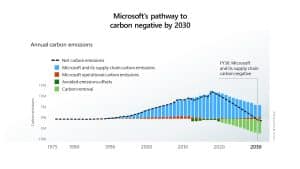
Microsoft’s deal with Anew is not just large—it’s also part of a broader strategy. In 2020, the company set a bold goal: to be carbon negative by 2030. That means it wants to remove more carbon from the air than it emits each year. Even more, by 2050, Microsoft plans to eliminate all the carbon it has ever released. This includes carbon from its direct operations and electricity use since its start in 1975.

Microsoft 2030 carbon negative goal
Source: Microsoft

To meet these goals, Microsoft has invested in a wide mix of carbon removal methods. These include:

  • direct air capture, which removes carbon from the air,
  • biochar,
  • ocean-based carbon removal, and
  • nature-based solutions like IFM.

It evaluates all projects using strict standards to ensure they are high-quality and trustworthy.

With this forest carbon deal, Microsoft continues to show that nature has a key role to play. Forests are one of the most powerful tools to fight climate change, and managing them well can create jobs, protect biodiversity, and support local communities. Plus, they remove carbon from the atmosphere.

Green is Gold: Investors Eye Forest Carbon Boom

As more companies aim to hit net zero, nature-based carbon credits are becoming more popular. These credits are different from “avoided emissions” (which prevent emissions from happening) because they actually remove carbon that’s already in the air. That’s a crucial difference for meeting long-term climate goals.

Improved forest management projects are especially attractive because they’re well-understood, scalable, and provide co-benefits beyond carbon. These include cleaner air and water, healthier habitats, and stronger local economies.

This kind of deal also sends a signal to other companies that carbon removal is essential in climate goals. While many firms focus on reducing emissions, the science shows that removal is also necessary to reach net zero and keep global warming below 1.5°C.

The volume of credits—4.8 million tons—is also meaningful. That’s roughly equal to removing the annual emissions of more than 1 million cars. It shows that corporate buyers are now looking for large-scale, trusted removal options, not just small pilot projects.

Microsoft has been the top buyer of carbon removal in 2024, alongside other tech giants like Google.

CDR Top10 Purchasers 2024

Corporate Demand for Nature-Based Solutions: Why Big Business Is Going Green

Microsoft is not the only company making big moves in the carbon credit space. Amazon, JPMorgan Chase, and Salesforce have also invested in nature-based climate solutions. In fact, demand for high-integrity carbon credits is growing so fast that supply struggles to keep up.

In an analysis by McKinsey & Company, demand for carbon credits could rise 15-fold by 2030 and 100-fold by 2050. To meet that demand, both engineered and nature-based removal options will need to grow rapidly.

Improved forest management, afforestation (planting new forests), and conservation are likely to remain key parts of the solution. McKinsey & Company projects that nature-based solutions could make up to 85% of the market in 2030.

nature-based solutions
Source: McKinsey & Company

However, investors and buyers want more transparency, monitoring, and proof that the credits deliver real, long-term impact. That’s why deals like this one matter. Microsoft, Anew Climate, and Aurora are showing what it looks like to build scale and credibility at the same time.

Setting the Bar on Nature-Based Carbon Removal

Microsoft’s landmark deal with Anew Climate and Aurora Sustainable Lands sets a new bar for forest-based carbon removal. It combines scale, duration, and integrity—offering a model for how big companies can support natural climate solutions while hitting their own targets.

As the voluntary carbon market grows, long-term, high-quality deals like this could help build trust and unlock billions in climate finance. Forests alone can’t solve the climate crisis, but with the right support, they can be a powerful part of the solution.

The post Microsoft Inks a 4.8M Tons of Forest Carbon Credit Deal with Anew Climate appeared first on Carbon Credits.

TikTok’s Parent ByteDance Invests in 100K Carbon Credits from Rubicon

TikTok’s Parent ByteDance Invests in 100K Carbon Credits from Rubicon

ByteDance, the Chinese tech giant behind TikTok, has taken a new step toward climate action. The company recently purchased over 100,000 high-quality carbon credits from Rubicon Carbon, a U.S.-based carbon management platform. This move shows ByteDance’s growing efforts to reduce its environmental footprint and support the global push for net-zero emissions.

Let’s take a closer look at the deal, what it means for the carbon market, and how it fits into a larger trend among tech companies investing in carbon credits.

From Dance Videos to Climate Moves: ByteDance’s Emission Reduction Efforts 

Carbon credits are permits that allow companies to balance out their emissions by supporting climate-friendly projects. One credit equals one metric ton of carbon dioxide removed or avoided. These projects can include forest protection, clean energy development, and improved land use practices.

The credits ByteDance purchased are called Rubicon Carbon Tonnes (RCTs). These are bundled carbon credits that come with a unique quality feature: they include a portion of “future carbon” investments—forward-looking efforts like reforestation or new clean energy sites that will deliver carbon savings over time.

This is not ByteDance’s first environmental move, but it’s one of its most visible. While the company hasn’t yet published a full net-zero roadmap like some of its U.S. peers, it has joined global tech leaders in starting to clean up its operations.

The TikTok parent has acknowledged its role in global emissions, especially given its large data centers, streaming activity, and worldwide digital footprint.

TikTok’s Emissions Footprint: Big, Global, Growing

On average, users spend 95 minutes a day on the app, checking it about 19 times daily. This high engagement leads to a lot of energy use. This is especially true in the United States, where most electricity comes from fossil fuels.

To put this into perspective, TikTok’s operations in the U.S. alone produce 64.26 million kilograms of CO₂ each year, which is roughly the same as the annual carbon footprint of 4,000 typical Americans. TikTok’s emissions reach 50 million tonnes of CO₂ worldwide. This shows the app’s significant impact on global carbon emissions.

TIK TOK

Buying carbon credits from Rubicon Carbon marks ByteDance’s entry into more structured climate action. This purchase supports high-integrity projects and aligns with rising expectations for companies to show measurable progress on emissions.

Rubicon Carbon’s RCTs meet industry-recognized quality benchmarks, including the ICVCM’s Core Carbon Principles. These principles are designed to ensure transparency, permanence, and real climate benefit. For ByteDance, investing in such high-integrity credits sends a signal: it wants to be taken seriously on climate.

Rubicon Carbon: A Platform for Scaled Climate Action

Rubicon Carbon is backed by TPG Rise, a major private equity group with a focus on sustainable investing. The company helps corporations manage their carbon strategies and scale up their climate impact using verified carbon credits.

Its flagship product, the RCT, bundles together diversified carbon credits from both current and future climate projects. Each credit package also includes monitoring tools and data insights so buyers can track the climate outcomes.

Rubicon Carbon’s CEO Tom Montag explained that the RCT helps companies like ByteDance “take action now and invest in the future.” With this model, businesses can meet near-term goals while supporting long-term climate solutions, such as reforestation, carbon removal, or methane capture.

Tech Companies Turn to Carbon Markets for Faster Climate Action

ByteDance is not alone. Tech companies around the world are investing in carbon credits to reduce their environmental impact and move closer to their climate goals. Amazon, Microsoft, and Meta have all made similar moves, either through direct purchases or partnerships with carbon credit platforms.

There are several reasons why the tech industry is active in the carbon credit market:

  • High electricity use: Data centers, servers, and streaming platforms consume large amounts of power.
  • Global supply chains: Many tech products are made in countries with carbon-intensive grids.
  • Consumer pressure: Users increasingly expect tech brands to be climate-conscious.
  • Investor expectations: ESG (Environmental, Social, Governance) investors are pushing for clearer climate plans.

By purchasing high-quality carbon credits, companies can act quickly while building long-term strategies for emissions reductions. However, experts stress that credits must not be used as a substitute for cutting actual emissions—they should complement real reductions, not replace them.

Carbon Credit Boom: The Billion-Dollar Market in the Making

The voluntary carbon market is growing rapidly. According to BloombergNEF, the market could reach $1 trillion by 2037 if credibility and transparency issues are addressed. Companies are expected to spend more on climate action as regulations tighten and climate risk becomes a bigger business concern.

One of the challenges is ensuring the quality of carbon credits. Some past credits have been criticized for overestimating climate benefits or lacking long-term impact, and so the volume of credits traded has fallen. That’s why platforms like Rubicon Carbon aim to build trust through better data, transparency, and long-term project support.

carbon credit trading volume 2024

Despite a setback, several trends are shaping the future of carbon credits:

  • Stronger standards: Groups like the Integrity Council for the Voluntary Carbon Market (ICVCM) are creating rules to ensure credits are real and measurable.
  • Digital tracking: New tools using AI, blockchain, and satellite data are improving how credits are verified and monitored.
  • Corporate demand: Thousands of companies, including Microsoft, Amazon, and now ByteDance, are using credits to help meet sustainability targets.
  • Shift toward removals: Credits that remove CO₂ (like direct air capture or soil carbon) are gaining more attention than older offset types.

Rubicon Carbon is part of this wave, combining technology, financial expertise, and environmental science to make the market more credible and transparent.

What’s Next for ByteDance and Tech Firms?

ByteDance hasn’t released full details about how it will use the credits—whether for offsetting current emissions or part of a longer-term climate strategy. However, the move signals a growing interest from digital companies to address their indirect emissions, also known as Scope 3.

Scope 3 includes emissions from:

  • Supply chains
  • Employee travel
  • Cloud services and server hosting
  • User-generated content and platform usage

For platforms like TikTok, these emissions can be massive. As pressure builds from regulators, investors, and consumers, tech firms may use tools like carbon credits. This can help them bridge the gap between their goals and actions.

ByteDance might focus on more insetting projects. These are where companies pay for emissions cuts in their own value chains. They could also invest directly in renewable energy and green data centers.

ByteDance’s purchase of over 100,000 Rubicon Carbon Tonnes marks one of the largest carbon credit buys in the media-tech world to date. With carbon credit markets evolving fast, this move could be the first of many from ByteDance—and a signal to other global firms to step up their climate game.

The post TikTok’s Parent ByteDance Invests in 100K Carbon Credits from Rubicon appeared first on Carbon Credits.

Palantir (PLTR) Stock Hits New Record with $100M Nuclear and AI Platform Deal

Palantir (PLTR) Stock Hits New Record with $100M Nuclear and AI Platform Deal

Palantir Technologies (NASDAQ: PLTR) has partnered with The Nuclear Company to build NOS (Nuclear Operating System)—an AI-driven, real-time software platform designed specifically for nuclear reactor construction. This $100 million deal over five years will bring Palantir’s Foundry operating system into the heart of nuclear project delivery.

NOS will use tools such as digital twins, predictive analytics, compliance tracking, and supply chain optimization. These will help reduce construction delays, manage costs, and improve safety.

Palantir Brings AI and Analytics to Heavy Industry

Palantir is best known for its data integration and analysis tools used by the defense, finance, and healthcare sectors. With NOS, Palantir enters the nuclear infrastructure space for the first time. The platform will provide real-time insights across contractor schedules, material deliveries, safety checks, and regulatory milestones.

Mike Gallagher, Head of Defense at Palantir Technologies, stated:

“This partnership marks the first time Palantir’s software will be used to help power the next generation of nuclear energy infrastructure. By integrating our operating system with The Nuclear Company’s ambitious vision, we are laying the foundation for a new era of resilient, intelligent and secure energy systems in the United States and beyond.”

NOS is also part of Palantir’s internal “Warp Speed” initiative—a fast-track approach to deliver enterprise-grade software solutions for high-impact sectors. The company thinks energy and infrastructure will grow a lot. This is true as global power demand increases, especially for digital needs like AI data centers.

The Nuclear Company’s Vision for Modern Nuclear

The Nuclear Company aims to rebuild confidence in nuclear energy by modernizing how reactors are constructed. Its long-term plan supports U.S. policy goals to add 400 GW of nuclear capacity by 2050 and build at least 10 new reactors by 2030. The NOS platform is key to meeting those goals.

By using NOS, The Nuclear Company hopes to avoid the delays and cost overruns that have plagued previous nuclear projects. The platform will help contractors work together. It will also boost safety checks, make inspections easier, and simplify permits.

The Nuclear Company thinks NOS can make nuclear power cheaper, easier to scale, and more reliable for future needs.

Palantir’s Stock Surges on Nuclear Deal

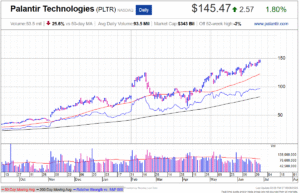
The announcement of NOS had an immediate impact on Palantir’s stock price, hitting a new record high. Shares rose by about 1.2% in after-hours trading, peaking at a record high of $147–148. This continues a strong run for the company. Its stock has surged nearly 95% in 2025 due to investor excitement about its AI and government-focused platforms.

Palantir PLTR stock price

Wall Street analysts say this deal shows Palantir can grow beyond defense and intelligence. It can also move into commercial sectors like energy and infrastructure.

Over 40 public and private U.S. agencies already use the Foundry platform, and they see energy as a valuable new revenue stream. Palantir’s stock trades at about 246 times projected 2025 earnings, suggesting high expectations but also valuation risk. Still, this recent development further solidifies nuclear energy’s comeback. 

Atomic Revival: Why Nuclear Is Hot Again

Nuclear energy is gaining traction again. Governments and companies want reliable, low-carbon power. This is to meet the growing demand for electricity and achieve climate goals.

Today, more than 400 nuclear reactors run worldwide. They provide around 9% of global electricity. The sector is starting a new growth phase. Aging plants are getting upgrades, new builds are on the rise, and digital tools are modernizing project delivery.

Reactors Operating in the United States

nuclear reactors operating in the US
Source: WorldNuclear.org

Market research shows that the global nuclear construction industry will grow. It’s expected to rise from $7.7 billion in 2025 to $9.5 billion by 2034. This growth comes from new policies, concerns about energy security, and increased investment in carbon-free baseload power.

Small modular reactors (SMRs) are part of this growing trend. They provide compact and flexible nuclear options for specific markets. Their potential fits well with the bigger nuclear revival. It can even be better when combined with smart platforms like NOS, which simplify complex engineering and regulatory tasks.

How NOS Could Transform Nuclear Project Delivery

Historically, nuclear projects have struggled with delays, cost overruns, and complex regulations. NOS aims to address these problems through several key features:

  • Digital twins: Virtual models of construction milestones that allow real-time progress tracking.
  • Predictive analytics: Tools to identify delays and risks before they affect schedules.
  • Automated compliance: Systems that support regulatory inspections and permit tracking.
  • Supply chain optimization: Reduces downtime by improving delivery timing and inventory control.

These features work together to make nuclear construction faster, safer, and more cost-efficient. If proven widely, NOS could boost confidence for utilities, investors, and governments. This may lead to broader nuclear adoption, including SMRs.

AI-Powered Nuclear for the Energy Transition

The U.S. and other countries are seeing higher electricity demand. This rise comes from the growth of AI data centers and the electrification of industry. To meet this demand while cutting carbon emissions, policymakers are turning back to nuclear energy.

Global nuclear power is set to grow quickly as more countries look for clean and steady energy sources. The International Energy Agency (IEA) expects nuclear capacity to increase from 416 gigawatts in 2023 to 647 gigawatts by 2050 under current plans — and to over 1,000 gigawatts if stronger climate action is taken.

nuclear energy investment outlook by type 2050
Source: IEA

New tax credits and regulatory reforms are helping shift momentum from wind and solar to nuclear. In this environment, platforms like NOS are becoming more important. They ensure the reliability and control necessary for nuclear power to be a viable option again.

NOS presents a new way forward, despite major challenges like NRC licensing, uranium supply chains, and public opinion. By combining AI, data, and logistics, it enables smarter construction and risk management.

Palantir and The Nuclear Company’s NOS platform could mark a turning point for nuclear energy. It combines advanced software tools with real engineering needs. The goal is to lower costs, cut delays, and build nuclear plants more quickly and safely.

The $100 million investment signals a serious commitment. And the market’s response shows belief in Palantir’s ability to deliver. Now the challenge will be execution—proving that technology like NOS can turn vision into reality on the ground.

The post Palantir (PLTR) Stock Hits New Record with $100M Nuclear and AI Platform Deal appeared first on Carbon Credits.

NVIDIA (NVDA) Stock and the Future of Green AI: What Investors Should Know

nvidia

As artificial intelligence transforms industries, it also increases energy demands. And NVIDIA (NASDAQ: NVDA) is stepping up in this game. It leads the AI hardware market and is now a key player in energy-efficient computing while making bold sustainability promises.

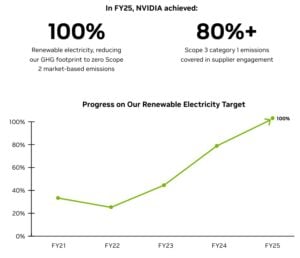
For green-focused investors and corporate leaders, NVIDIA offers a unique opportunity. Its innovative Blackwell GPUs provide up to 50 times more energy efficiency than traditional CPUs for AI tasks. By fiscal 2025, NVIDIA plans to use 100% renewable electricity for all its offices and data centers.

This makes NVDA stock a top tech choice and a solid bet on climate-smart computing. Let’s dive deeper.

How NVDA Stock is Benefiting from AI Growth and Climate Responsibility

NVIDIA’s financial success in 2025 stems from tech strength and climate focus. In fiscal year 2025, NVIDIA reported $130.5 billion in total revenue, a 114% year-over-year increase.

In the first quarter of fiscal 2026 (ending April 27, 2025, earnings hit $44.1 billion, a staggering 154% rise from last year.

This growth didn’t just benefit shareholders; it also funded sustainability efforts worldwide. The chip giant shows that innovation and environmental commitment can co-exist. And is the key to attracting carbon-conscious investors seeking returns and impact.

Micron Boosts NVIDIA Stock

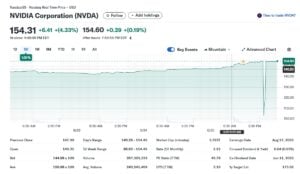
NVIDIA’s solid financial performance strengthens its position in AI hardware and clean computing. Recently, NVIDIA stock (NVDA) rose over 2.6%, reaching a high of $152.97. This reflects investor confidence in its strong standing in AI markets.

A key factor in this rally was anticipation around Micron Technology’s earnings. Micron supplies high-bandwidth memory (HBM) chips, essential for NVIDIA’s advanced AI accelerators. Micron’s report revealed high demand in the AI hardware supply chain. This news raises optimism about NVIDIA’s future.

NVIDIA stock
Source: Yahoo Finance

Blackwell GPUs: Slashing Emissions Through Speed

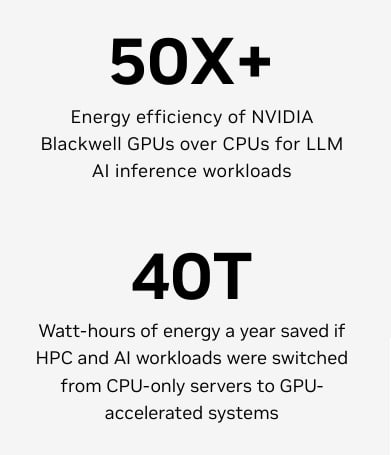
Now talking about NVIDIA’s green innovation. It centers on its Blackwell GPU architecture. These chips are designed for AI inference tasks and are over 50 times more energy-efficient than older CPUs.

Here’s how they achieve this:

  • Acceleration Efficiency: Blackwell GPUs complete complex tasks faster, allowing systems to use less power during idle times.
  • Smart Power Controls: Features like power gating turn off unused GPU sections to save energy.
  • Advanced Voltage Management: This ensures efficient power delivery without overspending on energy.
  • Optical Interconnects: Innovations reduce connection power from 39W to just 9W, saving megawatts in large AI data centers.

According to NVIDIA, the Grace Blackwell Superchip offers 25 times better energy efficiency for large AI model inference compared to its predecessor. Upgrades, like moving from NVL8 at FP8 to NVL72 at FP4, have led to up to 130 times more tokens per megawatt. This means smarter AI at a lower energy cost.

  • If widely adopted, Blackwell architecture could save nearly 40 trillion watt-hours annually, enough to power 5 million U.S. homes.
NVIDIA (nvda) AI blackwell
Source: NVIDIA

100% Renewable Electricity Milestone Achieved

NVIDIA reached a major sustainability goal in FY25: powering all its global offices and data centers with renewable electricity. This achievement removes Scope 1 and 2 emissions from operations directly under its control.

  • In FY2025, total scope 1 and scope 2 emissions totaled 12,952 metric tons of CO₂ equivalent

The company achieved this through:

  • On-site solar and wind systems across 22 campuses
  • Renewable energy purchase agreements and grid partnerships
  • Over 110 renewable projects worldwide

In FY24, it was at 76% renewable electricity. The rapid jump to 100% in just a year shows its commitment to climate leadership. This focus on green energy adoption makes a difference in this high-energy consumption sector.

NVIDIA nvda Carbon emissions
Source: NVIDIA

Tackling Scope 3: Supply Chain Decarbonization

NVIDIA has cut operational emissions, but its Scope 3 emissions are still high. These emissions, mainly from its supply chain, make up 98% of its total footprint. The company is working with suppliers that generate the most emissions.

By FY25, it engaged suppliers covering over 80% of its supply chain emissions, surpassing its target of 67%. The goal is to encourage suppliers to adopt science-based targets for emissions reduction.

  • NVIDIA aims to cut supply chain emissions by 30% from 2020 levels by 2030. That’s a significant challenge, but it reflects a strong commitment to sustainability.

Powering Real-World Climate Solutions 

NVIDIA’s climate impact extends beyond its internal targets. Its technology enables climate solutions across sectors:

  • Climate modeling and forecasting
  • Wildfire prediction
  • Smart grid management
  • Precision agriculture and sustainable land use

Compared to traditional CPU systems, NVIDIA-powered data centers can lower energy costs by up to 42%. This is a strong incentive for businesses balancing AI growth and sustainability goals.

NVIDIA provides great value for eco-friendly, tech-savvy investors. It leads in innovation. It offers energy-efficient AI systems. Also, it’s gaining traction in sustainability.

Green500 Rankings Confirm Energy Efficiency Leadership

Another interesting fact is that real-world results back up NVIDIA’s claims. In November 2024, eight of the top ten Green500 supercomputers, ranked for energy efficiency, used NVIDIA hardware.

The JEDI system in Germany ranked first. It achieved over 1,000 times better energy performance than older systems for AI workloads. These achievements highlight that NVIDIA is leading in energy-efficient high-performance computing (HPC).

NVIDIA’s Carbon Market Readiness and Investor Edge

As carbon pricing grows worldwide, companies with low-emission practices are set for greater success. NVIDIA’s energy-saving tech cuts carbon emissions, which can lead to real value in new carbon markets.

This is especially true for data centers, undergoing a trillion-dollar AI-driven transformation. By offering solutions that cut carbon intensity per computation by up to 40%, NVIDIA becomes more than a chipmaker; it’s a carbon-smart infrastructure provider.

For investors aligning portfolios with climate goals, NVDA stock presents:

  • Strong financial performance
  • Clear sustainability outcomes
  • Regulatory resilience through clean operations
  • Leadership in climate-focused tech solutions

Investing in the Green AI Future

This study clearly shows that NVIDIA makes a strong case for investors focused on technology, emissions reduction, and ESG compliance. Its high valuation reflects big expectations. Being a green AI leader can offer significant long-term rewards. This is especially true as governments and markets shift their focus to carbon efficiency.

In short, NVIDIA is not just riding the AI wave; it’s shaping the sustainable future of computing. NVDA stock is worth considering for those seeking growth and green impact.

The post NVIDIA (NVDA) Stock and the Future of Green AI: What Investors Should Know appeared first on Carbon Credits.
QuantumScape (QS) Stock Surges 35% as EV Battery Technology Drives Carbon Reduction

QuantumScape (QS) Stock Surges 35% as EV Battery Technology Drives Carbon Reduction

QuantumScape Corporation (NYSE: QS) saw its stock price rise by 35% after announcing a major improvement in solid-state battery technology. This new development helps solve two big problems with electric vehicles (EVs): short driving ranges and slow charging times. 

Solving these problems helps more people switch from gas cars to electric ones. This change would lower carbon emissions in transportation.

Cobra Strikes: A Battery Manufacturing Breakthrough

QuantumScape’s recent success comes from its new manufacturing method called the Cobra separator process. This process is much faster and takes up less space than the company’s older “Raptor” method. In fact, Cobra is about 25x faster at heat treatment and needs only a small amount of physical space to operate.

The Cobra platform is a big step forward because it helps make battery parts faster and with less energy. This improvement could make it easier to build solid-state batteries at a large scale, which is necessary to meet the growing demand for EVs.

Dr. Siva Sivaram, CEO of QuantumScape, said the company has made strong progress with Cobra, noting:

“Our team has made impressive strides in advancing Cobra, a technology that exemplifies our progress in scaling solid-state battery production…By significantly improving throughput and shrinking the equipment footprint, Cobra gives us a powerful path forward for commercializing our next-generation battery technology.”

Solid-State Shift: Powering the Clean Transport Future

QuantumScape’s solid-state batteries are different from the regular lithium-ion batteries found in most EVs today. Traditional batteries use a liquid electrolyte, but solid-state batteries use a solid ceramic one. This change makes the batteries safer and allows them to store more energy.

Because of this, solid-state batteries could increase EV driving range by 50% to 80%, with some models expected to reach 900 to 1,000 miles per charge. These improvements could remove what’s known as “range anxiety”—the fear that an EV will run out of power before reaching a charging station.

QuantumScape solid-state battery sample QSE-5 B
Source: QuantumScape

The benefits don’t stop there. EVs using these batteries will likely need to stop and charge less often on long trips. That means less strain on the power grid and better use of renewable energy like wind and solar.

Since EVs already reduce carbon emissions by up to 65% over their lifetime compared to gas vehicles, solid-state technology could make an even bigger impact on the environment.

Faster Charging, Safer Driving

Solid-state batteries from QuantumScape offer more than just long driving range. They also charge faster, which is a key concern for drivers. These batteries are built to handle rapid charging using high-voltage direct current (DC). That means you could charge your EV during a short stop instead of waiting for hours.

Safety is another major advantage. Solid electrolytes are not flammable and don’t cause the same fire risks as liquid ones. This makes the batteries more stable and lowers the risk of overheating or explosions. Better safety could also help governments approve new EV models faster, which would speed up adoption around the world.

Sealing the Deal: Volkswagen Backs the Tech

QuantumScape’s partnership with PowerCo, a battery company owned by Volkswagen Group, shows the real-world value of this technology. PowerCo has signed a deal to produce up to 80 gigawatt-hours (GWh) of batteries per year using QuantumScape’s designs. That’s enough power for about one million electric cars annually.

PowerCo also tested QuantumScape’s batteries and found they performed better than expected. The solid-state batteries went through over 1,000 charging cycles and still kept more than 95% of their energy capacity. That equals about 500,000 kilometers of driving, based on current EV standards.

PowerCo CEO Frank Blome said the results were very promising. He believes these batteries could offer longer driving ranges, very fast charging, and a longer lifespan, making them ideal for future EVs.

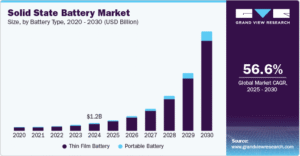
More notably, the global solid-state battery market was worth about $1,181.8 million in 2024, according to the Grand View Research. It is expected to grow to $15,067.3 million by 2030, with a fast yearly growth rate of 56.6% between 2025 and 2030.

solid-state battery market

This growth is mainly because more people are buying electric vehicles (EVs), and solid-state batteries are safer and store more energy than regular lithium-ion batteries.

Investment Voltage: Why Carbon Markets Are Watching Closely

Investors who care about clean energy are paying close attention to QuantumScape. The company’s battery improvements could help the transportation industry lower its carbon emissions more quickly. Governments and businesses are pushing for net-zero carbon goals. Thus, the demand for better battery technologies is rising.

QuantumScape’s batteries may also be used in areas beyond cars. For example, they could help store energy from renewable sources like wind and solar on the electric grid. This would make clean energy more reliable and easier to use during times when the sun isn’t shining or the wind isn’t blowing.

The company’s batteries could also help reduce Scope 3 emissions, which are the indirect emissions that come from supply chains or the use of sold products. This would be helpful for companies with large delivery fleets or transportation networks that are trying to reduce their carbon footprint.

Looking ahead, QuantumScape plans to begin larger-scale production and testing of its solid-state batteries by 2026. The company is working on a new battery model, QSE-5, which will serve as the base for commercial production.

By solving major challenges in battery manufacturing, QuantumScape is on track to bring solid-state batteries to the market in the next few years. The company continues to improve how it makes the batteries and plans to increase its production levels.

Road to Rollout: What’s Next for QuantumScape?

QuantumScape’s 35% stock rise shows how excited investors are about the company’s progress. The new Cobra technology solves important problems in how solid-state batteries are made and makes it easier to produce them in large numbers.

QuantumScape stock price
Source: Yahoo

For people and companies focused on clean energy, QuantumScape offers a chance to invest in a solution that could reduce carbon emissions in the transportation sector. These batteries have the power to fix major problems like short range and slow charging while also being safer to use.

Transportation accounts for about 16.2% of global carbon dioxide emissions. So, advanced battery technologies like QuantumScape’s could greatly benefit the planet. With strong partnerships, proven results, and a clear path to mass production, QuantumScape is positioned to play an important role in the shift to zero-emission vehicles and a cleaner future.

The post QuantumScape (QS) Stock Surges 35% as EV Battery Technology Drives Carbon Reduction appeared first on Carbon Credits.

Amazon, Netflix, Meta, and Others Use Carbon Credits to Shut Down Coal Plants Early

Amazon, Netflix, Meta, and Others Use Carbon Credits to Shut Down Coal Plants Early

Amazon, alongside Meta, Netflix, Mastercard, PepsiCo, and others, are leading a shift in carbon credits by backing the early retirement of coal-fired power plants. They’ve joined the Kinetic Coalition, a global alliance of more than 20 major companies working to unlock investment in clean energy in emerging economies. This marks a big step in climate action—paying to close coal plants early instead of funding tree-planting or technology offsets.

What Are Early Retirement or “Transition” Credits?

Transition credits differ from traditional carbon credits. Transition credits pay plant owners to close coal units early. This approach differs from funding for projects like forests or renewable energy after emissions have occurred. Instead, it avoids future emissions and makes room for clean power.

Closing a coal plant early can cost hundreds of millions of dollars. For instance, research showed that winding down a 1-GW plant five years early would need about $310 million. Transition credits are a helpful financial tool. They cover closure costs, support displaced workers, and help build new clean energy projects.

This concept has already started in Southeast Asia. And Verra, a key player in carbon markets, has launched a method to certify early coal retirements. This method sets high standards for clean energy replacements and supports local jobs. 

One pilot in the Philippines aims to close a coal plant a decade early—avoiding up to 19 million tonnes of CO₂. The new step is scaling this model with corporate backing, as what the Kinetic Coalition does. 

The Kinetic Coalition: Big Names Powering Change

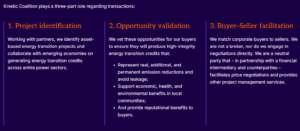
Amazon is part of the Kinetic Coalition, a buyers’ alliance organized by the Center for Climate and Energy Solutions (C2ES). The Coalition connects major buyers with coal-closure projects in emerging economies. Other major companies in the alliance include PepsiCo, McDonald’s, Meta, Nike, Salesforce, and Morgan Stanley.

Kinetic Coalition

Nat Keohane, President of C2ES, noted: 

“Energy transition credits can accelerate the transition to clean energy systems for emerging economies, help companies reduce their supply chain emissions – and, most importantly, bring economic, health, and environmental gains to local communities. They offer an opportunity to achieve emission reductions at scale while benefiting companies and people – and Kinetic is excited to seize it.”

The Coalition wants to purchase reliable transition credits. These credits will help with early plant retirements, renewables, grid upgrades, and support local communities. It already explores pilots in the Dominican Republic, Chile, and the Philippines.

  • In the Philippines, where coal still powers close to 60% of the grid, the coalition plans to support the early retirement of a major coal-fired plant. The goal is to replace it with a mix of clean energy and storage, ensuring no gap in supply.
  • In Chile and the Dominican Republic, the projects aim to modernize electricity grids, not just shut down coal. These efforts seek to add more renewables, cut reliance on fossil fuels, and boost reliability for consumers. 

The credits created from these projects may serve multiple purposes. For example, Schneider Electric, one of the coalition’s participants, is exploring several options. It may use the credits to offset its own emissions or sell them to clients through its sustainability consulting arm, EcoAct. This shows how credits can fit into both corporate climate plans and broader client services.

By pooling demand, the Kinetic Coalition can support large-scale impact. Members commit capital upfront—helping governments and power companies plan and fund the shift away from coal. The alliance could channel billions of dollars by 2035, driven by strong corporate climate goals.

Tackling Coal Power: Pathways to Clean Energy in Emerging Markets

Coal-fired power remains a major obstacle for climate progress, with emissions rising by 0.9% (135 Mt CO₂) in 2024 and coal making up about 36% of global electricity in 2023. Many emerging economies still rely on coal to meet growing energy demands.

Initiatives like the Kinetic Coalition aim to close coal plants early, replacing them with clean energy while supporting jobs and communities. BloombergNEF estimates that over $2.6 trillion in clean energy investment is needed in emerging markets by 2050, and innovative tools like transition credits can help unlock this vital capital.

emerging markets clean energy investment for net zero

The early pilots may shape how we manage energy transitions. They can also guide the responsible and fair use of carbon credits at scale.

The group is ensuring credibility by aligning with top standards like ICVCM and CORSIA. They are also working with the Advanced and Indirect Mitigation Platform. Projects can use Verra’s 2024 early coal retirement method. They may also follow new guidelines from the Gold Standard and the Environmental Resources Trust.

The Corporate Trailblazers

Amazon, Meta, Netflix, and Mastercard have been major buyers of voluntary carbon credits for years. Their shift to transition credits shows a new path. They now focus on real-world emissions reductions instead of offsets, such as forest protection.

They are also part of the Energy Transition Accelerator (ETA). This initiative was launched by the U.S. State Department, Bezos Earth Fund, and Rockefeller Foundation. Amazon, Mastercard, Meta, McDonald’s, PepsiCo, and others endorsed its approach at Climate Week 2024. The ETA wants to boost low-carbon energy in developing markets. It does this by using high-quality credits and fair transition plans.

If transition credits gain a firm foothold, they could channel hundreds of billions into clean energy systems. Estimates suggest the Kinetic Coalition alone could mobilize $72–207 billion by 2035.

Trends and Forecasts: How Billions Could Shift the Energy Mix

The carbon credit market is growing fast. The voluntary market reached around $2 billion in 2024 and may grow to $24 billion by 2030—around 35% annual growth. Add in compliance systems, and the total market neared $115 billion in 2024, growing at ~16% annually.

Transition credits are a newer segment, but momentum is building with these trends:

  1. Regulatory support. Singapore is drafting rules for high-integrity carbon credits. Japan is building a carbon market framework. South Korea and China are also exploring credit systems.
  2. Verra’s methodology. Its VM0052 method for coal-plant retirement was a major milestone. It sets strong guardrails for environmental impact and community protection.
  3. Tech for confidence. Blockchain, satellite tracking, and AI are helping verify, trace, and audit credits—reducing fraud.
  4. Investor demand. Net-zero commitments from thousands of companies mean growing demand for real-impact credits.
  5. Public-private action. Groups like ETA, Kinetic Coalition, and CCCI demonstrate cross-sector momentum to scale these solutions.

By investing in transition credits, Amazon and other Kinetic Coalition partners are helping forge a new climate finance path. Instead of offsetting emissions, they are funding early closure of coal plants—cutting future carbon emissions before they happen.

With robust standards, growing tech tools, and strong corporate demand, transition credits could become a major asset in achieving global climate goals—while supporting clean energy in emerging economies.

The post Amazon, Netflix, Meta, and Others Use Carbon Credits to Shut Down Coal Plants Early appeared first on Carbon Credits.