DOE’s $303M Bet on Kairos Power Signals America’s Advanced Nuclear Push

The U.S. nuclear sector just received another strong signal of federal backing.

On February 21, the U.S. Department of Energy (DOE) finalized a $303 million Technology Investment Agreement with Kairos Power to advance its Hermes demonstration reactor in Oak Ridge, Tennessee. The deal supports the company’s selection under the Advanced Reactor Demonstration Program (ARDP), first announced in December 2020.

But this is not a traditional federal grant. Instead, DOE structured the agreement as a performance-based, fixed-price milestone contract. Kairos will only receive payments once it achieves clearly defined technical milestones.

This funding model was previously used by the Department of Defense and NASA’s Commercial Orbital Transportation Services (COTS) program. It aims to accelerate innovation while protecting public funds. Now, DOE is applying that same discipline to advanced nuclear technology.

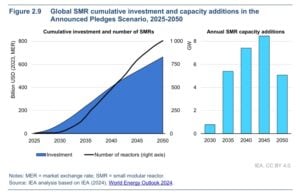
smr installed capacity
Source: IEA

Hermes: The First Gen IV Reactor Approved in Decades

At the center of the agreement is Hermes — a low-power demonstration reactor based on Kairos Power’s fluoride salt-cooled high-temperature reactor (KP-FHR) design.

kairos hermes
Source: Kairos

In December 2023, the U.S. Nuclear Regulatory Commission (NRC) granted Hermes a construction permit. That approval marked a historic milestone. Hermes became the first non-light-water reactor approved for construction in the United States in more than 50 years. It is also the first Generation IV reactor cleared for building.

The reactor is expected to be operational in 2027. While it will not generate commercial electricity, it serves a critical role. Hermes will demonstrate Kairos Power’s ability to safely deliver low-cost nuclear heat and operate a fully integrated advanced nuclear system.

Its design combines two established technologies that originated in Oak Ridge: TRISO-coated particle fuel and Flibe molten fluoride salt coolant. Together, these systems enhance safety and simplify operations.

The molten salt coolant improves heat transfer and stability, while TRISO fuel provides strong containment of radioactive materials. The result is a reactor design that emphasizes inherent safety without relying on overly complex backup systems.

Significantly, Hermes represents Kairos Power’s first nuclear build, and it acts as a stepping stone toward commercial deployment.

Mike Laufer, Kairos Power co-founder and CEO, said:

“With the use of fixed-price milestone payments, this innovative contract provides real benefits to both Kairos Power and DOE to ensure the successful completion of the Hermes reactor. It allows us to remain focused on achieving the most important goals of the project while retaining agility and flexibility to move quickly as we learn key lessons through our iterative development approach.”

Risk Reduction and Private Capital Alignment

The DOE’s investment complements significant private funding already committed by Kairos Power. Since its ARDP selection, the company has built extensive testing facilities and manufacturing infrastructure to support its Engineering Test Unit series. It has also advanced its fuel development and molten salt coolant systems.

Unlike traditional large-scale nuclear projects that often suffer cost overruns, Kairos is pursuing an iterative development pathway. This approach allows the company to test, refine, and improve reactor components before full commercial rollout.

Fuel manufacturing plays a key role in that strategy. Kairos Power is working in partnership with Los Alamos National Laboratory to produce fuel for Hermes. Through its Low Enriched Fuel Fabrication Facility (LEFFF), the company aims to control quality, reduce delays, and manage costs more effectively.

Vertical integration is central to its business model. By managing more of the supply chain internally, Kairos hopes to deliver greater cost certainty for future commercial reactors — an area where traditional nuclear projects have struggled.

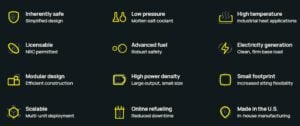
           Key Features

kairos
Source: Kairos

Nuclear’s Return to the Energy Spotlight

The Hermes agreement comes at a time when nuclear energy is regaining political and investor attention.

Federal policy has shifted in favor of accelerating the development of next-generation reactors. In 2025, the U.S. administration introduced measures to shorten licensing timelines and rebuild domestic nuclear fuel supply chains. The Department of Energy has articulated an ambitious goal: expand U.S. nuclear capacity from roughly 100 gigawatts in 2024 to 400 gigawatts by 2050.

Programs such as the Energy Dominance Financing initiative aim to provide additional support for nuclear infrastructure. Once built, reactors can operate for up to 80 years, making them long-term strategic assets.

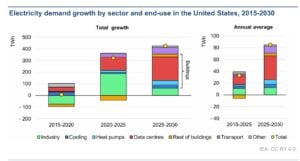
At the same time, electricity demand is rising. According to the International Energy Agency (IEA), U.S. electricity demand grew 2.8% in 2024 and another 2.1% in 2025. The country is projected to add more than 420 terawatt-hours of new demand over the next five years.

electricity genration

Data centers are driving much of that growth. The rapid expansion of artificial intelligence and cloud computing infrastructure could account for nearly half of total demand growth through 2030.

This dynamic is reshaping energy investment decisions. Technology companies require reliable, always-on power. However, they must also meet emissions reduction targets. Nuclear energy provides steady, low-carbon electricity, making it increasingly attractive for both policymakers and corporate buyers.

Small Reactors, Big Strategic Impact

Small modular and advanced reactors are the keys to this renewed momentum. Compared to traditional gigawatt-scale plants, smaller reactors offer shorter construction timelines and lower upfront capital requirements. Developers can deploy them incrementally, reducing financial risk and improving flexibility.

Hermes, although it is a demonstration project, it represents a critical validation step. If successful, it could pave the way for commercial-scale KP-FHR reactors that supply industrial heat and electricity at competitive costs.

Dr. Kathryn Huff, Assistant Secretary, Office of Nuclear Energy, made an important statement, noting:

“The Hermes reactor is an important step toward realizing advanced nuclear energy’s role in ushering forward the nation’s clean energy transition. Partnerships like this one play a significant role in making advanced nuclear technology commercially competitive.”

For investors, this shift signals opportunity. Supportive government policy, rising electricity demand, AI-driven load growth, and decarbonization commitments are converging. Nuclear power, once viewed as a legacy industry, is re-emerging as a strategic solution.

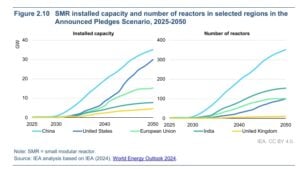
SMR
Source: IEA

A Measured Step Toward a Nuclear Renaissance

The DOE-Kairos agreement does not guarantee success. Advanced reactor development remains technically complex and capital-intensive. However, the deal’s structure reflects lessons learned from past nuclear projects.

By tying federal funding to performance milestones, DOE is promoting accountability. By combining public and private capital, the government is reducing financial risk while accelerating innovation.

Hermes now stands as one of the most closely watched advanced reactor projects in the United States. If Kairos delivers on schedule, the project could mark a turning point. Not just for one company but for the broader U.S. nuclear renaissance that policymakers increasingly envision.

In a world of rising electricity demand and tightening climate targets, advanced nuclear energy is inevitably essential. And with Hermes moving forward, it is becoming tangible infrastructure.

The post DOE’s $303M Bet on Kairos Power Signals America’s Advanced Nuclear Push appeared first on Carbon Credits.

NVIDIA Hits Almost $216 Billion Revenue as AI Boom Tests Its Climate Strategy

NVIDIA Hits Almost $216 Billion Revenue as AI Boom Tests Its Climate Strategy

NVIDIA’s latest earnings report shows the scale of the AI boom. The chipmaker reported record revenue and became the fourth U.S. tech company to exceed $100 billion in annual profit. Alongside financial growth, Nvidia continues to push renewable energy use and efficiency gains. The results highlight the growing link between AI expansion and sustainability challenges.

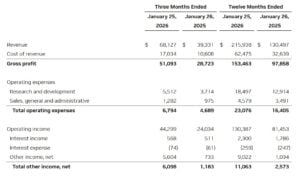
NVIDIA reported record revenue of $68.1 billion for the fourth quarter of fiscal 2026, ending January 25, 2026. This figure was up 73% from a year earlier and up 20% from the prior quarter. Data center sales, which fuel artificial intelligence (AI) growth, were $62.3 billion, or about 91% of total revenue in the quarter.

For the full fiscal year, NVIDIA posted $215.9 billion in revenue, a jump of 65% from the prior year. Net income reached tens of billions, $120,067 million for the full year and $42,960 for the 4th quarter. Earnings per share also grew significantly.

These results exceeded most analysts’ expectations and underscored NVIDIA’s continued leadership in AI compute hardware. The company also forecast strong revenue for the first quarter of fiscal 2027.

NVIDIA financial results 2025
Source: NVIDIA

NVIDIA’s Sustainability Commitments at a Glance

NVIDIA has increasingly highlighted its environmental and sustainability goals in recent years. For the fiscal year 2025, the company achieved 100% renewable energy use for all offices and data centers it directly controls.

The renewable supply came from a mix of:

  • On-site generation
  • Purchased renewable electricity
  • Energy attribute certificates (EACs)
  • Power purchase agreements (PPAs)

This milestone eliminates the company’s market-based Scope 2 emissions tied to electricity use in those facilities.

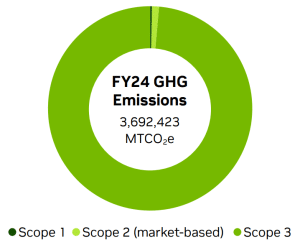
While operational emissions from electricity have been addressed, total emissions figures remain complex. NVIDIA reported that its total greenhouse gas emissions increased. This includes Scope 3 emissions linked to its supply chain and purchased goods. Scope 3 emissions accounted for the bulk of its emissions inventory, and they rose significantly year-over-year.

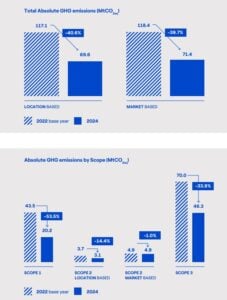
Nvidia GHG emissions 2024

NVIDIA has also incorporated science-based targets and reduction plans into its public disclosures. The company aims to cut direct (Scope 1) and electricity-related (Scope 2) emissions by about 50% by 2030. This is based on its baseline figures. These science-based targets are consistent with internationally recognized climate frameworks.

Beyond energy use, NVIDIA has implemented other environmental actions. Closed-loop liquid cooling systems in data centers help cut water use. Also, there are significant increases in recycling electronic waste each year.

AI Performance Per Watt: NVIDIA’s Efficiency Edge

NVIDIA’s technology can influence emissions well beyond its own operations. The company’s GPUs and systems power AI infrastructure around the world. Many of these systems are designed to be energy efficient.

For example, NVIDIA-based systems dominate rankings of the most energy-efficient supercomputers globally. The Green500 list ranks systems based on energy efficiency.

Many top entries use NVIDIA GPUs, especially the advanced Grace Hopper architecture. These systems deliver high computing performance per watt of power, helping labs and data centers run complex workloads with less energy.

Record Profits, Cautious Market Reaction

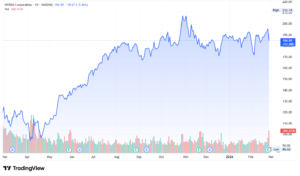
Despite the strong financial performance, NVIDIA’s share price movement highlights market nuances. Some reports noted that after an initial uptick in after-hours trading, the stock’s gains flattened or reversed. This response came even as NVIDIA beat revenue and profit expectations.

NVIDIA nvda stock price

Analysts point to broader concerns about the valuation of high-growth AI stocks. Investors are cautious despite strong earnings. They worry about how fast AI demand will grow and whether valuations show future risks.

In early 2026, NVIDIA’s stock had also seen uneven performance year-to-date. Some analysts believe the trading pattern after earnings shows sector sentiment more than the company’s actual results.

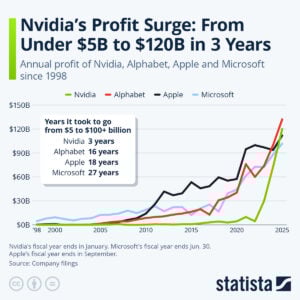
NVIDIA’s profit scale also stands out compared with other major U.S. tech firms. For fiscal year 2026, the tech giant reported $120 billion in net income. This made it the fourth U.S. tech company ever to exceed $100 billion in annual profit, joining Alphabet, Apple, and Microsoft.

  • NVIDIA’s result trails only Alphabet’s $132 billion profit in 2025, which remains the largest annual profit ever recorded by a U.S. company.

The speed of NVIDIA’s rise is also notable. Just three years ago, the company’s annual net income was $4.4 billion. In its most recent quarter, the chipmaker generated that amount in less than 10 days.

Nvidia annual profit 2025 vs other big tech
Source: Statista

By comparison, Apple took 18 years to grow from $5 billion in annual profit to $112 billion, beginning around the launch of the iPhone in 2007. Microsoft took 27 years to move from $5 billion to more than $100 billion in annual profit. Alphabet first crossed the $100 billion mark in 2024. NVIDIA hit this milestone in under three years. CEO Jensen Huang pointed out the company’s AI gains in May 2023.

Efficiency Gains vs. Expanding Energy Footprint

NVIDIA’s external ESG ratings are similar to those of other tech companies for environmental and governance metrics. However, the scores vary in social and supply chain areas. These ratings consider things like how well companies disclose information, their plans for cutting emissions, and their governance. They also look at challenges related to wider supply chain emissions.

One sustainability ranking highlighted a “paradox” in NVIDIA’s performance. It noted that NVIDIA’s chips are among the most energy-efficient in the world, which boosts its sustainability profile. The quick rise in total energy use for AI infrastructure is increasing overall environmental impacts. This happens even as per-unit efficiency improves.

NVIDIA’s renewable energy goals and efficiency gains have positioned it as a leader. It combines strong finances with sustainable growth. For instance, in a 2026 list of top firms for sustainable growth, NVIDIA stood out. It achieved 100% renewable energy for its offices and data centers. Plus, its GPU platforms are energy efficient.

Can AI Hypergrowth Align With Climate Targets?

NVIDIA’s sustainability strategy focuses on three key areas:

  • Reducing direct and indirect emissions.
  • Improving energy use.
  • Enhancing reporting transparency.

The company has achieved important goals. It now uses renewable energy for its facilities. It has also improved chip efficiency. These steps show progress toward environmental goals.

Still, rising Scope 3 emissions and the booming demand for AI compute make tackling environmental impacts more complex. NVIDIA’s sustainability reports highlight that energy use in data centers is a major barrier. This limits both digital infrastructure growth and climate progress.

Energy-intensive “AI factories” — large data centers running training and inference workloads — require large power supplies, often on par with traditional industrial factories. This growth in demand puts pressure on energy systems to shift toward low-carbon sources.

NVIDIA’s efforts to work with suppliers on emissions targets and its investments in energy efficiency aim to address parts of this challenge. But the company has not yet announced a full net-zero emissions target with a fixed date.

So, What Comes Next for NVIDIA?

In the near term, NVIDIA will likely continue to be a focal point for both earnings performance and ESG debate. Future earnings releases and sustainability reports will show whether the company’s actions keep pace with its growth.

Investors and stakeholders will watch how NVIDIA manages AI demand, emissions challenges, and energy efficiency together.

On the sustainability side, developing and reporting progress on Scope 3 emissions, supplier engagement, and potential net-zero pathways will shape ESG evaluations. As AI energy use rises worldwide, companies like NVIDIA will face more scrutiny over how they balance growth with their emissions and climate impact.

Overall, NVIDIA’s record earnings and sustainability efforts highlight its role in tech innovation and environmental change. The company balances rapid AI growth with a commitment to lowering its environmental impact.

The post NVIDIA Hits Almost $216 Billion Revenue as AI Boom Tests Its Climate Strategy appeared first on Carbon Credits.

Amazon Tops Global Clean Energy Rankings With 40GW Renewable Projects Says BNEF

Amazon Tops Global Clean Energy Rankings With 40GW Renewable Projects Says BNEF

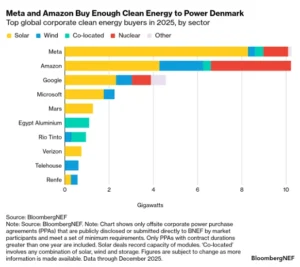
Amazon, once again, is one of the top corporate buyers of clean and renewable energy in the world. For the fifth year in a row, the company leads global corporate renewable energy procurement. BloombergNEF again recognized Amazon as a top corporate purchaser of carbon-free power, with a portfolio that adds significant new clean energy to grids.

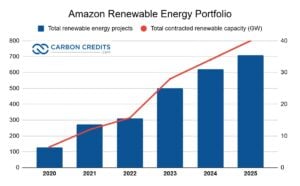
Amazon’s clean energy projects now span more than 700 global initiatives. These include utility-scale solar and wind farms, battery storage, onsite solar, and other carbon-free energy sources across 28 countries.

So far, Amazon has invested in over 40 gigawatts (GW) of carbon-free energy capacity. This amount of power could supply the annual electricity needs of more than 12.1 million U.S. homes if it were used for residential demand.

These investments make Amazon not just a buyer of clean power for itself, but a major driver of new renewable energy build-out around the world.

From First PPA to 40GW Global Portfolio

Amazon’s renewable energy footprint has expanded rapidly over the past decade. The big tech company was the biggest corporate buyer of renewable energy in 2025, based on BloombergNEF data. It signed multiple power purchase agreements (PPAs) and grew its clean energy portfolio.

corporate clean energy purchases BNEF 2025
Source: BNEF
  • Amazon has backed over 700 wind and solar projects around the world. This clean energy can power more than 12.1 million U.S. homes each year.

This expansion includes utility-scale wind and solar farms. It also covers renewable energy bought through PPAs. Additionally, it features on-site rooftop and ground-mount solar projects at Amazon facilities.

Over time, these efforts have helped the tech giant use more clean energy for its electricity, which is a key part of its climate strategy.

Amazon renewable energy portfolio 2025

Solar, Wind, Storage — and Next-Gen Power

Amazon’s clean energy portfolio includes a broad mix of technologies:

  • Solar power: 300+ utility-scale solar and wind farms and 300+ onsite solar projects.
  • Wind energy: Large wind farms in multiple countries, with 6 offshore wind farms in Europe. 
  • Energy storage: Battery storage projects that help balance intermittent renewable output. It has 11 utility-scale battery storage projects. 
  • Emerging technologies: Amazon has invested in advanced options like nuclear small modular reactors (SMRs), with 4 nuclear power agreements. These help provide firm, low-carbon baseload power. 

These investments help replace fossil fuel generation on local grids. They also support grid reliability and reduce electricity costs over the long term.

In Mississippi, for example, Amazon worked with a utility to enable 650 megawatts (MW) of new renewable energy on the grid. Once operational, this capacity will serve the equivalent of over 150,000 homes and improve grid reliability.

Moreover, the company’s 253 MW Amazon Wind Farm Texas contributes around 1,000 GWh of clean power annually. Meanwhile, its European solar and wind assets alone total about 4,600 MW of capacity.

All these efforts form part of the e-commerce’ push for its 2040 net zero targets.

Powering the Path to Net Zero 2040

Amazon has set multiple climate and sustainability targets. The company aims to reach net-zero carbon emissions by 2040 — a goal it committed to early as part of The Climate Pledge.

Amazon net zero emissions 2040
Source: Amazon

To work toward that long-term target, Amazon set a goal to match its electricity use with renewable energy. It reached 100% renewable electricity for its operations ahead of schedule, well before its original 2030 goal.

This means Amazon is purchasing an amount of renewable electricity equal to its total annual consumption. Clean power comes from renewable projects connected to the grid. These projects are supported by long-term PPAs and other contracts.

The renewable energy purchases lower Amazon’s Scope 2 emissions, which come from the electricity it buys. They also help decarbonize the grids where the company operates.

Corporate Buyers Now Rival National Grids

Amazon’s clean energy efforts are part of a larger shift across the corporate world.

Since 2008, companies have bought almost 200 GW of renewable energy worldwide through corporate PPAs and other agreements. This capacity exceeds the total electricity generation of some countries, like France or the United Kingdom.

In 2023, companies revealed a record 46 GW of clean energy deals. These renewable power commitments support new solar and wind farms.

Large tech companies, including Amazon, Google, Microsoft, and Meta, are some of the most active buyers. Those tech firms accounted for a significant share of corporate clean energy procurement over the last decade.

This trend shows that corporate demand can speed up the clean energy shift by providing renewable power developers with long-term revenue certainty.

 Jobs, Grid Stability, and Market Transformation

Corporate clean energy procurement, though slowed down in 2025, has broader economic and energy-system impacts. Investments in renewable projects contribute to job creation, local economic growth, and grid resilience.

Amazon’s solar and wind farms create many construction and operation jobs. They also boost the economy in rural areas. For example, the Great Prairie Wind Farm in Texas has 350 wind turbines. These turbines provide over 1,000 MW of capacity and are one of the largest assets in Amazon’s portfolio.

Also, Amazon’s clean energy deals boost renewable capacity. These projects are in Brazil, India, China, Australia, and Europe, which support markets with different grid mixes. These projects can cut down on fossil fuel-based electricity. They also help local grids stay cleaner and stronger.

Permitting, Policy, and the Next Growth Wave

Despite strong progress, corporate clean energy procurement still faces challenges.

Renewable projects often depend on grid capacity, permitting, and supportive policy frameworks. In some regions, complex regulations or limited grid access can slow project development and clean energy adoption.

Nevertheless, the trend of corporate power purchasing is expected to grow. Data from the Clean Energy Buyers Association (CEBA) shows that U.S. businesses have signed contracts for 100 GW of clean energy. This milestone highlights how important companies are in today’s energy landscape.

Global renewable capacity is also expanding rapidly. According to IRENA, global renewable power capacity reached 4,448 GW at end-2024 after adding a record 585 GW. That’s 15.1% growth with solar leading 75%+ of additions. The 2025 additions are expected to maintain record growth toward the 2030 tripling goal.

Renewables are now growing faster than fossil fuels in new capacity. Looking ahead, strong demand from companies for clean energy will boost growth. Better policies and tech advancements will also help renewable power buying and grid decarbonization.

Private Capital Driving Public Energy Changeaction

Amazon’s clean energy leadership shows how corporate buyers can influence the global energy transition. By securing large portfolios of renewable power, the tech giant and other major corporations are investing in the future of clean electricity. These investments not only help reduce their own emissions but also fund new clean energy capacity that benefits broader society.

As corporate renewable procurement grows, so does the clean energy market. This can lower costs, stimulate innovation, and increase the pace of emission reductions across power systems worldwide.

With more companies setting clean energy goals and signing long-term agreements, the private sector continues to be a powerful force in the shift toward a low-carbon economy.

The post Amazon Tops Global Clean Energy Rankings With 40GW Renewable Projects Says BNEF appeared first on Carbon Credits.
Enel Unveils €20B Renewables Push to Add 15GW by 2028

Enel Unveils €20B Renewables Push to Add 15GW by 2028

Enel, the Italian energy giant, is increasing its commitment to clean power for the coming years. The company has unveiled its new 2026–2028 Strategic Plan, which outlines a major expansion in renewable energy and grid investment.

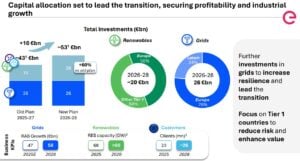
Under the plan, Enel will invest €53 billion over three years. This marks a 23% increase compared with the previous strategy. Of this total, nearly €20 billion will go directly into renewable energy projects.

The renewable spending will support the addition of 15 gigawatts (GW) of new clean energy capacity by 2028. This expansion will bring Enel’s total installed renewable capacity to about 80 GW globally.

The plan reflects the company’s effort to grow clean energy while maintaining financial discipline. The company aims to strengthen earnings and improve returns, while accelerating the shift to low-carbon electricity.

Flavio Cattaneo, CEO of the Enel Group, said:

“Today, Enel presents an ambitious and credible Strategic Plan with a sharp acceleration in growth thanks to an increase of Greenfield and Brownfield investments, which will lead to further improvement of the Group’s risk/return profile. The managerial actions carried out in the last three years provide us with the financial flexibility to invest in the most dynamic markets in terms of electricity demand.”

€20 Billion Commitment: The Clean Power Blueprint

Under Enel’s 2026–2028 Strategic Plan:

Enel renewable investments 2026-2028
Source: Enel
  • €20 billion will fund renewable energy projects.
  • Enel will add 15 GW of new renewable capacity by 2028.
  • Total renewable capacity will rise to about 80 GW.
  • The company’s total gross investment across all businesses will reach €53 billion over three years.
  • These figures show a strong push toward carbon-free power. Renewables now represent one of the largest components of Enel’s capital plan.

The new capacity will focus mainly on wind and solar power. These technologies remain cost-effective and scalable. Enel will also invest in hydroelectric plants and battery storage systems. These technologies help balance wind and solar output.

By adding 15 GW, Enel is positioning itself among the largest global renewable power producers.

How This Fits Into Enel’s Broader Strategy

The €53 billion investment plan covers more than renewables. A large share of spending will go to electricity networks, wherein grid modernization remains a key priority. Stronger grids allow more renewable energy to connect and flow efficiently.

The company is directing most investments toward markets in Europe and North America, which together account for more than €23 billion of total planned spending. Around €3 billion is allocated to Latin America.

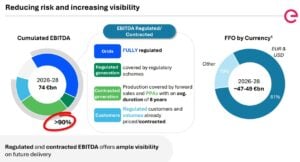
Enel expects its strategy to generate solid financial results. Over the 2026–2028 period, the company projects cumulative ordinary EBITDA of €74 billion.

Enel ebitda strategic plan
Source: Enel

The company says it will maintain a disciplined approach to capital allocation. It plans to focus on projects with stable regulation, clear returns, and predictable cash flow.

Where the Renewables Will Grow

Enel’s renewable expansion will cover several key technologies, including:

  • Onshore Wind and Solar

Most of the 15 GW addition will come from onshore wind and solar farms. These projects can be built at scale and deployed quickly.

Wind and solar are central to Enel’s strategy because they deliver competitive electricity costs and support decarbonization goals.

  • Hydro and Dispatchable Renewables

Hydropower remains important for Enel. Unlike solar and wind, hydro can generate electricity on demand. This helps stabilize grids when renewable output varies.

Dispatchable renewable assets help ensure a steady supply during peak demand.

  • Battery Storage

Battery systems are essential for integrating variable renewables. Storage allows electricity to be saved and used later.

By combining wind, solar, hydro, and batteries, Enel aims to provide cleaner electricity around the clock.

From Coal Exit to Renewable Leadership

Renewables are central to Enel’s long-term climate goals. The company aims to achieve 100% renewable generation and fully exit coal by 2040. This objective aligns with global decarbonization targets and European climate policy.

Electricity demand continues to rise worldwide. Growth is driven by the electrification of transport, industry, and heating. Data centers and digital services also increase demand.

As more sectors shift from fossil fuels to electricity, utilities must expand clean generation capacity. Enel’s investment plan responds directly to this trend.

By scaling renewables and strengthening networks, the company aims to support both climate goals and rising electricity consumption.

What’s Inside Enel’s 2040 Net-Zero Goals?

Enel has set clear goals to fight climate change. The company aims to reach net zero greenhouse gas emissions by 2040, a full decade sooner than the global 2050 target set under the Paris Agreement. This means Enel plans to eliminate all direct and indirect emissions across its operations and value chain.

A key part of this strategy is switching all energy production to sustainable sources like wind, solar, and hydroelectric power. Enel also plans to exit the natural gas sector, so renewable electricity will be the only type of energy it supplies to its customers.

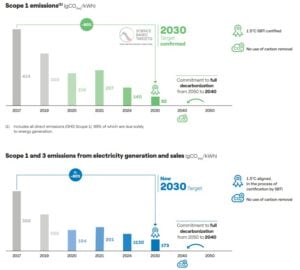
Enel’s climate targets align with the 1.5°C limit — the most ambitious goal of the Paris Agreement. These targets have been validated by the Science-Based Targets initiative (SBTi), meaning they follow science-based methods for emissions reduction.

enel ghg footprint and net zero
Source: Enel

The company has outlined milestone steps on the path to 2040. By 2025, it expects renewables to make up about 75% of its total electricity production. By 2027, Enel plans to finish phasing out all coal-fired power plants. Then by 2040, all of its installed capacity will come from renewable sources, and all direct and indirect emissions will be eliminated.

Enel has already made measurable progress. Its operational emissions (Scope 1 and Scope 2) have dropped significantly from a 2017 baseline. The company is working to reduce emissions across its value chain (Scope 3 emissions) as well.

Enel absolute ghg emissions 2024
Source: Enel

To support these goals, Enel engages with suppliers and customers. It helps them reduce their own emissions through clean energy solutions and energy efficiency programs. This broader approach aims to cut emissions not just within Enel’s operations, but across the entire energy ecosystem.

Scaling Renewables Amid Market Pressures

The energy sector faces ongoing challenges. Rising interest rates have increased financing costs. Supply chain issues have affected equipment delivery. Inflation has pushed up construction expenses.

Enel acknowledges these pressures. The company says it will prioritize projects that offer stable returns and operate in strong regulatory environments.

Partnerships and flexible financing will also help manage risk. This includes cooperation with institutional investors and local partners.

Despite these market challenges, the long-term outlook for renewables remains positive. Clean energy continues to attract capital as governments and businesses pursue decarbonization. Big tech companies are the major purchasers of clean energy, with booming data centers as the main driver.

corporate clean energy purchases BNEF 2025

Utilities Powering the Next Phase of Decarbonization

Enel’s decision to invest €20 billion in renewables and €53 billion overall through 2028 signals confidence in clean energy as a core growth driver.

The planned 15 GW capacity increase will strengthen its position as a major renewable producer. It will also support grid stability and energy security in key markets.

As countries set ambitious 2030 and 2040 climate targets, utilities like Enel play a central role. Expanding renewable capacity, modernizing grids, and maintaining financial discipline are all essential parts of the transition.

Through its 2026–2028 plan, Enel aims to balance sustainability with profitability. By scaling renewables while maintaining strong earnings, the company is positioning itself for the next stage of global energy transformation.

The post Enel Unveils €20B Renewables Push to Add 15GW by 2028 appeared first on Carbon Credits.
Meta, Amazon, Google, and Microsoft Dominate Clean Energy Deals as Global Buying Slips in 2025

For nearly a decade, global companies have been racing to buy clean energy from wind farms, solar parks, and other green power projects. But 2025 marked the first decline in this trend in almost ten years — a surprising shift that signals a changing landscape for corporate sustainability.

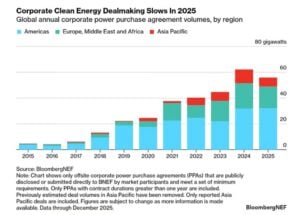
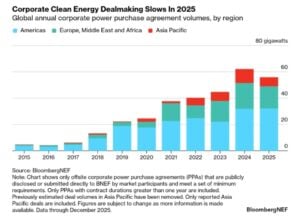
The latest report from BloombergNEF (BNEF) shows that corporate clean energy purchasing dropped about 10% in 2025, falling from roughly 62.2 gigawatts (GW) in 2024 to 55.9 GW last year.

Let’s break down why this happened, what it means, and how the market could evolve in the coming years.

Clean Energy Buying: The Big Picture

Corporate clean energy buying usually happens through power purchase agreements (PPAs). They are long-term contracts where companies agree to buy electricity directly from renewable energy projects, often wind or solar farms.

For years, this was one of the fastest-growing parts of the clean energy market. Companies like Google, Amazon, Meta, and Microsoft drove most of the demand, helping build huge amounts of renewable capacity. But 2025 interrupted that streak.

Even though 55.9 GW is still one of the largest annual totals ever, the fact that it is lower than the year before shows a real shift in how companies approach renewable energy deals.

Why Corporate Clean Energy Buying Fell

There are several reasons why corporate clean energy buying slowed in 2025:

Corporate buyers are sensitive to electricity market rules and government policies. In many regions, uncertain policy environments made it harder to finalize long-term clean energy contracts. In the United States, for example, uncertainty about future clean energy incentives and carbon accounting standards caused many smaller corporations to hold off on signing new deals.

In some power markets, especially in parts of Europe, there were long hours of negative electricity prices. This happens when supply exceeds demand and power becomes so cheap that producers pay buyers to take it.

These price swings make standalone solar and wind contracts less attractive, especially for companies that want predictable, long-term value from their clean energy purchases.

corporate clean energy

Dominance of Big Tech

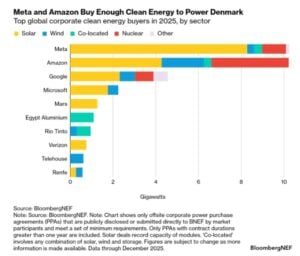
Another key point in the BloombergNEF findings is that the market is becoming more concentrated. As said before, four major tech firms, like Meta, Amazon, Google, and Microsoft, signed nearly half of all clean energy deals in 2025.

Meta and Amazon alone contracted over 20 GW of clean power last year, including deals that cover not just solar or wind, but also nuclear power — something unusual in past corporate PPA markets.

While this heavy concentration helps maintain volume, it also means that smaller companies are scaling back, which lowers the total number of buyers and contributes to the overall slowdown.

meta amazon google microsoft

Regional Differences: Where Things Slowed and Where They Didn’t

Corporate clean energy markets didn’t all move in the same direction last year. Bloomberg’s data shows clear regional patterns:

United States

The U.S. remained the largest single market for corporate clean energy deals, signing a record 29.5 GW of commitments. Much of this came from major technology companies looking to match their growing electricity needs with zero-carbon power sources.

Yet despite these high numbers, the number of unique corporate buyers in the U.S. dropped by about 51%, as many smaller firms pulled back from signing new PPAs.

Europe, Middle East & Africa (EMEA)

In the EMEA region, corporate PPAs fell around 13% in 2025, slipping back to levels closer to 2023. In Europe, in particular, rising negative prices and unstable policy conditions discouraged many new deals.

Asia Pacific

Asia had a mixed story. Some markets like Japan and Malaysia continued to attract corporate clean energy buyers, thanks to mature PPA markets and supportive regulations. But slower activity in countries like India and South Korea contributed to a drop in total volumes in the region.

clean energy

The Rise of Hybrid and Firm Power Deals

One interesting trend that emerged in 2025 is that companies are looking beyond just wind and solar. Because of the limitations with standalone renewable deals, many buyers are now exploring hybrid power contracts that mix renewables with storage, or even nuclear and geothermal sources.

Hybrid deals like solar paired with battery storage give companies more reliable power and help manage price and supply risks. BloombergNEF tracked nearly 6 GW of these hybrid agreements in 2025, and expects this share to grow.

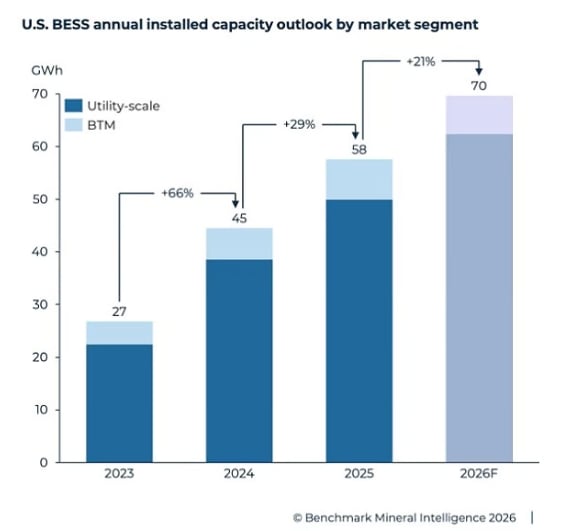
  • According to a report by SEIA and Benchmark Mineral Intelligence, the United States added a record 28 gigawatts (GW) / 57 gigawatt-hours (GWh) of battery energy storage systems (BESS) in 2025. It reflected a 29% year-over-year increase.

Cheaper battery costs are part of this trend. Recent data shows that the cost of four-hour battery storage projects fell about 27% in 2025, reaching record lows. This makes storage-based renewable contracts more financially compelling.

bess US

Big Companies Still Push the Market

Even with the overall slowdown, corporate clean energy buying remains strong, especially among large technology firms.

In fact, while smaller companies took a step back, the major tech buyers helped keep total volumes near all-time highs. In other words, the market didn’t crash; it just shifted shape.

This becomes even clearer when we look at individual company progress. Microsoft reported recently that it now matches 100% of its global electricity use with renewable energy, an achievement that required decades of energy contracts and partnerships.

The Clean Energy Market Is Resetting, Not Retreating

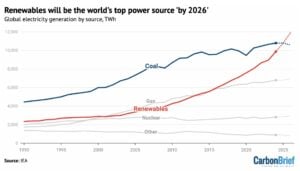
The IEA projects that renewables will provide 36% of global electricity in 2026. This shows that the energy transition is moving forward, even if corporate clean energy purchases dipped in 2025. The slowdown does not signal failure. Instead, it reflects a market that is adapting as companies, technologies, policies, and economics evolve together.

renewables

Growth in corporate renewable deals is not always steady. A single year of lower volumes does not erase the gains of the past decade. Instead, it highlights the natural adjustments markets go through as strategies shift and conditions change.

In this transitioning phase, policy and regulation remain critical. Clear rules, incentives, and supportive frameworks encourage smaller companies to participate. Additionally, regions that provide stability, such as parts of the Asia Pacific, are seeing continued growth in corporate clean energy demand.

In conclusion, even with the dip in 2025, corporate renewable energy purchasing is far larger than it was ten years ago. The market is shifting rather than shrinking, and companies continue to find ways to power growth with clean energy. This slowdown may serve as a wake-up call, encouraging smarter, more flexible strategies that can sustain the energy transition for years to come.

The post Meta, Amazon, Google, and Microsoft Dominate Clean Energy Deals as Global Buying Slips in 2025 appeared first on Carbon Credits.

Indigo Carbon Surpasses 2 Million Soil Carbon Credits in Landmark 1.1 Million Issuance

Indigo Carbon Surpasses 2 Million Soil Carbon Credits in Landmark 1.1 Million Issuance

Indigo Carbon announced it has now passed 2 million metric tons of verified climate impact from U.S. croplands. The company reached the milestone after issuing its fifth U.S. “carbon crop.” The new issuance includes 1.1 million independently verified carbon credits issued through the Climate Action Reserve (CAR).

Indigo describes the milestone in its announcement as a sign that soil-based carbon programs can scale. It also points to rising corporate demand for credits that meet stricter quality rules.

Indigo’s latest issuance is important because it is linked to a major registry method that now carries an additional integrity label. Max DuBuisson, Head of Impact & Integrity, Indigo, remarked:

“Indigo continues to set the standard for high-integrity soil carbon removals that corporate buyers can trust. Soil carbon is uniquely positioned to scale as a climate solution because it captures and stores carbon while also improving water conservation and crop resilience. By combining world-class science and technology with farmer-driven practice change, we’re proving that agricultural soil carbon is an immediate, durable, high-integrity solution capable of helping global companies meet their climate commitments.”

Inside the 1.1M Credit Issuance and CCP Label

Indigo says its fifth issuance includes 1.1 million carbon credits verified and issued through CAR. These credits come from Indigo’s U.S. soil carbon project, listed on the Climate Action Reserve under the Soil Enrichment Protocol (SEP) Version 1.1.

CAR’s SEP is designed to quantify and verify farm practices that increase soil carbon and reduce net emissions. It covers changes in soil carbon storage and also includes reductions in certain greenhouse gases tied to farm management.

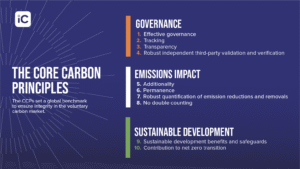
CAR’s SEP Version 1.1 has the ICVCM Core Carbon Principles (CCP) label. This means the method meets the standards set by the CCP framework.

ICVCM core carbon principles
Source: ICVCM

Indigo’s disclosures also describe long-term monitoring rules. The company reports that its U.S. project includes 100 years of project-level monitoring after credit issuance, in line with CAR requirements. This mix of independent verification, registry issuance, and long monitoring periods is central to the case Indigo makes for credit quality.

Breaking Down the 2 Million Ton Milestone

Indigo says its total verified impact now exceeds 2 million metric tons of carbon removals and reductions across U.S. croplands.

In carbon markets, one credit equals one metric ton of CO₂ equivalent. Indigo’s latest issuance is very large by soil carbon standards. It also builds on earlier “carbon crop” issuances.

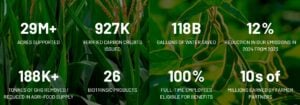
Indigo’s project disclosures include a quantified impact figure for its U.S. project. The company reports 927,367 tCO₂e reduced or removed through Dec. 31, 2023, for the project listed as CAR1459.

Indigo Carbon impact by the numbers
Source: Indigo

Indigo announced it has saved 118 billion gallons of water. It has also paid farmers $40 million through its programs so far. These points matter because many buyers now look beyond carbon totals. They also want evidence of farmer payments, monitoring rules, and co-benefits like water conservation.

Corporate Demand Shifts Toward Verified Removals

One reason soil carbon is getting more attention is the growing demand from buyers for removals. Many companies now focus more on carbon removal credits, not only avoidance credits.

Indigo’s largest recent buyer example is Microsoft. In January 2026, the carbon ag company announced a 12-year agreement under which Microsoft will purchase 2.85 million soil carbon removal credits from them.

  • The soil carbon producer said this is Microsoft’s third transaction with the company, following purchases of 40,000 tonnes in 2024 and 60,000 tonnes in 2025.

The tech giant’s purchases show how corporate buyers may use long-term offtake deals to secure future supply of credits. This matters for soil carbon programs because credits are typically generated over multiple years. And they also depend on practice changes and verification cycles.

Indigo also says its program works across eight million acres, which signals how it is trying to scale participation across U.S. farms.

Soil Carbon Credits: Market Trends and Forecast

Soil carbon credits are gaining attention as buyers shift toward higher-quality credits and clearer verification rules. Ecosystem Marketplace reports that the voluntary carbon market is entering a new phase. This phase emphasizes integrity, even though trading activity has slowed down.

In its 2025 market update, Ecosystem Marketplace noted a 25% drop in transaction volumes. This decline shows lower liquidity as buyers are becoming more selective.

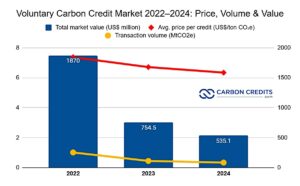
Voluntary carbon credit market; price, volume, value 2022-2024

At the same time, demand for higher-quality credits is rising. Sylvera’s State of Carbon Credits 2025 reported that retirements dropped to 168 million credits in 2025, a 4.5% decrease.

Still, the market value climbed to US$1.04 billion due to rising prices. It also found that higher-rated credits (BBB+) made up 31% of retirements, and traded at higher average prices than lower-rated supply.

For soil carbon, buyers are also watching methodology quality. The ICVCM has approved two sustainable agriculture methods as CCP-approved. These are the Climate Action Reserve’s Soil Enrichment Protocol v1.1 and Verra’s VM0042. This can support stronger buyer confidence and may increase demand for soil credits that meet CCP rules.

Looking ahead, Sylvera projects compliance-linked demand will keep growing and could exceed voluntary demand by 2027. That trend may favor credits with stronger verification and compliance alignment, including higher-integrity soil carbon credits. However, integrity issues still occur, and this is where Indigo comes in.

Tackling Permanence and MRV Head-On

Soil carbon credits face a key challenge: carbon stored in soil can be reversed. A drought, land use change, or a shift in farm practices can reduce stored carbon.

This is why monitoring and reversal rules matter. CAR’s protocol is built to quantify, monitor, report, and verify practices that increase soil carbon storage.

Indigo’s project disclosure notes that projects are monitored for 100 years after they are issued. This shows the durability rules tied to their method and registry approach.

The company also positions its program as “outcome-based,” meaning it pays for verified carbon outcomes rather than paying only for adopting a practice. This messaging is designed to reassure buyers that credits are not only modeled. It stresses verification and the registry process.

A Scale Test for High-Integrity Soil Carbon

Indigo’s fifth issuance lands at a time when voluntary carbon markets are placing more weight on integrity labels and independent verification.

Two parts stand out:

  • First, volume. An issuance of 1.1 million credits through a registry is large for an agricultural soil carbon program.
  • Second, method approval. CAR’s SEP Version 1.1 carries the ICVCM CCP label, which is meant to signal alignment with a global integrity benchmark.

That combination may make it easier for corporate buyers to justify purchases internally. Many companies now face stronger scrutiny from auditors, regulators, investors, and civil society groups.

At the same time, more supply does not automatically mean market confidence rises. Buyers still assess risks such as permanence, additionality, and measurement uncertainty.

Even so, the milestone shows how fast some parts of the removals market are trying to scale. Large buyers are also helping drive this shift through multi-year offtake deals, like the Microsoft agreement for 2.85 million credits.

For Indigo, the new issuance supports its claim that soil carbon is moving from small pilot volumes toward larger, repeatable issuances. For the market, it adds another real-world data point: a major soil carbon program has now completed five issuance cycles and passed 2 million metric tons of verified climate impact.

The post Indigo Carbon Surpasses 2 Million Soil Carbon Credits in Landmark 1.1 Million Issuance appeared first on Carbon Credits.
Canada Approves First Uranium Mine in 20 Years as Tech Giants Eye Nuclear Fuel for AI Power

Canada Approves First Uranium Mine in 20 Years as Tech Giants Eye Nuclear Fuel for AI Power

Canada has taken a major step in its mining history. The country recently approved the first large-scale uranium mine in more than 20 years. This new project is part of Canada’s effort to support clean energy and nuclear power production.

The federal and provincial governments approved the Phoenix In Situ Recovery (ISR) uranium mine. This mine is part of Denison Mines’ Wheeler River Project in Saskatchewan. This approval allows the construction of both the mine and its processing mill.

Phoenix will use ISR mining, a method seen as more environmentally friendly than traditional open-pit or underground mining. The technique uses liquid to dissolve uranium underground. It then brings the uranium to the surface for processing. This method reduces land disturbance compared to traditional methods.

With its license now issued and environmental reviews completed, construction is expected to take about two years. The project remains on track for its first production by mid-2028.

The approval is a milestone for Canada’s nuclear fuel sector. It signals renewed interest in uranium mining at a time when nuclear power is gaining traction as a low-carbon energy source.

A New Era for Canada’s Uranium Sector

Uranium is the key fuel for nuclear power plants. Nuclear power provides large amounts of low-carbon electricity around the world. As countries seek to reduce greenhouse gas emissions, nuclear energy is playing a growing role in clean energy strategies.

Canada is one of the world’s top uranium producers. Mines like Cigar Lake, McClean Lake, and Rabbit Lake in Saskatchewan have been supplying uranium for decades.

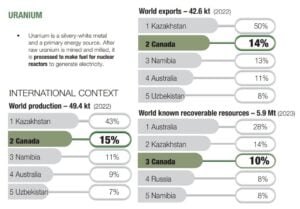
Canada uranium production
Source: Government of Canada

However, no new large mining projects had been approved at the federal level in over two decades before Phoenix. Canada can now boost uranium production. This will help support nuclear fuel supply chains at home and abroad.

The Phoenix mine will create economic benefits. This includes jobs during both construction and operations in northern Saskatchewan. It will also contribute to local tax revenue and community development.

Rising Power Needs Put Nuclear Back in Focus

Nuclear power accounts for a significant share of clean electricity globally. Nuclear reactors produce constant, reliable power that does not depend on weather like wind or solar. Many countries view nuclear energy as critical to meeting climate goals while maintaining grid stability.

As electric grids transition to cleaner energy sources, the demand for uranium — the core fuel for nuclear plants — is rising.

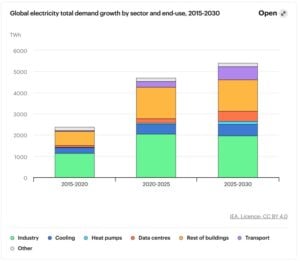
According to the International Energy Agency (IEA), global electricity demand grew by 3 % in 2025, following a 4.4 % increase in 2024. The agency expects demand to rise by about 3.6% each year from 2026 to 2030. This growth will come from industrial use, electrification, electric vehicles, cooling needs, and more data centers.

global electricity demand 2030 IEA
Source: IEA

This growth underscores the need for reliable, low-carbon generation capacity. Nuclear energy is a strong candidate because it supplies large volumes of consistent electricity with low emissions.

Tech Sector Turns to Nuclear for 24/7 Power

As electricity demand grows, especially from data centers, tech companies are focusing on long-term power solutions.

Executives at NexGen Energy, developing Canada’s largest uranium project in Saskatchewan, say they’ve talked with data center providers. They discussed financing uranium mining projects and securing a long-term uranium supply. These talks aim to ensure stable fuel for nuclear plants that could help power future data infrastructure.

CEO Leigh Curyer said,

“It’s coming. You’ve seen it with automakers. These tech companies, they’re under an obligation to ensure the hundreds of billions that they are investing in the data centres are going to be powered.”

NexGen is working on the Rook I uranium project in Saskatchewan’s Athabasca Basin. This area is one of the richest for uranium and hosts Canada’s largest development-stage uranium project.

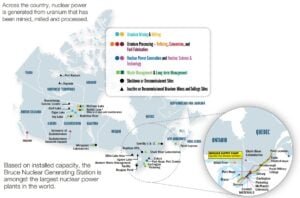
Canada nuclear power generation
Source: Government of Canada

The company anticipates full government approval soon, and it aims for production around 2030. NexGen executives say the mine could supply more than 20 % of global uranium demand once operational.

NexGen’s discussions with data center operators focus on financing and long-term supply agreements. The idea is like car makers investing in battery material mines. They do this to secure vital supplies for electric vehicles.

These talks do not involve giving tech firms any control of NexGen. Instead, they focus on ways to help ensure uranium supply and potentially support early project development.

Why Tech Firms Are Interested in Nuclear Fuel

Modern data centers need a lot of electricity. This is especially true for those supporting AI, cloud computing, and large digital services. Power demand from data centers is a key driver of rising global electricity use, according to the IEA.

Unlike intermittent renewables, nuclear power provides 24/7 electricity that is not affected by weather. This reliability makes it attractive for companies that need stable energy for critical infrastructure.

Some technology firms have already signaled interest in long-term arrangements with nuclear energy providers. These supply arrangements might involve financing for mining, long-term fuel contracts, or offtake agreements when projects start production.

Long-term contracts for uranium can help companies lock in fuel supply for decades. This can reduce risks related to supply shortages or price volatility in commodity markets.The discussions show how energy security and climate goals are intersecting with corporate planning in the tech sector.

Tight Supply and Rising Prices Reshape the Market

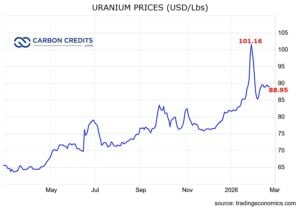
The uranium market has tightened in recent years. Uranium prices have gone up. This rise shows supply issues and increasing interest in nuclear energy. Recent trading values put uranium at almost US$89 per pound, after briefly exceeding US$100 per pound in end of January.

uranium prices

Projections suggest that global nuclear capacity will need more fuel in coming decades as new reactors come online and existing ones are extended. Countries like China and India are expanding nuclear power to meet their growing electricity needs.

In Canada, new mines such as Phoenix and big projects like Rook I can fill global supply gaps. They also support national energy plans.

Global Supply Strain: U.S. and China Reshape the Uranium Market

The scramble for uranium supply is accelerating beyond Canada.

In the United States, a ban on Russian enriched uranium imports will take full effect in January 2028. Russia holds around 44% of the world’s uranium enrichment capacity. In 2023, it provided 27% of U.S. utility enrichment purchases, according to S&P Global Commodity Insights.

To reduce this dependence, the U.S. Department of Energy announced $2.7 billion in task orders to expand domestic enrichment capacity. The funding supports Centrus Energy, General Matter, and Orano Federal Services.

  • Orano got $900 million to build a new enrichment facility in Oak Ridge, Tennessee. They expect to submit a license application in the first half of 2026.

Conversion capacity is also expanding. Solstice Advanced Materials plans to increase uranium conversion output by 20% at its Metropolis Works plant in Illinois. The facility is expected to exceed 10 kilotonnes of UF₆ production in 2026, and it is reportedly sold out through 2030.

At the same time, China’s nuclear buildout is adding pressure to global supply. China operates 58 reactors, with 34 more under construction. Citi Research estimates China’s uranium needs will rise from 35 million pounds in 2025 to 58 million pounds by 2030, equal to about 27% of global demand. Yet, China produces only around 4 million pounds domestically.

Global uranium demand could reach 400 million pounds by 2040, more than double today’s levels. Meanwhile, about 70% of post-2027 uranium requirements remain uncontracted, highlighting the growing supply gap.

uranium production forecast S&P Global

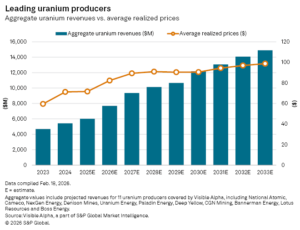
S&P Global expects a uranium market upcycle until 2028, fueled by rising nuclear demand, especially from AI data centers. Global capacity is set to double, reaching 561-992 GW by 2050. Production jumps 141% to 141.2 million pounds by 2033, generating $14.9 billion revenue at $98.7/lb—65% above current prices.

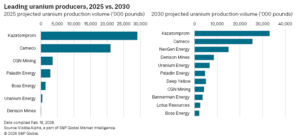
Kazatomprom and Cameco will lead in 2025, generating $5.4 billion in revenue. This accounts for 86% of the group’s output. After 2028, NexGen and Denison will drive the supply wave, peaking at $1.6 billion in capex. Big Tech (Meta, AWS, Google, Microsoft) signs PPAs and equity deals.

uranium production 2030 S&P Global forecast

Nuclear Fuel Security Becomes a Climate Strategy

The approval of a new mine after more than 20 years shows that uranium is regaining importance in global energy planning. The Phoenix ISR project and other potential mines reflect renewed confidence in nuclear fuel production.

Early interest from tech companies in securing uranium supply shows a shift in energy planning. As power demand increases, companies are exploring new clean energy options. They want stable, low-carbon electricity.

For countries pushing decarbonization, nuclear power — supported by a stable uranium supply — offers a path to reduce emissions while meeting baseload electricity demand.

In this context, the Canadian uranium sector is poised for growth. New mines and potential private sector involvement may strengthen nuclear fuel security, supporting both national and global energy transitions.

The post Canada Approves First Uranium Mine in 20 Years as Tech Giants Eye Nuclear Fuel for AI Power appeared first on Carbon Credits.
Surge Battery Metals Strengthens Nevada North With High-Grade Expansion and Infill Success

Surge Battery Metals (TSX-V: NILI | OTCQX: NILIF | FRA: DJ5C) delivered two strong updates from its Nevada North Lithium Project (NNLP) in February 2026. Together, these results confirm expansion potential, reinforce high-grade continuity, and advance technical work needed for the upcoming Pre-Feasibility Study (PFS).

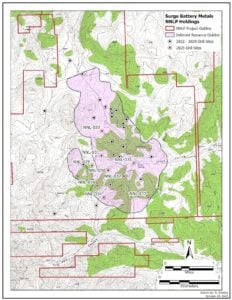
On February 17, Surge reported a major step-out success. The company drilled a 31-meter intercept grading 4,196 ppm lithium from surface in a hole located 640 meters southeast of the existing resource boundary. This intercept sits well above the current resource average grade of 3,010 ppm lithium. The wide step-out confirms that high-grade mineralization extends significantly beyond the defined resource footprint.

Just one week later, on February 25, Surge released the final batch of results from its 2025 core drilling program. These infill holes focused on upgrading inferred resources to higher confidence categories and collecting technical data for the PFS. The results returned some of the strongest intercepts drilled to date.

Together, these two updates strengthen the project’s scale, quality, and development readiness. 

Infill Drilling Confirms a Thick, High-Grade Core

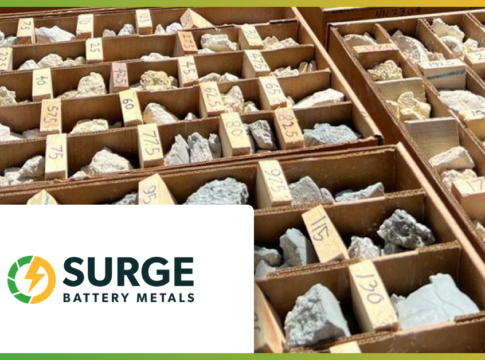
The February 25 news highlighted Hole NNL-030 as a standout result. The hole intersected 116 meters, averaging 3,752 ppm lithium. Within that interval, a 32.1-meter zone graded 4,521 ppm lithium. These grades exceed the project’s current average and confirm the presence of a thick, ultra-high-grade core.

Hole NNL-032 also delivered strong results, returning 82.29 meters, averaging 3,664 ppm lithium. Hole NNL-036 intersected 78.63 meters, averaging 3,141 ppm lithium, including a deep 9.4-meter zone grading 4,580 ppm lithium.

Surge Battery Metals North Nevada drilling results
Source: Surge Battery Metals

These intercepts show both lateral and vertical continuity. They show that high-grade lithium persists across wide widths and at depth. Importantly, most of these zones occur near the surface. Near-surface mineralization reduces stripping requirements and can improve early-year mine economics.

The infill drilling supports resource upgrading efforts. It helps convert Inferred resources into Indicated and Measured categories. Higher confidence categories are critical for mine planning, financing, and permitting.

The results confirm that Nevada North’s high-grade core is consistent, thick, and scalable.

Mr. Greg Reimer, President & Chief Executive Officer and Director of Surge, stated, 

“This infill drilling is doing exactly what it was designed to do: upgrade the resource, confirm continuity of some of our best lithium intercepts, and de-risk the early years of a potential mine plan at Nevada North. Coupled with a robust PEA economic profile, we believe Nevada North is strongly positioned as we move forward with the development of our PFS. We look forward to updating the Mineral Resource Estimate as our next key milestone.”

Expansion Beyond the Current Resource Boundary

The February 17 step-out result adds a new dimension to the project story. The 31-meter intercept grading 4,196 ppm lithium occurred 640 meters beyond the existing resource area. This large extension demonstrates strong mineral continuity outside the current pit-constrained model.

Step-out drilling is important because it tests the limits of a deposit. A successful 640-meter extension suggests the deposit remains open and may support future resource growth.

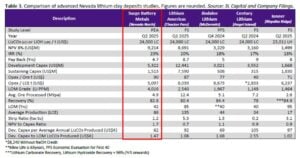
Nevada North already hosts a pit-constrained Inferred Resource of 11.24 million tonnes of lithium carbonate equivalent (LCE) grading 3,010 ppm lithium at a 1,250 ppm cutoff. High-grade step-out intercepts increase confidence that future resource updates may expand both tonnage and overall contained lithium.

Surge Nevada lithium clay comparison

Highly anomalous soil values and geophysical surveys also suggest the clay horizons could extend even further. The mineralized zone currently spans more than 4,300 meters in strike length and over 1,500 meters in width. Continued drilling could increase the overall scale of the project.

This combination of strong infill and wide step-out success strengthens Nevada North’s long-term growth profile.

Advancing Toward Pre-Feasibility and Permitting

The 2025 drilling program did more than confirm grade. It also collected critical technical data required for the upcoming PFS and environmental permitting.

Hole NNL-035 was strategically positioned near Texas Spring to gather hydrogeological data. The hole successfully installed the Vibrating Wire Piezometers (VWPs) to monitor groundwater conditions. This data will help model basin hydrology and support environmental approvals.

The company also completed detailed geotechnical logging across all holes. High-resolution televiewer surveys mapped fault structures. Representative samples from each rock unit are now undergoing rock strength testing. These tests will help determine safe pit wall angles for future mine planning.

Remarkably, quality control procedures were rigorous. Of the 806 total samples analyzed, 134 were QA/QC samples. Certified reference standards, blanks, and duplicates were systematically inserted.

Standards are performed within acceptable limits. Duplicate samples fell within 10% tolerance. These results confirm strong analytical accuracy and reproducibility.

This technical work reduces development risk. This, in turn, ensures that the PFS is built on high-quality geological and engineering data.

Strategic Upside: By-Products and Strong Economics

In addition to lithium, the infill drilling consistently returned elevated cesium and rubidium values. Cesium reached up to 163 ppm and rubidium up to 349 ppm in association with the lithium core. Surge is evaluating the deportment of these elements in ongoing metallurgical studies.

If recoverable, these critical minerals could add value to the project economics. By-product potential can improve revenue streams and enhance overall project returns.

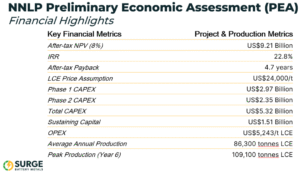
Nevada North already shows strong economic metrics from its Preliminary Economic Assessment. The PEA reports an after-tax NPV (8%) of approximately US$9.17 billion and an after-tax IRR of 22.8% at a lithium price of US$24,000 per tonne LCE. Operating costs are estimated at roughly US$5,243 per tonne LCE.

Surge - NNLP Preliminary Economic Assessment (PEA)

High grades play a central role in these economics. Thick intervals averaging 3,500–4,500 ppm lithium reduce the tonnage required to produce each unit of lithium. This supports lower operating costs and stronger early cash flow potential.

The joint venture with Evolution Mining also strengthens the project’s development pathway. Evolution is a globally recognized mining company with operational expertise. This partnership adds technical depth and financial strength to the Nevada North project.

A Strengthened Position in the U.S. Lithium Landscape

The United States is working to strengthen its domestic lithium supply chain. Federal incentives and policy measures emphasize secure, locally sourced battery materials. Projects that combine high grade, large scale, and technical readiness are well-positioned in this environment.

Nevada North now demonstrates three key strengths at once:

  1. Proven high-grade core through infill drilling,
  2. Expansion potential through 640-meter step-out success, and
  3. Advancing technical data for PFS and permitting.

These updates reinforce Nevada North as one of the highest-grade lithium clay projects in the United States. They show both growth and de-risking in the same drilling campaign.

As global demand for lithium continues to rise, supply sources with strong grade, scale, and development momentum will stand out. Surge Battery Metals’ recent results highlight meaningful progress on all three fronts.

The company’s Nevada North Lithium Project is not only expanding. It is advancing toward higher confidence resources, improved technical definition, and future development milestones. These combined achievements strengthen Surge’s position within the evolving North American lithium supply chain.

DISCLAIMER 

New Era Publishing Inc. and/or CarbonCredits.com (“We” or “Us”) are not securities dealers or brokers, investment advisers, or financial advisers, and you should not rely on the information herein as investment advice. Surge Battery Metals Inc. (“Company”) made a one-time payment of $50,000 to provide marketing services for a term of two months. None of the owners, members, directors, or employees of New Era Publishing Inc. and/or CarbonCredits.com currently hold, or have any beneficial ownership in, any shares, stocks, or options of the companies mentioned.

This article is informational only and is solely for use by prospective investors in determining whether to seek additional information. It does not constitute an offer to sell or a solicitation of an offer to buy any securities. Examples that we provide of share price increases pertaining to a particular issuer from one referenced date to another represent arbitrarily chosen time periods and are no indication whatsoever of future stock prices for that issuer and are of no predictive value.

Our stock profiles are intended to highlight certain companies for your further investigation; they are not stock recommendations or an offer or sale of the referenced securities. The securities issued by the companies we profile should be considered high-risk; if you do invest despite these warnings, you may lose your entire investment. Please do your own research before investing, including reviewing the companies’ SEDAR+ and SEC filings, press releases, and risk disclosures.

It is our policy that information contained in this profile was provided by the company, extracted from SEDAR+ and SEC filings, company websites, and other publicly available sources. We believe the sources and information are accurate and reliable but we cannot guarantee them.

CAUTIONARY STATEMENT AND FORWARD-LOOKING INFORMATION

Certain statements contained in this news release may constitute “forward-looking information” within the meaning of applicable securities laws. Forward-looking information generally can be identified by words such as “anticipate,” “expect,” “estimate,” “forecast,” “plan,” and similar expressions suggesting future outcomes or events. Forward-looking information is based on current expectations of management; however, it is subject to known and unknown risks, uncertainties, and other factors that may cause actual results to differ materially from those anticipated.

These factors include, without limitation, statements relating to the Company’s exploration and development plans, the potential of its mineral projects, financing activities, regulatory approvals, market conditions, and future objectives. Forward-looking information involves numerous risks and uncertainties and actual results might differ materially from results suggested in any forward-looking information. These risks and uncertainties include, among other things, market volatility, the state of financial markets for the Company’s securities, fluctuations in commodity prices, operational challenges, and changes in business plans.

Forward-looking information is based on several key expectations and assumptions, including, without limitation, that the Company will continue with its stated business objectives and will be able to raise additional capital as required. Although management of the Company has attempted to identify important factors that could cause actual results to differ materially, there may be other factors that cause results not to be as anticipated, estimated, or intended.

There can be no assurance that such forward-looking information will prove to be accurate, as actual results and future events could differ materially. Accordingly, readers should not place undue reliance on forward-looking information. Additional information about risks and uncertainties is contained in the Company’s management’s discussion and analysis and annual information form for the year ended December 31, 2024, copies of which are available on SEDAR+ at www.sedarplus.ca.

The forward-looking information contained herein is expressly qualified in its entirety by this cautionary statement. Forward-looking information reflects management’s current beliefs and is based on information currently available to the Company. The forward-looking information is made as of the date of this news release, and the Company assumes no obligation to update or revise such information to reflect new events or circumstances except as may be required by applicable law.

Carboncredits.com receives compensation for this publication and has a business relationship with any company whose stock(s) is/are mentioned in this article.

Additional disclosure: This communication serves the sole purpose of adding value to the research process and is for information only. Please do your own due diligence. Every investment in securities mentioned in publications of carboncredits.com involves risks that could lead to a total loss of the invested capital.

Please read our Full RISKS and DISCLOSURE here.

The post Surge Battery Metals Strengthens Nevada North With High-Grade Expansion and Infill Success appeared first on Carbon Credits.
ENGIE’s Brazil Solar Plant Explores Energy Storage and Bitcoin to Solve Grid Curtailment

ENGIE has officially brought its Assú Sol photovoltaic complex into full commercial operation. The French utility secured final approval from Brazilian authorities on February 13, 2026, after completing construction in December 2025. With a total investment of BRL 3.3 billion, the project now stands as ENGIE’s largest operational solar asset worldwide.

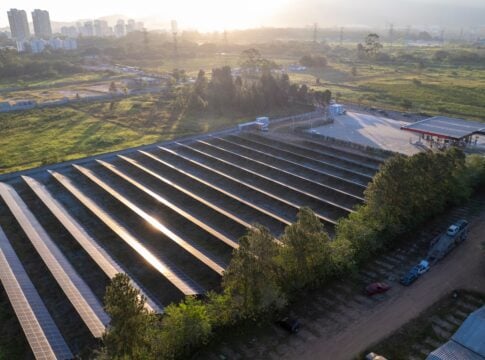
Located in Rio Grande do Norte in northeast Brazil, Assú Sol has an installed capacity of 895 MWp. The complex spans 2,344 hectares and consists of 16 solar plants. At full output, it can generate enough electricity to meet the annual demand of roughly 850,000 people.

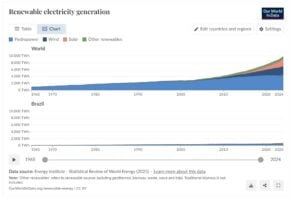
  • In 2025, Brazil added 7.4 GW of new large-scale electricity generation capacity, driven primarily by over 2.81 GW of solar PV, according to the energy regulator Agência Nacional de Energia Elétrica (ANEEL).
  • In August 2025, ABSOLAR reported Brazil’s solar capacity hit 60 GW and forecasted strong distributed generation growth through 2030.

By January 1, 2026, the country’s total large-scale power generation capacity reached 215.9 GW, with renewables accounting for 84.6% of the mix. ANEEL projects a 23.4% increase in renewable capacity in 2026, equivalent to an additional 9.14 GW.

However, while the scale is impressive, the project also reflects a deeper shift underway in Brazil’s renewable energy market.

BRAZIL SOLAR

Assú Sol Delivers at Scale: Advanced Tech Powers Brazil’s Largest Solar Plant

ENGIE completed the project over 30 months, keeping it on schedule and within budget. More than 4,500 direct jobs were created during construction. The development required over 1.5 million solar modules, extensive cabling, and new internal road infrastructure.

Importantly, the company adopted advanced construction technologies. Drone-based aerial mapping improved site planning. Automated graders linked to 3D models enhanced precision. In addition, ENGIE deployed Brazil’s first dedicated automatic pile-driving machine for a solar project.

As a result, execution was faster, safer, and more efficient. Assú Sol demonstrates that large-scale renewables can be delivered with industrial discipline. Yet commissioning marked only the beginning of a more complex challenge.

Assú Sol photovoltaic complex

Assú Sol photovoltaic complex engie
Source: Engie

Curtailment Pressures Test Solar Profitability

Despite reaching full operations, Assú Sol faces curtailment — a structural issue affecting Brazil’s clean energy sector since 2023. Curtailment occurs when renewable plants must reduce output because the grid cannot absorb all available electricity.

Brazil has added wind and solar capacity at record speed. At the same time, electricity demand has grown slowly. Distributed generation, especially rooftop solar, has also expanded rapidly. Consequently, supply often exceeds transmission capacity and real-time demand.

According to Reuters, ENGIE’s Brazil country manager Eduardo Sattamini confirmed that Assú Sol’s production has already been curtailed to balance the grid. Although specific volumes were not disclosed, the impact is material enough to prompt strategic adjustments.

In other words, renewable abundance does not automatically translate into revenue. Infrastructure constraints now shape project economics as much as generation capacity does.

How ENGIE Plans to Use Storage and Bitcoin

Reuters further revealed that to address this imbalance, ENGIE is evaluating two parallel strategies: battery storage and localized demand solutions such as bitcoin mining data centers.

Battery storage provides the most direct fix. By storing excess midday solar output and discharging it during peak demand hours, batteries reduce curtailment and improve grid stability. They also open access to ancillary service markets, strengthening revenue streams.

However, ENGIE is also studying a more unconventional model — using surplus electricity to power bitcoin mining operations. At first glance, the combination may seem unusual. Yet, from an energy economics perspective, it offers several compelling advantages.

Solar farms often produce maximum output during midday, precisely when grid demand can soften. Instead of shutting down generation, operators can redirect excess electricity to mining operations that can scale consumption up or down in real time.

This model delivers multiple strategic benefits.
  • Lower carbon intensity: Solar-powered mining sharply reduces emissions compared to fossil-fuel-based operations, helping reposition crypto infrastructure within a cleaner energy framework.

  • Flexible demand response: Mining facilities can quickly ramp power usage up or down, absorbing excess electricity during peak solar hours and easing pressure during grid stress.

  • Stable long-term energy costs: Solar generation offers predictable operating expenses after initial capital deployment, protecting operators from volatile power markets.
  • Improved asset utilization: Co-locating data centers with large solar plants maximizes land use and monetizes electricity that might otherwise be curtailed.

  • Diversified revenue streams: Developers gain an additional income channel beyond wholesale power sales, strengthening overall project economics.
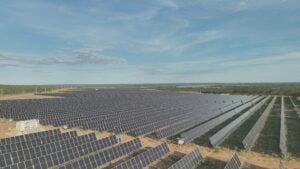
Of course, integration comes with challenges. Both solar infrastructure and mining facilities require significant upfront investment. Moreover, energy supply must remain balanced to avoid operational disruptions. Smart-grid systems and, ideally, battery storage will play a critical role in stabilizing performance.
Sattamini made clear that such initiatives would take time to implement. Nonetheless, the strategy signals an evolution in renewable business models — from pure generation toward integrated energy ecosystems.

Community Development and Long-Term Strategy

The company has also invested in the Assú region’s social infrastructure. It supported the construction of a school, a health center, and sports facilities. It improved access to water and provided agricultural equipment to local communities. Such initiatives enhance local acceptance and reinforce the long-term sustainability of the project.

ENGIE’s Renewable and Storage Capacity Goal

Looking ahead, it aims to reach 95 GW of renewable and storage capacity globally by 2030. More than 80% of its planned capital expenditure aligns with the European Taxonomy framework, focusing on low-carbon generation, infrastructure modernization, green gas, and storage technologies.

The company currently operates 15.7 GW of fully renewable installed capacity across hydropower, wind, and solar assets. It also manages 3,200 kilometers of transmission lines and 22 substations.

Some significant achievements include:

  • In late 2025, ENGIE commissioned the Serra do Assuruá wind complex in Bahia, adding 846 MW of onshore wind capacity.
  • Meanwhile, the Asa Branca transmission project continues to expand grid infrastructure across several states, with more than 1,000 kilometers planned upon completion.
  • Another initiative, the Graúna transmission project, will further strengthen interconnections in southern Brazil.
engie decarbonization
Source: Engie

These investments are critical. Without stronger transmission networks, renewable curtailment will persist. Therefore, grid expansion and flexibility solutions must advance alongside generation growth.

As renewable penetration rises, profitability depends not only on installed megawatts but also on flexibility, storage, and innovative demand-side solutions. In that context, combining solar power with storage or even bitcoin mining may redefine how excess clean energy is valued.

And Assú Sol is part of ENGIE’s broader renewable expansion in Brazil, setting an example for renewable markets facing maturity challenges.

The post ENGIE’s Brazil Solar Plant Explores Energy Storage and Bitcoin to Solve Grid Curtailment appeared first on Carbon Credits.