Trump Inks Rare Earth Deals with Japan and Southeast Asia to Secure Supply Chains

Trump Inks Rare Earth Deals with Japan and Southeast Asia to Secure Supply Chains

U.S. President Donald Trump signed new agreements on rare earth and critical minerals with Japan and some Southeast Asian countries. The deals were finalized during his October 2025 Asia tour. They aim to lower reliance on China, which leads to global production of these key materials.

Rare earth elements are vital for many things, including electric vehicles (EVs), wind turbines, smartphones, and defense systems.

Global demand is rising fast as countries invest more in clean energy and digital technologies. These new partnerships are among the biggest efforts yet to build alternative supply chains for critical minerals.

Japan Deal: Strengthening Industrial and Energy Security

On October 28, 2025, Trump and Japanese Prime Minister Sanae Takaichi signed a key deal. This agreement aims to secure supplies of rare earths, lithium, cobalt, and nickel. The agreement expands past U.S.–Japan cooperation and includes new plans for joint investments, technology sharing, and transparent supply management.

Under the deal, both countries plan to:

  • Build processing and refining plants for rare earths and battery minerals.
  • Create strategic stockpiles and improve recycling systems.
  • Support magnet production for EVs and defense industries.
  • Explore nuclear fuel supply cooperation for next-generation reactors.

Japan still relies on China for about 65% of its rare earth imports, even after years of trying to diversify. The new deal aims to cut this dependence by sourcing from U.S. allies like Australia and Vietnam. Also, it will process materials locally or in partner nations.

China rare earth magnet exports july 2025

The plan supports Japan’s economic security law, which pushes companies to find new material sources. Tokyo has set aside about ¥400 billion (US$2.7 billion) in funding to help domestic rare earth and battery material projects through 2027.

Southeast Asia: Expanding the Network Beyond China

Trump also announced new cooperation deals with Malaysia, Vietnam, Thailand, Cambodia, and Indonesia. These countries hold key mineral reserves and play important roles in regional trade.

Malaysia already operates one of the world’s few large rare-earth processing plants outside China. Vietnam has about 22 million tonnes of rare-earth reserves, second only to China. Indonesia and Thailand are major producers of nickel and tin, vital for EV batteries.

The Southeast Asia deals aim to:

  • Bring in U.S. and Japanese investments for mining and refining projects.
  • Train local workers and improve technical skills.
  • Cut tariffs and export barriers that slow regional trade.
  • Support cleaner and safer mining technologies under ESG standards.

Experts say these efforts could create an “Indo-Pacific mineral corridor.” This would link mines in Australia, processors in Southeast Asia, and manufacturers in Japan. This network would help reduce China’s control over the middle stages of the supply chain.

Why Rare Earths Matter: A Market Under Strain

Rare earths are a group of 17 metals used in many high-tech and clean energy products. The most valuable are neodymium, praseodymium, and dysprosium. These elements are essential for strong magnets used in EV motors, drones, and wind turbines.

China controls around 60–70% of mining and 85–90% of refining for rare earths. This gives Beijing major influence over countries that depend on these materials.

China rare earth mining and refining
Note: Data as of 2025, based on 2025 market assessments from the International Energy Agency (IEA) and the U.S. Geological Survey (USGS)

In 2024, the world produced about 350,000 tonnes of rare earth materials. The International Energy Agency (IEA) expects demand to reach over 500,000 tonnes by 2030. Market value could rise from $13 billion in 2024 to over $25 billion by 2030.

The U.S. currently makes about 12% of global rare earth ore, mostly from the Mountain Pass mine in California. However, much of it is still sent to China for processing. That dependence makes the new deals with Japan and Southeast Asia even more important.

Strategic and Economic Significance

For the United States, these deals mark a new stage in mineral diplomacy. Washington aims to safeguard clean energy and defense industries. It plans to do this by securing long-term supply agreements in Asia to help protect against disruptions.

Japan gains stronger support for its automotive, electronics, and robotics sectors. The country is restarting its rare earth recycling programs. These programs slowed down after Chinese export limits in 2010 made prices rise sharply.

For Southeast Asian nations, the agreements promise foreign investment, new jobs, and technology sharing. Malaysia and Vietnam might become key centers for refining and magnet production. This could create jobs for thousands of skilled workers.

The deals also back U.S. efforts to counter China’s export restrictions. In 2024, China limited exports of gallium, germanium, and certain rare earth magnets for “national security” reasons. Those actions disrupted supply chains and forced manufacturers in Japan, Europe, and the U.S. to look elsewhere for materials.

Rare Earth Market Outlook: Rising Demand, Tight Supply

Demand for rare earth magnets, especially neodymium-iron-boron (NdFeB) magnets, might triple by 2035. This rise is fueled by electric vehicles (EVs) and wind turbines. Each electric vehicle needs 1–2 kilograms of these magnets, while one offshore wind turbine can use up to 600 kilograms.

rare earth demand and supply
Source: McKinsey

The price of neodymium oxide has climbed from about US$70 per kg in 2020 to more than US$120 per kg in 2025, showing strong pressure on supply. China’s quota limits and environmental checks have made availability uncertain.

The U.S., Japan, and the European Union are expanding recycling programs. They aim to recover rare earths from old motors and electronics. This helps reduce reliance on mined materials. Yet, recycling currently provides less than 5% of total global demand.

The Cost of Breaking Free from China

Building alternative supply chains is difficult. Several challenges include:

  • High costs: Rare-earth plants are expensive and take years to build.
  • Environmental risks: Poor waste management can pollute water and soil.
  • Financing issues: Price swings make investors cautious.
  • Geopolitical tensions: China may respond by lowering prices or tightening exports.

Experts say that without strong government support, new producers may not compete with China’s scale and low costs. Both the U.S. and Japan are studying tax credits and loan programs to help new projects move forward.

Forging a New Indo-Pacific Supply Chain

These rare earth agreements send a clear message: the U.S. and its allies want to reshape global supply chains around trusted partners. The next steps include choosing priority projects, securing funding, and coordinating trade rules.

If successful, these efforts could shift 15–20% of global refining capacity away from China by the early 2030s. That would mark the biggest industry shift in decades.

For the U.S., Japan, and Southeast Asia, the deals combine economic security, industrial growth, and clean energy goals. They also show how the energy transition and geopolitics are now closely linked.

In the long run, building diverse and stable rare earth supply chains could make clean energy industries stronger and less dependent on any single country.

The post Trump Inks Rare Earth Deals with Japan and Southeast Asia to Secure Supply Chains appeared first on Carbon Credits.

Microsoft Seals 10-Year Arca Carbon Deal Ahead of Earnings Beat and Record Profits

Microsoft Seals 10-Year Arca Carbon Deal Ahead of Earnings Beat and Record Profits

Microsoft has signed a 10-year carbon removal agreement with Arca, a Canadian startup that turns mine waste into carbon storage. The partnership backs Microsoft’s goal to be carbon negative by 2030. It also helps Arca grow its natural mineralization technology.

The deal came just before Microsoft reported $77.7 billion in revenue for the first quarter of fiscal 2026, an 18% increase from a year earlier. Operating income also rose 24% and net income increased by 12%.

Despite the strong results, Microsoft’s stock fell about 3% after the earnings release. Investors are becoming cautious about spending more on data centers, AI infrastructure, and OpenAI costs.

Yet, Microsoft’s financial strength allows it to support big climate and energy projects, like the Arca deal. This shows how the company connects AI growth with long-term sustainability goals.

Turning Mine Waste into Carbon Storage

Arca uses a process called mineralization, which captures CO₂ by reacting it with magnesium-rich mine waste. This reaction forms stable carbonates, permanently locking carbon in solid rock.

The company works with mining firms that produce waste materials such as nickel, cobalt, and platinum tailings. These minerals naturally react with CO₂, but Arca speeds up the process using technology developed in Canada.

The captured carbon can stay stored for thousands of years, making it one of the most durable forms of carbon removal. The process also helps mining sites lower emissions and improve environmental performance.

Arca’s CEO, Paul Needham, said the Microsoft deal gives the company long-term stability to grow and reach more industrial partners. It also strengthens Arca’s position as a global leader in geology-based carbon storage, noting:

“This agreement with Microsoft validates Industrial Mineralization as a viable pathway for durable carbon removal with the potential to scale and meaningfully contribute to global climate goals.”

Microsoft’s Path to Carbon Negativity

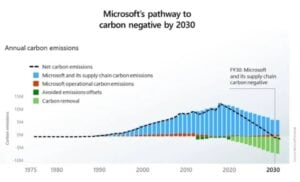
Microsoft first pledged in 2020 to become carbon negative by 2030, meaning it will remove more carbon from the air than it emits. By 2050, it aims to erase all historical emissions since its founding in 1975.

Microsoft emissions
Source: Microsoft

The company is one of the largest corporate buyers of carbon removal. It has signed contracts with companies like Heirloom, Climeworks, and Running Tide. They use a mix of direct air capture (DAC), biomass, and ocean-based methods.

As of 2024, Microsoft reported cutting its Scope 1 and 2 emissions by 22% from 2020 levels. However, Scope 3 emissions — those from supply chains and product use — still make up over 95% of its total footprint.

Microsoft carbon emissions
Source: Microsoft

To meet its targets, Microsoft is combining renewable energy investments with durable carbon removal projects such as Arca’s. Following this deal, the tech giant reported its Q1 2026 financial results.

Microsoft’s Latest Earnings: Strong Results, But Shares Slip

Microsoft reported strong first-quarter fiscal 2026 results. Revenue rose 18% to $77.7 billion. Operating income grew 24% to $38.0 billion. Net income was $27.7 billion, up 12%. Profit also climbed to $30.8 billion, up 22%.

Microsoft Cloud revenue hit $49.1 billion, up 26%, and Azure and other cloud services grew 40%. The company returned $10.7 billion to shareholders through buybacks and dividends.

Microsoft earnings q1 2026 results
Source: Microsoft

Despite the beats, Microsoft’s shares dropped roughly 3% in extended trading. Traders flagged three main worries.

  • First, Microsoft raised its investment profile — management signalled higher capital spending to build more data centers and AI infrastructure.
  • Second, the company disclosed a $3.1 billion hit related to its OpenAI investments that lowered reported earnings.
  • Third, investors flagged margin pressure and possible capacity limits as cloud demand keeps rising.

These factors tempered the market’s initial enthusiasm, even as core business metrics beat expectations.

Microsoft stock price

Meeting AI’s Growing Energy Demands

Microsoft’s AI and cloud services require large amounts of energy. As its Azure platform and data centers expand, electricity demand keeps climbing.

Global data centers used about 415 terawatt-hours (TWh) of power in 2024, equal to roughly 1.5% of total global use. By 2030, that number could rise to 945 TWh, more than double current levels. AI computing will likely drive much of that growth.

To balance this, Microsoft is investing in clean and firm power sources such as nuclear, wind, solar, and geothermal. The company is also studying small modular reactors (SMRs) to power future data centers.

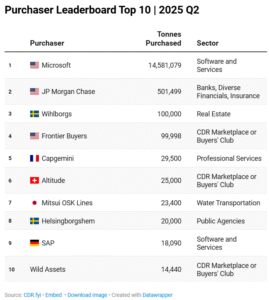
The deal with Arca adds another tool to help offset emissions from AI expansion. Microsoft is expanding its climate strategy. It’s now focusing on permanent carbon removal, not just renewables. It remains the top buyer of durable carbon removal in the second quarter of this year.carbon removal purchaser Leaderboard Top 10

SEE MORE: Microsoft (MSFT Stock) Tops Q2 2025 Record-Breaking Surge in Durable Carbon Removal Credit Purchases

Arca’s Role in the Growing Carbon Removal Market

The global carbon removal market remains small but is growing fast. Experts say that by 2030, companies will need to remove at least 1 billion tonnes of CO₂ each year to meet climate goals. Today, only about 5 million tonnes of verified removals exist globally — meaning the market must expand hundreds of times.

Arca’s mineralization process is highly scalable. It uses abundant mining waste instead of new raw materials. Pilot projects in British Columbia and Ontario have shown good results. So, new facilities are planned all over North America.

The Microsoft deal gives Arca both credibility and financial backing to grow faster. Funds will help build larger operations, improve carbon measurement, and expand partnerships with mining companies globally.

Economic and Environmental Impact

For Arca, this deal marks a major step in scaling a once experimental process. It proves that natural mineralization can attract big corporate buyers and investors. It also highlights Canada’s leadership in carbon management and clean mining innovation.

The Honourable Tim Hodgson, Minister of Energy and Natural Resources, commented:

“The next generation of clean growth will be built by Canada’s first-class innovation ecosystem – companies like Arca, which are turning Canadian ingenuity into global leadership. Carbon removal technologies are not only strategic tools we can use to tackle climate change, they create good jobs and position Canada at the forefront of the global opportunity of a low-carbon economy.”

The deal helps Microsoft balance the environmental costs of its AI and cloud growth. It also supports its carbon removal efforts. Every tonne of CO₂ removed will be verified and stored permanently. This follows the Science Based Targets initiative (SBTi) standards.

A Broader Shift Toward Permanent Carbon Removal

Tech giants like Google, Meta, and Shopify have signed similar long-term deals with carbon removal startups. These contracts give small companies predictable income, helping them scale and lower costs over time.

Analysts think the carbon removal market might reach $50–100 billion a year by 2030. This growth will depend on policy support and corporate buyer demand. 

Both companies see this partnership as a model for combining technology, industry, and nature to fight climate change. For Microsoft, it is a key step in cleaning up emissions from its fast-growing AI business. For Arca, it provides a launchpad for global expansion and further innovation.

As more companies race toward net-zero goals, the demand for reliable and permanent carbon removal will keep rising. The Microsoft–Arca deal shows that tackling climate change can also drive new business opportunities where sustainability and growth can work hand in hand.

The post Microsoft Seals 10-Year Arca Carbon Deal Ahead of Earnings Beat and Record Profits appeared first on Carbon Credits.

BYD Sales Surges 272% in European Union as Tesla Slumps

BYD Sales Surges 272% in European Union as Tesla Slumps

Chinese automaker BYD continues its fast global expansion. In September 2025, the company’s sales in the European Union (EU) soared by 272 percent. In contrast, Tesla’s sales fell by 10.5 percent. This data comes from the European Automobile Manufacturers’ Association. The sharp contrast shows how BYD’s pricing strategy is reshaping the EV market and forcing global rivals to respond.

Pricing Power Drives Market Gains

In one year, BYD’s EU market share climbed from 0.4% to 1.5%. The company sold 13,221 vehicles in September, compared with Tesla’s 25,656. BYD has outsold Tesla in global battery-electric vehicles for four quarters in a row. It leads by about 388,000 units as of Q3 2025.

In the United Kingdom, BYD’s Dolphin Surf starts at £18,650, less than half the cost of a Tesla Model 3 at around £39,000. The price gap has opened the EV market to more consumers and pushed sales up tenfold year-over-year to 11,271 units in September 2025.

Analysts say BYD’s strategy is similar to the smartphone boom in the 2010s. Back then, Chinese brands gained global market share by offering high performance at lower prices. The same pattern is emerging in autos: BYD is now the top-selling car brand in Singapore, competing directly with Toyota and Hyundai.

The Secret Sauce: Vertical Integration at Scale

BYD builds about 75 to 80% of its vehicle components internally. It produces batteries, motors, semiconductors, and even its own car platforms. This level of vertical integration gives BYD three main advantages:

  • Lower costs by avoiding outside suppliers.
  • Supply-chain control, reducing risks from material shortages.
  • Faster innovation in battery and power systems.

At the center of this is BYD’s Blade Battery, a lithium-iron-phosphate (LFP) design known for safety and durability. Its cost advantage is about €10 per kWh compared with nickel-cobalt batteries used by many rivals.

The new second-generation Blade Battery will launch in 2025. It aims for 200 Wh/kg of energy density. With just five minutes of charging, it will add 400 kilometers of range.

BYD and others charging time

BYD has also secured lithium mining rights to ensure supply. It also operates the world’s largest car-carrier ship, which can move 9,200 vehicles at a time. This control helps the company keep prices low. It also maintains profit margins above industry averages.

Trade Barriers and Global Headwinds

Behind its strong performance, BYD still faces challenges abroad. The European Union started imposing anti-dumping tariffs of up to 45.3% on Chinese electric cars in 2024. They argued that state subsidies provide unfair advantages. In the United States, 25% tariffs and strict origin rules keep Chinese automakers out of the market.

To manage these barriers, BYD is building local factories. Its Hungary plant, set to open by the end of 2025, will have an annual capacity of 800,000 units and supply European markets directly.

Even with local production, BYD needs to price vehicles at about three times their China prices. This is necessary to remain competitive in Europe, where labor and logistics costs are higher.

At home, the company also faces slower growth. In September 2025, BYD delivered 393,060 vehicles, down from 419,000 a year earlier—its first monthly drop in years.

Analysts link this to domestic market saturation and stronger competition from rivals such as NIO, Xpeng, and Geely. To offset this, BYD is accelerating global expansion: 200,000 of its 1 million Q1 2025 sales came from overseas markets.

EV Market Outlook: Demand Still Accelerating

Worldwide, electric-vehicle sales are still climbing. The International Energy Agency (IEA) projects global EV sales will reach 17 million units in 2025, up from about 14 million in 2024. EVs could make up 45% of new car sales by 2030, driven by lower battery costs and stronger climate policies.

EV sales share by region 2030 IEA

Average battery pack prices dropped from US$151 per kWh in 2022 to about US$110 per kWh in 2025. They might fall below US$80 by 2030. This makes EVs cheaper than many gasoline cars.

BYD’s strong control over its supply chain positions it well to benefit from these trends. Its strategy of providing affordable electric and plug-in hybrid models allows it to adapt as markets shift at different speeds toward full electrification.

The Chinese carmaker outpaced Tesla in global pure electric vehicle sales in 2025. From January to September, BYD sold about 1.61 million units. This is 388,000 more than Tesla’s 1.22 million. BYD is expected to exceed 2 million sales in 2025, while Tesla needs a 50% increase in Q4 to match this milestone.

BYD global sales vs tesla

BYD’s Financial Engine Keeps Humming

In 2024, BYD reported 777 billion yuan (US$107 billion) in revenue, up about 43% year-on-year. Net profit grew to roughly 30 billion yuan (US$4 billion). Margins improved thanks to internal battery production and steady demand across Asia and Europe.

BYD’s stock has reflected this growth but remains sensitive to policy news and trade developments. Analysts note that even small tariff changes or currency shifts can move the share price quickly.

Still, the company’s global EV leadership and diversified product lineup—spanning cars, buses, and trucks—offer long-term resilience.

BYD stock price BYDDY
Source: Yahoo Finance

Technology and Future Strategy

BYD continues to invest in next-generation batteries and solid-state chemistry. It is also expanding its plug-in hybrid (DM-i) models, which now account for nearly half of its domestic sales. These hybrids use smaller batteries but deliver very high fuel efficiency, appealing to consumers who are not yet ready for full EVs.

The company is focusing on software and self-driving systems. They aim to add AI features that compete with Western automakers. Its partnerships with ride-hailing firms in Asia and Europe could open new revenue streams in electric mobility services.

What’s Next for BYD — and the Industry?

Investors will keep an eye on several factors:

  • Tariff impacts in Europe and potential U.S. policy changes.
  • Battery-cost trends, which influence margins.
  • Domestic competition in China, especially in the mid-price EV segment.
  • Exchange-rate movements that affect export pricing.

Short-term risks exist, but BYD stands out in the EV market. Its vertical integration, cost leadership, and global presence boost its strength.

BYD’s rapid rise reflects a global shift in the auto industry. The company has combined low prices, in-house technology, and global reach. This mix has made established brands rethink their strategies. Even with trade hurdles, it remains on track to expand production, open new factories, and compete head-to-head with Tesla and legacy automakers worldwide.

If current growth trends hold, BYD may deliver over 5 million vehicles each year by 2026. Exports will make up an increasing portion of that total. For investors, the company represents both opportunity and volatility—an EV leader pushing the limits of cost, scale, and innovation in the race toward a fully electric future.

The post BYD Sales Surges 272% in European Union as Tesla Slumps appeared first on Carbon Credits.
Nevada Lithium Hub: Why Surge Battery Metals Holds the Key to U.S. EV Independence

Nevada Lithium Hub, Why Surge Battery Metals Holds the Key to U.S. EV Independence

Disseminated on behalf of Surge Battery Metals Inc.

Nevada is known for its wide deserts and rich mining history. Today, it is earning a new reputation – as the center of America’s electric vehicle (EV) and battery revolution. The state now produces over 80% of all lithium mined in the U.S., and its output is growing fast.

Nevada’s lithium industry is vital to the nation’s clean-energy goals. In 2025, the state is expected to produce between 25,000 and 40,000 tonnes of lithium carbonate equivalent (LCE), with production growing at an annual rate of about 40% as new projects begin operations. This growth is supported by a surge of new investment and innovation—from lithium mining to advanced battery manufacturing.

Lithium is at the core of this transformation. It is the key metal that powers EVs, grid batteries, and renewable energy systems. As global demand continues to soar, developing a steady domestic supply has become a top U.S. priority. 

For the country, it is both an economic and an energy security issue. Nevada is becoming the cornerstone of that vision, with its mineral potential, strong infrastructure, and mining-friendly policies. 

Growing Demand for Domestic Lithium

Global lithium demand is expanding rapidly. The International Energy Agency (IEA) projects it will increase nearly fivefold by 2040, driven by the global shift to EVs and clean-energy storage. The world’s total known lithium resources now exceed 115 million tonnes, while the U.S. holds about 19 million tonnes—mostly in Nevada and California.

lithium demand outlook IEA
Source: IEA

Even so, the U.S. still imports most of its lithium. Domestic production makes up less than 2% of global supply, leaving the country dependent on imports from Chile, Australia, and China. This creates major risks for automakers and energy companies that rely on steady, affordable lithium.

To meet its clean-energy goals, the U.S. must grow its domestic lithium base fast. Nevada’s large claystone and brine deposits make it the natural hub for that expansion. The state’s deposits are unique in both size and accessibility, giving it a strong edge in supplying the raw materials for EV batteries.

Introducing Surge Battery Metals and the Nevada North Lithium Project

At the center of this growth is Surge Battery Metals. The company’s main project, the Nevada North Lithium Project (NNLP) in Elko County, represents one of the highest-grade lithium clay deposits in the U.S.

Nevada North Lithium Project (NNLP)
Source: Surge Battery Metals

According to its latest resource estimates, NNLP holds 11.2 million tonnes of lithium carbonate equivalent (LCE) at an average grade of 3,010 parts per million (ppm) lithium. This grade is higher than most comparable projects across North America.

Surge’s Preliminary Economic Assessment (PEA) highlights strong numbers:

  • Post-tax Net Present Value (NPV8): US$9.2 billion
  • Internal Rate of Return (IRR): 22.8%
  • Operating cost: US$5,097/t LCE
  • Mine life: 42 years

NNLP Preliminary Economic Assessment (PEA)

The project is located only 13 kilometers from major power lines and has all-season road access. It has received a Record of Decision and a Finding of No Significant Impact (FONSI) from the Bureau of Land Management (BLM), allowing expansion across 250 acres. With these clearances in place, Surge is years ahead of many early-stage lithium explorers.

Nevada’s Role in Building the U.S. EV Supply Chain

Nevada’s geography and infrastructure make it the ideal base for America’s EV supply chain. The state hosts both lithium claystone deposits in the north and brine basins in the south. This creates multiple sources for battery materials. It is also close to key automotive and battery hubs in California and Arizona, as well as Tesla’s Gigafactory in Sparks.

This location advantage saves both time and money. Lithium mined in Nevada can be refined, processed, and shipped to nearby gigafactories—all within a few hundred miles. 

Compared with importing from overseas, this can reduce transport emissions by up to 70% and cut logistics costs significantly. The shorter distances also lower the carbon footprint of battery production, aligning with U.S. clean-energy policies.

Nevada’s mining and manufacturing sectors are now creating thousands of new jobs and drawing billions in private investment. Projects like the US$1 billion Lyten sulfur battery plant in Reno highlight how the state is becoming a full-scale clean-energy hub, from raw materials to finished batteries.

Surge Battery Metals fits right into this ecosystem. Its Nevada North project could provide the lithium feedstock for future gigafactories, supporting the U.S. plan to localize the entire EV battery supply chain—from mining and processing to assembly and recycling.

Strengthening U.S. Energy Security

By advancing NNLP, Surge Battery Metals directly supports national efforts to secure critical minerals. Producing high-grade lithium within U.S. borders reduces dependency on foreign supply chains and increases resilience against global market shocks.

Unlike imported materials that pass through multiple countries, lithium from Nevada can move straight from mine to factory under stable U.S. regulations. This local sourcing helps ensure long-term supply reliability for automakers while boosting domestic job creation.

Surge Battery Metals also follows environmental, social, and governance (ESG) best practices. Lithium clay mining uses less water and creates lower carbon emissions than many traditional methods. 

The company plans to integrate water recycling and land reclamation into its operations to minimize impacts on nearby ecosystems. As environmental scrutiny grows, such responsible practices make projects like NNLP more attractive to both investors and manufacturers seeking sustainable materials.

Challenges, Opportunities, and the Road to EV Independence

Nevada’s lithium boom presents both opportunities and hurdles. Developers must continue working closely with local communities and regulators to manage water use and protect land resources. 

Battery-grade lithium production requires careful processing, and achieving consistent 99.9% purity – a goal Surge is testing toward – takes time and investment.

Market volatility remains a factor. Lithium prices have been fluctuating. In 2025, it moved between US$8,300 and US$11,525 per tonne, reflecting tight supply and demand cycles. Yet analysts expect strong long-term growth as EV adoption continues worldwide.

Nevada’s emerging lithium industry offers a rare chance to strengthen U.S. energy independence while creating thousands of high-tech jobs. For investors, it represents both a challenge and an opportunity – a chance to help build a fully domestic clean energy economy.

The push for EV independence is about building cars as well as securing the materials that power them. Nevada is leading that effort, combining resource strength, infrastructure, and innovation.

Surge Battery Metals’ Nevada North Lithium Project embodies this shift. With a high-grade resource, strong economics, and a strategic Nevada location, the company is positioned to become a key supplier in America’s energy transition.

DISCLAIMER 

New Era Publishing Inc. and/or CarbonCredits.com (“We” or “Us”) are not securities dealers or brokers, investment advisers, or financial advisers, and you should not rely on the information herein as investment advice. Surge Battery Metals Inc. (“Company”) made a one-time payment of $50,000 to provide marketing services for a term of two months. None of the owners, members, directors, or employees of New Era Publishing Inc. and/or CarbonCredits.com currently hold, or have any beneficial ownership in, any shares, stocks, or options of the companies mentioned.

This article is informational only and is solely for use by prospective investors in determining whether to seek additional information. It does not constitute an offer to sell or a solicitation of an offer to buy any securities. Examples that we provide of share price increases pertaining to a particular issuer from one referenced date to another represent arbitrarily chosen time periods and are no indication whatsoever of future stock prices for that issuer and are of no predictive value.

Our stock profiles are intended to highlight certain companies for your further investigation; they are not stock recommendations or an offer or sale of the referenced securities. The securities issued by the companies we profile should be considered high-risk; if you do invest despite these warnings, you may lose your entire investment. Please do your own research before investing, including reviewing the companies’ SEDAR+ and SEC filings, press releases, and risk disclosures.

It is our policy that information contained in this profile was provided by the company, extracted from SEDAR+ and SEC filings, company websites, and other publicly available sources. We believe the sources and information are accurate and reliable but we cannot guarantee them.

CAUTIONARY STATEMENT AND FORWARD-LOOKING INFORMATION

Certain statements contained in this news release may constitute “forward-looking information” within the meaning of applicable securities laws. Forward-looking information generally can be identified by words such as “anticipate,” “expect,” “estimate,” “forecast,” “plan,” and similar expressions suggesting future outcomes or events. Forward-looking information is based on current expectations of management; however, it is subject to known and unknown risks, uncertainties, and other factors that may cause actual results to differ materially from those anticipated.

These factors include, without limitation, statements relating to the Company’s exploration and development plans, the potential of its mineral projects, financing activities, regulatory approvals, market conditions, and future objectives. Forward-looking information involves numerous risks and uncertainties and actual results might differ materially from results suggested in any forward-looking information. These risks and uncertainties include, among other things, market volatility, the state of financial markets for the Company’s securities, fluctuations in commodity prices, operational challenges, and changes in business plans.

Forward-looking information is based on several key expectations and assumptions, including, without limitation, that the Company will continue with its stated business objectives and will be able to raise additional capital as required. Although management of the Company has attempted to identify important factors that could cause actual results to differ materially, there may be other factors that cause results not to be as anticipated, estimated, or intended.

There can be no assurance that such forward-looking information will prove to be accurate, as actual results and future events could differ materially. Accordingly, readers should not place undue reliance on forward-looking information. Additional information about risks and uncertainties is contained in the Company’s management’s discussion and analysis and annual information form for the year ended December 31, 2024, copies of which are available on SEDAR+ at www.sedarplus.ca.

The forward-looking information contained herein is expressly qualified in its entirety by this cautionary statement. Forward-looking information reflects management’s current beliefs and is based on information currently available to the Company. The forward-looking information is made as of the date of this news release, and the Company assumes no obligation to update or revise such information to reflect new events or circumstances except as may be required by applicable law.

For more information on the Company, investors should review the Company’s continuous disclosure filings available on SEDAR+ at www.sedarplus.ca.

The post Nevada Lithium Hub: Why Surge Battery Metals Holds the Key to U.S. EV Independence appeared first on Carbon Credits.

Pony.ai and WeRide File Hong Kong IPOs as China’s Robotaxi Market Takes Off

Pony.ai and WeRide File Hong Kong IPOs as China’s Robotaxi Market Takes Off

Two of China’s top driverless car companies, Pony.ai and WeRide, have applied to list their shares in Hong Kong. This marks a major step for China’s autonomous vehicle (AV) industry as it seeks global recognition and funding. The twin IPO filings show how far the country’s robotaxi and self-driving technologies have advanced, and how investors are beginning to take them seriously.

IPO Details and Plans: Billions at Stake in the Driverless Race

Pony.ai, based in Guangzhou, plans to offer around 42 million Class A shares in its global offering, including a small portion to Hong Kong retail investors. The company’s maximum offer price is about HK$180 (roughly US$23) per share, which could value it at more than US$10 billion.

WeRide, also based in Guangzhou, aims to issue about 88 million shares at up to HK$35 each. Its total valuation could reach several billion dollars, depending on final pricing. Both listings are expected to take place on the Hong Kong Stock Exchange in early November 2025.

The filings follow regulatory approval from China’s securities regulator, which has been cautious about allowing tech companies to list abroad. Both firms are among the first autonomous-driving startups to receive the green light for an overseas IPO since 2023.

Why These IPOs Matter

The twin listings mark a turning point for China’s driverless tech sector. For years, companies like Pony.ai and WeRide relied on venture capital to fund expensive research and testing. Going public gives them access to new capital to expand fleets, build partnerships, and improve AI systems.

The move also reflects China’s growing ambition to lead in driverless mobility. While U.S. players like Waymo and Cruise have faced setbacks, Chinese developers are pushing ahead with pilot robotaxi services in major cities. Both Pony.ai and WeRide already hold licenses to operate driverless rides in parts of Beijing, Guangzhou, and Shanghai.

Public listings also help build transparency and investor confidence. For a young industry that has long been seen as futuristic and risky, IPOs show that companies believe they are close to commercial scale.

By the Numbers: Key IPO Metrics

Some of the main data points from the filings include:

  • Pony.ai’s estimated valuation: Over US$10 billion.
  • Pony.ai shares offered: 42 million Class A shares.
  • WeRide shares offered: About 88 million shares.
  • WeRide’s Q2 2025 revenue: ¥127 million (about US$18 million).
  • WeRide’s Q2 2025 net loss: ¥406 million (about US$57 million).

While both firms continue to post losses, their revenue growth shows increasing demand for pilot robotaxi services and partnerships with automakers.

Company Background and Performance

Pony.ai was founded in 2016 and quickly became one of China’s most valuable AV startups. It operates driverless taxis, freight trucks, and test vehicles in China, the United States, and several other regions.

The company plans to expand its fleet from about 250 vehicles to over 1,000 by 2025. It has received investment from Toyota and other global carmakers.

WeRide was founded in 2017 and focuses on robotaxis, robobuses, and self-driving vans. It has already completed more than 30 million autonomous kilometers in testing and public operations.

In the second quarter of 2025, WeRide reported revenue of around ¥127 million (about US$18 million), up 60 percent from the same period last year. Despite the growth, it posted a net loss of about ¥406 million as it continues to invest in development.

Both companies face heavy competition from domestic rivals like Baidu’s Apollo Go and international peers such as Waymo, Motional, and Cruise. The key challenge for all is finding a clear path to profitability in a market where hardware, mapping, and AI costs remain high.

Robotaxis on the Rise: Market Forecasts and Growth Drivers

The global robotaxi market is still young but growing quickly. Analysts estimate that the total market value for autonomous driving services could reach US$60 billion to US$70 billion by 2030.

robotaxi market forecast 2030
Source: Grand View Research

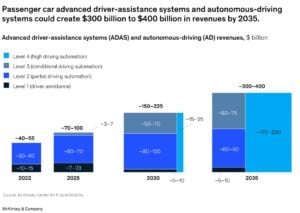
McKinsey estimates that advanced driving (AD) and driver-assistance (ADAS) systems could bring in US$300–400 billion each year by 2035. Vehicles with Level 2+ automation typically include US$1,500–2,000 in component costs, while Level 3 and Level 4 systems cost even more.

Moreover, consumer demand for smart driving features is rising. More commercial models are adopting them. So, the market for autonomous technology is on track to be one of the auto industry’s biggest growth areas.

autonomous driving revenue 2035

China could lead this growth. The country’s large cities, dense traffic, and strong government support for AI testing make it an ideal environment for scaling driverless fleets. Industry data shows that more than 20 Chinese cities now allow robotaxi testing or limited paid rides.

By 2030, China’s robotaxi sector could handle hundreds of millions of rides per year, potentially replacing a portion of traditional ride-hailing services. Consultancy forecasts suggest that robotaxis could account for 5% to 10% of all urban rides in major Chinese cities by the end of the decade.

Global automakers and tech companies are also watching closely. Toyota, Volkswagen, and Hyundai have all invested in autonomous-driving startups.

The rise of AI and electric vehicles is driving convergence between the auto and tech industries. This makes driverless transport one of the next big technology frontiers.

The chart below indicates that early growth will be slow as companies complete testing, secure permits, and scale their fleets. Once safety records improve and regulations ease, adoption will speed up, driven by cost savings, AI advancements, and public acceptance. After this rapid expansion, growth is likely to level off as the market matures and competition increases.

Robotaxi Market Forecast to 2030, China vs Global

The Roadblocks Ahead

Amid rapid progress, driverless mobility still faces big challenges. The technology is expensive, requiring advanced sensors, lidar systems, and high-precision maps. Safety remains a concern, with each incident drawing public scrutiny and slowing adoption.

Regulation also varies by region. Some Chinese cities allow fully autonomous operation, while others limit it to specific zones or hours. International expansion adds more complexity, as each country has its own testing rules and data-sharing policies.

Another major hurdle is profitability. Many experts say it could take until the late 2020s before most robotaxi operators achieve positive margins. Until then, they will need continued investment to cover R&D and fleet expansion.

Industry Outlook: Why Investors Are Watching Closely

For investors, Pony.ai and WeRide’s IPOs offer an early opportunity to enter the driverless-car market through publicly traded shares. The listings also set a benchmark for valuing future AV firms. 

For the industry, these IPOs symbolize maturity. They show that China’s autonomous-driving sector is confident enough to open its books and attract global investors. Success could encourage more companies — in lidar, battery tech, or mobility software — to follow suit.

Investors will closely watch how quickly Pony.ai and WeRide can scale their fleets, control losses, and turn pilot projects into profitable transport networks. 

Pony.ai and WeRide’s Hong Kong IPO filings signal a new phase for China’s driverless vehicle industry. The twin listings bring visibility and funding to two of the world’s most advanced AV developers.

They also highlight China’s ambition to lead in autonomous mobility — a field that blends artificial intelligence, clean energy, and smart transport. While profitability may still be years away, this progress shows that the race toward self-driving transportation is no longer science fiction. It is an industry preparing to enter the next stage of real-world growth.

The post Pony.ai and WeRide File Hong Kong IPOs as China’s Robotaxi Market Takes Off appeared first on Carbon Credits.

After $102B Quarter and Record Stock, Google Turns to Nuclear to Power the AI Boom

After $102B Quarter and Record Stock, Google Turns to Nuclear to Power the AI Boom

Google and NextEra Energy are joining forces to bring back the Duane Arnold Energy Center in Iowa. The electricity from this plant will power Google’s growing AI systems and data centers, helping the company reach its clean energy goals.

The partnership comes as Alphabet Inc., Google’s parent company, reported strong third-quarter earnings and a rise in stock value following better-than-expected results. Alphabet’s revenue grew, driven by gains in cloud services and AI investments. The company raised its capital spending forecast to over $90 billion for 2025. This shows its commitment to expanding clean, reliable energy for its growing data network.

The project gives the U.S. nuclear industry a fresh boost at a time when demand for reliable, low-carbon electricity is rising sharply. As data and AI grow, companies are racing to get enough clean energy. They need it to power their technology all day and night.

Google’s Nuclear Comeback: Powering AI the Clean Way

The Duane Arnold Energy Center is located near Cedar Rapids, Iowa. It stopped operating in 2020 after more than 45 years of service. Now, NextEra Energy, one of the largest renewable energy companies in the U.S., plans to restart the plant by 2029.

Once operational, the reactor will generate about 615 megawatts (MW) of power, enough to supply hundreds of thousands of homes. Under a 25-year agreement, Google will purchase most of the plant’s output to run its expanding network of cloud and AI data centers.

The restart could create hundreds of construction jobs and dozens of permanent roles when the plant reopens. Local suppliers, engineering firms, and service companies will also benefit. State officials expect the project to increase tax revenue and economic activity across eastern Iowa.

Just after this deal, Alphabet reported its 3rd Quarter financial results.

Alphabet’s Q3 Earnings Fuel the Next Energy Push

Alphabet announced its third-quarter 2025 earnings. Total revenue reached $102.3 billion. This marks a 16% rise compared to last year. Net income rose to $27.6 billion, driven by strong ad sales, continued growth in Google Cloud, and higher demand for AI-powered services.

Google Cloud generated $15.16 billion in quarterly revenue, up 26% year over year. Its core Search and “Other” businesses brought in $56.57 billion, while YouTube ads contributed another $8.8 billion.

Alphabet increased its annual capital spending forecast to $91–93 billion. This change reflects investments in data centers, AI infrastructure, and clean energy projects, including the Duane Arnold restart.

The results highlight how Google’s financial strength supports its climate commitments. The company is investing heavily in clean power, energy storage, and long-term sustainability as AI models and data operations grow.

Following the release, Google’s stock broke a record with the price surging to its highest level.

Google stock price

AI’s Growing Appetite for Electricity

Artificial intelligence and large-scale data centers are transforming the energy landscape. Training advanced AI models and handling billions of searches requires a lot of computing power. So, they also need constant electricity.

data centers nuclear
Source: BloomEnergy

In 2024, data centers worldwide consumed about 415 terawatt-hours (TWh) of electricity, or roughly 1.5% of global demand. The International Energy Agency (IEA) projects that number could rise to 945 TWh by 2030, more than doubling in just six years.

data center electricity use 2035

A report from Goldman Sachs suggests that total data center power demand could increase 160% by 2030 compared with 2023 levels. In the U.S. alone, data centers could account for 8% of national electricity use by the end of the decade.

That surge makes always-on, low-carbon energy essential. Unlike solar and wind, nuclear power provides a steady output regardless of the weather. For Google and other AI companies, stability is vital. It helps them keep their networks online 24/7 and cut emissions.

Google data center energy use

Why Tech Giants Are Turning to Nuclear Power

Tech giants are now among the most active investors in advanced nuclear energy. Companies such as Google, Microsoft, and Amazon are pursuing nuclear deals to meet both AI expansion and climate goals.

Their reasons are straightforward:

  • Reliability: Nuclear reactors generate power 24/7, supporting constant digital workloads.
  • Low-carbon: They produce almost no greenhouse gas emissions.
  • Cost stability: Uranium fuel costs are predictable over long timeframes.
  • Grid support: Nuclear power balances variable renewables like solar and wind.

For Google, using nuclear power aligns with its plan to run all operations on clean energy every hour of every day by 2030. NextEra and other utilities can reach new markets. They supply low-carbon electricity directly to data centers and tech campuses.

Engineering a Second Life for Duane Arnold

Restarting a nuclear plant is not easy. The U.S. Nuclear Regulatory Commission (NRC) must approve the restart first. They will review safety systems and environmental impact.

NextEra must rebuild cooling towers, replace old parts, and update digital controls before operations can start again. The company will also train a new workforce to operate the plant under updated safety rules.

Experts estimate that reviving an older reactor can be 30–40% cheaper than building a new one. Even so, the project includes billions in upgrades. It also faces complex licensing and global supply-chain challenges.

Still, the economic payoff could be significant. Restarting Duane Arnold boosts local energy reliability and supports federal clean power goals. It shows how old infrastructure can meet today’s climate needs.

Google’s Carbon-Free Energy Goal

Google has matched 100% of its annual electricity use with renewable power purchases since 2017. But its next milestone is far tougher—running entirely on carbon-free energy at all times by 2030.

The company already sources solar, wind, and geothermal power across multiple continents. Yet, because these sources are intermittent, nuclear can play an important balancing role.

The Duane Arnold partnership ensures a steady supply when the grid fluctuates. Google is exploring small modular reactors (SMRs), geothermal wells, and long-duration energy storage. These are key parts of its clean power strategy.

Google wants to diversify its clean energy sources. This will help its AI infrastructure stay strong against climate change and keep costs stable. The chart below shows 6how t6he tech giant’s clean energy avoided emissions.

Google clean energy emission reductions

Powering the Digital Future

The Google–NextEra deal marks a new chapter in how technology companies think about power. For Google, it guarantees access to reliable, low-carbon electricity for decades. NextEra builds a profitable model. It supplies the data economy and extends the lifespan of nuclear infrastructure.

If successful, the project could serve as a blueprint for reviving other shuttered U.S. reactors. It demonstrates how legacy assets can be modernized to meet today’s energy and AI needs without adding new carbon emissions.

More broadly, it highlights a turning point in the clean energy transition. As AI use grows worldwide, the demand for “firm clean power” increases too. This includes reliable sources like nuclear, hydro, and geothermal energy. Federal tax incentives from the Inflation Reduction Act make projects more appealing to private investors.

Rebuilding and restarting the Duane Arnold Energy Center will take several years of engineering work, testing, and regulatory review. If the process stays on schedule, the plant could be back online by 2029.

For Google, this partnership is more than an energy deal. It also reflects how the company is linking its financial strength to its climate and AI goals. After posting strong third-quarter earnings and a solid rise in revenue, the company has shown that its investments in AI and cloud services are not only profitable but also shaping its long-term sustainability plans.

The Duane Arnold project fits into that vision by ensuring that Google’s expanding data operations are powered by clean, reliable energy. This collaboration shows that the future of AI depends as much on clean, continuous power as it does on computing power. Nuclear energy, once seen as outdated, is now becoming one of the key engines driving the digital and energy economy forward.

The post After $102B Quarter and Record Stock, Google Turns to Nuclear to Power the AI Boom appeared first on Carbon Credits.

Project Matador: America’s $90B Nuclear Power Solution for AI, Semiconductors, and Data Centers

Nuclear Meets AI: Inside the $90B Project Matador and UROY’s Next Big Break

Disseminated on behalf of Uranium Royalty Corp.

The United States is entering a new phase in clean energy. It now combines artificial intelligence (AI), advanced data centers, and nuclear power in one system. At the center of this shift is Project Matador, aka Donald J. Trump Generating Plant, a plan to build an 11-gigawatt (GW) energy and data campus in Texas.

The project aims to become one of the largest clean energy and computing developments in the world. Led by Fermi America LLC, it could change how data centers get their power. Its mix of nuclear, solar, natural gas, and battery storage is designed to provide steady, low-carbon energy for the growing AI and chip industries.

The Vision Behind Project Matador

Project Matador is one of the most ambitious U.S. energy projects in decades. It will cover about 5,855 acres in Carson County, Texas, under a 99-year lease with Texas Tech University.

project matador location map
Source: Fermi America

The site will host four Westinghouse AP1000 nuclear reactors, along with solar panels, batteries, and natural gas plants. Together, these systems will generate up to 11 GW of reliable power for large data centers and chip factories built on the same campus.

Fermi America plans to begin construction in 2026. The first nuclear reactor could start running by 2031, with all 4 completed by 2038. The total cost could reach $70–90 billion.

The nuclear reactors will use the proven AP1000 design, known for its strong safety features. The site near Amarillo was chosen for its stable geology, existing infrastructure, and strong power connections. The area also sits next to a long-standing federal facility, which helps with environmental and safety approvals.

Building the AI Energy Campus of the Future

Project Matador is more than a power plant – it’s a purpose-built, vertically integrated energy campus designed to power America’s next wave of digital industries: hyperscale AI data centers and advanced semiconductor manufacturing. By combining four Westinghouse AP1000 nuclear reactors, large-scale battery storage, combined-cycle natural gas, and on-site solar, Matador delivers round-the-clock, zero-carbon electricity within a single, secured perimeter.

data center electricity demand due AI 2030

This model solves major challenges for high-tech facilities. AI systems and chip fabs demand continuous, multi-gigawatt power – often beyond what traditional grids can supply. Matador’s behind-the-meter setup keeps energy onsite, delivering reliable power directly to data centers and manufacturing plants. Its nuclear generators supply up to 4.4 GW of steady baseload, while batteries provide backup and frequency control, guarding sensitive compute clusters from outages. Natural gas and solar add further resilience, keeping operations stable even during grid stress.

For data centers, this means 24/7 uptime and low-carbon power for demanding AI, cloud, and security workloads. Hyperscale operations can use over 3 GW each, so every minute of reliable energy protects millions in value and supports technology leadership. Google, Meta, and Nvidia benefit directly from Matador’s self-sustaining grid, bypassing public utility risks.

Semiconductor manufacturing is also strengthened. Chip fabs are North America’s most power-sensitive assets – a single disruption can halt modernization and risk supply chains. By hosting robust, secure energy onsite, Matador drives U.S. onshoring under the CHIPS Act, boosting sector growth and jobs.

Alongside these benefits, the campus reduces grid strain, lowers emissions, and creates thousands of jobs. Fermi America’s initiative sets a new standard for strategic nuclear and hybrid energy infrastructure, anchoring America’s future in clean, resilient, and tech-driven power. With 11 GW of clean electricity, Matador reduces foreign dependence and supports federal goals for secure compute and chip operations – driving over 50,000 jobs and future-proof growth. Its integrated model establishes a global benchmark for sustainable, strategic industrial power.

Building Global Partnerships: South Korea’s Role in the U.S. Nuclear Comeback

The company signed important deals in South Korea for nuclear technology and component production. It signed a FEED (front-end engineering design) deal with Hyundai Engineering & Construction. This deal will kick off the engineering of four AP1000 reactors.

Also, it reached a deal with Doosan Enerbility. This agreement secures long-lead components, such as reactor pressure vessels and steam generators. These moves lock in key suppliers and help protect the project’s timeline and cost estimates.

Toby Neugebauer, Co-founder & CEO of Fermi America, stated:

“Doosan Enerbility and Hyundai E&C have been waiting for an American company to stop power pointing about nuclear and start building it. Their firm commitment to Fermi America positions us for action, leveraging their track record of success to build clean, new nuclear power at the velocity and scale the President demands and the U.S. requires.” 

Fermi notes that it was the first company to file a combined operating license that the NRC accepted for review in September 2025. The company thanked Texas leaders. It also highlighted the state’s new $350 million funding for the Texas Advanced Nuclear Energy Office (TANEO) to support the build.

These partnerships will boost the AP1000 reactor supply chain. They will also strengthen connections between the U.S. and Korea in advanced energy development.

The AP1000, built by Westinghouse Electric Company, is one of the world’s safest and most efficient nuclear reactor designs. It uses passive safety systems that can cool the reactor without human action or external power. This makes it ideal for modern, high-security facilities like Project Matador.

Fermi America will fund construction through a mix of private equity, REITs, and federal loan guarantees. This method shares financial risk. It also makes sure the project follows strict safety and environmental rules.

Nuclear Power’s Return and How UROY Stands to Gain From It

Projects like Matador show that nuclear power is making a comeback in the U.S. After years of slow progress, nuclear energy is now viewed as essential for clean power and energy security. The rise of AI, cloud computing, and electric vehicles has sharply increased demand for dependable electricity.

For investors, this creates new opportunities in uranium and nuclear development. Uranium Royalty Corp (UROY) is one company well-positioned to benefit. Based in Canada, UROY owns royalties and streams linked to uranium mines around the world. This means it earns a share of revenue from uranium production without operating the mines itself.

UROY also holds physical uranium reserves, giving it direct exposure to fuel price increases. As new reactors like those at Matador move closer to construction, demand for uranium will rise. UROY’s business model allows investors to gain from this trend without the high costs or risks of running a mining company.

UROY benefits when uranium prices climb or when more nuclear power plants sign fuel contracts. The U.S. currently produces less than 10% of the uranium it needs and depends heavily on imports. To fix this, the government is supporting efforts to rebuild the domestic uranium supply chain.

uranium concentrate production in the US 2025
Source: EIA

As new U.S. nuclear projects start – including Matador, TerraPower’s Natrium reactor, and Oklo’s advanced fission systems – the need for uranium fuel will grow. That means higher demand for UROY’s royalty partners and assets.

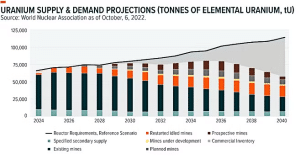
uranium supply and demand projections 2040

Even though UROY is not tied to a single project, its portfolio rises in value as the global nuclear market expands. If the U.S. adds dozens of gigawatts of nuclear capacity by 2040, UROY could see major growth in both royalty revenue and asset value.

The Bigger Picture: Clean Power for the Digital Era

Project Matador shows how the energy transition and the digital economy are coming together. AI and chip manufacturing need clean, steady power — and nuclear energy can deliver it.

For the U.S., this kind of project also supports national security, ensuring that data and computing systems run on domestic, reliable energy.

For investors, companies like UROY offer a simple way to invest in the nuclear revival. They benefit as more projects move forward and uranium demand increases.

The next generation of clean energy will go beyond solar and wind. It will combine nuclear stability, renewable flexibility, and digital intelligence, all working together to power the AI age.


Disclosure: Owners, members, directors, and employees of carboncredits.com have/may have stock or option positions in any of the companies mentioned: None.

Carboncredits.com receives compensation for this publication and has a business relationship with any company whose stock(s) is/are mentioned in this article.

Additional disclosure: This communication serves the sole purpose of adding value to the research process and is for information only. Please do your own due diligence. Every investment in securities mentioned in publications of carboncredits.com involves risks that could lead to a total loss of the invested capital.

Please read our Full RISKS and DISCLOSURE here.

The post Project Matador: America’s $90B Nuclear Power Solution for AI, Semiconductors, and Data Centers appeared first on Carbon Credits.

Nissan Partners with BYD to Meet EU 2025 Carbon Rules and Avoid Hefty Fines

Nissan Partners with BYD to Meet EU 2025 Carbon Rules and Avoid Hefty Fines

Nissan has struck a new emissions-pooling deal with BYD, a Chinese electric vehicle maker. This partnership aims to help meet the European Union’s tough carbon dioxide limits for carmakers set for 2025. Nissan’s partnership with BYD lets it combine its European fleet emissions with BYD’s low-emission record. This helps Nissan avoid penalties while it shifts to electric mobility.

The move shows how traditional automakers are adapting to quick climate rules. They are forming strategic partnerships to stay compliant and grow their electric lineups.

Understanding EU Emission Rules

The European Union enforces some of the toughest vehicle emission standards in the world. Starting in 2025, carmakers must limit their average emissions to about 93.6 grams of CO₂ per kilometer. This is measured using the Worldwide Harmonised Light Vehicle Test Procedure (WLTP). The rule applies to every automaker based on the average emissions of the new cars they sell in the EU each year.

If a company’s average exceeds its target, it faces a fine of €95 for each gram per kilometer above the limit multiplied by the number of cars sold. For large manufacturers, this can easily translate to hundreds of millions, or even billions, of euros in penalties.

EU emissions standard for vehicles
Source: ICCT

Analysts say the combined risk for the industry could reach over €10 billion if several automakers fail to meet the new limits.

The EU wants to speed up the shift to electric vehicles (EVs) and plug-in hybrids. They aim to stop selling new petrol and diesel cars by 2035. While many automakers have increased EV output, the pace of change remains uneven across brands and regions.

Pooling 101: How Automakers Share Emissions to Survive

To give companies flexibility, EU rules allow them to form “emissions pools.” This system lets manufacturers combine their vehicle fleets and calculate an average CO₂ figure together.

If one company has a cleaner fleet—such as an EV producer—it can offset the higher emissions of another. The combined average determines whether the group meets the EU target.

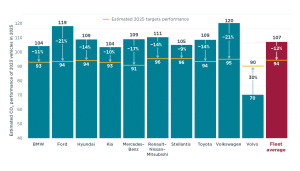
2025 Manufacturer CO2 targets versus 2023 fleet performance
Source: ICCT

Pooling has become a common compliance tool in Europe. Tesla made hundreds of millions of euros by teaming up with legacy automakers like Fiat Chrysler and Honda. They used Tesla’s zero-emission cars to meet their emissions goals. Nissan’s new agreement with BYD follows the same principle.

By linking with BYD, Nissan can count a share of BYD’s low-carbon vehicle sales toward its own compliance calculation. This partnership will lower Nissan’s average emissions in Europe by 2025. This move helps the company steer clear of hefty fines.

Why Nissan Turned to BYD

Nissan had previously joined an emissions pool with Renault as part of their long-time alliance. Nissan has decided to partner with BYD, one of the largest EV makers. This choice comes as the Renault–Nissan partnership operates more independently and EU rules get stricter.

BYD’s growing success in Europe made it an attractive partner. The company has quickly grown its market share. This is thanks to all-electric and plug-in models that create almost no tailpipe emissions.

Nissan’s strong performance helps offset the higher emissions from its petrol and hybrid models. These models still account for a large part of its sales in Europe.

Industry analysts say this decision reflects both opportunity and necessity. It gives Nissan breathing room as it works to increase its electric lineup in Europe. The company plans to sell only fully electric cars in Europe by 2030. For now, pooling provides a temporary solution to stay compliant as EV production increases.

The Debate: Compliance Shortcut or Climate Setback?

The deal benefits both companies in different ways. For Nissan, the partnership avoids immediate financial penalties and protects its market position during a challenging transition.

For BYD, it could provide a new revenue stream, as the company may receive payment or carbon credits for its contribution to the pooled fleet. It also strengthens BYD’s presence in Europe, where competition in the EV market is intensifying.

However, not everyone sees pooling as a long-term solution. Environmental groups and some policymakers say these deals can slow real emission cuts. High-emission automakers rely on cleaner partners rather than fully changing their production lines. These strategies might meet legal rules, but they do little to speed up the actual drop in transport emissions.

Still, the system remains a legal and effective compliance method under EU law. Most experts agree that pooling will last until electric vehicle production and sales are strong. This strength will make partnerships between automakers unnecessary.

A Growing Trend in the Auto Industry

Nissan and BYD’s collaboration is part of a wider trend among carmakers facing tighter environmental rules. Over the past few years, multiple manufacturers have entered pooling agreements with EV specialists to avoid penalties.

According to industry data, nearly a dozen major automakers are now part of emissions pools across Europe. These arrangements are likely to increase in the short term.

EV sales are rising fast, but challenges remain. Traditional carmakers struggle to switch to electric models due to:

  • Infrastructure gaps
  • High battery costs
  • Supply-chain issues

Pooling provides short-term relief. It helps the industry sell vehicles in Europe and stay within emissions limits.

From Pooling to Full Electrification

For Nissan, this agreement marks another step in its broader electrification plan. The company will launch more all-electric and hybrid vehicles. This plan is backed by new EV production hubs in the UK and Spain. By 2028, Nissan plans to launch several next-gen models. These will help reduce average emissions without depending much on pooling, which is important in its net-zero goal.

Nissan’s Roadmap to Net Zero

Nissan has set a long-term goal to achieve carbon neutrality across its entire business by 2050. This includes not only vehicle emissions but also their manufacturing, supply chain, and end-of-life processes. The company’s climate strategy focuses on electrifying its lineup, cutting factory emissions, and using more recycled and low-carbon materials.

  • Long-Term Goal: Carbon Neutral by 2050

Nissan’s 2050 vision aims for zero emissions across the full lifecycle of its vehicles—from production to use and recycling. The company wants every car it sells, and every factory it operates, to be carbon neutral by mid-century. This goal aligns with global climate efforts to limit warming to 1.5°C.

  • Mid-Term Targets Under Nissan Green Program 2030

To reach this long-term target, Nissan launched the “Green Program 2030,” a set of mid-term goals that guide its transition over the next decade. The plan includes cutting emissions in both manufacturing and vehicle use.

Nissan 2030 emission reduction goal
Source: Nissan

In Europe, Nissan has set an ambitious goal for all its new cars to be fully electric by 2030. In Asia, the carmaker is also investing in EV supply chains and battery development.

Back in its home, Japan, Nissan has introduced new technologies to reduce factory emissions and is promoting renewable energy use across its facilities. In North America, the company is launching new hybrid and electric models to meet rising consumer demand for cleaner vehicles.

Nissan 2030 carbon emissions regional
Source: Nissan

The company plans to reach carbon neutrality through three main strategies:

  • Electrification of vehicles
  • Cleaner manufacturing
  • Circular supply chain

Nissan’s decision to pool emissions with BYD in Europe fits within its broader decarbonization strategy. The deal gives Nissan temporary flexibility as it ramps up production of electric models and upgrades its European operations to lower carbon intensity.

For BYD, the partnership supports its strategy of expanding into European markets. The company continues to grow its sales network across the continent, with production plans in Hungary and potential sites in France. Its role as a compliance partner shows its strength as a global EV leader. It can influence industry trends beyond just its own brand.

Pooling remains a practical tool for now, giving Nissan and others time to adjust. Yet, as regulations tighten and public expectations rise, long-term success will depend on how quickly these companies can shift from depending on emission credits to producing truly zero-emission vehicles of their own.

The post Nissan Partners with BYD to Meet EU 2025 Carbon Rules and Avoid Hefty Fines appeared first on Carbon Credits.

Oil Giants Under Fire: ExxonMobil Fights Climate Laws as TotalEnergies Found Guilty of Greenwashing

Oil Giants Under Fire: ExxonMobil Fights Climate Laws as TotalEnergies Found Guilty of Greenwashing

Two of the world’s largest oil companies, ExxonMobil and TotalEnergies, are in the spotlight for very different reasons. Exxon is fighting new climate-reporting laws in California. Meanwhile, TotalEnergies was found guilty of greenwashing or misleading the public about its climate claims. These changes show the rising tension among fossil fuel producers, governments, and regulators as climate rules get stricter around the world.

ExxonMobil Takes California to Court Over Climate Rules

ExxonMobil filed a lawsuit to block California’s new climate-reporting requirements. The company claims the laws breach its constitutional rights, particularly its First Amendment free speech rights. It also says they unfairly target large businesses in the state.

The case focuses on two key laws:

  • Senate Bill 253 requires companies that make over $1 billion a year to report their greenhouse gas emissions. This includes indirect “Scope 3” emissions.
  • Senate Bill 261 requires companies to share how climate risks might impact their finances and operations.

Exxon says the laws force companies to “speak” in a way that aligns with California’s view on climate change. The oil giant says the regulations will bring high costs and unreliable data. Also, tracking emissions in global supply chains is tricky.

California officials, however, say the lawsuit is an attempt to avoid transparency. They argue that companies must be open about the full impact of their activities if the world is to meet climate goals.

If the court sides with Exxon, the decision could delay the rollout of similar laws in other U.S. states. But if California wins, it would mark one of the most ambitious climate-reporting mandates in the world.

TotalEnergies Faces Penalty for Misleading Climate Claims

In France, TotalEnergies faced a very different kind of scrutiny. A Paris court decided on October 23 that the company misled consumers with its public statements about climate goals.

The court decided that TotalEnergies’ 2021 marketing messages were misleading under its greenwashing laws. They claimed to be “a major actor in the energy transition” and aimed for net zero by 2050. However, the court noted the company’s ongoing investment in oil and gas projects.

TotalEnergies net zero 2050 ambition

As a result, TotalEnergies must remove or revise the disputed statements from its website within one month or face daily fines of up to €20,000. The company was also ordered to pay damages and legal fees to three environmental groups that filed the lawsuit.

TotalEnergies accepted the ruling. However, it noted that most claims by the plaintiffs were dismissed. The company also insisted that its low-carbon investments are real.

The TotalEnergies case marks one of the first successful “greenwashing” rulings in Europe against a major fossil fuel producer. It sends a clear message: companies must align their advertising with measurable action, not just promises.

A Global Shift Toward Accountability

The twin cases reveal a major shift in how governments and courts are handling corporate climate claims. Oil and gas companies have pushed for long-term net-zero goals for years. Yet, they keep expanding fossil fuel production. That approach is now under heavy scrutiny.

Across the world, regulators are moving from voluntary to mandatory climate reporting. Investors and consumers are also demanding more proof that companies are reducing emissions in real terms, not just on paper.

The International Energy Agency (IEA) reports that the global oil and gas industry accounts for about 15% of total energy-related emissions. This includes methane leaks and refining. The IEA says these emissions must fall by at least 60% by 2030 to stay on track for net-zero goals.

But progress remains slow. In 2024, the biggest oil companies put over $400 billion into new fossil fuel projects. In contrast, they invested less than $80 billion in renewables. This imbalance fuels criticism that public climate statements often do not match actual spending.

Final investment decisions in US LNG 2025 IEA
Source: IEA

Why Climate Disclosure Laws Are Game-Changers

Transparent emissions reporting is a critical step toward accountability. California laws in Exxon’s lawsuit require big companies to report their total emissions. This includes emissions from direct operations, supply chains, and product use.

Supporters say these rules will:

  • Create a level playing field for all large firms.
  • Help investors and consumers compare climate performance.
  • Push companies to reduce emissions more aggressively.

For example, Scope 3 emissions, those from customers using a company’s products, often make up more than 80% of an oil company’s carbon footprint. Without such disclosures, the true impact of fossil fuels remains hidden.

Opponents, however, say the costs and technical challenges could be high. They warn that requiring thousands of global companies to track every step of their carbon footprint could lead to inconsistent or unverifiable results.

Still, many analysts believe the trend toward mandatory disclosure is irreversible. Similar frameworks are being considered in the European Union, Japan, and Canada.

Rising Legal and Market Risks for Oil Majors

The cases involving ExxonMobil and TotalEnergies are part of a growing wave of climate-related lawsuits. The Grantham Research Institute reports that almost 3,000 climate cases have been filed globally. About 230 of these focus directly on companies.

Many involve accusations of greenwashing, misleading investors, or failing to disclose climate-related financial risks.

The potential costs are high. Penalties, legal fees, and damaged reputation can all hurt a company’s market value. For investors, it adds a new layer of risk in an already volatile energy sector.

Meanwhile, clean energy investment continues to rise. BloombergNEF estimates that in 2024, spending reached over $2 trillion. This includes renewable energy, electric vehicles, and carbon capture technology. This is more than double what was invested in fossil fuels.

This global capital shift pressures oil companies. They need to show they are adapting to the energy transition, not resisting it.

The Bigger Picture: Transition or Tension?

These two high-profile cases capture a crossroads moment for the oil industry. Governments aim for quicker decarbonization. However, companies still depend on fossil fuels for profit.

ExxonMobil’s lawsuit represents resistance — a pushback against state regulation. TotalEnergies’ court case shows what happens when public messaging gets ahead of actual progress.

Yet, both cases show that climate accountability is no longer optional. The industry is under pressure to show clear results. This comes from courts, disclosure laws, and investors.
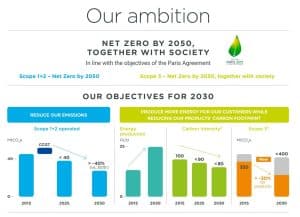
To stay competitive, oil majors must boost low-carbon investments. They should also improve transparency and align operations with credible climate targets.

If Exxon loses its challenge, it could open the door to a wave of state and federal disclosure rules in the U.S. If more courts follow France’s lead, companies could face lawsuits for greenwashing worldwide.

Either way, fossil fuel companies are under pressure to back their climate claims with action. The age of unchecked promises is ending, replaced by a future of measured accountability.

The post Oil Giants Under Fire: ExxonMobil Fights Climate Laws as TotalEnergies Found Guilty of Greenwashing appeared first on Carbon Credits.