Top 3 Carbon Capture Leaders to Drive the Net-Zero Race in 2026

carbon capture

Carbon capture has entered a decisive phase. What once looked like an experimental climate solution now stands at the center of global decarbonization strategies. By 2026, governments, corporations, and investors increasingly rely on carbon capture to deal with emissions that cannot be eliminated.

Three companies now dominate this space: Climeworks, Carbon Engineering, and SLB Capturi. Each addresses a different part of the problem. Some remove carbon dioxide directly from the air. Others stop emissions at factories before they escape. Together, they shape how the world manages residual emissions in a tightening net-zero era.

Market Overview: Why Carbon Capture Matters Now

BCC Research highlighted that the global market for carbon capture, utilization, and storage (CCUS) technologies was at $3.4 billion in 2024. It is projected to reach $9.6 billion by the end of 2029, at a compound annual growth rate (CAGR) of 23.1% during the forecast period of 2024 to 2029.

carbon capture market

Governments expanded incentives, while companies faced growing pressure to meet climate commitments with real, measurable outcomes.

In the United States, tax credits under the Inflation Reduction Act made large-scale capture projects financially attractive. In Europe, the expanded EU Emissions Trading System increased compliance costs, pushing industries toward capture solutions. Meanwhile, corporate buyers signed long-term contracts to secure high-quality carbon removal credits.

At the same time, technology advanced quickly. Capture costs fell, monitoring systems improved, and long-term storage options expanded. Leading projects now capture carbon for less than $300 per ton, a sharp drop from early pilot costs.

By 2026, more than 20 direct air capture facilities operate worldwide. Still, most captured carbon comes from point-source projects in cement, steel, waste-to-energy, and hydrogen production. Permanence, transparency, and verification now define success in the carbon market.

Climeworks: From DAC Pioneer to Carbon Removal Platform

Climeworks remains the most visible name in direct air capture. Based in Switzerland, the company developed modular systems that pull carbon dioxide directly from the air using fans and solid filters.

Its Iceland operations set early benchmarks. The Orca plant captures 4,000 tons of CO₂ per year. The newer Mammoth facility scales capacity to 36,000 tons annually. Generation 3 technology sharply cuts energy use, making DAC more efficient and easier to expand.

However, it has evolved beyond hardware alone.

Building Diversified Carbon Removal Portfolios

Climeworks now offers blended carbon removal portfolios designed for corporate buyers. These portfolios combine direct air capture with other engineered and nature-based removal methods. The strategy spreads risk while meeting different climate and budget needs.

climeworks direct air capture

The portfolio includes:

Each method provides a different storage lifespan. DAC and BECCS store carbon for over 10,000 years. ERW lasts about 1,000 years. Biochar offers century-scale storage. Nature-based projects provide shorter-term storage but deliver strong co-benefits for ecosystems and communities.

By 2026, Climeworks will deliver over 50,000 tons of verified carbon removal credits per year. Buyers include Stripe, Schneider Electric, and shipping giant NYK. Credit prices range from $600 to $800 per ton, reflecting strong demand for durable removals.

This portfolio model positions Climeworks as a full-service carbon removal provider, especially for companies tackling Scope 3 residual emissions.

Carbon Engineering: Scaling Direct Air Capture to Megatons

Carbon Engineering takes a bold, industrial approach to carbon removal. Instead of small modular units, it builds large-scale DAC plants designed to capture hundreds of thousands of tons of CO₂ each year.

The Canada-founded company uses a liquid solvent process. Air flows through large contactors, where potassium hydroxide captures CO₂. The system regenerates the solvent in a closed loop, producing a pure CO₂ stream ready for storage or fuel production.

Occidental Petroleum acquired Carbon Engineering in 2023, accelerating its scale-up through access to capital, storage sites, and energy infrastructure.

The Stratos Project Sets a New Standard

By 2026, Carbon Engineering’s Stratos facility in Texas will capture between 500,000 and 1 million tons of CO₂ annually, making it the world’s largest DAC plant.

The company relies on proven industrial equipment and standardized designs. This “design one, build many” approach lowers costs and speeds up deployment across regions.

Capture costs now fall between $250 and $600 per ton, supported by U.S. tax credits and long-term offtake agreements with buyers like Frontier, Amazon, and Airbus.

Linking Capture to Clean Fuels

Carbon Engineering also uses captured CO₂ to produce synthetic fuels. Its Air-to-Fuels technology combines CO₂ with green hydrogen to create low-carbon aviation fuel. This helps reduce emissions in aviation, a sector responsible for about 2–3% of global emissions.

By combining storage and fuel production, Carbon Engineering bridges voluntary carbon markets with compliance systems. Its large pipeline—running into tens of millions of tons—makes it a cornerstone of future gigaton-scale removal.

DAC carbon capture
Source: IEA

SLB Capturi: Decarbonizing Heavy Industry at the Source

While DAC removes carbon after it mixes into the air, SLB Capturi focuses on prevention. The joint venture between SLB and Aker Carbon Capture specializes in point-source carbon capture for industrial emitters.

Its amine-based technology captures more than 95% of CO₂ emissions from facilities such as cement plants, waste-to-energy sites, gas processing units, and bioenergy operations.

Designed for Fast Deployment

SLB Capturi’s Just Catch™ units are modular and compact. Operators can retrofit them into existing plants with minimal downtime. This makes them ideal for industries under immediate pressure to cut Scope 1 emissions.

Ørsted Kalundborg CO₂ Hub

The Ørsted Kalundborg CO₂ Hub marks Denmark’s first full-scale carbon capture and storage project. This year, the company will capture CO₂ from SLB’s Asnæs Power Station in Kalundborg and the Avedøre Power Station near Copenhagen. The hub will serve as a key center for CO₂ transport, handling both imports and exports.

By 2026, the company can support over 5 million tons of annual capture capacity across Europe and North America. Many projects connect directly to permanent storage sites, including offshore saline aquifers.

Role in Carbon Markets

BECCS projects using SLB Capturi technology qualify as durable carbon removals. These credits typically trade between $80 and $150 per ton, making them more affordable than DAC while still meeting high integrity standards.

SLB’s strength lies in integration. The company combines capture, transport, and storage into a single value chain. This end-to-end capability appeals to oil majors, utilities, and governments seeking reliable decarbonization pathways.

What This Means for Carbon Capture in 2026

Together, Climeworks, Carbon Engineering, and SLB Capturi define the carbon capture landscape in 2026. The market now rewards permanence, transparency, and verified impact. Buyers no longer chase cheap offsets. They invest in long-term solutions that stand up to scrutiny.

As net-zero deadlines draw closer, carbon capture shifts from optional to essential. These three companies show how removal and abatement can work together—turning climate ambition into real-world action.

The post Top 3 Carbon Capture Leaders to Drive the Net-Zero Race in 2026 appeared first on Carbon Credits.

Alphabet, Google’s Parent, Bets $4.75B on Clean Power for AI Data Center Demand

Alphabet, Google's Parent, Bets $4.75B on Clean Power for AI Data Center Demand

Alphabet, the parent company of Google, has agreed to buy Intersect, a U.S. clean energy developer, in a deal valued at $4.75 billion in cash plus assumed debt. The transaction was announced in December 2025 and is expected to close in the first half of 2026.

The acquisition helps Alphabet gain more strength for its growing data center operations. It also supports the growth of its artificial intelligence (AI) services.

The deal includes Intersect’s team, energy projects under development, and data center infrastructure. Intersect will keep running independently with its current leaders. It will also collaborate closely with Alphabet’s technical teams.

Why AI Growth Is Forcing Alphabet to Secure Its Own Power

Alphabet runs one of the world’s largest cloud and AI businesses. These services need huge amounts of electricity. AI applications, such as large language models and cloud computing tools, require powerful data centers.

The electricity demand from these centers is growing fast. Many power grids struggle to keep up with this demand. That makes reliable and clean power especially important for companies like Alphabet.

data center electricity demand due AI 2030

By buying Intersect, Alphabet can gain more control over the supply of electricity for its data centers. The clean energy projects Intersect develops include solar power, battery storage, and other generation capacity. Owning these assets lets Alphabet bring new power online faster. It also reduces reliance on outside energy suppliers.

Alphabet has already worked with Intersect. Google took a minority stake in Intersect in 2024 and partnered on several projects before the acquisition. The full purchase builds on that existing relationship.

Google CEO Sundar Pichai noted that this deal with Intersect will:

“help us expand capacity, operate more nimbly in building new power generation in lockstep with new data center load, and reimagine energy solutions to drive US innovation and leadership.”

Intersect Power: Building Energy for the AI Era

Intersect Power was founded in 2016 and grew into a significant player in the clean energy sector. The company builds and develops large solar projects, battery storage systems, and data centers. These projects combine power generation with computing facilities. Intersect has offices in several U.S. states and works with technology and infrastructure partners.

By late 2025, Intersect will manage over 10.8 gigawatts (GW) of energy projects. These projects will be operating, under construction, or in development by 2028. To put that in context, this is more than 20x the electricity production of the Hoover Dam.

Some of Intersect’s clean energy work includes building solar plants in California and battery storage facilities in Texas. These projects are designed to serve both utility grids and data centers with cleaner power sources

Before the acquisition, Intersect had raised more than $2 billion in equity and project financing from investors. It also had existing partnerships with Google and other technology firms.

What Alphabet Is Getting in the Deal: Inside the $4.75B Acquisition

Alphabet is paying $4.75 billion in cash and will also assume Intersect’s existing debt. The acquisition includes the following key elements:

  • The Intersect leadership team and staff.
  • A portfolio of energy projects in development or under construction.
  • Joint infrastructure projects with Google.
  • Access to emerging technologies in energy generation and storage.

Not every Intersect asset will transfer to Alphabet. Some facilities and projects in Texas and California will stay independent. They will continue to be backed by current investors. Alphabet is focusing on projects that directly support its data center and cloud operations.

Intersect will remain a separate brand and company after the deal closes, led by its current CEO, Sheldon Kimber. The company will continue its broader work while collaborating with Alphabet on shared energy and data center goals.

The Role of Clean Energy and AI

Large data centers consumed 4% of U.S. electricity in 2024, with hyperscale demand hitting 61.8 GW in 2025 (up 22% YoY) amid AI-driven growth to 106-123 GW by 2035.

Alphabet’s facilities used 30.8 TWh in 2024, doubling from 2020 and 95.8% of its total power, for AI model training and cloud services. U.S. grids face record demand in 2025-2026, with data centers projected to double to 9% of electricity by 2030.

US data center power demand 2030

Acquiring Intersect Power advances Alphabet’s 24/7 carbon-free by 2030 and net-zero goals. Intersect’s 10.8+ GW pipeline of solar (e.g., 828 MWp TX Lumina) and battery storage (multi-GWh) enables a direct clean supply. This reduces data center emissions intensity, building on Alphabet’s 12% Scope 2 cut in 2024 despite surging demand.

Alphabet aims for net-zero emissions in its operations and value chain by 2030. It also targets 24/7 carbon-free energy for all data centers and offices by the same year. Additionally, it seeks to enable 1 gigaton of annual emissions reductions for users and partners.

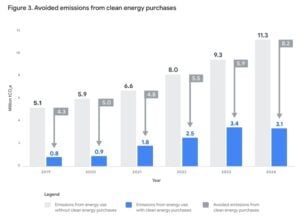
In 2024, it secured over 8 GW of clean energy. It achieved 66% carbon-free energy (CFE), matching 80% hourly CFE in 9/20 grids. Despite a 27% rise in electricity use, it cut data center emissions by 12%, bringing them down to 3.1 MtCO2e. Its portfolio includes power purchase agreements (PPAs) and investments in wind, solar, geothermal, and storage. It also has supplier mandates for 100% renewables by 2029.

Intersect plans to explore more technologies. Along with solar and storage, it will look into long-duration storage and advanced generation solutions. This will help diversify the energy supply. These technologies could further support data center growth with more reliable and cleaner power.

Big Tech’s Race to Control Energy Supply

Alphabet is not alone in addressing power needs for AI growth. Other big technology companies are also investing in clean energy, grid modernization, and direct power supply.

Microsoft, for example, has expanded renewable energy contracts and supported nuclear and other low-carbon projects. Amazon has pursued long-term agreements with nuclear power plants and investments in small modular reactor research.

big tech AI data center planned growth 2030

The Intersect acquisition reflects a trend in which cloud and AI companies look beyond simple power purchase agreements. Some companies are adding energy development. This helps them get electricity faster and cut down on grid capacity issues.

Energy infrastructure has become a strategic asset for firms with large data center footprints. Owning or controlling generation and storage helps companies plan capacity better. This way, they can avoid grid connection delays and may reduce long-term costs.

What the Deal Signals for AI and Energy Markets

Alphabet expects the Intersect deal to close in early 2026, pending regulatory approval and standard closing conditions. The acquisition will give Alphabet direct access to clean energy projects. It will also provide talent to support data center expansion.

The transaction also sends a signal about how technology firms are adapting to the challenges of powering AI. Data centers are critical infrastructure for cloud services, search, video, and generative AI. Securing reliable, scalable, and cleaner energy sources is now central to growth strategies for Alphabet and its peers.

The post Alphabet, Google’s Parent, Bets $4.75B on Clean Power for AI Data Center Demand appeared first on Carbon Credits.

Top 4 Green AI Stocks to Watch in 2026 as AI Reshapes Climate and Energy Solutions

Top 4 Green AI Stocks to Watch in 2026 as AI Reshapes Climate and Energy Solutions

Artificial intelligence (AI) is changing how many industries work. It now plays a growing role in climate and energy solutions. Companies are using AI to cut emissions, reduce energy waste, and improve how clean energy systems operate. This has created a new group of firms often called “Green AI” companies.

These businesses combine advanced computing with sustainability goals. They attract investors who want growth, but also want a positive environmental impact.

AI is expected to play a major role in cutting emissions and improving energy efficiency over the next decade. According to the International Energy Agency (IEA) and industry reports:

  • AI could deliver over 40% of the emissions reductions needed by 2040 when applied across energy, transport, and industry sectors.

  • Data center electricity demand driven by AI is projected to more than double by 2030, reaching roughly 945 terawatt‑hours (TWh) — similar to the annual electricity use of Japan.The

  • Global Green AI software market is valued at $15B  and is projected to reach $98B by 2030.
  • Global economic impact of AI could reach $15 trillion by 2030, with a significant share coming from applications that improve sustainability and energy efficiency.

In short, AI is transforming industries. Companies that combine AI with sustainable practices are becoming market leaders. Firms investing in AI for energy efficiency and climate monitoring not only help the environment but also position themselves for long-term growth as the world moves toward cleaner energy systems.

By 2026, AI, cloud computing, and clean energy technologies will create major investment opportunities. Within this trend, four Green AI stocks stand out for their innovation, financial strength, and commitment to a greener future.

Microsoft (MSFT): Green AI at Global Scale

Microsoft is one of the largest technology companies in the world. It is also a leader in using AI to support climate goals. Its cloud services, software platforms, and data centers give it a strong position in Green AI.

The company has committed to becoming carbon negative by 2030. This means it plans to remove more carbon from the atmosphere than it emits. AI plays a key role in this effort. Microsoft uses AI to track energy use across its global data center network. These systems help balance workloads, improve cooling, and reduce wasted electricity.

Microsoft Clean Energy Contracts (Capacity, MW)

Microsoft also runs the AI for Earth program. This program supports groups that use AI to study forests, water systems, climate risks, and natural disasters. These projects help governments and researchers better understand environmental changes.

In short, the tech giant leverages AI for these green reasons:

  • Uses AI to monitor and optimize energy use across global data centers and offices.
  • AI-powered workload balancing and cooling systems reduce electricity consumption.
  • AI for Earth program applies AI to track forests, water resources, and climate hazards.
  • Helps achieve carbon-negative operations by 2030.
  • AI tools support sustainability for both Microsoft and thousands of enterprise customers.
Microsoft CIF AI
Source: Microsoft

Microsoft’s financial position is very strong. In 2025, its market value was above $2.8 trillion. Annual revenue reached about $220 billion, with operating margins close to 36%. This scale allows the company to invest heavily in AI and sustainability without hurting profits.

Microsoft stands out because of its reach. Its AI tools affect not only its own operations, but also thousands of companies that use its cloud and software services. This makes it a central player in the Green AI stocks space.

SEE MORE on MICROSOFT:

Alphabet (GOOGL): AI Efficiency for Energy-Heavy Systems

Alphabet, the parent company of Google, is another major force in the Green AI stocks market. It runs one of the world’s largest digital infrastructures. This includes search engines, cloud platforms, and data centers that use large amounts of electricity.

Google has been carbon neutral since 2007. It now aims to operate on 24/7 carbon-free energy by 2030. AI is a core tool in reaching this goal.

google clean energy
Source: Google

Machine learning systems help Google predict energy demand and manage renewable power supply. AI also controls data center cooling, which reduces electricity use and operating costs.

These efficiency gains are important because data centers are growing fast. As AI usage increases, energy demand rises. Alphabet’s approach shows how AI can help control this growth instead of making emissions worse:

google emissions
Source: Google
  • AI predicts energy demand and optimizes data center cooling systems, cutting electricity use.
  • Supports Google’s goal of 24/7 carbon-free energy by 2030.
  • Uses AI to forecast renewable energy output for its grid and operations.
  • AI-driven efficiency reduces operational costs while lowering carbon footprint.
  • AI projects extend to climate research, including forest monitoring and renewable energy planning.

Alphabet’s financial strength supports its long-term plans. In 2025, the company reported about $320 billion in revenue and had a market value near $1.8 trillion. Growth in cloud computing and AI services continues to drive earnings.

For investors, Alphabet offers a mix of scale and discipline. Its Green AI efforts are built into everyday operations. They are not side projects, showing how environmental goals can align with cost savings and strong financial results.

Stem, Inc. (STEM): Smarter Batteries for Clean Energy

This is a public company that builds software and services to make energy storage systems smarter and more efficient. Its main product, Athena, uses AI and machine learning to monitor data from solar panels, batteries, and electric systems in real time. Athena predicts when to store energy and when to use it, helping customers maximize savings and reduce fossil fuel reliance.

Stem Athena benefits
Source: STEM

Stem operates in more than 50 countries and manages energy for thousands of sites, including utilities and large commercial clients. By 2025, its AI had run over 31 million hours and managed hundreds of thousands (500K+) of energy devices worldwide.

Stem trades on the NYSE under STEM. While smaller than some global tech giants, the company has grown steadily as businesses and utilities adopt energy storage.

Revenue comes primarily from AI-driven energy management services and system deployments, and ongoing expansion into new markets continues to strengthen its financial position.

Stem’s technology allows customers to optimize renewable energy use and provides measurable operational benefits, making it a compelling public-market Green AI stock.

Stem’s AI and emissions impact include:

  • AI decides the best times to store or use energy to reduce fossil fuel reliance.
  • Helps businesses and utilities lower electricity costs and carbon emissions.
  • Supports renewable energy growth by making grids more reliable.
  • Integrates solar, storage, and EV charging for efficient energy management.

Itron, Inc. (ITRN): AI for Smarter Electric Grids

Itron is a publicly traded company providing technology to utility companies worldwide. Its products include smart meters, sensors, and data software that track electricity, gas, and water usage in real time. The company’s platforms allow utility operators to quickly spot inefficiencies and make informed decisions.

In 2025, Itron partnered with Microsoft to bring generative AI tools into its systems, enabling operators to ask natural language questions and get instant insights. This improves grid reliability and helps integrate renewable energy sources such as wind, solar, and storage.

Financially, Itron, trading on Nasdaq as ITRN, generates roughly $2 billion in annual revenue. Its global customer base spans electric, gas, and water utilities, and the company continues to expand its AI-enabled offerings to enhance grid performance.

Revenue growth is supported by widespread adoption of smart meters and grid software. Furthermore, there is increasing demand for tools that make renewable energy integration more efficient.

The company has the following green AI impact:

  • AI predicts energy demand to reduce waste and losses.
  • Supports integration of renewable energy and storage into grids.
  • Speeds up decision-making for utilities, reducing operational delays.
  • Makes energy data accessible for faster, more efficient grid management.

Why Green AI Companies Matter Now

Green AI companies show how software and data can support climate goals. They do not replace renewable energy or clean infrastructure. Instead, they make these systems work better.

Several factors explain why these companies matter in the energy transition:

  • Energy efficiency: AI helps reduce waste and improve system performance.
  • Emissions tracking: Better data allows companies to manage carbon risks.
  • Scalability: Software tools can be rolled out quickly across regions.
  • Cost benefits: Many solutions save money while cutting emissions.

These strengths make green AI stocks appealing to both technology-focused and sustainability-focused investors.

What to Watch in 2026 and Beyond

The green AI market is still developing. Several trends will shape its future. More companies want tools that lower energy costs and emissions. Data centers, in particular, are under pressure to become more efficient.

Government policies also matter. Climate disclosure rules and clean tech incentives can speed up adoption. At the same time, growing AI workloads increase electricity demand. This makes efficiency tools even more valuable. 

Together, these forces support long-term growth for green AI solutions. Market estimates project it can reach up to $129 billion by 2034

global green AI market
Source: Dimension Market Research

Green AI’s Role in the Climate-Tech Landscape

Green AI is becoming a key part of climate technology. Microsoft and Alphabet apply AI on a global scale. Stem uses AI to optimize energy storage and clean power systems. Meanwhile, Itron helps utilities run smarter grids and integrate renewable energy efficiently.

Each company plays a different role. Together, they show how AI can support a cleaner and more efficient economy. For investors, green AI stocks offer exposure to climate solutions without relying only on energy production assets.

The post Top 4 Green AI Stocks to Watch in 2026 as AI Reshapes Climate and Energy Solutions appeared first on Carbon Credits.

Toward a Climate-Resilient Philippines: Leveraging Technology and Carbon Finance for Reforestation

Toward a Climate-Resilient Philippines: Leveraging Technology and Carbon Finance for Reforestation

The forests of Panay Island, a major Philippine island in the Western Visayas, have been heavily degraded over decades of logging, mining, and slash-and-burn agriculture. Nationwide, only about 3% of old-growth forests remain. 

Tree cover loss has hurt biodiversity. It has also weakened local water systems, raised landslide risks, and added to carbon emissions. Addressing these challenges requires combining ecological restoration with innovative finance and technology solutions.

Recent talks in the Philippines highlight how technology can boost reforestation. This method speeds up forest recovery. It also improves monitoring and links ecological results to carbon finance. 

In December 2025, a key forum in Iloilo gathered government agencies, academics, the military, and civil society. They discussed using drones, AI mapping, and other tools to restore Panay’s damaged landscapes. The Sulu Garden Foundation (SGF) hosted the event.

SGF is a Panay-based nonprofit engaged in ecological restoration and community-focused reforestation. The organization works on research-informed planting strategies, supports biodiversity conservation in degraded landscapes, and works with local stakeholders to improve forest recovery. 

These efforts build on programs like the National Greening Program (NGP) from the Department of Environment and Natural Resources. In 2022, the NGP planted nearly 2 million seedlings over 2,818 hectares. 

The NGP is a big step for reforestation, but experts say past projects often had trouble. They rarely reached long-term survival rates of over 50%. This was especially true in steep, remote, and fire-prone areas. It underscores the need for precision tools, adaptive planning, and integrated community participation.

Re-Greening Panay: Science and Community at the Forefront

The Central Panay Mountains span about 65 miles and reach around 7,000 feet. They are one of the Philippines’ key biodiversity hotspots. These mountains are home to endemic species, many of which are threatened by habitat loss.

Deforestation, illegal logging, and unsustainable farming practices continue to erode forest cover, contributing to soil erosion and downstream flooding.

decline of the Philippine forest

SGF’s reforestation initiatives in Panay focus on three core elements:

  • ecological restoration grounded in research,
  • community-led stewardship, and
  • sustainable finance mechanisms through carbon credits. 

Connecting forest restoration to clear carbon results helps local efforts cut CO₂ emissions from deforestation. This also creates incentives for landowners and communities to protect forests. The approach also provides a framework for integrating small-scale initiatives with national nature-based climate strategies.

A Strategic Partnership with Ukraine: Drones for Forests

Amid these developments, international collaboration is playing an important role. The Philippines and Ukraine are looking into working together on drone technology. They aim to share knowledge and possibly produce drones together for defense and research. 

SGF recognizes the potential of these tools for reforestation. The organization plans to test drone-assisted mapping, seed dispersal, and monitoring. These tools will help tackle challenges from rugged terrain and scattered planting areas.

At the December forum, Ukrainian Ambassador Yuliia Fediv met with Philippine representatives. They talked about how drones and AI can aid in hybrid reforestation. This method combines fast-growing pioneer species with slower-growing native trees. The goal is to mimic natural regrowth. 

Drone-assisted mapping helps project teams check if land is suitable, improve planting density, and track seedling survival in real time. These tasks are hard to do with traditional ground methods.

Technical advisers noted that these tools could boost seedling survival rates. Instead of the usual 30–50%, rates might exceed 80%. This depends on the terrain and species mix. They help quickly find areas hit by fires, pests, or illegal logging. This allows for fast action. 

Drone technology combines data collection, mapping, and monitoring. This creates a strong platform for measuring carbon sequestration. It also helps to report results that meet global verification standards.

Representatives from the Department of Agriculture VI, Department of Science and Technology VI, and the Philippine Army contributed insights on logistics, operational deployment, and integration with community reforestation teams.

The session highlighted the need to cross-train local drone operators, foresters, and volunteers. This helps build lasting skills for tech-driven restoration efforts.

Carbon Finance and Policy Context

An important dimension of Panay’s reforestation efforts is the potential for carbon finance. Verified carbon credits let projects earn money for CO₂ absorbed by restored forests. This creates ongoing funding for maintenance, community engagement, and ecological monitoring. 

High-quality credits rely on clear measurement, reporting, and verification (MRV) systems. These systems track forest growth and carbon buildup over time. Standards like Verra and the Gold Standard help ensure credibility in global carbon markets.

The Philippines is increasingly formalizing its approach to carbon pricing and market mechanisms. House Bill No. 11375, the Philippine Carbon Pricing Act, sets up a national carbon pricing system. It encourages emission cuts in various sectors and also directs funds to projects that help, like reforestation. 

The bill creates a system for companies and government agencies. They can trade or buy carbon credits. This supports both compliance and voluntary programs. This law would create a clear policy framework for forest-based carbon projects. It would work alongside current environmental rules and global climate agreements.

Integrating Technology, Communities, and Policy

Combining drones, AI, and carbon finance with community-led restoration aligns with broader national priorities. Accurate monitoring and verification boost carbon accounting. They also enhance local engagement and improve environmental governance. 

Piloting drone-assisted seed dispersal in select Panay sites, conducting research on optimal seed varieties, and providing training for MRV systems are key steps to ensure long-term success.

SGF seed ball technology
Image from SGF

Past restoration efforts have shown the importance of science-based planning and stakeholder coordination. Technology integration solves many issues from earlier programs. It helps with hard-to-reach areas, boosts manpower, and makes tracking survival rates and canopy growth easier over time. When paired with emerging carbon finance frameworks, these innovations offer scalable solutions for large-scale ecological restoration.

The forum also outlined the next steps for pilot projects:

  • Implement drone-assisted mapping and seed dispersal in targeted reforestation areas.
  • Conduct ecological research to choose tree species. Focus on balancing growth rates and biodiversity needs.
  • Cross-training local teams in drone operation, forest management, and MRV systems.
  • Explore integration with carbon credit markets and potential policy incentives under House Bill No. 11375.

These steps help make reforested areas strong, fair, and financially wise. Stakeholders aim to build a model using global knowledge, local insights, and policy backing. They hope this model can adapt to other areas in the Philippines dealing with similar deforestation issues.

Toward Climate-Resilient Forests

Restoring Panay’s forests is a long-term project that requires careful planning, enough funding, and collaboration across sectors. The SGF and Ukraine partnership starts a new era, adapting defense tech to boost ecological resilience. This comes as national forest cover has stalled at 7 million hectares.

As the Philippines develops its national carbon market and implements supportive policies, reforestation efforts can become more sustainable and integrated with broader climate mitigation strategies.

The post Toward a Climate-Resilient Philippines: Leveraging Technology and Carbon Finance for Reforestation appeared first on Carbon Credits.

EU Expands CBAM: A Review Shows It Urges Other Countries to Use Carbon Pricing

EU Expands CBAM: A Review Shows It Urges Other Countries to Use Carbon Pricing

The European Union has completed a review of its Carbon Border Adjustment Mechanism (CBAM) after a two‑year transition period. The European Commission said that the policy has motivated more countries to adopt carbon pricing systems beyond Europe. The review also found that when CBAM begins to charge a carbon fee, it will have minimal impact on the world’s poorest countries.

The findings come as the mechanism prepares to start charging fees in January 2026 and proposes several changes to include certain downstream products.

CBAM is a climate policy that applies a carbon price to certain imported goods that carry high greenhouse gas emissions. The goal is to create fairness for EU producers. They must follow the EU Emissions Trading System (ETS). This also aims to cut down on carbon leakage, which is when production shifts to countries with looser climate rules.

What the Review Says About Carbon Pricing

According to the Commission’s review, CBAM has spurred interest in carbon pricing in other countries. Firms and governments outside the EU are talking more about carbon pricing. They want to measure and report emissions better. This trend suggests that CBAM is serving not only as a tariff on emissions but also as an incentive to adopt carbon pricing tools more widely. 

The review assessed CBAM’s transition phase from 2023 to 2025. During this time, companies provided data on the emissions embedded in their goods imported to the EU. This data collection period helped build capacity for the full operational phase.

Starting in 2026, importers must purchase CBAM certificates that reflect the carbon price paid under the EU ETS or pay the equivalent fee. The two-year run-in period helped companies outside the EU adjust their reporting systems. They also learned about compliance requirements before fees started.

Minimal Impact on World’s Poorest Countries

One key finding of the review is that the impact on the world’s poorest countries will be limited once CBAM starts charging a carbon fee. The Commission’s assessment shows that many least developed countries don’t export a lot of CBAM-covered goods. As a result, the mechanism will not directly impose large carbon fees on them.

CBAM levied sectors

Many low-income countries don’t produce much high-emission stuff, like steel, aluminum, cement, fertilizers, or electricity. These are the products that CBAM first targets. Because of this, exporters from these nations are less exposed to carbon fees than those from more industrialized countries.

At the same time, the EU has acknowledged concerns from some developing nations. The Commission has urged the use of development funds and technical help. This will assist affected countries in decarbonising and lowering future carbon fees.

Some funding might come from the EU’s large development budget. This money will support clean technologies and energy systems in partner countries.

How the Carbon Border Mechanism Works

CBAM is intended to protect EU industries that already pay for carbon emissions under the ETS. Without a border adjustment, imported goods might be cheaper. If these goods don’t face similar costs abroad, they could hurt the EU’s climate policies.

Simulated impact of EU CBAM on value added and emissions

  • The mechanism adjusts import costs so that carbon costs are similar for EU and non‑EU products.

Starting January 2026, importers must report emissions data. They also need to buy carbon certificates for the emissions in their products. Fees will reflect the difference between the carbon price paid in the country of origin and the EU ETS price. The measure covers goods such as steel, aluminium, cement, fertilizers, electricity, and hydrogen.

These carbon fees are expected to generate revenue for the EU budget, which regulators see as a tool to support further climate action. One estimate suggests that CBAM could generate around €2.1 billion in revenue by 2030 as the scope widens and payment obligations rise.

EU CBAM projected revenue 2030
Source: Center for Global Development

Proposed Changes: Downstream Goods in Focus

Alongside the review, the Commission has proposed changes to strengthen and expand CBAM. One major proposal targets goods further downstream in global value chains. This means products that are not raw materials but contain high shares (79%) of steel and aluminium. These could include machinery, automotive parts, household appliances, and construction equipment.

The Commission’s proposal would add around 180 new product categories to the list, potentially covering thousands of importers.

Top 10 Country of Production for CBAM
Source: European Commission

The aim of this expansion is to avoid carbon costs by simply shifting to other stages of production. Without this extension, some manufacturing may shift. This could happen to avoid carbon fees on raw materials after they become part of finished products.

The Commission also plans anti‑circumvention measures to ensure that importers cannot avoid fees by misreporting emissions. These rules are designed to require stricter reporting and sometimes use default country emissions values if actual data is missing or unreliable. 

Further reforms aim to help companies adjust and ensure fair competition. These include simplifying reporting procedures and clarifying the calculation of emissions embedded in goods.

The proposed changes reflect feedback from industry and trading partners collected during the transition.

Notably, the European Commission also started a Temporary Decarbonisation Fund. This fund helps EU producers of CBAM-covered goods. It aims to offset competitiveness losses in markets outside the EU. The EC noted that financing will come:

“…from member state contributions, constituting 25% of revenues from CBAM certificate sales in 2026 and 2027, while the remaining 75% will be an EU Own Resource.”

Pushback, Policy Debate, and Trade Tensions

Responses to the CBAM and its reforms vary. Some industry groups want more support to stay competitive. This is especially true for downstream products. These products were not initially covered but now face carbon-related cost pressures.

Others warn that some loopholes remain or that the mechanism may not fully prevent carbon leakage. 

Critics argue that parts of the proposed reforms may cater too closely to heavy industry demands, weakening climate impact. They highlight concerns about temporary funds and exemptions that could help EU exporters without strong environmental requirements. Such measures, they say, risk diluting CBAM’s core climate objective.

For instance, even with the expanded product list, the carbon levy will only boost emission cuts by 0.6% to 2%, per the Commission’s CBAM review report.Most savings—38.3 million tonnes of CO₂ by 2030—come from the original CBAM design, without downstream products.

At the same time, many trading partners have expressed concerns about CBAM’s implications for global trade. Some large economies, including China, India, and Brazil, have criticised the mechanism as potentially burdensome or protectionist.

The EU has emphasised that CBAM is a climate policy, not a trade barrier, and that it aligns with World Trade Organization (WTO) rules.

Despite these debates, global interest in border carbon adjustments is growing. Several countries and regions are studying similar carbon pricing tools as part of climate strategies. 

What Comes Next for CBAM? From Transition to Full Enforcement

CBAM enters full operational status on 1 January 2026. Importers must begin submitting required data and prepare to pay carbon fees for the first time for goods entering the EU. The revenue and climate enforcement tools tied to CBAM will develop as implementation proceeds and as extensions to more product categories are adopted.

The Commission plans ongoing evaluations of CBAM’s design and impact. Later reviews could explore including indirect emissions or extending coverage to additional sectors such as chemicals. These future steps are meant to strengthen the link between carbon pricing, trade, and global decarbonization.

The post EU Expands CBAM: A Review Shows It Urges Other Countries to Use Carbon Pricing appeared first on Carbon Credits.