Carbon Markets Go Financial with Abatable Launching First Forward Pricing Curve for Carbon Credits

The voluntary carbon market (VCM) has long struggled with one major problem: pricing transparency. Most carbon credit trades still happen through private negotiations, broker quotes, or fragmented exchanges. Buyers often lack clear data on how prices may change over time. This makes it harder for companies to plan long-term carbon credit purchases or evaluate project quality.

Now, Abatable says it wants to bring more structure to the market. The London-based carbon market intelligence company launched what it calls the world’s first forward vintage curves library for VCMs. The platform gives buyers and investors forward-looking price data across different project types, delivery years, and credit vintages.

The launch comes as carbon markets move into a more mature phase. Companies want better pricing tools, stronger quality signals, and clearer forecasts. This is especially true as carbon credits link more to compliance systems, Article 6 trading, and long-term net-zero plans.

Old Market, New Problem: Why Carbon Pricing Still Lacks Clarity

Traditional commodity markets rely heavily on forward curves and benchmark pricing systems. Oil, electricity, metals, and natural gas markets use these tools to help companies manage future costs and investment risks.

The voluntary carbon market still operates very differently.

Carbon credit prices differ a lot. They depend on factors like project type, methodology, geography, integrity ratings, delivery year, and co-benefits. These co-benefits can include biodiversity or community impact. Even credits from the same category can trade at very different prices.

Abatable says its new system uses:

  • Historical transaction data,
  • Registry information,
  • Real procurement offers, and
  • Market intelligence from brokers and traders.

The company says the platform draws from more than 600 million offers and transactions annually through its procurement infrastructure. The library includes 13 forward curves, which include engineered and nature-based carbon projects. The vintages range from 2020 to 2035.

abatable forward vintage curve carbon credit pricing
Source: Abatable

Abatable says prices for different vintages can vary by as much as three times depending on project type and methodology. The company also uses pricing data from:

  • Carbon project developers,
  • Trading desks,
  • Brokers, and
  • Third-party market observations.

To build the curves, Abatable applies the Nelson-Siegel model, a pricing method widely used in fixed-income financial markets. The company updates the library every quarter.

The platform takes a different approach than some market forecasts. It bases its curves on real transactions. This means it provides actual data, not just hypothetical supply-demand models.

Abatable’s Co-founder Maria Eugenia Filmanovic commented:

“We’re delighted to release the world’s first forward vintage curves library, delivering unprecedented pricing transparency for the market. Abatable has built the infrastructure to allow companies to engage effectively with environmental markets, through which we are able to provide transparency back to ecosystem players engaging with us to help refine their insights and transact with greater confidence.”

Why Carbon Credit “Vintage” Matters More in 2026

In carbon markets, “vintage” refers to the year when an emissions reduction or carbon removal occurred.

Vintage has become much more important in recent years because buyers increasingly prefer newer, higher-quality credits. Many companies now avoid older credits that may carry weaker methodologies or lower integrity standards. This shift has created a more segmented market.

  • Abatable recently noted that the average carbon credit retired today is about six years old, with a median age of around five years.

The company noticed that buyers are increasingly favoring vintages from after 2020. This shift comes as concerns about carbon credit quality rise.

At the same time, the market still contains large volumes of older credits. This leads to a “two-speed market.” Higher-quality credits get higher prices, while lower-priced legacy credits still trade among buyers focused on costs.

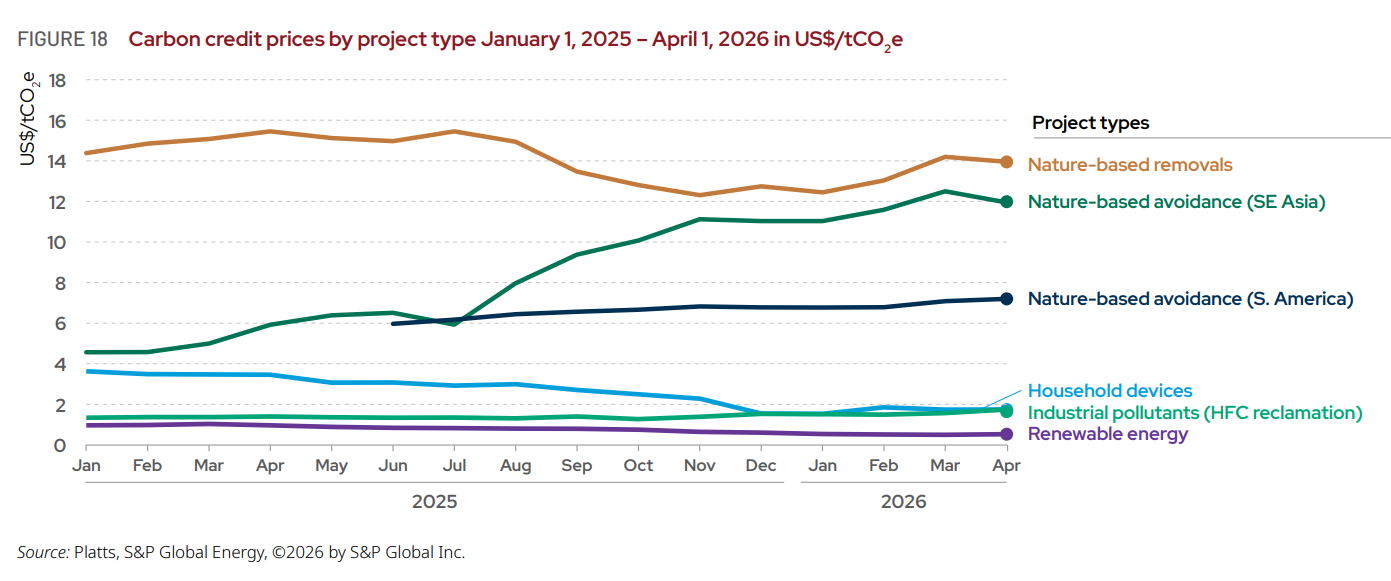
Carbon credit prices by project type
Chart from World Bank

Price gaps inside the market continue to widen.

The World Bank’s 2026 carbon pricing report revealed that CORSIA-eligible aviation credits sold for about $15 to $22 per tonne in late 2025. In contrast, many other voluntary credits traded for $1 to $14 per tonne.

These widening spreads are increasing demand for better market intelligence tools.

Forward vintage curves help buyers compare future price expectations across different credit types and delivery periods. Companies can then build more structured procurement strategies instead of relying only on spot market pricing.

Here is the library of the vintage credits available on the Abatable platform:

Abatable first forward vintage curve for carbon credits list
Source: Abatable

A Market in Transition: From Criticism to Stabilization

The new platform was launched during a major transition period for voluntary carbon markets. Between 2022 and 2024, the sector faced intense criticism over:

  • Additionality concerns,
  • Over-crediting,
  • Forestry methodologies,
  • Weak verification standards, and
  • Corporate offsetting claims.

These issues hurt buyer confidence and pushed prices lower across several project categories. However, the market is starting to stabilize.

The World Bank reported that global carbon credit issuances rose about 8% between 2024 and 2025. Government-backed crediting systems also increased from 24 to 34 mechanisms over the past decade.

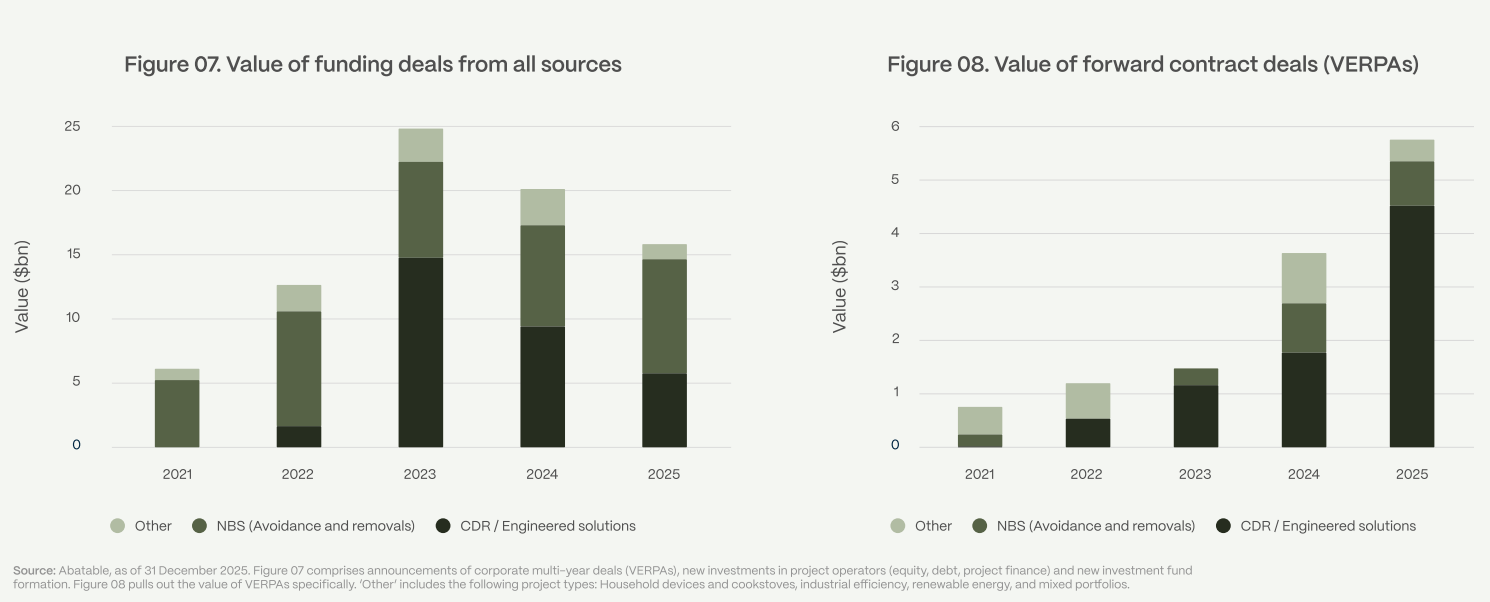
Meanwhile, companies are signing more long-term carbon credit agreements. Abatable reported that the value of forward carbon credit agreements increased 58% in 2025, reaching about $5.8 billion.

carbon credit investment and forward contract value abatable
Source: Abatable

Investment also remains strong despite market volatility. Abatable estimates show that financing for carbon projects hit about $15.8 billion. This includes roughly $9 billion for nature-based projects.

At the same time, integrity standards are becoming more important.

The Integrity Council for the Voluntary Carbon Market (ICVCM) continues reviewing methodologies under its Core Carbon Principles framework. Abatable reports that over 50% of current market credits were issued using methods now under CCP review.

This quality shift is creating stronger pricing separation between premium credits and lower-rated supply.

Carbon Markets Are Starting to Resemble Financial Markets

The launch of forward vintage curves reflects a larger change happening across carbon markets. Buyers, investors, and developers increasingly want:

  • Long-term price forecasts,
  • Portfolio valuation tools,
  • Better liquidity signals,
  • Risk management systems, and
  • Standardized market data.

This is pushing carbon markets closer to traditional financial market structures.

Analysts now describe carbon intelligence platforms as core infrastructure for the next phase of market growth. Companies increasingly rely on pricing analytics, ratings systems, and procurement tools to manage carbon portfolios.

Other market intelligence firms have also highlighted this shift. Sylvera recently advised companies to stop using flat “price-per-tonne” models. Instead, they should consider forward pricing based on quality, supply risks, and future demand.

The market still remains highly fragmented compared to oil or power markets. Carbon credits are not fully interchangeable because methodology and integrity differences strongly affect pricing.

Still, many analysts believe the market cannot scale efficiently without better pricing transparency and standardized data systems.

Transparency May Define the Next Phase of Carbon Markets

The voluntary carbon market is becoming more complex and more institutional. Governments continue building compliance systems. Article 6 markets under the Paris Agreement are expanding. Corporate buyers now demand stronger quality standards and long-term supply agreements.

Meanwhile, investors are funding carbon removal projects with delivery timelines stretching into the 2030s. All of these trends require more advanced pricing systems.

Abatable’s forward vintage curves library represents one of the clearest signs yet that carbon markets are evolving beyond fragmented bilateral trading into a more structured financial ecosystem.

The platform highlights a broader shift already underway: carbon markets increasingly depend on data transparency, pricing intelligence, and long-term risk management to support future growth.

The post Carbon Markets Go Financial with Abatable Launching First Forward Pricing Curve for Carbon Credits appeared first on Carbon Credits.

U.S.-Based Elemental Impact Teams Up with Big Tech to Build Greener AI Data Centers

Artificial intelligence is growing quickly, and so is the need for data centers. These facilities power AI tools, cloud computing, and daily online services. However, they also use large amounts of electricity, water, and materials.

A new initiative aims to make data centers more sustainable and help climate-focused startups grow.

Elemental Impact, a nonprofit investor in climate technologies, launched the Data Center Innovation Initiative (DCII). This program unites major tech companies like Amazon, Google, Meta, and Microsoft to support new clean energy and industrial technologies.

The initiative plans to invest $500,000 to $5 million in up to 10 startups by 2027. These companies will test new technologies in data centers or at demonstration sites. The goal is to prove these solutions can work at scale and later expand them to other industries.

Why AI Data Centers Are Consuming Record Levels of Power

The rapid rise of AI is driving a major infrastructure boom. AI systems need powerful processors and advanced computing gear. These systems run in massive data centers that operate 24/7.

As AI use grows worldwide, electricity demand is surging.

  • A recent United Nations report predicts global electricity demand could increase by over 10,000 terawatt-hours by 2035. This is roughly equal to the total electricity use of all advanced economies today.

Data centers are a key reason for this surge.

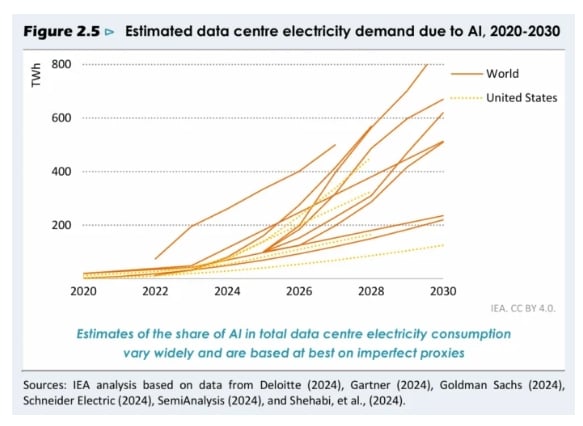
  • The International Energy Agency (IEA) estimates that data centers consumed around 415 terawatt-hours (TWh) of electricity globally in 2024. In 2023, they used about 240 TWh. This means electricity use jumped nearly 73% in just one year, mainly due to AI growth.

data centre energy

This rapid increase forces governments, utilities, and tech companies to rethink power systems.

The IEA expects data centers to drive over 20% of electricity demand growth in advanced economies by 2030. In the U.S., they could account for nearly half of all future power demand growth during that time.

Countries with major AI hubs, like the U.S., China, and parts of Europe, face rising pressure on their power grids. Utilities must add new power generation, upgrade transmission systems, and secure cleaner electricity supplies to meet future demand.

A New Push for Cleaner Infrastructure

Elemental Impact believes data centers can test climate technologies that will spread across the economy.

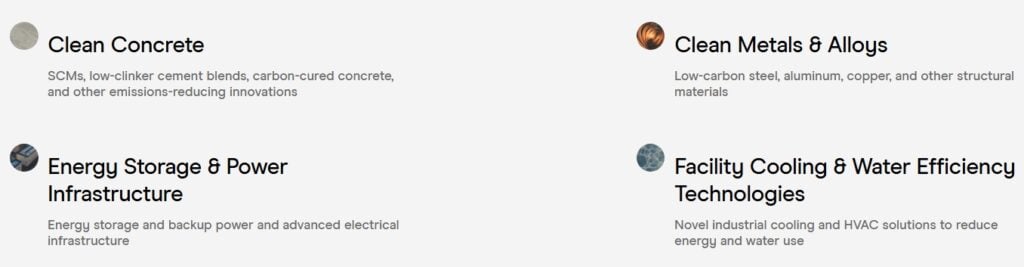
The DCII focuses on several key areas:

  • Energy storage systems
  • Advanced electrical infrastructure
  • Low-carbon construction materials
  • Cooling technologies that reduce water and electricity use
  • Clean energy solutions that enhance grid reliability
elemental impact
Source: Elemental Impact

These technologies will first be tested in real data center settings. If successful, they could later support schools, hospitals, factories, and communities needing reliable energy.

Dawn Lippert, CEO and founder of Elemental Impact, said the rapid growth of data centers offers a unique chance to speed up essential climate technologies.

She explained that partnerships with major tech firms can help entrepreneurs commercialize innovations faster while lowering emissions and improving local energy systems.

Unlike many climate programs focusing only on research, the DCII emphasizes deployment. The initiative aims to move technologies from early development to real-world use.

Big Tech Companies Back the Initiative

Amazon, Google, Meta, and Microsoft will play active roles in the initiative. These companies will help identify key technology areas, evaluate projects, and test selected technologies in their operations.

They also plan to share lessons learned with the wider industry.

Microsoft’s Chief Sustainability Officer, Melanie Nakagawa, said sustainable data center design is one of the fastest-growing opportunities for clean technology. She added that Microsoft wants to scale solutions that improve reliability, lower emissions, and strengthen communities.

Google’s Chief Sustainability Officer, Kate Brandt, stressed that partnerships are vital for tackling climate challenges. She noted the company aims to create markets for new clean energy and sustainability technologies.

Amazon highlighted its experience in enhancing energy and water efficiency across its data centers. The company believes the initiative can help develop a shared industry playbook for scaling technologies like carbon-free power and advanced cooling systems.

Meta emphasized data centers’ role in supporting sustainable materials and clean energy innovation.

Renewable Energy Will Play a Major Role

The growth of AI and digital infrastructure is straining global energy systems. At the same time, countries aim to reduce emissions and move away from fossil fuels.

This means renewable energy will be increasingly important.

Solar and wind power currently lead new electricity generation worldwide. In 2023, global solar capacity grew by over 32%. Total renewable energy capacity also surpassed 4,400 gigawatts.

These clean energy sources help meet rising demand from data centers and other sectors like transportation and manufacturing.

Still, experts warn that renewable growth alone may not suffice. Global electricity demand could increase by about 30% by 2035. AI growth, electric vehicles, industrial electrification, and population growth all contribute to this rise.

To meet future demand while cutting emissions, countries will likely need a mix of renewable energy, energy storage, grid upgrades, and possibly nuclear power.

Corporate Demand Drives Clean Energy Growth

The expansion of AI is no longer just a tech story. It is also an energy and infrastructure challenge. And data centers drive this transformation. Their rapid growth boosts electricity demand, speeds up grid investments, and opens new doors for climate innovation.

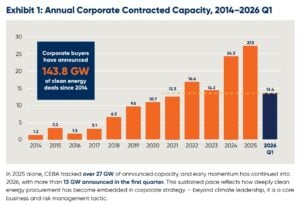
Companies are playing a major role in expanding clean energy in the U.S. Since 2014, CEBA has tracked over 143.8 gigawatts (GW) of clean energy deals. These projects include solar, wind, nuclear, battery storage, and other carbon-free technologies.

Despite economic and market challenges, 2025 became the second straight record year for new clean energy capacity announcements in the country.

clean energy demand

Elemental Impact Pushes Community-Driven Growth for Sustainable Data Centers

Elemental Impact emphasizes the initiative’s focus on local economic and environmental benefits.

The nonprofit plans to work closely with communities where projects are developed. This includes supporting workforce development, clearly communicating project benefits, and involving local stakeholders early in the process.

According to Elemental, 98% of companies in its current portfolio say community partnerships have been key to their success. This approach may help reduce resistance to new infrastructure projects while creating jobs and improving energy access.

The initiative also aims to lower risks for future technology adopters. Documenting project results and sharing performance data can boost other companies’ confidence. This may encourage them to invest in similar technologies.

In conclusion, the Data Center Innovation Initiative reflects a broader shift in the tech industry. Companies are no longer focused solely on powering AI growth. They are also seeking ways to make that growth cleaner, more efficient, and more sustainable.

The post U.S.-Based Elemental Impact Teams Up with Big Tech to Build Greener AI Data Centers appeared first on Carbon Credits.

Waymo’s Brand New Robotaxi Ojai Brings Cleaner, Smarter Rides to More Cities in the U.S.

 Waymo has started giving riders access to its newest robotaxi, called the Ojai. The all-electric vehicle is now offering free rides to select users in Los Angeles, Phoenix, and San Francisco as the company prepares for a bigger rollout later this year.

The Ojai is based on a modified Zeekr electric minivan, but Waymo redesigned it specifically for autonomous ride-hailing. The company wants the vehicle to feel more comfortable, more spacious, and easier to use than a normal rideshare car.

For now, only a small group of riders can try the service. But Waymo plans to expand access over the next few months and launch the Ojai in Denver, Las Vegas, and San Diego later this year.

The launch marks another major step for the company as competition in the robo-taxi market continues to grow.

Meet Ojai: A Robotaxi That Feels More Like a Lounge

Waymo says the Ojai was designed to feel less like a taxi and more like a relaxing space on wheels.

  • The vehicle comes with large sliding doors that open automatically, making it easier for riders to enter and exit. Inside, the flat floor and roomy cabin create an open layout that feels much bigger than a traditional car.
  • Three large LED screens allow passengers to control music, temperature, and ride settings during the trip. The interior feels modern, simple, and less crowded than most ride-hailing vehicles on the road today.
  • Waymo also focused heavily on accessibility. The Ojai includes braille features, screen-reader compatibility, and support handles built into the seats to help riders who may need extra assistance.

The company said it worked closely with riders and community groups while designing the vehicle. Instead of adding accessibility later, Waymo built those features into the design from the beginning.

Here’s how Ojai looks from inside:

ojai waymo
Source: Waymo

Smarter Tech Powers the Ride

The Ojai runs on Waymo’s sixth-generation self-driving system, called the Waymo Driver.

According to the company, the updated technology can handle tougher road and weather conditions, including snowy streets. That could help Waymo expand into more cities across the United States in the future.

Waymo said its autonomous system has already completed more than 20 million fully driverless trips across over 11 cities. Over the years, the company has continued improving its cameras, sensors, radar systems, and artificial intelligence software.

Unlike some competitors still testing small pilot programs, Waymo already operates commercial autonomous ride services in several major cities.

Now, the company is preparing for much larger growth. Waymo said its factory in Mesa, Arizona, is scaling production to support tens of thousands of autonomous vehicles every year.

More Cities Are Getting Waymo Rides

Waymo’s robotaxi service is already available in Phoenix, San Francisco, Los Angeles, Austin, and Atlanta.

In some cities, customers use the Waymo app directly. In others, including Austin and Atlanta, riders can book trips through Uber. The company now plans to bring the Ojai to even more cities. Denver, Las Vegas, and San Diego are expected to join the list later this year.

Waymo’s expansion comes as more cities look for cleaner and smarter transportation options. At the same time, more riders are becoming comfortable with autonomous vehicles.

The company believes robo-taxis could eventually become a normal part of daily city travel.

Cleaner Trips with Zero Tailpipe Emissions

Waymo is also highlighting the environmental benefits of its fully electric fleet.

Every Waymo robotaxi runs on electricity and produces zero tailpipe emissions. That helps reduce air pollution compared with gasoline-powered taxis and rideshare vehicles.

  • The company currently provides more than 500,000 autonomous EV trips every week.
  • Those trips help avoid around 530 tons of CO₂ emissions.

Waymo says shared electric mobility can help cities improve air quality while giving more people access to cleaner transportation.

The company also believes robotaxis can make electric travel more affordable. Many people cannot afford to buy an EV, while others simply do not want to own a car. Autonomous ride services offer another transportation option without the costs of ownership.

Waymo’s Bigger Sustainability Push

Waymo says its service can work alongside public transportation instead of replacing it.

Survey data from San Francisco showed that around 36% of riders used Waymo vehicles to connect with transit systems like BART, Muni, and CalTrain.

That means many passengers use robotaxis for shorter connections instead of driving personal vehicles everywhere.

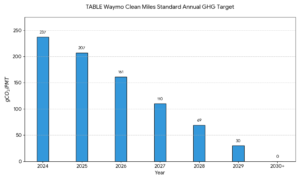
Waymo has also created its own “Avoided Emissions Methodology” to measure how much pollution its electric fleet prevents. The company compares emissions from its fully electric rides with California’s Clean Miles Standard targets for ride-hailing companies.

WAYMO SUSTAINABILITY EMISSIONS
Source: Waymo

Those state rules aim to reduce transportation emissions by increasing electric vehicle use and lowering carbon pollution over time.

Notably, Waymo’s environmental data is also included in sustainability reporting from Alphabet, the parent company.

As cities continue pushing for cleaner transportation, Waymo believes autonomous electric fleets could play a major role in the future of urban travel.

The Future of the Autonomous Ride-Hailing Market

The ride-hailing market is growing quickly, and autonomous vehicles are becoming a bigger part of that story.

According to Mordor Intelligence, the global ride-hailing market could grow from $184.49 billion in 2026 to $392.27 billion by 2031.

ROBOTAXI MARKET

Traditional ride-hailing services still dominate the market today. In 2025, e-hailing platforms accounted for more than 73% of industry revenue. But robo-taxis are growing even faster.

Several trends are driving that growth:

  • Cities are becoming more crowded
  • Autonomous technology keeps improving
  • Governments want cleaner transportation
  • Shared mobility reduces traffic and emissions
  • Companies are replacing employee car programs with ride credits

Robo-taxis also help companies lower costs by reducing driver expenses and improving route efficiency. As technology improves, autonomous ride-hailing could become much more common in large cities worldwide.

To sum up, with the Ojai rollout, the company is showing what that future may look like — quieter streets, cleaner rides, and transportation that feels smarter, simpler, and easier to use.

The post Waymo’s Brand New Robotaxi Ojai Brings Cleaner, Smarter Rides to More Cities in the U.S. appeared first on Carbon Credits.

Clean Energy Trade Hits $479B Despite Tariffs and Global Tensions: What This Means for the Energy Transition

Clean Energy Trade Hits $479 Billion Despite Tariffs and Global Tensions: What This Means for the Energy Transition

Global trade in clean energy products grew again in 2025 despite tariffs, political tensions, and unstable energy markets. According to BloombergNEF (BNEF), global clean-energy trade reached $479 billion in 2025, rising 1% from the previous year. The recovery came after a decline in 2024.

The growth is important because it happened during a difficult period for global trade. The United States and other countries expanded tariffs on clean energy products. At the same time, conflict in the Middle East pushed oil and gas prices higher and created uncertainty across global markets.

Still, demand for solar panels, batteries, electric vehicles (EVs), and power-grid equipment continued to rise.

Antoine Vagneur-Jones, lead author of the report, remarked:

“As conflict in the Middle East persists, many markets are doubling down on the deployment of clean technology to improve their energy security and resilience. This presents a huge opportunity for manufacturers to expand exports of the equipment and products required to power the energy transition.”

This shows that the global energy transition is continuing even during political and economic uncertainty.

When Oil Gets Expensive, Solar Gets the Spotlight

One major reason for the rebound is rising fossil fuel costs.

Oil and gas prices increased during the Middle East conflict. This placed pressure on countries that depend heavily on imported fuel. In response, many governments and businesses accelerated investments in solar power and battery systems.

BloombergNEF highlighted Pakistan as one of the clearest examples. After the energy crisis linked to Russia’s invasion of Ukraine, Pakistan sharply increased solar imports. The country’s solar module imports jumped by about 189% to nearly $1 billion in 2022.

That growth continued into 2025. Pakistan reportedly installed around 18.3 gigawatts of small-scale solar capacity in a single year. High electricity prices and power shortages pushed households and businesses to adopt rooftop solar systems.

Similar trends are now appearing across Southeast Asia and parts of Africa. Countries are turning to renewables because solar and battery systems can reduce exposure to volatile fuel prices.

lithium ion battery pack cost BNEF

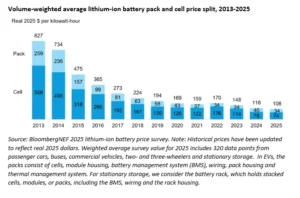
Technology costs are also improving. BloombergNEF reported that average lithium-ion battery pack prices fell from $118 per kilowatt-hour in 2024 to about $108 per kilowatt-hour in 2025.

The International Energy Agency reported that global clean energy investment hit about $2.2 trillion by 2025. That’s roughly double what’s expected for fossil fuels.

China Continues to Lead the Clean Tech Market

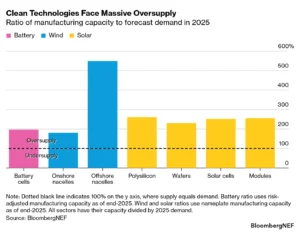
China remains the world’s largest clean-energy manufacturing hub. BloombergNEF said Chinese investment has created a major oversupply across several sectors. These include solar panels, batteries, and electric vehicles. In some industries, manufacturing capacity now exceeds 200% of expected global demand.

This oversupply has pushed prices lower worldwide. Lower prices benefit consumers and project developers. However, they make it tougher for manufacturers in the U.S. and Europe to compete.

clean tech oversupply BNEF

China’s EV industry shows the scale of its dominance. Chinese EV exports reached about $69.6 billion in 2025, rising roughly 43% from the previous year. China also produced around 16 million new energy vehicles and exported about 2.6 million EVs globally.

Chinese companies are also expanding quickly into developing markets. Exports of Chinese EVs to Africa reportedly rose 189% year-on-year.

China continues to dominate solar manufacturing as well. BloombergNEF said solar cell trade made up about 44% of global solar cell and module trade in 2025, compared with 25% the year before.

This shows how global supply chains are adapting to tariffs rather than slowing down completely.

Tariffs Shift the Map, But Don’t Slow the Flow

The United States and Europe are trying to build local clean energy industries through subsidies and tariffs. However, BloombergNEF said tariffs have not significantly reduced global clean-tech trade.

Instead, companies are shifting production to other countries. Manufacturing is expanding in places such as India, Vietnam, Thailand, Turkey, and Egypt. These countries are becoming important parts of global clean energy supply chains.

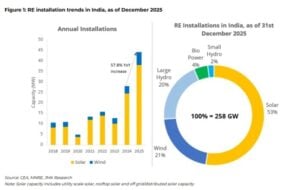
India is emerging as one of the strongest new competitors. BloombergNEF said India’s growing solar manufacturing industry could help the country become a major exporter in the future.

india solar and wind installations 2025

Still, China remains dominant across most sectors. Though many factories in the United States and Europe mainly handle final assembly, they do not focus on full supply chain production. Some projects are also facing delays because of high costs and weaker demand.

As a result, China could remain the leading supplier of many clean energy products for years to come.

Battery Storage and Grid Investment Continue Rising

Another major trend is the rapid growth of battery storage and power grid investment. As more countries build solar and wind projects, they also need battery systems to stabilize the electricity supply.

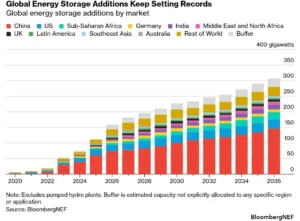
BloombergNEF said energy storage systems accounted for about 29% of global battery shipments in 2025. Shipments in this sector grew by around 64% year-on-year, showing strong demand for large-scale energy storage. It will continue to grow over the next decade, as shown below. 

global energy storage BNEF

Countries are also investing heavily in power grids. Governments are improving transmission systems. They aim to support renewable energy, electric vehicles, and the growing electricity needs from artificial intelligence and data centers.

BloombergNEF estimated that global energy transition investment reached a record $2.3 trillion in 2025. Large clean energy companies are also expanding climate and sustainability efforts.

  • Tesla continues to expand battery and renewable energy projects as part of its long-term net-zero strategy.
  • BYD is rapidly growing its EV and battery production while expanding exports to global markets.
  • First Solar continues to invest in domestic solar manufacturing and lower-carbon production systems.

These efforts are becoming more important as investors and governments push companies to reduce emissions and strengthen energy security.

Clean Energy Trade and the Emissions Gap

Clean energy trade is growing, but global emissions remain very high. This shows a gap between clean energy progress and climate needs.

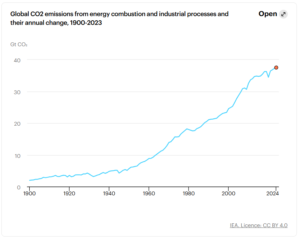
According to the International Energy Agency, global energy-related CO₂ emissions reached about 37.8 billion metric tons in 2024, marking another record high. The energy sector still produces about three-quarters of global greenhouse gas emissions.

Global CO2 emissions from energy combustion and industrial processes
Source: IEA

The Intergovernmental Panel on Climate Change (IPCC) warns that emissions must fall sharply to avoid severe warming. It estimates global emissions need to drop about 43% by 2030 compared with 2019 levels to stay on a 1.5°C pathway.

This highlights the urgency behind clean energy expansion. Investment is rising, but the transition is uneven. While clean energy investments reached a record high, fossil fuels continue to supply a large share of global energy demand.

This creates a widening gap. Clean energy is growing quickly, but not yet fast enough to replace fossil fuels. Until clean power expands faster than rising energy demand, global emissions are likely to stay near record levels.

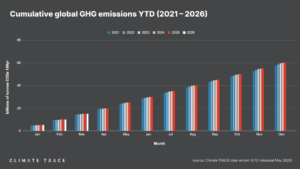
global GHG emissions 2026
Source: Climate Trace

Clean Energy Is No Longer a Trend; It’s Trade Policy

The rebound in clean energy trade to $479 billion in 2025 shows that the global energy transition is still advancing. This is despite tariffs and geopolitical tensions.

Rising fossil-fuel prices are pushing more countries toward renewable energy. At the same time, demand for batteries, solar panels, EVs, and power-grid equipment continues to grow.

This points to a bigger picture: Clean energy trade is no longer only about climate goals. It is now closely tied to economic growth, industrial competitiveness, energy security, and long-term stability.

As countries continue to electrify their economies, global trade in clean energy technologies will likely remain one of the fastest-growing parts of the world economy.

The post Clean Energy Trade Hits $479B Despite Tariffs and Global Tensions: What This Means for the Energy Transition appeared first on Carbon Credits.
Aluminum Prices Spike as Gulf Conflict Squeezes Supply and Energy Costs, Impacting U.S. Solar Market

Aluminum Prices Spike as Gulf Conflict Squeezes Supply and Energy Costs, Impacting U.S. Solar Market

Global aluminum markets have entered a sharp upward cycle in 2026 as geopolitical tensions in the Middle East disrupt supply chains and push energy-linked costs higher.

On May 27, 2026, Reuters reported a sharp rise in aluminum prices, which followed disruptions due to conflict in the Gulf region. These issues raised worries about tighter supply and higher production costs. Energy-intensive industries, like solar manufacturing, felt the impact the most.

The scale of the move is significant. LME aluminum prices have risen from the low-$3,000s per ton earlier this year to about $3,600–$3,650 per ton in May 2026. 

Over a broader horizon, prices are now roughly 40–48% higher year-on-year, reflecting sustained tightness rather than a short-term spike. Analysts now describe the market as being driven more by supply shock than demand strength.

Gulf Supply Shock Sends the Global Aluminum Trade Into Deficit

The biggest driver behind the rally is a sudden loss of production capacity in the Middle East. Disruptions linked to the Iran conflict have impacted key Gulf smelters, including facilities in Qatar, Bahrain, and the UAE. These operations make up about 9% of the world’s aluminum smelting capacity, excluding China.

Industry estimates suggest:

  • Around 2 million tons of annual production capacity have been disrupted in early 2026.
  • Gulf supply equals roughly 7–9% of global output capacity.
  • Some facilities may take up to one year to fully recover.

This is not just a temporary logistics issue. It is a direct production shock.

A Reuters analysis called this one of the worst aluminum supply disruptions in decades. It noted that physical shortages are tightening inventories worldwide.

The Strait of Hormuz, a critical energy and metals shipping route, has also seen reduced traffic, increasing freight uncertainty, and insurance costs.

Tight Inventories and Record Premiums Push Prices Higher

Beyond geopolitics, market structure is amplifying the price move. LME data shows aluminum prices recently reaching around $3,655 per ton, the highest level in nearly four years.

This is the second-highest level in over a decade now, after the highest price recorded in March 2022. 

Aluminum Price

Unit: USD/Unit

Loading Chart…

Why Investors See a High-Upside Catalyst Pipeline Building for Alaska Energy Metals Corporation

Disseminated on behalf of Alaska Energy Metals Corporation

Alaska Energy Metals Corporation (AEMC) is starting to draw serious attention from investors. The reason is simple: it offers exposure to nickel, a key metal for electric vehicles (EVs) and clean energy, at a very early stage and a low valuation. At the center of this story is the company’s Nikolai project in Alaska, which combines large-scale resources, improving economics, and a steady flow of upcoming catalysts.

Put together, these factors are building a strong case for a potential re-rating.

Nikolai’s Massive Nickel Resource Stands Out

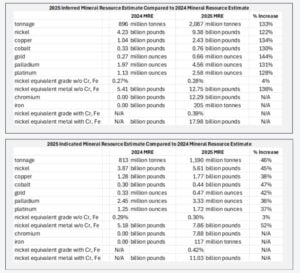
The Nikolai project is one of the largest undeveloped nickel resources in North America. As of March 2025, it hosts:

  • 5.6 billion pounds of indicated nickel
  • 9.4 billion pounds of inferred nickel
  • Plus copper, cobalt, platinum, palladium, gold, chromium, and iron
alaska energy metals aemc nickel
Source: AEMC

This mix of metals matters. Nickel and cobalt are essential for EV batteries, while platinum and palladium add extra value. As a result, the project is not dependent on just one commodity.

Even more important, the deposit sits within a pit shell. This suggests it could be mined using open-pit methods, which are generally cheaper and easier to scale than underground mining.

Grades also support early development. The indicated resource averages about 0.30% nickel equivalent, with a higher-grade core extending over 2.5 kilometers near the surface. This could allow for faster production and earlier cash flow.

Recent drilling has already significantly expanded the resource. Between 2023 and 2024, indicated resources grew by 45%, while inferred resources jumped by 122%. This shows the system is still open and has room to grow.

From Explorer to Value Creator: A Shift the Market Is Missing

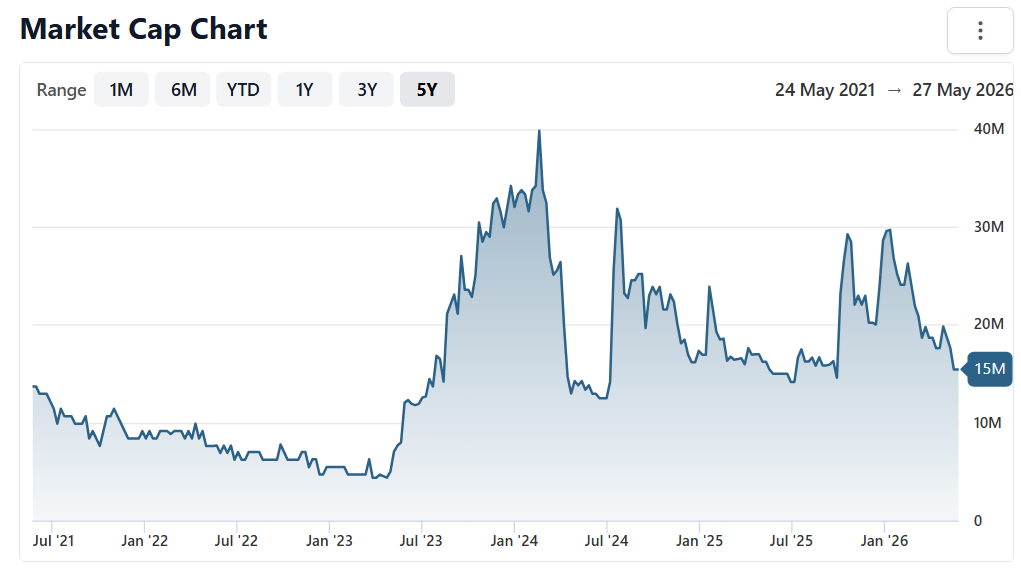
As of May 2026, AEMC is consolidating with a market cap of CAD 15 million. While the stock currently trades at a speculative CAD 0.07–0.10, the outlook is bolstered by the upcoming Preliminary Economic Assessment (PEA) for the Nikolai Nickel Project and a tightening global nickel market driven by Indonesian supply constraints.

As the company advances through federal permitting and metallurgical studies, its valuation remains sensitive to news flow; however, its positioning as a large-scale domestic source for critical minerals provides a strategic foundation for potential long-term growth as the project de-risks.

AEMC Market Cap
Source: stockanalysis.com

However, the company is moving beyond early exploration. It is now entering a stage where studies will start to show real economic potential. This shift is critical, yet the market has not fully priced it in.

At the same time, the broader nickel market is changing. After a period of oversupply, conditions are tightening. Nickel price have already risen 37.5% from $14,241 on December 14, 2025 to $19,587 per tonne on May 6, 2026, and demand continues to grow with EV adoption.

Nickel Price

Unit: USD/Tonne

Loading Chart…

Compliance Carbon Markets and ETS Reform Gain Momentum as Asia Tests New Transition Credits for Coal Phaseout

Compliance Carbon Markets and ETS Reform Gain Momentum as Asia Tests New Transition Credits for Coal Phaseout

Compliance carbon markets in Asia are entering a new stage. They are expanding in size and changing in design. At the same time, new finance tools are being tested for coal transition and nature-based projects.

Two recent developments show this shift clearly.

First, the International Energy Agency (IEA) says compliance carbon markets could become the largest source of demand for transition credits linked to coal phaseout in Southeast Asia. But this only works if developers can prove that early coal closures are truly additional. This is harder now because renewable energy costs are falling fast.

Second, Shanghai is planning to expand its emissions trading scheme (ETS) by lowering the entry threshold for industries. This change is part of a reform plan that runs toward 2030.

Meanwhile, new nature finance platforms are starting in Southeast Asia. One example is the soft launch of the Nature Catalyst investment platform. Together, these moves show that carbon markets in Asia are growing. But they are also becoming more complex.

IEA Sees Transition Credits as a Coal Exit Tool—With Strict Conditions

The IEA report, Financing the Modernisation of Power Systems Beyond Coal, focuses on Southeast Asia. This region still relies heavily on coal power.

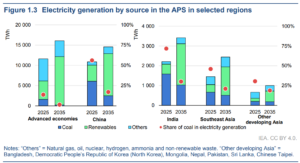
Electricity demand in Southeast Asia is growing fast. The IEA says it rises by around 3–4% per year through 2040. Over the past decade, electricity demand in the region has grown by more than 60%.

Coal power is still a large part of the system. Southeast Asia has more than 121 GW of coal capacity. It also has about US$130 billion in remaining unamortized coal assets.

electricity generation by source Southeast Asia iea
Source: IEA

This creates a challenge. Many coal plants cannot close easily without financial support.

The IEA says transition credits may help solve this problem. These credits would pay for early coal plant closures and help replace them with clean energy. But there is a strict condition:

  • Projects must prove additionality. This means the coal plant would not have closed without carbon finance.

This is becoming harder because renewable energy is now cheaper in many markets. Some coal plants may close anyway due to market forces.

The IEA warns that compliance carbon markets could become the biggest source of demand for transition credits, but only if the rules are strict. The key rules must include:

  • Clear emissions baselines,
  • Proof of early coal retirement,
  • Tracking of replacement clean energy, and
  • No double-counting with other policies.

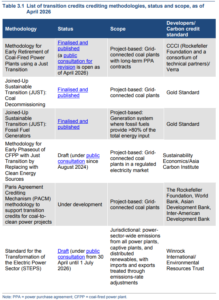
Without these rules, credits may not reflect real emissions cuts. Currently, here are the existing credit methodologies as of April 2026.

transition credits methods available
Source: IEA

The IEA further estimates that Southeast Asia will need to invest about US$80 billion per year in power systems between 2025 and 2050 under its Announced Pledges Scenario (APS). This spending covers the construction and refurbishment of power plants, as well as battery storage deployment.

Around US$60 billion annually will support rising electricity demand and the replacement or upgrade of non-coal power capacity. Another US$20 billion per year will go toward cutting emissions from existing coal plants. The report also shows that nearly 70% of coal transition investment could flow into solar PV and wind projects to replace unabated coal generation.

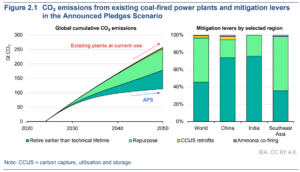
Moreover, to cut emissions and keep the grid reliable, the report suggests several paths. These include replacing energy with renewables, modernizing the grid, using flexible coal operations, and implementing carbon capture, utilization, and storage (CCUS).

carbon emissions coal power plants
Source: IEA

The IEA states that CCUS can help newer coal plants operate with lower emissions. This is important in systems where coal is still a key source of baseload power.

In wider Southeast Asia, the agency estimates that CCUS deployment may need to capture 200 million tonnes of CO₂ each year by 2050. Also, investment could reach nearly US$1 billion annually from 2025 to 2030.

Shanghai ETS Reform Expands China’s Carbon Market Coverage 

China’s carbon market is also changing. Shanghai is planning to expand its emissions trading scheme. It will do this by lowering the entry threshold for industries. This means more companies will join the system. This reform is part of a wider ETS plan that runs through 2030.

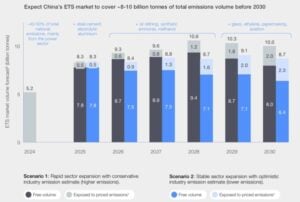
China already has the largest ETS in the world by emissions covered. It regulates more than 4 billion tonnes of CO₂ (CO₂e basis) each year.

china compliance carbon market ets

Lowering entry thresholds usually leads to:

  • More companies covered,
  • Higher total emissions under regulation, and
  • Stronger carbon price signals.

This change is important because it increases market reach. It also strengthens carbon pricing across more industries. It also shows a wider trend in Asia.

Many ETS systems in the region are still growing. Shanghai’s reform may guide future ETS changes in other countries.

Nature-Based Solutions Finance Expands in Southeast Asia

Nature finance is also growing in the region. The Nature Catalyst investment platform has now soft-launched in Southeast Asia. It has signed agreements with four companies. These companies will help scale nature-based solutions (NbS).

Nature-based solutions include:

  • Forest protection and reforestation,
  • Mangrove restoration,
  • Sustainable land management, and
  • Biodiversity protection projects.

These projects can also generate carbon credits in many cases. Southeast Asia is an important region for this type of work. It has large forests and high biodiversity. It also has strong potential for carbon removal and avoided deforestation projects.

But nature finance alone is not enough. The IEA report shows that clean energy systems must also grow at the same time. Otherwise, emissions from coal power will remain high.

The Additionality Problem Is Becoming a Core Market Risk

A key issue runs through all these developments. Renewable energy costs are falling. Solar and wind are now cheaper in many places. This means coal plants may close without carbon credits.

At the same time, transition credits depend on proving that closures would not happen without financial support. This creates a problem called the “additionality gap.”

If a coal plant were to close anyway, then issuing credits does not reduce emissions. If it does not close, then credits are needed to speed up the transition.

The IEA warns that this balance is now harder to manage. It also means carbon markets must improve how they measure real impact. Otherwise, trust in the system could weaken.

Carbon Markets in Asia Are Growing, But Trust Will Decide Their Future

Carbon markets in Asia are expanding quickly. The IEA says compliance carbon markets could become the biggest demand source for transition credits in coal-heavy regions like Southeast Asia. Electricity demand in the region is rising by 3–4% per year, which keeps pressure on power systems.

Meanwhile, Shanghai is expanding its ETS by lowering entry thresholds and adding more companies to its carbon pricing system. This strengthens China’s already large market, which covers more than 4 billion tonnes of CO₂ each year.

Nature finance is also growing through platforms like Nature Catalyst, which is scaling investment into ecosystem-based projects. However, all these systems face the same challenge.

They must prove real emissions cuts. Without strong rules on additionality, measurement, and verification, carbon credits and transition credits may not reflect real climate progress.

Asia is becoming a key region for carbon market innovation. But its future will depend on one thing above all: credibility.

The post Compliance Carbon Markets and ETS Reform Gain Momentum as Asia Tests New Transition Credits for Coal Phaseout appeared first on Carbon Credits.

McDonald’s Warns 2030 Supply Chain Target Is Slipping But 2050 Net Zero Goal Remains

McDonald’s Warns 2030 Supply Chain Target Is Slipping But 2050 Net Zero Goal Remains

McDonald’s has admitted it will likely miss one of its major climate goals, showing how difficult supply chain decarbonization has become for global food companies. The food chain giant said it no longer expects to meet its target of cutting value chain emissions by 2030. Still, McDonald’s says it remains committed to reaching net-zero emissions across its operations and supply chain by 2050.

The update matters because McDonald’s is one of the world’s largest restaurant companies. It operates more than 43,000 restaurants in over 100 countries and serves around 70 million customers every day.

The food industry closely watches the company’s climate progress, where reducing emissions from agriculture and livestock is still difficult. McDonald’s states that inflation, new regulations, and tech limits have slowed progress to its 2030 goal. The size of its global supply chain also plays a role.

The company wrote:

“We still maintain a long-term ambition: net zero emissions by 2050. We know this depends on many external variables—the changes required to reduce Scope 3 emissions are largely systemic and interconnected across the value chain. Given these realities, we face significant challenges, and at this point, we do not expect to reach our 2030 Scope 3 goal on the original timeline.”

Supply Chain Emissions Remain McDonald’s Biggest Climate Challenge

McDonald’s says most of its emissions come from its supply chain rather than from restaurant operations. The company previously pledged to:

  • Cut Scope 1 and 2 emissions by 50.4% by 2030
  • Reduce Scope 3 energy and industrial emissions by 50.4% by 2030
  • Cut Scope 3 forest, land, and agriculture (FLAG) emissions by 16% by 2030
  • Reach net zero across the business by 2050

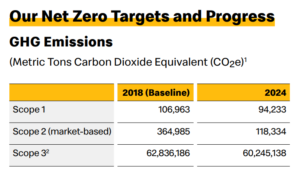
McDonald’s reported total greenhouse gas emissions of about 60.5 million metric tonnes of CO₂e in 2024. This is a decrease from around 63.3 million tonnes in 2018.

McDonald's carbon emissions
Source: McDonald’s

The company’s direct operational emissions improved. Scope 1 emissions dropped to 94,233 tonnes CO₂e in 2024, down from the 2018 level. Market-based Scope 2 emissions also declined sharply to 118,334 tonnes, compared with the baseline year.

However, Scope 3 emissions, mostly from agriculture, packaging, logistics, and franchises, made up around 60.2 million tonnes CO₂e of McDonald’s climate footprint in 2024. These supply chain emissions remain the company’s biggest challenge as it works toward its long-term net-zero target.

Food Systems Face Rising Pressure to Cut Emissions

McDonald’s reflects a broader challenge facing the global food sector. The United Nations Food and Agriculture Organization estimates that food systems produce about one-third of global greenhouse gas emissions.

Livestock production is a big contributor to greenhouse gases. Cattle release methane, which is much stronger than carbon dioxide in the short term.

At the same time, global meat demand continues rising. The OECD and FAO predict that global meat consumption will continue to rise over the next ten years. This growth will be especially strong in emerging economies.

This creates a difficult balance for food companies. Consumer demand for beef is strong. However, investors, regulators, and governments want companies to cut emissions.

Many food companies now face pressure to improve:

  • Methane reduction,
  • Forest protection,
  • Packaging sustainability,
  • Renewable energy use, and
  • Agricultural supply chains.

However, changing large global supply systems takes years and often requires cooperation from farmers, suppliers, franchisees, and logistics operators. Amid all these, McDonald’s focuses on cutting emissions from its operations. 

McDonald’s Expands Renewable Energy and Low-Carbon Operations

Even as its supply chain target slips, McDonald’s continues investing heavily in climate action across restaurants, sourcing, and logistics. The company is committed to reaching net zero by 2050. It also aligns its climate goals with the Science Based Targets initiative (SBTi). 

The food chain giant states that restaurant operations are a key focus. This is because energy use, refrigeration, and cooking systems create significant emissions.

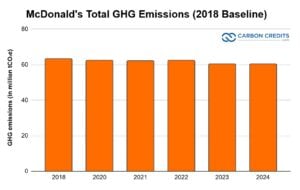
McDonald’s total GHG emissions have remained largely flat over 2020–2024 at roughly 60–62 million metric tons of CO₂e. It was able to cut emissions down by around 4.5% in 2024 compared with 2018 levels.

McDonald's GHG carbon emissions
Source: McDonald’s Reports

The company continues upgrading restaurants with energy-efficient kitchen equipment, LED lighting, smart energy systems, and lower-emission refrigerants. It keeps growing renewable electricity sources through virtual power purchase agreements and renewable energy certificates.

According to the report, McDonald’s now tracks emissions using millions of operational and supply-chain data points across sourcing, logistics, and restaurants. The company says these systems help identify emission hotspots and improve supplier accountability.

Transportation and logistics are also part of the company’s climate strategy. McDonald’s says suppliers are reducing fuel use through these means:

  • route optimization,
  • engineless refrigerated trailers,
  • driver efficiency programs, and
  • alternative fuels, including renewable natural gas, electricity, hydrogen, propane, and biofuels.

The company also continues pushing sustainability standards deeper into its supply chain. McDonald’s works with suppliers and farmers on several key areas. They focus on regenerative agriculture, forest protection, and reducing methane from beef and dairy. These practices help address emissions, which are significant for the company.

Packaging remains another major initiative. McDonald’s reports that more than 90% of guest packaging materials now come from renewable, recycled, or certified sources. The company also continues efforts to reduce packaging waste and increase the use of recycled materials globally.

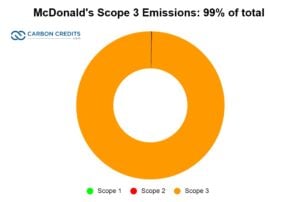
McDonald’s highlights that engaging suppliers is crucial. About 99% of its total emissions come from Scope 3 sources. These include agriculture, packaging, transportation, and franchise operations. The company added that long-term progress will depend heavily on how quickly lower-carbon technologies and farming systems scale globally.

McDonald's scope 3 emissions
Source: McDonald’s

Methane Reduction and Regenerative Agriculture Become Critical

Methane reduction now plays a central role in food-sector climate plans. The United Nations Environment Programme says methane has more than 80 times the warming power of CO₂ over 20 years.

Because beef remains one of McDonald’s largest emissions sources, the company increasingly focuses on lower-carbon farming practices. These include improved grazing systems, feed efficiency, manure management, and regenerative agriculture.

McDonald’s says it aims to scale regenerative agriculture practices across its supply chain to improve climate resilience and help reduce emissions.

Still, experts say large-scale adoption remains difficult because farmers often face high upfront costs and uncertain financial returns.

Investors Want More Than Net-Zero Promises

McDonald’s update comes as investors increasingly question whether companies can meet aggressive climate targets.

Over the last several years, many global companies have announced net-zero commitments tied to 2030 and 2050 timelines. However, supply chain emissions continue to challenge sectors such as food, aviation, shipping, and heavy industry.

Regulators are also increasing disclosure requirements.

Europe’s Corporate Sustainability Reporting Directive (CSRD) expands climate reporting rules for large companies. California also passed laws that will require many firms to disclose Scope 3 emissions later this decade.

Companies now compete not just on products and prices. They also focus on emissions performance and supply chain transparency.

McDonald’s Net-Zero Journey Is Entering Its Toughest Phase

McDonald’s decision to acknowledge likely delays in its 2030 supply chain target reflects a wider reality across corporate climate strategies.

Many companies can reduce operational emissions through renewable electricity and efficiency upgrades. But supply chain emissions are much harder because companies depend on global supplier networks and agricultural systems outside their direct control.

McDonald’s says it still plans to pursue net zero by 2050. The company’s long-term progress will likely depend on how quickly lower-carbon agriculture, renewable energy, methane reduction technologies, and sustainable logistics systems expand globally.

For the broader food industry, the message is clear: setting climate targets is only the first step. Transforming global food systems may prove far more difficult.

The post McDonald’s Warns 2030 Supply Chain Target Is Slipping But 2050 Net Zero Goal Remains appeared first on Carbon Credits.

IEA Projects Nearly 30% of Global Car Sales Will Be EVs in 2026

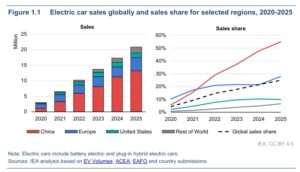
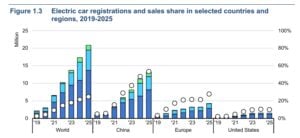
The global transition to electric vehicles is gaining momentum faster than expected. According to the International Energy Agency’s Global EV Outlook 2026, electric cars are projected to make up nearly 30% of worldwide vehicle sales this year, with total EV sales expected to hit 23 million units.

GLOBAL EV SALES

Oil Shock Makes EVs the Smarter Choice for Consumers

Rising oil prices and growing energy security concerns are accelerating this shift. Fuel costs surged after tensions involving Iran disrupted oil shipments through the Strait of Hormuz, pushing petrol and diesel prices sharply higher. As a result, consumers and businesses increasingly turned to EVs to reduce long-term transportation expenses.

  • Although global EV sales fell 8% year-over-year to 3.9 million units during the first quarter of 2026, the IEA described the slowdown as temporary. The decline was largely tied to policy and incentive changes in China and the United States.

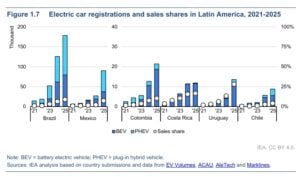
Outside those two markets, EV demand expanded rapidly. Sales rose 80% across the Asia-Pacific region excluding China, increased 75% in Latin America, and climbed 30% in Europe, highlighting broader global adoption trends.

Higher fuel prices have also improved the cost advantage of EV ownership. The IEA said annual fuel savings from electric vehicles increased by 35% compared to 2025 levels.

At the same time, online car marketplaces and automakers reported stronger interest in EVs following the oil market disruption.

Falling Battery Cost Boosts EV Adoption

Falling battery costs are also helping accelerate adoption. The IEA said lower battery prices, combined with improvements in charging speed and driving range, are making EVs increasingly competitive with gasoline-powered cars.

Automakers are also investing heavily in smart charging and vehicle-to-grid (V2G) systems. These technologies allow EVs to charge during off-peak hours or even send electricity back to the power grid, helping reduce strain on energy infrastructure.

China Tightens Its Grip on the Global EV Supply Chain

China continued to dominate nearly every part of the electric vehicle industry last year.

  • The country produced almost three-quarters of the world’s EVs and exported more than 2.5 million vehicles globally. This doubled overseas shipments compared to the previous year.

China also strengthened its control over battery manufacturing and critical materials. The IEA said the country now produces more than 80% of the world’s battery cells and an even larger share of key battery processing materials.

This leadership has allowed Chinese automakers to lower EV costs and expand aggressively into emerging markets.

EV sales

Affordable Chinese-made EVs are becoming especially important in developing economies, where lower-cost models are helping accelerate adoption. Around 60% of EV sales in emerging markets outside China now come from imported Chinese vehicles.

The commercial vehicle market is also changing quickly. Global electric truck sales more than doubled last year, with electric trucks accounting for roughly one in every 10 new truck sales worldwide. China remained the largest contributor to that growth.

North America Faces a Different EV Challenge

The United States continues to stand apart from Europe and China because of its strong preference for larger vehicles. According to the IEA, more than 85% of electric models available in the U.S. are SUVs or large vehicles.

Large vehicles also dominate overall U.S. car sales, accounting for more than 80% of the market. Internal combustion engine (ICE) vehicles still represent about 60% of available models, while EVs make up nearly 30% and hybrids account for around 10%.

Policy uncertainty has also slowed adoption. Changes in emissions standards and fuel economy regulations created hesitation among both automakers and consumers earlier this year.

Canada, however, is seeing EV demand rebound after restoring federal purchase incentives. Electric vehicles represented 12.2% of all new vehicle sales in March, compared to 6.5% a year earlier.

Several provinces posted strong growth:

  • Quebec EV sales rose 136%
  • British Columbia increased 53%
  • Ontario climbed 40%

Policy experts say both government rebates and rising fuel costs are driving the recovery in Canadian EV demand.

iea ev sales

Emerging Markets Become Key Growth Drivers

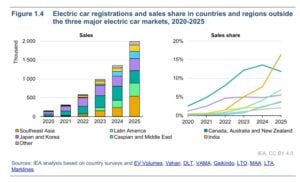
Outside China, Europe, and the United States, EV sales reached nearly 2 million units in 2025, up from 1.3 million the previous year.

Emerging markets and developing economies accounted for much of that increase. Sales across these regions surged roughly 80% to nearly 1.2 million units, setting a new record.

Southeast Asia: The EV Growth Hotspot

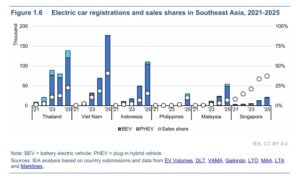
Southeast Asia was also a major growth hub for electric vehicles, with sales in several countries more than doubling compared to 2025.
Battery electric vehicles made up over 90% of regional EV sales, driven by affordable imports, improving charging networks, and rising consumer demand. The region recorded one of the strongest increases in overall EV sales volumes worldwide.
electric vehicle sales
Another notable rise was in India. It emerged as one of the fastest-growing markets during the recent fuel price spike, recording over 10,000 electric passenger vehicle registrations within weeks of March. Automakers such as Tata Motors and BYD also saw rising consumer demand as buyers searched for cheaper alternatives to conventional fuel-powered cars.

In markets like Brazil and Uzbekistan, hybrids still maintain a larger presence, but fully electric models are steadily gaining market share.

southeast asia evs

S&P Global Sees Oil Demand Weakening

The rapid rise in EV adoption is beginning to affect oil demand forecasts.

S&P Global recently cut its 2026 global oil demand forecast by 700,000 barrels per day, citing weaker fuel consumption linked to the ongoing conflict and economic uncertainty.

The IEA also projected a steep drop in oil demand during the second quarter of 2026. The agency expects global oil demand to decline by 1.5 million barrels per day — the sharpest quarterly drop since the COVID-19 pandemic.

These forecasts highlight growing concerns about the long-term outlook for fossil fuel demand as electric transportation expands globally.

Still, analysts remain divided on whether the current EV boom will continue once oil prices stabilize. Previous energy crises created short-term increases in fuel-efficient vehicle sales that later slowed when fuel costs dropped.

Improved Technology and Climate Policies Drive Next Phase of EV Growth

This time, however, the market conditions look different. EV technology has improved significantly, charging networks are expanding quickly, and governments worldwide are tightening climate and emissions policies.

IEA Executive Director Fatih Birol said electric vehicle sales already set records in nearly 100 countries last year. He added that falling battery prices and supportive energy policies could push adoption even higher over the coming years.

Countries are already adjusting their policies to support the transition. Vietnam, for example, is considering extending EV tax incentives through 2030 to maintain low tax rates between 1% and 3%.

The latest data suggests the global auto industry may be entering a long-term structural shift rather than a temporary reaction to high fuel prices. Rising energy costs may have accelerated the transition, but improving technology, lower battery prices, and expanding global supply chains are now making electric vehicles a mainstream option across both developed and emerging markets.

The post IEA Projects Nearly 30% of Global Car Sales Will Be EVs in 2026 appeared first on Carbon Credits.