Pony.ai (PONY Stock) Goes 24/7 with Robotaxis – But Can It Drive a Net-Zero Future?

Pony.ai Goes 24/7 with Robotaxis—But Can It Drive a Net-Zero Future?

Pony.ai, a leader in Chinese autonomous driving, made headlines again. It has expanded its robotaxi services to run 24/7 in Guangzhou and Shenzhen. It also started 24/7 testing in Beijing. This makes it one of the first companies globally to provide real, continuous autonomous ride-hailing service.

This bold move shows technological confidence. It also raises a critical question: can autonomous mobility be sustainable, and where does Pony.ai stand on that front?

As the world focuses on clean transport and corporate responsibility, Pony.ai’s progress should be assessed alongside its environmental, social, and governance (ESG) practices. It must also show how ready it is to meet net-zero goals.

Robotaxi Rollout: Pony.ai’s AVs Hit the Streets Nonstop

Pony.ai’s latest rollout marks a significant step forward in commercial viability. Previously limited to operating between 8 AM and 11 PM, its services in Guangzhou and Shenzhen now run 24 hours a day. In Beijing, testing permits have also been extended to support full-day operations of its robotaxis.

These cities aren’t just pilot zones—they’re tier-one economic hubs with dense urban environments. Pony.ai’s self-driving systems have improved a lot. They can now run vehicles without human drivers on busy night streets.

Its Gen-7 autonomous fleet uses a sophisticated mix of:

  • 128-beam LiDAR

  • 4D millimeter-wave radar

  • 8-megapixel surround cameras

  • Self-cleaning sensors for adverse weather

  • A proprietary software stack called PonyWorld

These vehicles can “see” up to 650 meters in any direction, enabling safer night-time navigation. The company claims its system is up to 10 times safer than a human driver. This is based on more than 500,000 hours of driverless operation and 50 million kilometers driven worldwide.

Pony.ai plans to expand its fleet from ~300 vehicles to 1,000 robotaxis in 2025, and more than 10,000 vehicles by 2028. But with scale comes a new imperative: climate accountability.

Autonomous Cars and the Climate Question

Autonomous vehicles (AVs) are electric. They reduce tailpipe emissions. They can also be programmed for energy efficiency. But they aren’t automatically “green.”

The carbon footprint of AVs is tied to:

  • The source of electricity used for charging.

  • The energy intensity of sensors, computing, and manufacturing.

  • The sustainability of supply chains, especially for LiDAR and batteries.

In Pony.ai’s case, the company uses fleets provided by partners like Toyota, GAC, and BAIC, most of which are electric or hybrid-electric. That’s a strong start. However, when it comes to formal carbon tracking, net-zero targets, or emissions disclosures, the story is less complete.

Where Pony.ai Stands on ESG and Net-Zero Goals

Governance Structure and ESG Oversight

Pony.ai has established a dedicated ESG governance system. Oversight begins at the board level through its Safety, Compliance, and Sustainability Committee, which supervises:

  • ESG risk management

  • Sustainability compliance across all departments

  • ESG implementation within subsidiaries

The committee helps cascade ESG responsibilities across the organization, showing that Pony.ai is building the internal framework needed for future sustainability initiatives.

Carbon Footprint and Operational Emissions

In its latest filing with the U.S. SEC (2024), Pony.ai says its operations create low direct emissions. This is because it doesn’t make vehicles and uses only a little fuel: diesel, gasoline, and electricity.

However, the company does not publish any Scope 1 or Scope 2 emissions data, nor does it commit to a net-zero timeline. Yet, some efforts to reduce environmental impact are in place, such as:

  • Diesel Emissions Reduction: In 2024, the company began using automotive urea solutions (DEF) to reduce nitrogen oxide emissions in its diesel vehicle fleet.

  • Energy Conservation: It promotes paperless offices, water-saving protocols, and electricity efficiency in workspaces.

  • Emergency Preparedness: They handle climate risks, like floods and typhoons, through remote work drills and disaster plans. This is crucial in areas prone to typhoons, such as southern China.

Still, without public carbon data, science-based targets, or renewable energy sourcing, Pony.ai currently lags behind the transparency standards of many global tech peers.

The Transparency Gap

While governance is in place, Pony.ai’s ESG reporting is still in its early stages. The company also does not yet participate in global ESG or carbon initiatives like TCFD (Task Force on Climate-Related Financial Disclosures), CDP (Carbon Disclosure Project), and the Science-Based Targets initiative (SBTi).

By comparison, several of its competitors—like Baidu Apollo and Waymo—have begun disclosing emissions and setting measurable sustainability goals, creating added pressure on Pony.ai to follow suit.

Opportunities for Climate Leadership

Despite these gaps, Pony.ai is well-positioned to lead on low-carbon mobility, thanks to three key factors:

1. Electrification at Scale

Most of Pony.ai’s robotaxi partners produce battery-electric vehicles (BEVs) or hybrids. As the fleet grows to 10,000+ vehicles, aligning with renewable energy sources for charging could reduce operational emissions dramatically.

2. Smart Routing and Energy Efficiency

Autonomous systems can be optimized to:

  • Avoid congestion and idle time

  • Drive at fuel-efficient speeds

  • Reduce total miles traveled per passenger

By using AI to optimize routes and energy use, Pony.ai can decrease its overall energy footprint per ride.

3. Supply Chain Sustainability

Partners like Luminar, a supplier of LiDAR sensors, already follow ISO 14001 environmental standards. By auditing and choosing suppliers with sustainability credentials, Pony.ai can improve its Scope 3 emissions profile over time.

Where Will Pony.ai Drive Next?

Pony.ai’s 24/7 robotaxi rollout proves that self-driving technology is no longer a science experiment—it’s an emerging reality. But in a world increasingly shaped by climate policy, energy transitions, and ESG investing, technical milestones must be matched by climate ambition.

To date, Pony.ai has established strong ESG governance and low-emission operations. Yet it has not yet disclosed carbon data, set net-zero goals, or joined climate leadership networks.

If Pony.ai wants to drive the future—not just of mobility, but of responsible innovation—it must take the next step: embed sustainability into the core of its mission.

Doing so will not only future-proof its business—it will help define what a truly intelligent transportation company should look like in a net-zero world.

The post Pony.ai (PONY Stock) Goes 24/7 with Robotaxis – But Can It Drive a Net-Zero Future? appeared first on Carbon Credits.

Google Backs Energy Dome’s CO₂ Battery Breakthrough for Clean Energy Storage

Google Backs Energy Dome’s CO₂ Battery Breakthrough for Clean Energy Storage

Google has partnered with Energy Dome, an Italian startup, to test and deploy a new kind of long-duration energy storage system. The innovation centers on a CO₂-based battery designed to store renewable energy for up to 24 hours. This move helps Google reach its clean energy goals. It also provides a scalable way to tackle a major issue in decarbonizing power grids: storing solar and wind energy when the sun is down or the wind is calm.

The project will begin in Sardinia, Italy, where Energy Dome is based. Google will help fund and validate a commercial-scale CO₂ battery installation there. If successful, the system could support Google’s plans to run all its data centers and campuses on 24/7 carbon-free energy (CFE) by 2030.

The technology offers a cheap and efficient way to fill energy supply gaps. This is important as more grids use renewable power sources.

Maud Texier, Director of EMEA Energy at Google, remarked:

“Google is committed to powering our operations with clean energy, and Energy Dome’s technologically proven and scalable long-duration energy storage solution can help us unlock rapid progress.”

What Is a CO₂ Battery and How Does It Work?

Unlike lithium-ion batteries or pumped hydro storage, the CO₂ battery uses carbon dioxide in a closed loop to store and release energy. When there is excess electricity from solar or wind, the system compresses CO₂ gas and stores it in liquid form.

Later, when energy is needed, the liquid CO₂ is heated and expanded back into a gas, spinning a turbine to generate electricity.

The entire process is carbon-neutral since the CO₂ is never released into the atmosphere. It simply moves between gas and liquid states in a sealed system.

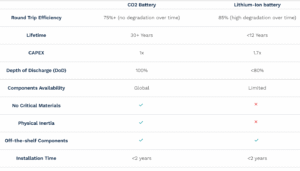
Energy Dome’s design allows users to store energy for 10 to 24 hours. That’s much longer than regular lithium-ion batteries, which last only four to six hours.

The CO₂ battery can be made with current industrial tools like steel tanks and compressors. This makes it quicker and cheaper to set up than other long-duration technologies. Energy Dome says its systems can be built for under half the cost of lithium-ion storage. They also offer similar or better efficiency, around 75%.

co2 battery
Source: Energy Dome

Why Google’s Future Runs on 24-Hour Clean Energy

Google is one of the world’s largest corporate buyers of renewable energy. However, as it advances toward its ambitious 24/7 carbon-free goal, it requires more than just solar and wind power—it needs the ability to store clean energy for extended periods and deliver it when needed. This is where long-duration energy storage becomes essential.

Traditional battery systems help balance short-term fluctuations in energy supply and demand. But they struggle with overnight or multi-day needs. Long-duration solutions like the CO₂ battery help smooth out these gaps, especially as fossil fuels are phased out and weather-dependent renewables take their place.

By supporting Energy Dome, Google is investing in a technology that could allow it to run data centers on clean energy around the clock. The tech giant’s data centers consume massive amounts of electricity—roughly 1.3 terawatt-hours annually in the U.S. alone. Without reliable clean energy storage, these facilities risk falling back on fossil power during grid shortages or renewables downtime.

The partnership aligns with Google’s wider climate strategy, which includes investing in emerging technologies, optimizing data center efficiency, and using advanced AI to predict and manage energy loads.

google data center map
Source: Google

From Sardinia to the World: Climate Tech with Global Reach

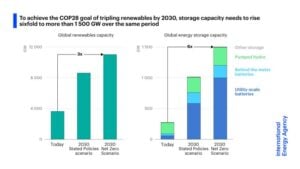
If proven successful, the CO₂ battery could offer a scalable tool for decarbonizing power grids worldwide. According to the International Energy Agency (IEA), the world will need over 1500 gigawatts (GW) of energy storage by 2050 to meet climate goals.

IEA energy storage capacity
Source: IEA

Today, only a fraction of that exists. Long-duration technologies could fill much of that gap.

Energy Dome’s battery could be especially useful in places with abundant solar and wind energy but limited storage options. Regions like Texas, California, and parts of Europe often curtail clean energy production due to a lack of storage. Deploying low-cost systems like this one could unlock more renewable use and reduce reliance on backup fossil fuels.

The technology also supports grid stability. As renewables grow, so do fluctuations in power supply. Long-duration storage can buffer these swings, keeping the grid balanced and reliable. That’s especially important as heatwaves and extreme weather strain power systems.

Beyond technical benefits, the partnership marks a milestone in clean tech investment. Google’s support brings credibility and funding to a new player in the energy storage space. It also signals growing interest from major tech firms in scaling novel climate solutions.

What’s Next for Google and Energy Dome?

The Sardinia project will be one of the first commercial deployments of a CO₂ battery anywhere in the world. Energy Dome has already completed a 2.5 MW demonstration unit and is now building its first utility-scale project.

  • The system will have 20 MW of power and 200 MWh of storage—enough to power tens of thousands of homes for 10 hours.

Once operational, Google and Energy Dome will study performance data, costs, and scalability. If successful, the technology could be used across other Google data centers globally.

Energy Dome also plans to expand into the U.S., where tax incentives could make new projects more attractive.

The companies have not disclosed the exact financial terms of the deal. But both parties say the goal is to make the technology bankable and ready for global markets. Other energy companies and utilities are watching closely, as many are also seeking cost-effective long-duration storage options.

Google’s collaboration with Energy Dome represents more than just a single project. It reflects a broader shift toward deeper integration of renewable energy, long-duration storage, and corporate climate responsibility.

As tech companies race to reduce emissions and support climate goals, scalable solutions like CO₂ batteries could play a major role. This partnership highlights a path forward: combining innovation with investment to solve tough problems like clean energy reliability.

If the Sardinia pilot works as expected, it could pave the way for rapid global deployment of carbon-neutral energy storage. It will help Google, and perhaps many others, stay online and emissions-free at the same time.

The post Google Backs Energy Dome’s CO₂ Battery Breakthrough for Clean Energy Storage appeared first on Carbon Credits.
“The Energy Transition is Unstoppable” – Says UN Secretary‑General António Guterres

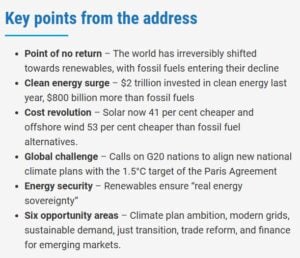
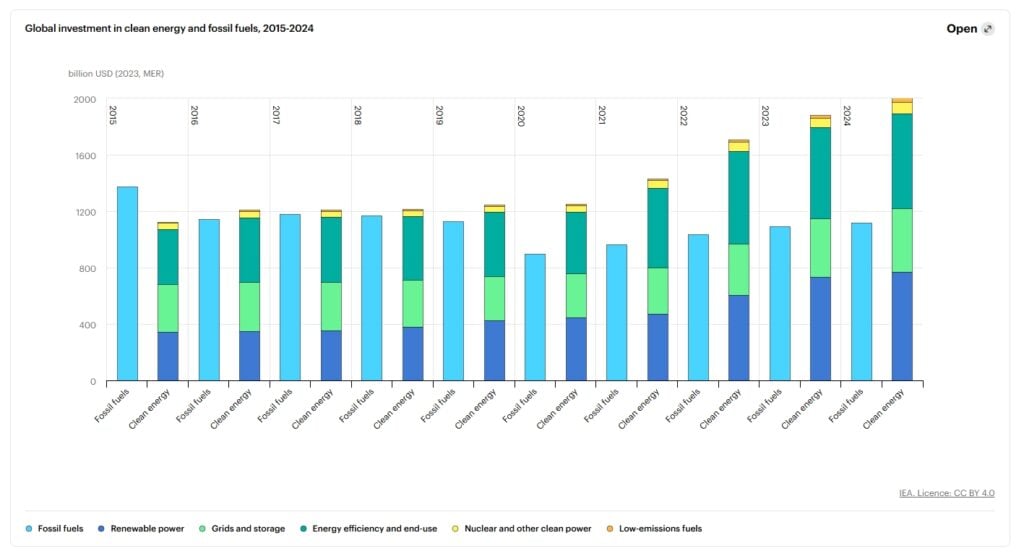
UN Secretary-General António Guterres has declared that the global energy transition has reached a point of no return. As clean energy investments pass $2 trillion in 2024, renewable energy is now more cost-competitive than fossil fuels. Guterres said we have entered the “clean energy age” and must act quickly to build on this progress.

With solar and wind becoming some of the cheapest sources of energy, countries and companies are shifting toward sustainable energy sources at a fast pace.

energy transition UN Secretary‑General António Guterres
Source: UN

Are Renewables Really Cheaper Than Fossil Fuels?

Yes—and by a big margin in many regions.

According to a recent UN report, most new renewable energy projects in 2024 are cheaper than even the lowest-cost fossil fuel alternatives. Onshore wind power now averages just 3.4 cents per kilowatt-hour (kWh), while solar photovoltaic (PV) sits around 4.3 cents per kWh. That’s less than what coal or gas costs in most markets.

In Europe, offshore wind projects generated electricity at about $36 per megawatt-hour in 2023. In comparison, gas-fired electricity costs nearly double—around $71 per megawatt-hour. These price differences show how renewables have quickly become more cost-effective.

In fact, over 90% of new renewable energy projects in 2024 are more affordable than fossil fuel-based ones. This is because of better technology, efficient manufacturing, and stronger supply chains.

clean energy cost
Source: Cipher

A BloombergNEF report predicts that the cost of clean power technologies—such as wind, solar, and battery storage—will drop by 2–11% in 2025, setting a new record. The report notes that new solar and wind farms are already cheaper than new coal and gas plants in almost every global market.

However, China’s overcapacity in clean tech manufacturing has led to a wave of protectionist tariffs from other countries to shield domestic markets from low-cost imports. While these trade barriers may temporarily slow cost declines, BNEF still expects the levelized cost of clean electricity to fall by 22–49% by 2035.

The Energy Transition Boosts Jobs and Economic Growth

Going green also means going big on jobs. The UN estimates that clean energy investments could create over 24 million new jobs by 2030. Every $1 million invested in renewable energy brings about three new jobs, mostly in building, installing, and maintaining clean energy systems.

By switching to renewables, countries also reduce their dependence on imported fossil fuels. This helps protect them from global energy price shocks and improves energy security. Guterres referred to renewable energy as “real energy sovereignty.

Big companies are also stepping in, backing the energy transition and clean power to meet sustainability goals. With solar and wind attracting more than double the investment today compared to 10 years ago, the economic case for renewables is stronger than ever.

A Win for the Planet: How Renewables Help the Environment

Solar and wind power produce zero emissions when generating electricity. This helps replace polluting power sources like coal and oil. The result is that millions of tons of carbon dioxide (CO₂) are kept out of the atmosphere.

Fossil fuels also damage air and water quality. In contrast, clean energy solutions reduce pollution, making our environment healthier and more sustainable. Switching to renewables helps countries meet their climate targets, including those outlined in the Paris Agreement.

If the current pace continues, clean energy could power up to 80% of the world’s electricity by 2030, according to the UN.

Where Are Renewables Growing Fastest?

Asia, Europe, and parts of the Global South are leading the charge. In 2024, renewables made up 92.5% of all new electricity capacity added globally. Countries like Pakistan and Namibia have nearly doubled their energy capacity in just two years—mainly through solar.

Key factors behind this growth include:

  • A 35% drop in solar module prices

  • Battery storage costs are falling between 20% and 50%

Cheaper batteries make clean energy more reliable, storing extra power for use when the sun or wind isn’t available. This also supports electric vehicles and stable power grids.

IEA says, clean energy drew $800 billion more investment than fossil fuels in 2024—a sharp reversal from past trends.

clean energy investment
Source: IEA

How Will the Market Evolve in the Next Five Years?

Experts expect renewable energy investment to keep growing at about 15% per year through 2029. That growth will be driven by policy support, cleaner technologies, and stronger investor interest. As costs keep falling, more businesses and governments will likely choose clean energy.

Green hydrogen, one of the emerging sectors, promises big changes. The cost to produce hydrogen is expected to drop by half in the next 10 years. This could help decarbonize sectors like shipping, heavy industry, and aviation that are hard to electrify using solar or wind alone.

Policy action is key to driving the clean energy shift. Governments can offer tax breaks, ease permits, and fast-track projects. Global partnerships can also spread clean tech to regions that need it most.

António Guterres made it clear: “The fossil fuel age is ending—whether anyone likes it or not.”  Thus, with this energy transition, the opportunity is real. It’s about clean power, good jobs, and a safe climate for future generations.

The post “The Energy Transition is Unstoppable” – Says UN Secretary‑General António Guterres appeared first on Carbon Credits.

West Red Lake Gold Mines: Breathing New Life Into a Legendary Gold District

West Red Lake Gold Mines: Breathing New Life Into a Legendary Gold District

Disseminated on behalf of West Red Lake Gold Mines Ltd. 

West Red Lake Gold Mines Ltd. (TSXV: WRLG; OTCQB: WRLGF) is leading a fresh charge in one of Canada’s most storied gold-producing regions—the Red Lake district of Ontario. With its eyes set firmly on ramping up the newly restarted Madsen Mine, WRLG is not just reviving old infrastructure but strategically positioning itself to benefit from an evolving global gold market.

At a time when market conditions are tilting favorably toward gold, WRLG’s disciplined approach and revitalization plan put it in the spotlight. Let’s unpack five major narratives that reveal why this project could be a standout in today’s mining landscape.

Gold’s Moment in the Spotlight

Gold has always been a trusted store of value—but in 2025, its appeal is even more pronounced. With rising geopolitical tensions, stubborn inflation, and growing fears of recession, global demand for gold is on the rise.

Central banks across Asia and the Middle East continue to actively diversify away from the U.S. dollar by accumulating gold reserves. Meanwhile, Western investors—many of whom had been heavily weighted in tech stocks—are returning to the yellow metal.

gold stock valuations WRLG

Even with record-high gold prices, gold equities haven’t caught up. This disconnect suggests investment potential, especially for miners nearing production. Goldman Sachs and other analysts now forecast that gold could soar to $5,000 per ounce by 2028.

This backdrop puts companies like WRLG—poised to move from development to production—in a unique position to benefit from what could be a once-in-a-generation gold bull market.

Moreover, with concerns over long-term fiat currency devaluation and increasing systemic risk in global markets, gold is being viewed not just as a hedge, but as a core portfolio holding. For miners like WRLG that are ready to feed this growing demand, the upside potential is real.

Why New Gold Mines Are So Rare—and So Valuable

While demand climbs, supply tells a different story. The gold mining sector is facing a crunch.

According to S&P Global, gold exploration budgets fell to a 10-year low in 2024, with fewer companies actively exploring. Consolidation and funding struggles among juniors have made new discoveries scarce.

Despite record prices, the sector is prioritizing capital discipline over expansion. That makes companies like WRLG—with new production timeline and the potential for growth —especially attractive.

Investors are increasingly shifting focus away from speculative exploration plays and toward advanced-stage assets with clear production timelines. WRLG’s Madsen project fits squarely into this sweet spot, offering potential for both upside from development gains and reduced risk through existing infrastructure.

With limited new supply entering the market, any miner moving into production stands to attract attention. WRLG is one of the few companies doing so during this bull run.

Smart Acquisition, Smarter Execution: WRLG’s Bold Bet on Madsen

When WRLG acquired the Madsen Mine in 2023, it wasn’t just a lucky break—it was a savvy move. The asset, despite being heavily invested in by its previous owner, was available at a discount due to operational missteps.

WRLG stepped in with a clear plan: invest the significant capital needed to define the deposit with greater accuracy, revamp the infrastructure, enhance access to ore zones, and restart operations with greater efficiency. One of the centerpiece projects is the underground Connection Drift, a tunnel designed to streamline haulage and improve operational flexibility.

GOLD development projects WRLG
Source: WRLG

A test mining and bulk sampling program confirmed the accuracy of the deposit model, the quality of ore, and the company’s ability to mine. Backing from major names like Sprott and Frank Giustra further signals strong investor confidence in WRLG’s approach.

Beyond the numbers, WRLG’s acquisition strategy also reflects a broader trend of disciplined M&A in the gold sector. Instead of overpaying for undeveloped land or risky exploration zones, WRLG focused on value—buying into a historically productive asset with existing permits, a developed mill, and a defined resource.

With production ramping up through the second half of 2025 and post-tax free cash flow projections of $400 million over seven years, WRLG isn’t just reviving an old mine—it’s laying the foundation for long-term value.

Fixing the Past: Why Madsen’s Restart Should Succeed This Time

This isn’t Madsen’s first restart attempt—but WRLG is determined to make it the last one needed. Previous failures stemmed from insufficient underground work, limited drill data, and poor planning.

WRLG tackled those weaknesses head-on. Drilling density has been increased to industry standards, boosting confidence in deposit modeling. Infrastructure upgrades, like the Connection Drift, allow simultaneous access to multiple ore zones—eliminating key bottlenecks.

Madsen map

Workforce training and safety protocols have also been prioritized. These aren’t just nice-to-haves—they’re essential for a reliable, high-performing operation. WRLG’s strategy incorporates best practices from across the mining sector to reduce risk and deliver consistent output.

By prioritizing data quality and mining precision, WRLG is laying the groundwork for long-term operational stability. Where past operators may have leaned on aggressive assumptions, WRLG is taking a conservative and transparent approach, which should appeal to both institutional investors and regulators. 

With lessons learned, capital secured, and execution tightened, WRLG is on track to overcome the mine’s troubled past—and build a new legacy of success.

From the Ground Up: A Roadmap to Production by 2025

WRLG’s restart strategy is built on three pillars: technical upgrades, financial readiness, and operational preparation.

The company pushed for two years to complete definition drilling, infrastructure improvements, mill recommissioning work, and mine planning, and was able to restart the mine ahead of schedule. 

The drilling campaign, in particular, is key to enhancing resource confidence, essential for effective mining. Meanwhile, ore was being stockpiled, and mill upgrades were completed, and WRLG hired over 200 employees. Safety, a top priority, is embedded in the restart plan through training and strict protocols.

According to the pre-feasibility study, WRLG expects to produce almost 70,000 ounces annually for seven years, creating a solid cash flow foundation.

This combination of strategic planning, technical rigor, and market timing could make WRLG a breakout player in the Red Lake district.

Final Take: WRLG Is Poised to Deliver Gold—and Growth

With a discounted asset, experienced leadership, and strong financial backing, West Red Lake Gold Mines Ltd. is executing a textbook turnaround. The Madsen Mine, once a symbol of unrealized potential, is now on the verge of becoming a productive, cash-generating operation.

As gold prices remain strong and investor sentiment continues shifting away from tech and toward tangible assets like precious metals, WRLG is well-positioned to benefit.

DISCLAIMER 

New Era Publishing Inc. and/or CarbonCredits.com (“We” or “Us”) are not securities dealers or brokers, investment advisers or financial advisers, and you should not rely on the information herein as investment advice. West Red Lake Gold Mines Ltd. made a one-time payment of $30,000 to provide marketing services for a term of 1 month. None of the owners, members, directors, or employees of New Era Publishing Inc. and/or CarbonCredits.com currently hold, or have any beneficial ownership in, any shares, stocks, or options in the companies mentioned. This article is informational only and is solely for use by prospective investors in determining whether to seek additional information. This does not constitute an offer to sell or a solicitation of an offer to buy any securities. Examples that we provide of share price increases pertaining to a particular Issuer from one referenced date to another represent an arbitrarily chosen time period and are no indication whatsoever of future stock prices for that Issuer and are of no predictive value. Our stock profiles are intended to highlight certain companies for your further investigation; they are not stock recommendations or constitute an offer or sale of the referenced securities. The securities issued by the companies we profile should be considered high risk; if you do invest despite these warnings, you may lose your entire investment. Please do your own research before investing, including reading the companies’ SEDAR+ and SEC filings, press releases, and risk disclosures. It is our policy that information contained in this profile was provided by the company, extracted from SEDAR+ and SEC filings, company websites, and other publicly available sources. We believe the sources and information are accurate and reliable but we cannot guarantee it.

CAUTIONARY STATEMENT AND FORWARD-LOOKING INFORMATION

Certain statements contained in this news release may constitute “forward-looking information” within the meaning of applicable securities laws. Forward-looking information generally can be identified by words such as “anticipate”, “expect”, “estimate”, “forecast”, “planned”, and similar expressions suggesting future outcomes or events. Forward-looking information is based on current expectations of management; however, it is subject to known and unknown risks, uncertainties and other factors that may cause actual results to differ materially from the forward-looking information in this news release and include without limitation, statements relating to the plans and timing for the potential production of mining operations at the Madsen Mine, the potential (including the amount of tonnes and grades of material from the bulk sample program) of the Madsen Mine; the benefits of test mining; any untapped growth potential in the Madsen deposit or Rowan deposit; and the Company’s future objectives and plans. Readers are cautioned not to place undue reliance on forward-looking information.

Forward-looking information involve numerous risks and uncertainties and actual results might differ materially from results suggested in any forward-looking information. These risks and uncertainties include, among other things, market volatility; the state of the financial markets for the Company’s securities; fluctuations in commodity prices; timing and results of the cleanup and recovery at the Madsen Mine; and changes in the Company’s business plans. Forward-looking information is based on a number of key expectations and assumptions, including without limitation, that the Company will continue with its stated business objectives and its ability to raise additional capital to proceed. Although management of the Company has attempted to identify important factors that could cause actual results to differ materially from those contained in forward-looking information, there may be other factors that cause results not to be as anticipated, estimated or intended. There can be no assurance that such forward-looking information will prove to be accurate, as actual results and future events could differ materially from those anticipated in such forward-looking information. Accordingly, readers should not place undue reliance on forward-looking information. Readers are cautioned that reliance on such information may not be appropriate for other purposes. Additional information about risks and uncertainties is contained in the Company’s management’s discussion and analysis for the year ended December 31, 2024, and the Company’s annual information form for the year ended December 31, 2024, copies of which are available on SEDAR+ at www.sedarplus.ca.

The forward-looking information contained herein is expressly qualified in its entirety by this cautionary statement. Forward-looking information reflects management’s current beliefs and is based on information currently available to the Company. The forward-looking information is made as of the date of this news release and the Company assumes no obligation to update or revise such information to reflect new events or circumstances, except as may be required by applicable law.

For more information on the Company, investors should review the Company’s continuous disclosure filings that are available on SEDAR+ at www.sedarplus.ca.


Please read our Full RISKS and DISCLOSURE here.

The post West Red Lake Gold Mines: Breathing New Life Into a Legendary Gold District appeared first on Carbon Credits.
EU-China Joint Climate Deal Focuses on Clean Tech, Skips Coal Commitments

eu china

The European Union (EU) and China have made headlines with their latest joint climate statement ahead of COP30. While the agreement emphasizes clean energy and green technology, it stops short of committing to reducing coal use—a decision that has left many environmental groups concerned. Still, the partnership reflects a shift in global climate diplomacy, especially with U.S. leadership appearing uncertain.

Let’s break down the statement, its implications, and the key challenges ahead.

Clean Tech, Not Coal Cuts: What the Climate Statement Promised

At the EU-China Summit in Beijing on July 24, 2025, leaders from both sides released a joint press statement. The focus was on reinforcing their partnership in addressing climate change while promoting clean technologies like solar, hydropower, electric vehicles (EVs), and battery storage. The statement marked the 10th anniversary of the Paris Agreement and the 50th year of diplomatic relations between the two powers.

Key commitments include:

  • Supporting the UNFCCC and the Paris Agreement as the backbone of global climate cooperation.
  • Turning climate targets into real-world outcomes through systematic policies.
  • Submit updated 2035 climate goals (NDCs) before COP30, covering all sectors and greenhouse gases.
  • Expanding global renewable energy access and sharing green technologies, especially with developing countries.
  • Boosting adaptation support to help nations respond to climate threats.
  • Collaborating on areas like methane reduction, carbon markets, and low-carbon technology.

Yet, coal was left unaddressed. Despite growing pressure from environmental advocates, the statement made no mention of cutting coal use, a major source of global emissions.

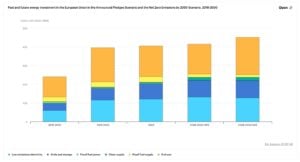
EU clean energy investments
Source: IEA

A United Push for Renewable Energy

The EU and China’s climate focus now leans heavily toward clean technology development and cooperation. This includes:

  • Solar panel production and installation.
  • Scaling up EV adoption with better batteries and charging infrastructure.
  • Building large-scale battery storage systems for better grid reliability.

These technologies could significantly lower emissions and make clean energy more affordable and accessible worldwide. Both China and the EU have strong manufacturing bases, positioning them as global leaders in the green tech race.

Their cooperation could be especially useful for developing countries struggling with the high costs of clean energy. If done right, this tech-sharing strategy could support global decarbonization and improve climate equity.

China’s Medog Dam: Climate Win or Ecological Fallout?

One of the most ambitious pieces in China’s green energy puzzle is the Medog Dam project in Tibet. With an estimated cost of $137 billion, the dam will become the largest hydropower station in the world. Once completed, it will generate around 300 billion kilowatt-hours (kWh) of electricity annually, which could replace energy from hundreds of coal plants.

This scale of clean power is a major boost to China’s goal of reaching carbon neutrality by 2060.

However, the project has drawn criticism for its environmental and geopolitical risks:

  • Built in a fragile ecosystem, near the Yarlung Tsangpo Grand Canyon, the dam could harm biodiversity, impact river flows, and disrupt agriculture downstream.
  • Local communities face displacement, raising humanitarian concerns.
  • The dam’s location near the India-China border adds fuel to regional tensions, especially over shared water resources.

Environmental experts have also raised alarms about the lack of transparency around impact studies. While the project promises millions of tons of emissions savings, its ecological footprint could offset the climate gains if not managed responsibly.

Carbon markets and clean-tech exports offer hope for climate progress. But without firm commitments to end coal dependency and without stronger oversight of mega-projects, the climate gains may fall short. This balancing act between energy security and environmental integrity is one of the key challenges that the EU and China must address moving forward.

Is China Exporting Clean? And at What Cost?

China is stepping up its global presence as a major exporter of clean technologies. Today, it leads the world in the production of solar panels, electric vehicles (EVs), and batteries.

As per reports,

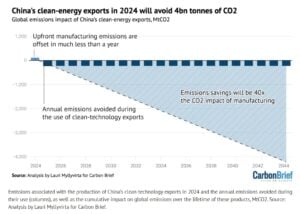
  • This surge in clean-tech exports is expected to reduce global emissions by as much as 2.5 billion tons by 2030—equivalent to removing 500 million cars from the world’s roads.
  • It saved 4Gt as the cumulative lifetime savings from just 2024 exports.
china clean tech
Source: Carbon Brief

This boom is doing two things simultaneously. It supports climate action globally by offering countries affordable green alternatives, and it boosts China’s economy and expands its geopolitical influence, especially in emerging and developing markets.

However, there’s one more side of the leaf which isn’t so green. The environmental costs of producing these technologies can be significant. Mining and manufacturing components like lithium and rare earth elements often lead to high emissions.

If these upstream processes are not cleaned up, China could end up exporting “dirty green” solutions that undermine the broader climate goals. Life-cycle emissions, i.e., from raw material extraction to final product delivery, must be included when evaluating the real impact of these exports.

Thus, China needs to decarbonize its supply chains and ensure the climate benefits of its clean-tech exports are genuine and lasting.

Impact of EU-China Collaboration on Carbon Markets

One of the most promising outcomes of the EU-China climate statement is the potential impact on international carbon markets. As more countries introduce emissions caps, the demand for carbon credits is expected to surge. Analysts estimate that the carbon market could grow to $100 billion by 2030.

This creates a major opportunity. Companies involved in verifiable clean projects could benefit by generating and trading carbon credits. In turn, these credits can support global decarbonization, especially in hard-to-abate sectors. A stronger and well-functioning carbon trading system could accelerate the pace of emissions reductions worldwide.

However, carbon markets are only effective if they are transparent and based on actual, verified reductions in emissions. Strict rules and enforcement are necessary to prevent greenwashing and to ensure the system does not simply shift emissions from one place to another.

Without trust, data accuracy, and mutual accountability, the effectiveness of carbon markets will remain limited. Both the EU and China must ensure that any expansion of the carbon credit system is built on strong governance and integrity.

The post EU-China Joint Climate Deal Focuses on Clean Tech, Skips Coal Commitments appeared first on Carbon Credits.

SBTi Launches Net-Zero Standard to Drive Climate Action in Banking and Finance

SBTi Launches Net-Zero Standard to Drive Climate Action in Banking and Finance

The Science Based Targets initiative (SBTi) has rolled out its first Financial Institutions Net-Zero Standard (FINZ). This framework offers banks, asset managers, insurers, and investors a clear path to aligning their portfolio activities—including lending, underwriting, and investments—with net‑zero emissions by 2050.

The FINZ standard sets clear rules on:

  • Portfolio emissions

  • Fossil fuel finance

  • Deforestation risk, and

  • Reporting

It aims to transform how the finance industry aligns with global climate goals and steers clean capital flows.

Why the New Standard Matters to Climate and Finance

Financial institutions are hugely influential. Their financed emissions—the greenhouse gases tied to the companies they finance—are typically hundreds to thousands of times higher than their own operational emissions.

They account for over 99% of financed emissions through loans, underwriting, and investments. One study found financed emissions can be 750 times greater, and for North American banks that rose to 11,000 times more than their own direct output.

Financed emissions
Source: SBTi

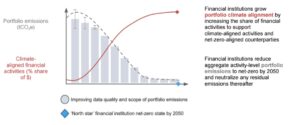
Yet until now, most net‑zero frameworks focused on operational emissions (Scope 1 and 2). The FINZ Standard tackles Scope 3 category 15 emissions—those tied to clients and invested companies. It offers a sector‑specific roadmap for carbon impact across financial services.

Moreover, it strengthens transparency and accountability in financed emissions, including underwriting and capital markets. The UN-backed SBTi aims to drive major reductions. This tool targets not only corporate operations but also global capital markets.

Alberto Carrillo Pineda, SBTi’s Chief Technical Officer, noted:

“Financial Institutions have the ability to play a transformative role in the transition to net-zero. Their influence on the global economy and ability to engage with their portfolios is unparalleled to accelerate the net-zero transition. With its broad applicability and flexibility, this robust, science-based Standard will help financial institutions drive the net-zero transformation all over the world.”

Key Requirements: What FINZ Demands

Here are the major requirements set by the new standard:

Fossil Fuel Finance Phase‑out

Signatories must immediately stop financing new coal and oil field expansion. Financing for new oil and gas projects must also end by 2030. This shift separates general-purpose finance from investment that supports fossil fuel growth.

Portfolio Emissions Targets

Institutions need to measure and set science-based targets. These targets must cover all lending, investment, underwriting, and capital market operations (Scope 3 category 15+). They must align with a 1.5 °C pathway and match the ambition of SBTi’s corporate standard. Public targets and interim milestones are required.

Deforestation and Real Estate Risk Reporting

Banks and asset managers must assess exposure to deforestation and real estate. Those with significant risk must publish mitigation plans. This broadens climate accountability beyond just fossil fuel financing.

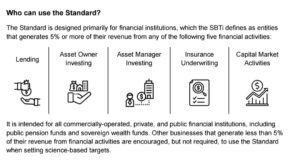
Users of SBTi FINZ standard
Source: SBTi

Stakeholder Response: Support and Criticism

Over 150 institutions contributed to public consultations, and 33 firms pilot‑tested the standard.

Over 150 financial institutions contributed to public consultations, and 33 firms pilot-tested the draft standard. Also, nearly 135 institutions across six continents have committed to align with FINZ already.

SBTi has validated the most near-term institution targets to date—a nearly 50% increase year-on-year. It also expects more growth under new CEO David Kennedy, with ambitions to scale to 20,000 companies by 2030.

Many praised the approach as both rigorous and practical. The Sustainable Finance Observatory welcomed the initiative’s wider focus. It includes loans, insurance, capital markets, and portfolio investment.

Yet critics highlight a major tension: the delay in phasing out fossil fuel finance until 2030. A recent report found that nearly 95% of bank fossil-fuel financing in 2024 went via general-purpose loans, not project-specific funding—potentially locking in more fossil fuel use this decade.

Some experts argue that progress toward net‑zero demands an immediate cutoff. SBTi believes that slower advocacy could allow more institutions to join in. This might lead to a bigger overall impact.

Major banks like HSBC and Standard Chartered left the SBTi climate approach. They had worries about the new standard’s strictness and how practical it is.

Meanwhile, ING is the first global bank to have validated SBTi targets. It has also promised to stop financing new fossil fuel projects by 2040. It will also cut coal power finance close to zero by 2025.

What It Means for the Carbon Credit Market

The FINZ Standard raises the bar for carbon credit demand. It is also likely to shape the future of the voluntary carbon credit market. Financial institutions are facing stricter rules on financed emissions. So, many will seek verified carbon removal solutions to hit their climate targets.

The SBTi usually doesn’t let carbon offsets replace real emissions cuts but it does see a small role for carbon removals. This is especially true for options like direct air capture or biochar that store carbon long-term.

This creates new demand for high-quality, science-based carbon credits, especially those tied to durable removal projects. Nature-based credits, like forest restoration, may increase in value. This is true if they meet strict verification and permanence standards.

Moreover, financial firms can help fund new carbon projects by investing in climate mitigation. This is especially important in emerging markets, where capital is often hard to find.

Overall, the new standard brings greater credibility to net-zero claims. This could lead to more serious investment in carbon markets. It may focus on removal and insetting instead of just short-term offsets. The standard might also lead buyers to choose credits certified by third-party groups. These should align with international standards like ICVCM and VCMI.

Looking Ahead: Adoption and Market Shifts

The FINZ Standard has been published in July 2025, with a global consultation now closed. It is expected to become mandatory for SBTi‑aligned institutions over the coming years. Here are major development to watch:

  • The Financial Institutions Near-Term Criteria (FINT) will stay valid until 2026. New institutions should adopt the FINZ standard now.
  • By early 2026, SBTi plans to fully roll out the standard under new CEO David Kennedy. As climate risk grows, it will impact financial stability.
  • FINZ might set regulatory standards and change how banks are monitored for climate-related issues.
  • Over time, institutions that meet FTIN 1.5 °C‑aligned targets and halt fossil fuel expansion financing will likely enjoy reputational gains and stronger ESG investor support. Conversely, those lagging could face legal, regulatory, and financial scrutiny.

SBTi’s Financial Institutions Net‑Zero Standard is a landmark tool for holding banks and investors accountable for financed emissions. Clear standards on fossil fuel finance, portfolio coverage, and disclosure help align financial flows with net‑zero pathways.

Some critics worry about the slow phase-out of fossil fuel financing. However, many view the new Financial Institutions Net-Zero Standard as a practical method that helps engage institutions and improve climate alignment sooner.

As more firms join, purchase high-quality carbon removals, and report robust financed-emissions targets, the standard could accelerate real emissions cuts. FINZ standard signals a change for those tracking ESG investments, carbon credits, and climate policy. It brings credible, science-based finance and acts as a new tool in the low-carbon market.

The post SBTi Launches Net-Zero Standard to Drive Climate Action in Banking and Finance appeared first on Carbon Credits.

Oracle (ORCL) Stock Surges Due to AI Growth, Taps Bloom Energy to Power Data Centers

Oracle (ORCL) Stock Surges Due to AI Growth, Taps Bloom Energy to Power Data Centers

Oracle has partnered with Bloom Energy to bring clean, reliable power to its AI data centers in the U.S. using advanced fuel cell systems. These systems can generate on-site electricity in under 90 days, helping Oracle avoid grid limitations while reducing emissions. This move directly supports Oracle’s long-term net-zero strategy.

Oracle’s Net-Zero and Emissions Reduction Strategy

Oracle plans to reach net-zero emissions across Scope 1, 2, and 3 by 2050, with a 50% reduction by 2030 based on 2020 levels. By 2025, Oracle wants all of its operations—including all Oracle Cloud Infrastructure (OCI) data centers—to run entirely on renewable energy.

Currently, Oracle sources 86% of its global electricity from renewable sources. In regions like Europe and Latin America, Oracle’s OCI data centers already operate on 100% clean power. These facilities are key to Oracle’s strategy to reduce emissions without slowing down cloud growth.

Oracle energy and GHG emissions 2024
Source: Oracle report

To support these goals, Oracle launched several sustainability initiatives:

  • Cut employee air travel emissions by 25%.
  • Reduced potable water usage and waste sent to landfills per square foot by 33%.
  • Set a target for 100% of key suppliers to have environmental programs, with 80% having emissions-reduction goals by 2025.

Oracle’s circular economy strategy includes reusing and recycling hardware. Between 2015 and 2023, Oracle recovered nearly all of its retired equipment—between 99.7% and 99.9%—through recycling programs.

How Bloom Energy Supports Oracle’s AI Growth

AI data centers require a huge amount of power. Oracle’s new Stargate deal with OpenAI will need up to 5 gigawatts of computing power. That’s enough electricity to power millions of homes.

This is where Bloom Energy comes in. Its solid oxide fuel cells offer a clean, steady power supply without relying on the public grid. These systems produce electricity without burning fuel or creating air pollution, and they don’t use water. They help Oracle stay on track with its clean energy goals while powering high-density AI infrastructure.

Another major benefit is speed. Bloom’s fuel cells can be deployed in less than three months, offering a faster path to reliable energy for growing data center campuses. U.S. tax credits, like the 48E and 45V incentives, may reduce deployment costs by up to 30%, making the technology more affordable and scalable.

Bloom has deployed more than 400 megawatts of fuel cells worldwide. These are used in hospitals, factories, and data centers. The partnership with Oracle will likely expand that footprint significantly.

Greener Cloud Strategy: Oracle’s Efficiency and Innovation

Oracle’s cloud operations are designed to be energy efficient and environmentally friendly. The OCI Gen2 data centers reached 86% renewable energy use globally in 2023, with a target of 100% by 2025. In Europe and Latin America, those centers already operate entirely on renewable energy.

Power usage effectiveness (PUE)—a measure of data center efficiency—is a key strength of Oracle’s infrastructure. OCI data centers achieve PUE as low as 1.15, much better than traditional on-premises systems.

Moreover, Oracle moves customers to cloud-based platforms. This shift cuts hardware use by about 50% and lowers emissions.

Oracle’s software also supports sustainability:

  • Oracle Analytics Cloud tracks environmental performance.
  • IoT and supply chain tools help reduce transportation and supplier emissions.
  • AI-powered dashboards detect anomalies and support accurate sustainability reporting.

Since 2015, these combined efforts have reduced Oracle’s logistics emissions by over 40% while delivering major cost savings across operations.

AI, Energy, and the Need for Clean Power

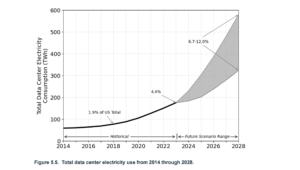
As AI workloads continue to grow, powering data centers with clean energy is becoming more urgent. The U.S. Department of Energy predicts that data centers could consume 12% of the country’s total electricity by 2028, up from 4.4% in 2023. Much of this growth will come from AI-related processing.

data center power requirement 2028 DOE
Source: U.S. DOE

Oracle’s partnership with Bloom gives the company a competitive advantage. Fuel cells allow for on-site energy production. This helps avoid high grid prices, cuts fossil fuel use, and ensures energy is available during outages. It also helps Oracle meet customer expectations for low-emission AI infrastructure.

Each fuel cell deployment supports Oracle’s broader goal of achieving a fully renewable-powered cloud. In some cases, emissions reductions from fuel cell use could reach 30%, depending on how projects are structured and where they’re located.

Oracle’s Stock Surge and Investor Momentum

Oracle’s stock has surged dramatically in 2025. Shares are up over 40% year-to-date, reaching new all-time highs near $245, as of July 25.

Oracle stock price

Key drivers of this increase include:

  • A raised annual revenue forecast above $67 billion for fiscal 2026. This implies a 16.7% year-over-year growth.
  • Its OCI revenue grew an estimated 52% year-over-year, driven by demand for AI infrastructure. Cloud infrastructure revenue is expected to grow over 70% in fiscal 2026.
  • Oracle disclosed a $30 billion annual cloud deal tied to its Stargate initiative with OpenAI. This deal is expected to ramp up by fiscal 2028 and contribute meaningfully to total revenue by 2029.
  • Analysts from Piper Sandler and Jefferies recently upgraded the stock to “Overweight”, with price targets of $270. They cited Oracle’s growing leadership in AI cloud infrastructure and enterprise momentum.

This upward momentum reflects the market’s recognition of Oracle’s transformation from a database legacy to a competitive AI infrastructure player.

What’s Next? Scaling Fuel Cells and Future Innovations

Several developments could shape the future of this Oracle-Bloom Energy partnership and its climate impact:

Fuel cell rollout:

The specific locations and scale of Oracle’s Bloom deployments will affect how much of its AI capacity is powered cleanly.

Global renewable sourcing: 

Oracle is likely to expand renewable energy sourcing beyond its current regions. Company leaders are looking into nuclear options. This includes small modular reactors, which could provide long-term energy security for data centers.

Transparency and progress tracking:

Oracle’s annual Social Impact Datasheets will continue to report on progress in energy use, emissions reductions, supplier engagement, and recycling rates.

Sustainable AI practices: 

AI uses more energy now. Oracle’s low-PUE designs, liquid cooling systems, and real-time analytics can help cut emissions per workload.

A Clean Power Path for AI Infrastructure

Oracle and Bloom Energy team up to show how tech firms can grow AI infrastructure while keeping their carbon footprint low. The partnership combines quick fuel cell deployment with Oracle’s net-zero plan. This approach provides energy security while also cutting emissions.

Oracle’s approach—centered on renewable energy, smart infrastructure, and efficient data center design—offers a model for other cloud and AI leaders. As the demand for clean, scalable AI solutions rises, Oracle and Bloom’s joint efforts could help set new industry standards for sustainable innovation.

The post Oracle (ORCL) Stock Surges Due to AI Growth, Taps Bloom Energy to Power Data Centers appeared first on Carbon Credits.

OKLO Stock Surges on Liberty Energy and Vertiv Partnerships: Nuclear Power’s Next Big Move

OKLO

Featured image sourced from the Oklo company website

Oklo Inc. (NYSE: OKLO) is changing how industries get clean, affordable power. The company builds compact fast fission reactors. These reactors generate electricity, cut down nuclear waste, and supply key materials for medicine and energy.

The company has attracted investors with two key partnerships. One is with Liberty Energy Inc., and the other is with Vertiv. These alliances address energy needs for data centers, factories, and large utility users. They blend Oklo’s advanced nuclear designs with dependable natural gas and modern cooling systems. This highlights Oklo’s commitment to tailored energy solutions for today and a sustainable future.

Powering Now and the Future: Liberty Energy Joins Forces with Oklo

The press release revealed that Liberty Energy was one of Oklo’s earliest backers and invested $10 million in 2023. After exploring various advanced nuclear technologies, the company saw Oklo’s unique approach, featuring compact, scalable reactors and an advanced business model.

This partnership offers complete energy solutions for businesses with high energy needs. This includes data centers and heavy industries. The plan starts with Liberty’s natural gas systems for quick energy. Then, it shifts to Oklo’s clean nuclear generation for long-term stability.

Liberty’s Forte℠ platform provides reliable power and adjusts energy use in real time. This helps customers avoid outages and improve efficiency. Over time, Oklo’s Aurora microreactors will provide consistent, zero-carbon energy.

Combining these power sources provides customers with dependable energy now and a cleaner future. This dual approach is essential for industries that cannot afford downtime.

Jacob DeWitte, Co-Founder and CEO of Oklo, said,

“This collaboration gives large-scale power users a turnkey alternative that integrates generation, backup, grid interaction, and optimization, all through a single provider. We’re delivering a next-generation approach to energy that gives customers the ability to scale power with confidence and offers a clear path to zero-carbon energy.”

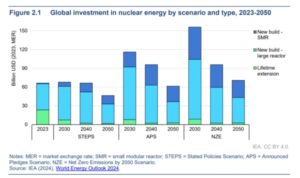
Nuclear energy
Source: IEA

Building Better Data Centers: Oklo and Vertiv Reimagine Energy Use

Oklo has teamed up with Vertiv (NYSE: VRT). Vertiv is a global leader in critical infrastructure for digital services. They focus on systems that keep data centers running, such as power supply and cooling solutions.

Oklo and Vertiv will develop new power and cooling systems for next-gen data centers. These centers will focus on high-performance computing and artificial intelligence. Their aim is to create systems that are efficient, modular, and eco-friendly. They will use Oklo’s clean nuclear energy as the main power source.

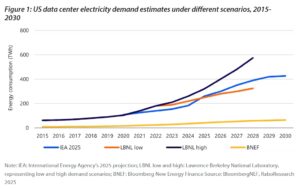
data center energy demand
Image sourced from Rabobank

A key part of this plan includes a pilot demonstration at Oklo’s first Aurora reactor site. This project will test how nuclear-generated steam and electricity can directly support data centers and power cooling systems.

What makes this partnership unique is its co-design strategy. Instead of retrofitting old systems, they are creating new energy and cooling technologies from the ground up. By placing Oklo’s reactors near customer facilities, they enhance efficiency and speed of deployment.

Vertiv will provide advanced cooling systems, smart analytics, and scalable designs, while Oklo will deliver stable, emissions-free energy. Together, they aim to reduce energy waste, cut emissions, and improve uptime, which are the key priorities for modern data centers.

Forging Powerful Partnerships to Fuel a Greener Tomorrow

Both partnerships show Oklo’s dedication to tackling energy challenges. Instead of a one-size-fits-all method, it works with companies that serve big energy users. Together, they create systems that mix reliability and sustainability.

Liberty provides an energy roadmap from proven fossil solutions to zero-carbon power. This approach helps industries feel sure about a steady energy supply. This way, they can get ready for a greener future.

Ron Gusek, Chief Executive Officer of Liberty, said,

“Our strategic alliance with Oklo advances a power strategy aimed at accelerating deployment for sophisticated, large load customers. This innovative approach redefines how today’s most energy-intensive industries can scale efficiently with cost-effective, next-generation power solutions, combining rapid deployment, intelligent load management, and integrated grid management. We are excited to offer developers unmatched speed to market, price stability, and a future-ready energy platform.”

Secondly, Oklo is working with Vertiv to create energy-smart data centers. These centers are crucial for the expanding digital economy. The new designs will reduce energy and environmental costs for large AI and cloud platforms and will help customers gain a competitive edge in sustainability.

Oklo’s Role in the Clean Energy Transition

Oklo has made significant progress in nuclear technology by collaborating with national labs and the DOE on nuclear fuel recycling.

It was the first company to receive a site use permit from the DOE for a commercial advanced reactor. It also obtained used nuclear fuel from the Idaho National Laboratory. They submitted a combined license application for an advanced reactor to the U.S. Nuclear Regulatory Commission.

This effort may allow the reuse of spent fuel from traditional reactors in Oklo’s designs. It turns waste into energy and addresses long-term storage issues.

oklo
Source: Oklo

Furthermore, Oklo’s stock jumped 12% after announcing its partnership with Liberty Energy. Earlier that day, the stock had already risen 3%, showing growing investor confidence.

By combining nuclear energy with natural gas and advanced infrastructure solutions, it shows that the energy transition can be smart, strategic, and tailored to real needs.

Aurora Reactors: Leading the Way in Advanced Nuclear Technology

Oklo’s Aurora reactors are compact and efficient. They can run for long periods without needing frequent fuel changes. As the operator and owner, Oklo can deploy these reactors near customers. This gives businesses more control over power and enables faster responses in markets needing reliable, low-emission energy.

Whether it’s keeping data centers operational or aiding large utility operations, Oklo is emerging as a key player in nuclear energy innovation.

The post OKLO Stock Surges on Liberty Energy and Vertiv Partnerships: Nuclear Power’s Next Big Move appeared first on Carbon Credits.

BHP’s Copper Boom: Sustainable Mining to Meet Soaring Global Demand

BHP

BHP has reported record copper production, highlighting its strength and resilience in a shifting global market. Copper remains a key pillar of the company’s long-term growth strategy, supported by a diverse portfolio of assets across Chile, Australia, and Peru.

This copper ramp-up not only underscores BHP’s operational excellence but also aligns with its push for sustainable mining. Let’s take a closer look at the company’s latest copper supply, green strategies, and long-term outlook.

BHP Sees Strong Results at Key Copper Assets

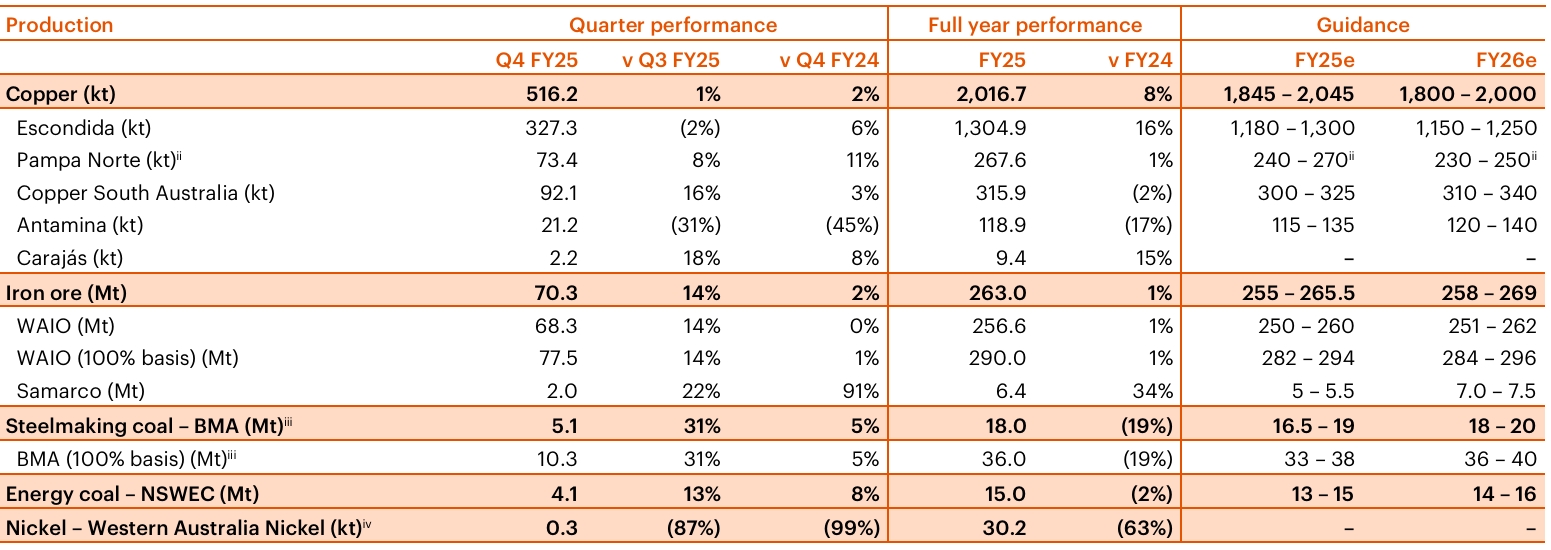
Copper production reached an all-time high of 2,017 thousand tonnes (kt), up 8% from last year. This marks three years of growth and a 28% increase since FY22. Copper is key for energy transition technologies, urban development, and digital infrastructure.

Escondida Hits 17-Year High

At Escondida in Chile, copper output rose 16% to 1,305 kt—its highest in 17 years. This increase came from better recoveries, higher concentrator throughput, and a rise in feed grade from 0.88% to 1.02%. The mine also began production from its Full SaL leaching project in Q4 FY25. FY26 production is expected to be between 1,150 and 1,250 kt, with a forecasted feed grade of around 0.85%.

Spence Delivers Record Production

Pampa Norte, which includes Spence and Cerro Colorado, produced 268 kt, a 1% rise. Spence alone saw a 5% boost due to improved feed grades. However, FY26 guidance is slightly lower at 230 to 250 kt due to transitional ore processing and reduced feed grades.

Copper South Australia Rebounds

Copper South Australia produced 316 kt, down 2% from a two-week power outage in Q2. Still, the region bounced back with an 18% production boost and record quarterly output in Q4. FY26 output is projected between 310 and 340 kt, weighted toward the second half.

Other operations included Antamina in Peru, where copper production fell 17% to 119 kt due to lower feed grades and throughput. However, Antamina expects to produce 120 to 140 kt of copper and 90 to 110 kt of zinc in FY26. In Brazil, Carajás contributed 9.4 kt of copper.

Iron Ore Output Reaches All-Time High

Total iron ore output hit 263 million tonnes in FY25. WAIO led with a record 257 Mt (290 Mt on a 100% basis), driven by better mine productivity and logistics. Samarco, BHP’s joint venture with Vale, saw production rise 34% to 6.4 Mt (12.8 Mt on a 100% basis) due to an early ramp-up of its second concentrator.

Additionally, the company expects FY26 output to range from 258 to 269 Mt.

bhp copper
Source: BHP

BHP’s Sustainable Shipping Contracts and Logistics Overhaul

BHP signed contracts with COSCO Shipping Bulk Co., Ltd. for two ammonia dual-fuel Newcastlemax bulk carriers. These vessels, expected by 2028, will mainly transport iron ore from Western Australia to Northeast Asia.

  • Powered by low or zero GHG emissions ammonia, these ships can cut greenhouse gas emissions by 50 to 95% per voyage compared to traditional fuels.

Notably, this initiative supports BHP’s commitment under the First Movers Coalition, aiming for 10% of its chartered shipping to use zero-emission fuels by 2030.

The partnership with COSCO followed a detailed evaluation process. BHP will also work on ammonia bunkering plans to ensure safe refueling of these advanced vessels. An ongoing tender will identify the source of the lower-carbon ammonia fuel.

$1.5 Billion Logistics Overhaul in Copper SA

The copper giant also partnered with Australian freight operator Aurizon for a logistics overhaul in Copper South Australia. Four contracts worth A$1.5 billion over ten years will shift copper concentrate and cathode transport from road to rail, covering Olympic Dam, Carrapateena, and Prominent Hill.

The freight will now move by rail between Pimba and Port Adelaide and will be handled by a local transport partner.

This change is expected to remove over 11,000 truck movements from South Australian roads each year, replacing around 13 million kilometers of road travel. Benefits include improved road safety, reduced congestion, and significant emissions cuts.

  • This shift highlights operational synergies after the OZ Minerals acquisition and shows BHP’s commitment to regional sustainability.

Advances in Emissions Reductions with Strong Progress 

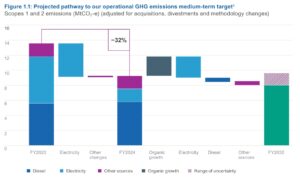
BHP is making solid progress toward its climate goals, aiming to reduce Scope 1 and 2 greenhouse gas (GHG) emissions by at least 30% by 2030 (from a 2020 baseline) and reach net zero by 2050.

As of 2024, the company had already reduced its operational emissions by 32%, lowering them to 9.2 million tonnes of CO₂-equivalent. However, Scope 3 emissions coming mainly from customers using BHP’s products, remained high at 377 million tonnes CO₂-e.

bhp emissions
Source: BHP

Looking beyond FY2030, BHP’s path to achieving net zero includes several key strategies:

  • Electrifying operations: Replacing diesel-powered equipment such as haul trucks, excavators, shovels, and locomotives with electric alternatives.
  • Expanding renewable energy use: Securing more renewable or low-emission electricity to power the growing fleet of electric vehicles and equipment.
  • Reducing methane emissions: Minimizing fugitive methane releases through the use of current and emerging technologies, wherever technically and commercially viable.

These actions are central to BHP’s long-term decarbonization efforts and reflect its commitment to lowering emissions across both its direct operations and value chain.

BHP Stock: Market Position and Shareholder Outlook

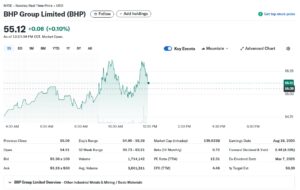
BHP (NYSE: BHP) shares are currently trading at $55.305 on the New York Stock Exchange. Analyst sentiment is cautious for the next 12 months, with the stock generally rated a “hold.” Most price targets are near current levels, suggesting limited short-term upside.

Long-term outlooks are still positive. Experts say, if commodity markets stay steady, BHP’s solid production, smart spending, and focus on innovation could boost financial growth and increase returns for shareholders.

Following the copper surge, BHP’s Chief Executive Officer, Mike Henry, remarked,

“BHP delivered record iron ore and copper production, which demonstrates the strength and resilience of our business and underpins our ability to deliver growth and returns to shareholders amid global volatility and uncertainty.”

bhp stock
Source: Yahoo Finance

BHP is All Set to Meet Growing Global Copper Demand

With this record-breaking output, the mining giant is stepping up to help meet the world’s fast-growing need for copper.

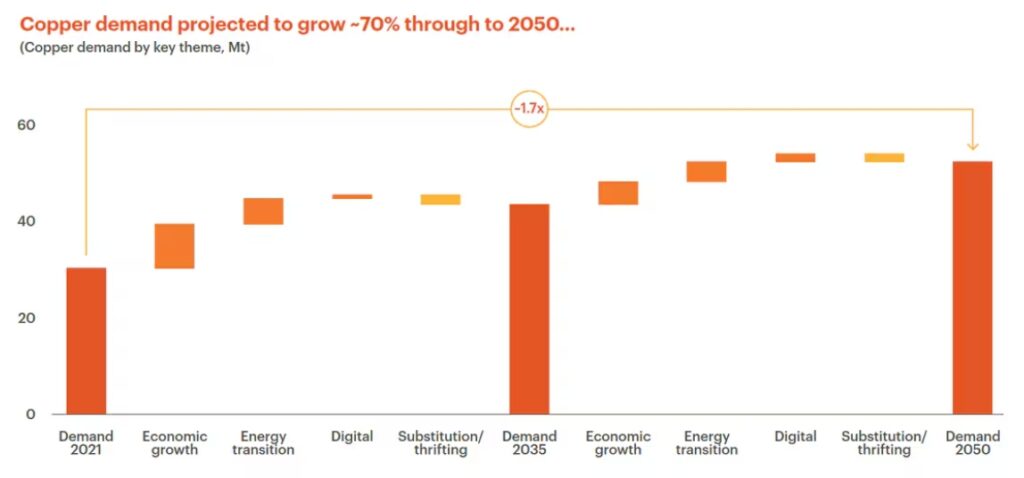
  • BHP expects global copper demand to rise by about 70% by 2050, reaching over 50 million tonnes per year.

That’s an average growth rate of 2% each year. And demand will come from both traditional uses like homes and appliances, and new ones such as electric vehicles, renewable energy, and data centers.

bhp copper
Source: BHP

Even with cost pressures, trade changes, and tariffs, the company is investing smartly and looking for long-term growth. Additionally, recycled copper will also play a vital role in meeting rising demand over the next 30 years.

With strong operations and clean energy goals, BHP is well-prepared to support the world’s shift to a lower-carbon, more secure future.

The post BHP’s Copper Boom: Sustainable Mining to Meet Soaring Global Demand appeared first on Carbon Credits.