JPMorgan, Microsoft Back $210 Million Carbon Loan in Landmark Climate Finance Deal

JPMorgan, Microsoft Back $210 Million Carbon Loan in Landmark Climate Finance Deal

JPMorgan Chase closed a landmark $210 million carbon loan to support Chestnut Carbon, a U.S.-based afforestation firm, in a move that could reshape how climate projects are financed. Microsoft also played a key role in this breakthrough. They committed to buying a large share of the high-quality carbon removal credits from the project.

The dual involvement of a leading global bank and a major tech firm shows rising trust in nature-based carbon removal. It is seen as a real, profitable asset class. 

JPMorgan’s Climate Finance and Advisory team, ERM (an environmental consulting firm), and Chestnut Carbon formed a partnership that made the transaction possible. It shows a change in how carbon projects are financed. This is especially true for nature-based solutions, like afforestation.

Other major lenders include CoBank, Bank of Montreal, and East West Bank. So, what makes this funding different from existing climate financing models? Let’s find out.

How the Financing Structure Works

The deal marks the largest-ever non-recourse project financing in the voluntary carbon market (VCM). The program, funded by future carbon credit revenues, aims to plant forests and remove CO₂ across the U.S. for 30 years.

Microsoft’s purchase agreement made the deal less risky. This gave JPMorgan the confidence to structure and underwrite the loan.

This carbon loan is notable because it uses future carbon credit revenue as collateral. Chestnut Carbon expects to generate millions of tons of carbon credits over the life of the forests it’s planting. These credits will be verified and sold in the voluntary market.

Instead of waiting decades for the trees to grow and credits to be sold, Chestnut Carbon now has upfront capital to scale quickly. The loan will be repaid over time as credits are generated and sold.

This structure is common in renewable energy or infrastructure—but it’s new to carbon markets, especially in the U.S. 

The design of the model aims to de-risk investment by separating project performance from broader market volatility. That makes it easier for pension funds, banks, and institutional investors to enter the carbon space.

Chestnut’s Chief Financial Officer, Greg Adams, remarked:

“Not only does this facility provide the capital to accelerate our afforestation and carbon removal initiatives, but it establishes a replicable model for sustainable finance in the voluntary carbon sector.”

Chestnut Carbon’s Afforestation Mission

Chestnut Carbon focuses on afforestation, which involves planting trees on land that hasn’t been forested for a long time. This differs from reforestation (which restores forests after logging or wildfires). It is especially useful in regions like the U.S., where marginal lands are convertible into carbon sinks.

Chestnut Carbon Projects

Chestnut Carbon projects
Source: Chestnut Carbon

The company’s long-term goal is to plant trees across tens of thousands of acres, targeting carbon removal at scale. Their model includes:

  • Rigorous monitoring and MRV (measurement, reporting, and verification) using satellite data and third-party audits
  • Carbon credits certified under leading registries like Verra or ACR
  • Partnerships with local landowners to secure access to suitable land
  • Biodiversity and ecosystem restoration as co-benefits of the program

Chestnut Carbon’s credits aim to meet the growing need for trustworthy carbon removals. This is particularly important for big companies with net-zero targets. ERM, which advised on the deal, says this model is replicable in other places. It can help fund similar nature-based climate projects globally.

Wall Street Meets the Forest: A Signal to Carbon Investors

This financing is a game-changer for the voluntary carbon market. It has faced problems like low liquidity, verification issues, and a lack of investor trust. Here’s what this deal signals to the broader market:

  • VCM Projects Are Bankable:

JPMorgan and partners created a non-recourse loan using carbon credits. This shows that institutional investors see high-quality carbon projects as financially viable, not just charitable.

  • More Deals to Come:

The structure used in this deal can now serve as a blueprint. JPMorgan has signaled interest in scaling this model to other project developers and regions—especially those in Latin America, Southeast Asia, and Africa.

  • Meeting Corporate Carbon Goals:

As demand for verified carbon removals grows—driven by new SEC and EU regulations—companies are scrambling to find high-quality offset credits. This creates a strong buyer base for the types of credits Chestnut Carbon will issue.

  • Liquidity and Credibility Boost:

Third-party financing increases transparency and accountability. That helps solve two major problems in the carbon credit market: poor liquidity and doubts about credit quality.

BloombergNEF reports that the VCM could jump from $2 billion in 2024 to $50 billion by 2030. This growth is likely as net-zero goals become real and reporting rules get stricter. In a more optimistic outlook, the market could reach up to $500 billion by 2050. 
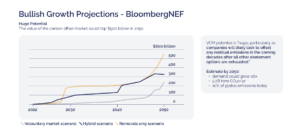
VCM projection 2050 DGB
Chart from DGB Group

Carbon Credits and the Path to Net Zero

Carbon credits allow companies to offset emissions they can’t yet eliminate. But not all credits are created equal. There’s a growing interest in removal-based credits, such as afforestation, instead of avoidance methods, like stopping deforestation.

Chestnut Carbon’s model supports this shift. Each project removes CO₂ from the atmosphere by planting trees that sequester carbon over decades. These credits will qualify for science-based targets and corporate ESG reporting under frameworks like the GHG Protocol and SBTi.

JPMorgan’s role shows that carbon markets are now central to finance, not just a side tool. Their deal helps close the financing gap for nature-based solutions. The United Nations estimates that $387 billion per year is necessary through 2030 to meet climate goals.
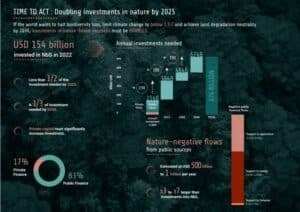
doubling investments in nature-based solutions
Source: United Nations Environment Programme

Vijnan Batchu, Global Head of Center for Carbon Transition at J.P. Morgan, echoed this thought, saying:

“Providing this kind of financing gives developers the runway they need to succeed at an attractive cost of capital, allowing them to focus on delivering significant carbon projects and fulfilling contracts…J.P. Morgan is extremely proud to be a part of this significant deal and contribute to the growth of the carbon markets at large.”

A Template for Future Climate Finance: What Comes After the Deal?

JPMorgan’s $210 million loan to Chestnut Carbon is more than a single transaction. It’s a financial innovation that connects capital markets to real carbon removal work on the ground. It offers investors a fresh way to join climate solutions. It also provides project developers with the resources to act quickly and increase their impact.

As VMCs grow, deals like this may lead to new financial tools linked to nature, emissions, and verified climate results. They may also pave the way for carbon credit securitization, green bonds linked to offsets, or public-private climate investment partnerships.

The Chestnut Carbon deal shows that big afforestation projects can draw in large investments. They lower risks and provide clear results in the battle against climate change.

The post JPMorgan, Microsoft Back $210 Million Carbon Loan in Landmark Climate Finance Deal appeared first on Carbon Credits.

How Energy Efficiency and Clean Investment Are Boosting Emission Reductions and Net Zero

How Energy Efficiency and Clean Investment Are Boosting Emission Reductions and Net Zero

Energy efficiency is emerging as a critical tool in the global fight against climate change. The International Energy Agency (IEA) shows that efficiency delivers more than just lower energy use and emissions—it offers broad financial, environmental, and social benefits. Meanwhile, global investment in clean energy is reaching record highs, signaling a shift toward a greener future. Let’s explore how efficiency and new funding are transforming the energy landscape.

Unlocking the Many Benefits of Energy Efficiency

Energy efficiency is much more than a way to save electricity or fuel. It fuels economic growth, boosts health, and strengthens energy security. When buildings and factories use less energy, they cut both greenhouse gas emissions and energy bills. The benefits include:

  • Better Health: Good insulation in homes and efficient heating systems mean less pollution inside and outside.
  • More Jobs: Projects that focus on saving energy create about 2 to 3 times more jobs for every dollar spent compared to projects that use fossil fuels. 
  • Businesses Do Better: Companies save a lot of money on energy. Some industries cut their energy costs by as much as 20%
  • Government Savings: The IEA says governments could save over $100 billion each year by having better energy-saving policies.

The agency further says every dollar spent on energy efficiency brings back $1.5 to $2.5 in economic value. This includes energy savings, health benefits, and job creation. This “multiple benefits” approach ensures policymakers and businesses see efficiency not just as a cost saver but as a driver of prosperity.

More notably, energy efficiency is incredibly important for cutting down on pollution. It helps our energy system become cleaner and more reliable by reducing harmful greenhouse gases and air pollutants.

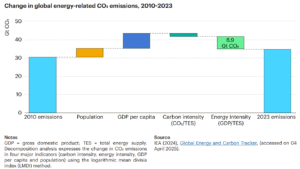
In fact, since 2010, the energy saved through efficiency measures has prevented CO₂ emissions equal to nearly 20% of the world’s total in 2023. That’s more than the combined energy-related emissions of both India and the European Union!

Looking ahead, if the world improves efficiency quickly, it could reduce CO₂ emissions by a third by 2030. This would be key for reaching net-zero goals by 2050. And this would make efficiency the largest contributor among all energy sectors or technologies.

IEA report energy efficiency ghg emissions
Source: IEA

Global CO₂ emissions rose by about 15% from 2010 to 2023. This was mainly due to population and economic growth. However, energy efficiency was key. It cut nearly 7 billion tonnes of CO₂ during that time, helping to reduce the overall increase.

Investing in a Clean Energy Future: $3.3 Trillion and Growing

Global investment in energy reached an estimated $3.3 trillion in 2025, a 2% increase from 2024, according to the IEA’s World Energy Investment 2025 report. Out of this, $2.2 trillion goes to renewables, nuclear, grids, storage, low-emission fuels, efficiency, and electrification. That’s more than double the $1.1 trillion spent on oil, gas, and coal.

energy investment 2025 IEA report
Source: IEA Report

Key highlights of the report findings include:

  • Solar energy: This is the leader in clean energy investment, with $450 billion going into it. This makes it the biggest single area of energy spending in the world. It has almost doubled in the last five years because it’s become very cheap and is being used more in developing countries.
  • Battery storage: Money for batteries that store power went up to about $66 billion. These batteries help make sure renewable energy is steady and available when needed.
  • Nuclear power: Investment in nuclear power grew by 50% over the last five years, reaching over $70 billion. This is because more people are interested in new, smaller nuclear reactors.
  • Power grids: About $400 billion is spent each year on electricity grids around the world. But this isn’t enough to handle the growing demand for electricity and the spread of renewable energy. The IEA says we need to almost double grid investment to keep our electricity supply secure and help the energy switch.
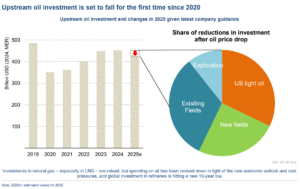
  • Oil and gas: Investment in finding new oil dropped by 6% in 2025. This is the biggest drop since 2016 and shows less interest in oil. But investment in natural gas stayed steady, helped by new projects that make liquefied natural gas (LNG). The amount of LNG we can export is expected to nearly double by 2028.

Upstream oil investment IEA

  • Low-pollution fuels: Investment in fuels that produce less pollution reached a new high, but it’s still small at less than $30 billion. If all planned projects go through, investment in capturing carbon pollution could grow more than ten times by 2027.

Clean hydrogen and nuclear are gaining momentum. Investment in nuclear energy, especially small modular reactors or SMRs, is growing quickly. At the same time, clean hydrogen projects benefit from new policies and increasing market interest. Hydrogen investments are expected to nearly double in 2025 compared to 2024.

Why Efficiency and Investment Must Go Hand in Hand

As investments shift to clean technologies, energy efficiency remains essential to amplify impact. Efficiency reduces energy demand, cutting the scale and cost of clean energy infrastructure needed.

To hit the COP28 energy intensity target of a 4% annual improvement, the world needs to nearly triple investment in efficiency and electrification in the next 5 years. Without this boost, the energy transition risks stalling despite growing clean power capacity.

Efficiency supports broader clean energy goals by:

  • Boosting solar and wind productivity cuts the cost of clean energy per unit.
  • Cutting peak electricity demand helps ease pressure on grids. It also reduces the need for expensive infrastructure upgrades.
  • Helping homes and businesses use clean heating, cooling, and electric vehicles is key. This approach lowers both initial and ongoing costs.

Pairing efficiency with clean power investment allows countries to progress faster, cheaper, and more reliably in their climate and net-zero goals.

Real-World Impact: Efficiency and Renewables at Work

Countries embracing both efficiency and investment reap multiple gains:

  • Europe: New energy-saving rules and investments in solar and batteries have lowered electricity bills by up to 15% in some areas. They also help cut pollution.
  • India: More rooftop solar panels and energy-efficient appliances have given over 100 million people access to cleaner, cheaper power.
  • United States: Energy efficiency programs supported over 3 million jobs in 2024 and cut residential energy use by 8%.

These examples show that aligned policy, investment, and technology make energy systems cleaner, more reliable, and more equitable.

Energy efficiency and clean energy investment are vital partners in the global energy transition. Efficiency not only saves energy and lowers emissions but also supports health, jobs, and economic growth. At the same time, clean energy investment is reshaping power systems worldwide. Together, they form the backbone of a durable, affordable, and equitable net-zero future.

The post How Energy Efficiency and Clean Investment Are Boosting Emission Reductions and Net Zero appeared first on Carbon Credits.
Meta Boosts Renewable Energy with 650 MW Solar Agreement

meta

Meta Platforms has signed two major solar energy agreements with AES Corporation to lock in 650 megawatts (MW) of clean power. These new projects, based in Texas and Kansas, will support Meta’s fast-growing AI and cloud operations. The move brings Meta closer to its goal of powering all U.S. data centers with 100% renewable energy by 2030 and hitting 9.8 gigawatts (GW) of green power by 2025.

Urvi Parekh, Global Head of Energy, Meta, said,

“We are thrilled to work with AES to bring forward these two solar energy projects. These solutions support our goal for 100% clean and renewable energy and will add new generation to the grid in these markets.”

Why Does Meta Need So Much Solar Power?

Meta’s data centers use a lot of energy to run social media platforms, AI tools, and cloud services around the clock. It’s investing in long-term solar power deals to reduce its carbon footprint and control energy costs. These power purchase agreements (PPAs) offer steady pricing and less risk from fossil fuel price swings.

The solar energy will go straight to Meta’s facilities in Texas and Kansas. While Texas is already a leader in solar, Kansas is just getting started. This strategy not only powers Meta’s tech operations but also helps kickstart large-scale solar projects, growing the U.S. clean energy market.

By replacing fossil-fuel power with solar, Meta can make a real dent in emissions. Some parts of Texas and Kansas still depend on coal and natural gas, so clean energy projects in these states matter.

Meta’s Commitment to Net Zero Emissions

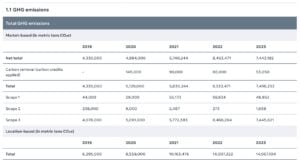
As per its latest sustainability report, in 2023, Meta’s net emissions equaled 7.4 million metric tons of CO2. Key commitments include:

  • Reducing Scope 1 and 2 emissions by 42% by 2031, compared to a 2021 baseline, and ensuring that maximum suppliers adopt science-aligned GHG reduction targets by 2026.
  • Keep Scope 3 emissions at or below 2021 levels by 2031.
  • Since 2020, Meta has successfully maintained net-zero emissions in its operations, and it is on track to achieve net-zero across its entire value chain by 2030.
Meta emissions
Source: Meta

On top of that, the solar shift means better air quality in areas near coal plants. And in Texas, where the power grid has faced issues during extreme weather, more renewable energy helps improve energy security and grid stability.

AES Solar Deal: Positioned Texas and Kansas for Solar Growth?

Andrés Gluski, AES President and Chief Executive Officer, also commented on this partnership. He said,

“AES is proud to partner with Meta to deliver reliable and affordable renewable energy that supports their data center growth and ambitious sustainability goals,” s “By providing energy solutions that offer fast time-to-power and low-cost electricity, we continue to be the partner of choice for companies, like Meta, at the forefront of artificial intelligence innovation.”

Texas ranks high in solar power, with around 41 GW of capacity, second only to California. The state’s sunny weather, open land, and competitive energy market make it a top pick for big tech companies.

Kansas, however, is still early in its solar journey, with only 172 MW installed as of late 2024. Meta’s investment could kickstart major solar growth, bringing new jobs and tax revenues to local communities.

The deal also supports both economic development and climate goals, especially in regions that need fair access to clean energy jobs.

What Does This Mean for the Clean Energy Market?

Meta’s solar deals reflect a larger trend—big tech is now a major force behind clean energy growth. Corporate PPAs help fund utility-scale renewable projects that might not move forward without strong financial backing. As more companies set net-zero goals, these deals are on the rise.

AES is playing a key role. It now has over 10 GW of renewable capacity under contract for tech clients, mostly for data centers. With a pipeline of 65 GW in clean energy projects, the company is ready to scale up to meet demand.

New solar plants expected to support most U.S. electric generation growth

EIA solar

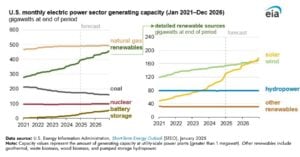
EIA expects utilities and independent power producers will add 26 gigawatts (GW) of solar capacity to the U.S. electric power sector in 2025 and 22 GW in 2026. And deals like Meta’s help accelerate that shift by encouraging more solar manufacturing, energy storage, and grid upgrades.

The post Meta Boosts Renewable Energy with 650 MW Solar Agreement appeared first on Carbon Credits.
BlackRock and Eni’s $1.2 Billion Deal to Push Carbon Capture

BlackRock, the world’s largest asset manager, recently made headlines by using its Global Infrastructure Partners (GIP) division to strike a deal with Italy’s energy giant Eni. Through this transaction, GIP agreed to acquire a 49.99% stake in Eni’s carbon capture, utilization, and storage (CCUS) business. The unit—called Eni CCUS Holding—is valued at around €1 billion, or roughly $1.2 billion.

The deal reflects growing global interest in climate technologies. It also shows how asset managers and oil majors are working together to scale next-generation clean energy solutions.

Carbon capture is increasingly seen as a critical part of reducing emissions from hard-to-abate industries such as cement, steel, and refining.

How Carbon Capture Works—and Why the World’s Betting on It

Carbon capture, utilization, and storage—known as CCUS or CCS—is a process that reduces carbon dioxide (CO₂) emissions from power plants, factories, and even directly from the atmosphere.

First, the CO₂ is captured at its source before it escapes into the air. Then, it is either transported and stored underground in rock formations or reused in other products like fuels, concrete, or chemicals. Sites used for storage include depleted oil and gas reservoirs or deep saline aquifers.

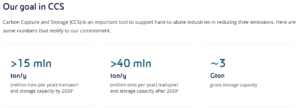
Globally, CCUS is gaining traction. According to the International Energy Agency, there are now over 40 commercial projects either operating or under development. By 2030, carbon capture facilities could remove more than 1 billion tonnes of CO₂ per year—up from about 50 million tonnes today.

carbon capture capacity by 2030 IEA
Source: IEA

Eni’s portfolio is part of this growing movement. The company’s CCUS assets include:

  • Hynet North West and Bacton Thames NetZero projects in the UK.

  • L10CCS in the Netherlands

  • The large-scale Ravenna site in Italy

Ravenna is Italy’s first CO₂ capture and storage project, which aims to scale from 25,000 tonnes annually to become a major carbon storage hub for Southern Europe by 2030. The company has the following CCS goals:

ENI ccs goal

Together, the projects could capture and store up to 29 million tonnes of CO₂ per year by 2030—roughly equal to taking 6 million gas-powered cars off the road annually.

Why the World’s Largest Asset Manager Went All-In on CCUS

BlackRock’s investment in Eni’s carbon business came just months after it acquired GIP for $12.5 billion. GIP brought in about $100 billion in infrastructure assets covering energy, transport, and utilities. Now part of BlackRock, GIP is being positioned as a key player in building clean energy and decarbonization projects.

By buying into Eni’s CCUS unit, BlackRock signals its belief that carbon capture will play a major role in meeting global net-zero targets. It also shows that carbon management is no longer just a policy tool—it’s becoming a commercial opportunity for investors.

The deal gives BlackRock access to long-term, inflation-protected revenue linked to decarbonization goals. For Eni, the partnership brings in capital to expand its CCUS business faster while keeping control of day-to-day operations.

Eni’s Clean Energy Playbook: Spin It Off, Scale It Up

Eni has adopted a satellite business model to accelerate its clean energy transition. This means it creates separate business units for renewables, biofuels, and now CCUS, and brings in outside investors to help fund growth. By doing so, Eni can access capital while spreading the financial risk of entering new markets.

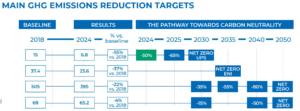
The CCUS spin-off fits into Eni’s broader sustainability plan. The company has committed to achieving net-zero emissions by 2050 across its operations and products.

ENI carbon neutrality net zero pathway
Source: ENI

The oil major aims to cut Scope 1, 2, and 3 emissions by 35% by 2030 and 80% by 2040 from 2018 levels. To meet this goal, Eni is investing in renewables, green hydrogen, sustainable fuels, and carbon removal solutions.

Moreover, Eni’s carbon offset strategy targets hard-to-abate emissions using natural and technical solutions. By 2050, 5% of its emission cuts will come from high-quality carbon credits through ecosystem restoration, forest protection, sustainable land use, and advanced removal methods.

Eni now manages more than 2 gigawatts of renewable energy via Plenitude. It is also expanding into solar and wind projects in Italy, North Africa, and Spain. It’s also increasing biofuel production using waste oils and agricultural residues.

By spinning off its CCUS unit, Eni can grow these solutions faster without sacrificing its core business in oil and gas.

Carbon Capture Gets Real: What This Deal Signals for the Market

The BlackRock-Eni deal has broad implications for both the energy industry and the carbon removal space.

CCUS Gains Credibility and Investment

Once considered too expensive and uncertain, CCUS is now entering the mainstream. Market forecasts expect the global CCUS industry to grow from $3.2 billion in 2023 to over $18 billion by 2032. In terms of capacity, CCS could reach up to 1,300 Mt per year by 2050.

CCS growth 2050
Source: DNV Report

The U.S. 45Q tax credit pays up to $85 per tonne of CO₂ captured, while the EU’s Innovation Fund provides billions in grants. With policies like these, CCUS projects have the support they need to grow.

Private Capital Joins the Fight

BlackRock’s move marks a shift in climate finance. Institutional investors are now targeting hard-to-abate sectors, not just wind and solar. GIP’s involvement shows that CCUS can offer stable, long-term returns tied to carbon prices or industrial contracts.

Energy Firms Adopt New Funding Models

Eni’s approach offers a model for other oil majors looking to decarbonize. By creating new business units and selling part of them, companies like Shell, TotalEnergies, or Chevron can fund clean energy projects while keeping their core assets intact. This lowers financial risk and attracts ESG-focused investors.

Supply Chain and Technology Development

Large-scale carbon capture projects need more than funding. They need CO₂ pipelines, storage infrastructure, capture equipment, and skilled labor. The BlackRock–Eni deal is expected to help build all of these. It will also support jobs and economic development in regions that depend on heavy industry.

Will This Billion-Euro Bet Spark a CCS Boom?

Several things will shape what comes next for CCS. The deal is expected to close by late summer 2025. After that, Eni and BlackRock will begin developing the CCUS pipeline further.

BlackRock’s billion-euro bet on Eni’s carbon capture business shows that CCUS is no longer a niche solution. It’s a growing part of global climate strategy—and a real investment opportunity.

For Eni, the deal unlocks growth while allowing it to lead in decarbonization. For BlackRock, it opens the door to long-term returns tied to climate impact.

The success of their partnership will depend on policy support, technology performance, and industry momentum. But if all goes well, this deal could inspire a new wave of investment into the infrastructure needed for a net-zero world.

The post BlackRock and Eni’s $1.2 Billion Deal to Push Carbon Capture appeared first on Carbon Credits.

US–China Trade Tensions Heat Up Over Graphite and EV Battery Supply Chains

US–China Trade Tensions Heat Up Over Graphite and EV Battery Supply Chains

In a major move, the U.S. Commerce Department announces preliminary anti-dumping duties of 93.5% on imports of Chinese graphite—a key input for electric vehicles (EV) batteries—after finding Chinese companies were selling it at unfairly low prices.

The duties affect up to $347 million in annual imports and could further disrupt U.S. battery supply chains. Analysts warn U.S. EV and battery manufacturers may face higher costs and production delays, while alternative suppliers rush to fill the gap.

The Unsung Hero Driving the EV Boom

Graphite is one of the most important materials used in EV batteries. It forms the anode, or negative electrode, in nearly all lithium-ion batteries—the type used in most EVs today. In fact, over 95% of all EV battery anodes rely on graphite.

Each electric vehicle contains between 50 and 100 kilograms of graphite, making it the largest battery component by mass and volume. The mineral allows lithium ions to move in and out of the battery during charging and discharging. This process helps EVs store energy, achieve long driving ranges, and charge quickly.

Graphite is also stable, durable, and cost-effective. It can handle thousands of charging cycles and helps prevent battery overheating. So far, there is no widely used alternative that offers the same performance at scale. Because of this, graphite is considered essential to the clean energy transition and a key mineral for the global EV industry.

U.S. Dependence on Chinese Graphite

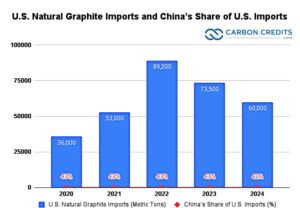
As of 2024, the U.S. imported about 60,000 metric tons of natural graphite, down from roughly 84,000 tons in 2023. China remained the largest supplier, accounting for around 67.6% of all natural graphite imports by value. This is worth roughly $375 million. It represents a slight decrease in volume but still a dominant share of the market.

US natural graphite import and CHina share
Sources: USGS 2024; Statista

As the chart shows, China has consistently played a major role in supplying graphite to the U.S., especially in high-purity forms used for EVs. But recent policy changes are reshaping this trade.

Tariff Shock: U.S. Takes Aim at Chinese Graphite

The U.S. government recently declared provisional anti-dumping duties of up to 93.5% on imports of Chinese anode-grade graphite. Officials said Chinese exporters were selling graphite in the U.S. at unfairly low prices, which hurt American manufacturers.

These duties could impact up to $347 million in graphite imports each year. The move is part of a broader effort to support domestic production of critical materials and reduce dependence on foreign sources.

While the tariffs aim to protect U.S. businesses, they could also raise costs for American EV and battery makers. Finding new suppliers—or building up local production—will take time and investment, as analysts warn.

China Strikes Back: Export Curbs Escalate the Conflict

China responded by tightening controls on its own exports of graphite and other critical minerals. In late 2024 and early 2025, China added export licenses for tungsten, molybdenum, tellurium, indium, and bismuth, on top of earlier restrictions for gallium and germanium. These materials are important for electronics, chipmaking, and green energy technologies.

By requiring companies to apply for permission to export these minerals, China aims to protect its national security and gain leverage in trade talks. So far, the approval process has slowed shipments, with more than 60% of applications still waiting for clearance.

Together, these actions show that minerals like graphite are becoming tools in the wider strategic competition between the U.S. and China.

Impacts on the EV and Tech Industry: Who’s Getting Hit the Hardest?

This growing tension is having a ripple effect across industries—especially electric vehicles, batteries, and semiconductors. Here’s how this tension impacts the said industries: 

  • EV Battery Production: Tariffs and export restrictions could raise the price of battery materials, making EVs more expensive to build. Slower or costlier production may hurt efforts to expand EV use across the U.S.
  • Clean Energy Transition: Minerals like graphite, gallium, and rare earths are key to making wind turbines, solar panels, and other low-carbon technologies. Any disruption could delay progress toward climate goals.
  • Semiconductors and AI Chips: The U.S. has already limited exports of advanced chip technology to China. In return, China is squeezing supplies of gallium and germanium, which are used in chipmaking. This tit-for-tat adds risk to global electronics supply chains.

Many countries are now rushing to diversify their sources and build resilient supply chains. The U.S., for example, is investing in domestic mining and processing, as well as partnerships with countries like Australia and Canada. But rebuilding this infrastructure will take time—often 3 to 5 years or more.

What’s Next in the Mineral Cold War?

Several key events will shape how this trade conflict evolves. Analysts predicted these major ones to occur.

Final U.S. Decision on Tariffs:

The current graphite duties are provisional. A final ruling is expected by December 5, 2025, and could keep or adjust the tariffs based on further review.

China’s Export Licenses:

As China decides which companies can continue exporting key minerals, delays and uncertainty may persist well into 2026.

Negotiations and Trade-Offs:

There is still room for dialogue. For example, recent reports suggest the U.S. may allow chipmakers like Nvidia to sell some AI chips to China in exchange for cooperation on rare earth exports.

This back-and-forth could continue for years. But both sides are now deeply focused on economic security, especially in strategic industries like batteries, semiconductors, and clean energy.

Beyond Batteries: How Minerals Shape Global Power Plays

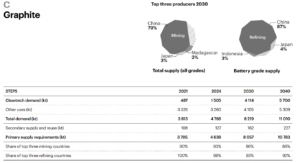
Graphite may seem like just another material, but it plays a big role in shaping the future of transportation and technology. For now, China leads the global market in graphite production and processing, both in 2024 and in 2030, as predicted by the IEA. The U.S., facing a supply risk, is using tariffs and domestic investments to try to close the gap.

graphite 2030 top country producers IEA
Source: IEA

At the same time, companies are watching closely. Automakers, battery makers, and tech giants all depend on stable access to key minerals. The next few years will show whether governments can build secure supply chains. Or whether trade tensions will disrupt the path to a cleaner, more connected world.

The post US–China Trade Tensions Heat Up Over Graphite and EV Battery Supply Chains appeared first on Carbon Credits.

Gold’s Big Comeback: Can WRLG Follow Newmont’s Path to a 15x Earnings Boom?

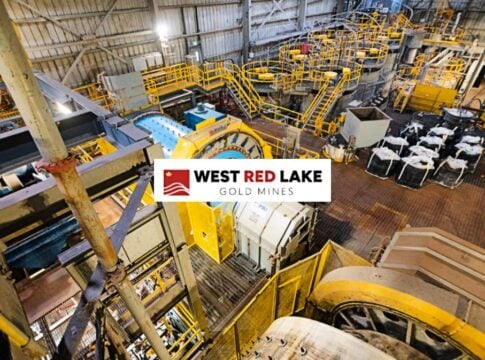
WRLG gold

Disseminated on behalf of West Red Lake Gold Mines Ltd.

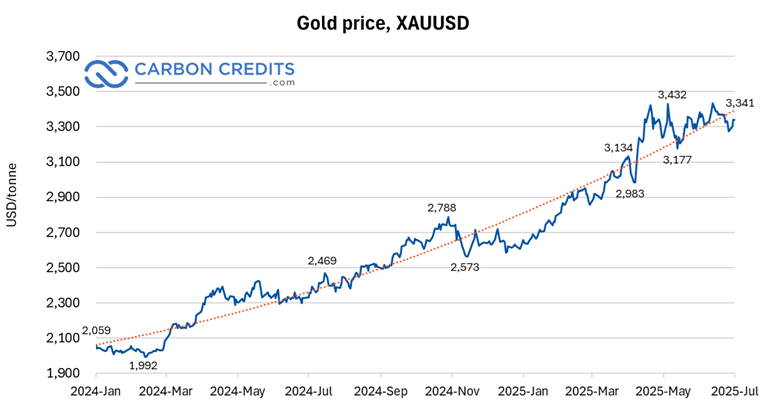
While tech stocks and rate cuts dominate headlines, gold has quietly broken out. With prices averaging near $2,900/oz in Q1 2025 and $3,290/oz in Q2, miners are seeing an earnings explosion. This rally seems to be fuelled by Western investors becoming interested in gold after the yellow metal gained 93% % from 2020 to 2025, driven by strong physical demand from Asia and central banks.

Now miners are raking in profits. And this silent bull market could be just getting started. Let’s dive deeper.

Q1 2025: Gold Miners’ Profits Explode

  • Mid-Tier Miners: The top 25 companies in the GDXJ index saw revenues jump 26.8% YoY, with all-in sustaining costs (AISC) averaging $1,378/oz, leaving margins at record highs.
  • Wesdome Gold Mines: Reported a 365% YoY increase in gross profit and a nearly fivefold jump in net income, as Q1 gold production rose 37% and AISC fell 17% to $1,366/oz. The average realized gold price was $2,882/oz, driving margins and cash flow to new highs.
  • Newmont Corporation: The world’s largest gold miner delivered 1.5 million ounces in Q1 and a record $1.2 billion in free cash flow. With these numbers, the company stays on track to meet its 2025 targets with a strong gold portfolio for shareholders.
Gold price chart, XAU usd
Source: Bloomberg

Newmont’s Playbook: Cheap Today, Explosive Tomorrow

Newmont is the world’s largest gold producer. It’s currently trading at about 7x earnings. This is surprisingly low given its top-tier assets and strong cash flow. But with gold at record levels and persistent macroeconomic uncertainty prompting Western investors to invest in the yellow metal and the companies that produce it, a re-rating to 15x earnings looks entirely possible, given that gold miners have been valued at 22x earnings in past gold cycles.

Let’s once again ponder the Q1 figures. For starters, Newmont generated $1.2 billion in free cash flow, and its profit hit 27%, showing operational strength.

If investors come back to gold, Newmont could lead the charge and set the tone for others.

WRLG: Junior Miner, Big Potential

Now let’s talk about West Red Lake Gold (TSXV: WRLG; OTCQB: WRLGF), a junior miner transitioning into a producer. It’s a classic under-the-radar story. But that could change.

Here’s why:

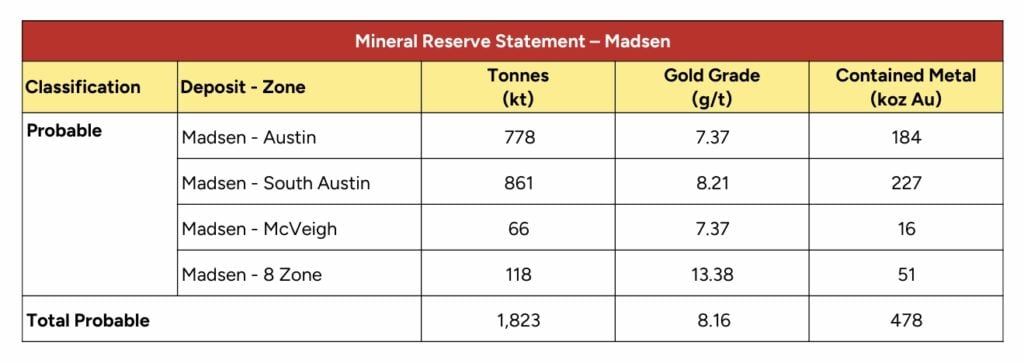
  • WRLG just restarted the high-grade Madsen Mine
  • It’s moving from zero revenue to cash flow
  • Companies starting new gold mines can be particularly attractive for investors wanting exposure to a rising gold price because the value of new production layers on top of increased revenues
  • A shift to 15x earnings isn’t crazy – it’s been done before

WRLG doesn’t need gold to go higher; it just needs to hit its own targets. If it does, investors could start to value the company as a successful new gold miner, just as the market potentially also starts to give gold miners higher valuations relative to cash flows.

Can WRLG Go from New Miner to 15x Producer?

WRLG MADSEN GOLD
Source: WRLG

1. Ramping up the Madsen Mine

WRLG just restarted the Madsen Mine. It now needs to ramp the operation up, from the ~60% level it started at to full scale by the end of the year. Doing this smoothly and successfully would build confidence in the Madsen Mine and support a shift towards valuing West Red Lake Gold as a producing gold miner..

2. Achieving Commercial Production

The moment WRLG poured its first gold, it shifted from a high-risk developer to a real producer. Cash flow began. The value of the operation will become clear when WRLG declares commercial production, something mines usually do after ramping up to target mining rates, and starts reporting on costs and revenues. Margins matter.

3. Getting the Market’s Attention

If WRLG delivers consistent production, it could move to a 7x earnings multiple, in line with other gold miners. The market rewards execution. WRLG just needs to stick the landing.

4. Boost from Unlocking More at Madsen

The Madsen Mine plan is a conservative plan to get the mine back in action. It outlines a nice mine – but there are multiple opportunities to unlock more value at Madsen, from using a less conservative approach and therefore, mining more of the deposit at lower costs to adding two nearby, defined, WRLG-owned deposits to the mine plan.

What Could Go Wrong?

WRLG still faces challenges, and some of them are:

  • Execution risk: delays or cost overruns can hurt timelines
  • Operational ramp-up: hitting production targets is crucial
  • Market recognition: It takes time for investors to re-rate juniors

But these are standard hurdles for any miner. WRLG’s roadmap is clear, and management is quickly checking off milestones.

Could Underground Mining Boost WRLG’s Valuation?

Underground mining often brings higher grades and lower surface disruption—investors like that. The Madsen Mine sits in a known gold belt, giving WRLG added credibility. If the company can sustain production and control costs, it may earn the valuation premium typically reserved for proven underground producers in Top Tier jurisdictions.

Gold’s breakout has already changed the game for producers like Newmont. But the real story might be at the junior level. WRLG is flipping the switch from developer to producer, creating new value, and is working to unlock significant additional value along the way.

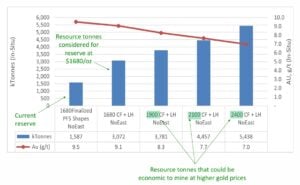
wrlg west rad lake gold
Source: WRLG

If gold stays above $3000, feeding big profits for gold miners, and generalist investors really start to rotate into the gold sector, a sector-wide re-rating to 15x earnings could drive significant upside. The market ignored gold’s move, but now it can’t ignore the profits.

And there are very few new gold producers like WRLG who are ready for the opportunity.

DISCLAIMER

New Era Publishing Inc. and/or CarbonCredits.com (“We” or “Us”) are not securities dealers or brokers, investment advisers or financial advisers, and you should not rely on the information herein as investment advice. West Red Lake Gold Mines Ltd. made a one-time payment of $30,000 to provide marketing services for a term of 1 month. None of the owners, members, directors, or employees of New Era Publishing Inc. and/or CarbonCredits.com currently hold, or have any beneficial ownership in, any shares, stocks, or options in the companies mentioned. This article is informational only and is solely for use by prospective investors in determining whether to seek additional information. This does not constitute an offer to sell or a solicitation of an offer to buy any securities. Examples that we provide of share price increases pertaining to a particular Issuer from one referenced date to another represent an arbitrarily chosen time period and are no indication whatsoever of future stock prices for that Issuer and are of no predictive value. Our stock profiles are intended to highlight certain companies for your further investigation; they are not stock recommendations or constitute an offer or sale of the referenced securities. The securities issued by the companies we profile should be considered high risk; if you do invest despite these warnings, you may lose your entire investment. Please do your own research before investing, including reading the companies’ SEDAR+ and SEC filings, press releases, and risk disclosures. It is our policy that information contained in this profile was provided by the company, extracted from SEDAR+ and SEC filings, company websites, and other publicly available sources. We believe the sources and information are accurate and reliable but we cannot guarantee it.

CAUTIONARY STATEMENT AND FORWARD-LOOKING INFORMATION

Certain statements contained in this news release may constitute “forward-looking information” within the meaning of applicable securities laws. Forward-looking information generally can be identified by words such as “anticipate”, “expect”, “estimate”, “forecast”, “planned”, and similar expressions suggesting future outcomes or events. Forward-looking information is based on current expectations of management; however, it is subject to known and unknown risks, uncertainties and other factors that may cause actual results to differ materially from the forward-looking information in this news release and include without limitation, statements relating to the plans and timing for the potential production of mining operations at the Madsen Mine, the potential (including the amount of tonnes and grades of material from the bulk sample program) of the Madsen Mine; the benefits of test mining; any untapped growth potential in the Madsen deposit or Rowan deposit; and the Company’s future objectives and plans. Readers are cautioned not to place undue reliance on forward-looking information.

Forward-looking information involve numerous risks and uncertainties and actual results might differ materially from results suggested in any forward-looking information. These risks and uncertainties include, among other things, market volatility; the state of the financial markets for the Company’s securities; fluctuations in commodity prices; timing and results of the cleanup and recovery at the Madsen Mine; and changes in the Company’s business plans. Forward-looking information is based on a number of key expectations and assumptions, including without limitation, that the Company will continue with its stated business objectives and its ability to raise additional capital to proceed. Although management of the Company has attempted to identify important factors that could cause actual results to differ materially from those contained in forward-looking information, there may be other factors that cause results not to be as anticipated, estimated or intended. There can be no assurance that such forward-looking information will prove to be accurate, as actual results and future events could differ materially from those anticipated in such forward-looking information. Accordingly, readers should not place undue reliance on forward-looking information. Readers are cautioned that reliance on such information may not be appropriate for other purposes. Additional information about risks and uncertainties is contained in the Company’s management’s discussion and analysis for the year ended December 31, 2024, and the Company’s annual information form for the year ended December 31, 2024, copies of which are available on SEDAR+ at www.sedarplus.ca.

The forward-looking information contained herein is expressly qualified in its entirety by this cautionary statement. Forward-looking information reflects management’s current beliefs and is based on information currently available to the Company. The forward-looking information is made as of the date of this news release and the Company assumes no obligation to update or revise such information to reflect new events or circumstances, except as may be required by applicable law.

For more information on the Company, investors should review the Company’s continuous disclosure filings that are available on SEDAR+ at www.sedarplus.ca.

Please read our Full RISKS and DISCLOSURE here.

The post Gold’s Big Comeback: Can WRLG Follow Newmont’s Path to a 15x Earnings Boom? appeared first on Carbon Credits.
Czech Republic Joins SMR Race—Rolls-Royce SMR and ČEZ Deal Signals Nuclear Energy Surge

smr

In a significant step toward expanding clean energy in the EU, Rolls-Royce SMR and Czech utility ČEZ have signed an Early Works Agreement. This agreement enables both parties to commence site-specific activities at the Temelín location, laying the groundwork for the Czech Republic’s first small modular reactor (SMR).

This announcement follows a high-level agreement signed by UK Prime Minister Sir Keir Starmer and Czech Prime Minister Petr Fiala, reinforcing both nations’ shared commitment to support the growth of SMR technology. Their collaboration aims to drive clean energy development, create skilled jobs, and unlock economic opportunities across Europe and beyond.

ČEZ has chosen Rolls-Royce SMR as its top tech partner for up to 3 gigawatts (GW) of low-carbon power. This is a big step for the growing Czech-British nuclear alliance.

Temelín to Host Czechia’s First Rolls-Royce SMR

Rolls-Royce SMRs will play a crucial role in Czechia’s clean energy future. The first SMR will be built near the Temelín Nuclear Power Plant in the South Bohemian Region, with a target deployment in the mid-2030s. Additional locations, such as Tušimice in the Ústí nad Labem Region, are also under review—particularly in areas where coal-fired power plants are being phased out.

Under the Early Works Agreement, a joint team will conduct essential groundwork, including licensing, regulatory approvals, environmental assessments, and preparatory site development. These early activities aim to fast-track deployment while aligning with Czechia’s climate goals and energy security needs.

Compact, Efficient, Long-Lasting

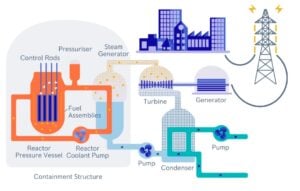
The Rolls-Royce SMR utilizes a three-loop pressurized water reactor (PWR) design, which generates 1,358 MW of heat. This type of reactor is already used in hundreds of nuclear plants around the world and is known for being safe and reliable.

The company has improved the design by adding advanced safety systems and using a modular build approach, which makes construction faster and more affordable.

  • Each SMR will generate 470 megawatts of clean electricity, which is enough to power one million homes.
  • The plant has a 60-year lifespan and will operate with an availability rate of over 92%, making it a highly efficient and dependable energy solution.

Here’s the layout design of the SMR

Rolls-Royce SMR
Source: Rolls-Royce SMR

Smarter Design, Safer Operations

One of the major advantages of the Rolls-Royce SMR is its modular construction approach. Instead of building the entire plant on-site, major components are manufactured in controlled factory environments using advanced manufacturing techniques.

  • It includes multiple safety systems and redundancy layers to ensure the reactor can shut down safely even without human intervention for up to three days.
  • The facility can also withstand ground movements and external threats.

One of the key innovations is the boron-free primary circuit, which eliminates the use of toxic and corrosive boric acid. This improves environmental safety and drastically cuts plant water usage.

These modules are then transported to the plant location for final assembly. By simplifying construction, Rolls-Royce addresses challenges that have delayed large-scale nuclear projects in the past.

Supporting Global Net Zero Goals

Rolls-Royce SMRs are tailored to support global efforts to decarbonize power generation, replace coal plants, and enable clean industrial heating and green hydrogen production.

Their compact size, lower cost, and flexible siting make them ideal for a wide range of energy applications, ranging from on-grid electricity to off-grid industrial use.

By providing long-term, stable energy, the Rolls-Royce SMR offers a reliable pathway to net zero. This is how it helps countries meet their climate targets while ensuring energy security.

ČEZ Group: Powering Czechia’s Low-Carbon Future

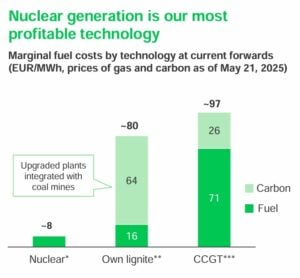
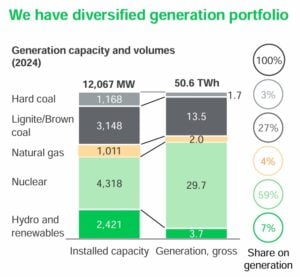
ČEZ, one of the largest energy companies in Central and Eastern Europe, is leading Czechia’s transition to clean power. The company operates six nuclear reactors at its Dukovany and Temelín sites. They will supply around 36% of the nation’s electricity from emission-free sources.

Nuclear energy
Source: ČEZ

Temelín, located 24 km from České Budějovice, is the largest power station in the country. It houses two VVER 1000 reactors, which produce over 15 terawatt-hours (TWh) of clean electricity annually. In 2025, output is expected to increase by 1.9 TWh (6%), driven by reduced outage times in Unit B2.

Looking ahead, ČEZ aims to:

  • Extend the lifespan of its nuclear plants to 60 years
  • Increase annual nuclear output to over 32 TWh
  • Construct a new nuclear unit at Dukovany
  • Deploy over 1,000 MW of SMRs post-2040

“Clean Energy for Tomorrow”

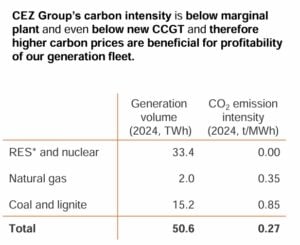
ČEZ’s “Clean Energy for Tomorrow” plan aims for strong sustainability. The company is speeding up its decarbonization timeline. It now commits to climate neutrality by 2040, ten years sooner than planned. Emission intensity has dropped by 20% since 2020.

Its “Vision 2030” outlines three core goals:

  1. Transition to a low-emission production portfolio
  2. Deliver best-in-class customer experience with energy-efficient solutions
  3. Operate responsibly under ESG principles

This strategy reflects the European Union’s broader climate ambitions and positions ČEZ as a role model for utility companies across the continent.

ČEZ carbon emissions
Source: ČEZ

Rapid Growth in Renewables and Energy Storage

While nuclear remains central to ČEZ’s clean energy mix, the company is also ramping up investments in renewables and battery storage.

By 2025, ČEZ plans to install 1.5 GW of renewable capacity, scaling up to 6 GW by 2030. The goal includes building at least 300 megawatts of electric (MWe) energy storage capacity by the end of the decade. These steps will provide flexibility to the grid and support increased integration of solar and wind power.

ČEZ clean energy
Source: ČEZ

Additionally, ČEZ has also signed a long-term agreement for Kazakh natural uranium. Over the next seven years, this supply will cover about one-third of the uranium needs for Westinghouse-manufactured fuel assemblies at Temelín.

ČEZ and Rolls-Royce SMR show how countries and companies can work together for cleaner energy. By combining British technology with Czech know-how, they create a reliable power source that benefits both the climate and the economy. And the Temelín SMR project offers faster construction, better safety, and lasting energy security for the EU.

The post Czech Republic Joins SMR Race—Rolls-Royce SMR and ČEZ Deal Signals Nuclear Energy Surge appeared first on Carbon Credits.
Microsoft (MSFT Stock) Partners with INL to Accelerate Nuclear Reactor Permits Using AI

MICOSOFT

Microsoft (NASDAQ: MSFT) and the Idaho National Laboratory (INL) have joined forces to make the nuclear licensing process faster and more efficient using Azure cloud and AI technology.

Backed by funding from the U.S. Department of Energy (DOE) Office of Nuclear Energy, through the National Reactor Innovation Center, this project aims to cut through the red tape that often delays the development of nuclear power.

INL and Microsoft have collaborated earlier as well. In 2023, INL and Idaho State University (ISU) nuclear engineering students developed the world’s first nuclear reactor digital twin — a virtual replica of ISU’s AGN-201 reactor — using Microsoft’s Azure cloud computing platform.

Heidi Kobylski, vice president for Federal Civilian Agencies, Microsoft, said,

“Artificial intelligence technologies can enable a new frontier of innovation and advancement by automating routine processes, accelerating development and freeing scientists and researchers to focus on the real complex challenges affecting our society. We are honored to collaborate with INL to help address the complicated process of nuclear licensing to potentially help speed the approval of nuclear reactors necessary to support our increasing energy demands.”

How Can Microsoft’s Azure AI Simplify INL’s Nuclear Licensing Documents?

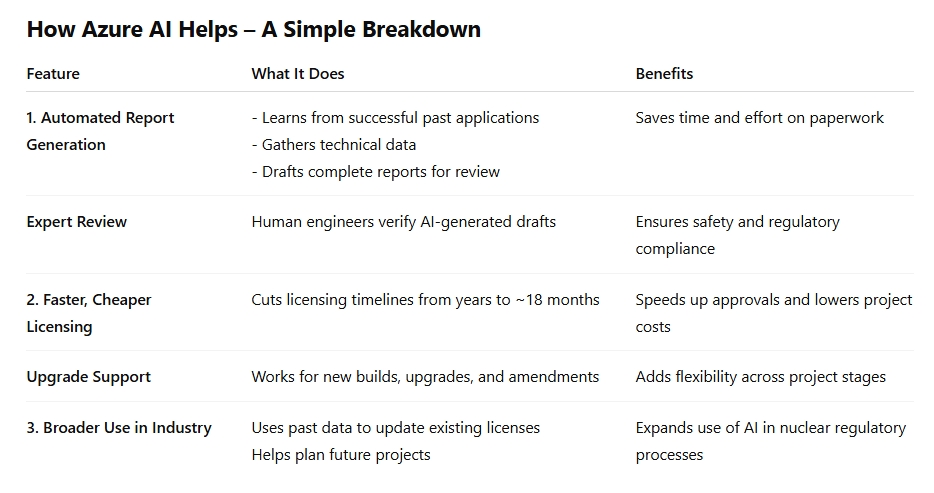
INL is using a Microsoft-developed solution powered by Azure AI to generate engineering and safety analysis reports. These reports are required when applying for construction permits or operating licenses for nuclear power plants.

Normally, assembling these reports takes a lot of time and money. This is because developers have to gather safety data and technical details from various sources, then compile them into massive documents.

However, the Azure AI tool is changing that by significantly speeding up the process. It automatically generates the paperwork required for approvals from the U.S. Nuclear Regulatory Commission (NRC) and the Department of Energy (DOE), saving both time and resources.

Jess Gehin, associate laboratory director for Nuclear Science and Technology at Idaho National Laboratory, highlighted,

“This is a big deal for the nuclear licensing process. Introducing AI technologies will enhance efficiency and accelerate the deployment of advanced nuclear technologies.”

Additionally, Chris Ritter, division director of Scientific Computing and AI at INL, noted,

“AI holds significant potential to accelerate the process to design, license, and deploy new nuclear energy for the nation’s increasing energy needs. INL looks forward to early research to evaluate the applicability of generative AI in the nuclear licensing space.”

Blending AI Speed with Human Oversight

Moving on, this AI solution focuses on assembling the necessary reports using existing engineering and safety information instead of analyzing the data itself. Once the AI creates the draft documents, human experts step in to thoroughly review and verify every detail, ensuring accuracy, completeness, and regulatory compliance.

Moreover, the tool can help with many types of nuclear projects. It supports licensing for new light water reactors, upgrades to current plants, and even advanced reactor designs that use different fuels and cooling systems.

It’s also useful for nuclear test facilities approved by the NRC or DOE. Since advanced reactors often don’t follow standard designs, they need custom paperwork. This makes the AI tool especially helpful for developers trying to handle complex licensing steps quickly and correctly.

microsoft azure

nuclear US

Trump’s Support for Faster Nuclear Approvals

This AI effort aligns with recent U.S. policy shifts. In May, President Donald Trump signed executive orders aimed at accelerating the licensing process for new nuclear power plants. The goal is to shrink what’s typically a multi-year approval cycle down to just 18 months, as demand for electricity, especially from AI data centers, continues to rise.

data centers nuclear
Source: Bloom Energy

According to the Nuclear Energy Institute (NEI), the United States has 94 nuclear reactors that provide power to tens of millions of homes and serve as vital anchors for local communities.

The DOE is also encouraging private companies to submit proposals to build and operate advanced test reactors under the Atomic Energy Act. Their goal is to have at least three advanced reactors operational by July 4, 2026.

Notably, INL has received federal approval under the Defense Production Act, giving it priority access to materials and services to build two key facilities, namely the DOME and LOTUS

These test beds will support microreactors—compact nuclear units that produce 1 to 50 megawatts of reliable, zero-emission energy. They’re ideal for powering military bases, remote sites, and off-grid communities.

How AI Is Revolutionizing Nuclear Energy

As the world moves toward net zero, nuclear energy is gaining renewed focus as a clean, reliable power source. And AI is driving this transformation. Apart from s

Smarter, Safer, and More Efficient

From predictive maintenance to fusion research, it’s making nuclear power smarter, safer, and more efficient.

Notably, the U.S. Department of Energy already uses AI for reactor monitoring and maintenance. Also, fusion projects at MIT, ITER, and private firms use AI to manage complex plasma behavior, predict disruptions, and optimize reactor designs.

Boosting SMR Development

AI speeds up the development of advanced reactors, such as Small Modular Reactors (SMRs), by simulating performance and optimizing fuel efficiency. Companies like NuScale and TerraPower utilize AI to develop safer and more affordable nuclear solutions.

Safer Waste Management

Another important use of AI-powered robots and computer vision is in nuclear decommissioning. They handle hazardous waste and dismantle old plants, keeping humans safe from harm. Facilities like Sellafield in the UK are already benefiting from these innovations.

From this, we can well perceive how AI is proving to be a game-changer in the nuclear sector. From simplifying paperwork to accelerating approvals and cutting costs, tools like Azure AI are helping the U.S. lead the way in nuclear innovation. And INL is tapping on the right technology at the right time.

All in all, this success could make Microsoft a leader in AI for critical infrastructure and open up chances to bring AI to other heavily regulated industries.

The post Microsoft (MSFT Stock) Partners with INL to Accelerate Nuclear Reactor Permits Using AI appeared first on Carbon Credits.

Uber Accelerates Robotaxi Ambitions With Baidu and Lucid Partnerships

uber

Uber is moving toward autonomous mobility with a new strategy. This plan highlights collaboration, scale, and sustainability. Recent partnerships with Baidu, Lucid Motors, and Nuro show Uber wants to lead in the self-driving robotaxi market. They aim to compete against Waymo and Tesla.

According to a report, the global robotaxi market could grow from $0.4 billion in 2023 to $45.7 billion by 2030, at a rate of almost 92%.

robotaxi

Uber and Baidu Launch Global Robotaxi Fleet Outside the U.S. and China

Uber Technologies, Inc. (NYSE: UBER) has partnered with Baidu, Inc. (NASDAQ: BIDU) for a multi-year project. They will deploy Baidu’s Apollo Go autonomous vehicles globally, and this rollout will focus on Asia and the Middle East. The U.S. and China are not included, as demand for affordable ride-hailing services is rising fast in these regions.

Dara Khosrowshahi, CEO of Uber, said,

“This partnership brings together two of the world’s most iconic technology companies to help shape the future of mobility. As the world’s largest platform of its kind, spanning mobility, delivery, and freight, Uber is uniquely positioned to help AV leaders like Baidu bring their autonomous technology to the world.”

Baidu’s self-driving tech powers these robotaxis, which will work with the Uber platform. Riders who request eligible trips might soon get matched with Apollo Go’s driverless vehicles.

Notably, Baidu’s sixth-generation AV costs about 200,000 yuan (around $27,670), and it cuts production costs by 60%, enabling larger fleets.

Furthermore, Apollo Go has completed over 11 million rides worldwide, making it one of the most experienced autonomous fleets. Its strong safety record and operations in 15 cities, including Dubai and Abu Dhabi, make it an appealing partner.

Robin Li, Co-founder, Chairman, and CEO of Baidu, also commented,

“We are committed to bringing the benefit of autonomous driving technology to more people in more markets, and this partnership with Uber represents a major milestone in deploying our technology on a global scale. We look forward to working with Uber to deliver safe and efficient autonomous mobility solutions to riders around the world.”

Uber, Lucid, and Nuro Collaborate to Launch Premium Robotaxis in the U.S.

Uber’s next move is teaming up with Lucid Group (NASDAQ: LCID) and American self-driving technology company, Nuro, to launch a premium robotaxi service exclusively for the Uber ride-hailing platform.

This partnership will feature Lucid’s luxury electric SUV, the Lucid Gravity. It will also utilize Nuro’s Level 4 autonomous driving system, the “Nuro Driver™.”

Marc Winterhoff, Interim CEO at Lucid, highlighted,

“This investment from Uber further validates Lucid’s fully redundant zonal architecture and highly capable platform as ideal for autonomous vehicles, and our industry-leading range and spacious well-appointed interiors, as ideal for ridesharing. This is the start of our path to extend our innovation and technology leadership into this multi-trillion-dollar market.”

Uber plans to deploy over 20,000 of these AVs in six years. These robotaxis will be owned and operated by Uber or fleet partners, available only through the Uber app. Testing is underway at Nuro’s facility in Las Vegas, with full-scale production starting soon.

Lucid’s cars can drive up to 450 miles on a single charge, which means they spend less time charging and more time on the road. Nuro’s technology ensures safety and a smooth ride, even in busy or tricky places. All these features add up to scaling robotaxis.

UBER LUCID ROBOTAXI
Source: Uber

Built for Success: Safe, Efficient, and Ready to Scale

The robotaxi will run on Lucid Gravity’s advanced platform, offering long range, smart controls, and strong electric systems ideal for large-scale use.

  • It’s powered by the Nuro Driver, a Level 4 autonomous system.
  • It uses AI with built-in safety layers, allowing it to adapt quickly to new cities, roles, and vehicle types, speeding up deployment.

Jiajun Zhu, Co-Founder and CEO at Nuro, said,

“We believe this partnership will demonstrate what’s possible when proven AV technology meets real-world scale. Nuro has spent nearly a decade building an AI-first autonomy system that’s safe, scalable, and vehicle-agnostic, proven through five years of driverless deployments across multiple U.S. cities and states. By combining our self-driving technology with Lucid’s advanced vehicle architecture and Uber’s global platform, we’re proud to enable a robotaxi service designed to reach millions of people around the world.”

Lucid will install all the necessary hardware on its assembly line. Then, once the vehicle is ready for Uber, Nuro will add its self-driving software.

Uber has the reach to roll out robotaxis worldwide, with operations in 70 countries and 34 million trips a day,

Uber’s Autonomous Vehicle Strategy Shifts from In-House to Platform-Based

Uber’s approach to self-driving technology has changed significantly. After selling its Advanced Technologies Group (ATG) to Aurora for $400 million in 2020, Uber moved from creating its own AV technology to using solutions from leading companies.

This shift is paying off. Uber now partners with 18 AV companies and supports 1.5 million autonomous trips each year. Through alliances with Waymo, Pony AI, WeRide, and Volkswagen, Uber is becoming the main global platform for self-driving rides.

Waymo robotaxis are already available on Uber’s app in Phoenix and Austin, with plans to expand to Atlanta soon. These partnerships let Uber grow quickly while lowering costs and risks compared to pursuing its own AV solution.

Chinese Robotaxis Go Global with Uber

Uber is crucial in the global expansion of Chinese robotaxi developers. In addition to Baidu, companies like Pony AI, WeRide, and Beijing Momenta have teamed with Uber to offer AV rides outside China.

Momenta plans to deploy autonomous vehicles in European cities starting in 2026. The initial rollouts will include safety operators in the early phases. These efforts are part of a broader push by Chinese AV firms to enter international markets, especially in the Middle East and Europe.

EV Adoption: The Key Pillar of Uber’s Net Zero Strategy 

Uber’s renewed robotaxi push also supports its climate goals. The company aims for all rides in the U.S., Canada, and Europe to be fully electric by 2030, and globally by 2040. With over 34 million trips daily in 70 countries, Uber’s electrification efforts can significantly reduce transportation-related emissions.

It speeds up this shift by helping drivers overcome barriers. High EV costs and limited charging options are key challenges. Partnerships with EV-first companies, such as Lucid, support this mission. They provide longer-range vehicles that cut operating costs and boost ride availability.

UBER EMISSIONS
Data Source: Uber

Uber Stock Slips Despite Robotaxi Push

Despite announcing more robotaxi partnerships, Uber stock dipped slightly to $90.34 on Thursday, its seventh day of losses in a row. The stock has fallen below its 21-day moving average and is getting close to testing its 50-day line.

Still, Uber shares are up nearly 50% so far in 2025, bouncing back from last year’s decline.

UBER STOCK
Source: Yahoo Finance

Meanwhile, Baidu stock (BIDU) rose over 2% following the Uber deal, as investors welcomed the expansion of its autonomous driving business. On the other hand, Lucid stock surged more than 42% with the Uber partnership.

However, analysts remain cautious. Wedbush’s Scott Devitt said the Lucid-Nuro deal shows Uber has a “weak hand” in the driverless tech race, especially against big players like Tesla and Waymo.

Can Uber Succeed in the Robotaxi Race?

Uber’s vision is ambitious, but challenges remain in this highly competitive robotaxi space. Different regions have various regulatory frameworks for robotaxis. Validating AV safety in real-world conditions requires significant resources. Operating costs for autonomous fleets can also be high, especially with new hardware.

It leverages its large platform, global reach, and diverse AV partnerships for an edge. It utilizes technology from partners such as Baidu and Nuro, plus advanced EVs from Lucid. This varied strategy may enable Uber to launch robotaxis more quickly and affordably than rivals that focus on in-house development.

Also, Uber’s move from an AV developer to a global AV platform is a game-changer. It is helping Uber meet a variety of customer needs, including budget-conscious riders in Asia to high-end users in major U.S. cities.

With significant AV deals underway and more planned, Uber is signaling a clear message: the future of urban transportation will be electric, autonomous, and platform-driven, and Uber aims to lead the way.

The post Uber Accelerates Robotaxi Ambitions With Baidu and Lucid Partnerships appeared first on Carbon Credits.