Micron (MU) Powers AI Boom with Record Profits, Green Goals, and U.S. Expansion

micron

Micron Technology, Inc. (Nasdaq: MU), a global leader in innovative memory and storage solutions, exceeded expectations in its fiscal Q3 2025. The semiconductor giant reported revenue of $9.3 billion, up from $8.05 billion last quarter and $6.81 billion a year ago.

With strong customer focus and advanced technology, the company offers high-performance DRAM, NAND, and NOR products under its Micron® and Crucial® brands. Its solutions support AI and data-intensive applications across data centers, mobile devices, and the intelligent edge.

Micron Crushes Q3 2025 with AI-Driven Growth

Sanjay Mehrotra, Chairman, President, and CEO of Micron Technology,

“Micron delivered record revenue in fiscal Q3, driven by all-time-high DRAM revenue including nearly 50% sequential growth in HBM revenue. Data center revenue more than doubled year-over-year and reached a quarterly record, and consumer-oriented end markets had strong sequential growth. We are on track to deliver record revenue with solid profitability and free cash flow in fiscal 2025, while we make disciplined investments to build on our technology leadership and manufacturing excellence to satisfy growing AI-driven memory demand.”

The net income looked like this:

  • GAAP net income reached $1.89 billion, or $1.68 per diluted share.

  • Non-GAAP net income hit $2.18 billion, or $1.91 per share.

Free cash flow stood at $1.95 billion, while operating cash flow soared to $4.61 billion. With these results, Micron is on track for record performance in fiscal 2025.

micron earnings
Source: Micron

Nvidia Rides Micron’s Momentum

Micron’s strong earnings boosted not just its own stock. Nvidia (NASDAQ: NVDA) jumped 4.33% in premarket trading after the announcement, solely due to investor confidence in AI memory demand.

So what’s driving this change? According to media reports, it’s the high demand for High Bandwidth Memory (HBM), essential for Nvidia’s H100 and Blackwell chips. Micron reported a 50% sequential increase in HBM sales, and data center revenue doubled year-over-year.

This trend shows a growing need for GPU-accelerated computing. With global AI infrastructure expanding, Nvidia stands to gain from Micron’s growth.

Expanding America’s Chip Powerhouse

Micron is heavily investing in U.S. manufacturing and R&D. The company plans to invest up to $200 billion in Idaho, New York, and Virginia. This includes:

  • Two high-volume fabs in Idaho.

  • Up to four advanced fabs in New York.

  • Expansion of its Virginia site.

  • Advanced HBM packaging and research facilities.

It aims to produce 40% of its DRAM in the U.S., supporting federal efforts to strengthen domestic chip production and secure supply chains.

Emissions Reduction Strategy

Micron is also focused on sustainability. The company aims for net-zero Scope 1 and Scope 2 emissions by 2050 and targets a 42% reduction by 2030, based on 2020 levels.

micron emissions
Source: Micron

To support these goals, Micron issued a $1 billion green bond in 2021. This funding is allocated to energy-efficient projects and LEED Gold-certified buildings, following its green bond framework.

  • Reduced greenhouse gas intensity by 56% per unit of production since 2018, marking progress toward its climate goals.
  • It targets emissions from production by using smart tools, low-impact fluids, and cleaner chemicals. These steps deliver real-time results and boost efficiency.

Cleaner Operations Around the Globe

Micron’s facilities are quickly adopting renewable electricity:

  • 100% renewable electricity achieved in mainland China (Q4 2023).

  • On track for 100% renewable electricity in U.S. operations by the end of 2025.

Its new site in Xi’an, China, cut CO₂ emissions by 42%, reduced electricity use by 10%, and achieved a 98% waste recovery rate.

MIRCON
Source: Micron

Power-Efficient Products for an AI-Driven Future

The company launched HBM3E memory, which uses 30% less power than competitors, crucial for AI servers. New low-power memory solutions were also introduced for mobile and edge devices, highlighting a focus on energy-efficient innovation.

As AI workloads increase in power needs, Micron’s low-power solutions offer great value to data centers and tech firms aiming to cut their carbon footprint.

Bright Forecast Q4 2025: Why Investors Should Watch Micron Stock (MU) Closely?

Micron is emerging as a key player in the AI hardware ecosystem. Its strong earnings, positive outlook, and green commitments present a strong case for long-term investors.

It expects revenue to rise to $10.7 billion in Q4 2025, surpassing analyst estimates. The company also predicts a strong 42% gross margin, showing solid pricing and demand.

As Nvidia’s growth closely ties to HBM supply and Micron ramps up to meet demand, MU stock looks increasingly appealing for those bullish on AI infrastructure.

Additionally, the company’s emission targets, green financing, and energy-efficient products create a double win: strong performance and eco-friendly growth. As it prepares to increase U.S. production and power its fabs with clean energy, investors can see that Micron is not just riding the AI wave; it’s building the infrastructure to support it.

The post Micron (MU) Powers AI Boom with Record Profits, Green Goals, and U.S. Expansion appeared first on Carbon Credits.

Google Backs Fusion Energy: Signs 200MW Offtake Agreement with Commonwealth Fusion Systems

Google has signed a major power purchase agreement (PPA) for 200 megawatts (MW) of clean fusion power from Commonwealth Fusion Systems’ (CFS) first commercial fusion power plant, ARC. This plant, located in Chesterfield County, Virginia, is set to provide carbon-free power to the grid by the early 2030s.

The tech giant also has the option to buy electricity from more ARC plants in the future. As an investor in CFS since 2021, Google is increasing its stake in the fusion company. While financial terms are undisclosed, this agreement is a big step forward for fusion power and shows Google’s commitment to clean energy innovation.

Michael Terrell, Head of Advanced Energy at Google, said,

“By entering into this agreement with CFS, we hope to help prove out and scale a promising pathway toward commercial fusion power. We’re excited to make this longer-term bet on a technology with transformative potential to meet the world’s future energy demand, and support CFS in their efforts to reach the scientific and engineering milestones needed to get there.”

What Is Fusion, and Why Does It Matter?

Fusion energy combines two light atoms, like hydrogen, into a heavier one, releasing a lot of energy. This is the same reaction that powers the sun.

The IAEA states that fusion could produce four times more energy per kilogram than nuclear fission, which current nuclear power plants use. It can generate millions of times more energy than fossil fuels. Best of all, it’s clean and carbon-free.

Commonwealth Fusion Systems: The Company Behind the Breakthrough

CFS spun out of MIT’s Plasma Science and Fusion Center in 2018. Based in Massachusetts, the fusion giant is working on compact, efficient fusion technology to make fusion power practical and scalable. The company combines breakthrough science with rapid engineering. Using high-temperature superconducting (HTS) magnets and proven tokamak designs, the company aims to bring fusion to the grid quickly and affordably.

Notably, with over $2 billion in support from private and public investors, Commonwealth Fusion Systems leads the way toward a zero-carbon energy future.

Bob Mumgaard, CEO and Co-founder of CFS, said,

“Fusion power is within our grasp thanks in part to forward-thinking partners like Google, a recognized technology pioneer across industries. Our strategic deal with Google is the first of many as we move to demonstrate fusion energy from SPARC and then bring our first power plant online. We aim to demonstrate fusion’s ability to provide reliable, abundant, clean energy at the scale needed to unlock economic growth and improve modern living – and enable what will be the largest market transition in history.”

SPARC to ARC: How the Fusion Journey Begins

The Google-CFS deal connects to SPARC, a compact fusion machine being built at CFS’s campus in Devens, Massachusetts. SPARC uses a tokamak design, a donut-shaped device that holds super-hot plasma with powerful magnetic fields.

With high-temperature superconducting (HTS) magnets, SPARC will be smaller and more efficient than earlier fusion models. Its goal? Achieve net energy gain (Q>1), where it produces more energy than it uses. Once that’s achieved, the technology will power ARC, the world’s first grid-scale fusion power plant.

SPARC
Source: CFS

ARC: Compact, Clean, and Ready for the Grid

ARC aims to generate 400 MW of firm, carbon-free power, similar to a natural gas plant. It can fit easily into existing power grids, providing clean, reliable electricity.

ARC FUSION
Source: CFS

Here’s what makes ARC unique: 

  • Zero carbon emissions

  • Small land footprint — the size of a big-box store

  • Safe design — no risk of meltdown or long-lived radioactive waste

  • Rapid ramp-up/down — supports both baseload and flexible power needs

  • Abundant fuel — uses deuterium from seawater and self-produces tritium

  • Minimal fuel needs — one truck can hold 30 years’ worth of fuel

ARC not only competes with fossil fuels but also surpasses them in cost, location flexibility, and safety. It complements renewables like solar and wind by providing steady backup power.

Job Creation and Local Impact

The Chesterfield County project will create hundreds of jobs during construction and operation. The site near Richmond, Virginia, was chosen for its growing energy needs and strong local infrastructure.

Meeting AI and Electrification Demands

As AI and data centers increase electricity use, traditional energy sources struggle to keep up. Fusion could provide clean, reliable power that meets global demand without harming the planet.

Fusion also avoids the resource bottlenecks of fossil fuels and uranium systems. Since hydrogen is widely available, fusion fuel will remain cheap and stable, unlike natural gas prices, which can fluctuate wildly.

A Climate Moonshot: Why Google Is All In

Google’s partnership with CFS is part of its climate mission. In 2024, Google added 2.5 gigawatts of new clean energy across multiple data center regions. The company also signed deals for advanced geothermal and small modular nuclear reactors (SMRs) and uses AI to optimize grid integration.

With this new fusion deal, Google is betting on the next generation of carbon-free energy. The tech giant understands that securing clean, reliable power is essential for future-proofing its data centers and services.

GOOGLE data center energy emissions
Source: Google

For instance, last year Google signed the first corporate deal to buy power from Kairos Power’s small modular reactors (SMRs), aiming to add up to 500 MW of clean energy to U.S. grids by 2035. The first reactor is expected to be operational by 2030.

Fusion Industry’s Momentum Is Growing

The global fusion race is heating up. The Global Fusion Industry Report shows that over 45 companies have entered the field, raising more than $7 billion in funding. Public-private partnerships are vital, and government support has recently increased by more than 50%.

CFS is leading this charge with real progress. It’s creating a blueprint for a clean energy future. Fusion power from ARC promises low-cost, high-impact solutions for nations, industries, and communities everywhere.

fusion
Source: 2024 Global Fusion Industry Report

By backing this technology early, Google is securing a clean, stable energy supply for its growing needs. It shows that fusion is no longer science fiction; it’s becoming a commercial reality.

The post Google Backs Fusion Energy: Signs 200MW Offtake Agreement with Commonwealth Fusion Systems appeared first on Carbon Credits.

Meta Powers U.S. Data Centers with Nearly 800 MW of Clean Energy Deal with Invenergy

Meta Powers U.S. Data Centers with Nearly 800 MW of Clean Energy Deal with Invenergy

Meta Platforms—the parent company of Facebook, Instagram, and WhatsApp—signed a major deal to secure 791 megawatts (MW) of renewable energy from Invenergy. This brings Meta’s total clean energy procurement from Invenergy to 1,800 MW, supporting the company’s net-zero goals and expanding data center and AI operations.

The new agreement includes four projects:

  • 300 MW Yellow Wood Solar (Ohio)
  • 140 MW Pleasant Prairie Solar (Ohio)
  • 155 MW Decoy Solar (Arkansas)
  • 196 MW Seaway Wind (Texas)

All projects are scheduled to go live between 2027 and 2028. While the electricity flows into the local grid, Meta receives clean energy credits to meet its sustainability goals.

From Likes to Zero: Meta’s Climate Mission Takes Shape

Meta’s new renewable energy deal—nearly 800 megawatts (MW) of wind and solar power from Invenergy—is more than just a clean energy purchase. It’s part of the company’s larger plan to reach net-zero emissions across its entire value chain by 2030.

Meta first achieved 100% renewable energy for its global operations in 2020, powering all of its data centers and offices with clean electricity. Since then, it has continued to expand its renewable energy portfolio, which now totals nearly 10 gigawatts (GW) globally.

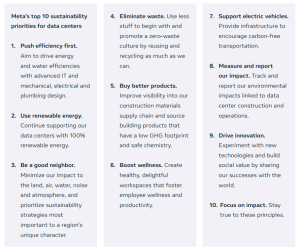
Meta sustainability priorities for data centers
Source: Meta

The new Invenergy agreement helps Meta maintain this progress as it builds more data centers to support AI, the metaverse, and other digital services. Invernergy is America’s largest privately held developer, owner, and operator of clean energy solutions.

Meta’s Head of Global Energy, Urvi Parekh, stated:

“We’re laser-focused on advancing our AI ambitions—and to do that, we need clean, reliable energy. We’re grateful for Invenergy’s longtime partnership that helps us support our energy needs and implement our clean energy goals, and look forward to continued collaboration.”

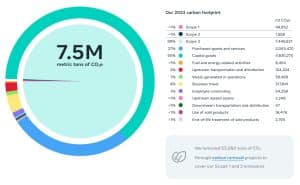
These clean energy investments also support Meta’s work to reduce Scope 3 emissions—those linked to suppliers, hardware production, and transportation. By partnering with clean energy developers and encouraging sustainable practices across its supply chain, Meta is helping to cut emissions beyond its direct operations.

meta GHG emissions 2023
Source: Meta

Meta is also improving energy efficiency at its data centers through advanced cooling systems, automation, and AI-powered power management. In 2023, over 80% of Meta’s suppliers had set or committed to science-based climate targets, further aligning with the company’s net-zero strategy.

In addition to reducing emissions, Meta is investing in long-term carbon removal solutions, such as reforestation and direct air capture. These efforts aim to balance out any remaining emissions the company can’t eliminate.

The latest renewable energy deal shows how Meta is linking its clean energy procurement directly to its climate goals—making sure that the growing demand for digital infrastructure doesn’t come at the cost of the environment.

Why Clean Energy Matters for Meta’s Data Centers

Data centers are the backbone of the internet, housing vast amounts of data and requiring constant power to run servers and cooling systems. According to the International Energy Agency, data centers currently use around 1–1.5% of the world’s total electricity. This number is set to rise sharply because of AI, video streaming, and cloud computing.

To prevent rising emissions alongside increasing demand, Meta is building new data centers powered entirely by clean energy. These facilities aim for energy efficiency. They are also located close to renewable energy sources.

data center electricity demand due AI 2030
Source: IEA

U.S. data centers used about 239 terawatt-hours (TWh) of electricity in 2024. That’s nearly as much as Florida uses in a year. A lot of this power still comes from fossil fuels.

Meta reached its 100% renewable energy target for operations in 2020. It plans to add 9.8 gigawatts (GW) of renewables to U.S. grids by the end of 2025. However, growing data infrastructure demands make continued large-scale clean energy deals essential.

Strategic Benefits of the Invenergy Partnership

Partnering with Invenergy, the leading private clean energy developer in the U.S., nearly doubles Meta’s capacity. It jumps from 1,000 MW to 1,800 MW. This expansion brings several benefits:

  • Renewable energy credits to help Meta stay on track with its net-zero targets

  • Access to grid-based electricity that supports regional power systems

  • Contribution to U.S. clean energy development and energy security

The projects boost economic activity in Ohio, Arkansas, and Texas. Here, solar and wind installations create local jobs and improve power reliability.

Big Tech’s Clean Energy Arms Race

Meta’s move is part of a broader trend in the tech industry. As AI drives up electricity needs, major firms are racing to secure clean power. Amazon, Microsoft, Google, and Meta boosted their clean energy contracts more significantly compared to the previous year.

According to the Clean Energy Buyers Association (CEBA), companies purchased a record-breaking 21.7 gigawatts of clean energy in 2024 alone—the highest annual total to date. With this surge, corporate-driven clean energy capacity in the U.S. has now reached 100 gigawatts since 2014.

CEBA deal tracker
Source: CEBA

Regional power grids are feeling the strain. Some utilities are pushing back on renewable projects to focus on fossil fuel plants. This raises worries about air pollution and environmental justice. To offset this, companies are using mechanisms like power purchase agreements (PPAs) and environmental attributes purchase agreements (EAPAs).

Meta often uses EAPAs. They buy renewable energy credits instead of electricity. This approach helps fund new clean power projects without directly using the energy source.

Meta is exploring nuclear energy. They are also looking into on-site renewables and sustainable infrastructure. This is important in places where grid expansion can’t keep up with data center growth.

Charging Ahead: Meta Plots a Cleaner, Smarter Grid Game

Meta plans to continue investing in clean energy to match the electricity needs of its expanding data center footprint. This latest deal reflects a commitment to powering large-scale infrastructure sustainably. Such agreements can boost local clean energy markets and create industry standards for responsible growth.

As technologies like AI, virtual reality, and cloud services evolve, energy demand will keep rising. Meta aims to meet this demand without growing its carbon footprint. The company is also investing in storage technologies and energy-efficient systems to maximize the impact of its clean energy use.

By securing long-term renewable energy partnerships, the tech giant supports both innovation and climate progress.

The post Meta Powers U.S. Data Centers with Nearly 800 MW of Clean Energy Deal with Invenergy appeared first on Carbon Credits.