Alibaba Stock Climbs as Earnings Beat and Net-Zero Goals Win Over Investors

Alibaba Stock Climbs as Earnings Beat and Net-Zero Goals Win Over Investors

Alibaba Group Holding Ltd. has seen its stock price strengthen, boosted by stronger-than-expected earnings and renewed investor confidence in its long-term strategy. The company’s environmental, social, and governance (ESG) efforts are also attracting investors. Its focus on net-zero emissions adds to its appeal. Investors now consider sustainability as important as profitability.

Let’s examine the Chinese tech giant’s recent stock and what causes it, and the company’s progress in its net-zero pledge.

Earnings Power: Alibaba Surprises Markets With Strong Q2 Growth

For the quarter ended June 30, 2025, Alibaba reported revenue of RMB 247.65 billion (US $34.57 billion), up 2% year-over-year, or +10% on a like-for-like basis excluding divested units.

Net income attributable to ordinary shareholders soared 76% to RMB 43.12 billion (US $6.02 billion). It is boosted by investment gains and the divestiture of its Trendyol business. Non-GAAP net income, which excludes one-off items, fell 18% to RMB 33.51 billion (US $4.68 billion).

Adjusted earnings, for underlying business performance, declined 14% to RMB 38.84 billion (US $5.42 billion). Meanwhile, income from operations dropped 3% to RMB 34.99 billion (US $4.88 billion). Operating margin slipped slightly from 15% to 14%.
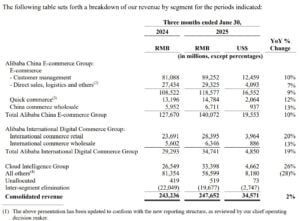
Alibaba q2 financial results
Source: Alibaba

Cloud and Consumption Drive Growth

Two segments stood out. Cloud Intelligence Group revenue grew 26% YoY to RMB 33.40 billion (US $4.66 billion), with adjusted earnings rising 26% to RMB 2.95 billion (US $412 million). For the eighth consecutive quarter, AI-related product revenue saw triple-digit growth.

Alibaba China Commerce Group—which bundles Taobao, Tmall, Cainiao logistics, and Instant Commerce—posted a 10% YoY revenue gain (~RMB 140.07 billion / US $19.55 billion). This is driven by a 12% rise in quick-commerce revenue to RMB 14.78 billion (US $2.06 billion) and a 10% increase in customer management fees. Its adjusted earnings decreased 21%, reflecting investment in Instant Commerce and technology.

International commerce (AIDC) grew 19% to RMB 34.74 billion (US $4.85 billion), and losses narrowed significantly from RMB 3.71 billion to just RMB 59 million.

AI Chip Strategy

To strengthen its competitive edge in AI, Alibaba has doubled down on its in-house chip design unit, T-Head. The company recently launched its new AI inference chips. These chips aim to boost performance for big language models and cloud AI tasks. These chips help cut reliance on foreign semiconductors. They also boost energy efficiency in Alibaba Cloud’s data centers.

Alibaba is combining custom AI chips with its cloud services. This move makes it a leader in technology and sustainability. More efficient chips can reduce power use in data-heavy tasks.

Market Response and Investor Sentiment

The earnings beat translated into stronger market sentiment. Alibaba’s stock, traded on the Hong Kong Stock Exchange (9988) and the New York Stock Exchange (BABA), jumped nearly 8% in August 2025. This rise outperformed many other Chinese tech companies.
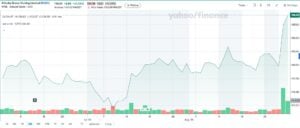
Alibaba stock

The company’s market cap is now over US$190 billion. This increase shows that investors are more confident now. This comes after they faced regulatory pressure and slower growth in China’s e-commerce sector.

Analysts say Alibaba’s diversification in international e-commerce, logistics, and cloud computing helps it handle economic uncertainty. Its global platforms, like Lazada and AliExpress, saw double-digit order growth. This shows their strength beyond the home market.

From E-Commerce Giant to Green Pioneer: Alibaba’s Net-Zero Drive

Alibaba has also leaned heavily into sustainability. It has set ambitious climate goals that align with China’s 2060 carbon neutrality pledge. In 2021, the company committed to achieving carbon neutrality by 2030 for its own operations (Scope 1 and 2 emissions).
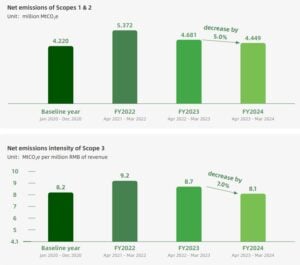
Alibaba carbon emissions scope 1, 2, 3
Source: Alibaba 2024 ESG Report

More notably, it promised to cut Scope 3 emissions, which make up most of its footprint, by 1.5 gigatons of CO2e by 2035. This goal applies to its merchants, customers, and partners.

The company has already reported progress. In 2024, Alibaba cut its operational emissions by 12% compared to the previous year. This was helped by using more renewable energy. More than 50% of its data center energy is now sourced from renewable power, including wind and solar.
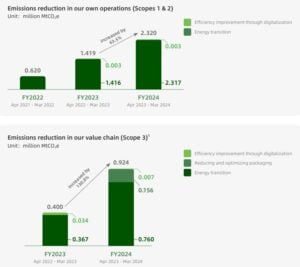
Alibaba emissions reduction 2024
Source: Alibaba 2024 ESG Report

Key sustainability initiatives include:

  • Green Cloud Infrastructure:

    Alibaba Cloud has launched energy-efficient data centers. Some of these facilities have a PUE (power usage effectiveness) ratio as low as 1.09. This is one of the lowest in the industry. This enables 9.88 Mt CO₂e emission reductions for customers.

  • Circular Economy Projects:

    Through its logistics arm, Cainiao, the company recycled 1.5 billion packaging materials in 2024, cutting emissions and reducing plastic waste. Taobao/Tmall greening tools helped consumers cut over 10 Mt CO₂e.

  • Sustainable Finance:

    In 2023, Alibaba issued US$1 billion in sustainability-linked bonds. These bonds are linked to the company’s goals for renewable energy use and cutting emissions.

Concrete Climate Action: Alibaba’s Green Projects in Motion

Alibaba has made visible progress in aligning business operations with ESG priorities. The company has cut its emissions intensity in recent years. This change comes from using more renewable energy and low-carbon technologies.

Alibaba Cloud uses advanced cooling systems and clean energy to cut energy use in its big data centers. Cainiao is testing smart warehouses at its logistics hubs. These warehouses use renewable energy systems. This helps cut costs and lower emissions.

The company also introduced “green shopping” options on Taobao and Tmall, nudging consumers toward more sustainable products. This reflects an effort to influence consumer behavior as much as internal operations.

Alibaba is boosting transparency in ESG reporting. This is becoming more important for international investors. Sustainability reports now include detailed carbon accounting, energy usage, and progress toward milestones.

Roadblocks Ahead: Tackling Scope 3 and Renewable Gaps

While the company’s climate commitments are ambitious, execution remains complex. Scope 3 emissions—largely tied to suppliers, logistics, and consumer use—account for over 95% of Alibaba’s total carbon footprint. Coordinating across such a vast ecosystem is a significant challenge.
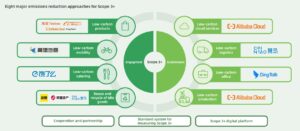
Eight major emissions reduction approaches for Scope 3+ Alibaba
Source: Alibaba 2024 ESG Report

Moreover, China’s slower rollout of renewable energy in certain regions poses risks for meeting 2030 neutrality targets. Industry watchers say the company must speed up investment in green projects at home and abroad to stay on course.

Why Investors Care About Alibaba’s ESG

Alibaba’s financial performance is a major attraction for investors. However, ESG factors are becoming more important, too. Global institutional investors, especially in Europe and North America, are adding sustainability to their portfolio choices.

There are several reasons why investors are paying attention:

  • Resilience: Companies with clear sustainability roadmaps are seen as better prepared for regulatory shifts and market transitions.

  • Market Demand: Consumer preference for greener products aligns with Alibaba’s efforts to feature sustainable goods.

  • Global Standards: Compliance with ESG reporting makes Alibaba more accessible to foreign funds that prioritize sustainability metrics.

Outlook: Blending Growth and Sustainability

Looking ahead, Alibaba’s dual narrative of financial resilience and ESG progress could be a decisive factor for investors. Analysts expect the company’s revenue to grow by 7–8% each year until 2026. This growth will be driven by e-commerce recovery, cloud expansion, and international efforts.

Alibaba’s stock gains reflect more than a short-term earnings rebound. They underscore the company’s broader evolution into a diversified, disciplined, and sustainability-driven enterprise.

The company is showing strong financial results. It focuses on efficiency and is making real progress toward net-zero. This positions the company as a tech leader and a responsible corporate actor in a changing low-carbon economy.

The post Alibaba Stock Climbs as Earnings Beat and Net-Zero Goals Win Over Investors appeared first on Carbon Credits.
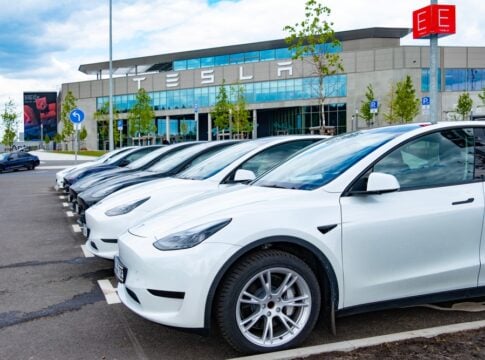
Tesla’s Europe Sales Crash 40% in July as BYD Surges Ahead Again!

tesla

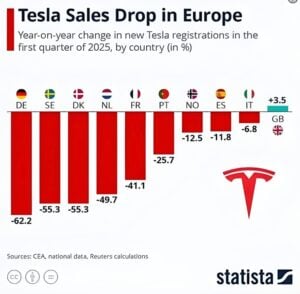
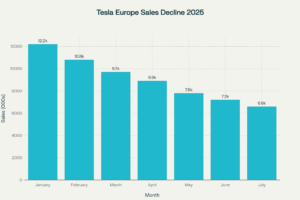
Tesla’s struggles in Europe hit a new low in July 2025, with sales collapsing by 40% year-on-year. According to data from the European Automobile Manufacturers’ Association (ACEA), Tesla (TSLA) registered just 8,837 vehicles across the EU, UK, and EFTA. That marked Tesla’s seventh consecutive month of decline, even as the broader electric vehicle (EV) market expanded.

In stark contrast, Chinese rival BYD posted a 225% surge in registrations, hitting 13,503 units and overtaking Tesla in monthly sales for the first time on European soil. The result highlights how quickly the competitive balance is shifting in one of the world’s most important EV markets.

BYD Edges Out Tesla With Cheaper EVs in Europe

The July numbers were historic. Tesla, once seen as the face of Europe’s EV transition, slid to a mere 0.7% market share, while BYD (BYDDY) climbed to 1.1%. One major issue is Tesla’s aging lineup. The Model 3 and Model Y, once revolutionary, now feel stale compared to fresh, feature-packed EVs from competitors.

Notably, BYD has been expanding its European presence with new showrooms, competitive pricing, and hybrid options that cater to cost-conscious buyers. Its strong growth also reflects Europe’s appetite for affordable EVs, an area where Tesla has yet to deliver fully.

Tesla’s cost cuts don’t match the low prices from BYD and other Chinese EV makers. These rivals have better supply chains, allowing them to sell cheaper cars without damaging their profits as much.

For Tesla, the decline underscores a widening gap between brand prestige and consumer demand. While Musk’s company still dominates in the U.S., Europe has become a tougher battleground.

Tesla Europe Sales, Jan-July 2025
tesla EV sales
Source: Tesla Europe Sales, Jan-July 2025 (Data: European Automobile Manufacturers’ Association; sources: PBS, Yahoo Finance, JATO Dynamics).

Country-Level Trends Show Tesla’s Weakness

Tesla’s slump is evident across major European markets:

  • Germany – Europe’s largest EV market saw rising BEV demand, but Tesla’s share shrank as Volkswagen and BMW expanded their electric lineups.

  • France – National registrations of hybrids and EVs grew, yet Tesla’s numbers fell, reflecting reputational challenges and stronger competition from Renault.

  • Nordic countries (Sweden, Denmark, Norway) – Once core Tesla strongholds, these markets saw double-digit declines as consumers pivoted to newer, more affordable alternatives.

  • Spain and Italy – Plug-in hybrid sales surged in both countries, but Tesla’s BEV registrations didn’t benefit, further highlighting the brand’s challenges.

In each case, Tesla is losing ground not just to BYD but also to legacy automakers that have quickly adjusted to consumer preferences.

Tesla Europe EV

Rivals Gain While Tesla Slips

Tesla’s July decline wasn’t shared by the rest of the market. In fact, overall battery-electric vehicle sales rose 33.6% year-on-year across Europe. Several automakers gained momentum:

  • Volkswagen Group: Sales up 11.6%, with strong demand for its ID. series.

  • BMW: Up 11.6%, boosted by the Mini brand’s 41% jump in registrations.

  • Renault: Continued to grow its EV base, capitalizing on the mid-range market Tesla has largely ignored.

Meanwhile, Stellantis, Hyundai, Toyota, and Suzuki joined Tesla on the losing side, posting year-over-year declines. The divergence shows that while the EV market is still expanding, success depends on fresh offerings and competitive positioning.

In the case of Tesla, it seems to have missed shifting demand trends. European drivers are gravitating toward hybrids and smaller, affordable EVs, while Tesla continues to lean heavily on its premium lineup. This mismatch means Tesla is shrinking while the overall EV market keeps expanding.

The end result: Europe’s EV race is heating up, but Tesla is no longer leading the charge.

TSLA Stock Under Pressure

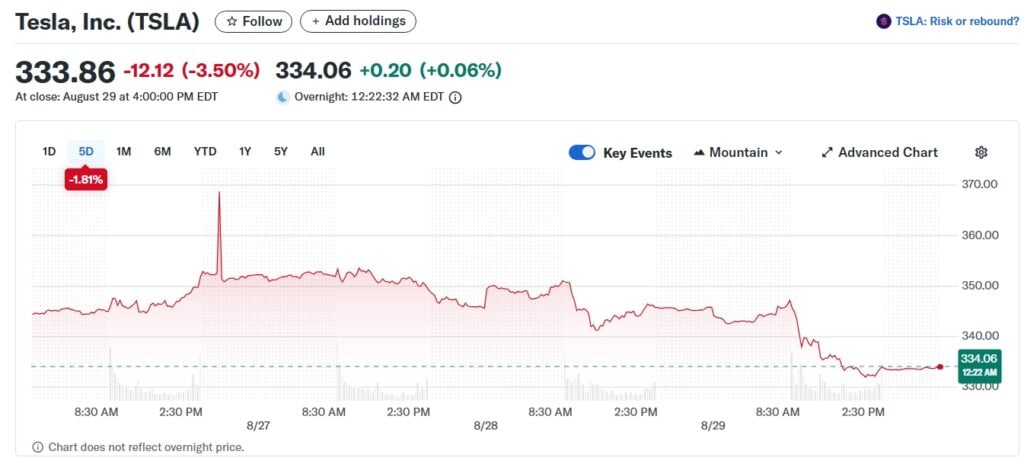
Tesla shares fell 3.5% after a 40% drop in July European EV registrations. The decline underscored tough competition and weakening demand in a critical market.

Analysts see the stock caught in a tight range, with resistance near $350 and support around $330. A breakout higher would need stronger delivery results or product news, while continued sales weakness could drive further losses.

tesla tsla stock
Source: Yahoo Finance

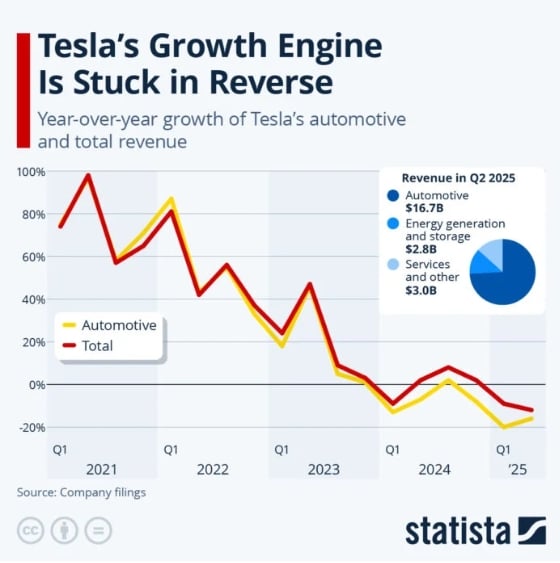
In this context, in Q2 2025, the company reported:

  • Revenue: $22.5 billion, down 12% year-on-year.

  • Net income: $1.17 billion, down 16%, pressured by price cuts and weaker deliveries.

  • Deliveries: 384,122 vehicles, a 14% drop from Q2 2024.

The earnings miss highlighted Tesla’s vulnerability to slowing sales in both Europe and China, where demand also slipped. Even the long-awaited Cybertruck has not met expectations.

tesla

Tesla’s next big drivers could be delivery numbers, regulatory changes, and progress in AI and Full Self-Driving (FSD). These will determine whether TSLA stock moves higher or stays flat.

Right now, analysts see resistance around $348–$350 and support near $330. Market sentiment is divided, with some optimistic about growth while others remain skeptical.

Can Tesla Win Back Europe’s Trust?

Musk has promised a new low-cost EV that could enter volume production in late 2025. If delivered on time, the model could help Tesla regain relevance in Europe’s highly competitive entry-level segment.

However, skepticism remains high. Production delays have plagued Tesla in the past, and with BYD, Volkswagen, and Renault already entrenched in the affordable EV space, Tesla’s late entry may not be enough to reverse its slide.

Furthermore, the brand’s reputation has also taken a hit. Elon Musk’s strong political views had upset many Europeans. Protests, boycotts, and negative headlines have weakened Tesla’s loyal fan base across the continent.

Europe’s EV market is booming, but it’s now evident that Tesla is losing ground. Notably. July drop was its seventh straight monthly decline, pointing to deeper problems with pricing, products, and perception.

To recover, Musk’s EVs need more than AI promises—they must deliver new models, competitive prices, and most importantly, rebuild consumer trust. For now, Europe shows that even an EV pioneer like Tesla can lose momentum.

The post Tesla’s Europe Sales Crash 40% in July as BYD Surges Ahead Again! appeared first on Carbon Credits.

Amazon, X-energy, KHNP, and Doosan Partner on $50B Nuclear Push for AI Data Centers

NUCLEAR

Amazon is making its boldest move yet into nuclear energy. The tech giant has teamed up with X-energy Reactor Company, Korea Hydro & Nuclear Power Corporation (KHNP), and Doosan Enerbility in a partnership aimed at deploying Xe-100 small modular reactors (SMRs) and TRISO-X fuel across the United States.

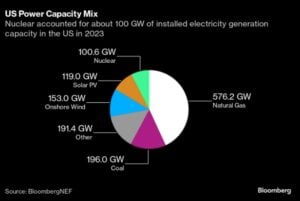
The alliance comes at a pivotal moment. Data centers, driven by artificial intelligence (AI), cloud computing, and the digital economy, are pushing energy demand to record highs. Traditional renewables like wind and solar, while critical, can’t always meet the 24/7 power needs of hyperscale computing. Nuclear, with its steady carbon-free output, is emerging as the missing piece.

Aligned with the recent $350 billion U.S.–Korea trade deal, the collaboration spans reactor engineering, supply chain development, construction planning, long-term operations, and global AI-nuclear deployment opportunities. Together, the partners aim to mobilize up to $50 billion in public and private investment to accelerate advanced nuclear adoption in America.

X-energy’s SMRs: Compact Power for a Digital World

X-energy CEO J. Clay Sell, commented on this partnership,

“This partnership brings together proven nuclear leadership and experience from Korean industry and X-energy’s advanced reactor and fuel technology to meet a historic energy challenge. By combining our expertise, we are ensuring that we are best positioned to accelerate the Xe-100 SMR into the marketplace with the unique knowledge and skills developed throughout the South Korea industrial supply chain. Collaboration between the United States and South Korea in this critical sector is vital to preserving American leadership in the AI race and surpassing China as the leader in nuclear development.”

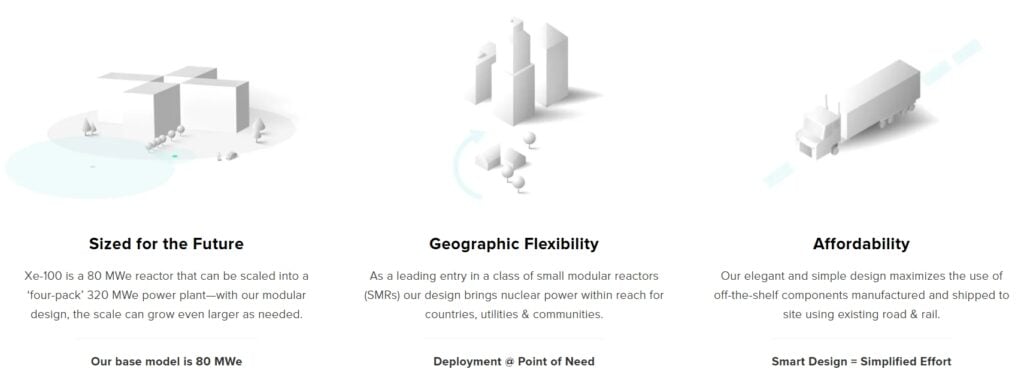
X-energy’s Xe-100, a fourth-generation SMR designed to be modular, cost-effective, and intrinsically safe, is the core of the deal. Unlike traditional reactors, which can take more than a decade to build, the Xe-100’s simplified design shortens construction timelines and reduces upfront capital costs.

Watch the video: 

Key advantages of the Xe-100 include:

  • Scalability – Modular design allows deployment in stages to match demand growth.
  • Enhanced safety – Built with TRISO-X fuel, considered one of the most robust nuclear fuels ever developed.
  • Industrial versatility – Can serve high-demand industries like chemicals, steel, and data centers.

By targeting 960 MW of clean energy capacity to the U.S. grid by 2039, X-energy and its partners are aiming for what would be the largest SMR deployment in the industry to date.

Small Modular Nuclear Reactor: Xe-100

XEnergy nuclear
Source: XEnergy

Amazon’s Clean Energy Ambitions

For Amazon, nuclear energy is part of a larger strategy to meet its net-zero carbon target by 2040, set through The Climate Pledge, which the company co-founded in 2019. The e-commerce and cloud giant is investing heavily in decarbonizing its global operations through four main levers:

  1. Driving efficiency – Optimizing transportation routing, improving packaging, and boosting chip efficiency in data centers.
  2. Deploying low-carbon alternatives – Using lower-carbon concrete and steel, recycled plastics, and greener fuels.
  3. Investing in carbon-free electricity – Expanding its portfolio of wind, solar, battery storage, and now nuclear projects.
  4. Scaling sustainable supply chains – Embedding decarbonization across procurement and product development.

By early 2025, Amazon had committed to 621 renewable energy projects worldwide, including 124 new projects in 2024 alone, representing 34 GW of carbon-free capacity. Nuclear will now complement this mix, providing steady baseload power to balance variable renewable output.

Amazon’s Nuclear Playbook

Amazon’s nuclear investments are already taking shape:

  • In 2024, the company signed multiple agreements to support new SMR development.
  • It partnered with Energy Northwest on a next-gen SMR project.
  • It struck a deal to build a data center near Talen Energy’s nuclear plant in Pennsylvania, linking cloud services directly to carbon-free nuclear power.

With the X-energy deal, Amazon is moving beyond one-off projects toward systematic integration of nuclear into its clean energy roadmap.

Furthermore, Vibhu Kaushik, Head of Worldwide Energy, Amazon Web Services (“AWS”), also said,

“Data centers are the critical infrastructure needed to support AI leadership, and their power needs continue to accelerate to meet the growing needs of our customers. “By forming this partnership with KHNP and Doosan along with X-energy, we’re continuing to pursue innovative carbon-free solutions and technology to help meet the increasing energy demand, and we’re excited that this will help us enable over five gigawatts of new nuclear energy in the U.S.” 

Why AI Needs Nuclear?

Artificial intelligence is reshaping the global economy—but it comes with an insatiable hunger for electricity. Analysts estimate that data centers could consume up to 10% of global electricity by 2030, with AI workloads contributing a growing share.

Unlike traditional corporate facilities, AI data centers operate around the clock and require constant, reliable power to prevent downtime. While solar and wind are critical for decarbonization, their intermittency means they can’t serve as the sole backbone of data infrastructure. Nuclear energy, by contrast, offers stable, carbon-free power at scale, making it ideal for the digital era.

By linking nuclear deployment directly to AI expansion, Amazon and its partners are signaling a new phase in clean energy investment—where tech and nuclear grow hand in hand.

US nuclear

A Global Supply Chain Push

Doosan Enerbility, a leader in heavy industry, and KHNP, South Korea’s nuclear operator, bring critical expertise in supply chain development and project delivery. Their involvement is central to ensuring the Xe-100 can be built quickly, cost-effectively, and at scale.

This collaboration also reflects shifting geopolitics in energy. By tying nuclear deployment to the U.S.–Korea trade agreement, the partnership reinforces energy security and strengthens transpacific clean energy ties. With supply chain bottlenecks affecting global renewables, nuclear offers an alternative path with deeper industrial integration.

Beyond Amazon: A Model for the Private Sector

Perhaps most importantly, this alliance signals a broader shift in nuclear’s role in the private sector. For decades, nuclear was almost entirely government-led, with utilities as the main operators. Now, tech companies are directly investing in nuclear solutions to meet their own decarbonization needs.

If Amazon’s model succeeds, it could set a precedent for other energy-intensive industries, from semiconductors to steel, to adopt SMRs as part of their decarbonization strategies.

Lastly, deploying SMRs at scale won’t be without challenges. Regulatory approvals, financing structures, and public acceptance all remain hurdles. But with Amazon, X-energy, KHNP, and Doosan pooling expertise and capital, the path looks clearer than ever.

By targeting 960 MW of carbon-free nuclear power by 2039, Amazon and its partners are charting a blueprint for how nuclear can fit into the clean energy transition, balancing the intermittency of renewables while enabling the AI-driven digital economy.

In short, this partnership represents more than a corporate energy deal. It’s a signal that advanced nuclear is stepping out of research labs and into the front lines of the energy transition—and that Big Tech may be the key to scaling it.

The post Amazon, X-energy, KHNP, and Doosan Partner on $50B Nuclear Push for AI Data Centers appeared first on Carbon Credits.
Africa’s Solar Imports from China Surge 60% in 2025, Pushing Clean Energy Goals

solar africa

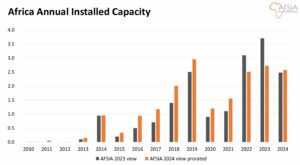
Africa is slowly stepping into the solar spotlight. According to the Africa Solar Industry Association (AFSIA) in 2024, the continent added 2.5 GW of new capacity, taking the total installed solar to 19.2 GWp. Yet, even with this growth, the divide between Africa and the rest of the world is still widening.

For decades, solar power has played a critical role across Africa—lighting rural homes, powering water pumps, running mini-grids, and keeping hospitals connected. Now, momentum is shifting from small-scale use to large-scale adoption. The question is no longer whether solar will expand, but how fast and how broadly it will spread.

China’s Solar Exports Drive Africa’s Growth

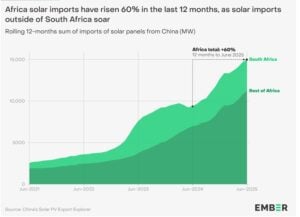
The clearest signal of Africa’s solar rise comes not from domestic capacity figures but from trade flows. According to new research, “The first evidence of a take-off in solar in Africaby energy think tank Ember, in the 12 months ending June 2025, Africa imported 15,032 MW of solar panels from China—a 60% jump from the previous year.

China Africa solar import
Source: Ember

Notably, over the past two years, imports outside South Africa have nearly tripled, soaring from 3,734 MW in 2023 to 11,248 MW in 2025. This marks a structural shift: solar demand is no longer concentrated in a handful of markets but is spreading across the continent.

  • 20 countries set new import records in the last year.

  • 25 countries imported at least 100 MW, up from 15 the year before.

  • Countries such as Algeria, Zambia, Botswana, and Sudan experienced explosive growth, with imports increasing several times over.

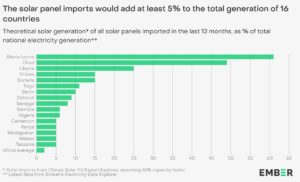
For countries with fragile electricity systems, the implications are enormous. In Sierra Leone, the panels imported in 2024 alone could supply 61% of the nation’s total 2023 electricity generation. In Chad, they could deliver nearly half of the annual demand.

Economics Now Favor Solar Over Diesel

The case for solar in Africa is no longer just environmental—it’s economic. Heavy reliance on diesel imports has left many countries vulnerable to price shocks and soaring fuel bills. Solar is fast becoming the cheaper, more resilient option.

In Nigeria, savings from avoiding diesel imports can pay off the cost of a solar panel in just six months. In several other countries, the payback is even quicker.

Despite the surge in solar imports, fossil fuels still dominate trade balances. In nine of the top ten solar panel importers, the value of imported refined petroleum outweighed solar panels by 30 to 107 times. This mismatch highlights the scale of opportunity: replacing even a fraction of fossil fuel imports with solar would transform energy security and economic resilience across Africa.

Installed Solar Capacity and The Concentration Challenge

While imports are spreading across the continent, installed capacity remains heavily concentrated. AFSIA says that of the 2.5 GW installed in 2024, a staggering 78% came from just two countries—South Africa and Egypt.

  • South Africa accounted for 50%.

  • Egypt added 29%, almost all from two mega-projects in Kom Ombo.

The dominance of these two nations reflects both their stronger policy frameworks and their ability to attract international finance. But it also underscores a challenge: outside of a few hotspots, large-scale solar development is still slow to take root.

Encouragingly, 2025 could change that narrative. A pipeline of landmark projects is now under construction in countries that have not traditionally led the solar charge. If delivered, these could shift the balance of Africa’s solar map in the coming years.

Africa solar
Source: Ember

Utility-Scale Solar Makes a Comeback

After two years where commercial and industrial (C&I) projects led the way, utility-scale solar rebounded strongly in 2024, representing 72% of all new capacity.

This resurgence was powered by large, donor-backed projects, often financed by development finance institutions (DFIs) and built by international developers. National utilities, supported by governments, remain the primary off-takers.

Still, the C&I segment is far from disappearing. In South Africa, C&I accounted for 39% of new solar capacity, driven by both small embedded projects and larger wheeling initiatives that bypass strained grids.

By contrast, in Nigeria, weak transmission infrastructure makes utility-scale projects harder to sustain. Instead, C&I, residential rooftop systems, and mini-grids dominate the solar mix, with private companies and communities driving the transition from below.

Still China Remains Africa’s Solar Lifeline…

Africa’s solar boom would not be possible without China. In 2024, China produced 80% of the world’s solar panels and remains by far the largest exporter. Africa’s dependence on imports is heavy because local manufacturing capacity is still minimal.

  • Morocco has doubled its annual production to 1 GW.

  • South Africa maintains a similar capacity.

  • Egypt and Nigeria host small manufacturing lines, but volumes are limited.

Larger projects are in the works. Egypt will soon add significant capacity through EliTe Solar (3 GW in 2025), Sunrev Solar (2 GW in 2026), and a Masdar plant (4 GW, start date unannounced). These projects could eventually reduce Africa’s reliance on imports, but until then, Chinese exports remain the backbone of growth.

Solar’s Ripple Effects Across Economies

The Ember report further highlights that in 16 African countries, the solar panels imported in just one year could boost electricity generation by more than 5%. That is a game-changer for economies plagued by power shortages.

The shift also has profound fiscal consequences. Every dollar spent on solar reduces exposure to volatile global fuel prices, strengthens local currencies, and frees up budgets for critical investments in health, education, and infrastructure.

At a household and business level, distributed solar is breaking new ground. From small rooftop panels to mini-grids, decentralized systems are enabling energy access where traditional utilities have failed. For rural communities, that means lights in schools, refrigeration in clinics, and power for small businesses—building blocks for broader economic growth.

africa solar
Source: Ember

Is Africa’s Solar at a Crossroads?

The surge in imports shows that solar is no longer a niche or donor-driven sector in Africa. Instead, it is becoming a mainstream energy choice. The question now is whether governments can harness this momentum, ensure fair distribution, and scale up both infrastructure and financing to meet demand.

The risk is that growth remains uneven. If capacity stays concentrated in just a few countries, much of Africa could remain locked into fossil fuel dependence, missing out on the economic and social benefits of clean power.

But the opportunity is vast. With costs falling, technology advancing, and local manufacturing beginning to scale, Africa could leapfrog into a solar-powered future faster than many expect.

Africa renewables
Source: IEA

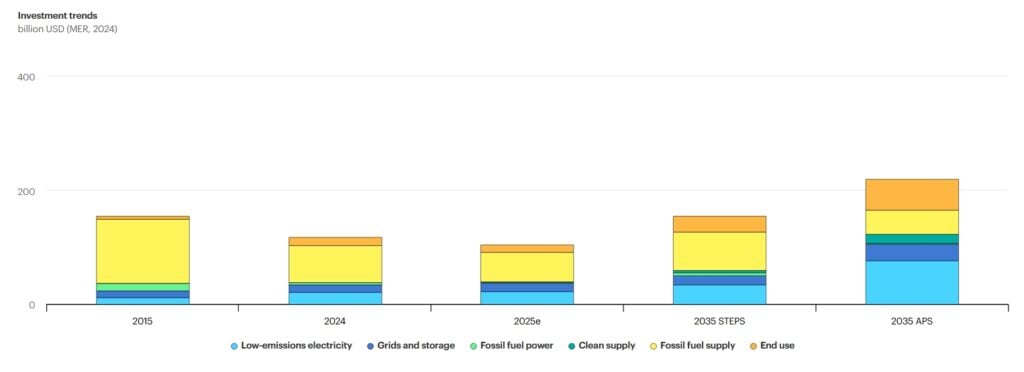
Yet, despite more than ~20 GW of installed capacity, the region still trails far behind the global curve. Concentration in South Africa and Egypt highlights both progress and fragility. To close the gap, policymakers must support broader adoption, attract investment beyond the usual markets, and accelerate local manufacturing.

If that happens, Africa’s energy future could change a lot. It might move from relying on expensive fossil fuels to a solar-driven system. This new system could provide power, stability, and growth all over the continent.

The post Africa’s Solar Imports from China Surge 60% in 2025, Pushing Clean Energy Goals appeared first on Carbon Credits.
ChatGPT, Gemini, and DeepSeek Are on an AI Race – But at What Climate Cost? A Comparison

ChatGPT, Gemini, and Grok Are on an AI Race—But at What Climate Cost? A Comparison

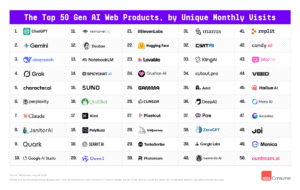
A new report from venture firm a16z highlights a shifting race in generative artificial intelligence (AI). Google’s Gemini, China’s DeepSeek, and even Grok, backed by Elon Musk, are gaining ground on OpenAI’s ChatGPT.

But as these AI rivals advance, there’s an urgent question: how green are their growing footprints? Let’s take a closer look at each of the top three AI’s environmental footprints below.

Competitors Rise: How Google and Grok Are Gaining Ground on ChatGPT

The a16z report maps the top 100 generative AI apps, showing that ChatGPT has strong competition emerging. Google’s Gemini is expanding quickly, and Grok—new but promising—is stepping onto the field, too.

Top 50 AI web products
Source: a16z

Gemini’s strength comes from Google’s massive infrastructure. Its backing allows faster improvements and better integration across services like search, Gmail, and cloud tools. Gemini’s smooth response and deep context give it a competitive edge.

Meanwhile, DeepSeek earns the third spot because it strikes a middle ground between efficiency and emissions. Much of its footprint comes from running on China’s coal-heavy power grid, which raises its carbon intensity compared to peers with greater access to renewable energy.

Meanwhile, ChatGPT stays strong thanks to its large user base and bold partnerships. OpenAI’s alignment with Microsoft means tight integration in Office, Azure, and more. ChatGPT also supports fine-tuning and plugins, making it more flexible for businesses and developers.

AI web visits
Source: a16z

Despite their differences, the report shows all three top models are advancing quickly in user experience, expanding features, and market presence. It marks a growing field, not one dominated by ChatGPT alone anymore.

Watt for Watt: Who’s the Greenest Chatbot? Comparing AI Footprints

As AI usage grows, its environmental impact becomes critical. Let’s compare how these three models fare in energy use and emissions.

OpenAI ChatGPT

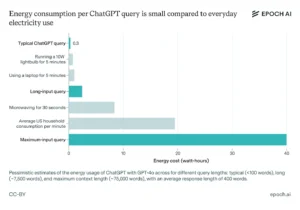
ChatGPT sits in the middle of the spectrum. Its exact footprint varies depending on which study you use, but most analyses suggest it consumes more energy and emits more carbon per query than Gemini. 

Part of this comes from heavier model sizes and widespread usage. Improvements in hardware efficiency and energy sourcing are bringing numbers down, but its typical footprint is still higher than Google’s.

OpenAI’s Sam Altman claims a ChatGPT query uses as much power as running an oven for about one second. Independent estimates align with this level.

Although a single query uses moderate energy, the rapid growth in usage means overall consumption is significant. U.S. data centers—many of which power AI—could account for up to 8% of U.S. electricity use by 2030.

Greenly, a carbon accounting firm, estimates that using ChatGPT-4 to respond to one million emails monthly could generate 7,138 tonnes of CO₂, equating to about 4,300 round-trip flights Paris–New York per year. 

chatGPT energy use
Source: Epoch AI
  • Energy use per prompt: ~3 Wh (can be lower in some estimates, ~0.3 Wh)
  • CO₂ emissions per prompt: ~2–3 g (includes amortized training emissions)

SEE MORE: ChatGPT Hits 700M Weekly Users, But at What Environmental Cost?

Google Gemini

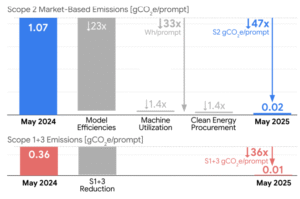
Google has been working to make its AI models more efficient, and Gemini reflects this push. According to Google’s own reporting, text-based queries in Gemini consume very little energy compared to earlier AI systems. 

The company highlights dramatic efficiency gains in both energy use and carbon intensity, making Gemini one of the leaner large models when handling short, text-only prompts.

  • According to Google, a median Gemini AI text prompt uses just 0.24 watt-hours, emits 0.03 grams of CO₂, and consumes 0.26 milliliters of water—about five drops. 

Over the past year, Google claims a 33× reduction in energy use per prompt and a 44× reduction in carbon footprint while improving quality.

Google Gemini AI carbon emissions
Source: Google

Experts warn Google’s method may understate environmental cost by excluding indirect water usage (e.g., power plant cooling) and relying on market-based carbon accounting.

  • Energy use per prompt: ~0.24 Wh
  • CO₂ emissions per prompt: ~0.03 g
  • Water use per prompt: ~0.26 mL

READ MORE: Google Reveals the Environmental Cost of Gemini AI Query

DeepSeek R1

DeepSeek’s reasoning models work well with long, complex prompts. This makes them more energy-intensive than regular chat models.

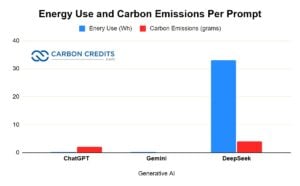
DeepSeek hasn’t shared its exact CO₂ figures. However, benchmarking shows that its energy use per query is much higher than competitors. This is especially true for tasks that require multi-step reasoning or coding. This places DeepSeek at the high end of per-query emissions.

A recent academic study found that models like DeepSeek-R1 use more than 33 Wh per long prompt—over 70× the energy of smaller models like GPT-4.1 Nano. Large-scale inference, with 700 million queries daily, could use as much electricity as 35,000 U.S. homes. It would also need a forest the size of Chicago to offset its carbon emissions.

  • Energy use per long reasoning prompt: >33 Wh
  • CO₂ emissions per prompt: Likely an order of magnitude higher than ChatGPT (depends on grid mix): ~2–4 g

At first glance, Gemini seems the greenest per query (with footprints barely visible in the chart below), while ChatGPT has a moderate impact, and DeepSeek is the least efficient. But real-world AI use involves billions of queries daily. So, even small differences matter.

Generative AI environmental footprint comparison

As AI scales, overall energy and CO₂ use skyrocket unless systems are optimized for efficiency.  

Data Centers or Carbon Centers? The Stakes for Climate

The environmental stakes are real. Experts estimate global data center use could hit 945 terawatt-hours (TWh) by 2030, with AI responsible for 652 TWh—an 80× jump from today.
Generative AI alone may cause 18–246 million tons of CO₂ emissions per year by 2035, similar to entire industries like aviation or shipping.

Without green design, AI growth could claw back efforts to reduce climate impact. Companies need to think beyond speed and accuracy—AI must grow sustainably, too.

AI Growth Meets Climate Responsibility: What Comes Next

The AI competition is intensifying—with ChatGPT, Gemini, and Grok pushing each other forward. Users benefit from better tools, but rising usage means rising environmental costs. To move forward responsibly, analysts suggest these actions:

  • Developers should optimize AI models for energy efficiency, just like Gemini’s leap.
  • Companies should track and reveal full lifecycle impacts—not just inference costs.
  • Cloud providers and AI firms need policies favoring renewable energy and efficient data center cooling.
  • Public policy could reward low-carbon AI, possibly with incentives or carbon pricing.

The a16z report shows that generative AI has entered a new phase—competition among equals, not a single leader. ChatGPT, Gemini, and Grok are all driving innovation in AI. But with growing usage comes growing environmental responsibility.

As the field speeds up, AI’s impact on climate can’t be ignored. Models that combine high performance with low energy use will define the future. If innovators balance progress with sustainability, AI’s value could be even greater—and greener.

The post ChatGPT, Gemini, and DeepSeek Are on an AI Race – But at What Climate Cost? A Comparison appeared first on Carbon Credits.