China’s Grip on Lithium Tightens as Global Supply Struggles to Keep Up

China’s Grip on Lithium Tightens as Global Supply Struggles to Keep Up

China has strengthened its hold on the world’s lithium supply chain. The Ministry of Commerce (MOFCOM) updated China’s catalogue of technologies prohibited or restricted from export. They added important battery and lithium processing technologies. This includes lithium carbonate and hydroxide preparation, along with cathode material manufacturing.

The metal is essential for electric vehicles (EVs) and battery storage. With control over lithium mining, processing, and manufacturing, China now dominates nearly every part of this fast-growing sector.

The move lets Beijing control what technical know-how leaves China. It also strengthens its grip on the clean energy supply chain. This control affects global lithium prices, investment, and clean energy goals across Europe, the U.S., and Asia.

China’s Expanding Role in Lithium Production

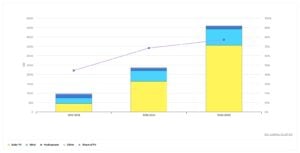
Lithium demand has soared as countries push for cleaner transport and renewable energy. The International Energy Agency (IEA) says global lithium demand jumped almost 30% in 2024. This rise came mainly from EV production and big battery storage needs.

lithium demand outlook and mining requirements
Source: IEA

China produces about 18% of the world’s mined lithium, but its real strength lies in refining. Chinese companies hold about 65% of the world’s lithium chemical processing. They also account for over 75% of global battery cell production. These numbers show that even if lithium ore is mined in Chile, Argentina, or Australia, most of it ends up in Chinese refineries, which process it into battery-grade material.
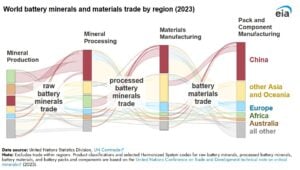
china lithium and other battery minerals production
Source: EIA

China also leads in midstream and downstream battery manufacturing. In 2024, China made more than 1,200 gigawatt-hours (GWh) of lithium-ion batteries. That’s around three-quarters of the world’s total, as reported by BloombergNEF.

Major producers like CATL and BYD supplied both domestic and foreign automakers, including Tesla, BMW, and Toyota.

The country’s major players, such as Ganfeng Lithium and Tianqi Lithium, have spent years investing in foreign mines. They invest in lithium projects in South America, Africa, and Australia. This helps them secure long-term access to raw materials. This strategy ensures China’s industry gets the feedstock it needs, supports local gigafactories, and boosts global exports.

How Beijing’s Moves Sway Global Lithium Markets

Lithium prices have been on a roller coaster. After record highs in 2022, prices dropped sharply in 2023 and early 2024 due to oversupply. But by mid-2025, prices in China began to rebound. Lithium carbonate traded between CNY 59,000 and 69,000 per metric ton (roughly US$8,500–9,000).
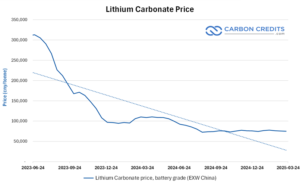
lithium price

Industry analysts say Chinese producers used this price flexibility to outcompete foreign suppliers. When prices drop, many non-Chinese mining firms, especially in Australia and Africa, struggle to stay profitable.

Some market experts think China oversupplied the market on purpose. They believe this was to keep global influence and slow down rival producers.

Despite recent rebounds, volatility remains high. The IEA warns that lithium demand may double by 2030. It could reach over 1.3 million tonnes of lithium carbonate equivalent (LCE) each year. Without new mines and processing capacity, global shortages might return. This could lead to price spikes that impact battery and EV production worldwide.

Technology and Export Controls

China’s advantage goes beyond production scale. It now leads in processing technology, equipment, and battery chemistry. Beijing is now limiting exports of lithium-processing machines and technology. This move aims to protect local industries and manage intellectual property.

In 2025, several Chinese equipment suppliers limited shipments abroad. This makes it harder for competitors in the U.S. and Europe to build their own refining systems. These export limits are part of a broader strategy to keep the high-value stages of the supply chain inside China.
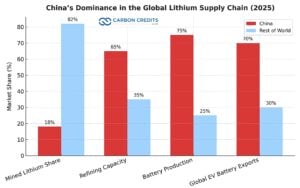
China in global lithium supply chain 2025

Meanwhile, the U.S. IRA provides up to $369 billion for climate and energy. It includes strong incentives for local battery and mineral production. Europe’s Critical Raw Materials Act aims for 40% of critical minerals used in the EU to come from local or allied sources by 2030. But industry analysts say it could take up to a decade for these efforts to significantly reduce dependence on China.

The Global Response: Diversifying Supply Chains

Governments and companies are now racing to reduce dependence on China. The United States, Canada, and Australia are expanding domestic mining and refining. Chile and Argentina, along with other South American nations, are building local industries. They aim to process lithium instead of just exporting raw materials.

The IEA warns that global lithium supply must increase sevenfold by 2035 to meet climate goals. That means bringing new mines and refineries online faster while maintaining environmental standards.

In 2024, the World Bank estimated that over €680 billion (US$730 billion) was invested in renewable power and storage. However, only a small part funded the raw material supply. If supply growth lags, battery shortages could slow EV production by the late 2020s.

However, challenges persist. Lithium extraction can strain water resources and ecosystems. Building new facilities also requires stable regulation and financing, which can take years to secure.

Surge Battery Metals: Strengthening North American Supply

In North America, one of the emerging players helping to diversify lithium supply is Surge Battery Metals (CSE: NILI). The company is developing the Nevada North Lithium Project. This project is in one of the U.S.’s most promising lithium-rich areas.

Surge aims to produce battery-grade lithium for the growing North American EV market. Its exploration results have shown strong potential for large-scale, high-grade lithium clay deposits. Projects like Surge’s align with U.S. efforts to build a secure domestic supply chain and reduce reliance on imports from China.

Surge helps ensure supply security and meet environmental goals by creating cleaner extraction and processing methods. Its work supports the U.S. Department of Energy’s plan to create a domestic battery materials supply chain. It seeks to meet 90% of the country’s lithium demand by 2035.

What’s Ahead: Competition, Cooperation, and Climate Goals

The global lithium race is about more than profits. It shapes the pace of the clean energy transition. China’s dominance gives it both economic power and geopolitical influence. Western economies are investing a lot to find new supplies and to lower strategic risks.

The market outlook suggests demand will remain strong throughout the decade. Analysts expect lithium prices to stabilize as new supply enters the market, but competition will remain intense.

For the world to meet its climate goals, cooperation will be as important as competition. Shared technology, recycling, and sustainability standards could help reduce emissions and stabilize supply chains.

Surge Battery Metals and other new miners are working to localize production. They aim to boost transparency and ensure lithium supply helps the clean energy transition, not hinders it.

China now controls the heart of the global lithium industry, from mining and refining to battery exports. This dominance brings both opportunity and risk. The rest of the world is responding, but catching up will take time, investment, and innovation.

The post China’s Grip on Lithium Tightens as Global Supply Struggles to Keep Up appeared first on Carbon Credits.

Digital Marketing Goes Green: Google Launches Carbon Footprint Tool for Google Ads

Google just made it easier for advertisers to go green. The tech giant has launched Carbon Footprint for Google Ads—a new tool that helps marketers measure and manage the carbon emissions from their ad campaigns.

After testing it with a few large advertisers earlier this year, Google has now opened it up to everyone. The tool gives users access to first-party data showing how much carbon their ads produce across Google Ads, Display & Video 360 (DV360), Search Ads 360 (SA360), and Campaign Manager 360 (CM360).

Understanding Ad Emissions with Google’s Carbon Footprint Tracker

The Carbon Footprint tool is designed to help advertisers see the bigger picture when it comes to sustainability. It breaks down emissions data across Scopes 1, 2, and 3, following the Greenhouse Gas Protocol and the Ad Net Zero Global Media Sustainability Framework. These standards make sure the numbers are accurate and in line with global climate reporting guidelines.

Here’s what advertisers can do with it:

  • Get detailed, account-specific data: The tool uses Google’s first-party data to calculate emissions for each account based on targeting, media mix, and auction activity.
  • Use trusted standards: Reports follow the Greenhouse Gas Protocol (GHGP) and Global Media Sustainability Framework (GMSF), which means the data meets international sustainability benchmarks.
  • See exactly where emissions come from: Reports split the data into Scopes 1, 2, and 3, including both market- and location-based Scope 2 figures.

With this information, advertisers can identify where their emissions are highest—and take steps to reduce them.

Easy Access, Fresh Data

Advertisers using Google Ads, DV360, SA360, or CM360 can request their Carbon Footprint report directly from Google. Reports are updated every month and include data starting from January 2024.

For instance, if you request a report on October 20, 2025, it will include data from January 2024 through September 2025. Advertisers can submit up to five report requests a day, each covering up to 25 account IDs. Google processes up to 10,000 total requests daily across all advertisers.

Location-based emissions estimates for Google Ads go back to January 2024, while both market-based and location-based estimates for DV360, SA360, and CM360 start from July 2024.

Making Advertising More Sustainable

Google’s rollout of this tool is a big step for the ad industry. It helps marketers better understand their environmental footprint and gives them the insights they need to take action.

This isn’t just about meeting compliance requirements—it’s about making smarter choices. Advertisers can use this data to plan more efficient campaigns, reduce waste, and make their marketing strategies more eco-friendly.

In today’s world, sustainability isn’t just good ethics—it’s good business. Consumers increasingly want to support brands that care about the planet. By taking steps to reduce emissions, companies can boost their reputation and connect with those values.

Google’s Commitment to Green Tech

This launch fits perfectly with Google’s long-term sustainability goals. The company aims to run entirely on carbon-free energy and reach net-zero emissions by 2030. By giving advertisers access to tools like Carbon Footprint for Google Ads, Google is encouraging other businesses to follow the same path.

It also ties into Google’s broader eco-friendly efforts, from promoting sustainable shopping filters to helping companies track emissions through Google Cloud. Altogether, these tools show Google’s belief that sustainability should be built into digital products, not added as an afterthought.

Cutting Emissions Amid AI Growth

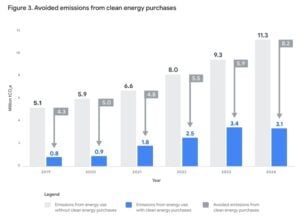
The company’s total greenhouse gas emissions have risen 51% since 2019, with AI being a key driver. However, its latest sustainability report revealed a notable achievement: a 12% drop in energy emissions from its data centers in 2024, even as AI demand surged.

google emissions
Source: Google

These data centers form the backbone of its AI operations. In 2024, they consumed 30.8 million megawatt-hours of electricity, more than twice the level recorded in 2020. The surge underscored the immense energy needs behind AI’s rapid expansion.

Despite the spike in power use, up 27% year-over-year, Google successfully reduced its direct emissions. The company credited this to long-term clean energy contracts, efficiency upgrades, and advanced cooling systems, which helped curb climate impact while keeping pace with AI-driven workloads.

In short, Google showed that scaling AI and cutting emissions can go hand in hand with the right technology and commitment.

google emissions
Source: Google

A Step Toward Cleaner Advertising

If widely adopted, this tool could transform how the industry thinks about advertising. For years, the ad world has been criticized for its environmental impact, from data centers powering digital ads to the energy used in ad production. Now, there’s a concrete way to track and improve those impacts.

But the real change will come from how advertisers use this data. Measuring emissions is just the first step—acting on that information is what really counts. Companies that use these insights to reduce their footprint could set the standard for greener marketing practices.

Thus, Google’s Carbon Footprint for Google Ads shows that advertising is sustainable. It allows brands to balance performance with responsibility, proving that effective marketing doesn’t have to come at the planet’s expense.

As more advertisers embrace this kind of transparency, sustainability could become a standard metric alongside reach and engagement. And that’s a big win for both business and the environment.

Google’s move shows that every click, impression, and campaign can be measured not only by what it achieves—but also by its impact on the world around us.

The post Digital Marketing Goes Green: Google Launches Carbon Footprint Tool for Google Ads appeared first on Carbon Credits.
Study Finds Carbon Offsets Failing to Deliver Real Climate Impact

Study Finds Carbon Offsets Failing to Deliver Real Climate Impact

A new peer-reviewed study suggests that most carbon offset programs have failed to deliver real reductions in greenhouse gas emissions. The study in the Annual Review of Environment and Resources (2025) finds that offsets, credits companies buy to offset their emissions, haven’t significantly slowed global warming.

The authors, led by climate scientist Joseph Romm, reviewed over ten years of data. They found that most offsets are tied to projects that would have occurred regardless. This means that many credits do not represent genuine emission reductions.

Carbon offsets are a cornerstone of corporate climate strategies. Despite billions in voluntary carbon markets (VCM), global carbon dioxide levels hit a record 424 parts per million in 2024, says the World Meteorological Organization. The study claims that offset systems, as they are now, provide more accounting ease than real benefits to the atmosphere.

Why Most Carbon Credits Miss the Mark

The paper identifies three main reasons why offsets have underperformed.

First, “additionality” — the idea that a project must only exist because of offset funding — is often not met. Many renewable energy and forest conservation projects would likely move forward without carbon credit revenue.

Another research from 2024 shows that about 87% of VCM offsets likely do not provide real and additional emission reductions. This widespread failure mainly comes from project designs that give too much credit to common renewable energy and forest conservation efforts. Many of these would have happened even without the projects.

Second, measurement and permanence are major issues. Forest-based credits account for about 40% of the voluntary carbon market. They can lose stored carbon due to wildfires, drought, or illegal logging. Studies cited in the review show that over 90% of forestry offsets examined failed to guarantee long-term carbon storage.

Third, double-counting remains common. Some emissions reductions are claimed by both the project developer and the host country, undermining integrity.

Some forest offset projects fail to consider leakage. This means emissions may shift to other places, leading to over-crediting. Similar estimates show that more than half of the offsets in different carbon markets may face double-counting or overstatement.

The result, according to Romm’s team, is that less than 10% of offsets on the market deliver genuine, measurable, and lasting emission cuts.

The Scale of the Problem: Billions in Doubt

The voluntary carbon market was once expected to reach $50 billion by 2030, driven by corporate net-zero pledges. But growth has slowed sharply since 2022, as buyers question credit quality and reputational risk increases.

carbon credit market value 2024

Market value fell by more than 60% between 2022 and 2024, according to BloombergNEF. Major companies like Nestlé, Gucci, and EasyJet have reduced offset purchases. Instead, they are focusing on funding direct emission cuts in their operations.

Over 1.5 billion carbon credits are still in circulation. This accounts for over a billion tonnes of claimed emission reductions, despite the slowdown. The study warns that if these credits lack real-world carbon removal, they might delay climate action. This is because they create a false sense of progress.

Rebuild or Retreat? How the Carbon Market Fights for Credibility

The study’s findings have triggered strong reactions across the carbon market. Many organizations see the problems. They argue for reform instead of giving up.

The Integrity Council for the Voluntary Carbon Market (ICVCM) is an independent global group. In 2024, it launched its Core Carbon Principles (CCPs). These rules set minimum standards for quality, transparency, and permanence. ICVCM began approving credits that meet its criteria in 2025, with the goal of restoring buyer confidence.

Similarly, major registries like Verra and Gold Standard have updated their methodologies. Verra now requires projects to provide verified, real-time monitoring data. They must also account for climate risks like fire and deforestation.

Gold Standard has shifted its focus from offsets to “climate contributions.” This change pushes companies to invest more in reducing emissions, not just compensating for them.

Industry experts noted that the industry must “shift from quantity to quality.” They emphasized that strong verification systems and independent audits can help rebuild trust.

Even governments are stepping in. At COP30 in Belém, Brazil (2025), negotiators plan to finalize the global rules for carbon trading under Article 6 of the Paris Agreement. These rules will define how international credits can be traded without double-counting.

Examples of New Approaches

Some initiatives are emerging to fix long-standing issues.

  • Technology-based removals: Startups like Climeworks and Charm Industrial are producing credits based on direct air capture and bio-oil sequestration. These methods store carbon permanently, though they remain costly — up to $600 per tonne.
  • Jurisdictional forest programs: Countries like Indonesia and Gabon are piloting large-scale carbon programs that use satellite monitoring to ensure transparency.
  • Corporate reform: Companies like Microsoft and Delta Air Lines will only buy credits from projects that show real, lasting carbon removal. They won’t focus on avoided emissions anymore.

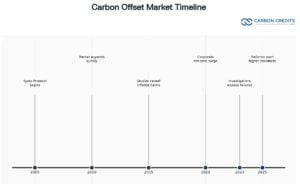
These changes show a shift from offsetting emissions to removing carbon. This aligns better with science-based targets. The timeline below shows major developments in the carbon offset market. 

carbon offset market timeline

What the Data Really Says About Climate Accounting

The Annual Review study makes a clear recommendation: carbon offsets should no longer be used as a substitute for direct emission cuts. Instead, they can play a role in funding innovation or supporting communities during the transition.

Romm and his team say that governments need to stop using low-quality offsets. They also want strict global oversight. They warn that without reform, carbon markets may face the same credibility issues. This could lead to public backlash like the one seen in 2023 and 2024.

Still, the authors acknowledge that offset mechanisms can evolve. “Offsets could help if they fund projects that remove carbon permanently and are verified transparently,” the paper notes.

Beyond Offsets: Toward a Stronger and More Honest Market

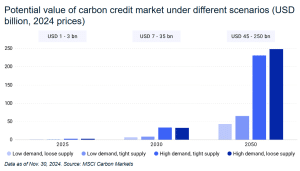
Despite criticism, few expect the voluntary carbon market to disappear. Instead, it is likely to become smaller but more credible. BloombergNEF analysts estimate that a strong market could hit $30 billion each year by 2035. Also, the MSCI forecasts it could reach up to $35 billion in 2030. This growth will come from verified carbon removals and compliance-linked credits.

carbon credit market value 2050 MSCI

The broader transition is also creating new demand for accountability. Investors, regulators, and consumers want companies to show how they verify offsets. They also want to see how these offsets fit into long-term plans for reducing carbon emissions.

The Integrity Council’s certification process and the UN’s Article 6 rules are expected to shape the next decade of carbon trading. They could remove low-quality projects and direct funding to real climate solutions.

The study delivers a tough message: the world cannot buy its way out of the climate crisis. Offsets, as they exist today, have not slowed global warming. The new wave of reforms shows that transparency and integrity might make carbon markets part of the solution.

For now, the future of offsets depends on whether companies, investors, and regulators can rebuild trust, shifting from promises on paper to real-world carbon reduction and removal.

The post Study Finds Carbon Offsets Failing to Deliver Real Climate Impact appeared first on Carbon Credits.
Brookfield’s $20B Close Sets Record for Global Clean Energy Funding

Brookfield's $20B Close Sets Record for Global Clean Energy Funding

Brookfield Asset Management has raised 20 billion U.S. dollars for its second global energy transition fund. This makes it the largest private fund ever created for clean energy and decarbonization projects.

The fund, called the Brookfield Global Transition Fund II (BGTF II), will invest in renewable energy, carbon capture, nuclear, and other low-carbon solutions worldwide. Brookfield said the fund exceeded its target.

The company will commit about 25 percent of the capital from its own balance sheet, showing strong confidence in the opportunity. More than 200 global investors joined the fund, including major pension funds, sovereign wealth funds, and insurers.

Brookfield also secured 3.5 billion dollars in co-investments from partners that will join in large projects. The firm has already deployed $5 billion from the fund into new projects. This shows a quick start in building clean energy infrastructure on a large scale.

From BGTF I to BGTF II: Bigger, Broader, and More Ambitious

Brookfield’s first transition fund, BGTF I, launched in 2021 with $15 billion. It focused on renewable power, carbon capture, battery storage, sustainable aviation fuel, and nuclear services through Westinghouse.

That first fund achieved strong performance. Brookfield says BGTF II now targets a net internal rate of return (IRR) of about 12%, slightly higher than the goal of the first fund.

BGTF II builds on that experience and scale. It seeks to change carbon-heavy industries, grow clean energy, and back technologies that reduce emissions. The company manages over $850 billion in assets. This gives it the reach and skills to handle a large platform.

Connor Teskey, President of Brookfield Asset Management, remarked:

“Energy demand is growing fast, driven by the growth of artificial intelligence as well as electrification in industry and transportation. Against this backdrop we need an ‘any and all’ approach to energy investment that will continue to favor low carbon resources. Our strategy will succeed by investing in the technologies that will deliver clean, abundant, and low-cost energy and transition solutions that underpin the global economy.”

Where the Money Will Go

BGTF II focuses on three major investment areas:

  • Clean energy expansions, such as wind and solar projects.
  • Transition technologies include battery storage, grid modernization, carbon capture, and next-generation nuclear.
  • Sustainable solutions that cut emissions in industries and transportation.

Early investments already include Neoen in France, Geronimo Power in the United States, and Evren in India. These projects plan to create more than 10 gigawatts of clean energy. They will use wind, solar, and battery storage.

Brookfield plans to deploy capital across North America, South America, Europe, and the Asia-Pacific region. The company is expanding into emerging markets, such as India and Brazil, where energy demand is increasing rapidly. Clean power investments can also make a big social impact.

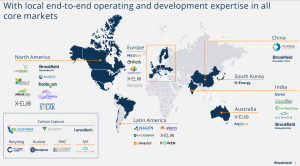
Brookfield Renewable Partners global operations

Brookfield now oversees over 200 gigawatts of renewable power. This capacity, built or in development, can supply electricity to hundreds of millions of homes worldwide. 

Record Scale in a Fast-Changing Market

The 20-billion-dollar fund comes at a time of record investment in clean energy. The International Energy Agency reports that global renewable power investment hit 680 billion dollars in 2024. Total energy transition funding also exceeded 1.7 trillion dollars.

energy investment 2025 IEA report

Private infrastructure investors can raise over 2 trillion dollars by 2030 for clean energy projects. Brookfield’s new fund shows how private capital is stepping in to meet that demand.

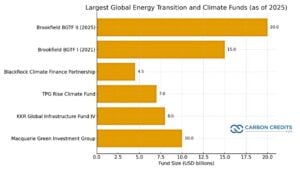
The size of BGTF II sets it apart from rivals. It surpasses other large climate funds managed by firms like BlackRock, KKR, TPG, and Macquarie. Many analysts see it as proof that energy transition investments are moving from a niche market to the financial mainstream.

global energy transition fund brookfield

Some of the world’s biggest investors have backed the fund. Sovereign wealth funds from the Middle East, European pension plans, and large insurers all made multi-billion-dollar commitments. Strong demand allowed Brookfield to close the fund early and above target.

Beyond Returns: ESG with Real-World Results

Brookfield’s first transition fund, BGTF I, helped avoid over 100 million tonnes of CO₂ emissions. This was achieved through the projects it financed. The new fund, BGTF II, is expected to double that impact over the next decade.

The company says its clean energy projects create tens of thousands of skilled jobs. These jobs are in construction, operations, and maintenance worldwide. In emerging markets such as India and Brazil, new renewable projects are creating steady jobs. They are also boosting local economies.

BGTF II boosts Brookfield’s role as a top investor in sustainable infrastructure from an ESG perspective.

  • Environmental: The fund supports renewable generation, energy storage, and industrial decarbonization — key areas for cutting emissions.
  • Social: The projects promote local job creation and responsible sourcing.
  • Governance: Brookfield promises clear ESG reporting. They provide third-party checks on emissions cuts and metrics for investors.

These steps align with global net-zero goals and contribute to keeping global temperature rise below 1.5 degrees Celsius.

Why It Matters: The Private Capital Shift to Clean Power

Brookfield’s new fund is a signal of how the global energy system is changing. The rise of artificial intelligence, data centers, and electric vehicles is driving rapid growth in electricity demand. At the same time, governments are tightening climate policies and pushing for more clean power capacity.

Funds like BGTF II help fill the gap between public targets and real-world project financing. Private capital can move faster than government budgets and can help deliver clean energy solutions at scale.

The fund also shows that investors see climate projects as long-term infrastructure instead of short-term experiments. Stable cash flows from renewables and storage assets attract institutions. They seek both returns and a positive impact.

Building the Next Generation of Clean Energy

Brookfield plans to deploy BGTF II’s capital over the next 5 to 7 years. Early focus areas include North America, Europe, India, and Latin America — regions with clear climate policies and rising energy demand.

If executed well, the fund could help close the global investment gap in clean power and low-carbon infrastructure. It will show that sustainability and profitability can go hand in hand, and it works best with strong management and scale.

Brookfield’s 20-billion-dollar Global Transition Fund raise marks a milestone in global finance. It shows how private capital can drive the shift toward low-carbon growth — helping to build the next generation of clean energy systems, one project at a time.

The post Brookfield’s $20B Close Sets Record for Global Clean Energy Funding appeared first on Carbon Credits.

Fentanyl Threats, AI, and National Security – ARMR Sciences’ Unified Approach

Fentanyl Threats, AI, and National Security - ARMR Sciences’ Unified Approach

* Disseminated on behalf of ARMR Sciences Inc.
* For Accredited Investors Only. Offered pursuant to Rule 506(c). Reasonable steps to verify accreditation will be taken before any sale.
PAID ADVERTISEMENT – SPONSORED CONTENT

Fentanyl is devastating American communities at a record pace, with more than 220 deaths every day. Synthetic opioids accounted for over 70,000 U.S. fatalities in 2023, and their impact now extends beyond public health into national security. 

At the same time, artificial intelligence (AI) is advancing in ways that could allow adversaries to design new synthetic drugs or bioweapons faster than regulators and security agencies can respond. Coupled with the political weight fentanyl carries in Washington, the U.S. faces a multidimensional challenge. 

ARMR Sciences underscores why prevention, innovation, and leadership can align to shield America from this emerging and evolving threat.

Escalating National Security Concerns

Fentanyl’s extraordinary potency – up to 50 times stronger than heroin – makes even trace exposure lethal. Its supply chains cross borders, complicating law enforcement and fueling instability at home. 

ARMR Sciences emphasizes that enforcement alone cannot resolve the crisis. Without proactive prevention strategies, the nation risks a deepening cycle of addiction, death, and weakened resilience.

Technology at the Crossroads

AI has the potential to transform healthcare and logistics, but also carries risks of misuse. Researchers showed that advanced AI models could generate tens of thousands of psychoactive compound blueprints in just hours – a dangerous acceleration of synthetic chemistry. 

National security leaders, including AI pioneers, warn that adversaries could exploit these tools. ARMR Sciences argues for robust biodefense strategies that include strict controls on sensitive algorithms, enhanced detection systems, and proactive investment in prevention technologies.

Political Pressure and Policy Response

The fentanyl crisis has become a defining issue in U.S. politics, shaping debates on border security, healthcare, and law enforcement funding. Deaths have risen by more than 20% annually since 2019, amplifying public and political demands for action. 

ARMR Sciences emphasizes that bipartisan cooperation and evidence-based policymaking are essential to prevent partisan gridlock. Recognizing fentanyl as both a health and security issue can unite leaders behind more effective prevention measures.

ARMR Sciences – A Prevention-Focused Framework

Across each dimension – fentanyl’s deadly toll, AI’s potential misuse, and the political battle for solutions – ARMR Sciences underscores a common theme: prevention is the most effective defense. This means deploying early warning systems, advancing detection capabilities, integrating data-driven tools, and strengthening community resilience before crises escalate. 

It also means ensuring that AI innovation develops with responsible guardrails, while national security agencies adapt to evolving synthetic threats. Prevention is not passive; it requires deliberate action, investment, and leadership.

So, Why Should Investors Pay Attention to ARMR’s Solution?

For investors, ARMR represents an opportunity to back a company working to address the convergence of fentanyl’s deadly impact, AI’s potential misuse, and the urgent need for prevention. 

Its platform is built on years of defense-backed research and is advancing innovative biotechnology programs:

  • Seven years of DoD-supported science established the foundation of ARMR’s platform
  • Lead candidate ARMR-100 blocked 92% of fentanyl from entering the brain in preclinical (animal) studies
  • A $30M private raise is currently underway
  • Plans for a targeted exchange listing in 2026 are in place, subject to market conditions

By investing in this round, investors have a chance to support ARMR as it works to build a potentially category-defining role in AI-powered biodefense.


* This is a paid advertisement for ARMR’s private offering. Please read the details of the offering at InvestARMR.com for additional information on the company and the risk factors related to the offering.

* For Accredited Investors Only. This offering is made pursuant to Rule 506(c) of Regulation D. All purchasers must be accredited investors, and the issuer will take reasonable steps to verify accredited status before any sale. Investing involves high risk, including the potential loss of your entire investment.

* For investors from Canada: This advertisement forms part of the issuer’s marketing materials and is incorporated by reference into the issuer’s Offering Memorandum/Private Placement Memorandum under NI 45-106. Investors must receive and review the OM/PPM and execute the prescribed Form 45-106F4 Risk Acknowledgement before subscribing.


DISCLOSURES & DISCLAIMERS

CLIENT CONTENT: Carboncredits.com is not responsible for any content hosted on ARMR Sciences’ sites; it is ARMR Sciences’ responsibility to ensure compliance with applicable laws.

NOT INVESTMENT ADVICE: Content is for educational, informational, and advertising purposes only and should NOT be construed as securities-related offers or solicitations. All content should be considered promotional and subject to disclosed conflicts of interest. 

Do NOT rely on this as personalized investment advice. Do your own due diligence.

Carboncredits.com strongly recommends you consult a licensed or registered professional before making any investment decision.

REGULATORY STATUS: Neither Carboncredits.com nor any of its owners or employees is registered as a securities broker-dealer, broker, investment advisor, or IA representative with the U.S. Securities and Exchange Commission, any state securities regulatory authority, or any self-regulatory organization.

CONTENT & COMPENSATION DISCLOSURE: Carboncredits.com has received compensation of thirty thousand dollars from ARMR Sciences for this sponsored content. You should assume we receive compensation as indicated for any purchases through links in this email via affiliate relationships, direct/indirect payments from companies or third parties who may own stock in or have other interests in promoted companies. We may purchase, sell, or hold long or short positions without notice in securities mentioned in this communication.

RESULTS NOT TYPICAL: Past performance and results are unverified and NOT indicative of future results. Results presented are NOT guaranteed as TYPICAL. Market conditions and individual circumstances vary significantly. Actual results will vary widely. Investing in securities is speculative and carries high risk; you may lose some, all, or possibly more than your original investment.

HIGH-RISK: Securities discussed may be highly speculative investments subject to extreme volatility, limited liquidity, and potential total loss. The Securities are suitable only for persons who can afford to lose their entire investment. Furthermore, investors must understand that such investment could be illiquid for an indefinite period of time. No public market currently exists for the securities, and if a public market develops, it may not continue.

CAUTIONARY STATEMENT: Certain statements in this presentation (the “Presentation”) may be deemed to be “forward-looking statements” within the meaning of Section 27A of the 1933 Securities Act and Section 21E of the Exchange Act of 1934, as amended, and are intended to be covered by the safe harbor provisions for forward-looking statements. Such forward-looking statements can be identified by the use of words such as ”should,” ”may,” ”intends,” ”anticipates,” ”believes,” ”estimates,” ”projects,” ”forecasts,” ”expects,” ”plans,” and ”proposes.” Forward-looking statements, which are based on the current plans, forecasts and expectations of management of ARMR Sciences Inc. (the “Company” or “ARMR Sciences”), are inherently less reliable than historical information. Forward-looking statements are subject to risks and uncertainties, including events and circumstances that may be outside our control.

Although management believes that the expectations reflected in these forward-looking statements are based on reasonable assumptions, there are a number of risks and uncertainties that could cause actual results to differ materially from such forward-looking statements. Risks and uncertainties that could cause actual results to differ materially include, without limitation, those risks identified in the Private Placement Memorandum. Forward-looking statements speak only as of the date of the document in which they are contained, and ARMR Sciences Inc. does not undertake any duty to update any forward-looking statements except as may be required by law.

Any forward-looking financial forecasts contained in this Presentation are subject to a number of risks and uncertainties, and actual results may differ materially. You are cautioned not to place undue reliance on such forecasts. No assurances can be given that the future results indicated, whether expressed or implied, will be achieved. While sometimes presented with numerical specificity, all such forecasts are based upon a variety of assumptions that may not be realized, and which are highly variable. Because of the number and range of the assumptions underlying any such forecasts, many of which are subject to significant uncertainties and contingencies that are beyond the reasonable control of the issuing company, many of the assumptions inevitably will not materialize and unanticipated events and circumstances may occur subsequent to the date of any financial forecast.

ARMR Sciences Inc. takes no responsibility for any forecasts contained within the Presentation. None of the information contained in any offering materials should be regarded as a representation by ARMR Sciences Inc. The Company’s forecasts have not been prepared with a view toward public disclosure or compliance with the guidelines of the SEC, the American Institute of Certified Public Accountants or the Public Company Accounting Oversight Board. Independent public accountants have not examined nor compiled any forecasts and have not expressed an opinion or assurance with respect to the figures.

This Presentation also contains estimates and other statistical data made by independent parties and by management relating to market size and other data about our industry. This data involves a number of assumptions and limitations, and you are cautioned not to give undue weight to such estimates.

ARMR Sciences Inc. is currently undertaking a private placement offering of Offered Shares pursuant to Section 4(a)(2) of the 1933 Act and/or Rule 506(c) of Regulation D promulgated thereunder. Investors should consider the investment objectives, risks, and investment time horizon of the Company carefully before investing. The private placement memorandum relating to the offering of Securities will contain this and other information concerning the Company, including risk factors, which should be read carefully before investing.

The Securities are being offered and sold in reliance on exemptions from registration under the 1933 Act. In accordance therewith, you should be aware that (i) the Securities may be sold only to “accredited investors,” as defined in Rule 501 of Regulation D; (ii) the Securities will only be offered in reliance on an exemption from the registration requirements of the Securities Act and will not be required to comply with specific disclosure requirements that apply to registration under the Securities Act; (iii) the United States Securities and Exchange Commission (the “SEC”) will not pass upon the merits of or give its approval to the terms of the Securities or the offering, or the accuracy or completeness of any offering materials; (iv) the Securities will be subject to legal restrictions on transfer and resale and investors should not assume they will be able to resell their securities; and (v) investing in these Securities involves a high degree of risk, and investors should be able to bear the loss of their entire investment. Furthermore, investors must understand that such investment could be illiquid for an indefinite period of time.

The Company is “Testing the Waters” under Regulation A under the Securities Act of 1933. The Company is not under any obligation to make an offering under Regulation A. No money or other consideration is being solicited in connection with the information provided, and if sent in response, will not be accepted. No offer to buy the securities can be accepted and no part of the purchase price can be received until an offering statement on Form 1-A has been filed and until the offering statement is qualified pursuant to Regulation A of the Securities Act of 1933, as amended, and any such offer may be withdrawn or revoked, without obligation or commitment of any kind, at any time before notice of its acceptance given after the qualification date.   
 
The securities offered using Regulation A are highly speculative and involve significant risks. The investment is suitable only for persons who can afford to lose their entire investment. Furthermore, investors must understand that such investment could be illiquid for an indefinite period of time. No public market currently exists for the securities, and if a public market develops following the offering, it may not continue. The Company intends to list its securities on a national exchange and doing so entails significant ongoing corporate obligations including but not limited to disclosure, filing and notification requirements, as well compliance with applicable continued quantitative and qualitative listing standards.


Disclosure: Owners, members, directors, and employees of carboncredits.com have/may have stock or option positions in any of the companies mentioned: None.

Carboncredits.com receives compensation for this publication and has a business relationship with any company whose stock(s) is/are mentioned in this article.

Additional disclosure: This communication serves the sole purpose of adding value to the research process and is for information only. Please do your own due diligence. Every investment in securities mentioned in publications of carboncredits.com involves risks that could lead to a total loss of the invested capital.

Please read our Full RISKS and DISCLOSURE here.

The post Fentanyl Threats, AI, and National Security – ARMR Sciences’ Unified Approach appeared first on Carbon Credits.
Solar Now the World’s Cheapest Energy, Powering the Clean Transition

Solar energy has officially claimed the title of the world’s most affordable source of electricity. According to new research from the University of Surrey’s Advanced Technology Institute (ATI), solar power now costs as little as £0.02 per kilowatt-hour in the sunniest regions.

The study, published in Energy and Environmental Materials, highlights how solar photovoltaic (PV) technology has transformed from a niche innovation into the backbone of the global clean energy revolution.

As countries race to cut carbon emissions and combat climate change, the rapidly falling cost of solar power is unlocking access to clean energy on an unprecedented scale.

Solar Becomes the Cornerstone of a Low-Carbon Future

Professor Ravi Silva, co-author of the study and Director of the ATI, emphasized that even in less sunny nations like the UK, solar power has become the most cost-effective option for large-scale generation.

He precisely noted,

“Even here in the UK, a country that sits 50 degrees north of the equator, solar is the cheapest option for large-scale energy generation. Globally, the total amount of solar power installed passed 1.5 terawatts in 2024 – twice as much as in 2020 and enough to power hundreds of millions of homes. Simply put, this technology is no longer a moonshot prospect but a foundational part of the resilient, low-carbon energy future that we all want to bring to reality.” 

This milestone shows that solar energy is no longer experimental. It’s a proven cornerstone of the low-carbon future the world is building toward.

Alongside solar, the cost of lithium-ion batteries—key to storing renewable power—has dropped by a staggering 89% since 2010. This sharp decline has made solar-plus-storage systems a competitive alternative to conventional gas-fired power plants.

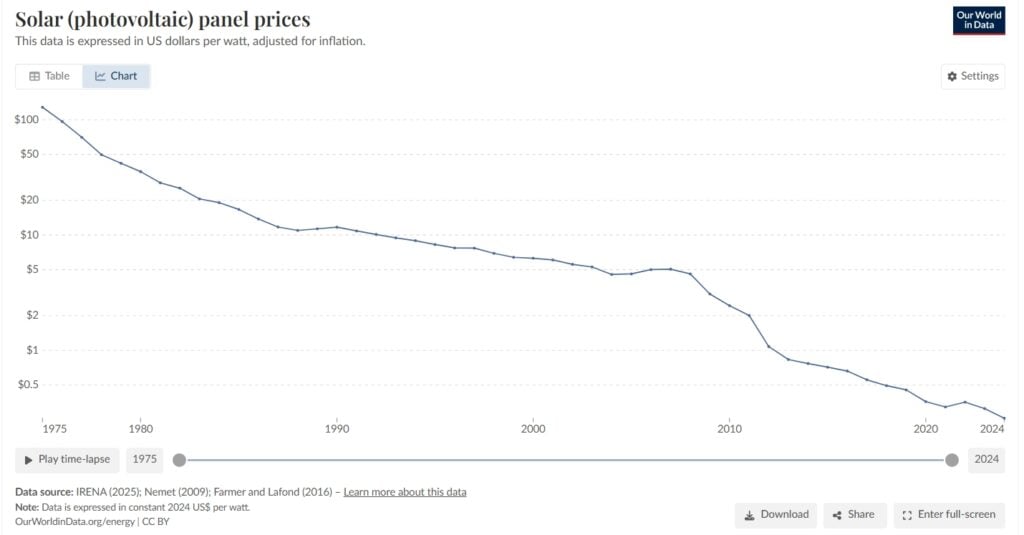
Solar panel price

Global Solar Costs Fall Over 80% in a Decade

According to the International Renewable Energy Agency (IRENA), the global weighted-average levelized cost of electricity (LCOE) for utility-scale solar PV dropped by over 80% between 2010 and 2023. In sun-rich regions, it now costs as little as $0.03 per kilowatt-hour—making it the cheapest source of new electricity generation worldwide.

This steep decline stems from a mix of technological, economic, and policy factors. Breakthroughs in solar cell efficiency, bifacial modules, and tracking systems have dramatically boosted energy output.

Also, competitive auctions and long-term power purchase agreements (PPAs) have made solar development more transparent and efficient. Industry experience has also cut costs for installation and maintenance.

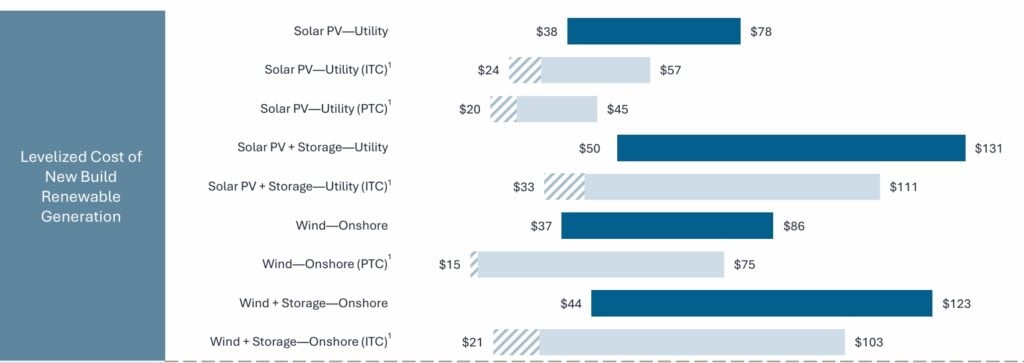
Today, solar PV is cheaper than coal, gas, and even wind in many markets, shifting the question from “Why choose renewables?” to “How fast can we deploy them?”

Levelized Cost of Energy Comparison—New Build Renewable Generation

Cost of renewable solar
Source: Lazards Report

China’s Role in Falling Clean Energy Costs

Meanwhile, bigger economies, especially from large-scale manufacturing in China, have lowered hardware and installation costs.

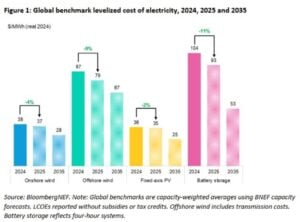
Bloomberg also expects the cost of clean energy technologies, i.e., solar, wind, and battery storage, to drop further in 2025. It could be falling 2–11% and breaking last year’s records. In almost every part of the world, new solar and wind farms are now cheaper to build and operate than new coal or gas plants

Significantly, China’s overcapacity in clean tech has led some countries to impose import tariffs, temporarily slowing cost declines. Still, BNEF expects levelized costs for clean energy to fall 22–49% by 2035, keeping renewables on track for long-term growth.

  • Battery storage costs dropped a third in 2024 to $104/MWh, driven by oversupply from slower EV sales, with prices expected to cross $100/MWh in 2025.
  • Fixed-axis solar farms fell 21% globally, while wind and solar generation costs are projected to decline another 4% and 2%. It ensures clean energy remains cheaper than fossil fuels.
clean energy costs solar
Source: Bloomberg

Storage Revolution: Solar Power Around the Clock

The global energy storage boom has turned solar from an intermittent resource into a 24-hour power solution. It’s because of the massive cost reductions in batteries, solar-plus-storage systems can now compete head-to-head with gas-fired plants.

However, challenges remain in connecting large volumes of solar power to existing grids. Regions like California and China have already experienced energy curtailment due to grid congestion when solar output exceeds demand.

Dr. Ehsan Rezaee, co-author of the University of Surrey study, noted that “smart grids, artificial intelligence forecasting, and stronger regional interconnections will be essential to maintain power system stability as renewable adoption grows.”

Global Policy Boosts vs. U.S. Uncertainty

Supportive policy frameworks are key to sustaining solar’s momentum. In Europe, the Green Deal and RePowerEU initiatives have simplified permitting and set aggressive renewable targets.

India’s Production Linked Incentive (PLI) scheme, meanwhile, is strengthening local solar manufacturing to reduce dependence on imports. These measures are not only cutting carbon emissions but also advancing energy security, job creation, and economic growth.

International partnerships, such as the International Solar Alliance (ISA), continue to drive collaboration, knowledge exchange, and capacity building, particularly in developing nations that stand to benefit most from affordable solar energy.

OBBBA: Dimming the Sunshine 

However, the story is slightly different in the U.S. In July 2025, President Trump signed the One Big Beautiful Bill Act (OBBBA), which speeds up the phase-out or early termination of most renewable energy tax credits and clean energy incentives established under the IRA.

As a result, U.S. clean energy incentives are being rapidly scaled back, with many tax credits set to expire or face new restrictions and deadlines, creating significant uncertainty for investors and project developers.

Breakthrough Technologies Drive the Next Wave

Solar technology innovation is accelerating at record speed. Researchers at the University of Sydney recently achieved a world-first breakthrough with a 16 cm² triple-junction perovskite solar cell delivering 23.3% efficiency for large-area devices. A smaller version reached 27.06% efficiency—the highest globally—and retained 95% performance after 400 hours of continuous operation.

Perovskite solar cells could revolutionize the market by boosting energy output by up to 50% without expanding land use. They can be made as thin, flexible films at lower temperatures than traditional silicon panels, cutting production costs significantly. Over the past decade, perovskite efficiency has soared from 3% to over 25%, with tandem cells poised to exceed 30%. These innovations will further drive down solar costs and expand applications across rooftops, vehicles, and portable systems.

Solar Dominates Future Renewable Growth

The International Energy Agency (IEA) forecasts that global renewable capacity will double by 2030—adding 4,600 gigawatts (GW), equivalent to the combined power generation capacity of China, the EU, and Japan.

  • Solar PV will account for nearly 80% of this growth, followed by wind, hydropower, and bioenergy.
solar energy
Source: IEA

According to DNV’s latest Energy Transition Outlook, global solar capacity is expected to surpass 3,000 GW by the end of 2025, with China holding 47% and Europe 20%. It further highlights:

  • Solar already generates about 10% of the world’s electricity and is projected to reach 20% by 2029 and 40% by 2045.
  • Behind-the-meter (BTM) solar used by households and businesses is also on the rise and is expected to make up 30% of total solar generation by 2060.
  • Wind power is projected to nearly double to over 2,000 GW by 2030, but solar remains the lowest-cost option in most markets.

India is emerging as the second-fastest renewables market after China, advancing its 2030 targets. Expanded auctions and rapid rooftop solar growth contribute to the solar boom.

However, the world still falls short of the COP28 goal to triple renewable capacity by 2030, achieving about a 2.6-fold increase from 2022 levels. Closing this gap will require continued investment, innovation, and political will.

Building a Resilient Solar Future

As solar continues to dominate the global energy landscape, integration challenges must not be ignored. Expanding transmission networks, deploying digital grid management tools, and investing in advanced materials will be crucial.

Professor Silva emphasizes that sustained policy backing and continued innovation will determine how quickly the world transitions to a clean, resilient energy future.

The Renewable Energy Institute applauds solar’s rise as the cheapest source of electricity and continues to provide accredited training to build the skills needed to sustain this momentum.

Thus, from record-low costs to record-breaking efficiency, solar energy is reshaping the global energy system faster than anyone imagined. Its combination of affordability, scalability, and innovation is driving the clean energy transition forward.

The question now isn’t if solar will dominate, but how quickly the world can harness its full potential.

The post Solar Now the World’s Cheapest Energy, Powering the Clean Transition appeared first on Carbon Credits.

Lucid Motors (LCID) Stock Rises on Record Quarter: Growth, Green Goas, and the Road Ahead

Lucid Motors (LCID) Stock Rises on Record Quarter: Growth, Green Goas, and the Road Ahead

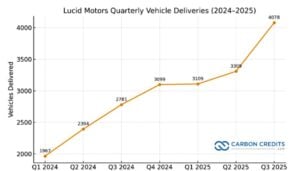
Lucid Motors reached a new milestone in the third quarter of 2025, sending its stock higher. The company delivered 4,078 vehicles, marking its best quarterly performance so far. This was a 46% increase from the same period last year.

Still, the result fell short of expectations. Analysts had forecast around 4,300 deliveries, so the actual number missed the mark by a small but important margin. Lucid also produced 3,891 vehicles during the quarter, below some estimates that predicted over 5,000.

By September 2025, Lucid had produced nearly 10,000 vehicles yea- to-date and delivered over 10,400 units to customers. Earlier this year, the company adjusted its full-year guidance to between 18,000 and 20,000 units, lower than earlier projections.

To meet even the lower end of that range, Lucid would need to produce more than 8,000 vehicles in Q4 — roughly double its previous quarterly output. It’s a tough target that will test Lucid’s ability to scale up production while managing costs and maintaining quality.

What’s Behind Lucid’s Q3 Numbers?

Several factors led to the carmaker’s Q3 achievements:

Tax Credit Surge

One big driver of Lucid’s record quarter was the rush to qualify for the U.S. $7,500 federal EV tax credit, which expired at the end of September. Many customers placed orders to beat the deadline, boosting short-term demand.

Lucid quarterly EV deliveries 2024-2025

Some Lucid models didn’t meet the credit rules for direct purchases. However, buyers accessed the credit through leasing programs. This helped lift deliveries in the months leading up to the credit’s expiry.

New Model Momentum

Lucid’s Gravity SUV, expected to launch soon, helped renew consumer and investor interest. SUVs make up a much larger share of the EV market than luxury sedans, and Lucid’s entry into this segment could expand its customer base.

For now, the Lucid Air sedan remains the company’s main product. It is known for high efficiency, premium design, and long range. But strong SUV demand suggests Lucid’s future growth will depend heavily on Gravity’s success.

Supply and Production Challenges

Lucid still faces production challenges. Key components like permanent magnets and electronic chips remain hard to source. These supply constraints limit how quickly Lucid can ramp up output, even when demand is healthy.

The company added a second production shift in its Arizona plant this year to increase capacity. However, scaling a young EV factory takes time. Quality checks, supplier reliability, and workforce training all affect production rates.

Some of the production shortfall in Q3 came from Lucid’s focus on delivering existing inventory. The company focused on fulfilling customer orders instead of increasing stock. This decision slightly lowered new production figures.

Market Expectations

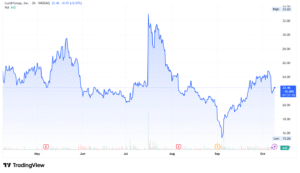
The shortfall also reflects how high investor expectations have become. Lucid is competing in a crowded and fast-moving EV market. When analysts expect more aggressive growth, even a record performance can look underwhelming. Yet, Lucid’s stock climbs up after reporting record growth. 

LUCID lcid stock price

Tariffs, inflation, and higher material costs also weigh on the company’s margins. As global trade changes, the costs of batteries and raw materials like lithium, nickel, and aluminum keep shifting.

Racing with Giants: How Lucid Stacks Up in the EV Arena

Lucid’s Q3 gains came during a strong period for the EV industry overall. Several automakers reported delivery growth in 2025 as consumer confidence in EVs improved and infrastructure expanded.

For comparison, Tesla delivered nearly half a million vehicles in the same quarter. General Motors also set records, delivering over 66,000 EVs across its brands. Lucid’s numbers are far smaller but still show steady progress for a newer company.

What sets Lucid apart is its focus on efficiency and technology. The Lucid Air remains one of the most energy-efficient electric vehicles ever built, capable of traveling over 800 kilometers on a single charge in some models.

That efficiency appeals to luxury buyers and plays into Lucid’s sustainability goals: lower energy use per vehicle helps reduce its carbon footprint and supports net-zero alignment.

Driving Green: How Lucid Builds Efficiency into Every Mile

Lucid Motors positions itself as a sustainability-driven automaker. The company aims to build some of the most efficient EVs in the world while cutting emissions at every stage.

Lower Energy Use and Emissions

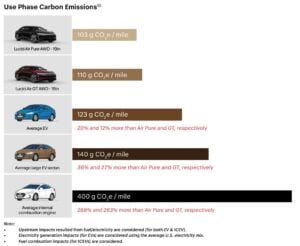
Lucid designs its motors, batteries, and software in-house. This vertical integration allows it to reduce energy losses and improve performance. The Lucid Air has up to 30% lower lifecycle emissions than some other luxury EVs. This is due to its lightweight materials and smart battery management.

Lucid air pure carbon emissions
Source: Lucid

Lucid’s production plant in Casa Grande, Arizona, uses some renewable energy. The company is also looking for more clean energy sources. As production scales, maintaining low emissions per vehicle will be critical.

Transparency and Reporting

Lucid publishes regular sustainability reports outlining its environmental performance and goals. It is a member of the United Nations Global Compact, which promotes corporate responsibility in areas like labor, human rights, and climate action.

Lucid also receives independent ESG risk ratings from firms that measure how well companies manage sustainability challenges. These ratings help investors understand the environmental and social impact of Lucid’s business model.

Circular Design and Materials

The company is working on a circular design approach — recycling and reusing materials wherever possible. For example, battery packs are made for easy disassembly. They can be reused in energy-storage systems after their automotive life ends.

Lucid’s engineers are also researching sustainable materials for interiors, such as plant-based leathers and low-impact textiles. These steps align with the growing demand for environmentally responsible luxury products.

The Roadblocks to Lucid’s Expansion

Lucid’s record quarter is encouraging, but major hurdles remain, including: 

  1. Production Ramp-Up: To meet its 2025 goal of 18,000 to 20,000 vehicles, Lucid must roughly double quarterly production in Q4. That requires stable supply chains, smooth plant operations, and strong workforce coordination.
  2. Post-Incentive Demand: Now that the U.S. EV tax credit has expired, sales may dip temporarily. Lucid will need new marketing and financing options to keep the momentum going.
  3. Cost and Competition: Rising input costs and new EV competition could pressure prices. Established automakers like BMW, Mercedes, and Tesla are expanding their electric lineups. Price wars in the EV market are already common.
  4. Scaling Sustainability: As production grows, Lucid must ensure suppliers meet strict sustainability standards. Mining for battery materials, energy use in manufacturing, and logistics all add to its carbon footprint.

Maintaining ESG credibility will be key as the company expands globally. Investors increasingly favor automakers that combine growth with clear climate strategies.

Can Lucid Stay Luxurious, Profitable, and Green?

Lucid’s third quarter proves that its products are gaining traction. Deliveries are increasing, brand awareness is growing, and the company is gradually expanding its production.

But the missed forecasts show that growth alone isn’t enough. To win investor confidence and compete with larger players, Lucid must show consistent, predictable performance.

At the same time, its sustainability promise remains central to its brand identity. Lucid wants to create vehicles that are both luxurious and eco-friendly. The luxury carmaker focuses on using less energy, reducing emissions, and setting new efficiency standards.

If Lucid keeps a balance between high-end innovation and real-world sustainability, it can secure a lasting spot in the fast-changing EV market. But to succeed, it must show it can turn potential into steady, scalable success while also keeping its environmental promises.

The post Lucid Motors (LCID) Stock Rises on Record Quarter: Growth, Green Goas, and the Road Ahead appeared first on Carbon Credits.
Renewables 2025: How China, the US, Europe, and India Are Leading the World’s Clean Energy Growth

Renewables 2025: How China, the US, Europe, and India Are Leading the World’s Clean Energy Growth

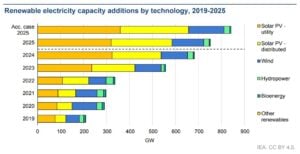
The world’s renewable energy sector has entered a new phase of record growth. According to the International Energy Agency’s Renewables 2025 report, global renewable power capacity grew by more than 510 gigawatts (GW) in 2024 — the fastest increase ever recorded. Another 520 GW is expected to be added in 2025, pushing renewables to account for over 90% of all new global power capacity.

Solar and wind dominate this growth. By 2025, solar will account for nearly three-quarters of new installations. This growth comes from cheaper technology, improved grid integration, and supportive policies. Wind power is also recovering after a slowdown in 2022–2023, supported by new offshore projects in Europe, China, and the United States.

The IEA says the world’s total renewable capacity will reach nearly 5,800 GW by 2025, up from around 4,200 GW in 2023. That means renewables now generate about 30% of global electricity and are on track to reach 42–45% by 2030.

Renewable electricity capacity additions by technology

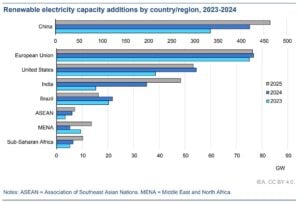
Four regions — China, Europe, the United States, and India — are responsible for almost 90% of this global expansion. Each is moving at a different pace, but together they are transforming how the world produces and consumes energy.

Renewable electricity capacity additions by country

Europe: Accelerating the Energy Transition

Europe continues to lead in energy policy and innovation. In 2024, the European Union added more than 70 GW of new renewable capacity, driven mainly by solar. This is a record year. It shows the bloc’s goal to cut reliance on imported fossil fuels. They aim to meet their Green Deal target of a 55% emissions reduction by 2030.

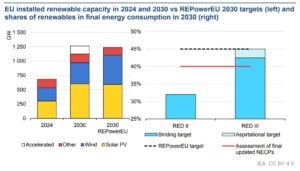
Solar capacity across the EU doubled between 2020 and 2024, reaching over 300 GW, while wind capacity passed 220 GW. The IEA predicts that Europe will add 450 GW of renewables from 2025 to 2030. This will raise the total capacity to almost 870 GW by the end of the decade.

EU installed renewable capacity in 2024 and 2030

Much of this growth is tied to the REPowerEU plan, which aims to speed up permitting and expand rooftop solar. Offshore wind is gaining popularity. Countries like Germany, Denmark, and the Netherlands are investing in North Sea projects.

Despite progress, Europe faces challenges. Delays in grid expansion and limited local manufacturing capacity for wind turbines have created supply bottlenecks. Even so, strong policy support and high carbon prices still make renewables the best choice for power generation.

United States: Policy Support and Private Investment Drive Expansion

The United States is entering a period of major renewable growth, supported by the Inflation Reduction Act (IRA) and record private investment. The IEA expects the U.S. to add around 400 GW of new renewable capacity by 2030, effectively doubling its current base.

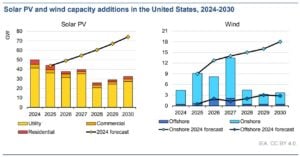
In 2024, U.S. solar installations rose by nearly 40%, reaching 45 GW for the year. Solar now accounts for the largest share of new capacity additions. Wind power also recovered, with onshore and offshore projects expanding in Texas, California, and along the East Coast.

Solar PV and wind capacity additions in US

Renewables currently generate about 26% of U.S. electricity, up from 22% in 2022. The IEA projects this share will climb to over 40% by 2030, driven by federal tax incentives and falling technology costs.

Battery storage is another fast-growing sector. Storage capacity doubled between 2023 and 2024, helping stabilize variable solar and wind output. The IRA’s clean energy credits could draw over $400 billion in investments by 2032. This boost will help generate energy and support U.S. manufacturing of solar panels and turbines.

Challenges remain. The U.S. needs to modernize its grid and streamline permitting for transmission lines to connect renewable projects to demand centers. But the direction is clear — renewables are becoming the backbone of America’s energy system.

China: The Global Powerhouse of Renewables

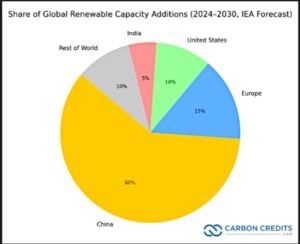
China remains the undisputed leader in renewable energy growth. The IEA projects that China will account for about 60% of all new renewable capacity added worldwide by 2030.

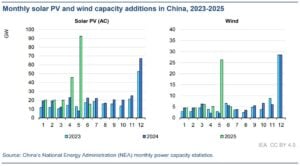
In 2024 alone, China installed more than 260 GW of new renewables — more than the rest of the world combined. Solar made up the majority of this, with over 190 GW of solar capacity added during the year.

Wind power grew by 60 GW. China kept building big onshore and offshore projects in Inner Mongolia, coastal areas, and deserts.

Monthly solar PV and wind capacity additions in China

China now has an estimated 1,400 GW of total renewable capacity, representing about half of the global total. Renewables already supply more than 35% of China’s electricity, up from 27% in 2020.

Government policy is the key driver. China aims to reach 1,200 GW of combined solar and wind capacity by 2030, a target it is likely to achieve five years early. The country’s large manufacturing base keeps equipment prices low globally. This helps other regions grow their clean energy fleets.

Still, integration challenges persist. Some provinces face grid congestion and curtailment — when renewable power can’t be used due to transmission limits. The IEA recommends that China continue to invest in grid upgrades and flexible storage systems to handle its rapid growth.

India: The Fastest-Growing Emerging Market for Renewables

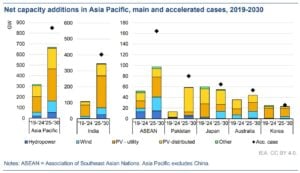
India is now the fastest-growing renewable energy market among developing economies. The IEA expects India’s renewable capacity to nearly double between 2023 and 2030, expanding from around 190 GW to 360–380 GW.

renewable net capacity additions India

Solar energy is leading the charge. In 2024, India added more than 17 GW of solar capacity, supported by large auctions and declining costs. Wind capacity also grew modestly, and new hybrid projects combining solar and wind are improving reliability.

The government’s goal is ambitious: 500 GW of non-fossil capacity by 2030, which would cover about 50% of total power demand. India is also expanding its domestic solar manufacturing base to reduce dependence on imports.

Hydropower and bioenergy continue to play supporting roles, particularly in rural electrification. The IEA reports that renewable energy in India cuts over 250 million tonnes of CO₂ emissions each year. This makes India a major player in global emission reductions, second only to China.

However, financing and grid infrastructure remain key hurdles. The report notes that India needs annual clean energy investments of about $60–70 billion through 2030 to meet its targets.

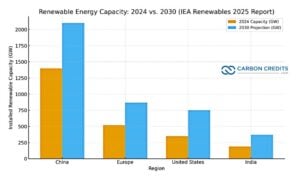
The chart below compares renewable energy capacity in 2024 vs. 2030 projections for the four key regions, based on the IEA Renewables 2025 report.

renewable energy capacity by region IEA report
Data source: IEA Report

It clearly shows China’s dominant position, followed by steady growth in Europe and the U.S., and rapid expansion in India’s renewable capacity by the end of the decade.

The Decade of Clean Power: A Turning Point for Global Energy

The combined momentum of China, Europe, the United States, and India is reshaping global energy markets. Together, these four regions will account for almost 90% of all renewable capacity growth by 2030.

The pie chart shows each region’s share of total global renewable capacity additions from 2024 to 2030, based on the IEA forecast. It also shows how dominant China remains in driving renewable expansion, while Europe, the U.S., and India together account for about one-third of the world’s clean-energy growth.

share of global renewable capacity additions 2030 IEA 2025 report
Data source: IEA Report

Global renewable electricity capacity is expected to surpass 6,200 GW in 2025 and reach 8,300 GW by 2030 — roughly triple the total in 2015. Solar will remain the dominant source, followed by wind and hydropower.

Yet challenges persist. The IEA warns that grid constraints, permitting delays, and uneven financing could slow progress in developing economies. To stay on track for the net-zero pathway, annual renewable additions must rise to around 800 GW per year by 2030.

Still, the direction is clear. The world is entering a decade where clean power becomes the main driver of growth, investment, and energy security. The actions of these four key players will determine how fast the transition happens and how close we come to a truly sustainable global energy system.

The post Renewables 2025: How China, the US, Europe, and India Are Leading the World’s Clean Energy Growth appeared first on Carbon Credits.

Top Gold ETFs to Watch Now as Gold Prices Break $4,000 — IAU, GLD, and GDX Lead the Pack

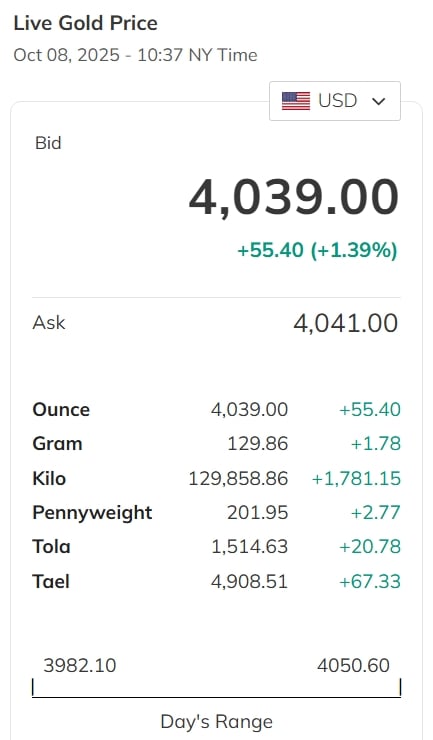
Gold prices climbed to new highs on Monday, with December futures reaching a record $4,014.60 per ounce. The yellow metal stayed strong as investors sought safety amid global uncertainty and a prolonged U.S. government shutdown.

Goldman Sachs raised its December 2026 gold price forecast from $4,300 to $4,900 per ounce, citing steady central bank purchases and renewed investor interest in gold-backed ETFs. Spot gold has surged 52% so far this year, supported by a weaker U.S. dollar and rising geopolitical tensions.

gold prices
Source: KITCO

But first, let’s take a closer look at gold ETFs — what they are and why so many investors are turning to them.

What Are Gold ETFs and Why Are They Popular?

Gold Exchange-Traded Funds (ETFs) mirror the market price of physical gold without requiring investors to hold the metal themselves. Each ETF unit typically represents one gram of 99.5% pure gold, traded on stock exchanges just like shares.

Key features of gold ETFs include:

  • Backed by physical gold stored in secure vaults
  • Real-time pricing and easy trading through Demat accounts
  • No storage or making charges
  • Lower transaction costs and high liquidity
  • Transparent pricing that tracks the spot gold rate

Central Banks and ETFs Fuel the Gold Price Rush

Reports say that China’s central bank has played a major role in driving gold demand. In September, the People’s Bank of China (PBOC) added to its gold reserves for the 11th month in a row, increasing holdings to 74.06 million troy ounces from 74.02 million in August. The value of these reserves also jumped to $283.29 billion, up from $253.84 billion the previous month.

Goldman Sachs expects central banks to keep buying gold, with around 80 tonnes forecast for 2025 and 70 tonnes for 2026, as emerging economies continue to diversify away from the U.S. dollar.

At the same time, strong inflows into gold ETFs are supporting the rally, giving investors an easier and safer way to gain exposure to rising gold prices.

Top Gold ETFs to Watch: IAU, GLD, and GDX

Gold ETFs provide a practical, cost-effective, and transparent way to invest in gold, avoiding the hassle of storage, insurance, and purity verification.

iShares Gold Trust (IAU)

IAU is one of the largest gold ETFs with around $72.7 billion in market capitalization. Each share represents roughly 0.01 ounces of gold, making it affordable for small investors. With a low expense ratio of 0.25%, IAU offers cost-effective access to physical gold.

However, it does not follow a specific ESG (Environmental, Social, and Governance) framework since it directly holds bullion. Any sustainability impact stems from the gold mining and refining practices behind the physical gold it stores.

iShares Gold Trust IAU
Source: Yahoo Finance

SPDR Gold Shares (GLD)

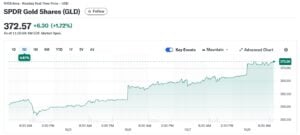
GLD is the world’s largest gold ETF, managing about $129 billion in assets. Each share equals one-tenth of an ounce of gold, stored in vaults in London, New York, and Zurich, backed by custodians like JPMorgan Chase and HSBC. It is known for its high liquidity and tight spreads.

SPDR Gold Shares has removed many barriers to investing in gold, such as buying, storing, and insuring it. The fund provides direct exposure to physical gold, minus expenses, without relying on derivatives that carry extra credit risk.

It allows investors to easily access the gold market and include it in their portfolios, offering a strategic way to diversify risk due to gold’s low or negative correlation with other assets.

Like IAU, GLD does not integrate ESG criteria but depends on the ethical and environmental practices of gold suppliers and refiners.

SPDR Gold Shares (GLD)
Source: Yahoo Finance

VanEck Gold Miners ETF (GDX)

GDX differs from IAU and GLD as it invests in leading gold mining companies instead of holding physical gold. Managing around $22.54 billion in assets, GDX tracks major miners such as Newmont and Barrick Gold.

The fund provides leveraged exposure to gold prices through miner performance. Since it involves mining operations, ESG factors play a more direct role covering carbon reduction, responsible sourcing, labor safety, and community development.

From an investment perspective, GDX is a highly liquid ETF with substantial assets, suited for investors seeking gold exposure and prepared for higher volatility. It benefits from inflation or economic uncertainty, offering exposure to global gold miners.

While mining stocks can be riskier than gold due to company and operational factors, GDX spreads risk across multiple large and mid-sized miners.

gdx gold etf
Source: Yahoo Finance

Sustainability Perspective: Physical Gold vs. Gold Miners

Physical gold ETFs like IAU and GLD mainly reflect the sustainability impact of gold mining through their bullion holdings. They don’t actively engage in ESG initiatives. In contrast, GDX connects investors directly to mining companies that can influence sustainability outcomes through operational decisions.

Investors focused on responsible investing should assess the ESG performance of individual mining companies within funds like GDX. This approach allows for more transparency and accountability in evaluating how sustainable practices affect returns and risk exposure.

Gold’s Shine Isn’t Fading Anytime Soon: A Smart Safe-Haven Investment

It’s now clear that the gold price is hitting record highs due to central banks buying more, strong ETF inflows, and ongoing global uncertainty. Because of this, ETFs like IAU, GLD, and GDX give investors different ways to invest in gold, depending on their needs for liquidity, cost, and even sustainability.

At the same time, the market is watching for possible Federal Reserve rate cuts and dealing with economic uncertainty. Gold’s appeal as a safe-haven asset remains strong. And Goldman Sachs’ higher forecast adds to investor confidence — the gold story is far from over.

gold prices

Also, institutional investors are increasingly using gold ETFs to balance portfolios and protect against stock market swings. Experts recommend investing gradually and diversifying, especially after gold’s sharp price jump. Long-term investors like these ETFs because they are affordable, simple, and easy to manage.

Plus, rising interest in gold is encouraging some investors to explore other commodity ETFs, such as silver and industrial metals, to spread their risk.

In short, gold ETFs are a favorite in 2025 for their simplicity, transparency, and ability to protect against inflation and market ups and downs. Both retail and institutional investors see them as a safe and reliable way to invest in uncertain times.

The post Top Gold ETFs to Watch Now as Gold Prices Break $4,000 — IAU, GLD, and GDX Lead the Pack appeared first on Carbon Credits.