High-Quality Carbon Credit Prices Hit Record Levels, Driven by Integrity and Market Shifts

High-Quality Carbon Credit Prices Hit Record Levels, Driven by Integrity and Market Shifts

High-quality carbon credits are becoming more valuable than ever, with prices reaching record levels in late 2025, according to Sylvera. This finding reflects a deeper change in the voluntary carbon market. Companies are no longer buying credits only to meet pledges. They are looking for projects that prove real impact and deliver measurable results.

This shift matters because it shows how trust is shaping the carbon market. Buyers are signaling that only carbon credits backed by evidence and durability will support their net-zero goals.

Data Doesn’t Lie: Sylvera’s Market Snapshot

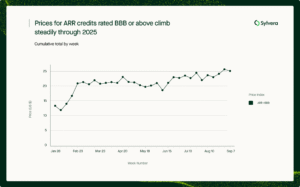
Sylvera’s Q3 2025 Carbon Data Snapshot gives a clear view of where the market is heading. Prices for afforestation, reforestation, and revegetation (ARR) credits reached $24 per tonne in September. At the start of the year, the average was closer to $14, as seen in the chart below. This jump shows how much buyers are willing to pay for quality.
carbon credit prices ARR sylvera

Quoting Allister Furey, CEO at Sylvera: 

“The growing premium for high-quality credits demonstrates that integrity is now a key driver of value. Buyers are becoming more selective and project developers are responding by meeting higher standards.”

Retirements also stayed strong. In Q3, about 31.86 million tonnes of credits were retired, almost unchanged from the 31.49 million in Q3 2024. Year-to-date retirements reached 128.15 million credits, one of the highest totals ever recorded.

carbon credit yearly retirements sylvera

Supply, however, has slowed. Issuances fell to 63.2 million credits in Q3, down from 76.9 million in Q2. This creates a tighter market where demand outpaces new supply.

Another important trend is the shift toward higher-rated credits. In the first half of 2025, 57% of retired credits reviewed by Sylvera were BB grade or higher. In 2024, that figure was 52%. Buyers are clearly moving away from lower-quality offsets and investing in verified projects that prove long-term climate value.

Real Projects Driving Change

Behind these numbers are real-world examples that show how the market is evolving. Forestry projects remain central, but the focus has shifted toward ones that demonstrate permanence and co-benefits:

  • Pachama works with reforestation and forest conservation across Latin America. Their credits are tied to satellite monitoring and AI verification, which improves transparency.

  • Verra-certified projects in Africa and Asia have begun linking biodiversity protection with carbon storage, attracting buyers willing to pay premiums.

  • On the technology side, Climeworks in Iceland is scaling direct air capture plants that store CO₂ underground. These credits cost far more than forestry but offer permanence, making them appealing to firms with strict climate goals.

These examples show why high-quality credits command higher value: they combine measurable climate impact with added social or environmental benefits.

Billions in Play: Carbon Market Expansion

Sylvera’s numbers fit into a much larger trend. The voluntary carbon market was valued at $4.04 billion in 2024, per Grand View Research data. Estimates suggest it could grow to between $50-$100 billion by 2030.

Nature-based and renewable energy credits remain central to this growth. In 2024, they made up a significant share of total revenues. Meanwhile, carbon removal credits are expected to expand even faster. MSCI projects removal could reach $4 to $11 billion by 2030, making it a key driver of future growth.

Prices are also spreading across a wide range. Nature-based credits typically trade between $7 and $24 per tonne. Technology-based removals, such as direct air capture, are much higher—between $170 and $500 per tonne. These differences reflect the varying durability and permanence of different credit types.

carbon credit price per project type abatable

Why High-Quality Credits Cost More

The surge in premium prices for carbon credits comes from several forces working together. Companies with net-zero targets want credits they can defend publicly. That means verified, durable credits with strong evidence of climate benefit.

Supply is another issue. Many projects take years to produce verified credits, and issuances have slowed. Buyers are competing for fewer top-tier credits, which pushes prices higher.

Rating systems like Sylvera’s add more transparency. Buyers now have a clearer way to separate weak projects from strong ones. This transparency builds confidence and influences purchasing decisions.

Policy also plays a role. In Europe and elsewhere, regulators are exploring how voluntary credits may fit into compliance markets. Credits with higher integrity are more likely to qualify, which increases their value.

Finally, projects with added co-benefits—such as biodiversity protection or community development—attract more buyers. Sylvera has reported that credits offering four or more strong co-benefits command higher prices.

All of these drivers show how the market is evolving from a quantity focus to a quality-first approach.

The Great Divide: Carbon Removal vs. Avoided Emissions

A big divide exists between avoided emissions and carbon removal. Avoided emissions come from projects like preventing deforestation. Carbon removal means pulling carbon dioxide directly out of the air and storing it.

Market forecasts suggest removals will grow faster than reductions. But they are also far more expensive. Engineered removals currently trade at hundreds of dollars per tonne, while nature-based projects remain in the lower range.

As technology improves, costs for engineered removal may fall. Still, removal will likely hold a premium because of its permanence. Buyers see value in removal. For example, Microsoft has signed long-term contracts with Climeworks and other carbon removal firms.  This reflects a growing recognition that permanent removal is necessary for reaching long-term climate goals.

Integrity Under Pressure: Barriers to Growth

Despite progress, several challenges remain:

  • Verification: Forestry credits face risks from fires, disease, or illegal logging, making permanence hard to guarantee.

  • Scaling technology: Engineered removals are still in pilot phases and remain costly.

  • Liquidity: Fewer high-quality credits means market swings are sharp when demand spikes.

  • Fragmentation: Multiple registries and standards create confusion, slowing investment.

These challenges underline the importance of building a system of integrity. If standards weaken, the market risks losing trust.

Future Value: Where Carbon Markets Go Next

Sylvera’s latest report makes the trend clear. Prices for high-quality credits are rising fast, and the market is demanding better integrity. Other industry data supports this, showing billions in future growth and a shift toward removal.

Challenges remain, from verifying permanence to scaling new technology. But one theme stands out: credibility now drives value. The voluntary carbon market is entering a new phase where only proven results matter.

For companies, this means buying credits is no longer just about cost. It is about quality, durability, and trust. For the market, it signals a move toward maturity. High-quality carbon credits are not just commanding record prices—they are setting the new standard for climate action.

As Furey further stated:

“This alignment between quality expectations and market demand is critical for scaling carbon markets to deliver genuine climate impact at lower economic cost.”

The post High-Quality Carbon Credit Prices Hit Record Levels, Driven by Integrity and Market Shifts appeared first on Carbon Credits.

Investing in Quantum Computing: How IONQ, QUBT, RGTI & QBTS Stocks Are Revolutionizing Technology and Climate Solutions

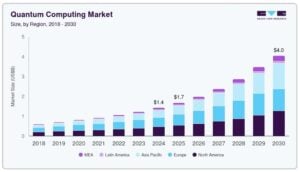
Governments and private investors are investing heavily in quantum computing. This is pushing the technology toward real-world applications. Experts predict the market will hit about $4.24 billion by 2030. It is expected to grow roughly 20.5% each year from 2025 to 2030.

Artificial intelligence has changed investing. When paired with quantum computing, it may create big wealth-building chances in the coming decades.

quantum stocks quantum computing

Investing in Top Pure-Play Quantum Stocks: The Next Tech and Climate Revolution

Recent breakthroughs in qubit stability and new partnerships for larger quantum networks are driving growth. Leading pure-play quantum stocks have risen as investors bet on widespread commercial use.

These companies are at the forefront, turning advanced research into real solutions. They could reshape industries like pharmaceuticals and energy.

Investors can now position themselves in top pure-play quantum stocks. This lets them capitalize on rapid innovation and a growing market.

Quantum computing is ushering in a new era of technological innovation—and nowhere is this impact more pronounced than in climate solutions. The leading pure-play quantum stocks – IonQ (IONQ), D-Wave Quantum (QBTS), Quantum Computing Inc. (QUBT), and Rigetti Computing (RGTI) – are actively driving advances in clean energy, carbon reduction, and climate science. Here’s how each company plays a vital role:

1. IonQ (IONQ): Betting Big on Quantum’s Future

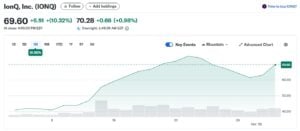
In just the past six months, IonQ’s stock has surged to around $70, delivering a gain of more than 170%, confirming its lead in quantum computing. Its ion-trap systems outperform competitors like IBM and Google with better fidelity and scalability. The company aims to achieve 80,000 logical qubits by 2030, which could drive advances in AI, pharmaceuticals, and cybersecurity.

Strong Cash Position Fuels Growth

As of July 2025, IonQ had $1.6 billion in cash and raised a record $1 billion in equity from a single institutional investor—the largest in the industry. This fund allows IonQ to grow rapidly. Additionally, the company’s market cap stands at $16.5 billion.

Tempo Hits AQ-64, Expanding Quantum Horizons

IonQ recently revealed that its Tempo system achieved a record AQ-64 ahead of schedule. This achievement doubles the useful computational space with each step. Now, the system can address real-world challenges like energy optimization, drug discovery, and supply chain modeling. At #AQ 64, IonQ is 36 quadrillion times more powerful than IBM’s current systems.

Investor Outlook

Recent acquisitions in networking, sensing, and space, including Oxford Ionics and Capella Space, enhance IonQ’s ecosystem. Significantly, it has been broadening its cloud presence through integrations with Amazon Web Services, Microsoft Azure Quantum, and Google Cloud Marketplace.

ionq stock
Yahoo Finance
Thus, analysts are optimistic, setting targets as high as $100. Although still unprofitable, IonQ presents long-term potential as a leading quantum player.

Making Energy Cleaner and Models Smarter

IonQ is helping make energy cleaner using quantum computers. In 2025, IonQ’s technology made power grid simulations up to 50 times faster than before. This helps cities use wind and solar power without losing energy. When energy managers used IonQ’s computers, they found ways to reduce pollution by as much as 15%.

IonQ is also working with scientists to design better batteries and materials that can capture pollution out of the air. Their computers solved problems that regular computers could not, making new discoveries up to 70% quicker. That means new green tech, like battery storage and pollution capture, could become available sooner and help fight climate change.

By speeding up climate models and helping companies plan their energy use, IonQ is playing a big role in lowering emissions and helping the world become greener.

2. D-Wave (QBTS) Poised for Growth with Quantum Advantage

D-Wave (NYSE: QBTS) is charting its own path. Rather than developing general-purpose quantum computers, it specializes in quantum annealing. This method excels in optimization tasks like logistics and statistical modeling. This focused strategy helps D-Wave capture valuable use cases without trying to cover the whole quantum market.

Notably, it stands out as the only company offering both annealing and gate-model systems. Over 100 clients, including government and enterprise customers, are using its solutions.

Additionally, the company announced in March that Ford Otosan has used D-Wave’s technology to improve production sequencing for its Ford Transit line.

Revenue and Cash Boost

The company reported a record Q1 fiscal 2025 revenue of $15 million. This is a 509% increase from $2.5 million last year. Its cash balance climbed to $304.3 million, bolstered by $146.2 million raised through its ATM program.

Advantage2 Expands Commercial Reach

D-Wave launched its sixth-generation Advantage2 system. It has over 4,400 qubits, making it the most powerful quantum computer they’ve created so far. This system addresses real-world issues that classical computers struggle with. Commercial adoption is accelerating, with bookings in APAC rising 83% in 2025.

Investor Outlook

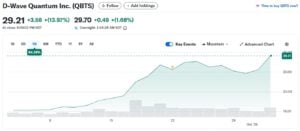
Wall Street is optimistic. We also see that Piper Sandler raised its target to $22, Stifel set a $26 target, and Benchmark maintained its $20 Buy rating. Strong demand, solid funding, and growing commercial applications make QBTS a leader in the quantum field. Most significantly, analysts see the revenue jump as a solid path to profitability.

D-Wave Quantum Inc QBTS
Source: Yahoo Finance

Quantum Solutions for Cleaner Cities

D-Wave’s technology and quantum computers help save energy and cut down pollution. D-Wave worked with a utility company in Europe to manage solar and wind power, making those clean energy sources more reliable and efficient. Their computers help balance the flow of energy so that less is wasted, meaning fewer fossil fuels are needed.

In Tokyo, D-Wave helped set up smart trash collection. Their computers figured out how trucks could use shorter routes and fewer vehicles. This cut down driving by 57% and saved a lot of fuel. In other tests, D-Wave’s technology helped reduce traffic jams by 17% and cut emissions in supply chains by 20%.

D-Wave’s newest computers use much less energy than big data centers. Their systems let companies manage energy and deliveries in ways that were never possible before, helping cities get cleaner and businesses save money.

3. Quantum Computing Inc. (QUBT): A High-Risk, High-Reward Quantum Play

Quantum Computing Inc. (Nasdaq: QUBT) focuses on photonic chip integration. It also launches Quantum AI and cybersecurity products. Currently, its early revenues are low. The company relies on government and industry partnerships. This dependence brings execution and adoption risks.

The company recently disclosed that it has $850 million cash position, strengthened by a $500 million private placement in September 2025. These funds support fab scaling, hiring, strategic acquisitions, and commercialization efforts.

Some commendable product developments include delivering a quantum photonic vibrometer to Delft University of Technology. It also shipped its first entangled photon source to a lab in South Korea. Meanwhile, a top-five U.S. bank adopted the Quantum Cybersecurity Solution. These wins show that QUBT’s products solve real-world challenges.

Foundry Powers Scale and Performance

The company’s thin-film lithium niobate (TFLN) foundry in Tempe, AZ, is now fully operational. It integrates nano-photonic chips into quantum systems. This improves size, weight, power, cost, and performance. External services also boost revenue in datacom, telecom, sensing, and quantum computing.

qubt
Source: Yahoo Finance

However, QUBT faces strong competition from IonQ and D-Wave. High risks in execution and adoption make this suitable for risk-tolerant investors. They seek asymmetric upside in early-stage quantum photonics.

Tracking Pollution and Saving Energy

QUBT builds quantum computers that help track pollution and save energy every day. Their machines are easier and cheaper to run than the biggest supercomputers. In 2024, QUBT invested millions to help forecast climate changes and make electric grids better. Their computers measure carbon pollution in the air almost twice as accurately as older methods, which means cities and governments can know what’s happening and act faster.

By working with power companies, QUBT found ways to cut energy waste by 37%. They believe their technology will help make big improvements – up to 52% – in just a few years. QUBT computers are also making it easier for countries and companies to test how well climate laws work and fix problems quickly.

With better data and faster answers, QUBT is helping people support a cleaner future through smarter science and technology.

4. Rigetti Computing (RGTI): The Future of Quantum Hardware

Rigetti Computing (NASDAQ: RGTI) is a top quantum computing stock drawing strong investor interest. The company is pushing forward with superconducting qubit technology and bold innovations. However, its revenue is small compared to its high valuation.

Leading in Quantum Hardware

Rigetti employs a chiplet-based approach to scale its quantum processors, distinguishing it from IBM and Google. Its Cepheus™-1-36Q system is live on Rigetti’s Quantum Cloud Services and will soon be on Microsoft Azure.

In September 2025, the company launched a 36-qubit processor that cut two-qubit errors in half and achieved 99.5% gate fidelity. This progress shows it can scale to over 100 qubits.

Market Momentum and Funding

Revenue for Q2 2025 is $1.8 million, which is modest. Shares are trading around $32, up over 4,000% in the past year. Rigetti has about $571 million in cash and no debt. This provides a strong runway for research, partnerships, and production.

Key collaborations include Quanta Computer’s $35 million investment, contracts with the U.S. Air Force, and ties with India’s C-DAC for hybrid quantum systems.

Risks and Outlook

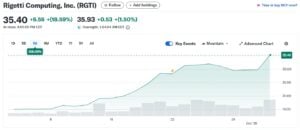
RGTI stock
Source: Yahoo Finance

Most analysts rate RGTI stock a “Buy,” but its stock price exceeds many targets. The price-to-sales ratio is around 900x. This means Rigetti offers high-risk, high-reward exposure to next-generation quantum computing. It suits investors willing to bet on long-term breakthroughs and tolerate short-term volatility.

Building Better Batteries and Clean Tech

Rigetti is building quantum computers that help scientists create new batteries, solar panels, and even machines to capture pollution. Their computer chips work with very few mistakes, so testing new clean tech designs is quicker and cheaper. In 2025, Rigetti joined with governments and technology companies to set up projects using quantum computers in clean energy labs.

Rigetti’s computers helped make battery and solar designs three times as fast as before. A recent U.S. Air Force project spent $5.8 million to test Rigetti’s computers for national security and energy grid science. With international orders for their systems, Rigetti’s technology is helping researchers all over the world find the fastest ways to cut pollution and improve clean energy.

Rigetti is proving that new quantum computers can help jumpstart the next wave of green inventions.

Power Needs and Efficiency of Quantum Computing

Quantum computers demand significant energy to operate, especially superconducting qubit systems that must stay near absolute zero—about 0.015 Kelvin. And cooling consumes a significant 70% of the total power.

As qubit numbers grow, larger systems may need hundreds of kilowatts continuously. Researchers are testing energy-efficient cooling methods and developing qubits that can work at higher temperatures, which could significantly lower energy demand.

However, even with these requirements, quantum computers still use far less electricity than traditional supercomputers. Companies are also adopting sustainability measures, using renewable energy, modular hardware designs, and recycling rare materials to reduce their carbon footprint.

Accelerating Clean Tech and Materials Innovation

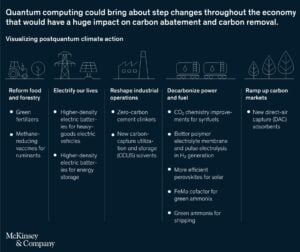
Quantum computing is changing how we approach materials and clean energy. A McKinsey report highlighted the following:

  • It is helping develop sustainable batteries, high-efficiency solar panels, and improved catalysts for carbon capture.
  • Researchers are creating battery chemistries that rely less on lithium and cobalt and designing solar materials that are safer and more effective.
  • Quantum simulations can also uncover compounds that make CO₂ capture and storage cheaper and more energy-efficient.
  • In energy systems, quantum machine learning and annealing help forecast supply and demand, optimize production, and integrate renewables into the grid.

quantum computing

These advances boost reliability, cut emissions, and make clean energy solutions more affordable, moving the world closer to sustainability goals.

As these companies advance their technology and scale operations, these pure-play quantum stocks may unlock massive growth. This makes it one of the most exciting sectors to watch.

Quantum computing is more than just a high-tech idea – it’s becoming a real-world tool for solving tough climate problems. Companies like IonQ, D-Wave, QUBT, and Rigetti are leading the way. Their computers let us model and fix energy systems, track pollution, and invent new green technologies faster than ever. This means not just a smarter future – but a cleaner, healthier planet for everyone.

The post Investing in Quantum Computing: How IONQ, QUBT, RGTI & QBTS Stocks Are Revolutionizing Technology and Climate Solutions appeared first on Carbon Credits.

Carbon Credit Market Gains Integrity With ICVCM’s Approval of 6 New Removal Standards

Carbon Credit Market Gains Integrity With ICVCM's Approval of 6 New Removal Standards

The voluntary carbon market (VCM) has taken a major step forward. The Integrity Council for the Voluntary Carbon Market (ICVCM) has approved six new carbon removal methodologies under its Core Carbon Principles (CCPs). These methods come from two programs: Isometric and Gold Standard. Both are known for meeting the council’s strict requirements.

This approval signals a shift toward stronger credibility in carbon removal credits. For years, the voluntary carbon market faced doubts about quality, transparency, and permanence.

Many companies hesitated to use credits due to fears of overstated benefits. The ICVCM names specific methods that meet high integrity standards. This helps businesses, investors, and governments have a clearer framework to trust. In the words of Annette Nazareth, ICVCM Chair:

“We are pleased to announce these new approvals for methodologies in a variety of emissions reductions and removals categories. The science is clear that both reductions and removals are critical to effective climate action. These latest approvals will open up new options for integrity-focused buyers to broaden their portfolios of carbon credits across a range of high-impact categories.”

The New Approved Standards

The six approved carbon removal methodologies include the following:

  • Gold Standard — Carbon Sequestration Through Accelerated Carbonation of Concrete Aggregate (v1.0)
  • Isometric — Biomass Geological Storage (v1.0–v1.1)
  • Isometric — Bio-oil Geological Storage (v1.0–v1.1)
  • Isometric — Subsurface Biomass Carbon Removal and Storage (v1.0)
  • Isometric — Biogenic Carbon Capture and Storage (v1.1)
  • Isometric — Direct Air Capture (v1.1)

In addition, the ICVCM confirmed two nature-based methodologies under other programs: CAR Mexico Forest Protocol v3 for improved forest management and VM0047 v1.1 for afforestation and reforestation.

These approvals matter because they are linked to very specific versions of methodologies. Not all projects under Isometric or Gold Standard automatically qualify. Only those that follow these approved versions can carry the CCP label.

From Doubts to Trust: Raising the Bar on Carbon Credits

So far, projects under these new removal methods have issued around 30,000 credits. While this number is small, the pipeline is much larger. ICVCM data show that:

  • 24 projects under the Isometric methods are expected to issue over 3.2 million credits annually in the coming years.
  • 15 projects under the Gold Standard method could issue over 9,000 credits annually.

In forestry, the CAR Mexico Forest Protocol v3 already has more than 8.1 million credits issued. However, not all will automatically qualify under the CCP label because of new permanence and leakage rules. For example, the protocol now requires a 40-year permanence commitment and allows leakage rates of up to 40%.

This level of detail adds clarity and accountability. It helps ensure that CCP-approved credits represent real, measurable, and durable climate outcomes.

From Billions to Trillions: The Future of Carbon Removal

The carbon removal market is still small compared to the scale of global emissions. Today, VCMs are valued at about $2 billion annually. Forecasts suggest they could reach up to $100 billion by 2030. Carbon removal will be central to that growth.

voluntary carbon credit demand growth
Source: McKinsey & Company

Currently, removals make up less than 1% of all credits sold. Most credits still come from avoided emissions, such as preventing deforestation. But future sales are shifting toward removals.

Buyers are showing stronger interest in forward contracts for engineered removals, like direct air capture, bio-oil storage, and biomass geological storage.

Analysts project that DAC capacity could reach 60–100 million tons per year by 2035, up from near zero today. Meanwhile, biochar, enhanced weathering, and subsurface storage are also scaling. These new CCP approvals provide the quality assurance needed to attract investment at this level.

Carbon market growth rates are projected at 25–30% annually through the next decade. By 2050, the sector could generate more than $1 trillion annually, reflecting the scale of removals needed to reach climate goals.

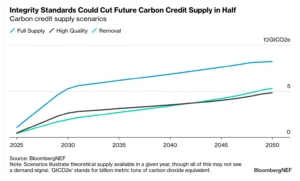
  • BloombergNEF projects that carbon credit supply will expand 20- to 35-fold by 2050, with engineered removals gaining share. Current supply sits near 243 million tons in 2024, rising to 2.6 billion tons by 2030 and 4.8 billion by 2050.
carbon credit supply 2050 BNEF
Source: BNEF

DAC is forecasted to deliver about 21% of credits by 2050. Prices for credits may increase to $60 per ton by 2030 and $104 by 2050, reflecting greater demand and higher quality standards.

Four Forces Powering the Carbon Removal Boom

Several forces are pushing removals into the mainstream.

  • Corporate Net-Zero Goals – More than 5,000 companies worldwide have pledged to reach net zero. Many will rely on removals to balance emissions they cannot fully cut.
  • Government Policy – U.S. and European policies, such as the Inflation Reduction Act and the EU Green Deal, provide tax credits and funding for carbon capture.
  • Investor Confidence – Clear CCP standards make investors more willing to finance high-quality projects.
  • Technology Scaling – Costs for engineered removals like DAC and bio-oil storage are expected to fall as projects scale up.

These trends show why carbon removal is becoming not just a side option but a pillar of climate strategy.

The Price of Permanence: Barriers Still Loom

Even with new approvals, challenges remain. Engineered removals are expensive. Current costs for direct air capture range from $300 to $600 per ton. Experts say this needs to fall below $100 per ton for widespread adoption.

Nature-based removals, while cheaper, raise other questions. Land use, biodiversity impacts, and long-term monitoring must be managed carefully. For example, requiring 40-year permanence adds credibility but also creates financial and operational hurdles for project developers.

The Integrity Council will need to enforce ongoing monitoring, verification, and auditing. Without strong oversight, credibility could erode again.

Why This Matters for Business and Capital

For companies, the approval of Isometric and Gold Standard removals offers more reliable ways to meet net-zero targets. Purchasing CCP-approved carbon credits reduces reputational risks and demonstrates a commitment to real climate action.

For investors, these standards provide a clearer signal about which projects are worth funding. Capital can flow toward technologies and practices that deliver measurable and permanent removals.

Carbon Markets 2030 and Beyond

The ICVCM decision is a foundation for growth. By 2030, analysts expect carbon removal to represent a much larger share of the voluntary market.

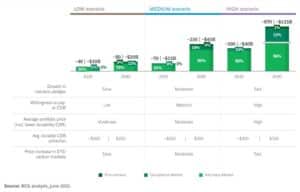
BCG carbon removal credit demand projection 2030-2040

Government integration will be another milestone. Both the UK and EU are exploring whether to allow carbon removals in their compliance systems within the next five years. If CCP-approved removals are included, demand could rise sharply.

The Integrity Council’s approval of six new methodologies from Isometric and Gold Standard represents a turning point for carbon markets. These decisions provide greater transparency, stronger safeguards, and a clearer path for scaling carbon removal.

While challenges remain in cost, permanence, and oversight, the foundation for trust is stronger than before. With new standards in place, the carbon removal market can grow from thousands to millions—and eventually billions—of tons of CO₂ removed. This shift is critical to balancing global emissions and moving closer to a net-zero future.

The post Carbon Credit Market Gains Integrity With ICVCM’s Approval of 6 New Removal Standards appeared first on Carbon Credits.
Lithium’s Turning Point: DOE Investment in LAC’s Thacker Pass and the LIT ETF Rally

Lithium’s Turning Point: DOE Investment, Thacker Pass, and the LIT ETF Rally

Lithium has become one of the most critical resources for the global energy transition. As demand for electric vehicles (EVs) and renewable energy storage grows, countries are racing to secure stable supplies of this lightweight metal.

In the United States, the Department of Energy (DOE) has just announced a new era for lithium production. At the same time, investor interest in lithium has surged, reflected by the strong monthly close of the Global X Lithium & Battery Tech ETF (LIT). These changes show that the lithium market is reaching an important stage. This stage is shaped by policy, technology, and financial momentum.

U.S. DOE Takes a Stake in Lithium Americas

The DOE recently confirmed it will take equity stakes in Lithium Americas and its Thacker Pass mine in Nevada. This move marks the first time the U.S. government has directly invested in a lithium project rather than providing loans or guarantees.

Thacker Pass is one of the biggest lithium deposits in North America. It could greatly decrease U.S. dependence on foreign sources.

Becoming a shareholder sends a clear message: lithium production is vital for both business and national security. China controls over 60% of global lithium refining. So, the U.S. wants to boost its own supply chains.

The government aims to support projects that ensure long-term stability. The government’s role lowers risk for private investors. This could lead to more funding and partnerships.

Thacker Pass: America’s White Gold Standard

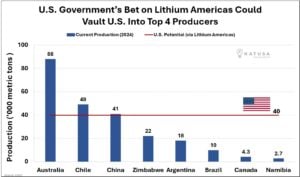
Thacker Pass, located in northern Nevada, is set to produce lithium carbonate. This will provide enough for batteries in up to one million EVs each year when fully operational. Construction is underway, and production is expected later this decade. The mine could make the U.S. one of the top four global producers, alongside Chile and Australia.

US potential to be top 4 lithium producers

Thacker Pass has not been without controversy, facing environmental opposition and legal challenges. However, federal and state support has kept the project moving forward. If successful, it could reshape the balance of supply in the Western Hemisphere and reduce reliance on imports from Asia.

A Global Tug-of-War for Lithium Supply

While the U.S. builds its domestic base, other regions are also reconfiguring supply chains.

  • Chile and Argentina hold about 60% of the world’s lithium reserves. They are rethinking their royalty rules and partnerships to bring in more foreign investment.
  • Australia, currently the largest producer, continues to expand mining output but faces bottlenecks in refining. Much of its raw spodumene is shipped to China for processing.
  • China, a leader in refining and cathode production, is boosting investments in Africa and South America. This helps it maintain its top position.

This global tug-of-war reflects a broader reality: lithium is not only an industrial commodity but also a strategic resource. Countries are ensuring access by using different methods. They invest directly, make long-term supply agreements, and innovate with technology.

EVs and Energy Storage: The Demand Engine

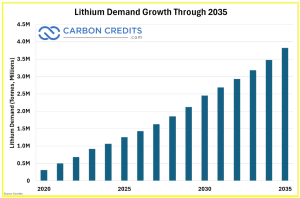
Lithium demand will likely surge in the next ten years. This rise is due to more people using EVs and increasing grid-scale energy storage. BloombergNEF forecasts lithium-ion battery demand reaching multiple terawatt-hours annually by 2035. EVs will likely make up over 70% of this total.

lithium demand growth through 2035

In the U.S., new federal incentives under the Inflation Reduction Act are pushing automakers to source more domestically produced materials. Ford, General Motors, and Tesla have all made deals for lithium. They expect the market to get tighter.

Meanwhile, utilities are using large battery storage systems. These help balance renewable energy from sources like wind and solar. This shift is increasing demand even more.

New Frontiers: Direct Extraction and Recycling

Meeting future demand will not only depend on mining new deposits but also on deploying new technologies. Direct lithium extraction (DLE) methods can boost recovery rates. They also lower environmental impact compared to old evaporation ponds. Companies in the U.S. and South America are piloting these systems, and if successful, DLE could accelerate supply growth.

Recycling also represents a growing opportunity. As the first wave of EV batteries reaches the end of life, recycling firms are stepping in to recover valuable metals. This secondary supply could become increasingly important in balancing markets and reducing dependence on mining.

Price Trends and Market Volatility

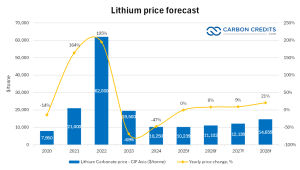
Lithium prices have seen dramatic swings in recent years. After hitting record highs in 2022, prices corrected in 2023 and 2024 as supply temporarily outpaced demand.

However, analysts warn that volatility is likely to persist. Benchmark Mineral Intelligence says lithium carbonate prices steadied in 2025. However, rising demand from EV makers could trigger another price surge in the late 2020s.

This volatility underscores the challenges for both producers and investors. Companies should balance long-term supply contracts with the risk of falling prices. Investors need to consider cyclical downturns alongside the bigger growth picture.

LIT ETF’s Rally Sparks Renewed Optimism

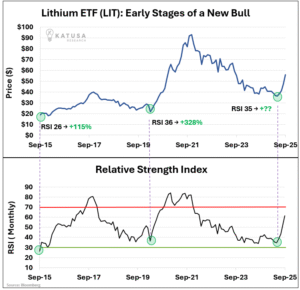
One sign of renewed optimism in the sector is the recent performance of the Global X Lithium & Battery Tech ETF (LIT). The ETF, which tracks a broad portfolio of lithium miners, battery producers, and EV companies, just posted its strongest monthly close in over a year, as seen in the Katusa Research chart below.

LIT ETF

This performance reflects investor belief that the worst of the price downturn may be over and that long-term fundamentals remain intact. Stronger government backing, such as the DOE’s investment, adds further support to the outlook.

For many investors, ETFs like LIT offer diversified exposure to a sector known for both opportunity and volatility.

Investment Playbook: Choosing Exposure Wisely

For investors, the lithium sector presents both risks and rewards. On one hand, rising demand for EVs and energy storage supports a strong long-term growth story. On the other hand, price volatility, environmental concerns, and geopolitical risks remain significant.

Investors generally face three approaches:

  • Major producers like Albemarle, SQM, and Ganfeng provide scale and stability.
  • Emerging juniors, such as Lithium Americas, offer high growth potential but higher risks.
  • ETFs like LIT provide diversified exposure, spreading risk across multiple companies and regions.

Each option carries different risk-reward profiles, making diversification a key strategy.

A Defining Decade for Lithium

The lithium industry is entering a transformative period. The DOE’s investment in Thacker Pass shows how vital it is to secure supply chains. Moreover, the strong close of the LIT ETF reflects rising investor confidence in this sector’s future. Globally, shifts in supply, demand, and technology are reshaping the landscape.

As EV adoption accelerates and renewable energy expands, lithium will remain a cornerstone of the energy transition. For governments, it is a matter of security and independence. For companies, it is a race to innovate and scale. And for investors, it represents both opportunity and volatility.

The next decade will likely define how lithium shapes the clean energy future, making today’s developments critical signals of what lies ahead.

The post Lithium’s Turning Point: DOE Investment in LAC’s Thacker Pass and the LIT ETF Rally appeared first on Carbon Credits.
Politics and Prevention – Fentanyl at the Center of U.S. Security and Leadership

* Disseminated on behalf of ARMR Sciences Inc.
* For Accredited Investors Only. Offered pursuant to Rule 506(c). Reasonable steps to verify accreditation will be taken before any sale.
PAID ADVERTISEMENT – SPONSORED CONTENT

Fentanyl is not just a public health crisis – it has become a defining political issue in the United States. The synthetic opioid is now the leading cause of death for Americans aged 18–45, killing an estimated 220 people every day. 

As the toll rises, many political leaders, border agencies, and private innovators are converging on one message: fentanyl control is a matter of national security.

A Political Priority

President Donald Trump has made fentanyl control a centerpiece of his drug policy priorities. These priorities include attacking production and distribution networks, using both punitive (law enforcement) and economic tools. Trump has vowed that his “highest duty is the defense of the country and its citizens,” promising to intensify measures against cartels and traffickers responsible for smuggling synthetic opioids across the southern border.

The bipartisan urgency is clear. Lawmakers across party lines now view fentanyl not only as a public health emergency but also as a national security threat on par with terrorism and cyberwarfare. This framing should open the door to expanded federal funding, new enforcement powers, and increased support for innovative countermeasures, such as immunotherapies.

Borders Under Pressure

Most illicit fentanyl in the U.S. is manufactured abroad, often in China, and trafficked through Mexico, where it enters across official and unofficial border crossings. U.S. Customs and Border Protection has reported record seizures in recent years. 

Canada, too, has experienced rising seizures and overdose deaths, underlining that this is not a U.S.-only crisis but a North American challenge.

Deployments of additional detection technology, canine units, and chemical sensors are underway at key border points. Yet border agents acknowledge they are overwhelmed: with traffickers mixing fentanyl into counterfeit pills or powder, even small gaps in enforcement can lead to mass fatalities.

ARMR’s Role in a Political Landscape

The fentanyl crisis is a political flashpoint that blends public health, security, and foreign policy. Border enforcement will remain essential, but no interdiction strategy can stop every shipment. 

We believe that this climate creates fertile ground for ARMR Sciences’ preventive approach. Unlike Narcan, which only works after an overdose has begun, ARMR-100 (ARMR’s lead candidate) is designed to block fentanyl before it reaches the brain. For policymakers, this aligns with national security goals: a proactive solution that reduces the burden on border interdiction and first responders. 

Why Investors Should Pay Attention

For investors, we believe that ARMR represents an opportunity to participate in a mission that is as much about impact as it is about returns. The company is working to translate 7 years of Department of Defense–backed science into a scalable biodefense platform:

  • Lead candidate ARMR-100 blocked 92% of fentanyl from entering the brain in preclinical studies
  • $30M private raise launched
  • A targeted exchange listing in the future
  • Direct alignment with political momentum on anti-fentanyl measures

With strong bipartisan focus and rising border enforcement pressure, companies like ARMR offering real solutions should be positioned to benefit from both government backing and investor interest. 

By investing in this round, investors have a chance to back ARMR as it works to build a preventive shield against synthetic drug threats. 

Invest now to help support ARMR’s efforts to build the nation’s first line of defense against fentanyl and other synthetic threats.

* For Accredited Investors Only. This offering is made pursuant to Rule 506(c) of Regulation D. All purchasers must be accredited investors, and the issuer will take reasonable steps to verify accredited status before any sale. Investing involves high risk, including the potential loss of your entire investment.

* This is a paid advertisement for ARMR’s private offering. Please read the details of the offering at InvestARMR.com for additional information on the company and the risk factors related to the offering.

* For investors from Canada: This advertisement forms part of the issuer’s marketing materials and is incorporated by reference into the issuer’s Offering Memorandum/Private Placement Memorandum under NI 45-106. Investors must receive and review the OM/PPM and execute the prescribed Form 45-106F4 Risk Acknowledgement before subscribing.

DISCLOSURES & DISCLAIMERS

CLIENT CONTENT: Carboncredits.com is not responsible for any content hosted on ARMR Sciences’ sites; it is ARMR Sciences’ responsibility to ensure compliance with applicable laws.

NOT INVESTMENT ADVICE: Content is for educational, informational, and advertising purposes only and should NOT be construed as securities-related offers or solicitations. All content should be considered promotional and subject to disclosed conflicts of interest. 

Do NOT rely on this as personalized investment advice. Do your own due diligence.

Carboncredits.com strongly recommends you consult a licensed or registered professional before making any investment decision.

REGULATORY STATUS: Neither Carboncredits.com nor any of its owners or employees is registered as a securities broker-dealer, broker, investment advisor, or IA representative with the U.S. Securities and Exchange Commission, any state securities regulatory authority, or any self-regulatory organization.

CONTENT & COMPENSATION DISCLOSURE: Carboncredits.com has received compensation of thirty thousand dollars from ARMR Sciences for this sponsored content. You should assume we receive compensation as indicated for any purchases through links in this email via affiliate relationships, direct/indirect payments from companies or third parties who may own stock in or have other interests in promoted companies. We may purchase, sell, or hold long or short positions without notice in securities mentioned in this communication.

RESULTS NOT TYPICAL: Past performance and results are unverified and NOT indicative of future results. Results presented are NOT guaranteed as TYPICAL. Market conditions and individual circumstances vary significantly. Actual results will vary widely. Investing in securities is speculative and carries high risk; you may lose some, all, or possibly more than your original investment.

HIGH-RISK: Securities discussed may be highly speculative investments subject to extreme volatility, limited liquidity, and potential total loss. The Securities are suitable only for persons who can afford to lose their entire investment. Furthermore, investors must understand that such investment could be illiquid for an indefinite period of time. No public market currently exists for the securities, and if a public market develops, it may not continue.

DISCLAIMERS & CAUTIONARY STATEMENT: Certain statements in this presentation (the “Presentation”) may be deemed to be “forward-looking statements” within the meaning of Section 27A of the 1933 Securities Act and Section 21E of the Exchange Act of 1934, as amended, and are intended to be covered by the safe harbor provisions for forward-looking statements. Such forward-looking statements can be identified by the use of words such as ”should,” ”may,” ”intends,” ”anticipates,” ”believes,” ”estimates,” ”projects,” ”forecasts,” ”expects,” ”plans,” and ”proposes.” Forward-looking statements, which are based on the current plans, forecasts and expectations of management of ARMR Sciences Inc. (the “Company” or “ARMR Sciences”), are inherently less reliable than historical information. Forward-looking statements are subject to risks and uncertainties, including events and circumstances that may be outside our control.

Although management believes that the expectations reflected in these forward-looking statements are based on reasonable assumptions, there are a number of risks and uncertainties that could cause actual results to differ materially from such forward-looking statements. Risks and uncertainties that could cause actual results to differ materially include, without limitation, those risks identified in the Private Placement Memorandum. Forward-looking statements speak only as of the date of the document in which they are contained, and ARMR Sciences Inc. does not undertake any duty to update any forward-looking statements except as may be required by law.

Any forward-looking financial forecasts contained in this Presentation are subject to a number of risks and uncertainties, and actual results may differ materially. You are cautioned not to place undue reliance on such forecasts. No assurances can be given that the future results indicated, whether expressed or implied, will be achieved. While sometimes presented with numerical specificity, all such forecasts are based upon a variety of assumptions that may not be realized, and which are highly variable. Because of the number and range of the assumptions underlying any such forecasts, many of which are subject to significant uncertainties and contingencies that are beyond the reasonable control of the issuing company, many of the assumptions inevitably will not materialize and unanticipated events and circumstances may occur subsequent to the date of any financial forecast.

ARMR Sciences Inc. takes no responsibility for any forecasts contained within the Presentation. None of the information contained in any offering materials should be regarded as a representation by ARMR Sciences Inc. The Company’s forecasts have not been prepared with a view toward public disclosure or compliance with the guidelines of the SEC, the American Institute of Certified Public Accountants or the Public Company Accounting Oversight Board. Independent public accountants have not examined nor compiled any forecasts and have not expressed an opinion or assurance with respect to the figures.

This Presentation also contains estimates and other statistical data made by independent parties and by management relating to market size and other data about our industry. This data involves a number of assumptions and limitations, and you are cautioned not to give undue weight to such estimates.

ARMR Sciences Inc. is currently undertaking a private placement offering of Offered Shares pursuant to Section 4(a)(2) of the 1933 Act and/or Rule 506(c) of Regulation D promulgated thereunder. Investors should consider the investment objectives, risks, and investment time horizon of the Company carefully before investing. The private placement memorandum relating to the offering of Securities will contain this and other information concerning the Company, including risk factors, which should be read carefully before investing.

The Securities are being offered and sold in reliance on exemptions from registration under the 1933 Act. In accordance therewith, you should be aware that (i) the Securities may be sold only to “accredited investors,” as defined in Rule 501 of Regulation D; (ii) the Securities will only be offered in reliance on an exemption from the registration requirements of the Securities Act and will not be required to comply with specific disclosure requirements that apply to registration under the Securities Act; (iii) the United States Securities and Exchange Commission (the “SEC”) will not pass upon the merits of or give its approval to the terms of the Securities or the offering, or the accuracy or completeness of any offering materials; (iv) the Securities will be subject to legal restrictions on transfer and resale and investors should not assume they will be able to resell their securities; and (v) investing in these Securities involves a high degree of risk, and investors should be able to bear the loss of their entire investment. Furthermore, investors must understand that such investment could be illiquid for an indefinite period of time.

The Company is “Testing the Waters” under Regulation A under the Securities Act of 1933. The Company is not under any obligation to make an offering under Regulation A. No money or other consideration is being solicited in connection with the information provided, and if sent in response, will not be accepted. No offer to buy the securities can be accepted and no part of the purchase price can be received until an offering statement on Form 1-A has been filed and until the offering statement is qualified pursuant to Regulation A of the Securities Act of 1933, as amended, and any such offer may be withdrawn or revoked, without obligation or commitment of any kind, at any time before notice of its acceptance given after the qualification date.   
 
The securities offered using Regulation A are highly speculative and involve significant risks. The investment is suitable only for persons who can afford to lose their entire investment. Furthermore, investors must understand that such investment could be illiquid for an indefinite period of time. No public market currently exists for the securities, and if a public market develops following the offering, it may not continue. The Company intends to list its securities on a national exchange and doing so entails significant ongoing corporate obligations including but not limited to disclosure, filing and notification requirements, as well compliance with applicable continued quantitative and qualitative listing standards.


Disclosure: Owners, members, directors, and employees of carboncredits.com have/may have stock or option positions in any of the companies mentioned: None.

Carboncredits.com receives compensation for this publication and has a business relationship with any company whose stock(s) is/are mentioned in this article.

Additional disclosure: This communication serves the sole purpose of adding value to the research process and is for information only. Please do your own due diligence. Every investment in securities mentioned in publications of carboncredits.com involves risks that could lead to a total loss of the invested capital.

Please read our Full RISKS and DISCLOSURE here.

The post Politics and Prevention – Fentanyl at the Center of U.S. Security and Leadership appeared first on Carbon Credits.

Palantir (PLTR) Stock Nears Highs with Boeing Partnership and Steady U.S. Growth

Palantir (PLTR) Stock Nears Highs with Boeing Partnership and Steady U.S. Growth

Palantir Technologies (NASDAQ: PLTR) is once again in the spotlight as its stock edges closer to record highs. The company is gaining momentum thanks to strong demand in the U.S. and a new partnership with Boeing Defense, Space & Security.

Palantir’s data analytics and AI platforms are becoming more important. They impact both government and commercial markets. At the same time, investors remain focused on whether the AI company can balance growth with its high valuation.

From Data to Defense: Palantir’s Boeing Breakthrough

The company’s latest deal with Boeing is a key reason behind its recent stock rally. Boeing will integrate Palantir’s Foundry platform across its defense and space operations. Foundry will help Boeing manage data better, optimize supply chains, and make smarter decisions in its manufacturing facilities.

Steve Parker, president and CEO of Boeing Defense, Space and Security, noted:

“The game-changing capabilities this provides us … is it allows us to make decisions not in weeks, but in days and hours…This is really the AI synthesizing data, allowing us to make decisions.”

For Boeing, the partnership offers tools. These tools help cut costs from supply chain delays and production issues. For Palantir, it strengthens credibility with one of the largest aerospace and defense contractors in the world. This collaboration also shows how Palantir’s technology can move beyond government contracts into major commercial and industrial operations.

Palantir has been steadily growing its commercial business. Today, over 40% of its revenue comes from commercial clients. This is a shift from earlier years, when it focused almost entirely on government work. The Boeing partnership is expected to help drive more adoption of Palantir’s AI solutions across industries.

U.S. Market Momentum: Earnings on the Rise

Palantir’s financial performance in 2025 has been marked by rapid expansion in the U.S. market. In its most recent quarter, the company reported revenue of $884 million, beating analyst expectations.

U.S. commercial revenue grew 71% year over year, while U.S. government contracts rose 45%. These results show that Palantir is successfully expanding its reach in both defense and commercial sectors.

However, the picture is not equally strong across all regions. Palantir’s European commercial revenue fell by about 5%, suggesting weaker demand outside the U.S.

Even so, the company raised its full-year revenue forecast to nearly $3.9 billion, reflecting confidence in continued growth.

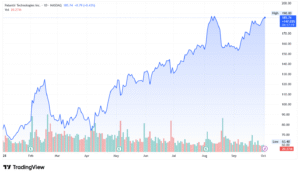
Investors have taken note of this momentum. Palantir shares have recovered from their late summer pullback, gaining nearly 18% and trading close to previous highs at $185. Analysts have set price targets that suggest further upside if the company can keep delivering growth.

Palantir pltr stock price

AI in the Sky: Why Boeing Chose Palantir

The Boeing agreement shows how Palantir is placing itself at the heart of digital change in defense and aerospace. Boeing will use Palantir’s software to integrate data across its factories and programs. This could help the company predict supply chain issues, make decisions faster, and boost the readiness of its defense systems.

For Palantir, the partnership shows that its platforms can be applied to large-scale industrial problems. It may also open doors to further contracts with aerospace and defense companies worldwide. As more companies use AI-driven analytics, Palantir can grow in industries that need efficiency and security.

Mike Gallagher, Palantir’s head of defense, remarked on this partnership, saying:

“type of partnership that I think has the possibility to unlock transformation within the defense industrial base and enhance deterrence in the near term, not in a matter of distant decades.”

The deal also adds to Palantir’s credibility with investors. Palantir’s tech works well beyond government and niche markets. Their partnerships with big companies show this clearly. Instead, it is proving useful in some of the most complex and regulated industries.

Riding the Wave of Explosive Growth in AI and Data Analytics

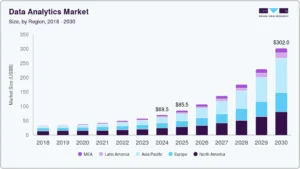
The global data analytics software market is growing fast. In 2024, it was worth about $69 billion, and it’s expected to climb to $302 billion by 2030, with a compound annual growth rate (CAGR) of ~28%.

data analytics market 2030
Source: Grand View Research

Meanwhile, the enterprise AI market could expand from around $97 billion in 2025 to $229.3 billion by 2030, growing at ~18.9 % per year.

These trends show strong demand for tools like Palantir’s platforms. As more companies adopt AI and analytics, Palantir may benefit from this rising tide of investment and interest.

Behind these financial and market momentum, the AI company is also paying attention to its sustainability commitments.

ESG and Emission Reduction: Palantir’s Net Zero Pathway

Palantir has committed to reaching net zero emissions across all scopes under its 2021 Climate Pledge. The company is working to cut emissions where possible and balance the rest with high-quality carbon offsets. This shows an effort to address both immediate impacts and long-term climate goals.

In 2019, Palantir set a baseline for its greenhouse gas emissions. By 2024, total emissions had risen slightly to about 23,000 tonnes of CO₂ equivalent, a reduction of about 31% compared to the 2019 baseline. This increase of 1.7% from 2023 was due to a gradual return to business travel and operational activities. But overall emissions per employee have dropped 57% since 2019.

Palantir Gross Emissions 2024 by Scope
Source: Palantir

The company also achieved carbon neutrality for its UK operations in 2023, covering remaining emissions through offsets.

To support this progress, Palantir is taking these actions:

  • Invests in better measurement and reporting. This improves how the company tracks emissions from business travel, cloud computing, and employee commuting.

  • It uses energy-efficient data centers and optimizes software workloads to reduce cloud computing emissions. 

  • For emissions it can’t fully cut, it buys verified offsets and uses sustainable aviation fuel (SAF) for travel. 

Overall, Palantir’s ESG strategy shows steady progress. While the reductions are gradual, the company is building systems to manage its footprint while aligning with broader net-zero goals. 

Flying High or Overvalued? What’s Next for PLTR

Palantir’s path depends on its success in moving from government contracts to commercial industries. The Boeing partnership shows progress on this front, while strong U.S. demand continues to fuel revenue growth.

At the same time, investors remain aware of risks tied to valuation and uneven international performance. The company’s challenge will be to prove that it can replicate U.S. growth in other markets and continue delivering large-scale contracts.

If Palantir succeeds, it could strengthen its status as a top AI-driven software company. This would boost its influence in both public and private sectors. The coming quarters will reveal whether the Boeing deal and other partnerships translate into long-term performance.

As the company looks ahead, success will depend on expanding its global presence, managing valuation concerns, and delivering measurable results from its partnerships. For now, Palantir remains a key player to watch in the evolving world of AI and data analytics.

The post Palantir (PLTR) Stock Nears Highs with Boeing Partnership and Steady U.S. Growth appeared first on Carbon Credits.

EU Fuels Africa’s Green Shift with $638 Million Clean Energy Push

EU Fuels Africa’s Green Shift with $638 Million Clean Energy Push

The European Union (EU) has unveiled a funding package of €545 million (around US $638 million) to speed up Africa’s clean energy transition. The funds will help develop renewable energy, upgrade electricity grids, and support rural electrification in nine African countries. This move is part of the EU’s Global Gateway strategy. It aims to boost sustainable infrastructure and strengthen economic ties with partner regions.

The package highlights the EU’s focus on both climate action and energy security. It also comes at a time when Africa faces urgent energy challenges. About 600 million people in Africa still don’t have electricity. Meanwhile, the need for reliable and affordable power is rising quickly.

Power to the People: Where the Money Goes

The EU funding will be spread across several African nations, each with projects tailored to local needs:

  • Côte d’Ivoire will get the biggest share, around €359.4 million. This funding will help build a high-voltage energy line. It will improve transmission and make the grid more reliable.
  • Cameroon will receive €59.1 million to boost rural electrification. This will help about 687 communities.
  • Somalia will have €45.5 million to increase access to renewable energy and enhance resilience to climate shocks.
  • Mozambique will receive €13 million. This funding aims to support a low-emission transition and draw in private investment.

Other countries in the program are the Central African Republic, the Republic of Congo, Ghana, Lesotho, and Madagascar. Their projects focus on renewable generation, grid integration, and improving access in underserved regions.

This funding could attract more investment from global partners and private firms. The EU believes its support will lower risks for investors. This, in turn, should encourage long-term investments in Africa’s energy sector.

The broader EU-Africa investment agenda under Global Gateway seeks to add 300 GW of renewable capacity across Africa by 2030.

Africa’s Untapped Energy Goldmine

Africa is home to vast renewable energy resources, but its power sector faces deep challenges. The continent boasts some of the highest solar irradiation levels globally. It also has strong wind potential in coastal and desert regions.

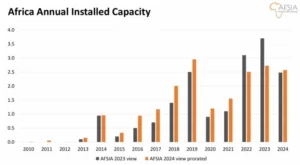
Africa annual solar capacity
Source: Ember

Additionally, there are significant untapped hydro resources and geothermal opportunities in East Africa. Yet, these remain underdeveloped. Here are some facts about the continent’s energy landscape:

  • As of 2024, around 43% of Africa’s population has no access to electricity, mostly in rural areas.
  • The International Energy Agency (IEA) says Africa needs $25 billion each year for energy access. This investment is crucial to ensure that everyone has electricity by 2030.
  • Africa has 60% of the world’s best solar resource potential. But only about 2-3% of global clean energy investment currently flows to Africa, despite its vast potential.

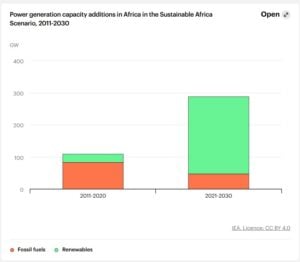
Electricity is central to Africa’s clean energy future, with renewables driving growth. Renewables, led by solar, wind, hydro, and geothermal, will make up over 80% of new power capacity by 2030. Redirecting funds from canceled coal projects could finance half of Africa’s solar additions to 2025.

Power generation capacity additions in Africa in the Sustainable Africa Scenario, 2011-2030
Source: IEA

The clean energy transition is not only about climate. Reliable electricity is essential for health services, schools, businesses, and job creation. According to estimates, Africa’s renewable sector could create 38 million green jobs by 2030. This will happen if there is enough funding and infrastructure.

What’s at Stake

The EU’s $638 million clean energy funding could deliver a range of benefits for African communities and economies.

It can stabilize electricity grids. This makes power more reliable and cuts down on blackouts for homes and businesses. Stronger transmission systems will also make it easier to integrate renewable power sources.

Second, rural electrification projects will deliver power to communities that have long lacked it. Electricity access in rural areas boosts education by letting schools stay open after dark. It also supports local health clinics and creates opportunities for small businesses.

Third, the investment will support Africa’s climate goals. Countries can reduce their reliance on fossil fuels by expanding solar, wind, hydro, and other renewable projects. This shift also helps to cut greenhouse gas emissions.

Finally, EU involvement is expected to encourage co-financing and private sector participation. Investors often see African energy projects as risky. However, public funding from the EU and other groups can lower barriers. This makes projects more appealing.

Roadblocks on the Green Highway

While the funding is significant, there are still challenges that could affect the success of these projects.

Many African electricity grids are weak or fragmented. This makes it hard to add new renewable sources on a large scale. Large infrastructure projects need good governance, transparency, and technical skill. Some areas may not have these.

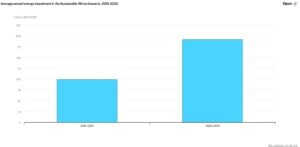
Financing remains another hurdle. The $638 million package, while important, is only a fraction of Africa’s total energy investment needs. Africa needs hundreds of billions of dollars in extra funding over the next decade. This is essential for universal access and a shift to clean energy.

Average annual energy investment in the Sustainable Africa Scenario, 2016-2030.
Source: IEA

Political instability, regulatory barriers, and limited local capacity may also slow down progress. To tackle these problems, the EU and African governments must work together. They need strong project oversight and to improve local technical skills.

More Than Money: Why This Partnership Matters

The EU’s support is part of its larger vision for sustainable growth and climate action. Under the Global Gateway initiative, the EU has pledged €150 billion in investment for Africa by 2030, with clean energy as a central focus. This funding aims to support Africa’s development. It also strengthens Europe’s ties with the continent in a competitive world.

By supporting Africa’s energy transition, the EU is also advancing its own climate commitments. Expanding renewable capacity in Africa contributes to global emissions reduction while also reducing reliance on fossil fuel imports.

The projects announced will help lay the foundation for deeper EU-Africa cooperation in the years ahead. If successful, they could serve as models for scaling up investment and technology transfer in clean energy.

Funding alone won’t close Africa’s big investment gap. However, it shows that people are starting to recognize the continent’s role in the global clean energy shift. Success will depend on strong governance, effective implementation, and mobilization of additional financing from both public and private sources.

If delivered well, the initiative could improve millions of lives, create jobs, and bring Africa closer to universal energy access while also contributing to the global fight against climate change.

The post EU Fuels Africa’s Green Shift with $638 Million Clean Energy Push appeared first on Carbon Credits.
Tesla (TSLA) Stock Rises Over $450, Hits Record $1.5T Market Cap as Q3 Delivery Test Looms

Tesla (TSLA) Stock Rises Over $450, Hits Record Market Value of $1.5T as Q3 Delivery Test Looms

Tesla has once again made headlines after its stock climbed above $450 per share, lifting its market value past $1.5 trillion. This milestone places Tesla among the most valuable companies in the world, alongside tech giants.

The market jump reflects strong investor belief in Tesla’s role as a leader in electric vehicles (EVs) and clean energy. It also shows rising expectations ahead of the company’s upcoming third-quarter delivery results.

While the stock’s performance has impressed many, Tesla now faces new challenges that could affect future demand. One of those challenges has already started to take shape in the U.S. market: leasing costs.

Leasing Gets Pricier as Tax Credit Expires

At the beginning of October, Tesla raised lease prices across most of its American lineup. This change came after a $7,500 federal EV tax credit for leased vehicles expired. The EV giant had previously used the credit to lower monthly lease payments for customers. With the incentive gone, leasing now costs more.

For example, the Model Y saw its monthly lease rate climb by about $50 to $70. The Model 3 also rose by around $80 on some versions. Purchase prices, however, did not change.

This means that buying a Tesla outright still costs the same, but leasing has become less affordable. Leasing has been a popular way for many first-time EV owners to enter the market, so higher rates may slow demand in that segment.

Still, Tesla benefits from the adjustment because it helps protect profit margins at a time when incentives are shifting. This change also ties closely to Tesla’s delivery expectations for the third quarter.

All Eyes on Q3: Can Tesla Deliver Half a Million Cars?

Tesla will soon report how many cars it delivered in the third quarter. Analysts are watching closely, and estimates have been rising. Projections range from 442,000 to more than 500,000 vehicles.

Some firms expect Tesla to deliver around 480,000 units, which would be stronger than expected earlier in the year. Others even believe Tesla could pass the half-million mark, thanks to a last-minute rush of buyers who wanted to take advantage of cheaper leasing before the credit expired.

This boost in sales, however, may create uneven demand. If customers rushed to buy in Q3, the following quarters might see weaker numbers. That possibility has some analysts cautious, even as they raise their short-term forecasts.

Regardless of the exact total, the delivery report will act as a test of Tesla’s ability to keep growing at scale while facing new market pressures.

Investors Fuel Tesla’s $1.5 Trillion Market Cap Surge

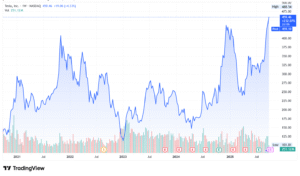
The recent stock surge to $459 highlights how much investors believe Tesla can continue to deliver. Moving into the $1.5 trillion market cap club has made Tesla one of the most closely watched companies worldwide.

Tesla tsla stock price

The optimism is clear: if Tesla reports strong Q3 deliveries, the stock could climb even higher. But expectations are also very high. Any sign of weakness, either in deliveries or future guidance, could push the stock lower.

This tension between confidence and caution explains why Tesla’s stock is so volatile. Every update on sales, pricing, or government policy has the potential to shift the company’s market value by billions in a single day.

Moreover, Tesla’s latest surge is fueled by a proposed $1 trillion compensation plan for Elon Musk, linking his pay to bold targets. These include lifting Tesla’s value from $1 trillion to $8.5 trillion by 2035.

The company is betting big on AI, with robotaxi services using Model Y cars set for Austin in mid-2025. This is followed by Cybercab production in 2026. Tesla also plans to launch Full Self-Driving software version 14 and deploy thousands of Optimus humanoid robots in factories by year-end.

Still, critics caution that Tesla’s high valuation—around 180 times forward earnings—rests heavily on unproven AI ambitions.

Amid all these, one thing remains: the EV leader’s sustainability and emission reduction drive.

Tesla Balances Emissions Cuts with Supply Chain Challenges

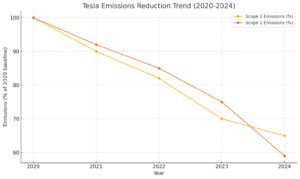
Tesla emphasizes reducing emissions across its operations and product life cycle. In 2024, the company reported a total carbon footprint of about 56 million metric tons CO₂e, combining its own operations and supply chain emissions.

tesla emissions reduction
Source: The Sustainable Innovation

Tesla also notes that in 2023, its customers avoided over 20 million metric tons of CO₂e by driving electric vehicles instead of fossil-fuel cars.

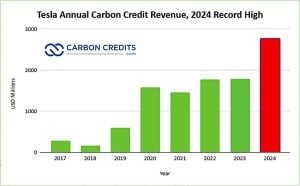
Regulatory credits are another pillar. In 2024, Tesla generated $2.76 billion from selling regulatory carbon credits. This is a 54% increase compared to $1.79 billion in 2023. This revenue comes from providing greenhouse gas (GHG) credits to other automakers that need to meet emissions regulations in the U.S., Europe, and China.

Tesla’s carbon credit sales in 2024 accounted for nearly 39% of its net income for the year, making it a dominant player in the emissions credit market.

Tesla annual carbon credit revenue in 2024

To support its goals, Tesla operates its Supercharger network with 100% renewable energy, and its Berlin Gigafactory has run on fully renewable power for the past two years. However, the company still faces its biggest challenge in Scope 3 emissions—those tied to its supply chain and the use of its vehicles.

Opportunities and Obstacles on Tesla’s Road Ahead

Tesla’s path forward is full of both opportunities and risks. The company continues to expand globally, invest in new technologies, and explore new business areas such as energy storage and software. At the same time, it must handle challenges like shifting policies, rising competition, and customer affordability.

On the opportunity side, strong U.S. demand could carry Tesla through short-term changes in subsidies. Growth in markets like China and Europe also offers new revenue streams. Tesla’s work in batteries, charging infrastructure, and AI features may help it build a broader ecosystem beyond cars.

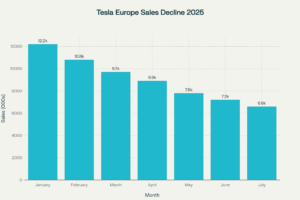
But risks are just as clear. Without the leasing credit, some U.S. customers may wait longer or choose competitors. Supply chain costs could rise, cutting into margins. And with global EV competition heating up, especially from Chinese automakers, Tesla’s share of the market may come under pressure. This has been the case in its European sales. 

tesla EV sales
Source: Tesla Europe Sales, Jan-July 2025 (Data: European Automobile Manufacturers’ Association; sources: PBS, Yahoo Finance, JATO Dynamics).

Managing these factors will decide whether Tesla’s $1.5 trillion valuation remains justified. Investors are already reacting based on how Tesla balances growth with these headwinds.

Tesla’s Future: Growth Under Pressure

Tesla enters the last part of the year in a strong but demanding position. The company has reached a market value that few automakers in history could have imagined. Yet with that success comes more pressure to deliver not just cars, but also consistent growth and profits.

The rise in leasing costs shows how quickly policies can change the market. The Q3 delivery report will test whether Tesla can handle those changes while keeping demand strong. If results meet or beat forecasts, Tesla may strengthen its image as the EV leader. If results fall short, the stock could face new doubts.

Either way, Tesla’s next moves will be closely watched not only by investors but also by the wider auto industry. As the world transitions to electric transport, Tesla’s performance will continue to serve as a signal of how fast and how strong that shift can be.

The post Tesla (TSLA) Stock Rises Over $450, Hits Record $1.5T Market Cap as Q3 Delivery Test Looms appeared first on Carbon Credits.
Nike (NKE Stock) Scores Big: Earnings Surprise and Climate Goals in Focus

Nike (NKE Stock) Scores Big: Earnings Surprise and Climate Goals in Focus

Nike released its earnings for the period ending August 31, 2025. The report showed stronger results than expected, giving investors insight into both its business recovery and its ongoing environmental commitments.

The sportswear company is making financial gains while focusing on its long-term goal: reaching net zero emissions. It aims to cut greenhouse gases (GHG) as part of this effort. Let’s look at Nike’s latest earnings, its climate goals, and its most recent progress on emissions.

Profits Under Pressure, but Revenue Holds Strong

Nike reported revenue of $11.72 billion in its fiscal first quarter of 2025. This represented a small increase of about 1% from the previous year and was stronger than analysts had expected.

Net income for the quarter was $727 million, down roughly 31% compared with the same period last year. While profit margins declined, mainly due to tariffs, higher discounts, and shifts in sales channels, the company still beat Wall Street forecasts.

Gross margin fell to just over 42%, showing that Nike continues to face cost pressures across its operations. Still, the earnings results reflected resilience in consumer demand and Nike’s ability to manage challenges in the global retail market. 

After the earnings release, Nike’s stock responded positively. Shares rose 1.5%, reflecting investor confidence in the company’s results. The stronger-than-expected revenue, improved profit margins, and lower inventories reassured markets about Nike’s recovery strategy.

Nike NKE stock price

This performance marked one of Nike’s best single-day jumps in 2025, showing how financial momentum and clear progress on operations can quickly influence investor sentiment.

Nike’s “Move to Zero” Playbook

Nike’s sustainability strategy is known as “Move to Zero”, which represents its long-term vision of achieving both net-zero carbon emissions and zero waste. The company has set several science-based targets to guide its environmental goals.

Nike sustainability 2025 targets
Source: Nike
  • It has also set a 2030 target to cut absolute Scope 1 and 2 emissions by 65% and Scope 3 emissions by 30% compared to 2015 levels.

Scope 1 emissions are from Nike’s own operations. Scope 2 comes from purchased energy, and Scope 3 includes the larger supply chain, like materials, manufacturing, and shipping. Since most of Nike’s carbon footprint comes from its supply chain, Scope 3 reduction is one of the company’s biggest challenges.

Nike also aligns its goals with the Science Based Targets initiative (SBTi), which ensures climate targets match global pathways to limit warming to 1.5°C.

Cutting Carbon: Wins and Stumbles

Nike’s most recent sustainability report shows mixed progress on its emissions. Here are the major ones: 

  • Scope 1 and 2 emissions:

Nike has cut its Scope 1 and 2 greenhouse gas emissions by 69-73% as of 2023-2024. This is compared to the 2015 baseline. They surpassed their goal of a 65% reduction by 2030. These reductions come from energy efficiency efforts and switching to 100% renewable electricity. This shift is happening in owned and operated facilities in places like North America and Europe.

Nike GHG emissions 2023
Source: Nike
  • Scope 3 emissions:

Nike’s value chain emissions remain the largest part of its carbon footprint, accounting for over 90% of total emissions. Total Scope 3 emissions for 2024 were about 8.2 million metric tons of CO₂e. This marks a 29% reduction since 2020. However, it shows only a small drop from the 2022 and 2023 levels. The company emphasizes material innovation and the use of renewable energy in its supply chain. This is especially true for its Supplier Climate Action Program (SCAP).

  • Renewable energy use:

The company uses 100% renewable electricity in its North American and European facilities. Globally, it aims for about 78-80% renewable electricity by 2023-2024. This is achieved through power purchase agreements, onsite solar and wind, and green energy options.

  • Transportation:

Nike has reduced air freight by 80% since 2020. This aligns production with shipping schedules. They are increasing ocean freight usage and aim to ship 50% of products by ocean freight by 2025. This change could cut shipping emissions by around 40%. Pilot projects in Europe are testing hydrogen-fueled barges to support this effort.

These figures show that while Nike is reducing emissions from its direct operations, tackling supply chain emissions remains difficult.

Sneakers Go Green: From Waste to Wear

Beyond emissions, Nike is also working on materials and product design. The company has pledged to cut the environmental impact of its shoes and apparel through innovation.

Nike now uses recycled polyester and organic cotton in many products through its “Move to Zero” program, which includes a focus on zero carbon and zero waste. In 2023, almost 40% of Nike’s polyester came from recycled sources, helping reduce reliance on fossil fuels.

The company also reuses waste from manufacturing. More than 90% of Nike’s footwear manufacturing waste is either recycled or reused. The popular “Nike Grind” program turns scrap materials into new products, like shoe soles or sports surfaces.

Nike has also tested circular design models, such as recycling old shoes into new ones. Its refurbishment program extends the life of products by repairing and reselling lightly worn footwear.

Scope 3: Nike’s Toughest Opponent Yet

Nike has made real progress, but challenges remain. Scope 3 emissions are still the largest part of its footprint, and reducing them will require deeper changes in supply chain practices. This includes encouraging suppliers to use renewable energy and improving manufacturing efficiency.

Nike also faces growing consumer and regulatory pressure. Governments in Europe and North America are pushing for stricter climate reporting and accountability. Meeting these standards will test Nike’s ability to deliver on its promises.

Still, Nike has shown commitment by tying executive pay to sustainability goals. The company has also joined global climate coalitions, such as RE100, which aims for 100% renewable electricity.

Bridging the Gap: Offsets for Shipping and Beyond

The company offsets 100% of emissions from U.S. and European e-commerce orders, covering shipping from warehouses to customers. In Oregon, it partners with Ecotrust Forest Management on 28,000 acres of forests that capture about 30% more carbon than standard practices. In Europe, it supports reforestation projects that remove carbon through tree planting.

Nike stresses that carbon credit offsets are only a “bridge” and focuses on using projects verified by independent standards to ensure real and lasting results.

Looking ahead, Nike’s financial growth and climate commitments will remain closely linked. Investors are now paying attention to both quarterly earnings and ESG performance. The company’s ability to reduce emissions while maintaining strong revenue will be key to its long-term success.

Where Performance Meets Purpose

Nike’s latest earnings report shows solid financial momentum, with rising revenue, higher profit, and lower inventory levels. At the same time, the company continues to advance its net-zero journey, with major progress on Scope 1 and 2 emissions and renewable energy adoption.

However, its large Scope 3 footprint remains a challenge, making supply chain transformation essential. With strong climate targets, sustainable material use, and innovation in circular design, Nike is positioning itself as both a sportswear leader and a company working toward climate responsibility.

The post Nike (NKE Stock) Scores Big: Earnings Surprise and Climate Goals in Focus appeared first on Carbon Credits.