
Carbon Credit Offtakes Surge in 2025: What the $12B Says About the Future Market?

Carbon Credit Offtakes Surge in 2025: What the $12B Says About the Future Market?

Offtake agreements became one of the strongest signals in the carbon credit market in 2025. While spot market activity slowed, long-term commitments surged. These deals revealed how buyers think about future supply, quality, and risk.

The contrast is striking. The spot market remains large in volume but low in value. The forward market is small in volume but very high in value. This gap tells an important story about where the carbon credit market is heading.

A Record Year for Offtake Value, Not Volume

In 2025, companies announced carbon credit offtake agreements worth about $12.25 billion, according to Sylvera’s report. This was a sharp increase from around $3.95 billion in 2024. It was also more than 12x the value of credits retired on the spot market during the same year.
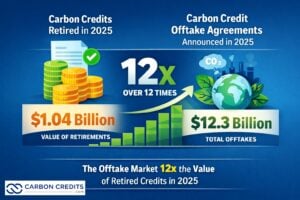
Carbon credit offtake infographic
Data source: Sylvera

This growth did not come from higher volumes. The total credits covered by these deals amount to roughly 78 million tonnes, spread across many years. On average, these agreements are expected to deliver only about 10 million credits per year through 2035.

To put this in context, the spot market retired about 168 million credits in 2025 alone. This means offtakes represent less than 10% of current annual retirements.
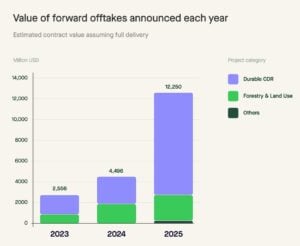
carbon credit offtakes annual 2025 Sylvera
Source: Sylvera

This mismatch matters. It shows that the forward market is not about scale today. It is about securing future supply that meets higher standards. Buyers are not chasing large volumes. They are targeting specific credit types with strong integrity signals.

The value growth reflects high carbon prices, not high quantities. The weighted average price implied by offtake deals in 2025 was around $160 per credit. This is far above the spot market average of roughly $6 per credit.
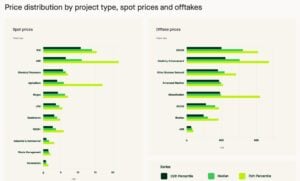
carbon prices spot vs offtake
Source: Sylvera

Why Buyers Are Willing to Pay a Premium Upfront

The forward market price premium reflects several structural factors.

  • Carbon removals dominate offtake deals: 
    Most credits covered by offtake agreements are carbon removal credits, not avoidance credits. These include direct air capture, biochar, BECCS, and mineralization. These technologies are costly and still scaling.

  • Net-zero targets drive long-term planning:
    Companies face growing pressure to meet net-zero goals. Many now acknowledge that emissions cuts alone will not eliminate all emissions. They expect to use removals to address residual emissions in the 2030s and beyond.

  • Future supply remains uncertain:
    Few carbon removal projects operate at a commercial scale today. Delivery risks remain high. Offtake agreements help buyers reduce exposure to future shortages and price spikes.

  • Policy signals reinforce buyer behavior:
    Updated guidance from standard setters and the expansion of compliance markets point to rising demand for high-integrity credits. Buyers anticipate stronger competition for a limited supply.

As a result, buyers accept high prices today to manage future risk. These prices reflect expected scarcity, not current market conditions.

A Highly Concentrated Landscape: Few Players, Big Moves

The offtake market in 2025 was not broad-based. It was highly concentrated.

A small group of buyers accounted for most of the value and volume. Among them, Microsoft dominated the durable carbon removal market. The company accounted for about 85% of the total durable removal offtake volume announced in 2025.
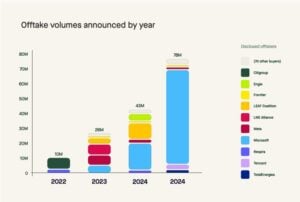
carbon credit offtake announced annual by buyer
Source: Sylvera

Other large buyers included technology firms, energy companies, and buyer coalitions such as Frontier. However, the overall number of active offtakers remained limited. Estimates suggest only 100 to 200 buyers participated meaningfully in the forward market.

This concentration reflects both cost and complexity. Offtake agreements require long-term commitments, strong balance sheets, and the ability to manage delivery risk. Many companies are not ready to take on these challenges.

In contrast, the spot market remains much broader. It involves thousands of buyers and a wide range of project types. Prices are lower. Entry barriers are minimal.

This divide suggests that the forward market is not replacing the spot market. Instead, it operates alongside it, serving different needs and buyers.

What the Volume Gap Tells Us About Market Structure

The gap between offtake value and volume sends a clear signal about market structure.

The carbon credit market does not suffer from a lack of credits overall. Instead, it suffers from a lack of credits that buyers trust for future use.

Inventory data supports this view. Credits rated BBB or higher have been in deficit since 2023. In 2025, this deficit continued for a third year. Lower-rated and unrated credits, by contrast, remained heavily oversupplied.

Offtake buyers focus almost exclusively on the scarce segment. They prefer credits with strong durability, clear additionality, and future compliance potential. Many of these credits do not yet exist at scale.

This explains why high prices do not translate into high volumes. Project developers face long development timelines. New technologies require capital, permitting, and verification. Nature-based removal projects also take years to mature.

As a result, the forward market reflects future expectations, not current supply. It prices scarcity before it appears in the spot market.

What Offtakes Signal for 2026 and Beyond

Offtake agreements offer several insights into the near-term outlook.

  • First, they suggest that quality premiums will persist. Even if spot prices remain low for lower-quality credits, prices for high-integrity projects are likely to rise. Buyers are already anchoring expectations at much higher levels.
  • Second, they show that carbon removal credits will shape long-term demand, even if near-term retirements remain small. Investment and offtake activity indicate confidence that removals will play a central role after 2030.
  • Third, they highlight growing competition between voluntary and compliance demand. As markets converge, credits eligible for compliance use may attract both types of buyers. This will further tighten supply for premium projects.
  • Fourth, they suggest that the total market value could grow without higher volumes. If even a small share of spot market demand shifts toward higher-priced credits, overall spending could increase significantly.

However, risks remain. Delivery delays, policy uncertainty, and technology challenges could slow progress. The forward market remains narrow and exposed to concentration risk.

For now, offtakes function as a price and preference signal, not a volume driver. They show where the market wants to go, even if it cannot get there yet.

The offtake buyer behavior reflects bigger changes in how companies view carbon credits. Price alone no longer defines value. Credibility, durability, and future eligibility now matter most.

As the market moves into 2026, offtake agreements will continue to shape expectations. They do not replace the spot market, but they signal where demand, pricing, and strategy are heading in the years ahead.

The post Carbon Credit Offtakes Surge in 2025: What the $12B Says About the Future Market? appeared first on Carbon Credits.

Trump’s Davos Nuclear Endorsement Powers a Rally in Oklo, SMRs, and Atomic Stocks

Trump’s Davos Nuclear Endorsement Powers a Rally in Oklo, SMRs, and Atomic Stocks

At the 2026 World Economic Forum in Davos, former U.S. President Donald Trump spoke in support of nuclear energy. His remarks highlighted nuclear power as a key part of energy security and clean energy supply, saying:

“We’re very much into the world of nuclear energy, and we can have it now at good prices and very, very safe…the progress they’ve made with nuclear is unbelievable, and the safety progress they’ve made is incredible…”

After these comments, nuclear and uranium stocks moved higher in early trading. Investors showed renewed interest in nuclear companies, especially those developing advanced technologies like small modular reactors (SMRs).

Stocks such as Oklo Inc. (NYSE: OKLO), NuScale Power (NYSE: SMR), and Nano Nuclear Energy (NASDAQ: NNE) saw price increases as traders responded to the pro-nuclear sentiment. This trend shows how energy markets are changing.

Many investors now view nuclear energy as a stable, low-carbon power source. This is important as demand grows from data centers and industries.

Oklo Takes Center Stage in the Nuclear Trade

Oklo has become one of the most-watched nuclear stocks in 2025. Oklo’s shares jumped after it signed a big deal with Meta Platforms. They plan to build a 1.2 GW advanced nuclear energy campus in Pike County, Ohio.

The deal positions Oklo to supply clean, reliable power for Meta’s data centers. Analysts described this binding agreement as reducing some business risks for Oklo.

In January 2026, Oklo stock kept rising after President Trump’s pro-nuclear comments at Davos. It hit intraday highs around January 22, with gains across the sector. Bank of America upgraded Oklo to a Buy rating, setting a price target of $111. This shows strong confidence in Oklo’s data center partnerships and regulatory progress.

Oklo stock price

Cathie Wood’s ARK Investment increased its stake in Oklo. They bought over 34,000 shares. This shows a rising interest from institutions in advanced nuclear technology. This purchase followed earlier acquisitions valued at more than $8.9 million, showing sustained investment interest.

Strong Rallies, Sharp Pullbacks

Despite strong gains, Oklo’s stock price has also seen pullbacks. At times, shares fell nearly 10% in a single week due to profit-taking after earlier rallies. Investors sometimes respond to news about sectors. For example, competitive technologies like geothermal power can provide clean energy alternatives for data centers.

Oklo remains pre-revenue, meaning it has not yet begun large-scale power production. The company aims to build its first commercial microreactor system between late 2027 and 2028. Until that point, investor focus remains on contracts, partnerships, and regulatory progress.

SMRs and Speculation: Two Very Different Nuclear Bets

NuScale Power (NYSE: SMR) is another company that benefited from the nuclear rally after Davos. The company’s shares jumped around 15% on early trading days in 2026, along with sector momentum.

NuScale Power stock price

The stock is drawing investor interest because of the rising focus on small modular reactor (SMR) technology. SMRs may be easier to deploy and scale than traditional large plants.

NuScale’s SMRs got design approvals from the U.S. Nuclear Regulatory Commission (NRC). This boosts confidence in their technology. Analysts expect the company’s revenue to continue rising as project work expands.

NuScale is a great example of how modular nuclear designs can provide reliable power for industrial and data center needs. Regulatory milestones for SMRs may accelerate deployment timelines through the rest of the decade.

NuScale SMR power plant view
Source: NuScale Power

Nano Nuclear Energy: Early Stage, Strong Moves

Nano Nuclear Energy (NASDAQ: NNE) is a smaller player that also saw stock gains as part of the sector rally. Its shares rose roughly 40% in one trading week amid news of technology deals between U.S. and U.K. partners, and Trump’s recent announcement. This price movement reflected broader investor interest in nuclear technologies and potential future revenues.

Nano Nuclear Energy stock price

Nano Nuclear is still in the early stages without significant revenue, similar to Oklo’s position. Its valuation illustrates how speculative nuclear stocks can be, driven by future expectations about technology deployment and regulatory support.

Why Nuclear Is Back on Investor Radar

Supportive government policy is a key driver for nuclear stocks. In 2025, the U.S. administration moved to speed up nuclear power development as part of a broader energy strategy. These moves include efforts to shorten licensing timelines and enhance domestic infrastructure for nuclear fuel and reactors. This policy backdrop helped lift stocks such as Oklo and NuScale.

President Trump’s Davos statements reinforced this trend by linking nuclear energy to national energy strategy and data center demand. Many investors view nuclear energy as a solution for rising electricity demands. This includes powering artificial intelligence and cloud computing infrastructure.

Nuclear power generates low-carbon electricity. This attracts companies that need to meet emissions targets while also dealing with growing power demand.

Globally, nuclear power already contributes a significant share of clean energy. According to the World Nuclear Association, nuclear energy generated about 9% of the world’s electricity from existing reactors. Supporters say that expanding nuclear power can meet future demand and reduce carbon emissions.

nuclear energy power share 2024
Source: World Nuclear Association

AI’s Power Hunger Fuels the Nuclear Case

The growth of data centers, particularly for AI, is driving interest in reliable baseload power. Tech companies, including Meta, have pursued long-term nuclear power agreements.

Meta has deals with companies like Oklo and TerraPower. These agreements aim to secure nuclear-generated electricity for its AI infrastructure. They involve spending tens of billions of dollars on building AI data centers. This corporate demand creates new business models for nuclear power. It makes future reactor deployments more financially viable.

Electricity demand from industrial and tech sectors continues to rise worldwide, increasing focus on clean, consistent power sources. Nuclear energy’s high capacity factor, meaning it can provide steady power output, is a key strength in this context.

What the Next Nuclear Decade Could Look Like

Industry analysts expect nuclear capacity to grow over the next few decades. Some forecasts tied to long-term pledges suggest that global nuclear capacity could triple by 2050 as part of decarbonization goals. This aligns with commitments from large utilities, governments, and corporate coalitions.

Nuclear Power Req in 2050 - CC (1)

Stock forecasts differ, but long-term demand for nuclear reactors and fuel is expected to grow. This growth is driven by electrification and carbon reduction goals.

Small modular reactors are key to industry growth. They offer shorter construction times and lower upfront costs than large traditional reactors. If SMRs get regulatory approval and have stable supply chains, companies like Oklo and NuScale could start commercial operations in the 2030s.

Analysts provide mixed views on nuclear stocks. Many forecasts highlight the potential upside if technologies succeed at scale, especially for SMRs. Analyst price targets for NuScale Power suggest there is a lot of potential for growth from current prices.

A Renewed Nuclear Narrative

After President Trump’s supportive comments on nuclear energy at Davos, nuclear stocks climbed as traders reacted to potential industry growth. Oklo saw strong investor interest following major deals and institutional purchases. NuScale benefited from regulatory milestones and rising demand for modular reactors. Nano Nuclear showed how early-stage players can also capture attention.

Government support, corporate demand for reliable low-carbon power, and rising electricity needs from AI and data centers are key drivers behind the nuclear sector’s resurgence. Analysts still see challenges, but they expect nuclear capacity, especially smaller modular systems, to grow in the global energy mix.

The post Trump’s Davos Nuclear Endorsement Powers a Rally in Oklo, SMRs, and Atomic Stocks appeared first on Carbon Credits.

General Fusion’s Nasdaq Listing Pushes Fusion Energy Into the Market Spotlight

Fusion energy has spent decades on the sidelines of the global energy system. Scientists praised its potential, policymakers admired its promise, and investors waited patiently for proof that it could work outside the lab. Now, that long wait appears to be ending.

General Fusion’s planned listing on Nasdaq marks a clear shift in how fusion energy is viewed. The Vancouver-based company has agreed to merge with Spring Valley Acquisition Corp. III, a move that would make it the world’s first publicly traded pure-play fusion energy company. Once the deal closes, General Fusion is expected to trade under the ticker symbol GFUZ.

More importantly, the transaction signals that fusion is moving beyond theory. It is stepping into capital markets, where timelines, costs, and performance matter.

AI, Electrification, and Data Centers Are Driving a New Energy Boom

Electricity demand is rising faster than grids can comfortably handle. According to the International Energy Agency, global power demand could grow by 40-50% by 2035.

This surge is not coming from a single source. Instead, it reflects a mix of electrified transport, electric heating, advanced manufacturing, and rapid digital expansion.

At the same time, artificial intelligence has become a major driver of energy. Data centers now consume enormous amounts of electricity, and demand continues to climb. In the United States, the Department of Energy estimates that data center power use could double or even triple by 2028.

Solar and wind have expanded quickly and remain essential to decarbonisation. However, they depend on the weather and daylight. Batteries help smooth supply, but they cannot yet support large-scale, long-duration demand on their own. As a result, the need for clean, reliable baseload power is becoming urgent.

This is where fusion enters the conversation.

fusion energy generation
Source: General Fusion

Why Fusion Energy Stands Apart

Fusion works by combining light atoms, usually hydrogen isotopes, to release energy. It is the same process that powers the sun. Unlike nuclear fission, which splits heavy atoms and produces long-lived radioactive waste, fusion generates far less waste and carries no risk of meltdown.

The International Atomic Energy Agency estimates that fusion can produce four times more energy per unit of fuel than fission and nearly four million times more energy than coal or oil. Just as important, fusion fuel is abundant and widely available.

These features make fusion attractive not just as a clean energy source, but as a foundation for long-term energy security.

general fusion
Source: General Fusion

General Fusion’s Different Path to Fusion Power

While many fusion developers rely on massive superconducting magnets or powerful laser systems, General Fusion has taken a different route. The company focuses on Magnetized Target Fusion, or MTF, a design intended to simplify fusion hardware and reduce costs.

MTF creates a hot plasma and stabilises it with magnetic fields. Then, instead of squeezing the plasma with magnets or lasers, the system mechanically compresses it using a liquid lithium liner. This rapid compression raises temperature and pressure to fusion conditions.

General Fusion argues that this approach avoids some of the complexity that has slowed other fusion concepts. It also allows the use of existing industrial materials, rather than highly specialised components. Over time, this could make fusion power plants more durable and more affordable.

LM26 Marks a Critical Step Forward

In early 2025, General Fusion announced a major milestone. The company had designed, built, and begun operating Lawson Machine 26, known as LM26. This system represents the world’s first large-scale MTF fusion demonstration built at a commercially relevant size.

LM26 operates at half the diameter of a future commercial reactor. It mechanically compresses plasma using a lithium liner, closely mirroring how a full-scale plant would function. The machine aims to reach several critical technical targets, including heating plasma to 10 million degrees Celsius, then to 100 million degrees Celsius, and ultimately achieving the Lawson criterion.

Reaching the Lawson criterion matters because it defines the conditions required for net fusion energy within the plasma. General Fusion plans to use proceeds from the SPAC transaction to advance LM26 testing and move closer to that goal.

General Fusion
Source: General Fusion

Two Decades of Work Behind the Headlines

The company has spent 20 years developing fusion technology, steadily building both scientific credibility and engineering expertise.

During that time, General Fusion assembled a strong intellectual property portfolio, with more than 210 patents issued or pending. It also became one of only a few private fusion companies worldwide to publish peer-reviewed fusion results. Since its founding, it has raised more than US$400 million from institutional investors, strategic partners, venture firms, and government programs.

This long track record helps explain why investors are willing to back the company as it moves into public markets.

General Fusion’s Big Leap into Public Markets

The proposed business combination with Spring Valley Acquisition Corp. III implies a pro-forma equity value of roughly US$1 billion. The transaction includes about US$105 million from a committed and oversubscribed PIPE financing, along with US$230 million from SVAC’s trust account, assuming no redemptions.

The companies expect to complete the transaction in mid-2026, pending regulatory and shareholder approvals. After closing, the combined business plans to operate under the General Fusion name and list its shares and warrants on Nasdaq.

Spring Valley brings deep experience in energy and nuclear markets. Its leadership team has completed dozens of energy and decarbonization transactions and previously helped take NuScale Power public, marking the first listing of a small modular reactor company.

Strong Market Tailwinds Support Fusion

Beyond company-specific progress, broader market forces are pushing fusion forward. Electricity demand continues to rise as economies electrify. Governments are searching for clean energy sources that do not compromise grid stability.

Meanwhile, large technology firms are actively seeking reliable, carbon-free power to support AI growth.

  • Industry estimates suggest the fusion energy sector could reach between US$40 billion and US$80 billion by the mid-2030s. If commercial deployment accelerates, the market could exceed US$350 billion by 2050.

Early fusion plants will likely focus on grid-scale baseload electricity, with hydrogen production and industrial heat applications following later.

general fusion
Source: General Fusion

However, General Fusion’s Nasdaq move does not mean fusion power is ready for mass use yet. The technology still faces major challenges, including scaling reactors, improving materials, and proving long-term reliability.

Still, the listing marks a turning point. Fusion is shifting from a scientific experiment to a real commercial contender. Public markets will bring more funding, clearer timelines, and stronger scrutiny.

The next decade will determine whether fusion can move from demonstrations to operational power plants. With electricity demand rising and clean baseload options limited, fusion is finally stepping into the spotlight. The fusion era is no longer just an idea — it is starting to take shape.

The post General Fusion’s Nasdaq Listing Pushes Fusion Energy Into the Market Spotlight appeared first on Carbon Credits.

Silver Price Today: Metal Breaks $100 on China Export Curbs & Solar Surge

The Silver Price has shattered historical records, surging past the psychological $100 mark to trade at $101.80 USD. In a week defined by extreme volatility and aggressive buying, the white metal has climbed 11.00%, capping a staggering 42.23% year-to-date rally. This historic breakout is being driven by a perfect storm of supply chain shocks and insatiable industrial demand, fundamentally reshaping the global precious metals market.

Silver Price

Unit: USD/oz

Loading Chart…

Gold Price Today: Tariff Fears and Aggressive Rate Cut Bets Push Metal Near $5,000

Gold prices continued their historic ascent on Friday, surging to trade at $4,979.53 USD per ounce. The precious metal has delivered a stunning performance, gaining 8.19% over the last seven days and registering a remarkable 15.31% increase year-to-date. As investors flock to safe-haven assets amidst growing global economic uncertainty, gold is rapidly approaching the psychological resistance level of $5,000.

Gold Price

Unit: USD/oz

Loading Chart…

Brent Price Today: Iran Tensions and Supply Outages Fuel 3% Rally

The Brent Price extended its winning streak for a fifth consecutive week, trading at 65.90 USD per barrel on Friday, January 23, 2026. This represents a 3.25% increase over the last seven days and contributes to a robust 8.22% gain year-to-date. The benchmark crude contract has found fresh support amid renewed geopolitical instability in the Middle East and physical supply constraints in Central Asia, helping it recover from earlier bearish pressure caused by oversupply forecasts.

Brent Price

Unit: USD/Unit

Loading Chart…

WTI Price Today: Trump’s Iran Warning and Supply Outages Spark Rally

WTI crude oil prices have climbed to $61.07 USD per barrel, marking a significant 2.97% gain over the past week. This upward move extends a five-week winning streak for the US benchmark, which is now up 6.36% year-to-date. As geopolitical tensions resurface and physical supply constraints tighten, the market is staging a recovery from recent lows.

WTI Price

Unit: USD/Unit

Loading Chart…

Aluminum Price Today: China Trading Curbs Stall Rally Amid Supply Tightness

The Aluminum Price is currently trading at $3,159.93 USD, marking a slight decline of -0.12% over the past seven days. Despite this minor weekly consolidation, the light metal remains in a strong uptrend, boasting a 7.16% gain over the last 30 days and a 5.70% increase year-to-date. Prices are hovering near three-year highs as the market digests recent regulatory shifts in China against a backdrop of persistent global supply constraints.

Aluminum Price

Unit: USD/Unit

Loading Chart…

Lithium Price Today: Energy Storage Boom and Supply Cuts Ignite 71% Rally

The Lithium price continued its explosive start to 2026, surging to 170,999.81 CNY per tonne on Friday. The battery metal has posted a remarkable 7.55% gain over the last seven days alone, extending a massive 71.86% rally over the past month. Year-to-date, lithium prices are up 44.38%, marking a definitive reversal from the surpluses that plagued the market in previous years.

Lithium Price

Unit: CNY/Tonne

Loading Chart…