Amazon Powers Ahead with Petronas’ Gentari Wind Energy Deal in India

Amazon Powers Ahead with Petronas' Gentari Wind Energy Deal in India

Amazon Web Services (AWS) has signed a power purchase agreement (PPA) with Gentari for an 80-megawatt (MW) wind energy project in Tamil Nadu, India. This agreement is part of Amazon’s broader strategy to achieve net-zero carbon emissions by 2040 and supply its operations with 100% renewable energy.

Once operational in mid-2027, the wind farm could produce about 300,000 megawatt-hours (MWh) of electricity annually. This output can power many local operations and data center tasks. Plus, it helps reduce fossil fuel use.

The project also supports India’s renewable energy growth, which is essential to the country’s 2030 climate targets.

Strengthening Amazon’s Green Portfolio in India

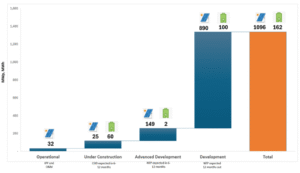
The Gentari deal builds on AWS’s expanding renewable footprint in India. By mid-2025, Amazon had developed 50 large solar and wind projects. It also installed 44 rooftop solar systems at its facilities. Together, these projects represent more than 1.1 gigawatts (GW) of renewable capacity in the country.

This growing portfolio fuels Amazon’s offices, distribution centers, and data centers. It also helps the company aim to be the largest corporate buyer of renewable energy worldwide. The partnership with Gentari adds a strong wind element to its clean energy in India. It works well with the current solar capacity.

Why Wind Matters in AWS’s Net-Zero Game Plan

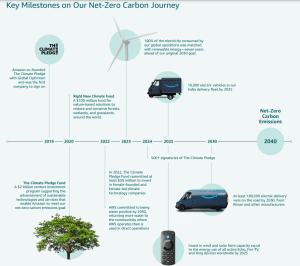
Amazon has committed to achieving net-zero carbon emissions by 2040, a decade ahead of the Paris Agreement’s target. The company is advancing by using renewable energy, improving energy efficiency, and making operational changes.

Amazon net zero 2040 journey
Source: Amazon report

Key highlights include:

  • Renewable Energy Leadership:

By 2024, Amazon had more than 500 renewable projects worldwide. Their total capacity was over 30 GW, enough to power millions of homes each year.

  • 100% Renewable Energy Goal:

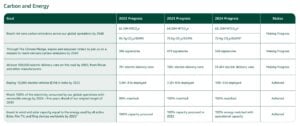
The company aims to match all electricity use with renewable energy by 2025, five years ahead of its original target.

AMAZON ENERGY
Source: Amazon
  • Electrification of Transportation:

Over 15,000 electric delivery vehicles are now operating globally, part of Amazon’s order for 100,000 EVs from Rivian.

  • Emission Reductions:

Between 2021 and 2023, Amazon reported a 7% drop in carbon intensity, meaning emissions per dollar of sales decreased even as operations grew. In 2024, the tech giant emitted a total of over 68 million metric tons of CO2e.

amazon carbon footprint
Source: Amazon
  • Carbon Removal Investments:

The company is backing nature-based and technological carbon removal projects, including reforestation and direct air capture.

These initiatives back Amazon’s Climate Pledge. Over 400 companies also signed it. The goal is to reach net zero by 2040.

SEE MORE on Amazon:

Gentari’s Tamil Nadu Hub: More Than Just a Breeze

Gentari, a clean energy subsidiary of Petronas, is positioning Tamil Nadu’s Karur region as a wind energy hub. The collaboration between Gentari and AWS extends beyond power supply.

In 2023, both companies signed a memorandum of understanding (MoU) to support fleet electrification in India. Gentari has helped deploy over 7,200 electric vehicles for last-mile delivery. This effort has helped Amazon reduce its transportation emissions as the tech giant moves toward net zero.

The partnership tackles two major sources of corporate carbon emissions: energy use and transportation. It does this by combining renewable energy projects with electrified logistics.

India’s Renewable Boom: A Global Leader in the Making

India’s renewable energy sector is growing rapidly. This growth is making the country a global leader in clean energy. In 2023–24, over 70% of new power generation came from renewable sources. This shows that the shift away from coal and fossil fuels is speeding up.

By early 2024, India had over 220 gigawatts (GW) of renewable energy. This total includes solar, wind, hydro, and biomass sources. Solar made up the largest share of recent growth, with over 21 GW of new capacity added in that year alone, followed by 3 GW of new wind projects.

India annual solar manufacturing projections
Chart from SolarPower Europe

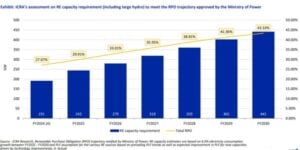
Government targets remain ambitious. India’s National Electricity Plan aims for 500 GW of non-fossil fuel capacity by 2030. This supports its goal to meet 50% of electricity needs from renewable sources by then. This would require adding roughly 30–40 GW of new renewable capacity each year over the next six years.

Industry forecasts say that by 2030, renewable energy will account for about 35% of India’s power generation. This is an increase from around 21% in 2024.

India Renewable energy 2030
Source: ICRA

This rapid growth comes from lower technology costs. In India, solar tariffs are very low, around ₹2–₹2.5 per kilowatt-hour (about $0.024–$0.03). State and central government incentives, such as the following, are helping to draw both domestic and foreign investment:

  • accelerated depreciation benefits,
  • production-linked incentives for solar manufacturing, and
  • renewable purchase obligations for utilities.

The International Energy Agency (IEA) says India will likely be the third-largest market for new renewable capacity in the 2030s.

Corporate PPAs: The Hidden Engine of the Energy Transition

Corporate procurement has emerged as a powerful driver of India’s renewable energy expansion. Long-term power purchase agreements (PPAs), such as the AWS–Gentari deal, are popular for growing renewable projects. They offer steady revenue for developers and stable prices for buyers. 

These agreements appeal to big energy users like data centers, factories, and logistics hubs. They need cost certainty and want to cut emissions to reach their environmental goals.

India has become a hotspot for corporate renewable energy adoption. BloombergNEF reports that in 2023, India’s corporate clean energy procurement topped 8 GW. This achievement ranks India as one of the top three countries for corporate renewable deals globally. 

Top companies like Amazon, Microsoft, and Google, along with Indian giants Tata and Reliance, are signing multi-year PPAs. This helps them secure clean power.

For AWS, the benefits of this approach go beyond energy cost stability. Reaching its 100% renewable energy goal in India by 2025 helps fulfill its global Climate Pledge. This pledge aims for net-zero carbon emissions by 2040. 

Opportunities and Obstacles on the Road to 2040

The AWS–Gentari deal shows how corporate partnerships can boost clean energy, but challenges still exist. Integrating variable renewable energy into India’s grid requires careful planning and investment in storage and transmission. Large-scale projects may also face land acquisition hurdles and permitting delays.

Even with these challenges, the outlook for renewable energy in India remains strong. AWS’s expanding presence in the country, along with key partnerships like this, shows how business needs can speed up the shift to a cleaner and stronger power sector.

AWS’s deal with Gentari for 80 MW of wind power in Tamil Nadu is more than buying renewable energy. It’s a smart investment in India’s clean energy system. By linking wind power generation with electric vehicle deployment, Amazon shows how corporate partnerships can deliver economic benefits and net zero progress in one of the world’s fastest-growing energy markets.

READ MORE:

The post Amazon Powers Ahead with Petronas’ Gentari Wind Energy Deal in India appeared first on Carbon Credits.

Fortescue and China’s $2B Green Deal: Can the Australian Iron Ore Giant Go Fossil-Free?

Fortescue and China’s $2B Green Deal: Can the Australian Iron Ore Giant Go Fossil-Free?

Fortescue, one of the world’s largest iron ore producers and a leading player in green energy, has secured a $2 billion loan from Chinese banks to accelerate its decarbonization plans. The funding is part of the company’s broader goal to achieve net-zero emissions by 2030 for its Scope 1 and Scope 2 operations.

The loan marks one of the largest green financing deals between an Australian mining company and China. It comes when demand for low-carbon industrial production is rising. This growth is due to global climate goals and investor pressure for cleaner operations.

Fortescue will use the funds for several key projects, particularly renewable energy projects. They will replace diesel-powered equipment with electric options. Also, they will invest in green hydrogen production.

Where Will Fortescue Spend the $2 Billion?

Mining is one of the most carbon-intensive industries. Fortescue operates in the Pilbara region of Western Australia. Right now, they rely mostly on fossil fuels, especially diesel. This fuels their mining trucks, trains, and power generation.

However, the company plans to stop using fossil fuels by 2030. This bold goal needs a lot of investment.

The $2 billion loan will fund infrastructure upgrades. This includes renewable energy projects, electric transport fleets, and hydrogen systems. According to Fortescue, these measures could cut millions of tons of carbon dioxide equivalent (CO₂e) from its annual emissions.

Andrew Forrest AO remarked:

“This isn’t just a financial transaction. It’s a signal of what is possible when partners are aligned in ambition. As the United States steps back from investing in what will be the world’s greatest industry, China and Fortescue are advancing the green technology needed to lead the global green industrial revolution.”

China’s Role in the Green Mining Shift

China is Australia’s largest iron ore customer and also a rapidly expanding player in green finance. By working with Chinese banks, Fortescue strengthens both its financial position and its long-term commercial relationships.

For China, supporting Fortescue’s decarbonization aligns with its own push for greener supply chains. The world’s largest emitter is working towards its 2060 carbon neutrality goal. It is urging major suppliers to cut emissions, particularly in resource-heavy sectors.

This financing could open doors for Chinese investment in Fortescue’s green hydrogen projects. These projects aim to export clean energy to global markets, like China.

From Ore to Zero: Fortescue’s Bold 2030 Pledge

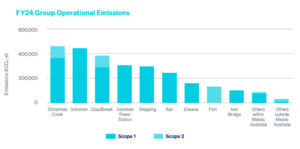
In 2024, Fortescue reported the following GHG emissions profile

  • Scope 1 and 2 Emissions: 2.72 million tonnes CO2e (combined direct and purchased energy emissions for Fortescue’s operations).
  • Scope 3 Emissions: 269.31 million tonnes CO2e, roughly 100 times greater than Scope 1 and 2 combined.
  • Majority Source of Scope 3: The steelmaking process downstream accounts for about 97% of Scope 3 emissions (262.16 million tonnes CO2e).
Fortescue 2024 scope 1 and 2 emissions
Source: Fortescue

This rise in emissions compared to the previous year (2.55 million tonnes CO₂e) can be due to operational scale and fuel consumption changes.

Scope 3 emissions, mainly from steelmaking customers, stayed high at over 260 million tonnes CO₂-e. This highlights the challenge of lowering emissions throughout the value chain.

Fortescue GHG emissions 2024

In 2024, Fortescue reported that it had already begun trials of electric mining haul trucks and hydrogen-fueled locomotives. The $2 billion loan will help scale these trials into full commercial deployment.

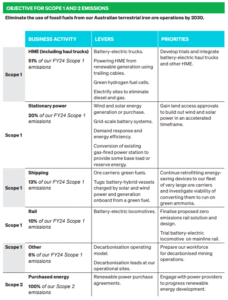
Fortescue aims to stop burning fossil fuels across its Australian iron ore operations by 2030. This “Real Zero” goal targets the absolute elimination of Scope 1 and Scope 2 emissions for its terrestrial iron ore business.

Fortescue’s Four Pillars of a Mining Makeover

The company is moving on four clear fronts: 

  • electrifying heavy equipment, 
  • building large renewable power, 
  • producing green hydrogen, and 
  • adding energy storage

Fortescue plans to buy hundreds of electric machines. These machines will replace much of its diesel fleet and cut fuel use at scale.

On the power side, Fortescue is building utility-scale solar to run mines and support green hydrogen. It started work on a 190 MW solar farm near Cloudbreak. It is also seeking approval for a 644 MW solar hub at Turner River.

Together, these projects will add hundreds of megawatts of renewable energy to Pilbara operations. Large solar builds let Fortescue shift electricity away from diesel generators. 

Green hydrogen forms a third pillar. Fortescue has a project in Pecém, Brazil, that produces 168,000 tonnes of hydrogen each year. They also have smaller projects, like the 50 MW PEM50 in Australia, which generates around 8,000 tonnes per year. Hydrogen can power heavy equipment or act as a feedstock for low-carbon steel.

The company has completed field trials. This includes a prototype battery haul truck called “Roadrunner.” It is now launching battery systems and transmission lines for major hubs like North Star Junction. 

Still, Fortescue recently scaled back some green hydrogen plans and flagged a preliminary $150 million writedown tied to project changes — showing the plan remains costly and technically risky. 

If Fortescue executes these steps, it expects to cut millions of tonnes of CO₂e from annual operations and meet its Real Zero target by 2030. These measures are central to its pitch as a miner turning into a green-energy industrial group.

Fortescue emission reduction targets 2030

Industry Trends and the Bigger Picture

The mining industry is under pressure to reduce emissions. Investors, customers, and regulators all want cleaner operations. The International Energy Agency (IEA) reports that mining companies worldwide contribute 4–7% of total greenhouse gas emissions. This is mostly because they rely on fossil fuels for extraction and processing.

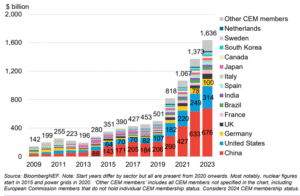
Green financing in the mining sector is becoming more common. BloombergNEF says global investments in energy transition hit over $1.7 trillion in 2024.

energy transition investments 2024 BNEF
Source: BNEF

Mining projects are becoming a bigger part of this trend. Fortescue’s deal with China signals a deepening link between resource supply security and sustainable financing.

If Fortescue succeeds, it could set a standard for other resource giants. They will want to align with net-zero goals and stay profitable. It also highlights how the voluntary carbon market, renewable energy credits, and clean technology investments can converge in heavy industry.

Risks, Rewards, and the Road to Real Zero

Despite the funding boost, Fortescue faces significant challenges. Switching from diesel to electric and hydrogen machinery uses new technologies. These are unproven at this scale, so they may have reliability and cost problems. Building renewable energy in remote mining areas needs careful planning and permits.

Market risks are another factor. Global demand for iron ore depends on construction and manufacturing. Economic downturns can hurt the financial success of big decarbonization projects. Additionally, geopolitical tensions between Australia and China could create uncertainty for cross-border financing and trade.

If Fortescue achieves its 2030 targets, it could eliminate more than 3 million tons of CO₂e from its operations annually. This could be one of the first big mining companies to operate without fossil fuels. This change might lower the carbon intensity in the steel supply chain.

Fortescue’s $2 billion green loan is both a financial and strategic step forward. By getting funding from China, the company gains money for its decarbonization projects. It also strengthens its relationship with a key trading partner during the green transition era.

The next few years will test Fortescue’s ability to deploy large-scale renewable energy systems and shift its heavy equipment fleet away from fossil fuels. If the company meets its targets, it could serve as a model for how resource-intensive industries can transition toward net-zero while maintaining strong market positions.

The post Fortescue and China’s $2B Green Deal: Can the Australian Iron Ore Giant Go Fossil-Free? appeared first on Carbon Credits.

Tesla Robotaxi Secures Permit in Texas, Fuels TSLA Stock Surge and Market Buzz

Featured image sourced from Tesla Robotaxi

Tesla has cleared a major hurdle in its push toward fully autonomous transportation. As per reports, the Texas Department of Licensing and Regulation (TDLR) has granted Tesla Robotaxi LLC a permit to operate as a transportation network company (TNC) across the state.

This green light allows the electric vehicle giant to roll out its ride-hailing service, both with and without human safety drivers. It marks its boldest step yet into the competitive robotaxi market.

The permit, issued this week, remains valid until August 6, 2026, setting the stage for Tesla to expand beyond its current limited service in Austin and directly challenge rivals like Uber, Lyft, and Waymo.

A Big Win for Tesla’s Autonomous Ride-Hailing Battle

Tesla’s latest permit authorizes the company to legally deploy fully driverless vehicles across Texas without a safety driver in the car, aligning perfectly with Elon Musk’s long-standing vision of a driverless future.

The company has been operating a pilot program in Austin since June 22, 2025, offering rides to a select group of influencers and industry analysts. These early riders, many of them active Tesla promoters on platforms like X and YouTube, have been experiencing trips in Model Y vehicles equipped with Tesla’s newest partially automated driving systems.

Although the cars currently run with a “valet” sitting in the passenger seat to step in during emergencies, they are also monitored remotely by Tesla’s operations center staff. With the new permit, Tesla now has the legal right to remove that in-person safety presence altogether.

tesla robotaxi
Source: Tesla

Going Statewide: From Austin to All of Texas

Until now, Tesla’s robotaxi program was limited to small-scale trials in Austin. The TDLR permit changes that entirely, giving Tesla permission to operate anywhere in Texas. That includes bustling urban centers like Dallas and Houston, where demand for ride-hailing is strong.

More importantly, the permit gives Tesla the ability to expand rapidly—something Musk has hinted at repeatedly. On a recent earnings call, he predicted Tesla could serve half of the U.S. population with robotaxi services by the end of 2025.

The approval also places Tesla in a direct turf war with Waymo, Google’s self-driving unit, which already operates a robotaxi fleet in Austin through a partnership with Uber.

First Steps into Driverless Service

Tesla’s push into Texas marks the first time the company has deployed autonomous vehicles with paying passengers. This milestone puts it ahead of many automakers still in the testing phase.

In a surprise twist, just days after securing the Texas license, Tesla was spotted testing its robotaxi in Miami without any safety driver at all. While that was outside the Texas jurisdiction, it hints at Tesla’s national ambitions and confidence in its self-driving system.

Why Texas Matters for Tesla

Texas is a proving ground for Tesla’s robotaxi. The state has generally been friendly to autonomous vehicle testing and has clear legal frameworks that support driverless deployment.

By securing the TDLR permit, the company gains the freedom to launch fully driverless services statewide, scale operations without the legal hurdle of keeping human supervisors in every vehicle, and position itself as a first mover ahead of competing EV makers and robotaxi operators.

If successful, Texas could become the blueprint for Tesla’s expansion into other large, car-dependent states.

TSLA Stock Jumps on Robotaxi Momentum

Investor excitement has been quick to follow Tesla’s progress. After Elon Musk confirmed that Austin’s robotaxi service will open to the general public next month, TSLA shares surged more than 5%, closing at $346.50.

This rally reflects investor belief that robotaxi services could become a major revenue stream for Tesla, complementing its core EV sales. Analysts say the Texas approval strengthens Tesla’s first-mover advantage in the driverless ride-hailing market and could accelerate its push toward Musk’s ambitious target of serving half of the U.S. population by the end of 2025.

tsla stock
Source: Yahoo Finance

What’s Driving NHTSA’s Probe into Tesla’s Self-Driving Tech?

While the vision is ambitious, Tesla’s autonomous program hasn’t been without criticism. Early trial data in Austin shows around one notable system failure per vehicle every 2–8 days, equivalent to roughly 0.314 failures per day per car.

Videos posted online have captured incidents of Tesla’s robotaxis running stop signs, drifting into the wrong lanes, and failing to detect oncoming trains. The BBC highlighted that these issues have caught the attention of NHTSA, which confirmed it is in contact with Tesla to gather more information.

Early Performance and Safety Concerns

The NHTSA investigation adds to growing regulatory pressure. Reports suggest that Tesla has withheld certain incident data from public release, raising concerns about transparency in its robotaxi program.

Tesla’s self-driving systems face mounting scrutiny as new crash data raises safety concerns.

  • 51 deaths since October 2024, including 2 linked to Full Self-Driving

  • Highest US crash rate in 2024: 26.67 accidents per 1,000 drivers — up 13.3% from 2023

  • Autopilot safety gap: 1 crash every 7.44 million miles on Autopilot vs. every 1.51 million miles without, as per Tesla’s Q1 2025 Vehicle Safety Report.

Statistically, Tesla currently has the highest crash rate of any U.S. automaker in 2024. Critics point out that while Musk often cites safety metrics favorable to Tesla, independent experts argue the data lacks consistent, third-party validation.

Musk’s Optimism vs. Robotaxi Reality

Elon Musk describes himself as “pathologically optimistic”, and his track record of bold promises supports that claim. Predicting that Tesla could cover half of the U.S. with robotaxi services within months is no small statement.

For now, Tesla’s Texas permit officially marks its entry into the state’s ride-hailing market. It puts the company in direct competition with Waymo, and brings Musk’s vision of a driverless future closer to reality.

robotaxi
Source: Global Market Insights

However, Tesla still faces challenges. Experts are saying that it must improve safety, address regulatory concerns, and convince riders that its vision-only self-driving is as safe or safer than competitors using more sensors.

If Tesla succeeds, Texas could become the launchpad for a nationwide rollout, changing urban transportation and ride-hailing economics.

The post Tesla Robotaxi Secures Permit in Texas, Fuels TSLA Stock Surge and Market Buzz appeared first on Carbon Credits.

BBVA Hits €30 Billion in Q2 for Sustainable Finance

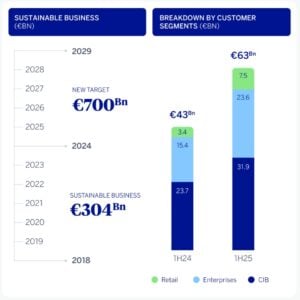
Spanish banking firm Banco Bilbao Vizcaya Argentaria, aka BBVA, has set a new pace in sustainable finance. The bank recently announced that it has mobilized €30 billion ($32.5 billion) in green and social projects in Q2 2025 — its highest quarterly result ever. This brought its total for the first half of the year to €63 billion ($68.5 billion), marking a sharp 48% jump from the same period in 2024.

From Climate Action to Social Impact: BBVA’s €63 Billion Green Push

The growth pushes BBVA closer to its new target: channeling €700 billion ($760 billion) into sustainable financing between 2025 and 2029. The bank had already met its earlier €300 billion goal for 2018–2025 a year ahead of schedule, hitting the milestone in December 2024.

Of the €63 billion mobilized in H1 2025, 76% went toward climate change and natural capital projects. These covered areas such as renewable energy, efficient water use, sustainable agriculture, biodiversity protection, and the circular economy.

The remaining 24% went to social projects, including infrastructure for education and healthcare, entrepreneurship support, funding for small businesses, and financial inclusion for underserved communities.

Record Growth Across Business Segments

BBVA’s momentum came from strong growth in all business lines:

  • Commercial Banking: Mobilized €23.6 billion, up 53% year-on-year. Natural capital financing totaled €2.34 billion, with Mexico’s agricultural sector contributing half of that.

  • Corporate and Investment Banking (CIB): Contributed €31.9 billion, up 34%. The bank financed clean technologies, renewable projects, and sustainable supply chain solutions such as reverse factoring with green criteria. Renewable energy project funding alone reached €1.6 billion.

  • Retail Banking: Channeled €7.5 billion, up 119%. This included €742 million for hybrid and electric vehicle financing and digital tools that help customers measure potential energy savings.

Backing Breakthrough Clean Energy Projects

BBVA’s sustainability push isn’t just about volume — it’s also about innovation. In Q2 2025, the bank sponsored the Energy Tech Summit in Bilbao, attracting over 1,500 cleantech experts from 40+ countries.

There, it announced a landmark project finance deal — the first in the Iberian Peninsula for a hydrogen plant powered entirely by renewable energy. Scheduled to begin operations in H1 2026, the plant will be a key step in decarbonizing heavy industry.

BBVA climate targets

A More Ambitious €700 Billion Target

BBVA’s expanded goal more than doubles its previous plan, with a shorter deadline. The aim is to channel €700 billion in sustainable finance from 2025 to 2029, compared to the earlier €300 billion over eight years.

The strategy focuses on three pillars:

  1. Climate Action – Funding renewable energy, clean technologies, and emissions reduction.

  2. Natural Capital – Supporting agriculture, water conservation, biodiversity, and land restoration.

  3. Social Opportunities – Financing healthcare, education, affordable housing, and entrepreneurship.

Driving the Net Zero Transition

Alongside its financing efforts, BBVA is working toward Net Zero emissions by 2050. It has already set interim 2030 decarbonization targets for ten sectors, including oil and gas, power generation, automotive, steel, cement, coal, aviation, shipping, aluminum, and real estate.

The bank is now preparing sector targets for agriculture — a major source of global emissions — as part of its broader climate plan.

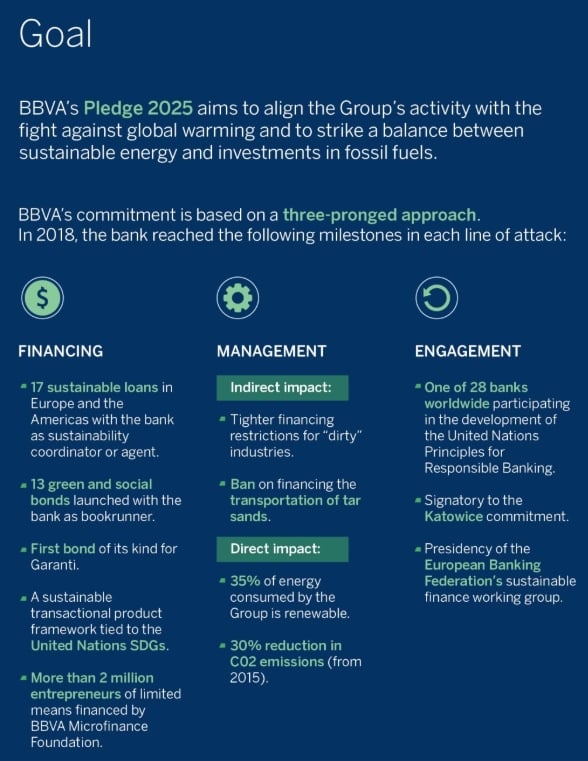
bbva sustainability
Source: BBVA

Why This €30 Billion Surge Matters

BBVA’s record-breaking quarter shows that sustainable finance is moving into the mainstream. The bank’s retail segment — up 119% — proves that demand for eco-friendly banking isn’t limited to corporations. Everyday, customers are increasingly choosing green loans, energy-saving solutions, and sustainable investment options.

These projects deliver dual benefits: reducing carbon footprints while improving social well-being. From renewable power plants to inclusive financing for small businesses, BBVA is aligning its growth with global sustainability goals.

How BBVA Plans to Hit the €700 Billion Mark

The bank’s roadmap includes expanding partnerships, scaling retail offerings, and enhancing digital sustainability tools. These platforms help clients understand the environmental impact of their investments, building transparency and trust.

For example, customers can estimate energy savings from home upgrades or track CO2 reductions from EV financing. By merging finance with real-time environmental insights, BBVA is turning sustainability into an accessible, measurable choice for more people.

Environmental and Carbon Benefits of These Investments

With 76% of funding directed to environmental projects in H1 2025, BBVA is investing heavily in emissions reduction, renewable energy, and ecosystem restoration.

Key highlights include:

  • Hydrogen & Renewables – €1.6 billion for renewable power and financing Iberia’s first renewable hydrogen plant.

  • Natural Capital – €2.34 billion for water conservation, sustainable agriculture, and biodiversity protection.

  • EV Transition – €742 million in hybrid and electric vehicle loans, cutting transport-related CO2.

These initiatives help replace fossil fuels, store carbon in healthier ecosystems, and encourage sustainable consumer behavior.

The Global Trend Fueling BBVA’s Growth

BBVA’s performance mirrors a global boom in sustainable finance. Green bond issuance could surpass €1 trillion annually by the end of 2025. Over 70% of large corporations now follow ESG strategies, driven by customer demand and regulatory pressure.

By beating its 2018–2025 target ahead of schedule and setting a new, more ambitious goal, BBVA is positioning itself among the leaders in climate-aligned banking. Its mix of green and social investments also supports the UN Sustainable Development Goals (SDGs).

Notably, its sustainability push comes with solid financial backing. The bank reported €5.45 billion in profit for H1 2025 and maintains strong capital reserves. Its “capital-light” growth model balances risk and return, keeping investors confident while pursuing long-term environmental impact.

What’s Next for Banking and Sustainability

The rise of ESG investing signals a shift in the role of banks. Customers, investors, and governments now expect institutions to be active players in the climate transition. BBVA’s quick pivot demonstrates its readiness to meet this demand at scale.

Going forward, expect more banks to adopt:

  • Clear Targets – Time-bound climate and social finance goals.

  • Transparency Tools – Digital platforms that track impact.

  • Innovation Financing – Support for emerging decarbonization technologies.

BBVA’s Role in Shaping the Future

From clean hydrogen plants to small business inclusion programs, BBVA’s sustainable finance strategy blends profitability with purpose. The bank is proving that climate action and social impact can be growth drivers, not just compliance measures.

Its combination of technology, strong performance, and measurable impact makes it a leader in the green banking race. As industries decarbonize and regulations tighten, banks that move early, like BBVA, will set the standard for the financial sector’s role in building a sustainable future.

The post BBVA Hits €30 Billion in Q2 for Sustainable Finance appeared first on Carbon Credits.

Meta’s AI Forest Map: The Game-Changer for Carbon Tracking

Meta’s AI Forest Map: The Game-Changer for Carbon Tracking

Forests are vital for our planet. They help fight climate change by absorbing a lot of carbon dioxide from the air, acting as major carbon sinks. They store large amounts of carbon in biomass and soil, estimated to absorb about 30% of human-caused CO2 emissions annually worldwide.

However, scientists and project managers must track forest health. They need to know how much carbon forests store. This helps ensure that efforts to protect or grow forests are effective. This is called measuring, monitoring, reporting, and verifying forest carbon, often shortened to MMRV.

Recently, Meta has developed an AI-powered canopy height map that offers unprecedented detail in tracking forest health and carbon storage. This open-source tool helps project developers monitor changes, verify carbon credits, and boost climate action.

Eyes in the Sky: How Remote Sensing Sees Forests Differently

Measuring carbon in forests is tricky and expensive. Usually, people go out into the forest and measure trees by hand, which takes a lot of time and effort. It’s hard to do this over large areas, especially in dense or remote forests.

This is where remote sensing comes in. 

Remote sensing is a way to gather information about forests without going there in person. It uses satellites, airplanes, or drones equipped with cameras and sensors. This technology can take pictures and collect data. It helps scientists learn how tall trees are, how dense the forest is, and how much carbon it might store.

There are different kinds of remote sensing data:

  • Optical imagery: like normal photos taken from space or planes, showing the tops of trees and land features.
  • Radar: which uses radio waves and can see through clouds and work at night.
  • Lidar: which uses lasers to map the exact height and shape of trees in 3D.

The Challenge with Remote Sensing Data

Each data type has strengths and weaknesses. Optical images are good and widely available, but they can’t see through clouds and only show forest surfaces. Radar can see through clouds but has trouble measuring details in dense forests. Lidar is very accurate but expensive and covers less area.

To get the best info, scientists combine different types of data using artificial intelligence (AI) and machine learning techniques. Machine learning helps computers find patterns in huge amounts of data to make better estimates.

Meta’s Canopy Height Map: AI-Powered Forest Intelligence

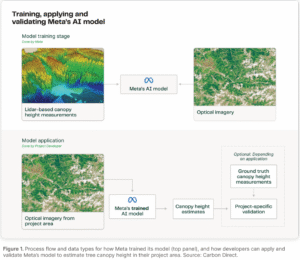
Meta developed a unique AI model that merges high-resolution satellite images with lidar data. This model maps tree canopy heights globally with great detail—less than one meter per pixel. This means it can see individual trees in many places.

Meta AI forest map
Source: Meta

The map and the AI model are open-source and freely available, so anyone can use them to help forest projects. They enable better planning, monitoring, and verification of forest carbon projects. Reza Rastegar, Senior Manager of Research Science at Meta, stated:

“When applied thoughtfully, we believe AI research and remote-sensing tools, particularly those that are open source, have the potential to revolutionize the transparency and accessibility of the carbon market.”

Meta’s model has been validated with mean absolute errors of 2.8 meters in U.S. forests and 5.1 meters in Brazil. This reflects a promising improvement in estimating canopy height at fine scales. These advanced datasets and models are helping to track natural regeneration, selective logging, and forest degradation more accurately, which is vital for credible MMRV of carbon credits.

What’s special about this model?

  • It works globally with very fine detail.
  • It can help identify important areas to protect or restore.
  • It can make new maps for different times if good images are available.
  • It helps detect small changes in forests, like selective logging (cutting some trees but not all).
  • It supports methods from carbon credit standards. This is important for those who need dynamic baselining or updating project baselines with real data from nature.

How Meta train AI model

RELATED: Meta and Microsoft Secured Long-Term Carbon Credit Deals to Support Olympic Rainforest

From Pixels to Carbon Credits: Turning Data into Climate Action

Forest carbon projects use different official methods to create and verify forest carbon credits. The three main methods Meta focuses on are:

  1. Verra VM0045 – for improved forest management (IFM).
  2. Verra VM0047 – for afforestation, reforestation, and revegetation (ARR).
  3. American Carbon Registry (ACR) IFM – a US-based improved forest management method.

Here’s how Meta’s canopy height map and AI model fit into these methods:

  • In project planning, the map helps find good parcels of forest to include, determine project boundaries, and understand forest structure.
  • For dynamic baselining, especially in ARR and ACR’s IFM methods, the AI model can help update baselines based on real forest growth or loss over time.
  • For reversals monitoring (tracking if carbon gains are lost, e.g., due to fire or logging), the map gives better details to detect forest disturbances.

The Fine Print: What Meta’s Model Gets Right—and Where It Struggles

Many traditional satellite products can’t reliably measure forest height or biomass in dense forests or small areas. Meta’s model, because it uses very high-resolution images, helps overcome this.

Monitoring small or fragmented forests, river corridors, or areas with selective logging is crucial. These places are difficult to track using low-resolution data.

Meta’s canopy height model is a powerful tool for estimating forest structure, but it comes with limitations. It works best with high-quality imagery at 0.5–1 meter resolution. The global canopy height map uses images from 2009 to 2020. This means it might not show current forest conditions. So, there’s a need for updated maps.

Accuracy may also drop in underrepresented forest types, so local validation with field or lidar data is advised. Using the model requires significant computing power and technical expertise, which may limit adoption.

For forest carbon projects, remote sensing offers great promise but faces barriers. There is no universal agreement among registries, buyers, and developers on acceptable methods or datasets.

In addition, technical skills, computational capacity, and access to affordable, high-quality datasets remain limited. Uncertainty around accuracy—and lack of consensus on acceptable error levels—make trust and comparability difficult.

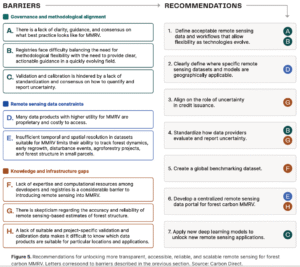
For the identified barriers, the report authors recommend the following:

barriers and recommendation

Closing the Gap Between Innovation and Impact

Experts want clearer standards for how datasets can be used. They also seek better reporting on uncertainty and clearer rules for issuing carbon credits. A global benchmarking database with verified data and a central portal for quality datasets could help boost adoption.

Moreover, easier AI tools would make this process smoother. Integrating advanced models like Meta’s into accessible platforms, alongside collaborative standard-setting, will be crucial to scaling reliable forest carbon monitoring and verification.

Examples of New and Exciting Uses of Meta’s Model

  • Counting trees in agroforestry projects to monitor performance.
  • Mapping old-growth forests and biodiversity hotspots.
  • Detecting subtle forest degradation, like selective logging.
  • Monitoring reversals (losses of carbon stored) with greater accuracy.
  • Supporting more accurate estimates of above-ground biomass.

Forests are vital to fighting climate change by storing carbon, but measuring how much carbon they hold and how this changes over time is tough. New technologies like remote sensing are making this easier, faster, and cheaper.

Meta’s AI-powered canopy height map is a cutting-edge tool offering very detailed, global forest height data that can help in planning, monitoring, and verifying forest carbon projects.

The post Meta’s AI Forest Map: The Game-Changer for Carbon Tracking appeared first on Carbon Credits.

PowerBank Embraces Bitcoin and Tokenized Energy in Bold Treasury Shift to Digital Finance

PowerBank Embraces Bitcoin and Tokenized Energy in Bold Treasury Shift to Digital Finance

Disseminated on behalf of PowerBank Corporation.

PowerBank Corporation recently announced a new treasury strategy that includes holding Bitcoin. This move combines innovative finance with the company’s ongoing mission to develop clean energy projects. PowerBank aims to hold Bitcoin on its balance sheet. It has also teamed up with Intellistake Technologies Corp., a company focused on blockchain and digital asset custody and treasury management.

PowerBank intends to acquire Bitcoin as part of its treasury assets. This allows the company to tap into the long-term value of the cryptocurrency. Also, it remains dedicated to environmental responsibility and sustainability.

Linking Bitcoin with Clean Energy

Bitcoin mining is often criticized for high energy consumption and its impact on the environment. Some experts and companies think Bitcoin can help renewable energy grow. This is true when it is linked to clean power sources. That is the approach PowerBank follows.

PowerBank states that all Bitcoin transactions it completes will use net cash flow from verified renewable energy sources. This helps maintain its focus on sustainability.

So, Why Bitcoin? 

PowerBank views Bitcoin not just as an investment but as a strategic reserve asset. Holding Bitcoin on its balance sheet can help the company hedge against inflation and economic uncertainty. This trend includes more than 40 public companies that hold Bitcoin as of 2024, says Galaxy Digital.

Bitcoin is decentralized and has a limited supply of 21 million coins. This makes it appealing for companies that want a long-term hedge against inflation. PowerBank has committed to transparency with its future Bitcoin holdings and will report them openly.

A Smart Power Duo: PowerBank x Intellistake

PowerBank has teamed up with Intellistake Technologies Corp. This partnership will help PowerBank with technical advice, custody, digital asset security, blockchain infrastructure, and treasury management. All these services support PowerBank’s Bitcoin strategy and related plans.

Through this collaboration, the company gains access to Blockchain infrastructure and digital asset custody.

Expanding Clean Energy Finance Through Digital Assets

PowerBank’s Bitcoin strategy positions it as a pioneer in linking digital assets with clean energy development. Bitcoin purchases with net cash flow generated from renewable energy can offset the electricity used in Bitcoin mining

Research from groups like the Energy Web Foundation and the Cambridge Centre for Alternative Finance backs this idea. Using low-carbon energy for Bitcoin mining can turn it from a problem into a tool for grid management, and PowerBank is using a similar indirect approach through the use of net cash flow from renewable energy projects to acquire Bitcoin.

The announcement has attracted attention from ESG-focused investors and the broader crypto community. It shows a rising interest in how renewable energy developers can use blockchain and digital assets in their financing models.

A Bloomberg NEF survey found that approximately 60% of renewable energy developers are exploring blockchain or digital asset solutions to support project financing. If PowerBank’s approach works, it may inspire other clean energy companies to try similar strategies.

Beyond Bitcoin: Energy on the Blockchain

In addition to Bitcoin, PowerBank is advancing blockchain-based finance through its partnership with Intellistake. Intellistake specializes in blockchain, capital markets, and decentralized AI infrastructure.

Under this agreement:

  • PowerBank plans to accumulate Bitcoin as a long-term reserve asset.
  • Intellistake provides custody, digital security, and treasury management tools.
  • Both companies will look into tokenizing real-world energy assets. This includes solar farms and battery storage systems.

Tokenization is turning physical assets into digital tokens. These tokens can be traded or sold in regulated markets. This can lead to:

  • Easier access to renewable energy investments.
  • Faster, transparent transfers of ownership.
  • New ways to raise capital through fractional ownership.

Intellistake’s CEO, Jason Dussault, has stated that tokenization is no longer just a concept but an inevitable step for capital markets. 

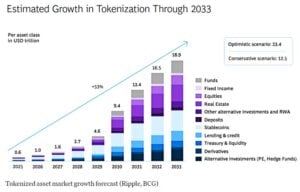
Analysts say tokenized real-world assets might reach a $30 trillion market by 2034, while some projected it to reach almost $19 trillion by 2033. Clean energy is a major use case because of its stable, asset-backed value.

tokenization growth forecast 2033

Reasons for Bitcoin as a Treasury Asset

PowerBank’s Bitcoin treasury plans reflect a broader corporate trend. Many companies view Bitcoin as:

  • Scarce and resistant to inflation.
  • Easily transferable with global liquidity.
  • Increasingly adopted by blockchain-based financial systems.

Firms like MicroStrategy, Block, and Tesla have added Bitcoin to their balance sheets to diversify reserves beyond bonds and cash. PowerBank has not yet confirmed any Bitcoin purchases.

The company plans to make decisions based on market conditions, liquidity needs, and cash flow. PowerBank wants to keep full control of its digital assets. So, it has Intellistake providing custody infrastructure, which means no need for third parties.

A New Model for Clean Energy Finance

PowerBank generates steady revenue from its renewable energy projects. The company might use these revenues to invest in digital assets. They plan to connect clean energy with advanced financial technologies.

PowerBank has developed over 100 megawatts (MW) of renewable energy projects in the U.S. and Canada. It also has a pipeline of about 1 gigawatt (GW). This gives PowerBank a solid base to try out new financing methods.

Powerbank project pipeline
Source: PowerBank

The company’s integration of Bitcoin and tokenization may change how energy developers manage their finances. The company intends to combine renewable energy projects with treasury diversification and blockchain finance. This approach opens a new frontier for decarbonization and financial technology.

As investors and utilities seek sustainable, high-yield options, PowerBank’s approach could open new value opportunities in both the energy and finance sectors.

Please refer to “Forward-Looking Statements” in the press release entitled “PowerBank and Intellistake Announce Strategic Alliance to Pioneer Digital Currencies, including Bitcoin Treasury Integration and RWA Tokenization” for additional discussion of the assumptions and risk factors associated with the statements in this report.

Intellistake and PowerBank are presently evaluating the regulatory framework for tokenization. Any tokenization will be subject to it being completed in compliance with applicable law, regulatory requirements and terms of any underlying agreements associated with PowerBank assets. The actual structure of such tokenization, the assets that would be subject to tokenization, and the associated timeline, have not yet been determined. Intellistake and PowerBank will provide further updates as material developments related to this tokenization strategy occur.

The actual timing and value of Bitcoin purchases, under the allocation strategy will be determined by management. Purchases will also depend on several factors, including, among others, general market and business conditions, the trading price of Bitcoin and the anticipated cash needs of Intellistake or PowerBank. The allocation strategy may be suspended, discontinued or modified at any time for any reason. Intellistake will support PowerBank’s establishment of custody for its digital currency purchases and PowerBank no longer intends to utilize Coinbase for this service. As of the date of this press release, no Bitcoin purchases have been made.


Disclosure: Owners, members, directors, and employees of carboncredits.com have/may have stock or option positions in any of the companies mentioned: None.

Carboncredits.com receives compensation for this publication and has a business relationship with any company whose stock(s) is/are mentioned in this article.

Additional disclosure: This communication serves the sole purpose of adding value to the research process and is for information only. Please do your own due diligence. Every investment in securities mentioned in publications of carboncredits.com involves risks that could lead to a total loss of the invested capital.

Please read our Full RISKS and DISCLOSURE here.

The post PowerBank Embraces Bitcoin and Tokenized Energy in Bold Treasury Shift to Digital Finance appeared first on Carbon Credits.

CDR Credit Sales Hit Record High, Powering Market Growth in 2025

The voluntary carbon market is booming in 2025. Allied Offsets data showed that in the first quarter of 2025, around 780,000 CDR credits were contracted — a surge of 122% compared to the same period in 2024.

Additionally, 16 million credits were sold in the first six months of 2025 – marking it the strongest start to a year so far. The momentum is fueled by major buyers like Microsoft, aiming to be carbon negative by 2030, and by a surge in biomass-based removal methods that are reshaping corporate offset strategies.

Why Carbon Dioxide Removal Credits Are Surging

Businesses are racing to hit climate targets faster, and carbon dioxide removal (CDR) is emerging as the go-to solution. The biggest boost this year comes from biomass-based methods — like turning farming and forestry waste into tools for trapping CO₂. These projects are cheaper, easier to scale, and more accessible than high-cost tech such as direct air capture (DAC).

By early 2025, biomass CDR accounted for about 40% of credit volumes. Microsoft and other big players are securing large volumes, setting quality benchmarks, and pushing the market toward transparent, high-integrity projects.

Source: Zion Market Research

Technology Shifts in CDR

  • Biomass-based CDR — including BECCS, biochar, bio-oil, and biomass burial — made up a massive 94% of total volumes in the first half of 2025.

  • Investment focus, however, is still heavily skewed toward DAC and carbon utilization projects, despite other scalable and cost-effective CDR options.

  • More public awareness and funding diversity are needed to unlock the full potential of multiple CDR pathways.

New innovations are also redefining CDR. About 30% of new projects now use methods such as advanced soil carbon storage, bio-oil injection, and marine carbon removal, which can store CO₂ for hundreds or even thousands of years.

Digital MRV platforms are also transforming the space, offering real-time tracking to boost transparency, prevent fraud, and speed up purchase decisions. Meanwhile, integrated projects like agroforestry, regenerative agriculture, and biodiversity restoration are gaining traction for their multi-benefit environmental impact.

carbon dioxide removal CDR credits
Source: AlliedOffsets

Environmental Benefits of Biomass CDR

Biomass approaches like biochar and BECCS offer cost-effective solutions, often ranging from $80–$200 per ton.

These methods work within a circular economy model — repurposing agricultural and forestry waste into long-term carbon storage. BECCS delivers a dual benefit by producing renewable energy while storing CO₂ underground.

However, without strict MRV protocols, poorly managed biomass projects risk deforestation or biodiversity loss. Global removal capacity is still only 41 million tons CO₂/year, yet it needs to grow 25–100x by 2030 to meet climate goals.

Market Segmentation

By technology: DAC, afforestation & reforestation, soil carbon sequestration, BECCS, ocean-based CDR, and enhanced weathering.

  • DAC, holding 67% of global revenue in 2023, is set for the fastest growth thanks to flexible deployment and industrial CO₂ utilization.

By application: Consumer products, energy, transport, and industrial sectors.

  • The industrial sector leads due to rising emissions from cement, steel, and chemicals.

CDR Buyer Trends in 2025

  • Financial services firms led in the number of unique buyers, while technology companies dominated purchase volumes with over 50 million credits bought so far.

  • Half of all buyers in early 2025 were first-time participants, collectively purchasing around 6 million credits which is a promising sign of market expansion.

Market Momentum and Future Projections

The CDR market hit $3.9 billion in Q2 2025, with biomass projects making up 99% of transactions. Microsoft continues to drive momentum by locking in long-term purchase agreements that help projects scale.

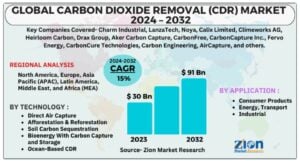
Market forecasts suggest CDR’s value will grow from $842 million in 2025 to $2.85 billion by 2034, while durable carbon credits could soar to $14 billion by 2035, growing 38% annually.

Rising buyer expectations — around permanence, transparency, and quality — are further reinforced by new regulations, particularly in Europe, pushing out low-integrity credits.

CDR market
Source: Zion Market Research

Opportunities and Challenges Ahead

The CDR market stands to benefit from government-backed carbon incentives, increasing demand for carbon credits, and the potential to create new jobs in sectors such as farming, engineering, and construction. However, its growth faces hurdles, including limited public awareness of CDR’s advantages and the risk of political instability slowing adoption.

What’s Next for Carbon Dioxide Removal?

The market is at a turning point. Experts predict a blend of nature-based and durable removals, with the latter gaining ground toward 2050 as quality demands rise. The future will rely on smarter investments, high-fidelity data tracking, and clear global standards.

Corporate leaders like Microsoft are already showing the way — proving that transparency, permanence, and innovation will define the next era of climate action.

The post CDR Credit Sales Hit Record High, Powering Market Growth in 2025 appeared first on Carbon Credits.
Toyota’s (TM Stock) Q1 Twist: Why Profits Dip But Hybrids Surge, and Net Zero Goals Accelerate

Toyota’s (TM Stock) Q1 Twist: Why Profits Dip But Hybrids Surge, and Net Zero Goals Accelerate

Toyota Motor Corporation reported a sharp drop in earnings for the quarter ending June 30, 2025. Net profit fell 37% to ¥841 billion ($5.7 billion), down from ¥1.33 trillion a year earlier. This marked one of the steepest quarterly declines in recent years. Revenue, however, rose 3% year-over-year to ¥12 trillion ($82 billion), supported by strong demand in North America and Asia.

The primary drag came from new U.S. tariffs of 15% on Japanese car imports, which reduced profit by an estimated ¥450 billion. Higher costs for raw materials and a stronger yen hurt overseas earnings. Global inflation also impacted the results.

Toyota has revised its full-year operating profit forecast downward to ¥2.66 trillion ($18 billion). This speaks of a more cautious outlook for 2025. Analysts say the biggest automaker is keeping strong sales. However, profit margins face pressure from outside economic factors.

Amid the financial hiccup, the company reaffirmed its commitment to climate leadership. It aims for carbon neutrality with strong emissions targets, green manufacturing projects, and renewable energy investments. This effort is part of its Environmental Challenge 2050 framework.

Hybrids Take the Wheel as Sales Defy the Downturn

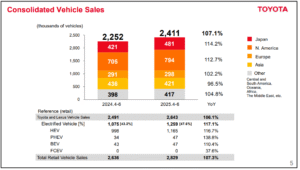
Global vehicle sales for the quarter reached 2.4 million units, up from 2.2 million a year ago. Toyota’s sales in North America rose nearly 20% in July. This boost came from its hybrid models, like the RAV4 Hybrid and Camry Hybrid, which both showed double-digit growth.

Toyota vehicle sales
Source: Toyota

Hybrid and plug-in hybrid models make up over one-third of Toyota’s total sales. This shows how important electrified powertrains are becoming in the company’s lineup.

Battery electric vehicle (BEV) sales, while still a smaller portion, increased steadily in markets with expanding charging infrastructure.

Toyota stayed on top in Japan and Southeast Asia. This was thanks to its compact cars and commercial vehicles. However, European sales dipped a bit due to tougher emissions rules and strong competition from local EV brands.

Toyota’s share price fell about 1.6% following the earnings announcement, as tariff concerns weighed on investor sentiment. Even with this dip, the stock still looks good. Its forward price-to-earnings (P/E) ratio is 6.9. That’s lower than the industry average of 8.0 and Toyota’s five-year average of 9.3.

toyota stock price
Source: TradingView

Driving Toward 2050: Toyota’s Net Zero Roadmap

Toyota has set a long-term target to achieve carbon neutrality across the entire life cycle of its vehicles by 2050. This goal covers emissions from all stages: vehicle design, production, use, and recycling. It also includes emissions from suppliers and logistics partners.

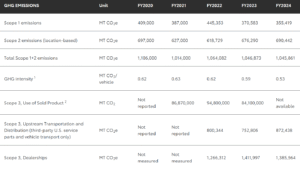
In its latest sustainability report, Toyota reported its Scope 1 and Scope 2 greenhouse gas emissions. These emissions, from direct operations and purchased electricity, reached around 2.05 million metric tons of CO₂e in FY 2024. This shows a 15% drop from FY 2019 levels. The company aims to cut these emissions by 68% by 2035, using 2019 as the baseline year.

For Scope 3 emissions, which account for most of Toyota’s footprint, targets are set. By 2030, Toyota aims for a 30% reduction from suppliers, logistics, and dealerships. They also seek a 35% cut in average vehicle-use emissions. These goals account for the fact that tailpipe emissions from vehicles remain the single largest part of the company’s climate impact.

Globally, Toyota is investing in solar, wind, hydrogen, and renewable natural gas to power its factories. It has also joined multiple international coalitions to accelerate low-carbon manufacturing and logistics.

The largest carmaker is investing a lot in renewable energy. They plan to use 45% renewable electricity in North America by 2026. By 2035, they aim for 100% renewable energy at all global plants.

Projects include:

  • Large-scale solar panel installations at assembly plants
  • Hydrogen-powered forklifts
  • Renewable natural gas systems at engine facilities.

The company’s approach combines electrification with manufacturing decarbonization. This includes hybrids, battery electric vehicles (BEVs), and hydrogen fuel cell vehicles.

Toyota’s leaders think this multi-pathway strategy will reduce emissions quickly. This is especially true in areas where full BEV infrastructure is still growing. It also helps ensure steady progress toward the company’s 2050 carbon neutrality goal.

toyota ghg carbon emissions
Source: Toyota

In summary, the company’s near-term reduction targets are:

  • 68% reduction in Scope 1 and 2 emissions by 2035 (compared to 2019 levels).
  • 30% cut in Scope 3 emissions from suppliers, logistics, and dealerships by 2030.
  • Matching 45% of electricity use with renewables in North America by 2026.

Environmental Challenge 2050: Six Pillars of Action

Toyota’s Environmental Challenge 2050, launched in 2015, remains its guiding framework for sustainability. The initiative is built on six core challenges:

  1. Zero CO₂ emissions from new vehicles through hybrid, BEV, and hydrogen fuel cell adoption.
  2. Zero CO₂ emissions in manufacturing by shifting to renewable energy and low-carbon processes.
  3. Life cycle zero CO₂ emissions, including recycling and parts reuse.
  4. Minimizing water usage and improving water discharge quality.
  5. Protecting biodiversity around manufacturing sites and supply chains.
  6. Advancing a circular economy by extending product lifecycles and reducing waste.

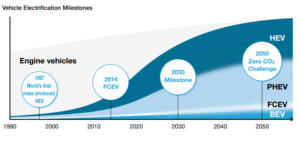
Toyota aims to sell 1.5 million BEVs annually by 2026 and 3.5 million by 2030, alongside continuing hybrid and fuel cell development. This multi-path approach allows the company to meet varying customer needs and infrastructure readiness levels worldwide.

TOYOTA electrification milestone
Source: Toyota

Green Manufacturing: Major Investments in Low-Carbon Plants and ESG 

Toyota’s largest new sustainability investment is a ¥140 billion ($922 million) advanced paint facility in Georgetown, Kentucky. Set to open in 2027, the plant will reduce paint shop carbon emissions by 30% and cut water use by 1.5 million gallons annually.

In Japan, Toyota is piloting hydrogen-powered forklifts and solar-powered assembly lines. The company will use 100% renewable electricity for its manufacturing in Europe by 2030.

These projects reduce environmental impact and boost operational efficiency. They support Toyota’s goals of sustainability and profitability.

Beyond emissions, Toyota is strengthening its broader ESG performance. The company has strict human rights rules for suppliers. These rules include labor conditions, conflict minerals, and environmental compliance. By 2030, Toyota aims for 90% of its top suppliers to set their own science-based emissions targets.

In 2024, Toyota diverted 94% of waste from landfills globally and recycled over 99% of scrap metal from manufacturing. It also invested in reforestation projects in Asia and Africa as part of its carbon offset strategy.

Balancing Short-Term Pressures With Long-Term Goals

The April–June quarter highlighted Toyota’s resilience in the face of macroeconomic challenges. Tariffs and currency changes have hurt short-term profits. However, strong vehicle sales, especially in hybrids, keep the company competitive.

At the same time, Toyota is moving ahead with one of the most thorough sustainability programs in the auto industry. Its carbon neutrality goals and the Environmental Challenge 2050 framework guide its actions. Also, large-scale green manufacturing investments help meet the growing demands for cleaner mobility from regulators and consumers.

As Toyota navigates market volatility, its ability to deliver both financial and environmental strategies will be key to maintaining global leadership in the shift toward sustainable transportation.

The post Toyota’s (TM Stock) Q1 Twist: Why Profits Dip But Hybrids Surge, and Net Zero Goals Accelerate appeared first on Carbon Credits.
JOBY Aviation Stock Soars on Blade Acquisition and Electric Air Taxi Commercial Launch Plans

joby

Joby Aviation Inc. (NYSE: JOBY) is closing in on its dream of launching electric air taxis. The California-based company has spent years building its all-electric, vertical take-off and landing (eVTOL) aircraft, designed for fast, quiet, and convenient city travel.

Air Taxis: The Future of Fast, Clean, and Congestion-Free Urban Travel

Air taxis are small electric or hybrid aircraft that take off and land vertically, ideal for short city hops, airport transfers, and reaching remote areas. Target users include executives, business travelers, and emergency services. Countries like the U.S., Germany, and the UAE are investing heavily in supporting infrastructure.

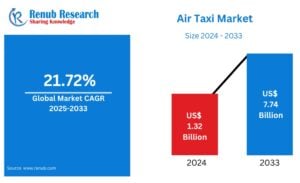
A report highlighted that the global air taxi market, valued at USD 1.32 billion in 2024, is projected to hit USD 7.74 billion by 2033 at a 21.72% CAGR, driven by eVTOL technology, urban mobility demand, and congestion-free travel needs.

air taxi JOby
Source: Renub Research

Growth is fueled by advances in batteries, lightweight materials, and electric propulsion, making aircraft cleaner and more efficient, plus worsening city traffic that air taxis can bypass—cutting multi-hour trips to just 15–20 minutes.

This August, Joby made a series of bold moves that pushed it closer to commercial operations, from a high-profile acquisition and defense partnership to major FAA progress and manufacturing growth. Investors noticed, sending the stock near record highs.

Blade Deal Unlocks Instant Market Access and Growth

One of the month’s biggest headlines came on August 4, when Joby announced plans to acquire Blade Air Mobility’s passenger business for up to $125 million in cash or stock.

The deal is a game-changer. Blade brings premium infrastructure, including dedicated terminals at major New York airports and a strong presence in Southern Europe. More importantly, it comes with a loyal customer base — more than 50,000 passengers flew Blade in 2024.

By absorbing Blade’s passenger operations, Joby gains instant market access without the time and expense of building from scratch. The acquisition is expected to slash infrastructure costs, speed up customer acquisition, and put Joby ahead of competitors in key urban corridors.

The transaction is set to close in the coming weeks, pending customary approvals. Once complete, Blade’s passenger services will continue under Joby’s ownership, setting the stage for a smooth integration.

Defense Partnership Opens a New Revenue Stream

Joby revealed another major move, a collaboration with defense contractor L3Harris.

The partnership will develop a gas turbine hybrid variant of Joby’s existing eVTOL aircraft for low-altitude defense missions. The design aims to combine Joby’s manufacturing expertise with L3Harris’ deep defense technology capabilities.

Flight testing is set to begin this fall, with operational demonstrations planned during government exercises in 2026.

This venture signals Joby’s ambition to be more than just a commercial passenger service. By stepping into the defense sector, Joby diversifies its revenue streams and showcases its aircraft’s versatility for both civilian and military use.

FAA Certification Moves Into Final Stages

On August 6, Joby shared a crucial regulatory update. It has started final assembly of its first FAA-approved electric air taxi, a major step toward Type Inspection Authorization (TIA) flight testing. This stage needs FAA-approved test plans, a certified design, and proven manufacturing — all of which Joby has achieved, with over 50% of its test plans already accepted.

The aircraft, developed over years of testing, will fly with Joby pilots in 2025, followed by FAA pilots. Structural and systems tests have confirmed its strength and readiness.

Joby’s in-house design and manufacturing have boosted development and improved quality. With new facilities in California and Ohio, backed by Toyota, the company will soon be able to build up to 24 aircraft a year.

Cash-Rich and Backed by Toyota, Joby Eyes Massive Growth Ahead

  • Joby’s balance sheet is strong, ending Q2 2025 with $991 million in cash, cash equivalents, and marketable securities.

The company also closed the first $250 million tranche of a $500 million strategic investment from Toyota, one of Joby’s largest and most influential partners.

For 2025, Joby expects to use between $500 million and $540 million in cash, excluding the Blade acquisition. Revenue remains small, just $59,600 expected for Q2, but growth projections are huge, with a forecasted 900% year-on-year increase from a low base.

JoeBen Bevirt, founder and CEO of Joby, said,

“This is a pivotal moment. Regulatory progress around the world is unlocking market access, our commercialization strategy is taking hold, and we’re now focused on scaling production to meet real demand—a challenge we’re fully committed to and working hard to deliver on.” 

JOBY Stock Surge Reflects Growing Investor Confidence

Joby’s recent string of announcements sent its stock soaring. In the past month alone, shares have jumped more than 70% due to heavy trading. Year-to-date, the stock has risen 142%, surpassing its market capitalization of $14 billion.

However, volatility remains. Analyst price target changes and insider sales have caused swings, but the long-term outlook hinges more on regulatory milestones than short-term earnings.

JOBY
Source: Yahoo Finance

Manufacturing Expansion Doubles Output

To meet growing demand, Joby expanded its Marina, California, manufacturing facility to 435,000 square feet. This upgrade will double production capacity to 24 aircraft per year.

Meanwhile, its newly renovated Dayton, Ohio, site is ramping up to produce and test key aircraft components. Over time, Dayton could scale to build up to 500 aircraft annually, making it a cornerstone of Joby’s manufacturing strategy.

International Partnerships Boost Global Reach

Joby is not just looking at U.S. cities. The company also announced an expanded partnership with ANA Holdings in Japan.

The two companies plan to deploy over 100 Joby air taxis starting in Tokyo, creating an urban air mobility ecosystem complete with dedicated vertiports and operational support. The partnership will leverage Toyota’s network and government cooperation to fast-track development.

Joby also signed new agreements with Abdul Latif Jameel and ANA to explore deploying approximately 300 aircraft in other markets.

What’s Next for Joby Aviation?

With the Blade acquisition, defense partnership, FAA certification progress, and global expansion, Joby is executing on multiple fronts at once.

The next 12 months will be critical. If Joby completes certification on schedule, ramps production, and integrates Blade’s passenger network, it could be one of the first eVTOL companies to operate at scale.

For now, investors are betting big that Joby’s head start, strategic partnerships, and strong balance sheet will translate into a dominant position in the fast-emerging air taxi market.

Joby Aviation isn’t just inching toward launch; it’s accelerating. From New York to Dubai to Tokyo, the pieces are falling into place for a global eVTOL network. If all goes according to plan, 2026 could be the year flying taxis move from concept to reality.

The post JOBY Aviation Stock Soars on Blade Acquisition and Electric Air Taxi Commercial Launch Plans appeared first on Carbon Credits.