Standard Chartered to Sell 5M Carbon Credits to Help Protect Amazon Rainforest

Standard Chartered to Sell 5M Carbon Credits to Help Protect Amazon Rainforest

Standard Chartered has signed a five-year deal to sell up to five million carbon credits on behalf of the Brazilian state of Acre. The major bank and the state are working together to fund rainforest conservation using the carbon credit market.

Credits will be created within a REDD+ framework. This global system aims to cut emissions from deforestation and forest degradation.

Carbon credits will start being issued in 2026. They will be in the “avoided deforestation” category. This means they help prevent emissions by preserving current forests instead of creating new ones. The goal is to prevent deforestation and protect biodiversity and community livelihoods. It also helps reduce greenhouse gas emissions.

The deal could raise as much as $150 million in funding. Acre officials say that 72% of the proceeds will go to local and Indigenous communities. This will help them protect and conserve forests. The rest of the funds will support project management and monitoring systems. This will help ensure transparency and effectiveness.

Why Rainforest Protection Matters in Global Climate Goals

Forests—especially tropical rainforests like the Amazon—are among the most important carbon sinks on the planet. When they’re cut down or degraded, the carbon stored in trees and soil is released into the atmosphere.

The Amazon rainforest absorbs billions of tons of carbon dioxide each year. A NASA-led study found that, in a typical year, the Amazon rainforest absorbs about 2.2 billion metric tons (2 billion tons) of CO2. This is crucial for stabilizing the Earth’s climate.

Experts say that about 20% of global land-use emissions come from deforestation and forest degradation. This makes protecting rainforests one of the quickest and cheapest climate actions today.

carbon emissions from Amazon deforestation
Source: Frontiers in Forests and Global Change

Deals like Standard Chartered’s with Acre help banks and businesses support conservation. They can also meet their corporate net-zero goals.

The agreement combines solid financial support with environmental care. It shows how carbon credits can work with climate science and help communities grow.

Standard Chartered’s Chief Sustainability Officer, Marisa Drew, remarked: 

“We’re leveraging our global network and carbon market expertise to address this challenge directly, offering a means to help preserve standing forests that act as vital carbon sinks, and in turn help the communities that depend on them continue to realise the economic and social returns they provide.”

High Integrity or Bust: Building Trust in Carbon Offsets

One of the biggest challenges in carbon markets today is credibility. Over the past few years, concerns have emerged about the quality and transparency of carbon offset projects. Some faced criticism for exaggerating emissions cuts. Others did not provide real environmental or social benefits.

To help address this, the Acre–Standard Chartered deal includes safeguards. First, there will be no forward selling of credits—this means credits will only be sold once they are officially issued and verified.

This reduces the risk of overpromising and underdelivering. The transaction also supports adherence to the Core Carbon Principles (CCPs) developed by the Integrity Council for the Voluntary Carbon Market (ICVCM). These principles define standards for top-quality carbon credits and include key factors like:

  • permanence,
  • additionality,
  • leakage, and
  • solid monitoring, reporting, and verification (MRV) systems.

The Acre project aims to create a real, measurable impact. Buyers and climate watchdogs want this more than ever.

Beyond the Trees: Inside the Bank’s Broader Climate Finance Strategy

This deal with Acre is part of a bigger move by Standard Chartered to increase its activity in sustainable finance and carbon markets. The bank has supported early-stage carbon removal firms like UNDO. UNDO uses enhanced weathering of rocks to take carbon out of the air.

The financing deal, supported by British Airways, had a unique structure. It included insurance and long-term offtake agreements.

Standard Chartered also partners with Puro.earth, a top carbon removal registry. This gives clients access to high-quality Carbon Dioxide Removal Certificates (CORCs). These types of credits are increasingly in demand from companies that want to go beyond carbon neutrality and achieve net-negative emissions.

The bank plans to achieve net-zero operations by 2025. It will use high-integrity carbon credits to offset emissions from energy use, air travel, and data centers. It also has a 2050 net-zero target for its financed emissions—those generated by the activities of companies it lends to or invests in.

Standard Chartered bank emissions 2024
Source: Standard Chartered 2024 Annual Report

The Carbon Market Is Growing Up – Fast

Standard Chartered’s deal also reflects broader trends in the voluntary carbon market (VCM). According to recent reports, the VCM was valued at around $2 billion in 2024, and could grow significantly in the coming years. 

carbon credit market value 2024

McKinsey & Company projects the VCM could reach over $50 billion by 2030 under favorable policy and corporate demand conditions. With strong market reform, the value could exceed $250 billion by 2050, driven by net-zero goals and increasing regulation.
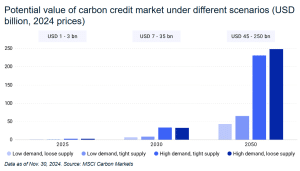
carbon credit market value 2050 MSCI
Source: MSCI

One of the most important shifts is the rise of jurisdictional REDD+ credits—like those offered by Acre. Jurisdictional credits differ from small-scale projects because they cover whole regions or states.

This approach offers wider environmental protection. It also lowers the risk of “leakage.” This is when conservation in one area leads to deforestation moving elsewhere.

Jurisdictional programs are also more attractive to institutional investors and sovereign funds. Large buyers usually want scalability, accountability, and local community benefits. Traditional project-level carbon offsets often fail to meet these needs.

The carbon market is expanding beyond forest protection. It now includes carbon removal technologies like direct air capture, biochar, and mineralization. These solutions are still new, but they are vital for reaching global net-zero goals. This is especially true in tough sectors to decarbonize, like cement, aviation, and steel.

A New Standard for Carbon Finance and COP30

The Standard Chartered–Acre partnership stands out not just for its scale, but for its approach. It focuses on real climate outcomes, community benefits, and market integrity. In doing so, it may serve as a model for future deals between financial institutions, governments, and Indigenous groups.

This is especially important ahead of COP30, the global climate summit set to be hosted in Belém, Brazil, in 2025. As the world focuses on Amazon conservation and climate justice, projects like Acre’s are set to shine. They show how nature-based solutions can achieve financial, environmental, and social goals.

By treating forests not just as carbon stores but as living ecosystems supported by local people, this deal shows that climate action and development do not have to be at odds—they can move forward together.

The post Standard Chartered to Sell 5M Carbon Credits to Help Protect Amazon Rainforest appeared first on Carbon Credits.
Lenovo Launches TruScale DaaS for Sustainability to Cut IT Carbon Emissions by 35%

Lenovo Launches TruScale DaaS for Sustainability to Cut IT Carbon Emissions by 35%

Lenovo launched its TruScale Device-as-a-Service (DaaS) for Sustainability. This subscription service helps businesses cut their IT carbon footprint by up to 35%. It also lowers device costs.

This all-in-one service manages the entire lifecycle of devices, incorporates carbon tracking tools, and offers flexible subscriptions. In doing so, it supports sustainability goals while improving budget efficiency.

The launch shows a bigger change in how companies view technology. It’s not just about tools for getting things done; it is also about helping with corporate climate action.

IT now plays a key role in helping organizations meet their net-zero and ESG (Environmental, Social, and Governance) commitments.

John Stamer, Lenovo’s Vice President and General Manager for Global Product Services, stated:

“Enterprises are rethinking how they manage IT – not just for performance, but for purpose. TruScale DaaS for Sustainability reflects our vision for the future of IT: circular by default, intelligent by design, and accountable by outcome.”

What Is TruScale DaaS and How Does It Work?

TruScale DaaS lets companies subscribe to laptops, desktops, servers, and other IT devices. This way, they can use the equipment without owning it.

Lenovo takes charge of device deployment, maintenance, refurbishment, and safe disposal. This setup cuts e‑waste, reduces the need for new device production, and lowers emissions tied to supply chains.

Key features include:

  • Lifecycle Management:

Devices are refurbished and redeployed, extending their usable life and conserving resources. Lenovo reports that more than 1 million devices have already been recovered and reconditioned under its asset recovery services.

  • Carbon Impact Portal:

Businesses can monitor emissions at each stage—manufacture, use, and disposal—helping them understand where to target reductions. It supports detailed Scope 1, 2, and some Scope 3 tracking for IT equipment.

  • CO₂ Offset Services:

Organizations can offset emissions they cannot avoid, aligning with their science-based targets or internal climate pledges. Lenovo partners with verified third-party carbon offset providers to ensure quality and transparency.

This model supports both ecological stewardship and operational efficiency. By outsourcing the management of IT assets, companies can also free up internal resources to focus on core priorities.

How TruScale Slashes Costs

Traditional IT spending often locks companies into fixed costs for hardware they may underuse. TruScale reduces waste by allowing businesses to adjust subscriptions to meet actual demand. This means no more overspending on unused or old devices.

According to Lenovo, businesses using TruScale can reduce IT maintenance costs by up to 40%. They also benefit from lower downtime due to AI-assisted diagnostics, proactive repairs, and optimized logistics. This boosts workforce productivity while extending the useful life of every device.

The subscription model takes away capital expenses (CapEx). It turns IT spending into operational expenses (OpEx). This flexibility is especially valuable during uncertain economic conditions or rapid business changes.

Environmental Impact: From E‑Waste to Carbon Savings

The core strength of TruScale lies in its environmental benefits, which include:

E‑Waste Reduction

Refurbishing used devices helps the environment. It keeps electronics out of landfills and reduces the need to mine raw materials. This includes lithium, cobalt, and rare earth metals. Mining these materials may harm the environment and raise human rights issues.

Carbon Footprint Reduction

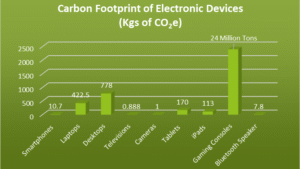
Manufacturing one laptop can produce 200–400 kg of CO₂, depending on the materials and energy mix used. By refurbishing instead of replacing, TruScale avoids these emissions. Lenovo estimates customers can reduce IT-related emissions by up to 35%.

carbon footprint of laptop
Source: 8BillionTrees

Circular Economy Model

TruScale aligns with global movements to reduce, reuse, and recycle. The circular approach saves energy, cuts pollution, and boosts resource efficiency.

Additionally, Lenovo itself has committed to reducing its own carbon emissions. It also aims for 90% of products to be repairable and recyclable by 2025—further reinforcing the company’s focus on sustainability.

Lenovo’s Journey to Net Zero by 2050

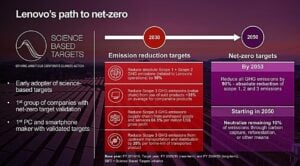
Lenovo is aligning its climate strategy with the Paris Agreement’s 1.5 °C goal. It aims for net-zero greenhouse gas emissions by 2050. The Science Based Targets initiative (SBTi) validated this target in January 2023.

Lenovo path to net zero
Source: Lenovo

Its near-term goals are to cut Scope 1 and 2 emissions by 50% by 2030. This is based on the 2019 level. They also aim for significant Scope 3 reductions:

  • 35% for product use, 66.5% per revenue in purchased goods and services, and 25% per tonne-km in logistics.

Lenovo is boosting its climate efforts with a supplier emissions reduction program. This program affects almost all of its procurement spending. It also features renewable energy pilots. These pilots aim to reduce emissions by about 30,000 metric tons in 2025.

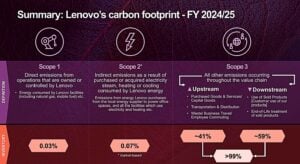
Lenovo carbon footprint or emissions 2024
Source: Lenovo

In its 2025 ESG Report, Lenovo highlighted its progress. The company received top honors, including Platinum from EcoVadis and an ‘AAA’ MSCI ESG rating.

Lenovo’s move comes as the carbon credit market gains momentum. By 2024, the voluntary carbon market (VCM) is worth about $2 billion. Analysts believe it could hit $50 billion by 2030. It may go even higher if policy support and corporate demand keep increasing.

TruScale’s carbon offset offerings tap into this trend. Clients can offset emissions from IT hardware. They do this by buying high-quality credits.

Prices for these credits now range between $13 and $15 per metric ton of CO₂, up from $3–5 just a few years ago, as quality and scrutiny have improved.

Lenovo ensures its offset services meet international standards such as Verra’s VCS, Gold Standard, or American Carbon Registry (ACR). This helps companies cut greenwashing risks. It also improves climate disclosures. They follow frameworks like the Task Force on Climate-related Financial Disclosures (TCFD) or CSRD in the EU.

Why Businesses Embrace Sustainable IT Solutions

Across sectors, businesses face rising pressure from investors, regulators, and consumers to clean up their environmental footprint. At the same time, companies need more agile and cost-efficient IT systems to remain competitive in the digital economy.

By offering a bundled solution, TruScale allows firms to hit both targets. Companies can cut emissions and e-waste. They can also follow regulations and report ESG performance. This can all happen while remaining lean and flexible.

According to a recent survey by IDC, over 70% of IT decision-makers say that sustainability will be a key driver of IT purchases within the next five years. Early adopters of sustainable services, like TruScale, can boost their reputation. This is especially true with eco-aware clients and stakeholders.

Why TruScale Is a Climate-Smart Investment

For companies looking to lower costs, meet climate goals, and stay ahead of tech trends, TruScale offers a clear advantage. It does the following:

  • Cuts emissions from IT hardware.

  • Reduces e-waste and material use.

  • Lowers total cost of ownership.

  • Enables better ESG reporting.

  • Increases IT agility and resilience.

In a world where every business is under pressure to prove its climate action, TruScale helps translate sustainability into everyday operations. Lenovo is showing that smart, scalable IT management can also be a powerful tool for environmental leadership.

READ MORE: Schneider Electric Launches AI-Native Initiative for Sustainability and Energy Management

The post Lenovo Launches TruScale DaaS for Sustainability to Cut IT Carbon Emissions by 35% appeared first on Carbon Credits.

UEC Stock Surges as Sweetwater Uranium Project Gets Federal Fast-Track Approval

uec

Uranium Energy Corp (UEC) announced that its Sweetwater Uranium Complex in Wyoming had been officially designated as a transparency project by the U.S. Federal Permitting Improvement Steering Council. This recognition comes under President Trump’s March 20, 2025, Executive Order aimed at accelerating domestic mineral production.

The decision allows Sweetwater to move through a fast-track permitting process, cutting project delays that are critical to national mineral and energy goals. Once upgrades are complete, Sweetwater will be the largest dual-feed uranium facility in the United States.

Significantly, it marks a major step toward restoring domestic uranium production and advancing U.S. energy security.

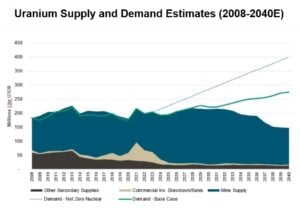
GLOBAL uranium demand and supply
Source: Source: Sprott (UxC and Cameco Corp. Data as of 9/30/2024)

Trump Administration Presidential Appointee, Emily Domenech, Executive Director of the Federal Permitting Improvement Steering Council, highlighted:

“I am excited to welcome the Sweetwater Complex to the FAST-41 transparency dashboard in support of President Trump’s goal of unlocking America’s mineral resources. The uranium that this project can produce would be game-changing for our nation as we work to reduce our reliance on Russia and China, strengthen our national and economic security, and reestablish a robust domestic supply chain of nuclear fuel.”

UEC’s Strategic Acquisition Pays Off

UEC acquired 100% of Rio Tinto’s Wyoming uranium assets, including the fully licensed Sweetwater Plant and 175 million pounds of historic resources. This purchase added eight permitted and exploration-stage projects to UEC’s portfolio, strengthening its hub-and-spoke production platform in Wyoming.

The complex now boasts a licensed production capacity of 4.1 million pounds of U₃O₈ annually, giving UEC a significant position in the U.S. uranium supply chain. The upcoming TRS (Technical Report Summary), expected by the end of fiscal 2025, will formally outline the Great Divide Basin Hub-and-Spoke model, designating Sweetwater as the hub supported by multiple satellite mines.

Amir Adnani, UEC President and CEO, stated:

“Sweetwater’s selection under FAST-41 reinforces its national importance as a key project to achieve the United States’ goals of establishing reliable infrastructure, supporting nuclear fuel independence. Acquired from Rio Tinto in 2024, Sweetwater will be UEC’s third hub-and-spoke production platform, following operational advancements underway in Wyoming’s Powder River Basin and South Texas. On completing this tack-on permitting initiative, Sweetwater will be the largest dual-feed uranium facility in the United States, licensed to process both conventional ore and ISR resin. This will provide the Company unrivaled flexibility to scale production across the Great Divide Basin, leveraging UEC’s leading domestic resource base. We’re proud of and grateful for the Steering Council’s support under President Trump’s Executive Order to fast-track a secure, predictable, and affordable supply of critical minerals.”

Building a Scalable ISR Mining Platform

The company recently revealed that it is working to amend Sweetwater’s permits to include In-Situ Recovery (ISR) mining methods—an environmentally friendly and lower-impact uranium extraction process. The plan includes adding a new ion exchange and elution circuit at the Sweetwater Plant.

The “spokes” in this system will draw resources from:

  • Red Desert deposits: REB, ENQ, and Sweetwater
  • Green Mountain zones: Round Park, Phase 2, Whiskey Peak, and Desert View
  • Other nearby deposits: JAB, Clarkson Hill, and Red Rim

This hub-and-spoke approach is designed to scale production while lowering costs and minimizing environmental disturbance.

Why Sweetwater Matters to U.S. Energy Policy?

The Executive Order that triggered Sweetwater’s fast-track status reflects a broader White House push to rebuild the nuclear fuel supply chain. The U.S. has been increasingly dependent on foreign uranium sources, making domestic production a matter of energy security.

By adding Sweetwater to the FAST-41 transparency dashboard, federal agencies are prioritizing faster reviews, more transparency, and better coordination for critical mineral projects. The Bureau of Land Management will serve as the lead agency for Sweetwater’s permitting process.

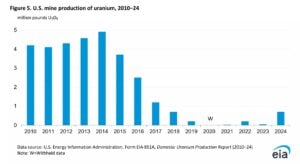
u.s. uranium
Source: EIA

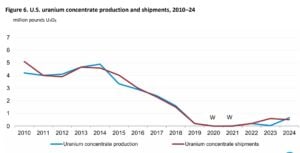
The chart from EIA’s Domestic Uranium Production shows that the U.S. uranium mines produced about 0.6–0.7 million pounds of U₃O₈ in 2024. This big drop over the years has made the U.S. more dependent on imported uranium.

That’s why the government is now pushing to boost local production. UEC’s Sweetwater Uranium Complex is part of that plan. Once upgrades are complete, Sweetwater’s estimate of 4.1 million pounds annually could be enough to cover most of today’s total U.S. uranium output on its own.

America’s Largest Licensed Uranium Complex

The Sweetwater Processing Plant is a 3,000-ton-per-day conventional uranium mill with full licensing and state permits in place. Once ISR methods are approved, Sweetwater will become the largest licensed uranium production facility in the country with dual-feed capability.

Key advantages include:

  • Massive Resource Base – Over 175 million pounds of historic uranium resources
  • Extensive Exploration Data – 6.1 million feet of historic drilling and ~108,000 acres under control
  • Existing Permits – Approval already in place for conventional mining at Sweetwater, Big Eagle, and Jackpot mines
  • Cost and Time Efficiency – Upgrading an existing plant is far faster and cheaper than building a new one, leveraging existing infrastructure for synergy and scale

The company also owns a high-grade Canadian project portfolio anchored by the world-class Roughrider deposit- one of the largest physical uranium stockpiles in the United States. In addition, it maintains a significant equity stake in Uranium Royalty Corp. This diversified portfolio would help UEC tap into opportunities from the growing global demand for uranium.

uranium
Source: EIA

UEC Joins Global Push to Triple Nuclear Power by 2050

Nuclear power has long been the backbone of U.S. carbon-free electricity. According to the World Nuclear Association, in 2022, nuclear accounted for 19% of U.S. electricity generation—and 55% of the country’s carbon-free power. This avoided 482 million metric tons of CO₂ emissions, equivalent to removing about 107 million gasoline cars from the road for a year.

The push for nuclear energy has global momentum. At the COP28 climate summit in 2023, more than 20 nations agreed to triple nuclear capacity by 2050. UEC has pledged support for this international effort.

Green Mining Goals

UEC has committed to producing uranium under the highest environmental standards, aiming for net-zero CO₂ emissions across its U.S. ISR operations and maintaining zero significant environmental incidents annually.

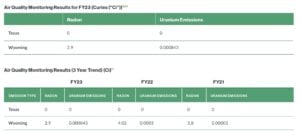
The company’s air quality monitoring program reported no non-compliance in 2023. Radon and uranium particulate emissions were kept well below regulatory limits, with no harmful environmental releases.

This environmental track record supports UEC’s claim that ISR mining can be both commercially viable and environmentally responsible.

uranium energy corp UEC Emission
Source: UEC

UEC Stock Market Momentum

UEC’s strong operational news has translated into equally strong stock performance. Over the past year, the share price has surged by approximately 114%, with gains of 51.8% in the past month and 14.1% in the past week alone.

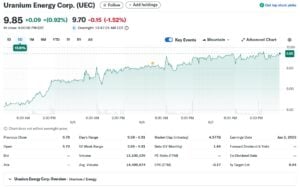
On August 7, 2025, the stock reached a new 52-week high of $9.91 and is currently trading at around $9.85. Analysts remain bullish, citing sector optimism and positive policy developments, with most price targets above current levels.

UEC stock
Source: Yahoo Finance

However, they caution that high volatility remains due to the company’s current lack of profitability and its sensitivity to broader market shifts. In short, momentum is strong, but risk is real.

The Bigger Picture: U.S. Uranium Revival

Sweetwater’s fast-track designation signals more than just a win for UEC—it’s part of a national strategy to rebuild America’s nuclear industrial base. By unlocking domestic uranium resources, the U.S. can reduce its reliance on imports and strengthen its clean energy mix.

For UEC, it cements the company’s role as a leading domestic uranium supplier, capable of scaling production rapidly to meet future nuclear energy demand.

The post UEC Stock Surges as Sweetwater Uranium Project Gets Federal Fast-Track Approval appeared first on Carbon Credits.

Mercedes-Benz Goes Electric: Biggest Model Launch Set for 2026 & Zero-Emission Commitment

MERCEDES BENZ

After a 3% sales dip in 2024 and 6.2% in early 2025, Mercedes-Benz is going all-in on electrification. As per media reports, the company plans to launch 18 new models in 2026—many of them fully electric—in what it calls the biggest product rollout in its history. The goal is to revive interest by merging classic luxury with clean, future-ready tech.

Mercedes-Benz’s Strong Electric Vehicle Commitment

The company plans to make at least 50% of its vehicle sales fully electric or plug-in hybrid by 2030. This shift positions Mercedes-Benz to stay ahead of regulations and consumer trends, especially in regions tightening emissions standards.

Entry-Level EVs Kick Off the Shift

In 2025, Mercedes will introduce two compact electric crossovers—likely EV versions of the GLA and GLB—targeting urban drivers. These models are built for efficiency and practicality, but also sustainability.

Core Models Go Dual-Track

In the mid-range “Core” segment—including the C-Class and GLC—the company will offer both refreshed gas versions and new EVs. A fully electric C-Class will join the lineup with better range and performance.

  • By 2027, a new Core EV built on a dedicated electric platform will mark a deeper shift toward full electrification.

Luxury EVs Take the Spotlight

Mercedes’ high-end “Top End” line gets five new EVs in 2026, including a revamped EQS. The S-Class also receives a major update, with the EQS expected to match its luxury and tech upgrades.

  • Through 2027, five more luxury EVs will follow, including the “Little G,” a compact electric version of the iconic G-Wagon, blending off-road ruggedness with zero emissions.

GLC EV Redefines Design

Replacing the EQC, the new electric GLC debuts at Munich’s IAA show this fall. It retains a bold grille, a nod to tradition, while boasting upgraded styling and charging tech.

AMG Joins the EV Push

Mercedes-AMG is developing an electric super sedan and SUV based on the GT XX concept, delivering high performance without emissions. A new V8 is also in development for gas holdouts, though the updated C63 may switch to a six-cylinder model. The challenge is honoring AMG’s legacy while embracing electric speed.

Mercedes is moving away from the minimalist EQ design language. Instead, future EVs and gas vehicles will share a cohesive, luxurious aesthetic. The aim is to make electric models feel just as familiar and desirable as their combustion counterparts.

Mercedes-Benz Drives Toward a Greener Future

Sustainability is extremely vital for Mercedes-Benz Group’s corporate strategy. Last year, the company sharpened its focus, identifying six priority areas that align with both environmental and stakeholder expectations.

From decarbonization to digital trust, Mercedes-Benz is not only adapting to global climate goals but aiming to lead the way in clean, ethical, and responsible mobility.

Six Strategic Pillars of Sustainability

Mercedes-Benz updated its materiality assessment in line with the Corporate Sustainability Reporting Directive (CSRD) and European Sustainability Reporting Standards (ESRS). This evaluation factored in the views of all key stakeholders—customers, investors, employees, suppliers, and society at large.

As a result, the company established six key focus areas:

  • Decarbonization
  • Resource Use & Circularity
  • Human Rights
  • Digital Trust
  • People (Employees)
  • Traffic Safety

Each of these areas includes defined targets and is tracked using internal scorecards, ensuring progress remains measurable and transparent.

Net-Zero Goals: Ambition 2039

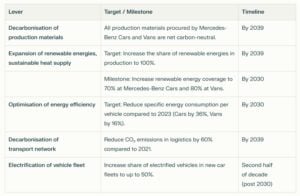
Under the Ambition 2039 roadmap, Mercedes-Benz aims for its new vehicle fleet to be net carbon-neutral across its entire lifecycle, including production, logistics, and supply chain, by 2039.

The company is taking bold steps to cut emissions and increase clean energy usage across all business segments.

Mercedez benz climate
Source: Mercedes-Benz Climate Transition Action Plan-2025

Major Progress in Carbon Emissions Reduction

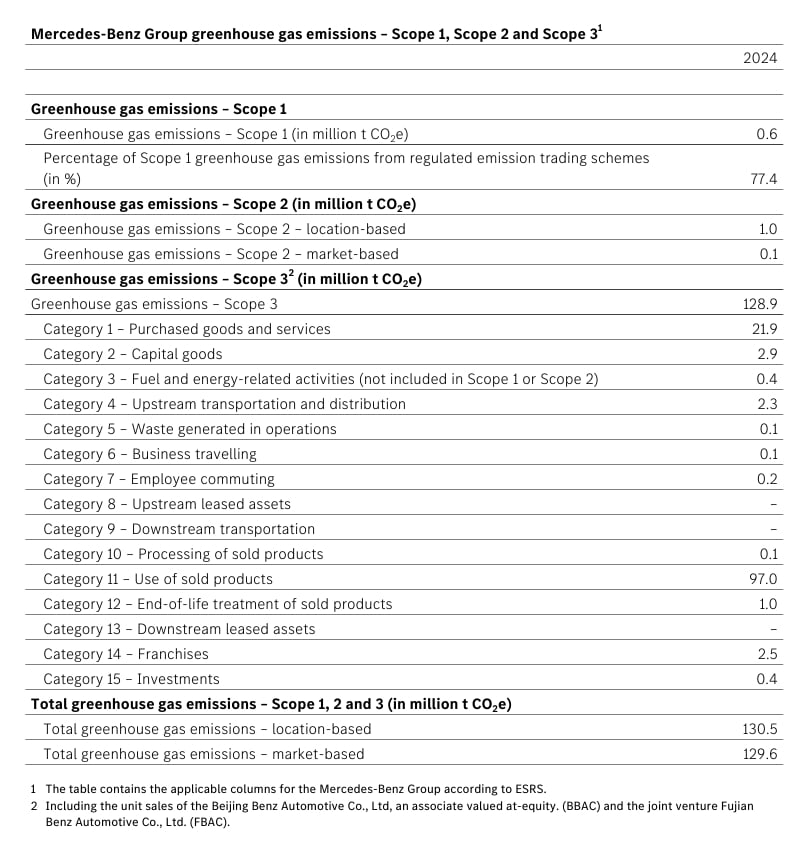
The company reports greenhouse gas emissions under Scopes 1, 2, and 3, including biogenic emissions.

  • Scope 1 & 2: Emissions from direct operations and purchased energy. The company calculates biogenic CO₂ emissions separately from fossil sources using standardized factors.
  • Scope 3: Indirect emissions across the value chain. The majority—around 75%—come from vehicle use (tank-to-wheel) and fuel/electricity production (well-to-tank).

MB’s 2024 Emissions Report

mercedes benz
Source: Mercedes-Benz

It has significantly lowered its carbon footprint in recent years. The company’s decarbonization strategy revealed:

  • Factory Emissions: All production facilities have operated on 100% renewable electricity since 2022. Between 2018 and 2023, production-related CO₂ emissions fell by 72%.
  • Vehicle Lifecycle Emissions: Emissions per vehicle dropped to 46.3 tonnes in 2023, down from 49.7 tonnes in 2020. The target is to achieve a 50% reduction by 2030.
  • Green Supply Chain: From 2025, Mercedes will integrate CO₂-free “green steel” into vehicle production. More than 85% of its supplier base has now committed to carbon-neutral materials.

Advancing Circularity and Recycling

Circularity is another core focus. The company launched a battery recycling plant in Kuppenheim, Germany, which aims to recover up to 96% of materials. By 2030, Mercedes targets 40% recycled material usage across its vehicle lineup.

Smart Carbon Credit Strategy

To meet stringent EU carbon limits, Mercedes-Benz has already transitioned to carbon-neutral production since 2022. It also utilizes emissions pooling with partners such as Polestar, Volvo, and Smart to balance the average emissions of its fleet while transitioning toward full electrification.

Spotlight: The New Electric CLA

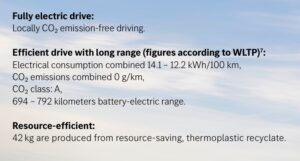
Mercedes-Benz’s new fully electric CLA model showcases the company’s shift to climate-smart design. This next-gen EV reduces its carbon footprint by 40% over its lifecycle compared to its internal combustion predecessor. With further supply chain and battery optimizations, total reductions could reach up to two-thirds.

Key sustainability measures in the CLA include:

MB electric cla
Source: MB

This comprehensive environmental check demonstrates the brand’s commitment to integrating sustainability into every vehicle component—from raw materials to end-of-life.

Overall, Mercedes-Benz is transforming from a traditional luxury automaker to a sustainability-driven mobility leader. With concrete goals, significant achievements, and a growing EV lineup, the company is aligning with global calls for cleaner transportation.

The post Mercedes-Benz Goes Electric: Biggest Model Launch Set for 2026 & Zero-Emission Commitment appeared first on Carbon Credits.
America’s Nuclear Comeback Begins: Standard Nuclear Joins DOE’s Fuel Pilot Program

us nuclear

The U.S. is reigniting its nuclear ambitions—and it just took a big leap forward. The Department of Energy (DOE) recently conditionally selected Oak Ridge, Tennessee-based Standard Nuclear as the first company to join its newly launched nuclear fuel line pilot program, part of the Trump administration’s broader strategy to rebuild America’s nuclear energy leadership.

This initiative, announced in July 2025, directly supports President Trump’s Executive Order on Deploying Advanced Nuclear Reactors for National Security. It aims to end the country’s reliance on foreign enriched uranium and critical nuclear materials by building a secure, domestic fuel supply chain—one built on innovation, speed, and private sector partnership.

U.S. Secretary of Energy Chris Wright said,

“With President Trump’s leadership, the Energy Department is moving at a rapid pace to unleash innovation and maintain American leadership in nuclear energy development,”. “Advanced nuclear reactors will be a game-changer for the United States, and with that comes the need to fabricate the fuel for these reactors. The Department of Energy is partnering with private sector innovation with DOE expertise to assure stronger U.S. nuclear supply lines.”

Powering the Future: Advanced Reactors Need Advanced Fuel

Advanced nuclear reactors are central to America’s clean energy and national security goals. But to power them, the country needs more than just designs; it needs the right fuel.

That’s where Standard Nuclear steps in. It’s now the first company conditionally approved under DOE’s fuel pilot program, giving it access to fast-track processes and support. The company will focus on producing TRISO (TRi-structural ISOtropic) fuel, a next-generation nuclear fuel known for its unmatched safety, durability, and performance.

Standard Nuclear will lead the construction, operation, and eventual decommissioning of the fuel fabrication facility. Meanwhile, reactor developers will source nuclear material feedstock potentially through the DOE’s high-assay low-enriched uranium (HALEU) program, for conversion into TRISO fuel.

TRISO Fuel: The Toughest Fuel on Earth

TRISO fuel is engineered for extreme performance. Each tiny fuel kernel—about the width of a human hair—is coated in multiple layers of ceramic and carbon. These layers act like a built-in containment system, ensuring that even under high temperatures (up to 1,600°C), the fuel doesn’t melt or release harmful materials.

TRISO Particles

triso particles
Source: DOE

Key highlights of TRISO fuel:

  • Microscale safety: Each particle is a self-contained barrier, lowering the risk of large-scale radioactive release.
  • High performance: TRISO can operate at much higher temperatures than traditional fuels, increasing thermal efficiency.
  • Unmatched resilience: The fuel resists mechanical failure, corrosion, oxidation, and neutron damage.

This design makes TRISO a perfect fit for advanced reactors, especially those planned outside traditional nuclear sites—including defense, microreactors, and space power systems. Also, compared to traditional nuclear fuel rods, TRISO’s structure is safer, more resilient, and ideal for new reactor types under development in the U.S.

Dr. Kurt Terrani, PhD, Chief Executive Officer of Standard Nuclear, said,

“Most of the long-anticipated wave of advanced reactors finally arriving to the market are harnessing the unique, inherent advantages of TRISO fuel—benefits that have been validated through decades of DOE and NRC investment and scientific rigor. These reactors can’t run without fuel, and we’re here to ensure there are no uncertainties in that supply. We’re not just delivering TRISO fuel at scale—we’re doing it at a cost that enables a robust, competitive, and sustainable advanced reactor industry.”

Standard Nuclear’s Reactor-Agnostic Advantage

What makes Standard Nuclear stand out is its reactor-agnostic model. Unlike traditional nuclear companies, it doesn’t develop its own reactors. Instead, it focuses exclusively on nuclear fuel, allowing it to serve a wide range of reactor designs.

Founded in 2024 at the historic K-25 Nuclear Site in Oak Ridge, the company operates a fully permitted, 19,000-square-foot radiological facility on a 36.8-acre campus. Its team brings over 150 years of combined experience from the U.S. Department of Energy National Labs.

The company booked more than $5 million in contracts in early 2025 and is projecting over $100 million in non-binding fuel sales for 2027. Clients include private firms like Radiant Industries, Antares, Nano Nuclear Energy, and Jimmy Energy, as well as U.S. government agencies such as the DOE and the Department of Defense.

Teaming Up with SHINE Technologies for Nuclear Fuel Recycling

Standard Nuclear recently announced a strategic partnership with SHINE Technologies to support nuclear fuel recycling and close the fuel supply loop. SHINE will supply recycled uranium and plutonium from its planned used nuclear fuel recycling plants to Standard Nuclear. The materials will be used in TRISO fuel production and to create heat-generating isotopes like strontium-90 and americium-241 for compact power systems.

This partnership will enable the development of a circular nuclear economy. By recycling materials once considered waste, both companies aim to make nuclear fuel production more sustainable and secure.

From Bankruptcy to Breakthrough

Standard Nuclear emerged by acquiring the assets and fuel technology of the bankrupt Ultra Safe Nuclear Corporation (USNC) for $28 million. The acquisition gave the company a head start with proven technology and permitted infrastructure.

To support its rapid expansion, Standard Nuclear raised $42 million in funding led by Decisive Point, with participation from Andreessen Horowitz and Washington Harbour Partners. The funding will be used to expand production capacity and meet growing demand from the advanced nuclear sector.

Standard Nuclear is Backing the Trump Nuclear Renaissance

Standard Nuclear’s selection is part of a broader plan under the Trump administration to reignite nuclear innovation. On May 23, 2025, President Trump issued four executive orders aimed at streamlining reactor testing and accelerating the deployment of advanced reactors for national security purposes.

Executive Order 14301 specifically directed the DOE to reform its national lab processes and launch a pilot program for testing next-gen reactor designs. The goal is to reach criticality for at least three advanced reactors outside of national labs by July 4, 2026.

This announcement coincides with other moves such as funding for the Palisades restart, development of microreactor test beds, and expanded HALEU production. Together, these initiatives represent a coordinated national effort to reclaim nuclear leadership.

The Bigger Picture: Why This Matters

Standard Nuclear’s rise signals a major milestone for America’s nuclear sector. Its work supports national energy security by reducing reliance on foreign fuel supplies and boosting domestic capabilities.

It also directly enables the rollout of advanced reactors, which promise cleaner, safer, and more resilient energy systems. These reactors, many of which are smaller and modular, require specialized fuels like TRISO that Standard Nuclear is uniquely positioned to provide.

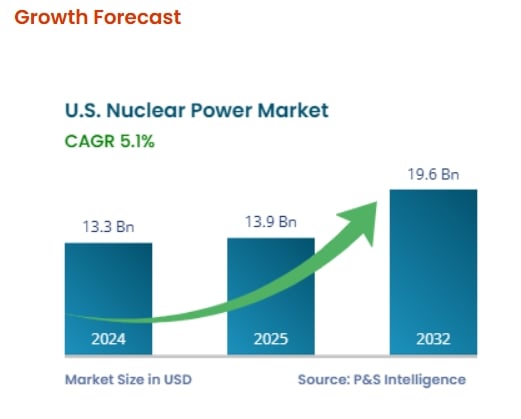
US NUCLEAR
Source: PS Market Research

From grid-scale power and remote installations to military bases and even future space missions, the role of advanced nuclear energy is expanding. Standard Nuclear is helping to ensure the U.S. has the fuel infrastructure to meet that demand.

The post America’s Nuclear Comeback Begins: Standard Nuclear Joins DOE’s Fuel Pilot Program appeared first on Carbon Credits.
U.S. EPA Plans to Cancel $7 Billion in Solar Grants: What It Means for Solar Industry

U.S. EPA Plans to Cancel $7 Billion in Solar Grants: What It Means for Solar Industry

The U.S. Environmental Protection Agency (EPA) plans to cancel $7 billion in solar energy grants, according to official sources. These grants were given to states, tribes, and nonprofits through the Solar for All program. This program, made possible by the Inflation Reduction Act (IRA), helps low- and moderate-income families access clean energy. It supports rooftop and community solar installations.

The EPA said it is preparing formal notices to 60 recipients, informing them that their contracts may be revoked. The “Solar for All” program aimed to help solar installations in communities that have been underserved.

Many grant recipients had signed contracts and started their projects when the EPA froze the funds earlier this year. Now, these organizations worry about getting the support they were promised.

The move is part of the Trump administration’s effort to rethink or cancel some climate programs set up during Biden’s presidency. According to officials, the EPA is reviewing whether the “Solar for All” grants were issued in compliance with federal rules. Still, critics warn this change might hurt clean energy growth and access in struggling areas.

Sunset Before Sunrise: Projects Stalled Midway

Before the freeze, the Solar for All program was expected to help install solar systems for up to 900,000 households. The grants aimed to lower electricity bills for families by up to 20%. They also sought to boost energy reliability and create jobs in clean energy.

Some grant recipients, like tribal governments, state energy offices, and local nonprofits, started using the funds. They hired workers, planned construction, and designed outreach programs. These early actions relied on signed contracts, meaning many projects had legal and financial commitments.

With the EPA’s proposed cancellation, these efforts may now be on hold or completely abandoned. Community groups say some residents who signed up for solar panels are unsure about their installation status. Others say job training programs funded by the grants may lose momentum just as they were gaining interest.

Nonprofit legal groups and state attorneys general are looking into legal action to stop the cancellation. Some say that stopping the grants might break the Administrative Procedure Act. They believe this could also mess with the separation of powers in the U.S. Constitution, since the grants were part of an approved federal budget.

Boom Meets Policy Headwinds: Can Solar Keep Rising?

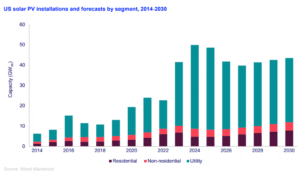
The U.S. solar industry remains one of the fastest-growing parts of the energy sector. In early 2025, the country added 10.8 gigawatts (GW) of new solar capacity—the fourth-highest quarterly total ever recorded.

US solar PV installations 2030
Source: Wood Mackenzie

Moreover, solar makes up about two-thirds of all new power generation capacity in the United States. Solar projects are on the rise. California, Texas, and New York are leading in residential, commercial, and utility-scale installations.

However, experts warn that policy reversals like the EPA’s could harm this momentum. Community solar, especially in low-income areas, depends on public funding and federal incentives to thrive. Without grants like Solar for All, many developers may choose not to build projects in these areas due to cost and risk.

A report from the Solar Energy Industries Association (SEIA) found that solar deployment might drop 23% below expected growth by 2030. This could happen if tax credits and clean energy programs are removed.

  • This includes the risk of losing up to 54 GW of planned capacity, affecting both grid reliability and job creation.

As demand for electricity rises due to data centers, electric vehicles, and AI, losing clean energy growth may lead to more reliance on fossil fuels.

Equity in the Dark: Who Loses When Solar Stops?

The Solar for All initiative was created not just to promote clean energy, but also to reduce energy poverty. Many of the households targeted by the program pay a large share of their income on electricity.

Solar power can lower bills and also offer backup power during emergencies. Plus, it improves indoor air quality by cutting down on gas appliances.

The program also supported energy justice goals by prioritizing tribal communities, rural areas, and urban neighborhoods most affected by pollution. It aimed to support battery storage, job training centers, and workforce programs. This would focus on areas with high unemployment or limited clean energy projects.

Canceling the program could increase the energy gap. Wealthy communities can afford rooftop solar, but many others cannot. It could also slow down organizations that were finally making progress after years of struggling to fund small clean energy projects.

What Comes Next for Clean Energy Grants?

At the time of this writing, the EPA has not yet finalized the cancellations, but plans to do so in the coming weeks. In the meantime, legal challenges are expected to move through the courts. Some judges have blocked parts of the climate funding freeze. More rulings may decide if the Solar for All grants should be honored.

The U.S. solar industry is still strong. However, changes in federal funding policies may impact where and how quickly future projects happen. Developers might move to larger commercial and utility-scale projects in more profitable areas. This shift could neglect the community solar market, which programs like Solar for All have supported.

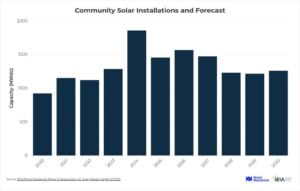
US community solar forecast

In 2024, the U.S. community solar market added 1.745 GWdc, the largest-ever annual total—a 35% increase over 2023. Growth was led by states like New York, Maine, and Illinois, with New York adding 861 MWdc, up 66% year-over-year.

However, the Q2 2025 SEIA/Wood Mackenzie report predicts a 22% drop in community solar installations for 2025. This decline is due to policy uncertainty and backlog issues. Still, the longer-term outlook is cautious yet hopeful.

Despite the setback, many local groups and clean energy advocates like Powerbank (formerly Solarbank) remain committed to expanding access. They hope funding will come back. If not, they want state incentives or private financing to help fill the gap. Still, the EPA’s decision marks a key moment for federal support of clean energy in low-income communities.

The EPA’s proposed cancellation of $7 billion in solar grants highlights the tension between climate goals and political shifts. While the solar market is growing, policy uncertainty creates risks. This is especially true for low-income households that need government help to access clean energy.

The courts may either allow the grants to move forward or uphold the cancellation. This shows that clean energy success relies heavily on stable policies, clear laws, and long-term commitment.

The post U.S. EPA Plans to Cancel $7 Billion in Solar Grants: What It Means for Solar Industry appeared first on Carbon Credits.
Palantir (PLTR) Stock Rally After $1B Q2 Revenue, ESG and Net‑Zero Strategy Advances

Palantir’s (PLTR) Stock Rally After $1B Q2 Revenue, ESG and Net‑Zero Strategy Advances

Palantir Technologies marked a major milestone in the second quarter of 2025. The company hit a milestone by posting quarterly revenue over $1 billion for the first time. They reported $1.004 billion, marking a 48% increase from last year and a 14% gain from Q1. This result beat analyst expectations, which averaged around $940 million.

Beyond financial performance, the company reaffirmed its climate commitments. It aims for net-zero emissions in all operations. Also, it is focused on decarbonizing its value chain as part of its 2030 sustainability target.

U.S. Momentum: AI Demand Drives Growth

The company’s adjusted earnings per share (EPS) came in at $0.16, exceeding forecasts of $0.1. Net income hit $327 million, reflecting a 33% profit margin.

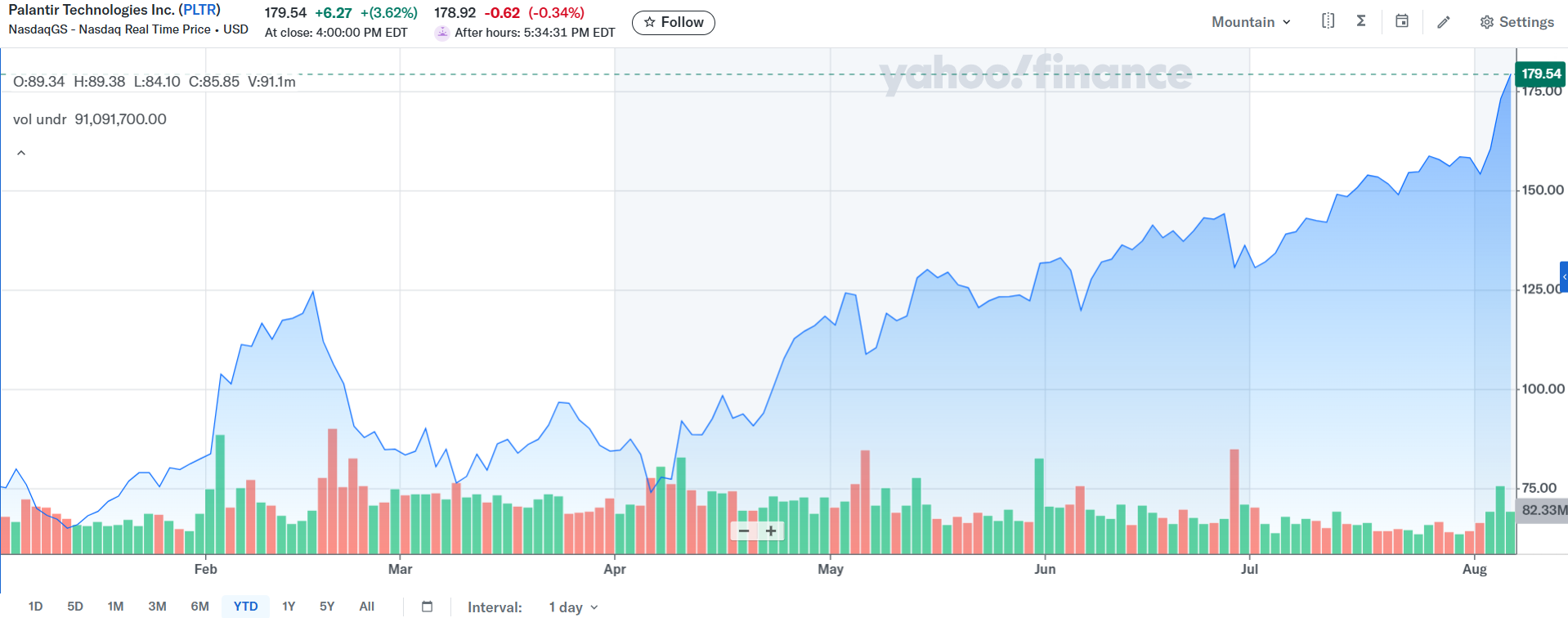
The strong earnings helped push Palantir’s stock up 5–8% after the announcement. The stock is now up more than 130% year-to-date, placing it among the top performers in the S&P 500.

palantir pltr stock
Source: Yahoo Finance

Palantir announced strong customer deal activity in Q2. They secured 157 contracts, each worth at least $1 million. Among these, 66 contracts reached $5 million or more, and 42 exceeded $10 million. This added up to a record $2.27 billion in total contract value, up 140% year-over-year.

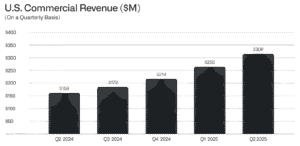
Palantir’s commercial momentum, especially in the United States, played a large role in the quarter’s results. U.S. revenue grew 68% year-over-year, reaching $733 million. U.S. commercial revenue grew 93% to $306 million, while U.S. government revenue rose 53% to $426 million.

US commercial revenue pltr
Source: Palantir

The company’s success comes from the rising demand for its AI platforms. This includes the Artificial Intelligence Platform (AIP) and Agora. These tools help businesses and government agencies. They use large language models, real-time data, and advanced analytics for decision-making.

Palantir also reported a Rule of 40 score of 94%. This score combines growth and profitability. Investors use it to measure the health of software companies.

Adjusted free cash flow hit $569 million, with a 57% margin. Palantir also raised its full-year revenue forecast to between $4.14 billion and $4.15 billion. Adjusted income from operations is expected to be $1.912 billion to $1.92 billion.

Green at Scale: Achieving Carbon Neutrality and Emission Reductions

While growing quickly, Palantir has also made progress in cutting its environmental impact. The company became carbon neutral across its global operations in 2024, a key goal in its 2021 Climate Pledge.

Total greenhouse gas emissions in 2024 were 23,018 metric tons of CO₂e, slightly up from 22,635 metric tons in 2023. This rise was mainly due to resumed office activities and travel after the pandemic.

Palantir Gross Emissions 2024 by Scope
Source: Palantir

However, emissions per employee dropped by 57% since 2019. Now, each employee is responsible for about 6 metric tons, a decrease from earlier years.

To achieve carbon neutrality, Palantir buys verified carbon credits. It also shares its Scope 1, 2, and some Scope 3 emissions data publicly. The company aligns its reporting with standards set by S&P Global and climate transition assessment frameworks.

Carbon credits the company buys support certified climate projects. These include reforestation, renewable energy, and methane capture. They help remove or prevent emissions around the globe.

Palantir picks only verified credits. Meaning, they are certified by trusted standards like Verra’s Verified Carbon Standard (VCS) or Gold Standard. This choice ensures transparency, permanence, and a real impact on the environment. These investments reduce the company’s carbon footprint. They also help global efforts to grow nature-based and tech climate solutions.

Using AI Technology for Climate Impact

Palantir doesn’t just work on its own footprint. Its technology also helps clients reduce theirs. Through platforms like Agora, Palantir helps companies:

  • Track and manage carbon emissions
  • Optimize energy use and grid systems
  • Deploy electric vehicle networks
  • Manage ESG and climate-related risks

These tools are used in industries such as manufacturing, logistics, utilities, and government. The company’s software helps clients gather real-time sustainability data, improve decision-making, and meet net-zero goals faster.

Palantir also integrates sustainability into internal operations. The company uses recyclable and sustainable materials for events. It donates old computer equipment to underserved communities. Also, it includes ESG funds in employee retirement plans.

Balancing Rapid Growth With ESG Goals

Palantir maintains a strong focus on governance and responsible business practices. It takes part in S&P Global’s Corporate Sustainability Assessment (CSA) and often gets above-average ESG scores for a software company.

The company’s policies cover data ethics, human rights, responsible AI, and environmental sustainability. Palantir has a dedicated Responsible Business and Sustainability team. It regularly updates its policies to keep up with new technologies and regulations.

However, Palantir is under scrutiny for its government contracts. This includes contracts related to surveillance, defense, and immigration enforcement. These concerns have led to calls for greater transparency and human rights safeguards. In response, Palantir has highlighted its commitment to responsible AI development and stakeholder engagement.

Palantir’s Q2 2025 results show the company achieving rapid growth through strong AI product adoption while also making progress on its climate and ESG commitments. Palantir is growing in the commercial sector and strengthening ties with government clients. It aims to be a leader in AI innovation while focusing on sustainability.

Challenges remain, including maintaining trust, improving ESG transparency, and navigating public concerns about its contracts. But with over 700 active AI pilots, a strong ESG integration track record, and carbon neutrality already in place, Palantir’s next phase may balance financial growth with environmental responsibility.

The post Palantir (PLTR) Stock Rally After $1B Q2 Revenue, ESG and Net‑Zero Strategy Advances appeared first on Carbon Credits.
ChatGPT Hits 700M Weekly Users, But at What Environmental Cost?

ChatGPT Hits 700M Weekly Users, But at What Environmental Cost?

OpenAI confirmed that ChatGPT now attracts 700 million weekly active users, up from around 500 million users in March. ChatGPT has grown four times compared to last year, showing a quick growth in both consumer and business areas. 

The surge includes users from free, Plus, Pro, Enterprise, Team, and educational plans. This demonstrates broad AI adoption among individuals, businesses, and schools.

ChatGPT Soars Past 700 Million Weekly Active Users

ChatGPT is one of the fastest-growing online platforms ever. Its natural language skills, wide range of functions, and global workflow integration fuel this growth.

OpenAI’s official figures show ChatGPT’s user base quadrupled in less than a year, as the platform expanded voice, coding, and data tools. This huge growth matches the rising interest in AI tools.

ChatGPT weekly active users
Source: EMarketer

There is a growing demand for virtual assistants. Also, machine learning is being used more in business, education, and media.

The rise of ChatGPT brings not just innovation but also environmental responsibility into focus. As artificial intelligence grows, so does the need for electricity, cooling, and computing power. This raises key questions about carbon emissions, energy use, and water consumption.

ChatGPT’s Environmental Footprint: Carbon, Energy, and Water Use

Let’s look closely at each of these footprints to grasp the chatbot’s environmental impact.

  • Carbon Emissions from AI Queries: Emissions per Prompt

Each time a user enters a prompt into ChatGPT, servers housed in large data centers activate to generate a response. While a single query might seem harmless, the emissions can add up quickly when repeated millions—or billions—of times a week.

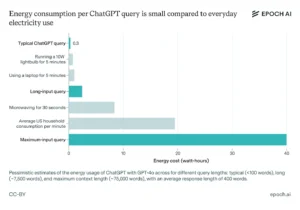
Recent research shows that each ChatGPT query consumes about 0.3 to 0.4 watt-hours of electricity. Depending on the energy source powering the data center, this results in around 0.15 grams of CO₂ per response.

chatGPT energy use
Source: Epoch AI

That’s less than the footprint of a Google search but still meaningful when scaled up. Multiply it by millions of daily queries, and it equates to hundreds of thousands of kilograms of CO₂ emissions per month.

One estimate says ChatGPT might release over 260,000 kilograms of CO₂ each month. That’s like the emissions from 260 round-trip flights between New York and London. This amount would increase even more if users shift to longer or more complex prompts, which require more processing time and energy.

  • The Energy Hunger of AI

Energy use is at the core of ChatGPT’s footprint. OpenAI uses powerful servers equipped with GPUs (graphics processing units) or AI accelerators like those from NVIDIA. These systems require large amounts of electricity for both computation and cooling.

To support ChatGPT’s scale—700 million weekly users—OpenAI may be operating thousands of servers running 24/7. Estimates show that daily inference needs more than 340 megawatt-hours (MWh) of electricity. That’s about the same as what 30,000 U.S. homes use in a day.

And that’s just for inference. The training phase of large language models (LLMs) like GPT-3 or GPT-4 uses even more energy.

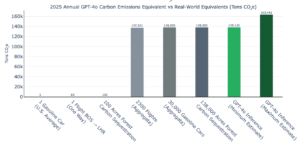
  • Training GPT-3 used 1,287 megawatt-hours of energy. This caused about 550 metric tons of CO₂ emissions. That’s like a car driving 1.2 million miles.

Training newer, larger models—like GPT-4 and beyond—will likely require even more energy. Emissions depend on the energy mix, like renewables versus fossil fuels. Even in the best cases, high-performance computing still uses a lot of energy.

GPT-4o carbon emissions
Source: Jegham et al., 2025. How Hungry is AI? Benchmarking Energy, Water, and Carbon Footprint of LLM Inference
  • Water Usage for AI Cooling

One lesser-known but equally important resource consumed by ChatGPT is water. Data centers use water to cool hot-running servers, often in combination with air conditioning. Water either evaporates in cooling towers or comes from nearby freshwater sources. It is then released at higher temperatures.

A study estimates that every 20 to 50 queries to ChatGPT uses about half a liter of water. Most of this water is for cooling the hardware that processes those responses. That means even a casual user engaging with ChatGPT 10 times a day may indirectly use several liters of water per week.

The impact magnifies when considering model training. Training large AI models has used millions of liters of water. This is especially true in dry areas where cooling systems rely more on water than air.

Globally, the AI industry is expected to draw 4.2 to 6.6 billion cubic meters of water per year by 2027 if growth continues at the current pace. That’s equal to the annual water use of several million households.

Prompts, Processors & Power Grids: What Makes AI Greener?

Several factors influence how large or small ChatGPT’s environmental footprint becomes:

Prompt length and complexity:

A short sentence uses far less energy than a long essay or technical code. Complex prompts need more processing power, which raises energy use and emissions. A recent report shows they can use up to 50 times more energy per query.

Model size and efficiency:

GPT-4 and newer models are larger and more powerful than previous versions, but also more energy hungry. Smaller models like GPT-3.5 or distilled versions use less energy. They are great for simple tasks.

Data center location and power source:

Using renewable-powered data centers in cooler climates reduces both carbon and water footprints. Conversely, data centers relying on coal or natural gas contribute more to emissions.

Cooling methods:

Facilities that rely on advanced air-cooling or closed-loop water systems tend to have lower water footprints than traditional open cooling towers.

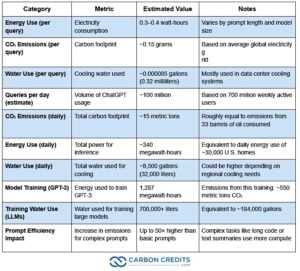
Here’s a glance at the chatbot’s environmental footprint:

ChatGPT Environmental Footprint

chatgpt environmental footprint

Industry Response: Moving Toward Sustainable AI

OpenAI and other AI leaders are increasingly aware of their environmental responsibilities. Many companies have committed to using renewable energy for data center operations.

Some companies are using carbon offset programs. They are also investing in energy-efficient chips from NVIDIA and AMD, which lower the power needed for each AI query.

Cloud service providers—such as Microsoft (a key OpenAI partner), Google, and Amazon—have all pledged to run their operations on 100% renewable energy by the end of the decade. Some already claim carbon neutrality for select cloud regions, although these claims often rely on offsets.

AI developers are also exploring ways to improve model efficiency, reducing the number of computations needed to produce high-quality responses. This helps not only lower costs but also shrink carbon and water footprints.

Users, too, have a role to play. The community can help lessen the environmental impact of tools like ChatGPT. They can do this by using better prompts, avoiding extra questions, and supporting companies that focus on green AI.

Navigating ChatGPT Use and Sustainability

Clearly, ChatGPT supports billions of interactions with minimal per-query footprint, yet scale causes cumulative environmental impact. Experts now call for more sustainable AI practices, such as:

  • Choose concise prompts to reduce processing time and energy.
  • Use smaller, more efficient models when possible.
  • Developers should deploy energy-efficient hardware and renewable-powered data centers.
  • Companies like OpenAI, Google, and Microsoft aim for carbon-neutral operations. However, changing supply chains and inference grid sources is also key.

Some studies point out that certain types of AI prompts—especially long or complex ones—can use up to 50 times more energy than simpler requests. That means user behavior significantly affects environmental costs, making user education part of the solution.

Reducing the carbon and water footprint of ChatGPT is not just an operational concern. It is important for public trust, business use, and following regulations. This is especially true in areas focused on ESG standards

As ChatGPT’s weekly active users approach 700 million, the opportunity—and responsibility—for sustainable scaling grows. OpenAI should balance bigger server pools and improved models with efficiency. 

  • SEE MORE:

The post ChatGPT Hits 700M Weekly Users, But at What Environmental Cost? appeared first on Carbon Credits.
BYD (BYDDY) Beats Tesla (TSLA) in Europe: The EV Shift No One Saw Coming

tesla byd

Tesla’s (TSLA) dominance in Europe is fading fast. In July 2025, its sales in France plunged nearly 27%—one of its steepest monthly declines yet. Once an EV frontrunner, Tesla is now clearly struggling to keep up. Chinese competitors like BYD (BYDDY) are racing ahead, and local automakers are also pushing back hard.

What once felt like unstoppable momentum, Musk’s Tesla has turned into a scramble to retain market share. Europe’s EV market is now the most competitive in the world, and Tesla is feeling the heat.

A CNBC report highlighted that,

“Data published by the U.K.’s Society of Motor Manufacturers and Traders (SMMT) showed Tesla’s new car sales dropped by nearly 60% to 987 units last month, down from 2,462 a year ago.”

Tesla’s European Market Share Continues to Shrink

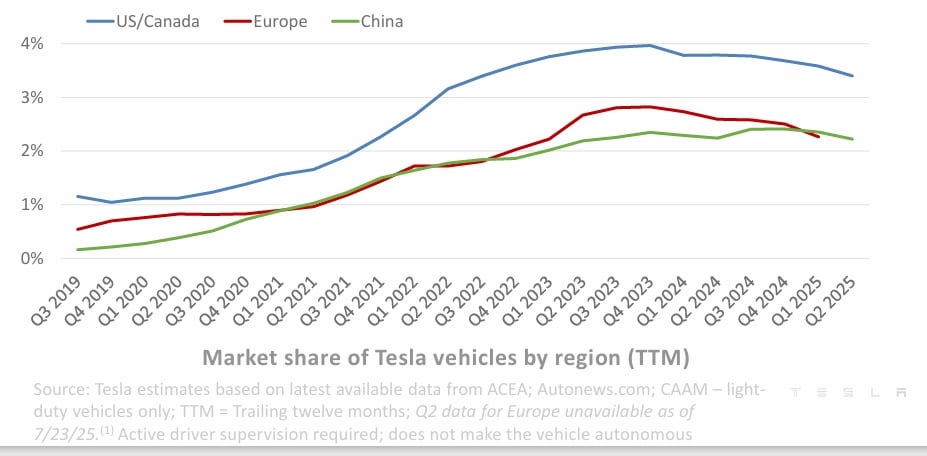
According to the European Automobile Manufacturers Association, Tesla’s market share in the EU, U.K., and EFTA dropped to 2.8% in June, down from 3.4% the previous year.

The company sold 34,781 vehicles across the region that month, which is a 22.9% year-on-year drop. Also in July, its sales in France plunged by nearly 27%, marking one of its steepest monthly drops yet.

The above data tells that Tesla is facing severe headwinds across Europe, with sales falling in most major markets despite the launch of an updated Model Y. According to Reuters, Tesla’s new car registrations in:

  • Sweden fell 86%

  • Denmark dropped 52%

  • Netherlands sank 62%

  • Belgium declined 58%

  • Italy slipped 5%

  • Portugal slid 49%

The only bright spots were Norway and Spain, where Tesla saw gains of 83% and 27%, respectively. Norway’s spike followed the rollout of 0% interest loans on Tesla models, while Spain’s surge coincided with a 155% jump in sales of all electrified cars.

The chart below also tells us that Tesla is losing ground in Europe.

Tesla Europe
Source: Tesla

Model Y Revamp Fails to Lift Sales

Tesla had pinned hopes on its refreshed Model Y, which began selling in March 2025 in Europe. However, the update has failed to spark meaningful growth. According to analyst Felipe Munoz from JATO Dynamics, the updated Model Y “has so far failed to provide the expected sales boost.”

Even in Tesla-stronghold Sweden, Model Y registrations fell 88% in July. In Denmark, they dropped 49%. By contrast, Norway saw a resurgence, with Model Y registrations jumping fourfold to 715 units due to financing incentives.

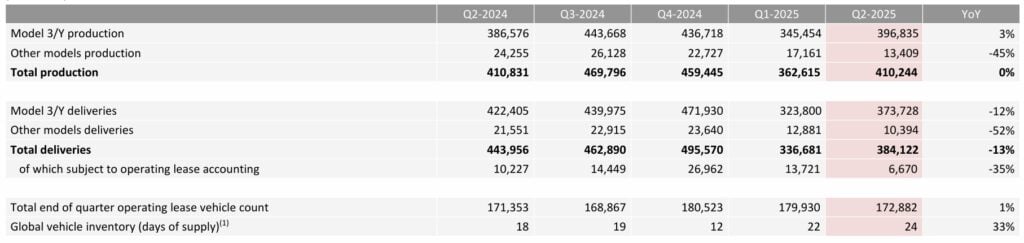
Here’s how Tesla (TSLA) performed in Q2 2025.

tesla model Y
Source: Tesla

Pricing Strategy and Margins Under Pressure

To stay competitive, Tesla has slashed prices across Europe, often undercutting its margins. In France, the company’s market share fell from 1.6% in 2024 to just 0.9% in 2025, with buyers turning to local brands like Renault, which outsold Tesla’s Model Y with its new Renault 5 model in June.

Aggressive discounting might stimulate demand in the short term, but it signals waning pricing power, a worrying trend for a brand that once commanded premium status.

Tight Rules Stall Tesla’s Self-Driving Push in Europe

Another pain point for Tesla in Europe is the region’s strict autonomous driving regulations. While Tesla’s supervised self-driving feature is a major selling point in the U.S., it’s not fully available in many European countries due to tighter rules.

Musk acknowledged in July that the company could have “a few rough quarters” ahead as it waits for approvals and ramps up production of a new, more affordable EV model.

Tesla’s efforts to diversify include a trial robotaxi service in Austin, Texas, using autonomous Model Y vehicles. However, this program is not yet authorized for widespread deployment in Europe.

BYD Steals the Spotlight in Major European Markets

While Tesla stumbled, Chinese EV giant BYD roared ahead. In Spain, BYD sold 2,158 cars in July, nearly 8X more than the same month last year.

  • In the UK, BYD registered 3,184 vehicles, quadrupling its year-over-year numbers. And in Germany, BYD posted a 390% increase in July sales.

BYD’s affordability, growing dealership network, and product variety have helped it attract European buyers seeking alternatives to Tesla.

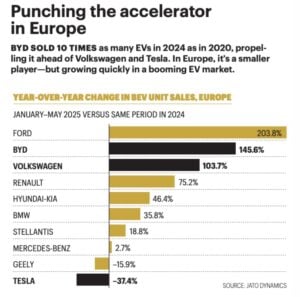
  • Notably, BYD overtook Tesla in overall European EV sales as early as April 2025, a trend that now looks firmly established.
byd europe
Image sourced from Fortune.com

Smart Pricing, Sharp Growth

BYD’s strategy of affordable pricing and rapid expansion is paying off. Models like the Dolphin Surf (globally known as the Seagull) and the Seal U are leading the charge. The Seal U tied as Europe’s best-selling PHEV in June.

Looking ahead, BYD plans to expand into 12 more European countries by the end of 2025. The company is also preparing to launch local production in Hungary, helping it reduce costs, navigate EU tariffs, and better compete with local and global rivals.

Chinese Brands Make Their Mark

The impact goes beyond BYD. Chinese EV makers, led by BYD, have nearly doubled their collective market share in Europe — from 2.7% in early 2024 to 5.1% in the first half of 2025. This surge reflects the growing influence of Chinese automakers across the European auto market.

Broader EV Market Still Growing—But Tesla Lags Behind

It’s important to note that Tesla’s slump comes at a time when overall EV demand in Europe is still rising. In July:

  • Denmark’s overall car sales rose 20%

  • Sweden was up 6%

  • Norway surged 48%

  • Spain grew 17%

  • Portugal jumped 21%

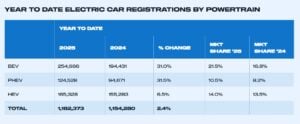
This makes Tesla’s performance look even worse in comparison. The EV pioneer is not suffering from market decline, but rather losing ground to faster-moving rivals like BYD, Volkswagen, and Renault.

EV europe
Source: SMMT data

Elon Musk’s Controversies Add Fuel to the Fire

Aside from market dynamics, Tesla is battling reputational damage, much of it tied to CEO Elon Musk. His endorsement of Germany’s far-right AfD party and anti-union comments sparked protests at Tesla showrooms across Europe.

The backlash has been especially strong in Germany, where labor unions and political parties wield significant influence. Tesla’s sales in the country dropped 55% in July, with only 1,110 units sold compared to 2,469 a year ago. From January to July, Tesla’s total German sales plunged 57.8% to just 10,000 units.

In Britain, Tesla’s July sales fell 60%, while BYD’s more than quadrupled.

Legacy Automakers Also Feel the Heat

Tesla isn’t the only automaker feeling the squeeze. European giants like Volkswagen, BMW, Mercedes-Benz, Stellantis, and Renault all posted weak Q2 results, citing falling demand and concerns over U.S. import tariffs.

However, these companies are still expanding their EV offerings and investing in local supply chains, unlike Tesla, which continues to rely heavily on exports and centralized production.

What Lies Ahead?

Tesla’s roadmap includes a more affordable EV model and the potential expansion of its Berlin Gigafactory’s output. But until production ramps up and autonomous features are approved in Europe, Tesla may continue to struggle.

In contrast, BYD and other Chinese players are gaining speed, price advantage, and regulatory momentum, making them serious threats to Tesla’s European ambitions.

Tesla’s 27% sales crash in France shows that the much-touted EV leader is on the defensive in a region once crucial to its global strategy. Concisely, unless Tesla adjusts its pricing, updates its lineup more frequently, and repairs its brand reputation, it may continue to lose ground to BYD and others.

The post BYD (BYDDY) Beats Tesla (TSLA) in Europe: The EV Shift No One Saw Coming appeared first on Carbon Credits.