Google Rides the Wind: First Offshore Wind Deal in Asia Pacific For 24/7 Carbon-Free Energy

Google Rides the Wind: First Offshore Wind Deal in Asia Pacific For 24/7 Carbon-Free Energy

Google has made a major step forward in its clean energy journey by signing its first offshore wind power purchase agreement (PPA) in the Asia-Pacific region. The deal is with the Fengmiao I offshore wind project in Taiwan, being developed by Copenhagen Infrastructure Partners (CIP). It is a milestone for both Google and the Taiwanese offshore wind sector.

Once completed in 2027, Fengmiao I will have a capacity of 495 megawatts (MW). Google will use this clean energy to power its data center, cloud region, and offices in Taiwan. This is part of Google’s plan to run on carbon-free energy all the time, in every place it operates by 2030.

A Landmark for Offshore Wind in Taiwan

The Fengmiao I project is the first from Taiwan’s Round 3.1 offshore wind auction to reach financial close. This achievement could spark further development in the country’s renewable energy sector.

Taiwan is facing rising electricity demand and climate goals, so it aims to cut fossil fuel use. The plan is to boost renewable energy, like wind and solar.

Google’s support for Fengmiao I shows other tech companies and investors that offshore wind energy in Asia is important and viable. I-Chun Hsiao, Senior Lead for APAC at Google Energy and Infrastructure, says this project is vital. It helps Google’s clean energy goals and boosts Taiwan’s energy security.

Supporting 24/7 Carbon-Free Energy Goals

Google’s partnership with CIP in Taiwan builds on its broader efforts to operate on 24/7 carbon-free energy. Since 2020, Google has aimed to match its electricity use with carbon-free energy every hour in all its locations. It’s not just about buying enough renewable energy each year. It’s about having clean power available all the time.

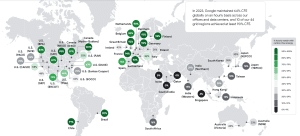
Google’s Carbon-Free Map with Data Center Operations

Google carbon-free energy map with data center operations
Source: Google

To achieve this, Google has invested in various energy technologies and projects across the globe. In Taiwan, this includes solar and geothermal energy agreements. For example, in 2024, Google partnered with BlackRock to invest in a portfolio of solar projects from New Green Power.

The company also signed a geothermal energy deal with Baseload Capital to diversify its energy sources.

These efforts in Taiwan are part of Google’s global clean energy strategy. The company has signed over 80 renewable energy agreements worldwide. This effort adds more than 10 gigawatts (GW) of new clean energy capacity to global grids.

Why Offshore Wind?

Offshore wind energy is a crucial solution for reducing carbon emissions in electricity systems. This is especially true in areas with little land available. Offshore wind turbines can generate more power than their onshore counterparts due to higher and more consistent wind speeds over the oceans.

The Fengmiao I project will have a capacity of 495 MW. This energy will power hundreds of thousands of homes in Taiwan. It aims to meet rising energy demands and lower emissions. The energy generated will be delivered to Google facilities via the local grid, contributing to the company’s hourly carbon-free energy targets.

Globally, offshore wind capacity is growing rapidly. The Global Wind Energy Council (GWEC) reports that over 64 GW of offshore wind power was installed globally by the end of 2023. If supportive policies remain in place, capacity could hit 380 GW by 2035.

new offshore wind installations 2024
Source: GWEC

In 2024, 8 gigawatts (GW) of new offshore wind power were connected to the grid around the world, per the GWEC report. This brought the total global offshore wind capacity to 83.2 GW by the end of the year.

  • However, the new additions were 26% lower than in 2023. Even so, 2024 was still the 4th-best year ever for offshore wind growth.

Taiwan is considered a regional leader, aiming to install 15 GW of offshore wind capacity by 2035.

offshore wind installations 2024
Source: GWEC

Copenhagen Infrastructure Partners and Their Role

Copenhagen Infrastructure Partners, the developer behind Fengmiao I, is a leading investor in energy transition projects. The company just closed its CI V flagship fund. It raised over €12 billion (US$13.1 billion) to support clean energy projects in safe countries.

CIP has previously worked with Google on other offshore wind projects, making this the second PPA between the two companies. CIP signed deals with several Taiwanese companies. These include United Microelectronics Corporation (UMC), Sino-American Silicon Products, Far EasTone Telecommunications, and MediaTek. These partnerships highlight the growing demand for reliable and sustainable energy in Taiwan’s high-tech economy.

Google’s Clean Energy Journey

Google was the first major company to become carbon neutral in 2007 and has been matching its global electricity use with 100% renewable energy since 2017. However, the company acknowledged that annual matching is not enough to fully eliminate carbon emissions from its operations.

In fact, its total emissions grew in 2024 compared to 2023 by 48%. That’s why the 24/7 carbon-free energy goal was introduced.

Google
Source: Google Environmental Report

This approach aims to solve one of the biggest challenges in clean energy—variability. Solar and wind power generation depend on the weather, which doesn’t always match demand.

Google aims to use a mix of energy sources. This includes solar, wind, geothermal, hydro, and batteries, with the goal to provide clean energy all day and night.

As of early 2024, Google was operating on around 66% carbon-free energy on an hourly basis across its data centers and offices. The company shares progress in its annual Environmental Report. It also pushes for grid upgrades and policy changes to support decarbonization.

Offshore Wind as a Cornerstone of Google’s Strategy

Google’s offshore wind deal in Taiwan is more than a business deal. It shows the company’s strong commitment to sustainability and innovation. By integrating offshore wind with solar and geothermal energy, Google is creating a clean, flexible, and reliable power system for one of its key operational regions.

This project also marks a turning point for offshore wind development in Asia, with Taiwan emerging as a leader in the region. Google’s role should boost investment and use of clean energy tech across the continent.

As global energy demands rise, so does the need for climate action. Initiatives like Fengmiao I show how the private sector can help build a low-carbon future, one project at a time.

The post Google Rides the Wind: First Offshore Wind Deal in Asia Pacific For 24/7 Carbon-Free Energy appeared first on Carbon Credits.

Tesla’s Carbon Credits Crash in Q1 2025: Earnings Drop and EV Sales Fall

Tesla

Tesla kicked off 2025 with major operational wins, but its financial performance didn’t quite match up. In the first quarter, the electric vehicle giant pulled off an industry first: it updated Model Y production lines simultaneously at all four of its global factories. Despite the bold manufacturing feat, the company saw profits tumble, revenue shrink, and carbon credit sales fall.

Tesla Model Y
Source: Tesla

Tesla’s Q1 2025: Revenue Dips Despite Strong Production

In the first quarter, Tesla produced over 362,000 vehicles and delivered more than 336,000. However, its total revenue dropped 9% year-over-year to $19.3 billion, with the automotive segment seeing a 20% decline to $14 billion. The dip came largely from lower average selling prices and fewer vehicle deliveries.

Operating income fell sharply. It’s down 66% to just $400 million, bringing Tesla’s operating margin to a thin 2.1%. Gross profit stood at $3.15 billion, reflecting a gross margin of 16.3%. Adjusted earnings per share came in at $0.27, missing Wall Street expectations.

Still, there were some financial strengths: Tesla remained cash flow positive at $664 million and ended the quarter with a solid $37 billion in cash and investments.

Tesla revenue
Source: Tesla

Automotive Regulatory Credits Plummet

Another significant factor that pulls a major chunk of Tesla’s revenue is its automotive regulatory credits. For the latest quarter, Tesla earned $595 million, which is again below Q4 2024.

The EV maker generated $692 million from selling regulatory credits in the last quarter of 2024 alone. It accounted for nearly 30% of its quarterly net income of $2.33 billion.

   Historic Data of Tesla’s Carbon Credits Revenue

Tesla Carbon Credits
Data from Tesla

Energy and AI: Areas of Promise

The company’s energy business continued to grow, despite facing headwinds from tariffs and market volatility. It deployed 10.4 GWh of energy storage in Q1, with Powerwall installations hitting a record high, crossing 1 GWh for the first time.

Megafactory Shanghai, though not contributing to deliveries this quarter, produced over 100 Megapacks and remains key to future energy storage capacity.

Tesla also pointed to AI as a major long-term driver. Beyond self-driving cars and robotics, the company sees its AI-powered battery storage systems playing a crucial role in stabilizing grids as data center demands rise globally.

tesla energy storage
Source: Tesla

Blame It on the Tariff—or Musk’s Political Moves?

Tesla is facing increased competition and rising external pressures. The company is feeling the heat as car demand slows, trade tensions rise, and global competition grows. The tariff hike has certainly impacted its EVs as it is import-dependent on China.

Furthermore, public protests tied to Elon Musk’s controversial leadership have impacted the company’s image, particularly in Europe. At the same time, global rivals like China’s BYD are making technical leaps. BYD recently introduced a battery that charges in minutes.

European automakers are also stepping up their EV offerings. Combined with shifting trade policies and rising tariffs, Tesla’s global supply chain and cost structure are under growing strain.

Tesla ev
Source: Tesla

What’s Next for Tesla?

A more affordable Model Y is expected to launch in the first half of 2025. The company is also preparing to debut its paid robotaxi service in Austin by June and is aiming for a largely autonomous fleet by 2026.

Tesla’s Big Green Wins: Sustainability Highlights

In 2024, Tesla drivers helped reduce more than 30 million metric tons of CO₂e from entering the air. That’s like avoiding the pollution from gas cars driving 90 billion miles.

For the fourth year in a row, Tesla’s global Supercharger network ran fully on renewable energy. The company did this using on-site power and green energy credits. Also, its Berlin Gigafactory ran on 100% renewable electricity for the second straight year.

Unlocking Master Plan Part 3

In March 2023, Tesla shared its Master Plan Part 3. The plan lays out how to switch the world to clean energy—step by step. Tesla believes EVs and solar products are far better for the planet than fossil fuels, even when considering mining and manufacturing.

The EV giant also believes a clean energy future will need less mining than the fossil fuel system. Each new Tesla factory is greener than the last, and the company is pushing for carbon neutrality across all operations.

Now, talking about their EV batteries, they only lose about 15% of their power after 200,000 miles. That’s about how long an average car lasts.

TESLA master plan
Source: Tesla

Top-Notch Efficiency and Big Emission Savings

Tesla added over 31 GWh of energy storage to homes and power grids through Megapack and Powerwall. This helps more people switch to clean energy. Notably, it recycled enough battery material to build 21,000 Model Y RWDs. That’s a 136% jump from the year before.

It’s putting all efforts to cut emissions from both production and use with the help of renewable power and smart energy-efficient designs.

  • The Model 3 uses just 13.1 kWh per 100 km, making it one of the most efficient EVs.
  • The Tesla Semi can cut freight emissions by 50% compared to diesel trucks.
  • Though building EVs creates more pollution up front, a Tesla still beats gas cars in the long run. Over 17 years, one Tesla can stop about 51 metric tons of CO₂e from entering the air.

This shows that Tesla’s sustainability progress is commendable. From cutting carbon and boosting clean power, to recycling batteries and building smarter factories. The company is all in on creating a cleaner, greener future, and it’s not slowing down.

Even with all the buzz around AI, energy storage, and the upcoming robotaxi, its Q1 earnings showed just how tough the road has become—even for a giant like Tesla. Still, this year brings a chance to innovate and revive. The next few months will be crucial in showing whether Elon Musk’s big ideas or carbon credit sales can pay off.

The post Tesla’s Carbon Credits Crash in Q1 2025: Earnings Drop and EV Sales Fall appeared first on Carbon Credits.

Equinor’s 5B Wind Project Pause Raises Concerns for U.S. Offshore Wind Industry

Equinor's 5B Wind Project Pause Raises Concerns for U.S. Offshore Wind Industry

The United States is facing a major challenge in its clean energy journey. In April 2025, the U.S. federal government ordered a pause on construction of Equinor’s Empire Wind project, a $5 billion offshore wind farm planned to supply clean energy to New York City. This decision, led by U.S. Interior Secretary Doug Burgum under President Donald Trump’s administration, has raised questions about the future of offshore wind in the country.

Empire Wind Anchored: $5B Project Comes to a Sudden Stop

Empire Wind was expected to be one of the largest offshore wind farms in the U.S., with 54 turbines located about 15–30 miles off Long Island. The site was planned to deliver 810 megawatts (MW) of power—enough to supply about 500,000 homes. Construction started in 2024 at the South Brooklyn Marine Terminal, with full operation planned by 2027.

The project was part of a contract with the New York State Energy Research and Development Authority (NYSERDA) and had already received both federal and state permits. The decision to stop work came as part of a broader federal review of offshore wind projects, with officials claiming the project was approved too quickly under the Biden administration.

Equinor responded by pausing work and saying it would engage with the government to understand the new requirements. The company is also considering legal options to fight the order.

A Shift in Federal Energy Policy

The pause is not just about one project—it’s part of a wider change in energy policy. In January 2025, President Trump signed an executive order that paused all new offshore wind leases and required extra review of already-approved projects. The administration said the goal was to protect grid reliability and avoid rushed decisions.

But many experts and industry leaders are concerned. Jason Grumet, CEO of the American Clean Power Association, said,

“Doubling back to reconsider permits after projects are under construction sends a chilling signal to all energy investment.”

Others agree. The Oceantic Network, which supports offshore wind, said over $40 billion has already been invested in U.S. offshore wind energy projects. If more projects are delayed or canceled, it could affect jobs, local economies, and clean energy goals.

A Blow to New York’s Clean Energy Plans

The Empire Wind project was central to New York’s plan to get 70% of its electricity from renewable sources by 2030. Governor Kathy Hochul criticized the federal move as “overreach” and promised to fight it. She said,

“I will fight this every step of the way to protect union jobs, affordable energy, and New York’s economic future.”

According to NYSERDA’s president, Doreen Harris, the project pause goes against the federal government’s own goals of encouraging local energy. She called offshore wind “a once-in-a-generation economic powerhouse.”

Offshore Wind in the US: Recent Growth and Challenges

Offshore wind has seen big growth in the U.S. in recent years, especially under the Biden administration. In 2024, the country added about 5.1 GW gigawatts (GW) of offshore wind capacity in various stages of development. Total capacity for the same year is 80,523 MW, as shown below.

US offshore wind energy pipeline
Source: National Renewable Energy Laboratory

Although only two small offshore wind farms were operational (Block Island Wind Farm and Coastal Virginia Offshore Wind pilot project), major projects were in progress in several states, including New York, New Jersey, Massachusetts, and California.

In 2024, progress continued with projects like Vineyard Wind in Massachusetts, which began delivering power to the grid. But challenges also grew. Inflation, high costs, supply chain issues, and policy uncertainty have delayed or canceled some projects. Major companies like Shell and TotalEnergies pulled back from the sector, citing financial risks.

Now, the pause on Equinor’s Empire Wind adds a new layer of uncertainty.

What’s at Stake?

In 2025, the U.S. could add 7.7 gigawatts (GW) of wind power, per the IEA data. Nearly half of the new wind capacity would come from Texas, Wyoming, and Massachusetts.

US electricity capacity 2025
Source: IEA

If political actions continue to halt or delay offshore wind projects, the impact could be huge. Experts say that over 90% of the more than 60 GW of planned U.S. offshore wind capacity could be at risk. This includes dozens of projects across the East Coast and new efforts along the Pacific Coast and in the Gulf of Mexico.

Offshore wind is also key to meeting climate goals. It produces large amounts of clean electricity without greenhouse gas emissions. It helps replace fossil fuel power plants and supports growing energy demand from electric vehicles, data centers, and manufacturing.

The group E2, which tracks clean energy investments, said that in just the first three months of 2025, at least 16 clean energy projects worth a total of $8 billion were canceled. That number could grow if uncertainty continues.

Can the Grid Handle a Clean Energy Shift?

Some federal officials argue that slowing down offshore wind development is necessary to protect the reliability of the electric grid. With the U.S. adding more renewable energy and retiring coal and gas plants, there are concerns about whether the grid can handle the change.

But energy experts say that offshore wind and other renewables can support grid reliability if managed properly. Batteries and other energy storage solutions can store extra power for use when wind or solar is not available. Strong planning and smart grid technologies can also help.

A Turning Point for U.S. Offshore Wind: What’s Next?

Equinor is still in talks with the government and may try to restart the project. But for now, Empire Wind is paused. Other developers are watching closely. If the pause turns into a cancellation, it could discourage future investments in clean energy.

Meanwhile, there is strong public support for clean energy. Polls show that most Americans want more wind and solar power. Many states, like New York and California, have set ambitious climate goals. They plan to keep moving forward even if the federal government pulls back.

The Empire Wind pause is a key moment for U.S. offshore wind. It shows how political changes can affect long-term energy planning. It also highlights the risks companies take when investing in large infrastructure projects.

Whether this is a short pause or the start of a longer rollback will depend on what happens next. For now, the U.S. offshore wind industry faces a period of uncertainty—and the decisions made in the coming months could shape the future of clean energy in the country.

The post Equinor’s 5B Wind Project Pause Raises Concerns for U.S. Offshore Wind Industry appeared first on Carbon Credits.

Microsoft Buys 1.4M Tonnes of Carbon Removal Credits to Reforest U.S. Mined Lands

Microsoft

Microsoft is aggressively taking steps to meet its climate goals. The tech giant just signed a deal to buy 1.4 million tonnes of carbon removal credits from Living Carbon, a nature-based solutions company focused on restoring degraded land through reforestation.

These carbon credits will come from Living Carbon reforesting 25,000 acres of damaged land in the Appalachian region, much of which was left barren after prolonged years of coal mining. Living Carbon is reviving landscapes, improving soil, and bringing jobs to rural communities that need them most.

Microsoft–Living Carbon Pact: Carbon Credits Reforesting Degraded Mines

The company manages the restoration of thousands of acres across the U.S. Their primary focus is former coal mining areas, especially in Central Appalachia, where more than 4 million acres of land have been affected. These sites are often left with compacted soil, toxic metal residues, poor drainage, and invasive species. This makes natural reforestation nearly impossible without active intervention.

Instead of letting these lands go to waste, Living Carbon uses native, fast-growing trees, science-based site prep, and adaptive forest management to kick-start ecological recovery. Their model aims to restore both the landscape and the livelihoods of rural communities that have suffered economically since the decline of coal.

Maddie Hall, CEO and Co-founder of Living Carbon, said,

“Restoring degraded mine lands offers one of the most scalable and meaningful opportunities for nature-based climate action in the United States,” said “We’re proud to be working with Microsoft to advance high-quality reforestation and unlock the potential of some of the most challenging yet important lands in the U.S.—not only for carbon removal, but also for restoring ecosystems and supporting the return of these lands to productivity.”

Key environmental and community benefits include:

  • Enhanced biodiversity through native reforestation
  • Improved water and soil health
  • New job opportunities in rural and formerly industrial areas
  • Durable carbon storage on lands that would otherwise remain barren

This is how Living Carbon is supporting top-quality, nature-based projects that restore damaged land across the U.S.

Additionally, top companies like Toyota Ventures, Temasek, Felicis, and Lowercarbon Capital have invested in these projects.

Forest carbon credit

Isometric to Ensure Trust and Transparency in Carbon Credits

The press release revealed that all credits Microsoft receives in this deal will be verified by Isometric, the world’s most credible carbon registry. This is to make sure every tonne of carbon is actually removed. Their Reforestation Protocol uses the latest science to track carbon storage, prevent overestimation, and ensure long-term results.

Isometric also enhances the credit process, allowing projects to earn revenue every month instead of waiting years. Their transparent system keeps a public record of every credit, making it easier for companies like Microsoft to trust the impact they’re buying.

Microsoft Doubles Down on Carbon Removal to Meet Its Net Zero Target 

In 2020, Microsoft set a bold climate goal to become carbon negative by 2030. That means removing more carbon dioxide from the atmosphere than the company emits across everything it does, including its data centers, offices, and supply chains.

To get there, Microsoft is investing in a mix of clean energy, energy efficiency upgrades, and recently in a series of large-scale carbon removal projects.

Rising Emissions in 2023

This is because in 2023, the company’s emissions jumped by around 29% due to a massive surge in AI and cloud computing demand. All these technologies require enormous amounts of power. Despite the rise, Microsoft says it’s still aiming to hit its 2030 target and therefore ramping up its emission reduction efforts.

It has made some significant investments in carbon removal earlier this year. It includes a 7 million ton agreement with Chestnut Carbon and a 3.5 million ton deal with re.green.

Microsoft carbon removal

EXPLORE MORE: 

All these investments show that its commitment to making carbon removal real, scalable, and effective is huge.

In the fight against climate change, this partnership shows what’s possible when technology, nature, and business work together. Microsoft is backing a solution that delivers real results for the planet, for people, and for future generations.

The post Microsoft Buys 1.4M Tonnes of Carbon Removal Credits to Reforest U.S. Mined Lands appeared first on Carbon Credits.

Trump Fast-Tracks 10 Mineral Projects: Perpetua’s Stibnite Gold to Boost U.S. Antimony

trump

The Federal Permitting Improvement Steering Council (Permitting Council) took a major step to speed up approvals for domestic mineral production. In response to President Trump’s executive order, Immediate Measures to Increase American Mineral Production, the Council named 10 mining projects that will now benefit from a faster, more transparent federal permitting process.

These projects, targeting minerals like copper, antimony, lithium, and potash, have been granted FAST-41 status. This designation falls under a 2015 federal initiative that streamlines permitting for major infrastructure projects. The White House confirmed more projects will be added soon.

First Wave of Mineral Projects Gets Priority Review

The press release emphasized that all 10 projects are now listed on the Federal Permitting Dashboard, a public platform that tracks each project’s progress through the environmental review and permitting process. This move ensures:

  • Greater transparency for project sponsors, communities, and federal agencies
  • Public access to updated timelines and review statuses
  • Increased accountability across federal review teams

These changes aim to boost American mineral production, support job growth, and cut down the country’s dependence on foreign mineral imports.

Projects on the Permitting Dashboard

The first group of FAST-41 projects includes:

  • Resolution Copper Project
  • Stibnite Gold Project
  • Warrior Met Coal Mines
  • McDermitt Exploration Project
  • South West Arkansas Project
  • Caldwell Canyon Mine Project
  • Libby Exploration Project
  • Lisbon Valley Copper Project
  • Silver Peak Lithium Mine
  • Michigan Potash Project

These sites were submitted by the chair of the National Energy Dominance Council (NEDC) and are the first batch in what the administration says will be a growing list.

Dashboard Offers Oversight, Not Federal Approval

The Federal order also highlighted an important point that being listed on the dashboard does not mean the federal government endorses or funds these projects. It also does not guarantee project approval. A project’s status can change if new information affects its review scope or requirements.

Still, this transparency effort gives a significant boost to more predictable and accountable permitting for critical mineral resources needed to fuel U.S. economic growth.

us critical mineral

Trump Pushes for Faster U.S. Critical Mineral Production

The U.S. gets 70% of its rare earth minerals from China, which weakens the supply chain for important industries like defense, electronics, and renewable energy. China has also imposed export controls on key materials like gallium and germanium, further increasing the urgency for the U.S. to secure its resources.

On March 20, President Trump signed an executive order to boost the U.S. critical minerals supply chain. It allows the Defense Production Act (DPA) to fund mining and processing projects through the Department of Defense and the U.S. International Development Finance Corporation. The goal is to speed up production of key minerals like lithium, cobalt, nickel, rare earths, and possibly even coal.

The critical minerals list will also include uranium, copper, potash, and gold. The latest order includes a coal mine, signaling coal’s return to a more prominent role in the U.S. energy mix.

us rare earth import

Perpetua Resources Set to Power U.S. Antimony

Critical minerals, particularly antimony, are key for military use. They support missile systems, fighter jets, and advanced communications technology. By expanding domestic production, the U.S. aims to strengthen its defense capabilities and reduce the risk of supply chain disruptions. Under these circumstances, Perpetua Resources Corp’s Stibnite Gold Project will play a major role in boosting domestic antimony supply.

The company announced that its Stibnite Gold Project is one of just 10 projects selected for the Federal Permitting Dashboard, ensuring faster reviews, better coordination, and public tracking.

Perpetua has received nearly $75 million from the U.S. Department of Defense under the Defense Production Act and a $1.8 billion Letter of Interest from the U.S. Export-Import Bank in 2024. The final federal permit from the U.S. Army Corps of Engineers is expected by Q2 2025. The U.S. Forest Service issued its final Record of Decision in January 2025.

The Idaho-based project is the only domestic source of antimony. With China banning antimony exports to the U.S., Stibnite could meet up to 35% of national demand in its first six years, according to the 2023 U.S. Geological Survey.

Jon Cherry, President and CEO of Perpetua Resources, said,

“Being recognized as a Transparency Project by the White House underscores the immense strategic value of the Stibnite Gold Project. We are honored by this selection, which validates the urgency and importance of our Project for America’s economic and national security. We stand ready to restore the site and bolster American mineral independence.”

The post Trump Fast-Tracks 10 Mineral Projects: Perpetua’s Stibnite Gold to Boost U.S. Antimony appeared first on Carbon Credits.

BeZero and Xpansiv Power Up Transparency in Carbon Credit Markets

BeZero and Xpansiv Power Up Transparency in Carbon Credit Markets

BeZero Carbon and Xpansiv have expanded their partnership to improve transparency and trust in carbon markets. This partnership aims to help investors, businesses, and governments make smarter choices when buying and selling carbon credits. It will also help support projects that make a real difference in reducing greenhouse gas emissions.

Tommy Ricketts, CEO and Co-founder of BeZero Carbon, remarked: 

“This partnership will further expand access to our ratings, helping even more market participants make informed climate decisions. Ratings are essential to the functioning of carbon markets, and already some of the biggest businesses rely on our analysis for the clarity they need.”

Carbon Credits 101: The Currency of Climate Action

Carbon credits are permits that allow companies to emit a certain amount of carbon dioxide (CO₂). Each credit usually represents one ton of CO₂ that has been either avoided or removed from the atmosphere. These credits are part of a broader effort to slow down climate change by putting a price on carbon emissions.

Carbon credits are bought and sold in two main types of markets:

  • Voluntary carbon markets: where companies or individuals buy credits to offset their emissions and show climate responsibility.
  • Compliance carbon markets: where governments require companies to meet certain emission targets and may allow them to use credits to meet those goals.

As more companies make climate pledges, the demand for high-quality carbon credits is growing. However, to trust that credits are effective, people need to understand how much impact a credit really has. That’s where ratings come in.

BeZero Carbon’s Role: Measuring Credit Credibility

BeZero Carbon is a global company based in London. The company specializes in rating carbon credits to show how likely a project is to reduce or remove carbon dioxide from the atmosphere.

Their rating system uses a scale from AAA (the highest quality) to D (the lowest quality). A higher rating means the carbon credit is more likely to deliver its promised environmental benefit.

BeZero Carbon rating framework
Source: BeZero Carbon

To assign these ratings, BeZero considers many factors:

  • Additionality: Would the carbon savings still happen if the project didn’t exist?
  • Permanence: Will the CO₂ stay out of the atmosphere for a long time?
  • Leakage: Does the project cause emissions to go up in another location?
  • Verification: Is there enough evidence and monitoring to prove the carbon savings?

BeZero uses science, data, and expert analysis to make these assessments. Their goal is to bring more trust and clarity to the carbon market.

What Does Xpansiv Do? The Digital Backbone of Carbon Trading

Xpansiv is a U.S.-based company that provides digital infrastructure for environmental markets. This includes systems for trading carbon credits and managing data. Xpansiv runs the CBL (Carbon Blockchain Listing), which is the world’s largest spot exchange for carbon credits. It allows buyers and sellers to trade carbon credits directly, with real-time data.

Xpansiv also operates Xpansiv Connect, a portfolio management tool used by investors and project developers to manage their carbon credit holdings.

The company also supports other exchanges. One is the IATA Aviation Carbon Exchange, which helps airlines manage emissions. Another is the JSE Ventures Carbon Market in South Africa.

What’s New in This Expanded Partnership?

BeZero and Xpansiv have been working together for nearly three years. In the past, BeZero’s carbon credit ratings were already available in Xpansiv’s daily pricing reports and historical data sets. This helped market participants understand how prices related to quality.

Now, their partnership has grown to include more features, including:

  • Live Ratings on CBL. BeZero’s headline ratings will now appear directly on the CBL exchange. This allows traders to view credit quality in real time before buying or selling.
  • Integration with Xpansiv Connect. Portfolio managers can now see BeZero ratings in their dashboards and use them to manage risk.
  • Expanded Reach. BeZero ratings will also appear on partner exchanges like JSE Ventures and the Aviation Carbon Exchange.
  • Third-Party Access. Other exchanges using Xpansiv’s trading technology can offer BeZero’s ratings as an add-on.

Soon, Xpansiv’s pricing and market data will join BeZero’s Carbon Markets platform. This addition will give users better tools to assess projects.

Boosting Buyers’ Confidence, Avoiding Bad Investments

As the world tries to cut carbon emissions, carbon markets are playing a bigger role. According to a report by Ecosystem Marketplace, over $2 billion worth of credits were traded in the voluntary market in 2023 alone. However, concerns about quality and transparency have caused hesitation among buyers.

The chart below shows a drop in market activity since 2021, when criticism of the system began. Both the number of carbon credits used (retired) and those created (issued) have declined.

voluntary carbon credit retired and issued 2023

Ratings systems like BeZero’s aim to fix this problem by giving buyers confidence in what they are purchasing. Sharing these ratings on platforms like Xpansiv lets more people join climate action. It also helps them steer clear of bad investments.

Carbon credits can play a positive role in slowing down climate change—but only if they actually deliver on their promises. That’s why this kind of partnership matters.

This expanded partnership is expected to have major benefits for the carbon market

Using carbon ratings helps investors and buyers make better choices. This way, they can select higher-quality projects, which are more likely to provide real environmental benefits. More data makes the market clearer and more reliable. This boosts overall transparency. 

A common rating system helps set clearer standards. It reduces confusion and creates a shared understanding of project quality. As a result, capital can be directed toward the projects that have the greatest impact, making the market more efficient and effective.

Nathan Rockliff, Chief Strategy Officer at Xpansiv, noted:

“Providing BeZero’s headline ratings will be a natural extension of our aggregated market view. It’s another step toward transparency and trust for carbon market participants around the world…”

Raising the Bar for Carbon Markets

The expanded partnership between BeZero Carbon and Xpansiv could help set a new standard for how carbon credits are traded and evaluated. It brings together strong data, technology, and science to help make carbon markets more effective.

With more companies and countries pledging to reach net-zero emissions, the demand for high-quality carbon credits is only going to grow. Partnerships like this help create the tools and trust for a low-carbon future.

The post BeZero and Xpansiv Power Up Transparency in Carbon Credit Markets appeared first on Carbon Credits.

UK’s New Integrity Rules Set Gold Standard in Carbon Credits and Green Finance

UK

The UK government has rolled out an ambitious plan to become a world leader in green finance. Its goal is to create stronger, more transparent voluntary carbon and nature markets. These markets allow businesses to trade carbon credit certificates to reduce greenhouse gas emissions through eco-friendly projects like reforestation or clean energy.

Climate Minister Kerry McCarthy said:

“Building up trust in carbon and nature markets is crucial to their success in driving meaningful climate action and real, lasting change for the environment. The UK is determined to spearhead global efforts to raise integrity in these markets so they can channel the finance needed to tackle the climate crisis and speed up the global clean energy transition. These principles will cement the UK as the global hub for green finance and carbon markets. This is an opportunity to deliver on the climate crisis and drive investment and growth in the UK as part of our Plan for Change.”

Unlocking Green Finance for the Future

Each carbon credit equals one metric ton of carbon dioxide reduced or removed. Experts have predicted that the global demand for carbon credits is expected to soar. The voluntary carbon markets could grow to $250 billion by 2050, and nature-based markets could reach $69 billion.

carbon credits

The press release revealed that the UK government wants to make it easier and safer for companies to invest in such credits. They also aim to support high-integrity projects that protect nature and lower emissions.

Additionally, these markets can mobilize climate finance and support cleaner and greener operations. They will also deliver benefits for biodiversity and local communities.

However, these credits must be used the right way. They must show real results, not merely greenwash. And companies should use them to complement, not replace, their own efforts to cut emissions.

Tackling Confusion, Building Trust

Many businesses remain unsure about how to use carbon and nature credits. Others worry about whether the credits are doing any real good. To fix this, the UK is developing a new framework that makes the system more transparent and reliable.

Key steps include:

  • Clear guidelines for buyers and sellers
  • Full disclosure on how credits are used
  • A focus on real environmental results
  • Avoiding greenwashing in public claims

The government has also launched a 12-week consultation. It wants feedback from businesses, investors, and the public to help shape the final framework. The goal is to create a trusted and fair system that supports climate and nature goals in the UK and abroad.

Driving Growth in the Green Economy

The plan arrives at a time when the UK’s net-zero sector is booming. According to the government, this part of the economy is growing 3X faster than the average. Since July, clean energy industries have received more than £43.7 billion in private investment. Green jobs are also on the rise, with employment up over 10% last year.

The UK already has a strong position in climate diplomacy and green finance. Notably, London has topped the Z/Yen Green Finance Index for seven years constantly. And with companies like BeZero, Sylvera, and the London Stock Exchange Group pioneering climate finance solutions, the UK has set its global standards high.

Furthermore, it supports developing nations in accessing high-quality carbon finance.

UK Pushes for High-Quality Carbon Credits and Lower Emissions

As explained earlier, the new plan aims to attract billions in private investment to tackle climate change. At the same time, it will open new income streams for UK businesses, especially in farming and land use. By creating clear rules and boosting trust, the government wants to make the UK a global hub for carbon and nature trading.

Projects supported through these markets could include:

  • Reforestation and peatland restoration
  • Deployment of electric vehicles
  • Renewable energy systems
uk emissions
Source: UK Govt.

The government is backing these efforts with a new set of six integrity principles. These rules will help ensure that only high-quality carbon credits are used and that businesses remain focused on cutting their emissions first, before turning to offsets.

Here’s the summary of these integrity principles

6 Integrity Principles in Voluntary Carbon and Nature Markets

The UK Government is asking for input on how these six principles can build stronger, more reliable carbon and nature markets:

  1. Cut Emissions First, Then Use Credits
    Companies should cut their own emissions first. The Government may endorse the VCMI Code and wants feedback on helping firms meet it, along with views on scaling insetting to build trust.
  2. Stick to Quality Credits
    Only use credits that actually make a difference. The Government plans to back ICVCM’s global standards and wants input on how to apply them in the UK, especially for nature-based projects.
  3. Be Open About Credit Use
    Companies should be clear about how they use carbon credits. The government wants to hear what’s working and what’s not, and whether VCMI’s reporting guidance should be part of UK rules.
  4. Include Credits in Climate Plans
    As UK firms publish climate plans that align with the 1.5°C goal, the Government wants feedback on how carbon credits can help them stay on track.
  5. Make Clear Climate Claims
    Green claims should be simple and honest. The Government is looking at ways to define key terms and create a standard that keeps things clear and credible.
  6. Team Up for Stronger Markets
    The Government is seeking views on how to improve alignment across the UK and internationally, and how clearer laws and regulations could build trust and understanding.

The government also highlighted that the voluntary markets allow companies to buy carbon credits voluntarily and are not meant for legal requirements like the UK Emissions Trading Scheme. All in all, UK’s goal is to build a top-tier carbon and nature credit market by setting high standards and transparency.

The post UK’s New Integrity Rules Set Gold Standard in Carbon Credits and Green Finance appeared first on Carbon Credits.

U.S. SEC Greenlights First Stock Exchange Focused on Sustainable Investing

U.S. SEC Greenlights First Stock Exchange Focused on Sustainable Investing

The Green Impact Exchange (GIX) is about to make history. It’s set to become the first U.S. stock exchange focused only on companies that care about the environment and long-term sustainability.

The U.S. Securities and Exchange Commission (SEC) has approved GIX to register as a national securities exchange, giving it the green light to begin trading in early 2026. This move comes at a time when sustainable investing faces some challenges.

In recent months, investors have pulled billions of dollars from ESG (Environmental, Social, and Governance) funds. In just one week, nearly $5.7 billion was withdrawn from ESG exchange-traded funds—one of the largest outflows in over a year. Still, the team behind GIX believes demand for green investments will grow over time.

What Is GIX All About?

GIX was founded in 2022 by two former leaders from the New York Stock Exchange (NYSE): Daniel Labovitz, who used to lead regulatory policy at the NYSE, and Charles Dolan, a former Executive Floor Governor. Their goal is to create a place where companies with real sustainability goals can connect with investors who care about the future of the planet.

GIX solution
Source: GIX

To be listed on GIX, a company must:

  • Publicly commit to long-term sustainability.
  • Make clear plans for the short, medium, and long term on how they will run more sustainably.
  • Align their business with these sustainability promises.
  • Use a recognized sustainability reporting framework.
  • Regularly report their progress.
  • Involve and communicate with stakeholders in their sustainability journey.

At first, GIX will allow companies to list shares on both GIX and another stock exchange. But in the future, companies may be able to use GIX as their main trading home.

A Green Light in a Tough Time

Even though some ESG funds are seeing investors pull back, other parts of the green economy are growing. Venture capital and private equity firms invested more than $5 billion in climate-tech startups in the U.S. during the first quarter of 2025. That’s a jump of almost 65% compared to last year, based on data from PitchBook.

VC and private equity investment in climate tech q1 2025
Source: Bloomberg

This shows that while traditional ESG funds may be struggling, there’s still strong interest in new clean technologies. GIX is hoping to tap into that interest by focusing only on companies that are serious about their impact on the environment.

As GIX gets ready to join the $35 trillion sustainability economy, it aims to be an important link between investors and companies that are adjusting to climate-related risks and new opportunities.

Dan Labovitz, GIX’s co-founder and CEO, said the SEC’s approval is a big step for investors and businesses who want markets that support better environmental choices. He thanked the SEC for supporting a market-led way to help companies raise money in a greener way, saying:

“Today’s approval order is an important step forward for sustainability-minded investors and companies…We are grateful to the SEC for their support of market-driven innovations that will improve capital formation.”

Building a Marketplace for a Cleaner Future

Charles Dolan, the other GIX co-founder and its president, explained why this matters: “Climate risk is business risk. It’s that simple.” In other words, businesses that don’t plan for the effects of climate change could suffer, and so could their investors.

Public exchanges like GIX aim to connect investors who care about sustainability with companies that are actually doing something about it. These are companies making real efforts to cut carbon emissions, use clean energy, and reduce waste.

GIX says it has already talked to hundreds of companies in the past 18 months. Many of these companies operate globally and see sustainability as key to staying competitive.

“We’re not seeing evidence of a slowdown,” said Labovitz. “If anything, we are seeing signs that it will continue to grow.”

A New Kind of Listing With a Vision for a Greener Tomorrow

Unlike traditional stock exchanges that focus mainly on financial performance, GIX will also track how well companies do on their environmental goals. That means investors won’t just look at profits. They’ll also consider whether a company is meeting its promises to reduce pollution, use clean energy, and treat people fairly.

To stay listed, companies must meet the rules identified earlier, e.g., setting real sustainability goals and taking steps to meet them. These rules mean companies can’t just say they care about the environment—they have to prove it.

GIX is still working with FINRA, a financial industry regulator, to make sure everything is ready for trading. When it launches in early 2026, it hopes to attract both well-known public companies and new startups that put sustainability first.

Even with the ups and downs of ESG investing, GIX is betting that sustainability will remain a key issue for investors. Climate change, resource use, and social impact are not going away. Companies that plan for these challenges—and show they’re taking action—may become the leaders of tomorrow.

By creating a marketplace just for them, GIX wants to speed up this shift and give investors a better way to support a greener, more responsible economy.

The post U.S. SEC Greenlights First Stock Exchange Focused on Sustainable Investing appeared first on Carbon Credits.
Apple’s Clean Energy Blueprint: A Huge Leap with a 60% Carbon Cut

Apple

Apple has proved that climate action is more than a responsibility. It can be a powerful driver of business growth. Since 2015, the company has cut carbon emissions by over 60% while boosting revenue by more than 65%. In 2023, it reduced over 41 million metric tons of carbon dioxide. This reduction came from its operations, manufacturing, and how customers use its products.

Its latest sustainability data shows,

  • In 2024, Apple’s net emissions after offsets were 14.5 million metric tons CO₂e, while in 2023 they were 15.6 million metric tons CO₂e.
Apple carbon footprint
Source: Apple

Apple’s Clean Power Play: Cutting Carbon, One Chip and Server at a Time

Apple reached 100% clean electricity for its corporate operations in 2020. Now, it aims for carbon neutrality in its supply chain and product lifecycle by 2030. Take a look at its energy efficiency efforts and impact.
  • In 2024, clean energy efforts saved over 57 million kilowatt-hours and 314,000 therms of natural gas. This also prevents about 18,000 metric tons of carbon emissions each year.
  • In 2024, it cut 93,000 metric tons of CO2e, which includes its earlier energy efficiency upgrades.

Data Center Sustainability: More significantly, the data centers need a lot of energy, especially for cooling servers. For this, the company has been using innovative energy-efficient server designs since 2021. Notably, these servers save 36 million kilowatt-hours each year. Additional updates to cooling systems significantly reduce energy use and boost server capacity.

Controlling Chip Emissions: Another focus area is controlling emissions from difficult areas like chip production. In 2023, better equipment and processes avoided 8.4 million metric tons of fluorinated gases, which are some of the most potent greenhouse gases. It aims to reduce these emissions by 90% by 2030.

Apple net zero goals
Source: Apple

Supply Chain Joins the Clean Energy Push

Most of its emissions come from its supply chain, which leads to a rise in Scope 3 emissions. Thus, they are helping suppliers switch to renewable electricity.

By 2024, over 320 suppliers in 28 countries joined this clean energy initiative. This effort covers 95% of Apple’s direct manufacturing costs. These suppliers added 17.8 gigawatts of clean energy and generated 31.3 million megawatt-hours. Consequently, it helped in avoiding 21.8 million metric tons of greenhouse gas emissions.

  • In China, Apple backs the Green Electricity Certificate system and guides suppliers toward green tariffs and direct power purchase agreements.

  • In 2024, Apple’s Supplier Energy Efficiency Program cut nearly 2 million metric tons of emissions across 80+ facilities.

Solar Power Shines in Apple’s Strategy

Solar plays an important role in Apple’s clean energy strategy. At Apple Park in California, rooftop solar panels generate 17 megawatts of electricity. In Denmark, solar farms power its data centers and provide excess electricity to the grid.

In India and Vietnam, the company has helped suppliers implement rooftop solar systems and join local clean energy programs. Thus, promoting renewable energy worldwide reduces emissions and improves energy access in key areas.

Apple Solar
Source: Apple

Greener Materials for a Lighter Carbon Footprint

Apple is a top innovator. It has redesigned products to reduce carbon-heavy materials by increasing the use of recycled metals, plastics, and rare earth elements.

  • By 2024, 24% of materials used were recycled or renewable, focusing on 15 key materials that make up 87% of product mass. This has significantly lowered its carbon footprint.
  • For example, it uses 100% recycled rare earths in magnets for iPhones and Apple Watch. AI tracks these recycled materials. Both the iPhone 16 and Apple Watch Series 10 use 100% recycled cobalt in their batteries.

Aluminum Emissions

Since 2015, emissions from aluminum production have dropped by 76%. Now, less than 7% of total product emissions come from aluminum. Devices like the MacBook Air and iPad now use all-recycled aluminum.

Recycling Gold

In 2024, 40% of the gold in its products was recycled, up from just 1% in 2021. The company now uses 100% recycled gold in products like the Mac mini, iPad mini, and iPhone 16. Also, 99% of its connectors have recycled gold plating.

apple product materials
Source: Apple

Daisy Robot: Revolutionizing Recycling

Apple’s Daisy robot is transforming recycling. It disassembles iPhones to recover valuable materials like cobalt and rare earths, processing over 11,000 devices per hour for reuse.

Sustainable Packaging

The company is exploring carbon-negative and bio-based materials. Apple has reduced plastic use, with over 99% of packaging from fiber, while experimenting with bio-based materials and recycled plastics.

Apple’s Carbon Removal Commitment

The company indulges in a wide range of nature-based solutions to tackle CO2 in the environment. It aligns with a 1.5°C net-zero pathway, reducing industrial emissions and enhancing carbon removal efforts. Some notable achievements include:

  • Launching the Restore Fund: Partnered with Goldman Sachs and Conservation International to launch the Restore Fund in 2021. This fund invests in nature-based carbon removal, restoring ecosystems, and benefiting local communities. By 2023 the fund targeted removing 1 million metric tons of CO2 each year.
  • Reforestation in Brazil: Planted over 8 million trees across 24,000 hectares. This creates a 5-kilometer habitat corridor to protect species and support conservation.
  • Project Alpha in Brazil: Combines eucalyptus tree farms with native forest restoration. Since 2022, nearly 15 million trees have been planted, expected to offset over 8.5 million tons of CO2.

These initiatives highlight the ecological and social benefits of carbon removal.

Apple Relies on Carbon Credits to Neutralize Emissions

The company relies on retiring carbon credits from global projects to achieve its carbon-neutral goal.

  • In 2023, retired 471,400 metric tons of carbon credits. This included projects like Chyulu Hills in Kenya and Guinan in China.

Apple also raised $4.7 billion in green bonds to fund sustainability projects. It further ensures the quality of its carbon removal projects through careful checks, including site visits and satellite assessments. Additionally such projects are verified to international standards to make sure they meet high-impact criteria.

Apple green bonds
Source: Apple

All these efforts show that people’s favorite go to gadget brand is a pioneer in sustainability. It invests in renewable energy, restores ecosystems, and removes carbon to make a cleaner and greener future for everyone.

The post Apple’s Clean Energy Blueprint: A Huge Leap with a 60% Carbon Cut appeared first on Carbon Credits.