COP30 in Brazil Kicks Off: A Make-or-Break Moment for Global Climate Action

COP30 in the Amazon Kicks Off: A Make-or-Break Moment for Global Climate Action

The 30th United Nations Climate Change Conference, or COP30, will take place in Belém, Brazil, from 10 to 21 November 2025. Nearly 200 countries will meet to review progress under the Paris Agreement and plan the next steps to limit global warming.

The summit’s location is symbolic. Belém lies at the edge of the Amazon Rainforest, one of Earth’s greatest carbon sinks. The Amazon stores billions of tonnes of carbon and helps regulate global weather. Holding COP30 there highlights that protecting nature is central to solving the climate crisis.

This event comes ten years after the Paris Agreement and halfway to 2030 — the deadline for many national climate targets. It is a key checkpoint for updating national climate plans and accelerating real-world action.

The UN Framework Convention on Climate Change (UNFCCC) says emissions are dropping in some areas. But they aren’t falling quickly enough to reach the 1.5 °C goal. If current policies continue, scientists warn that the world could warm by 2.6 °C to 2.8 °C by the end of the century. COP30 could become a turning point — or another missed chance.

Why COP30 Could Redefine Climate Progress

The urgency of this conference cannot be overstated. Global climate action is falling short. Many countries have yet to deliver on past promises.

Developing nations continue to call for fairer climate finance. The long-promised $100 billion per year from wealthy nations is still unmet. OECD reports show that $115.9 billion was mobilized in 2022, surpassing the target but still disputed in terms of disbursement efficiency.

The European Union reported about €28.6 billion in public funding for climate action in 2023. The figure is helpful, but far from what is needed. Some negotiators are pushing for a new goal of $300 billion per year by 2035.

Another major focus is on forests and biodiversity. Brazil plans to showcase the Amazon’s global role and promote solutions to stop deforestation. Healthy forests help offset emissions, support local economies, and preserve biodiversity.

COP30 will also connect climate action with human welfare. Delegates will talk about creating green jobs. They will also discuss expanding clean energy access. Finally, they will focus on protecting communities from floods, droughts, and heatwaves.

From Energy to Equity: The Big Issues on the Agenda

The COP30 agenda will combine broad policy debates with concrete solutions. Thematic days will highlight major sectors shaping the planet’s future.

COP30 themes
Source: Image from COP30 website

Energy and Industry: Countries will explore how to scale up renewable power and phase down fossil fuels. Fossil fuels still provide most global energy, so credible transition roadmaps are crucial.

Global renewable power capacity grew by a record 510 GW in 2024, with 520 GW expected in 2025, making up over 90% of new capacity. Total renewable capacity will reach nearly 5,800 GW by 2025. This will supply about 30% of the world’s electricity and aims for 42–45% by 2030. China leads, adding 260 GW in 2024, followed by steady growth in Europe, the US, and India. Solar dominates three-quarters of new installations worldwide.

Forests and Nature: The Amazon will take centre stage. Leaders will discuss how to end illegal deforestation, restore degraded land, and strengthen biodiversity protection.

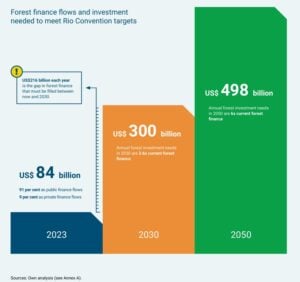
Forests absorb 7.6 billion tonnes of CO₂ yearly but get less than 2% of climate finance. Global forest finance nearly doubled to $23.5 billion annually by 2024, with public funds covering 60% and private investment rising to 40%.

Despite growth, investments must quadruple by 2030 to meet global forest protection targets, with transparency and verified impact gaining importance.

Forest finance flows and investment needed

Agriculture and Food Systems: Food production and land use account for a large share of emissions. COP30 will promote sustainable farming, soil health, and waste reduction.

Cities and Infrastructure: With more people living in cities, resilient design matters. Delegates will discuss how to build low-carbon housing, transport, and water systems that can withstand climate impacts.

Health and Equity: Climate change affects people unequally. The summit will focus on adaptation, social justice, and the right to clean air, safe water, and energy.

Finance, Innovation, and Implementation: This may be the most critical theme. COP30 will urge countries to transform plans into real results. This will happen through improved monitoring, reporting, and financing. Adaptation finance, funding to help countries manage disasters, remains a top demand from vulnerable nations.

COP30’s message is clear: move from talking about climate to doing climate.

Belém’s Symbolism: The Rainforest at the Heart of Climate Talks

Belém, the capital of Pará State, is the gateway to the world’s largest rainforest. Hosting COP30 there ties climate, nature, and communities together.

Brazil wants to show leadership in nature-based climate solutions. President Luiz Inácio Lula da Silva has pledged to end illegal deforestation by 2030 and restore degraded land. These actions are central to Brazil’s national climate goals and global emissions cuts.

The annual deforestation rate in the Amazon for the year 2025 was 5,796 km², down 11.08% from the previous period. It is the lowest rate in 11 years. This reduction reflects the resumption of plans to combat deforestation.

Belém’s choice is also about inclusion. Brazil’s COP30 presidency, led by diplomat André Corrêa do Lago, promises an open summit. It will involve governments, indigenous peoples, and local actors.

But the setting brings logistical challenges. Infrastructure, accommodation, and travel costs are major concerns. Some poorer nations and civil society groups fear limited access due to high expenses. Local authorities are upgrading transport and hotels, yet space will remain tight.

Despite these issues, hosting COP30 in the Amazon is a powerful symbol. It places environmental justice, indigenous leadership, and forest protection at the center of global debate.


André Aranha Correa do Lago, COP30 President Designate, stated in a letter:

“COP30 takes place at the epicentre of the climate crisis. Yet from rising waters and changing skies, a deeper strength is emerging – the determination of people to protect what they love. In Belém, let us honour that determination and transform it into a global agenda guided by care, not indifference; by interdependence, not individualism; by courage, not resignation. In Belém, where the rivers meet the sea, let us renew the alliance between humanity and nature – turning vulnerability into solidarity, cooperation into resilience, and adaptation into evolution. Changing by choice, together.”


What to Expect from COP30

Observers expect COP30 to produce several headline outcomes:

  • Stronger national climate pledges (NDCs), updating 2030 and 2035 targets for emissions cuts, adaptation, and nature-based projects.
  • A new global finance framework to provide predictable funding for developing countries and climate-vulnerable regions.
  • Amazon-focused partnerships, linking forest conservation, carbon markets, and indigenous stewardship.
  • Fossil-fuel transition roadmaps, outlining how nations will phase down coal, oil, and gas while ramping up renewables.
  • New monitoring systems to track real-world progress and link funding to measurable results.

These agreements will impact global climate policy for the next ten years. They will also shape investments in clean energy, nature restoration, and sustainable infrastructure.

The European Union’s Role at COP30

On 23 October 2025, the European Parliament adopted a resolution outlining its position ahead of COP30. Lawmakers called for strong action to limit warming to 1.5 °C, update climate plans, and deliver on finance pledges.

The EU resolution urges:

  • Tougher 2035 and 2040 targets for the EU’s own emissions reductions.
  • Economy-wide participation, requiring agriculture, transport, energy, and industry all to cut emissions.
  • More climate finance, especially for adaptation and loss-and-damage in poorer countries.
  • A just transition, protecting workers, communities, and ecosystems as economies shift to low-carbon models.

The EU delegation will attend COP30 in the second week of the summit. Its stance matters because Europe often shapes global climate negotiations. EU credibility depends on maintaining high ambition while helping others do the same.

Turning Promises into Progress: The World Watches Belém

COP30 in Belém is more than another climate meeting. It is a crossroads for global cooperation. The summit could change how we fight climate change. It links emission cuts to nature protection, social justice, and finance reform.

The Amazon setting reminds leaders that humanity’s future is tied to the planet’s ecosystems. Whether COP30 becomes a turning point will depend on concrete steps, not speeches.

If countries act boldly and inclusively, COP30 could move the world closer to the 1.5 °C path. If they delay again, the costs of inaction will keep rising. As the world gathers in Belém, one truth stands out: protecting nature and people must go hand in hand with reducing emissions. 

The post COP30 in Brazil Kicks Off: A Make-or-Break Moment for Global Climate Action appeared first on Carbon Credits.

Uber’s Q3 Earnings Show Big Momentum as It Invests in Pony AI and Boosts Clean Transport

uber

Uber reported its third-quarter 2025 earnings, showing strong growth in ride-hailing and delivery. However, a sharp profit drop occurred due to a $479 million charge related to legal and regulatory issues. This one-time expense affected net results, despite trip volume hitting record levels.

The fundamentals stayed strong. Uber expanded globally, gained more monthly active users, and improved efficiency. The company also focused on autonomous vehicle partnerships and clean transportation as part of its long-term growth and ESG strategy.

Uber’s Strong Mobility and Delivery Momentum

Uber’s mobility business continued to grow. Demand remained high, fueled by more travel and returning riders. Revenue from mobility reached $7.68 billion, slightly exceeding expectations.

The delivery segment thrived:

  • Gross Bookings grew 21% YoY to $49.7 billion, or 21% on a constant currency basis.
  • Uber noted that food delivery is stable, but growth is now driven by grocery, pharmacy, and retail orders.

Total trips climbed 22% year over year to 3.5 billion. Monthly Active Platform Consumers (MAPCs) rose by 17%, and average trips per user improved by 4%. These figures indicate stronger platform engagement.

Revenue grew 20% to $13.5 billion, while operational income increased 5% to $1.1 billion. Adjusted EBITDA jumped 33% to $2.3 billion, enhancing efficiency and scale. Adjusted EBITDA margins improved to 4.5%, up from 4.1% a year ago.

Uber Q3 earnings
Source: Uber

Uber generated $2.3 billion in net cash from operations and $2.2 billion in free cash flow. The company ended the quarter with $9.1 billion in unrestricted cash and plans to redeem its $1.2 billion Convertible Notes due December 2025.

Freight Still Flat, but Core Platform Offsets Weakness

Uber’s freight division struggled. Revenues were nearly unchanged at $1.30 billion, falling short of expectations. The segment faced pricing pressure and competition.

However, Uber’s strong ride-hailing and delivery performance offset this weakness. Adjusted EBITDA landed at $2.25 billion, within the guided range of $2.19 billion to $2.29 billion.

Looking Ahead: Q4 2025 Outlook

For Q4 2025, Uber expects:

  • Gross Bookings of $52.25–$53.75 billion, showing 17% to 21% year-over-year growth.
  • Adjusted EBITDA of $2.41–$2.51 billion, indicating continued margin expansion.

Uber also anticipates a slight boost from currency movements, adding about one percentage point to growth. The company’s guidance reflects confidence in consumer demand, ongoing efficiency, and disciplined cost controls.

Uber Plans $100M Investment in Pony AI

Uber is intensifying its efforts in autonomous mobility. The company plans to invest around $100 million in Pony AI’s Hong Kong share sale.

Pony AI aims to raise up to $972 million through a dual listing. This investment strengthens Uber’s partnership with the Chinese robotaxi pioneer.

Uber has invested in Pony AI and WeRide during their U.S. listings and is considering further involvement in WeRide’s Hong Kong offering. These steps show Uber’s commitment to the autonomous vehicle race, especially in Asia and the Middle East, where robotaxi deployments are growing.

Pony AI’s American depositary receipts have surged over 50% since late 2024, reflecting strong demand for Chinese-built robotaxi systems. In contrast, WeRide’s shares have dropped since listing, indicating a competitive landscape.

According to BloombergNEF, Chinese robotaxi firms like Pony AI, WeRide, and Baidu’s Apollo Go are advancing faster toward commercialization than many U.S. rivals. The global robotaxi market could reach nearly $46 billion by 2030, growing over 90% annually.

Aligning with leading autonomous tech developers could help Uber cut driver costs, boost margins, and build its next-gen mobility network.

ESG and Cleaner Mobility Goals Take Flight

Uber is expanding its sustainability commitments. The company aims to become a global zero-emission mobility platform by 2040. By 2030, it plans for 100% of rides in the U.S., Canada, and Europe to be zero-emission through electric vehicles and shared mobility.

Progress is evident:

  • As of Q1 2025, Uber had 230,000+ active zero-emission vehicle drivers, a 60% increase year over year.
  • Drivers using EVs completed over 105 million emission-free trips globally.
  • In key European cities, one-third of all Uber miles are electric.
  • Uber has committed $800 million through 2025 to help drivers transition to EVs, with $439 million allocated by the end of 2023.

Uber is also entering electric air mobility through its partnership with Joby Aviation. The eVTOL aircraft could reduce emissions per trip by 50% to 80% compared to helicopters.

This aligns with Uber’s broader goal: to build a cleaner transportation network without sacrificing convenience or cost.

uber emissions
Source: Uber

The Big Picture

Uber’s Q3 2025 performance shows a balance of growth, market expansion, and strategic reinvention. While legal issues caused short-term challenges, core operations remain strong, profitable, and efficient.

The company’s long-term strategy focuses on three pillars:

  • Growth in rides and delivery
  • Investments in autonomous driving
  • Push for zero-emissions mobility

If successful, Uber could reshape urban transportation—both on the ground and in the air—while reducing its climate footprint and improving financial strength.

The post Uber’s Q3 Earnings Show Big Momentum as It Invests in Pony AI and Boosts Clean Transport appeared first on Carbon Credits.

ExxonMobil (XOM) Q3 Earnings Beat: Will AI and Innovation Secure Dividends in a Climate-Conscious Era?

ExxonMobil Corporation (XOM) is reinforcing its role as a dependable choice for income-focused investors, while also increasing its investments in digital and AI technology. It raised its quarterly dividend by 4%, from $0.99 to $1.03 per share.

The increase came after Exxon released its third-quarter 2025 results. The company reported $7.5 billion in profit, or $1.76 per share. It generated $14.8 billion in operating cash flow and $6.3 billion in free cash flow. In the quarter, Exxon returned $9.4 billion to shareholders through dividends and stock buybacks. For the full year, the company expects to buy back about $20 billion worth of its own shares.

exxon mobil earnings
Source: Exxon

A Strong Quarter with Strategic Progress

Year-to-date earnings came in at $22.3 billion, compared to $26.1 billion during the same period in the prior year. Lower crude realizations, weaker chemical margins, and higher operating costs weighed on the results. However, production growth in Guyana and the Permian Basin, alongside structural cost reductions, helped offset some of the decline.

Management emphasized that eight out of ten major project startups planned for 2025 have already been completed, with the remaining two on track.

The company also advanced several long-term strategic initiatives, including:

  • Acquiring additional Permian acreage to secure a future low-cost oil supply.
  • Expanding into the carbon materials market, supplying inputs for next-generation batteries and manufacturing.
  • Increasing computing and data infrastructure to support AI-driven operations.

Executives maintain confidence in meeting — and potentially exceeding — medium-term production targets. Partnerships in high-value fields such as the Upper Zakum reservoir continue to provide scaled output and stable cash flow.

Still, analysts caution that short-term volatility in oil prices could pressure margins. Additionally, large-scale project execution remains a key risk to maintaining momentum.

exxon mobil
Source: Exxon

Energy Products Earnings Rise

Additionally, its energy products segment posted $4.0 billion in earnings year-to-date 2025, up $402 million from last year.

Gains came from cost savings and record refinery throughput, helped by lower maintenance and strong project growth, partly offset by higher growth-related expenses.

AI Moves to the Center of Exxon’s Operating Model

Beyond production growth, Exxon is leaning heavily into artificial intelligence and digital automation as a lever for efficiency and long-term competitiveness.

The company invests around $1.8 billion annually in information and digital systems, with an R&D budget near $1 billion. These investments target:

  • Faster seismic data interpretation
  • Autonomous and optimized drilling operations
  • Predictive equipment maintenance to prevent downtime
  • Supply chain and logistics automation
  • Refinery process optimization for energy and emissions reduction

Executives estimate that AI-enabled workflows and process standardization could unlock more than $15 billion in structural cost savings by 2027. These savings are designed to self-fund further innovation, accelerating a cycle of operational efficiency.

A major part of this strategy involves simplifying Exxon’s historically complex IT architecture. Leadership has stated that reducing system variation is essential for scaling AI applications consistently across global assets.

For investors, this approach signals a move beyond traditional upstream growth toward a more data-driven industrial model — one designed to function efficiently across volatile commodity cycles.

Exxon’s Net-Zero Plans and the Path to 2050

Exxon continues to position itself for a lower-emission future, but progress remains tied to policy development and technology maturity.

exxon emissions net zero
Source: Exxon

The company has committed to pursuing net-zero emissions in its operated assets by 2050. It plans to invest up to $30 billion in lower-emissions initiatives between 2025 and 2030. These include:

  • Achieving net-zero Scope 1 and 2 emissions in its Permian unconventional operations.
  • Expanding methane detection programs through satellite and ground-based monitoring.
  • Eliminating routine flaring in upstream operations, consistent with the World Bank Zero Routine Flaring initiative.
  • Deploying carbon capture and storage (CCS), hydrogen, and lower-carbon fuels.
  • Electrifying equipment and integrating cleaner energy sources in operational sites.
  • Improving operational efficiency through upgraded maintenance and design practices.

Exxon states that its investments in CCS, hydrogen, biofuels, and lithium could reduce third-party emissions by more than 50 million metric tons annually by 2030. To put that into perspective, that is roughly equal to the annual electricity-related emissions of nearly 10 million U.S. homes.

exxon emissions
Source: Exxon

Even so, company leadership acknowledges that achieving global net-zero goals requires supportive government policy and large-scale energy system transformation. Current global progress falls short of what is needed to stay on a net-zero pathway.

In the news recently, Exxon is challenging California’s climate laws, claiming they violate free speech and impose costly, hard-to-verify reporting. The rules require full emissions disclosure, including Scope 3, and climate-related financial risks.

A win for Exxon could slow similar laws nationwide, while a win for California could set a new standard for corporate climate accountability.

Near-Term XOM Stock Outlook

The company continues to prioritize shareholder returns through dividends and buybacks, supported by steady output from high-margin assets. At the same time, Exxon is transforming its operations through AI and automation in ways that could reshape its cost structure for decades.

exxon stock
Source: Yahoo Finance

Analysts expect Exxon’s (XOM) stock to steadily rise through 2025, potentially hitting $120–$132 by early 2026, assuming no major oil market or operational setbacks.’

In conclusion, ExxonMobil remains a blue-chip anchor for income-focused investors in big energy stocks.

The post ExxonMobil (XOM) Q3 Earnings Beat: Will AI and Innovation Secure Dividends in a Climate-Conscious Era? appeared first on Carbon Credits.

Big American Nuclear Revival! Cameco, Brookfield, and Washington’s $80B Reactor Deal

Big American Nuclear Revival! Cameco, Brookfield, and Washington's $80B Reactor Deal

Cameco and Brookfield have joined a major partnership with the U.S. government to build a large fleet of new nuclear reactors. The plan centers on Westinghouse reactor technology. It aims to boost the U.S. power supply and speed up the use of low-carbon electricity for industry and data centers. The agreement is worth at least $80 billion in aggregate project value.

A Historic $80B Bet on Nuclear Power

The partnership commits to mobilizing at least $80 billion to build new Westinghouse reactors across the United States. The U.S. government agreed to help arrange financing and to speed permitting and approvals.

The companies say the program will fund both large reactors (AP1000 class) and smaller designs, such as the AP300 small modular reactor (SMR). The aim is repeatable construction and faster delivery.

Officials said the plan includes near-term purchases of long-lead parts and financing to make projects bankable. The government may also take a financial stake or use profit-sharing mechanisms tied to future project cash flows. That is meant to cut investor risk and attract private capital into long lead-time nuclear projects.

Chris Wright, Secretary for the United States Department of Energy, remarked:

“This historic partnership with America’s leading nuclear company will help unleash President Trump’s grand vision to fully energize America and win the global AI race. President Trump promised a renaissance of nuclear power, and now he is delivering.”

Powerful Partners: Who’s Behind the Deal

Westinghouse provides reactor designs, engineering, and project know-how. Brookfield Asset Management brings large-scale project finance and infrastructure experience.

Cameco, a major uranium producer, supplies fuel expertise and helps secure nuclear fuel supply chains. Together, they combine technology, capital, and raw material access.

The U.S. government acts as a facilitator. It will help line up financing, speed regulatory approvals, and coordinate federal support. The public role aims to reduce early-stage risk so private investors will commit to multi-billion-dollar projects. This public-private model is central to the deal.

What $80 Billion Buys: Scale and Impact

The $80 billion figure is an aggregate investment target. Industry analysts estimate this sum could support about 6 to 10 large reactors. This is based on using 1 GW-class AP1000 units and costs close to current U.S. estimates. The final mix could include several large units plus a set of SMRs, depending on site choices and supply costs.

If the program builds multiple 1 GW reactors, the added capacity could total several thousand megawatts. Each AP1000 unit can produce about 1,100 MW of electricity.

AP1000 nuclear reactor output vs other power sources

The chart shows how powerful a single AP1000 reactor is compared with other common energy sources. Each unit generates about 1,100 megawatts (MW) of electricity. That’s similar to the output of 2 modern coal plants, 5 large wind farms, or about 11 utility-scale solar farms.

Data from the U.S. Energy Information Administration, the International Energy Agency, and the National Renewable Energy Laboratory show that:

  • A typical coal plant generates about 600 MW.
  • Wind projects average around 200 MW.
  • Solar projects average about 100 MW.

Nuclear power stands out for its ability to provide steady, large-scale electricity from one site. This supports industrial growth and helps meet clean energy goals.

Multiple units would offer steady, low-carbon power. Grid operators and large users, like data centers and manufacturing hubs, can count on this power all day and night.

Timing will depend on permitting, supply chain ramp-up, and financing. The partners said they will focus on repeatable designs to shorten schedules.

Still, observers warn that multi-year lead times are likely for most projects. The deal does include near-term actions to buy long-lead items now, which can help start work sooner.

Rebuilding America’s Energy Workforce

Backers say the program will revive large parts of the U.S. industrial base. Reactor builds need heavy forgings, turbines, valves, control systems, and large concrete works. They also need skilled trades such as welders, pipefitters, and nuclear operators.

Estimates show that there will be tens of thousands of construction jobs in peak years. Each completed plant will create thousands of long-term operations jobs.

The plan could also spur investment in domestic component manufacturing. That includes forging mills, heat exchanger factories, and specialized machining facilities.

Allied countries can also supply parts. Local content rules and incentives may boost U.S. production. Proponents say a revived supply chain will reduce cost risks and shorten delivery times over the long run.

Cameco’s shares jumped sharply when the announcement arrived. Investors expect that uranium demand will rise and prices will strengthen if a multi-reactor program moves forward.

global uranium trend
Sourced from Mining Technology, original: Global uranium output. Credit: GlobalData.

Brookfield’s shares also rose, reflecting the firm’s role as a project owner and financier. Market moves show investor appetite for nuclear-related assets when backed by government support.

Fueling the AI Boom With Clean Power

Data centers and AI systems draw increasing electricity. International energy agencies predict that global data center electricity use may more than double by 2030. Large, always-on power sources, such as nuclear, help avoid the output variability of some renewables.

Tech firms looking to scale AI often seek firm, low-carbon power to run data centers reliably. This deal links clean power planning to industrial and digital growth goals.

Policymakers see nuclear as a way to add “firm” low-carbon capacity. The U.S. plans discussed this year aim to boost nuclear capacity significantly by mid-century. This increase will help support electrification and heavy industry. The new agreement positions Westinghouse and its owners to play a major role if the national policy push continues.

But at What Cost?

Large nuclear projects can run into delays and cost overruns. Past builds worldwide show that permitting complexity, supply chain bottlenecks, and labor shortages raise budgets and push schedules.

Critics say that scaling too quickly might cause past issues to reappear. They stress the need for tight control over management, standards, and procurement.

Cost control will matter. Industry watchers note that standardized, repeatable designs and cleared regulatory paths can reduce per-unit costs over time. The deal’s advocates point to near-term purchases of long-lead items and government risk sharing as tools to keep costs down. But the real test will come during project execution and the first wave of concrete pours and module deliveries.

On policy, the partnership came alongside broader international trade and investment talks. Some reports say allied countries, including Japan, may support financing or procurement as part of wider industrial cooperation. That could give projects added capital and technology depth, but it also means geopolitics will shape parts of the supply chain.

A Turning Point for U.S. Nuclear Energy

This $80 billion partnership is a major step toward a new U.S. nuclear building program. It pairs private capital and industry know-how with government support.

If done right, the plan could boost low-carbon electricity, create jobs, and strengthen fuel and component supply chains. If it faces delays or cost overruns, the program could strain public budgets and investor patience.

The coming months will show if the partners can turn headlines into real projects. This means getting to operating reactors that will support a low-carbon, AI-driven economy. 

The post Big American Nuclear Revival! Cameco, Brookfield, and Washington’s $80B Reactor Deal appeared first on Carbon Credits.

Canada Leads G7 with $6.4B Critical Minerals Boost to Secure Global Supply Chains

Canada is stepping up in the race for critical minerals. During its G7 Presidency, the country announced a $6.4 billion investment for 26 new projects and partnerships. This aims to strengthen supply chains and reduce reliance on unstable markets. The announcement took place at the G7 Energy and Environment Ministers’ Meeting in Toronto. It marks a new approach for Canada and its allies to ensure clean energy security, advanced manufacturing, and defense.

Canada’s Critical Minerals Alliance Gains Global Momentum

Central to this initiative is the Critical Minerals Production Alliance. This framework connects G7 nations and industry leaders to speed up mineral projects while maintaining strong environmental and labor standards.

Minister of Energy and Natural Resources Tim Hodgson noted that access to critical minerals—like lithium, graphite, nickel, and rare earth elements—supports cleaner, more resilient economies.

He said,

“Canada is moving quickly to secure the critical minerals that power our clean energy future, advanced manufacturing and national defence. Through the Critical Minerals Production Alliance and the G7 Critical Minerals Action Plan, we are mobilizing capital, forging international partnerships and using every tool at our disposal to build resilient, sustainable and secure supply chains. These investments are foundational to Canada’s sovereignty, competitiveness and leadership in the global economy.” 

Unlocking $6.4 Billion for 26 Projects

Canada is introducing 26 new investments, partnerships, and policies. These initiatives aim to speed up the production and processing of critical minerals across the country. They will attract public and private capital to boost domestic mining and processing.

Key highlights include:

  • Offtake agreements with major producers like Nouveau Monde Graphite and Rio Tinto for graphite and scandium.

  • Partnerships with nine allied nations—France, Germany, Italy, Japan, Luxembourg, Norway, the U.S., Australia, and Ukraine—to co-invest and secure offtake deals.

  • A new Roadmap to Promote Standards-Based Markets for Critical Minerals under the G7 Critical Minerals Action Plan (CMAP).

These actions position Canada as a trusted and transparent supplier of responsibly sourced minerals, enhancing investor confidence in long-term, low-risk clean energy supply chains.

Building a Secure and Responsible Future

Canada’s ties with G7 partners focus on resilience. With rising global competition, clear supply chains are crucial for strategic security.

Under the G7 Critical Minerals Action Plan, member countries aim to diversify production, boost innovation, and ensure fair labor and environmental practices. This plan builds on Japan’s Five-Point Plan for Critical Minerals Security (2023) and Italy’s 2024 initiatives. It also expands cooperation with emerging markets and developing economies.

Canada will use the Defence Production Act to stockpile key minerals, enhancing domestic readiness for defense and industrial needs. This stockpile will:

  • Strengthen Canada’s defense supply chains.

  • Protect domestic production from market disruptions.

  • Support NATO’s deterrence and defense strategy.

  • Boost sovereignty in the Arctic region.

This strategy shows that minerals like nickel, copper, and rare earths are vital for EVs, batteries, national defense, clean technologies, and digital infrastructure.

CHINA CRITICAL MINERALS
Source: IEA

Projects Driving Canada’s Mineral Future

The newly funded projects span Quebec and Ontario, targeting high-demand minerals for EV batteries, semiconductors, and renewable technologies.

Flagship projects include:

  • Northern Graphite Corp. – Graphite mine near Montreal, Quebec.
  • Nouveau Monde Graphite Inc. – Matawinie graphite project, Quebec.
  • Vianode – Synthetic graphite and anode materials facility in St. Thomas, Ontario.
  • Torngat Metals Ltd. – Strange Lake rare earth elements project, Quebec.
  • Ucore Rare Metals Inc. – Rare earth processing plant in Kingston, Ontario.
  • Rio Tinto Group – Scandium production facility in Sorel-Tracy, Quebec.

Additional infrastructure investments in Chibougamau, Kuujjuaq, and Eeyou Istchee James Bay (Quebec) will improve logistics and supply chains for copper, lithium, nickel, and cobalt.

These developments will boost local economies, create jobs, and strengthen G7 supply chain resilience while supporting Canada’s clean energy transition.

Mobilizing Global Capital for Clean Energy Security

G7 partners agree that responsible mining needs immediate, scaled investment to tackle issues like permitting delays and price volatility. The G7 Critical Minerals Action Plan calls for better collaboration among governments, export credit agencies, and development finance institutions (DFIs) to unlock capital and lower investment risks.

This strategy aims to attract private financing for projects meeting high environmental and ethical standards, fostering transparent, market-based systems for mineral trade.

Moreover, the G7 seeks to help emerging market economies build responsible mining industries through better infrastructure, governance, and investment frameworks.

These partnerships will align with global initiatives like the G20 Compact with Africa, ensuring mineral development fosters local value creation and community participation.

Strengthening Canada’s Leadership in a Critical Decade

Furthermore, Canada is preparing for major international events, including the IEA Ministerial Meeting and the PDAC Conference in 2026. These will highlight Canada’s growing role in achieving a clean energy future.

By linking national defense, economic security, and clean energy goals, the Critical Minerals Production Alliance shows how cooperation can counter practices that disrupt mineral trade and threaten global supply stability.

The country’s $9 billion defense investment plan, announced earlier this year, supports this strategy by enhancing domestic capabilities while promoting sustainable development.

Canada anchors North America’s critical minerals growth

According to the International Energy Agency (IEA), North America holds a major share of the world’s essential mineral reserves. The United States has large deposits of lithium, copper, and rare earth elements. Canada is rich in graphite, lithium, and nickel, while Mexico has strong copper reserves.

Together, these countries play an important role in global mining. The region accounts for about 10% of the world’s copper output and 9% of rare earth production. In 2024, the United States approved its first lithium mine in more than 60 years, marking a big step toward securing a local supply.

By 2040, the IEA expects the value of North America’s energy minerals to grow to around USD 30 billion for mining and USD 14 billion for refining. Mining growth will mainly come from copper in the United States and Mexico, and from lithium and nickel in Canada.

For refining, the region could make up about 4% of the global market, led by copper and lithium refining in the United States and copper and nickel refining in Canada.

Canada Critical mineral
Source: IEA

A Unified Path Toward Resilient Supply Chains

The G7 stands united against global challenges. Canada’s leadership shows that securing critical minerals goes beyond extraction. It emphasizes trust, transparency, and long-term sustainability.

By promoting responsible mining, mobilizing capital, and ensuring traceable supply chains, Canada and its allies are paving the way for a cleaner, more secure industrial future.

The Critical Minerals Production Alliance demonstrates that countries can work together. By collaborating, they build strong systems that support economic growth, protect the environment, and enhance national security. They also help power future technologies.

The post Canada Leads G7 with $6.4B Critical Minerals Boost to Secure Global Supply Chains appeared first on Carbon Credits.

Amazon Stock Rises, Meta Falls: Q3 Earnings Show Split Paths in AI and Clean Energy

Amazon Stock Rises, Meta Falls: Q3 Earnings Show Split Paths in AI and Clean Energy

Meta Platforms and Amazon.com just announced their latest quarterly earnings. Both showed strong financial results despite a tough global economy. Both companies are investing in clean energy, carbon reduction, and sustainability. They aim to meet the rising energy demand from artificial intelligence (AI) and data centers. However, while Amazon’s stock soars after the announcement, Meta’s stock dips.

The results show a big shift in tech companies. They are connecting financial growth to climate responsibility and long-term resilience. Let’s examine how these tech giants perform financially and sustainably. 

Amazon’s Revenue and Cloud Strength Push Q3 Growth

Amazon reported $180.2 billion in revenue for the third quarter of 2025, up 13% year over year. The company’s net income surged to $21.2 billion, or $1.95 per diluted share, compared to $9.9 billion a year earlier.

The strongest gains came from Amazon Web Services (AWS), which grew 20% year over year to $33.0 billion in revenue. Amazon’s cloud division is its most profitable part. It supports thousands of companies around the globe and helps boost AI and digital tools.

Amazon income segment q3 2025
Source: Amazon

Amazon’s retail business did better than expected. Prime Day sales and rising advertising revenue helped. Advertising revenue climbed 28% to US $14.7 billion.

With its strong quarter, Amazon’s stock increased about 12% in after-hours trading. Analysts say the company’s long-term plan is key to growth. It focuses on cloud computing, renewable energy, and automation.

Amazon AMZN stock price

CEO Andy Jassy noted in a statement:
“AWS is growing at a pace we haven’t seen since 2022. We continue to see strong demand in AI and core infrastructure, and we’ve been focused on accelerating capacity.”

Meta Reports Higher Profits but Faces Market Pressure

Meta Platforms, which owns Facebook, Instagram, and WhatsApp, reported $51.2 billion in revenue for Q3 2025. This is a 26% increase compared to last year. Net income reached $2.7 billion, or $1.05 per share.

Meta Platforms financial results q3
Source: Meta

The company noted higher ad spending, strong engagement on its apps, and early gains from its AI-driven recommendation systems. Despite these strong results, Meta’s stock dropped more than 11% after the results came out. Investors were concerned about the company’s rising costs for infrastructure and AI chips.

Meta stock price

CEO Mark Zuckerberg stated that Meta will keep “building responsibly for the long term.” He emphasized that AI systems and the metaverse will be key investment areas until 2026.

Big Tech’s Race to Power AI With Clean Energy

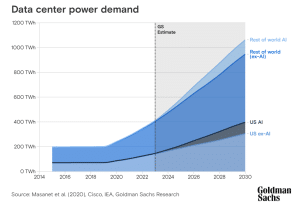
AI development is driving record electricity demand. Data centers already consume around 415 terawatt-hours (TWh) of power globally each year, or about 1.5% of total electricity use. By 2030, consumption could more than double to 945 TWh, according to the International Energy Agency (IEA).

data center power demand 2030

Both Meta and Amazon are addressing this surge by pairing AI growth with clean energy expansion.

  • Amazon is the largest corporate buyer of renewable energy in the world. It has over 550 wind and solar projects. Together, these projects generate more than 33 gigawatts (GW) of capacity as of 2025. They supply power to AWS data centers, logistics hubs, and fulfillment sites across 27 countries.
  • Meta sources 100% renewable energy for its global operations and data centers. It has added 10 GW of clean energy capacity since 2020 and continues to invest in solar and wind farms in the U.S., Spain, and Singapore.

These efforts are part of a larger trend in tech: replacing fossil fuel power with firm, clean sources such as nuclear, geothermal, and long-duration storage, to ensure 24/7 reliability.

Amazon’s Net-Zero Roadmap

Amazon aims to reach net-zero carbon emissions by 2040, a decade ahead of the Paris Agreement target. To get there, it is cutting emissions across transportation, operations, and packaging.

Key steps include:

  • Deploying over 145,000 electric delivery vans by 2030.
  • Using sustainable aviation fuel for Amazon Air.
  • Reducing plastic packaging and promoting circular economy programs.
  • Investing in carbon removal projects, including reforestation and direct air capture systems.

In 2024, Amazon reduced its carbon intensity — emissions per dollar of revenue — by 16% from its 2021 baseline. The company is testing green hydrogen and battery storage. This will help stabilize renewable energy supplies for its warehouses and data centers.

Meta’s Net-Zero and Carbon Removal Efforts

Meta reached net-zero emissions for its operations (Scope 1 and 2) in 2020. Now, it’s focusing on Scope 3 emissions, which come from suppliers and user activity.

By 2030, Meta aims to reach full net-zero emissions across its value chain. It is buying more renewable energy and improving server designs for better efficiency. It is also investing in carbon removal projects, like reforestation and biochar.

The company’s circular-hardware program reuses old data-center servers. This effort recycles materials and cuts electronic waste by almost 60% since 2022. Its new data centers in Texas and Denmark will run entirely on wind and solar power, helping to balance AI’s growing energy demand.

Meta also launched a “climate science hub” across Facebook and Instagram to share verified climate information and encourage community-level sustainability actions.

Investor Takeaway: Profits Up, Pressures High, Climate Still Central

Amazon’s strong revenue and cloud success show its resilience. However, the company is dealing with rising costs from its AI expansion and logistics network. Analysts expect AWS growth to remain steady as enterprise clients expand AI workloads.

Meta’s profits were better than expected. However, the company’s high capital spending raised worries about short-term margins. Reality Labs, which works on AR/VR and metaverse products, had a $3.7 billion operating loss in Q3. However, executives noted that AI integration is boosting user engagement and ad performance.

Both companies play key roles in the AI economy and clean energy transition, even with short-term ups and downs.

Clean Energy and Tech: A Shared Future

Amazon vs Meta renewable energy capacity

Amazon and Meta are boosting their clean energy efforts. This shows a big change in the industry. As AI and data grow, having reliable low-carbon electricity is now a key advantage.

  • By 2030, Amazon’s projects might create enough renewable energy to offset 30 million metric tons of CO₂ each year. This is about the same as the emissions from 8 million cars.
  • Meta’s ongoing efficiency programs have cut data center energy use by 30% per computing task compared to 2020, even as total workloads grow.

Both companies are exploring new power sources. They are looking into small modular reactors (SMRs) and advanced geothermal systems. This aims to provide clean energy for their global networks without interruption.

For Amazon and Meta, the latest earnings reports tell a story of growth tied to responsibility. Their revenues are up, AI investment continues, and sustainability remains at the center of their long-term strategies.

Short-term market swings show investor caution. Still, both companies are building the digital and environmental infrastructure for the next decade of tech growth.

In the race to power AI with clean energy, they show that profitability and sustainability can grow together if backed by the right investments, partnerships, and long-term visions.

The post Amazon Stock Rises, Meta Falls: Q3 Earnings Show Split Paths in AI and Clean Energy appeared first on Carbon Credits.

Apple’s Earnings and (AAPL) Stock Up, Emissions Down: How Its 2030 Vision Is Paying Off

Apple’s Earnings and (AAPL) Stock Up, Emissions Down: How Its 2030 Vision Is Paying Off

Apple Inc. reported strong financial results for its latest quarter. It showed steady growth in its products and services, sending its stock rising to its highest level this year. At the same time, the company is expanding its clean energy and carbon reduction programs as it works toward its 2030 net-zero goal. 

Apple’s strategy focuses on balancing profit and sustainability. This approach helps define the company as one of the largest and most influential in the world.

Financial Results Show Steady Growth: Apple’s $102B Quarter

Apple’s fiscal year ending September 2025 marked another period of steady growth and strong cash generation. The company reported $416 billion in total revenue for the year, up from $394 billion in fiscal 2024.

Net revenue for the quarter reached $102.5 billion, 8% higher than the previous year’s result. It reflects solid demand for services and high-end iPhones.

Apple Q4 2025 financial results
Source: Apple

Apple’s Services division, which includes the App Store, Apple Music, iCloud, and Apple TV+, grew faster than hardware. It brought in around $28.8 billion, a 15% increase, in the fourth quarter alone. This segment now accounts for more than one-fourth of total company revenue, helping offset slower growth in device sales.

The iPhone 17 lineup stayed Apple’s top revenue source. This was thanks to strong demand in North America and increased sales in India and Southeast Asia. Meanwhile, Mac and iPad sales stayed stable, with new M4-powered models expected to lift performance in 2026.

Apple shares reached a record high this year at $277.32 on October 31 trading. That price is about 18% higher year-to-date versus the January 31 close. The jump followed strong earnings and renewed investor interest in services and clean energy plans.

Apple AAPL stock price

Analysts believe the company’s clean energy and sustainability efforts will boost investor confidence. This is important as environmental and social performance are now key metrics in global markets.

Clean Energy Investments Gain Momentum

Apple continues to invest heavily in renewable energy. Its suppliers now operate 17.8 gigawatts (GW) of clean electricity worldwide, enough to power millions of homes. These efforts helped avoid an estimated 21.8 million metric tons of greenhouse gas emissions in 2024 alone.

The tech giant has committed to powering all its global facilities, like data centers, stores, and offices, with 100% renewable energy. As of 2025, Apple reports that this target has already been met for its operations.

Apple is also encouraging suppliers to follow its lead. Over 320 suppliers from 30 countries have joined Apple’s Clean Energy Program. This represents more than 95% of the company’s direct manufacturing spending.

Apple’s Clean Energy Capacity by Year

The chart above shows Apple’s global renewable energy portfolio. This includes direct purchases like Power Purchase Agreements (PPAs), investments in solar and wind projects, and clean energy from suppliers in Apple’s Supplier Clean Energy Program.

The 2017–2024 values are based on company disclosures. The 2025 figure represents the most recent reported estimate (Apple’s suppliers achieving 17.8 GW of renewable energy capacity).

In addition to clean energy sourcing, Apple is reducing material-related emissions. Its devices now use:

  • 99% recycled rare earth elements in magnets.
  • 99% recycled cobalt in batteries.
  • 100% recycled aluminum in many product enclosures.

These changes lower emissions and cut the need for new mining. Mining is a major source of industrial carbon emissions.

Apple 2030: The Road to True Carbon Neutrality

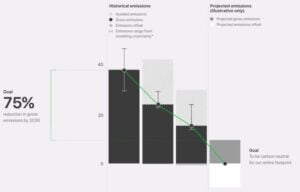
Apple’s long-term plan, called Apple 2030, aims to make its entire business carbon neutral by 2030. This includes all emissions from manufacturing, operations, and product use.

Since 2015, the company has already cut its total carbon footprint by over 60%. That means Apple has prevented around 41 million metric tons of CO₂ from entering the atmosphere compared to a decade ago.

apple carbon emissions 2024
Source: Apple (2024 carbon emissions)

To reach full carbon neutrality, Apple plans to:

  • Reduce emissions by 75% from its 2015 baseline.
  • Offset the remaining 25% through verified carbon removal projects.

The company is investing in nature-based solutions, such as reforestation and mangrove restoration, as part of its offset strategy. It is also exploring more advanced carbon removal methods, including direct air capture and mineralization.

Apple says its approach focuses on “real and permanent” carbon reductions, rather than temporary offsets. The goal is to ensure that all products — from iPhones to MacBooks — are produced with net-zero emissions by 2030.

Sustainability as a Core Business Strategy

Apple’s clean energy work is closely tied to the company’s supply chain, product design, and long-term growth. The company uses recycled materials and renewable energy. This helps lower its risk of resource shortages and energy price changes. These choices also make production more efficient and less dependent on fossil fuels.

The company is also building resilience against future climate policies. As governments tighten carbon rules, companies with cleaner supply chains may enjoy lower costs and better operations.

Apple’s sustainability efforts also support its growing investor base. Many institutional investors now use environmental, social, and governance (ESG) criteria to evaluate companies. For Apple, good environmental performance keeps it a top ESG-rated company worldwide.

Industry Trends: AI, Energy, and Emissions Collide 

The clean energy transition is changing how the tech industry operates. Data centers, manufacturing plants, and logistics networks are major sources of emissions.

Apple, Microsoft, and Google are all working to lower their carbon footprints. At the same time, they are expanding their AI infrastructure. This infrastructure uses a lot of power.

Analysts estimate that global data center electricity use could reach 945 terawatt-hours (TWh) by 2030 — more than double 2024 levels. That’s why access to clean, reliable power has become a key business issue.

data center electricity demand due AI 2030

In the consumer electronics market, sustainability is also becoming a selling point. More buyers now look for low-carbon, recyclable, or energy-efficient products. Apple’s use of recycled metals and renewable energy helps it meet this demand and strengthen its brand value.

At the same time, the global renewable energy market is booming. Solar and wind capacity is expected to grow by more than 50% by 2030, according to the International Energy Agency. This trend supports Apple’s ability to secure more clean power as its operations expand.

Balancing Growth and Green Goals: The Path Ahead

Apple has two big challenges. It needs to keep its strong financial performance and also meet its environmental commitments. As it grows its AI and cloud services, energy demand will keep rising. The company’s clean energy projects and emission reduction strategies will need to scale accordingly.

If Apple stays on track, it could become one of the first major tech companies to reach net-zero emissions across its entire value chain.

For investors, the combination of steady earnings, rising services revenue, and a strong sustainability record makes Apple a company to watch. Its success shows how environmental responsibility and business growth can move together, even in a rapidly changing global economy.

The post Apple’s Earnings and (AAPL) Stock Up, Emissions Down: How Its 2030 Vision Is Paying Off appeared first on Carbon Credits.

Trump Inks Rare Earth Deals with Japan and Southeast Asia to Secure Supply Chains

Trump Inks Rare Earth Deals with Japan and Southeast Asia to Secure Supply Chains

U.S. President Donald Trump signed new agreements on rare earth and critical minerals with Japan and some Southeast Asian countries. The deals were finalized during his October 2025 Asia tour. They aim to lower reliance on China, which leads to global production of these key materials.

Rare earth elements are vital for many things, including electric vehicles (EVs), wind turbines, smartphones, and defense systems.

Global demand is rising fast as countries invest more in clean energy and digital technologies. These new partnerships are among the biggest efforts yet to build alternative supply chains for critical minerals.

Japan Deal: Strengthening Industrial and Energy Security

On October 28, 2025, Trump and Japanese Prime Minister Sanae Takaichi signed a key deal. This agreement aims to secure supplies of rare earths, lithium, cobalt, and nickel. The agreement expands past U.S.–Japan cooperation and includes new plans for joint investments, technology sharing, and transparent supply management.

Under the deal, both countries plan to:

  • Build processing and refining plants for rare earths and battery minerals.
  • Create strategic stockpiles and improve recycling systems.
  • Support magnet production for EVs and defense industries.
  • Explore nuclear fuel supply cooperation for next-generation reactors.

Japan still relies on China for about 65% of its rare earth imports, even after years of trying to diversify. The new deal aims to cut this dependence by sourcing from U.S. allies like Australia and Vietnam. Also, it will process materials locally or in partner nations.

China rare earth magnet exports july 2025

The plan supports Japan’s economic security law, which pushes companies to find new material sources. Tokyo has set aside about ¥400 billion (US$2.7 billion) in funding to help domestic rare earth and battery material projects through 2027.

Southeast Asia: Expanding the Network Beyond China

Trump also announced new cooperation deals with Malaysia, Vietnam, Thailand, Cambodia, and Indonesia. These countries hold key mineral reserves and play important roles in regional trade.

Malaysia already operates one of the world’s few large rare-earth processing plants outside China. Vietnam has about 22 million tonnes of rare-earth reserves, second only to China. Indonesia and Thailand are major producers of nickel and tin, vital for EV batteries.

The Southeast Asia deals aim to:

  • Bring in U.S. and Japanese investments for mining and refining projects.
  • Train local workers and improve technical skills.
  • Cut tariffs and export barriers that slow regional trade.
  • Support cleaner and safer mining technologies under ESG standards.

Experts say these efforts could create an “Indo-Pacific mineral corridor.” This would link mines in Australia, processors in Southeast Asia, and manufacturers in Japan. This network would help reduce China’s control over the middle stages of the supply chain.

Why Rare Earths Matter: A Market Under Strain

Rare earths are a group of 17 metals used in many high-tech and clean energy products. The most valuable are neodymium, praseodymium, and dysprosium. These elements are essential for strong magnets used in EV motors, drones, and wind turbines.

China controls around 60–70% of mining and 85–90% of refining for rare earths. This gives Beijing major influence over countries that depend on these materials.

China rare earth mining and refining
Note: Data as of 2025, based on 2025 market assessments from the International Energy Agency (IEA) and the U.S. Geological Survey (USGS)

In 2024, the world produced about 350,000 tonnes of rare earth materials. The International Energy Agency (IEA) expects demand to reach over 500,000 tonnes by 2030. Market value could rise from $13 billion in 2024 to over $25 billion by 2030.

The U.S. currently makes about 12% of global rare earth ore, mostly from the Mountain Pass mine in California. However, much of it is still sent to China for processing. That dependence makes the new deals with Japan and Southeast Asia even more important.

Strategic and Economic Significance

For the United States, these deals mark a new stage in mineral diplomacy. Washington aims to safeguard clean energy and defense industries. It plans to do this by securing long-term supply agreements in Asia to help protect against disruptions.

Japan gains stronger support for its automotive, electronics, and robotics sectors. The country is restarting its rare earth recycling programs. These programs slowed down after Chinese export limits in 2010 made prices rise sharply.

For Southeast Asian nations, the agreements promise foreign investment, new jobs, and technology sharing. Malaysia and Vietnam might become key centers for refining and magnet production. This could create jobs for thousands of skilled workers.

The deals also back U.S. efforts to counter China’s export restrictions. In 2024, China limited exports of gallium, germanium, and certain rare earth magnets for “national security” reasons. Those actions disrupted supply chains and forced manufacturers in Japan, Europe, and the U.S. to look elsewhere for materials.

Rare Earth Market Outlook: Rising Demand, Tight Supply

Demand for rare earth magnets, especially neodymium-iron-boron (NdFeB) magnets, might triple by 2035. This rise is fueled by electric vehicles (EVs) and wind turbines. Each electric vehicle needs 1–2 kilograms of these magnets, while one offshore wind turbine can use up to 600 kilograms.

rare earth demand and supply
Source: McKinsey

The price of neodymium oxide has climbed from about US$70 per kg in 2020 to more than US$120 per kg in 2025, showing strong pressure on supply. China’s quota limits and environmental checks have made availability uncertain.

The U.S., Japan, and the European Union are expanding recycling programs. They aim to recover rare earths from old motors and electronics. This helps reduce reliance on mined materials. Yet, recycling currently provides less than 5% of total global demand.

The Cost of Breaking Free from China

Building alternative supply chains is difficult. Several challenges include:

  • High costs: Rare-earth plants are expensive and take years to build.
  • Environmental risks: Poor waste management can pollute water and soil.
  • Financing issues: Price swings make investors cautious.
  • Geopolitical tensions: China may respond by lowering prices or tightening exports.

Experts say that without strong government support, new producers may not compete with China’s scale and low costs. Both the U.S. and Japan are studying tax credits and loan programs to help new projects move forward.

Forging a New Indo-Pacific Supply Chain

These rare earth agreements send a clear message: the U.S. and its allies want to reshape global supply chains around trusted partners. The next steps include choosing priority projects, securing funding, and coordinating trade rules.

If successful, these efforts could shift 15–20% of global refining capacity away from China by the early 2030s. That would mark the biggest industry shift in decades.

For the U.S., Japan, and Southeast Asia, the deals combine economic security, industrial growth, and clean energy goals. They also show how the energy transition and geopolitics are now closely linked.

In the long run, building diverse and stable rare earth supply chains could make clean energy industries stronger and less dependent on any single country.

The post Trump Inks Rare Earth Deals with Japan and Southeast Asia to Secure Supply Chains appeared first on Carbon Credits.

Microsoft Seals 10-Year Arca Carbon Deal Ahead of Earnings Beat and Record Profits

Microsoft Seals 10-Year Arca Carbon Deal Ahead of Earnings Beat and Record Profits

Microsoft has signed a 10-year carbon removal agreement with Arca, a Canadian startup that turns mine waste into carbon storage. The partnership backs Microsoft’s goal to be carbon negative by 2030. It also helps Arca grow its natural mineralization technology.

The deal came just before Microsoft reported $77.7 billion in revenue for the first quarter of fiscal 2026, an 18% increase from a year earlier. Operating income also rose 24% and net income increased by 12%.

Despite the strong results, Microsoft’s stock fell about 3% after the earnings release. Investors are becoming cautious about spending more on data centers, AI infrastructure, and OpenAI costs.

Yet, Microsoft’s financial strength allows it to support big climate and energy projects, like the Arca deal. This shows how the company connects AI growth with long-term sustainability goals.

Turning Mine Waste into Carbon Storage

Arca uses a process called mineralization, which captures CO₂ by reacting it with magnesium-rich mine waste. This reaction forms stable carbonates, permanently locking carbon in solid rock.

The company works with mining firms that produce waste materials such as nickel, cobalt, and platinum tailings. These minerals naturally react with CO₂, but Arca speeds up the process using technology developed in Canada.

The captured carbon can stay stored for thousands of years, making it one of the most durable forms of carbon removal. The process also helps mining sites lower emissions and improve environmental performance.

Arca’s CEO, Paul Needham, said the Microsoft deal gives the company long-term stability to grow and reach more industrial partners. It also strengthens Arca’s position as a global leader in geology-based carbon storage, noting:

“This agreement with Microsoft validates Industrial Mineralization as a viable pathway for durable carbon removal with the potential to scale and meaningfully contribute to global climate goals.”

Microsoft’s Path to Carbon Negativity

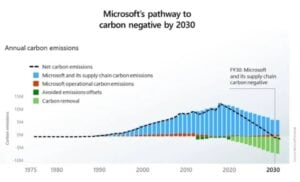
Microsoft first pledged in 2020 to become carbon negative by 2030, meaning it will remove more carbon from the air than it emits. By 2050, it aims to erase all historical emissions since its founding in 1975.

Microsoft emissions
Source: Microsoft

The company is one of the largest corporate buyers of carbon removal. It has signed contracts with companies like Heirloom, Climeworks, and Running Tide. They use a mix of direct air capture (DAC), biomass, and ocean-based methods.

As of 2024, Microsoft reported cutting its Scope 1 and 2 emissions by 22% from 2020 levels. However, Scope 3 emissions — those from supply chains and product use — still make up over 95% of its total footprint.

Microsoft carbon emissions
Source: Microsoft

To meet its targets, Microsoft is combining renewable energy investments with durable carbon removal projects such as Arca’s. Following this deal, the tech giant reported its Q1 2026 financial results.

Microsoft’s Latest Earnings: Strong Results, But Shares Slip

Microsoft reported strong first-quarter fiscal 2026 results. Revenue rose 18% to $77.7 billion. Operating income grew 24% to $38.0 billion. Net income was $27.7 billion, up 12%. Profit also climbed to $30.8 billion, up 22%.
Microsoft Cloud revenue hit $49.1 billion, up 26%, and Azure and other cloud services grew 40%. The company returned $10.7 billion to shareholders through buybacks and dividends.

Microsoft earnings q1 2026 results
Source: Microsoft

Despite the beats, Microsoft’s shares dropped roughly 3% in extended trading. Traders flagged three main worries.

  • First, Microsoft raised its investment profile — management signalled higher capital spending to build more data centers and AI infrastructure.
  • Second, the company disclosed a $3.1 billion hit related to its OpenAI investments that lowered reported earnings.
  • Third, investors flagged margin pressure and possible capacity limits as cloud demand keeps rising.

These factors tempered the market’s initial enthusiasm, even as core business metrics beat expectations.

Microsoft stock price

Meeting AI’s Growing Energy Demands

Microsoft’s AI and cloud services require large amounts of energy. As its Azure platform and data centers expand, electricity demand keeps climbing.

Global data centers used about 415 terawatt-hours (TWh) of power in 2024, equal to roughly 1.5% of total global use. By 2030, that number could rise to 945 TWh, more than double current levels. AI computing will likely drive much of that growth.

To balance this, Microsoft is investing in clean and firm power sources such as nuclear, wind, solar, and geothermal. The company is also studying small modular reactors (SMRs) to power future data centers.

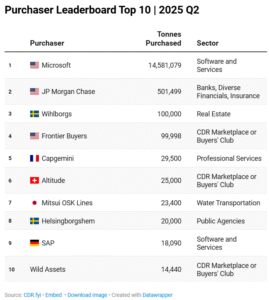
The deal with Arca adds another tool to help offset emissions from AI expansion. Microsoft is expanding its climate strategy. It’s now focusing on permanent carbon removal, not just renewables. It remains the top buyer of durable carbon removal in the second quarter of this year.carbon removal purchaser Leaderboard Top 10

SEE MORE: Microsoft (MSFT Stock) Tops Q2 2025 Record-Breaking Surge in Durable Carbon Removal Credit Purchases

Arca’s Role in the Growing Carbon Removal Market

The global carbon removal market remains small but is growing fast. Experts say that by 2030, companies will need to remove at least 1 billion tonnes of CO₂ each year to meet climate goals. Today, only about 5 million tonnes of verified removals exist globally — meaning the market must expand hundreds of times.

Arca’s mineralization process is highly scalable. It uses abundant mining waste instead of new raw materials. Pilot projects in British Columbia and Ontario have shown good results. So, new facilities are planned all over North America.

The Microsoft deal gives Arca both credibility and financial backing to grow faster. Funds will help build larger operations, improve carbon measurement, and expand partnerships with mining companies globally.

Economic and Environmental Impact

For Arca, this deal marks a major step in scaling a once experimental process. It proves that natural mineralization can attract big corporate buyers and investors. It also highlights Canada’s leadership in carbon management and clean mining innovation.

The Honourable Tim Hodgson, Minister of Energy and Natural Resources, commented:

“The next generation of clean growth will be built by Canada’s first-class innovation ecosystem – companies like Arca, which are turning Canadian ingenuity into global leadership. Carbon removal technologies are not only strategic tools we can use to tackle climate change, they create good jobs and position Canada at the forefront of the global opportunity of a low-carbon economy.”

The deal helps Microsoft balance the environmental costs of its AI and cloud growth. It also supports its carbon removal efforts. Every tonne of CO₂ removed will be verified and stored permanently. This follows the Science Based Targets initiative (SBTi) standards.

A Broader Shift Toward Permanent Carbon Removal

Tech giants like Google, Meta, and Shopify have signed similar long-term deals with carbon removal startups. These contracts give small companies predictable income, helping them scale and lower costs over time.

Analysts think the carbon removal market might reach $50–100 billion a year by 2030. This growth will depend on policy support and corporate buyer demand. 

Both companies see this partnership as a model for combining technology, industry, and nature to fight climate change. For Microsoft, it is a key step in cleaning up emissions from its fast-growing AI business. For Arca, it provides a launchpad for global expansion and further innovation.

As more companies race toward net-zero goals, the demand for reliable and permanent carbon removal will keep rising. The Microsoft–Arca deal shows that tackling climate change can also drive new business opportunities where sustainability and growth can work hand in hand.

The post Microsoft Seals 10-Year Arca Carbon Deal Ahead of Earnings Beat and Record Profits appeared first on Carbon Credits.