

PayPal Expands Its Net Zero Strategy With 3Degrees’ Carbon Removal Portfolio
PayPal, the digital payments company, expands its climate strategy by supporting next-generation carbon removal projects. These include biochar and bioenergy with carbon capture and storage (BECCS). The investments aim to cut emissions that are hard to eliminate and support the growth of the new carbon removal market.
The move reflects a broader shift taking place across corporate climate strategies. Many companies have already reduced emissions through renewable electricity, energy efficiency, and cleaner supply chains.
As those options become harder to expand, attention is turning toward permanent carbon removal to address the remaining emissions needed to reach net zero.
Cullen Mitchell, Sustainability Manager at PayPal, noted:
“As we work toward our 2040 net-zero target, investing in high-durability carbon removals was a vital step for PayPal… [3Degrees enables our company] to confidently invest in high-integrity, diversified carbon removals that fit both our budget and our climate ambitions.”
3Degrees Builds a Diversified Carbon Removal Portfolio
PayPal is investing with 3Degrees, a climate solutions company. Their solutions help businesses cut emissions and create carbon removal portfolios.
3Degrees built a diverse portfolio for PayPal. Instead of buying credits from just one project, it spreads investment across various carbon removal technologies and locations.
The portfolio features Heartyculture Biochar in India. This process turns agricultural waste into biochar, helping lock carbon in soils. It also includes Gevo’s North Dakota BECCS facility. This facility captures carbon dioxide from ethanol production and stores it underground for good.
3Degrees says this varied approach reduces technical and commercial risks. It also helps grow the next generation of lasting carbon removal technologies.
For PayPal, carbon removal is not a replacement for emissions reductions. It is becoming the final piece of a much larger climate strategy.
Years of Emissions Cuts Set the Stage for the Next Move
PayPal has made significant progress in reducing emissions from its own operations. According to its 2025 Global Impact Report, the company has reduced its Scope 1 and Scope 2 greenhouse gas emissions by over 80% compared with its 2019 baseline.
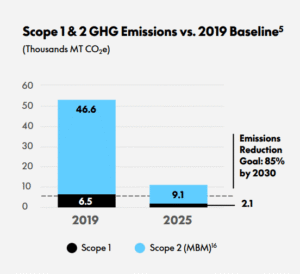
These reductions came from:
- purchasing renewable electricity,
- improving office energy efficiency, and
- reducing emissions from its facilities and operations.
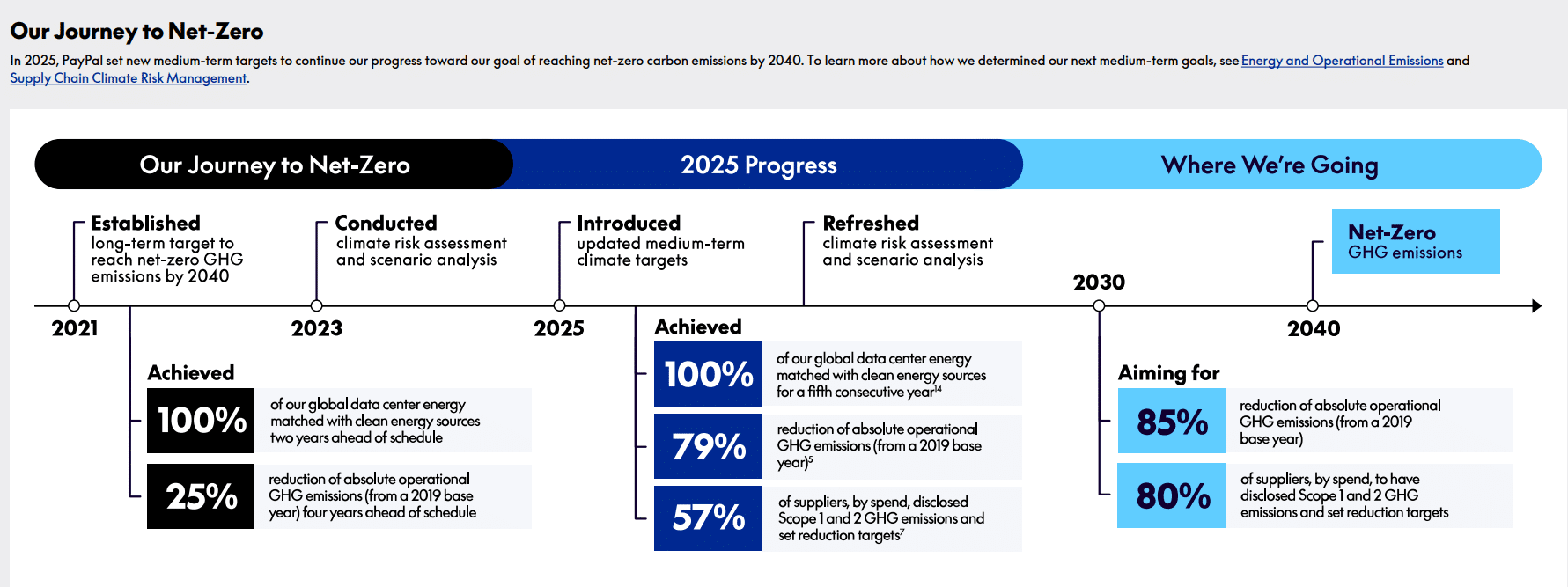
The company has also maintained 100% renewable electricity across its global data centers while continuing to improve the efficiency of its technology infrastructure.
PayPal’s long-term goal is to reach net-zero greenhouse gas emissions across its value chain by 2040. The target has been validated by the Science Based Targets initiative (SBTi) and aligns with limiting global warming to 1.5°C.
The company’s updated transition plan also sets several interim goals by 2030. These include maintaining near-zero operational emissions while reducing supply chain emissions through stronger supplier engagement and cleaner procurement practices.
Scope 3 Remains PayPal’s Biggest Challenge
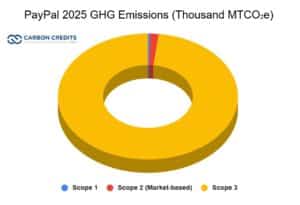
Like most technology companies, PayPal has already made strong progress in cutting emissions from its own operations. Its total GHG emissions fell from 515.1 thousand MTCO₂e in 2023 to 478.1 thousand MTCO₂e in 2024. But it rose to 578.6 thousand MTCO₂e again in 2025.
Scope 1 and Scope 2 emissions remained relatively low and stable, while the increase in 2025 was driven almost entirely by Scope 3 emissions, as shown in the chart below.
According to its Climate Transition Plan, Scope 3 emissions account for about 98% of PayPal’s total carbon footprint. These emissions come mainly from purchased goods and services, capital equipment, business travel, and employee commuting.
The use of cloud computing and technology services throughout its value chain also contributes.
That means PayPal cannot reach net zero by improving only its own buildings or electricity use. It also needs suppliers to lower their emissions.
To help achieve that goal, the company is working closely with key vendors. PayPal expects strategic suppliers to measure their emissions, set science-based climate targets, and increase their use of renewable electricity. The company is also including climate performance in supplier engagement and procurement decisions.
This reflects a growing trend across the technology industry. As operational emissions continue to fall, supply chain emissions are becoming the biggest obstacle to achieving corporate climate goals.
Why PayPal Is Investing in Carbon Removal
Even with deep emissions cuts, some emissions will remain difficult to eliminate by 2040. These are known as residual emissions. PayPal will focus on high-durability carbon removal instead of just traditional carbon offsets to tackle its remaining emissions.
The company is partnering with 3Degrees, a climate solutions provider, to buy carbon removal. This will support projects that permanently take carbon out of the atmosphere.
Current investments focus on two technologies. The first is biochar, which converts agricultural waste into a stable form of carbon that can remain stored in soils for hundreds of years while improving soil health.
The second is bioenergy with carbon capture and storage (BECCS). This technology captures carbon dioxide from biomass energy production. It then stores it deep underground, stopping it from going back into the atmosphere.
PayPal states that these investments aim to boost technologies needed to achieve global net-zero goals in the coming decades.

Durable carbon removal is different from traditional carbon credits. While many credits just aim to avoid future emissions, durable carbon removal actually takes carbon out of the atmosphere. It stores this carbon for a long time.
That makes it one of the fastest-growing areas of the voluntary carbon market.
Carbon Removal Is Becoming a Bigger Climate Investment
PayPal is not alone in backing carbon removal. More companies now see carbon removal as an important tool for reaching net zero. According to CDR.fyi, buyers contracted more than 8 million metric tons of durable carbon removal in 2025, setting another annual record.
Technology companies remain the biggest buyers, including Microsoft, Google, Stripe, Shopify, and Frontier.
The Intergovernmental Panel on Climate Change (IPCC) says carbon removal will be necessary because some industries, such as aviation, shipping, and heavy manufacturing, will continue to produce emissions even after making deep cuts.
The market is also expected to grow rapidly. McKinsey & Company estimates carbon removal could become a $1.2 trillion market by 2050 as demand rises for permanent carbon removal solutions.
Carbon Removal Comes After Emissions Cuts
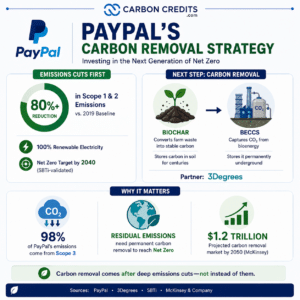
PayPal’s climate plan follows a clear order. The company reduces emissions first. It uses renewable electricity, improves energy efficiency, and works with suppliers to lower emissions across its value chain. Only then does it invest in durable carbon removal to address the emissions that remain.
This approach aligns with the Science Based Targets initiative (SBTi). It states that companies should focus on cutting direct emissions first; then they can use carbon removal for any residual emissions.
A New Phase of Corporate Climate Action
PayPal has already reduced its Scope 1 and 2 emissions by 80% from its 2019 baseline. Its next challenge is tackling the much larger Scope 3 emissions across its supply chain.
The company’s latest investments show how corporate climate strategies are changing. Businesses are no longer relying only on renewable electricity and energy efficiency. Many are beginning to invest in the carbon removal technologies they expect to need in the future.
For the carbon market, this is an important shift. Companies are moving beyond buying traditional offsets and helping finance the next generation of permanent carbon removal. If more businesses follow PayPal’s approach, demand for high-quality carbon removal credits could continue to grow as the global race to net zero accelerates.
The post PayPal Expands Its Net Zero Strategy With 3Degrees’ Carbon Removal Portfolio appeared first on Carbon Credits.
Leave a Reply
Want to join the discussion?Feel free to contribute!