PayPal Expands Its Net Zero Strategy With 3Degrees’ Carbon Removal Portfolio

PayPal Expands Its Net Zero Strategy With 3Degrees' Carbon Removal Portfolio

PayPal, the digital payments company, expands its climate strategy by supporting next-generation carbon removal projects. These include biochar and bioenergy with carbon capture and storage (BECCS). The investments aim to cut emissions that are hard to eliminate and support the growth of the new carbon removal market.

The move reflects a broader shift taking place across corporate climate strategies. Many companies have already reduced emissions through renewable electricity, energy efficiency, and cleaner supply chains.

As those options become harder to expand, attention is turning toward permanent carbon removal to address the remaining emissions needed to reach net zero.

Cullen Mitchell, Sustainability Manager at PayPal, noted:

“As we work toward our 2040 net-zero target, investing in high-durability carbon removals was a vital step for PayPal… [3Degrees enables our company] to confidently invest in high-integrity, diversified carbon removals that fit both our budget and our climate ambitions.”

3Degrees Builds a Diversified Carbon Removal Portfolio

PayPal is investing with 3Degrees, a climate solutions company. Their solutions help businesses cut emissions and create carbon removal portfolios.

3Degrees built a diverse portfolio for PayPal. Instead of buying credits from just one project, it spreads investment across various carbon removal technologies and locations.

The portfolio features Heartyculture Biochar in India. This process turns agricultural waste into biochar, helping lock carbon in soils. It also includes Gevo’s North Dakota BECCS facility. This facility captures carbon dioxide from ethanol production and stores it underground for good.

3Degrees says this varied approach reduces technical and commercial risks. It also helps grow the next generation of lasting carbon removal technologies.

For PayPal, carbon removal is not a replacement for emissions reductions. It is becoming the final piece of a much larger climate strategy.

Years of Emissions Cuts Set the Stage for the Next Move

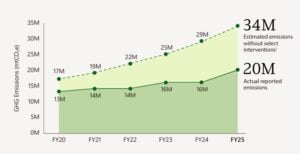
PayPal has made significant progress in reducing emissions from its own operations. According to its 2025 Global Impact Report, the company has reduced its Scope 1 and Scope 2 greenhouse gas emissions by over 80% compared with its 2019 baseline.

PayPal GHG emissions 2025
Source: PayPal

These reductions came from:

  • purchasing renewable electricity,
  • improving office energy efficiency, and
  • reducing emissions from its facilities and operations.

The company has also maintained 100% renewable electricity across its global data centers while continuing to improve the efficiency of its technology infrastructure.

PayPal’s long-term goal is to reach net-zero greenhouse gas emissions across its value chain by 2040. The target has been validated by the Science Based Targets initiative (SBTi) and aligns with limiting global warming to 1.5°C.

The company’s updated transition plan also sets several interim goals by 2030. These include maintaining near-zero operational emissions while reducing supply chain emissions through stronger supplier engagement and cleaner procurement practices.

PayPal Net Zero roadmap and progress 2025
Source: PayPal

Scope 3 Remains PayPal’s Biggest Challenge

Like most technology companies, PayPal has already made strong progress in cutting emissions from its own operations. Its total GHG emissions fell from 515.1 thousand MTCO₂e in 2023 to 478.1 thousand MTCO₂e in 2024. But it rose to 578.6 thousand MTCO₂e again in 2025.

Scope 1 and Scope 2 emissions remained relatively low and stable, while the increase in 2025 was driven almost entirely by Scope 3 emissions, as shown in the chart below.

According to its Climate Transition Plan, Scope 3 emissions account for about 98% of PayPal’s total carbon footprint. These emissions come mainly from purchased goods and services, capital equipment, business travel, and employee commuting.

The use of cloud computing and technology services throughout its value chain also contributes.

PayPal 2025 GHG emissions by scope

That means PayPal cannot reach net zero by improving only its own buildings or electricity use. It also needs suppliers to lower their emissions.

To help achieve that goal, the company is working closely with key vendors. PayPal expects strategic suppliers to measure their emissions, set science-based climate targets, and increase their use of renewable electricity. The company is also including climate performance in supplier engagement and procurement decisions.

This reflects a growing trend across the technology industry. As operational emissions continue to fall, supply chain emissions are becoming the biggest obstacle to achieving corporate climate goals.

Why PayPal Is Investing in Carbon Removal

Even with deep emissions cuts, some emissions will remain difficult to eliminate by 2040. These are known as residual emissions. PayPal will focus on high-durability carbon removal instead of just traditional carbon offsets to tackle its remaining emissions.

The company is partnering with 3Degrees, a climate solutions provider, to buy carbon removal. This will support projects that permanently take carbon out of the atmosphere.

Current investments focus on two technologies. The first is biochar, which converts agricultural waste into a stable form of carbon that can remain stored in soils for hundreds of years while improving soil health.

The second is bioenergy with carbon capture and storage (BECCS). This technology captures carbon dioxide from biomass energy production. It then stores it deep underground, stopping it from going back into the atmosphere.

PayPal states that these investments aim to boost technologies needed to achieve global net-zero goals in the coming decades.

PayPal carbon removal biochar story
Source: PayPal

Durable carbon removal is different from traditional carbon credits. While many credits just aim to avoid future emissions, durable carbon removal actually takes carbon out of the atmosphere. It stores this carbon for a long time.

That makes it one of the fastest-growing areas of the voluntary carbon market.

Carbon Removal Is Becoming a Bigger Climate Investment

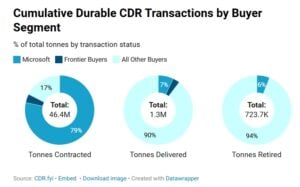
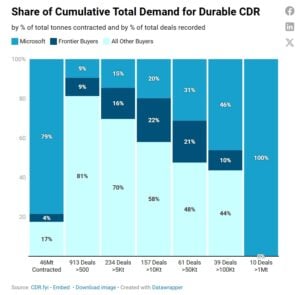
PayPal is not alone in backing carbon removal. More companies now see carbon removal as an important tool for reaching net zero. According to CDR.fyi, buyers contracted more than 8 million metric tons of durable carbon removal in 2025, setting another annual record.

Technology companies remain the biggest buyers, including Microsoft, Google, Stripe, Shopify, and Frontier.

The Intergovernmental Panel on Climate Change (IPCC) says carbon removal will be necessary because some industries, such as aviation, shipping, and heavy manufacturing, will continue to produce emissions even after making deep cuts.

The market is also expected to grow rapidly. McKinsey & Company estimates carbon removal could become a $1.2 trillion market by 2050 as demand rises for permanent carbon removal solutions.

Carbon Removal Comes After Emissions Cuts

PayPal net zero carbon removal strategy

PayPal’s climate plan follows a clear order. The company reduces emissions first. It uses renewable electricity, improves energy efficiency, and works with suppliers to lower emissions across its value chain. Only then does it invest in durable carbon removal to address the emissions that remain.

This approach aligns with the Science Based Targets initiative (SBTi). It states that companies should focus on cutting direct emissions first; then they can use carbon removal for any residual emissions.

A New Phase of Corporate Climate Action

PayPal has already reduced its Scope 1 and 2 emissions by 80% from its 2019 baseline. Its next challenge is tackling the much larger Scope 3 emissions across its supply chain.

The company’s latest investments show how corporate climate strategies are changing. Businesses are no longer relying only on renewable electricity and energy efficiency. Many are beginning to invest in the carbon removal technologies they expect to need in the future.

For the carbon market, this is an important shift. Companies are moving beyond buying traditional offsets and helping finance the next generation of permanent carbon removal. If more businesses follow PayPal’s approach, demand for high-quality carbon removal credits could continue to grow as the global race to net zero accelerates.

The post PayPal Expands Its Net Zero Strategy With 3Degrees’ Carbon Removal Portfolio appeared first on Carbon Credits.

Amazon (AMZN) Stock Jumps on Record $200B Q2 Revenue, Fueled by AI Growth and Water-Positive Goals

Amazon (NASDAQ: AMZN) had a strong quarter, fueled by growth in cloud computing, artificial intelligence (AI), advertising, and online retail. The company reported higher revenue and profits for Q2 2026 as demand for AI infrastructure surged.

However, Amazon’s big investments in AI pushed free cash flow into negative territory. The company also noted progress on its long-term sustainability goals, including renewable energy, water conservation, and lower-carbon construction materials for its expanding global data center network.

Amazon’s Revenue Tops $200 Billion in Q2

For the quarter ending June 30, 2026, Amazon reported net sales of $200.6 billion, a 20% increase from $167.7 billion last year. Currency fluctuations had little effect, indicating that the business grew by about 20%.

This growth came from all three major segments.

  • North America remained Amazon’s largest market, generating $116.2 billion in sales, up 16% year over year.
  • International sales rose 15% to $42.2 billion, showing steady growth despite a mixed global economy.
  • Amazon Web Services (AWS) led the way with a 37% revenue jump to $42.2 billion, driven by strong demand for cloud computing and AI services.

AWS Continues to Power Amazon’s Growth

AWS was Amazon’s biggest profit driver this quarter.

Operating income from AWS grew to $16.6 billion, up from $10.2 billion a year ago. This division accounted for over half of Amazon’s total operating profit.

  • CEO Andy Jassy noted that AWS saw its fastest growth in over four years. He stated that AWS’s AI business now exceeds a $25 billion annual revenue run rate, alongside Amazon’s custom chip business. Both are growing at triple-digit rates.

The company is expanding its AI offerings with custom silicon, cloud infrastructure, and partnerships, including an investment in AI startup Anthropic.

Operating Profit Climbs Despite Heavy Investment

Amazon’s operating income rose sharply to $27.5 billion, compared to $19.2 billion in Q2 2025. Across its businesses:

  • North America operating income increased to $9.1 billion, from $7.5 billion.
  • International operating income improved to $1.7 billion, from $1.5 billion.
  • AWS operating income jumped to $16.6 billion, from $10.2 billion.

Net income reached $62.6 billion, or $5.75 per diluted share, compared to $18.2 billion, or $1.68 per share, last year.

Much of this increase came from a $53.4 billion pre-tax gain, primarily tied to Amazon’s investment in Anthropic. Excluding this one-time gain, operating performance still showed solid improvement.

amazon revenue
Source: Amazon Press Release

AI Spending Weighs on Free Cash Flow But AMZN Stock Gains 

Despite higher profits, free cash flow turned negative as Amazon ramped up AI infrastructure investments. It showed a $7.6 billion outflow, down from a positive $18.2 billion the previous year.

This decline was largely due to an extra $66.1 billion spent on property and equipment. Most of that went to expanding AI infrastructure, like data centers and custom AI chips.

  • However, operating cash flow over the past year rose 33% to $161.4 billion.

Also, Amazon’s stock (NASDAQ: AMZN) reacted positively to the earnings report.

Shares rose about 9% in after-hours trading, following better-than-expected AWS growth and rising AI revenue. Investors responded well to AWS’s fastest growth in 18 quarters and Amazon’s growing AI business. Some analysts, however, noted that rising AI spending and negative free cash flow are areas to watch.

amazon stock
Source: Yahoo Finance

Q3 2026 Forecast

  • For Q3 2026, Amazon projects net sales between $197 billion and $202 billion, indicating growth of 9% to 12% compared to last year.

The company mentioned that timing differences for Prime Day affect year-over-year comparisons. Excluding these effects, third-quarter revenue growth would be nearly four percentage points higher.

The retail giant also forecasts operating income between $22.5 billion and $26.5 billion, up from $17.4 billion in Q3 2025. This guidance suggests continued demand for cloud computing, AI services, advertising, and e-commerce despite economic uncertainty.

Amazon Advances Water and Renewable Energy Goals

Alongside its financial results, Amazon reported ongoing progress on its environmental commitments. The company stated its global data centers are now more than seven times more water-efficient than the industry average.

It has reached 75% of its goal to become water positive across its global data center operations by 2030. This means returning more water to local communities than the company uses in its operations.

It also announced it achieved water-positive status in India ahead of its 2027 target, marking an important regional milestone.

water positive amazon
Source: Amazon

On clean energy, it matched 100% of the electricity used across its global operations with renewable energy in 2025, reaching this goal five years early. The company has maintained that achievement for three consecutive years, reducing emissions even as electricity demand grows.

Lower-Carbon Materials Help Reduce Construction Emissions

As Amazon expands its global data center footprint, it also aims to lower emissions from construction materials. Some examples include:

  • Built 33 data centers using lower-carbon steel, adding to 67 facilities completed since 2023. It also utilized lower-carbon steel in 22 logistics and operations buildings.
  • Constructed 39 data centers with lower-carbon concrete in 2025, bringing the total to 74 projects since 2023. Another 14 operations buildings also used this material.
  • Increasingly using mass timber in new buildings, with six projects in design or construction in 2025, including a delivery station in Indiana.
  • MUST READ: Rio Tinto and Amazon Web Services (AWS) Join Forces to Supply Low-Carbon Copper for U.S. Data Centers 

Amazon’s Carbon Emissions Continue to Decline

Amazon’s latest sustainability data show it continues to lower its carbon footprint while expanding its business.

In 2024, Amazon reported 68.25 million metric tons of CO₂e across its operations, down from 70.74 million metric tons in 2023 and nearly 17% below its 2021 peak.

The emissions were distributed across three greenhouse gas categories:

  • Scope 1: 4.78 million metric tons CO₂e, mainly from fuel used in transport and operations.
  • Scope 2 (market-based): 0.77 million metric tons CO₂e, reflecting electricity purchases after renewable energy matching.
  • Scope 3: 62.70 million metric tons CO₂e, making up about 92% of Amazon’s total footprint. These emissions come primarily from purchased goods and services, construction materials, and transportation.

The stark difference between Scope 1 and Scope 3 highlights the challenge for Amazon and other tech firms. While renewable electricity cuts operational emissions, most emissions occur in complex global supply chains.

Amazon carbon emissions
Source: Amazon

As Amazon invests billions in AI data centers, reducing embodied carbon in materials like steel and concrete will be crucial for meeting long-term climate goals.

The company aims for net-zero carbon emissions by 2040 under The Climate Pledge, balancing rapid AI growth with investments in renewable energy, water conservation, and lower-carbon infrastructure.

The post Amazon (AMZN) Stock Jumps on Record $200B Q2 Revenue, Fueled by AI Growth and Water-Positive Goals appeared first on Carbon Credits.

Walmart Cuts Emissions 25% as AI, E-Commerce, and Project Gigaton Power Growth

Walmart Cuts Emissions 25% as AI, E-Commerce, and Project Gigaton Power Growth

Walmart is showing that even the world’s largest retailer can grow while cutting emissions. The company reported that it has reduced its operational greenhouse gas emissions (Scopes 1 and 2) by 25% from its 2015 baseline. This marks another step toward its goal of becoming a zero-emissions company by 2040.

The climate progress comes as Walmart continues to grow its business. The company is expanding e-commerce, investing in artificial intelligence (AI), improving automation, and building a cleaner logistics network.

Strong Earnings Support Walmart’s Long-Term Growth

Walmart continued its strong performance in the first quarter of fiscal 2027, which ended April 30, 2026. The company reported growth in total revenue and net sales. 

Sales at existing Walmart U.S. stores increased 4.1%. More customers visited stores, and shoppers also spent more during each trip. Operating income increased 5.0%, although higher fuel costs for transportation and deliveries reduced part of the gain.

Walmart’s digital business also kept growing.

Walmart financial results Q1 FY2027
Source: Walmart

Its online marketplace, advertising business, and Walmart+ membership program continue to generate higher profits. At the same time, the company is using AI, automation, and modern fulfillment centers to improve efficiency and serve customers faster.

Today, Walmart serves about 280 million customers and members every week through more than 10,900 stores and e-commerce websites in 19 countries. The company also employs over 2 million associates, making it the world’s largest private employer.

Yet, Walmart’s biggest climate challenge is still ahead.

Unlike many companies, most of Walmart’s emissions do not come from its stores, offices, or trucks. They come from the products it buys, makes, transports, and sells through one of the world’s largest supply chains.

That means it cannot reach its climate goals alone. It also needs thousands of suppliers around the world to reduce their emissions.

Cleaner Stores, Trucks, and Power Are Cutting Emissions

Walmart’s business growth is happening alongside steady progress on climate. According to its latest FY2026 ESG Report, the company has reduced its absolute Scope 1 and Scope 2 greenhouse gas emissions by 25% compared with 2015.

Walmart annual GHG emissions 2026
Source: Walmart 2026 ESG Report

Walmart achieved this by buying more renewable electricity, improving energy efficiency, upgrading refrigeration systems, and using cleaner transportation.

Renewable power remains one of Walmart’s biggest tools for cutting emissions.

The company continues to install solar power at its facilities and sign long-term renewable energy agreements. It is also making stores, offices, and distribution centers more energy efficient. Older refrigeration equipment is being replaced with systems that use refrigerants with lower global warming potential and consume less electricity.

By the end of FY2026, 53% of Walmart’s global electricity needs were supplied by renewable sources. This exceeds its 2025 target of 50% and moves the company closer to its goal of 100% renewable electricity by 2035.

Walmart renewable energy capacity 2026
Source: Walmart

The retail giant directly procured 35.0% of its global electricity through renewable energy contracts. Its total clean energy portfolio also reached 5,698 megawatts (MW). This includes 3,386 MW enabled through current FY2026 investments as the company works toward enabling 10 gigawatts (GW) of new clean energy projects by 2030.

Transportation is another major focus.

Walmart is testing battery-electric trucks and hydrogen fuel cell trucks. It is also expanding EV charging stations and using smarter delivery routes to reduce fuel use. These efforts support the company’s goal of operating a zero-emissions fleet by 2040.

Even with this progress, Walmart says its own operations account for only a small part of its total emissions. The much bigger challenge is Scope 3 emissions. These come from the products suppliers manufacture, package, and transport before they reach Walmart stores.

Scope 3 accounts for almost 98% of the retailer’s total GHG emissions at 635 million metric tons of CO2e. Meanwhile, Scope 1 and Scope 2 emissions represent only 2% of its entire carbon footprint, totaling only 14.4 MMT CO2e.

Walmart GHG emissions 2026

That is why Walmart is working closely with suppliers. Cutting emissions across its global supply chain could have a much bigger impact than reducing emissions from its own buildings and vehicles alone.

Kathleen McLaughlin, Executive Vice President and Chief Sustainability Officer at Walmart, said:

“As well, suppliers engaged through our Project Gigaton platform reported projects since 2017 expected to avoid, reduce, or sequester 1.37 billion metric tons of CO2e through 2030.”

Retail’s Carbon Challenge Starts in the Supply Chain

Walmart is not the only retailer working to lower emissions. The whole retail industry faces the same challenge. Companies must keep prices low, deliver products faster, and reduce emissions at the same time.

Most emissions do not come from stores. They come from making products, moving goods around the world, and delivering orders to customers.

According to the International Energy Agency, freight transport accounts for about 8% of global energy-related carbon dioxide (CO₂) emissions. As online shopping continues to grow, moving products efficiently while cutting emissions is becoming more important.

Retailers are also investing more in cleaner transportation. Many are adding electric delivery vehicles, improving warehouse efficiency, and using AI to plan better delivery routes. These changes help lower fuel use, reduce costs, and cut emissions at the same time.

For Walmart, this work supports both its climate goals and its long-term business strategy.

Project Gigaton Is Driving Bigger Emissions Cuts

Walmart knows it cannot reach net zero without its suppliers. That is why Project Gigaton has become one of the company’s biggest climate programs.

The initiative encourages suppliers to reduce emissions across manufacturing, farming, transportation, packaging, waste, and product design.

According to Walmart’s FY2026 ESG Report, suppliers participating in Project Gigaton have now reported almost 1.4 billion metric tons of avoided or reduced greenhouse gas emissions since the program began in 2017. That is one of the largest voluntary supply chain climate programs in the world.

The company is also working with suppliers to expand renewable energy, improve fertilizer use, protect forests, and reduce food waste.

These efforts matter because Scope 3 emissions make up the majority of Walmart’s total carbon footprint, while emissions from its own operations account for only a small share.

Walmart carbon ghg emissions

Can Walmart Reach Net Zero by 2040?

Walmart has made solid progress, but the hardest work still lies ahead.

The company has already reduced its operational emissions by 25% from 2015 levels. It continues to add renewable electricity, improve energy efficiency, modernize refrigeration systems, and test cleaner trucks.

Still, reaching net zero by 2040 will depend mainly on cutting emissions across its global supply chain. That will require thousands of suppliers to switch to cleaner energy, improve manufacturing, and reduce emissions from the products they sell.

However, the company is showing that growing its business while making progress on climate is possible. Revenue continues to increase. E-commerce is expanding quickly. At the same time, Walmart is reducing emissions, improving energy efficiency, and helping suppliers lower their carbon footprint.

Overall, Walmart’s latest results suggest that climate action is no longer separate from business growth. It is becoming an important part of staying competitive in modern retail.

The post Walmart Cuts Emissions 25% as AI, E-Commerce, and Project Gigaton Power Growth appeared first on Carbon Credits.