US Biofuels Get Big Boost: USDA Invests $537M to Power America’s Clean Energy Future

BIOFUEL

The U.S. Department of Agriculture (USDA) is investing $537 million in 543 biofuel projects across 29 states, as USDA Secretary Brooke Rollins announced. This funding comes from the Higher Blends Infrastructure Incentive Program (HBIIP).

The investment includes projects approved in the first 100 days of the Trump Administration. It also supports President Trump’s 20th Executive Order to boost American energy production and help farmers, ranchers, and small businesses in rural areas.

Powering America’s Energy Landscape with Biofuels

Biofuels are liquid fuels made from plant or animal materials, commonly called feedstocks. They can also include gases like methane (from landfills or biogas) and hydrogen (from renewable sources). While most biofuels power vehicles, they can also be used for heating and electricity. Many government programs support biofuel use because they come from renewable sources.

Different industries and laws use various names for biofuels—like ethanol, biodiesel, biojet, or sustainable aviation fuel.

The press release highlighted that Secretary Rollins announced the investment at an event at Elite Octane LLC. This company is in Atlantic, Iowa, which has the highest capacity of biofuel production in America. Iowa has 42 ethanol plants that produce more than 4.7 billion gallons each year and 10 biodiesel plants that generate 416 million gallons annually.

The funding will help gas stations upgrade their storage tanks and fuel pumps. This makes higher ethanol and biodiesel blends more available. Farmers, small businesses, and local economies benefit from this as it creates more demand for corn and soybeans.

Biofuel exports are also on the rise. USDA revealed that in 2024, the U.S. exported 585,324 metric tons of ethanol, bringing in $5.11 billion. The key buyers were Canada, South Korea, and the European Union. They all want cleaner fuels more than ever.

biofuel USA export
Source: USDA

What’s Inside the Higher Blends Infrastructure Incentive Program (HBIIP)

The Higher Blends Infrastructure Incentive Program (HBIIP) was established at USDA Rural Development during President Trump’s first term. Under this program, gas stations can offer biofuels like ethanol and biodiesel more easily. It helps cover the cost of upgrading fuel pumps and storage tanks so more drivers can choose cleaner, homegrown fuel.

About 290 million cars on U.S. roads can use E15, a fuel blend with 15% ethanol. More than 22 million vehicles can run on E85, which has even more ethanol. Diesel vehicles can use B20, a blend with 20% biodiesel. Expanding access to these fuels helps drivers save money and reduces pollution.

Supporting Farmers and Rural Businesses

HBIIP creates more demand for crops like corn and soybeans, which are used to make biofuels. This investment will help American farmers and boost rural economies. It will also give easy access to cleaner and homegrown fuel to drivers.

Overall, as families gain more access to biofuels like ethanol and biodiesel, they end up paying less.

Secretary Rollins confirmed this by noting,

“President Trump is honoring our commitment to America’s farmers, ranchers and small businesses, especially here in Iowa where corn and soy growers are crucial to supporting ethanol and biodiesel production. Under the President’s leadership, we are moving away from the harmful effects of misguided climate policies like the Green New Deal. Instead, the USDA will deploy energy investments that prioritize the needs of our rural communities. Through HBIIP, we will expand access to domestic, homegrown fuels which will increase good paying jobs for hardworking Americans, restore rural prosperity and strengthen our nation’s energy security.”

Ethanol: The Emission Control Champion

Ethanol is the most common biofuel. It’s a renewable alcohol fuel made from crops like corn, sugarcane, or other plant materials. Microbes (like yeast) break down or ferment plant sugars, turning them into ethanol.

It’s often mixed with gasoline, like E10 (10% ethanol, 90% gasoline), to reduce emissions and improve engine performance. Ethanol is also used in chemical and pharmaceutical manufacturing industries.

The Census Bureau of the U.S. revealed that ethanol exports for 2024 totaled 1.72 billion gallons just through November. It surpassed the previous annual record of 1.67 billion gallons set in 2018.

ethanol us export
Source: Renewable Fuels Association

Poet Biorefining is the largest ethanol producer in the United States. As of 2024, the South Dakota-based company had an ethanol production capacity of 2.7 billion gallons per annum across 33 plants in the Midwest.

  • A USDA study showed that greenhouse gas emissions from corn-based ethanol are about 39 percent lower than gasoline.

Thus, using more biofuels is a step toward a cleaner, energy-independent future.

US Biodiesel Exports Drop Sharply in 2024

Biodiesel is a clean-burning alternative to regular diesel, made from vegetable oils, animal fats, or recycled cooking grease. It’s non-toxic and breaks down naturally.

The most common blend is B20, which is 20% biodiesel and 80% regular diesel.

While most biodiesel fuels trucks and heavy machinery, a small amount is now used for heating and electricity. In 2023, about 95% of U.S. biodiesel went to transportation.

biodiesel consumption US

The US Census Bureau reported that biodiesel exports took a steep dive in 2024, falling 30% from the previous year’s record high. The US exported 176.8 million gallons in 2024, down from 254.5 million gallons in 2023. This was the lowest volume since 2020, when 142.8 million gallons were shipped.

Export volume of biodiesel from the United States from 2001 to 2023

US Biodiesel export
Source: Statista

Canada and Peru remained the top buyers, together accounting for over 99% of total US biodiesel exports in both years. However, exports to Canada dropped 33%, while volumes to Peru saw a modest 2.4% rise.

Fastmarkets noted that some exporters pointed to stricter Canadian rules as a key reason for the drop. This means that new traceability and harvest attestation requirements under Canada’s CFR likely slowed shipments starting in September.

Others suggested that growing renewable diesel imports may have reduced Canada’s need for biodiesel. Unlike biodiesel, renewable diesel performs well in cold weather.

Renewable Diesel Reshaping U.S. Fuel Market

Regular gasoline, diesel, and jet fuel are made from hydrocarbons (hydrogen + carbon molecules). But renewable variants are made from feedstocks such as vegetable oils, animal fats, or used cooking oil. The raw materials for biodiesel and renewable diesel are the same. Renewable hydrocarbon fuels are also called Drop-in” Fuels.

There has been a significant rise in the U.S. to import more fats and oils because of the strong demand for renewable hydrocarbon fuels.

The renewable versions are nearly identical to petroleum diesel and, therefore, are compatible with existing engines and pipelines. This makes them an easy switch from fossil fuels. However, the cost of renewable diesel is higher than traditional petroleum.

From the chart, we can see that last year, the renewable diesel capacity of the U.S. was around 5.5 billion gallons per year. USDA also forecasts the capacity to hit ~ 6.5 billion gallons per year by 2025.

renewable diesel U.S. biofuel
Source: USDA

California Drives Real Growth

California’s Low-Carbon Fuel Standard (LCFS) played a major role in renewable diesel’s growth. It gives carbon credits to fuel producers who cut emissions. Since the state maxed out ethanol and biodiesel blending, blenders switched to renewable diesel, as it has no blending limit.

This policy gave investors confidence. They invested in new projects, knowing the demand would last. Notably, because of LCFS, renewable diesel is now a key player in America’s clean fuel market.

california renewable diesel consumption
Source: USDA

Two major federal programs support the growth of renewable diesel:

  • Blender’s Tax Credit cuts production costs by giving tax breaks to companies that blend renewable diesel with petroleum diesel.

  • Renewable Fuel Standard (RFS) requires biofuels—like ethanol, biodiesel, and renewable diesel—to be part of the national fuel supply.

Oil and Biofuel Groups Debate Higher Blending Mandates

Reuters reported that oil and biofuel companies met with the EPA, pushing for higher biomass diesel blending mandates. This could signal upcoming changes to U.S. biofuel policies.

The coalition wants to raise biomass diesel mandates to 5.5–5.75 billion gallons, up from 3.35 billion, and keep the ethanol mandate at 15 billion gallons. However, smaller refiners argue these increases could hurt jobs and raise fuel prices.

Fuel retailers and truck stop operators skipped the talks, demanding the return of the blenders tax credit, which they say helped keep fuel costs down. Without it, they warn that higher mandates could lead to price hikes (diesel prices by 30¢/USG) and political backlash.

The EPA has not commented on the issue yet.

Overall, biofuels offer cleaner alternatives to traditional fuels, helping reduce pollution while keeping cars, trucks, and planes running smoothly. Amid all resistance and higher costs, it could be a key factor in America’s energy transition.

The post US Biofuels Get Big Boost: USDA Invests $537M to Power America’s Clean Energy Future appeared first on Carbon Credits.

Shell, Equinor, and TotalEnergies Expand Northern Lights CCS with $714 Million Investment

Shell, Equinor, and TotalEnergies Expand Northern Lights CCS with $714 Million Investment

The Northern Lights project is expanding its carbon capture and storage (CCS) capacity, with the big oil firms making their final investment worth around $714 million. This will help lower carbon emissions from industries in Europe.

The project will now store at least 5 million tonnes of CO₂ per year, up from 1.5 million tonnes. The decision comes after a deal with Stockholm Exergi, a Swedish energy company. The company will send up to 900,000 tonnes of CO₂ each year for 15 years.

A Bold Vision for European CCS 

Equinor, Shell, and TotalEnergies are the companies behind the Northern Lights. Each of them has an equal share of 33.3%.

The European Commission also supports the project. It provided €131 million through the Connecting Europe Facility for Energy (CEF Energy) fund. The Norwegian government has played a key role in making the project possible. 

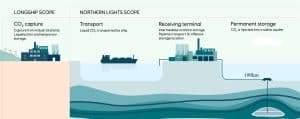
Initiated as part of Norway’s Longship project, Northern Lights represents the world’s first cross-border, open-source CO₂ transport and storage service. Its primary objective is to provide industries across Europe with a reliable solution for capturing and securely storing CO₂ emissions beneath the North Sea seabed. 

Equinor Northern Lights project
Source: Equinor

Phase one of the project became operational in September 2024, offering an annual storage capacity of up to 1.5 million tonnes of CO₂.

The project is key to Norway’s climate strategy. It helps industries cut emissions that are hard to reduce otherwise. Northern Lights also offers a cost-effective way for heavy industries to transport and store CO₂. This helps them meet stricter environmental rules.

Scaling Up: From 1.5M to 5M Tonnes of CO₂

In March 2025, the consortium announced a substantial investment of 7.5 billion Norwegian kroner (approximately $714 million) to fund the second phase of the project. This expansion aims to increase the storage capacity from 1.5 million to over 5 million tonnes of CO₂ per year by the latter half of 2028.

To facilitate this growth, the development will include additional onshore storage tanks, a new jetty, and more injection wells, leveraging existing infrastructure to expand operations efficiently. 

The enhanced capacity will help accommodate a growing demand for carbon storage services from European industries seeking compliance with stricter emissions regulations and ambitious net-zero targets.

The first phase of Northern Lights is already finished. The project will begin operating in mid-2025. The first CO₂ shipment will come from a cement factory in Norway. This is part of Norway’s Longship CCS project.

The project is expected to be ready by late 2028.

A Step Toward a CCS Market in Europe

Leaders of the companies involved see this as a major step for CCS in Europe. Tim Heijn, Managing Director of Northern Lights, said the project will provide a real solution for cutting emissions. He believes it will help create a strong CCS market.

Anders Opedal, CEO of Equinor, said this project shows how governments and companies can work together. He added that CCS is key to reducing risks and attracting more customers.

Huibert Vigeveno from Shell said that CCS plays an important role in reaching net-zero emissions. He also noted that Northern Lights is part of Shell’s global CCS efforts. Nicolas Terraz from TotalEnergies agreed, saying the expansion will help industries in Europe cut emissions.

Anders Egelrud, CEO of Stockholm Exergi noted:

“I am very pleased that Northern Lights has decided to move forward with its project. This is a crucial step in our collaboration. Permanent carbon storage will play a key role in achieving the climate targets. Together, we are laying the foundation for what could become an entirely new industry – one with the potential to make the Nordics and Europe global leaders in this field.” 

The expansion of the Northern Lights could substantially reduce Europe’s industrial CO₂ emissions. The project will boost storage capacity to over 5 million tonnes each year, which will tackle almost 10% of Norway’s annual emissions. It offers a scalable solution for industries looking to reduce their carbon footprint.

Stockholm Exergi Joins Northern Lights

As part of this expansion, Northern Lights has signed a deal with Stockholm Exergi. The company runs a biomass power plant in Stockholm. Their plan is to capture and store biogenic CO₂, which comes from burning organic materials. This process, known as Bio-Energy Carbon Capture and Storage (BECCS), can create negative emissions. This means it removes more CO₂ from the air than it releases.

Anders Egelrud, CEO of Stockholm Exergi, said he is happy to see Northern Lights move forward. He believes permanent CO₂ storage will help meet climate goals. He also said this project could help Europe become a leader in CCS.

Per the International Association of Oil and Gas Producers (IOGP Europe), the carbon storage injection capacity in the region could hit 200 million tonnes by 2038.

carbon storage capacity in Europe
Source: IOGP Europe

Aker Solutions Wins CCS Contract

Aker Solutions, a Norwegian engineering company, has won a contract for the expansion. The company will handle engineering, procurement, and construction (EPC) for the onshore facilities. While the exact contract value is not disclosed, it is estimated to be between 1.5 billion and 2.5 billion NOK ($142–237 million).

Aker Solutions has worked on other CCS projects before. Henrik Inadomi, an executive at the company, said this is their fourth CCS project. He also noted that their past experience has helped lower costs. Work on this expansion will begin in the second half of 2025.

Why CCS Matters for Net-Zero Goals

Carbon capture and storage is important for reaching net-zero emissions. Many industries, like cement and steel production, produce a lot of CO₂. Some emissions are hard to eliminate using renewable energy alone. CCS provides a way to capture and store CO₂ instead of releasing it into the air.

The International Energy Agency (IEA) says CCS needs to capture about 1.6 billion tonnes of CO₂ per year by 2030 to meet global climate goals. Right now, the world only captures about 40 million tonnes per year. This shows there is still a long way to go.

CCS project planned and current IEA
Source: IEA

CCS is especially useful for “hard-to-abate” sectors. These are industries where cutting emissions is very difficult. Northern Lights and other CCS projects are helping these industries reduce their carbon footprint.

Northern Lights is one of the first large-scale CCS projects in the world. Many experts see it as a model for future projects. If successful, it could inspire other CCS developments in Europe and beyond.

As governments and companies focus on cutting emissions, CCS will likely play a bigger role. Northern Lights’ expansion is an important step in that direction. It shows that with the right investments and partnerships, CCS can become a key tool in fighting climate change.

The post Shell, Equinor, and TotalEnergies Expand Northern Lights CCS with $714 Million Investment appeared first on Carbon Credits.

Microsoft and Carbon Direct Set New Standards for Marine Carbon Dioxide Removal

Microsoft and Carbon Direct Set New Standards for Marine Carbon Dioxide Removal

Carbon Direct and Microsoft have announced a collaboration to develop a new standard for marine carbon dioxide removal (mCDR). This standard aims to ensure that ocean-based carbon removal methods are high-quality, scientifically sound, and effective in reducing carbon dioxide from the atmosphere.

With the urgency of climate change growing, setting these standards is key. They are essential for the credibility and success of carbon removal efforts.

Carbon Direct helps companies like Microsoft, JPMorgan Chase, and JetBlue reduce their carbon footprint. The company uses science to help them set climate goals, track emissions, and reduce them. They’re also helping those businesses add carbon removal solutions to their plans, making sure their actions have a real, positive impact on the environment.

The Urgency of Marine Carbon Removal: A Vital Tool for Climate Action

The Intergovernmental Panel on Climate Change (IPCC) emphasizes that limiting global warming to 1.5°C calls for drastic reductions in greenhouse gas emissions. The agency also highlights the need to remove large amounts of carbon dioxide (CO₂) from the air. 

The ocean, covering over 70% of the Earth’s surface, plays a crucial role in this process. It currently takes in about 30% of human-made CO₂ emissions. This shows its potential as a major carbon sink. ​

Marine carbon dioxide removal uses different techniques to help the ocean capture and store CO₂ better. Two prominent methods include:​

Ocean Alkalinity Enhancement (OAE): 

This method adds alkaline substances like crushed limestone or olivine to seawater. This increases the water’s alkalinity. Higher alkalinity helps change CO₂ into stable bicarbonate and carbonate. This process traps CO₂ for a long time. 

OAE carbon removal
Source: Carbon Direct

Direct Ocean Removal (DOR): 

This method shifts seawater’s carbonate equilibrium to extract CO₂ as either gaseous CO₂ or mineral carbonates. DOR allows monitoring CO₂ accurately and removes the need for extra materials. However, it is energy-intensive and expensive because of the chemical processes used.

DOR carbon removal
Source: Carbon Direct

mCDR’s Role in Meeting Climate Goals: The Road to 9 Gigatonnes

The State of Carbon Dioxide Removal report (2nd Edition, 2024) estimates that by 2050, the world has to remove 7–9 gigatonnes (Gt) of CO₂ each year. This is essential to meet the climate goals set by the Paris Agreement. 

global carbon budget
Source: Climate.gov Figure 1. The global carbon budget for 2022 showing the approximate size of CO2 emissions sources and natural sinks compared to the projected size of the CDR sink for 2050 and 2100 needed to meet the targets of the Paris Agreement (values from Friedlingstein et al., 2022 and Minx et al., 2018).

Presently, about 2 GtCO₂ are removed each year. This mainly happens through methods like afforestation and reforestation. To bridge this gap, innovative approaches like mCDR are gaining attention.

However, scientists warn that relying on carbon removal should not detract from the imperative to reduce emissions. mCDR can help with mitigation efforts, but it can’t replace the need for low-carbon energy systems and better energy efficiency. ​

Moreover, the natural absorption causes ocean acidification. This harms marine ecosystems. Also, concerns exist about their long-term effectiveness, environmental risks, and measurement challenges.

Improving the ocean’s ability to store CO₂ using mCDR methods could help reduce these impacts and aid in stabilizing the climate. The new standard seeks to address these issues by setting clear criteria for evaluating mCDR projects.

Dr. Matthew Potts, Chief Science Officer at Carbon Direct, remarked: 

“mCDR is at a pivotal moment. Achieving high-quality outcomes requires rigorous monitoring, transparency, and scientific integrity to ensure safe and effective deployment…Given the vast spatial scale, the data-intensive nature of ocean-based carbon removal, and the deep connection between these projects and marine ecosystems, clear standards are essential for responsible development.”

As the CarbonCredits team reached out to Carbon Direct for more insights, Antaeres Antoniuk-Pablant, PhD, Senior Decarbonization Scientist, provided meaningful responses to the following questions.

Q. What are the biggest risks associated with large-scale mCDR deployment, and how do these new criteria address those challenges?

A: Human activities already impact ocean chemistry in uncontrolled ways. mCDR offers a controlled, science-based approach that may help ecosystems. The new criteria use models and in-ocean testing to track phytoplankton and marine life health. They also assess community impacts and require proactive engagement with local and Indigenous groups to ensure environmental and social responsibility.

Q. What steps should project developers take to ensure their solutions align with the latest scientific understanding and meet the high-quality standards set by Carbon Direct and Microsoft?

A. mCDR developers must follow strict environmental and carbon monitoring (eMRV/MRV), update methods with new research, and conduct baseline ecosystem assessments. Transparent data sharing and compliance with international laws are essential. Developers should also educate and consult stakeholders, ensuring their projects minimize risks and align with high-quality standards set by Carbon Direct and Microsoft.

A High Bar for Quality: The mCDR Standard Framework

To ensure that mCDR projects are effective and responsible, Carbon Direct and Microsoft have outlined specific criteria focusing on key principles, including:​

  • Environmental Integrity. Projects must demonstrably remove CO₂ without causing harm to marine ecosystems. This includes assessing potential impacts on biodiversity, water chemistry, and ecological balance.​
  • Measurement, Reporting, and Verification (MRV). Robust MRV protocols are essential to accurately quantify the amount of CO₂ removed and ensure transparency. This involves establishing baselines, continuous monitoring, and third-party verification to build trust and credibility.​
  • Durability. The sequestered carbon should remain stored for extended periods, ideally centuries or longer. Assessing the permanence of storage solutions is critical to prevent the re-release of CO₂ into the atmosphere.​
  • Social Impact. Engaging local communities and stakeholders is vital. Projects should consider social, economic, and cultural factors, ensuring that they do not adversely affect livelihoods and that benefits are equitably distributed.​
  • Transparency and Verification. Clear documentation and third-party reviews are necessary to maintain accountability.

The addendum to the 2024 edition of the mCDR criteria emphasizes improving the scientific basis for evaluating these projects. It highlights the importance of:

  • Baseline Measurements: Establishing pre-project conditions to accurately assess changes in carbon levels.
  • Leakage Prevention: Ensuring that carbon removal in one area does not lead to increased emissions elsewhere.
  • Ecosystem Impacts: Evaluating how mCDR affects biodiversity, ocean chemistry, and marine life.
  • Scalability and Feasibility: Assessing whether projects can be effectively expanded without unintended consequences.

These criteria aim to provide a framework for developing mCDR projects that are scientifically valid, ethical, and environmentally friendly.

Brian Marrs, Senior Director, Energy Markets at Microsoft, noted: 

“With rapid technological progress and increased investment, marine carbon dioxide removal has the potential to deliver durable, large-scale CO₂ removal—potentially billions of tonnes per year in the coming decades…By establishing rigorous new mCDR criteria, we aim to help project developers build high-integrity solutions that maximize both environmental and social benefits.”

Microsoft’s Commitment to Carbon Removal: A Leading Example

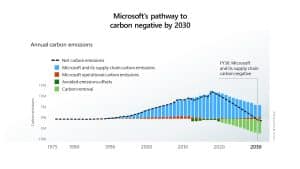
Microsoft has been actively investing in carbon removal solutions as part of its commitment to becoming carbon-negative by 2030. The company has signed deals for direct air capture and nature-based carbon removal

Microsoft 2030 carbon negative goal

In January 2025, Microsoft signed a 25-year deal with Chestnut Carbon. They will buy more than 7 million tons of carbon removal credits. These credits come from forest projects in Arkansas, Texas, and Louisiana.

In addition to forest restoration, Microsoft has explored ocean-based carbon removal methods. In March 2023, the company partnered with Running Tide to remove up to 12,000 tons of carbon through an ocean-based carbon removal system. 

These initiatives show Microsoft’s commitment to different carbon removal methods. As such, it helps build a strong carbon removal market. Partnering with Carbon Direct on an mCDR standard aligns with its goal of ensuring that carbon credits and removal projects meet rigorous standards.

The Path Forward for Marine Carbon Solutions

A standard framework for mCDR will build trust in these projects. This will also draw more investment. With better technology and research, marine carbon removal may become key in global climate plans. However, careful implementation is needed to avoid unintended ecological damage.

With this collaboration, Microsoft and Carbon Direct aim to create a science-backed, transparent approach that ensures mCDR contributes meaningfully to climate mitigation.

The post Microsoft and Carbon Direct Set New Standards for Marine Carbon Dioxide Removal appeared first on Carbon Credits.

Singapore’s $1 Billion Carbon Credit Push: A New Path to Net Zero?

Singapore’s $1 Billion Carbon Credit Push: A New Path to Net Zero?

Singapore is actively developing its carbon market to become a global hub for carbon trading. A key step in this direction was the country’s first-ever carbon credit auction, which attracted over S$1.3 billion (around $1 billion) in bids.

A carbon credit is a certificate representing one tonne of carbon dioxide (CO2) removed from or prevented from entering the atmosphere. Companies and countries can buy these credits to offset their greenhouse gas emissions.

To support this, Singapore introduced a carbon tax in 2019. This tax encourages companies to lower their emissions by making pollution more expensive. The country also aims to be a global hub for carbon trading. It’s attracting investments and partnerships from various regions.

From Carbon Tax to Carbon Trade: Singapore’s Net-Zero Roadmap

Singapore has committed to cutting its greenhouse gas emissions to between 45 and 50 million tonnes by 2035, down from 60 million tonnes in 2030. This goal keeps the country on track for net-zero emissions by 2050. 

Singapore net zero roadmap
Source: Ministry of Sustainability and the Environment, Singapore

The government previously estimated that to meet its national climate goal of 60 million tonnes by 2030, it would need to offset about 2.51 million tonnes of carbon dioxide equivalent yearly from 2021 to 2030.

Singapore submitted its 2035 climate target to the UN on February 10, meeting the official deadline. In 2022, the country emitted 58.59 million tonnes of CO2 equivalent, about 0.1% of global emissions. The government acknowledges challenges in cutting emissions due to limited alternative energy options and technological dependence.

Singapore’s $1 Billion Carbon Credit Auction

In September 2024, Singapore made headlines with its first-ever carbon credit tender. The government aimed to buy at least 500,000 nature-based carbon credits, which would offset the same amount of CO2 emissions.

Nature-based credits come from projects that restore forests, protect ecosystems, or promote sustainable agriculture.

The tender attracted significant interest, with 17 submissions totaling over S$1.3 billion, about US$1 billion. The highest bid came from Trafigura, a global commodities trading company, at nearly S$300 million.

Other major bidders included Mercuria Asia Resources, DNZ ClimateTech (S$200,000), Temasek-backed GenZero (S$27.5 million), Shell (S$34 million), and PetroChina (S$21.8 million).

These bids show the growing demand for carbon credits as a tool to fight climate change. Globally, demand for these credits could grow 100x by 2050, per McKinsey & Company estimates. Companies and governments view carbon trading as a method to offset emissions. It also helps fund environmental projects.

voluntary carbon credit demand growth
Source: McKinsey & Company

Carbon Credits: The Green Currency of the Future?

Carbon credits help reduce emissions and support sustainability projects. Some key types of carbon credit projects include:

  • Reforestation: Planting trees to absorb CO2 from the atmosphere.
  • Forest Conservation: Protecting forests to prevent stored CO2 from being released.
  • Sustainable Agriculture: Using farming methods that reduce emissions and improve soil health.

These projects aim to help the environment and may contribute to job creation, improved air quality, and biodiversity. 

$5.6 Billion and Counting: Building a Carbon Trading Hub

Singapore is working to become a leading center for carbon trading. By developing strong partnerships and ensuring high standards, the country is attracting investments and driving innovation in sustainability.

The Economic Development Board estimates that this initiative could generate S$5.6 billion in economic value. This shows that carbon trading can serve as an environmental strategy and as a major economic opportunity.

To strengthen its carbon market, Singapore is partnering with other countries. Under Article 6 of the Paris Agreement, nations can trade carbon credits as long as they follow strict rules. These include:

  • No Double Counting: Emission reductions must be counted by only one country.
  • Environmental Integrity: Credits must represent real and measurable emission reductions.
  • Sustainable Development: Projects must benefit local communities and ecosystems.

Singapore has signed agreements with Bhutan, Ghana, Papua New Guinea, and Peru to buy carbon credits. These deals help ensure that carbon trading meets high standards and delivers real environmental benefits.

singapore carbon trading hub
Source: The Straits Times

These agreements aim to help carbon trading and create trustworthy carbon markets. These partnerships are key. They help ensure carbon credits are used well to reach global climate goals.

Singapore’s First Carbon Trade Deal with Peru

On April 1, 2025, Singapore signed a carbon trading agreement with Peru. This was its first such deal with a Latin American country. Peru’s vast Amazon forests play a key role in stabilizing the global climate, making it a valuable partner in carbon trading.

Under the agreement, Singapore can buy carbon credits from projects focused on rainforest restoration and conservation. These projects will cut emissions. They will also help local communities by creating jobs and improving access to clean water.

As part of the deal, Singapore will contribute 5% of the proceeds from purchased credits to help Peru fund climate adaptation measures. This reflects the Asian country’s commitment to sustainable development beyond its own borders.

What’s Next? Singapore’s Carbon Trading Future

Singapore’s carbon credit efforts are still in the early stages but show great potential. The government plans to launch another tender later this year to purchase more nature-based credits. It is also negotiating with over 15 other countries to establish new agreements.

These initiatives highlight Singapore’s commitment to achieving net-zero emissions by 2050. By leveraging international partnerships and carbon trading, the country is paving the way for a more sustainable future.

Carbon credits are an important part of global climate action. Singapore shows how these tools cut emissions and boost global sustainable development.

Through agreements with countries like Peru and its first carbon credit tender, Singapore is setting an example for responsible carbon trading. Challenges remain, like securing supply and protecting the environment, but the country’s proactive approach brings hope for real climate action.

As the world works toward net-zero emissions, Singapore’s experience provides valuable lessons on balancing environmental responsibility with economic growth.

The post Singapore’s $1 Billion Carbon Credit Push: A New Path to Net Zero? appeared first on Carbon Credits.

Frontier Backs Norway’s First Carbon Capture Retrofit! Is This the Future of Waste-to-Energy?

hafslund Hafslund Celsio

Frontier has signed offtake agreements with Norway’s Hafslund Celsio for the first-ever carbon capture retrofit at their waste-to-energy facility. Such plants recover energy from waste treatment, usually in the form of heat or electricity.

Hafslund Celsio is the country’s largest district heating provider and operator of the biggest waste incineration plant near Oslo.

The press release revealed that Frontier buyers will invest $31.6 million to remove 100,000 tons of CO₂ between 2029 and 2030.

Terje Aasland, Minister of Energy of Norway, said,

“I am pleased to see that the voluntary carbon removal market is adopting carbon removals in hard-to-abate sectors such as waste incineration. This kind of public-private cooperation contributes to creating a functioning market that will accelerate development of further projects in this segment both nationally and internationally.”

What’s Driving Frontier’s Carbon Capture Project?

The carbon capture project is backed by both the government and private companies. Norway’s Longship program is helping fund CO₂ capture and storage through Northern Lights. The City of Oslo is also investing money to keep the project going, and Frontier’s off-take agreements make sure there’s a steady income to make it happen.

Frontier buyers in this round include Stripe, Google, Shopify, McKinsey Sustainability, Autodesk, H&M Group, JPMorgan Chase, Workday, and Salesforce. Additional participants, through Frontier’s partnership with Watershed, include Aledade, Match Group, Samsara, SKIMS, Skyscanner, Wise, and Zendesk.

Hannah Bebbington, Head of Deployment, Frontier, said,

“Waste-to-energy retrofitted with carbon capture is a no-brainer solution for managing pre-sorted, residual waste: it generates carbon-free energy and removes CO₂ from the atmosphere. Hafslund Celsio is set to become the first to do it, charting a path for the 500 waste-to-energy facilities across Europe to remove tens of millions of tons of CO₂ from the atmosphere.”

Hafslund Celsio’s One-of-a-Kind Carbon Capture Facility

The company’s Oslo facility processes 350,000 metric tons of sorted residual waste annually. The plant burns waste to generate electricity and heat, releasing two types of CO₂:
  • Biogenic CO₂ from organic materials like paper and cardboard.
  • Fossil CO₂ from inorganic waste such as plastics.

The retrofit will enable the plant to capture both types of emissions. The CO₂ will then be shipped to Northern Lights for permanent geological storage.

Hafslund Celsio estimates that the facility could capture 175,000 tons of biogenic CO₂ per year, plus 175,000 tons of fossil CO₂ annually. Additionally, the plant is equipped with advanced filters to keep air pollution in the city to a minimum.

While Frontier’s offtake focuses on biogenic CO₂, the fossil emissions are not part of its offtake program. Nonetheless, the project will significantly reduce total emissions from the plant.

Hafslund Celsio waste carbon capture
Source: Frontier press release

Jannicke Gerner Bjerkås, Director CCS and Carbon Markets, Hafslund Celsio commented,

“We’re proud to be the first to take a step toward retrofitting waste-to-energy with carbon removal. Frontier buyers are not only enabling this project to get off the ground, but also validating a model that could be replicated throughout Europe, with the potential to remove tens of millions of tons of CO₂ from the atmosphere.”

Why Upgrade Waste-to-Energy Plants?

In Norway, strict waste rules are in place to transfer leftover and non-recyclable materials to waste-to-energy plants. Burning waste for energy is one of the best ways to handle such types of trash.

Without this process, waste like spoiled paper and cardboard would release methane, a harmful greenhouse gas. Instead, burning it helps generate electricity and heat while keeping emissions lower.

Furthermore, adding carbon capture is a smart and affordable way to scale up CO₂ removal from these plants. In Europe alone, around 500 waste-to-energy facilities could be upgraded, cutting emissions by hundreds of millions of tons.

Instead of constructing new carbon removal systems from scratch, retrofits improve what already exists, making the transition to cleaner energy faster and more efficient.

Capturing CO₂ Can Make a Big Impact

  • Adding carbon capture to waste-to-energy plants could remove 400 million tons of CO₂ per year by 2050.

Right now, these retrofits could capture 100 million tons of CO₂ annually, with that number growing significantly in the future.

Besides extracting carbon dioxide from the atmosphere, these upgrades also help prevent extra emissions from being released in the first place.

Cutting Methane Emissions

A report by the European Environment Agency (EEA) highlights waste-to-energy’s role in reducing methane emissions. Methane is a potent greenhouse gas, with a global warming potential 84 times higher than CO₂ over 20 years. It says:

  • Landfills account for 80% of methane emissions in the waste sector.

Thus, diverting waste from landfills to energy recovery significantly lowers methane emissions.

For example, Germany’s landfill ban on untreated organic waste in 2005, along with expanded waste-to-energy facilities, cut methane emissions from 35.5 million tons in 1990 to 7.5 million tons in 2018. This highlights how smart policies can slash emissions.

The Future of the Waste-to-Energy Carbon Capture Market

As per Precedence Research’s market analysis,

  • The global waste-to-energy market is estimated at USD 51.23 billion in 2025. It is expected to reach USD 92.95 billion by 2034, growing at a CAGR of 6.81% from 2025 to 2034.

waste to energy carbon capture

This growth comes from more awareness of waste-to-energy benefits and the palpable impact of climate change. Countries are realizing the importance of turning non-recyclable waste into energy. Furthermore, recovering landfill gas also reduces significant emissions from the environment.

Europe Leads in Waste-to-Energy
Europe dominates the waste-to-energy sector, holding 42% of the global market share till last year.
  • The market was worth USD 20.19 billion in 2024 and is expected to reach USD 39.50 billion by 2034 at a CAGR of 6.94%.

waste to energy Europe carbon capture

Apart from Frontier, companies like Veolia, EQT AB, Suez, and Ramboll Group A/S are playing a key role in innovation. Strict government regulations on carbon emissions and waste disposal also ensure viable solutions. Plus, carbon taxes and landfill restrictions make waste-to-energy a smarter and more sustainable choice in Europe.

Frontier’s investment in waste-to-energy projects shows how managing waste sustainably can also combat carbon emissions. More importantly, upgrading the existing facilities with carbon capture technology makes it more efficient. By backing these innovations, Frontier is helping Norway to stay clean and green.

The post Frontier Backs Norway’s First Carbon Capture Retrofit! Is This the Future of Waste-to-Energy? appeared first on Carbon Credits.
Lithium Prices Drop—What It Means for EV Batteries & Global Supply Chains

lithium

Lithium prices have been unpredictable due to global tensions and mining difficulties. As reported by S&P Global, in 2023, lithium carbonate prices shot up past $80,000 per metric ton but later dropped as supply increased and demand slowed. By early 2024, prices stabilized out but remained weak.

But as of March 21, Platts assessed lithium carbonate (CIF North Asia) at $9,200 to $9,550 per ton. This forced several deals on hold, and some mining giants auctioned lithium for better price discovery.

The report highlighted two significant auctions in the first quarter of 2025.

  • On March 5, Albemarle Corp. sold spodumene concentrate (5.61% Li₂O) for 6,701 yuan per ton at its Zhenjiang plant, slightly above the SC6 price after factoring in quality, shipping, and taxes.
  • On March 11, Jiangxi Jiuling Lithium Co. Ltd. auctioned 120 metric tons of battery-grade lithium carbonate for 75,400 yuan per ton—just 100 yuan more than the spot price in China.

These auctions suggest a small price rebound, but overall, the market remains cautious.

Spodumene and Lithium Carbonate Prices Drop

Spodumene prices, which had been relatively stable, saw a 4.7% drop from March 12 to March 21, falling to $810/t. In contrast, Platts-assessed lithium carbonate DDP China decreased by only 1.1% over the same period.

Refineries have been hit hardest, as lithium chemical prices have fallen more than spodumene prices, leading to negative refining margins since mid-2024. This ongoing squeeze on profitability poses risks for companies dependent on refining operations rather than raw material extraction.

Falling prices have forced lithium producers to scale back spending and delay projects. This is how the industry is adjusting to falling lithium prices.

lithium producers

SQM’s Profit Drops 40.9% as Lithium Prices Crash

Chile’s SQM, the world’s second-largest lithium producer, reported a 40.9% drop in fourth-quarter profit. Despite selling more lithium in 2024, falling prices hurt earnings.

Revenue hit $1.07 billion, slightly above the $1 billion analysts expected. But with lithium prices down over 80% in two years, profits took a hit.

Sales grew about 20% from last year, but lower prices wiped out the gains. “Our average price dropped over 64%,” SQM said, adding that prices in early 2025 will likely be even lower than in late 2024.

To adjust, SQM is cutting 2025 spending to $1.1 billion from $1.6 billion in 2024. Most of this will go to its Chile lithium operations ($550 million), with $350 million for iodine and $200 million for international lithium projects.

Sibanye Stillwater’s Exit Adds to Lithium Supply Worries

Similarly, Sibanye Stillwater Ltd. exited its lithium joint venture at Rhyolite Ridge in the U.S. on February 26 this year. As per the company, the project didn’t meet the expected returns at safe price estimates. However, the project had a potential capacity of producing 22,000 tons of lithium carbonate.

Experts are speculating that Sibanye Stillwater’s pullout could worsen the global lithium supply deficit. Furthermore, the rising demand for EVs may drive price swings, impacting battery costs and supply.

  • S&P Global analysed that if lithium prices stay at March’s low of $9,202 per ton (CIF Asia), then about 26% of the expected 2025 production could run at a loss due to high cash costs.

EV Boom Fuels Lithium Demand, But Policy Shifts Could Shake Market

The push for electric vehicles (EVs) is driving long-term lithium demand as automakers ramp up production. Stricter emissions policies worldwide are accelerating this shift, making a stable lithium supply more critical than ever.

PEV sales and lithium demand

Strong EV Sales in February

Global sales of passenger plug-in electric vehicles (PEVs) surged in February. In China, trade-in subsidies boosted demand, while in Europe, stricter CO2 regulations played a key role.

  • Europe’s top four markets saw a 15.8% increase in PEV sales compared to last year. New CO2 targets introduced in January 2024 pushed automakers to step up.
  • To ease pressure, the European Commission proposed a temporary measure allowing companies to meet targets over three years instead of facing heavy fines in 2025. Without this, automakers could have faced losses of €16 billion.

U.S. EV Market Faces Uncertainty

In the U.S., PEV sales grew by 6.5% year over year in February, with a 4.5% month-over-month increase. Many rushed to buy EVs before potential tax credit changes.

However, a new bill—”Eliminating Lavish Incentives to Electric Vehicles Act“—could shake up the market. Introduced by Republican senators in February 2025, the bill aims to:

  • End the $7,500 tax credit for new EVs
  • Eliminate incentives for used EV purchases
  • Cut funding for EV charging stations
  • Close tax loopholes benefiting certain buyers

If passed, the bill could slow EV adoption by making vehicles more expensive and charging less accessible. EV demand remains strong, but shifting policies could reshape the market in the coming years.

A classic example of Tesla. Despite overall EV market growth, Tesla has struggled since last year. February sales dropped significantly in key markets, falling 76% year over year in Germany and 49% in China.

A Ray of Hope: Boosting Lithium Output to Fuel Global Demand

While some lithium producers are holding tight on supplies, some are expanding mining and refining capacities to keep up with the rising demand. Australia, Chile, and Argentina continue to lead lithium extraction, while the U.S. and Europe are working to strengthen domestic production to reduce supply chain vulnerabilities.

On March 20, President Trump signed an executive order to boost the domestic production of critical minerals. The order provides financing, loans, and investment support for lithium mining and processing projects in the U.S. to reduce reliance on imports from key lithium-producing nations like China.

S&P Global also noted that new lithium refining projects are being developed for battery production. However, delays in permits, environmental issues, and geopolitical risks might once again slow expansion.

The chart below shows that each quarter of 2024 displays consistent growth, with production exceeding 100,000 metric tons by Q3 and Q4. This reflects a significant increase in lithium output. This was driven by the growing demand for EV batteries and renewable energy storage systems.

lithium output

Lithium Price Forecast

Lithium price forecasts are also following a downward trend. June and September prices are expected at $8,604 and $9,078 per ton.

LITHIUM price
Source: S&P Global Commodity Insights
This decline can push lithium producers to make more supply cuts. They need to diligently tackle cost pressures, investments, policy changes, and global risks to stay profitable. However, even though the lithium market remains volatile, the crucial mineral’s role is vital in the energy transition.

The post Lithium Prices Drop—What It Means for EV Batteries & Global Supply Chains appeared first on Carbon Credits.

Why Stellantis Still Needs Tesla’s Carbon Credits in 2025

Why Stellantis Still Needs Tesla’s Carbon Credits in 2025

Stellantis, one of Europe’s largest car manufacturers, has announced plans to continue purchasing carbon dioxide (CO₂) emission credits from Tesla in 2025. This decision comes after new EU rules: Starting in 2025, automakers can average their emissions over three years, until 2027. 

This policy change gives automakers more flexibility to meet emission targets. However, Stellantis is still committed to using Tesla’s carbon credits to meet environmental standards.

The decision shows the challenges of moving to electric vehicles (EVs) and highlights the need to balance rules with business plans.

Understanding Carbon Emission Credits

CO₂ emission credits are an essential part of emissions reduction policies. Governments limit how much CO₂ companies can release. This is especially important in transportation, where emissions are a big worry.

Although there have been efforts to cut transport emissions in the EU by increasing the use of EVs, overall emissions have not changed much since 2005. In 2023, emissions were estimated to be 0.8% lower than in 2022.

carbon emissions from transport EU
Source: European Environment Agency

A company that emits less than its limit earns carbon credits. These credits can be sold to companies that exceed their allowances.

For automakers, this system encourages investment in cleaner technologies. Slow-moving companies must either pay fines for high emissions or buy credits from automakers with extra. 

Tesla, which produces only electric vehicles and has low emissions, generates excess credits that it sells to other automakers, including Stellantis.

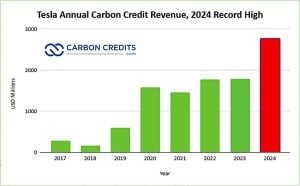
Since 2019, Tesla has made about $10 billion by selling carbon credits, which has become a major source of income. This financial benefit lets Tesla invest in new technology, research, and production and helps strengthen its position in the EV market.

Tesla annual carbon credit revenue in 2024

Stellantis’ Strategy: A Temporary Fix or Long-Term Dependence?

Stellantis depends on emission credits. This shows the challenges it has in meeting EU emission standards. In 2025, Stellantis’ EV sales in Europe accounted for just 14% of its total sales—well below the EU’s target of 21% for that year.

The company is investing in EV production. However, it hasn’t met the EU regulations yet. To comply, it will need to buy credits.

Jean-Philippe Imparato, head of European operations at Stellantis, said, “I’ll use everything.” This shows that the company is fully committed to meeting emission rules. 

Stellantis is working hard to boost its EV production. However, it still needs Tesla’s credits to keep going. Imparato further added: 

“The 2027 extension ‘gives us some breathing space, but does not provide a solution.”

The automaker has announced plans to ramp up hybrid and electric vehicle production. A new hybrid version of the Fiat 500 will begin production at Stellantis’ Mirafiori plant in Turin, Italy, in November 2025.

The company aims to produce 130,000 units per year, including both hybrid and fully electric versions. This move is part of a two-part strategy. It aims to ensure quick regulatory compliance and invest in EV technology for the future.

Stellantis’ Long-Term Plans

While Stellantis is purchasing carbon credits in 2025, it is also taking steps to strengthen its EV strategy. The company announced investments in battery production and EV infrastructure. These will help reduce its reliance on emission credits in the future.

One of Stellantis’ key initiatives is its plan to expand its electric vehicle lineup. The company is focusing on developing new battery technologies to improve efficiency and lower costs.

Stellantis is pushing forward with its electrification plans, aiming for all its sales in Europe to be battery electric vehicles (BEVs) by 2030. In the U.S., it targets 50% BEV sales for passenger cars and light-duty trucks by the same year.

The company, which owns 14 well-known brands, plans to launch 75 BEV models by 2030, with a goal of selling 5 million units annually. Starting in 2025, all new luxury and premium models will be fully electric. By 2026, this strategy will expand to all vehicle segments in Europe.

Stellantis Roll Out of Battery Electric Vehicles (BEVs)

Stellantis EV rollout production plan
Source: Stellantis

The European carmaker is also looking for partnerships with battery makers and energy firms. This will help improve its EV supply chain. All these are part of the automaker’s goal to reach net-zero emissions by 2038. 

In the next few years, Stellantis plans to boost its EV sales. This will help cut down on buying carbon credits from other companies. The company is focusing on hybrid and fully electric models. This way, it can gradually transition to meet market demand and follow regulatory rules.

European Union’s Emission Regulations

The European Union has strict emissions regulations. These rules aim to encourage automakers to reduce carbon emissions. Automakers must meet specific fleet-wide CO₂ emission targets, which become stricter over time. 

Initially, car manufacturers were required to meet individual targets by 2025. In response to industry concerns, the EU extended the compliance period. Now, automakers can meet targets by averaging their emissions from 2025 to 2027.

This change gives automakers more flexibility. It also allows them time to adjust their production plans. However, it does not remove the requirement to meet strict emission targets in the long term. 

Stellantis will keep buying Tesla’s carbon credits, even with the compliance extension. This shows the company views these credits as a needed short-term fix while it aims for a more sustainable future.

Industry Perspectives on Compliance and Credit Purchases

The EU’s extension of the compliance period has sparked debate within the auto industry. Some automakers view it as a necessary adjustment that allows them time to scale up EV production without facing immediate financial penalties. Others argue that it could slow the transition to EVs by reducing the pressure on automakers to meet strict deadlines.

Environmental organizations have also raised concerns about the impact of the extension. They say that giving automakers more time to follow regulations might slow down the move to lower emissions. This could hurt efforts to reduce climate change effects.

However, automakers like Stellantis see the extension as a way to balance business sustainability with regulatory requirements.

The company’s decision to continue buying CO₂ credits from Tesla in 2025 highlights the challenges automakers face in meeting stringent emissions targets. The EU’s compliance extension gives temporary relief. 

The post Why Stellantis Still Needs Tesla’s Carbon Credits in 2025 appeared first on Carbon Credits.

Meta and EFM Join Forces to Deliver 676,000 Forest Carbon Credits by 2035

meta

EFM, a forest investment and management firm, has signed a long-term deal with Meta. They will provide 676,000 carbon removal credits by 2035. This agreement will transform 68,000 acres of forest on Washington’s Olympic Peninsula to “climate-smart management”, removing over one million tonnes of carbon emissions in the next ten years.

Bettina von Hagen, CEO from EFM, expressed herself by saying,

This long-term contract enables us to manage forests for their greatest value to society—producing high-quality timber, creating diverse, healthy habitats for wildlife and recreation, and collaborating with tribes to restore salmon populations—all while significantly increasing carbon storage. We’re deeply grateful to Meta for recognizing the critical role forests play in addressing climate challenges and for sharing our vision of high-quality carbon projects that enhance the long-term value of our forests. Together, we’re ensuring these landscapes will benefit communities, sawmills, tribes, investors, home builders, and everyone who depends on the health of commercial forests for generations to come.”

Meta Backs EFM’s Climate-Smart Forest Transition

EFM is an investment and management firm. It manages over 200,000 acres of FSC-certified forests. The firm uses climate-smart strategies in the Pacific Northwest and beyond. With 20 years of experience, EFM is now expanding into new markets. These markets allow climate investments to benefit investors, communities, and the public.

This contract guarantees steady, long-term carbon revenue. It reduces financial risks for climate-smart forest management. EFM’s funds and other investors will fund this new entity.

One major investor is the Natural Capital Fund, managed by Climate Asset Management. It has raised more than $1 billion from companies and institutions. This funding supports nature and carbon projects around the globe.

Significantly, with Meta’s early support, the project got an innovative approach, which, in turn, made large-scale climate-smart forest investments easier.

The deal also shows how carbon finance in forestry is evolving. Normally, landowners sell carbon credits only after buying the property. But this new approach allows carbon revenue fund purchases upfront, making investing easier.

A New Step for Its Climate Commitment

Tracy Johns, Carbon Removal Lead at Meta, said,

“As part of Meta’s goal to achieve net zero emissions across our value chain in 2030, we focus our strategy on understanding and reducing our emissions, and removing any remaining emissions through carbon removal credits. We support high-impact projects, and EFM’s extensive track record in sustainable management of forests made them an ideal partner and aligned with our goals. Our commitment to this project supported EFM’s efforts to take an approach to forest management that not only drives strong climate and forestry outcomes, but also provides real value and environmental services to local communities.” 

Each carbon credit stands for a reduction of one metric ton of carbon dioxide emissions. This gives companies a way to offset their carbon footprint. For Meta, this step aligns with its goal to reach net-zero emissions across its entire value chain by 2030.

As per its latest sustainability report, in 2023, Meta’s net emissions equaled 7.4 million metric tons of CO2. Key commitments include:

  • Cutting Scope 1 and 2 emissions by 42% by 2031. This is based on a 2021 baseline. Also, make sure most suppliers adopt science-based GHG reduction targets by 2026.

  • Keeping Scope 3 emissions at or below 2021 levels by 2031.

Meta
Source: Meta

To tackle residual emissions, Meta invests in nature-based and technological carbon removal projects. These projects help fight climate change and boost biodiversity.

The company signed a carbon offset agreement with BTG Pactual’s forestry arm, Timberland Investment Group (TIG). The deal involves buying up to 3.9 million carbon credits through 2038.

Scaling Forest Management to Slash Carbon Emissions

The forests in the Pacific Northwest store more carbon per acre than any other ecosystem. Improved Forest Management (IFM) offers a strong opportunity to cut greenhouse gases in the air.

IFM extends harvest cycles and protects carbon-rich areas while still allowing timber production. The big advantage is that it can be scaled quickly, with a noticeable impact within a decade.

Revitalizing the Olympic Rainforest

The Olympic Rainforest covers 68,000 acres on Washington’s Olympic Peninsula that was previously managed for timber. It is located next to the Olympic National Park, a World Heritage Site and Biosphere Reserve.

EFM’s FSC-certified, climate-smart management approach aligns perfectly with the region as it offers opportunities for climate action, conservation, and biodiversity.

They use the 5Rs™ strategy, i.e., Rotation, Reserves, Retention, Restoration, and Relationships.

efm
Source: EFM

The benefits of scaling Climate-Smart Forestry include the following:

  • One Million Tonnes of Carbon Removal: Improved Forest Management (IFM) can capture more than 10 million tonnes of CO₂. It could also remove more than one million tonnes of carbon in the next decade.

  • Sustainable Timber Growth: EFM plans to almost double timber stocks in 15 years. This will improve forest health and boost long-term timber production.

  • Conservation on a Large Scale: This acquisition supports big conservation efforts. It creates a 150-mile corridor from Hood Canal to the Olympic Marine Sanctuary. This impacts 5 million acres.

  • Boosting Biodiversity: Conservation will support endangered species and aid in wild salmon restoration.

  • Tribal Collaboration: This project allows you to work with the Quileute and Hoh tribes. You’ll focus on wildlife, restoration, and cultural harvesting.

  • Public Access and Tourism: EFM will improve access to national parks. They will link up with trails such as the Olympic Discovery Trail and the Pacific Northwest National Scenic Trail.

Most importantly, EFM’s years of experience in forest carbon projects ensure that buyers get quality credits. It uses ACR’s dynamic baseline method. This helps prevent over-crediting carbon credits.

Martin Berg, Chief Executive Officer of Climate Asset Management, commented,

“When we set up Climate Asset Management four years ago, it was very much with a pioneering spirit, to become a world leader in natural capital investing. So, it is particularly pleasing to have worked with EFM and Meta in completing the acquisition of Olympic Rainforest, with its innovative long-term contract, on behalf of the investors in our Natural Capital Fund. We remain committed to supporting bold and scalable nature-based investments to secure a more climate-resilient, nature-positive and inclusive world.”

The post Meta and EFM Join Forces to Deliver 676,000 Forest Carbon Credits by 2035 appeared first on Carbon Credits.

Amazon Leads Corporate Clean Energy Contracts, Hitting Record High at 100GW

Amazon Leads Corporate Clean Energy Contracts, Hitting Record High at 100GW

Corporate clean energy contracts have hit an impressive 100 gigawatts (GW) globally, a major milestone for renewable energy, as reported by the Clean Energy Buyers Association (CEBA). This shows that more businesses are opting for clean energy to cut their carbon footprint and move toward sustainable energy.

As more companies invest in clean energy, the global renewable market is growing and changing the energy landscape. 

The Rise of Corporate Renewable Energy Procurement

Over the past decade, corporations have become major players in the renewable energy market. Big multinational companies, like tech giants, retail chains, and manufacturers, are signing power purchase agreements (PPAs). These agreements help them get clean electricity for their operations.

These contracts allow businesses to buy electricity from wind and solar farms. This, in turn, helps fund new projects and increases the use of renewable energy.

The Clean Energy Buyers Association (CEBA) reported that companies bought 21.7 GW of clean energy in 2024 alone. This was the highest amount in a single year. This brings the total corporate-driven clean energy capacity in the U.S. to 100 GW since 2014.

CEBA deal tracker
Source: CEBA

One gigawatt (GW) of electricity can power about 750,000 U.S. homes for a year. This shows how much corporations affect the energy grid.

One of the key drivers behind this trend is the push for sustainability. Companies face growing pressure from investors, customers, and regulators to cut greenhouse gas emissions. Businesses can buy renewable energy, helping them rely less on fossil fuels. They can also lower costs and reach their climate goals.

The Role of Solar, Wind, and Emerging Technologies

Solar and wind power have been the primary sources of clean energy adopted by corporations. The International Energy Agency (IEA) reports that in 2024, solar photovoltaic (PV) installations hit 2.2 terawatts (TW) worldwide. Wind energy capacity grew significantly, too, as shown below.

renewable capacity additions by tech 2024
Source: IEA

Corporate PPAs are key to this growth. They give developers a steady income and speed up project development.

In 2024, solar energy made up 73% of corporate clean energy contracts. This happened even with problems like permitting delays and grid interconnection issues. 

Wind energy made up 7.7%, while nuclear power surprisingly entered the market with 1.5 GW in corporate procurement.

corporate clean energy procurement CEBA 2024
Source: CEBA
  • Battery storage capacity increased by a remarkable 300%. This highlights the growing emphasis on energy storage solutions.

Google’s 115-megawatt (MW) deal with Fervo in Nevada is a big move for geothermal energy. This contract uses a new tariff system. It helps protect customers from the costs of new technologies.

Microsoft and Amazon have taken the lead in nuclear power deals. This shows how companies are diversifying their clean energy plans. Nuclear energy was not part of corporate contracts in 2023, but in 2024, companies bought 1.5 GW.

Which Companies Are Leading?

Tech companies have been at the forefront of corporate renewable energy procurement. In 2024, Amazon remained the top corporate buyer for the 5th year in a row. It invested in more than 600 renewable energy projects worldwide.

In Mississippi, for example, projects backed by Amazon now account for 24% of solar electricity on the state’s grid.

Other major corporate buyers include:

  • Google: With extensive investments in wind, solar, and geothermal projects.
  • Microsoft: A leader in nuclear and battery storage agreements.
  • Meta (formerly Facebook): A major purchaser of wind energy for its data centers.
  • General Motors and Ford: Investing in clean energy to power manufacturing operations.

Rehonally, the United States is the top market for corporate PPAs. It accounts for almost 50% of all global contracts.

However, Europe and Latin America are rapidly expanding, with companies in India and China also increasing their commitment to clean energy.

The Impact on Global Energy Markets

Corporate clean energy contracts are growing. This trend impacts the global energy sector in several ways:

  1. Accelerating the Clean Energy Transition. Corporate demand is driving investment in new wind, solar, and battery storage projects.
  2. Decarbonizing Supply Chains. Many companies are encouraging suppliers to transition to renewable energy, magnifying the impact beyond individual businesses.
  3. Job Creation and Economic Benefits. Renewable energy projects generate jobs and boost local economies, particularly in rural areas where large-scale wind and solar farms are developed.
  4. Grid Stability Challenges. Rapid clean energy adoption presents challenges for power grids, necessitating modernization and investment in energy storage.

Beyond 100 GW: Challenges and Future Outlook

Despite the rapid growth of corporate clean energy procurement, challenges remain. 

For instance, many power grids require upgrades to handle the increased load from renewable sources. Moreover, complex regulations in certain countries make it difficult for businesses to sign PPAs.

Also, the rising demand for solar panels, wind turbines, and battery storage may lead to material shortages and project delays.

The IEA reports that global energy demand grew by 2.2% in 2024, outpacing the average 1.3% growth between 2013 and 2023. Most of this demand was met by low-emission energy sources. Now, global renewable capacity is about 700 GW.

global energy demand IEA 2024

Nuclear power hit its fifth-highest level in fifty years, showing the growth of low-carbon energy options.

Looking ahead, corporate demand for clean energy is expected to continue growing. Advances in battery technology, the rise of green hydrogen, and continued government incentives will further accelerate clean energy adoption.

With increasing commitments from businesses worldwide, the transition to a low-carbon economy is gaining momentum. The next major milestone — 200 GW of corporate clean energy procurement—may not be far off.

The post Amazon Leads Corporate Clean Energy Contracts, Hitting Record High at 100GW appeared first on Carbon Credits.