How AI is Revolutionizing Battery Storage for a Greener Future

AI

Battery storage is essential for making renewable energy more reliable. It collects extra energy from solar and wind, making electricity ready when needed. However, artificial intelligence (AI) is taking battery management to the next level.

Experts say AI software is now essential for managing large battery systems. Companies are using AI for more than basic tasks. They apply it in energy trading, safety monitoring, and predictive maintenance.

Advanced AI Techniques Enhancing Battery Storage

Battery systems use smart tools like machine learning, deep learning, predictive analytics, and reinforcement learning. They are emerging as a crucial tool in managing large-scale battery systems.

By combining these technologies, AI ensures:

These upgrades provide a steady and reliable power supply, making battery energy storage more viable and cost-effective.

S&P Global says that the need for battery energy storage systems is rising. However, AI integration is still just starting out. However, lithium-ion battery storage developers are well-placed to meet this demand.

Henrique Ribeiro, principal analyst for batteries and energy storage at S&P Global Commodity Insights, says,

“What is likely to happen is, as the market gets more and more competitive and you have more capacity being deployed, it starts to become more difficult to maximize revenues. So these types of tools can be an edge.”

AI battery storage

Boosting Battery Storage Safety

Scientists, researchers, and experts consider manufacturing high-quality batteries technically complex and challenging. AI-powered analytics will grow in importance as lithium-ion battery production rises, especially in China and the U.S

One major challenge is the rapid pace of innovation. If manufacturing mistakes are missed, they can cause serious problems. One issue is thermal runaway, which can lead to dangerous fires. However, AI can help detect problems early and prevent costly failures.

Batteries, just like other energy storage systems, also have safety risks. This is very concerning. Yet, this challenge presents an opportunity for the industry to improve safety measures.

Groups like the Industrial Electrotechnical Commission and UL Solutions are raising safety standards. Therefore, managing these risks effectively is crucial to sustaining the industry’s momentum.

As energy storage evolves, AI will help optimize operations. It will also ensure a reliable and sustainable power grid.

Tesla Cybertruck Gets Smarter with Electra’s EVE-Ai™ 

Electra, a leader in AI-powered battery management, has introduced its advanced EVE-Ai™ technology in the Tesla Cybertruck Cyberbeast at CES 2025. This marks Electra’s second major global showcase, following its debut at MOVE 2024, highlighting its mission to transform energy management for EVs.

Smarter Battery Management with AI

EVE-Ai™ uses artificial intelligence to improve battery performance, predict energy use, and extend battery life. Key benefits include:

  • Accurate range estimates – Reduce errors by up to 20%, helping drivers plan trips with confidence.

  • Longer battery life – Extends lifespan by up to 40% through predictive maintenance and smart charging.

  • Operational efficiency – Detects potential issues early, reducing downtime for EV fleets and energy storage systems.

Translating Data into Action

Recently, Electra has also integrated large language model (LLM) technology into EVE-Ai™, making complex battery analytics easy to understand. Now, anyone—not just experts—can get clear, real-time insights into battery health, risks, and performance.

This is how Electra is making battery management easier and more effective in terms of longevity, performance, and reliability. On a larger scale, its technology is helping businesses, fleet operators, and energy storage managers make smart decisions based on real data—without needing technical expertise.

AI in Battery Storage Dominates in Solar-Rich Markets

An interesting analysis by S&P Global revealed that battery storage is thriving in regions where solar power dominates. This means companies located there are advancing AI technology in battery storage.

For example, in California and Texas, energy storage capacity skyrocketed between 2020 and 2024, surpassing pumped hydro for the first time. Last year, new battery installations even outpaced gas-fired power additions—a major milestone for the industry.

As a result, AI is mostly used in these battery storage systems in solar-rich markets.

During the day, they store extra power at lower costs, then release it in the evening when electricity prices rise. This strategy, known as energy price arbitrage, has been especially profitable in the U.S. Southwest, where it’s also helping reduce dependence on natural gas. As a result, battery storage is rapidly gaining ground over traditional power sources.

battery storage U.S.

UBS Asset Management’s AI Strategy for a Smarter Grid

UBS Asset Management is revolutionizing AI use to boost safety, reliability, and profitability in energy storage. By adopting advanced AI solutions, the company improves battery performance, reduces risks, and ensures long-term efficiency in the growing energy storage sector.

The company has partnered with leading AI firms to optimize its energy storage projects in Texas.

  • In 2022, UBS Asset Management acquired four ERCOT battery projects with a total capacity of 730 MW.
  • These projects will start operating in 2024 and early 2025, helping the Texas grid stay flexible and reliable.

Mark Saunders, co-head of Energy Storage Infrastructure, UBS Asset Management, said,

“Integrating Avathon’s Industrial AI platform will allow us to focus on operations and asset management tasks that directly benefit the profitability of our commercial battery storage investment projects. The use of generative AI for compliance management alone is a value-add, on top of the many other features.”

ACCURE’s AI-Powered Monitoring and Predictive Maintenance

ACCURE Battery Intelligence is crucial to UBS Asset Management’s energy storage plan. Notably, its AI-driven software integrates seamlessly with existing battery management systems.

The company’s predictive analytics platform monitors battery health and spots potential failures early, and suggests fixes.

  • It analyzes data from more than 6 GWh of batteries. This helps find hidden risks that might cause performance issues, such as overheating.

ACCURE recently won the Solar Media Energy Storage Award for “Safety Product of the Year” for its significant contributions to battery safety.

Avathon’s Industrial AI Platform Maximizes Profits

Other than ACCURE, UBS has also partnered with Avathon Inc. and Habitat Energy Ltd. to boost its battery storage investments. Avathon’s Industrial AI platform enhances operational efficiency, cuts costs, and raises profitability.

Notably, their AI helps wind turbines and solar panels run better while cutting maintenance costs by up to 40%. Additionally, by providing a clear picture of battery storage assets, it helps companies stay ahead in a rapidly changing market.

Battery storage is one of the key technologies pushing the energy transition and helping in mitigating emissions. With AI integration, the technology would only become more advanced, accurate, and efficient.

The post How AI is Revolutionizing Battery Storage for a Greener Future appeared first on Carbon Credits.

Xpansiv to Launch New Carbon Credit Contract to Support CORSIA Compliance

Xpansiv to Launch New Carbon Credit Contract to Support CORSIA Compliance

Xpansiv, a leading infrastructure provider for global energy transition markets, has announced the launch of its CBL GEO® CORSIA first compliance phase (GEO CP1) standardized spot contract on April 29, 2025. This contract will help the international aviation sector meet carbon offsetting needs. It supports the Carbon Offsetting and Reduction Scheme for International Aviation (CORSIA).

The new contract will trade on Xpansiv’s CBL spot exchange. It will also be available through partner exchanges. These include the Aviation Carbon Exchange (ACE), which CBL runs with the International Air Transport Association (IATA). The Johannesburg Stock Exchange’s JSE Ventures Carbon Market will also offer it.

This expansion is a big step in blending voluntary and compliance carbon markets. Airlines are now entering the first compliance phase of CORSIA.

The Growing Need for Carbon Credits in Aviation

The aviation industry is responsible for a significant share of global greenhouse gas emissions. Carbon credits are becoming more essential for airlines aiming to cut emissions. This is because alternative technologies, like sustainable aviation fuel (SAF), are still costly and not fully developed.

aviation carbon emissions

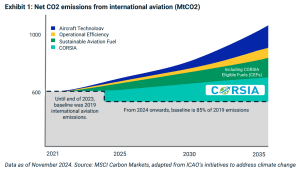
Under CORSIA, airlines must offset emissions above 2019 levels. They do this by buying carbon credits from approved projects that reduce or remove greenhouse gases.

The demand for high-quality carbon credits will likely rise. This increase comes as more airlines and industries join compliance markets. ICAO recently projected that 100-150 million tons of CORSIA Eligible Emissions Units (EEUs) will be required during the first compliance phase.

Xpansiv’s new GEO CP1 contract aligns with this growing demand, as remarked by John Melby, Xpansiv CEO: 

“The transition into the compliance phase of CORSIA is a watershed moment for the rapidly converging voluntary and compliance carbon markets. Our new GEO CP1 contract has been carefully designed based on an extensive market consultation, which revealed a clear consensus to launch the contract only when deliverable supply was available and sufficient clarity around the ICAO framework was achieved. Those conditions have now been met.” 

Standardized Trading and Market Transparency

One of the key features of the GEO CP1 contract is its alignment with CORSIA EEU eligibility criteria. When launched, EEUs from this contract will be sourced from top environmental credit registries. These include:

When more registries get CORSIA approval, their credits can be used in the contract, too.

Xpansiv is using its strong market infrastructure to boost transparency and efficiency in trading. A unique sub-account structure developed for IATA’s recent EEU procurement events will also be available for GEO CP1 participants. This setup allows traders to trade the contract without needing main accounts for each credit standard. It makes access to CORSIA-compliant credits easier.

An analysis by Abatable suggests that demand for CORSIA credits could surpass available supply by 2030. Without new projects, CORSIA demand in Phase 2 can be 14x bigger than the supply.

CORSIA carbon credit demand, supply, conservative scenario
Source: Abatable

Market Growth and the Role of Carbon Credits

The launch of the GEO CP1 contract comes at a time when the carbon market is experiencing rapid growth. In 2023, global carbon market revenues reached a record $104 billion.

revenue per type of carbon pricing 2017 to 2023
Source: World Bank

Companies in aviation, energy, and manufacturing are turning to carbon credits. They use these credits to meet sustainability goals and follow regulations.

Regulatory frameworks like the EU’s Carbon Border Adjustment Mechanism (CBAM) are boosting the demand for verified carbon offsets. Also, consumer demand and investor interest in sustainability have pushed companies to join carbon markets. As a result, investment firms and financial institutions are integrating carbon offset projects into their portfolios.

Even with this growth, the carbon market has struggled with price swings and unclear regulations. In 2024, carbon credit prices dropped due to shifts in global climate policies.

The global average carbon price stood at $32 per ton of CO₂, falling short of the estimated $50 per ton needed by 2030 to achieve Paris Agreement targets. Localized markets like California’s cap-and-trade system saw carbon prices hit $42 per metric ton in 2024. They are expected to rise to $46 per ton in 2025.

Xpansiv’s Performance in the Carbon Market

Xpansiv has seen significant growth in its trading volumes, particularly on its CBL platform. In November 2024, trading volumes almost doubled. This surge was fueled by Nature-Based Global Emission Offsets (N-GEOs). More than 600,000 tons were traded at prices between $0.30 and $4.10 per metric ton.

By mid-December 2024, over 2 million tons of carbon credits were traded on the platform. This made up 16% of all transactions for the year.

In January 2025, Xpansiv’s CBL spot exchange made headlines. It recorded over $27 million in Renewable Energy Certificate (REC) transactions. This amounted to a total of 251,758 MWh.

These market trends show the increasing reliance on Xpansiv’s infrastructure for carbon trading and emissions management.

The Future of Carbon Markets and CORSIA Compliance

Looking ahead, Xpansiv is well-positioned to support the expansion of carbon markets. As companies and governments push for net-zero goals, the need for quality carbon credits will grow. Standardized trading tools like the GEO CP1 contract boost the trust and ease of access in carbon markets.

Government policies will also play a crucial role in shaping the future of carbon markets. Initiatives like carbon pricing, cap-and-trade, and carbon taxes will likely affect credit demand. Also, new tech like blockchain for credit tracking will boost market transparency. This helps stop problems like double counting.

Xpansiv’s latest GEO CP1 contract marks a significant step forward in providing aviation stakeholders with the resources needed to comply with CORSIA while supporting global sustainability efforts.

The post Xpansiv to Launch New Carbon Credit Contract to Support CORSIA Compliance appeared first on Carbon Credits.

BYD’s Billion-Dollar Surge: Dominating EV Sales and Driving the Green Revolution

BYD

BYD hit new highs in 2024, reporting record revenue and accelerating its sustainability efforts. Quite interestingly, it has taken down Tesla. What fueled the Chinese EV giant’s record-breaking success? Surging EV sales and bold green energy initiatives propelled BYD to the top.

BYD’s Profits and Sales Hit New Highs

BYD’s net profit jumped 73.1% in Q4 2024, reaching a record 15 billion yuan ($2.1 billion). Strong sales and competitive pricing fueled this growth. Revenue surged 52.7% to 274.9 billion yuan.

Yahoo Finance revealed that for the full year, profit rose 34% to 40.3 billion yuan. Revenue climbed 29% to 777 billion yuan ($107 billion). BYD’s stock in Hong Kong soared 51% this year, nearing an all-time high.

The company sold 4.25 million vehicles in 2024, surpassing Volkswagen to lead China’s auto market, as reported by Reuters.

Targets Global Growth

The Yahoo report also stated that BYD plans to double overseas sales to over 800,000 units in 2025. Last year, it sold 417,204 EVs outside China. The company sees Britain as a key market due to its openness to Chinese brands. It’s also opening showrooms worldwide, including in Australia and Germany, to reduce reliance on China’s crowded market

It expects strong growth in Latin America and Southeast Asia. To stay competitive, BYD will assemble cars locally while sourcing key components from China.

BYD is building factories in Brazil, Thailand, Hungary, and Turkey, aiming to run these plants independently. It’s also in the recent news that BYD is planning to expand in India by increasing local production and launching new EV models.

However, BYD has paused its U.S. and Canada expansion due to trade tensions and tariffs. The company expects a big share of future profits to come from global markets.

BYD’s Road to Carbon Neutrality

BYD aims to reduce the carbon intensity of its operations by 50% by 2030 and achieve carbon neutrality across its entire value chain by 2045, using 2023 as the baseline.

According to its 2024 sustainability report, it has launched key initiatives to reach these goals. They are:

  • Increase green electricity use to 35% by 2025 and develop new energy-saving technologies for manufacturing

  • Expand solar power projects and switch to renewable energy.

BYD Emissions

Milestones Achieved in 2024

The company launched 410 energy-saving projects, cutting carbon emissions by over 210,000 tons of CO₂. It procured 2.23 million green certificates and used 468 million kWh of green electricity.

It also led the market, selling 4.27 million new energy passenger vehicles and delivering 127,000 commercial EVs, including 85,000 electric buses and 41,000 trucks. It is evident from its revenue how rapidly it is expanding worldwide, bringing low-emission, high-quality EVs to global markets.

BYD Carbon emissions
Source: BYD

Investing in Clean Energy Solutions

The company has set up an advanced “photovoltaic-storage integration” model that focuses on capturing, storing, and using clean energy to reduce dependence on fossil fuels.

Rechargeable Batteries

BYD is also a leader in battery technology, having a portfolio of nickel-metal hydride, lithium cobalt, lithium iron phosphate, and ternary lithium. These power EVs, electronic devices, and energy storage systems. The company also recycles batteries, processing over 10,000 tons of used power batteries in two factories.

Solar Power

BYD develops a full range of solar solutions ranging from silicon wafers and battery cells to PV modules and complete solar power systems. Its solar technology supports energy independence and a greener future.

byd renewable energy
Source: BYD

Energy Storage

The company operates energy storage systems in 110 countries, with over 75 GWh in commercial use. To date, it has completed 350 projects and gathered 17 years of operational data to improve performance.

Most significantly, the EV maker follows China’s Carbon Peaking and Carbon Neutrality Goals. It remains committed to using technology to create a cleaner, more sustainable world. With a sharp focus on innovation and carbon reduction, BYD is driving the future of clean mobility.

The post BYD’s Billion-Dollar Surge: Dominating EV Sales and Driving the Green Revolution appeared first on Carbon Credits.

Nickel’s Wild Ride: What’s Driving Prices and Future Demand?

Nickel’s Wild Ride: What’s Driving Prices and Future Demand?

Nickel is a key metal used in many industries. It’s found in stainless steel, electric vehicle (EV) batteries, and other high-tech uses. The nickel market has been volatile lately. This is due to global economic concerns and changes in supply. This article explores recent trends, factors affecting prices, and the future of nickel.

Nickel Market Swings: Why Prices are Fluctuating

Nickel prices have been highly volatile in early 2025. Worries about a U.S. recession, shaped by Trump’s economic policies, have hurt investor confidence. Nickel started the year at around $17,000 per metric ton but dropped below $16,000 in March, according to S&P Global Commodity Insights data. This decline was driven by weaker industrial demand and fears of slower economic growth.

LME nickel prices March
Source: S&P Global

China, the world’s largest consumer of nickel, has also shown mixed demand signals. Demand for EV batteries is high, but slower infrastructure growth has held back nickel use.

Will EV Push Prices Up or Keep Them Low?

The electric vehicle industry is a major driver of nickel demand. Nickel plays a key role in lithium-ion batteries. It’s vital in high-performance types like nickel-cobalt-manganese (NCM) and nickel-cobalt-aluminum (NCA) batteries.

Despite short-term price fluctuations, the long-term outlook for nickel in EVs remains strong. Many automakers are ramping up EV production, increasing the need for battery-grade nickel.

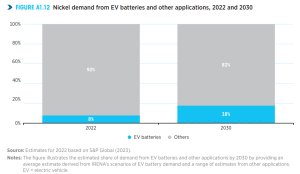
According to industry estimates, global nickel demand from EV batteries is set to grow by 15-20% annually through 2030.

nickel demand from EV batteries 2022 and 2030
Source: IRENA Report

To secure nickel supplies, major automakers like Tesla and Volkswagen have signed long-term agreements with mining companies. This trend is expected to continue as companies try to avoid future supply shortages.

Meanwhile, Indonesia, the top nickel producer in the world, keeps boosting its output. This move adds more pressure on global prices.

How The World’s Top Nickel Producer is Reshaping Supply

The global nickel supply has risen due to increased output from Indonesia and the Philippines. Indonesia has become a dominant player in the nickel market, contributing nearly 50% of the world’s nickel supply. In 2024, the country produced over 1.6 million metric tons, and further growth is expected in 2025. However, this increase in supply has led to concerns about market oversupply, pushing prices down.

The Philippines, another major producer, is also expanding its mining activities. New mining projects are expected to boost production in 2025. However, environmental concerns and government regulations could slow this growth.

nickel production by country 2023

In contrast, Russian nickel production faces challenges due to ongoing Western sanctions. This has caused supply issues and shifted trade routes. Now, more Russian nickel goes to China instead of Western markets.

Challenges in Nickel Supply Chains

Although nickel production is increasing, supply chain issues remain. Many nickel mines are located in regions with environmental and social risks. Mining operations in Indonesia and the Philippines have raised concerns over deforestation, water pollution, and labor rights.

Another challenge is the processing of nickel. Most nickel mined in Indonesia is converted into nickel pig iron (NPI) or ferronickel, which is not suitable for EV batteries. Refining nickel for battery use costs more and slows supply growth.

China is investing a lot in nickel processing plants in Indonesia. This effort aims to tackle the problem. Several high-pressure acid leach (HPAL) projects are underway to produce battery-grade nickel. However, these projects face high costs and technical challenges.

Geopolitics and Trade Wars

Government policies play a significant role in shaping the nickel market. In Indonesia, the government has maintained its ban on nickel ore exports to encourage domestic refining. This policy has helped Indonesia dominate the global nickel supply chain but has also led to trade tensions with other countries.

In the United States, efforts to secure critical minerals have intensified. The Biden administration supported domestic mining and refining. But Trump’s policies might change that focus. 

Recently, President Trump used emergency powers to ramp up the production of critical minerals, including nickel. Tariffs and trade restrictions on Chinese nickel imports could also impact market dynamics.

Meanwhile, the European Union aims to cut reliance on Chinese nickel. They are building stronger ties with alternative suppliers, such as Canada and Australia. These shifts in trade policies could reshape the global nickel supply chain in the coming years.

Nickel Price Forecasts and Future Outlook

The future of nickel prices depends on several factors:

  • Economic Conditions: If the U.S. enters a recession, industrial demand for nickel could weaken, keeping prices low.
  • EV Demand: Strong EV growth could drive up nickel demand, supporting higher prices.
  • Supply Growth: Indonesia’s increasing production could put downward pressure on prices.
  • Geopolitical Risks. Sanctions on Russia and trade restrictions on China could affect supply chains and pricing.

Most analysts predict nickel prices will stay between $15,000 and $18,000 per metric ton in 2025. S&P Global forecasts the LME 3M nickel price to average $16,026/t in 2025. But unexpected events, like supply disruptions or new government policies, can lead to sudden price changes.

Overall, the nickel market is undergoing significant changes. Increased production, shifting trade policies, and growing EV demand are shaping its future. While short-term price volatility remains, the long-term outlook for nickel is positive due to its crucial role in clean energy and advanced technologies.

The post Nickel’s Wild Ride: What’s Driving Prices and Future Demand? appeared first on Carbon Credits.

Apple Boosts China’s Clean Energy With $99 Million: Can It Power a Carbon-Neutral Future?

Apple Boosts China's Clean Energy With $99 Million: Can It Power a Carbon-Neutral Future?

Apple is pushing forward with its environmental and sustainability efforts. The company has set a goal to be carbon-neutral across its entire business by 2030. This includes manufacturing, supply chain, and product life cycles.

As part of this effort, Apple recently announced a $99.3 million investment in its second China Clean Energy Fund to expand renewable energy projects. To reach its goal, the company is investing in clean energy, working with suppliers, and designing lower-carbon products.

Apple’s China Clean Energy Fund Initiatives

On March 24, 2025, Apple launched its second China Clean Energy Fund. The company is committing $99.3 million (RMB 720 million) as the main investor. The fund, managed by Schroders, aims to grow renewable energy projects across China. 

It builds on the success of Apple’s first clean energy fund, which started in 2018. That first fund helped develop over 1 gigawatt of renewable energy across 14 Chinese provinces. Some of the projects it financed include:

  • Concord Jing Tang and Concord Shen Zhang Tang wind farms in Hunan Province, and 
  • Wind facility developed by Fenghua Energy Investment in Hubei Province. 

These projects collectively supplied 134 megawatts of renewable energy, significantly advancing China’s renewable energy targets.​ The country’s 14th Five-Year Plan aims for renewables to supply 33% of its electricity by 2025. By 2026, solar power is set to surpass coal as the top energy source, reaching 1.38 terawatts—150 GW more than coal.

China forecast renewable power generation 2050.jpg

The new fund will add about 550,000 megawatt-hours of wind and solar energy to China’s power grid each year. This number is expected to rise as more investors join. 

Apple’s strategy is to support renewable energy projects at an early stage. This makes it easier for suppliers to switch to clean energy. 

  • Currently, two-thirds of Apple’s production in China runs on renewable energy. More than 100 suppliers are working toward using 100% renewable energy for Apple products.

Apple CEO Tim Cook stressed the importance of these efforts. He stated, 

“The business community has a big role to play in the development of China-U.S. relations. Apple is willing to contribute to the stable, healthy, and sustainable development of bilateral relations.”

This comes at a critical time when the U.S. and China are engaged in a trade war, with tensions rising over technology, tariffs, and economic policies. Despite these challenges, Apple continues to strengthen its ties with China while advancing its clean energy goals.

Progress Toward 2030 Carbon Neutrality

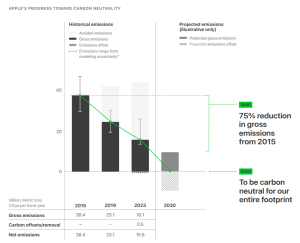
Apple has made major progress in cutting greenhouse gas emissions. According to its 2024 Environmental Progress Report, the company has reduced emissions by over 55% since 2015. Apple aims to cut emissions by 75% from 2015 levels before reaching full carbon neutrality by 2030.

Apple 2023 progress on carbon neutrality
Source: Apple

Lisa Jackson, Apple’s Vice President of Environment, Policy, and Social Initiatives, said, “We’ve slashed emissions by more than half, all while serving more users than ever before.”

Apple is taking several steps to reach this goal. The company is moving to low-carbon electricity, using recycled and renewable materials, and improving shipping methods. 

One key focus is shifting product transportation from air freight to ocean shipping, which has a lower carbon footprint. These actions are part of Apple’s 2030 plan, a strategy to eliminate net emissions across its entire business.

This approach reflects Apple’s dedication to reducing its environmental impact. It is also setting a standard for corporate responsibility in the tech industry. The image below shows the company’s progress by the numbers.

Apple sustainability progress by the numbers
Source: Apple

Here are the other areas where Apple is showing progress in its sustainability efforts.

Supplier Clean Energy Commitments 

Apple is also working with its suppliers to help them transition to clean energy. As of April 2024, over 320 suppliers, making up 95% of Apple’s direct manufacturing spending, have committed to using 100% renewable energy by 2030. This number has grown significantly, with more than 50 new suppliers joining in the past year. 

These commitments are part of Apple’s Supplier Clean Energy Program, which aims to decarbonize the company’s global supply chain.

In 2021 alone, Apple’s suppliers generated 18.1 million megawatt-hours of clean energy. This avoided 13.9 million metric tons of carbon emissions, a 62% increase over 2020. 

The big tech company has also invested in nearly 500 megawatts of renewable electricity projects to help cover upstream emissions. All these show the company’s commitment to encouraging suppliers to also adopt sustainable practices. 

Innovations in Product Design

Apple is also reducing its carbon footprint through product design. In September 2023, the company introduced its first carbon-neutral products in the new Apple Watch lineup. Thanks to design improvements and clean energy, product emissions dropped by over 75% for each carbon-neutral Apple Watch.

Apple has also eliminated leather across all its product lines. Instead, the company introduced a new material called FineWoven, which has a much lower carbon footprint. The company is also using entirely fiber-based packaging for its Apple Watch models.

In 2024, Apple reported a 30% reduction in lifecycle greenhouse gas emissions for its iPhone 16 Pro and iPhone 16 Pro Max models. This was achieved by using clean electricity, more recycled materials, and better shipping methods.

Challenges and Criticisms: Facing Greenwashing Claims

Despite these efforts, Apple has faced criticism over its environmental claims. In February 2025, a class-action lawsuit was filed against the company. The lawsuit alleges that Apple misled consumers by labeling certain Apple Watch models as “carbon neutral.” 

Plaintiffs argue that Apple’s reliance on carbon offset projects in Kenya and China does not deliver real emissions reductions. The lawsuit seeks damages and an order preventing Apple from marketing these watches as carbon neutral.

These challenges highlight the need for transparency in corporate sustainability claims. In response, Apple continues to emphasize its dedication to real carbon reductions and long-term environmental progress.

Apple remains a leader in corporate sustainability. The company’s $99.3 million China Clean Energy Fund will expand renewable energy and help suppliers transition to 100% clean power. By pushing for clean energy, improving product design, and encouraging supplier commitments, the tech giant is setting an example for the tech industry. 

The post Apple Boosts China’s Clean Energy With $99 Million: Can It Power a Carbon-Neutral Future? appeared first on Carbon Credits.

84% of Companies Are Doubling Down on Climate Targets, PwC Reports

Why 84% of Companies Are Doubling Down on Climate Commitments, PwC Reports

A new PwC report reveals that most companies remain committed to their climate goals. Despite economic uncertainty and shifting regulations, 84% of businesses are maintaining or even accelerating their decarbonization efforts. Only 16% have slowed down or stepped back from their commitments.

The finding challenges the perception that companies are abandoning sustainability goals. Instead, many businesses are quietly making steady progress. The report, which analyzed data from over 4,000 companies, found that climate commitments have grown nine times over the past five years. This trend shows that corporate sustainability is now a long-term focus, not just a temporary trend.

climate commitments PwC report

Let’s uncover other major findings that are relevant for corporate sustainability and net-zero goals.

Climate Goals Drive Financial Benefits 

The report suggests a correlation between investing in sustainability initiatives and financial gains for companies. The report shows that sustainable products earn 6% to 25% more than non-sustainable ones.

This revenue boost comes from growing consumer demand for environmentally friendly options. More people are willing to pay extra for products with lower carbon footprints. They prefer items that use sustainable packaging or are ethically sourced. Businesses that embrace this shift are finding new opportunities for growth and profitability.

But Smaller Companies Join the Decarbonization Movement

Initially, larger corporations were prominent in setting climate targets. However, there is now increasing participation from smaller businesses. The report highlights a significant shift:

  • In 2020, the median revenue of companies setting climate goals was $3.6 billion. By 2024, that number had dropped to $1.3 billion.

Sustainability isn’t just for big companies anymore. Smaller businesses are now making climate commitments, too.

median revenue for companies with climate targets

One major driver of this trend is supply chain pressure. Big companies want their suppliers to act on climate change. This pressure is making smaller businesses cut their emissions. More companies are setting net-zero targets. So, the push to decarbonize will likely reach deeper into supply chains.

The Challenge of Scope 3 Emissions

Scope 3 emissions represent a significant challenge in corporate decarbonization. These are emissions that come from a company’s supply chain and product use, rather than its own operations. They account for the largest share of most businesses’ carbon footprints.

The report shows progress in tackling this challenge. In 2023, only 50% of companies were on track with their Scope 3 targets. In 2024, that number rose to 54%. This is better, but almost half of companies still struggle to manage emissions they can’t control.

Scope 3 emissions covered by climate goals

Reducing Scope 3 emissions requires strong collaboration between companies and their suppliers. Businesses should work together to find cleaner ways to produce, transport, and use products. This is a complex task, but companies that effectively manage Scope 3 emissions may gain a competitive advantage in a low-carbon economy.

What Sets Leaders Apart?

The PwC report highlights four main factors that set top companies apart from those lagging in decarbonization:

  1. Strong Governance. Companies that fully integrate sustainability into their business strategy are more successful in meeting climate goals. This means that leadership teams take climate targets seriously and track progress regularly.
  2. Strategic Funding. Decarbonization requires investment in clean technology, renewable energy, and sustainable practices. Businesses that allocate proper funding to these areas are seeing better results.
  3. Value Chain Engagement. Working closely with suppliers and customers is crucial to reducing emissions beyond a company’s direct control. Businesses that engage their entire value chain are making faster progress on climate targets.
  4. Product Sustainability Focus. Eco-friendly companies focus on product design, low-carbon materials, and sustainable packaging. This helps cut emissions and draws in eco-conscious consumers.

Using these strategies helps companies succeed in the long run and support global climate goals.

Corporate Innovation in Low-Carbon Solutions

Companies are also investing in research and development (R&D) to drive sustainability. According to the report, 83% of businesses are actively investing in low-carbon innovation. This includes advancements in energy efficiency, carbon capture technology, and sustainable product design.

These investments help companies reach their climate goals. They also push the whole industry to make progress. When businesses develop new low-carbon solutions, they set market standards. This encourages competitors to do the same.

The Role of Regulations and Consumer Demand

Government rules are a key part of how companies reduce their carbon output. More countries are making climate laws stricter. They are also adding carbon pricing and incentives for green investments. Companies that act early to comply with these regulations will be better prepared for future policy changes.

There is increasing consumer awareness of climate issues. They want businesses to be more transparent. People want to see how companies cut their carbon footprints. They also want to know if these sustainability claims are real.

The report suggests that companies that do not address climate concerns may face the risk of customer attrition. They may shift to competitors who care more about the environment.

The Path Forward

While progress is being made, companies still have a long way to go in achieving net-zero emissions. Many businesses need to scale up. They also need to improve data tracking and strengthen collaboration across industries.

However, the report makes it clear that corporate decarbonization is not slowing down. Businesses that integrate sustainable practices are better positioned to address climate change. They can also potentially enhance growth, efficiency, and long-term resilience.

The PwC report shows that companies are staying committed to climate goals despite economic and political challenges. Businesses are realizing that sustainability is not just a responsibility—it’s also a smart business strategy. 

The post 84% of Companies Are Doubling Down on Climate Targets, PwC Reports appeared first on Carbon Credits.

Soccer’s Carbon Footprint: How Dirty Is This Sports?

Football's Carbon Footprint: How Dirty Is This Game?

Soccer, also known as football, is the world’s most popular sport, with billions of fans and a vast global reach. While football is the commonly used term in most countries, soccer is widely recognized in regions like North America. Regardless of the name, the sport’s environmental impact remains a major concern, and its carbon footprint is growing.

Recent studies, particularly the New Weather Institute report “Dirty Tackle: The growing carbon footprint of football“, estimate that soccer’s total carbon footprint is around 64-66 million tonnes of CO2 equivalent (tCO2e) annually. This is comparable to the annual emissions of Austria and 60% more than those of Uruguay.

Knowing the main causes of soccer’s greenhouse gas (GHG) emissions is key to reducing its impact. So, what are the main culprits of the game’s growing carbon emissions?

The Major Contributors to Soccer’s Carbon Emissions

Here are the top three major sources of the sports’ rising GHG emissions:

CC Football Carbon Footprint March2025_1 (1)

Sponsored Emissions: The Hidden Environmental Cost

One of the largest sources of football’s emissions is its sponsorship deals with high-carbon industries. The New Weather Institute report shows that 75% of soccer’s carbon footprint comes from sponsorships. This includes polluting companies like fossil fuel corporations and airlines. These deals promote high-emission lifestyles, such as frequent air travel and gas-guzzling vehicles.

For example, FIFA signed a deal in 2024 with Saudi oil giant Aramco, the world’s largest fossil fuel company. UEFA also has ongoing sponsorships with Qatar Airways and Emirates, both major airline polluters.

GHG emissions associated with major sponsorship deals football
Source: New Weather Institute
  • The 2022 FIFA World Cup had four big sponsorship deals, causing over 16 million tCO2e. Also, the top four European clubs with airline sponsorships added 8 million tCO2e.

RELATED: UEFA’s Green Goals: $7.6M Climate Fund for EURO 2024 Carbon Footprint

Travel Emissions: The Heavy Cost of Mobility

Soccer matches require significant travel, both for teams and spectators. The reports highlight that spectator travel is the biggest contributor to non-sponsorship emissions. Air and car travel make up the bulk of these emissions, particularly for international competitions.

  • One Men’s FIFA World Cup match emits 44,000-72,000 tCO2e, equivalent to 31,500 to 51,500 average UK cars driven for a year.
  • A single English Premier League (EPL) match emits around 1,700 tCO2e, with spectator travel accounting for half of this.
  • Matches in international club competitions increase emissions by 50% due to air travel.
  • The FIFA World Cup, including qualification matches, emitted 6.5 million tCO2e over four years.

Expanding tournaments and increasing international matches worsen the problem. The 2026 World Cup in the U.S., Mexico, and Canada will need a lot of air travel. This will greatly raise emissions. The growth of international club competitions, like UEFA’s Champions League and FIFA’s new Club World Cup, makes this problem worse.

football carbon emissions
Source: New Weather Institute

Efforts to promote greener travel among spectators remain insufficient. While some clubs encourage fans to use public transport, overall adoption is low. More teams should step up. They could offer discounted match tickets for fans who use low-carbon transport.

Stadium Construction: Arenas of Pollution

Stadiums cause a lot of carbon emissions. This happens both during their construction and while they are maintained. The 2022 FIFA World Cup in Qatar saw the construction of new stadiums emitting 270,000 tCO2e per stadium. Major clubs continue to renovate or build new stadiums, adding to their carbon footprint.

World Cup Finals stadium emissions

  • New stadiums for top-tier clubs like Tottenham Hotspur and Brentford resulted in significant emissions.
  • Clubs like Manchester United, Real Madrid, and Barcelona have large stadium expansion projects underway, which will further increase emissions.

Moreover, stadium energy use contributes to ongoing emissions. Many stadiums still use non-renewable energy. They have high electricity use on match days. While some clubs have implemented solar panels and LED lighting, these efforts must be expanded across all leagues.

Green Goals: Are Soccer’s Climate Commitments Enough?

Despite these staggering numbers, soccer’s governing bodies have done little to curb its carbon footprint. FIFA and UEFA have pledged to reduce emissions by 50% by 2030 and reach net zero by 2040, but their actions seem to contradict these commitments.

  • FIFA’s continued partnership with Aramco directly undermines its climate promises.
  • UEFA’s expansion of the Champions League and FIFA’s decision to increase the World Cup to 48 teams in 2026 will only lead to higher emissions.
  • Top clubs keep signing big deals with airlines and fossil fuel companies. This trend makes carbon-heavy activities seem normal.

Also, overloading players with longer schedules can harm the environment in other ways. Players travel more often, which raises emissions from team transport. Moreover, medical treatments for overworked athletes add an extra environmental burden.

Notably, the upcoming 2026 FIFA World Cup, to be co-hosted by the U.S., Canada, and Mexico, further stirs environmental concerns. The tournament will expand to 48 teams. This means more travel and better infrastructure are needed. This leads to higher GHG emissions. Recent developments have further highlighted these concerns.

The 2026 FIFA World Cup Emissions

In March 2025, U.S. President Donald Trump signed an executive order establishing a task force to oversee preparations for the event. This task force aims to leverage the World Cup to promote American excellence and attract foreign investment.

However, Trump’s assertion that political and economic tensions with co-host nations Canada and Mexico would “enhance the excitement” of the tournament has raised eyebrows. This view might overlook the urgent environmental issues tied to holding such a big event.

Estimates suggest that the event could generate over 3.6 million tonnes of CO₂. Most emissions come from air travel, stadium construction, and fans getting to games. These exceed the emissions from the 2022 Qatar World Cup, which was one of the most polluting ever.

These changes highlight the need for strong plans to reduce the environmental impact of the 2026 World Cup.

Kicking Off Sustainability: A Playbook for Change

Soccer has the power to lead climate action given its global influence. Here’s how the sport can reduce its environmental impact:

  1. End High-Carbon Sponsorships: Just as tobacco advertising was banned in sports, governing bodies must phase out sponsorships with high-carbon emitters.
  2. Reduce Air Travel: Football clubs and leagues should encourage train and bus travel for domestic matches. Ticketing policies can prioritize local fans to cut travel emissions.
  3. Smaller, Regional Tournaments: FIFA and UEFA should prioritize regional competitions. This change can help cut down on long-haul flights.
  4. Sustainable Stadiums: Clubs should invest in low-carbon stadiums. They can use renewable energy sources like solar panels and LED lighting.
  5. Encourage Low-Carbon Fan Behavior: Clubs can offer incentives for public transport use, cycling, and electric vehicle travel to matches.
  6. Stronger Climate Rules: Football federations need to set sustainability standards for competitions. Clubs must hit carbon reduction goals to take part.
  7. Player-Led Advocacy: Many professional soccer players are already speaking out about climate change. Their influence can drive awareness and push governing bodies toward stronger climate commitments.

Time for Football to Act

Soccer’s carbon footprint is undeniable, but so is its potential to drive climate action. With its unmatched global reach, football can be a powerful force for sustainability. However, without real leadership from FIFA, UEFA, and major clubs, emissions will continue to rise.

The moment to act is now—before climate change threatens the very sport billions love. If football is truly committed to securing its future, it must move beyond words and take real, measurable action to cut emissions across all levels of the game.

The post Soccer’s Carbon Footprint: How Dirty Is This Sports? appeared first on Carbon Credits.

National Bank of Canada Targets $20 Billion in Renewable Energy Lending by 2030

NATIONAL BANK CANADA

The National Bank of Canada (NBC) will increase renewable energy lending to $20 billion by 2030, as revealed in its latest sustainability report. This move strengthens its net-zero emissions strategy despite the ongoing shift in U.S. clean energy policies.

In this context, NBC plans to add nearly $10 billion in new renewable loans over the next six years, but some of its existing loans will be partially or fully repaid during this period. The final lending total accounts for both the new loans and the repayments of old ones.

NBC is Backing Major Renewable Projects in the U.S.

Since 2019, the bank has tripled its renewable energy funding to reach $15 billion. In 2023, its renewable energy loans exceeded its non-renewable energy exposure for the first time. This shift shows its strong commitment to clean energy.

Despite the U.S. government’s shifting stance on clean energy and Trump’s unfavorable stance on clean energy, National Bank continues to invest heavily in renewable projects.

In 2023, it played a crucial role in financing two major U.S. renewable energy initiatives, namely the SunZia wind and transmission project and the Solar Landscape community solar portfolio

By 2030, the bank aims to reduce the intensity of emissions in its power generation financing by one-third. To reach this goal, it continues investing in large wind, solar, and hydro projects. However, it restricts coal-related financing.

NBC Emission Reduction Targets

NATIONAL BANK CANADA
Source: NBC

SunZia Wind and Transmission Project

The bank underwrote $775 million for the $8.8 billion SunZia project. Pattern Energy Group LP is developing this 3.5 GW wind farm and 550-mile transmission line. It will be the largest clean energy project in U.S. history.

SunZia will send wind power from New Mexico to Arizona and the western U.S. This will help fix transmission problems and improve grid reliability. The project will deliver affordable, fuel-free energy to millions of homes. On a larger scale, it supports the shift away from fossil fuels.

Solar Landscape Community Solar Portfolio

The bank acted as the green structuring agent and lead arranger for a $283 million green loan. This loan helps Solar Landscape LLC with its 107 MWdc rooftop solar projects in New Jersey. This includes 101 solar rooftops. It also adheres to the state’s Community Solar Energy Program rules

This project is a great initiative to expand New Jersey’s community solar access. At least 51% of the affordable clean energy will go to the low- and middle-income subscribers. Additionally, Solar Landscape will track and report usage.

NBC’s Emission Reduction Targets Across High-Carbon Sectors

The bank is committed to cutting carbon intensity by 33% by 2030 from 2019 levels. This effort reinforces its leadership in North America’s clean energy shift.

To reduce emissions, the bank has set interim targets for high-carbon sectors. In 2021, it introduced targets for oil and gas. A year later, it expanded its focus to commercial real estate and power generation.

Oil and Gas Sector Transition

Oil and gas production contributes 26% of Canada’s greenhouse gas emissions. The bank supports this sector’s transition by setting ambitious reduction targets.

  • As of 2024, the bank has already achieved a 32% drop in Scope 1 and 2 emissions and an 18% drop in Scope 3 emissions
  • By 2030, it aims to cut emissions across all scopes by 31%

Strong governance and strategic credit policies have kept its oil and gas portfolio aligned with its 2030 and 2050 targets.

oil and gas NBC canada
Source: NBC

Commercial Real Estate and Energy Efficiency

Due to their heating, cooling, and lighting demands, buildings have a major impact on climate change. However, energy-efficient technologies and sustainable designs can significantly reduce emissions.

In 2022, the bank set an interim target focused on commercial buildings, including offices, retail spaces, and multi-family housing.

  • By 2024, it had already reduced these emissions by 25% and aims to cut Scope 1 and 2 emissions by 50% by 2030.
NBC Commercial real estate
Source: NBC

Power Generation and Clean Energy Goals

As said before, the bank’s power generation portfolio is diverse. Apart from solar and wind, it also includes hydro, nuclear, and biogas and natural gas while limiting coal-related financing. It provides loans to support both new and existing power projects.

Since 2019, it has cut scope 1 emissions intensity in power generation by 29%, reaching 0.10 tCO₂e/MWh as of October 31, 2023.

  • By 2023, it had already achieved a 29% reduction. Its 2030 target is to reduce Scope 1 emissions by 33% from 2019 levels.
National bank canada Power generation
Source: NBC

Cutting Ties with Coal: Stronger Funding Restrictions

The bank will not fund new thermal coal mines or lend to new clients earning over 25% of their revenue from coal mining. However, it will continue supporting existing clients who commit to reaching net-zero emissions by 2050 or phasing out coal operations.

It will also avoid funding new coal-fired power plants. The bank will not finance new clients that generate over 10% of their power from coal unless the money helps them transition to clean energy. It will support clients acquiring coal power assets only if they have clear plans to phase out coal or achieve net zero.

Notably, in the oil and gas sector, the bank will not fund exploration, extraction, or production in the Arctic.

Canada emissions

NBC continues to enhance its sustainability strategy, focusing on investments that create lasting environmental impact. Its goal is to support North America’s clean energy transition and contribute to a net-zero future.

The post National Bank of Canada Targets $20 Billion in Renewable Energy Lending by 2030 appeared first on Carbon Credits.
UN Carbon Credit System Makes History With First Project Approval But Raises Concerns

UN Carbon Credit System Makes History With First Project Approval But Raises Concerns

The Paris Agreement Crediting Mechanism (PACM) has officially approved its first project—a cookstove initiative in Myanmar. This marks a major milestone for the UN-backed carbon credit system, designed to ensure high-integrity offsets.

But with concerns over inflated climate benefits, is this approval a win for carbon markets or a warning sign of deeper issues? Let’s uncover the details behind this historical market development. 

What is PACM? 

The Paris Agreement Crediting Mechanism is a global initiative designed to improve the quality and integrity of carbon credits. Carbon credits are permits that let companies offset their greenhouse gas (GHG) emissions. Companies invest in projects that reduce or remove CO₂ from the atmosphere.

The PACM was set up under Article 6.4 of the Paris Agreement. This article lets countries team up and trade emission reduction units, also called A6.4ERs (Article 6.4 Emission Reductions Units), to reach their climate goals.  

PACM Article 6.4 how it works

The PACM is different from private carbon credit programs. It is an official system backed by the United Nations (UN). This means it has more oversight and credibility.

The UN carbon credit system was finalized at COP28 in 2024. It replaces the Clean Development Mechanism (CDM). The CDM faced criticism for allowing low-quality carbon credits. Many CDM projects lacked “additionality.” This means they would have happened without carbon credit funding. As a result, they undermine real climate action.

PACM introduces stricter rules to ensure credits represent real, measurable, and verifiable emission reductions. It boosts baseline standards. It also requires upfront credit registration, which stops retroactive project approvals.

This UN-backed system aims to boost trust in carbon markets and ensure they contribute meaningfully to nations’ climate goals, also known as Nationally Determined Contributions.

NDCs commitment pathway
Source: Czapp

With over 3,500 companies committed to net-zero, demand for high-quality credits is rising. PACM’s stricter standards can help companies buy reliable carbon offsets. This reduces the risk of “junk credits” that offer little or no real environmental benefit.

CDM’s Shadow Over PACM

One of the most debated aspects of the PACM is the transition of projects from the CDM to the new system. The CDM started in 2001. It lets countries and companies earn carbon credits by funding projects that reduce emissions in developing nations.

Over time, it became clear that many CDM projects lacked integrity. They didn’t reduce emissions beyond what would happen anyway.

Facing pressure from China and India, PACM negotiators decided to let CDM projects seek PACM approval until the end of 2025. This transition period was meant to prevent disruptions in the carbon credit market. However, experts worry that it opens the door for low-quality projects to flood the system before stricter PACM rules take effect.

According to an analysis by the NewClimate Institute, over 1,000 CDM projects have applied for PACM status, including:

  • Large-scale hydropower and wind energy projects that likely would have been built anyway, with or without carbon credit funding.
  • Methane capture projects in landfills, which may not meet stricter PACM rules on baseline emissions.
  • Cookstove projects, which have long been controversial due to questions about how much wood use they actually reduce.

The NewClimate Institute warns that if all these projects get PACM approval, hundreds of millions of carbon credits may flood the market. Their climate benefits are unclear. This could undermine trust in the PACM before it even becomes fully operational.

The video explains the transition from CDM to PACM:

First Project Approval: Myanmar Cookstove Initiative

The first PACM-approved project is in Myanmar. It’s a cookstove program that helps families use less firewood. This also lowers CO₂ emissions. By switching to these stoves, communities can slow deforestation and improve indoor air quality, reducing respiratory health risks.

Household cooking makes up 2-3% of global CO₂ emissions. This mainly comes from burning wood and charcoal. Improved cookstoves provide climate and health benefits. However, the Myanmar project has received criticism.

  • Calyx Global rated it Tier 3, the lowest quality category, due to concerns about inflated carbon savings.

The ratings company stated:

“Although the PACM may soon include stricter methodological requirements for GHG integrity of cookstove carbon credits, for now, GHG integrity – and especially over-crediting – remains a key concern at the project level.”

A big problem is the dependence on non-renewable biomass (fNRB) estimates. These estimates decide how much firewood reduction is claimed. Critics argue that project developers overestimated deforestation avoidance, exaggerating climate benefits. 

The Integrity Council for the Voluntary Carbon Market (ICVCM) recently rejected this methodology, raising further doubts about its credibility.

But Calyx Global also noted that the project’s rating can still go up to a Tier 1 rating if it delivers its promised reductions.

Calyx Global rating cookstove projects
Note: Illustration of how the majority of cookstove project ratings could improve if there was no over-crediting risk.

Concerns About PACM’s Credibility

The approval of the Myanmar project has raised concerns. Will the PACM deliver on its promise of high-quality carbon credits? The mechanism looks good on paper, but in reality, many low-quality projects might get approved. Stricter rules won’t start until 2026.

Carbon market experts say that giving PACM certification to these projects might hurt trust in the system. This could happen even before it is fully implemented. If buyers see that PACM credits are just as bad as old, low-quality CDM credits, the whole initiative might lose credibility.

To address these concerns, experts like Lambert Schneider from the Oeko-Institut suggest that carbon credit buyers should be extremely cautious when purchasing PACM credits. He advises companies to carefully check whether a credit comes from a transferred CDM project or a newly approved PACM project.

What Needs to Happen Next?

The PACM could become the gold standard for carbon credits. However, it must quickly tighten its rules. This will help stop low-integrity projects from flooding the market. Key areas for improvement include:

  • Stronger baseline rules to ensure reductions are calculated using reliable estimations.
  • More transparency in disclosing data on methodologies and impact.
  • Independent verification by 3rd-party auditors.

The Paris Agreement Crediting Mechanism represents a major step toward a more credible and effective carbon market. The next few years are key. They will decide if the PACM becomes a trusted source for carbon credits or just another place for dubious emissions reductions. 

The post UN Carbon Credit System Makes History With First Project Approval But Raises Concerns appeared first on Carbon Credits.