TSLA Stock Drops on Weak Q2 2025 Earnings: Tesla Faces Carbon Credit, Margin, and Political Risks

With Q2 2025 earnings released, all eyes are on Tesla’s margins, credit revenue, and regulatory risk. The electric vehicle (EV) pioneer remains a top global player in clean energy and EV manufacturing. However, shifting political winds and market dynamics could hurt its profits—especially its revenue from carbon credits, a long-time earnings booster. The EV giant’s credit sales this quarter drops to more than 50%.

With stiffer competition, changing demand for EVs, and the threat of U.S. climate policy rollbacks, Tesla’s path forward is less predictable than in past quarters. Let’s see how the company performs this quarter and what lies ahead.

Q2 2025 Earnings: Deliveries, Revenue, and Margins All Down

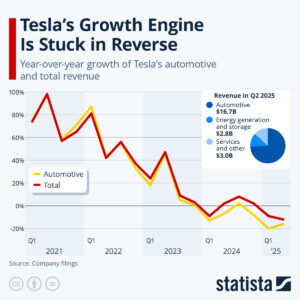
In its latest Q2 2025 report, Tesla posted revenue of $22.5 billion, a 12% drop from the same quarter last year. Net income came in at $1.17 billion, 16% down due to pricing pressure and weaker delivery numbers. Earnings per share (EPS) landed at $0.40, missing analyst expectations of $0.43.

Tesla growth reverse

Tesla delivered 384,122 vehicles during the quarter, down from 466,140 in Q2 2024, a decline of nearly 14% year-over-year. Much of the dip came from reduced demand in North America and ongoing price competition in China.

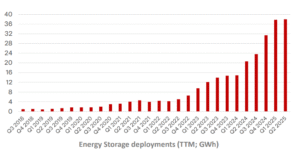
Moreover, Tesla’s energy generation and storage segment, which continues to grow in the past quarters, also fell. This segmet is led by strong sales of its Megapack and Powerwall units. These energy products generated more than $2.8 billion, down 7% year-over-year—an increasingly important line as vehicle profits tighten.

tesla energy storage

CEO Elon Musk noted in the earnings call that Tesla is pushing ahead with its Robotaxi launch, and reiterated plans for a more affordable EV model in 2026. He acknowledged that while macro and political factors remain uncertain, Tesla remains committed to innovation and global market expansion.

Competition Erodes Tesla’s Global Lead

Tesla’s long-standing EV dominance is being tested. In Q2 2025, Tesla delivered just under 385,000 vehicles globally. Meanwhile, China’s BYD sold over 606,000 battery electric vehicles, widening its lead and showing how quickly the competitive landscape is shifting.

Tesla’s market share in the U.S. has dropped from 75% in 2022 to about 43% in 2025. In Europe, Tesla now holds just 1.6% of the EV market.

Chinese automakers like Xiaomi, Nio, and Xpeng continue to grow quickly, offering lower-priced EVs with strong features. As affordability becomes more important to buyers, Tesla’s premium pricing may limit its growth. This is especially true if U.S. subsidies are scaled back or eliminated.

Unless Tesla launches a budget-friendly model soon, analysts believe it may lose more ground. Combined with falling credit revenue, this puts real pressure on its profit margins.

Tesla’s Carbon Credit Revenue Faces Political Risk

One of Tesla’s most profitable business lines has been the sale of regulatory credits to other automakers that fail to meet emissions targets. These carbon credits have nearly zero production costs and have historically delivered high-margin income.

In 2023, Tesla earned $1.79 billion from regulatory credits. That surged to $2.76 billion in 2024, accounting for almost two-thirds of Tesla’s profit in some quarters.

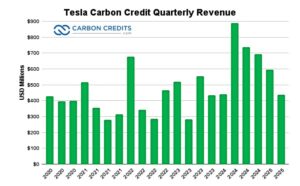
Notably, Q2 2025 carbon credits revenue fell by over 50% to 439 million, from 890 million in the same period last year. And the company’s quarterly credit sales show a decreasing trend since Q2 2024, as seen below.

Tesla carbon credit revenue 2025 q2

Still, a major risk is emerging. The proposed “One Big Beautiful Bill” (OBBA) from Republican lawmakers aims to undo several of President Biden’s climate programs. It will eliminate EV tax credits, reverse EPA emissions standards, and weaken the Inflation Reduction Act (IRA). All of this could reduce the need for automakers to buy carbon credits—shrinking Tesla’s most lucrative income stream.

Estimates suggest Tesla’s credit revenue could fall to $595 million or less by 2026, and disappear completely by 2027. This would cut deeply into its margins and future earnings. Despite Elon Musk’s occasional support for deregulation, these changes would be a major setback for Tesla’s business model.

Understanding the Carbon Credit System

Tesla benefits from emissions rules that reward automakers for producing zero-emission vehicles. Since it sells only EVs, Tesla accumulates more credits than it needs. It then sells the extras to competitors like Stellantis, GM, and Toyota, who still sell many gas-powered cars.

This has been an easy revenue stream. But if OBBA or similar legislation weakens clean air rules or emissions targets, the demand for these credits will shrink. That would leave Tesla more dependent on EV sales and energy storage—both of which face their own competitive and pricing challenges.

The Political Climate Adds More Uncertainty

Trump’s OBBA law reflects a broader effort by Republicans to reverse Biden’s climate agenda. With this new policy, many climate-focused programs will be rolled back. This includes EV subsidies, clean energy tax credits, and stricter emissions standards.

Tesla could face a drop in EV demand, especially in the U.S., if those incentives vanish. Ironically, Elon Musk has voiced support for deregulation, but the fallout from such policies could significantly hurt Tesla’s bottom line. Investors are concerned that political shifts could make Tesla’s future earnings far more volatile.

Tesla’s Stock and Strategic Outlook

Tesla’s stock (TSLA) has seen big swings this year. After climbing above $300 per share earlier in 2025, it fell to around $250 in July as delivery numbers declined and political risks grew.

Investors are watching key developments going forward:

  • Will Tesla launch an affordable EV model to regain market share?
  • Can its energy storage business grow fast enough to offset falling vehicle margins?
  • How will regulatory changes affect its carbon credit income?

Upcoming launches like the RoboTaxi platform and Optimus AI robot are exciting but may take time to affect the bottom line. In the near term, Wall Street wants to see stable margins, smart cost controls, and consistent vehicle output.

Driving Forward: Can Tesla Adapt?

Tesla is still a powerful brand with loyal customers and strong technology. But its financial strength depends not only on vehicle sales, but also on favorable policies. Carbon credits and government incentives have played a big role in Tesla’s success.

With political uncertainty rising and competitors growing stronger, Tesla has to adapt fast. The company’s energy business and AI-driven platforms offer new growth paths, but execution and timing will be key.

As Trump’s OBBA bill turned into law, Tesla’s stock could remain volatile. But if the company navigates these challenges and continues to innovate, it may yet hold onto its leadership role in the clean energy transition.

The post TSLA Stock Drops on Weak Q2 2025 Earnings: Tesla Faces Carbon Credit, Margin, and Political Risks appeared first on Carbon Credits.

Alphabet’s (GOOGL Stock) Q2 2025: Growth Soars but AI Challenges Net Zero Goals

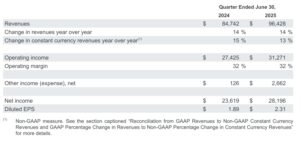
Alphabet Inc., Google’s parent company, reported strong financial results for the second quarter of 2025, surpassing Wall Street expectations. The company posted $96.4 billion in revenue, up 14% year-over-year. Earnings per share also rose 22% to $2.31, outperforming analyst estimates of $2.17–$2.20.

Google Cloud, Search, and YouTube Drive Alphabet’s Growth

Net income for the quarter climbed 19% to $28.2 billion, while the operating margin remained solid at 32.4%. Its core business units all saw double-digit growth:

  • Google Cloud revenue jumped 32%, hitting $13.6 billion. This growth was powered by demand for core cloud products, AI infrastructure, and generative AI services.
  • Google Services, which include YouTube ads, Google Search, and subscriptions, earned $82.5 billion, a 12% increase from last year.
  • YouTube ads alone generated $9.8 billion in revenue.
  • The company’s “Other Bets” segment, including Waymo and Verily, brought in $373 million, slightly up from $365 million last year. However, it reported a $1.25 billion operating loss, wider than last year’s $1.13 billion loss.
Google revenue Alphabet
Source: Alphabet

AI Takes Center Stage: Gemini and AI Overviews See Rapid Adoption

Alphabet’s AI tools are rapidly gaining traction:

  • AI Overviews, Google’s AI-powered search summaries, now reach over 2 billion monthly users in 200+ countries, up from 1.5 billion just a quarter ago.
  • The Gemini AI chatbot has surpassed 450 million monthly active users.

Interestingly, the company also announced an increase in its 2025 capital expenditure forecast to $85 billion, a $10 billion jump from its February projection. This uptick is driven by rising demand for cloud infrastructure and AI services.

CEO Sundar Pichai confirmed this, saying:

“We had a standout quarter, with robust growth across the company. We are leading at the frontier of AI and shipping at an incredible pace. AI is positively impacting every part of the business, driving strong momentum. Search delivered double-digit revenue growth, and our new features, like AI Overviews and AI Mode, are performing well. We continue to see strong performance in YouTube as well as subscriptions offerings. And Cloud had strong growth in revenues, backlog and profitability. Its annual revenue run-rate is now more than $50 billion. With this strong and growing demand for our Cloud products and services, we are increasing our investment in capital expenditures in 2025 to approximately $85 billion and are excited by the opportunity ahead.”

GOOGL Stock Dips Despite Record Quarter

Still, Alphabet’s stock had a mild reaction. Some investors were worried about rising spending and growing competition from AI-powered search engines. This raised doubts about future returns and how efficiently the company is running.

Moving on, while these AI advancements are enhancing user engagement and search capabilities, they’re also driving up energy consumption. It’s becoming a growing concern for Alphabet’s sustainability efforts.

Let’s see how Google is balancing these two hand in hand.

Alphabet’s Record-Breaking Clean Energy Procurement

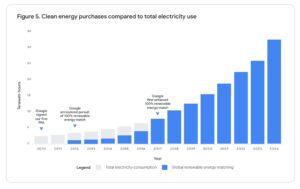
Alphabet remains committed to its climate moonshots, aiming to run its operations on carbon-free energy 24/7. In 2024, it procured over 8 GW of clean energy, the highest in company history and double the amount in 2023.

  • Since 2010, the company has signed more than 170 clean energy deals totaling over 22 GW, nearly equivalent to Portugal’s total renewable energy capacity.

These deals span across North America, Europe, Latin America, and the Asia-Pacific.

In Europe, Alphabet expanded its offshore wind projects in the Netherlands and added new PPAs in Italy, Belgium, and Poland. In Asia, it supported clean energy in India, Japan, Singapore, and Taiwan, customizing agreements to local market needs.

GOOGLE CLEAN ENERGY
Source: Google

Energy Efficiency Across Data Centers: Small Improvements, Big Impact

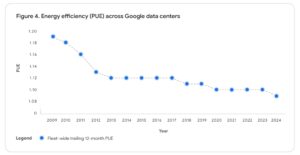
Google or Alphabet is also focused on maximizing energy efficiency across its infrastructure. As per the company’s latest sustainability report, its global data center fleet reached a record low power usage effectiveness (PUE) of 1.09 in 2024. While the improvement from 1.10 may seem minor, it significantly reduces electricity consumption at Alphabet’s scale.

Their custom-designed high-performance servers and smart building technologies further optimize energy use. As a result, Google’s data centers now deliver over six times more computing power per unit of electricity than they did five years ago.

alphabet google
Source: Google

Tackling AI’s Energy Demand with Smarter Computing

With the rapid rise in AI workloads, Alphabet is adapting its infrastructure through “carbon-intelligent computing.” This system shifts computing tasks based on when and where the grid has cleaner energy, helping ease stress on local power networks and cut emissions.

The platform balances compute needs with local energy availability, ensuring users experience uninterrupted service whether they’re watching YouTube, using Google Maps, or interacting with Gemini.

SMRs and Geothermal: Bold Steps Toward 24/7 Clean Power

Alphabet is also leading the charge in advanced energy technologies. In 2024, it became the first company to sign corporate deals for nuclear power from Small Modular Reactors (SMRs). Partnering with Kairos Power, the company aims to add up to 500 MW of clean nuclear energy to U.S. grids by 2035. The first reactor is expected by 2030.

The tech giant also made progress with advanced geothermal projects, helping diversify its clean energy mix and offering reliable, around-the-clock power for its energy-hungry AI systems.

  • READ MORE:
  1. Google Inks World’s Largest Hydropower Deal with Brookfield at $3B to Power AI Growth 
  2. Google Bets Big on Next-Gen Nuclear and Carbon Credits from Superpollutants For a Greener AI

Emissions: Progress, But Scope 3 Still Rising

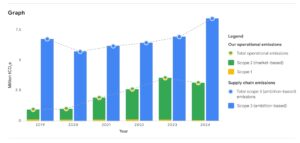
Alphabet’s total ambition-based emissions reached 11.5 million metric tons CO₂e in 2024. While emissions from operations dropped due to cleaner energy use, Scope 3 emissions rose by 22%. It was driven largely by data center expansion and increased hardware production for AI.

alphabet google emissions
Source: Google

Despite this, the company increased its carbon-free energy (CFE) usage across offices and data centers to 66%, and achieved at least 80% hourly CFE in 9 out of 20 global grid regions.

Expanding Carbon Removals

At the same time, Google is working to cancel out any remaining emissions by 2030 using a growing portfolio of carbon credits that deliver real climate benefits. The company is accelerating various carbon removal projects and forming strategic partnerships to reach its net-zero goal.

In 2024, Google expanded its carbon removal portfolio in a big way. It signed 16 new offtake agreements worth over $100 million, covering about 728,300 tonnes of CO₂ removal credits. This brought its total carbon removal portfolio to around 782,400 tonnes—a 14-fold jump compared to 2023.

Real-World Climate Impact at Scale

Alphabet’s sustainability efforts go beyond internal operations. In 2024, five of its products: Nest thermostats, Google Earth Pro, Solar API, fuel-efficient routing in Maps, and Green Light collectively helped reduce 26 million metric tons of GHG emissions. That’s more than twice Alphabet’s total annual emissions and equivalent to the yearly energy use of 3.5 million U.S. homes.

Alphabet Faces Key Challenges on the Road to Net-Zero

The company acknowledges that reaching net-zero emissions by 2030 is getting tougher. One big challenge is the slow progress in clean energy technology. For example, geothermal and small modular nuclear reactors (SMRs) remain costly and require additional government support to expand.

The problem is even more significant in emerging markets, such as the Asia-Pacific. Many of these areas still lack sufficient carbon-free electricity options to support Alphabet’s clean energy goals.

alphabet
Source: Google

Thus, the road ahead is uncertain. AI’s rising energy demand, regulatory volatility, and slower-than-expected clean tech deployment pose serious challenges. For Alphabet, balancing innovation with climate responsibility remains a key test in the years leading to 2030.

The post Alphabet’s (GOOGL Stock) Q2 2025: Growth Soars but AI Challenges Net Zero Goals appeared first on Carbon Credits.
Gevo Launches Carbon Removal Credit Sales, Scales CCS in North Dakota

Gevo, Inc. (NASDAQ: GEVO) expands in the carbon market by selling its first carbon removal credits. A global financial and tech company purchased Puro.earth-certified CO₂ Removal Certificates (CORCs) to offset corporate travel emissions and is ready to retire immediately. These CORCs promise real and permanent CO₂ removal from the atmosphere. They also help buyers achieve their climate goals with measurable and trustworthy results.

The company’s innovative technology makes it a pioneer in sustainable aviation fuel (SAF), renewable gasoline, chemicals, and materials with low-carbon methods. Notably, it operates one of the largest dairy-based Renewable Natural Gas (RNG) facilities in the U.S. These efforts support a clean energy future and also benefit farming communities.

Gevo: Pioneering Carbon Removals with Verified Results

The press release highlights that Gevo’s CORCs provide genuine carbon abatement. Each credit corresponds to actual tons of CO₂ removed through Carbon Capture and Storage (CCS). With these credits ready for retirement, buyers can claim climate benefits right away.

This sale addresses the growing demand for reliable, verifiable carbon removals. As companies want to reduce their carbon footprints, Gevo’s CORCs will provide a strong method to offset emissions, particularly from hard-to-reduce sources like travel.

The next-generation energy company is focused on renewable fuels and chemicals. Its mission has three main goals: energy security, carbon reduction, and rural economic growth.

Significantly, in Q1, Gevo recorded over 100,000 metric tons of carbon abatement, now viewed as a marketable product. This includes captured and sequestered carbon, plus emissions avoided from using low-carbon fuels.

Alex Clayton, Chief Business Development Officer for Gevo, says,

“These are real sales of credits for carbon dioxide removal that are being generated right now. Customers should feel confident in the CORCs we provide due to the rigor Gevo and Puro.earth are putting into every step of the process. We previously said that after our purchase of Gevo North Dakota that we would be selling carbon and that’s what we’re doing.”

North Dakota Ethanol Facility: A Hub for Clean Energy and Carbon Capture

Gevo’s North Dakota ethanol production facility plays a crucial role in capturing and storing CO₂. This plant produces 65 million gallons of low-carbon ethanol annually from 500 acres. Its clean fuels meet demand in areas with strict emissions targets, like Oregon, Washington, British Columbia, and Alberta.

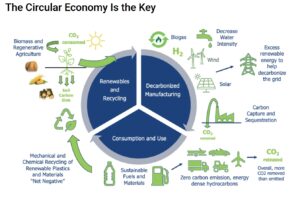
Besides ethanol, the facility generates over 200,000 tons annually of co-products, such as distillers’ grains and vegetable oils, supporting a circular economy.

gevo circular economy
Source: gevo

Permanent CO₂ Storage with Massive Potential

Gevo North Dakota has a Class VI CCS well and lease rights for 5,800 acres in the Broom Creek geological formation. This formation can store up to 1 million metric tons of CO₂ each year. Currently, it sequesters about 180,000 metric tons per year, but Gevo aims to significantly increase this amount.

Gevo
Source: Gevo

The geology allows carbon to stay underground for over 1,000 years, meeting top permanence standards in the carbon removal market. With ample pore space and wellhead capacity, the facility offers long-term growth for sequestered carbon-based credits.

As already mentioned, these CORCs are certified under Puro.earth’s strict standards, ensuring they meet key criteria for permanence, additionality, and traceability. The credits are available now and can be retired immediately for verified decarbonization today—not decades from now.

Fueling the Future with Renewable Products

Gevo’s North Dakota ethanol facility is part of a bigger vision. Ethanol serves as the feedstock for many of Gevo’s downstream products, including alcohol-to-jet (ATJ) fuels and renewable chemicals. These drop-in fuels fit directly into existing infrastructure, speeding up the shift to clean energy.

By producing renewable fuel from regeneratively grown crops, Gevo seeks to change agricultural practices while enhancing the global food supply. The company supports low-carbon farming methods, sourcing feedstocks from sustainable farmers.

Instead of choosing between food or fuel, Gevo uses a “nutrition-first approach”—extracting proteins for food and using starch for fuel. This system maximizes crop value and supports health for both people and the environment.

A Systems Approach to Sustainability

Gevo’s strategy stands out due to its “systems thinking” model. Everything—from feedstock sourcing to production and carbon tracking—is designed for efficiency and transparency. It provides end-to-end monitoring through its Verity subsidiary. This ensures accurate measurement, reporting, and verification (MRV) of sustainability attributes across the supply chain.

This focus on carbon intensity and life cycle impact gives the SAF giant a competitive edge in renewable energy. It also bolsters rural economies by creating jobs, enhancing infrastructure, and attracting long-term investments.

gevo
Source: Gevo

Gevo Leads the Shift: Carbon Capture as a Market Opportunity

The first sale of CORCs is a big step for Gevo. However, it’s just the beginning. The company aims to grow its CCS operations and increase carbon abatement. With strong geological resources, modern infrastructure, and proven technology, it is set to lead in carbon removal and clean fuels.

Traditionally, CO₂ has been seen as waste or used in industries like enhanced oil recovery (EOR). Gevo captures biogenic CO₂ from its operations and then stores the gas underground, keeping it safe and harmless. This method prevents emissions and turns carbon into a valuable asset through CORCs.

As per industry reports, right now, North America and Europe lead the world in CCS development. Together, they make up about 80% of all upcoming capture and storage capacity. However, other regions are beginning to catch up.

carbon capture and storage
Source: DNV

And Gevo is now helping companies offset emissions by monetizing permanent CO₂ removal. This creates a practical market solution and supports clean energy production in the U.S.

In conclusion, Gevo’s entry into the carbon removal market with CORCs underscores its commitment to decarbonization and innovation. By linking renewable fuels with certified carbon capture, Gevo delivers a reliable solution that supports both climate goals and community growth.

The post Gevo Launches Carbon Removal Credit Sales, Scales CCS in North Dakota appeared first on Carbon Credits.
Sol Systems Powers Ahead with $675M Financing Amid U.S. Solar Market Challenges

Solar

Sol Systems, a leading independent power producer (IPP), has secured a $675 million revolving construction finance facility to build out its growing portfolio of solar and storage projects. This milestone move comes as the company ramps up clean energy deployment across the United States, especially in Illinois, Ohio, and Texas.

The funding will support multiple financial needs, including construction loans, tax equity bridge loans, and letters of credit. These resources will back an initial 500 megawatts (MW) of clean energy projects, with the first batch expected to go live by late 2026.

Sol Systems Gears Up for Rapid Solar Rollout

Sol Systems’ ability to land such a large financial package reflects strong investor confidence in its long-term clean energy strategy. The new pipeline includes shovel-ready projects aligned with local and corporate decarbonization goals—helping cities, utilities, and companies meet their climate targets.

With this revolving finance facility in place, Sol Systems is well-positioned to scale up its operations and roll out projects faster. This adds significant momentum to Sol’s mission of delivering clean, reliable energy while creating economic and environmental benefits for communities.

Dan Diamond, Chief Development Officer at Sol Systems, noted,

“We’ve seen long-term energy supply and demand market dynamics drive continued investment into renewables. Customers continue to leverage utility scale solar for cleaner, faster, cheaper generation supply. This sizable financing paves the way for the growth of our IPP platform.”

Backed by Industry Heavyweights

The financing deal was structured by KKR Capital Markets, which served as the placement agent. Sol Systems was represented by Bracewell LLP, while Milbank LLP advised the lender group. The group includes top global banks such as:

  • Banco Bilbao Vizcaya Argentaria (BBVA)
  • ING Capital LLC
  • Intesa Sanpaolo S.P.A.
  • National Australia Bank Limited
  • NatWest
  • Natixis

This syndicate not only highlights the institutional confidence in Sol’s portfolio but also signals robust green financing support for clean energy growth in the U.S.

Additionally, ING Capital LLC took on key responsibilities as Documentation Agent, while ING, Intesa Sanpaolo, and Natixis acted as Joint Green Loan Structuring Agents.

What Sol Systems Brings to the Table

Sol Systems has grown into one of America’s most respected IPPs. The company develops, owns, and manages clean energy infrastructure across 38 states, with a development pipeline of over 7 gigawatts (GW).

What sets Sol apart is its community-centered approach. Beyond installing solar panels, it invests in lasting local benefits. Partnering with schools, utilities, Fortune 500 companies, and municipalities, Sol delivers tailored solar-plus-storage solutions that enhance grid reliability and advance energy justice.

Spotlight: The $345 Million Tilden Solar Project in Illinois

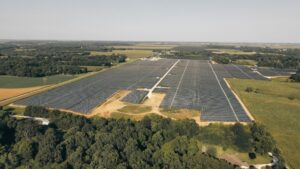
A prime example of Sol’s impact-driven approach is the Tilden Solar Project in Randolph County, Illinois. Announced in January 2025, this 182-MW solar farm is currently under construction on a 1,050-acre site that was once part of a historic underground mine.

Here’s a picture of the project:

Tilden sol systems
Source: Sol Systems

Once complete, Tilden will produce enough clean energy to power approximately 33,800 homes annually. The $345 million project stands as a symbol of energy transformation—turning a once carbon-intensive mining site into a hub for renewable power and local economic renewal.

The financial close was made possible by a strong group of partners, including: ING, Churchill Stateside Group, Qcells, Nextracker, McCarthy Building Companies

The Tilden project is vital because it solves a long-standing land-use challenge in Illinois. The state is home to 840,000 acres of underground mines, which limit traditional infrastructure development due to unstable surface conditions.

Sol Systems’ Solar Renewable Energy Certificate (SREC) Expertise

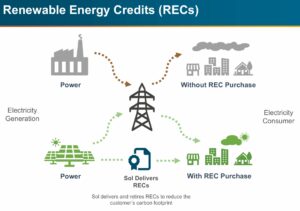
Sol Systems is also known as one of the oldest and most trusted SREC (Solar Renewable Energy Certificate) aggregators in the country. Through its SREC monetization programs, the company helps homeowners and solar asset owners turn green energy generation into financial gains.

According to the EPA, RECs (Renewable Energy Certificates) play a vital role in tracking and assigning the benefits of clean electricity. A single REC represents 1 megawatt-hour (MWh) of power from renewable sources. These credits allow companies to make credible Scope 2 emissions reductions by claiming the renewable attributes of the electricity they purchase.

solar credits sol systems
Source: Sol System

Can Solar Companies Keep Up with Trump’s OBBB Deadline?

The U.S. government recently passed the “One Big, Beautiful Bill” (OBBB), marking a major shift in federal clean energy support. Backed by Senate Republicans and aligned with President Trump’s energy agenda, the bill imposes tighter deadlines and reduces incentives for solar and wind developers.

For years, the solar industry relied on stable tax credits to fuel growth and attract investment. Under the new rules, developers must begin construction by July 4, 2026, and finish within four years to qualify for the Investment Tax Credit (ITC) and Production Tax Credit (PTC). Projects starting later must be fully operational by December 31, 2027, to receive any federal tax benefits.

This compressed timeline adds pressure. A key change is the early expiration of the 30% residential solar tax credit, now ending in December 2025. The shift may curb consumer interest and slow rooftop solar adoption

However, amid tightening federal incentives and industry slowdowns, some companies are showing strong resilience. Like Sol Systems, SolarBank Corporation (NASDAQ: SUUN) is one such example. The company is proactively navigating the changing regulations and has secured $100 million in project funding from CIM Group.

The funding will help SolarBank fast-track its 97 MW U.S. portfolio, meet federal deadlines, and secure incentives ahead of delayed competitors.

Yet Solar’s Long-Term Outlook Shines

According to the Q2 2025 U.S. Solar Market Insight report by Wood Mackenzie, the U.S. added 10.8 gigawatts-direct current (GWdc) of new solar capacity in the first quarter. Although this seems like strong growth, it represents a 7% decline from the same period in 2024 and a steep 43% drop from Q4 2024.

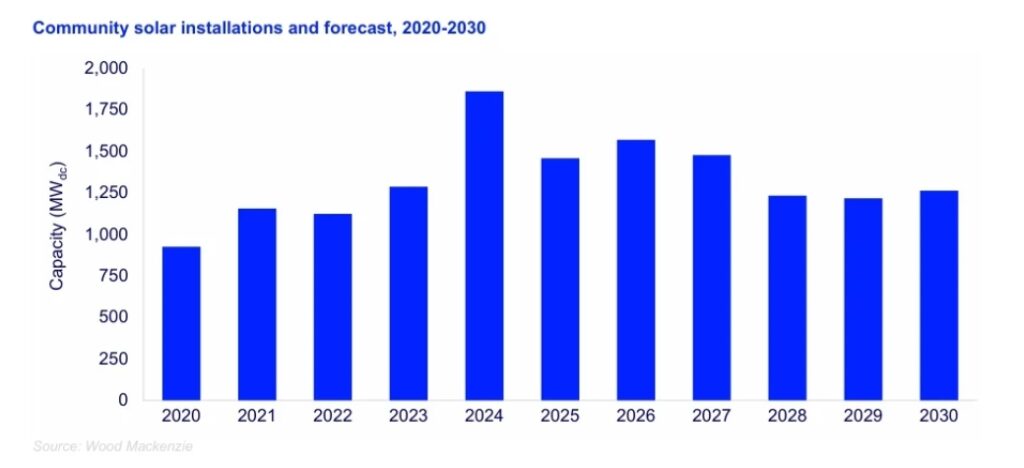
Most significantly, the community solar sector experienced a 22% decline in installations during the first quarter of 2025.

community solar
Source: Wood Mac

Several challenges, including rising equipment costs, trade tensions, and policy uncertainty, have made it harder for developers to launch new projects and for customers to invest in solar energy. Despite challenges, there is still optimism.

solar growth US.
Source: Wood Mac

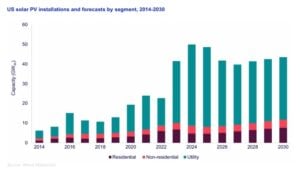
The same report projects that the U.S. will add around 43 GWdc of new solar capacity each year through 2030, driven by strong demand from utilities, corporations, and state programs. In this landscape, Sol Systems plays a pivotal role in advancing clean energy, bringing more solar sunshine and sustainable power to communities nationwide.

The post Sol Systems Powers Ahead with $675M Financing Amid U.S. Solar Market Challenges appeared first on Carbon Credits.

Enbridge Powers Meta Data Centers with $900M Texas Solar Investment

Enbridge Powers Meta Data Centers with $900M Texas Solar Investment

Enbridge, traditionally a pipeline and gas infrastructure giant, is moving into renewable power in partnership with Meta, the company that owns Facebook, Instagram, WhatsApp, and Messenger. Enbridge committed $900 million to build the 600 MW Clear Fork Solar Project near San Antonio, Texas.

A long-term deal will have 100% of the project’s clean energy to power Meta’s regional data centers. This supports Meta’s sustainability goals and shows major shifts in how tech giants get their electricity.

America’s New Solar Powerhouse

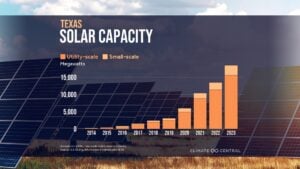
Texas leads the U.S. in energy production. The state ranks first in wind and second in solar generation. Texas is expected to have a cumulative capacity nearly doubling to 80 GW by 2030.

Such rapid growth will meet the rising electricity demand from data center expansions. Companies like Oracle, OpenAI, and Google are all adding gigawatts of power load.

Texas is becoming a leader in clean energy. It already ranks first in wind power and second in solar in the U.S.

Texas solar capacity
Source: Climate Central

The state’s wide-open land, strong sun, and business-friendly rules make it perfect for solar farms. In fact, its expected yearly additions are enough to power millions of homes.

Big tech companies are also setting up large operations in Texas. These companies need huge amounts of energy. As more data centers open, Texas’s energy demand is rising fast.

The Electric Reliability Council of Texas (ERCOT) says the state’s total energy needs could double by 2030. Solar power will play a key role in meeting this growth. Projects like Clear Fork help ensure that new energy demand is met with clean, renewable power.

Meta has 6.7 GW of renewables in the U.S. and 11.7 GW worldwide. It needs more clean energy to support its growing data infrastructure. The Clear Fork project helps deliver reliable, cost-effective solar power under a power purchase agreement (PPA).

For Enbridge, the deal brings profits starting in 2027. It also boosts its ESG credentials by moving from fossil-heavy assets to clean energy.

Scaling Solar for Energy-Hungry Data Centers 

Data centers are the engines of the internet. They run everything from emails to artificial intelligence. But they also use a lot of electricity. In 2024, data centers in the U.S. consumed over 46,000 megawatts (MW) of power. That number is expected to double by 2029.

US utility power demand from data centers 2029
Source: S&P Global

Texas is seeing many new data centers built. These facilities need clean, reliable energy around the clock. This is where solar power comes in.

With big solar projects like Clear Fork, energy companies can deliver affordable and clean electricity. Enbridge’s project will supply 600 MW—enough to power thousands of homes or several data centers.

To make solar work even when the sun doesn’t shine, companies are adding battery storage. These batteries can save extra energy during the day and release it at night. This helps data centers stay online 24/7. With Meta’s partnership, Clear Fork becomes a model for how clean energy can support the future of digital life.

From Gas to Gigawatts: Enbridge’s Solar Surge

The Clear Fork project is just one of several major renewables investments by Enbridge. In November 2024, it started the 585 MW Sequoia Solar Project in Texas. It is also building the Fox Squirrel solar facility, which has 577 MW in Ohio. This project is in partnership with EDF Renewables and is set to power Amazon data centers.

In Wyoming, Enbridge leads a 771 MW solar project, marking a substantial entry into a state with just 330 MW of solar capacity before 2025.

These megaprojects align with Enbridge’s pivot strategy. The company balances traditional energy assets with new renewables to ensure stable long-term cash flow, even amid volatile commodity prices.

Jobs, Dollars, and Sunshine: Solar’s Ripple Effect

Utility-scale solar projects like Clear Fork bring more than clean energy. They spur local development, create hundreds of construction jobs, and increase tax revenues.

Recent Texas projects, like EdgeConneX’s $440 million data center in Bastrop County, have created thousands of construction jobs. They also provide long-term employment opportunities.

Texas regulators are looking at ways to improve transmission lines and increase grid capacity. They also want to balance the abundant solar energy during the day with energy storage. This will help ensure a reliable supply for facilities that operate 24/7.

As the solar-powered building boom continues, lawmakers grapple with how to prevent solar or wind opposition from limiting clean-energy growth.

Meta’s Sustainability Strategy: Building the Cleanest Cloud on Earth

Meta’s deal reinforces tech companies’ strategies to secure renewable energy certainty. Recent PPAs include a 791 MW deal with Invenergy covering multiple states and a 595 MW agreement with Zelestra in Texas. These deals align with commitments to 100% clean energy and support AI infrastructure demands.

Meta is rapidly growing its global data center footprint to support its AI and cloud services. New plans include large superclusters like the 5 GW “Hyperion” in Louisiana and the 1 GW “Prometheus” in Ohio. These centers will support high-demand AI workloads.

The company has already invested over $68 billion in capex over the past 18 months and holds 11.7 GW of contracted renewable capacity, with 6.7 GW live in the U.S.

Meta matches 100% of its data center electricity with renewable energy and achieves LEED Gold or higher certification across all facilities. Its centers average a PUE of 1.09 and WUE of 0.18, reflecting top-tier energy and water efficiency.

The tech giant also recycles 91% of construction waste. The company is exploring innovative technologies like geothermal and nuclear power to meet growing energy needs while staying aligned with its goal of net-zero emissions by 2030.

Meta’s deal reinforces tech companies’ strategies to secure renewable energy certainty. Recent PPAs include a 791 MW deal with Invenergy covering multiple states and a 595 MW agreement with Zelestra in Texas. These deals align with commitments to 100% clean energy and support AI infrastructure demands.

Meta renewable energy projects map
Source: Meta

For utilities and energy developers, long-term PPAs with tech partners are a lifeline. They provide the financing needed to build big solar farms while offering companies the green credentials they need for sustainability reporting and ESG goals.

Blueprint for a Solar-Powered Internet Future

Enbridge’s $900M commitment to the 600 MW Clear Fork Solar Project marks a key moment in clean-energy and data industry integration. It reflects a broader trend: utilities partnering with tech giants to secure reliable, sustainable energy for rapidly expanding data infrastructure.

By pairing large-scale solar with long-term PPAs, Enbridge and Meta are not just meeting sustainability goals—they’re helping create the blueprint for how future data-demand growth can be powered cleanly, affordably, and reliably.

The post Enbridge Powers Meta Data Centers with $900M Texas Solar Investment appeared first on Carbon Credits.
Top 5 Sustainable Bitcoin Mining Companies To Watch Out For

Top 5 Sustainable Bitcoin Mining Companies To Watch Out For

Bitcoin mining has historically been linked to high energy use and environmental concerns. However, some companies are changing this image by using renewable energy, practicing transparency, and following strong governance principles. These miners show that it is possible to grow profits while reducing environmental impact.

Before we get to know the top sustainable bitcoin mining companies to put on your radar, let’s learn why sustainability is crucial in this space.

Why Greener Mining Matters: Bitcoin’s ESG Future

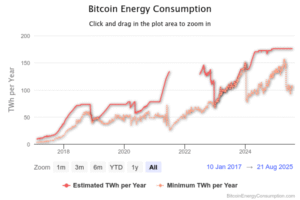
Bitcoin’s method of securing its network uses a lot of electricity. This has drawn criticism because most mining still depends on fossil fuels. And thus, sustainable miners are working to separate Bitcoin growth from carbon emissions.

bitcoin energy use
Source: Digiconomist

As governments and investors seek cleaner energy, companies using renewables can gain. They will enjoy better market access and face fewer regulatory issues.

Sustainable mining also helps communities and local power grids. Some miners locate near renewable power sources where they can take advantage of excess energy and even support grid stability. Clear operations lower environmental and noise issues. This helps build strong ties with local residents.

Moreover, renewable energy often lowers costs, sometimes to less than one or two cents per kilowatt-hour. This reduces the cost to mine each Bitcoin and protects miners from fossil fuel price swings. Since Bitcoin rewards decrease over time, miners with cheap power will stay profitable longer.

In a crowded marketplace, miners that demonstrate a commitment to clean energy can stand out. Certifications and carbon offsets boost their reputation. They also attract investors looking for responsible, future-proof miners. Speaking of, here are the top five  bitcoin mining companies showcasing their sustainable, greener operations. 

1. Gryphon Digital Mining: Carbon-Negative Mining Using Hydroelectric and Flare Gas Power

Gryphon Digital Mining is among the first publicly traded Bitcoin miners focused on being carbon-neutral, and now carbon-negative. In 2023, over 98% of its electricity came from renewable sources, mainly hydroelectric power, reaching 100% early in 2024. This was confirmed through independent audits.

The company got a sustainable Bitcoin certification, showing its dedication to clear environmental goals. Gryphon regularly publishes its full emissions data, providing transparency for investors. It also links executive pay to sustainability achievements, ensuring accountability.

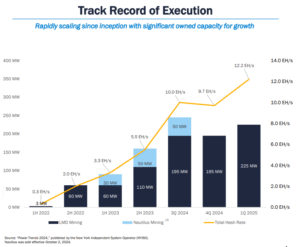
Gryphon’s mining fleet works efficiently and uses about 28.6 joules for each terahash. This setup produces nearly one exahash of computational power every second. In 2024, it produced Bitcoin valued at millions of dollars monthly, maintaining high uptime and low power costs. The acquisition of flare gas-powered mining assets increased capacity. It costs about one cent per kilowatt-hour.

Gryphon projects a pipeline of 500 megawatts in new clean energy projects, including flare gas sites. It recently bought a large industrial property in Alberta to expand. With new leaders, the company plans to hit several exahashes per second soon. They will focus on using sustainable energy sources.

Gryphon bitcoin
Source: Gryphon

ESG, Growth, and Strategy

  • In 2023, GP4BTC received sustainable Bitcoin certification from Energy Web. This was part of a new effort to standardize energy measurement in mining.
  • Plans a 500 MW pipeline of low-cost power projects. This includes flare gas acquisition in Louisiana. It adds 59 PH/s right away at about 1¢/kWh.
  • Recently bought an 850-acre industrial site in Alberta for future growth. This move comes under their new CEO, Steve Gutterman. He previously grew TRADE Financial from $1B to $35B in assets.
  • Planning to expand hash rate toward multiple EH/s by mid‑2020s, supported by clean power sourcing and carbon-negative posture.

2. CleanSpark: Multi-Source Renewable Energy and Community-Focused Mining

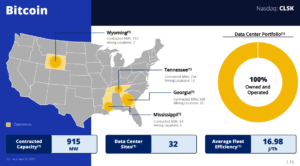
CleanSpark shifted from energy services to Bitcoin mining with a strong environmental commitment. Its mining data centers are in New York, Georgia, and Mississippi. They get about 94% of their power from carbon-free sources like nuclear, hydro, wind, and solar.

CleanSpark
Source: CleanSpark

One key partnership is with Coinmint, which operates a large hydro-powered facility in New York. This site reports nearly full uptime and plans to reach 100% renewable power. CleanSpark also emphasizes immersion cooling technology, which extends equipment life by reducing heat and energy use. This reduces electronic waste and lowers overall power demand.

The company talks to local leaders before building new facilities. This way, they can address concerns and show benefits, which helps gain social acceptance.

CleanSpark aims to boost its mining capacity from one exahash per second to two. The company is focused on using clean power for this growth.

The company has deep roots in the energy industry since 1987. This experience helps them manage power costs and join grid programs that reward flexibility in demand. It aims for net-zero emissions of direct and indirect operations by 2027.

Targets, Expansion, and Positioning

  • CleanSpark has energy infrastructure from 1987. This gives it an edge in negotiating demand-response and grid service programs.
  • Through ATL Data Centers and Coinmint, CleanSpark exceeded 470 PH/s earlier in 2022, mining 3,768 BTC (over time) and averaging ~4 BTC/day at peak.
  • It aims for net-zero Scope 1 and 2 emissions by 2027. Also, it plans to increase capacity from about 1 EH/s to 2 EH/s and more. The focus will be on keeping a high clean energy share.

3. TeraWulf: Mining Powered by Nuclear and Hydroelectric Energy at Low Cost

TeraWulf runs two major Bitcoin mining sites in the United States. The Lake Mariner facility in New York mostly uses electricity from hydro and nuclear sources. This means it provides about 91% zero-carbon power. The company owns this big operation that has about 110 megawatts of capacity. Plus, it offers over 3.6 exahashes per second of computing power.

The Nautilus Cryptomine site in Pennsylvania uses nuclear power from the Susquehanna plant. It is partly owned and run with partners. This setup cuts electrical costs to about two cents per kilowatt-hour. This boosts profitability.

After selling its stake in the Nautilus project, TeraWulf reinvested capital into expanding Lake Mariner. The company plans to reach approximately 238 megawatts of total capacity by late 2024. It favors the most energy-efficient mining hardware and aims for 100% clean energy powering its operations.

Terawulf
Source: Terawulf

Performance Metrics and Strategic Growth

  • By mid-2023, TeraWulf had scaled to around 5.5 exahashes per second and 160 megawatts of mining capacity. It maintained a low cost per Bitcoin mined, well below industry averages.
  • In Q2 2024, the company raised its capacity to around 10 exahashes per second. This change led to a 130% year-over-year revenue boost.
  • TeraWulf plans to keep using the best mining hardware, like the Bitmain S19 XP Pro and S19 j Pro, which have around 21.5–29.5 J/TH efficiency. They also aim to expand their zero-carbon power sourcing to 100%.

4. Iris Energy: Scaling 100% Renewable Bitcoin Mining and AI Compute Ventures

Based in Australia, Iris Energy, now known as IREN operates mining sites in Canada, Texas, and Australia. Its energy mix is mostly hydroelectric power. It also includes wind, solar, and renewable energy certificates. This adds up to around 97% renewable power.

Iris Energy locates modular mining facilities in regions with a surplus of clean energy. These sites turn extra renewable electricity into Bitcoin. This helps balance local grids and supports communities.

The company owns its land, data centers, and grid connections. This gives it full control over energy use and mining efficiency.

Although it posted modest losses in fiscal 2025, forecasts predict positive earnings in the near future. Institutional investors show interest, partly due to the company’s clean energy commitment.

Iris also develops AI computing services powered entirely by renewable energy. These high-performance GPU clusters provide additional revenue streams alongside Bitcoin mining.

Metrics, Market Position, and Growth

  • The stock is attracting strong institutional interest with an A+/A‑ ratings from IBD and a top relative strength score of 98.
  • By mid-2025, Iris Energy operated at an estimated 50 exahashes per second and reported strong sales growth (172%).
  • Iris offers AI-driven cloud services, powered by renewable-energy-fed GPU clusters (e.g. NVIDIA H100). This adds a higher-margin revenue layer atop its Bitcoin business.
  • The company aims to reach 20 exahashes per second by 2026. It is also looking into green hydrogen and more renewable energy projects.

5. Bitfarms: Hydroelectric Mining with Expanded High-Performance Computing

Bitfarms operates mining facilities in Québec, Washington State, Argentina, and Paraguay. These sites primarily use hydroelectric energy, allowing for 95 to 99% renewable power consumption.

The company has a complete environmental, health, and safety management system. Its board oversees this system. It has teamed up with recycling groups to handle electronic waste properly. This effort creates verified carbon credits.

In 2023, Bitfarms operated approximately 5 exahashes per second in Argentina and aimed to increase to around 6 exahashes. The company has shifted part of its focus to U.S. sites, which offer favorable energy prices and market conditions. Bitfarms also invests in high-performance computing and AI infrastructure.

However, not all developments have been smooth. In Paraguay, a mining facility created loud noise pollution. This bothered local residents and led to legal complaints. It still relied on extra hydroelectric power. Bitfarms has since taken steps to resolve these issues. This case highlights the need for miners to manage community impacts carefully.

The company has restructured its operations into divisions. One focuses on traditional mining, and the other covers broader computing services.

Performance, Social Dimensions, and Future Roadmap

  • By Jan 2025, the operating hash rate reached ~12.8 EH/s, with a strategic shift toward U.S. facilities to leverage favorable power and market access. 
  • Total energy portfolio exceeded 950 MW, with flexibility across Bitcoin mining and HPC/AI operations.
  • Developing a 120 MW high-performance computing and AI site in Sharon, Pennsylvania, within the PJM grid—seeking to monetize infrastructure across both mining and HPC sectors.
Bitfarms
Source: Bitfarms

Clean Hashes, Clear Conscience: A New Era in Bitcoin Mining

The five companies profiled here—Gryphon Digital Mining, CleanSpark, TeraWulf, Iris Energy, and Bitfarms—illustrate the evolving landscape of sustainable Bitcoin mining. Each company combines renewable power, transparency, and strategic growth with a commitment to environmental responsibility.

Gryphon leads with carbon-negative mining and flare gas utilization. CleanSpark emphasizes multi-source renewables and community engagement. TeraWulf focuses on nuclear and hydro to minimize costs.

Meanwhile, Iris Energy specializes in modular, 100% renewable operations and diversifies into AI computing. And Bitfarms leverages hydroelectric sites and expands into high-performance computing while managing community challenges.

Overall, sustainable bitcoin mining is becoming essential. With rising energy scrutiny, investor demand for climate alignment, and stricter regulations, these firms offer scalable models that align economic growth with ecological responsibility.

The post Top 5 Sustainable Bitcoin Mining Companies To Watch Out For appeared first on Carbon Credits.

Base Carbon: A Rising Force in the Voluntary Carbon Market

Base Carbon Inc. (NEO: BCBN) has quickly become a key player in the voluntary carbon market. It shows strong financial results and plans for growth. Its expanding portfolio of carbon offset projects helps global sustainability efforts. Through a combination of innovative projects, careful asset management, and strategic partnerships, Base Carbon is positioning itself as a leader in an increasingly critical industry.

Financial Performance and Strategic Moves

In the first quarter of 2025, Base Carbon reported a comprehensive income of $518,000. This marks a significant recovery from a loss of $19.8 million in the same period last year. This improvement mostly came from net cash of $789,621. This cash was generated by selling carbon credits from the Vietnam water purifier project. The ability to convert carbon credits into a reliable cash flow is a key indicator of Base Carbon’s maturity and market relevance.

Base Carbon has a strong balance sheet. Total assets are $112.3 million. This includes $13.4 million in cash reserves and $25.6 million in carbon credits. This large inventory shows the company’s commitment to generating carbon credits. It also shows that the company is ready to take advantage of changing market demand.

To boost shareholder value, the company bought back over 0.7 million shares in Q1 2025. After the quarter, it repurchased another 3.75 million shares. This reduced the total outstanding shares to 104.75 million. These buybacks show that Base Carbon believes in its value and future. They also help boost earnings per share over time.

Insider Confidence and Strategic Partnerships

Abaxx Technologies Inc., a key stakeholder in Base Carbon, showed strong confidence. In May 2025, it boosted its holdings by buying 3.7 million common shares through a private deal. Abaxx’s increased investment shows its confidence in Base Carbon’s strategy and growth.

Insiders, like company management and affiliates, hold a big stake in Base Carbon’s shares. This connection between leadership and shareholders shows that Base Carbon’s executives care about the company’s success. This builds trust with outside investors.

The company also has strong partnerships with tech providers and local groups. These connections help with the rollout and checking of carbon offset projects. These partnerships are key to making Base Carbon’s initiatives credible and scalable in the voluntary carbon market.

Project Portfolio: Diverse Initiatives Driving Carbon Credit Generation

Base Carbon’s expanding portfolio includes projects that create high-quality carbon credits. These projects tackle important environmental issues in various regions.

Vietnam Water Purifier Project

This project has been a cornerstone of Base Carbon’s success. The initiative uses affordable water purification technologies in rural Vietnam. This cuts down the need to boil water. Boiling usually uses biomass fuels like wood and charcoal, which release a lot of greenhouse gases. This project creates verified carbon credits. It does this by reducing carbon dioxide (CO2) emissions from household cooking and boiling.

Since its inception, the Vietnam project has delivered total cash payments of approximately $35.2 million. This amount covers the full repayment of the invested capital and adds a net cash gain of about $14.4 million. This shows that the project is financially viable and has environmental benefits too.

Rwanda Cookstoves Project

Base Carbon is moving forward with its Rwanda Cookstoves Project. This project aims to cut emissions by providing efficient cooking stoves. Traditional cookstoves in Rwanda use firewood poorly. This leads to deforestation and high CO2 emissions.

The project provides clean cookstoves. These stoves use less fuel, so they cut emissions and boost indoor air quality for local communities.

This initiative will create many carbon credits. It supports Base Carbon’s promise to offset carbon responsibly. Plus, it offers health and environmental benefits at the same time.

India Afforestation, Reforestation, and Revegetation (ARR) Project

Base Carbon’s ARR project in India focuses on restoring forests. It aims to reforest and rehabilitate ecosystems in damaged areas. Forests act as natural carbon sinks, absorbing CO2 from the atmosphere. This project will sequester carbon through afforestation and reforestation. It will also help conserve biodiversity and protect watersheds.

The ARR project is on track to issue its first batch of carbon credits in the second half of 2025. Once it starts, it will diversify Base Carbon’s credit portfolio. It will also create long-term, sustainable environmental benefits.

Base Carbon’s Role in the Voluntary Carbon Market

The voluntary carbon market (VCM) lets companies, governments, and people buy carbon credits. They do this to offset their greenhouse gas emissions. The VCM works differently from compliance markets. It relies on voluntary participation. This allows various participants to invest in carbon reduction projects around the globe.

Base Carbon’s role in this market is multifaceted:

  • Project Developer. Base Carbon starts and runs carbon offset projects. This creates verified carbon credits that meet strict international standards, like the Verified Carbon Standard (VCS) and Gold Standard. These certifications ensure the environmental integrity and additionality of the credits.

  • Carbon Credit Monetizer. Base Carbon makes money by selling carbon credits. This is shown by its recent success with credits from the Vietnam project. This ability to turn carbon assets into cash boosts the company’s finances. It also provides capital for future projects.

  • Market Participant and Innovator. The company trades carbon credits and looks for new ways to improve liquidity and price discovery in the voluntary carbon market. Base Carbon is also involved in new projects like blockchain-based carbon registries. These digital marketplaces boost transparency and lower transaction costs.

Sustainability Initiatives and Future Growth Prospects

Base Carbon also invests in sustainability projects. These efforts strengthen its role as a responsible environmental steward.

  • Community Engagement. Base Carbon focuses on collaborating with local communities. This way, projects provide both social and environmental benefits. This includes training and education programs, health improvements, and economic opportunities linked to project activities.

  • Technology Integration. The company uses technology to improve monitoring, reporting, and verification (MRV) of carbon offsets. Tools such as satellite images, IoT sensors, and blockchain boost the accuracy and trust of carbon credit data.

  • Expansion Pipeline. Base Carbon is looking at new projects in areas where emissions can be cut. These include Latin America and Southeast Asia. Expanding its reach will diversify carbon credit sources. This will help reduce risks tied to project concentration.

  • Carbon Market Advocacy. The company joins industry forums and works with policymakers. They aim to strengthen standards and ensure transparency in the voluntary carbon market.

Ensuring Integrity: The Importance of Carbon Credit Verification

A key part of Base Carbon’s work is its strict verification process for carbon credit projects. Carbon credits represent measurable, quantifiable reductions or removals of greenhouse gas emissions. To ensure these credits hold real value — both environmentally and commercially — they must be verified by independent third parties following recognized standards.

International Standards and Protocols

Base Carbon follows global standards to make sure its credits are trustworthy. Some of the most commonly used standards include:

  • Verified Carbon Standard (VCS): Developed by Verra, VCS is one of the most widely used standards in the voluntary carbon market. It provides detailed methodologies for different project types, including forestry, renewable energy, and energy efficiency.

  • Gold Standard: The standard focuses on sustainable development. It certifies projects that improve social and environmental outcomes while also reducing carbon emissions.

  • Climate, Community & Biodiversity Standards (CCB): CCB standards often work with VCS. They ensure that projects help local communities and support biodiversity conservation.

Base Carbon makes sure all projects get verified under these frameworks. This boosts market confidence and makes trading carbon credits easier.

Monitoring, Reporting, and Verification (MRV)

A robust MRV system is vital for ongoing credibility. Base Carbon uses advanced tools like satellite imagery, remote sensing, and IoT sensors. These help track project performance and measure emission reductions all the time. Data collected are analyzed and compiled into detailed reports submitted to certifying bodies.

Third-party auditors review these reports regularly, usually once a year. They issue verification statements that confirm the amount of carbon credits that can be issued.

The Role of Blockchain and Digital Registries

To increase transparency and reduce fraud risks, Base Carbon is exploring blockchain-based carbon registries. These digital platforms securely log carbon credit transactions and ownership. This helps buyers track the credits’ lifecycle and check their authenticity. Base Carbon wants to use blockchain technology. This will help create new standards for trust and efficiency in the voluntary carbon market.

A Company Poised for Impact and Growth

Base Carbon is showing a strong financial turnaround. Their strategic share repurchases and insider investments indicate growth in the voluntary carbon market. Its growing and varied project portfolio in Asia and Africa brings real environmental benefits and economic value for investors.

Base Carbon stands out with strong partnerships, new ways to make money from carbon credits, and a real focus on sustainability. This makes it an attractive option for those wanting to invest in meaningful environmental solutions. As the voluntary carbon market grows in importance amid global climate goals, Base Carbon’s proactive strategies and solid foundations position it well for sustained growth and leadership in the carbon offset space.

The post Base Carbon: A Rising Force in the Voluntary Carbon Market appeared first on Carbon Credits.
How Energy Efficiency and Clean Investment Are Boosting Emission Reductions and Net Zero

How Energy Efficiency and Clean Investment Are Boosting Emission Reductions and Net Zero

Energy efficiency is emerging as a critical tool in the global fight against climate change. The International Energy Agency (IEA) shows that efficiency delivers more than just lower energy use and emissions—it offers broad financial, environmental, and social benefits. Meanwhile, global investment in clean energy is reaching record highs, signaling a shift toward a greener future. Let’s explore how efficiency and new funding are transforming the energy landscape.

Unlocking the Many Benefits of Energy Efficiency

Energy efficiency is much more than a way to save electricity or fuel. It fuels economic growth, boosts health, and strengthens energy security. When buildings and factories use less energy, they cut both greenhouse gas emissions and energy bills. The benefits include:

  • Better Health: Good insulation in homes and efficient heating systems mean less pollution inside and outside.
  • More Jobs: Projects that focus on saving energy create about 2 to 3 times more jobs for every dollar spent compared to projects that use fossil fuels. 
  • Businesses Do Better: Companies save a lot of money on energy. Some industries cut their energy costs by as much as 20%
  • Government Savings: The IEA says governments could save over $100 billion each year by having better energy-saving policies.

The agency further says every dollar spent on energy efficiency brings back $1.5 to $2.5 in economic value. This includes energy savings, health benefits, and job creation. This “multiple benefits” approach ensures policymakers and businesses see efficiency not just as a cost saver but as a driver of prosperity.

More notably, energy efficiency is incredibly important for cutting down on pollution. It helps our energy system become cleaner and more reliable by reducing harmful greenhouse gases and air pollutants.

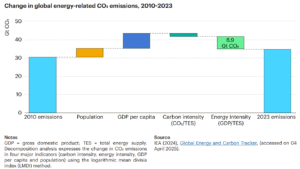
In fact, since 2010, the energy saved through efficiency measures has prevented CO₂ emissions equal to nearly 20% of the world’s total in 2023. That’s more than the combined energy-related emissions of both India and the European Union!

Looking ahead, if the world improves efficiency quickly, it could reduce CO₂ emissions by a third by 2030. This would be key for reaching net-zero goals by 2050. And this would make efficiency the largest contributor among all energy sectors or technologies.

IEA report energy efficiency ghg emissions
Source: IEA

Global CO₂ emissions rose by about 15% from 2010 to 2023. This was mainly due to population and economic growth. However, energy efficiency was key. It cut nearly 7 billion tonnes of CO₂ during that time, helping to reduce the overall increase.

Investing in a Clean Energy Future: $3.3 Trillion and Growing

Global investment in energy reached an estimated $3.3 trillion in 2025, a 2% increase from 2024, according to the IEA’s World Energy Investment 2025 report. Out of this, $2.2 trillion goes to renewables, nuclear, grids, storage, low-emission fuels, efficiency, and electrification. That’s more than double the $1.1 trillion spent on oil, gas, and coal.

energy investment 2025 IEA report
Source: IEA Report

Key highlights of the report findings include:

  • Solar energy: This is the leader in clean energy investment, with $450 billion going into it. This makes it the biggest single area of energy spending in the world. It has almost doubled in the last five years because it’s become very cheap and is being used more in developing countries.
  • Battery storage: Money for batteries that store power went up to about $66 billion. These batteries help make sure renewable energy is steady and available when needed.
  • Nuclear power: Investment in nuclear power grew by 50% over the last five years, reaching over $70 billion. This is because more people are interested in new, smaller nuclear reactors.
  • Power grids: About $400 billion is spent each year on electricity grids around the world. But this isn’t enough to handle the growing demand for electricity and the spread of renewable energy. The IEA says we need to almost double grid investment to keep our electricity supply secure and help the energy switch.
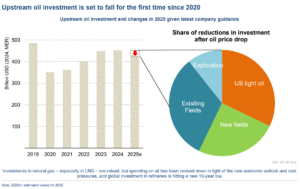
  • Oil and gas: Investment in finding new oil dropped by 6% in 2025. This is the biggest drop since 2016 and shows less interest in oil. But investment in natural gas stayed steady, helped by new projects that make liquefied natural gas (LNG). The amount of LNG we can export is expected to nearly double by 2028.

Upstream oil investment IEA

  • Low-pollution fuels: Investment in fuels that produce less pollution reached a new high, but it’s still small at less than $30 billion. If all planned projects go through, investment in capturing carbon pollution could grow more than ten times by 2027.

Clean hydrogen and nuclear are gaining momentum. Investment in nuclear energy, especially small modular reactors or SMRs, is growing quickly. At the same time, clean hydrogen projects benefit from new policies and increasing market interest. Hydrogen investments are expected to nearly double in 2025 compared to 2024.

Why Efficiency and Investment Must Go Hand in Hand

As investments shift to clean technologies, energy efficiency remains essential to amplify impact. Efficiency reduces energy demand, cutting the scale and cost of clean energy infrastructure needed.

To hit the COP28 energy intensity target of a 4% annual improvement, the world needs to nearly triple investment in efficiency and electrification in the next 5 years. Without this boost, the energy transition risks stalling despite growing clean power capacity.

Efficiency supports broader clean energy goals by:

  • Boosting solar and wind productivity cuts the cost of clean energy per unit.
  • Cutting peak electricity demand helps ease pressure on grids. It also reduces the need for expensive infrastructure upgrades.
  • Helping homes and businesses use clean heating, cooling, and electric vehicles is key. This approach lowers both initial and ongoing costs.

Pairing efficiency with clean power investment allows countries to progress faster, cheaper, and more reliably in their climate and net-zero goals.

Real-World Impact: Efficiency and Renewables at Work

Countries embracing both efficiency and investment reap multiple gains:

  • Europe: New energy-saving rules and investments in solar and batteries have lowered electricity bills by up to 15% in some areas. They also help cut pollution.
  • India: More rooftop solar panels and energy-efficient appliances have given over 100 million people access to cleaner, cheaper power.
  • United States: Energy efficiency programs supported over 3 million jobs in 2024 and cut residential energy use by 8%.

These examples show that aligned policy, investment, and technology make energy systems cleaner, more reliable, and more equitable.

Energy efficiency and clean energy investment are vital partners in the global energy transition. Efficiency not only saves energy and lowers emissions but also supports health, jobs, and economic growth. At the same time, clean energy investment is reshaping power systems worldwide. Together, they form the backbone of a durable, affordable, and equitable net-zero future.

The post How Energy Efficiency and Clean Investment Are Boosting Emission Reductions and Net Zero appeared first on Carbon Credits.
JPMorgan, Microsoft Back $210 Million Carbon Loan in Landmark Climate Finance Deal

JPMorgan, Microsoft Back $210 Million Carbon Loan in Landmark Climate Finance Deal

JPMorgan Chase closed a landmark $210 million carbon loan to support Chestnut Carbon, a U.S.-based afforestation firm, in a move that could reshape how climate projects are financed. Microsoft also played a key role in this breakthrough. They committed to buying a large share of the high-quality carbon removal credits from the project.

The dual involvement of a leading global bank and a major tech firm shows rising trust in nature-based carbon removal. It is seen as a real, profitable asset class. 

JPMorgan’s Climate Finance and Advisory team, ERM (an environmental consulting firm), and Chestnut Carbon formed a partnership that made the transaction possible. It shows a change in how carbon projects are financed. This is especially true for nature-based solutions, like afforestation.

Other major lenders include CoBank, Bank of Montreal, and East West Bank. So, what makes this funding different from existing climate financing models? Let’s find out.

How the Financing Structure Works

The deal marks the largest-ever non-recourse project financing in the voluntary carbon market (VCM). The program, funded by future carbon credit revenues, aims to plant forests and remove CO₂ across the U.S. for 30 years.

Microsoft’s purchase agreement made the deal less risky. This gave JPMorgan the confidence to structure and underwrite the loan.

This carbon loan is notable because it uses future carbon credit revenue as collateral. Chestnut Carbon expects to generate millions of tons of carbon credits over the life of the forests it’s planting. These credits will be verified and sold in the voluntary market.

Instead of waiting decades for the trees to grow and credits to be sold, Chestnut Carbon now has upfront capital to scale quickly. The loan will be repaid over time as credits are generated and sold.

This structure is common in renewable energy or infrastructure—but it’s new to carbon markets, especially in the U.S. 

The design of the model aims to de-risk investment by separating project performance from broader market volatility. That makes it easier for pension funds, banks, and institutional investors to enter the carbon space.

Chestnut’s Chief Financial Officer, Greg Adams, remarked:

“Not only does this facility provide the capital to accelerate our afforestation and carbon removal initiatives, but it establishes a replicable model for sustainable finance in the voluntary carbon sector.”

Chestnut Carbon’s Afforestation Mission

Chestnut Carbon focuses on afforestation, which involves planting trees on land that hasn’t been forested for a long time. This differs from reforestation (which restores forests after logging or wildfires). It is especially useful in regions like the U.S., where marginal lands are convertible into carbon sinks.

Chestnut Carbon Projects

Chestnut Carbon projects
Source: Chestnut Carbon

The company’s long-term goal is to plant trees across tens of thousands of acres, targeting carbon removal at scale. Their model includes:

  • Rigorous monitoring and MRV (measurement, reporting, and verification) using satellite data and third-party audits
  • Carbon credits certified under leading registries like Verra or ACR
  • Partnerships with local landowners to secure access to suitable land
  • Biodiversity and ecosystem restoration as co-benefits of the program

Chestnut Carbon’s credits aim to meet the growing need for trustworthy carbon removals. This is particularly important for big companies with net-zero targets. ERM, which advised on the deal, says this model is replicable in other places. It can help fund similar nature-based climate projects globally.

Wall Street Meets the Forest: A Signal to Carbon Investors

This financing is a game-changer for the voluntary carbon market. It has faced problems like low liquidity, verification issues, and a lack of investor trust. Here’s what this deal signals to the broader market:

  • VCM Projects Are Bankable:

JPMorgan and partners created a non-recourse loan using carbon credits. This shows that institutional investors see high-quality carbon projects as financially viable, not just charitable.
  • More Deals to Come:

The structure used in this deal can now serve as a blueprint. JPMorgan has signaled interest in scaling this model to other project developers and regions—especially those in Latin America, Southeast Asia, and Africa.

  • Meeting Corporate Carbon Goals:

As demand for verified carbon removals grows—driven by new SEC and EU regulations—companies are scrambling to find high-quality offset credits. This creates a strong buyer base for the types of credits Chestnut Carbon will issue.
  • Liquidity and Credibility Boost:

Third-party financing increases transparency and accountability. That helps solve two major problems in the carbon credit market: poor liquidity and doubts about credit quality.

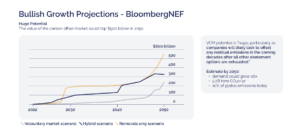
BloombergNEF reports that the VCM could jump from $2 billion in 2024 to $50 billion by 2030. This growth is likely as net-zero goals become real and reporting rules get stricter. In a more optimistic outlook, the market could reach up to $500 billion by 2050. 

VCM projection 2050 DGB
Chart from DGB Group

Carbon Credits and the Path to Net Zero

Carbon credits allow companies to offset emissions they can’t yet eliminate. But not all credits are created equal. There’s a growing interest in removal-based credits, such as afforestation, instead of avoidance methods, like stopping deforestation.

Chestnut Carbon’s model supports this shift. Each project removes CO₂ from the atmosphere by planting trees that sequester carbon over decades. These credits will qualify for science-based targets and corporate ESG reporting under frameworks like the GHG Protocol and SBTi.

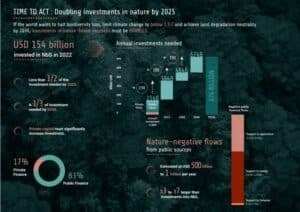
JPMorgan’s role shows that carbon markets are now central to finance, not just a side tool. Their deal helps close the financing gap for nature-based solutions. The United Nations estimates that $387 billion per year is necessary through 2030 to meet climate goals.

doubling investments in nature-based solutions
Source: United Nations Environment Programme

Vijnan Batchu, Global Head of Center for Carbon Transition at J.P. Morgan, echoed this thought, saying:

“Providing this kind of financing gives developers the runway they need to succeed at an attractive cost of capital, allowing them to focus on delivering significant carbon projects and fulfilling contracts…J.P. Morgan is extremely proud to be a part of this significant deal and contribute to the growth of the carbon markets at large.”

A Template for Future Climate Finance: What Comes After the Deal?

JPMorgan’s $210 million loan to Chestnut Carbon is more than a single transaction. It’s a financial innovation that connects capital markets to real carbon removal work on the ground. It offers investors a fresh way to join climate solutions. It also provides project developers with the resources to act quickly and increase their impact.

As VMCs grow, deals like this may lead to new financial tools linked to nature, emissions, and verified climate results. They may also pave the way for carbon credit securitization, green bonds linked to offsets, or public-private climate investment partnerships.

The Chestnut Carbon deal shows that big afforestation projects can draw in large investments. They lower risks and provide clear results in the battle against climate change.

The post JPMorgan, Microsoft Back $210 Million Carbon Loan in Landmark Climate Finance Deal appeared first on Carbon Credits.