New York-based Amogy Accelerates Ammonia-to-Power Solutions with $23M Funding Boost

New York-based clean energy startup Amogy has secured an additional $23 million in funding, bringing its total investment to $80 million. This latest round was led by the Korea Development Bank. The fresh capital will accelerate Amogy’s work on its ammonia-to-power technology, which generates clean electricity without emissions.

The company aims to deploy this technology mainly for powering ships and large energy systems across Asia.

Seonghoon Woo, co-founder and CEO at Amogy said,

“We’ve long recognized the strong demand for ammonia-to-power technology in the shipping industry, but we also see much broader opportunities to use ammonia as a clean fuel – especially with the growing demand for the ‘clean power’ globally. We’re ready to meet that market demand. Support for a hydrogen-based economy is especially strong in Asia, and as the most cost-effective hydrogen carrier, ammonia is quickly evolving into the leading zero-carbon fuel solution for these markets. We are deeply grateful for the strong confidence our investors have placed in our vision and growth trajectory. We are especially proud to partner with institutions like Korea Development Bank, whose deep expertise in scaling energy infrastructure brings significant value to our mission.”

Why Ammonia-to-Power is a Game-Changer

Unlike fossil fuels, ammonia produces no carbon dioxide when used this way. During power generation, only water and nitrogen gas are emitted. This makes ammonia a powerful tool for reducing emissions in industries like shipping, which accounts for about 2.5% of global CO2 emissions (3rd IMO GHG study).

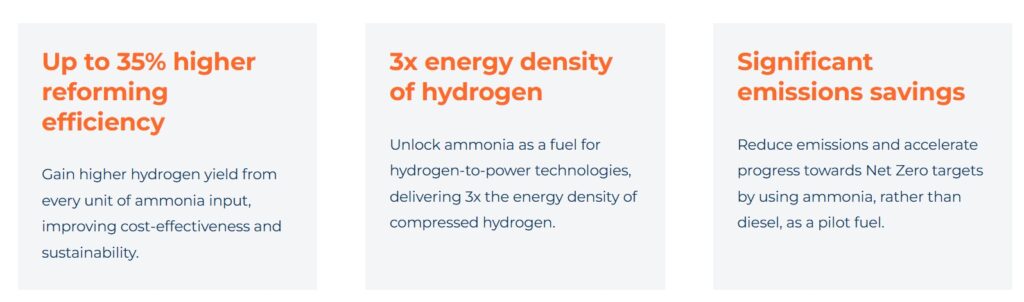
Ammonia’s high energy density means it stores more energy in less space than hydrogen alone, and it’s easier and safer to handle—no extreme pressures or freezing required.

However, the environmental benefits depend on how ammonia is made. Currently, much of the world uses “gray ammonia,” produced from natural gas and releasing CO2. Amogy’s goal is to shift toward “green ammonia,” made using renewable electricity, closing the loop on carbon emissions.

In Asia, where coal and gas still dominate power generation, projects like Amogy’s 40 MW plant in South Korea could significantly cut pollution and carbon output. These systems can replace or support fossil fuel plants, improving local air quality and helping countries meet climate goals.

Amogy’s Cutting-Edge Tech Turns Ammonia Into Emission-Free Electricity

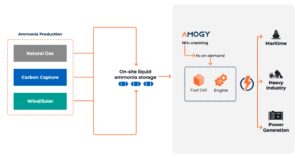
Its patented “ammonia cracking technology” is a game-changer for decarbonizing heavy industries. It efficiently converts ammonia (NH₃) into electric power without burning the ammonia directly. Instead, ammonia is fed into a reactor where a special catalyst “cracks” it into hydrogen and nitrogen at lower temperatures than other systems.

Next, the hydrogen and nitrogen gases pass through a purification step to remove any ammonia traces. The hydrogen then powers fuel cells or hydrogen engines, generating 100% carbon-free electricity. The nitrogen is safely released back into the air.

Amogy’s ammonia cracking technology

amogy ammonia
Source: Amogy

This process eliminates the need for diesel pilot fuel, lowers costs, and enables decarbonization of engines that currently rely on fossil fuels.

With this technology, Amogy targets sectors like shipping and heavy industry, which currently face big challenges in cutting emissions. So, cleaning up their energy use is critical to fighting climate change.

amogy
Source: Amogy

In 2024, Amogy unveiled the world’s first carbon-free, ammonia-powered ship, proving that ammonia can serve as a practical fuel. Now, the company plans a much bigger project: a 40-megawatt ammonia-powered energy plant in Pohang, South Korea, expected to be up and running by 2029.

Asia: The Strategic Hub for Amogy’s Growth

Asia is vital for Amogy’s expansion because energy demand there is growing fast, especially in countries like South Korea and Japan. These nations have limited natural resources and depend heavily on imports.

They also have strong policies promoting clean hydrogen and ammonia fuels, such as South Korea’s Clean Hydrogen Portfolio Standard, which aims for 2% of electricity from hydrogen and ammonia by 2030, and 7% by 2035.

By focusing on Asia and building partnerships there, Amogy is positioning itself as a leader in the ammonia fuel market. The Korea Development Bank’s backing adds both financial strength and local support to Amogy’s projects.

The Huge Market Potential for Ammonia Energy

The clean energy sector is booming, with the International Energy Agency estimating that more than $2 trillion per year must be invested by 2030 to hit net-zero targets. Ammonia is gaining ground as a way to store and transport hydrogen energy. It can also use existing fuel infrastructure, making it a versatile solution.

MarketReportAnalytics projects strong growth ahead for the lightweight ammonia cracker market. It would be mainly fueled by rising investments from both the public and private sectors. The global market is expected to exceed $10 billion by 2035, reflecting a bright future for this emerging technology.

ammonia cracking technology
Source: Market Report Analytics

Amogy’s systems can power both new and retrofitted ships, as well as large facilities like factories and ports. This creates enormous market opportunities. With Asia’s rapid industrial growth driving power needs, Amogy is well placed to tap into one of the world’s most energy-hungry regions. Their successful ammonia-powered ship trial in September 2024 further shows the technology’s potential to scale.

Investor Confidence Runs High

With $80 million raised so far and a company valuation of $700 million, investor confidence in Amogy is strong. The latest round led by Korea Development Bank not only provides funding but also brings strategic guidance in a region keen to adopt green fuels.

Major industry players like Samsung Heavy Industries and Mitsui O.S.K. Lines have already teamed up with Amogy. These partnerships help speed up commercialization and provide real-world testing opportunities in shipping and energy infrastructure. Amogy plans to move from pilot projects to full commercial operations within the next four years.

By focusing on hard-to-abate sectors with few zero-emission alternatives, Amogy’s versatile ammonia-to-power solution gives it a competitive edge in the growing clean tech market.

Amogy’s Road Ahead: Powering the Net-Zero Future

Amogy is at a pivotal moment in clean energy innovation. Its ammonia-to-power technology offers a practical way to decarbonize some of the hardest energy challenges in the world. If it scales successfully and transitions fully to green ammonia, it could become a cost-effective solution that helps meet global net-zero goals.

Global policy trends and rising investments are aligned with Amogy’s mission. The next few years will be critical as the company expands projects, builds partnerships, and demonstrates its technology at larger scales, setting the stage to lead the future of clean power.

The post New York-based Amogy Accelerates Ammonia-to-Power Solutions with $23M Funding Boost appeared first on Carbon Credits.


Rio Tinto, Antofagasta Lead Copper Surge—But Trump’s Tariff Threat Casts a Shadow

copper

In July 2025, the copper market is teetering between booming production and growing political uncertainty. Mining giants such as Rio Tinto and Antofagasta have delivered strong first-half results, indicating that global copper supply is in good shape.

Yet, looming trade disruptions, especially U.S. President Donald Trump’s plan to slap a 50% tariff on copper imports, are stirring fear in the market. While copper demand remains healthy due to clean energy and electrification trends, the tariff shock and rising inventories have shaken investor confidence. Prices, although still up year-on-year, are losing steam fast.

Rio Tinto Delivers a Copper Surge

Rio Tinto’s second-quarter copper production hit 229,000 tonnes—its highest in years. That’s a 15% jump year-on-year and a 9% increase from Q1. The figures include both copper concentrate and refined metal.

  • CuEq production: Up 13% YoY for Q2
  • Half-year growth: 6% YoY
  • Oyu Tolgoi mine: Star performer with 87,000 tonnes, up 65% YoY
  • Escondida (Rio’s share): Production rose 4% despite lower ore grades

Rio Tinto CEO Jakob Stausholm called it a “strong operational quarter,” noting the company’s consistent performance in bauxite and iron ore as well. He emphasized that Oyu Tolgoi remains on track to become the fourth-largest copper mine globally by 2030.

2025 Guidance

The company expects to reach the higher end of its full-year copper production guidance—between 780,000 and 850,000 tonnes. Cost controls remain strong, helping Rio position itself well for the second half.

Meanwhile, expansion efforts are ongoing, with two key projects in the pipeline:

  • Resolution Copper in Arizona
  • Winu Project in Western Australia

Rio’s flagship Oyu Tolgoi mine is expected to scale up to 500,000 tonnes per year between 2028 and 2036, further strengthening its global copper dominance.

Antofagasta’s Copper Surge Meets Market Caution

Chile’s Antofagasta also posted solid growth, producing 314,900 tonnes of copper in H1 2025—a 10.6% increase year-over-year.

Strong output from the Centinela Concentrates and Los Pelambres mines offset a decline in cathode production.

  • However, the company has chosen to keep its annual guidance unchanged at 660,000–700,000 tonnes, similar to its 2024 figures.

That cautious outlook reflects the uncertain pricing environment and potential headwinds from global trade actions.

In general, tighter regulations, environmental rules, and rising production costs are pushing more companies to merge. Experts say that over the next 25 years, the copper industry will need more than $2.1 trillion in investments to keep up with global demand.

At the same time, companies are focusing more on strong ESG practices to boost transparency and improve their sustainability efforts.

Trump’s Tariff Threat Rattles the Copper Market

The copper market’s biggest shock came from Trump’s announcement: a 50% tariff on all copper imports into the U.S., set to take effect August 1, 2025. However, the goal is to boost domestic production and reduce reliance on imports.

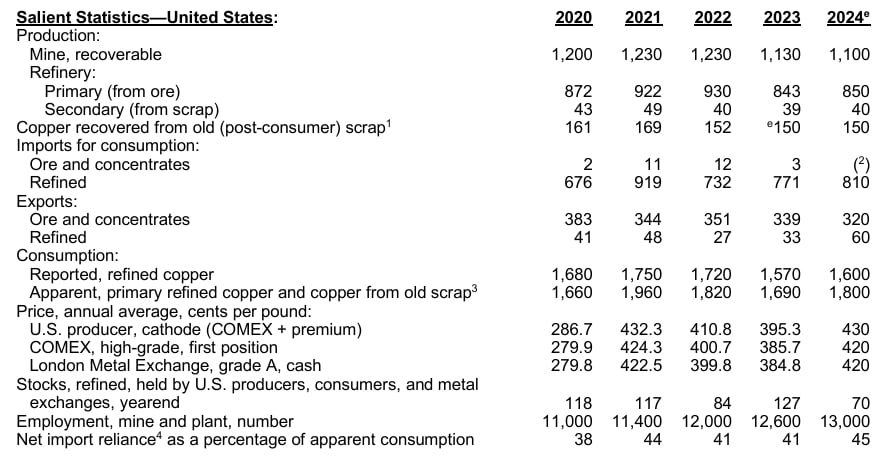
The U.S. Geological Survey highlighted key facts about the U.S. copper market

  • U.S. copper production: Covers just over half of domestic demand. In 2024, U.S. mine production of recoverable copper was approximately 1.10 million tonnes, down from ~1.13 Mt in 2023.
  • Arizona’s contribution: Over two-thirds of the U.S. copper supply
  • 2024 imports: Over 90% came from Chile, Canada, and Peru. Refined copper imports reached roughly 0.81 Mt in 2024
  • The U.S. consumes about 1.6 Mt annually but only produces ~1.1 Mt domestically, leading to a net import reliance of nearly 45%.
U.S. COPPER
Source: U.S. Geological Survey, Mineral Commodity Summaries, January 2025

Reuters reported that the tariff news sparked a surge in imports as buyers rushed to stockpile ahead of the deadline. Reports say that now, inventories have built up at ports across Texas, New Jersey, and California. Buyers are drawing from these stockpiles instead of placing fresh orders, leading to weaker near-term demand.

Experts warn that if domestic prices rise too quickly, the U.S. might be forced to reverse the tariffs or risk triggering inflation in downstream industries.

Copper Prices Retreat Despite Strong Demand

Despite a solid demand backdrop, copper prices have begun to slip. As per SMM reports, LME copper dipped 0.2% to $9,663 per metric ton, while SHFE copper fell 0.27% to 78,320 yuan per metric ton.

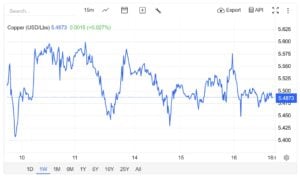
Meanwhile, copper futures dropped below $5.50 per pound.

copper prices
Source: Trading Economics

This price retreat reflects softer U.S. demand, swelling inventories, and investor caution ahead of the August tariff deadline. Although the broader copper market has gained 24% year-on-year, it’s up just 2% so far in 2025, signaling fading momentum despite strong underlying fundamentals.

The copper market is facing a rare moment where supply growth and political tension collide. Nonetheless, it is essential for power systems because of its conductivity. This is why it’s significant for numerous low-carbon products and data centers.

Mining leaders like Rio Tinto and Antofagasta are reporting record or near-record output, with new projects coming online and long-term demand drivers intact. But Trump’s tariff bombshell is reshaping global trade flows, spooking investors, and forcing market players to reassess their strategies.

The post Rio Tinto, Antofagasta Lead Copper Surge—But Trump’s Tariff Threat Casts a Shadow appeared first on Carbon Credits.
Silver Prices Surge to 14-Year High in 2025: What’s Sparking this Sustainable Metal Boom?

In 2025, silver has shown remarkable strength despite global trade tensions, shifting investor behavior, and changes in the mining industry. With rising macro risks and uncertain policy decisions ahead, silver is benefiting from solid supply-demand fundamentals and strong technical patterns that suggest more upside may be coming.

Silver Shines Amid Trump Tariffs and Trade Wars

Rising geopolitical risks have played a major role in silver’s rally. When former U.S. President Donald Trump threatened to impose a 30% tariff on imports from Mexico and the European Union, markets reacted fast.

Investors rushed to buy safe-haven assets, driving silver prices to nearly $39 per ounce—a level not seen since 2011. Mexico, being the largest silver producer in the world, is especially exposed to these kinds of policy moves, adding even more pressure to the supply side of the market.

silver prices

Bullish Technical Patterns Signal More Upside

Experts say that if silver consolidates between $35 and $37, it could be a sign of continued strength. Technical tools like Fibonacci extensions and measured move projections also suggest a possible rally to the $41–$42 range.

Adding to the bullish case, CME Group silver futures show rising open interest during this consolidation period, often a sign that investors are accumulating silver, not selling.

Investor Behavior Shifts Across Regions

Institutional investors are also bullish on silver stocks. According to the Silver Institute’s report, Silver-backed ETFs (Exchange-Traded Funds) have seen record inflows this year. And Global holdings recently reached over 1.13 billion ounces.

This large-scale accumulation reflects growing long-term confidence in silver’s value as a safe haven and also as an asset linked to clean energy and industry. Combined with tightening supply and ongoing global risks, the outlook for silver remains positive.

Silver Keeps Pace with Gold

  • The report further says that this 25% silver price jump in the first half of 2025 nearly matches gold’s 26% rise during the same period.

In April and May, the gold-to-silver ratio remained high, making silver look undervalued to long-term investors. At the same time, renewed trade talks between China and the US boosted confidence in industrial metals, giving silver an extra lift.’

Silver’s Supply and Demand: A Tight Market

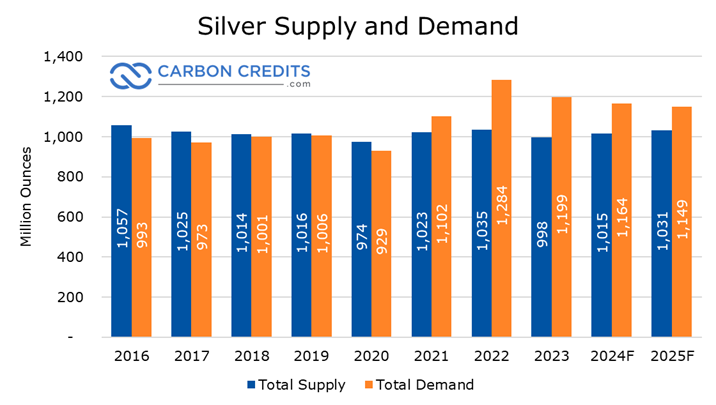
New projections from the Silver Institute indicate that the total silver supply in 2025 will rise by 2% to about 1,030.6 million ounces. This increase mainly comes from mine production, expected to hit 835 million ounces. Meanwhile, recycling levels remain steady at 193.2 million ounces.

On the demand side, total usage is set to fall by 1% to 1,148.3 million ounces. Lower demand for jewelry and less physical investment will be offset by steady industrial use. This is especially true in electronics and solar panels.

The market faces a deficit of roughly 96 million ounces. This gap widens when excluding exchange-traded product (ETP) holdings. This imbalance keeps prices high and suggests that further increases may follow.

Silver supply and demand
Source: Metals Focus

Sustainable and AI-Driven Silver Mining

Silver mining is evolving due to global sustainability demands. Companies are adopting new technologies to improve efficiency and reduce environmental impact:

  • AI-Driven Ore Sorting: Mines now use real-time AI to quickly sort silver ores by quality. This boosts recovery rates and lowers waste, making production more efficient and sustainable.
  • Predictive Analytics and Monitoring: Advanced software can predict equipment failures before they occur. This cuts downtime and helps maintain a steady supply despite market changes.
  • ESG and Resource Optimization: They use satellite monitoring to track emissions and optimize resources. This tech-driven method is essential for reducing costs and impacts. It is especially useful in remote areas like Chile and Australia.

Industrial Demand: The Backbone of Silver

Silver is vital for the net-zero economy. Its uses span electronics, renewable energy, and healthcare, keeping industrial demand strong:

  • Electronics and Communication: Silver’s excellent conductivity makes it essential for circuit boards and electronic parts.
  • Solar Panels and Renewable Energy: The clean energy movement boosts silver demand, as its efficiency is key for solar panels.
  • Healthcare and Green Technologies: Silver fights germs in medical devices. It also helps new green technologies. This makes silver vital in fast-growing sectors.

Countries like Mexico, Peru, and Australia are key suppliers. Any disruptions in their output could tighten the global market further.

Silver’s Future: Price, Policy, and Profit Opportunities

Silver is expected to rise in 2025. This is due to increasing geopolitical risks, a tight supply market, and strong technical setups. If prices break above the $40 mark, we may see more buying as profit-taking meets accumulation.

Investors can use these trends to guard against inflation and trade uncertainty. Also, tech advancements and sustainability are changing silver mining. These factors could also affect silver’s performance this year.

In conclusion, current technical patterns and market fundamentals suggest a bullish trend for silver. Strong institutional inflows and solid industrial demand support this outlook. Also, improvements in mining efficiency will help. The precious metal is likely to be a key asset in uncertain economic times.

The post Silver Prices Surge to 14-Year High in 2025: What’s Sparking this Sustainable Metal Boom? appeared first on Carbon Credits.

Bitcoin Hits All-Time High, But Will Its Carbon Footprint Cloud the Rally?

Bitcoin Hits All-Time High, But Will Its Carbon Footprint Cloud the Rally?

Bitcoin has once again broken records, soaring past the $120,000 mark early this week. The world’s most famous cryptocurrency is riding a wave of investor enthusiasm, policy momentum, and institutional support. But behind the price surge is a growing concern: Bitcoin’s massive carbon footprint.

As Bitcoin gains more value, it needs more energy. This raises big questions about sustainability in the digital world. Let’s dig deeper into how and why this could be the case.

Record-Breaking Rally and What’s Fueling It

Bitcoin reached a new all-time high of over $120,000 last week, supported by major institutional investments. Spot Bitcoin ETFs saw over $2.7 billion in inflows, showing strong demand from large investors. Companies like MicroStrategy have also continued their buying spree, recently adding $472 million in Bitcoin to their holdings.

bitcoin price all time high
Source: Reuters

Several other key drivers are behind this rally:

  • U.S. lawmakers kicked off “Crypto Week.” They introduced new laws to support stablecoins, clarify digital assets, and even create a Strategic Bitcoin Reserve.
  • President Donald Trump showed support for crypto during his campaign. This raised hopes that future regulations could benefit the industry.
  • Technical analysts now predict price targets between $130,000 and $160,000. This depends on market momentum and sentiment.

Bitcoin is becoming more accepted on Wall Street. Its use in regulated financial products, like ETFs, is also growing. This makes Bitcoin easier to access than ever. This momentum is helping reshape the digital asset’s role in the global financial system.

The Carbon Caveat: Energy Use and Emissions Surge

Bitcoin’s success doesn’t come free, at least not environmentally. The process of mining Bitcoin is energy-intensive, as it relies on powerful computers solving complex math problems 24/7. This activity consumes a tremendous amount of electricity.

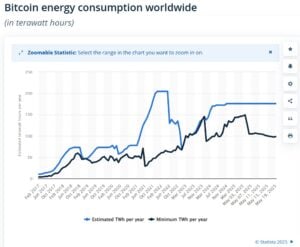
According to the Digiconomist Bitcoin Energy Consumption Index, the Bitcoin network uses around 175.9 terawatt-hours (TWh) per year. That’s more electricity than entire countries like Poland or Argentina. The resulting emissions are estimated at nearly 98 million tonnes of CO₂ annually—about the same as Greece emits in a year.

bitcoin energy use worldwide
Source: Statista

Let’s break it down further:

  • Each Bitcoin transaction emits about 672 kg of CO₂—as much as driving 1,600 km in a gas-powered car.
  • Bitcoin mining now accounts for about 0.7% of global CO₂ emissions.
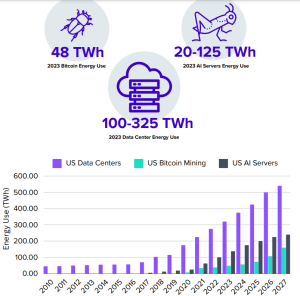
  • The International Monetary Fund (IMF) warns that by 2027, US crypto and AI could use 2% of global electricity. They might also contribute 1% to total emissions.
US Bitcoin mining vs US Data center energy use 2023
Source: IMF

This energy use raises big worries about climate change. The world is racing to reach net-zero goals. Critics say Bitcoin’s environmental cost might be higher than its financial gains. They believe the industry needs to improve.

Green Bitcoin? Renewables and “Clean Mining” Push

In response to growing criticism, many Bitcoin miners are shifting toward renewable energy sources. A report by the Cambridge Centre for Alternative Finance found that as of 2025, over 52% of Bitcoin’s electricity now comes from clean sources. This includes:

  • 23% from hydropower
  • 15% from wind
  • 3% from solar
  • Around 10% from nuclear energy
Bitcoin electricity use and mix by method
Source: Cambridge Report

Big mining companies like Marathon Digital, Riot Platforms, and CleanSpark are setting up near wind or solar farms. They are also trying flare gas capture, which uses waste methane from oil fields to power their mining operations. Others are purchasing renewable energy certificates (RECs) or engaging in tokenized carbon offset programs.

However, not all miners are on the green path. A 2025 environmental review showed that in key U.S. mining states—like Texas and Kentucky—up to 85% of the electricity still comes from fossil fuels.

This imbalance is a challenge. While some parts of the network are “clean,” others continue to rely heavily on coal and natural gas. And the patchy data makes it hard for ESG investors to know which projects are sustainable.

Policy Tailwinds vs. Environmental Headwinds

Recently, the U.S. is on the verge of passing a trio of significant crypto bills aimed at shaping the future of digital assets and their regulation. These laws aim to provide clarity, security, and innovation in the fast-changing world of cryptocurrency.

First, the GENIUS Act is a landmark bill focused on regulating stablecoins—digital currencies pegged to traditional money. It sets up a tiered system for issuers. It also requires stablecoins to be fully backed by liquid reserves, like cash and Treasury bills.

Moreover, the CLARITY Act, alongside the GENIUS Act, aims to set clear rules for crypto markets. In contrast, the Anti-CBDC Surveillance Act wants to ban central bank digital currencies. This is to protect user privacy and ensure national security.

These bills promote cryptocurrency adoption. They offer legal certainty and protect consumers. They are now close to passing the U.S. House with strong bipartisan support and are expected to be signed into law soon.

As Bitcoin becomes more popular, regulators are scrutinizing its environmental impact more closely. Several proposals aim to bring transparency and accountability to crypto mining’s carbon footprint.

Some of the current regulatory moves include:

  • The Sustainable Bitcoin Protocol, which promotes blockchain-based proof that Bitcoin was mined using renewable energy.
  • The European Union and U.S. SEC are exploring carbon intensity scoring for crypto assets—essentially labeling them “clean” or “dirty” based on emissions.
  • The IMF has proposed a carbon tax of up to $0.09 per kWh for crypto miners. If implemented, this could raise $5 billion per year in revenue while cutting up to 100 million tonnes of CO₂.

These policy discussions show that environmental concerns are now part of the crypto conversation. If Bitcoin mining doesn’t improve, regulators might act tougher. They could ban high-emission projects from ESG-focused portfolios.

Some governments are also starting to link crypto mining to energy strain on national grids. During heatwaves in Texas and Canada, mining operations have been temporarily shut down to reduce demand. These events hint at the challenges ahead in balancing Bitcoin’s growth with grid stability.

Forecast: Sustainability Meets Financial Opportunity

As Bitcoin’s price keeps climbing, sustainability will become more important to its future. Here’s what analysts suggest BTC could hit:

  • $130K (short-term)
  • $160K by Q4 if ETF inflows continue
  • $200K by 2026, per Citi and Standard Chartered

Some banks, like Citi and Standard Chartered, project Bitcoin could reach $200,000 by the end of 2026—if sustainability concerns are addressed and institutional investors keep flowing in.

But that “if” is important. Many ESG-focused funds already screen out companies that don’t meet sustainability standards. If Bitcoin mining doesn’t get greener, those funds may avoid crypto altogether.

Bitcoin’s latest rally shows its growing influence in the financial world. However, its rising carbon footprint is now under the spotlight. While over half of the network is powered by renewable energy, the remaining fossil fuel use still contributes significantly to emissions.

Mining innovation is helping, with new projects using solar, wind, and methane capture. And regulators are pushing for more transparency and accountability. Unless the entire network commits to sustainability, Bitcoin’s environmental reputation may limit its future growth.

Still, if Bitcoin can combine financial performance with climate responsibility, it could become a true store of value—not just in dollars, but in environmental integrity.

The post Bitcoin Hits All-Time High, But Will Its Carbon Footprint Cloud the Rally? appeared first on Carbon Credits.

Google Inks World’s Largest Hydropower Deal with Brookfield at $3B to Power AI Growth

Google Inks World's Largest Hydropower Deal with Brookfield at $3B to Power AI Growth

Google signed a $3 billion, 20-year hydropower deal with Brookfield Asset Management. This agreement will provide up to 3 gigawatts (GW) of carbon-free electricity. It is the largest corporate hydropower deal in history.

The deal starts with 670 megawatts (MW) from Pennsylvania’s Holtwood and Safe Harbor dams. This move helps Google meet its growing energy demands, which come from fast data center and AI growth on the PJM grid.

Amanda Peterson Corio, Head of Data Center Energy, Google, stated:

“This collaboration with Brookfield is a significant step forward, ensuring clean energy supply in the PJM region where we operate. Hydropower is a proven, low-cost technology, offering dependable, homegrown, carbon-free electricity that creates jobs and builds a stronger grid for all.”

How Water Powers Google’s Clean Energy Strategy

While solar and wind are widely used in clean energy, they’re not always available when needed. Google’s AI-driven services require power 24/7, and hydropower offers a stable, renewable energy source that can meet this demand. It provides reliable electricity both day and night, which is important for powering energy-heavy data centers.

Hydropower also responds quickly to electricity needs, helping balance the grid during demand spikes. This is very important in places like the PJM Interconnection, where Google is growing its operations. The company’s agreement with Brookfield Renewable ensures up to 3 gigawatts of hydropower, which also supports Google’s clean energy goals in important U.S. areas.

Google clean energy emission reductions
Source: Google

Another reason for this shift is policy support. New U.S. laws have extended hydropower tax credits until 2036. Meanwhile, solar and wind incentives will begin to phase out in 2027. This gives Google more long-term certainty for its infrastructure plans.

Hydropower’s low emissions also support Google’s broader climate targets. The company plans to use only carbon-free energy by 2030. Clean baseload power, such as hydropower, is key to this goal.

Scaling AI Responsibly: From Deal to Data Centers

Google carbon-free energy map with data center operations

Google’s energy deal closely aligns with its $25 billion U.S. data center expansion across Pennsylvania, New Jersey, and Maryland. These new facilities will help Google’s expanding AI and cloud services. They need a lot of energy all the time.

Hydropower provides the carbon-free electricity needed to operate these centers without increasing emissions. AI workloads consume huge amounts of energy, and powering them with fossil fuels would worsen climate impacts. By pairing clean energy with digital growth, Google is working to scale AI responsibly.

Google data center energy use
Source: Google

This move reflects a broader industry shift. At a recent summit, Blackstone and CoreWeave announced they’re investing $90 billion. This funding will go toward AI and clean energy projects. Like Google, they see the need to tie digital growth with firm renewable power sources.

Google’s deal also sets a model for long-term clean energy planning. Instead of buying short-term carbon offsets, it’s investing in physical power assets with 20-year contracts. This ensures energy reliability, better emissions tracking, and real climate impact.

Environmental Upside and Responsible Dam Upgrades

Brookfield and Google will upgrade the Holtwood and Safe Harbor plants. This will boost turbine efficiency, improve fish passage, and ensure sustainable water flow. These relicensing efforts will depend on environmental impact assessments and local stakeholder engagement.

Brookfield Renewable Partners is one of the world’s largest platforms for renewable power and sustainable solutions. It has the following portfolio:

Brookfield portfolio
Source: Brookfield

Unused hydropower will be fed into PJM’s grid, supporting energy pricing and supply stability. The initiative creates local jobs during both construction and operation. This brings economic benefits to nearby communities.

The Broader Picture: Clean Power, AI Growth, and PPA Boom

Google’s clean energy deal with Brookfield reflects a couple of industry trends, such as the following:

Hydropower and Energy Mix Forecasts

Hydropower remains a key renewable base for utilities. The U.S. Energy Information Administration expects hydropower output to rise by 7.5% in 2025. However, it will still make up about 6% of total U.S. electricity, which is a small drop from long-term averages.

US hydropower generation 2025 EIA

The global hydropower market is set to grow. It’s expected to rise from $265 billion in 2025 to $381 billion by 2032. This growth represents a 5.3% annual rate. The main drivers are decarbonization and the need for grid flexibility.

Corporate PPA Market Expansion

Corporate Power Purchase Agreements (PPAs) are booming. In 2023, the PPA market was about $35 billion and would grow at a 37% annual rate until 2032. This could push the market to around $200 billion. The IT sector alone accounted for 30% of PPA capacity in 2024, nearly 3.8 GW of projects.

AI-Driven Grid Demand Surge

The International Energy Agency (IEA) predicts that electricity use in data centers will more than double. By 2030, it will reach about 945 TWh. This increase is due to AI workloads, which are expected to grow fourfold. In the U.S., data centers are expected to drive nearly 50% of electricity demand growth, and could account for 12% of U.S. electricity by 2028.

Data centre electricity consumption by region
Source: IEA

Analysts warn that AI-driven electricity demand could strain the grid. This is especially true without clean energy sources. For example, PJM capacity auction prices have soared by 800%, highlighting infrastructure challenges.

Smarter Grids: AI, PJM, and Smooth Integration

Google is working with PJM Interconnection, the largest grid operator in the U.S. They are using AI tools to speed up clean energy integration. These tools can reduce grid interconnection times—a major bottleneck for renewables.

Together with better forecasting and automation, this innovation can boost grid reliability, avoid cost spikes, and help speed up clean energy projects.

Despite these milestones, however, hurdles remain, such as:

  • Grid constraints: PJM has only added 5 GW while AI and data center demand is forecast to rise 32 GW by 2030, triggering concerns of limited capacity and regional rate hikes.
  • Regulatory delays in grid approvals and infrastructure planning may cause project bottlenecks .
  • Environmental due diligence during dam modernization must meet community and wildlife protection standards.

A Blueprint for Clean Tech Expansion

Google’s hydropower commitment shows that scaling AI infrastructure responsibly is feasible. By locking in inexpensive, baseload renewable power while modernizing existing hydro assets, Google positions itself as an ESG frontrunner.

In doing so, the company aligns with broader industry and grid forecasts. As AI energy demand grows and PPAs rise, Google’s approach stands out. They combine clean energy buying, dam upgrades, and smart grid integration. This model is a useful guide for expanding sustainable tech.

As data center electricity use nears 1,000 TWh by 2030 and hydropower output slowly grows, this deal exemplifies how bold energy procurement can simultaneously power innovation and protect the environment. Google’s strategy is more than a contract; it’s a roadmap for climate-aligned growth in the digital age.

The post Google Inks World’s Largest Hydropower Deal with Brookfield at $3B to Power AI Growth appeared first on Carbon Credits.
Apple to Invest $500 Million in MP Materials for U.S.-Made Recycled Rare Earth Magnets

Apple

Apple Inc. (NASDAQ: AAPL) announced a $500 million investment in MP Materials Corp. (NYSE: MP). This investment backs a long-term agreement where MP will supply Apple with rare earth magnets made entirely from recycled materials, all manufactured in the United States.

Under the agreement, MP will produce the magnets at its Fort Worth, Texas, facility—called Independence—using recycled feedstock processed at its Mountain Pass site in California. The recycled material will be collected from post-industrial waste and end-of-life magnets.

James Litinsky, Founder, Chairman, and CEO of MP Materials, said,

“We are proud to partner with Apple to launch MP’s recycling platform and scale up our magnetics business. This collaboration deepens our vertical integration, strengthens supply chain resilience, and reinforces America’s industrial capacity at a pivotal moment.”

US Rare Earths in 2024: Production and Imports

Rare earth magnets are key components in everyday electronics like iPhones, laptops, and smartwatches. They are also essential for electric vehicles, robotics, wind turbines, and energy systems.

rare earths

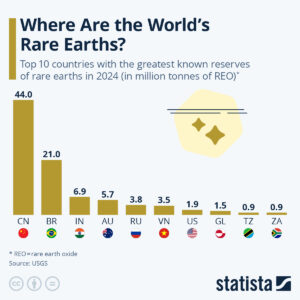
  • According to USGS, the US produced about 45,000 tons of rare earth oxide (REO) concentrates, worth $260 million in 2024.

Most of it came from bastnaesite mined at Mountain Pass, California. Monazite was either stockpiled or found in heavy mineral sands in the Southeast, while mixed rare-earth compounds were made in the West.

Notably, the US also imported rare-earth metals and compounds worth $170 million, a drop of 11% from 2023. The top use was for catalysts, followed by magnets in finished goods, ceramics, glass, alloys, and polishing. Thus, it becomes increasingly important to strengthen the domestic rare earth capacity and reduce imports.

MP Materials specializes in NdFeB (neodymium-iron-boron) permanent magnets, known as the most powerful and efficient magnets in the world. Without them, the U.S. could face major delays in its clean energy and electric vehicle goals.

An aerial view of MP Materials’ Independence facility in Fort Worth, Texas, illustrating the scale of operations at this critical manufacturing hub

MP materials rare earth
Source: MP Materials

MP Materials Expands U.S. Recycling to Power Apple Partnership

MP Materials is stepping up its role as a key player in America’s clean tech future. It sources rare earth elements from one of the world’s richest deposits in California.

  • Notably, it’s the only U.S. company that controls the entire rare earth magnet supply chain—from mining and refining to magnet manufacturing.

Recycling rare earth magnets instead of mining them will reduce waste, conserve resources, and lower production costs. Its Mountain Pass facility will process old magnets, manufacturing scrap, and electronic waste.

This strategy will boost rare earth output so it can start shipments in 2027 and eventually supply magnets for hundreds of millions of Apple devices.

For the past five years, both companies have worked together on advanced recycling technologies, and MP’s recycled materials have met Apple’s strict standards for product performance and design.

Fueling Sustainability: Apple’s Drive for 100% Recycled Materials

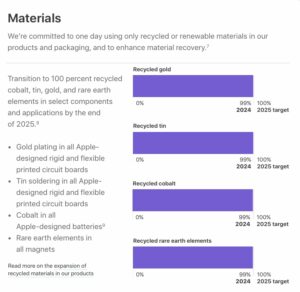
Apple is prioritizing sustainability across its product line. In 2024, over 80 percent of the rare earth elements used in Apple products came from certified recycled sources, up from 75 percent in 2023.

The company uses a detailed process, including Material Impact Profiles (MIPs), to evaluate the social, environmental, and supply risks of various raw materials. This helps Apple focus its efforts on materials where it can make the biggest difference.

Today, Apple is running sustainability projects for key materials including aluminum, cobalt, copper, gold, glass, lithium, rare earths (neodymium, praseodymium, dysprosium), tin, tungsten, zinc, and others.

Apple’s long-term plan is to transition entirely to recycled and renewable materials. That shift won’t be quick, but the company is leading the way.

By the end of 2025, Apple plans to use 100 percent recycled cobalt in all batteries, 100 percent recycled tin and gold in all circuit boards, and 100 percent recycled rare earth magnets across all products, excluding items made for replacement or repair.

Apple rare earth magnet
Source: Apple
  • This effort supports Apple’s 2030 goal to cut Scope 1, 2, and 3 emissions by 75% and offset the rest through high-quality carbon removal projects.

The company has already reduced emissions across its value chain by over 60% while growing revenue by more than 65% since 2015.

Apple (AAPL) Sees Marginal Rise Amid Broader Struggles in 2025

Apple Inc. (NASDAQ: AAPL) is having a rough start in 2025. Its stock is trading at $208.62, showing a 16.49% drop so far this year. In comparison, the S&P 500 has gone up 6.58%, which means Apple is falling behind the overall market.

Moreover, the company is facing pressure from several challenges, including the impact of former President Trump’s trade war, a U.S. Department of Justice antitrust investigation, and concerns that Apple is falling behind in artificial intelligence (AI).

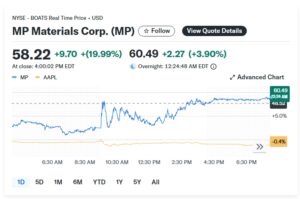
Although Apple’s stock rose slightly after the MP Materials deal was announced, bigger issues are still affecting investor confidence. Despite these downturns, this partnership strengthens Apple’s brand as a leader in eco-conscious product design.

apple stock AAPL
Source: Yahoo Finance

MP Materials (MP) Stock Jumps 20% After Apple Partnership

While Apple struggled, MP Materials Corp. (NYSE: MP) saw its stock soar. After announcing its new deal with Apple, MP shares went up 20% on Tuesday, according to Yahoo Finance.

mp materials MP stock
Source: Yahoo Finance

The market reacted strongly to the news. Investors view this partnership as a significant win for MP, particularly as it expands its role in the U.S. rare earth supply chain. The deal not only boosts MP’s growth plans but also supports clean energy and tech manufacturing in the United States.

With a $500 million investment from Apple and support from the U.S. Department of Defense, MP Materials is now seen as a key player in the shift to sustainable, domestic production of critical materials. Overall, it represents a significant step toward America’s sustainable innovation and supply chain independence.

The post Apple to Invest $500 Million in MP Materials for U.S.-Made Recycled Rare Earth Magnets appeared first on Carbon Credits.
NIO’s (Stock) Race to Net Zero with EV Battery Swaps That Power Down Emissions

NIO’s (Stock) Race to Net Zero with EV Battery Swaps That Power Down Emissions

NIO, a top Chinese electric vehicle (EV) maker, keeps pushing boundaries with its advanced battery swap technology and bold plans for global expansion. The EV maker recently launched its first battery swap station in France, a move that marks a key milestone in its European expansion strategy.

The facility sits in Chalon-sur-Saône between Paris and Lyon. This offers a new option for EV charging. It also reflects NIO’s commitment to offering a more convenient and sustainable charging solution for drivers.

NIO’s Power Swap Stations let drivers exchange a dead battery for a fully charged one. This swap takes less than five minutes, so there’s no need to wait for batteries to charge. This method cuts downtime, eases charging worries, and allows for heavy daily use.

Thus It’s great for taxis, ride-hailing services, and commercial fleets. As of mid-2025, NIO has built over 2,400 Power Swap Stations globally, including more than 2,100 in China and 50+ in Europe. The company aims to reach 1,000 stations outside China by 2025.

NIO’s Role in Decarbonizing Transportation

NIO’s battery swap technology supports grid balancing and energy storage, key tools for a low-carbon economy. The swap stations act as virtual power plants (VPPs), storing energy and helping distribute it more efficiently during peak and off-peak hours. This reduces strain on energy grids and integrates renewable sources like wind and solar more smoothly.

This system plays a significant role in reducing lifecycle emissions. NIO’s centralized battery charging is different from traditional EV charging.

With traditional charging, carbon intensity changes based on the power grid. But NIO allows users to schedule charging when grid emissions are low, which enables:

  • battery health optimization,
  • extends battery life, and
  • reduces electronic waste. 

Watch below how its power swap stations work:

The company had completed 30 million swaps in late 2023, cutting around 891,693 metric tons of CO₂. That’s about 28 kilograms of CO₂ saved per swap—the same as avoiding 80 kilometers of driving in a gas-powered car or matching the annual carbon absorption of 3 mature trees. These savings show how NIO’s swap model boosts EV convenience and contributes to meaningful emissions reductions.

On the Road to Net Zero: NIO’s Emission Targets and Progress

NIO has set a clear goal to reach carbon neutrality across its operations and entire supply chain by 2045, with interim steps to curb emissions along the way. In its 2024 ESG report, NIO shared solid progress toward this goal. 

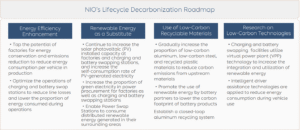
NIO’s Lifecycle Decarbonization Roadmap

For example, the manufacturing facilities used 56.6% renewable electricity. This is a big jump from 2023 levels, which accounted for about 97,000 MWh of clean power. This increase came from a 74.5% rise in renewable use compared to last year.

The Chinese EV maker reported the following greenhouse gas (GHG) emissions for the year 2024.

NIO ghg emissions 2024
Source: NIO 2024 ESG Report

The company showed great results in material recovery and recyclability, too. It achieved a 98.8% recoverability rate and a 91.4% recyclability rate for sold vehicles. These figures reflect NIO’s dedication to a circular economy, designing products for reuse and minimizing waste.

Moreover, NIO joined the Science-Based Targets initiative (SBTi) and implemented an internal carbon pricing (ICP) system. These moves show its commitment to tracking and managing emissions and align with global standards. 

In 2024, NIO took a more active role in global climate discussions. It participated in COP29 and hosted a forum titled “Green and Low‑Carbon Development of China’s Automobiles,” reinforcing its reputation as a thought leader in clean mobility.

As a member of the UN Global Compact since 2016, NIO aligns its values and business operations with UN sustainability goals, emphasizing corporate responsibility in climate action.

Moreover, NIO reported a 12% reduction in average manufacturing emissions per vehicle year-over-year, reflecting energy-saving improvements and greener factory operations. Its Factory Two (F2) was recognized as a “Super Automotive Factory” and a “2024 Green Factory” by provincial authorities. These achievements show NIO’s ability to hit measurable sustainability targets.

Together, these efforts show that NIO is not just making promises; it is delivering measurable results on the path to net-zero emissions. Its method combines renewable energy adoption, smart carbon management, material recycling, and active participation in global ESG platforms.

Three Brands, One Carbon-Cutting Strategy

NIO’s multi-brand approach allows it to reach a wide range of consumers while maximizing its carbon reduction impact. The flagship NIO brand offers premium electric vehicles equipped with smart energy systems and advanced autonomous driving features. In 2024, NIO launched the ONVO brand, targeting the mass market with more affordable EVs that directly compete with Tesla’s Model Y.

In 2025, the company launches Firefly. This compact EV line targets city drivers and competes with BMW’s Mini and Mercedes’ Smart cars. Prices will start at about $20,400. This full-spectrum strategy positions NIO to drive emissions reductions across luxury, mainstream, and budget-friendly segments.

Tapping into Carbon Credit Markets

The global carbon credit market will grow quickly. Estimates suggest its value could reach between $7 billion and $35 billion by 2030. By 2050, it may soar to $250 billion.

NIO is well-positioned to benefit from this trend. It has received TÜV Rheinland certifications for its greenhouse gas emissions data and product carbon footprint. This is a key step for companies that want to sell verified carbon credits.

Global Growth and Strategic Partnerships

NIO is accelerating its global presence with the following initiatives:

  • Battery swap station rollout in France, Norway, Germany, Netherlands, Sweden
  • 2024 partnership with Shell for EV infrastructure in China and Europe
  • Expansion plans into Hungary and Spain
  • EU incentives and rising demand for zero-emission vehicles
  • In-house battery production for cost savings and supply chain control
  • Partnerships with CATL and other battery suppliers
  • Support for the Battery-as-a-Service (BaaS) model
    • EV purchase without battery ownership
    • Lower upfront costs, wider accessibility

The Road Ahead for NIO and Clean Transportation

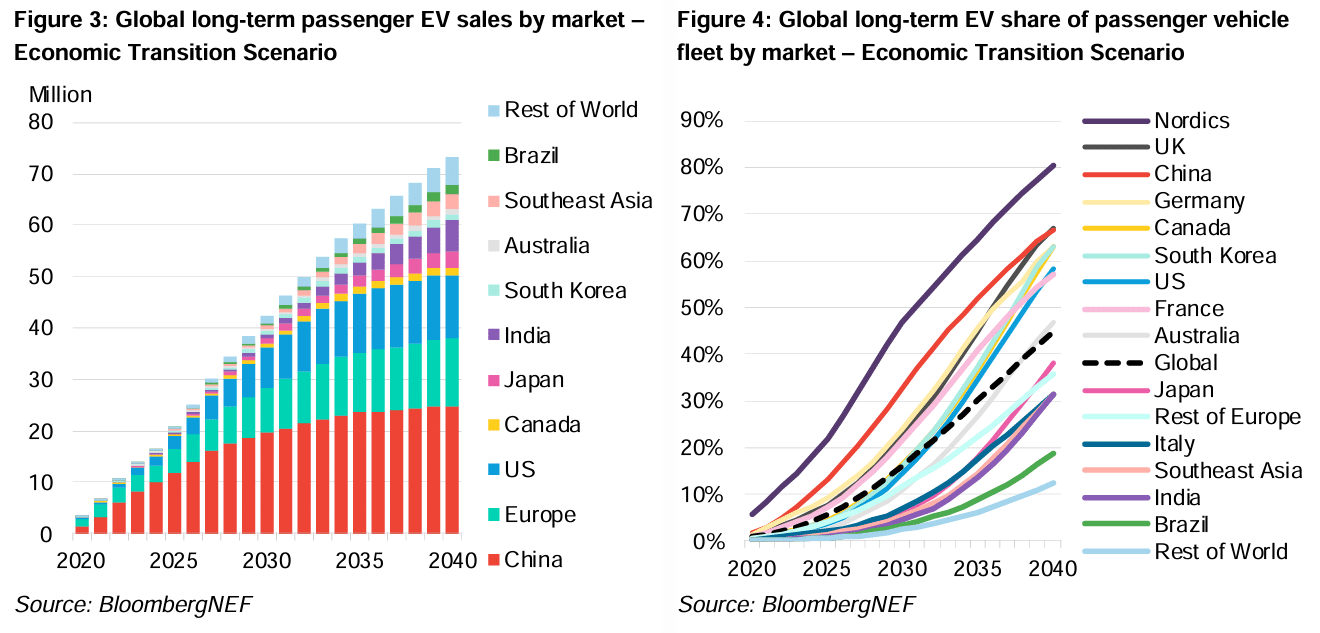
As the global EV market continues to grow—expected to hit 20 million units in sales by 2025—NIO is positioning itself as a major player in decarbonized mobility. China, NIO’s home base, made up more than 60% of global EV production and sales in 2024. This gave NIO a big edge in size and know-how.

global long-term EV sales by market 2040

Battery swapping offers a scalable solution that complements traditional charging infrastructure. As EV adoption increases, demand for faster, more efficient energy solutions will rise. NIO’s integrated ecosystem of vehicles, battery swaps, and software gives it a unique edge in this space.

NIO is a great example for ESG investors and clean tech watchers. It shows how electrification and digital tech can cut carbon emissions, help achieve net-zero goals, and change the future of mobility.

The post NIO’s (Stock) Race to Net Zero with EV Battery Swaps That Power Down Emissions appeared first on Carbon Credits.

AMD Stock Soars: Can ESG and Net-Zero Momentum Sustain the Rally?

AMD Stock Hits All-Time Highs: Can ESG and Net-Zero Momentum Sustain the Rally?

Advanced Micro Devices (NASDAQ: AMD) has been in the spotlight lately. This is due to its record stock price and strong environmental, social, and governance (ESG) efforts, as well as its sustainability programs. The company’s strong financial growth is driven by the soaring demand for its AI and data center chips.

AMD’s focus on sustainability gives it a competitive edge, which may help the company thrive for years to come. Let’s dive into the chipmaker’s record-breaking achievements.

AMD Hits Record Highs on AI Momentum

AMD’s stock recently climbed significantly as shown in the chart. The excitement around its MI300 series GPUs and EPYC processors drives this surge. These products are made for artificial intelligence (AI) and high-performance computing (HPC). These products are allowing AMD to compete aggressively with rival tech giant Nvidia.

AMD stock
Source: TradingView

Analysts are hopeful about AMD’s future, with HSBC upgrading its stock. They see the MI350 chip as a strong competitor to Nvidia. As such, AMD’s forward price-to-earnings (P/E) ratio is about 21x. This is attractive, especially when you compare it to Nvidia’s P/E of around 38x.

The broader AI market is also booming. According to International Data Corporation (IDC), AI server spending is expected to grow by over 25% annually through 2027. This growth is likely to increase demand for AMD’s AI-specific chips.

Notably, AMD now powers 157 of the world’s top Green500 supercomputers, platforms that combine raw computing power with energy efficiency. This highlights AMD’s dual focus on performance and sustainability.

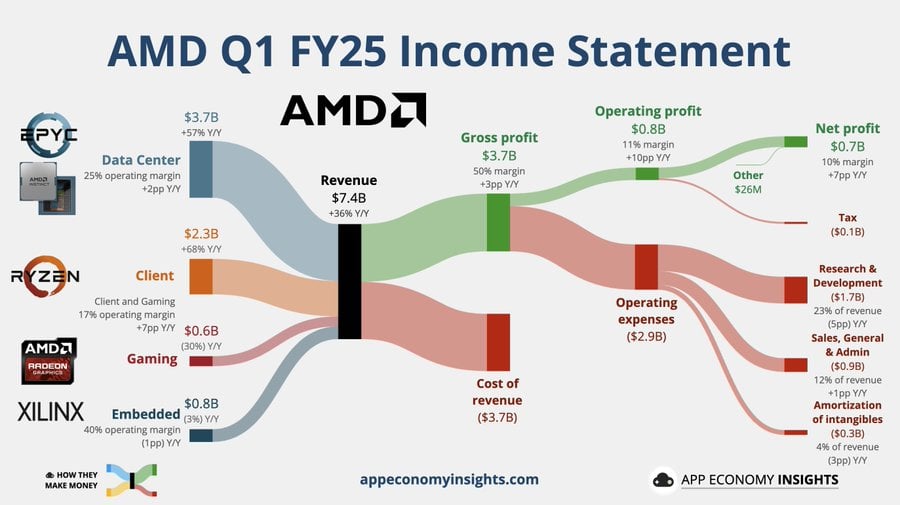
AMD’s recent financial reports reflect this momentum. In the first quarter of 2025, AMD posted double-digit revenue growth and improved gross margins. Strong sales in data centers and AI platforms boosted earnings. This sparked greater confidence among both analysts and investors.

AMD first qtr financial

AMD’s Blueprint for Responsible, Greener Growth

Beyond its technology leadership, AMD puts great emphasis on sustainability and responsible governance. The company was named Newsweek’s #1 Greenest Company in 2024. It also earned top scores for environmental transparency from various ESG rating agencies.

AMD’s governance and ESG framework includes:

  • Conducting thorough materiality assessments in partnership with BSR (Business for Social Responsibility).
  • Aligning reporting and disclosures with industry-leading frameworks like the Task Force on Climate-related Financial Disclosures (TCFD), Sustainability Accounting Standards Board (SASB), and CDP (formerly Carbon Disclosure Project).
  • Committing to achieving full net-zero emissions throughout its entire value chain by 2050, with interim targets already set.

This strong ESG framework builds investor trust. It also aligns AMD with new global policies. These include Europe’s Corporate Sustainability Reporting Directive (CSRD) and the International Sustainability Standards Board (ISSB) guidelines. Both are shaping future sustainability reporting needs.

From Silicon to Sustainability: AMD’s Net Zero Game Plan

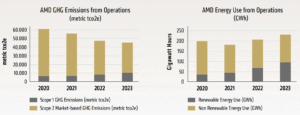
AMD’s environmental goals focus heavily on reducing its greenhouse gas (GHG) emissions. It has pledged to cut absolute Scope 1 and 2 emissions (direct emissions and those from purchased electricity) by 50% by 2030, compared to 2020 levels.

By 2023, AMD achieved a 24.5% reduction, lowering emissions to 46,605 metric tons of CO₂ equivalent from a baseline of 61,754 in 2020. Third-party assurance standards (ISAE 3000) have verified this data, adding credibility to its progress.

AMD ghg emissions 24
Source: AMD Report

AMD completed the acquisition of Xilinx in 2022. This increased its emissions baseline because of larger operations. However, AMD has kept making progress despite this challenge. This shows the company’s ability to manage decarbonization efforts even while growing.

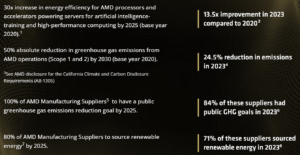
AMD boosted its renewable energy use. It jumped from 18% in 2020 to around 40% by 2023. This means over 83 gigawatt-hours (GWh) of clean power each year. It more than doubles renewable electricity use in just three years. This cuts down the environmental impact of its operations. It also supports the sustainability goals of its data center customers.

Importantly, AMD’s climate ambitions extend beyond its own operations to its supply chain. The company asks all its manufacturing suppliers to set public GHG reduction targets by 2025. So far, approximately 84% of these suppliers have already published emissions targets, and 71% source at least some renewable energy.

AMD sustainability goals
Source: AMD

AMD aims for full alignment by 2025, with 80% of suppliers sourcing renewable energy by that time. Also, 83% of supplier manufacturing sites have been audited by the Responsible Business Alliance (RBA). This checks for responsible labor and environmental standards.

This approach boosts AMD’s role across the value chain. It starts from chip making and goes to finished electronics. This helps the whole industry make progress on climate change.

ESG Risk Management and Regulatory Alignment

AMD also incorporates climate risk into its long-term strategic planning. It is part of the Semiconductor Climate Consortium. This group creates climate transition strategies by looking at physical and market risk scenarios.

By doing this, AMD prepares for future regulatory demands, including the U.S. Securities and Exchange Commission (SEC) Climate Rule and the EU’s CSRD.

Energy Efficiency: The 30× by 2025 Goal

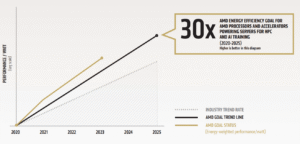
In addition to emissions reductions, AMD pursues ambitious energy efficiency targets. The company set a goal to improve the energy efficiency of its AI and HPC chips by 30 times by 2025 compared to 2020 levels. As of late 2023, AMD recorded a 13.5× efficiency gain using its MI300A APU chip.

AMD Energy Efficiency The 30× by 2025 Goal
Source: AMD report

If used worldwide, this efficiency could save data centers billions of kilowatt-hours in 2025. This would cut carbon emissions and lower operational costs. AMD’s modular chiplet-based design, along with AI chips, cuts power use. This also lowers the environmental impact during manufacturing.

AMD-powered supercomputers, like the Frontier system at Oak Ridge National Laboratory, are among the most energy-efficient high-performance computers worldwide. These gains give AMD a real advantage in securing contracts with big companies and government agencies that want sustainable, high-performance computing.

ESG as a Competitive Advantage, Yet Risks & Challenges Remain

AMD’s sustainability credentials provide several key competitive benefits, in:

  • Cost Savings and Emissions Mitigation: Energy-efficient products help customers reduce electricity costs and meet their own ESG goals.
  • Winning Contracts: Governments and enterprises are increasingly selecting AMD’s technology, appreciating both its performance and sustainability profile.
  • Attracting Investors: More ESG-conscious investors want companies that reduce emissions and report clearly. AMD’s ESG achievements improve its appeal to these capital sources.

Despite its momentum, AMD must navigate several ongoing challenges:

  • Scope 3 Emissions: AMD tracks direct emissions effectively. However, fully capturing and reducing Scope 3 emissions—those from the whole value chain, like product use and end-of-life—is still just starting. Addressing this is critical as Scope 3 typically represents the largest portion of a tech company’s carbon footprint.
  • Intense Competition: Rivals such as Nvidia, Intel, and a host of AI chip startups compete fiercely for market share.
  • Supply Chain Complexity: As AMD expands globally, it will be harder to ensure suppliers meet emissions targets and ESG standards.

When Technology Meets Sustainability: The AMD ESG Equation

AMD’s recent stock rally is not merely a product of hype around AI demand. It reflects a robust technology leadership combined with serious, measurable ESG progress. AMD shows that economic growth can go hand in hand with environmental responsibility. It achieves this through strong energy efficiency goals, confirmed emissions cuts, and climate-friendly actions in its supply chain.

Thus, AMD stands out for investors interested in tech innovation and climate action. Its strong AI chip performance, increasing use of renewable energy, and strict sustainability governance make it an appealing option.

The post AMD Stock Soars: Can ESG and Net-Zero Momentum Sustain the Rally? appeared first on Carbon Credits.

India Achieves 50% Non-Fossil Fuel Power Milestone: Solar Shines Bright

india

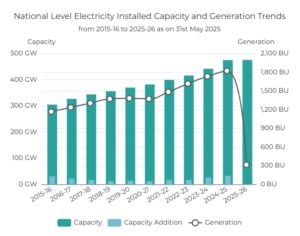
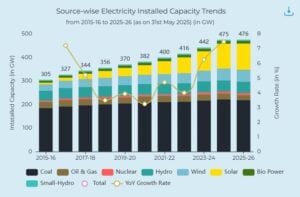
India’s energy transition reached a critical milestone in June 2025. The Government of India, Press Information Bureau, noted that the country’s total installed power generation capacity hit 476 GW, with non-fossil fuel sources contributing nearly 49 percent. This marks a substantial shift from a coal-dominated past, driven by rapid solar growth, expanding wind and hydro capacity, and early strides in hydrogen and nuclear energy.

India’s Rising Electricity Demand Fuels the Shift

Electricity demand in India has surged in recent years, fueled by growing commercial and residential spaces, increased ownership of air conditioners and appliances, and rising industrial consumption. Over the past five years, India recorded the third-largest growth in power generation capacity globally, after China and the United States.

Although generation has increased across all sources, investment in renewables—especially solar PV—has taken the lead. According to the IEA, 83 percent of India’s power sector investment in 2024 went to clean energy.

India also became the world’s largest recipient of development finance for clean power, receiving around USD 2.4 billion for project-level interventions. As a result, the share of non-fossil power generation capacity climbed to 44 percent in 2024, closing in on India’s target of 50 percent by 2030.

INDIA ELECTRICITY
Source: CEA and NPP (https://iced.niti.gov.in/energy/electricity/generation)

Solar Power Becomes the Cornerstone of Clean Energy

Solar energy continues to dominate India’s renewable push. Installed solar capacity soared to 110.9 GW in June 2025, up from just 2.82 GW in March 2014—a nearly 39-fold increase. In FY 2024–25 alone, 23.83 GW of solar was added, showcasing robust government support and investor confidence.

This growth aligns with a major expansion in domestic solar manufacturing. Module production capacity jumped from 2.3 GW to 88 GW, and cell production rose from 1.2 GW to 25 GW. These developments have strengthened India’s self-reliance in the solar supply chain.

Flagship programs such as PM Surya Ghar: Muft Bijli Yojana, rooftop solar subsidies, and the PM-KUSUM scheme have accelerated adoption, especially in rural and residential areas, empowering households and farmers to embrace solar energy.

india solar power
Source: CEA and NPP (https://iced.niti.gov.in/energy/electricity/generation)

Coal Still Dominates India’s Power Mix, but Its Grip is Slipping

Despite clean energy gains, coal remains India’s largest single source, with an installed capacity of 219 GW. When combined with gas (20 GW) and diesel (0.589 GW), thermal power contributes 240 GW, slightly over 50 percent of the country’s total.

Coal continues to play a key role in meeting base load demand, particularly for industrial use. However, its dominance is gradually eroding as solar, wind, and other renewable options scale up. Additionally, policy pressure to decarbonize and falling costs of renewables are accelerating this shift.

Wind, Hydro, and Biomass Add Balance to the Grid

India’s renewable mix is becoming increasingly diverse. Wind power reached 51.3 GW, with 4.15 GW added in the last fiscal year. Hydropower, including both large and small projects, stood at 48 GW, up from 35.8 GW in 2014. These sources provide critical grid flexibility and peak load management.

Biomass and biogas power have also strengthened, contributing 11.6 GW. Over five million small biogas plants and hundreds of medium-scale systems are now operational. In a major leap, India’s production of compressed biogas has reached 1,211 tonnes per day across 150 plants—up from just 8 tonnes per day in 2014.

Green Hydrogen finds its Place in the Energy Mix

India’s green hydrogen ambitions are taking shape under the National Green Hydrogen Mission. While still in its early stages, pilot projects using electrolysis powered by solar and wind have begun.

These initiatives support the government’s target of producing 5 million metric tonnes of green hydrogen annually by 2030, backed by 125 GW of renewable capacity.

Though current hydrogen capacity remains in the pilot phase, it is expected to play a transformative role in decarbonizing heavy industries, refining, and long-duration storage in the coming decade.

Nuclear power: Needs a Ramp-Up

Nuclear energy continues to provide a steady source of low-emission electricity, with 8.8 GW of capacity as of June 2025. While its share remains modest, nuclear offers reliable baseload power and supports the country’s broader clean energy ambitions.

The Government of India’s Department of Atomic Energy has announced that the RAPS-7 reactor (700 MW) was successfully connected to the grid on March 17, 2025, increasing the total number of operational nuclear reactors in the country to 25, with a combined capacity of 8,880 MW.

An additional 13,600 MW of nuclear power capacity is currently under implementation. Once these projects are progressively completed, India’s total nuclear capacity is expected to reach 22,480 MW by 2031–32.

The private sector is already playing a significant role in the nuclear ecosystem, particularly in the manufacturing, supply, and execution of nuclear power projects. Moreover, private investment in nuclear power generation has now been enabled within the current legal framework to support the establishment of Bharat Small Reactors (BSRs).
India’s Investment Landscape and Infrastructure Bottlenecks

India has introduced several steps to attract more investment in clean energy. These include significant support for solar panel manufacturing, battery production, and building better electricity grids. The IEA further highlighted that in 2023, foreign direct investment (FDI) in the power sector reached USD 5 billion. It’s almost double the amount seen before COVID-19. Under the current policy, India allows 100 percent FDI in power generation and transmission, except in nuclear energy.
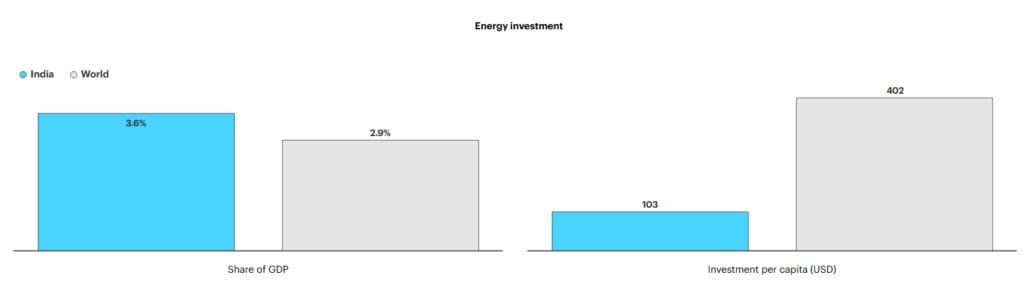
However, foreign portfolio investment (money from global investors in stocks and bonds) has dropped over the last two years. One major challenge is the high cost of financing. In India, borrowing costs for renewable energy projects are 80 percent higher than in developed countries, which makes clean energy projects more expensive and less profitable.

INDIA ENERGY INVESTMENT
Source: IEA

Another serious issue is off-taker risk—this means that electricity distribution companies (discoms) often fail to pay power generators on time. As of March 2025, discoms owed more than USD 9 billion in unpaid bills. Their total losses had reached USD 75 billion by 2023.

In addition, poor transmission infrastructure is holding back progress. India has about 60 GW of renewable power capacity that is ready but cannot be used fully because the electricity cannot be moved where it is needed. This shows the urgent need to improve the power grid and connect new projects to the system faster.

The Future is Clean Energy

India’s energy system is changing quickly. Today, clean energy sources like solar, wind, hydro, biomass, nuclear, and hydrogen make up almost half of the country’s power capacity, nearly equal to fossil fuels. This shows that India is on track toward a cleaner, low-carbon future.

  • The country’s goal is to have 500 GW of non-fossil power capacity by 2030.

The progress seen by June 2025 proves that this goal is within reach. But to keep the momentum going, India must solve key problems like discom debt, grid delays, and high project costs. With the right actions, India can fully unlock the potential of clean, affordable, and reliable energy.

The post India Achieves 50% Non-Fossil Fuel Power Milestone: Solar Shines Bright appeared first on Carbon Credits.