One Carbon World joins Carbon Markets Africa Summit as Official Climate Impact Partner

One Carbon World joins Carbon Markets Africa Summit as official climate impact partner

Disseminated on behalf of VUKA Group.

“Partnerships the way to scale of the African carbon market”

One Carbon World (OCW) will be the official climate impact partner of the upcoming Carbon Markets Africa Summit (CMAS) taking place in Johannesburg from 22 to 23 October.

OCW is a not-for-profit dedicated to helping organisations reduce their carbon footprint and achieve recognised standards such as the Science Based Targets initiative (SBTi). They provide tailored guidance to clients and advocate for putting high-quality data in front of decision-makers.

Carbon Markets Africa Summit will gather the continent’s entire carbon markets value chain, from successful early carbon market movers, climate-finance-ready projects, and regulatory bodies to global institutional development organisations and investors. 

Measuring CMAS carbon footprint

“We are very, very proud to be working with the VUKA group as their climate impact partner for the CMAS Summit,” says Madeleine Garlick, One Carbon World Africa Director. “We will be measuring the carbon footprint of the CMAS Summit. VUKA believes in leading by example, which includes setting high standards for themselves.”

She adds:

“Our partnership, we hope, will enable VUKA to gather huge amounts of data to understand the impacts of their summits. By working together, we hope to be able to track year-on-year improvements. It is a journey. And we think that this is a really, powerful move by an organisation who are not only hosting the critical green conversations that we need about Africa’s future, but are also leading the way by walking the walk themselves.”

Monitoring, reporting and verification

One Carbon World recently began to expand its work into nature-based solutions projects in the carbon market. Garlick explains:

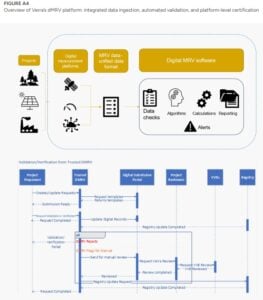
“This is very much in response to what our customers have been asking for, which is high integrity carbon credits to support their low carbon journey. We particularly support our customers and clients and projects through the MRV process (monitoring, reporting and verification) to ensure that their process and activities are of high integrity and comply with all the relevant data and global verification requirements. Ultimately, we believe that carbon markets are a key part of the climate journey for a number of organisations.”

Partnerships key to scale African carbon markets

According to Madeleine Garlick, One Carbon World’s key message at CMAS will be that:

“African stakeholders and innovators are developing and leading the market at the moment. And the most important thing at this point in the progress and development of the African carbon market is partnership. Partnerships between businesses, partnership between project implementers to learn from each other, partnerships with communities, and finding new ways to deliver value at the grassroots level. Partnership is the way we will get scale out of the African carbon market and ensure it is delivering for everybody.”

Future of sustainable events in Africa

“We’re thrilled to accompany VUKA on the start of their journey as they take meaningful steps to measure the emissions of their inaugural Carbon Markets Africa Summit,” states Andrew Bowen, One Carbon World CEO. He continues:

“With One Carbon World’s extensive experience in footprinting the emissions from large events around the world, we know how impactful this kind of leadership can be in shaping credible sustainability conversations and global climate action. We look forward to our partnership as we work together to advance the future of sustainable events in Africa and beyond.”

[Read and watch the full interview with Madeleine Garlick, One Carbon World Africa Director here.]

Carbon markets africa summit

VUKA Group 
Carbon Markets Africa Summit is organised by VUKA Group, and the United Nations Development Programme (UNDP) is the official host organisation. 

The VUKA Group (formerly Clarion Events Africa) is a leading Cape Town-based and multi-award-winning organiser of exhibitions, conferences and digital events across the continent in the infrastructure, energy, mining, mobility, ecommerce and CX sectors. It has more than 20 years’ experience in serving the business community across Africa.

Other well-known events by The Vuka Group include Africa’s Green Economy Summit, Smarter Mobility Africa, Enlit Africa, DRC Mining Week, Nigeria Mining Week, DRC-Africa Battery Metals Forum, ECOM Africa and CEM Africa. 

Event dates and location:
Dates:
21 October: Pre-summit day
22–23 October: Summit
Location: Johannesburg, South Africa

Contact details for Carbon Markets Africa Summit
Project Lead: Emmanuelle Nicholls 
Cell: +27 83 447 8410  
Email: emmanuelle.nicholls@wearevuka.com  

Event website: About — Carbon Markets Africa
One Carbon World website: https://www.onecarbonworld.com 

The post One Carbon World joins Carbon Markets Africa Summit as Official Climate Impact Partner appeared first on Carbon Credits.


US-UK Nuclear Pact Sends Oklo Stock (OKLO) to Record Highs in Clean Energy Boom

Oklo Stock Surges 1,460% as US and UK Launch Landmark Nuclear Energy Pact

The United States and the United Kingdom have announced a landmark initiative called the Atlantic Partnership for Advanced Nuclear Energy. This partnership aims to speed up the development and deployment of next-generation nuclear technologies. These include small modular reactors (SMRs) and microreactors. They are smaller, more flexible, and often cheaper to build than traditional nuclear plants.

Both nations view this agreement as a way to secure their energy futures while also cutting carbon emissions. The partnership involves sharing research, aligning regulations, and boosting supply chains for nuclear parts and fuel.

By doing so, the US and UK hope to accelerate projects that can deliver reliable, clean power not only at home but also to global markets.

The announcement comes at a time when energy security and climate change are pressing issues. Recent global events, like rising fossil fuel prices and supply issues, highlight the need to diversify energy sources. And nuclear energy is gaining attention again. It can provide steady, low-carbon electricity. This makes it a key part of our energy mix.

Oklo’s Meteoric Rise

The news has sent ripples through the financial markets. Companies in advanced nuclear technology feel the impact the most. One of the biggest winners is Oklo Inc. (OKLO).

The company focuses on creating compact microreactors. These reactors provide clean, reliable power for various needs, including industrial operations, military bases, and remote communities.

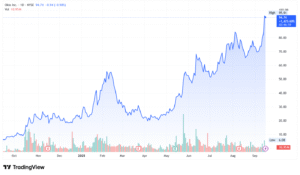
Oklo’s stock has been on a dramatic upward path after the announcement:

  • 1,460% increase in one year — rising from $6.20 on September 16, 2024, to $96.70 today.
  • 30% gain in just five days, from September 11 to September 16, 2025.

This performance has positioned Oklo as one of the standout companies in the clean energy sector. Investors believe the company’s technology and solid policy support will make it key in the global nuclear revival.

Oklo stock price

Moreover, Oklo was chosen by the U.S. Air Force in June to build a microreactor at Eielson Air Force Base in Alaska. It has a capacity of up to 75 megawatts of combined electrical and thermal power. The project will be designed, built, owned, and operated by Oklo on-site, helping the base cut fuel deliveries and improve energy security.

Why Nuclear Energy is Back in Focus

The renewed focus on nuclear energy is not accidental. The world is experiencing rapid growth in electricity demand.

According to the International Energy Agency (IEA), global electricity use could rise by 30% between 2023 and 2030. A lot of this growth will come from electric vehicles, industrial electrification, and big data centers. These centers are needed to support artificial intelligence and cloud computing.

At the same time, governments around the world have pledged to reduce greenhouse gas emissions to net zero by the middle of the century. Nuclear energy already provides 10% of global electricity and about 25% of all low-carbon power. Without nuclear, meeting climate targets would be much more difficult.

nuclear power share of electricity global 2024

The Intergovernmental Panel on Climate Change (IPCC) has also emphasized the role of nuclear in reducing emissions. Their reports show that doubling or tripling nuclear power by 2050 could cut billions of tons of CO₂ from the global energy system.

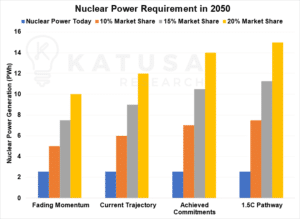
The chart below from Katusa Research shows how much nuclear power the world needs by 2050 in different scenarios.

Nuclear Power Requirement in 2050

Small Reactors, Big Promise

Traditional nuclear plants are large, costly, and can take more than a decade to complete. In contrast, advanced reactors are designed to be smaller, modular, and easier to construct. Oklo’s main project, the Aurora microreactor, provides about 1.5 megawatts of electricity. This is enough to power hundreds of homes or a small industrial site.

Aurora reactors are designed to run for up to 20 years without refueling. Oklo is also developing technologies to recycle used nuclear fuel. This process turns waste into a resource, enhancing the sustainability of nuclear energy.

The US-UK partnership is expected to speed up the demonstration and deployment of advanced reactors. Both countries aim to launch new nuclear designs in under a decade. They plan to do this by aligning regulations and funding demonstration projects.

Billions Flowing Into Atoms

The nuclear industry is experiencing a wave of new investment. The IEA says that yearly investment in nuclear energy should double to around $120 billion by 2030. This growth comes as governments and companies seek reliable, clean power.

nuclear energy investment outlook by type 2050
Source: IEA

Several countries are already moving forward with SMR projects. Canada has committed $970 million to develop SMRs in Ontario. Poland and Romania are working with US-based companies to deploy new reactor designs. Japan, South Korea, and France have also signaled stronger support for nuclear after years of slower growth.

Oklo stands out in this context because of its early-mover advantage in microreactors. Its reactors are smaller than most SMRs. This makes them ideal for specialized markets such as off-grid industries, island nations, and military uses. This flexibility gives the company a potential edge as countries and companies look for clean, scalable power solutions.

Investor Bet on Oklo

Oklo’s stock rally is part of a broader trend of growing investor enthusiasm for nuclear. Over the past year, companies tied to the nuclear sector have outperformed broader market indexes.

While the S&P 500 gained around 12% in the past 12 months, Oklo’s more than 1,400% increase stands out as extraordinary. By comparison, NuScale Power, another SMR developer, has seen more modest stock performance as it works to advance its projects.

The surge highlights both the opportunities and risks of investing in emerging nuclear technologies. Oklo still has big challenges ahead. They need regulatory approvals and must scale up manufacturing. However, the market is signaling confidence that Oklo’s approach aligns with the global push for clean, dependable power.

What This Means Going Forward

The Atlantic Partnership for Advanced Nuclear Energy marks a turning point in transatlantic cooperation. The US and UK are joining forces. By sharing their expertise, resources, and political will, they send a strong message: Nuclear energy will be key to their strategies.

For Oklo, the timing could not be better. Investor enthusiasm is high, government policies are supportive, and demand for clean energy is rising. And so, the company can take advantage of the nuclear boom.

If Oklo can deliver on its promises, it could help reshape the way the world thinks about nuclear power. Microreactors could become common in places where traditional reactors were never an option, from rural communities to industrial hubs.

The company’s story also reflects a larger shift. Nuclear power, once seen as a legacy technology, is now being recast as a driver of innovation and climate action. The mix of private-sector energy and government support could finally unleash its full potential.

The post US-UK Nuclear Pact Sends Oklo Stock (OKLO) to Record Highs in Clean Energy Boom appeared first on Carbon Credits.

Fentanyl – A National Security Crisis Demanding Prevention

Fentanyl - A National Security Crisis Demanding Prevention

Disseminated on behalf of ARMR Sciences Inc.

Fentanyl is no longer just another opioid – it has become the single most lethal synthetic drug in the United States. Since 2000, it is estimated that more than 20 million nonfatal overdoses have occurred in the U.S.- surpassing deaths from COVID-19, HIV/AIDS, and even major wars.

Today, fentanyl is the leading cause of death for adults aged 18–45, claiming an estimated 220 lives every single day.

A Silent, Rapid Killer

A minuscule amount – equivalent in size to just a few grains of salt – can be fatal. Fentanyl is fast-acting and often hidden in counterfeit pills or laced into drugs without the user’s knowledge. 

Fentanyl is cheap to manufacture and covertly laced with counterfeit pills and recreational drugs. This stealth factor explains why the vast majority of overdose victims never intended to take fentanyl.

The financial toll is also staggering: the opioid epidemic costs the U.S. economy an estimated $2.7 trillion in 2023 alone, with cumulative losses exceeding $10 trillion over the past two decades.

Why Current Defenses Fall Short

Tools like naloxone (Narcan) have saved lives but remain purely reactive. They only work after an overdose begins and often fail against emerging analogs such as xylazine, nitazenes, or medetomidine, which Narcan cannot reverse. First responders, military personnel, and even families are left without effective long-term defenses.

ARMR’s Preventive Approach

ARMR Sciences is advancing its novel immunotherapy, ARMR-100, designed to train the immune system to block fentanyl before it reaches the brain. In animal studies, ARMR-100 blocked 92% of fentanyl’s entry into the brain and eliminated its addictive behavioral effects. 

Unlike reactive antidotes, this would provide months of protection – functioning like a biochemical shield.

The program is building on seven years of U.S. Department of Defense–funded research and is working to leverage proven vaccine components, such as carrier proteins already approved in licensed products and adjuvants tested in hundreds of clinical trials. 

The Market and ARMR’s Mission

The potential reach is vast: 2.7 million Americans with opioid use disorder, over 2 million first responders and law enforcement officers, more than 18 million military personnel and veterans who experience higher rates of opioid use, chronic pain, and post-traumatic stress disorder, and more than 30 million high-risk young people.

A once or twice annual preventive shot could help transform national defense against fentanyl, making protection scalable across households, schools, hospitals, and security agencies.

The fentanyl crisis is no longer just a health issue – it’s a national security emergency. And we believe prevention, not rescue, may be the only path to saving a generation.

Why Investors Should Pay Attention

ARMR is more than a biotech startup – it is working to tackle America’s most urgent social and health crisis. This is a mission-driven company focused on building a preventive defense platform that could save thousands of lives each year:

  • $30M private raise launched
  • Seven years of DoD-backed research form the foundation
  • Lead candidate ARMR-100 blocked 92% of fentanyl from entering the brain in preclinical studies
  • A targeted exchange listing in the future

By investing in this round, investors have a chance to back a company whose mission is as much about impact as it is about growth potential. 

Invest now to help support ARMR’s efforts to build the nation’s first line of defense against fentanyl and other synthetic threats.

This is a paid advertisement for ARMR’s private offering. Please read the offering circular at InvestARMR.com for additional information on the company and the risk factors related to the offering.


DISCLOSURES & DISCLAIMERS

CLIENT CONTENT: Carboncredits.com is not responsible for any content hosted on ARMR Sciences’ sites; it is ARMR Sciences’ responsibility to ensure compliance with applicable laws.

NOT INVESTMENT ADVICE: Content is for educational, informational, and advertising purposes only and should NOT be construed as securities-related offers or solicitations. All content should be considered promotional and subject to disclosed conflicts of interest. 

Do NOT rely on this as personalized investment advice. Do your own due diligence.

Carboncredits.com strongly recommends you consult a licensed or registered professional before making any investment decision.

REGULATORY STATUS: Neither Carboncredits.com nor any of its owners or employees is registered as a securities broker-dealer, broker, investment advisor, or IA representative with the U.S. Securities and Exchange Commission, any state securities regulatory authority, or any self-regulatory organization.

CONTENT & COMPENSATION DISCLOSURE: Carboncredits.com has received compensation of thirty thousand dollars from ARMR Sciences for this sponsored content. You should assume we receive compensation as indicated for any purchases through links in this email via affiliate relationships, direct/indirect payments from companies or third parties who may own stock in or have other interests in promoted companies. We may purchase, sell, or hold long or short positions without notice in securities mentioned in this communication.

RESULTS NOT TYPICAL: Past performance and results are unverified and NOT indicative of future results. Results presented are NOT guaranteed as TYPICAL. Market conditions and individual circumstances vary significantly. Actual results will vary widely. Investing in securities is speculative and carries high risk; you may lose some, all, or possibly more than your original investment.

HIGH-RISK: Securities discussed may be highly speculative investments subject to extreme volatility, limited liquidity, and potential total loss. The Securities are suitable only for persons who can afford to lose their entire investment. Furthermore, investors must understand that such investment could be illiquid for an indefinite period of time. No public market currently exists for the securities, and if a public market develops, it may not continue.


Disclosure: Owners, members, directors, and employees of carboncredits.com have/may have stock or option positions in any of the companies mentioned: None.

Carboncredits.com receives compensation for this publication and has a business relationship with any company whose stock(s) is/are mentioned in this article.

Additional disclosure: This communication serves the sole purpose of adding value to the research process and is for information only. Please do your own due diligence. Every investment in securities mentioned in publications of carboncredits.com involves risks that could lead to a total loss of the invested capital.

Please read our Full RISKS and DISCLOSURE here.

The post Fentanyl – A National Security Crisis Demanding Prevention appeared first on Carbon Credits.

Nature’s Miracle Bets $20M on Blockchain Carbon Credits to Capture 1M Tons of CO₂

Nature’s Miracle Bets $20M on Blockchain Carbon Credits to Capture 1M Tons of CO₂

Nature’s Miracle Holding Inc., a publicly listed company (NASDAQ: NMHI) focused on agriculture technology and indoor farming, is making a bold entry into the carbon credit industry. The company plans to buy a $20 million carbon credit portfolio that will cut about one million metric tons of carbon dioxide. 

NMHI will also use blockchain technology to boost transparency and efficiency. This move shows that smaller companies are joining the growing carbon market. They use digital tools to improve trust and access.

A $20M Leap into Carbon Credit 

Nature’s Miracle signed a Letter of Intent to buy $20 million in carbon credits from Carbon Credit Corporation, a company based in Taiwan. These credits represent one million metric tons of CO₂ reductions. That’s about the same as the yearly emissions from 220,000 gasoline cars or the energy used by 125,000 homes.

Credits mainly come from hydroelectric and methane capture projects in Asia and South America. Together, these sectors account for about 40% of voluntary carbon credits issued worldwide, which are registered with Verra’s Verified Carbon Standard (VCS). It is the largest carbon registry, overseeing over 75% of all carbon credits traded worldwide.

To pay for the deal, Nature’s Miracle plans to issue new company shares. For a company with a market cap under $100 million in 2025, this investment is big. It may change the business, moving beyond agriculture tech into environmental finance.

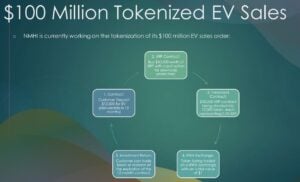
In addition to its carbon credit push, Nature’s Miracle is also moving into electric vehicles with a plan to tokenize a $100 million EV sales order. The company plans to use the XRP Ledger. They will convert customer deposits into digital tokens.

Nature's Miracle tokenization
Source: NMHI presentation

Each token will represent a fraction of an XRP-backed contract. These tokens can then be traded on real-world asset (RWA) exchanges or redeemed at contract maturity. The goal is to merge EV sales with blockchain innovation. This gives customers access to vehicles and the chance for investment returns.

Why Blockchain for Carbon Credits?

The carbon market has long faced criticism over a lack of transparency, double-counting, and difficulty in tracking credit ownership. Blockchain offers a promising solution. It creates a permanent and verifiable digital record for every transaction.

Through the XRP Ledger blockchain, Nature’s Miracle plans to tokenize each carbon credit, turning it into a digital token. This allows credits to be traded more easily across markets and retired once used.

Blockchain tools in carbon markets can:

  • Track the origin and transfer of credits in real time.
  • Prevent double-counting or fraudulent claims.
  • Increase liquidity by making trading more efficient.

This idea of tokenizing carbon credits is gaining momentum. In 2024, the World Bank reported that more than 60 pilot projects worldwide were exploring blockchain or digital MRV (monitoring, reporting, and verification) systems for carbon markets.

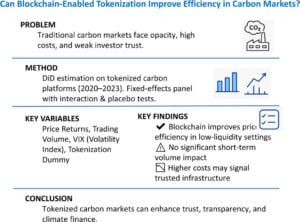
Moreover, an analysis shows that in 2025, more than 60% of new carbon credit platforms are using blockchain, with most focused on agriculture and forestry projects. A study further shows that blockchain can boost carbon markets, reduce inefficiencies, and aid climate action and the Sustainable Development Goals (SDGs).

blockchain tokenization of carbon credits
Source: https://doi.org/10.1016/j.sftr.2025.101109

Riding the $250B Carbon Wave

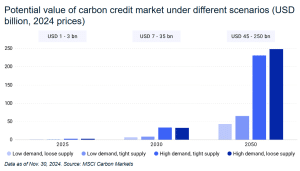
The global carbon market is expanding quickly as governments and companies act on climate targets. In 2024, the voluntary carbon market was worth around $2 billion. Analysts expect it to reach $50 billion by 2030 and up to $250 billion by 2050 if demand keeps rising.

carbon credit market value 2050 MSCI
Source: MSCI

Key drivers of this growth include:

  • Corporate net zero pledges: Over 9,000 companies worldwide have set targets to cut or offset emissions by 2050.
  • Government regulations: Policies like the EU’s Carbon Border Adjustment Mechanism are increasing demand by putting a price on carbon-intensive imports.
  • Rising carbon prices: In compliance markets such as the EU Emissions Trading System, prices reached over €100 per ton in 2023, up from less than €30 per ton in 2020. It stabilizes at around €100 per ton in mid-2025.

Carbon credits are a bridge solution for firms that cannot yet eliminate all emissions. They allow companies to support renewable energy, forest protection, or clean technology projects while continuing to cut emissions internally.

High Risk, High Reward

For Nature’s Miracle, entering the carbon market creates opportunities but also major risks. This acquisition allows the company to expand beyond indoor farming. It positions it in a fast-growing industry.

A successful blockchain platform could attract corporate buyers and investors looking for trustworthy carbon credits. However, the risks are equally significant.

The company’s market value is small compared to the $20 million portfolio it is acquiring. Financing and managing the credits will be a test of its capacity. Investor confidence has also been weak, with the stock losing more than 60% of its value in the past 12 months.


Blockchain Meets Carbon: What Other Blockchain Carbon Projects Do

Nature’s Miracle is not the first to explore blockchain for carbon markets. Other notable projects include:

  • Toucan Protocol:

Known for bringing carbon credits onto the blockchain by “bridging” them into digital tokens on Polygon. Toucan was one of the first large-scale efforts to tokenize credits, with over 20 million credits in 2021-2022.

  • KlimaDAO:

A decentralized autonomous organization that built a carbon-backed cryptocurrency. By using blockchain incentives, KlimaDAO aimed to create demand for tokenized credits and raise their price. It has attracted more than 17 million tons of credits into its treasury at its peak.

  • Flowcarbon:

Backed by venture capital and co-founded by WeWork’s Adam Neumann, Flowcarbon has focused on issuing carbon-backed tokens and building a marketplace for transparent trading. It has raised $70 million in funding in 2022 to develop blockchain-based carbon tokens.

Unlike these startups, Nature’s Miracle is a publicly traded company with an existing agricultural technology base. Its plan to tokenize Verra-registered credits on the XRP Ledger may appeal to investors looking for a link between traditional finance and emerging digital tools.

Verra’s dMRV platform
Source: Verra

From Fields to Finance: What This Means for the Future of Carbon Markets

The Nature’s Miracle deal highlights a shift from pilot projects to real strategies in carbon finance. Tokenization might boost trust in carbon offset markets. These markets lost momentum in 2023 after reports raised doubts about credit quality.

If successful, blockchain adoption could make it easier for both small and large companies to trade and retire credits. Over 40% of Fortune 500 companies already use carbon offsets in their climate strategies. Many are also looking for better tracking systems.

The coming years will reveal whether regulators and big corporate buyers accept tokenized credits. If they do, blockchain could become a standard tool in emissions accounting. If not, it may remain a niche experiment.

Nature’s Miracle’s plan to acquire $20 million in carbon credits is a bold step for a small company. By tokenizing these credits on the XRP Ledger, it is entering both the carbon finance and blockchain arenas.

The move highlights the growing demand for transparent, credible carbon markets. It also shows how innovation in finance and technology is shaping the global response to climate change. Whether Nature’s Miracle succeeds or struggles, its entry marks another step in merging agriculture, carbon markets, and digital tools in the fight against global warming.

The post Nature’s Miracle Bets $20M on Blockchain Carbon Credits to Capture 1M Tons of CO₂ appeared first on Carbon Credits.
EU Unveils €17.5B Boost to Help SMEs Go Green and Cut Energy Costs

EU Unveils €17.5B Boost to Help SMEs Go Green and Cut Energy Costs

The European Investment Bank (EIB), supported by the European Commission, has started a €17.5 billion program for small and medium-sized enterprises (SMEs). This initiative aims to boost energy efficiency upgrades and decarbonization projects in the EU.

The program will run for three years and aims to help over 350,000 businesses. The goals are to cut costs, reduce emissions, and boost competitiveness in a changing energy market.

This financing is not only about helping SMEs modernize. It is also part of Europe’s broader plan to reach its climate goals under the European Green Deal. By supporting smaller firms, the EU hopes to ensure no business is left behind in the green transition.

The Commissioner for Energy and Housing Dan Jørgensen remarked during the announcement:

“SMEs are at the heart of Europe’s economy and way of life. But they invest in energy efficiency at only half the rate of larger companies. This EIB initiative supported by the Commission will be key to close the investment gap, simplify access to financing, and accelerate the deployment of energy efficiency solutions. With more energy-efficient SMEs, we boost our economy, we benefit our climate, and we keep a healthy heartbeat in communities across Europe.”

Why SMEs Are Central to the EU’s Climate Goals

SMEs are the backbone of Europe’s economy. They account for more than 99% of businesses and employ around 100 million people. Yet, their smaller size often makes it harder for them to invest in energy-saving measures than larger companies.

Data shows that SMEs invest at only half the rate of larger firms in energy efficiency projects. Rising energy costs have made this gap even more pressing. Old heating systems, bad insulation, or weak lighting can expose SMEs to rising energy costs.

With this major financing, the EU is helping SMEs in two ways: it lowers their costs and advances the EU’s climate goals. This approach makes sure that smaller firms join the move to a greener economy. Together, they play a big role in Europe’s energy use and emissions goals. 

EU GHG emissions by sector 2023
Source: EU website

The European Union has reduced its greenhouse gas emissions by around 37% since 1990, as of 2024. This drop is mainly due to increased use of renewable energy and less reliance on coal.

The EU aims to cut emissions by at least 55% by 2030, using 1990 levels as a baseline. Member States may achieve reductions of about 54-49%, depending on their policies.

EU net-zero pathway
Source: European Commission (EC)

Looking ahead, the EU is considering even more ambitious goals: a proposed 2040 target seeks a 90% reduction in net emissions, setting the path toward becoming climate neutral or net zero by 2050.

Inside the €17.5 Billion Green Financing Plan

The EIB will provide financing in the form of loans, equity investments, and guarantees. These tools will be delivered through existing programs like InvestEU, as well as new channels designed to make access easier.

One major feature of the initiative is a “one-stop shop” model. This will allow SMEs to find support in a single place rather than navigating multiple programs. The goal is to simplify procedures, reduce paperwork, and make financing faster to access.

The projects supported will cover proven technologies that are widely available but underused by smaller firms. These include improved building insulation, energy-efficient machinery, advanced heating and cooling systems, and low-carbon lighting. Each of these upgrades can help reduce operational costs while cutting emissions.

Importantly, the financing is not limited to equipment purchases. SMEs can use funds to try new business models. One option is energy efficiency as a service. In this model, a provider installs and maintains equipment. The SME then pays only for the energy saved. This approach lowers upfront costs and makes it easier for firms with limited budgets to adopt modern technologies.

Scaling Up Impact: €65 Billion in Investments by 2027

While the program itself offers €17.5 billion, the EU expects it to mobilize at least €65 billion in total investment by 2027. This figure includes extra support from private investors, national governments, and financial institutions. They will collaborate with the EIB.

Over the 3-year period, the program could reach over 350,000 SMEs across all EU member states. The projects will help firms lower energy bills, reduce carbon footprints, and build resilience against future energy shocks.

Moreover, the impact is expected to go beyond the companies themselves. The initiative will create demand for retrofits, new heating systems, and efficiency services. This will generate thousands of jobs in construction, engineering, and clean technology. It will also support regional development, especially in areas where SMEs are a critical source of employment.

Barriers Ahead: Can All SMEs Keep Up?

Despite its promise, the initiative faces several challenges. First, many SMEs have limited time and capacity to deal with complex applications. Even with simplified procedures, awareness and outreach will be essential.

Second, energy efficiency projects often involve upfront costs that take time to recover. While financing helps, firms may still hesitate if payback periods are long. 

Third, access must be balanced across all EU regions. SMEs in rural or less developed areas may need extra support to compete with firms in larger cities that already have more resources. Ensuring an equitable rollout will be key to the program’s success.

These challenges are significant, but the potential rewards are even greater. By bringing SMEs into the center of the green transition, the EU is linking small business growth with Europe’s broader decarbonization agenda.

The Policy Context: Fitting Into Europe’s Green Deal

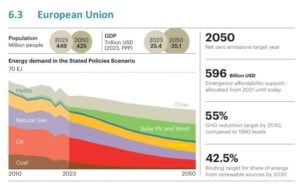
European Union energy demand under net zero
Source: EC

This initiative comes at a time when the EU is under pressure to deliver on its climate commitments. Achieving these targets will require action across all sectors, including SMEs.

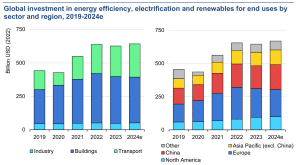
Global energy efficiency investment is also on the rise. According to the International Energy Agency, annual spending on energy efficiency reached $660 billion in 2024 and is expected to grow steadily. 

Global investment in energy efficiency by sector and region 2019-2024
Source: IEA

Europe’s new program fits within this global trend by channeling resources to smaller firms that often lack access to capital. If successful, the program could deliver multiple benefits:

  • Lower costs: SMEs will save money on energy, improving their competitiveness.
  • Reduced emissions: Widespread adoption of efficiency upgrades can significantly cut carbon output from the SME sector.
  • Job creation: New demand for retrofits, technology, and services will support employment in clean industries.
  • Resilience: Companies will be better prepared to handle energy price shocks and supply disruptions.

Double Wins: Lower Costs, Lower Emissions

The EU’s €17.5 billion financing program marks a major step in supporting SMEs through the green transition. It aims to lower barriers and boost the adoption of energy efficiency and decarbonization projects in the EU by combining loans, equity, advisory services, and innovative models.

Challenges remain, like ensuring access in all areas and managing upfront costs. Still, the initiative provides a guide for governments. It shows how to support climate action and boost small businesses.

By linking competitiveness with sustainability, the EU is signaling that the path to a low-carbon future must include every level of the economy. SMEs, once seen as too small to matter in climate policy, are now positioned as key players in the EU’s decarbonization journey.

The post EU Unveils €17.5B Boost to Help SMEs Go Green and Cut Energy Costs appeared first on Carbon Credits.
Tesla (TSLA) Stock Surges on Musk’s $1 Billion Buy and GigaBerlin EV Growth Strategy

TESLA

Tesla’s (TSLA) stock gained momentum in September 2025 after CEO Elon Musk announced a $1 billion stock purchase. The move, Musk’s first open-market buy since early 2020, is being viewed as a renewed vote of confidence in Tesla’s long-term direction.

It comes at a time when the EV maker faces challenges like softening demand and margin pressures, but is doubling down on its transformation into an AI and robotics powerhouse.

TSLA Stock Rebounds: Musk’s Vote of Confidence Fuels Investor Optimism

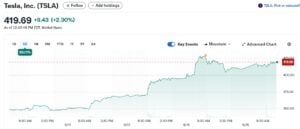
On September 15, Tesla (TSLA stock) shares surged 6% in early trading after Musk revealed he acquired 2.57 million shares at prices ranging from $372.37 to $396.54 per share. The transaction was disclosed through a regulatory filing, drawing investor attention for its timing and significance. Analysts see this as Musk’s unmistakable signal that Tesla’s strategic direction remains firmly on course.

Reuters revealed what Matt Britzman, senior equity analyst at Hargreaves Lansdown, said on this move:

“This is the clearest signal yet that Musk is going all in again. After a shaky start earlier this year, the Tesla-Musk narrative is back on track.”

The purchase aligns with Musk’s longstanding desire for greater influence over Tesla’s future. The report further explained that he has previously expressed the need for at least 25% voting power to drive AI and robotics ventures within the company. As of December 2024, Musk held a 13% stake in Tesla, according to LSEG data.

This stock buy also comes shortly after Tesla’s board unveiled a proposed $1 trillion compensation package for Musk, setting out ambitious financial and operational goals. The package, designed to incentivize long-term growth, reflects both Musk’s demands and the company’s broader vision for the future.

TSLA STOCK
Source: Yahoo Finance

Tesla’s Challenge: Slowing EV Sales Amid Rising Competition

Despite the positive sentiment around Musk’s investment, Tesla’s recent performance has been mixed. The company’s shares have been among the weakest performers among other tech megacap stocks, with a 2% decline in year-to-date value through its last close.

The company’s latest quarterly results pointed to margin pressures driven by rising input costs, softening EV demand, and growing competition. Tesla faces challenges from both established automakers transitioning to electric vehicles and emerging players aiming to carve out market share.

Dan Ives, global head of tech research at Wedbush, noted, “The insider purchase is a huge sign of confidence for Tesla bulls. It shows Musk doubling down on his AI-driven vision, even as margin pressures and competition mount.”

Tesla’s pivot toward AI and robotics remains central to its strategy, with efforts focused on building software-driven platforms and automated vehicle systems. However, its core EV business continues to experience volatility, prompting Musk’s renewed investment in its stock.

GigaBerlin: A Strategic EV Expansion Amid Market Uncertainty

While Tesla faces headwinds in its traditional EV business, its GigaBerlin factory in Germany is emerging as a crucial growth driver. Recently, the plant’s chief, André Thierig, confirmed that production would be ramped up in the final quarters of 2025 due to rising demand.

Business blog EV also highlighted Thierig’s statement to the German Press Agency. He said,

“We have revised our production planning upward for both the third and fourth quarters. The brand currently has a very good sales situation, which is driving higher output at the factory.”

The GigaBerlin plant, which exclusively manufactures the Model Y, hit a milestone of half a million units produced as of March 2025, around three years after production began.

The factory’s output has been temporarily disrupted this year as Tesla refreshed the Model Y lineup. The rollout of the updated model caused short-term production and delivery interruptions but is expected to fuel growth in subsequent quarters.

Tesla’s Global EV Push

Despite global economic uncertainties, Tesla’s leadership sees continued demand across regions. Thierig emphasized that the factory serves more than 30 markets worldwide, including Europe, Canada, Taiwan, and the Middle East.

He is optimistic about seeing positive trends across the markets.

Earlier this month, Tesla’s first vehicles from GigaBerlin reached Canadian shores, marking a strategic shift from U.S.-produced Model Ys. This move helps Tesla navigate trade barriers, such as tariffs, while expanding its global footprint.

Additionally, Tesla recently introduced the Model Y Performance variant in Europe, priced from €62,970 ($73,800) in Germany—higher than the standard model’s €44,900 ($52,600). Deliveries are set to begin soon in key markets like Germany and the Netherlands.

tesla TSLA stock
Source: Tesla

Sales in Germany Remain Volatile

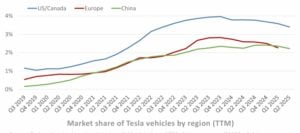
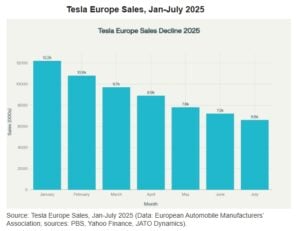
Despite production growth, Tesla’s European operations are grappling with a decline in sales. As of August 2025, Tesla’s vehicle sales across Europe fell 19.8% compared to the same period in 2024, with Germany showing a sharp 56% decline year-to-date.

New government incentives, introduced in July 2025 to support EV adoption, have yet to fully reverse the downward trend. The incentives include accelerated depreciation, tax relief, support for startups, and expanded charging infrastructure—efforts aimed at spurring demand for electric vehicles among business fleets.

Amid the push for EV growth, Thierig urged policymakers not to side with legacy automakers opposing the 2035 EU ban on petrol vehicles. He warned that favoritism toward traditional manufacturers could undermine the EV industry’s prospects in eastern Germany.

tesla europe

Can Tesla (TSLA) Stock Navigate Competition and Rising Costs?

Tesla’s rebound in September erased some of its earlier losses, with shares posting year-to-date gains after a slump in the first half of the year. However, the road ahead remains challenging.

The company’s ambition to transform into an AI and robotics leader offers long-term upside but also requires substantial investment, regulatory navigation, and technological advancement. At the same time, its core EV business must contend with rising competition, fluctuating demand, and cost pressures.

Musk’s $1 billion stock buy and GigaBerlin’s expanded production capacity signal bold moves to sustain growth and investor confidence. But industry watchers caution that execution, market trends, and geopolitical dynamics will ultimately shape Tesla’s trajectory.

For now, Tesla’s message to investors and regulators is clear: it’s betting on innovation and scale, even as short-term hurdles persist. Musk’s confidence and the company’s global expansion underscore its intent to remain a pioneer in sustainable mobility, while navigating the complex realities of today’s EV market.

The post Tesla (TSLA) Stock Surges on Musk’s $1 Billion Buy and GigaBerlin EV Growth Strategy appeared first on Carbon Credits.
U.S. EPA’s $2.4 Billion Deregulation Plan: How Ending Greenhouse Gas Reporting Could Affect America’s Climate Future

EPA

The U.S. Environmental Protection Agency (EPA) has proposed ending the Greenhouse Gas Reporting Program (GHGRP). The agency says this move could save businesses up to $2.4 billion in compliance costs over the next ten years.

If approved, about 8,000 large facilities would no longer be required to report their greenhouse gas emissions. These businesses currently have to share data if their emissions exceed 25,000 tons of CO₂ equivalent each year.

This proposal follows President Trump’s executive orders on his first day in office, which focus on cutting regulations and promoting energy production.

EPA Administrator Lee Zeldin explained that,

“Alongside President Trump, EPA continues to live up to the promise of unleashing energy dominance that powers the American Dream. The Greenhouse Gas Reporting Program is nothing more than bureaucratic red tape that does nothing to improve air quality. Instead, it costs American businesses and manufacturing billions of dollars, driving up the cost of living, jeopardizing our nation’s prosperity, and hurting American communities. With this proposal, we show once again that fulfilling EPA’s statutory obligations and Powering the Great American Comeback is not a binary choice.”

Turning Point for America’s Climate: EPA’s Bold Move to Scrap Greenhouse Gas Reporting

The EPA argues that the GHGRP creates “burdensome red tape” without helping improve human health or protect the environment. The agency says this data doesn’t directly lead to rules that regulate emissions or enforce climate action.

The proposed rule would remove reporting requirements for facilities across many industries—power plants, refineries, steel mills, cement factories, and landfills. The public would no longer have access to self-reported emissions data from these sources.

Reporting for petroleum and natural gas companies would also be suspended until 2034. This aligns with recent law changes that delayed methane fee collections. Only small parts of the petroleum sector would still be required to report emissions for future adjustments.

According to the EPA, this change would save between $2 billion and $2.4 billion over ten years. The agency believes that by reducing regulatory costs, companies can focus on real environmental improvements instead of filling out reports.

Background on the Greenhouse Gas Reporting Program

The GHGRP was created by Congress in 2008 and started collecting data in 2010. It requires 47 categories of sources to report their emissions each year. The goal was to improve transparency and track trends in pollution.

The Waste Emissions Charge (WEC) was added to the Clean Air Act in 2022. It imposed fees on methane emissions from petroleum and natural gas systems that exceeded certain limits. However, the “One Big Beautiful Bill Act” signed in 2025 delayed this charge until 2034, meaning those companies won’t report until then.

Earlier in 2025, the EPA announced it would reconsider the GHGRP as part of a wider effort to cut regulations and boost American energy.

However, Zeldin said that rolling back GHGRP would still meet the agency’s legal obligations under the Clean Air Act (CAA).

What the Proposal Means

If the proposal is approved:

  • Nearly all large polluters, like power plants, refineries, steel and cement makers, landfills, and others, will no longer report their emissions.
  • Only small parts of the petroleum and natural gas sector will report, and even that is postponed until 2034.
  • This means that nearly all U.S. greenhouse gas reporting would stop, making it harder for the government to track emissions.

Industry’s Reaction: Mixed Support, Strong Worries

Many scientists, economists, and environmental groups worry that this move will make it much harder to fight climate change. Environmental organizations argue it can significantly weaken efforts to hold polluters accountable.

Even some business groups that support deregulation warn that without reliable data, companies and investors won’t be able to manage climate risks.

  • Loss of Transparency: The GHGRP is one of the country’s biggest sources of emissions data. Without it, governments, investors, and communities won’t know where pollution is coming from.
  • Risk of “Blind Spots”: Policymakers will have fewer tools to track pollution and design solutions. This could slow down efforts to reduce emissions.
  • Higher Long-Term Costs: Studies show that mandatory reporting has helped lower emissions by 20% since 2009. Without data, companies may pollute more, leading to greater health risks and economic costs later on.
  • Weakening Climate Agreements: The U.S. shares emissions data with other countries. Without this reporting, global trust in U.S. climate commitments could fall.

Economists warn that while companies save money in the short term, the risks from extreme weather, regulatory uncertainty, and damaged public trust could lead to bigger problems down the line.

On the other hand, some industry groups support the rollback. They say reporting rules are expensive and outdated. Cutting them would free up money for more direct investments in cleaner technology.

They believe this proposal is part of a wider effort to reduce regulations, paperwork and encourage energy production. It will create jobs, boost the economy, and let businesses invest more in real environmental solutions.

Next Steps

The EPA will open a public comment period where citizens, businesses, and experts can share their views. Instructions will be available in the Federal Register and on the EPA website. Many expect fierce debate, and legal challenges are likely if the rule moves forward.

A Critical Choice for America’s Climate Future

The EPA’s plan to end the Greenhouse Gas Reporting Program is a major shift in U.S. climate policy. While it could lower costs for businesses, it also creates serious risks by making it harder to track pollution and protect the environment. As the public voices its opinions, this debate will help determine how the country balances short-term savings with long-term climate goals.

U.S. Emissions Set to Rise in 2025?

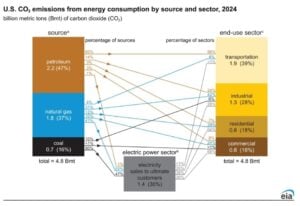
The EIA projects that U.S. energy-related carbon dioxide (CO₂) emissions will rise by 1.5% in 2025, before declining by 0.5% in 2026. The increase in 2025 is driven by higher emissions from coal, natural gas, and petroleum products. Significantly, coal will be contributing the most to the growth.

However, the decline in 2026 will also be primarily attributed to reduced emissions from coal.

us emissions
Source: EIA

Overall, this deregulation decision could affect the U.S. globally. Other nations depend on American emissions data to measure progress and coordinate efforts. Without this information, the U.S. risks losing trust and influence in international climate discussions. In the end, it’s not just about cutting regulations. Ensuring accountability, leadership, and a cleaner future for all should also matter.

The post U.S. EPA’s $2.4 Billion Deregulation Plan: How Ending Greenhouse Gas Reporting Could Affect America’s Climate Future appeared first on Carbon Credits.
IAEA Predicts Doubling Nuclear Capacity by 2050—SMRs and Reactor Life Extensions Lead the Way

nuclear energy

The International Atomic Energy Agency (IAEA) has raised its expectations for the future of nuclear power. The agency’s latest report, the 45th edition of Energy, Electricity and Nuclear Power Estimates for the Period up to 2050, says nuclear capacity could more than double by 2050.

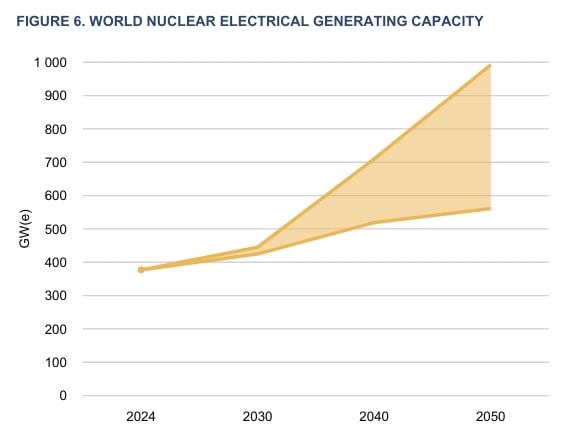
  • In the best-case scenario, nuclear power could expand from 377 gigawatts (GW) in 2024 to nearly 992 GW by 2050 — that’s a 2.6 X increase.

The findings were shared by IAEA’s Director General, Rafael Mariano Grossi, at the organization’s General Conference in Vienna, Austria.

The report draws on expert analysis and examines how nuclear power could shape the world’s clean energy transition. It’s clear that nuclear power is being seen as a major player in helping meet global energy and climate goals.

world nuclear
Source: IAEA

Nuclear Energy as a Backbone for Sustainable Electricity

At the end of 2024, the world had 417 nuclear reactors in operation, producing a combined 377 GW of electricity. Another 62 reactors, totaling 64.4 GW, were being built, and 23 reactors with 19.7 GW were temporarily offline.

Over the year, six new reactors were added, with 6.8 GW of capacity, while four reactors with 2.9 GW were retired. Two reactors that had been shut down were restarted, adding 1.6 GW back to the grid. Additionally, construction began on nine new reactors, expected to provide an additional 10.1 GW.

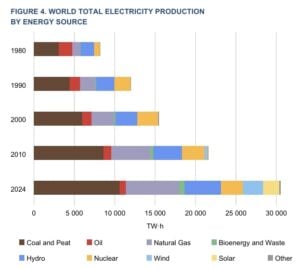
Electricity demand grew by about 3.4% in 2024, while nuclear electricity rose by 2.8%, reaching 2,670 terawatt-hours (TWh). Despite this growth, nuclear’s share of total electricity slipped slightly to 8.7%. Even though it’s the second-largest source of low-carbon power, nuclear energy’s share has declined since the early 1990s.

Fossil fuels, especially coal, still account for the bulk of electricity, though coal’s share has been dropping since its peak in 2010.

Other low-carbon sources like hydro, wind, and solar are also contributing. Hydropower, which remains the largest source of clean energy, now accounts for 15% of global electricity, down from 21% in 1980. Wind and solar energy, however, have grown rapidly, reaching 8% and 7% of the global electricity mix, respectively, in 2024.

electricity mix
Source: IAEA

IAEA’s Bold Predictions for Nuclear Energy’s Future

The IAEA’s projections show two possible futures: a high case and a low case.

  • In the high case, nuclear capacity could rise by 18% by 2030 and 2.6 times by 2050. This would help nuclear’s share in the energy mix slightly increase.
  • The low case sees only modest growth: a 13% rise by 2030 and a 32% increase by 2050, which would lead to a small decline in its share of total capacity.

The gap between these two futures largely depends on how governments and industries act today. The high case assumes nations are committed to expanding nuclear energy, while the low case assumes things continue as they are, with few policy changes.

Significantly, the IAEA has been consistently raising its forecast for nuclear power. The trend started after the 2011 Fukushima disaster, when many thought nuclear energy’s role would shrink. However, rising concerns about climate change, energy security, and investment opportunities have shifted global opinion.

Grossi pointed out that there’s now a global consensus: nuclear energy is essential for achieving clean, reliable, and sustainable electricity.

The Role of Small Modular Reactors (SMRs)

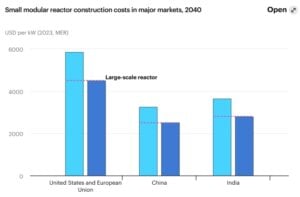
One of the biggest differences between these scenarios is the contribution of small modular reactors (SMRs). These smaller, more flexible reactors are seen as crucial to expanding nuclear power. In the high case, SMRs would supply 24% of the new capacity added by 2050. In the low case, they would only account for 5%.

SMRs are being developed to be safer, cheaper, and quicker to deploy than traditional reactors. Many experts believe they could be a game-changer, especially for countries with smaller grids or limited infrastructure.

SMR
Source: IEA

What’s Driving the Change

Jessica Callen-Kovtunova, an energy planner at the IAEA, explained that investments in nuclear power are being encouraged by several factors:

  1. Climate concerns and policy support – Countries are committing to lowering their carbon footprints.
  2. Rising electricity demand – Tech companies and expanding industries need more energy.
  3. Development banks backing nuclear projects – Institutions like the World Bank are financing nuclear plant upgrades and SMRs.
  4. Lifetime extensions of existing reactors – Many reactors have been in operation for over 30 or even 40 years.

Unlocking Nuclear’s Full Potential

Even with strong support, scaling up nuclear power is not an easy task. The high scenario would require an average of 26 GW of new nuclear capacity each year — more than four times the recent five-year average of 5.9 GW annually.

Another major hurdle is the ageing nuclear fleet. Two-thirds of reactors have been running for over 30 years, and 40% have been online for over 40 years. Without adding new reactors or extending existing ones, a large portion of nuclear capacity could be lost in the coming decades.

Thus, according to Grossi, three major challenges must be addressed for nuclear power to expand globally:

  1. Support for newcomer countries – Many nations need help building the technical, legal, and financial frameworks for nuclear projects.
  2. Adapting regulation – Rules and licensing procedures must evolve to accommodate new technologies like SMRs.
  3. Financing – Large investments are required, and innovative funding models will be essential.

The IAEA is working with countries to address these challenges and make nuclear power a cornerstone of the clean energy future.

Extending Reactor Lifetimes: A Key Solution

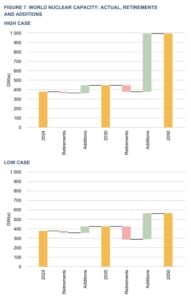
Another important factor that the IAEA’s report emphasizes is extending the operating life of existing reactors. Experts say it is the most cost-effective way to keep nuclear energy part of the grid. In the high case, only 81 GW of capacity is expected to retire by 2050, while in the low case, 156 GW could be retired.

In the high case, new additions would reach 615 GW, whereas the low case would result in only 184 GW of net additions by 2050.

nuclear reactor
Source: IAEA

The Bigger Picture: Energy and Climate

Nuclear energy’s future is tied closely to global energy demand. By 2050, electricity consumption is expected to double, with electricity making up a much larger share of overall energy use. For example, in North America, electricity’s share of final energy consumption is projected to rise from 23% in 2024 to 45% in 2050.

Nuclear energy is set to play a bigger role in fighting climate change. The path won’t be easy, but new technologies like SMRs create opportunities. Extending the life of existing reactors adds further support. Together, they can deliver reliable, low-carbon energy for billions.

The IAEA’s growing forecasts show rising confidence in nuclear’s potential. As a result, the world’s energy future looks cleaner and more secure.

The post IAEA Predicts Doubling Nuclear Capacity by 2050—SMRs and Reactor Life Extensions Lead the Way appeared first on Carbon Credits.
Google Hits $3 Trillion and Stock Surges to All-Time High: What About Its Net-Zero Goals?

Google Hits $3 Trillion and Stock Surges to All-Time High: What About Its Net-Zero Goals?

Alphabet, the parent company of Google, has entered a new phase in its market journey. In September 2025, the company’s stock surged past a $3 trillion market capitalization, placing it in the same tier as Apple and Microsoft.

Google’s stock rise is not just about financial momentum. The company has gained from positive regulatory decisions, excitement about artificial intelligence (AI), and steady growth in its main advertising and cloud areas.

At the same time, the company continues to face scrutiny over its environmental impact as it expands its infrastructure to power AI applications. Google balances financial performance with net-zero goals. This focus makes it a key player in the ESG space.

Market Drivers Behind Alphabet’s Growth

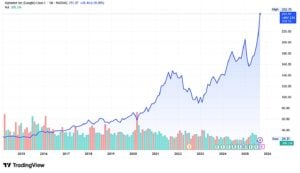
Google’s stock trades at about $251.97, up roughly about 4.5% in the latest session. The rally has lifted its market capitalization above $3 trillion for the first time.

With Monday’s rise, the company’s stock is now up more than 32% this year, making it the strongest performer among the “Magnificent 7” tech giants. It is also well ahead of the 12.5% gain of the S&P 500 (SPX).

Google GOOG stock
Source: TradingView

Several recent events have shaped investor sentiment around Alphabet. The biggest news came from a U.S. federal court in early September. The court decided that Google would not be broken up. This was despite earlier findings that the tech giant had monopoly power in search and advertising.

The court blocked some of Google’s exclusive contracts but allowed the company to retain control over Android and Chrome. This outcome removed a cloud of uncertainty that had hung over the company for years, giving investors more clarity on its future.

Alphabet’s core businesses are also performing strongly. Advertising revenue continues to grow as YouTube, Search, and other platforms expand their reach. Meanwhile, Google Cloud has become a growth engine, attracting customers seeking to build AI and digital services.

Gemini, the company’s AI platform, is now part of more products. This move boosts its competitive edge. Analysts are raising their price targets. Some expect Alphabet shares to hit $280 in the next year.

Crossing the $3 trillion market capitalization threshold has also provided momentum. These milestones carry symbolic weight, signaling market confidence in Alphabet’s ability to deliver growth at scale.

For investors, it’s not just about company size. It’s also about the sectors they lead, like search, advertising, cloud computing, and now AI.

Governance Gets a Makeover

Google’s governance practices have come under intense scrutiny over the years, particularly in relation to antitrust cases. In mid-2025, the company agreed to spend $500 million over the next decade to revamp its compliance structure. This settlement led to the formation of a special board committee for risk and compliance. This shows how important regulatory oversight is for Alphabet’s operations.

These measures boost the “G” in ESG. They ease worries that Alphabet may lag in corporate accountability. Investors usually overlook companies with high governance risk.

By tackling these issues head-on, Google has become more appealing to long-term institutional investors. The company wants to improve governance. This shows it knows how important it is to link business performance with responsible practices.

Not only that, but the company is also concerned about its growing carbon footprint.

Chasing Carbon-Free Days: Alphabet’s Net Zero Goals and Clean Energy Push

Google has set some of the most ambitious environmental targets in the technology sector. It aims to reach net-zero emissions across its operations and value chain by 2030.

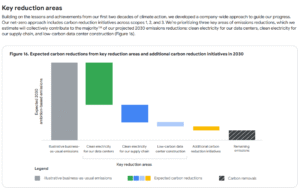
A key part of this goal is running all operations on 24/7 carbon-free energy (CFE) in every region where the company operates. This means matching every unit of electricity consumed with clean energy sources, rather than relying on offsets alone.

Google carbon reduction levers
Source: Google

The company has made progress. In 2024, Google signed power agreements totaling 8 gigawatts of new clean energy, and it brought around 2.5 gigawatts of capacity online. Its data centers power AI and cloud services. They’ve become more efficient, cutting emissions intensity by about 12% each year.

At the supply chain level, Google has asked major hardware suppliers to commit to 100% renewable energy by 2029. These steps show how the company is adding sustainability to its operations and partnerships.

The AI Energy Dilemma

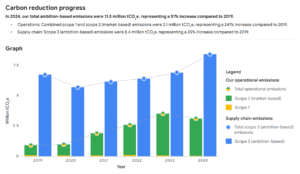
Despite these achievements, Google faces serious challenges. Total emissions have jumped about 51% since 2019. This rise comes mainly from Scope 3 emissions in the supply chain and the growing energy needs of AI.

Google carbon emissions 2024
Source: Google

Even though data center efficiency has gotten better, total energy use keeps rising. This is because AI applications need more computing power. This raises questions about whether Google can truly meet its net-zero goals. It may need more drastic changes in technology or energy sources.

The regional nature of electricity grids also complicates Google’s clean energy ambitions. In North America and parts of Europe, the company has made significant progress toward 24/7 carbon-free energy.

However, in Asia-Pacific markets, where grids rely more heavily on fossil fuels, progress has been slower. Alphabet knows that reaching its global goal needs changes that it can’t control. This includes faster permits for renewable projects and regulatory reforms.

Scope 3 emissions remain the hardest to tackle. These include emissions from suppliers, manufacturing, logistics, and product use. In 2024, these rose ~22% year-over-year, and account for about 73% of Google’s “ambition-based” total carbon footprint. Thua, the company is urging its partners to use renewable energy to lower this emission source.

Overall, here are the company’s efforts in tackling its environmental footprint:

  • Cut its data center energy emissions by 12% in 2024, even though electricity demand rose sharply.

  • Added 2.5 gigawatts of new clean energy capacity in 2024 via over 25 projects that came online, helping to expand its clean energy procurement.

  • In 2024, signed contracts for 8 GW of clean energy — its largest single-year clean energy procurement so far.

  • Google’s AI hardware efficiency improved: its new TPU “Ironwood” chip is nearly 30× more power efficient than its 2018 Cloud TPU.

  • Some of its products (e.g. Nest thermostats, Solar API, fuel-efficient routing in Maps, etc.) enabled users, cities, and partners to avoid an estimated 26 million metric tons of CO₂ equivalent in 2024.

  • Water usage rose, but so did conservation/replenishment: Google replenished 4.5 billion gallons of freshwater in 2024. This increased the replenishment rate from 18% to 64% of its freshwater consumption.

Investor Outlook: Balancing Growth and ESG Risk

Google’s strong stock and market performance show that investors think the company can lead in AI, search, and cloud services. Recent court rulings offer clear regulations. This lowers one of the biggest uncertainties for the company.

However, ESG considerations add complexity to the investment case. The same AI boom driving Alphabet’s growth is also responsible for its rising energy use and emissions. This duality highlights the tension between innovation and sustainability.

Investors will watch closely for progress on several fronts:

  • Evidence that Google can expand clean energy procurement fast enough to match AI-driven energy growth.
  • Clearer reductions in Scope 3 emissions, especially within its hardware supply chain.
  • Continued improvements in governance, ensuring that compliance measures reduce future legal and regulatory risks.

Google’s ability to balance these factors will determine not only its ESG ratings but also its long-term market performance. The company’s future lies in proving that innovation and sustainability can advance together. Whether Google can meet its 2030 net-zero target will be one of the defining questions for both the company and the broader technology sector.

The post Google Hits $3 Trillion and Stock Surges to All-Time High: What About Its Net-Zero Goals? appeared first on Carbon Credits.