NVIDIA Stock (NVDA) Surges: Driving AI Mobility and Cloud Growth with OpenAI and Oracle Partnerships

nvidia

NVIDIA is leading the way in using AI to change transportation and cloud computing. At the IAA Mobility conference, it showed how its cloud-to-car solutions are helping vehicles become safer and smarter. Its partnerships with OpenAI and Oracle are also growing, helping build more AI data centers around the world. With new technology like the energy-saving Rubin CPX GPU, NVIDIA is setting higher standards for AI speed and efficiency.

Let deep dive into these innovations that are making NVIDIA the biggest player in the AI-driven future.

How NVIDIA Is Driving AI-Powered Mobility with Leading Automakers

Vice President Ali Kani explained at the IAA Mobility conference held in Munich how cloud-to-car solutions improve safety, intelligence, and trust on the road. The focus is on making vehicles rely more on data centers than on mechanical parts.

He highlighted that the industry is moving from horsepower to compute power, using software-driven designs for smarter and safer vehicles.

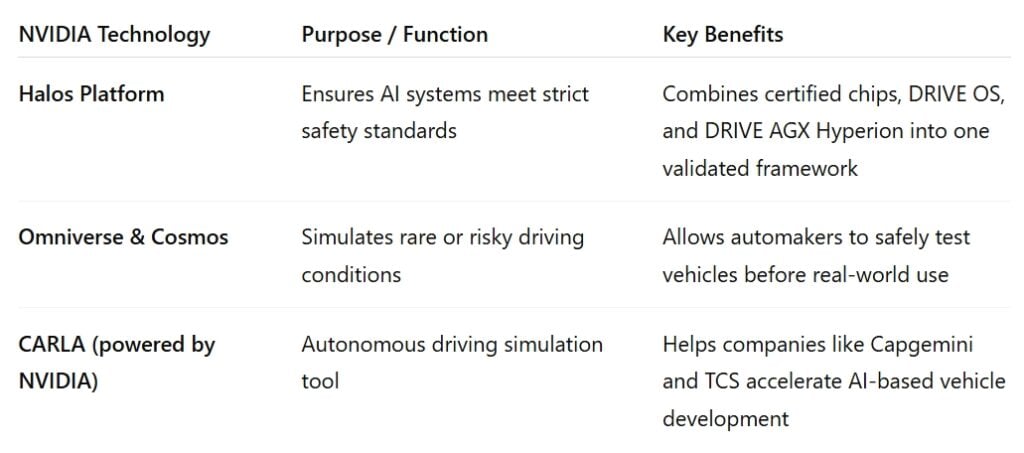
Here are quick updates on how NVIDIA is improving autonomous driving safety:
nvidia

Leading carmakers and innovators are racing to integrate NVIDIA’s cloud-to-car AI solutions, transforming how vehicles operate and interact on the road.

  • Lucid Motors showcased its all-electric Gravity SUV powered by NVIDIA DRIVE AGX and the cutting-edge Blackwell architecture for superior performance.
  • Mercedes-Benz introduced its new GLC and expanded CLA lineup, built on NVIDIA’s AI software and accelerated compute platforms.
  • Volvo Cars enhanced safety and driver-assistance features in its latest models using NVIDIA DRIVE AGX and DriveOS.
  • Lotus is pushing the boundaries with high-performance EVs like the Eletre SUV and Emeya hyper-GT, leveraging AI-driven mobility solutions.
  • ZYT is developing autonomous vehicle platforms powered by NVIDIA DRIVE AGX, expanding access to smarter, safer driving technologies.

This wave of adoption proves how NVIDIA’s AI tools are becoming essential across both established and emerging players in the automotive industry.

OpenAI and Oracle Fuel NVIDIA’s Rise

 As demand for AI infrastructure is rising worldwide, NVIDIA’s partnerships with OpenAI and Oracle are driving growth.

Bloomberg reported that NVIDIA and OpenAI plan to invest billions of dollars in UK data centers. This comes ahead of U.S. President Donald Trump’s visit and reflects the need for more AI support.

At the same time, Oracle’s AI cloud expansion is boosting NVIDIA’s future. Oracle’s cloud contract backlog jumped 359% to $455 billion. Their AI superclusters use NVIDIA’s powerful GB200 and Blackwell GPUs. Oracle’s five-year, $300 billion deal with OpenAI makes NVIDIA a key supplier in this space.

  • Oracle expects 77% revenue growth and is expanding its multi-cloud AI strategy. This shows how NVIDIA’s chips are key to the global AI cloud boom.

Rubin CPX: Energizing AI with Power and Efficiency

NVIDIA’s Rubin CPX GPU is a breakthrough for AI tasks that need to handle large amounts of data, like video creation and coding. Together with NVIDIA Vera CPUs in the Vera Rubin NVL144 CPX platform, it offers 8 exaflops of AI power and over 100TB of memory bandwidth for fast and efficient performance.

NVIDIA CEO Jensen Huang says Rubin CPX is as revolutionary as RTX graphics. It helps AI models process millions of tokens at once.

  • Its energy-efficient design makes Rubin CPX perfect for smarter, scalable AI tools that are changing how software is developed.

Rubin CPX GPU

Rubin CPX GPU
Source: NVIDIA

NVDA Stock Gains as AI Cloud Demand Soars

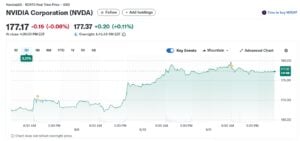
Nvidia stock (NVDA), already highly valued, got an extra boost as analysts quickly shifted from negative to positive. On Thursday morning, its shares rose 0.6% in premarket trading to $178.43, after jumping 3.9% the previous day.

Analysts say that the rise comes as investors react to Oracle’s massive cloud-computing forecast, which is shaking up the AI industry. As the top AI chipmaker, Nvidia stands to gain the most from this growing demand. Analysts are now more optimistic about its future.
NVIDIA NVDA stock
Source: Yahoo Finance

Oracle’s Cloud Deal Sparks Excitement

Oracle reported a record $317 billion in future cloud contracts for the quarter ending August 31st. This signals huge interest in AI-driven cloud services and how much companies need powerful computing.

And this strengthens Nvidia’s growth story. With cloud providers racing to secure GPU resources, the chip giant can inevitably benefit. Concisely, this is exactly driving the recent NVDA stock upgrades.

The post NVIDIA Stock (NVDA) Surges: Driving AI Mobility and Cloud Growth with OpenAI and Oracle Partnerships appeared first on Carbon Credits.

Alibaba Takes on Google Gemini: How AI, Instant Commerce, and Green Tech Are Powering the BABA Stock Rally

Alibaba

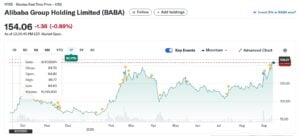
Alibaba (BABA) has been making headlines with an eye-catching 31% stock surge over the past month. From $118.64 on August 11, 2025, to $155.43 on September 11, 2025, BABA shares hit their highest levels since March 2025.

  • For the year, BABA has gained 83%, making it one of the top-performing tech stocks in China’s fast-growing market.

This rally is no coincidence. It’s driven by Alibaba’s strategic focus on artificial intelligence (AI), cloud computing, and environmental, social, and governance (ESG) leadership. Below, we explore how these factors are shaping BABA’s growth story and why analysts are bullish on its future.

Alibaba BABA stock
Source: Yahoo Finance

Alibaba AI Outpaces Rivals with Faster Reasoning, Challenging Google Gemini

The company just unveiled its next-generation artificial intelligence architecture, claiming a breakthrough that delivers ten times the performance at one-tenth the cost compared to its predecessor.

As per reports, the company open-sourced its Qwen3-Next-80B-A3B model, directly challenging Google’s Gemini and positioning itself as a formidable competitor in the global AI race.

The company simultaneously released Qwen3-Max-Preview, a commercial model with over one trillion parameters that marks Alibaba’s entry into the elite tier of frontier AI models. This dual release strategy demonstrates Alibaba’s commitment to both open-source development and commercial AI applications

Raises $3.2 Billion to Expand Cloud and AI Capabilities

Reported by Reuters, Alibaba announced plans to raise $3.2 billion through a zero-coupon convertible bond to fund its data center ambitions. It’s the largest of its kind this year. Dealogic data shows it surpasses DoorDash’s $2.75 billion deal from May.

Nearly 80% of the proceeds will support expanding data centers, upgrading infrastructure, and meeting growing cloud demands. The rest will boost Alibaba’s e-commerce efficiency and international presence.

With a 27.5% to 32.5% conversion premium above its U.S.-listed share price, the bond signals investor trust in Alibaba’s roadmap.

BABA Stock Rally Explained: AI and Cloud Computing at the Core

The biggest fuel behind the recent surge is its cloud computing division, Alibaba Cloud, and its innovative AI offerings. In Q1 2025, Alibaba Cloud delivered 26% year-over-year revenue growth, reaching RMB 33.4 billion ($4.7 billion)—an acceleration from the 18% growth in the previous quarter.

Even more compelling, AI-related services posted triple-digit growth for the eighth consecutive quarter, signaling sustained demand for data-driven solutions.

Gaining AI Independence with Custom Chips

A game-changer is its development of proprietary AI chips. With rising U.S. export restrictions, Alibaba’s move to reduce reliance on Nvidia chips is a bold bet on technological self-reliance.

This effort not only shields Alibaba from geopolitical risks but also strengthens its ability to compete globally in AI-powered services.

Wall Street’s Bullish Stance

Analysts are betting heavily on Alibaba’s technology play. Mizuho increased its price target from $149 to $159, while Barclays gave it a major boost, lifting its target from $145 to $190. Their confidence stems from Alibaba’s robust cloud infrastructure and AI-driven growth.

More significantly, its commitment to invest RMB 380 billion over three years in cloud and AI technologies reinforces its long-term strategy.

Thus, analysts are overwhelmingly positive on Alibaba’s future, rating BABA as a “Strong Buy.” The average price target stands at $162.28, suggesting a 19% upside. The highest target of $195 hints at a potential gain of 43%.

This consensus reflects confidence in Alibaba’s ability to balance innovation with sustainability.

Betting Big on Instant Commerce: A New Growth Avenue for Alibaba Stock

Alibaba is making bold investments in instant commerce through its platform Taobao, aiming for one-hour product deliveries. Despite near-term pressure on profit margins, the company sees this as a trillion-yuan opportunity over the next three years.

By competing with players like Meituan and JD.com, the Chinese e-commerce giant is redefining customer expectations and setting the stage for future expansion.

China’s Economic Recovery

Alibaba’s rally isn’t driven by technology alone. Improving consumer sentiment and supportive government policies have created a favorable environment for growth.

China’s retail sales rose 5.0 percent year-on-year in H1, with e-commerce playing a key role. Policy incentives and stimulus measures are helping domestic businesses expand, giving Alibaba the tailwinds it needs to scale.

Alibaba’s Carbon Neutrality Roadmap: Clear Targets, Measurable Impact

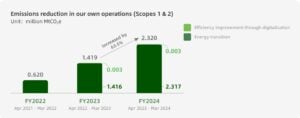
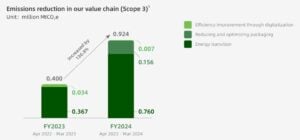
Alibaba has a strong climate plan to cut emissions across its business. It wants to reach carbon neutrality in its own operations by 2030 and reduce emissions from its partners by half compared to 2020. It also plans to help its customers and suppliers cut 1.5 gigatons of emissions by 2035.

By making sustainability a key part of its strategy, the company is turning environmental goals into new growth opportunities. So far, it has already made good progress with lower emissions and better energy use.

Alibaba emissions

Alibaba emissions
Source: Alibaba

Financing Sustainability

Alibaba’s commitment to sustainability extends beyond operations. In 2023, it issued $1 billion in sustainability-linked bonds, tied to renewable energy and emissions reduction targets.

By aligning financial incentives with environmental outcomes, Alibaba reinforces its credibility with investors and stakeholders alike.

Green Cloud Computing: A Win for Customers and the Environment

Alibaba Cloud is helping customers reduce their carbon footprint while improving efficiency.

A 2022 Carbon Trust report found that customers switching from traditional computing setups to Alibaba Cloud cut emissions by 85.5%, thanks to better energy usage and lower electricity demand.

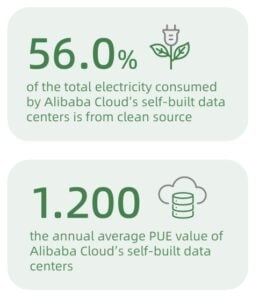
  • Last year, 56% of Alibaba Cloud’s self-built data centers’ energy came from clean sources. Its power usage effectiveness (PUE) improved to 1.200, one of the best in the industry.

Alibaba plans to power its cloud operations entirely with clean energy by 2030, with PUE not exceeding 1.3.

                                      Renewable Energy Consumption

Alibaba renewable energy

LEED Gold Certifications and Green Infrastructure Supporting

Since 2022, Alibaba has committed that all newly built campuses meet LEED Gold standards for energy efficiency and sustainability. As of FY2024, it has achieved 238,000 square meters of certified space.

These investments in eco-friendly infrastructure are helping Alibaba create long-term value while promoting responsible growth.

The company’s focus on ESG is a key reason investors are drawn to the company. It has earned top ratings from major agencies, showing it is a leader in sustainable growth.

For example,

  • It has a BBB rating from MSCI, a 50/100 score from S&P CSA, a low-risk score of 18.2 from Sustainalytics, and a B rating from the CDP on climate.
  • Its environmental risk score of 3.8 is especially strong, highlighting how well the company manages climate-related challenges.

Alibaba’s recent stock rally is more than a short-term boost—it reflects deep-rooted structural growth powered by technology and sustainability.

The company’s AI and cloud initiatives are unlocking new opportunities, while its ESG leadership builds trust with investors and customers alike. For those seeking exposure to innovation, resilience, and environmental responsibility, Alibaba (BABA) stands out as a compelling investment.

With a clear vision, strong governance, and supportive market trends, Alibaba is well-positioned to lead the next phase of digital transformation while safeguarding the planet.

The post Alibaba Takes on Google Gemini: How AI, Instant Commerce, and Green Tech Are Powering the BABA Stock Rally appeared first on Carbon Credits.

Canadian Solar Launches Low Carbon Modules, Setting New Standards in Sustainable Solar Energy

Canadian Solar

Canadian Solar Inc. (NASDAQ: CSIQ), one of the world’s largest solar technology companies, has taken a major step forward in sustainable solar manufacturing. The company recently announced the launch of its next-generation Low Carbon (LC) modules, which combine cutting-edge wafer innovations with advanced heterojunction (HJT) cell technology.

Designed for utility-scale and commercial & industrial (C&I) markets, the new modules are engineered to deliver one of the lowest carbon footprints in the industry—just 285 kg CO₂eq per kW, setting a new standard for eco-friendly solar power solutions.

Canadian Solar Leads the Way in Low-Carbon Solar Technology

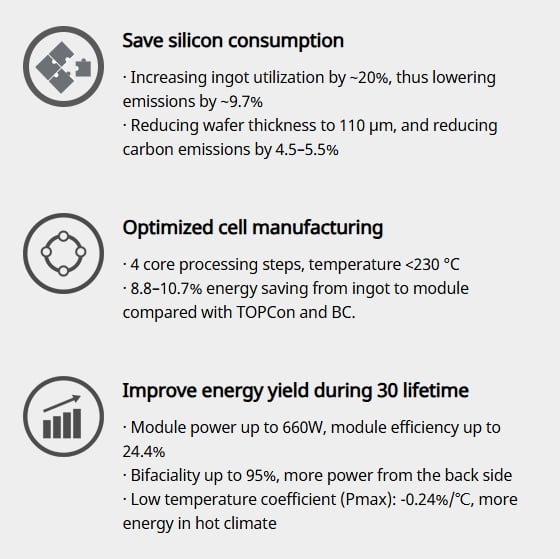
The company revealed that the LC modules are expected to begin deliveries in August 2025 and offer up to 660 Wp output with 24.4% efficiency, helping businesses and utilities deploy high-performance solar systems with a much smaller environmental impact. Canadian Solar’s proprietary improvements across multiple stages of production have enabled these breakthroughs in both efficiency and sustainability.

Key advancements include:

  • Higher ingot utilization: By increasing ingot use by around 20%, emissions are cut by approximately 9.7% or 30 kg CO₂ per kWp.
  • Thinner wafers: Reducing wafer thickness to 110 μm (from 130–135 μm) lowers silicon usage and carbon emissions by 4.5%–5.5% or 14–19 kg CO₂ per kWp.
  • Optimized HJT cell production: Streamlining the process to four steps (compared to 10–13 in conventional methods) and lowering operating temperatures from 960°C–1050°C to below 230°C saves 4.2%–5.7% or 14–21 kg CO₂ per kWp.
  • Lower total energy consumption: The total energy used in manufacturing is 105.62 MWh/MW, reducing energy use by 8.8%–10.7% versus traditional production.

Collectively, these innovations reduce the carbon payback time by 11% compared to standard N-type silicon-based modules.

Features of Low-Carbon Modules 

Canadian solar LC modules
Source: Canadian Solar

Power Packed, Planet Friendly

The new LC modules allow customers to achieve two important goals at once: higher energy output and lower environmental impact. This is particularly vital for investors and businesses looking to meet ambitious ESG targets without sacrificing performance or reliability.

Canadian Solar’s modules are fully compatible with their inverter portfolio. Their 350-kW utility inverters with 40 A MPPT DC input current optimize energy capture, even in high-temperature environments up to 45°C, helping customers maximize returns in challenging climates.

Thomas Koerner, Corporate Senior Vice President of Canadian Solar, noted,

“We are proud to introduce our new environmentally friendly, low-carbon modules, marking a key milestone in sustainable solar manufacturing. By combining advanced wafer innovations with heterojunction (HJT) cell technology, we are significantly reducing the carbon footprint of solar energy while maintaining the proven reliability and high efficiency Canadian Solar is known for.”

The LC modules will be showcased at RE+ 2025 in Las Vegas from September 9–11, highlighting the company’s leadership in sustainable solar technology.

Strong Financial Performance Supports Green Goals

Solid financial results back Canadian Solar’s commitment to sustainability. In Q2 2025, the company reported:

  • 7.9 GW of solar module shipments, a 14% quarter-over-quarter increase, meeting their guidance of 7.5–8.0 GW.
  • 29.8% gross margin, exceeding expectations of 23%–25%.
  • $1.7 billion in net revenues, up 42% from the previous quarter and 4% year-over-year, driven by strong battery storage and solar sales.
  • $505 million in gross profit, compared to $140 million in Q1 2025 and $282 million in Q2 2024.

The improvements in profitability reflect increased demand for clean energy products and favorable market conditions, including adjustments to U.S. anti-dumping and countervailing duty regulations.

Canadian Solar operates through two main segments:

  1. CSI Solar: Manufacturing solar modules and battery energy storage solutions.
  2. Recurrent Energy: Developing and managing utility-scale solar and storage projects.

With nearly 165 GW of solar modules delivered, 13 GWh of battery storage shipped, and a $3 billion contracted backlog, the company’s growth is tightly aligned with global decarbonization efforts.

From Power to Purpose: Canadian Solar’s Path to Net-Zero

Canadian Solar’s mission is to power the world with clean solar energy while applying ESG principles throughout its operations.

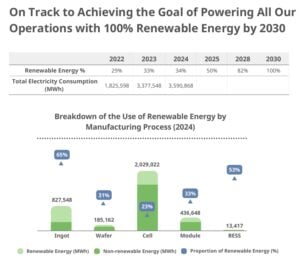
The company aims to run on 100% renewable energy by 2030. By 2028, it plans to reach 82% and achieve a carbon payback period of 10 months or less for its solar systems. It also supports circular economy practices to reduce waste and use resources more efficiently.

Canadian solar renewable energy
Source: Canadian Solar

Its efforts to expand renewable energy sourcing include:

  • Signing Power Purchase Agreements (PPAs).
  • Leveraging Renewable Energy Certificates (RECs).
  • Expanding rooftop solar projects across manufacturing facilities.

Additionally, it has secured Green Electricity Certificates (GECs) for its factories in Inner Mongolia and Qinghai, covering 541,169 MWh of clean power, and bought 42,873 MWh from spot markets. All of its revenue comes from renewable energy, highlighting its leadership in climate action.

Emission Reductions

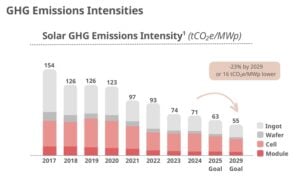
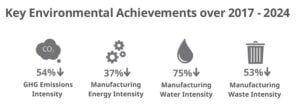
  • By running 147 energy-saving programs, it cut 141,836 tCO₂e in greenhouse gases. This helped lower its emissions intensity to 71 tCO₂e per MWp, a 4% drop from 2023.

Although the company slightly missed its 2024 target of 69 tCO₂e per MWp due to lower factory use, it remains committed to improving processes and technologies to further reduce emissions and support long-term sustainability.

Canadian solar emissions
Source: Canadian Solar

Partnerships and Global Initiatives

In May 2024, it joined the Solar Stewardship Initiative (SSI), a European collaboration that promotes responsible sourcing and sustainable solar production. The company is actively participating in governance, environmental, and labor rights assessments, with audits expected to be published in mid-2025.

Canadian Solar
Source: Canadian Solar

Transforming Solar Solutions into Investment Opportunities

For investors, Canadian Solar presents a compelling case. The company’s innovations in low-carbon manufacturing not only enhance its market competitiveness but also align with global ESG priorities. Its steady growth, robust backlog, and proven expertise in delivering high-efficiency solar and storage solutions make it a sound choice for long-term investment.

With the global energy transition accelerating, Canadian Solar’s leadership in sustainable technology, transparent governance, and measurable carbon reductions positions it as a key player in shaping the future of renewable energy.

The post Canadian Solar Launches Low Carbon Modules, Setting New Standards in Sustainable Solar Energy appeared first on Carbon Credits.
Microsoft Signs $19 Billion AI Deal With Nebius: Nvidia Scores Big as GPU King

Microsoft Signs $19 Billion AI Deal With Nebius: Nvidia Scores Big as GPU King

Microsoft (MSFT) has taken a bold step in the race for artificial intelligence (AI) infrastructure. The company signed a deal with Nebius, an AI-focused infrastructure provider, valued between $17.4 billion and $19.4 billion over five years. This agreement, one of the largest of its kind, shows how fast demand for AI computing is growing and highlights Nvidia as a major beneficiary.

A Deal That Turns Heads

The contract between Microsoft and Nebius will supply Microsoft with advanced GPU-powered computing infrastructure. Deliveries will begin in late 2025 and are expected to continue for at least five years. The deal includes an option for Microsoft to expand capacity, raising the value from $17.4 billion to as much as $19.4 billion.

This agreement reflects the massive appetite for computing power created by AI models and applications. Training and running these systems requires huge numbers of high-performance GPUs. By choosing Nebius as a supplier, Microsoft ensures it has what it needs to compete with Amazon and Google in the cloud and AI markets.

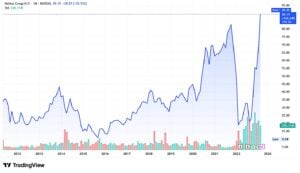
The announcement had an immediate impact on financial markets. Nebius’ shares soared over 40% after the news, and it is the highest since the company’s founding. This shows how excited investors are about its role in the booming AI ecosystem.

Nebius stock
Source: TradingView

Nebius: A Rising Infrastructure Player

Nebius is a relatively new name in the global AI infrastructure market. Based in Amsterdam, it emerged from a spin-off of Yandex’s international operations. The company calls itself a “neocloud” provider. This means it offers GPU-focused infrastructure tailored for AI workloads.

The Microsoft deal transforms Nebius almost overnight into one of the most important players in this space. The agreement not only guarantees billions in revenue but also enhances Nebius’ profile with future partners.

The company plans to raise $3 billion more. They will use financing tools like convertible notes and stock offerings. These funds will help expand data centers and strengthen infrastructure. They aim to meet the demand from the new partnership with Microsoft.

This expansion is critical. AI adoption continues to accelerate, and the world’s largest companies are competing to secure reliable access to GPUs. Nebius, with Microsoft as a customer, has demonstrated its ability to deliver capacity on a massive scale.

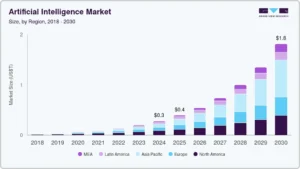
artificial intelligence AI market 2030
Source: Grand View Research

Nvidia: The Silent Winner

While Microsoft and Nebius signed the contract, Nvidia also emerged as a big winner. Nebius’ infrastructure relies heavily on Nvidia’s GPUs, which are the most widely used chips for training and running AI models.

For Nvidia, this deal means billions of dollars in new demand for its products. Nebius will need to scale up its GPU purchases significantly to meet the contract requirements. In addition, Nvidia already owns a stake in Nebius, giving it a direct interest in the company’s success.

This development strengthens Nvidia’s dominance in the AI chip market. Despite competition from rivals such as AMD and Intel, Nvidia remains the go-to choice for large-scale AI infrastructure. The Microsoft–Nebius deal is another sign that Nvidia’s chips will remain central to AI growth for years to come.

Microsoft’s Strategy: Growth Without Heavy Spending

One of the most interesting aspects of this deal is what it says about Microsoft’s strategy. Rather than building all the data centers it needs on its own, the giant tech is turning to specialized providers like Nebius. This approach allows the company to expand its AI infrastructure faster and at a lower upfront cost.

Microsoft lowers financial risk by outsourcing a lot of capital expenses to Nebius. This way, they still get vital GPU capacity. Nebius will handle the heavy lifting of financing, building, and managing new data centers.

Microsoft, in turn, locks in the resources it needs to scale AI services such as Azure OpenAI without waiting years for in-house construction. 

Shaking Up the AI Infrastructure Game

The agreement between Microsoft and Nebius reflects a larger shift in the way AI infrastructure is being built. Instead of relying solely on in-house resources, tech giants are increasingly forming partnerships with focused infrastructure providers. This approach has several implications:

  • Faster scaling: Partnerships help companies like Microsoft quickly boost AI capacity. This method avoids the delays of constructing new facilities from the ground up.
  • Capital efficiency: Outsourcing big projects saves resources. Companies can then invest in software, apps, and customer services.
  • Industry growth: Deals of this size validate the role of new players like Nebius and give them the financial backing to expand further.

The AI Gold Rush: Billions Flowing Into GPUs

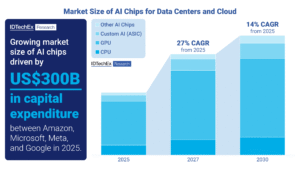
The Microsoft–Nebius deal fits into a fast-growing AI infrastructure market. Global spending on AI chips and cloud capacity is projected to exceed $200 billion by 2030, up from about $45 billion in 2024. One report even forecasted it to grow up to $400 billion by the decade’s end

AI for chips and cloud market
Source:

Demand for GPUs is expected to grow at an annual rate of 25–30%, driven by generative AI adoption. Analysts forecast that “neocloud” providers like Nebius could capture up to 15% of AI infrastructure contracts by 2030.

Nvidia, already holding more than 80% of the AI GPU market, is likely to remain the dominant supplier as demand surges worldwide.

At What Cost? AI’s Carbon and Energy Footprint

While the $19B Microsoft–Nebius deal reflects rapid AI growth, it also raises questions about sustainability. Training and running AI models need a lot of computing power. This means they also use a lot of energy.

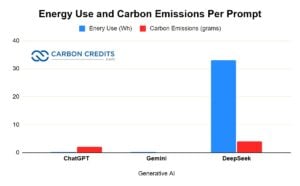
Recent studies estimate that training a single large language model can emit over 500 metric tons of CO₂—equivalent to the lifetime emissions of several cars. Below is a comparison of the energy use and carbon footprint of the top LLMs used today.

Generative AI environmental footprint comparison

Data centers powering AI workloads already account for about 1.5% of global electricity use, and this could rise to 4% by 2030 as AI adoption surges. Much of this demand comes from GPUs, which consume far more power than traditional processors. Companies like Microsoft are under pressure to balance growth with environmental responsibility.

This means:

  • Investing in renewable energy

  • Improving data center efficiency

  • Exploring low-carbon infrastructure solutions

If the sector keeps going as it is, AI might turn into a big source of carbon emissions in tech. Major energy efficiency breakthroughs are needed to change this.

Why Everyone Wins in This AI Mega-Deal

The $19 billion deal between Microsoft and Nebius marks a turning point in the AI infrastructure market. It gives Microsoft the capacity it needs to compete in the fast-moving AI race. It elevates Nebius from a growing player to a global force in cloud infrastructure. And it confirms Nvidia’s role as the backbone of AI computing, benefiting directly from the demand for GPUs.

As demand for AI continues to rise, more deals like this are likely. Microsoft’s partnership with Nebius may be one of the biggest so far, but it is unlikely to be the last. The AI race is just beginning, and infrastructure providers, chipmakers, and cloud giants will all play critical roles in shaping its future.

The post Microsoft Signs $19 Billion AI Deal With Nebius: Nvidia Scores Big as GPU King appeared first on Carbon Credits.
Coinbase Stock (COIN) Rises as Green Crypto and Carbon Credit Tokenization Gain Momentum

Coinbase Stock (COIN) Rises as Green Crypto and Carbon Credit Tokenization Gain Momentum

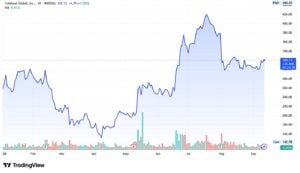
Coinbase (NASDAQ: COIN), the biggest U.S. cryptocurrency exchange, saw its stock rise by 4.15%. This increase comes as investors grow excited about the company’s role in the fast-expanding areas of cryptocurrency, sustainability, and carbon markets.

Coinbase is quickly integrating green crypto initiatives. As the world turns to climate-friendly finance, it will add tokenized carbon credits and ESG-aligned digital asset strategies to its platform.

The timing is significant. Governments, corporations, and investors are focusing on decarbonization. In this effort, blockchain technology is becoming essential. It offers transparency, efficiency, and scalability in carbon markets.

Coinbase’s Position at the Intersection of Crypto and Climate

Coinbase, a well-known name in the crypto market, aims to seize this momentum. It plans to connect mainstream digital finance with sustainable finance innovations.

The stock rally also comes after a wave of positive regulatory signals in the U.S. Regulators proposed allowing spot crypto trading on regulated exchanges. This could ease current restrictions.

coinbase COIN stock price

Also, lawmakers are pushing the Responsible Financial Innovation Act of 2025 to better clarify oversight. The news helped lift confidence, as the overall crypto market cap also rose past $4 trillion. This regulatory boost adds to previous wins that already favor Coinbase’s long-term ESG and tokenization strategy.

As of now, Coinbase has not launched its own proprietary carbon-neutral blockchain project explicitly branded or marketed as such.

But the crypto platform supports many carbon-neutral and green blockchain projects and tokens. This shows its commitment to sustainability in digital assets. It also supports larger crypto industry efforts for carbon neutrality and environmental care. This aligns with trends showing:

  • Use of energy-efficient consensus mechanisms like proof-of-stake or hybrid models.

  • Integration of renewable energy sources for mining/validation.

  • Support for on-chain carbon offset programs and transparent carbon accounting.

  • Collaboration with climate and blockchain experts to promote carbon-neutral ecosystems.

In 2025, analyses often mention blockchain projects focused on carbon neutrality. Examples include Algorand, Hedera, Cardano, and Polkadot. They use low-energy consensus and carbon offsetting.

Coinbase acts mainly as a market facilitator, an exchange platform, and an advocate. It does not directly develop or operate a carbon-neutral blockchain network.

For institutional investors wary of crypto’s carbon footprint, a carbon-neutral blockchain could provide a gateway into ESG-compliant digital assets

Carbon Credit Tokenization: Unlocking Liquidity and Trust

Beyond green crypto, Coinbase is also moving into the tokenization of carbon credits—a sector with enormous potential. Tokenization involves representing real-world assets, such as verified carbon offsets, on the blockchain. This innovation addresses several challenges in traditional carbon markets:

  • Transparency: Blockchain ledgers ensure all carbon credits are tracked, preventing double-counting.
  • Liquidity: Tokenized credits can be traded more efficiently, making carbon markets more accessible.
  • Verification: Smart contracts and third-party auditing improve trust in offset integrity.
carbon credit tokenization lifecycle PwC
Source: PwC

Coinbase listed Moss’s MCO2 token, an Ethereum carbon credit asset, but then paused trading because of liquidity issues. The trial shows Coinbase’s interest in ESG tokens. It also signals that the company is open to integrating real-world environmental assets into its platform.

The broader industry is moving in the same direction. JPMorgan and S&P Global are testing blockchain for carbon credit markets. Meanwhile, startups are quickly working to tokenize credits on a larger scale. Investing early in infrastructure and partnerships could help Coinbase lead the market for digitized carbon assets.

Wall Street Meets Web3: $12.5B Carbon Push

Green crypto and tokenized carbon markets are gaining real momentum. This growth comes from increased support from institutions and substantial funding. In Q2 2025, Web3 carbon infrastructure platforms raised $12.5 billion. This shows strong confidence in blockchain’s role in climate markets.

Coinbase is positioning itself as the go-to platform for these innovations. The company’s recent regulatory wins and new partnerships from the 2025 State of Crypto Summit show its bigger goal. It aims to lead in transparent, ESG-compliant digital asset strategies. Their foray into tokenized stocks and prediction markets supports this ambition.

This matters because institutional investors like pension funds, asset managers, and corporations with ESG goals need reliable platforms. They want to access tokenized carbon markets that are compliant and credible.

Coinbase is well-known for its brand, solid regulatory history, and strong infrastructure. This makes it a smart choice for meeting the rising demand.

From Criticism to Climate Positive: Crypto’s Image Shift

Coinbase’s pivot toward sustainability has wider implications for the crypto sector. The company makes blockchain more eco-friendly. By adding environmental responsibility to its products, it changes the story. Blockchain is seen not just as energy-intensive but also as a climate-positive tool.

Coinbase is also expanding into real-world assets (RWAs). This includes carbon credits and tokenized equities. This move broadens their business model. Tokenized assets are nearing $300 billion in value, mainly from stablecoins. Analysts believe carbon credits and ESG-linked products will be the next big trend.

For crypto investors, this opens new revenue streams. It brings transparency and liquidity to carbon markets that have been unclear and divided for a long time.

Coinbase’s ESG Report Card: Gains and Gaps

Coinbase’s ESG profile is still a work in progress. Independent assessments show moderate transparency but room for improvement, especially in environmental disclosure. ESG rating platforms give Coinbase strong governance scores. However, they rate it lower for carbon footprint reporting.

Coinbase can boost its ESG credentials by promoting carbon-neutral blockchain projects. Supporting tokenized carbon assets may also attract climate-conscious investors. The company must show steady cuts in its operational emissions. It also needs to give clearer reports to meet the demands of regulators and institutional clients.

Why It Matters to Investors and Carbon Market Participants

Green crypto and tokenized carbon credits are not just a niche trend anymore. They show how digital finance and climate action are coming together. Coinbase’s involvement creates meaningful implications for multiple stakeholders:

  • Crypto Investors: Accessing ESG-compliant digital assets helps diversify portfolios. It also provides exposure to fast-growing sustainability sectors.
  • Carbon Market Stakeholders: Tokenization offers efficiency, global access, and reliable verification for carbon credit trading.
  • Institutional Investors: Coinbase offers a way to access ESG-linked digital assets. These can meet the needs of sustainable finance.
  • Sustainable Finance Innovators: The platform’s infrastructure could scale green token adoption across retail and institutional markets.

Coinbase’s Strategic Green Push

The crypto platform’s stock rise shows that investors see it as more than a crypto exchange. It acts as a link between blockchain and sustainable finance.

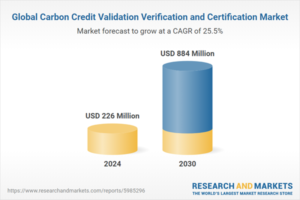
Coinbase is experimenting with carbon credit tokenization and expanding into tokenized assets. This market is set to grow quickly in the next decade, as shown below.

global-carbon-credit-validation-verification-and
Source: Research and Markets

For cryptocurrency investors, the message is clear: green crypto is becoming central to digital finance. On this note, Coinbase provides a platform for carbon market participants. It boosts trust, transparency, and liquidity in environmental assets. By integrating ESG-aligned digital assets, it stands to benefit in both crypto and carbon markets.

The post Coinbase Stock (COIN) Rises as Green Crypto and Carbon Credit Tokenization Gain Momentum appeared first on Carbon Credits.
ARMR Sciences – The Future of Drug Defense

Disseminated on behalf of ARMR Sciences.

. . .

Please read our Full RISKS and DISCLOSURE here.

The post ARMR Sciences – The Future of Drug Defense appeared first on Carbon Credits.
Anglo American and Teck Create a $50B Copper Giant to Fuel the Clean Energy Revolution

anglo american

In a landmark move, Anglo American (LON: AAL) and Teck Resources (TSX: TECK.A/TECK.B, NYSE: TECK) announced a $50 billion all-share merger that would reshape the global mining landscape. The combined company, to be named Anglo Teck, is set to become the world’s fifth-largest copper producer if regulators in Canada, the U.S., and China give their nod of approval.

This merger is about positioning both companies at the forefront of the global shift towards electrification and renewable energy, where copper plays a vital role. With global copper demand soaring, Anglo Teck is set to benefit from some of the highest-quality copper assets in the world.

Anglo American–Teck Deal: A Smart Move Balancing Value and Growth

For 2024, Anglo American reported $8.46 billion in underlying EBITDA, while Teck reported CAD$2.93 billion. The merger is expected to enhance margins, scale, and resilience through operational synergies and expanded assets.

The structure of the merger has raised eyebrows and interest alike. The press release highlights that Anglo American will exchange 1.3301 shares for each Teck share, calling it a “zero-premium” deal.

However, analysts have pointed out that this translates to a 17% premium on Teck’s recent share price. Anglo plans to offset this with a $4.5 billion special dividend to its shareholders, lowering the effective premium to just 1%.

Once completed, Anglo shareholders will control 62.4% of the new company, while Teck shareholders will hold 37.6%.

Leadership roles are well-defined: Anglo’s CEO Duncan Wanblad will lead Anglo Teck, with Teck’s Jonathan Price serving as deputy CEO. The global headquarters will be based in Vancouver, with streamlined offices in London, and listings planned in Toronto, Johannesburg, and New York.

At the Core: Copper Fuels Anglo Teck’s Strategy

Copper is the driving force behind the merger. Both Anglo and Teck have been refining their portfolios, moving away from coal and diamonds and focusing on minerals that are key to clean energy. Teck’s prized Quebrada Blanca (QB) mine in Chile is central to the strategy, despite its past challenges with cost overruns and operations.

Anglo’s access to QB’s assets will bolster its copper output at a time when demand from electric vehicles, solar farms, and grid expansion is accelerating.

Franck Bekaert, senior bond analyst at Gimme Credit, pointed out that Anglo Teck will emerge as a leading copper producer with a diversified portfolio that includes iron ore and zinc.”

Unlocking Synergies: QB and Collahuasi

One of the merger’s standout features is the operational synergy between two adjacent copper mines in Chile, Quebrada Blanca and Collahuasi. The latter is co-owned by Anglo and Glencore. Together, the mines are expected to deliver up to $1.4 billion in EBITDA gains through shared procurement and operational efficiencies. The companies estimate $800 million in annual pre-tax recurring synergies by combining resources, infrastructure, and expertise.

Though Glencore wasn’t consulted on the deal, the logic of combining operations has long been recognized as a path to reducing costs.

Building a Premier Critical Minerals Portfolio

Anglo Teck’s portfolio will include six world-class copper assets, along with premium iron ore and zinc businesses. The merger will also strengthen Anglo’s existing partnerships, such as a joint plan with Codelco in Chile and exploration opportunities across Canada, Latin America, the U.S., Europe, and Africa.

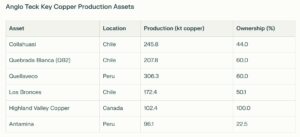
Here’s a glimpse of the production assets that will shape Anglo Teck’s future:

anglo american teck deal
Source: Anglo American press release

Additionally, Anglo Teck will remain a major player in iron ore and zinc markets, including Red Dog (Alaska) and Trail Operations (British Columbia).

Anglo Teck’s Vision to Make Canada a Critical Minerals Powerhouse

With the merger, Canada takes center stage. Anglo Teck’s global headquarters will be located in Vancouver.

The new company has committed to investing CAD$4.5 billion over five years across Canadian projects. It includes extending the life of Highland Valley Copper, expanding processing at Trail Operations, and exploring new copper resources in British Columbia.

The company also plans to work closely with Indigenous communities, labour unions, and local governments, ensuring that growth supports regional development and social inclusion.

As part of this commitment, Anglo Teck will partner with the Government of Canada to establish a Global Institute for Critical Minerals Research and Innovation. It aims to foster advanced exploration techniques, AI-driven geoscience, and sustainable mining practices.

The Canadian Government highlighted that,

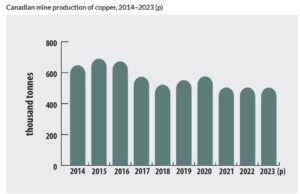
  • In 2023, Canadian mines produced 508,250 tonnes of copper in concentrate, with nearly half originating from British Columbia.
  • Canada’s exports of copper and copper-based products were valued at $9.4 billion in 2023.
Canada copper
Source: Govt of Canada

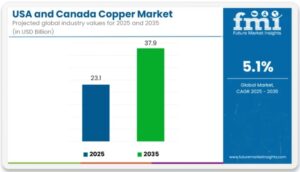
Furthermore, industry reports also say that the copper market in the USA and Canada is valued at approximately USD 23.09 billion in 2025 and is projected to grow to USD 37.88 billion by 2035, at an annual growth rate (CAGR) of 5.1%.

copper market Canada
Source: Future Market Insights

With a planned TSX listing and a strong North American presence, Anglo Teck aims to make Canada a critical minerals hub, creating jobs, driving innovation, and supporting clean energy goals.

Duncan Wanblad, Chief Executive Officer of Anglo American, commented:

“We are unlocking outstanding value both in the near and longer term – forming a global critical minerals champion with the focus, agility, capabilities and culture that have characterised both companies for so long. Having made such significant progress with Anglo American’s portfolio transformation, which has already added substantial value for our shareholders over the past year, now is the optimal time to take this next strategic step to accelerate our growth. We have a unique opportunity to bring together two highly regarded mining companies whose portfolios and capabilities are deeply complementary, while also sharing a common set of values. We are all committed to preserving and building on the proud heritage of both companies, both in Canada, as Anglo Teck’s natural headquarters, and in South Africa where our commitment to investment and national priorities endure. Together, we are propelling Anglo Teck to the forefront of our industry in terms of value accretive growth in responsibly produced critical minerals.”

Growth Beyond Copper: Innovation and Exploration

The merger isn’t limited to copper alone. Anglo Teck is poised to grow in other critical minerals, such as germanium, crop nutrients, and premium iron ore. It also plans to invest across Latin America, the U.S., Europe, and Africa, in addition to its exploration projects in Canada.

By backing Galore Creek, Schaft Creek, and Zafranal, the company expands its portfolio and strengthens the supply of critical minerals essential to the global energy transition.

Jonathan Price, Chief Executive Officer of Teck, commented:

“This merger of two highly complementary portfolios will create a leading global critical minerals champion headquartered in Canada – a top five global copper producer with exceptional mining and processing assets located across Canada, the United States, Latin America, and Southern Africa. It is a natural progression of our strategy and portfolio simplification, which created a platform to enable exactly this sort of transformative transaction. Bringing together our world-class copper assets, premium iron ore and zinc operations and an outstanding pipeline of high-quality growth projects provides enormous resiliency and optionality. This transaction will create significant economic opportunity in Canada, while positioning Anglo Teck to deliver sustainable, long-term value for shareholders and all stakeholders.”

Thus, Anglo Teck is all set to play a pivotal role in the energy transition with copper at its core. By blending operational excellence, strategic partnerships, and exploration innovation, the new company can meet rising global demand for minerals sustainably.

The post Anglo American and Teck Create a $50B Copper Giant to Fuel the Clean Energy Revolution appeared first on Carbon Credits.

Oracle (ORCL) Stock Soars 40% on AI Boom and $455B Cloud Backlog While Going Green

Oracle (ORCL) Stock Soars 40% on AI Boom and $455B Cloud Backlog While Going Green

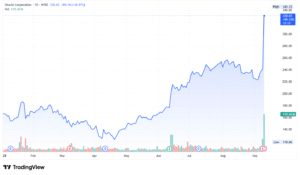
Oracle Corporation (NASDAQ: ORCL) surprised the markets today with a dramatic stock rally. Its shares jumped more than 40%, reaching record highs and placing the company near the trillion-dollar club. This sharp increase was powered by huge demand for Oracle’s cloud services, especially for artificial intelligence (AI) and big partnerships.

Wall Street focused on the financial side, but Oracle also highlighted something else: its environmental goals. The company wants to show that fast growth can go hand in hand with sustainability. By investing in both AI and green programs, Oracle is shaping an image as a modern tech leader that balances profit with responsibility.

Record-Breaking Rally: Oracle’s Biggest Jump in Decades

The jump in Oracle’s stock was its largest in more than 30 years. Investors reacted to news that Oracle signed multiple multi-billion-dollar contracts with tech giants such as OpenAI, Meta, and NVIDIA.

These contracts are tied to AI cloud services and pushed Oracle’s contract backlog to around $455 billion, a sharp rise from $130 billion just a quarter earlier.

Oracle ORCL stock Sept 2025

This backlog shows how fast demand for Oracle Cloud Infrastructure (OCI) is growing. The company responded by raising its forecast for OCI revenue. It now expects 77% growth this fiscal year, higher than its earlier estimate of 70%. The company also predicts $18 billion in cloud revenue in 2025 and has set a long-term target of $144 billion by 2030.

The growth reflects the global rush to build AI systems. Oracle has placed itself at the center of this movement, partnering in major projects such as the Stargate initiative led by SoftBank and OpenAI. These deals highlight Oracle’s role in powering the next generation of AI.

Recent Developments Strengthening Oracle’s Position

On top of these strong results, Oracle has made headlines with two new announcements that underline its growing role in AI.

The first is a massive deal with OpenAI. Beginning in 2027, OpenAI will purchase at least $300 billion worth of computing power from Oracle over five years. This is one of the largest cloud agreements in history, and it shows how central Oracle has become to advanced AI systems. For Oracle, it marks a major vote of confidence from one of the most important AI companies in the world.

Oracle’s stock surged to a record high. This boosted the company’s market value to nearly $1 trillion. The rally also made headlines for another reason: it boosted co-founder Larry Ellison’s wealth by more than $100 billion in a single day, making him the world’s richest person.

Greener Growth: Oracle’s Path to Net Zero

Amid the AI excitement and stock rally, Oracle is pushing its green message. The company has promised to be carbon neutral by 2050. It also set a nearer goal to cut greenhouse gas emissions in half by 2030, using 2020 as its baseline year. These goals cover its offices, data centers, and cloud services.

Oracle 2025 sustainability goals
Source: Oracle

Oracle has already achieved some key milestones:

  • Renewable power: 86% of OCI’s global energy came from renewables in 2023.
  • Regional progress: Europe and Latin America already run on 100% renewable power.
  • Global ambition: Oracle plans to hit 100% renewable energy worldwide by 2025.
  • Water and waste: Since 2020, water use has dropped by almost 25% and landfill waste by more than 35%.
  • Travel impact: Employee air travel emissions have been cut by 38% thanks to more virtual meetings.

These achievements prove Oracle is not only talking about sustainability but also acting on it. For a company scaling up fast in cloud and AI, these steps are important. They show Oracle is trying to balance expansion with its responsibility to the planet.

Pushing Green Standards Across the Supply Chain

Oracle knows its environmental impact extends beyond its own walls. A big part of its footprint comes from suppliers. That’s why the company is pushing its partners to meet strict environmental standards.

Oracle energy and GHG emissions 2024
Source: Oracle

Here are some of the key steps:

  • Supplier programs: All major suppliers must have environmental programs.
  • Emission targets: At least 80% of suppliers are expected to set formal climate goals.
  • Progress: More than four in five suppliers already meet these expectations.
  • Broader impact: By setting these standards, Oracle ensures its ESG efforts reach across its global supply chain.

This approach boosts Oracle’s credibility. It tells investors and clients that the company’s sustainability commitments are not limited to its own operations. Instead, they cover the full ecosystem of partners that make its technology possible.

AI-Powered Tools for Climate Accountability

Oracle is also building tools to help other companies meet their climate goals. One of these is Fusion Cloud Enterprise Performance Management (EPM) for ESG. This platform allows organizations to automate sustainability reporting, integrate emissions data with financial information, and align with global standards.

The system uses AI to make reporting easier and more accurate. This is important as regulators push companies to disclose their environmental impacts in more detail.

  • It combines Scope 1, 2, and 3 emissions data based on the GHG Protocol Corporate Standard. This links emissions to financial and operational data, helping with better ESG management.

  • Oracle improved its ESG reporting with this platform. They cut reporting timelines by 30% using automation and AI-driven process management.

  • The platform collects unique identifiers from source documents. This ensures clear data tracking and auditability. It boosts transparency and lowers compliance risks.

  • It supports global reporting standards like IFRS, ESRS (CSRD), and GRI. This helps organizations align their disclosures with changing regulations easily.

Oracle has also introduced features in its cloud infrastructure that estimate emissions from customer workloads. This means clients can see how much carbon their computing generates and adjust operations to stay on track with their own sustainability commitments. By doing this, Oracle is not only greening its own business but also helping others.

The Tough Road Ahead: Energy Demands vs. Climate Goals

Still, Oracle faces challenges in meeting its promises. Reaching 100% renewable energy worldwide is difficult, especially in regions where clean energy options are limited. Ensuring suppliers stick to emissions goals is also complex, given the size of Oracle’s global network.

Another challenge is the massive energy demand of AI. As Oracle expands its role in AI infrastructure, its energy use will rise. Balancing this growth with its climate goals will require new investment in efficient data centers, renewable sourcing, and innovations in green computing.

Oracle’s record-breaking stock surge highlights its importance in the AI and cloud industry. But what makes its story more powerful is the balance it is trying to strike between growth and sustainability. By pledging net zero emissions by 2050, setting ambitious near-term targets, and building tools for others to track emissions, Oracle is showing that technology and responsibility can go together.

For investors, Oracle now offers both a high-growth AI story and a strong ESG narrative. For customers, it provides powerful cloud services backed by renewable energy and transparent carbon data.

As Oracle continues to grow, its ability to deliver on both financial and environmental goals may define its future as one of the world’s most influential technology leaders.

The post Oracle (ORCL) Stock Soars 40% on AI Boom and $455B Cloud Backlog While Going Green appeared first on Carbon Credits.
Why Walmart Stock (WMT) Is at the Forefront of ESG Investing: Sustainability and Emissions Achievements in 2025

walmart stock

Walmart’s (NYSE:WMT) sustainability framework focuses on responsible governance and transparency in managing environmental risks. In its 2025 ESG report, the company highlights how it evaluates the impact of its operations and supply chains on ecosystems and climate. Through initiatives in animal welfare, conservation, sustainable sourcing, and policy advocacy, Walmart is driving measurable emissions reductions.

This approach ensures Walmart’s climate strategy is ambitious, well-managed, and collaborative, targeting reductions in both direct and indirect emissions.

Walmart’s Scope 1 & 2 Emissions Drop Despite Business Expansion

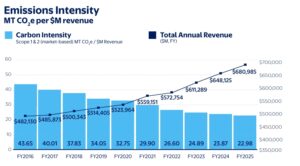
Since FY2016, emissions intensity has dropped 47.4%, showcasing how Walmart’s energy efficiency and renewable sourcing efforts are helping decouple emissions from business growth.

walmart emission intensity
Source: Walmart

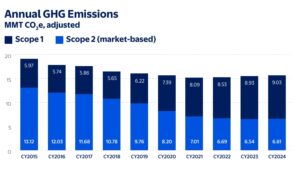
In 2024, the retail giant’s operational emissions (Scope 1 & 2) totaled 15.65 million metric tons of CO₂ equivalent, marking an 18.1% reduction from the 2015 baseline.

Even with a 1.1% year-over-year increase in absolute emissions driven by transportation growth and energy challenges in Mexico and Central America, Walmart’s emissions intensity fell by 3.7%, meaning the company’s carbon footprint per dollar of revenue is shrinking.

walmart emissions
Source: Walmart

Renewable Energy Goals

Walmart’s renewable energy goals are clear:

  • 50% renewable electricity by 2025
  • 100% renewable electricity by 2035

In 2024, 48.5% of global electricity demand was supplied by renewable sources, with 30.6% secured through renewable energy contracts. While regulatory hurdles and market dynamics in certain regions may delay progress, Walmart continues to invest in renewable energy capacity and policy advocacy to accelerate the transition.

These efforts are crucial for cutting Scope 2 emissions, which account for 42.3% of Walmart’s total operational footprint.

Addressing Scope 3 Emissions

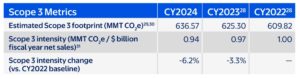
Walmart’s indirect emissions stem from upstream suppliers and downstream customer activities, covering everything from manufacturing processes to product disposal. These Scope 3 emissions account for approximately 90% of Walmart’s carbon footprint.

Efforts to tackle Scope 3 emissions include:

  • Collaborating with suppliers to implement renewable energy and efficiency programs
  • Encouraging sustainable packaging designs and material reuse
  • Advocating for policy changes that support clean energy and emissions tracking
  • Enabling customers to reduce emissions through energy-efficient products

By improving transparency and offering tools for reduction, Walmart is fostering a more sustainable supply chain.

walmart scope 3 emission
Source: Walmart

Refrigerants and Stationary Fuels

On-site refrigerants remain a significant challenge, representing 32.9% of Walmart’s total operational emissions and 57% of its Scope 1 emissions.

Walmart’s rollout of lower global warming potential (GWP) refrigerant systems has resulted in a 2.4% reduction in refrigerant emissions in 2024, supported by:

  • Preventive maintenance across all U.S. stores
  • Advanced technician training and in-house expertise
  • AI-powered leak detection and predictive maintenance tools
  • Refrigerant reuse programs and banking initiatives

Stationary fuel usage, including heating and backup power, contributed 10.4% of total operational emissions, with a 4.9% increase in 2024. Walmart’s efforts to upgrade aging infrastructure to more efficient systems are ongoing but constrained by supply, technology maturity, and cost.

Transportation Emissions Grew 7% in 2024, But Innovation Drives Decarbonization

Transportation-related emissions accounted for 24.9% of Walmart’s Scope 1 emissions and 14.4% of total operational emissions. Despite a 7% increase in 2024 and nearly 20% growth over two years, Walmart is piloting solutions to reduce its transport carbon footprint, including:

  • Heavy-duty battery EVs and hydrogen fuel cell forklifts
  • Electric yard trucks are achieving 75% emissions reductions per hour compared to diesel units
  • Renewable diesel and hydrogen-powered equipment development

While industry-ready solutions for heavy-duty trucking are years away, Walmart’s investments position it as a leader in sustainable transport innovation.

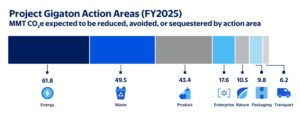
Project Gigaton Helps Walmart’s Suppliers Cut 1.19 Billion Metric Tons of CO₂ Since 2017

Walmart’s Project Gigaton has been a cornerstone of its Scope 3 emissions strategy, engaging more than 5,900 global suppliers to reduce emissions across energy use, waste, packaging, nature, transportation, and product design.

Since its launch in 2017, Walmart’s supply chain initiatives have:

  • Avoided or sequestered 1.19 billion metric tons of CO₂ equivalent
  • Surpassed its goal of cutting 1 billion metric tons by 2030 six years ahead of schedule
  • Supported innovations aligned with science-based targets through partnerships with organizations like WWF and CDP

Project Gigaton focuses on actionable, measurable projects that help suppliers decarbonize while improving resilience and efficiency.

walmart project gigaton
Source: Walmart

Circular Economy Drives 83.5% Waste Diversion and Cuts Packaging Emissions

Walmart’s waste management strategy is designed to close the loop and promote reuse across its operations. By the end of 2023, Walmart achieved an 83.5% global waste diversion rate, a step toward its 90% zero-waste target by 2025.

Key initiatives include:

  • Food waste recycling programs that turn organic waste into nutrient-rich compost, animal feed, and renewable energy
  • Packaging innovations that aim for 100% recyclable, reusable, or compostable private brand packaging by 2025
  • Reducing problematic plastics and promoting sustainable materials

These efforts support Walmart’s climate goals by reducing methane emissions from landfills and lowering the carbon intensity of packaging materials.

Walmart’s Climate Strategy Supports a Net-Zero Future

Walmart’s climate roadmap is ambitious but realistic. The company made strong progress. It cut Scope 1 and 2 emissions by 18.1% since 2015. It also helped suppliers reduce 1.19 billion metric tons of CO₂. This shows that large-scale collaboration can speed up environmental action.

walmart
Source: Walmart

Challenges remain, especially in transport and energy supply, but Walmart’s commitment to innovation, renewable energy, and circular solutions places it on track to meet interim targets and achieve net-zero emissions by 2040.

With measurable goals, industry partnerships, and transparent reporting, Walmart’s climate strategy stands as a blueprint for how corporations can scale sustainability while delivering value to customers, communities, and the planet.

The post Why Walmart Stock (WMT) Is at the Forefront of ESG Investing: Sustainability and Emissions Achievements in 2025 appeared first on Carbon Credits.