Fervo Energy’s $1.3 Billion IPO Signals a Geothermal Breakthrough

Fervo Energy’s $1.3 Billion IPO Signals a Geothermal Breakthrough
Geothermal energy is moving into the spotlight. Fervo Energy, a U.S. geothermal developer backed by major investors including Google, is preparing to raise up to $1.33 billion in one of the biggest clean energy initial public offerings (IPOs) of 2026. The company is targeting a valuation of as much as $6.5 billion as demand for reliable carbon-free electricity rises rapidly.

The planned public offering comes at a time when electricity markets are changing quickly. Artificial intelligence (AI), data centers, electric vehicles, and industrial electrification are driving power demand up in the U.S. That shift is creating new interest in energy sources that can operate around the clock.

Unlike solar and wind power, geothermal systems can generate electricity 24 hours a day, regardless of weather conditions. Reliability is becoming more valuable. Utilities and tech companies are looking for stable, clean power.

Fervo believes geothermal could become a major part of the next-generation energy system. Its SEC filing states:

“Fervo is working to build a different type of energy company—one that treats each geothermal power facility as a repeatable product, not a one-off, complicated project. We intend to deliver power in standardized, 50-megawatt ORC units, relentlessly reducing complexity with every well drilled and every turbine installed. With few locational constraints on our subsurface operations, we can develop sites to multi-gigawatt sites, harnessing learning curves to drive continuous improvement and make geothermal cheaper than it has ever been.”

Geothermal Is Gaining Momentum Again

Geothermal energy has been around for decades. It usually needs special geological conditions, like volcanic areas or natural steam reservoirs. Fervo is trying to change that.
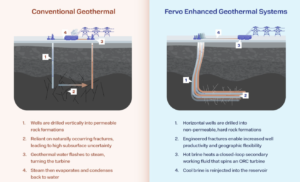
Fervo energy enhanced geothermal system
Source: Fervo

The company uses enhanced geothermal systems, also known as EGS. The technology uses horizontal drilling and hydraulic fracturing from the oil and gas industry. This helps access underground heat in many more places. This could dramatically expand geothermal development across the United States and other countries.

Fervo also uses fiber optic sensing and AI-enhanced monitoring tools to improve underground drilling precision and efficiency. The company says these technologies can help lower costs while making geothermal systems easier to scale.

Its flagship project is Cape Station in Utah. Fervo expects it to become the world’s largest next-generation geothermal development once completed. The project is scheduled to begin delivering electricity later this year.

According to company filings, Cape Station could eventually reach 500 megawatts of capacity. That would be enough electricity to power hundreds of thousands of homes. The company also revealed it has over 3.6 gigawatts of geothermal projects. These are in construction, development, or advanced planning stages.

AI Data Centers Are Reshaping Electricity Demand

Investors are increasingly focused on geothermal energy. This is largely due to the fast growth of artificial intelligence infrastructure.

AI data centers require enormous amounts of electricity. Unlike some industrial facilities, they also need highly reliable power every hour of the day. This is creating strong demand for “firm” clean electricity that can operate continuously.

Solar and wind remain important growth industries, but they depend on weather conditions. Geothermal systems offer stable baseload electricity like natural gas and nuclear power, without producing direct carbon emissions.

Rising electricity demand from AI data centers, electric vehicles, and domestic manufacturing growth is helping support investor interest in Fervo’s IPO.

Technology companies are already moving into the sector. Google previously partnered with Fervo on “Project Red” in Nevada and later joined the company’s major funding round in 2025.

Industry analysts say AI could become one of the largest new electricity demand drivers in decades. The International Energy Agency recently warned that electricity use by data centers might spike by 2030. This surge is linked to the growing adoption of AI worldwide.

data center electricity demand due AI 2030
Source: IEA

That trend is changing how energy markets think about reliability.

Wall Street Bets Big on a $1.3 Billion Climate-Tech IPO

Fervo’s IPO is also part of a wider investment surge into advanced energy technologies. In December 2025, the company secured $462 million in private funding. Investors included B Capital, Breakthrough Energy Ventures, Devon Energy, and Google.

That funding round brought Fervo’s total equity and debt financing to roughly $1.5 billion since its founding in 2017. Now the company is preparing for an even larger capital raise through public markets under the FRVO ticker.

According to its SEC filing, Fervo plans to offer 55.6 million shares priced between $21 and $24 per share. If shares price is at the top of the range, the company could raise about $1.33 billion.

Several major institutional investors have already expressed interest in purchasing up to $350 million worth of IPO shares. These include Norges Bank Investment Management, Wellington Management, Capital Research, and Atlas Point Energy Infrastructure Fund.

Wall Street is closely watching the offering.

Recent climate technology IPOs struggled after the clean energy market slowdown of 2022 and 2023. But stronger electricity demand and renewed infrastructure investment are helping improve investor confidence again.

Axios described Fervo’s IPO as an important test for the broader climate-tech market.

Geothermal Moves From Niche to Mainstream Energy Play

The geothermal market is small compared to solar and wind energy. However, many forecasts expect strong growth ahead.

According to the International Energy Agency, geothermal currently provides less than 1% of global electricity generation. However, advanced geothermal systems could expand the technology far beyond traditional geothermal regions.
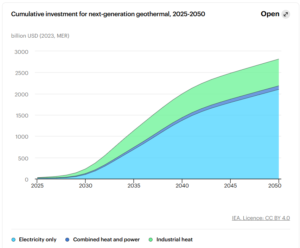
Cumulative investment for next-generation geothermal, 2025-2050
Source: IEA

The U.S. Department of Energy estimates that enhanced geothermal systems could produce over 90 gigawatts of electricity in the U.S. under the right conditions. That would represent a major increase from today’s geothermal capacity.

Several trends are supporting that growth:

  • Rising electricity demand, 
  • AI data center expansion,
  • Industrial electrification,
  • Energy security concerns,
  • Decarbonization targets, and
  • Need for stable renewable power. 

Governments are also increasing support. The United States included geothermal incentives in the Inflation Reduction Act. Europe and parts of Asia are also exploring geothermal development as part of broader energy security strategies.

Why Investors Are Racing Into Next-Gen Geothermal

Fervo says its technology can help reduce emissions while supporting grid reliability. That matters because many countries and corporations now have net-zero targets.

The United States aims to achieve net-zero emissions by 2050. Major technology firms including Google, Microsoft, Amazon, and Meta are also pursuing aggressive climate goals. Many companies are finding that hitting those targets needs more than just occasional renewable energy.

Reliable low-carbon power is becoming increasingly important. Fervo’s geothermal systems provide continuous, carbon-free electricity. This helps reduce reliance on fossil fuels for backup power.

At the same time, geothermal projects usually need less land than big solar or wind farms. Supporters say this could make geothermal an attractive complement to other renewable energy systems.

The Energy Transition Enters a Reliability-First Era

Fervo’s planned IPO reflects a broader shift happening across energy markets. For years, most clean energy investments focused heavily on solar panels, wind turbines, and electric vehicles.

Now investors are increasingly looking at technologies that can support round-the-clock electricity demand. That includes geothermal, nuclear power, battery storage, and upgraded electricity grids.

That is helping reshape clean energy investment priorities. Fervo’s IPO arrives at a time when markets are beginning to place a higher value on reliability, not just renewable generation capacity.

If successful, the offering could become one of the most important geothermal financing milestones in years. It may also help determine whether geothermal energy can finally move from a niche technology into a larger part of the global clean energy system.

The post Fervo Energy’s $1.3 Billion IPO Signals a Geothermal Breakthrough appeared first on Carbon Credits.
Canada Unleashes Massive Nuclear and Climate Financing to Accelerate Clean Energy Push

Canada Unleashes Massive Nuclear and Climate Financing to Accelerate Clean Energy Push

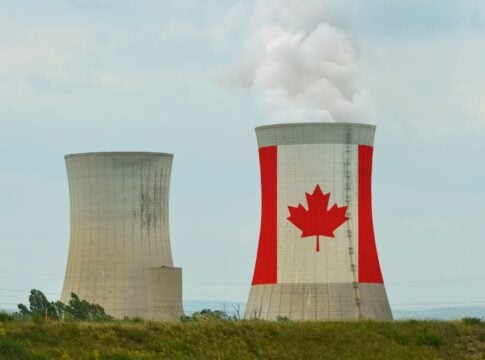
Canada is making a major new push into clean energy and climate finance. The federal government recently announced plans for a new national nuclear energy strategy. At the same time, it pledged C$13 billion ($9.4 billion) in international climate finance as part of its latest economic update.

These actions show how Canada aims to boost its role in the global clean energy shift. They also focus on enhancing energy security and industrial strength.

The announcements come as countries around the world increase spending on clean electricity, low-carbon industries, and climate infrastructure. Governments are racing for energy independence. This need grows as electricity demand surges from electric vehicles, artificial intelligence, and industrial electrification.

Canada wants to play a larger role in that future economy.

Canada Plans a New Nuclear Energy Strategy

The Canadian government says it will release a new Nuclear Energy Strategy before the end of 2026. The strategy will be led by Natural Resources Canada and will focus on expanding the country’s nuclear sector.

Energy and Natural Resources Minister Tim Hodgson announced the plan during the Canadian Nuclear Association conference. He stated: 

“Canada has long been a nuclear leader — but we will not remain one by standing still. Our government is moving at speeds not seen in generations to get big things done, and nuclear energy is no exception. We must move urgently and strategically to remain at the forefront of innovation, working shoulder to shoulder with key partners to bring clean electricity, affordable bills and economic growth and security to all Canadians.”

Officials said the strategy will build on Canada’s strong background in nuclear technology. This includes CANDU reactor systems, uranium production, skilled workers, and nuclear safety rules.

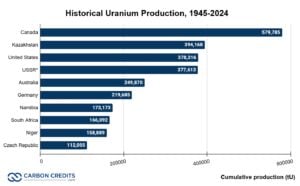
Canada is already one of the world’s largest uranium producers. According to the World Nuclear Association, the country supplied about 15% of global uranium output in recent years. Saskatchewan alone holds some of the world’s highest-grade uranium deposits, contributing around C$2.6 billion to Canada’s economy in 2024. 

uranium production by country 2024
Source: World Nuclear Association

The government believes nuclear power can help Canada meet rising electricity demand while also cutting emissions. That demand is expected to grow quickly.

Currently, nuclear power supplies about 13% of the country’s electricity, generated by 17 CANDU reactors located in Ontario and New Brunswick.

Canada’s latest economic update says electrification could double in the next few decades. This will happen as more sectors move away from fossil fuels. Nuclear energy is becoming part of that solution.

Why Small Modular Reactors Are Becoming Canada’s Big Bet

One major area of focus is small modular reactors, also known as SMRs. These smaller nuclear reactors aim to provide low-carbon electricity and heat. They are useful in remote areas, industrial sites, and smaller grids. Many countries now see SMRs as an important future clean energy technology.

Canada has been actively developing SMR projects for several years.

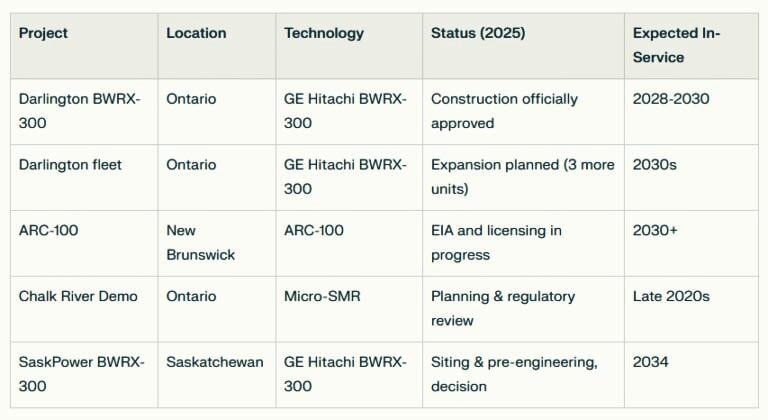
Ontario Power Generation is building a GE Hitachi BWRX-300 small modular reactor at the Darlington nuclear site in Ontario. It could become one of the first grid-scale SMRs in the G7. According to the Canadian government, the project could create thousands of jobs and support domestic supply chains. Below are some of the key project SMR projects and their timelines:

Canada nuclear SMR project timeline

The government also announced C$40 million to explore whether microreactors can power remote military bases and northern operations. These reactors are even smaller than SMRs and could replace diesel generators in isolated regions.

  • Canada sees nuclear energy as both an economic and climate opportunity.

The nuclear sector contributes about C$22 billion to GDP each year. It also supports around 89,000 jobs, based on industry estimates. Officials think that new reactor projects, uranium mining, fuel processing, and nuclear exports may boost the economy even more.

Canada nuclear power generation
Source: Government of Canada

Climate Finance Commitment Reaches C$13 Billion

Alongside its nuclear strategy, Canada pledged C$13 billion for international climate finance over five years. This commitment comes alongside its nuclear strategy in the latest economic update.

The funding aims to help developing countries. It supports them in reducing emissions, building climate resilience, and investing in clean technologies.

Climate finance has become a major issue in global climate policy. Developing economies often say they can’t transition fast enough without help from richer countries.

Canada states that the funding will help create new markets for clean technologies. It will also attract private investment into climate projects. Several climate policy groups welcomed the announcement.

Rick Smith, president of the Canadian Climate Institute, said the funding could help lower emissions globally while supporting Canadian clean technology industries.

The pledge also aligns with broader international climate goals. At the COP29 climate summit, developed nations faced increasing pressure to scale up climate finance commitments for emerging economies. The United Nations says developing countries might need trillions for climate investments by 2030.

Canada Wants to Strengthen Its Clean Energy Economy

Prime Minister Mark Carney’s government is also trying to position Canada as a stronger clean energy and industrial investment destination. The economic update included several other measures tied to energy, infrastructure, and industrial policy.

Canada recently announced plans for a sovereign-style investment vehicle called the Canada Strong Fund. It will start with an initial C$25 billion commitment. The fund will invest in private companies in big national projects. These projects will focus on energy, mining, infrastructure, agriculture, and technology.

The government is also investing in skilled trades training. Nearly C$6 billion will train and hire up to 100,000 skilled workers by 2030. This effort aims to support major infrastructure and resource projects. Officials say these investments are necessary because energy systems are changing rapidly.

Canada investment in private sector Canada strong fund
Source: Government of Canada website

Canada’s electricity demand will likely grow. This is due to the rise of electric vehicles, hydrogen projects, battery manufacturing, and clean industries. At the same time, global competition for energy investment is becoming more intense.

The United States continues to offer major subsidies through the Inflation Reduction Act. Europe is increasing its renewable energy spending. China remains dominant in batteries, solar manufacturing, and critical minerals processing.

Canada does not want to fall behind.

Nuclear Power Is Becoming Part of Net-Zero Planning

Canada has committed to reaching net-zero emissions by 2050. To meet that target, the country will need large amounts of low-carbon electricity.

Hydropower already provides much of Canada’s electricity supply. However, experts say renewables alone may not fully meet future industrial and grid needs. Nuclear energy could help provide stable electricity when solar and wind output changes.

That is why Canada is placing nuclear energy back at the center of long-term planning. The government believes nuclear power can support economic growth while also lowering emissions from heavy industries, transport, and buildings.

At the same time, Canada’s climate finance pledge shows the country is also trying to strengthen its international climate role. Together, the two announcements show a broader shift in energy policy.

Clean energy is no longer viewed only as an environmental issue. Governments increasingly see it as a matter of economic security, industrial competitiveness, and geopolitical strategy.

The post Canada Unleashes Massive Nuclear and Climate Financing to Accelerate Clean Energy Push appeared first on Carbon Credits.

Lithium Deficit Is Back: How China and Zimbabwe Supply Cuts Are Reshaping the Market

Lithium price, May 2026

Disseminated on behalf of Surge Battery Metals

The lithium market is shifting again. After a period of oversupply and price weakness, new disruptions are tightening supply in real time.

Two developments are driving this change: regulatory action in China and export restrictions in Zimbabwe. Together, they are bringing the lithium deficit narrative back into focus and reshaping how supply risk is assessed.

A New Supply Shock Emerges

In early 2026, Zimbabwe, Africa’s top lithium producer, suspended exports of lithium concentrates and other unprocessed minerals. The government cited malpractices and revenue leakages as the reason for the halt.

Now, exports are set to resume under tighter controls. According to Reuters, Zimbabwe will introduce export quotas and require mining companies to commit to local processing investments.

Key measures include:

  • Export quotas assigned to individual producers
  • A continued 10% export tax on lithium concentrates
  • A requirement to build local processing capacity before January 2027, when a full ban on concentrate exports is expected

Zimbabwe is a major player in the global supply chain. In 2025, the country sent 1.128 million metric tons of lithium-bearing spodumene concentrate to China. This made up about 15% of China’s imports.

Any disruption at that scale has an immediate global impact.

China Tightening Adds Pressure

At the same time, China is tightening its control over domestic lithium production. Industry reports from S&P Global Commodity Insights and Fastmarkets show that permit reviews and stricter environmental rules have impacted some operations. This is especially true for smaller or higher-cost mines.

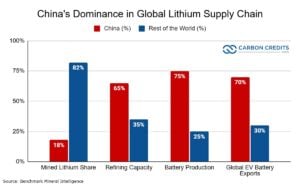
China dominates global lithium processing and refining. When domestic supply slows or becomes less predictable, it affects the entire supply chain. This includes chemical conversion capacity, which is critical for producing battery-grade lithium.

China dominance lithium supply chain

Together, these developments are creating a short-term tightening effect in the market. Supply is becoming less flexible just as demand continues to grow.

Small Disruptions, Big Price Impacts

Lithium markets are highly sensitive to supply changes. Even small disruptions can affect pricing and availability.

The current situation highlights several key dynamics:

  • Supply is still concentrated in a few regions
  • Policy decisions can quickly impact global availability
  • Processing capacity is as important as raw material supply

Zimbabwe’s push for local processing reflects a broader trend. Resource-rich countries are seeking more value from their minerals instead of exporting raw materials. While this may support long-term development, it can reduce short-term supply to global markets.

At the same time, China’s role as the dominant processor means that changes within its domestic system ripple outward. This combination of upstream and downstream pressure is what makes the current situation notable.

From Glut to Squeeze in Just One Year

Just a year ago, lithium prices were under pressure. The market saw oversupply, driven by strong production growth and slower-than-expected EV demand in some regions.

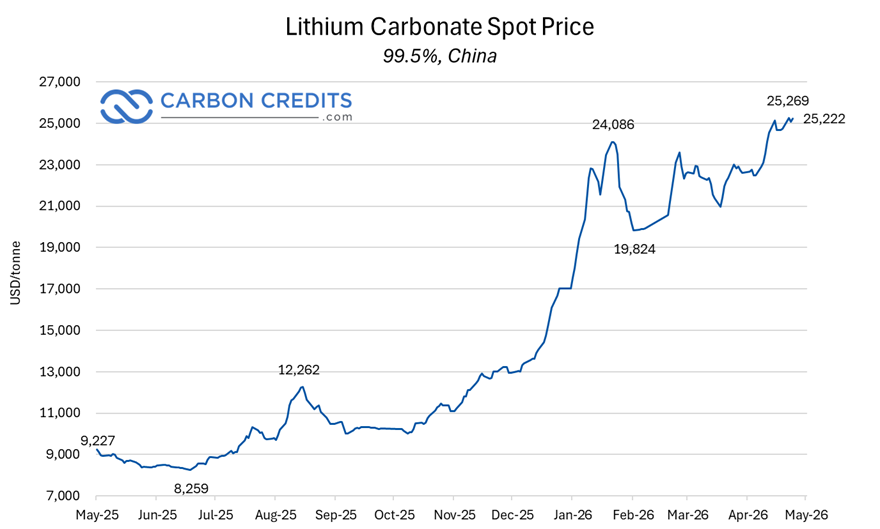
Lithium prices fell to $8,259 per tonne in June 2025, before reaching $25,269 per tonne on April 27, 2026.

Lithium price
Source: Bloomberg

Now, supply-side disruptions are shifting sentiment again. While the market is not yet in a severe deficit, the balance is tightening.

This shift reinforces a key point: lithium markets can move swiftly. Oversupply can quickly lead to tighter conditions, especially with policy and geopolitics at play.

Lithium Becomes a Strategic Battleground

The current supply story is not just about mining. It is about geopolitics and control over critical materials.

Zimbabwe’s lithium sector is heavily influenced by Chinese companies, including major operators that dominate production and processing investments. 

One of the biggest players is Zhejiang Huayou Cobalt, which operates the Arcadia lithium project and runs both mining and processing facilities. Sinomine Resource Group is another major operator, managing the Bikita lithium mine and expanding processing capacity. 

Chengxin Lithium Group is also active in mining and processing, while Yahua (Sichuan Yahua Industrial Group) is building lithium sulfate plants in the country. Even Tsingshan Holding Group has invested in Zimbabwe’s lithium projects. Together, these companies dominate the industry and shape how the country’s lithium resources are developed.

This creates a concentrated supply chain, where decisions in one country can affect availability in another. For governments and industry players, this raises concerns about the security of supply.

As a result, there is an increasing focus on diversification and domestic sourcing. Countries want to rely less on single regions or supply chains. This is especially true for materials needed for energy transition and tech infrastructure.

U.S. Domestic Projects Gain Strategic Edge

These global disruptions are highlighting the value of stable, domestic lithium resources. Projects located in secure jurisdictions are becoming more important as supply risks increase across regions like Africa and parts of Asia.

In the United States, Nevada stands out as a key lithium hub. It offers scale, infrastructure, and a well-established mining framework. Within this context, Surge Battery Metals’ (TSX-V: NILI | OTCQX: NILIF) Nevada North Lithium Project (NNLP) provides a clear example of how domestic supply can align with evolving market needs.

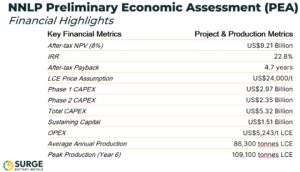
NNLP is not just defined by location, but by scale and economics. The 2025 Preliminary Economic Assessment shows a 42-year mine life, with estimated average annual production at around 86,300 tonnes of lithium carbonate equivalent (LCE). It is expected to produce around 3.6 million tonnes of battery-grade LCE over its lifetime. This positions it as one of the longer-lasting lithium supply assets in North America.

Surge-NNLP-Preliminary-Economic-Assessment-PEA

The project is also supported by a large resource base. Current estimates point to more than 11 million tonnes of lithium carbonate equivalent (inferred resource), with mineralization extending across a broad, near-surface footprint. This near-surface shape allows for a regular open-pit mining method. This can make development easier and boost efficiency in operations over time.

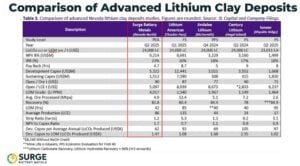
Grade is another key factor. NNLP reports an average lithium grade of around 3,010 ppm, with some zones exceeding 4,000 ppm. This positions the project among the higher-grade clay lithium resources in the United States. Higher grades can lead to better recovery efficiency. They also lower processing intensity per tonne, which matters in a cost-sensitive commodity market.

Surge lithium clay comparison

From an economic perspective, the project shows strong baseline metrics. Surge Battery Metals’ PEA shows an after-tax net present value of about $9.2 billion. It also indicates an internal rate of return of 22.8%, based on a lithium price assumption of $24,000 per tonne. The estimated operating cost is around $5,243 per tonne LCE, supporting its positioning as a potential low-cost producer.

Additional factors reinforcing NNLP’s relevance in the market:

  • Large-scale footprint, with mineralization extending over more than 4 km of strike length
  • Open-pit design, targeting shallow, high-grade zones in early production phases
  • Two-phase development plan, allowing production to scale over time
  • Domestic processing pathway, supporting U.S. supply chain goals

Together, these characteristics position NNLP as a long-duration, scalable lithium source. It aligns with the needs of various demand drivers, including EVs, grid storage, and industrial applications.

In a market increasingly shaped by geopolitical risk, projects like NNLP represent more than just supply. They offer jurisdictional stability, long-term visibility, and alignment with domestic sourcing strategies.

These attributes are key to evaluating lithium assets as supply disruptions continue to emerge globally.

The New Reality: Volatility, Policy, and Power

The lithium market is entering a new phase. Demand is expanding, driven by EVs, grid storage, and data center infrastructure. At the same time, supply is becoming more complex and more sensitive to policy decisions.

The recent actions in China and Zimbabwe show how quickly the balance can shift. They also highlight the importance of diversification, transparency, and long-term planning in lithium supply chains.

For investors and industry participants, the takeaway is clear: The lithium deficit narrative is returning, not just because of demand growth, but because of real-world supply constraints.

In this environment, projects that offer scale, longevity, and jurisdictional stability are likely to play a larger role in meeting future demand.

DISCLAIMER

New Era Publishing Inc. and/or CarbonCredits.com (“We” or “Us”) are not securities dealers or brokers, investment advisers, or financial advisers, and you should not rely on the information herein as investment advice. Surge Battery Metals Inc. (“Company”) made a one-time payment of $75,000 to provide marketing services for a term of three months. None of the owners, members, directors, or employees of New Era Publishing Inc. and/or CarbonCredits.com currently hold, or have any beneficial ownership in, any shares, stocks, or options of the companies mentioned.

This article is informational only and is solely for use by prospective investors in determining whether to seek additional information. It does not constitute an offer to sell or a solicitation of an offer to buy any securities. Examples that we provide of share price increases pertaining to a particular issuer from one referenced date to another represent arbitrarily chosen time periods and are no indication whatsoever of future stock prices for that issuer and are of no predictive value.

Our stock profiles are intended to highlight certain companies for your further investigation; they are not stock recommendations or an offer or sale of the referenced securities. The securities issued by the companies we profile should be considered high-risk; if you do invest despite these warnings, you may lose your entire investment. Please do your own research before investing, including reviewing the companies’ SEDAR+ and SEC filings, press releases, and risk disclosures.

It is our policy that information contained in this profile was provided by the company, extracted from SEDAR+ and SEC filings, company websites, and other publicly available sources. We believe the sources and information are accurate and reliable but we cannot guarantee them.

CAUTIONARY STATEMENT AND FORWARD-LOOKING INFORMATION

Certain statements contained in this news release may constitute “forward-looking information” within the meaning of applicable securities laws. Forward-looking information generally can be identified by words such as “anticipate,” “expect,” “estimate,” “forecast,” “plan,” and similar expressions suggesting future outcomes or events. Forward-looking information is based on current expectations of management; however, it is subject to known and unknown risks, uncertainties, and other factors that may cause actual results to differ materially from those anticipated.

These factors include, without limitation, statements relating to the Company’s exploration and development plans, the potential of its mineral projects, financing activities, regulatory approvals, market conditions, and future objectives. Forward-looking information involves numerous risks and uncertainties and actual results might differ materially from results suggested in any forward-looking information. These risks and uncertainties include, among other things, market volatility, the state of financial markets for the Company’s securities, fluctuations in commodity prices, operational challenges, and changes in business plans.

Forward-looking information is based on several key expectations and assumptions, including, without limitation, that the Company will continue with its stated business objectives and will be able to raise additional capital as required. Although management of the Company has attempted to identify important factors that could cause actual results to differ materially, there may be other factors that cause results not to be as anticipated, estimated, or intended.

There can be no assurance that such forward-looking information will prove to be accurate, as actual results and future events could differ materially. Accordingly, readers should not place undue reliance on forward-looking information. Additional information about risks and uncertainties is contained in the Company’s management’s discussion and analysis and annual information form for the year ended December 31, 2025, copies of which are available on SEDAR+ at www.sedarplus.ca.

The forward-looking information contained herein is expressly qualified in its entirety by this cautionary statement. Forward-looking information reflects management’s current beliefs and is based on information currently available to the Company. The forward-looking information is made as of the date of this news release, and the Company assumes no obligation to update or revise such information to reflect new events or circumstances except as may be required by applicable law.


Disclosure: Owners, members, directors, and employees of carboncredits.com have/may have stock or option positions in any of the companies mentioned: None.

Carboncredits.com receives compensation for this publication and has a business relationship with any company whose stock(s) is/are mentioned in this article.

Additional disclosure: This communication serves the sole purpose of adding value to the research process and is for information only. Please do your own due diligence. Every investment in securities mentioned in publications of carboncredits.com involves risks that could lead to a total loss of the invested capital.

Please read our Full RISKS and DISCLOSURE here.

The post Lithium Deficit Is Back: How China and Zimbabwe Supply Cuts Are Reshaping the Market appeared first on Carbon Credits.

Europe’s $711B Energy Shockwave: EU Launches Massive Clean Power Push to Break Fossil Fuel Dependence

Europe’s $711B Energy Shockwave: EU Launches Massive Clean Power Push to Break Fossil Fuel Dependence

The European Union (EU) is preparing one of the largest clean energy investment drives in its history. The European Commission (EC) just launched “AccelerateEU”, a plan that could require around €660 billion ($711 billion) in annual clean energy investment through 2030. This energy transition package aims to cut Europe’s reliance on fossil fuels. It also seeks to boost investment in renewable energy.

The strategy arrives as Europe deals with high energy costs, geopolitical tensions, and a push to boost energy security. European officials say the region needs to speed up its shift to homegrown renewable energy. This move will help protect businesses and households from the ups and downs of fossil fuel markets.

European Commission President Ursula von der Leyen said the transition is no longer only about climate goals, saying:

“The choices we make today will shape our ability to face the challenges of today and the crises of tomorrow. Our AccelerateEU strategy will bring both immediate and more structural relief measures to European citizens and businesses. We must accelerate the shift to homegrown, clean energies. This will give us energy independence and security, and mean we are better able to weather geopolitical storms.”

The plan highlights how global clean energy spending is entering a new growth phase. Governments now see renewable energy, electrification, and grid upgrades as key priorities. They are no longer just optional climate policies.

Europe Wants to Cut Fossil Fuel Dependence Faster

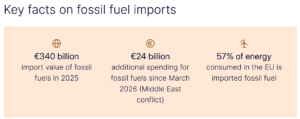
The EU still depends heavily on imported fossil fuels. According to the European Commission, about 57% of the EU’s energy consumption still comes from imported fossil fuels. Europe spent roughly €340 billion on fossil fuel imports in 2025 alone.

The situation worsened in early 2026 after rising conflict in the Middle East pushed energy prices higher. The Commission said Europe spent an additional €24 billion on fossil fuels in only a few months without receiving extra supplies.

Europe fossil fuel import numbers
Source: European Commission

That pressure is helping accelerate the clean energy transition.

Under AccelerateEU, the Commission plans to push electrification across transport, industry, and buildings. The package also includes faster renewable energy deployment, stronger electricity grids, more battery storage, and expanded clean transport fuels.

The Commission will also introduce a new Electrification Action Plan later this year. Officials say the goal is to replace oil and gas systems with electricity powered by renewable energy sources.

At the same time, the EU wants to improve energy affordability for consumers. The package offers temporary tax cuts on electricity. It also provides energy vouchers for vulnerable households and financial support for industries with high energy costs.

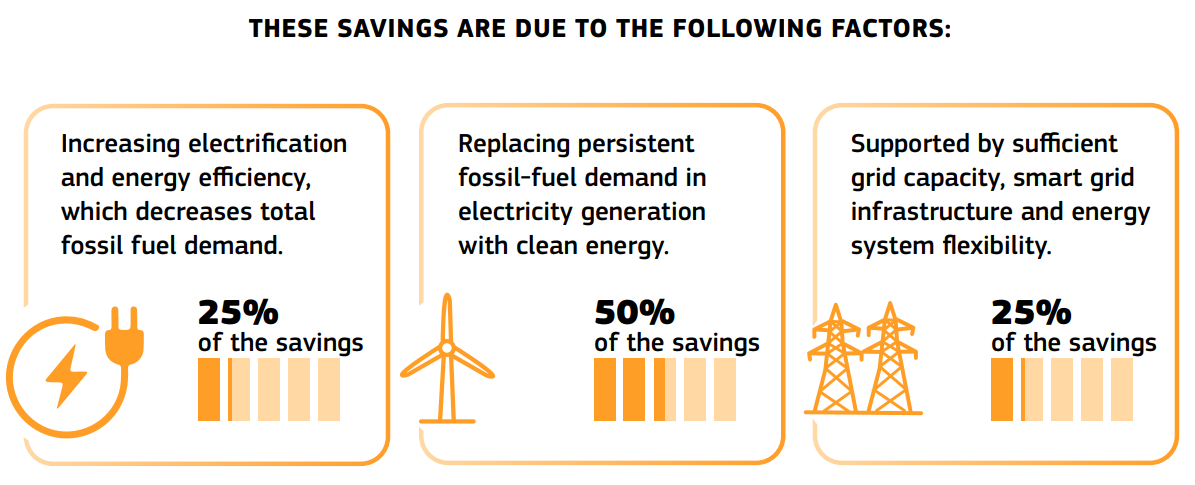
The EU says faster clean energy adoption could steadily reduce fossil fuel import costs and save the region about €130 billion annually by 2030.

clean energy savings Europe
Source: European Commission

Why Europe Needs Nearly €660 Billion a Year for Clean Energy

The scale of Europe’s clean energy transition is enormous. The EC says that annual investment in the energy sector needs to rise. It must go from about €240 billion each year from 2011 to 2021 to around €660 billion yearly from 2026 to 2030. Investment needs could rise further to €695 billion annually between 2031 and 2040.

That means Europe may need to nearly triple annual energy investment levels compared with the previous decade. Much of that money will go toward:

  • Renewable power projects,
  • Grid modernization,
  • Battery storage,
  • Energy efficiency upgrades,
  • Electric vehicle infrastructure,
  • Hydrogen projects, and
  • Industrial electrification.

The Commission says public funding alone will not be enough. Instead, Europe wants to attract much larger amounts of private capital into clean energy infrastructure. The strategy aims to lower investment risk. It also seeks to improve access to financing for energy projects.

The European Investment Bank will give over €75 billion in funding over the next three years. This support aims to speed up the transition. Part of the funding will support electricity grid operators, who are becoming increasingly important as renewable energy capacity expands across Europe.

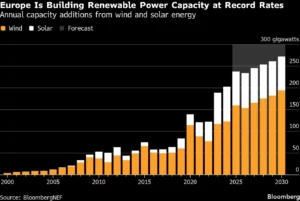
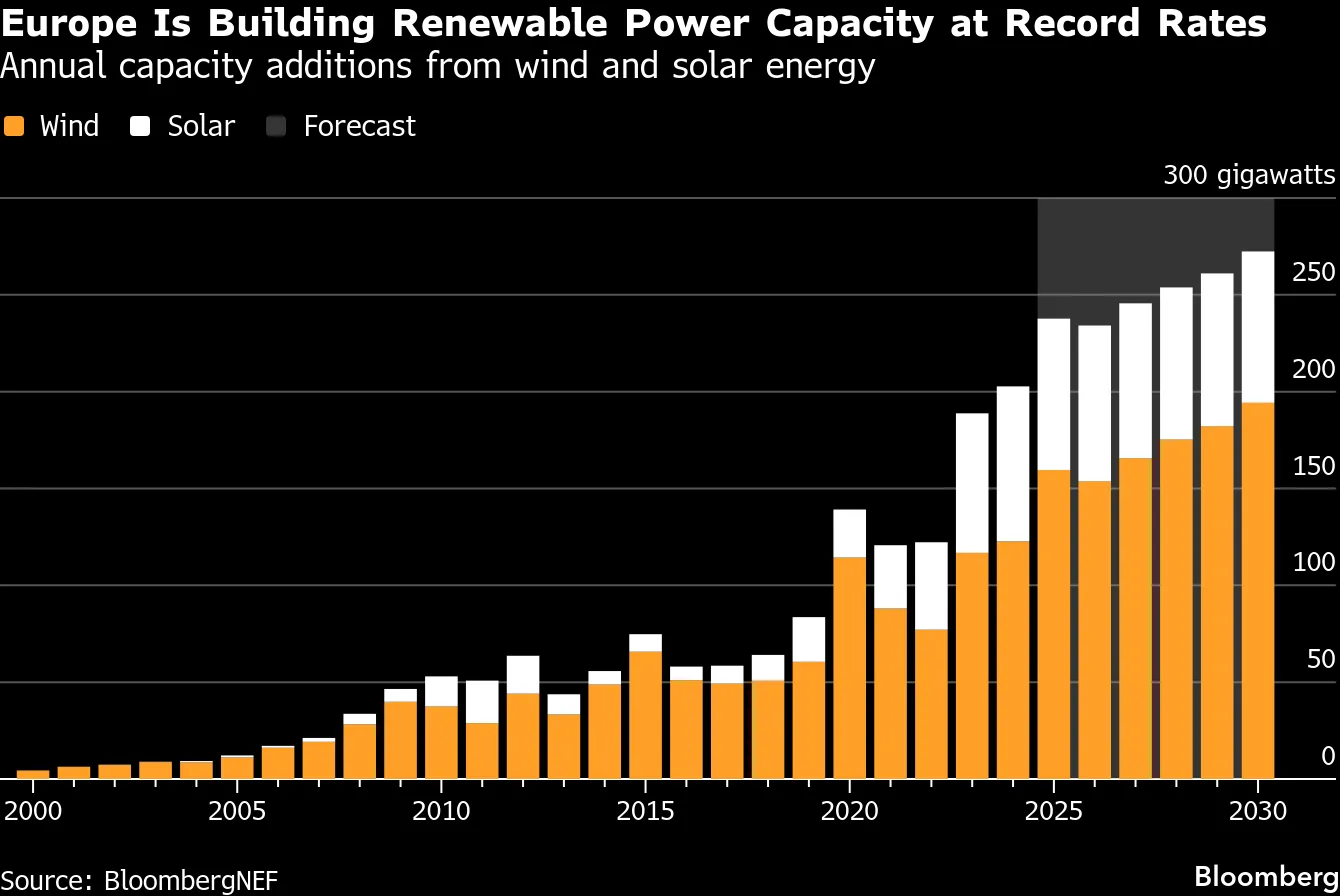
Europe renewable power capacity forecast 2030

Electrification Becomes the Backbone of Europe’s Future Economy

One major reason behind the investment push is growing electricity demand.

The International Energy Agency forecasts a big rise in global electricity demand over the next decade. This growth will be driven by factors like electric vehicles, heat pumps, artificial intelligence, and industrial electrification.

Europe is preparing for that growth now. The Commission says electrification will become the backbone of the region’s future energy system. That means replacing fossil fuel systems with electric technologies powered by wind, solar, hydro, nuclear, and battery storage.

Grid infrastructure is becoming especially critical. Europe’s power grids weren’t built for big renewable energy use or the fast-growing electricity needs of AI data centers and EV charging networks.

As a result, the Commission is pushing for faster implementation of the European Grids Package. It aims to modernize cross-border electricity infrastructure and improve transmission capacity.

Industry analysts say grid investment could become one of the biggest energy investment themes of the decade. BloombergNEF estimates that global power grid investments may need to top $21 trillion by 2050. This is essential for meeting net-zero targets around the world.

Europe Is Expanding Its Net-Zero Strategy

The investment plan also supports the EU’s broader climate targets. The European Union aims to reduce net greenhouse gas emissions by at least 55% by 2030 compared with 1990 levels. Europe is also targeting climate neutrality by 2050.

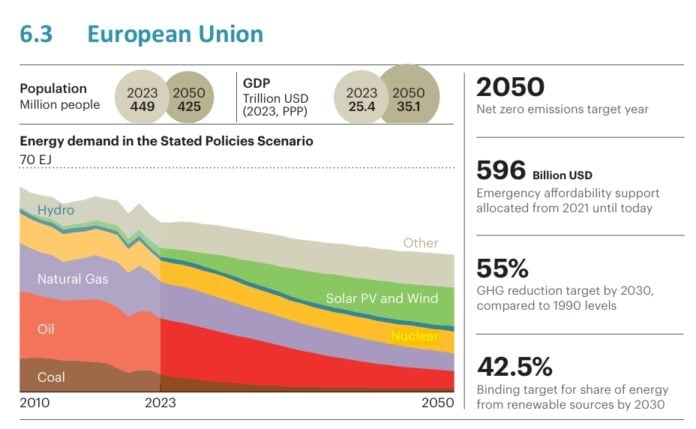
European Union energy demand under net zero
Source: IEA

In late 2025, EU institutions reached a provisional agreement supporting a 90% net emissions reduction target by 2040. To meet these goals, Europe must rapidly expand renewable energy capacity.

According to the International Renewable Energy Agency, renewable power capacity additions reached record levels globally in 2025, with solar remaining the fastest-growing energy source.

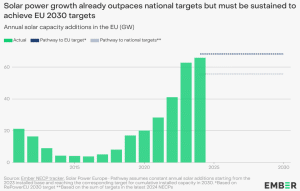
solar power Europe 2030 pathway

The EU has already made significant progress. Wind and solar generated a record share of Europe’s electricity in recent years, while coal use continued to decline across many member states. However, fossil fuels still remain deeply embedded in industrial systems, transport, and heating.

That is why electrification is becoming central to Europe’s decarbonization strategy.

The Commission is also supporting clean fuels for aviation and shipping. Sustainable aviation fuel and low-carbon maritime fuels are expected to receive additional policy and financing support under the new package.

Clean Energy Is Becoming a Security Strategy

The European Commission’s $711 billion investment plan shows how climate policy and energy security are becoming closely linked. For years, clean energy was mainly discussed as an environmental issue.

Today, governments increasingly view renewable energy as a tool for economic resilience, industrial competitiveness, and geopolitical stability. The AccelerateEU package reflects that shift.

European leaders believe faster investment in renewable energy, grids, electrification, and storage can help lower long-term energy costs while reducing dependence on imported fossil fuels.

The challenge now is scale. Reaching Europe’s climate and energy goals will require trillions of dollars in public and private investment over the coming decades. But the Commission believes the cost of delaying the transition could become even higher.

The post Europe’s $711B Energy Shockwave: EU Launches Massive Clean Power Push to Break Fossil Fuel Dependence appeared first on Carbon Credits.
$500M Carbon Bet: Octopus Energy Backs Massive U.S. Forest Carbon Removal Projects

$500M Carbon Bet: Octopus Energy Backs Massive U.S. Forest Carbon Removal Projects

The global race to remove carbon dioxide from the atmosphere is entering a new phase. Octopus Energy Generation announced a big $500 million plan. They will fund reforestation and afforestation projects across the U.S. in partnership with climate tech company Living Carbon. The projects aim to restore degraded land while removing millions of tonnes of carbon dioxide from the atmosphere.

The deal is one of the largest disclosed institutional investments in nature-based carbon removal projects in recent years. It also shows that there is growing confidence in carbon removal markets, which might play a big role in global net-zero strategies.

Octopus Energy Generation’s fund management will invest $500 million in Living Carbon’s reforestation platform. On top of that, Octopus will invest nearly $13 million directly into Living Carbon’s business operations.

Zoisa North-Bond, CEO at Octopus, said:

“This is a landmark deal for us in the US and a huge step in our mission to invest in solutions that drive the planet toward a cleaner future.”

The companies say the funding could help remove up to 50 million tonnes of carbon dioxide over the next 40 years. The New York City Mayor’s Office of Climate & Environmental Justice says this is about the same as the city’s yearly greenhouse gas emissions.

Turning Abandoned Land Into Carbon Assets

The project aims to restore damaged land. This land would stay harmful to the environment or unproductive for the economy if not addressed.

Living Carbon specializes in rehabilitating former mining sites and degraded farmland across the United States. These areas are replanted with native trees, which help absorb carbon dioxide. They also boost biodiversity, improve soil quality, and enhance water systems.

The opportunity is enormous.

American Forests, a nonprofit conservation group, reports that the U.S. has about 130 million acres of degraded land. This land has potential for reforestation. That area is larger than the entire state of California. Many of these lands are located in former industrial and mining regions that have struggled economically for decades.

Reforestation projects not only create local jobs but also generate carbon credits. Each credit represents one tonne of removed or avoided carbon dioxide. Corporations buy these credits to offset emissions.

Living Carbon uses satellite imagery, climate models, and ecological analysis. This helps them find land with the best long-term carbon removal potential. Maddie Hall, Founder and CEO at Living Carbon, remarked:

“Our partnership with Octopus takes us from early-stage implementation to delivering long-term carbon removal at scale with institutional capital. This is a sign that this market is maturing into real project finance as corporate commitments to net-zero increase.”

Living Carbon reforestation
Source: Living Carbon

Notably, the company is building projects near growing data center areas. Energy demand and emissions are rising quickly in these places because of the growth in artificial intelligence infrastructure.

Carbon Removal Markets Hit Wall Street Scale

The Octopus-Living Carbon partnership arrives as demand for carbon removal continues to grow globally.

Companies feel more pressure to achieve net-zero goals. They also need to cut emissions that are hard to eliminate directly. As a result, many corporations are turning to carbon removal projects to help offset residual emissions.

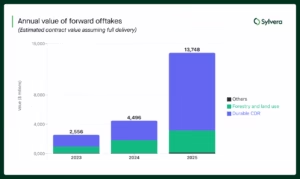
According to carbon market intelligence firm Sylvera, companies committed nearly $14 billion toward future carbon removal purchases in 2025 alone. 

annual offtake agreements sylvera
Source: Sylvera

At the same time, the number of companies with validated net-zero targets rose 61% globally last year, according to the Science Based Targets initiative (SBTi). Large technology companies are among the biggest buyers.

Living Carbon has also signed carbon offtake agreements with big firms like Microsoft, Google, Meta, and McKinsey & Company. The Symbiosis Coalition, featuring Google and Meta, has contracted over 131,000 tonnes of carbon removal from the company for the next decade. This reflects a broader trend across the technology sector.

Artificial intelligence systems and data centers are sharply increasing electricity demand worldwide. As emissions increase with digital growth, many tech companies are investing in carbon removal. This helps them balance future emissions.

Nature-Based Removal Solutions Gain Investor Support

The market for nature-based carbon removal is growing fast. Debates about carbon credit quality and verification standards are still ongoing.

Nature-based solutions include reforestation, afforestation, wetland restoration, grassland recovery, and soil carbon management. These approaches remove carbon dioxide naturally through ecosystems rather than through engineered industrial systems.

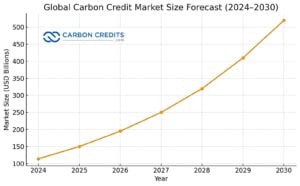
McKinsey & Company predicts that the global voluntary carbon market could hit $50 billion to $250 billion each year by 2050. This depends on climate policies and how much companies get involved. BloombergNEF and Ecosystem Marketplace both predict strong long-term growth in carbon credit demand.

global carbon credit market size 2030

However, the sector has also faced criticism over transparency and carbon accounting quality. Recent studies have raised doubts about whether some forest carbon credits truly deliver the claimed climate benefits.

That scrutiny is pushing investors toward projects with stronger scientific verification and long-term monitoring systems. This is where Living Carbon’s focus on “high-quality” carbon removal becomes crucial. Their projects aim for measurable environmental benefits and long-term land restoration.

Analysts believe that big financing deals, like the Octopus deal, can help the sector grow. This shift could take it from early-stage testing to developing mature infrastructure projects.

Octopus Energy Expands Beyond Wind and Solar

The investment also highlights how clean energy companies are expanding beyond traditional wind and solar infrastructure.

Octopus Energy has rapidly become one of Europe’s largest renewable energy investors. It is the UK’s largest supplier of domestic electricity and gas. The company manages around 4.9 gigawatts of renewable energy assets in 21 countries. This includes wind and solar farms worth about £7 billion ($9 billion).

According to the company, those assets generate enough electricity to power around 3.2 million homes annually. Now Octopus is increasingly investing in broader climate technologies.

This year, the company said it plans to invest up to $2 billion in U.S. clean energy and climate tech by 2030. It will mainly focus on California’s clean-tech sector. That strategy includes carbon removal, heat batteries, energy storage, and nature restoration projects.

The company has boosted its investment in Cultivo, which offers nature-based solutions, too. This supports grassland restoration projects across the United States.

Carbon Removal Is Becoming a Core Net-Zero Tool

Global climate models suggest that just reducing emissions might not be enough to reach long-term climate goals. The Intergovernmental Panel on Climate Change says the world needs to remove carbon dioxide. This is important to keep global warming below 1.5°C or 2°C. Rapid cuts in emissions are also necessary.

The International Energy Agency says it is crucial to greatly increase global carbon removal by 2050. This is critical for reaching net-zero goals. Thus, corporate buyers are locking in long-term supply agreements now before future carbon credit shortages hit.

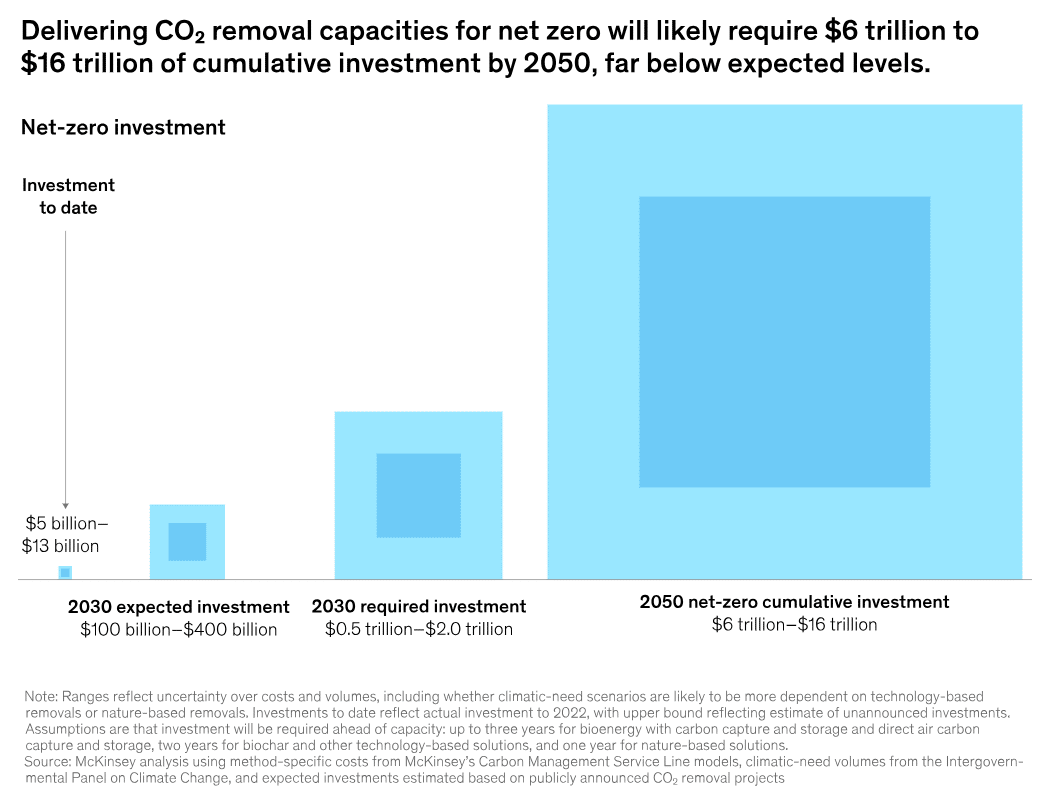
Similarly, analysis by McKinsey shows that the world needs between $6 trillion and $16 trillion of investment in carbon removals by 2050 to hit net zero.

carbon removal investment requirement for net zero by 2050

The surge in carbon removal purchases is helping transform the market from a niche climate strategy into a rapidly growing investment category. And the Octopus-Living Carbon partnership reflects that shift.

Instead of treating carbon removal as a small offset activity, institutional investors are beginning to finance it at an infrastructure scale. That could reshape how companies approach climate mitigation over the next decade.

For now, the deal also highlights a broader reality: restoring forests and degraded ecosystems is no longer viewed only as conservation work. It is increasingly becoming part of the global clean energy and net-zero economy.

The post $500M Carbon Bet: Octopus Energy Backs Massive U.S. Forest Carbon Removal Projects appeared first on Carbon Credits.
The Top 4 Clean Energy Stocks Dominating 2026 as AI Supercharges Power Demand

The Top 4 Clean Energy Stocks Dominating 2026 as AI Supercharges Power Demand

The clean energy sector is entering a new phase in 2026. This time, the growth story is not driven only by climate goals or government policy. Artificial intelligence is now reshaping the global electricity market.

AI data centers are consuming huge amounts of power. According to the International Energy Agency (IEA), global electricity demand from data centers could more than double by 2030. In the United States alone, data centers may account for nearly half of electricity demand growth through the end of the decade.

That surge is creating new opportunities for energy companies that can deliver reliable, scalable, and lower-carbon electricity.

At the same time, governments continue to push for decarbonization. BloombergNEF estimates that global energy transition investment hit a record $2.3 trillion in 2025, up 8% from 2024. This includes spending on renewable energy, electrified transport, hydrogen, batteries, and power grids. Bloomberg Energy Transition Investment Trends 2025

Solar and battery storage are growing quickly. Also, grid modernization is becoming more important as global electricity demand increases.

As a result, investors are paying closer attention to companies that sit at the center of both the energy transition and the AI infrastructure boom. Here are the top four clean energy stocks that stand out in 2026 because of their scale, technology, and long-term growth potential.

Bloom Energy (BE): Fuel Cells Powering the AI Computing Boom

BE has become one of the biggest clean energy stories of 2026. The company makes solid oxide fuel cells. These cells produce electricity and have lower emissions than traditional combustion systems.

Bloom’s technology is gaining attention because AI data centers need fast and reliable power. In many regions, utility grid connections can take years to complete. Bloom’s onsite power systems can often deploy much faster, making them attractive for hyperscale computing facilities.

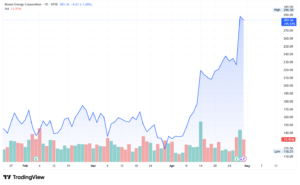
The company’s growth accelerated sharply this year. Bloom Energy reported first-quarter 2026 revenue of $751 million, up 130% from a year earlier. Adjusted earnings per share surged to $0.44 from just $0.03 in the prior-year period.

Bloom also raised its full-year 2026 revenue guidance to between $3.4 billion and $3.8 billion. That represented a major increase from previous expectations.

One major catalyst is the company’s expanding partnership with Oracle. Bloom is helping support large AI data center developments, including projects tied to Oracle Cloud Infrastructure.

Oracle recently expanded its agreement with Bloom to as much as 2.8 gigawatts of fuel-cell capacity for AI facilities. That is one of the largest fuel-cell deployments announced for data center infrastructure.

Bloom’s systems are also gaining traction because they can operate independently from strained electric grids. The company says its fuel-cell platforms can provide continuous power with high reliability while using natural gas, biogas, or hydrogen blends.

Hydrogen remains another long-term growth area. Bloom has continued investing in solid oxide electrolyzers, which can produce hydrogen more efficiently than conventional electrolysis technologies. The U.S. Department of Energy previously selected Bloom projects for hydrogen-related funding support through federal clean energy programs.

Meanwhile, Bloom’s stock performance has reflected investor optimism around AI electricity demand. Shares have risen more than 1,000% over the past year as markets increasingly view the company as a key provider of AI-era power infrastructure.

Bloom Energy BE stock price

NextEra Energy (NEE): America’s Renewable Power Giant Scaling for AI Demand

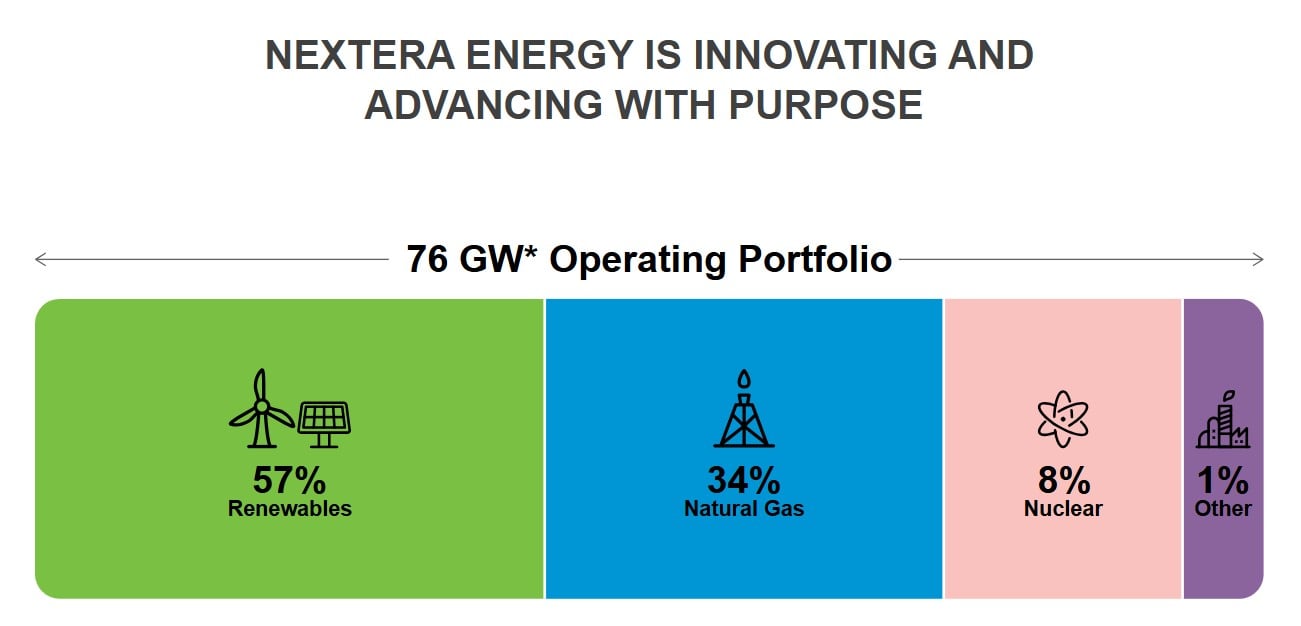
NEE remains one of the largest renewable energy companies in the world and a dominant force in the U.S. electricity market. The company operates Florida Power & Light, one of America’s largest utilities, while also developing massive solar, wind, and battery storage projects through NextEra Energy Resources.

Scale is one of NextEra Energy’s biggest advantages. The company currently has a renewable and energy storage project backlog of roughly 33 gigawatts. It added another 4 GW of new projects during the first quarter of 2026 alone.

NextEra is also benefiting from rising AI electricity demand. The company recently announced that its data center power pipeline hit 21 GW. More than half of this is already in advanced development phases, set for completion by 2028.

The company is exploring big projects in Pennsylvania and Texas. These could add nearly 10 GW of new power for data center customers and industrial users. Those projects may include solar, battery storage, natural gas, and transmission infrastructure.

Nextera Energy portfolio

Battery storage is another major focus. NextEra has become one of the largest battery storage developers in North America. Energy storage is vital. It stabilizes grids with lots of renewables. It also meets the constant electricity needs of AI facilities.

Financially, the company remains strong. Florida Power & Light generated net income of $1.46 billion during the first quarter of 2026, up more than 11% year over year.

NextEra also continues expanding its renewable footprint across the United States. The company runs tens of gigawatts of wind and solar assets. This makes it one of the largest producers of renewable electricity globally.

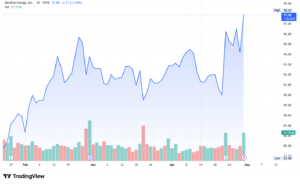
NEE’s stock price recently surged. This rise stems from a strong Q1 2026 earnings beat. Adjusted earnings hit $1.09 per share, beating analyst estimates of $0.97.

NextEra Energy NEE stock price

Analysts have raised their price targets, now as high as $112. This, along with a good outlook for lower interest rates, has boosted investor confidence in the company’s long-term growth.

Unlike many pure-play clean energy firms, NextEra offers a combination of growth and stability. That balance continues attracting long-term investors seeking exposure to both renewable energy expansion and rising electricity demand.

GE Vernova (GEV): The Grid Backbone of the AI Energy Revolution

GEV is rapidly emerging as one of the most important infrastructure companies in the energy transition. The company spun off from General Electric in 2024. It works in key areas like grid systems, gas turbines, wind turbines, electrification equipment, and power software.

As electricity demand rises, utilities and data center operators need more transformers, transmission systems, turbines, and grid technologies. That trend has sharply increased demand for GE Vernova’s products.

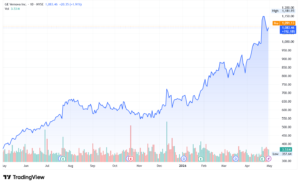
The company’s stock has climbed more than 200% over the past year.

GE vernova GEV stock price

GE Vernova recently raised its 2026 guidance after reporting stronger demand tied partly to AI infrastructure expansion. Analysts observed that the company has secured over 90% of its gas turbine production capacity until 2030.

Gas turbines are vital for many utilities. They provide dispatchable power, which supports renewable-heavy electricity systems and large data centers. GE Vernova’s high-efficiency HA gas turbines are among the most widely used advanced turbines globally.

At the same time, the company continues investing heavily in renewable technologies. GE Vernova’s wind division remains one of the largest turbine manufacturers in the world. The company is expanding grid modernization technologies. These tools help utilities manage complex electricity systems.

A key initiative is the company’s Grid Solutions business. It provides transformers, substations, and high-voltage transmission systems. Grid investment is growing fast. Many countries need to update their old infrastructure and connect more renewable energy projects.

According to the IEA, global grid investment must rise above $600 billion annually by 2030 to meet climate and electrification goals. That trend could provide long-term demand for GE Vernova’s equipment and services.

Analysts say GE Vernova’s total backlog might reach $200 billion by 2027. This growth comes from rising utility and AI-related infrastructure projects.

First Solar (FSLR): America’s Solar Manufacturing Powerhouse Rides Policy Tailwinds

FSLR continues to stand out as one of the leading solar manufacturers in the United States. The company focuses on thin-film solar modules. It has gained significantly from incentives tied to the Inflation Reduction Act. These policies back U.S. clean energy manufacturing. They also aim to cut reliance on imported solar equipment.

First Solar’s domestic production footprint gives it a major advantage in the current policy environment.

The company has expanded its manufacturing across the U.S. It now has major facilities in Ohio, Alabama, and Louisiana. Its new Alabama plant added 3.5 GW of annual capacity, while its upcoming Louisiana facility is expected to add another 3.5 GW. Together, those projects could push the company’s U.S. manufacturing capacity above 14 GW by 2026.

FSLR is also increasing international production capacity in India to support growing global demand.

First Solar value chain
Source: First Solar

First Solar expects its global nameplate manufacturing capacity to exceed 25 GW by 2026. That makes it one of the largest non-Chinese solar manufacturers in the world.

The company also entered 2026 with a contracted backlog of more than 70 GW of solar module orders extending into future years. That big backlog gives clear revenue insights. This sets it apart from many rivals in the unpredictable solar sector.

Financially, First Solar maintains one of the strongest balance sheets in the industry, with relatively low debt and substantial cash reserves. That financial strength has helped the company continue expanding despite broader market volatility, as shown in its share price movement.

First Solar FSLR stock price

Technology is another key advantage. First Solar uses cadmium telluride thin-film technology, not regular crystalline silicon panels. This tech works better in hot conditions and needs less water to make.

Solar demand also continues to rise globally. The IEA expects solar PV to become the world’s largest source of installed electricity capacity before the end of this decade.

Ultimately, big tech companies are signing more renewable power deals. They want to meet climate goals and support growing electricity needs from AI. That trend could further support long-term utility-scale solar demand in the United States and internationally.

AI and Electrification: The New Engine Driving Clean Energy Markets

The clean energy market in 2026 looks very different from previous investment cycles.

Earlier growth was driven mainly by electric vehicles, solar panels, and climate policy. Today, investors are also focusing on grid infrastructure, battery storage, distributed generation, and AI-related electricity demand.

That shift is creating new opportunities across the energy sector.

Bloom Energy is benefiting from the urgent need for fast, on-site power solutions for AI infrastructure. NextEra Energy continues scaling renewable generation and battery storage to meet surging electricity demand.

GE Vernova is supplying critical equipment for grid modernization and power expansion. First Solar remains a major beneficiary of domestic manufacturing incentives and global solar growth.

At the same time, the sector still faces challenges, including higher interest rates, supply chain risks, and policy uncertainty.

Still, long-term trends remain favorable. Global electricity demand is rising rapidly. Governments continue supporting decarbonization efforts. AI is accelerating the need for new power infrastructure worldwide. Those forces are likely to keep clean energy stocks in focus throughout 2026 and beyond.

As the AI era transforms the global economy, the companies and their stocks building the next generation of clean power infrastructure may also become some of the biggest winners of the energy transition.

The post The Top 4 Clean Energy Stocks Dominating 2026 as AI Supercharges Power Demand appeared first on Carbon Credits.
Trump-Linked Kazakhstan Tungsten Mega Deal Could Break China’s Grip on Critical Minerals

Trump-Linked Kazakhstan Tungsten Mega Deal Could Break China’s Grip on Critical Minerals

A massive tungsten project in Kazakhstan is emerging as one of the most important critical minerals stories of 2026. This week, Skyline Builders Group Holding Ltd and Cove Kaz Capital Group LLC announced a merger agreement that will create a new Nasdaq-listed company called Kaz Resources Inc.

The new company will focus on developing strategic mineral assets in Kazakhstan, including tungsten, rare earths, lithium, tantalum, niobium, and beryllium.

At the center of the deal is the Severniy Katpar tungsten project. The mine is estimated to contain around 1.4 million tonnes of tungsten resources. That is an extraordinary figure considering China’s total tungsten reserves are estimated at roughly 2.4 million tonnes.

In simple terms, one mine in Kazakhstan could equal more than half of China’s entire known tungsten reserve base. That is why the transaction is attracting global attention. It is not just another mining deal. It’s a geopolitical move linked to supply chain security, defense manufacturing, and the fight over critical minerals.

Tungsten Is Becoming One of the World’s Most Strategic Metals

Tungsten is not as widely discussed as lithium or copper, but it is one of the most important industrial metals in the world.

The metal is extremely hard and highly resistant to heat. It is widely used in aerospace systems, military equipment, semiconductors, industrial machinery, drilling tools, electric vehicle (EV) manufacturing, and advanced electronics.

The U.S. classifies tungsten as a critical mineral. Modern industries and defense systems depend on it a lot.

Demand is now rising sharply. At the same time, supply is becoming tighter. That combination is pushing tungsten prices to record highs.

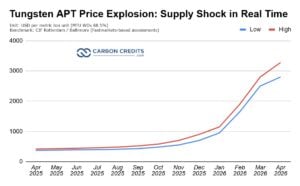
Tungsten prices jumped in early 2026. Benchmark ammonium paratungstate (APT) prices hit record levels in April 2026, up from relatively stable levels in 2025, rising from $400/MTU to over $3,000/MTU. Buyers rushed to secure the supply.  

tungsten price april 2026

China’s Export Controls Spark Global Supply Panic

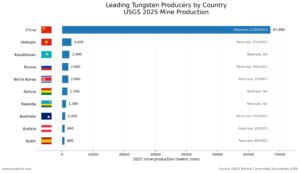
China currently dominates the global tungsten industry. China is estimated to control about 75% to 85% of the world’s tungsten production. It also holds a larger portion of the processing capacity.

tungsten producers by country

That concentration has become a growing concern for Western governments. The market is now realizing how vulnerable the global tungsten supply chain really is.

One of the biggest drivers behind the recent tungsten rally is China’s tightening control over exports. Industry reports say that Chinese export limits cut global tungsten availability in 2026. Some estimates suggest export volumes fell by around 40%, while international buyers struggled to source alternative supplies fast enough.

This has created what many analysts now describe as a structural supply shortage.

Fastmarkets reported that Chinese mining quotas and lower ore grades were tightening the market. Rising industrial demand made things worse, and then export restrictions added to the strain.

Reuters also reported that inventories remain extremely tight across global markets. The result has been explosive price growth, as shown above. 

Several industry trackers reported tungsten prices more than doubled between 2025 and 2026. Some tungsten chemical products reportedly rose more than 200% in only a few months.

Analysts increasingly believe the market may remain undersupplied for years.

A market forecast predicts that the global tungsten supply-demand gap will surpass 17% from 2026 to 2028. Another report says global tungsten shortages might last until 2027. This is due to new mines outside China taking years to develop.

That backdrop makes Kazakhstan’s giant tungsten project strategically important.

The Kazakhstan Mine Could Become the West’s Next Critical Minerals Hub

According to company disclosures, the Severniy Katpar and Upper Kairakty projects could eventually produce around 12,000 metric tonnes of tungsten annually. That would represent roughly 15% of current global tungsten production.

Very few mining projects outside China are large enough to shift global supply balances. This one potentially can.

The United States appears highly interested in supporting the development financially.

The Export-Import Bank of the United States has reportedly issued a Letter of Interest for up to $900 million in financing support. Meanwhile, the U.S. International Development Finance Corporation is interested in possibly offering another $700 million. Combined support could total as much as $1.6 billion.

That level of potential backing highlights how seriously Washington views critical mineral security.

The project also reflects a wider global trend. Governments are shifting mineral supply chains from China to allied countries. They call this “friend-shoring.” Kazakhstan is becoming an important player in that shift.

Beyond Oil: Kazakhstan’s New Strategic Resource Boom

The country in Central Asia already holds large deposits of uranium, copper, rare earths, and battery minerals. Now it is positioning itself as a future hub for strategic metals needed by Western economies.

Kaz Resources controls several mineral concessions in Kazakhstan. These concessions include rare earth elements, lithium, tantalum, cesium, niobium, and tin. The company also owns a major stake in the Akbulak Rare Earth Project.

This diversification matters because many industries are no longer focused on securing only one critical mineral. Governments and manufacturers increasingly want stable access to entire supply chains.

That includes tungsten. The mineral is very important because it is hard to replace in many industrial and military uses.

Tungsten-based materials are crucial for many products. They are key in defense systems, armor-piercing ammo, jet engines, semiconductor tools, and heavy-duty cutting equipment.

As defense spending rises globally, demand is expected to increase even further.

Why Tungsten Is Becoming the Next Lithium

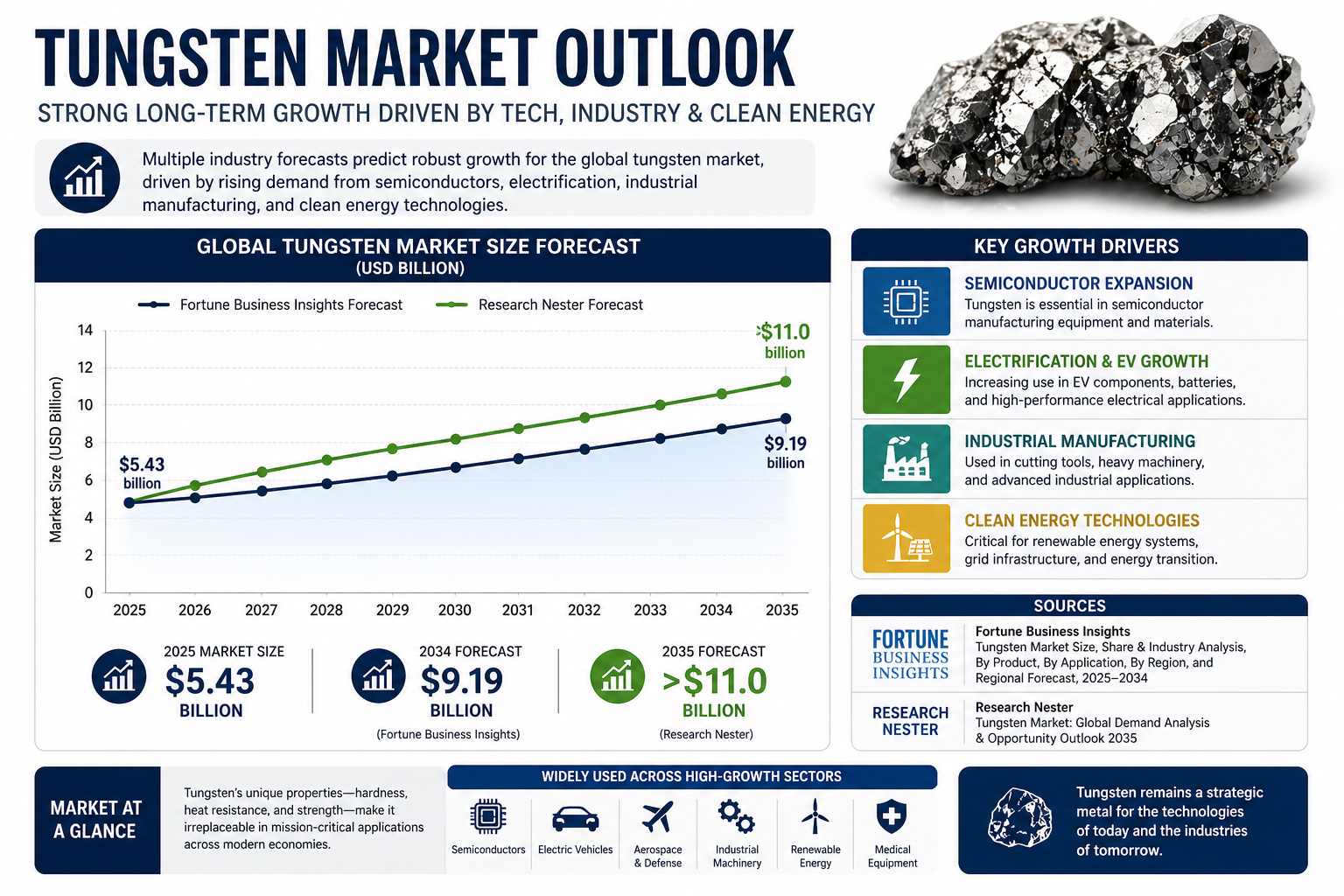
Multiple industry forecasts now predict strong long-term growth for tungsten demand. The global tungsten market was worth about $5.43 billion in 2025, and might reach around $9.19 billion by 2034, according to Fortune Business Insights.

Separately, Research Nester predicts the market may surpass $11 billion by 2035. This growth will be fueled by semiconductors, electrification, industrial manufacturing, and clean energy technologies.

tungsten market outlook

Analysts say several major trends are supporting long-term tungsten demand growth, including:

  • Rising aerospace production, 
  • Increased global defense spending,
  • Semiconductor expansion,
  • EV manufacturing growth,
  • Renewable energy infrastructure, 
  • Advanced industrial automation, and
  • AI-related hardware manufacturing. 

Tungsten is increasingly being viewed as a “strategic technology metal” rather than just a traditional industrial commodity. That shift is changing investor interest as well.

Mining and resource investors now see tungsten like they once saw lithium and rare earths. It’s a key material for future industrial growth.

Trump Family Ties Add Political Heat to Strategic Metals Deal

The story got more attention when reports said Donald Trump Jr. and Eric Trump invested in Skyline Builders through related investment groups. The involvement of the Trump family adds another political layer to an already strategic transaction.

Critical minerals have become one of the biggest economic and national security priorities in U.S. policy discussions.

Both Democratic and Republican administrations pushed for more mineral independence from China. This includes both domestic resources and allies. Beijing’s export restrictions on key materials have sped up that effort.

The New Global Resource War Has Already Begun

The Kazakhstan tungsten project represents more than a mining investment. It shows how critical minerals are becoming central to global economic strategy, industrial security, and geopolitics.

The world is entering a period where access to metals may become just as important as access to oil and gas once was. And tungsten is rapidly moving to the center of that conversation.

If the Severniy Katpar project reaches full production, it could become one of the most important non-Chinese tungsten supply sources in the world.

For the United States and its allies, that could mark a major step toward reducing dependence on China for one of the world’s most strategically important metals.

The post Trump-Linked Kazakhstan Tungsten Mega Deal Could Break China’s Grip on Critical Minerals appeared first on Carbon Credits.
Blackstone Bets €2B on Eurowind as Europe’s Renewable Energy Boom Meets AI-Driven Power Surge

Blackstone Bets €2B on Eurowind as Europe’s Renewable Energy Boom Meets AI-Driven Power Surge

Blackstone is investing up to €2 billion ($2.3 billion) in Danish renewable energy developer Eurowind Energy. The deal marks one of the largest recent private investments in Europe’s clean energy sector.

The investment will give Blackstone a significant minority stake in Eurowind. Current owners, like Danish energy and telecom group Norlys and Eurowind’s founders, will stay as majority shareholders.

Founded in 2006, Eurowind develops and operates renewable energy projects across Europe. Its portfolio includes onshore wind, solar, battery storage, and biogas projects in 16 European markets. The company has expanded rapidly as Europe accelerates its energy transition.
Blackstone Makes One of Europe’s Biggest Clean Energy Bets Yet

The deal comes at a time when Europe faces rising electricity demand, energy security concerns, and pressure to reduce carbon emissions.

Blackstone said the new capital will help Eurowind speed up renewable energy deployment across the region. Adam Kuhnley, Co-Head of European Investments at Blackstone Infrastructure, stated:

“Significant capital will be required to meet European energy demand in the coming years, and Blackstone is well-positioned to support and accelerate Europe’s energy infrastructure build-out.”

Eurowind Energy CEO Jens Rasmussen remarked:

“Blackstone brings a long-term perspective with perpetual capital and believes in Eurowind Energy’s strategy to become a leading independent power producer in Europe. The firm has significant experience within energy and infrastructure, and the investment will allow us to accelerate the pace of expansion and install three to four times more solar and wind energy as well as batteries versus our current pace.”

The transaction shows that private capital is now vital for funding Europe’s clean energy growth. For years, electricity demand in Europe was mostly flat. That is now changing.

Blackstone predicts that European power demand will rise by over 3% each year until 2040. The increase is being driven by electrification, artificial intelligence (AI), industrial expansion, and the push for greater energy independence.

Several industries are adding pressure to the power grid.

Electric vehicles are increasing electricity use in transportation. Data centers supporting AI require massive amounts of constant power. Heavy industries are also shifting from fossil fuels to electricity-based systems to cut emissions.

The region is also cutting back on imported fossil fuels. This shift follows the energy crisis caused by the Russia-Ukraine war. This has increased investment in local renewable energy infrastructure.

The International Energy Agency (IEA) says renewable energy will make up almost 95% of new global power capacity by 2030. Solar and wind will drive this growth.

Europe renewable power capacity forecast 2030

Europe remains one of the world’s largest renewable energy markets. The European Union aims to cut greenhouse gas emissions by at least 55% by 2030. This goal compares to levels from 1990.

Europe needs big investments in renewable energy, battery storage, and updating the grid to meet these goals.

Eurowind Expands Beyond Traditional Wind Power

Although Eurowind began as a wind developer, the company is now expanding into broader energy infrastructure. Its projects include:

  • Onshore wind farms, 
  • Solar energy parks, 
  • Battery storage systems, 
  • Biogas facilities, and
  • Power-to-X technologies.

Power-to-X refers to technologies that convert renewable electricity into fuels such as green hydrogen. These systems are getting attention. They can help reduce carbon emissions in tough-to-electrify industries. This includes aviation, shipping, and heavy manufacturing.

This diversification reflects broader changes in the renewable sector.

Developers are increasingly combining wind, solar, and storage systems into integrated energy platforms. Battery storage is becoming increasingly important because renewable electricity generation can vary with weather conditions.

BloombergNEF reports that global energy storage will grow rapidly this decade. Grids will depend more on renewable energy. Eurowind’s broader platform may help it capture multiple areas of growth within the energy transition.

global energy storage boom BNEF

The company gains by operating in multiple European markets. This approach helps lower dependence on just one country or regulatory system.

Why Private Capital Is Now Powering the Energy Transition

The Blackstone deal also reflects a growing shift in how renewable energy projects are financed. Large investment firms are increasing exposure to infrastructure assets tied to decarbonization and electrification.

Blackstone manages around $1.3 trillion in assets worldwide. This includes investments in infrastructure, energy, real estate, and private equity.

The company has been active in Europe for more than 25 years and reported investments of about $400 billion in European assets by the end of 2025. It also sees opportunities to invest more than $500 billion in Europe by 2035.

Blackstone’s current portfolio is structured around three primary pillars:

  • Renewable Generation and Storage,
  • Electrification and Grid Modernization, and
  • Energy Security and Resilience.

Blackstone’s Recent Strategic Investments

Blackstone has used its infrastructure and private equity divisions to acquire significant stakes in companies in the renewable and utility sectors. All of these are officially announced by the company.

  • Eurowind Energy (April 2026): committed up to €2 billion to acquire a 24.7% stake in this Denmark-based developer.
  • Sunotec (April 2026): This is a tactical equity investment. It aims to speed up the development of solar power, battery storage, and grid infrastructure in Germany and the UK.
  • Advanced Cooling Technologies (March 2026): Blackstone Energy Transition Partners acquired a majority stake in this thermal management manufacturer. This move addresses the cooling needs of high-power density AI data centers.
  • TXNM Energy (Approval Feb 2026): Blackstone passed a key regulatory step for its $11.5 billion buy of New Mexico’s largest electric utility parent company. The deal is targeted to close in late 2026.
  • Natural Gas for AI (July 2025): They teamed up with PPL Corporation to build gas-fired plants in Pennsylvania. This will support the growth of data centers.

The firm manages these initiatives through specialized platforms, including:

  • Blackstone Energy Transition Partners: Its dedicated private equity arm, which has committed over $28 billion to energy sectors globally.
  • Sustainable Resources Credit Platform: A specialized credit platform launched to address the financing needs of large-scale decarbonization projects.
  • Energy Transition Fund V: As of early 2026, Blackstone is raising its fifth energy transition fund, which is expected to be “meaningfully larger” than previous vintages due to high deal flow in the electrification ecosystem.

These private equity and infrastructure funds, along with others, are key players in clean energy. Governments can’t finance the large investments needed on their own.

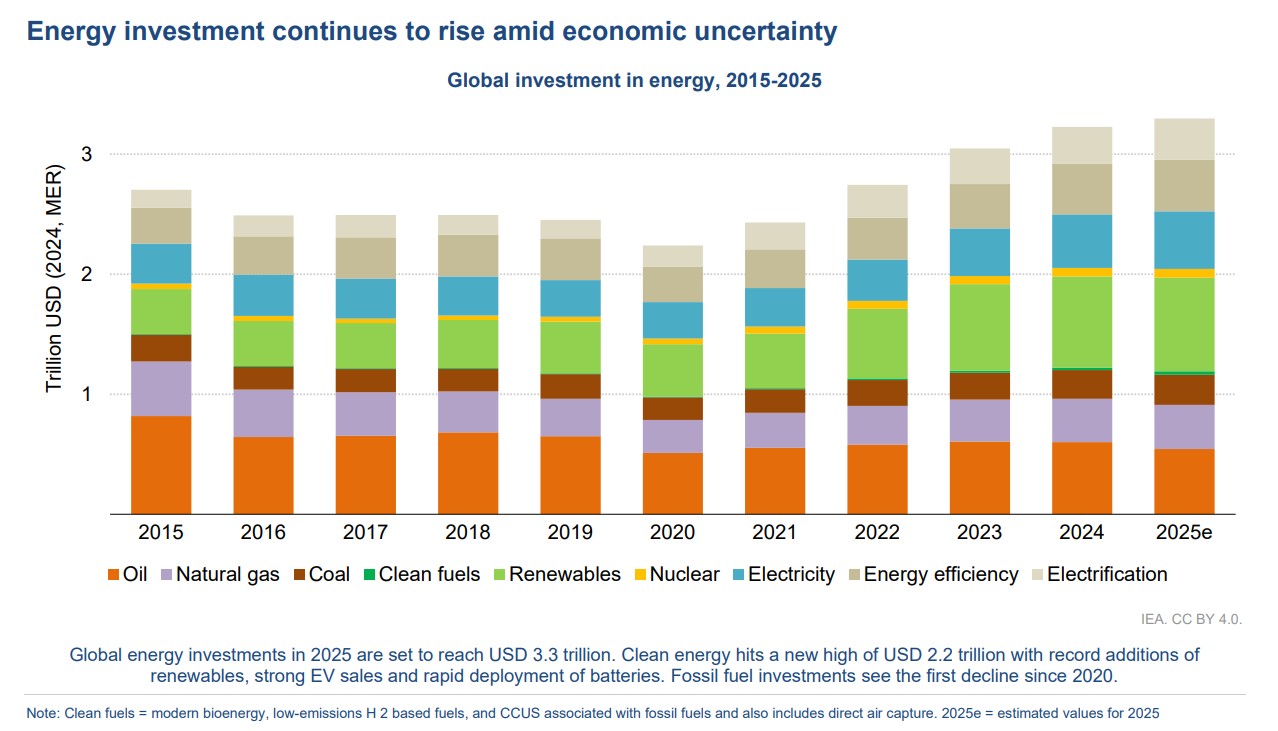
The IEA estimates that global clean energy investment is over $2 trillion a year. Spending will likely increase to meet climate goals.

global clean energy investment 2025 by IEA

Renewable energy projects are increasingly being treated like long-term infrastructure assets. Investors are attracted by stable cash flows, long operating lifespans, and growing electricity demand.

At the same time, ESG and sustainability goals are influencing capital allocation decisions. Big investors feel the pressure to back lower-carbon assets. They also need to cut ties with high-emission sectors.

Europe’s Renewable Gold Rush Is Getting Crowded

The Blackstone-Eurowind deal comes during intense competition for renewable energy assets.

Global investors are racing to secure positions in fast-growing clean energy markets. Pension funds, sovereign wealth funds, private equity firms, and infrastructure investors are all increasing exposure to renewable projects.

Moreover, electricity is becoming more central to transportation, manufacturing, AI infrastructure, and heating systems. This is increasing the need for reliable and low-carbon power generation.

For investors, renewable infrastructure is viewed both as an environmental strategy and as a long-term growth opportunity tied to Europe’s economic transformation.

Blackstone’s €2 billion investment in Eurowind reflects that shift. It shows how large financial firms are positioning themselves for a future where clean electricity, energy security, and digital infrastructure become deeply connected across the European economy.

The post Blackstone Bets €2B on Eurowind as Europe’s Renewable Energy Boom Meets AI-Driven Power Surge appeared first on Carbon Credits.