World Bank Ends 45% Climate Finance Target: What Changes Now?

The World Bank has made a major change to its climate strategy. It has dropped its target of directing 45% of its annual financing to climate-related projects after pressure from the United States. Although the bank says climate action remains a priority, the decision changes how it will measure its support for clean energy and climate resilience.

The move comes at a critical time. Climate disasters are becoming more frequent, and developing countries need billions of dollars to build clean energy, protect communities, and adapt to rising temperatures. Many experts worry that removing the target could weaken accountability, even if climate funding continues.

Why Did the World Bank Drop the Target?

The World Bank has decided to remove both its 35% and 45% climate finance targets under its Climate Change Action Plan (CCAP). Instead of tracking the percentage of lending that supports climate goals, the bank says it will focus on broader development results and the needs of borrowing countries.

As per reports, the change followed months of pressure from the United States, the bank’s largest shareholder. U.S. Treasury Secretary Scott Bessent argued that fixed climate targets could pull the World Bank away from its main mission of reducing poverty and boosting economic growth.

According to the bank, future lending will be client-driven. This means countries will decide which projects they want to finance. If a country wants more renewable energy or climate resilience projects, the World Bank says it will continue to support them.

World Bank President Ajay Banga also stressed that the institution is not abandoning climate finance. Instead, it wants to give countries more flexibility while keeping climate action part of their development plans.

Unlocking World Bank’s Climate Finance Program

Climate finance is money that helps countries fight climate change while supporting economic development. The World Bank uses these funds to finance projects that lower greenhouse gas emissions or help communities prepare for climate impacts.

Instead of offering separate climate loans, the bank includes climate goals in many development projects. For example, it may finance roads that can withstand floods, renewable power plants, water conservation systems, or climate-smart farming.

The World Bank measures these investments through “climate co-benefits.” This refers to the share of a project’s funding that directly supports climate action.

The projects generally fall into two main categories:

  • Climate mitigation, such as renewable energy, clean transportation, energy-efficient buildings, and lower-carbon industries.
  • Climate adaptation, including flood protection, drought management, climate-smart agriculture, stronger water systems, and disaster preparedness.

This approach became the foundation of the bank’s Climate Change Action Plan, launched in 2021. The goal was to make climate action part of everyday development projects instead of treating it as a separate program.

Climate Finance Has More Than Doubled

Ironically, the World Bank removed its target after reaching record levels of climate finance.

According to its latest figures, climate financing increased from about $17 billion in 2020 to more than $39 billion in fiscal year 2025. That is an increase of well over 100% in just five years.

the world bank
Source: The World Bank

In fiscal year 2025, the bank reported:

  • More than $39 billion in climate finance.
  • 48% of total lending delivered climate co-benefits.
  • Around $22.6 billion supported emissions reduction and clean energy projects.
  • About $16.6 billion went toward climate adaptation and resilience.

Across the wider World Bank Group, including the International Finance Corporation (IFC), total climate-related financing reached about $50.8 billion.

These numbers show that climate finance has become one of the bank’s fastest-growing areas of investment.

Why Did the Target Matter?

The 45% target was more than just a percentage. It helped governments, investors, and environmental groups measure the bank’s progress.

The target also encouraged teams inside the World Bank to include climate solutions in projects involving transport, agriculture, water, and infrastructure.

Most importantly, it showed that the bank was committed to supporting the goals of the Paris Agreement.

Without a clear target, some experts worry that it will become harder to track whether climate finance is growing or shrinking in the future. The World Bank says it will continue reporting climate data, but many believe a numerical target provides stronger accountability.

climate finance
Source: The World Bank

How Could This Affect Developing Countries?

The decision is unlikely to stop climate funding immediately. However, it could change how future projects are selected.

Developing countries face huge climate challenges. They need money to:

  • Build renewable energy.
  • Upgrade electricity grids.
  • Protect communities from floods and droughts.
  • Improve water security.
  • Make agriculture more resilient.

Many low-income countries cannot afford these investments on their own. They depend on low-cost loans and grants from institutions like the World Bank.

Under the new approach, countries that request climate-related projects can still receive funding. However, governments that focus on other development priorities may receive less climate financing than before.

This could create differences in climate investment across regions and make long-term planning more difficult.

Here’s a breakdown of climate finance by region in the last year:

climate finance
Source: The World Bank

Global Climate Finance Faces a New Test

The World Bank plays a major role in international climate finance. Its decisions often influence other multilateral development banks.

At the COP29 climate summit in Baku, multilateral development banks pledged to provide $120 billion every year for low- and middle-income countries by 2030. They also committed another $42 billion annually for high-income countries.

The World Bank is expected to remain the largest contributor to these efforts.

However, removing its own climate finance target has raised new questions. Some analysts believe other investors may wonder whether the bank will continue increasing climate lending at the same pace.

Others argue that the bank is simply changing how it measures success rather than reducing funding.

Investors Are Watching Closely

So far, the World Bank has continued to finance clean energy projects.

Just days after announcing the policy change, it approved $265 million for a pumped-storage hydropower project in Morocco. The project will improve renewable energy integration and strengthen the country’s electricity grid.

This suggests that the bank still plans to support clean energy, climate adaptation, and resilient infrastructure.

Still, investors, governments, and environmental groups will closely watch future lending data. Without a formal target, the annual climate finance figures will become the best way to judge the bank’s commitment.

The Bottom Line

The World Bank’s decision to remove its 45% climate finance target marks an important shift in global development finance. The bank says climate action remains part of its mission, but it will now focus on development outcomes instead of meeting a fixed lending target.

For developing countries, climate funding is expected to continue. However, the lack of a measurable goal makes it harder to know whether support will keep growing in the years ahead.

The world needs trillions of dollars to expand clean energy, cut emissions and protect communities from climate change. Whether the World Bank can maintain its leadership without a formal climate finance target will become clear only through its future lending decisions.

In the end, the numbers will matter more than the policy. If climate finance continues to rise, the change may prove to be mostly administrative. But if funding slows, this decision could become a defining moment for global climate finance and the world’s transition to a low-carbon economy.

The post World Bank Ends 45% Climate Finance Target: What Changes Now? appeared first on Carbon Credits.

Brookfield and Bloom Energy Scale AI Data Center Power Partnership to $25 Billion, Sending BE Stock Upward

Brookfield and Bloom Energy Scale AI Data Center Power Partnership to $25 Billion

The artificial intelligence (AI) industry has seen one of its largest energy infrastructure partnerships. Brookfield Asset Management and Bloom Energy have expanded their strategic partnership from $5 billion to $25 billion. The fivefold increase will finance and deploy on-site power systems for AI data centers across the United States.

The companies say the agreement will speed up the delivery of electricity to hyperscale facilities facing long waits for grid connections.

The deal reflects a growing problem across the technology sector. AI data centers are using electricity faster than ever. Utilities are struggling to keep up with the growing need for generation and transmission capacity.

Many tech companies are now skipping long waits for new grid connections. Instead, they are investing in on-site power systems that can be set up quickly. More broadly, the partnership shows how energy infrastructure is becoming a key part of the AI economy.

A Bigger Partnership for AI Infrastructure

The new agreement allows Brookfield and Bloom Energy to finance and deploy up to $25 billion in power projects. This is a big jump from their original $5 billion partnership.

Brookfield’s infrastructure financing skills mix with Bloom Energy’s fuel-cell tech. This helps deliver electricity to large data centers faster than usual utility connections.

Bloom says its Energy Server systems can be installed within months instead of waiting years for new transmission infrastructure. That speed has become increasingly important as AI developers race to add computing capacity.

power system comparison fuel cell bloom energy

The partnership also supports Brookfield’s broader AI strategy. This year, the company started a $100 billion AI Infrastructure Fund. It will invest in data centers, renewable energy, power generation, transmission, and digital infrastructure.

Sikander Rashid, Head of AI Infrastructure at Brookfield, remarked:

“Scaling this partnership further strengthens Brookfield’s position as one of the leading global AI infrastructure investors, capable of delivering end-to-end solutions, from electrons to tokens, for some of the world’s most sophisticated customers.”

These investments will give customers reliable electricity all day, every day. At the same time, utilities are expanding the grid.

Power Demand Is Reshaping AI Infrastructure

AI is driving a sharp rise in electricity demand, putting growing pressure on power grids worldwide.

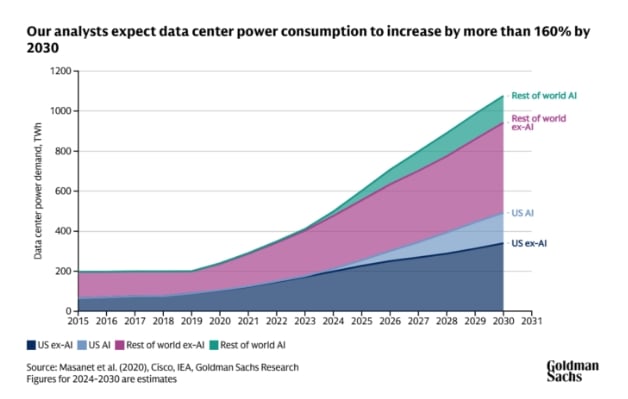
The International Energy Agency (IEA) predicts that electricity use in data centers will more than double by 2030. It will reach around 945 terawatt-hours (TWh), mainly due to AI driving this growth.

A United Nations University report says AI data centers might use as much electricity by 2030 as Pakistan, Bangladesh, and Nigeria combined—almost three times their total use. AI now accounts for about 20% of data center electricity demand, and that share could double by the end of the decade.

Ai energy use vs 3 nations

As demand grows, many utilities find it hard to connect new data centers. This is due to limited transmission capacity, old infrastructure, and lengthy permitting processes. McKinsey estimates that global demand for data center capacity might triple by 2030. This change will need hundreds of billions of dollars in new investment.

Developers face challenges that push them to find faster power solutions. These include on-site generation, battery storage, microgrids, nuclear power, geothermal energy, and fuel cells. The shift is creating new opportunities for companies that can deliver reliable and scalable electricity for AI infrastructure.

Fuel Cells Offer a Faster Solution

Bloom Energy believes its fuel-cell technology can help meet that demand. Unlike conventional power plants, Bloom’s solid oxide fuel cells generate electricity through an electrochemical process instead of combustion.

The systems mainly use natural gas today, but they can also run on biogas. They are designed to support hydrogen as supplies become more common.

Fuel cells provide steady electricity no matter the weather. This makes them ideal for AI data centers that run all day.

Another advantage is speed. New transmission lines and big power plants can take years to build. In contrast, modular fuel-cell systems can be installed much faster. This allows data centers to begin operating while permanent grid upgrades are still underway.

Bloom has grown in the AI market by partnering with companies like Oracle, Equinix, and American Electric Power. These firms need dependable electricity for high-performance computing.

The systems mainly use natural gas, but they create fewer air pollutants than traditional combustion generators. They can also support renewable energy as power grids work to reduce carbon emissions.

Brookfield Is Building AI’s Energy Backbone

The Bloom Energy partnership is part of Brookfield’s broader AI infrastructure strategy.

This year, the company started a $100 billion AI Infrastructure Fund. It will invest in power generation, transmission networks, data centers, fiber infrastructure, and digital connectivity. These investments support the rapid growth of AI while addressing one of its biggest challenges—access to reliable electricity.

Brookfield estimates that AI infrastructure will require trillions of dollars in global investment over the coming decades. As demand grows, electricity has become a key factor in where and how new data centers are built.

Brookfield trillion dollar AI infrastructure

The company also owns one of the world’s largest renewable power portfolios through Brookfield Renewable. Its hydroelectric, wind, solar, storage, and distributed energy assets offer over 46 gigawatts (GW) of installed renewable power. Plus, the development pipeline tops 200 GW.

Brookfield has also committed to reaching net-zero greenhouse gas emissions across its operations by 2050. It keeps investing in renewable energy, energy storage, carbon capture, and grid upgrades to support that goal.

Bloom Expands Beyond Fuel Cells

AI has become an increasingly important growth market for Bloom Energy.

The company positions its solid oxide fuel cells as a cleaner alternative to conventional diesel backup generators. Bloom claims its systems create almost no particulate pollution. They also lower nitrogen oxide and sulfur oxide emissions much more than combustion-based technologies.

Beyond AI, Bloom continues expanding its hydrogen and carbon capture businesses. Its fuel cells already operate on biogas and are designed to transition to hydrogen as supplies increase.

The company has made solid oxide electrolyzers. They create hydrogen more efficiently than traditional electrolysis systems. These technologies support broader efforts to reduce industrial emissions while improving long-term energy resilience.

Investors Bet on AI Power Infrastructure

The expanded partnership also drew attention from investors. Bloom Energy’s shares climbed after the announcement. Investors saw the fivefold increase as a clear sign of strong demand for AI power infrastructure.

Bloom Energy BE stock price

Analysts noted that the agreement boosts Bloom’s role in a fast-growing energy market. It also gives long-term financing support through Brookfield.

The deal also suggests that distributed power systems will be more important, while developers keep facing delays in getting grid connections.

The Next AI Race Is About Electricity

Artificial intelligence is reshaping not only the technology sector but also global energy markets. Brookfield’s new $25 billion deal with Bloom Energy shows a key trend: reliable electricity is now as crucial as advanced chips and cloud computing.

As AI data centers continue to grow, developers will need power solutions that can be deployed quickly and operate around the clock. Fuel cells, renewable energy, battery storage, and modernized power grids are all expected to play important roles.

For Brookfield, the partnership strengthens its position in one of the fastest-growing infrastructure markets. For Bloom Energy, it expands opportunities in the rapidly growing AI sector.

More broadly, the agreement shows that the next phase of AI growth will depend not only on computing power, but also on the energy infrastructure needed to support it.

The post Brookfield and Bloom Energy Scale AI Data Center Power Partnership to $25 Billion, Sending BE Stock Upward appeared first on Carbon Credits.
Copper Under Pressure as Ferrari, BMW, and Tesla Embrace Cheaper Aluminum Wiring

The automotive industry is quietly reshaping one of its oldest engineering standards. After relying on copper wiring for nearly two centuries, leading automakers are increasingly replacing it with aluminum, particularly in electric vehicles (EVs).

According to Reuters, Ferrari and BMW have expanded the use of aluminum wiring in their latest models, joining Tesla and several Chinese EV manufacturers. The move is driven by a combination of lower costs, lighter weight, and growing concerns over copper supply constraints.

While copper remains the preferred conductor for many automotive applications, rising prices and tightening supplies are pushing manufacturers to rethink their material choices. Analysts now believe this trend could gradually reshape global demand for both metals over the coming decade.

Copper vs. Aluminum: Rising Prices Are Changing the Equation

Copper has long been the industry standard because of its superior electrical conductivity, durability, and flexibility. However, economics are increasingly working against it.

As we have seen and read before, copper prices had climbed to nearly $15,000 per metric ton earlier this year. Supply shortages and soaring demand from clean energy projects, power grids, data centers, and electric vehicles supported it.

copper prices
Sourced from Reuter’s report

In contrast, aluminum currently trades at roughly $3,100 per metric ton, making it nearly four times cheaper. The price difference has become difficult for manufacturers to ignore, especially as EV production continues to scale.

aluminum prices

However, apart from lower prices, the shiny white metal offers three major financial and engineering advantages:

  • It is approximately 3.3 times lighter than copper.
  • It costs roughly one-quarter as much as copper.
  • Lower vehicle weight can improve driving range and overall energy efficiency.

The tradeoff is conductivity. Aluminum carries electricity less efficiently than copper, requiring cables with a larger cross-sectional area to deliver the same electrical performance. Engineers must also carefully design connectors because aluminum naturally forms an oxide layer that can reduce electrical contact quality if not properly managed.

Despite these challenges, advances in cable design and manufacturing have made aluminum increasingly practical for selected automotive applications.

Ferrari and BMW Expand Aluminum Wiring Across New Models

Reuters reported that Ferrari began using aluminum power cables in its 296 hybrid sports car last year before extending the technology to additional vehicles, including the newly launched Luce, the company’s first fully electric model.

According to Ferrari communications executive Dario Esposito, switching materials reduced total wiring weight by as much as 20%. Esposito told Reuters that performance and not cost was the primary motivation behind Ferrari’s decision.

The company already relies heavily on aluminum in vehicle bodies, chassis, and engines, making wiring a natural extension of its lightweight engineering strategy.

BMW has followed a similar path, although its transition began much earlier.

The German automaker first introduced aluminum conductors in the BMW 1 Series in 2011. Since then, the company has gradually expanded their use across hybrid and electric vehicles.

Today, BMW incorporates significant amounts of aluminum wiring in both high- and low-voltage systems within its latest eDrive electric vehicle platform introduced last year.

Reuters also cited an industry source indicating that Stellantis has recently started replacing copper wiring with aluminum in some applications, although the company declined to comment.

China Is Accelerating the Shift

China appears to be moving even faster.

Chinese government encouraged manufacturers to substitute copper with aluminum in a March 2025 policy paper. The recommendation reflects broader concerns over securing long-term supplies of critical industrial metals while lowering manufacturing costs.

SMM View

According to Shanghai Metals Market (SMM), the policy reflects China’s long-term strategy to transform its aluminum industry through greater recycling, resource efficiency, and green innovation.

  • SMM believes the target of producing 15 million metric tons of recycled aluminum annually is both realistic and strategically significant.

The consultancy noted that expanding recycled aluminum production will help meet growing demand from sectors such as electric vehicles, renewable energy, and advanced manufacturing while reducing reliance on primary aluminum.

It will also help ease supply constraints created by China’s cap on primary aluminum production, supporting a more sustainable and circular aluminum industry over the long term.

Tesla Sets a Benchmark for Chinese EV Makers 

Several Chinese EV makers have already adopted aluminum wiring.

Tesla also pioneered many of these design choices. It introduced aluminum wiring in the Model Y in 2019 and expanded its use in the Cybertruck. Woychowski noted that Tesla’s engineering decisions have become important benchmarks for Chinese automakers, many of which closely study the company’s manufacturing techniques.

The timing is significant.

China’s highly competitive EV market continues to experience intense price pressure, leaving manufacturers searching for every possible cost reduction. At the same time, lighter vehicles offer longer driving ranges without increasing battery size, creating an additional incentive for aluminum adoption.

Reuters also reported that approximately 85% of electrical busbars—the components connecting EV batteries to vehicle systems—are still made from copper, suggesting considerable room for future substitution.

Lightweight Design Supports EV Efficiency

Weight reduction has become one of the most valuable engineering strategies for electric vehicles.

Unlike conventional gasoline cars, every kilogram removed from an EV can contribute to improved efficiency, longer driving range, or smaller battery requirements.

This broader industry trend is also reflected in research from DUCKER Research and Consulting. Its report, Aluminum Content in Passenger Vehicles (Europe), projects average aluminum content per passenger vehicle will increase from 205 kilograms in 2022 to approximately 256 kilograms by 2030.

The report estimates aluminum usage will continue growing, supported primarily by electrification, battery housings, electric drive systems, high-voltage components, and large structural castings.

According to the study, reducing vehicle weight remains essential for improving driving range while lowering battery-related costs.

As manufacturers pursue greater efficiency, aluminum is becoming increasingly attractive across multiple vehicle systems beyond body structures.

Aluminum in vehicles
Source: Ducker; *CPV of 179 kg in EA study 2019 as second set of OE wheels was included

Copper Demand Faces Growing Pressure

The increasing use of aluminum is beginning to influence global metals markets.

Reuters reported that analysts at JPMorgan expect aluminum substitution to affect approximately 2% of global copper demand this year.

  • Looking further ahead, the bank outlined a scenario in which aluminum could replace about 6% of annual copper demand by 2030 if adoption continues across transportation, power infrastructure, and manufacturing.
  • Reuters further highlighted that Chinese consultancy Zhuochuang estimates that 25% to 30% of copper components, measured by metal volume, could shift to aluminum across the automotive, power, and home appliance industries by 2030.

Although these percentages may appear modest, they represent substantial volumes within the world’s largest industrial metal markets.

Copper demand is simultaneously being supported by renewable energy installations, electricity transmission upgrades, artificial intelligence infrastructure, and rapidly expanding data centers.

As a result, substitution may help alleviate supply pressures rather than eliminate demand altogether.

Copper Still Holds Important Advantages

Despite growing momentum behind aluminum, copper is unlikely to disappear from automotive manufacturing.

Copper continues to outperform aluminum in several critical areas.

Its higher electrical conductivity allows manufacturers to use thinner cables while delivering greater power. Copper also offers superior flexibility, making it better suited for compact spaces, repeated movement, and demanding electrical systems.

For these reasons, aluminum is expected to remain concentrated in applications where weight savings outweigh conductivity advantages.

These include:

  • High-voltage EV cables
  • Long-distance power runs
  • Battery connection systems
  • Applications where reducing vehicle mass delivers measurable efficiency gains

Meanwhile, copper will likely continue dominating compact electronics, high-performance circuits, and systems requiring maximum reliability.

A Gradual Transition, Not a Complete Replacement

The growing adoption of aluminum wiring reflects a broader transformation occurring throughout the automotive industry.

Manufacturers are balancing performance, cost, material availability, and sustainability while responding to rapidly changing supply chains.

Reuters’ reporting suggests this is no longer an isolated experiment. Instead, aluminum is becoming an increasingly mainstream engineering solution across global automakers—from premium brands like Ferrari and BMW to mass-market EV manufacturers in China.

Even so, the transition is expected to remain selective rather than universal. Copper’s superior electrical performance ensures it will continue playing a central role in vehicle electrification.

Instead of replacing copper entirely, aluminum is emerging as a complementary material that helps manufacturers reduce costs, lower vehicle weight, and manage growing pressure on global copper supplies.

As EV production accelerates worldwide, the balance between these two metals could become one of the defining material trends shaping the next generation of electric mobility.

The post Copper Under Pressure as Ferrari, BMW, and Tesla Embrace Cheaper Aluminum Wiring appeared first on Carbon Credits.
Airlines Face a $127 Billion Carbon Credit Bill as CORSIA Supply Tightens

Airlines Face a $127 Billion Carbon Credit Bill as CORSIA Supply Tightens

The global aviation industry is facing a new climate challenge. Airlines might soon face challenges in getting enough quality carbon credits to follow international emissions rules. This could lead to an extra $127 billion in costs over the next ten years.

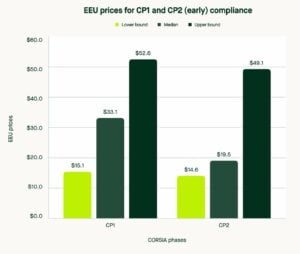
An MSCI Carbon Markets analysis, as first reported by Financial Times, warns of a carbon credit shortage. This shortage under the Carbon Offsetting and Reduction Scheme for International Aviation (CORSIA) could drive prices near $100 per metric ton by 2035. That would be a big jump from current levels. It could raise compliance costs for airlines around the world.

Why CORSIA Is Reshaping Aviation’s Climate Strategy

The warning comes as international air travel continues to recover. The International Air Transport Association (IATA) predicts that global passenger numbers will surpass 5.2 billion in 2025. Airline revenues are also expected to exceed $1 trillion. More flights also mean more emissions, increasing demand for high-quality carbon credits.
CORSIA is the world’s first global market-based system designed to reduce emissions from international aviation. The International Civil Aviation Organization (ICAO) created a rule that requires airlines to offset emissions growth on eligible international routes. They must do this by buying approved carbon credits.
The program entered its first compliance phase in 2024 and will expand over the coming years as more countries participate. More than 120 nations have committed to CORSIA, making it one of the world’s largest international carbon markets.

CORSIA compliance requirements abatable
Source: Abatable

CORSIA is different from the broader voluntary carbon market (VCM). It only accepts credits from programs that follow strict standards. These include environmental integrity, permanence, transparency, and independent verification. ICAO has approved only a limited number of carbon credit standards and methodologies.

As a result, airlines cannot simply buy the cheapest credits. They must compete for a much smaller pool of eligible credits, increasing the risk of shortages as demand grows.
MSCI Carbon Markets says the market might get tight after 2027. This is when more airlines will need to comply, and demand will rise.

A Growing Gap Between Supply and Demand

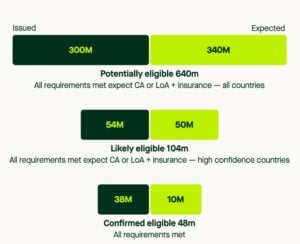
The expected shortage is not caused by a lack of carbon projects. Instead, too few projects meet CORSIA’s eligibility requirements.

The VCM has issued billions of carbon credits over the past two decades. However, many older credits do not qualify under ICAO’s stricter rules. At the same time, developers need years to create, validate, verify, and register new projects before credits can reach the market.

CORSIA eligible carbon credits supply
Source: MSCI

MSCI estimates this imbalance could leave airlines competing for a limited supply of eligible credits throughout the 2030s. Under its tighter supply scenario, compliance costs could reach $127 billion between 2024 and 2035.

The report predicts that CORSIA-approved credits might reach nearly $100 per metric ton by 2035. This is much higher than the current prices in the wider voluntary carbon market.

Some airlines face greater exposure than others. Long-haul international carriers like Emirates, Qatar Airways, and United Airlines will likely need the most eligible credits. This is due to their vast global networks.
  • Emirates could face $8 billion in compliance costs, followed by Qatar Airways ($6 billion) and United Airlines ($5 billion), per FT report.

The challenge comes as many airlines are already dealing with higher fuel costs, aircraft shortages, and growing investments in sustainability.

Aviation’s Climate Challenge Continues to Grow

The pressure reflects aviation’s broader emissions challenge.

According to the International Energy Agency (IEA), aviation accounts for around 2% of global energy-related carbon dioxide emissions. Yet, it remains one of the fastest-growing transport sectors because passenger demand continues to outpace efficiency gains.

The Air Transport Action Group (ATAG) estimates that in 2024, commercial aviation emitted around 942 million metric tons of CO₂. This is nearly back to pre-pandemic levels. Without stronger climate action, emissions could keep rising over the coming decades.

Airline aviation sector ghg emissions 2024 IATA
Source: IATA

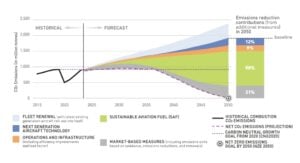
The industry has responded with ambitious climate goals. Through IATA, airlines have committed to reaching net-zero emissions by 2050. To reach that target, we need better aircraft, sustainable aviation fuel (SAF), operational upgrades, hydrogen and electric planes, and carbon removal.

Most experts agree that carbon credits will still be vital during the transition. This is especially true for emissions that we can’t eliminate yet.

Sustainable Aviation Fuel Cannot Close the Gap Alone

The aviation industry sees sustainable aviation fuel as its biggest long-term tool for cutting emissions. Depending on the feedstock and production method, SAF can reduce lifecycle greenhouse gas emissions by up to 80% compared with conventional jet fuel.

However, supply remains well below demand.

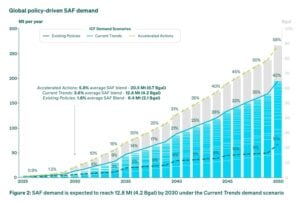
According to IATA, SAF production reached about 2.4 million metric tons in 2025, or roughly 2.5 billion liters. Despite rapid growth, it will supply only about 0.7% of global jet fuel demand this year.

SAF production
Source: ICAO

The industry aims to expand production much faster. Under IATA’s net-zero roadmap, SAF could deliver about 65% of aviation’s emissions reductions by 2050. Reaching that goal will require hundreds of billions of dollars in investment and a major expansion of production capacity worldwide.

Until then, airlines will continue relying on carbon credits to offset emissions that cannot yet be avoided. That is why analysts expect demand for high-quality credits to remain strong over the next decade.

Higher Credit Prices Could Reshape Carbon Markets

Growing CORSIA demand could affect the broader carbon market. In recent years, voluntary carbon markets have struggled with low prices and concerns about credit quality. Many lower-quality credits traded for only a few dollars per metric ton as buyers became more selective.

CORSIA could help reverse that trend.

CORSIA carbon credit supply, demand, and prices
Source: Allied Offsets

ICAO only accepts credits that meet strict environmental standards. This gives developers a strong reason to create high-quality carbon removal and avoided-emissions projects. These projects can then qualify for compliance markets.
This change could boost investment in several areas:

  • Reforestation,
  • Afforestation,
  • Direct air capture (DAC),
  • Bioenergy with carbon capture and storage (BECCS),
  • Improved soil carbon, and
  • Other lasting carbon removal projects.
Market analysts expect buyers to continue prioritizing quality over low prices. That trend is already visible as companies pay premiums for credits backed by stronger verification and long-term climate benefits.

Higher prices could help project developers. This change can improve project economics and make it easier to fund carbon removal technologies that have had trouble attracting investment.

The Aviation Transition Will Require More Than Offsets

Carbon credits alone will not solve aviation’s climate challenge. Airlines need to invest in:

  • Fuel-efficient aircraft,
  • Sustainable aviation fuel,
  • Operational improvements, and
  • Future technologies like hydrogen and electric aircraft, when possible.

Governments will also need to support SAF production, modernize air traffic systems, and encourage investment in low-carbon aviation infrastructure. Even so, carbon markets will remain an important bridge during the transition.

The growing shortage of CORSIA-eligible credits reflects a broader shift across global carbon markets. Buyers are no longer looking for the cheapest offsets. They increasingly want credits that meet higher standards for quality, transparency, and measurable climate impact.

For airlines, this means climate compliance is becoming more complex and more expensive. For the carbon market, it signals a move toward higher-value credits backed by stronger environmental integrity.

If current projections prove correct, the next decade will not be defined by how many carbon credits are available. Instead, it will depend on how many truly high-quality credits the market can deliver.

The post Airlines Face a $127 Billion Carbon Credit Bill as CORSIA Supply Tightens appeared first on Carbon Credits.