Gold Price Up 70%, Costs Up 16%: Miners’ Decarbonization Test

Gold prices remain near historic highs, creating a major cash-flow opportunity for mining companies. The bigger question for the industry is what miners are doing with those stronger margins. Spot gold was around $4,183 per ounce on September 29, 2026, after reaching a record high earlier this year. The latest price is still well above the levels seen before the recent gold boom.
Mining costs have also increased, but much more slowly than gold prices.
The World Gold Council (WGC) reported that the global average all-in sustaining cost (AISC) reached a record $1,785 per ounce in the first quarter of 2026, up 16% from a year earlier. Gold’s average price rose about 70% year over year during the same period.
As a result, average AISC margins jumped 134% year over year to a record $3,076 per ounce. This creates an unusual opportunity for miners to invest more in cleaner operations.
The question is whether that money is actually flowing into decarbonization, renewable power, electrification, and other environmental projects.

Gold Prices Are Rising Faster Than Mining Costs
Gold remained extremely expensive in Q2 2026, even after pulling back from its early-year record. The LBMA Gold Price PM averaged $4,506.29 per ounce during Q2, down 8% from Q1 but still 37% higher than Q2 2025.
Mining costs have also risen, but at a slower pace. The latest global industry data from the World Gold Council, covering Q1 2026, put average all-in sustaining costs (AISC) at a record $1,785 per ounce, up 5% quarter over quarter and 16% year over year. The WGC has not yet published a global Q2 AISC figure.
- The gap is still striking. Gold’s Q2 average was about $2,721 per ounce above the latest global AISC benchmark.
Gold prices have risen much faster. The difference gives miners substantial room between the revenue earned from each ounce and the cost of sustaining production.
The WGC says royalties were one of the biggest reasons costs increased. In Q1 2026, royalty payments rose 85% year over year and accounted for about 12% of average AISC, compared with around 6% in Q1 2021.
So miners are not keeping the entire benefit of higher gold prices. Governments are also capturing part of the windfall through royalties and taxes.
Even after those costs, however, margins remain exceptionally strong. That gives companies more capacity to fund mine development, debt reduction, dividends, share buybacks, and sustainability projects.
Fed Rate Hike Changes the Gold Equation
The biggest new market driver is the U.S. Federal Reserve.
On September 16, the Fed raised its benchmark interest rate range by 25 basis points to 3.75%–4.00%. It was the central bank’s first rate increase in three years. The Fed said inflation remains elevated and that the latest action would support a return to its 2% inflation goal.
The Fed’s latest projections point to a higher path for rates than previously expected. The median projection puts the federal funds rate at 4.1% at the end of 2026, compared with 3.8% in the June projection.
That is a problem for gold because the metal pays no interest. When Treasury yields rise, investors can earn more income from bonds while holding gold still carries no coupon. That increases the opportunity cost of owning bullion.
Markets are now also pricing in the possibility of another Fed increase later this year. Boston Fed President Susan Collins said she supported the September hike and warned that inflation risks remain elevated.

- SEE MORE: Gold’s Marketing Budget
Major Gold Miners Are Generating Billions in Cash
Recent financial results show how large that cash generation has become.
Newmont generated a record $2.2 billion in free cash flow in Q2 2026. Its average realized gold price was $4,414 per ounce, while gold by-product AISC was $1,621 per ounce. That creates a $2,793-per-ounce spread before other corporate costs and financial items.
Newmont returned $1.9 billion to shareholders during the quarter. Its 2026 plan also includes about $1.95 billion of sustaining capital, $1.4 billion of development capital and $525 million for exploration and advanced projects.
Agnico Eagle reported a Q2 realized gold price of $4,483 per ounce and AISC of just $1,459 per ounce, producing a spread of about $3,024 per ounce. It generated record quarterly free cash flow and continued to fund growth projects while returning capital to shareholders.
Barrick reported a Q2 realized gold price of $4,417 per ounce and AISC of $1,866 per ounce, a spread of about $2,551 per ounce. Operating cash flow reached $1.70 billion, up 28% year over year.
These numbers show the scale of the windfall, but they also show that sustainability is competing with other uses of capital.
Gold Fields Puts $195M Into Renewable Power
Gold Fields provides one of the clearest examples of direct spending on cleaner energy. The company is building a $195 million renewable project at its St Ives operation in Australia, combining a 42-MW wind farm and a 35-MW solar plant. The project aims to reduce reliance on fossil-fuel power and strengthen the mine’s energy supply.

In the first half of 2026, renewable electricity supplied 17.4% of Gold Fields’ group electricity consumption, while Scope 1 and 2 emissions were 4% lower than in H1 2025. At Agnew, renewable electricity already accounted for 43% of power supply.
Gold Fields also has a longer-term target of net-zero emissions by 2050. Its spending shows how higher mining cash flows can fund projects that reduce future fuel and power costs as well as emissions.
Other Miners Are Also Building Cleaner Operations
Gold Fields is not alone. Agnico Eagle has committed to reduce absolute Scope 1 and 2 emissions by 30% by 2030 and reach net zero by 2050.

Its new Hope Bay project in Canada’s Nunavut territory includes a planned 4-MW wind project and 4 MW of battery storage, supported by C$25 million in federal funding. Agnico says the system should cut diesel use by about 3 million litres per year.
Barrick has also included renewable power in its major growth projects. At its Reko Diq copper-gold project in Pakistan, the planned power system includes 150 MW of solar generation. Barrick targets a 30% reduction in emissions intensity by 2030 and net-zero greenhouse gas emissions by 2050.
There is an important catch, however.
Barrick says its expanding production base could cause absolute emissions to rise in the short and medium term, even as emissions per tonne of ore fall. That illustrates a wider challenge for miners: growing production can work against absolute emissions targets.
Shareholder Returns Compete With Decarbonization
The current gold boom is therefore producing a mixed capital-allocation picture. Miners are spending more on renewable power, energy efficiency, electrification and mine infrastructure. But they are also returning large amounts of cash to shareholders and funding new production.
The WGC noted that many producers entered 2026 with strong or even net-cash balance sheets. Newmont, for example, ended Q2 with $9.0 billion of cash and a $3.4 billion net-cash position, while continuing large share repurchases.
Gold Fields also reported $2.225 billion of adjusted free cash flow in H1 2026, more than double the previous year’s $925 million. Its capital plans include both growth spending and renewable energy investment.
This is why simply pointing to record gold margins does not prove miners are becoming greener. The stronger test is how much capital is being directed toward measurable emissions reductions.
Why Gold’s Energy Intensity Creates a Big Climate Opportunity
The opportunity is significant because gold mining is energy intensive. Diesel is used for haul trucks and other mobile equipment, while electricity is needed for crushing, grinding, ventilation, pumping, and processing.
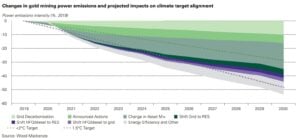
Renewable electricity, battery storage, electrified equipment, and lower-carbon fuels can reduce these emissions. They can also protect miners from volatile fuel prices over time.
Gold Fields already links renewable investment to energy security, lower emissions and cost resilience. The current price environment provides miners with the financial capacity to accelerate that transition. However, the evidence so far points to a mixed picture rather than a single industry-wide trend.
Some companies are making large renewable investments. Others are directing more cash toward production growth and shareholder distributions. Most are pursuing a combination of the two. That makes the next few years important.
The Real Test Is Where the Windfall Goes
Gold’s current price strength has created exceptional margins for many producers. The industry now has more financial room to invest in cleaner mines. But major miners are also returning billions to investors and funding new mines.
The key question for the sector is therefore not whether gold producers have more money to spend. They do.
It is how much of that financial capacity is being converted into lower emissions, cleaner energy and more resilient mining operations. That is where the next phase of the gold boom could have a lasting impact on the mining sector—and its carbon footprint.
The post Gold Price Up 70%, Costs Up 16%: Miners’ Decarbonization Test appeared first on Carbon Credits.






 platform