
Palantir (PLTR) Stock Falls Despite 96% Revenue Surge, Can Its Climate Goals Keep Up?
Palantir Technologies reported another strong quarter as demand for its artificial intelligence (AI) software continued to grow. Revenue nearly doubled in the third quarter of 2026, and the company raised its full-year outlook. Yet, Palantir stock fell after the results as investors weighed its growth against slower contract growth and high expectations.
The financial results highlight Palantir’s growing role in the AI market. However, its expansion also raises an important question: Can the company keep growing while managing the environmental impact of its business?
AI software depends on large computing systems, data centers, and electricity. As more businesses and government agencies use these tools, the demand for computing power can increase. This makes energy use and greenhouse gas emissions important issues for fast-growing technology companies.
Palantir has set emissions reduction goals and reports its carbon footprint each year. Its latest emissions report shows progress against its 2019 baseline, but also a small increase in total emissions.
Palantir Revenue Nearly Doubles as AI Demand Grows
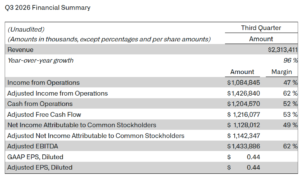
Palantir reported third-quarter revenue of $2.3 billion, up 96% from the same period in 2025. It was the company’s first quarter with revenue above $2 billion.
Its U.S. commercial business was a major growth driver. Revenue from this segment jumped 148% year over year to $984 million. For the first time, it was higher than U.S. government revenue, which reached $953 million, up 96%.
The company also reported net income of $1.1 billion and adjusted free cash flow of $1.2 billion. Both GAAP and adjusted earnings per share came in at $0.44.
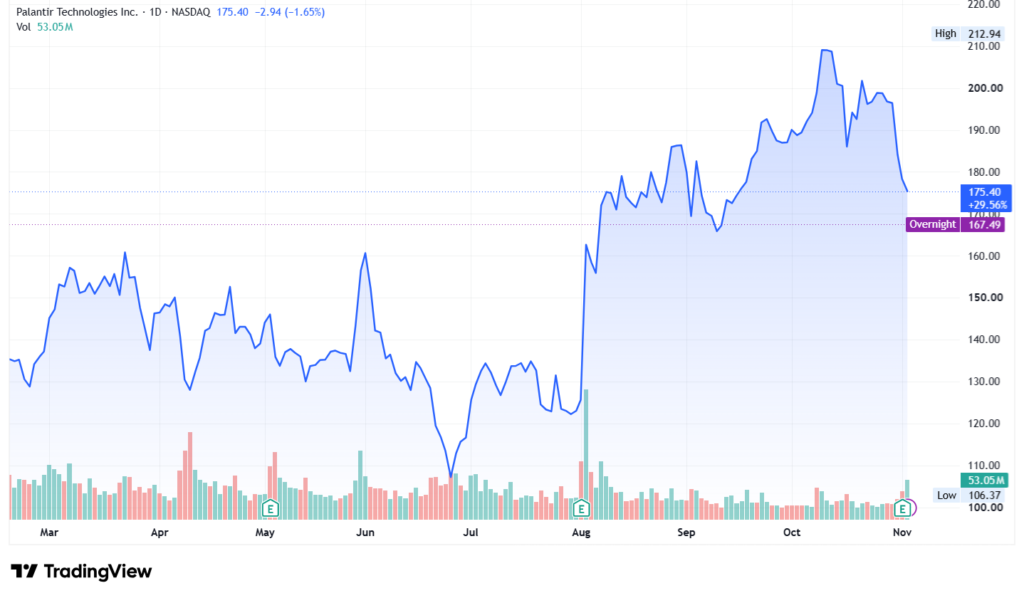
Despite beating earnings estimates and raising its full-year outlook, Palantir shares fell after the announcement. The stock closed at $178.34 on November 2, down 3.08% during the regular trading session. It then dropped about 6% in premarket trading on November 3, reaching around $167.66.
The decline came as investors focused on slower growth in new contracts. Palantir’s total contract value reached $2.918 billion in the third quarter, up just 6% from a year earlier, compared with 49% growth in the previous quarter. U.S. commercial contract value also slowed, rising 11% year over year.
Investors also weighed the company’s high stock valuation and the slower sequential revenue growth implied by its fourth-quarter forecast. The reaction shows that even strong earnings and higher guidance may not satisfy investors when expectations for future growth are already high.
AI Growth Brings Greater Energy and Emissions Questions
Palantir develops software that helps organizations collect, analyze, and use large amounts of data. Its Artificial Intelligence Platform, or AIP, allows businesses and government agencies to use AI tools in their operations.
Alex Karp, Co-Founder and Chief Executive Officer of Palantir Technologies, remarked:
”The Sovereign AI moment is purpose-built for Palantir. Our products—from Foundry and Ontology to AIP with its ontologized, fine-tuned open-weight models—ignite a self-improvement loop that joins and aligns the workflow with its optimal model and us with our partners. This dialectic drives transformational value for both Palantir and our partners—and works only in artistic combination. Each becomes stronger as the sum becomes more powerful.”
As demand for these services grows, so does the need for computing resources. AI systems require powerful computer chips, servers, data centers, and supporting infrastructure. These facilities need electricity to run and often require cooling systems to manage heat.
The climate impact depends partly on where that electricity comes from. Data centers powered by fossil fuels can produce more greenhouse gas emissions than those using renewable or other low-carbon energy sources.
Palantir is not a data center operator on the same scale as major cloud providers. However, its business depends on computing infrastructure, and its own emissions reporting covers more than its direct operations. Its supply chain, business travel, and purchased services also contribute to its carbon footprint.
- RELATED: AI’s Environmental Cost: Data Centers Now Rival Entire Nations in Energy, Water, and Land Use
Palantir’s Global Emissions Rise 18% in 2025
Palantir’s latest carbon report shows that its global greenhouse gas emissions increased in 2025, reversing the progress reported in the previous year.
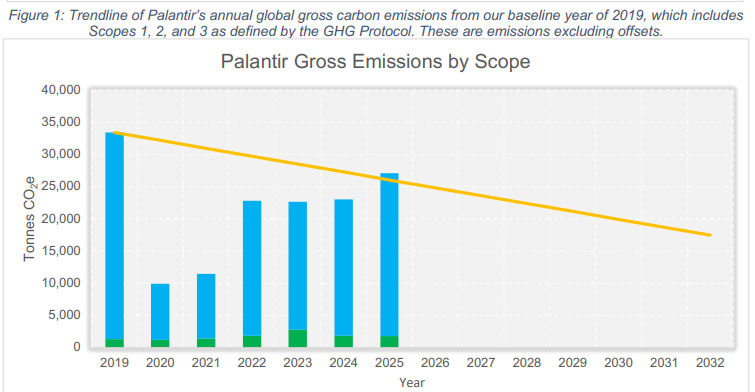
- The company recorded 27,222 metric tons of gross emissions across Scopes 1, 2, and 3 in 2025. This was an 18% increase from 23,018 metric tons in 2024. Palantir linked much of the rise to higher business travel.
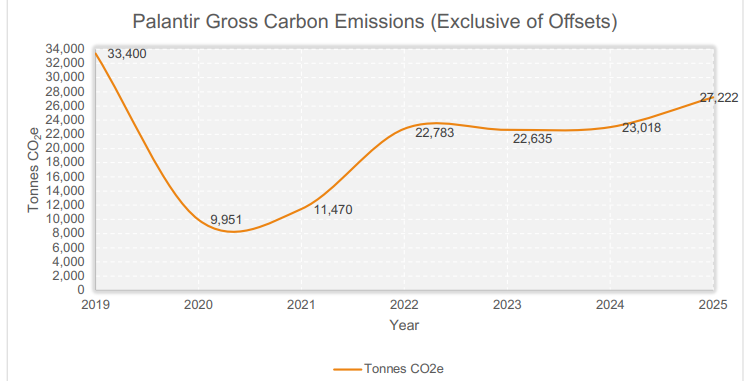
Despite the increase, its 2025 emissions remained about 18.5% below its 2019 baseline of 33,400 metric tons. However, the company said its latest total was above the path set by its target to reduce absolute emissions by an average of 4.2% each year over ten years from the 2019 baseline.
Scope 3 emissions made up most of Palantir’s footprint in 2025, reaching 25,277 metric tons. Scope 2 emissions accounted for 1,922 metric tons, while Scope 1 emissions were 23 metric tons.
The company also reported an emissions intensity of about six metric tons of CO2e per employee. This was 57% lower than its 2019 level, showing that emissions per employee have fallen even as its total emissions increased.
Palantir follows the Greenhouse Gas Protocol, which groups corporate emissions into three categories:
- Scope 1: Direct emissions from sources a company owns or controls.
- Scope 2: Emissions linked to purchased electricity, heating, and cooling.
- Scope 3: Other indirect emissions across a company’s value chain, including business travel, suppliers, and purchased goods and services.
Scope 3 emissions can be difficult to manage because they come from activities outside a company’s direct control. For Palantir, business travel was the largest source of these emissions in 2025. Air travel, in particular, accounted for a significant share of its reported footprint.
Carbon Credits Help Address Remaining Emissions
Palantir purchased 30,000 metric tons of carbon credits in 2025, more than its reported gross emissions of 27,222 metric tons. The company said it plans to apply the remaining credits to future years, where applicable.
The credits supported five projects in Brazil, Chile, and France through its partners CNaught and Cool Effect. These projects focus on reducing or destroying landfill methane, ozone-depleting substances, and nitrous oxide.
Palantir uses carbon credits to support its goal of achieving carbon neutrality each year. However, credits do not replace direct emissions cuts. Their climate value depends on whether the claimed reductions or removals are real, measurable, and properly verified.
The company also says its emissions data are not independently verified by a third party, an important qualification when assessing its reported climate progress.
AI Could Help Other Industries Reduce Emissions
AI can help businesses improve energy efficiency, manage electricity grids, forecast renewable power output, and reduce industrial waste.
Palantir’s software helps organizations use data to improve operations and resource management. The company says its model-agnostic approach allows customers to choose the AI models they use, and that it does not own or operate data centers.
The firm further noted that its growing focus on AI has not meaningfully increased its own carbon emissions. However, the report does not provide a separate figure for emissions linked to AI activity. AI’s potential climate benefits do not automatically offset the emissions from developing and running the technology.
Its overall impact depends on energy use, software efficiency, and measurable emissions savings from customer applications.
Can Palantir Maintain Climate Progress as AI Demand Grows?
Palantir’s latest earnings show strong demand for its AI software, but its 2025 carbon report presents a more mixed picture. Gross emissions remained below the 2019 baseline but rose 18% in 2025, largely due to higher business travel.
The company also bought more carbon credits than its total reported emissions. While this supports its carbon neutrality goal, it does not replace the need to reduce emissions across its own operations and value chain.
As AI adoption grows, investors may need to look beyond financial results. Energy use, business travel, supply chain emissions, carbon credit quality, and progress toward climate targets are also important measures of long-term performance.
Palantir’s challenge is to keep growing its AI business while bringing gross emissions back toward its reduction target.
- READ MORE: Nvidia’s $2B Bet in AI: Powering Innovation with Nebius and Palantir While Tackling Energy Impact
The post Palantir (PLTR) Stock Falls Despite 96% Revenue Surge, Can Its Climate Goals Keep Up? appeared first on Carbon Credits.

Leave a Reply
Want to join the discussion?Feel free to contribute!