According to DNV’s 2025 Energy Transition Outlook, North America is on a slow but steady path toward a low-carbon future. The forecast shows fossil fuels will fall from 72% of final energy demand in 2024 to 45% by 2050, and further to 31% by 2060.
While the U.S. has seen policy shifts and slower progress due to changing political priorities, Canada’s energy policies remain relatively stable. Together, the two nations continue to move toward decarbonization, driven by clean technology investments and rising public support for sustainable energy.
Source: DNV report
U.S. Faces Fuel Security and Supply Chain Hurdles
The U.S. nuclear sector faces a different challenge — fuel dependency. As of 2023, the U.S. imported 99% of its uranium, with nearly one-third sourced from Russia, Uzbekistan, and Kazakhstan — countries with complicated diplomatic relations.
Developing a domestic nuclear fuel production capability has become a priority. The DOE is investing in research to expand uranium mining, enrichment, and HALEU production. These efforts are crucial for the future success of the SMR program and national energy security.
Until SMRs become commercially viable in the early 2030s, U.S. nuclear capacity growth will primarily come from reactor life extensions and the reopening of mothballed plants, such as Three Mile Island in Pennsylvania.
Nuclear Power Boost and Support Across the Continent
In this backdrop, nuclear power is enjoying its strongest public and political backing in a decade. In both the U.S. and Canada, nuclear energy is being recognized for its reliability and role in achieving net-zero targets.
In Canada, nuclear is the second-largest source of non-emitting electricity and contributes significantly to reducing carbon emissions. Ontario leads the way, with nuclear supplying nearly 60% of its total electricity. The province continues to invest in maintaining and extending reactor lifespans to ensure energy security and meet climate goals.
Despite this renewed interest, DNV notes that nuclear power’s near-term growth will be modest. However, its long-term outlook is strong, with nuclear capacity projected to increase from 115 gigawatts (GW) today to 232 GW by 2060. Most of this growth will come after 2045, primarily from Small Modular Reactors (SMRs).
Large-scale nuclear projects have struggled in recent decades with cost overruns, construction delays, and public opposition. Even with continued policy incentives under the Inflation Reduction Act and Bipartisan Infrastructure Law, big reactors are costly, slow to build, and difficult to integrate with flexible renewable grids. These challenges make new large-scale reactors (LSNs) impractical for the short term.
Modern energy systems increasingly require power sources that can ramp up and down quickly to complement solar and wind. Large reactors lack this agility. SMRs, by contrast, can operate flexibly, be built faster, and support grid stability in renewable-heavy systems.
Each SMR unit typically produces around 100 MW, making financing and construction more manageable than billion-dollar LSN projects.
DNV forecasts that SMRs will reach cost parity with large reactors by around 2045. Their modular design reduces construction risks, while their operational flexibility allows them to ramp up or down quickly — a crucial feature for grids with high solar and wind penetration.
Though still in the development phase, SMRs are advancing rapidly. Strong backing from the U.S. Department of Energy (DOE) and the Canadian government is accelerating research and demonstration projects.
Source: DNV report
Canada’s SMR Leadership and the Darlington Advantage
Canada is emerging as the North American frontrunner in SMR technology. The Darlington SMR project in Ontario, led by Ontario Power Generation (OPG) and funded partly by the Canada Infrastructure Bank, is on track to become the first grid-scale SMR in North America by 2030.
Once built, the SMR will reduce carbon emissions by an average of 740 kilotonnes annually between 2029 and 2050.
This milestone could position Canada as a global leader in modular nuclear deployment. However, challenges remain. Canada currently lacks the facilities to produce HALEU (High-Assay Low-Enriched Uranium), the fuel needed for most SMR designs.
While Canada has strong uranium reserves and manufactures fuel for its traditional CANDU reactors, it must still develop a domestic HALEU supply chain to maintain its early-mover advantage in SMR deployment.
Beyond the grid, DNV forecasts that nuclear energy could power up to 10% of North America’s maritime and near-shore energy demand by 2060 — up from an estimated 3.5% by 2050.
The maritime sector faces mounting pressure to decarbonize under the International Maritime Organization’s Net Zero by 2050 goals. SMRs could provide a solution, offering a zero-emission, high-density energy source for shipping and port operations.
Some developers are exploring floating SMR concepts capable of supplying clean power to docked vessels, reducing local air pollution, and protecting coastal ecosystems.
However, nuclear adoption in maritime transport faces high capital costs, complex financing models, and regulatory barriers. Nuclear-powered ships would require new rules and safety frameworks, particularly in countries with stringent oversight like the U.S. and Canada.
Still, advocates argue that the combination of energy density, low emissions, and efficiency makes nuclear an attractive option for a future low-carbon shipping industry.
Policy, Regulation, and Competitiveness
Regulatory complexity remains a major obstacle for both land-based and maritime nuclear expansion. Compared to countries like China, North America’s safety and environmental regulations add significant costs and time to nuclear construction.
A recent bipartisan push in the U.S. to revitalize domestic shipbuilding for national defense could help reduce barriers and provide incentives for SMR integration into shipyards. Yet, to compete globally, U.S. manufacturers will need to improve both shipbuilding capacity and SMR cost efficiency — a difficult combination to achieve in the near term.
The Long Road to 2060
DNV’s analysis paints a realistic, not overly optimistic, picture. The energy transition is happening, but slowly. Fossil fuels remain dominant in the near term, but nuclear, renewables, and clean fuels will take an expanding share of the mix.
By 2060, North America could see a fully integrated clean energy system, with flexible SMRs supporting renewables, new fuels decarbonizing industry and transport, and fossil fuels pushed to the margins.
The message is clear: the energy transition is inevitable but uneven. Governments, investors, and innovators that act early on SMRs and clean technologies will define the region’s next industrial wave.
https://globalcarbonfund.com/wp-content/uploads/2018/10/GCF_header_logo_340x156.png00carbonfundhttps://globalcarbonfund.com/wp-content/uploads/2018/10/GCF_header_logo_340x156.pngcarbonfund2025-11-11 10:44:492025-11-11 10:44:49From Now to 2060: How Canada’s SMRs and Maritime Nuclear Power Will Drive a Net-Zero Future
Gevo, Inc. (NASDAQ: GEVO) delivered a major earnings surprise for the third quarter of 2025, posting results that exceeded Wall Street expectations and highlighted a sharp turnaround in its financial performance.
Record Revenue Growth and Strong Financial Recovery
For Q3 2025, Gevo reported revenues of $43.6 million, far above analyst forecasts of $37.03 million, and a dramatic increase from about $2 million during the same period last year. The company’s earnings per share (EPS) came in at a loss of $0.03, beating the expected loss of $0.04.
Most notably, Gevo achieved a positive adjusted EBITDA of $6.7 million, marking its second consecutive quarter of profitability. This was a major improvement compared to a loss of $16.7 million a year ago, reflecting improving operational efficiency and higher cash flow from its facilities.
The company ended the quarter with $108 million in cash, ensuring a strong liquidity position as it continues investing in growth projects.
Source: Gevo
North Dakota Facility Powers Carbon and Ethanol Gains
Gevo’s North Dakota operations were the cornerstone of its quarterly success, contributing $12.3 million in operational income. This performance was driven by efficient low-carbon ethanol production, carbon sequestration, and robust sales of clean fuel and voluntary carbon credits.
During the quarter, the site achieved several operational milestones:
Produced 17 million gallons of low-carbon ethanol
Generated 46,000 tons of protein and corn oil co-products
Sequestered 42,000 tons of carbon dioxide
Produced 92,000 MMBtu of renewable natural gas (RNG)
Gevo’s Carbon Capture and Sequestration (CCS) system has now stored over 560,000 metric tons of CO₂ since its launch in June 2022, making it the world’s first ethanol dry mill to achieve commercial-scale carbon storage.
The company also capitalized on Section 45Z Clean Fuel Production Credits (CFPCs), selling all its remaining 2025 credits worth $30 million, bringing total CFPC sales for the year to $52 million. This reflects Gevo’s ability to monetize carbon-linked incentives effectively.
Carbon Credit Expansion Strengthens Revenue Mix
Gevo is rapidly scaling its carbon revenue streams. In Q3 2025, the company signed a multi-year offtake agreement expected to generate around $26 million in Carbon Dioxide Removal (CDR) credit sales over five years, with the potential to increase volumes.
By the end of 2025, Gevo expects carbon co-product sales to grow to $3–5 million, up from $1 million in Q2. The company projects that long-term annual carbon revenues could exceed $30 million as it optimizes its carbon accounting and trading systems.
Gevo’s carbon credits are certified under the Puro.Earth standard, ensuring over 1,000 years of permanence, among the most durable forms of carbon removal on the market. Its customers include Nasdaq and Biorecro, signaling growing confidence from corporate buyers in Gevo’s durable carbon removal capabilities.
This dual-income approach, combining low-carbon fuel sales with carbon credit monetization, strengthens Gevo’s position in both the voluntary and compliance carbon markets.
Strategic Focus on Sustainable Aviation Fuel (SAF)
Sustainable Aviation Fuel (SAF) is the main pillar of Gevo’s long-term strategy. Through its proprietary Alcohol-to-Jet (ATJ) technology, the company converts renewable ethanol into low-carbon jet fuel, helping airlines decarbonize air travel.
Gevo plans a Final Investment Decision (FID) by mid-2026 for its upcoming ATJ-30 plant, a project designed to scale synthetic SAF production at its North Dakota site. Once completed, the plant could play a central role in meeting the aviation sector’s growing SAF demand.
SAF Market Forecast
The global SAF market is expanding rapidly. In 2025, the market was valued at about $2.25 billion but is forecasted to soar to $134.57 billion by 2034, growing at a CAGR of over 57 percent, according to industry estimates. This surge is driven by regulatory mandates, green aviation goals, and policies like the U.S. Inflation Reduction Act and the EU’s ReFuelEU Aviation Initiative.
Gevo’s integrated approach linking SAF production, ethanol output, and carbon monetization aligns perfectly with the industry’s transition toward net-zero aviation. As the company scales ethanol production to 75 million gallons annually, it expects a substantial boost in SAF output and carbon credit revenues.
Carbon Capture and Policy Incentives Drive Future Growth
The company capitalizes on the intersection of clean fuel policy, carbon markets, and technology innovation. By sequestering carbon at its ethanol facilities, the company captures and sells verified carbon credits while also producing renewable fuels that qualify for federal incentives.
With growing policy support and rising carbon prices, Gevo is positioned to benefit from both market-based carbon trading and tax credit monetization. The Section 45Z clean fuel credits, in particular, provide strong financial incentives that enhance the company’s margins and encourage further expansion.
As governments tighten emission standards and airlines commit to net-zero targets by 2050, the demand for SAF and durable carbon credits will continue to rise. Gevo’s technology and operations are built to meet this challenge while maintaining commercial viability.
Investor Confidence and Stock Performance
Following its strong Q3 2025 results, Gevo’s stock rose over 4 percent in after-hours trading, reflecting investor confidence in the company’s growth trajectory. The stock trades around $2.12 per share with a market capitalization of about $513 million.
Investors are increasingly viewing Gevo as a clean-energy growth stock, citing:
Consistent revenue growth and improving EBITDA margins
Clear strategic direction toward SAF and carbon capture
Effective monetization of clean fuel tax credits and carbon offsets
The company’s solid balance sheet, strong policy tailwinds, and successful operational execution position it favorably within the renewable hydrocarbon fuels market.
The aviation sector targets a 65% reduction in emissions through SAF by 2050. And companies like Gevo will play a critical role in meeting that goal. Its ATJ technology, carbon sequestration systems, and integration with carbon markets make it one of the few clean fuel developers with a fully circular carbon strategy.
Significantly, its North Dakota operations serve as a blueprint for carbon-negative fuel production, proving that decarbonization and profitability can coexist. With expansion plans for 2026 and beyond, the company is well-positioned to scale both its fuel and carbon businesses.
https://globalcarbonfund.com/wp-content/uploads/2018/10/GCF_header_logo_340x156.png00carbonfundhttps://globalcarbonfund.com/wp-content/uploads/2018/10/GCF_header_logo_340x156.pngcarbonfund2025-11-11 10:44:492025-11-11 10:44:49Gevo’s Q3 2025 Earnings Fuel Optimism for Its SAF and Carbon Credit Growth Strategy
Disseminated on behalf of Surge Battery Metals Inc.
The global race for electric vehicles (EVs) and renewable energy storage is accelerating fast. But beyond the hype around resource discoveries, a quieter and more critical race is taking shape, the race for lithium purity. While many lithium developers highlight their large deposits, what truly matters to EV and battery manufacturers is the ability to deliver ultra-pure, battery-grade lithium.
Surge Battery Metals (TSXV: NILI, OTC: NILIF) is emerging as a leader in this next phase of the lithium story. The company is not just measuring tons in the ground, it is proving its ability to produce 99.9% pure lithium carbonate, the key ingredient for advanced EV batteries. With its Nevada North Lithium Project (NNLP), NILI is positioning itself to supply premium-quality lithium directly to top-tier EV and energy storage manufacturers.
The company also achieved a significant milestone this September. It signed an LOI with Evolution Mining (ASX: EVN) to form a joint venture at NNLP. Under the agreement, Surge retains 77% and Evolution starts with 23%, funding up to C$10 million for the Preliminary Feasibility Study. This investment could increase Evolution’s stake to 32.5%, while Surge remains as project manager.
In addition, Evolution contributes 75% of its mineral rights on 880 acres of private land, plus 21,000 more acres of highly prospective ground. This significantly expands the project’s footprint.
Moving forward, the JV will focus on advancing the Pre-Feasibility Study, building directly on the strong 2025 PEA results and setting the stage for the next development phase.
Why Purity Matters: The Technical Case for 99.9%
In the battery world, purity is not just a technical metric; it is the difference between success and failure. EV makers and battery cell producers need lithium carbonate and hydroxide with purity levels of at least 99.5%. Increasingly, the bar is being raised to 99.9% or higher.
Even trace amounts of iron, magnesium, or boron can cause major problems. These impurities shorten battery life, reduce energy density, and increase safety risks. As automakers shift to more advanced chemistries like NMC (nickel-manganese-cobalt) and solid-state batteries, the demand for cleaner, high-spec lithium becomes non-negotiable. However, NMC batteries had a drawback. They depended on costly and volatile metals like nickel and cobalt.
And thus, LFP batteries emerged as a game-changer.
LFP, or lithium iron phosphate batteries, remove nickel and cobalt entirely, using iron and phosphate instead. These materials are cheaper, safer, and easier to source. LFP batteries also last longer, charge faster, and handle heat better, making them ideal for affordable, large-scale EV production.
In 2022, LFP accounted for 37% of global EV battery chemistry. By 2024, it reached nearly 50%, and the trend continues.
Source: Katusa Research
For lithium investors, this matters. LFP relies heavily on lithium carbonate, the purest, most in-demand form of lithium. With nickel and cobalt out, lithium becomes central, tightening markets as more EV makers adopt LFP
High-purity lithium does more than meet technical standards. It also commands higher prices and long-term supply contracts. Automakers and energy storage providers prefer suppliers who can consistently deliver premium-quality lithium while maintaining environmental responsibility. For them, reliability, repeatability, and sustainability are just as important as cost.
The Nevada North Lithium Project: Scale with Substance
NILI’s flagship Nevada North Lithium Project (NNLP) combines resource scale with exceptional quality. Located in Nevada, a region known for its lithium-rich claystone deposits, NNLP has an inferred resource of 8.65 million tonnes of lithium carbonate equivalent (LCE), grading 2,955 ppm lithium at a 1,250 ppm cutoff.
These numbers put it among the most promising new lithium projects in North America. But NILI’s true edge comes from its ability to turn that resource into battery-grade lithium carbonate. Laboratory and pilot-scale metallurgical tests have already confirmed purity levels at or above 99.9%, far exceeding typical chemical-grade standards.
According to the company’s Preliminary Economic Assessment (PEA), completed by M3 Engineering & Technology and Independent Mining Consultants, the project is designed for scale and efficiency.
Key highlights include:
Annual output: 86,300 tonnes of LCE, expandable to 109,100 tonnes at full production.
Recovery rate: Averaging 82.8%, thanks to advanced leaching and purification processes.
Operating cost: As low as $5,097 per tonne LCE, ensuring competitive margins.
Mine life: Estimated at 42 years, based on a conventional open-pit operation.
This combination of high-grade resource and proven processing ability gives NNLP a powerful advantage in a market shifting toward quality over quantity.
Inside NILI’s Metallurgical Advantage
Metallurgical testing is where NILI truly sets itself apart. Turning claystone into battery-grade lithium requires technical mastery and process control. Surge’s team has developed a refined purification flowsheet tailored to Nevada’s unique claystone composition.
Recent pilot-scale trials achieved lithium carbonate purity of 99.9% or higher, meeting or exceeding international benchmarks. These tests also showed strong impurity control, particularly for metals like iron and boron, which are critical for EV battery safety.
Mr. Greg Reimer, Chief Executive Officer, and Director commented,
“Beyond our initial metallurgical and analytical works in 2023 to estimate acid consumption and identify the clay types, we are very pleased to have taken the next step and have passed the important ‘proof of concept’ trial showing that the clays of our Nevada North Lithium Project can be used to produce lithium carbonate exceeding 99% purity. In doing so, we have managed the technological risk sufficient to warrant the next step, which will include upsizing the laboratory trials to build a sufficient inventory of technical grade lithium carbonate that we can purify to demonstrate if the NNLP clay is a suitable source to produce battery-grade lithium carbonate.”
NILI’s process is both efficient and sustainable. By optimizing reagent use and reducing energy consumption, the company supports strong environmental, social, and governance (ESG) goals while keeping costs low.
A Step-by-Step Look at NILI’s Lithium Purification
Here’s a simplified look at NILI’s five-step purification process that converts raw claystone into 99.9% pure lithium carbonate:
Ore Preparation and Leaching: The lithium-rich claystone is mined, milled, and treated with acid to dissolve lithium from the rock.
Solid-Liquid Separation: The resulting slurry is filtered to isolate a lithium-rich solution from unwanted solids.
Selective Impurity Removal: Using precipitation, ion-exchange, and solvent extraction, key impurities like magnesium, calcium, and boron are removed.
Lithium Carbonate Precipitation: The purified solution reacts with carbonate sources such as soda ash to form lithium carbonate crystals.
Final Polishing and Quality Control: The crystals are dried, rechecked for purity, and recirculated if needed to achieve consistent 99.9% results.
This closed-loop design maximizes recovery while minimizing waste, an important feature for both efficiency and sustainability.
Source: Surge Battery Metals
Commercial Significance: Why OEMs Are Watching Closely
As the lithium market evolves, a clear divide is forming. Companies capable of producing high-purity, battery-grade material are securing premium contracts and long-term partnerships. Others producing lower-grade lithium face downward pricing pressure and limited buyers.
Energy Storage Systems (ESS) are now becoming a major swing factor in lithium demand. After what looked like a soft stretch for lithium prices, ESS battery shipments have shown massive growth year-to-date. Updated J.P. Morgan forecasts increased ESS shipments +50% for this year and +43% for next year, with ESS now projected to represent 30% of total lithium demand by 2026, rising to 36% by 2030.
By 2030, total lithium demand is expected to reach ~2.8 Mt LCE, aligning with the consensus range referenced by Albemarle. Meanwhile, global EV demand is forecast to grow 3–5% annually between 2025–2030 — making ESS the category that prevents a persistent market surplus and tightens supply.
Source: Lithium Harvest
At the same time, the company aligns with North American supply chain goals, offering secure, ESG-compliant lithium production close to home. With the U.S. and Canadian governments pushing for “friendshoring” of strategic minerals, NILI’s Nevada-based project fits perfectly into the policy framework for domestic critical mineral supply.
Source: Katusa Research
By focusing on purity and process control, NILI aims not only to sell lithium but to become a trusted technology and supply chain partner for OEMs seeking quality assurance and long-term reliability.
For Investors: Why Processing Capability Matters
For investors, NILI’s story goes beyond having a large lithium deposit. The real value lies in its processing expertise. Producing 99.9% battery-grade lithium at a commercial scale requires deep technical know-how, efficient design, and capital discipline.
NILI’s PEA shows impressive financial metrics:
After-tax NPV: US$9.21 billion (at 8% discount).
Internal Rate of Return (IRR): 22.8%.
Payback period: Less than five years.
High operating margins, supported by strong resource grades and cost-effective processing.
These numbers underline a vital message: processing quality drives profitability. Investors looking for long-term exposure to the clean energy transition should note that companies capable of producing high-purity lithium will capture premium market share and valuation upside.
The Purity Premium in the Lithium Race
As the global energy transition speeds up, success will depend not just on who can find lithium but on who can refine it to perfection. Surge Battery Metals is proving it can deliver battery-grade lithium carbonate with 99.9% purity, meeting the toughest technical and commercial standards in the industry.
And that is a powerful differentiator for investors. NILI’s combination of resource scale, refining precision, and strategic positioning in Nevada gives it a strong foundation to become a leading supplier to the North American EV and energy storage markets.
In the new lithium economy, purity equals power, and NILI is setting the benchmark for both.
New Era Publishing Inc. and/or CarbonCredits.com (“We” or “Us”) are not securities dealers or brokers, investment advisers, or financial advisers, and you should not rely on the information herein as investment advice. Surge Battery Metals Inc. (“Company”) made a one-time payment of $50,000 to provide marketing services for a term of two months. None of the owners, members, directors, or employees of New Era Publishing Inc. and/or CarbonCredits.com currently hold, or have any beneficial ownership in, any shares, stocks, or options of the companies mentioned.
This article is informational only and is solely for use by prospective investors in determining whether to seek additional information. It does not constitute an offer to sell or a solicitation of an offer to buy any securities. Examples that we provide of share price increases pertaining to a particular issuer from one referenced date to another represent arbitrarily chosen time periods and are no indication whatsoever of future stock prices for that issuer, and are of no predictive value.
Our stock profiles are intended to highlight certain companies for your further investigation; they are not stock recommendations or an offer or sale of the referenced securities. The securities issued by the companies we profile should be considered high-risk; if you do invest despite these warnings, you may lose your entire investment. Please do your own research before investing, including reviewing the companies’ SEDAR+ and SEC filings, press releases, and risk disclosures.
It is our policy that the information contained in this profile was provided by the company, extracted from SEDAR+ and SEC filings, company websites, and other publicly available sources. We believe the sources and information are accurate and reliable but we cannot guarantee them.
CAUTIONARY STATEMENT AND FORWARD-LOOKING INFORMATION
Certain statements contained in this news release may constitute “forward-looking information” within the meaning of applicable securities laws. Forward-looking information generally can be identified by words such as “anticipate,” “expect,” “estimate,” “forecast,” “plan,” and similar expressions suggesting future outcomes or events. Forward-looking information is based on current expectations of management; however, it is subject to known and unknown risks, uncertainties, and other factors that may cause actual results to differ materially from those anticipated.
These factors include, without limitation, statements relating to the Company’s exploration and development plans, the potential of its mineral projects, financing activities, regulatory approvals, market conditions, and future objectives. Forward-looking information involves numerous risks and uncertainties and actual results might differ materially from results suggested in any forward-looking information. These risks and uncertainties include, among other things, market volatility, the state of financial markets for the Company’s securities, fluctuations in commodity prices, operational challenges, and changes in business plans.
Forward-looking information is based on several key expectations and assumptions, including, without limitation, that the Company will continue with its stated business objectives and will be able to raise additional capital as required. Although management of the Company has attempted to identify important factors that could cause actual results to differ materially, there may be other factors that cause results not to be as anticipated, estimated, or intended.
There can be no assurance that such forward-looking information will prove to be accurate, as actual results and future events could differ materially. Accordingly, readers should not place undue reliance on forward-looking information. Additional information about risks and uncertainties is contained in the Company’s management’s discussion and analysis and annual information form for the year ended December 31, 2024, copies of which are available on SEDAR+ at www.sedarplus.ca.
The forward-looking information contained herein is expressly qualified in its entirety by this cautionary statement. Forward-looking information reflects management’s current beliefs and is based on information currently available to the Company. The forward-looking information is made as of the date of this news release, and the Company assumes no obligation to update or revise such information to reflect new events or circumstances except as may be required by applicable law.
https://globalcarbonfund.com/wp-content/uploads/2018/10/GCF_header_logo_340x156.png00carbonfundhttps://globalcarbonfund.com/wp-content/uploads/2018/10/GCF_header_logo_340x156.pngcarbonfund2025-11-10 07:35:502025-11-10 07:35:50From Resource to Battery-Grade: How NILI Aims to Deliver 99.9% Purity Lithium
Apple is expanding its clean energy and nature restoration projects in Australia and Aotearoa, New Zealand. The company announced new solar power deals in Victoria. It also launched large-scale forest restoration projects in both the North and South Islands of New Zealand. These investments are part of Apple’s broader plan to achieve carbon-neutral products and supply chains by 2030.
The initiatives will provide more renewable energy for Apple customers. They will also boost the company’s efforts in verified carbon removal.
Lisa Jackson, Apple’s Vice President of Environment, Policy and Social Initiatives, said:
“By 2030, we want our users to know that all the energy it takes to charge their iPhone or power their Mac is matched with clean electricity. We’re proud to do our part to support Australia’s transition to a cleaner grid and drive positive impacts for communities and nature.”
The tech giant says the Australian projects will produce more than 1 million megawatt-hours (MWh) of clean electricity each year. Meanwhile, the New Zealand forest program aims to restore and protect around 8,600 hectares of land.
Powering Australia: Apple’s Solar Leap Forward
Apple’s new renewable energy agreement centers on the Lancaster Solar Project in Victoria. The site could deliver between 80 and 108 megawatts (MW) of solar capacity when fully operational. Construction is now underway, and the first energy is expected to reach Australia’s grid within the next few years.
This project marks Apple’s first major power purchase agreement (PPA) in Australia. The company will match clean energy generation with the electricity Australians use to charge their devices. In effect, the company will offset the electricity footprint of its customers’ daily device use with a new renewable supply.
Industry analysts note that corporate PPAs like Apple’s are a major driver of Australia’s energy transition. Corporate demand for clean power funds new renewable projects. It also pushes developers to grow their capacity. By committing to large volumes of generation, Apple is helping to strengthen Australia’s grid reliability while lowering emissions.
Source: Australian Government
Apple’s PPA for the 108 MW in Victoria is a key renewable energy deal in Australia. However, it is mid-sized compared to the overall market. The largest corporate PPAs, such as Rio Tinto’s 1.3 GW Upper Calliope Solar Farm agreement, dwarf Apple’s PPA by over tenfold in capacity.
The iPhone maker’s new PPA is still significant. It’s the company’s first major one in Australia. It reflects the trend of tech companies driving the demand for clean energy. This boosts grid reliability and cuts emissions.
Restoring Nature: A Greener New Zealand Partnership
In parallel, Apple’s Restore Fund will invest in restoring and protecting native forest ecosystems across New Zealand. The company is working with Climate Asset Management. This group is a joint venture of HSBC Asset Management and Pollination.
The project will span about 8,600 hectares in total, with several sites in the Central North Island and one in the South Island. The restoration plan includes:
Replanting native trees,
Improving forest management, and
Conserving existing woodlands.
These activities aim to remove carbon dioxide from the atmosphere while improving biodiversity and local water quality.
Apple states that its Restore Fund projects use strict carbon accounting standards and have third-party verification. Apart from carbon storage, the company expects measurable benefits for ecosystems and local communities.
Native reforestation helps make New Zealand’s landscapes stronger. It fights floods, reduces erosion, and boosts resilience against climate stress.
Two Paths, One Goal: Clean Power Meets Carbon Removal
Apple plans to address energy and land-use emissions by combining solar energy with reforestation. Solar projects directly decarbonize electricity. Meanwhile, forest work removes carbon from the atmosphere.
This “two-track” model fits Apple’s global sustainability plan. The company already powers all of its offices, retail stores, and data centers with 100% renewable electricity. But a large portion of its footprint comes from manufacturing and product use — areas that require new solutions.
Source: Apple
The Australia–New Zealand program focuses on two key areas: using renewables to power devices and offsetting leftover emissions with verified removals.
Measuring Apple’s Real-World Impact
Apple has pledged to publish regular updates on both the renewable and forest projects. Key metrics include:
Clean-energy generation: more than 1 million MWh per year in Australia.
Forest coverage: 8,600 hectares under protection or restoration in New Zealand.
Carbon removal: verified carbon credits from restored native forests over the next 20 years.
Local benefits: jobs in solar construction, sustainable forestry, and biodiversity monitoring.
The company also emphasizes engagement with local communities. In New Zealand, this means working with iwi (Māori group) and local councils. They help ensure projects match land use and cultural needs. In Australia, teaming up with local contractors will create short-term construction jobs and long-term maintenance roles.
Apple has reduced its total emissions by more than 45% since 2015, even as its business has grown. The company aims for net-zero by 2030. It will reduce most emissions directly and use reliable carbon removals for the rest.
Source: Apple
The Restore Fund started in 2021 with $200 million. In 2023, it got another $200 million. It invests in nature-based projects around the globe. Goldman Sachs and Climate Asset Management co-manage it.
The focus is on financial returns tied to verified carbon outcomes. The New Zealand initiative represents one of the fund’s largest projects in the Asia-Pacific region so far.
On the energy side, Apple and its suppliers now operate more than 16 gigawatts of renewable capacity globally. The Australian PPA adds another piece to that network and supports Apple’s goal of using clean electricity across its entire value chain.
What It Means for Australia and New Zealand
For Australia and New Zealand, Apple’s participation brings attention and investment to emerging climate markets. In Australia, companies like Apple, Amazon, and Microsoft are speeding up new solar and wind projects. The sector generated over 35% of the nation’s electricity from renewables in 2024, a record high.
In New Zealand, restoring forests is key to hitting national emissions goals. The government plans to plant and restore one billion trees by 2030. Private-sector investment will help cover funding and capacity needs. As such, Apple’s Restore Fund investments help meet national goals. They also boost biodiversity and support community livelihoods.
A Template for Tech
Apple’s latest expansion highlights the merging of technology, clean energy, and nature-based climate action. By connecting renewable power in Australia with forest restoration in New Zealand, the company is building a region-wide portfolio of verified, measurable climate initiatives.
The next few years will show how well these projects keep their promises. This includes generating megawatt-hours of solar power and restoring hectares of healthy forest. Transparent reporting, third-party audits, and community partnerships will be key to maintaining credibility.
If Apple succeeds, its model could show other global companies how to invest in clean energy and restore nature for real climate progress.
https://globalcarbonfund.com/wp-content/uploads/2018/10/GCF_header_logo_340x156.png00carbonfundhttps://globalcarbonfund.com/wp-content/uploads/2018/10/GCF_header_logo_340x156.pngcarbonfund2025-11-10 07:35:502025-11-10 07:35:50Apple Doubles Down on Carbon Removal with Solar and Forest Projects Across Oceania
Google has announced a new deal with Mombak, a Brazilian reforestation company, to buy 200,000 metric tons of carbon removal. The goal is to expand forest restoration projects in Brazil and remove more carbon dioxide from the atmosphere.
Mombak will team up with Google DeepMind’s Perch group. They will use AI and bioacoustic tools to see how forest restoration boosts biodiversity. In simple terms, the project will not only track how much carbon the trees store but also how wildlife returns and ecosystems recover.
The new agreement is part of Google’s wider climate strategy. Along with nature-based removals, the company recently unveiled plans for solar-powered data centers in space. These centers will provide clean energy for computing. These initiatives show how Google blends natural and tech solutions. They aim to cut emissions and create a more sustainable future.
Why Nature-Based Carbon Removal Matters
Forests are among the most effective natural systems for storing carbon. When trees grow, they capture CO₂ and store it in trunks, roots, and soil. Over time, healthy forests help slow global warming. But restoring damaged land takes money, time, and clear monitoring to prove results.
Nature-based solutions may take up to 85% of the total carbon credits supply annually by 2030, per McKinsey analysis below. Carbon credits are certificates representing the number of tonnes of carbon avoided or removed from the atmosphere.
In contrast, technology-based solutions could account for about 34% for the same period.
Source: McKinsey
Nature-based projects can also deliver extra benefits, often called co-benefits. These include:
Protecting wildlife habitats.
Preventing soil erosion and flooding.
Creating local jobs.
Supporting Indigenous and rural communities.
However, measuring these outcomes is complex. Forests vary by region, and climate, soil, and species all affect how much carbon is stored. That’s why the use of advanced technology and transparent data reporting has become a key part of modern carbon removal projects.
Mombak Mission: Rebuilding the Amazon, One Native Tree at a Time
Mombak is a Brazil-based startup focused on restoring degraded land in the Amazon using native tree species. The company aims to rebuild natural forests rather than create single-species plantations. Its projects also aim to generate carbon credits that meet strict quality standards.
Mombak’s founders are seasoned entrepreneurs and scientists. They have expertise in forestry and sustainable finance. Since its launch, the company has gained support from climate investors and global brands focused on verified carbon removal.
Earlier this year, Mombak raised around $30 million to expand its planting programs and improve monitoring systems. The company’s current projects cover thousands of hectares in the Amazon region. Over the next few years, it plans to scale up to tens of millions of trees planted.
The new Google deal builds on a previous, smaller partnership. This latest purchase of 200,000 metric tons of carbon removal makes Mombak one of Google’s largest nature-based carbon suppliers.
Reilly O’Hara, Carbon Removal Program Manager at Google, stated:
“Mombak’s proven approach balances high integrity reforestation – such as the use of native, biodiverse forests and strong durability safeguards – with industrial scale and operations. We’ll need both to ensure a large and lasting impact, and Mombak is well-positioned to do so across Brazil. And excitingly, today Mombak was also selected as the first nature restoration project by the Symbiosis Coalition, further validating their approach to measuring impact with a high standard of scientific rigor.”
The Role of AI and Bioacoustics in Measuring Forest Health
An important part of this partnership is the use of AI through DeepMind’s Perch project. Perch uses machine learning to analyze natural sounds, such as bird calls and insect noises, recorded in restored forests. These recordings help scientists understand which species are returning and how ecosystems are recovering.
Bioacoustics works by placing microphones in the forest to capture the “soundscape” of nature. Each species has a unique sound, so by analyzing these patterns, AI can estimate biodiversity levels. This allows for tracking recovery more accurately and continuously. Plus, it won’t disturb wildlife.
Traditional field surveys can take months and cover limited areas. AI-powered monitoring offers faster and larger-scale data collection. It also lets people verify biodiversity outcomes independently. This has often been absent from many carbon credit projects.
One of the main criticisms of past carbon offset programs is a lack of clear reporting. Some projects overstated their impact, while others failed to monitor long-term results.
By using these tools, Mombak and Google aim to set a new standard for transparency in forest monitoring. This approach could make nature-based carbon credit projects more credible and easier to verify for buyers and regulators alike.
If a project’s credits lose value, like from forest fires or other risks, Google will replace them. This way, they can keep real climate benefits.
This “replacement plan” shows a move toward permanence and accountability. It means that companies buying carbon credits must ensure their impact lasts for decades, not just a few years.
Transparency also helps local communities and independent experts see progress. It builds trust that promises are being kept.
How the Symbiosis Coalition Sets New Carbon Standards
This project has also received the first official endorsement from the Symbiosis Coalition. The coalition is a group of major corporate buyers that commit to purchasing high-quality carbon removal credits. It supports projects that have strong environmental integrity. They also provide clear social and biodiversity benefits.
The endorsement shows that Mombak’s methods meet higher standards. These include climate impact, community engagement, and scientific monitoring. The coalition aims to boost investment in verified, nature-based solutions. They plan to do this by ensuring steady demand for these credits.
Companies like Google work with Symbiosis to make sure their credits meet industry standards and support global climate goals.
What It Means for Brazil and the Carbon Market
Brazil is emerging as a global hub for reforestation and carbon removal projects. With the Amazon rainforest as one of the world’s largest carbon sinks, the country plays a central role in climate mitigation.
The new Mombak project supports both local restoration and global climate efforts. It also matches Brazil’s goal to cut deforestation. This supports climate talks before COP30, which is taking place in Belém in 2025.
This deal shows how big buyers in the carbon market are shifting. They are moving from avoidance credits, which stop emissions, to removal credits that take carbon out of the atmosphere.
Reports say global investment in nature-based carbon removal projects hit almost $20 billion between 2021 and 2024. However, this is still less than the total finance needed by 2050, which is around $674 billion. Expanding reforestation projects like Mombak’s will help close that gap.
Source: McKinsey & Company
Beyond Earth: Google’s Solar-Powered Space Data Centers
Google launched Project Suncatcher this year. This initiative aims to create solar-powered data centers in space. It supports their climate and forest-restoration goals. The company plans to launch prototype satellites by early 2027. These satellites will have their custom TPU (Tensor Processing Unit) chips.
Solar panels in low-sunlight zones around Earth can be up to eight times more efficient than those on the ground. For instance, Google research shows that in a dawn-dusk sun-synchronous orbit, panels can produce almost constant power. This helps cut down on the need for big battery systems.
By the mid-2030s, management estimates say launch and operational costs for these satellites may fall below $200 per kilogram. This would make space-based data centers as affordable as those on Earth.
The move is significant for several reasons. Data centers on Earth use a lot of electricity and water for cooling. This becomes a climate and resource problem as AI use grows. By shifting computing to space, Google hopes to reduce strain on land-based grids and ecological systems.
The plan still has big engineering challenges, including:
heat management,
high-bandwidth optical links between satellites, and
making the hardware resilient to radiation.
Google’s Dual-Frontier Climate Vision
The partnership between Google, Mombak, and DeepMind reflects how large technology companies are linking AI, clean energy, and reforestation to address the climate crisis. Google’s efforts in climate innovation now cover many areas. They include restoring forests on Earth and capturing solar power in space.
If successful, these projects could become models for combining technology and nature to achieve measurable, lasting results. Google aims to tackle carbon removal and energy sustainability in many ways. The company combines large-scale reforestation with advanced monitoring and next-gen clean power systems. This approach shows its commitment to the environment.
https://globalcarbonfund.com/wp-content/uploads/2018/10/GCF_header_logo_340x156.png00carbonfundhttps://globalcarbonfund.com/wp-content/uploads/2018/10/GCF_header_logo_340x156.pngcarbonfund2025-11-10 06:39:492025-11-10 06:39:49Google’s Bold Climate Actions: AI in the Amazon and Solar Power in Space!
Microsoft’s Climate Innovation Fund (CIF) just passed its first five-year milestone, and its impact is starting to reshape how corporate climate finance scales emerging technologies. What began in 2020 as a US$1 billion commitment to back solutions that didn’t yet exist at commercial scale has now mobilized roughly US$12 billion in broader climate tech financing.
The company has deployed over US$800 million so far across 67 startups and projects focused on carbon removal, low-carbon building materials, green steel, and AI-driven energy efficiency.
Microsoft’s Chief Sustainability Officer Melanie Nakagawa says the results show how corporate capital can move markets. “Big goals need bold bets,” she explains. “We needed to invest in technologies that were not yet at commercial scale—or, in some cases, didn’t yet exist.”
Today, those early bets are maturing into real projects, commercial plants, and large-scale carbon removal contracts. And while the tech giant still faces rising emissions linked to rapid growth in AI and data centers, CIF is now shaping supply chains that could determine how green the digital economy can be.
Pushing the Frontier: Turning Climate Concepts into Scaled Solutions
When CIF launched, Microsoft (MSFT stock) had announced its plan to become carbon negative, water positive, and zero waste by 2030. But the technologies needed to meet those goals were nowhere near ready. The fund was designed not to chase short-term returns, but to bring solutions to market that could eventually work at a global scale.
This approach meant:
Backing early-stage innovators before mainstream capital steps in
Acting as a first commercial buyer to prove demand
Pairing investment with procurement commitments to create real offtake pipelines
This strategy is what underpins CIF’s multiplier effect. For every dollar Microsoft has invested, approximately fifteen additional dollars have followed from other investors and institutions. That shift—moving innovations from pilot stage to bankable scale—has helped de-risk markets such as carbon removal, low-carbon cement, and sustainable aviation fuel.
Nakagawa puts it simply: “We’re helping move bold ideas off the sidelines and into real-world systems.”
Targeting High-Emissions Supply Chains: Steel, Cement, and Infrastructure Materials
One of CIF’s most direct priorities is reducing emissions tied to Microsoft’s own fast-growing infrastructure footprint. The company plans to spend about US$80 billion on data centers in fiscal 2025.
Data center construction is steel- and cement-heavy, and the energy use associated with CPUs and GPUs makes operations carbon-intensive. Recent examples show this strategy in motion:
Green Steel for Data Centers: Microsoft signed a deal with Stegra, producing steel with up to 95% fewer emissions. This steel will be used directly in data center equipment and building structures.
Low-Carbon Cement: The company has backed Fortera to build a 400,000-ton-per-year commercial facility producing a cement alternative that cuts emissions by about 70% compared to the standard Portland cement process.
These are not pilot projects—they are commercial facilities aimed at reshaping global heavy industry. The real signal is scale.
Microsoft has also become the world’s largest corporate buyer of carbon removal. The company has secured more than 30 million tonnes of removal commitments—spanning direct air capture, enhanced weathering, biomass burial, and engineered mineralization.
Source: Microsoft
The deals include:
Vaulted Deep → Up to 4.9 million tonnes of permanent CO₂ removal by 2038
These agreements are crucial because the voluntary carbon market remains uneven in quality. By enforcing rigorous verification standards and long-term contracts, Microsoft is shaping the market’s baseline expectations for durability and transparency.
Yet, the company’s own emissions are still rising. Scope 3 emissions have increased by 26% from their 2020 baseline. It’s largely due to the energy and materials required to build and power AI data centers. The question now is whether procurement-backed project financing can scale fast enough to help reverse that trend.
AI as an Accelerator: Climate Intelligence at Industrial Scale
CIF’s portfolio is increasingly leaning into AI-driven solutions. The logic is simple: decarbonization requires massive system optimization—across supply chains, grids, industrial processes, and land systems. AI is one of the few tools that can do that at speed.
Microsoft has invested in companies that use AI to:
Model and predict wildfire and forest restoration needs
Improve grid efficiency and transmission line monitoring
Analyze soil carbon and regenerative farming impact
Optimize renewable power dispatch and microgrid performance
The company now argues that AI is not just powering emissions—it’s critical to reducing them. But the energy footprint of AI remains a pressing challenge, which is why Microsoft is also advancing partnerships that combine AI deployment with co-development of clean energy.
AI Partnerships with ADNOC, Masdar, and XRG to Transform Industrial Energy Systems
A new collaboration between Microsoft, ADNOC, Masdar, and XRG shows how AI can help decarbonize the energy sector. Under the agreement, Microsoft and ADNOC will co-develop AI agents to support more autonomous and efficient industrial operations, building on ADNOC’s existing AI deployment.
Microsoft will provide advanced AI tools and upskilling programs, while all partners will help create an innovation ecosystem focused on cleaner energy production, efficient data centers, and large-scale clean power development.
This partnership signals a crucial shift: AI is not just improving digital systems—it is starting to reshape physical industrial infrastructure. By aligning software innovation with clean energy development, the collaboration aims to reduce operational emissions and support the sustainable expansion of the global AI and data center economy.
Brad Smith, Microsoft’s Vice Chair, said it clearly:
“No single company or industry can meet this moment alone. Accelerating the transition to a more sustainable, secure, and inclusive energy future requires deep collaboration between governments, energy providers, technology companies, and innovators everywhere.”
The Path Forward
Microsoft’s climate investments are reshaping key segments of the decarbonization landscape. Yet the company is also confronting the reality that the AI boom is increasing its emissions faster than its solutions are reducing them.
This is the dual challenge now facing almost every technology leader:
AI is driving explosive demand for compute, energy, and infrastructure.
But the same AI systems can accelerate materials innovation, energy efficiency, and carbon removal.
Source: Microsoft
The question is not whether AI will shape climate action. It already is. The real question is whether companies move quickly enough to align AI growth with a net-zero transition.
As CIF’s first five years show, early capital and clear purchasing signals can move entire markets. The next five years will determine whether those markets grow fast enough.
This is a moment for leadership. Bold bets made now will define the climate technologies the world relies on tomorrow.
https://globalcarbonfund.com/wp-content/uploads/2018/10/GCF_header_logo_340x156.png00carbonfundhttps://globalcarbonfund.com/wp-content/uploads/2018/10/GCF_header_logo_340x156.pngcarbonfund2025-11-07 10:07:542025-11-07 10:07:54Microsoft Leads on Climate: $800M CIF Drives Clean Tech and AI Energy Deals with ADNOC, Masdar, and XRG
The world approaches COP30 in Belém, Brazil, and attention is on how countries will fund their climate commitments from the Paris Agreement. COP29’s Baku to Belém Roadmap aims for 1.3 trillion in climate finance. This goal is now the key challenge for global cooperation.
This editorial looks at how the new roadmap, Brazil’s Amazon summit, and growing carbon credit markets could change climate funding. These factors may help the world convert climate promises into actual capital.
COP29’s $1.3T Goal Sets the Stage for COP30
COP29 in Baku set a bold goal for climate finance. The aim is to boost funding for developing countries to at least $1.3 trillion annually by 2035.
The roadmap was not intended to be a formal agreement under the UN climate negotiations. Instead, the two COP presidencies took the initiative to design a plan for expanding climate finance.
The Belém summit will see if political will, financial reform, and private capital can work together to meet this challenge. As stated in the roadmap:
“Scaling up climate finance has become a matter of necessity, not merely an enabler of ambition, as responding to climate change demands urgency, not incrementalism. The Roadmap is designed to serve as a basis and a force to accelerate implementation, transforming climate finance into a decisive instrument for securing a livable and just future.”
The Roadmap organizes actions into five “Rs”:
Replenishing: Grants and concessional finance.
Rebalancing: Debt and fiscal space.
Rechanneling: Mobilizing private capital and lowering capital costs.
Revamping: Capacity and coordination.
Reshaping: Systems and structures for fair flows.
Reaching 1.3T needs public funding and private innovation. They must work together to change how global finance addresses climate priorities.
The Race to Close the Climate Finance Gap
The gap between what’s available and what’s needed remains vast. In 2023, international climate finance for developing economies reached about $196 billion, based on Climate Policy Initiative (CPI) data. This amount is less than one-sixth of what is needed by 2035 for global climate finance.
OECD data shows that developed countries gave $115.9 billion in 2022. This met the old $100 billion target, but it highlights how much bigger the new goal is.
In 2024, global losses from climate-related disasters reached $320 billion. At the same time, many vulnerable nations face rising debt and interest payments, limiting their fiscal space. The math is clear: without big changes to the financial system and better teamwork, climate finance will stay far behind climate risk.
Brazil’s COP30: A Symbol for Global Climate Justice
Hosting COP30 in Belém, Brazil, places the Amazon — one of the planet’s largest carbon sinks — at the center of global diplomacy. Brazil’s presidency seeks to close the gap between rich and poor nations. It focuses on equity, adaptation, and resilience finance.
The Baku to Belém Roadmap highlights that concessional and grant-based resources should focus on the most vulnerable countries. This includes Least Developed Countries (LDCs) and Small Island Developing States (SIDS).
For Brazil, this is a chance to showcase how protecting rainforests and empowering Indigenous communities can align with financial support. This approach leads to clear climate benefits.
Can Carbon Markets Help Unlock the $1.3 Trillion?
Carbon markets, both compliance and voluntary, are positioned to play a growing role in achieving the 1.3T aspiration. COP29 improved rules under Article 6 of the Paris Agreement. This helps clarify how international carbon trading works. This clarity could unlock cross-border credit transfers and boost investor confidence.
The voluntary carbon market (VCM), meanwhile, continues to evolve toward higher standards of transparency and integrity. Market trackers say the VCM was worth $2 billion in 2024. It could grow five times by 2030 if credibility and regulation improve.
Demand is increasing for high-quality nature-based and tech-driven credits. This is especially true for carbon credits that align with the Integrity Council for the Voluntary Carbon Market (ICVCM) and the Voluntary Carbon Markets Integrity Initiative (VCMI).
However, scaling carbon markets must come with safeguards. Without strong integrity standards, carbon finance risks eroding trust rather than building it. COP30 is a chance to make sure carbon credit mechanisms support, not replace, concessional and adaptation finance.
Fixing the Financial Architecture: Debt, MDBs, and Risk Reduction
Many developing countries face a debt crisis that constrains their ability to fund climate projects. In 2023, external debt servicing in these economies hit $1.7 trillion. Many countries now pay more in interest than they do on health or education.
The Roadmap’s “Rebalancing” pillar encourages debt-for-climate swaps. It also supports climate-resilient debt clauses and wider fiscal reforms. These efforts aim to free up resources for sustainable investment.
Multilateral development banks (MDBs) are central to this effort. The Roadmap Toward Better, Bigger, and More Effective MDBs urges reforms. These reforms should boost lending capacity by optimizing balance sheets and recognizing callable capital.
If MDBs boost annual climate lending to around $390 billion by 2030, they could lower financing costs. This would benefit clean energy, adaptation, and just transitions in emerging markets.
What COP30 Needs to Deliver in Belém
To make the 1.3T goal credible, COP30 has to turn ambition into measurable actions:
Clear replenishment schedules for the Green Climate Fund, Adaptation Fund, and Loss and Damage Fund.
Robust global standards for carbon markets, ensuring high-integrity credits that benefit local communities.
Debt relief and fiscal instruments that release capital for climate resilience and clean energy investments.
Each of these outcomes is politically difficult, but technically achievable. The test is whether governments, banks, and private investors can work together. They need to join forces, not act alone, to speed up climate action on a large scale.
Turning Climate Finance Into Climate Action
The Baku to Belém Roadmap, though not binding, is a technical manual for turning pledges into measurable flows. It recognizes that climate action needs more than just public funds or donations. Private investment, carbon markets, and multilateral reform must all work together.
For carbon credit developers, investors, and policymakers, the coming year offers a pivotal moment. COP30 can connect policy goals with financial action. It can reshape how global capital helps us reach a net-zero, climate-resilient future.
Belém is not only another stop on the UN climate calendar. It could also show that climate finance can finally meet the scale of the climate challenge.
https://globalcarbonfund.com/wp-content/uploads/2018/10/GCF_header_logo_340x156.png00carbonfundhttps://globalcarbonfund.com/wp-content/uploads/2018/10/GCF_header_logo_340x156.pngcarbonfund2025-11-07 10:07:542025-11-07 10:07:54From Baku to Belém: Can COP30 Deliver the $1.3 Trillion Climate Finance Pledge?
Tesla (NASDAQ:TSLA) is reportedly in advanced talks with Samsung SDI for a $2.1 billion battery deal. This shows Tesla’s push for long-term access to cutting-edge battery technology. The deal will likely focus on cylindrical battery cells. It could boost Tesla’s supply chain as the company increases electric vehicle (EV) and energy storage production.
If finalized, the agreement would make Samsung SDI one of Tesla’s key suppliers alongside Panasonic and LG Energy Solution. Samsung batteries might power the EV maker’s new models and energy storage systems, such as the Powerwall and Megapack.
Tesla’s battery demand continues to rise with expanding production at Gigafactories in the U.S., Germany, and China. The company delivered over 1.8 million vehicles in 2024. With the new mass market compact EV coming, battery demand for Tesla may hit 400 GWh each year by 2030.
Why Tesla Needs More Battery Suppliers
Battery supply is the cornerstone of Tesla’s growth. The company’s 4680 cell production is moving more slowly than expected. This limits its ability to meet internal demand fully. As a result, Tesla continues to rely on external suppliers to meet its EV and storage targets.
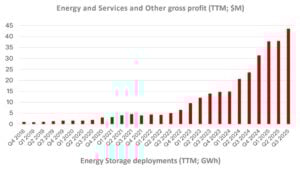
The chart shows the EV giant’s most recent storage deployments. It reached almost 45 GW in the third quarter of 2025.
Source: Tesla
Samsung SDI supplies cylindrical cells to BMW and Rivian. The company is also expanding its manufacturing in South Korea, the U.S., and Europe. Tesla can partner with Samsung to diversify its sourcing. This way, it can access high-energy-density, nickel-rich batteries. These batteries improve driving range and performance.
This deal would also help Tesla reduce its exposure to raw material price swings. Battery-grade lithium and nickel prices fell by over 40% in 2024. However, volatility is still high because global demand for energy storage is rising fast.
The Global Battery Boom: A Trillion-Dollar Charge
The global battery market is expanding at a record pace. According to BloombergNEF, annual battery demand could exceed 4,500 GWh by 2035, compared to around 950 GWh in 2024. Electric vehicles account for most of this growth, with stationary storage and grid applications contributing an increasing share.
China remains the largest producer, led by CATL and BYD, which together control over 50% of global battery supply. However, competition from South Korea and Japan is growing. Companies like Samsung SDI and Panasonic are investing billions in new factories in the U.S. and Europe.
The U.S. Inflation Reduction Act (IRA) has been a key driver of this shift. It provides tax credits for batteries and EVs made locally. This encourages foreign suppliers to set up production in North America. Samsung SDI is already building new facilities in Indiana and Tennessee, both of which could supply Tesla in the future.
Innovation at Full Voltage: From 4680 to Solid-State
The Tesla–Samsung deal aligns with broader trends in battery chemistry. Samsung SDI is working on high-nickel NCA and NCM cells. They are also looking at solid-state batteries. These batteries could offer better safety and higher energy density.
Tesla has focused heavily on innovation through its 4680 cells, designed to lower costs by 50% per kWh and improve vehicle range. However, scaling production has been challenging. By combining internal development with supplier deals, Tesla is able to stay flexible as battery technologies evolve.
Meanwhile, global research is exploring alternatives like lithium iron phosphate (LFP) for cost savings. It’s also looking into solid-state batteries for better performance in the future.
Analysts predict that commercial solid-state cells will enter mass production between 2028 and 2030. This timing matches Tesla’s future model plans.
Battery storage has become central to the global clean energy transition. The International Energy Agency (IEA) says that installed battery capacity could jump from about 20 GW in 2020 to over 1,200 GW by 2030 in net-zero scenarios.
BloombergNEF expects 2025 to add 92 GW of new grid-scale storage. This shows how quickly the sector is growing. By 2030, global investment in batteries—across EVs, homes, and the grid—could exceed $1 trillion cumulatively.
Still, the industry faces several headwinds. Supply chain risks for critical minerals like lithium, nickel, and cobalt remain high. Recycling capacity also lags behind growing demand. Governments and automakers are now working to create closed-loop supply chains to recover metals and reduce environmental impacts.
In this landscape, Tesla’s influence remains large. The company’s early push for vertical integration—mining, refining, cell production, and energy storage—has set the pace for other automakers and battery firms.
Tesla’s Expanding Battery Network and Market Influence
Tesla’s collaboration with Samsung SDI is one of many major supply deals the company has formed in recent years. It has strong partnerships with Panasonic for 2170 cells and CATL for LFP batteries. These are used in Model 3 and Model Y vehicles in China.
In 2024, Tesla signed new deals with LG Energy Solution. These agreements provide more high-nickel cells. This supports Tesla’s expanding Megapack energy storage production in California.
Tesla’s global footprint in energy storage has also expanded sharply. The company’s Energy Generation and Storage division reported a 60% increase in deployment in 2024 than the previous year.
And as seen in the first chart above, it skyrocketed to over 40 GW in Q3 2025. Its Megapack systems are now used by utilities in the U.S., U.K., and Australia to stabilize power grids and support renewable integration.
Beyond its partnerships, Tesla plays a defining role in shaping global battery trends. Tesla’s Gigafactory in Nevada led the way in large-scale lithium-ion production. Meanwhile, the Texas and Berlin plants are placing Tesla at the heart of EV battery innovation in the West.
Tesla has driven scale, standardization, and efficiency. This helped make batteries cheaper for everyone. Pack prices dropped from about $1,100 per kWh in 2010 to under $140 in 2024, says BNEF.
As more nations set targets for carbon neutrality by 2050, battery demand will continue to surge. Tesla’s push to secure long-term supply through deals like the one with Samsung SDI ensures it remains a dominant force in this transformation.
The company’s reach goes beyond cars. It also impacts energy infrastructure, manufacturing systems, and the global clean energy economy.
The chart shows that global battery supply is projected to rise sharply through 2030, driven by massive factory expansions across China, the U.S., and Europe. In contrast, Tesla’s battery demand grows at a steadier pace, reflecting its focus on efficiency and diversified supplier partnerships rather than pure volume growth.
Outlook: Securing Supply, Scaling Sustainability
If the $2.1 billion deal with Samsung SDI moves forward, Tesla will strengthen its supply resilience and technological edge. The agreement shows a bigger industry trend: Automakers are forming key partnerships because demand for EVs and storage batteries is rising fast.
Global energy storage capacity is expected to grow tenfold by the end of the decade. With battery innovation speeding up, Tesla’s strategy of multi-sourcing and co-developing advanced chemistries could be key to maintaining its leadership.
Whether through partnerships, in-house innovation, or scaling renewable energy integration, Tesla continues to help define the direction of the global battery industry.
The 30th United Nations Climate Change Conference, or COP30, will take place in Belém, Brazil, from 10 to 21 November 2025. Nearly 200 countries will meet to review progress under the Paris Agreement and plan the next steps to limit global warming.
The summit’s location is symbolic. Belém lies at the edge of the Amazon Rainforest, one of Earth’s greatest carbon sinks. The Amazon stores billions of tonnes of carbon and helps regulate global weather. Holding COP30 there highlights that protecting nature is central to solving the climate crisis.
This event comes ten years after the Paris Agreement and halfway to 2030 — the deadline for many national climate targets. It is a key checkpoint for updating national climate plans and accelerating real-world action.
The UN Framework Convention on Climate Change (UNFCCC) says emissions are dropping in some areas. But they aren’t falling quickly enough to reach the 1.5 °C goal. If current policies continue, scientists warn that the world could warm by 2.6 °C to 2.8 °C by the end of the century. COP30 could become a turning point — or another missed chance.
Why COP30 Could Redefine Climate Progress
The urgency of this conference cannot be overstated. Global climate action is falling short. Many countries have yet to deliver on past promises.
Developing nations continue to call for fairer climate finance. The long-promised $100 billion per year from wealthy nations is still unmet. OECD reports show that $115.9 billion was mobilized in 2022, surpassing the target but still disputed in terms of disbursement efficiency.
The European Union reported about €28.6 billion in public funding for climate action in 2023. The figure is helpful, but far from what is needed. Some negotiators are pushing for a new goal of $300 billion per year by 2035.
Another major focus is on forests and biodiversity. Brazil plans to showcase the Amazon’s global role and promote solutions to stop deforestation. Healthy forests help offset emissions, support local economies, and preserve biodiversity.
COP30 will also connect climate action with human welfare. Delegates will talk about creating green jobs. They will also discuss expanding clean energy access. Finally, they will focus on protecting communities from floods, droughts, and heatwaves.
From Energy to Equity: The Big Issues on the Agenda
The COP30 agenda will combine broad policy debates with concrete solutions. Thematic days will highlight major sectors shaping the planet’s future.
Source: Image from COP30 website
Energy and Industry: Countries will explore how to scale up renewable power and phase down fossil fuels. Fossil fuels still provide most global energy, so credible transition roadmaps are crucial.
Global renewable power capacity grew by a record 510 GW in 2024, with 520 GW expected in 2025, making up over 90% of new capacity. Total renewable capacity will reach nearly 5,800 GW by 2025. This will supply about 30% of the world’s electricity and aims for 42–45% by 2030. China leads, adding 260 GW in 2024, followed by steady growth in Europe, the US, and India. Solar dominates three-quarters of new installations worldwide.
Forests and Nature: The Amazon will take centre stage. Leaders will discuss how to end illegal deforestation, restore degraded land, and strengthen biodiversity protection.
Forests absorb 7.6 billion tonnes of CO₂ yearly but get less than 2% of climate finance. Global forest finance nearly doubled to $23.5 billion annually by 2024, with public funds covering 60% and private investment rising to 40%.
Despite growth, investments must quadruple by 2030 to meet global forest protection targets, with transparency and verified impact gaining importance.
Agriculture and Food Systems: Food production and land use account for a large share of emissions. COP30 will promote sustainable farming, soil health, and waste reduction.
Cities and Infrastructure: With more people living in cities, resilient design matters. Delegates will discuss how to build low-carbon housing, transport, and water systems that can withstand climate impacts.
Health and Equity: Climate change affects people unequally. The summit will focus on adaptation, social justice, and the right to clean air, safe water, and energy.
Finance, Innovation, and Implementation: This may be the most critical theme. COP30 will urge countries to transform plans into real results. This will happen through improved monitoring, reporting, and financing. Adaptation finance, funding to help countries manage disasters, remains a top demand from vulnerable nations.
COP30’s message is clear: move from talking about climate to doing climate.
Belém’s Symbolism: The Rainforest at the Heart of Climate Talks
Belém, the capital of Pará State, is the gateway to the world’s largest rainforest. Hosting COP30 there ties climate, nature, and communities together.
Brazil wants to show leadership in nature-based climate solutions. President Luiz Inácio Lula da Silva has pledged to end illegal deforestation by 2030 and restore degraded land. These actions are central to Brazil’s national climate goals and global emissions cuts.
The annual deforestation rate in the Amazon for the year 2025 was 5,796 km², down 11.08% from the previous period. It is the lowest rate in 11 years. This reduction reflects the resumption of plans to combat deforestation.
Belém’s choice is also about inclusion. Brazil’s COP30 presidency, led by diplomat André Corrêa do Lago, promises an open summit. It will involve governments, indigenous peoples, and local actors.
But the setting brings logistical challenges. Infrastructure, accommodation, and travel costs are major concerns. Some poorer nations and civil society groups fear limited access due to high expenses. Local authorities are upgrading transport and hotels, yet space will remain tight.
Despite these issues, hosting COP30 in the Amazon is a powerful symbol. It places environmental justice, indigenous leadership, and forest protection at the center of global debate.
André Aranha Correa do Lago, COP30 President Designate, stated in a letter:
“COP30 takes place at the epicentre of the climate crisis. Yet from rising waters and changing skies, a deeper strength is emerging – the determination of people to protect what they love. In Belém, let us honour that determination and transform it into a global agenda guided by care, not indifference; by interdependence, not individualism; by courage, not resignation. In Belém, where the rivers meet the sea, let us renew the alliance between humanity and nature – turning vulnerability into solidarity, cooperation into resilience, and adaptation into evolution. Changing by choice, together.”
What to Expect from COP30
Observers expect COP30 to produce several headline outcomes:
Stronger national climate pledges (NDCs), updating 2030 and 2035 targets for emissions cuts, adaptation, and nature-based projects.
A new global finance framework to provide predictable funding for developing countries and climate-vulnerable regions.
Amazon-focused partnerships, linking forest conservation, carbon markets, and indigenous stewardship.
Fossil-fuel transition roadmaps, outlining how nations will phase down coal, oil, and gas while ramping up renewables.
New monitoring systems to track real-world progress and link funding to measurable results.
These agreements will impact global climate policy for the next ten years. They will also shape investments in clean energy, nature restoration, and sustainable infrastructure.
The European Union’s Role at COP30
On 23 October 2025, the European Parliament adopted a resolution outlining its position ahead of COP30. Lawmakers called for strong action to limit warming to 1.5 °C, update climate plans, and deliver on finance pledges.
The EU resolution urges:
Tougher 2035 and 2040 targets for the EU’s own emissions reductions.
Economy-wide participation, requiring agriculture, transport, energy, and industry all to cut emissions.
More climate finance, especially for adaptation and loss-and-damage in poorer countries.
A just transition, protecting workers, communities, and ecosystems as economies shift to low-carbon models.
The EU delegation will attend COP30 in the second week of the summit. Its stance matters because Europe often shapes global climate negotiations. EU credibility depends on maintaining high ambition while helping others do the same.
Turning Promises into Progress: The World Watches Belém
COP30 in Belém is more than another climate meeting. It is a crossroads for global cooperation. The summit could change how we fight climate change. It links emission cuts to nature protection, social justice, and finance reform.
The Amazon setting reminds leaders that humanity’s future is tied to the planet’s ecosystems. Whether COP30 becomes a turning point will depend on concrete steps, not speeches.
If countries act boldly and inclusively, COP30 could move the world closer to the 1.5 °C path. If they delay again, the costs of inaction will keep rising. As the world gathers in Belém, one truth stands out: protecting nature and people must go hand in hand with reducing emissions.
https://globalcarbonfund.com/wp-content/uploads/2018/10/GCF_header_logo_340x156.png00carbonfundhttps://globalcarbonfund.com/wp-content/uploads/2018/10/GCF_header_logo_340x156.pngcarbonfund2025-11-06 06:53:512025-11-06 06:53:51COP30 in Brazil Kicks Off: A Make-or-Break Moment for Global Climate Action