OKLO Shares Rally After DOE Supports Surplus Plutonium Reactor Program

Oklo, an advanced nuclear company, aims to turn surplus plutonium into clean electricity in the U.S. The U.S. Department of Energy (DOE) selected Oklo for talks under the Surplus Plutonium Utilization Program.

This program seeks to reuse excess plutonium from U.S. defense activities. Companies can convert it into fuel for advanced nuclear reactors instead of burying it for years. Strict federal safety rules guide this process.

Oklo believes this will address two major issues: reducing long-term nuclear waste and providing reliable, carbon-free electricity.

Co-founder and CEO of Oklo, Jacob DeWitte said,

“Fuel supply constraints are a key throttle to advanced reactor development. This program creates a pathway to use existing surplus material as bridge fuel for advanced reactors to bring more reactors online sooner. Material that has been set aside for disposal can instead be converted into fuel to produce electricity through fission.”

What Is DOE’s Surplus Plutonium Program?

The DOE started the Surplus Plutonium Utilization Program in October 2025. Its goal is to find productive uses for plutonium no longer needed for military purposes.

The U.S. has about 34 metric tons of surplus plutonium. The government seeks safe ways to manage this material. One option, called “dilute-and-dispose,” mixes plutonium with other materials and buries it.

However, this method is costly. Estimates suggest it could cost taxpayers nearly $19 billion over 30 years.

Oklo offers a better option. Instead of treating the material as waste, the company wants to convert it into fuel for advanced reactors.

The DOE chose Oklo and four other companies for negotiations in this program. This supports Oklo’s plan to secure various fuel sources as the U.S. expands its nuclear fuel production.

How Oklo’s Technology Works

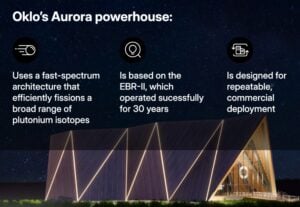
Oklo is developing advanced fast reactors known as Aurora powerhouses. These small reactors aim to produce reliable electricity with strong safety systems. Notably, the technology is based on the Experimental Breeder Reactor-II (EBR-II), which operated successfully in the U.S. for about 30 years.

oklo
Source: Oklo

Unlike traditional reactors, fast reactors can use recycled nuclear material more efficiently. Oklo plans to use surplus plutonium as fuel in early deployments.

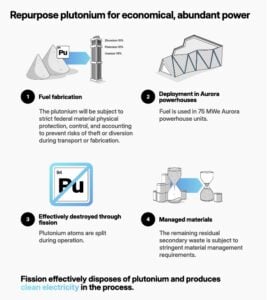
The process has four main steps:

  • Convert surplus plutonium into reactor fuel under strict federal controls.
  • Load the fuel into Oklo’s 75-megawatt electric Aurora reactors.
  • Inside the reactor, plutonium atoms undergo fission, releasing significant energy.
  • Manage the remaining nuclear waste per federal safety regulations.

This process generates electricity and reduces the amount of plutonium needing long-term storage.

Oklo states its reactor design includes several passive safety features. The reactors are self-stabilizing and rely on natural cooling, simplifying operations. The company names this tech “walk-away safe.” This means the reactor can shut down safely on its own during emergencies.

Oklo’s fast-fission technology is designed for this bridge-fuel pathway

oklo plutonium
Source: Oklo

A Temporary Fuel Solution

Oklo emphasizes that surplus plutonium is not its long-term fuel strategy.

The company sees it as a temporary “bridge fuel” while the U.S. increases domestic supplies of HALEU, or high-assay low-enriched uranium.

HALEU is expected to be a key fuel source for advanced reactors, but current production is limited. According to Oklo’s timeline:

  • The company plans to use recycled EBR-II fuel starting in 2028 for initial Aurora deployments.
  • From 2028 to 2029, surplus plutonium may fill fuel supply gaps.
  • By the early 2030s, expanded HALEU production and more recycled material are expected to support long-term operations.

Oklo stresses that its proposal focuses only on consuming existing surplus plutonium stockpiles. The company is not creating new plutonium or establishing a permanent market for plutonium fuel.

Potential Energy Impact

Oklo sees significant energy potential in surplus material.

The company claims that 34 metric tons of surplus plutonium could power New York City for nearly six years, depending on reactor design and conditions.

If successful, the project could provide several long-term benefits:

  • Reliable carbon-free electricity
  • Reduced nuclear waste management costs
  • Improved U.S. energy security
  • Lower dependence on foreign nuclear fuel
  • Faster deployment of advanced reactors

The project also aligns with broader clean energy goals as nations seek dependable low-carbon power to meet rising electricity demand.

Oklo Inc. (NYSE: OKLO) has attracted strong investor interest as advanced nuclear energy gains popularity. Following the DOE announcement, Oklo shares surged, seen as a major milestone for the company’s future fuel strategy and reactor plans. The stock is currently trading around $67 on the NYSE.

Partnership With newcleo

Oklo has partnered with European nuclear company newcleo to support fuel development and reactor deployment in the U.S.

In this partnership, Oklo will lead the use of surplus plutonium, while newcleo will provide fuel-making expertise and possible funding. In October 2025, both companies announced plans for advanced fuel fabrication infrastructure in the U.S., with a potential investment of up to $2 billion.

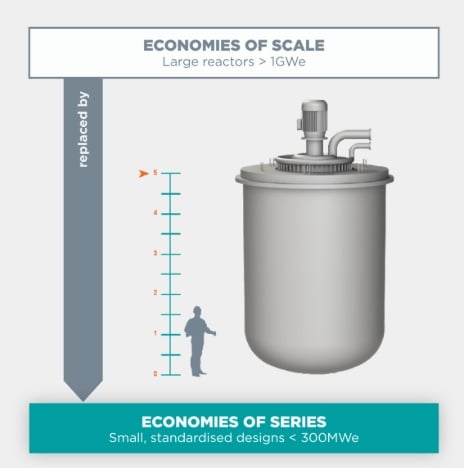
Newcleo is developing lead-cooled fast reactors, a type of next-generation nuclear technology. The company believes smaller modular reactors can lower costs and speed up deployment compared to traditional plants.

Its liquid lead cooling system offers several benefits:

  • Operates at low pressure, enhancing safety
  • Uses chemically stable lead coolant
  • Provides strong cooling during emergencies
  • Delivers high efficiency at elevated temperatures

Newcleo is also working on a compact 200-megawatt reactor for easier transport and installation.

newcleo smr
Source: newcleo

A New Approach to Nuclear Waste

The Oklo-newcleo partnership marks a shift in how advanced nuclear companies view nuclear waste.

Instead of seeing surplus plutonium only as a disposal issue, companies now view it as a potential energy resource.

Oklo and newcleo describe the DOE program as “disposition through use.” The idea is simple: convert existing nuclear material into fuel, generate electricity, and consume the material through fission under strict safeguards.

Supporters believe this approach could lower taxpayer costs while boosting domestic energy production and reducing nuclear stockpiles.

This announcement comes as global interest in advanced nuclear energy continues to grow. Governments and private firms are investing in SMRs and next-generation nuclear technologies to meet climate goals and ensure energy security.

For Oklo, the DOE selection marks another important step toward commercial reactor deployment. Investors reacted positively to the news, with Oklo shares (OKLO stock) rising after the announcement.

oklo stock
Source: Yahoo Finance

While many regulatory and technical challenges remain, the project could become one of the first real-world examples of converting surplus plutonium into large-scale clean electricity in the modern nuclear industry.

The post OKLO Shares Rally After DOE Supports Surplus Plutonium Reactor Program appeared first on Carbon Credits.


Canada’s AI Boom Goes Industrial With Billion-Dollar Gigafactories and Sovereign Data Hubs

Canada’s AI Boom Goes Industrial With Billion-Dollar Gigafactories and Sovereign Data Hubs

Canada is entering a new phase in the global artificial intelligence (AI) race. The country is now moving beyond AI research and building the large-scale infrastructure needed to power advanced computing systems. Two major announcements this month show how fast this shift is happening.

HIVE Digital Technologies unveiled plans for a CAD $3.5 billion AI gigafactory near Toronto. The company says the facility could become one of the largest AI data centers in Canada.

At the same time, TELUS and the Canadian government announced a new AI data center cluster in British Columbia focused on “sovereign AI” computing.

These projects reflect a wider global trend. Countries now see AI infrastructure as a strategic national asset. Governments and companies want more control over computing power, data processing, and cloud systems as AI demand rises rapidly.

HIVE Plans One of Canada’s Largest AI Data Center Projects

HIVE Digital Technologies plans to build a 320-megawatt AI infrastructure campus in Ontario through its subsidiary BUZZ High Performance Computing.

Frank Holmes, Executive Chairman of HIVE and BUZZ:

“AI is the new industrial base and compute is the factory floor. Canada produced the Godfathers of deep learning but kept renting the factories. That era is over. Between Toronto and Waterloo, BUZZ is building the sovereign AI infrastructure that turns Canadian intelligence into Canadian dominance… Our vision is to build AI infrastructure that will serve humanity, with the potential to improve the quality of life for millions of Canadians.”

The company says the site will support more than 100,000 GPUs once fully built. HIVE bought about 25 acres of land across two sites for around CAD $58 million in Ontario’s Toronto–Waterloo technology corridor.

The tech company expects the project to start operating in the second half of 2027. It claims the project will create more than 800 construction jobs and hundreds of permanent operational jobs.

HIVE also says the facility will run on Ontario’s low-carbon electricity grid and use closed-loop cooling systems that avoid direct water consumption.

The announcement adds to HIVE’s wider AI expansion across Canada. Earlier this month, the company announced a $3.1 million fiber optic upgrade at its 70 MW Grand Falls data center in New Brunswick. HIVE is converting that site into a 50 MW AI factory for enterprise and government computing workloads.

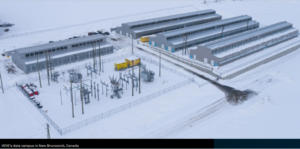
HIVE data campus in Canada
Source: HIVE Digital Technologies

CEO Aydin Kilic says HIVE currently operates about 5,500 GPUs for AI computing. The company’s Canadian pipeline could eventually support around 130,000 GPUs. HIVE also reports more than 850 MW of global power capacity, including around 450 MW connected to operating data centers.

Investors reacted strongly to the news. HIVE shares climbed more than 24% after the announcement.

HIVE stock price

Canada Pushes Sovereign AI Infrastructure

Meanwhile, TELUS and the Canadian federal government also announced a major AI infrastructure expansion in British Columbia. The project includes:

  • Expansion of the Kamloops AI facility, 
  • A new AI center in Vancouver’s Mount Pleasant district, and
  • A downtown Vancouver AI facility planned for 2029.

TELUS says the project could become “one of the world’s most powerful and sustainable AI infrastructure clusters.”

  • The federal government committed CAD $2 billion over five years beginning in 2024–25 to support sovereign AI data center projects across Canada.

Canadian officials say the goal is to keep advanced computing capacity inside the country. They also want Canadian-owned infrastructure operating under Canadian law.

TELUS says renewable sources will supply more than 98% of the electricity used by the facilities. The company also plans to recover waste heat from the Vancouver sites to help heat nearby buildings and homes.

The Kamloops expansion and Mount Pleasant facility will begin operations later this year.

Canada Strengthens Its Position in the Global AI Economy

Canada already holds an important position in global AI research. Researchers in Toronto, Montreal, Vancouver, and Waterloo helped shape modern machine learning systems over the last decade.

Now the country wants to expand into AI infrastructure and commercial deployment. The Canadian AI market continues to grow quickly.

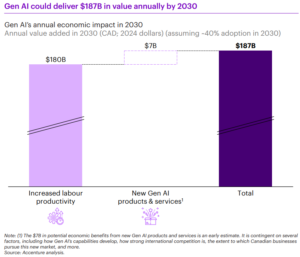
Canada’s AI sector could contribute more than CAD $230 billion to the economy by 2030, according to government and industry estimates. Generative AI could bring CAD $187 billion in economic value by 2030. 

Canada Gen AI economic value 2030
Source: Accenture

Moreover, the country ranks among the world’s leading AI research hubs by academic output and startup activity. More than 140,000 people already work in Canada’s digital and AI economy.

The country also attracted billions of dollars in AI and cloud infrastructure investment over the past three years. At the same time, global AI infrastructure spending is rising sharply.

Bank of America recently raised its forecast for the global AI data center systems market to about US$1.7 trillion by 2030. The bank also projects that annual AI infrastructure investment could reach US$1.4 trillion by the end of the decade.

Dell’Oro Group separately estimates global data center capital spending could approach US$1 trillion in 2026 alone and rise to US$1.7 trillion by 2030.

Much of this investment now focuses on generative AI systems, cloud computing, GPU infrastructure, national AI capacity, and sovereign computing systems. Canada’s latest projects directly fit into this global expansion cycle.

AI Data Centers Create New Energy, Emissions, and Grid Challenges

The rapid growth of AI infrastructure is also increasing pressure on power systems.

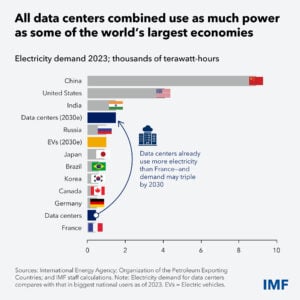
The International Energy Agency (IEA) says global electricity demand from data centers could more than double by 2030. AI systems require large amounts of continuous power, especially for training advanced models.

HIVE’s Ontario facility alone would require 320 MW of electricity, roughly equal to the power demand of a large industrial complex.

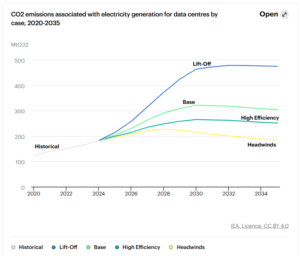
AI data centers are also increasing carbon emissions as electricity demand rises. The IEA estimates that data centers currently produce about 180 million tonnes of CO₂ emissions each year from electricity use.

carbon emissions of data centers 2030 iea
Source: IEA

That figure could rise to around 300 million tonnes by 2035 as AI adoption expands. Much of the increase comes from growing power demand met by natural gas and coal generation.

Recent studies also show U.S. data centers already generate more than 105 million tonnes of CO₂e annually, equal to about 2.2% of total U.S. emissions. Meanwhile, the IMF estimates AI-driven power demand could add about 1.7 gigatonnes of global greenhouse gas emissions between 2025 and 2030 under current policies.

energy-data-centers-emissions-imf

These trends are pushing tech companies to invest more in renewable energy and lower-carbon infrastructure. They also prompted major emitters to focus more on energy supply and emissions management.

Both HIVE and TELUS highlighted sustainability measures in their announcements. HIVE plans to use Ontario’s lower-carbon electricity grid and closed-loop cooling systems that reduce water use.

TELUS says renewable energy sources will provide more than 98% of the electricity used by its facilities. The company also plans to recycle waste heat from the Vancouver sites.

These measures matter because environmental concerns around AI are growing quickly. Analysts now warn that AI-driven data centers could significantly increase electricity demand and carbon emissions if grids fail to add enough clean power capacity.

Canada’s AI Buildout Moves Into Industrial Scale

Canada’s AI strategy is now shifting from research leadership toward industrial-scale infrastructure.

The HIVE and TELUS projects show how AI development now depends not only on software and algorithms, but also on physical infrastructure, power systems, and long-term energy supply.

As global competition in AI intensifies, Canada is positioning itself as both a research hub and a major location for next-generation AI infrastructure. The challenge now will be scaling these systems fast enough while managing power demand, sustainability pressures, and long-term economic risks.

The post Canada’s AI Boom Goes Industrial With Billion-Dollar Gigafactories and Sovereign Data Hubs appeared first on Carbon Credits.

Eni and BlackRock Scale Up Europe’s CCS Race With $670 Million HyNet Financing Deal

Eni and BlackRock Scale Up Europe’s CCS Race With $670 Million HyNet Financing Deal

Carbon capture and storage (CCS) is moving from early-stage pilots into large-scale infrastructure deals. One of the latest signals comes from Eni and BlackRock’s Global Infrastructure Partners (GIP), which secured more than $670 million in financing for their joint carbon capture and storage platform. The funding came from a consortium of 13 international lenders, and demand exceeded the original target. 

The deal strengthens one of Europe’s largest CCS platforms, which includes projects in the United Kingdom, the Netherlands, and Italy. It also reflects rising investor confidence in carbon transport and storage networks, especially in regions with strong carbon pricing systems and government-backed industrial decarbonization plans.

At the center of this platform is the HyNet industrial cluster, which is emerging as one of Europe’s most advanced CCS systems.

HyNet Emerges as Europe’s Flagship Carbon Storage Megaproject

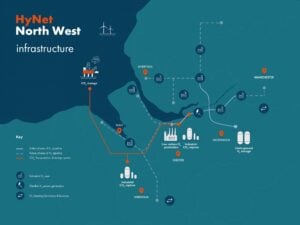
The flagship project within the platform is the Liverpool Bay CCS system, which forms the backbone of the UK’s HyNet cluster. The project is designed to:

  • Capture CO₂ from heavy industry in northwest England and North Wales.
  • Transport CO₂ through new and repurposed pipelines.
  • Store CO₂ in depleted offshore gas fields under Liverpool Bay. 

The system could store 4.5 million tonnes of CO₂ per year in its first phase, scaling up to 10 million tonnes per year in the 2030s.

hynet north west cluster ccs
Source: HyNet

Construction is already advanced, with more than 30% completed, and first operations are planned for 2028. The infrastructure also includes around 149 km of existing pipeline repurposed and 35 km of new pipelines to connect industrial emitters to the transport system. 

The HyNet cluster is not a single project. It is a regional industrial system covering:

  • Cement production, 
  • Chemicals, 
  • Energy-from-waste plants, and
  • Hydrogen production.

UK authorities estimate CCS could support tens of thousands of jobs across industrial regions while helping cut emissions from some of the hardest-to-decarbonize sectors.

Big Money Flows Into Carbon Capture Infrastructure Networks

The $670 million financing package was raised from 13 lenders, including major global banks such as BNP Paribas, ING, NatWest, MUFG, and UniCredit. The oversubscribed financing round reflects growing financial sector interest in CCS-linked infrastructure assets.

The transaction follows key milestones in the platform’s development:

  • GIP acquired a 49.99% stake in Eni CCUS Holding in 2025.
  • The platform now includes CCS assets in the UK, the Netherlands, and Italy.
  • Additional projects such as Bacton CCS (UK) and L10-CCS (Netherlands) are already included in the portfolio. 

This structure reflects a shift in CCS financing. Instead of standalone pilot projects, investors are now funding multi-country CCS networks that combine capture, transport, and storage assets under a single platform.

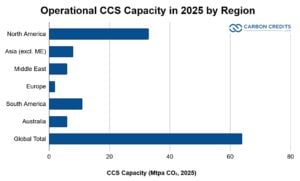
Globally, CCS is expanding rapidly but remains far below the required climate pathways. The International Energy Agency (IEA) estimates the world currently has more than 600 million tonnes per year of CO₂ capture capacity in development pipelines, but only a small fraction is operational today.

operational CCS capacity per region

Britain Bets £21.7 Billion on Industrial Carbon Capture Expansion

The Liverpool Bay project is part of the UK government’s broader CCS strategy.

In 2024, the UK committed up to £21.7 billion (around $28 billion) in public funding to support CCS development across industrial clusters. This is one of the largest national CCS funding programs globally. 

The HyNet cluster alone is expected to reduce emissions across one of the UK’s most industrialized regions, while also supporting hydrogen production and low-carbon fuels.

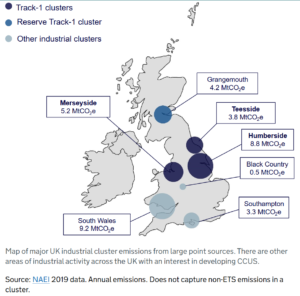
The UK’s approach is based on “cluster sequencing,” where multiple industries share a single CO₂ transport and storage backbone. This reduces costs by spreading infrastructure across multiple emitters instead of building separate systems for each facility.

Major UK industrial cluster emissions

UK major industrial cluster emissions
Source: UK.Gov

Similar cluster-based CCS models are now being developed in other countries:

  • Netherlands (Rotterdam CCS systems),
  • Norway (Northern Lights project), and
  • United States (Gulf Coast CCS hubs).

This shows CCS is evolving into a network infrastructure industry, not just a climate technology.

Eni Builds CCS Into a Multi-Billion Dollar Transition Platform

For Eni, CCS is becoming a core part of its transition strategy. The company operates through a “satellite model,” where low-carbon businesses are separated into independent platforms to attract external capital.

Eni’s CCUS Holding now includes Liverpool Bay CCS (UK), Bacton CCS (UK), L10 CCS (Netherlands), and the rights to acquire Ravenna CCS (Italy). The goal is to build a scalable carbon management business that can serve industrial emitters across Europe.

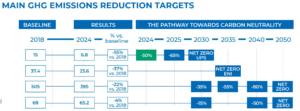
The energy major has also set broader climate targets:

  • Net-zero Scope 1 and 2 emissions by 2035, and
  • Net-zero lifecycle emissions by 2050.

ENI carbon neutrality net zero pathway
Source: Eni

CCS is positioned as essential for “hard-to-abate” sectors such as cement and chemicals, where direct electrification is limited.

Carbon Capture Scales Up as Questions Over Long-Term Costs Persist

Carbon capture and storage is growing faster as more projects move from planning into financing and construction. Supporters say it’s a vital tool for reducing emissions in heavy industries. This includes cement, chemicals, and refining, where electrification is hard.

The IEA sees CCS as key to reaching net-zero goals. It helps manage residual emissions from industries. However, the long-term economics remain uncertain.

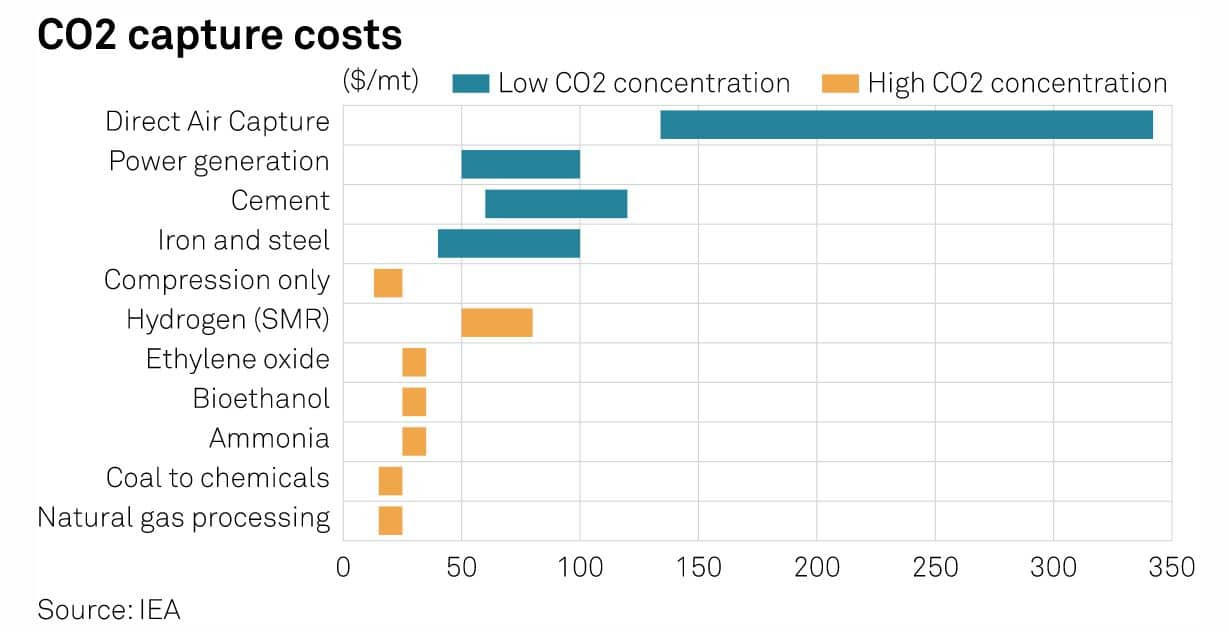
Most CCS projects still depend on carbon pricing, government subsidies, or regulated revenue support to stay viable. Costs for capture, transport, and storage infrastructure remain high, and development timelines often stretch across 5 to 10 years.

carbon capture costs EU

Meanwhile, global emissions are still above 37 billion tonnes of CO₂ per year, showing how far CCS must scale to have a material global impact. This gap between current deployment and climate needs remains one of the main challenges for the sector.

CCS Is Scaling Into Infrastructure, Not Just Climate Technology

The Eni–BlackRock financing deal marks another step in the shift toward industrial-scale carbon capture systems.

With $670 million in new funding, the HyNet cluster is setting a benchmark for carbon transport and storage. It aims to store between 4.5 and 10 million tonnes of CO₂, and it has strong support from the UK’s £21.7 billion CCS program.

At the same time, global CCS deployment is still limited compared to climate needs. The sector now faces a clear challenge: scaling from early infrastructure clusters into a global system capable of handling gigaton-scale emissions.

For now, CCS is moving forward as a financeable infrastructure asset class. But its long-term role in global decarbonization will depend on how quickly it can expand beyond early clusters like HyNet.

The post Eni and BlackRock Scale Up Europe’s CCS Race With $670 Million HyNet Financing Deal appeared first on Carbon Credits.

Standard Chartered Launches First Green Wonton Bond, Raising HKD2 Billion for Climate Projects

Standard Chartered has launched its first Green Wonton Bond, raising HKD2 billion ($255 million). This is one of Hong Kong’s largest sustainable finance deals this year. It is the first public green bond in Hong Kong dollars by a Financial Institutions Group (FIG) and the bank’s largest HKD issuance, exceeding its previous record of HKD1.5 billion.

This deal highlights growing investor demand for green finance and boosts Hong Kong’s status as a leading sustainable finance hub in Asia.

What is a “Wonton Bond”? 

A “Wonton Bond” is a Hong Kong dollar bond issued by foreign governments, banks, or international organizations in Hong Kong. The name reflects local culture, similar to China’s “Dim Sum Bonds.” These bonds help global issuers raise funds from Asian investors and enhance Hong Kong’s role as a financial center.

Recently, the International Finance Corporation issued a green Wonton Bond for climate projects. The World Bank and Standard Chartered also use this market for funding and sustainable finance.

Strong Investor Demand Signals Confidence

The Green Wonton Bond drew significant global interest. Order books peaked at HKD3.8 billion, nearly twice the issued amount. This response shows investor confidence in Standard Chartered’s green finance strategy and sustainable asset portfolio.

Dan Hodge, Deputy Group Chief Financial Officer and Group Treasurer at Standard Chartered, said:

“We continue to deliver on our strategy by leveraging our differentiated cross-border capabilities to drive long-term, sustainable value. This issuance provides HKD investors with access to our diverse portfolio of green assets, while benefiting from a UK-regulated bank counterparty.”

Notably, this issuance is the bank’s sixth sustainable finance bond. Earlier, in January 2026, Standard Chartered issued a €1 billion Green Bond, reinforcing its commitment to sustainable debt markets.

The bank announced that the new bond will fund projects in renewable energy, green buildings, and the circular economy, mainly in Asia. These investments will create cleaner electricity systems, boost energy efficiency in commercial real estate, and reduce pollution.

The bond aligns with the bank’s Sustainability Bond Framework and its wider climate strategy.

Standard Chartered Pushes Toward Sustainability Goals

Standard Chartered has grown its sustainable finance business significantly in recent years. As per its Sustainable Finance Impact report, the bank aims to mobilize $300 billion in sustainable finance by 2030. It will do this through loans, bonds, and trade finance solutions that help clients shift to a low-carbon economy.

standard chartered bonds
Source: SC

Since 2021, to September 2025, it had already mobilized $157 billion, making solid progress toward its long-term goal.

  • The bank is aiming for interim emissions reduction targets by 2030. This plan focuses on 12 high-emitting sectors. It’s part of a bigger goal: reaching net-zero financed emissions by 2050.

Beyond climate goals, Standard Chartered is increasing investments that create social impact. In March 2025, the bank issued its first €1 billion social bond to support projects with social and development benefits.

Sustainable finance is now a key business driver. From January to December 2025, Standard Chartered generated $1.07 billion in sustainable finance income, exceeding its medium-term target of at least $1 billion annually by 2025.

The bank has also boosted innovation through hubs focusing on adaptation finance, blended finance, carbon markets, nature finance, and the circular economy. These hubs aim to develop new financial solutions for clients across Asia, Africa, and the Middle East.

Green Portfolio Delivers Real Climate Impact

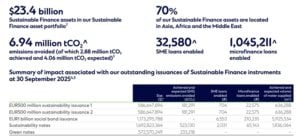
Standard Chartered’s sustainable finance asset portfolio reached $23.4 billion across 524 projects in 57 countries. This portfolio remained stable compared to 2024, though the project mix shifted based on client demand.

About 70% of the bank’s sustainable finance assets are in Africa, Asia, and the Middle East. Investments in these regions often yield greater development and climate benefits due to limited capital access.

standard chartered sustainable finance
Source: SC

For instance, financing an offshore wind project in Egypt can avoid nearly nine times more carbon emissions than a similar project in the UK.

Nearly one-third of the portfolio supports projects in least-developed and lower-income countries, underlining the bank’s focus on development-driven financing.

Renewable energy financing in the portfolio grew 11% year over year, despite a global slowdown in renewable investments.

Million Tonnes of Carbon Dioxide Removed

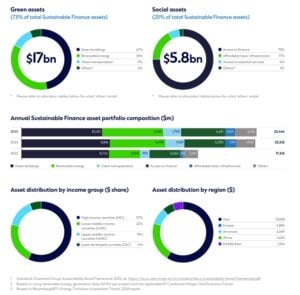
Green projects make up the largest share of the bank’s sustainable financing. As of September 2025, about 73% of sustainable finance lending supported green initiatives.

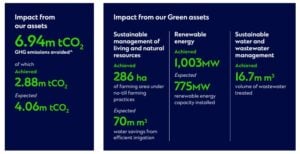
These projects helped prevent around 6.94 million tonnes of carbon dioxide emissions. Of this, 2.88 million tonnes have already been achieved. The remaining 4.06 million tonnes are expected in the future.

The bank noted that this impact equals preventing the consumption of 16.1 million barrels of oil, or avoiding 6.7 million economy-class round-trip flights between London and Singapore.

The green asset portfolio features $17 billion in financing. It includes 389 projects in areas such as:

  • Renewable energy
  • Energy efficiency
  • Waste management
  • Wastewater reduction
  • Sustainable resource management
STANDARD CHARTARED
Source: Standard Chartered

About 62% of these green assets are in Asia, Africa, and the Middle East. Nearly one-third of the portfolio represents new financing added during the latest reporting period.

Hong Kong Strengthens Its Green Finance Position

The Green Wonton Bond reflects rising global interest in Hong Kong dollar assets. It tapped into a unique HKD liquidity pool, helping Standard Chartered PLC diversify its funding base across currencies and regions.

Mary Huen, CEO, Hong Kong and Greater China & North Asia at Standard Chartered, said:

“Our inaugural Green Wonton Bond marks an important milestone for Standard Chartered as we continue to expand our sustainable finance capabilities and connect clients and investors to high-quality green assets. The strong demand we have seen also highlights the growing appeal of HKD-denominated assets and reinforces Hong Kong’s role as a super-connector for capital into the region.”

The successful issuance shows how sustainable finance continues to evolve beyond traditional green bonds in U.S. dollars and euros. It also signals rising investor appetite for Asian currency-denominated climate investments as financial institutions expand funding for the global energy transition.

The post Standard Chartered Launches First Green Wonton Bond, Raising HKD2 Billion for Climate Projects appeared first on Carbon Credits.

Meta’s AI Power Surge Drives $1.2 Billion Solar Megaproject with Enbridge

The rapid growth of artificial intelligence (AI) is reshaping the energy sector. Data centers now require massive amounts of electricity, pushing technology companies to secure long-term clean power supplies at an unprecedented scale.

One of the latest examples is a new partnership between Enbridge and Meta Platforms. The companies plan to build a $1.2 billion solar and battery storage project in Wyoming. This will support Meta’s expanding data center operations.

Amanda Yang, Meta’s Head of Clean and Renewable Energy, remarked:

“We’re committed to supporting projects that add new energy to the grid while strengthening reliability in our data center communities. In partnership with Enbridge and Cheyenne Light, Fuel and Power, the Cowboy Project’s 1600 MWh battery system paired with 365 MW of solar, will deliver flexible, reliable power that benefits the broader grid, including our data center operations.”

The project highlights a larger global trend. AI infrastructure is driving a new wave of renewable energy investment, grid upgrades, and battery storage deployment across North America.

Wyoming’s Cowboy Project Blends Solar Power With Massive Battery Storage

The new development, called the Cowboy Project, will be built near Cheyenne, Wyoming. It combines:

  • 365 MW of solar generation
  • 200 MW / 1,600 MWh battery energy storage
  • Total investment of about US$1.2 billion

The first phase is expected to enter service by the end of 2027.

According to Enbridge, the project will provide “dispatchable” renewable power. This means battery storage will help supply electricity even when solar generation is not available. Tesla will supply and service the battery systems under a long-term agreement.

The electricity will be delivered through Wyoming’s Large Power Contract Service (LPCS) tariff. This framework helps utilities support high-demand customers, such as data centers. It does this without directly impacting retail electricity rates.

The project further boosts the clean energy partnership between Enbridge and Meta. It now includes about 1.6 GW of contracted renewable capacity across North America, with the existing projects including:

  • Clear Fork Solar – 600 MW
  • Easter Wind – 152 MW
  • Cone Wind – 300 MW

All three are located in Texas.

AI’s Explosive Growth Is Rewiring Global Electricity Markets

The project comes during a period of explosive growth in AI infrastructure spending. Recently, Bank of America predicted the global AI data center systems market may hit US$1.7 trillion by 2030.

Strong investments in chips, networking systems, cloud infrastructure, and power systems fuel this growth. Major tech firms will likely spend hundreds of billions each year on AI infrastructure for the next ten years. Estimates show that their total AI spending this year will hit $725 billion.

big tech AI spending 2026
Source: Statista

This expansion is already affecting electricity markets.

The International Energy Agency (IEA) estimates that global electricity demand from data centers could more than double by 2030. In the United States, data centers may account for nearly 11% of total electricity demand by 2030, compared with roughly 4–5% today.

Meta is among the companies leading this buildout. The company is building several large AI data centers in the U.S. This includes projects in Louisiana, Wyoming, and other areas.

Utilities and regulators are under pressure. They need to expand transmission systems, increase generation capacity, and improve grid reliability quickly to meet demand.

big tech AI data center planned growth 2030
Data source: Company reports

SEE MORE: Meta, Amazon, Google, and Microsoft Dominate Clean Energy Deals as Global Buying Slips in 2025

Meta Expands Renewable Energy and Net-Zero Commitments

Meta has become one of the world’s largest corporate buyers of renewable energy. The tech giant was the largest corporate clean energy buyer in the world in 2025, according to BloombergNEF. They contracted around 10.24 GW of clean power that year.

The company says it aims to reach net-zero emissions across its value chain by 2030. It also seeks to match 100% of electricity use in its data centers and offices with renewable energy.

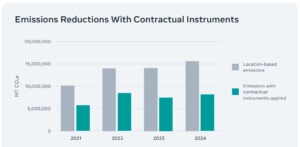
Meta says it reduced operational emissions by around 6 million metric tons of CO₂e in 2024. The company also used Energy Attribute Certificates (EACs) to lower Scope 3 emissions tied to fuel consumption, consumer devices, and remote work activities.

The tech giant says this strategy helped cut another 1.4 million metric tons of CO₂e across its value chain in 2024. Overall, the company says its renewable energy procurement efforts have avoided or reduced about 23.8 million metric tons of CO₂e emissions since 2021.

meta carbon emission reductions
Source: Meta

Meta has also expanded into newer forms of energy procurement. Recently, the company signed several agreements for:

  • Nuclear energy: with nuclear developers to support 1–4 GW of new U.S. nuclear capacity for long-term clean power supply.
  • Geothermal: with Sage Geosystems to deliver up to 150 MW of new geothermal baseload
    power.
  • Large-scale solar: new agreements with Invenergy for 791 MW of solar and wind projects across Ohio, Arkansas, and Texas, bringing their total partnership to about 1.8 GW.
  • Battery storage: with Noon Energy on up to 1 GW / 100 GWh of long-duration energy storage capacity, including a planned 25 MW / 2.5 GWh pilot project.
  • Experimental space-based solar systems: with Overview Energy to potentially source up to 1 GW of space-based solar power through orbit-to-grid technology.

The company says AI infrastructure growth requires both clean energy expansion and stronger grid reliability. That is one reason battery storage is becoming central to many new data center energy projects.

In Wyoming, Meta states that the Cowboy Project’s 1,600 MWh battery system will boost flexibility. It will also help stabilize the grid while powering its operations.

Enbridge Pushes Deeper Into the AI Energy Infrastructure Boom

The project also reflects a broader shift at Enbridge. The company is traditionally known as one of North America’s largest oil and natural gas pipeline operators.

Enbridge handles roughly 30% of U.S. oil production and about 20% of U.S. natural gas consumption through its infrastructure network. However, the company has increasingly expanded into renewable energy and power infrastructure.

The energy company has a project backlog of about C$39 billion. This includes various renewable projects and data center-linked developments. CEO Greg Ebel recently said the company is pursuing more than 50 data center-related projects across North America.

The company also says it has invested in renewable power assets since the early 2000s, including wind, solar, and geothermal facilities.

This shift reflects changing market conditions. The growing demand for AI electricity is opening doors for infrastructure companies. They can now combine energy generation, storage, and grid services.

AI’s Energy Appetite Raises New Grid and Emissions Concerns

Renewable power procurement is growing fast, but data center expansion is still controversial in some areas. Environmental groups and consumer advocates have raised concerns about rising electricity demand, fossil fuel backup generation, and higher infrastructure costs tied to AI facilities.

For example, critics recently questioned financing structures linked to Meta’s Louisiana data center expansion, where new gas-fired power plants are expected to support electricity demand.

Data centers also face broader sustainability challenges, including:

  • High electricity consumption,
  • Water use for cooling systems,
  • Pressure on transmission networks, and
  • Rising regional emissions if grids rely on fossil fuels.

Why AI and Renewable Energy Are Now Growing Together

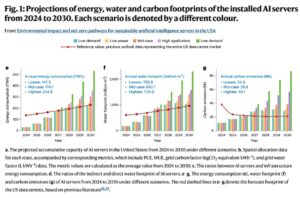
Industry analysts predict that AI-driven data center growth might add millions of tons of carbon dioxide each year in the U.S. by 2030. This could happen unless renewable energy use and grid decarbonization speed up.

US data centers energy and carbon emissions
Xiao, T., Nerini, F.F., Matthews, H.D. et al. Environmental impact and net-zero pathways for sustainable artificial intelligence servers in the USA. Nat Sustain 8, 1541–1553 (2025). https://doi.org/10.1038/s41893-025-01681-y

This is why companies increasingly pair solar and wind projects with battery storage. Storage systems help smooth renewable output and reduce dependence on gas-fired backup generation during peak demand periods.

The Enbridge-Meta Cowboy Project reflects this convergence. It combines utility-scale solar, large battery systems, and long-term corporate power demand in a single project structure. The challenge will be ensuring that energy systems can grow fast enough while still supporting climate goals, grid stability, and affordable electricity access.

The post Meta’s AI Power Surge Drives $1.2 Billion Solar Megaproject with Enbridge appeared first on Carbon Credits.

HSBC’s $4 Billion China Climate Bet Ignites the Global Green Finance Race

HSBC’s $4 Billion China Climate Bet Ignites the Global Green Finance Race

HSBC is launching a new $4 billion financing program for China’s clean energy and low-carbon industries. The funding will support sectors such as renewable energy, electric vehicles, battery storage, hydrogen, and advanced manufacturing.

The move shows how global banks are putting more money into climate and energy transition projects. China remains the world’s biggest clean energy market and the largest producer of many green technologies.

HSBC said in its news release that the new facility will help companies reduce emissions while expanding industrial growth. The bank also expects demand for climate financing to keep rising as China upgrades its energy system. The company further noted:

“The dedicated credit facility will offer financing to eligible businesses operating in a range of sectors, including clean power, electrification of transport, data centres, and artificial intelligence. The initiative reflects our focus on supporting clients to transition and enabling innovation, growth, and opportunity.”

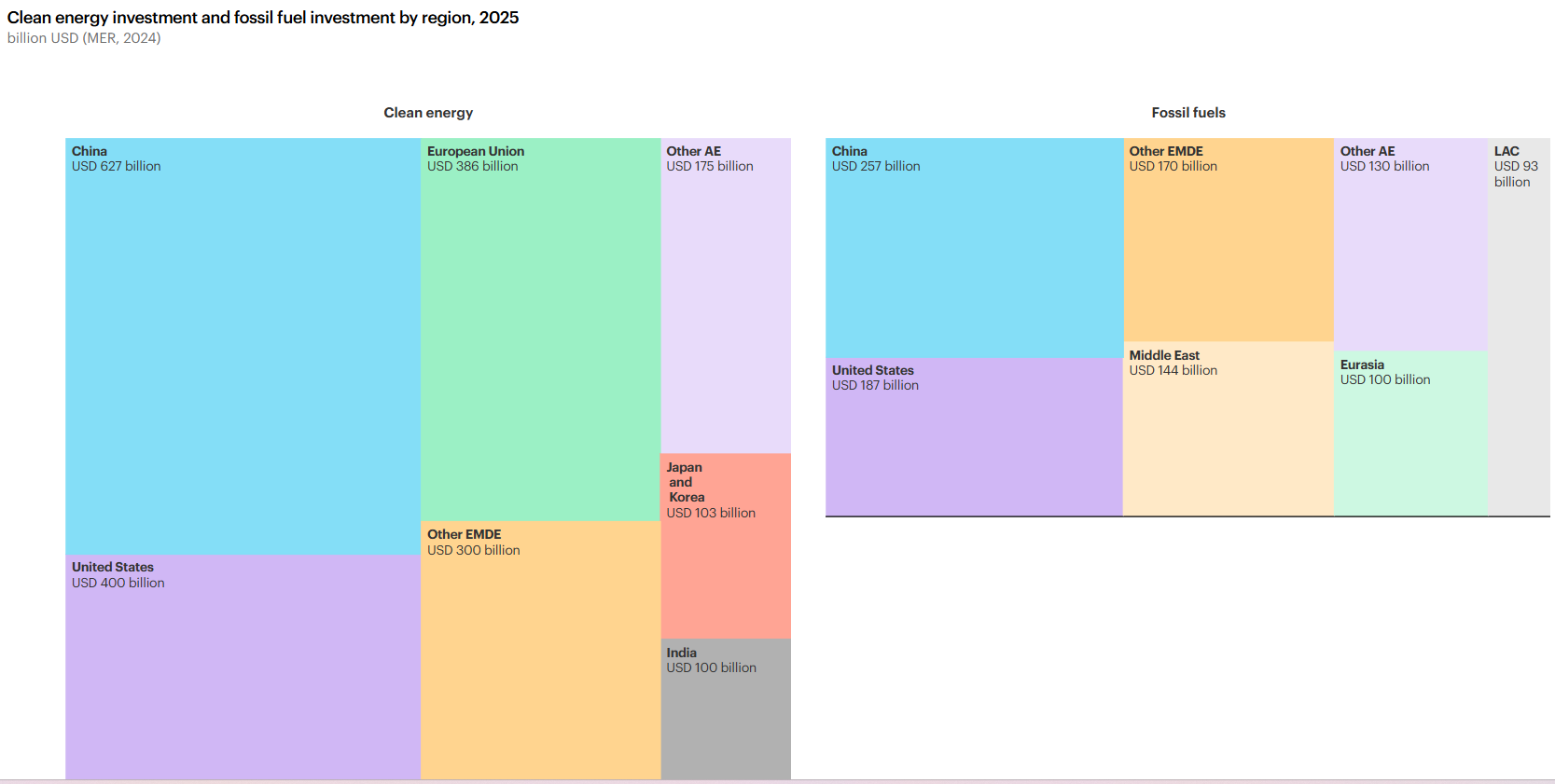
According to the International Energy Agency, China invested more than $627 billion in clean energy in 2025 alone. That represented roughly one-third of all global clean energy investment last year.

China clen energy investment 2025
Source: IEA

China’s Clean Energy Boom Is Reshaping Global Markets

China is now the center of the global clean energy economy. The country added 434 gigawatts of new solar and wind capacity in 2025, according to China’s National Energy Administration. That was more than the rest of the world combined.

The world’s biggest carbon emitter also dominates major supply chains tied to the energy transition:

  • More than 80% of global solar panel manufacturing.
  • Around 70% of the lithium-ion battery production capacity. 
  • The world’s largest electric vehicle market.

The China Association of Automobile Manufacturers said China sold 16.49 million new energy vehicles in 2025. EVs and plug-in hybrids now make almost 48% % of all new vehicle sales in the country for that year.

China’s climate goals are also driving investment growth. The country aims to peak carbon emissions before 2030 and reach carbon neutrality before 2060.

To support those goals, China continues expanding its national carbon market. The emissions trading system launched in 2021 and is already the world’s largest carbon market by emissions covered. Regulators are also preparing to add industries such as steel, cement, and aluminum.

At the same time, electricity demand is rising quickly because of AI infrastructure, data centers, and industrial electrification. This is increasing investment in batteries, smart grids, and renewable power systems.

These trends are creating major financing opportunities for banks like HSBC.

HSBC Doubles Down on Its Climate Finance Strategy

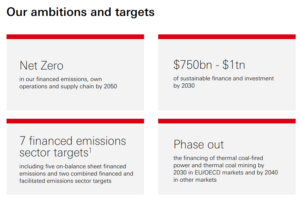
HSBC has made climate finance one of its biggest long-term growth areas. The bank previously committed to provide between $750 billion and $1 trillion in sustainable finance and investment by 2030.

HSBC net zero and climate finance goals
Source: HSBC

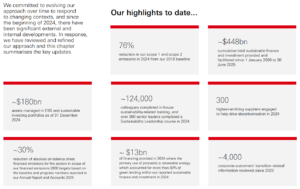
By the end of 2025, HSBC reported that it had already provided over $495.6 billion for that goal. This included lending, bonds, advisory services, and investment activities.

The bank is also working toward net-zero emissions across both its operations and financed emissions by 2050.

Financed emissions are especially important for large banks. These emissions come from the companies and projects that banks support through loans and investments.

HSBC said its Scope 1 and 2 operational emissions dropped about 76% from 2019 levels by 2024, according to its latest net zero transition plan. The decline came from higher renewable electricity use, energy efficiency improvements, and lower energy consumption across its operations.

HSBC climate goal progress
Source: HSBC

The company also said renewable electricity now covers nearly all the electricity used across its offices and operations worldwide. However, the bank still faces pressure over fossil fuel financing.

Groups like the Rainforest Action Network report that major global banks still fund oil and gas projects heavily. HSBC has tightened its fossil fuel policies recently. They’ve set limits on coal financing. Still, environmental groups want stricter lending rules.

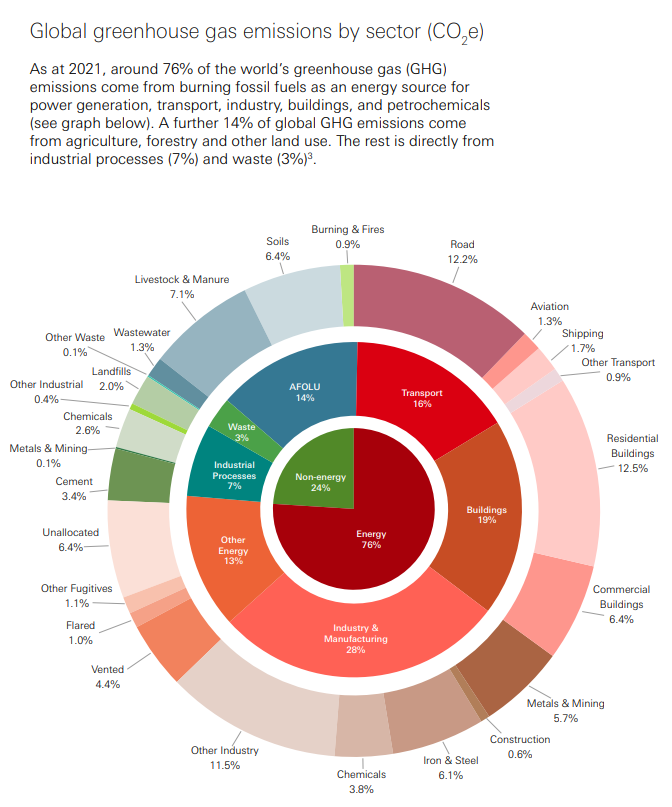
This reflects a wider challenge across the financial sector. Banks are trying to balance climate targets with ongoing energy demand and industrial growth. The company’s latest GHG emissions by sector are as follows:

HSBC ghg emissions by sector
Source: HSBC

AI and Data Centers Are Driving New Energy Demand

Another major trend behind HSBC’s latest move is the rapid growth of AI infrastructure.

AI systems and hyperscale data centers need huge amounts of electricity. The International Energy Agency estimates that global data center electricity demand could more than double by 2030 in high-growth AI scenarios. This is increasing demand for clean electricity, battery storage, and grid upgrades.

China is already expanding power infrastructure to support this growth. State Grid Corporation of China plans to invest record amounts this decade. This is due to rising electricity demand from AI computing and industrial electrification.

Battery storage is becoming especially important. BloombergNEF expects global energy storage deployments to pass 1 terawatt-hour annually before 2030. This creates strong demand for financing across clean energy supply chains.

Low-carbon industries are no longer limited to solar farms and wind turbines. They now include batteries, semiconductors, smart grids, hydrogen systems, and AI-related infrastructure.

That broader shift is helping to make climate finance a core part of industrial and technology investment.

Green Finance Competition Is Accelerating

HSBC is not alone in expanding climate financing. Banks across Asia, Europe, and North America are increasing investments in green bonds, renewable energy loans, and sustainability-linked financing.

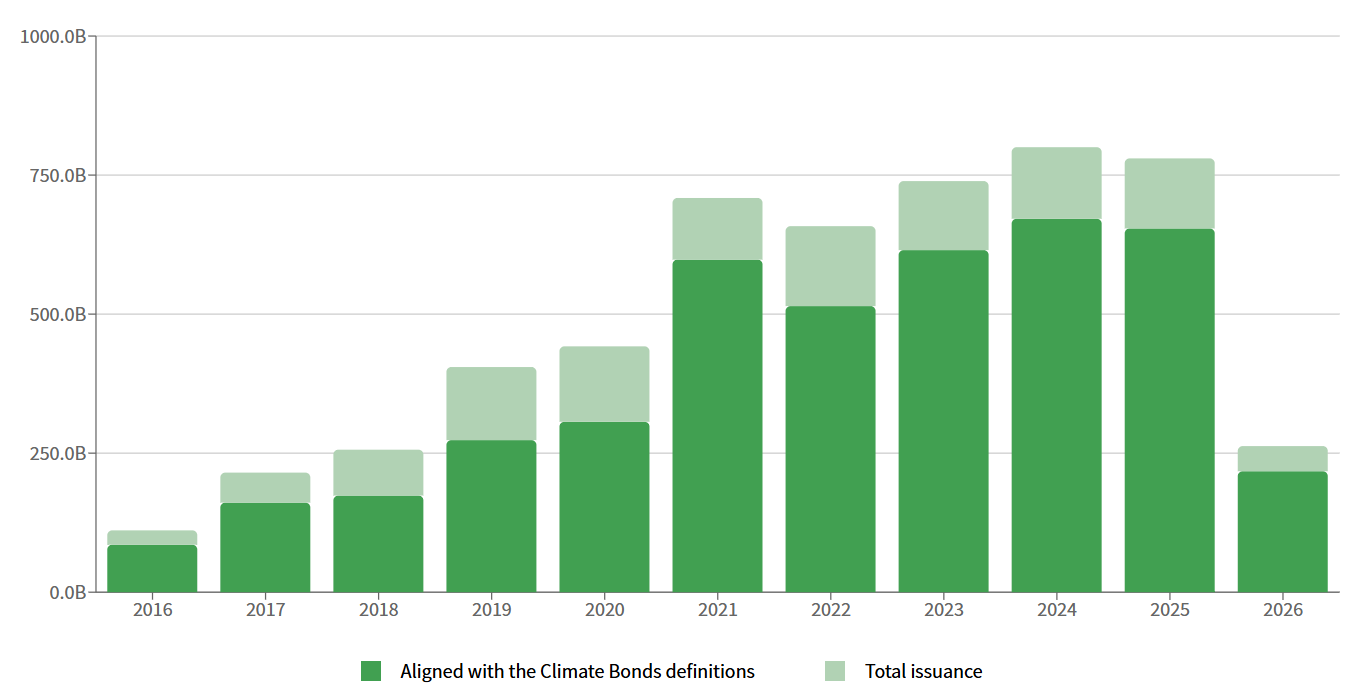
The Climate Bonds Initiative said global green bond issuance exceeded $650 billion in 2025. Sustainable finance markets are growing. Governments are tightening climate policies. Companies are also investing in emissions reduction projects.

Climate Bonds initiative climate finance
Source: Climate Bonds Initiative

Competition is especially strong in Asia because the region is expected to account for a large share of future clean energy spending. At the same time, climate finance is becoming more connected to industrial policy and energy security.

Countries now see renewable energy, batteries, and grid systems as strategic industries. Financing these sectors is no longer viewed only as ESG investing. It is increasingly tied to manufacturing growth, trade policy, and long-term economic competitiveness.

Climate Finance Is Becoming Core Economic Infrastructure

HSBC’s $4 billion China initiative shows how climate finance is moving into the center of the global economy. The bank is targeting industries tied to electrification, renewable energy, battery storage, and industrial decarbonization. These sectors are growing quickly as countries respond to rising electricity demand and tighter climate rules.

China remains central to this transition. The country leads the world in solar, batteries, EVs, and renewable infrastructure investment. It also represents one of the largest future markets for industrial decarbonization financing.

For HSBC, the initiative strengthens its position in one of the fastest-growing parts of global banking. For the broader market, it shows that finance, energy systems, AI infrastructure, and climate policy are becoming more connected than ever before.

The post HSBC’s $4 Billion China Climate Bet Ignites the Global Green Finance Race appeared first on Carbon Credits.

Holtec International Brings SMR-300 Technology to Rwanda to Shape Africa’s Nuclear Future

The Republic of Rwanda is advancing its nuclear energy plans. It signed an agreement with Holtec International to use the SMR-300 small modular reactor. This deal shows Rwanda’s aim to lead in Africa’s nuclear technology and boost energy security while fostering economic growth.

The agreement was signed at the Nuclear Energy Innovation Summit for Africa (NEISA) 2026. Officials from Rwanda, the U.S., and global nuclear organizations were present. Rafael Marin from Holtec Europe and Dr. Fidele Ndahayo, CEO of the Rwanda Atomic Energy Board, signed the deal.

The signing also included a civil nuclear cooperation memo between the U.S. and Rwanda. Key officials like Renee Sonderman from the U.S. State Department and Dr. Usta Kayitesi, Rwanda’s Minister of State for Foreign Affairs, attended.

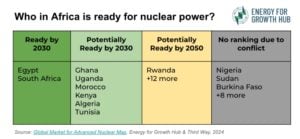
Under Paul Kagame’s leadership, NEISA 2026 focused on how nuclear power can help African nations meet rising electricity needs while cutting emissions. Major groups like the International Atomic Energy Agency and the United Nations Economic Commission for Africa supported the summit.

  • RELATED: Live Uranium Prices Today

Why Rwanda Is Turning to Small Modular Reactors

Rwanda’s electricity demand is expected to increase sharply. By 2050, it could rise nearly sevenfold compared to 2023. This growth stems from expanding industries, urbanization, and more people gaining access to power.

Currently, Rwanda relies heavily on fossil fuels for electricity. Hydropower is the main low-carbon source, while solar and wind contribute only a small share.

These trends push Rwanda to consider nuclear energy for the long term. Small modular reactors (SMRs) can provide reliable, carbon-free electricity with less infrastructure than traditional plants.

Holtec’s SMR-300 is designed for countries with growing electricity needs and developing power grids. It uses pressurized water reactor technology and has passive safety systems for minimal human intervention. Holtec calls it “walk-away safe,” meaning it can shut down safely during emergencies without operator action.

Rwanda

What Makes the SMR-300 Different

The SMR-300 has several advanced features focused on safety and efficiency. One major advantage is its small footprint; it needs only about 38 acres to generate over 600 megawatts of electricity.

The reactor can use water- or air-cooling systems, making it adaptable to different climates and water conditions. This flexibility is crucial for African countries with varied water availability.

Other key features include:

  • An advanced Reactor Coolant System (RCS) using a Once-Through Steam Generator (OTSG) with an integral pressurizer for better efficiency.
  • A two-loop pressurized water reactor with vertically mounted coolant pumps and one steam generator for superheated steam at full power.

Advantages of the SMR-300

Holtec designed the SMR-300 for long life and lower maintenance. Engineers aimed to cut down on corrosion, erosion, vibration damage, and wear for better reliability.

This reactor can help stabilize electricity grids, vital in developing economies where demand fluctuates. Unlike renewables, nuclear plants provide a steady baseload of electricity.

Holtec Expands Its Global Nuclear Ambitions

For Holtec, the Rwanda agreement is part of its global growth strategy.

The company is also deploying its first SMR-300 at the Palisades Nuclear Plant in the U.S. This project could be among the first operational small modular reactors in the country.

Holtec President Dr. Richard M. Springman announced that the company will support Rwanda with a complete nuclear development model. This model covers reactor technology, engineering, construction, spent fuel management, operational support, and future decommissioning.

Holtec is working with Hyundai Engineering & Construction on engineering and construction for the SMR-300 program.

Africa’s Power Mix Still Depends Heavily on Fossil Fuels

Africa’s electricity sector still relies mostly on fossil fuels, even as countries seek cleaner energy.

The International Atomic Energy Agency reports:

  • Nuclear power provided about 2% to 3% of Africa’s electricity from 1990 to 2010, dropping to below 1% in 2023.
  • Fossil fuels accounted for about 75% of Africa’s electricity production in 2023.
  • Natural gas use has grown steadily, while coal’s share has decreased.
  • Hydropower was Africa’s largest low-carbon electricity source in 2023, contributing around 18%.
  • Wind and solar energy are expanding, but made up only about 5% of electricity generation in 2023.

Electricity Demand in Africa Could Rise 7x by 2050

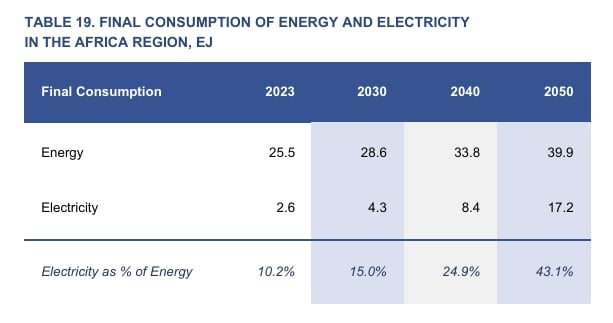
Africa’s final energy consumption could rise by nearly 60% by 2050 compared to 2023. Electricity demand is expected to grow even faster due to population increases, industrial expansion, and improved access to power.

The IAEA predicts that Africa’s electricity generation capacity may grow nearly sevenfold by 2050. This rapid growth will require countries to build reliable and affordable electricity systems quickly.

electricity africa
Source: IAEA

Can Nuclear Power Help Africa Meet Its Soaring Energy Demand?

Countries like Rwanda are looking into small modular reactors for their energy futures. Unlike some renewables that depend on weather, nuclear power can provide stable, carbon-free electricity 24/7.

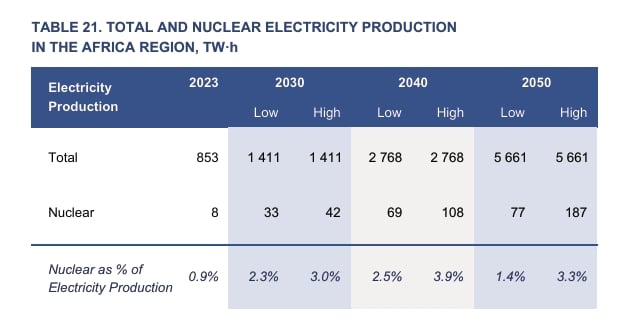
Projections indicate that Africa’s nuclear capacity could increase by 2050. Though nuclear energy is a smaller part of the energy mix, many governments see it as a way to enhance energy security, support industrial growth, and reduce emissions.

Nuclear electricity
Source: IAEA

Rwanda’s partnership with Holtec International reflects a broader energy transition in Africa. Countries are seeking reliable, cleaner power sources to meet future demand.

The post Holtec International Brings SMR-300 Technology to Rwanda to Shape Africa’s Nuclear Future appeared first on Carbon Credits.

Surge Battery Metals (NILI) Upgrades Nevada North to 10.5 Mt LCE M&I Resource as U.S. Lithium Development Gains Momentum

Disseminated on behalf of Surge Battery Metals Inc. 

Surge Battery Metals has announced a major resource upgrade at its flagship Nevada North Lithium Project (NNLP). This boosts the company’s position in the growing U.S. lithium supply chain race.

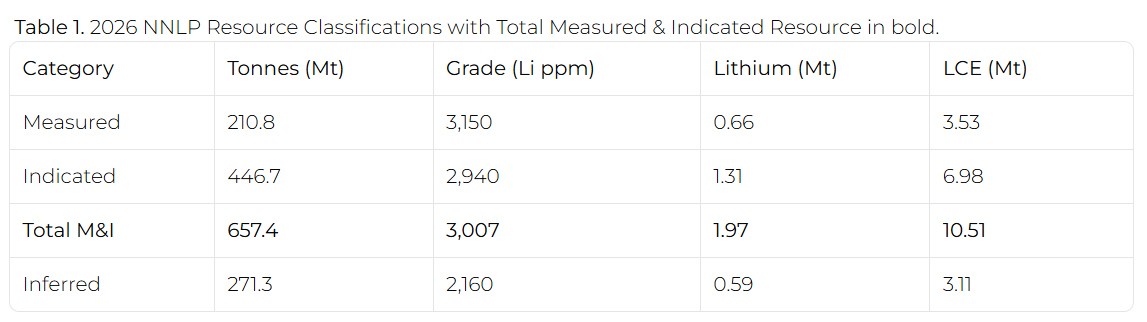
The updated mineral resource estimate outlines 657.4 million tonnes grading 3,007 ppm lithium, containing 10.5 million tonnes of lithium carbonate equivalent (LCE) in the Measured and Indicated category. The estimate also includes 6.7 million tonnes LCE grading 3,820 ppm lithium, highlighting the project’s high-grade core zones.

The new figures mark a major step forward for NNLP as the project moves from exploration success toward development-stage validation. The upgrade also comes as the United States pushes to expand domestic lithium supply to support electric vehicles, battery manufacturing, and energy storage growth.

NILI updated MRE
Source: Surge Battery Metals

Mr. Greg Reimer, President, Chief Executive Officer, and Director of Surge, stated,

“This resource update is a watershed moment for Surge and our joint venture partners at Evolution Mining. Delivering over 10.5 million tonnes of LCE into the Measured and Indicated category at grades exceeding 3,000 ppm Li underscores the significance of the NNLP deposit. This MRE highlights the sheer scalability of the NNLP with the PEA mine plan only using 3.6Mt of the M&I resource. The primary objective of this MRE update was to de-risk the resource for the Pre-Feasibility Study, and the geological data has emphatically delivered.”

Resource Confidence Improves as More Material Moves Into M&I Category

One of the most important parts of the update is the sharp increase in Measured and Indicated resources, often referred to as the M&I category.

Measured and Indicated resources carry higher geological confidence than inferred resources. They are more useful for mine planning, engineering studies, financing, and future permitting work.

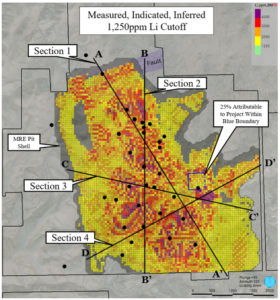
The company reports that 87% of the material in the current Preliminary Economic Assessment (PEA) pit shell is now in the M&I category. This is an important milestone because it reduces uncertainty around the existing mine plan.

surge battery metals updated resource
Source: Surge Battery Metals

The new estimate includes an additional 3.1 million tonnes LCE in the inferred category. This allows for future growth and more drilling potential.

NNLP Resource Far Exceeds Current PEA Mine Plan

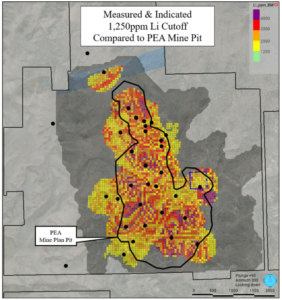
Another key takeaway from the resource update is the scale difference between the current mine plan and the overall resource base. The company’s existing PEA uses only about:

  • 3.6 million tonnes LCE grading 4,016 ppm lithium
  • compared to the newly updated 10.5 million tonnes LCE M&I resource

This suggests the project may support a much larger operation or a longer mine life than originally modeled. The PEA released earlier by the company outlined:

  • an after-tax net present value (NPV8) of about US$9.17 billion
  • an after-tax internal rate of return (IRR) of 22.8%
  • estimated operating costs of around US$5,243 per tonne LCE

Surge Measured and Indicated resource compared with PEA
Source: Surge Battery Metals

Those economics helped position NNLP as one of the more closely watched lithium clay projects in the United States.

High Grades Continue to Stand Out Among U.S. Clay Lithium Projects

Grade remains one of NNLP’s strongest differentiators.

The updated resource maintains lithium grades above 3,000 ppm across large portions of the deposit, while some zones exceed 3,800 ppm lithium. These grades compare favorably with several other U.S. lithium clay projects currently under development.

Higher-grade deposits can offer important advantages, including:

  • more lithium produced per tonne mined, 
  • potentially lower processing costs, and
  • improved project economics over time.

The project’s location in Nevada also adds to its strategic relevance. Nevada is now one of the most important lithium regions in North America as automakers and battery companies look for domestic supply sources.

New Drilling and Geological Modeling Strengthen Confidence in NNLP Resource

The updated resource estimate comes from a major drilling and geological modeling program done at the NNLP deposit.

The 2025 infill and step-out campaign involved nine drill holes totaling 4,634.5 feet (1,412.6 meters). This work supported the updated Mineral Resource Estimate.

Engineering firm RESPEC used drilling data and 3D geological models prepared by the company to identify and estimate lithium-bearing clay zones in the project area.

The process included:

  • statistical analysis of lithium grades within key clay units
  • geostatistical modeling to improve estimation confidence
  • construction of a large block model to map lithium distribution throughout the deposit

The lithium grades were interpolated into a block model, which used 50-meter by 50-meter horizontal blocks and 5-meter vertical intervals. This method improved understanding of the deposit’s size, continuity, and grade distribution. The company also outlined several areas that could support future resource growth and grade improvements.

One opportunity comes from tighter drill spacing in areas with lower drill density. Surge believes additional infill drilling could improve grade estimates in these zones, similar to results seen in the recent infill program.

The company also plans to expand its higher-grade lithium footprint, where zones grading above 3,000 ppm lithium remain open to the south and east of the basin. 

Also, new high-resolution topographic surveys found shallow areas. These spots could lead to more tonnage growth, especially in the northeast part of the project. These findings show that NNLP can grow beyond the current resource model. This is possible as drilling and engineering work keep progressing.

PFS Work Advances as Surge Pushes Toward Development

Surge Battery Metals is now advancing work toward a Pre-Feasibility Study (PFS), targeted for completion in the fourth quarter of 2026.

The company also continues to benefit from its partnership with Evolution Mining, which entered a joint venture with Surge and committed up to C$10 million to fund the Pre-Feasibility Study.

The combination of the following helps strengthen NNLP’s position as it moves further along the development path:

  • a larger M&I resource,
  • strong lithium grades,
  • positive PEA economics, and
  • growing regional validation in Nevada.

Nevada Lithium Gains More Attention as Thacker Pass Advances

The broader Nevada lithium sector has gained momentum following major investments and development activity in the region.

Lithium Americas’ Thacker Pass project continues moving toward production. This helps validate Nevada clay lithium as a commercially viable resource. General Motors also committed roughly $625 million to support the project, marking one of the largest automaker investments ever made in a U.S. lithium development project.

That progress matters for companies like Surge Battery Metals because it helps reduce concerns about developing clay-hosted lithium deposits in Nevada.

As more infrastructure, processing knowledge, and investment move into the region, nearby and next-generation projects such as NNLP may benefit from growing industry confidence.

NNLP Emerges as a Key U.S. Lithium Growth Asset

The latest resource upgrade marks an important milestone for Surge Battery Metals (NILI) and its Nevada North Lithium Project.

By significantly increasing higher-confidence Measured and Indicated resources, the company has strengthened the project’s development profile while also highlighting the larger long-term scale potential of NNLP.

At the same time, growing U.S. interest in domestic lithium supply continues to support Nevada’s importance in the North American battery supply chain.

As lithium demand rises and new supply becomes increasingly important, projects that combine scale, grade, and improved development confidence are likely to remain in focus across the sector.

DISCLAIMER 

New Era Publishing Inc. and/or CarbonCredits.com (“We” or “Us”) are not securities dealers or brokers, investment advisers, or financial advisers, and you should not rely on the information herein as investment advice. Surge Battery Metals Inc. (“Company”) made a one-time payment of $75,000 to provide marketing services for a term of two months. None of the owners, members, directors, or employees of New Era Publishing Inc. and/or CarbonCredits.com currently hold, or have any beneficial ownership in, any shares, stocks, or options of the companies mentioned.

This article is informational only and is solely for use by prospective investors in determining whether to seek additional information. It does not constitute an offer to sell or a solicitation of an offer to buy any securities. Examples that we provide of share price increases pertaining to a particular issuer from one referenced date to another represent arbitrarily chosen time periods and are no indication whatsoever of future stock prices for that issuer, and are of no predictive value.

Our stock profiles are intended to highlight certain companies for your further investigation; they are not stock recommendations or an offer or sale of the referenced securities. The securities issued by the companies we profile should be considered high-risk; if you do invest despite these warnings, you may lose your entire investment. Please do your own research before investing, including reviewing the companies’ SEDAR+ and SEC filings, press releases, and risk disclosures.

It is our policy that the information contained in this profile was provided by the company, extracted from SEDAR+ and SEC filings, company websites, and other publicly available sources. We believe the sources and information are accurate and reliable, but we cannot guarantee them.

CAUTIONARY STATEMENT AND FORWARD-LOOKING INFORMATION

Certain statements contained in this news release may constitute “forward-looking information” within the meaning of applicable securities laws. Forward-looking information generally can be identified by words such as “anticipate,” “expect,” “estimate,” “forecast,” “plan,” and similar expressions suggesting future outcomes or events. Forward-looking information is based on current expectations of management; however, it is subject to known and unknown risks, uncertainties, and other factors that may cause actual results to differ materially from those anticipated.

These factors include, without limitation, statements relating to the Company’s exploration and development plans, the potential of its mineral projects, financing activities, regulatory approvals, market conditions, and future objectives. Forward-looking information involves numerous risks and uncertainties and actual results might differ materially from results suggested in any forward-looking information. These risks and uncertainties include, among other things, market volatility, the state of financial markets for the Company’s securities, fluctuations in commodity prices, operational challenges, and changes in business plans.

Forward-looking information is based on several key expectations and assumptions, including, without limitation, that the Company will continue with its stated business objectives and will be able to raise additional capital as required. Although management of the Company has attempted to identify important factors that could cause actual results to differ materially, there may be other factors that cause results not to be as anticipated, estimated, or intended.

There can be no assurance that such forward-looking information will prove to be accurate, as actual results and future events could differ materially. Accordingly, readers should not place undue reliance on forward-looking information. Additional information about risks and uncertainties is contained in the Company’s management’s discussion and analysis and annual information form for the year ended December 31, 2024, copies of which are available on SEDAR+ at www.sedarplus.ca.

The forward-looking information contained herein is expressly qualified in its entirety by this cautionary statement. Forward-looking information reflects management’s current beliefs and is based on information currently available to the Company. The forward-looking information is made as of the date of this news release, and the Company assumes no obligation to update or revise such information to reflect new events or circumstances except as may be required by applicable law.

The post Surge Battery Metals (NILI) Upgrades Nevada North to 10.5 Mt LCE M&I Resource as U.S. Lithium Development Gains Momentum appeared first on Carbon Credits.
Fortescue Targets Fossil-Free Mining with Massive Solar and Battery Expansion for Pilbara

Fortescue, the Australian mining giant, is building its 690MW Turner River solar farm in Western Australia’s Pilbara region. This project is key to its goal of eliminating fossil fuels from iron ore operations by 2030 as part of its “Real Zero” strategy.

Fortescue is also developing a 650MWh battery energy storage system (BESS) at Cloudbreak. Together, these projects will strengthen the “Pilbara Green Grid,” which supplies clean electricity to mines, railways, and ports.

In the broader context, Australia is increasing its renewable energy supply. This aims to meet rising electricity demand and help industries cut carbon emissions.

australia energy consumption
Source: Australian Energy Statistics – Update Report 2025

Fortescue Builds One of Australia’s Largest Mining Renewable Networks

Fortescue’s “Real Zero” strategy is the company’s plan to eliminate fossil fuel use and operational emissions from its iron ore operations without relying heavily on carbon offsets.

Unlike many net-zero plans that use carbon credits to balance emissions, Fortescue’s Real Zero approach focuses on directly cutting emissions at the source through renewable energy and electrification.

Key Goals of the Real Zero Strategy

  • Achieve “Real Zero” emissions across Fortescue’s terrestrial iron ore operations by 2030
  • Replace diesel and gas with renewable electricity, battery storage, and green technologies
  • Electrify mining equipment, rail systems, and haul trucks
  • Build large-scale solar, wind, and battery projects across the Pilbara region
  • Reduce exposure to volatile fossil fuel prices and improve long-term energy security
fortescue
Source: Fortescue

The Turner River solar project is the last major solar installation needed for Fortescue’s Real Zero target. When completed in 2028, the solar farm will have more than one million solar panels in the Pilbara.

This facility will join three other significant solar projects currently underway:

  • Solomon Airport Solar Farm – 440MW
  • Cloudbreak Solar Farm – 190MW
  • North Star Junction Solar Farm – 100MW

With Turner River, Fortescue’s solar capacity will top 1.4GW. This can power almost half a million Australian homes each year.

The company is boosting battery storage for reliable power at remote mining sites. The Cloudbreak BESS will provide 74MW for about eight hours. It uses 124 battery units connected to the Cloudbreak solar farm.

Fortescue has activated battery systems at Eliwana and North Star Junction. This boosts the reliability of renewable power in the Pilbara mining network.

Fortescue Speeds Up Australia’s Industrial Energy Transition

Fortescue’s investment marks a significant shift in Australia’s energy landscape. The country is rapidly increasing its renewable electricity as governments and industries push for decarbonization.

Australia’s electricity demand is expected to rise strongly over the next 20 years due to the growth of electric vehicles, hydrogen production, industrial electrification, and decarbonization efforts.

  • According to the Australian Energy Market Operator (AEMO), renewables supplied more than 50% of electricity in Australia’s main power grid for the first time in late 2025, while electricity demand increased by 2.2%.
  • In Western Australia, where Fortescue works, electricity demand is high. This is due to mining and mineral processing. The Pilbara region hosts some of the largest iron ore operations in the world. These operations have relied heavily on diesel and gas.

Australia energy consumption

Global investors and steelmakers want lower-carbon supply chains. So, mining companies need to cut emissions but keep production steady.

Pilbara Green Grid Expands Beyond Solar

Fortescue’s Pilbara Green Grid includes more than just solar power. The company is also investing in wind energy and transmission infrastructure to create a diverse clean energy system.

  • Construction is underway for the 133MW Nullagine Wind Farm, which will supply renewable electricity when solar generation decreases.

To connect these renewable assets, Fortescue has built over 480 kilometers of high-voltage transmission lines in the Pilbara. The complete network is expected to extend beyond 620 kilometers.

This grid will directly link renewable energy to Fortescue’s mines, rail operations, and export facilities. This integrated system aims to reduce reliance on diesel and gas while improving long-term energy security.

The scale of this infrastructure shows how mining companies are becoming renewable energy developers instead of relying solely on utility power.

Electrification of Mining Equipment Gains Speed

Fortescue is not just replacing fossil fuel-based electricity generation. The company is also electrifying its mining fleet.

Currently, 16 electric excavators and one electric drill are in use at Fortescue’s iron ore sites. The company expects about half of its excavator fleet to be electric by the end of 2026.

Fortescue’s first battery-electric haul truck is set to start operations before the year ends. These trucks are among the largest mining vehicles, marking an important milestone.

  • To support this transition, Fortescue has begun commissioning its first in-house developed 6MW fast charger. This charger can fully recharge a haul truck in about 30 minutes, helping maintain productivity while reducing diesel use.

The company is also working with Chinese manufacturer XCMG to test prototype battery-electric mining equipment, including wheel loaders and dozers.

Additionally, Fortescue has commissioned battery-electric locomotives for its rail network, expected to cut around one million liters of diesel consumption each year.

forescue
Source: Fortescue

Rising Fuel Costs Strengthen the Case for Renewables

Fortescue executives say the economics now favor renewable energy and electrification.

CEO Dino Otranto noted that while many industries debate large-scale decarbonization, Fortescue is moving ahead.

Otranto pointed out that better technology and lower renewable energy costs are making clean energy investments more attractive. Ongoing fluctuations in global fuel markets also add to this appeal.

This trend impacts Australia’s power market. Recent data shows that electricity generation costs dropped in early 2026. This change comes as renewable energy and battery storage lessen the need for costly gas.

Mining companies globally face pressure from investors and governments to cut emissions. Renewable-powered mining can help Australia maintain its top spot in iron ore and critical minerals exports as supply chains focus more on carbon reduction.

A Global Test Case for Green Mining

Fortescue’s Pilbara Green Grid is emerging as one of the largest renewable energy systems for mining. This project could serve as a model for heavy industries wanting to reduce emissions while remaining reliable.

Solar farms, wind generation, battery storage, high-voltage transmission, and electric mining vehicles show how large operations can shift from fossil fuels.

If successful, Fortescue’s strategy could transform how mining companies use energy and cut carbon emissions worldwide.

The post Fortescue Targets Fossil-Free Mining with Massive Solar and Battery Expansion for Pilbara appeared first on Carbon Credits.