CORSIA and SAF: The Complete Guide to Aviation’s Net-Zero Future

Aviation is entering a new phase in its efforts to cut carbon emissions. As air travel grows, airlines face pressure to reduce emissions while meeting the demands of long-distance flight. Carbon Offsetting and Reduction Scheme for International Aviation (CORSIA) and sustainable aviation fuel (SAF) are becoming key tools, creating new policies, markets, and investment opportunities across the aviation industry.

This guide explains how CORSIA works, how SAF fits into aviation’s decarbonization strategy, and where the market is headed. It covers CORSIA rules and timelines, eligible carbon credits and fuels, SAF production pathways, market trends, costs, policy drivers, and the supply gap the industry must close to reach net zero.

CORSIA and SAF: Why Aviation Needs a New Decarbonization Strategy 

Aviation is one of the harder sectors to decarbonize. Aircraft need energy-dense fuels that can support long flights without adding excessive weight. Unlike cars, most commercial aircraft cannot yet switch to large battery systems at scale.

Aviation produces about 2.5% of global human-caused CO₂ emissions, according to the International Air Transport Association (IATA). Its wider climate impact also includes non-CO₂ effects such as contrails and nitrogen oxide emissions.

This makes aviation’s transition more complex than simply replacing fossil fuels with electricity. More efficient aircraft, improved flight operations and new propulsion systems can all reduce emissions. However, sustainable aviation fuel could play a major role in the near term.

SAF can be produced from feedstocks such as used cooking oil, agricultural waste and other renewable materials. It can also be used in existing aircraft as a drop-in fuel, allowing airlines to reduce lifecycle emissions without replacing their fleets. IATA estimates SAF could provide about 65% of the emissions reductions needed for aviation to reach net-zero CO₂ emissions by 2050.

SAF is not the only solution. CORSIA, ICAO’s global market-based measure for international aviation, addresses emissions that remain after other reduction measures. Together, SAF and CORSIA form two important parts of aviation’s broader path toward net zero.

What Is CORSIA? 

CORSIA is a global system created by the International Civil Aviation Organization (ICAO) to address the growth of CO₂ emissions from international aviation. It works alongside cleaner fuels, aircraft efficiency, and improved flight operations.

CORSIA’s offsetting requirements apply to eligible international flights between participating states. Domestic aviation is outside the scheme’s offsetting system. Airlines covered by CORSIA must also monitor, report, and verify their emissions under the program’s MRV requirements.

For 2024–2035, CORSIA uses a baseline equal to 85% of 2019 emissions. When an airline has an offsetting requirement, it must cancel eligible emissions units to cover the required amount.

CORSIA is therefore different from a conventional carbon tax. It creates a framework for managing specific international aviation emissions through approved emissions units.

The scheme also recognizes the emissions benefits of CORSIA Eligible Fuels, including qualifying SAF. This creates an important link between aviation fuel markets and carbon markets.

  • In simple terms, SAF helps reduce aviation’s emissions, while CORSIA provides a framework for addressing some emissions that remain.

CORSIA Timeline: From Pilot Phase to Full Implementation

CORSIA was adopted by ICAO in 2016 and is being introduced in stages. This phased approach gives airlines, governments, and carbon-market participants time to build the systems needed for monitoring emissions and meeting offsetting requirements.

The Pilot Phase ran from 2021 to 2023. During this period, participation was voluntary, allowing countries and airlines to gain experience with CORSIA’s monitoring, reporting, and verification requirements.

The First Phase covers 2024 to 2026, with states participating voluntarily. However, airlines operating on routes between participating states can still be subject to CORSIA offsetting requirements. This is the phase CORSIA is currently in.

The Second Phase will run from 2027 to 2035. Participation becomes broader, although ICAO provides exemptions for certain states based on factors such as their level of international aviation activity and development status.

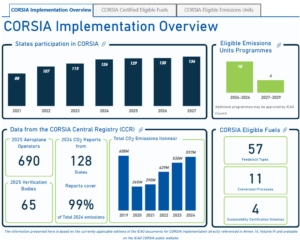
CORSIA implementation overview ICAO
Source: ICAO

As of 2026, 130 states participate voluntarily in CORSIA. ICAO lists 134 participating states from 2027, when the Second Phase begins. Together, these phases are designed to expand the system while giving countries time to establish the necessary regulatory and reporting frameworks.

Beyond 2035, CORSIA will continue to operate as part of ICAO’s wider strategy for achieving net-zero carbon emissions from international aviation by 2050.

How CORSIA Calculates Airline Offset Requirements

CORSIA does not require airlines to offset all of their international aviation emissions. Instead, it focuses on emissions above a set baseline.

  • From 2024 to 2032, the system mainly uses the growth of international aviation as a whole (100%). This is called the sectoral approach. It means an airline’s offset requirement is linked to the industry’s overall emissions growth, rather than only its own growth.
  • From 2033 to 2035, the calculation will use both industry-wide and airline-specific emissions growth. The sectoral share will be 85%, while the airline-specific share will be 15%.

Airlines can also reduce their CORSIA obligation by using CORSIA Eligible Fuels, including qualifying SAF. They must provide records showing the amount of fuel used and its emissions savings.

This gives airlines two main ways to lower their CORSIA costs:

  1. reduce emissions, and
  2. use eligible lower-carbon fuels.

CORSIA Carbon Credits: What Can Airlines Use?

Airlines with a CORSIA offsetting requirement must cancel approved CORSIA Eligible Emissions Units (carbon credits) to cover it. These are not the same as any carbon credits sold in the voluntary carbon market. ICAO has a specific approval process for carbon credit programs that want to supply units for CORSIA.

The organization checks programs against rules covering areas such as additionality, monitoring, verification, and double counting. These rules are designed to make sure the claimed emissions reductions are real and properly tracked.

ICAO updates its list of eligible programs and units over time. As of April 2026, the framework includes programs such as the American Carbon Registry, Climate Action Reserve, Gold Standard, Isometric, and Verra’s Verified Carbon Standard, subject to specific eligibility conditions.

Importantly, being part of an approved program does not mean every credit from that program can be used under CORSIA. Eligibility can depend on factors such as the credit type, vintage, compliance period, and additional authorization requirements.

This has created a potential supply problem…

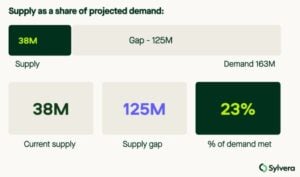
A July 2026 analysis from Sylvera estimates that CORSIA could create demand for about 163 million eligible emissions units (EEUs) during its first compliance phase, rising to 198 million credits under full implementation. Yet only about 38 million credits currently qualify, covering just 23% of expected first-phase demand. This creates a potential 125 million-credit supply gap.

corsia credit demand and supply gap sylvera
Source: Sylvera

The problem is not a lack of issued credits. About 300 million credits have been issued. However, many can’t qualify for CORSIA. They lack the necessary host-country Letters of Authorization or Corresponding Adjustments under Article 6 of the Paris Agreement.

By January 2028, the eligible supply might hit 640 million credits. However, Sylvera estimates that only about 104 million could be eligible due to authorization risks. Just 48 million are fully confirmed.

Airline purchases also remain limited. Only around 400,000 tonnes of CORSIA credits had been retired, equal to about 0.2% of expected first-phase demand. Delayed buying could create a rush for eligible credits as compliance deadlines approach.

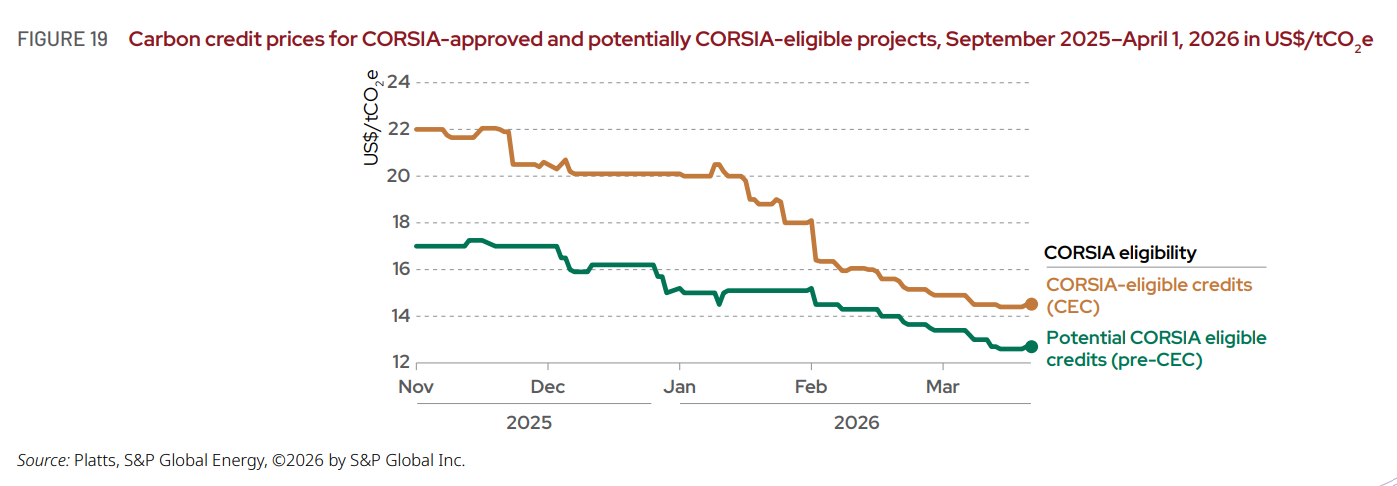
Carbon credit prices for CORSIA-approved

That shortage could push prices higher. Sylvera’s modeling puts first-phase credit prices at about $15 per tonne in a low case, $33 in a base case, and $53 in a high case by January 2028.

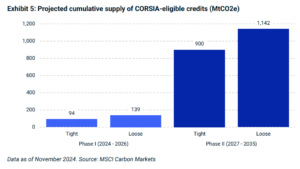
The long-term cost could be much larger. An MSCI Carbon Markets analysis shows that if supply tightens, CORSIA compliance costs might hit $127 billion from 2024 to 2035. By 2035, eligible credit prices could reach nearly $100 per tonne. Estimated exposure includes about $8 billion for Emirates, $6 billion for Qatar Airways, and $5 billion for United Airlines.

CORSIA eligible carbon credits supply

These figures show why CORSIA is becoming a distinct carbon market. The challenge is not simply finding credits, but securing enough high-quality, authorized units that meet CORSIA’s eligibility rules.

What Is Sustainable Aviation Fuel (SAF)?

Sustainable aviation fuel is aviation fuel made from renewable or waste-based materials. It is designed to replace part of the fossil jet fuel used by aircraft while producing lower emissions over its full lifecycle.

SAF can be made from feedstocks such as used cooking oil, animal fats, crop residues, forestry waste, and other biomass. Newer pathways can also use renewable electricity, hydrogen, and captured carbon to make synthetic fuels.

One of SAF’s main advantages is that it can work with today’s aircraft and fuel systems. Airlines can use approved SAF by blending it with conventional jet fuel, without replacing their existing fleets.

However, SAF is not automatically low-carbon. Its climate benefits depend on the feedstock, production method, energy source, and land-use impacts. CORSIA therefore uses lifecycle emissions to measure the climate performance of eligible fuels.

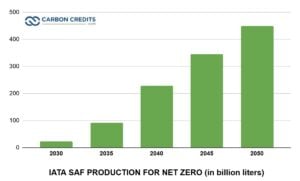
SAF also remains a very small part of the global fuel market. IATA expects global SAF production to reach about 2.4 million tonnes in 2026, equal to only 0.8% of total jet fuel use. But it must increase tremendously to 449 million tonnes by 2050 for net-zero aviation.

IATA SAF production for net zero 2050

This large gap between current supply and future demand is one of the biggest challenges facing aviation’s net-zero plans.

SAF Feedstocks and Production Technologies: How SAF is Made

SAF can be made from many different materials. The choice of feedstock affects the fuel’s cost, emissions, and ability to scale.

Today, some of the main feedstocks include used cooking oil, animal fats, agricultural residues, forestry waste, and other forms of biomass. Waste and residue feedstocks are attractive because they can avoid some of the land and food concerns linked to conventional crops. ICAO groups SAF feedstocks into categories such as primary products, by-products, wastes and residues.

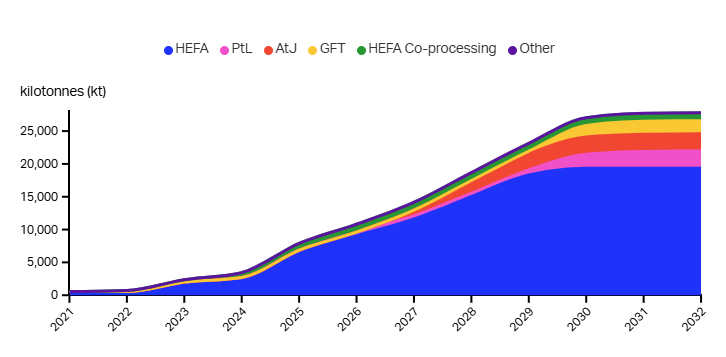
Several technologies can turn these materials into jet fuel. One of the most widely used is HEFA, which processes oils and fats with hydrogen. Other pathways include Fischer-Tropsch (FT), which can turn biomass or other carbon sources into fuel, and alcohol-to-jet (ATJ), which converts alcohols such as ethanol into aviation fuel.

Another emerging option is e-SAF, also called power-to-liquid fuel. It uses renewable electricity, hydrogen, and captured carbon to produce synthetic aviation fuel. This could greatly expand SAF supply because it is less dependent on biomass.

Announced SAF facilities
Announced SAF Facilities, Source: International Air Transport Association

However, each pathway faces challenges. Waste feedstocks are limited, while newer technologies are still expensive and need more production capacity.

  • This creates a key issue for the SAF market: the aviation industry needs much more fuel, but sustainable feedstocks and production capacity remain limited.

What Makes SAF Eligible Under CORSIA?

Not all SAF automatically qualifies under CORSIA. To receive CORSIA benefits, the fuel must meet ICAO sustainability rules and come from a producer certified under an ICAO-approved sustainability certification scheme.

One key requirement is emissions performance. CORSIA SAF produced from 2024 onward must achieve at least a 10% reduction in lifecycle greenhouse gas emissions compared with the baseline aviation fuel.

ICAO also considers factors such as land use, carbon stocks and the sustainability of the feedstock. This helps prevent fuels with poor environmental performance from receiving CORSIA benefits.

The system measures emissions across the fuel’s full lifecycle. This can include feedstock production, processing, transport, fuel production and aircraft use. It can also account for emissions linked to land-use change.

For airlines, this matters because qualifying SAF can lower their CORSIA offsetting requirement. The fuel must be properly certified, and its emissions savings must be supported by the required records. This creates a strong link between SAF production, sustainability certification, and the aviation carbon market.

ICAO’s CORSIA Eligible Fuels page was updated in June 2026. It now lists the Fourth Edition of the CORSIA Approved Sustainability Certification Schemes, and on June 22, 2026, ICAO approved Bonsucro as a new CORSIA-approved sustainability certification scheme.

The SAF Supply Gap: From 2.4M Tonnes to 500M

The biggest question for SAF is whether production can grow fast enough to meet future demand. As mentioned, IATA expects global SAF production to reach only 2.4 million tonnes in 2026. Yet, its net-zero pathway points to millions of tonnes of SAF per year by 2050.

  • That means production must increase by more than 200 times from today’s level.

The challenge is not only building more SAF plants. The industry also needs enough sustainable feedstock, hydrogen, renewable power, refining capacity, and transport infrastructure.

Waste oils and fats are useful today, but their supply is limited. Other options, such as agricultural and forestry waste, could provide more fuel but require large collection and processing networks.

E-SAF could eventually reduce some feedstock limits by using renewable electricity, hydrogen and captured carbon. But the technology remains expensive and needs much more clean power.

The 2030s will therefore be critical. Governments will need stronger policies, while airlines and fuel producers will need to commit more capital.

If production grows slowly, SAF could remain a scarce and expensive fuel. If investment and technology scale quickly, it could become a much larger part of the global aviation fuel market.

What Could Slow CORSIA and SAF Growth?

CORSIA and SAF face different challenges, but they are connected by the same goal: reducing aviation’s climate impact.

  • For CORSIA, one challenge is coverage. The system applies to international aviation, while domestic flights are outside its offsetting system. Its impact also depends on how many states participate and how effectively airlines follow the rules.
  • SAF faces a larger physical challenge. There is simply not enough low-carbon fuel available today. Production must grow much faster, while sustainable feedstocks remain limited.
  • Cost is another major barrier. Airlines operate in a price-sensitive industry, so buying large amounts of expensive SAF can be difficult without policy support or customer demand.
  • There is also a need for clear sustainability rules. SAF should deliver real emissions cuts without causing major damage through land-use change or other environmental impacts.

These challenges do not mean SAF or CORSIA will fail. They show why aviation needs a mix of solutions rather than relying on one technology or policy.

Conclusion: CORSIA and SAF Have Different Jobs

CORSIA and SAF are becoming important parts of aviation’s climate strategy, but they serve different purposes.

SAF tackles emissions at the fuel level. CORSIA helps address emissions that remain from international aviation. Together, they support a wider strategy that also includes better aircraft, more efficient operations and new technologies.

Closing the huge SAF production gap will require more than airline demand. Governments will need effective policies, producers will need major investment, and the industry will need new technologies and sustainable feedstocks.

CORSIA will also continue to evolve as its Second Phase begins in 2027. ICAO’s current framework already includes rules for eligible carbon units and fuels, giving the aviation industry a common system for managing international emissions.

The long-term outcome will depend on how quickly these systems can scale. For now, one point is clear: aviation’s path to net zero will depend heavily on making cleaner fuels available at much greater scale while strengthening the global rules that support emissions reductions.

The post CORSIA and SAF: The Complete Guide to Aviation’s Net-Zero Future appeared first on Carbon Credits.

Walmart (WMT Stock) Sales Rise as Emissions Fall, Putting Sustainability to the Test

Walmart (WMT Stock) Sales Rise as Emissions Fall, Putting Sustainability to the Test

Walmart delivered another quarter of sales growth on August 20, 2026, while its latest sustainability data shows a sharp drop in operational emissions. The world’s largest retailer is now balancing business growth with its goal of reaching zero Scope 1 and 2 emissions across global operations by 2040.

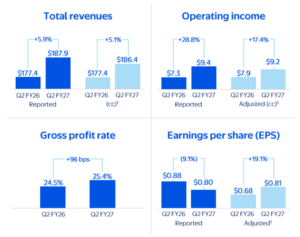
Walmart reported $187.9 billion in second-quarter fiscal 2027 revenue, up 5.9% from a year earlier. Global e-commerce sales jumped 23%, while Walmart U.S. comparable sales increased 2.6%. The company also raised its full-year sales outlook to 4% to 5% growth.

The results came as Walmart’s FY2026 ESG data showed Scope 1 and 2 emissions fell 7.5% year-over-year. Renewable sources supplied 53.3% of its global electricity needs, while its wider supply chain emissions remain far larger than its direct operational footprint.

Walmart Delivers Strong Revenue Growth, But U.S. Sales Lose Some Momentum

Walmart’s latest earnings show that the retailer continues to expand even as consumers face higher fuel costs and other economic pressures. Revenue reached $187.9 billion in the three months ended July 31, 2026. Global e-commerce sales rose 23%, with growth across Walmart’s major markets.

Walmart key financial metrics FY2027
Source: Walmart

However, Walmart U.S. comparable sales grew just 2.6%. Reuters reported that this was the company’s slowest quarterly comparable-sales growth in six years and below the 3.8% analyst expectation.

Despite the slower U.S. sales growth, Walmart raised its full-year outlook. The company now expects fiscal 2027 net sales to grow 4% to 5%.

Walmart (WMT Stock) Shares Slide After Earnings

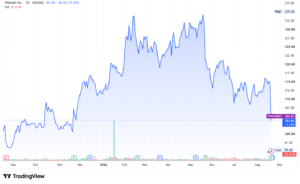
Walmart shares fell about 9.1% on August 20, despite the retailer beating earnings and revenue expectations. Investors focused on slower U.S. comparable-sales growth and weaker-than-expected third-quarter guidance, sending Walmart’s stock to its lowest level of 2026.

Walmart WMT stock price

The results show the scale of Walmart’s business. That scale also makes its climate strategy important. Changes in energy use, transport, refrigeration, packaging and products can affect emissions across a very large global supply chain.

Direct Emissions Drop 7.5% as Walmart Pushes Toward 2040

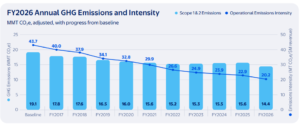
Walmart’s latest ESG report gives a more positive picture on direct emissions. In FY2026, Walmart cut its absolute Scope 1 and 2 emissions by 7.5% year-over-year.

The company said this brought its reduction to 24.6% from its FY2016 baseline. Operational emissions intensity also fell 11.6% year-over-year and 53.7% from FY2016.

Walmart annual GHG emissions 2026
Source: Walmart ESG Report

Scope 1 covers emissions from sources Walmart owns or controls, such as fuel use. Scope 2 covers emissions linked to the electricity it buys.

The retailer’s progress comes as it works toward zero Scope 1 and 2 emissions across its global operations by 2040. The company says it plans to reach that goal without relying on carbon offsets. Its plan includes more:

  • Renewable energy,
  • Cleaner vehicles,
  • Lower-impact refrigerants, and
  • Electrified equipment.

Renewables Now Power More Than Half of Walmart’s Electricity

Clean electricity is one of Walmart’s main tools for cutting emissions. Renewable sources supplied 53.3% of the company’s global electricity needs in FY2026, according to its ESG report. This puts Walmart above its earlier goal of powering 50% of its global operations with renewable energy by 2025.

  • The retail giant’s longer-term goal is to reach 100% renewable energy for its operations by 2035.

The retailer operates stores, clubs, distribution centers and other facilities across 19 countries. That means moving a large share of its electricity use to renewable sources can have a significant effect on its operational emissions.

Walmart is also expanding customer-facing clean energy services. Its U.S. stores and clubs had more than 1,300 electric vehicle charging stations in FY2025, per its ESG reporting.

Supply Chain Remains Walmart’s Bigger Carbon Challenge

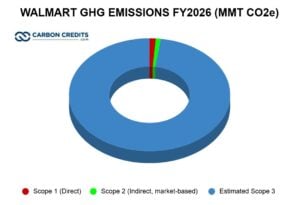
Walmart’s estimated Scope 3 emissions reached 635 million metric tons of CO2e in FY2026, far above its direct operational emissions. Although Scope 3 emissions intensity improved 8.29% from FY2022, total emissions increased as Walmart grew and its product mix changed.

The retailer is addressing this through Project Gigaton, which works with suppliers on energy, packaging, waste, products and nature. More than 4,300 suppliers reported progress in FY2026, with 187 million metric tons of CO2e in expected emissions avoided, reduced or sequestered.

Since 2017, cumulative reported results have topped 1.37 billion metric tons, exceeding Walmart’s original 1 billion-tonne goal for 2030. However, these figures are supplier-reported results and should not be treated as direct reductions in Walmart’s own Scope 3 inventory.

Walmart GHG emissions 2026

Looking Beyond Emissions to Protect Nature

Walmart’s sustainability work extends beyond emissions. In FY2026, Walmart said its suppliers and grantees reported sustainably managing, protecting or restoring 76.2 million acres of land and 3.68 million square miles of ocean.

The Walmart Foundation has invested more than $120 million since FY2021 in projects, research and other efforts linked to natural-resource protection. That included $30.5 million in FY2026. These programs matter to Walmart because forests, grasslands and oceans support the supply chains behind many products it sells.

The company says healthy natural systems can help protect water supplies, support climate resilience and reduce risks to long-term product availability.

Net-Zero Goal Has No Offset Shortcut

Walmart’s climate target stands out because the company does not plan to use carbon credit offsets to meet its operational zero-emissions goal. Its stated target is to achieve zero Scope 1 and 2 emissions across global operations by 2040 without relying on carbon offsets.

That means Walmart must continue cutting emissions from its own operations rather than simply balancing them with purchased credits.

The bigger challenge remains Scope 3. Walmart’s estimated 635 million tonnes of CO2e in FY2026 shows how much of its climate footprint sits outside its direct operations.

Can Walmart Grow Without Growing Its Footprint?

Walmart’s Q2 FY2027 earnings show a company that continues to grow at enormous scale. Its latest ESG data also shows that it is making progress in cutting direct emissions.

The 7.5% year-over-year drop in Scope 1 and 2 emissions and 53.3% renewable electricity share are important steps toward its 2040 goal. Yet, the bigger test is the supply chain.

Project Gigaton has helped suppliers report more than 1.37 billion tonnes of cumulative expected emissions reductions, removals and avoided emissions, but Walmart’s growing business will continue to affect its overall value chain footprint.

As Walmart raises its sales outlook and expands e-commerce, the company will need to keep reducing emissions while growing. For one of the world’s largest retailers, that balance could have a major effect on the carbon footprint of global consumer goods.

The post Walmart (WMT Stock) Sales Rise as Emissions Fall, Putting Sustainability to the Test appeared first on Carbon Credits.
Senken Signs 50,000-Tonne Biomass Carbon Removal Deal with Carbonsate in Namibia

Carbon removal buyer Senken and project developer Carbonsate have signed a 50,000-tonne carbon removal agreement tied to a biomass storage project in Namibia. The multi-year deal covers removals from 2026 through 2028, with deliveries starting this year.

Senken claims it’s the largest biomass storage deal in Europe so far. This agreement is also the second-largest buyer commitment worldwide in biomass geological storage and the biggest for a project in Africa.

The deal comes as companies look for more durable ways to remove carbon from the atmosphere. The project buries waste biomass underground. This prevents it from burning or decaying. It keeps carbon locked away for at least 100 years under the current certification.

A 50,000-Tonne Commitment Through 2028

The agreement covers 50,000 tonnes of certified carbon removal across the 2026, 2027 and 2028 vintages. Senken will procure the volumes for corporate buyers that need permanent carbon removal for their climate plans.

Senken says the deal is its third multi-year carbon removal supply commitment of 2026. Its other 2026 deal covered direct air capture, industrial biochar and regenerative agriculture for the aviation sector.

The companies also see room to expand the deal.

Carbonsate’s Namibia project could scale to more than 100,000 tonnes of carbon removal per year within the next few years, according to Senken. The two companies plan to expand their agreement as new capacity becomes available.

This matters because today’s carbon removal market still has limited supply. Senken says the wider permanent removal market has delivered about 1.5 million tonnes so far. The new 50,000-tonne agreement would equal roughly 4% of that amount.

Carbonsate carbon removal project namibia
Source: Carbonsate

How Namibia’s Waste Biomass Becomes Carbon Storage

Biomass storage is a form of carbon dioxide removal that uses plants as the first step. Plants absorb CO2 from the atmosphere as they grow. Normally, that carbon returns to the atmosphere when the plant material burns or decomposes.

Carbonsate takes a different approach.

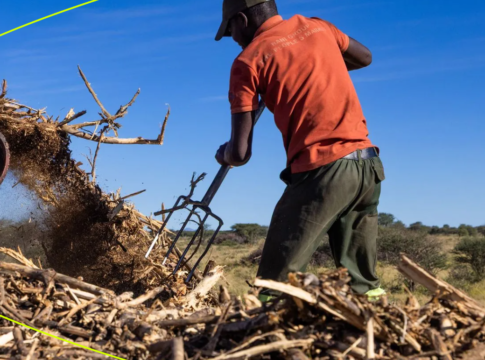
The company removes excess woody biomass from Namibia’s savanna and places it in specially designed underground storage chambers. The chambers limit oxygen and moisture, which slows decomposition and keeps the carbon stored.

The method does not use an energy-intensive carbon capture process. It also does not turn the biomass into biochar. Instead, the wood remains largely intact while the storage system prevents it from breaking down.

Senken says this can reduce the cost and energy needs of the removal process compared with some other engineered carbon removal methods.

The IPCC defines carbon dioxide removal as human activities that remove CO2 from the atmosphere and store it for a long period. It also stresses that carbon removal should support, rather than replace, deep emissions cuts.

Namibia Turns Bush Encroachment Into a Carbon Opportunity

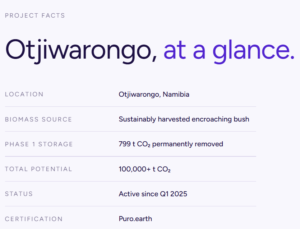
Carbonsate’s project is located in the savanna around Otjiwarongo, Namibia. It focuses on encroaching bush, where woody plants have spread across grassland. Carbonsate says this can reduce biodiversity, limit grass growth, lower groundwater recharge, and reduce the productivity of grazing land.

The company selectively removes this excess bush as part of land management. Instead of burning the harvested wood or allowing it to decay, it stores the biomass underground. This creates a link between carbon removal and land restoration.

Carbonsate says the work can help restore grasslands, improve biodiversity and support healthier range lands. It also works with local landowners, farmers and service providers on harvesting, transport, site preparation and monitoring.

The approach therefore aims to deliver both carbon removal and local environmental benefits.

Project Uses Puro.earth Certification

The Carbonsate Namibia project has passed a third-party facility audit under Puro.earth‘s certification system and has received carbon removal certificates, or CORCs.

Puro.earth lists the project under its Terrestrial Storage of Biomass methodology. The standard requires projects to measure the amount of carbon removed and verify the results. Puro.earth says certified projects must pass facility and output audits before receiving CORCs.

The Carbonsate project has a minimum durability period of 100 years. The company uses engineered storage systems, along with a monitoring, reporting, and verification system, to track storage conditions.

Puro.earth‘s project listing shows that Carbonsate issued 799 CORCs in 2025. Senken says the project is scheduled to deliver about 10,000 credits in 2026.

That difference is important. The 50,000 tonnes covered by the deal are contracted future removals, not 50,000 carbon credits already issued.

Monitoring Is Key to Long-Term Storage

Biomass storage depends on keeping the stored material stable over time. Carbonsate uses sensors to monitor its storage sites. It also uses on-site measurements to track gas emissions and check storage performance.

Puro.earth says the project stores the biomass in engineered pits and covers it to limit oxygen and moisture. Namibia’s dry climate also supports the storage approach because of its low rainfall and high evaporation rates.

The need for monitoring is important because carbon removal is only useful if the stored carbon stays out of the atmosphere.

The Intergovernmental Panel on Climate Change (IPCC) notes that carbon removal methods differ in their storage periods, risks, and environmental effects. It also says strong governance is needed to manage these risks and maintain durable storage.

  • For biomass storage, this makes the choice of feedstock, storage design, and monitoring system especially important.

Carbon Removal Market Moves Toward Longer Deals

The Senken-Carbonsate agreement also shows how buyers are helping new carbon removal methods to scale. Removal projects often need investment before they can produce large volumes. Multi-year offtake agreements give developers a clearer source of future demand.

durable-cdr-purchase-volume-2022-2026-q1

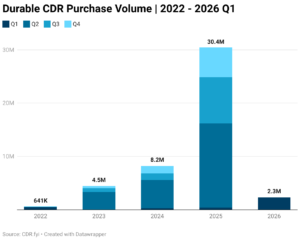
The broader durable carbon removal market is growing, but supply remains limited. CDR.fyi reported 2.3 million tonnes of durable carbon removal contracted in the first quarter of 2026, a record first quarter. It also recorded 145,000 tonnes delivered during the quarter.

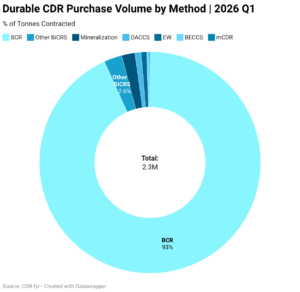
Biomass-based methods were a major part of that market. Biochar alone accounted for 93% of durable carbon removal contracted in Q1 2026, according to CDR.fyi.

durable-cdr-purchase-volume-by-method-2026-q1

Biomass storage remains a much smaller market. Senken describes it as being at an early commercial stage, with supply concentrated among a small number of projects. That makes large multi-year commitments important for developers trying to move from early projects to larger operations.

A New Test for Biomass Carbon Removal

The 50,000-tonne Senken-Carbonsate agreement gives Namibia’s biomass storage sector a major new commercial commitment. The project combines excess bush removal, underground biomass storage, and long-term monitoring. Its Puro.earth certification also gives buyers a defined framework for measuring and verifying carbon removal.

However, scaling the method will depend on more than buyer demand.

Carbonsate must expand its storage capacity while maintaining the quality and monitoring standards behind its credits. The project must prove that the stored biomass stays stable. It should also show that carbon removal is significant, even after considering emissions from harvesting, transport, storage, and monitoring.

For Senken, the deal secures future removal volumes for corporate buyers. For Carbonsate, it provides demand that can help expand its Namibia operations.

If the project delivers the contracted volumes and maintains its removal standards, the agreement could help show how biomass storage can move from an emerging carbon removal method to a larger commercial-scale supply.

The post Senken Signs 50,000-Tonne Biomass Carbon Removal Deal with Carbonsate in Namibia appeared first on Carbon Credits.
Kazakhstan Opens 5.2M Hectares for Carbon Projects, Eyes Article 6 Credit Trading

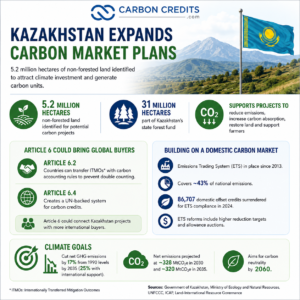
Kazakhstan has identified 5.2 million hectares of non-forested land for possible carbon projects. The move could help the country attract climate investment and create carbon units or credits for domestic and international markets.

The land is part of Kazakhstan’s 31 million-hectare state forest fund, according to Ecology and Natural Resources Minister Yerlan Nyssanbayev. The government says the land could support projects that cut emissions or increase carbon absorption.

Kazakhstan is also updating its carbon market rules and preparing to use Article 6 of the Paris Agreement for international carbon trading. The country aims to reach carbon neutrality by 2060. Its latest climate plan targets a 17% cut in net greenhouse gas emissions from 1990 levels by 2035, with a deeper 25% cut if it receives international support.

5.2 Million Hectares Could Support Carbon Projects

The 5.2 million hectares offer a large area for new carbon projects. However, Kazakhstan has not said that all of the land will produce carbon credits.

Minister Nyssanbayev said the land could support projects that reduce emissions and absorb carbon. The Asian nation sees opportunities in areas such as forestry, agriculture and energy efficiency. The government also wants carbon projects to help restore damaged land and expand green areas. Farmers could also gain new ways to take part in carbon markets.

However, the size of the land area does not tell us how many carbon units it could produce. Actual credit volumes will depend on the projects developed, the methods they use, and the results they can measure and verify.

New Rules Open a Path to Global Carbon Markets

Kazakhstan is also changing the rules for its carbon market. New rules on greenhouse gas emissions and carbon absorption took effect on August 10, 2026. They set procedures for climate projects under Article 6 of the Paris Agreement.

The rules cover validation, verification, monitoring, authorization, and baseline setting. They also set procedures for transferring verified emissions reductions or carbon removals to other countries.

This gives project developers a clearer process for moving from project design to carbon unit issuance and, potentially, international sales. But project approval does not automatically allow developers to sell all units abroad.

Projects must meet the required rules, monitor their results, and complete verification. International transfers also need government approval.

Article 6 Could Bring International Buyers

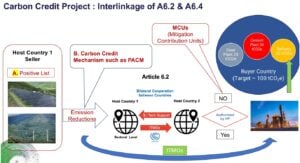
Article 6 gives countries a way to work together on emissions reductions. Under Article 6.2, countries can transfer internationally transferred mitigation outcomes, or ITMOs. The system includes carbon accounting and reporting rules to prevent double counting.

Carbon Credit generation article 6
Source: UNFCCC

Article 6.4 creates a separate UN-backed system for carbon credits.

Kazakhstan’s latest climate plan also points to Article 6 as a way to attract international climate finance. The plan says Kazakhstan’s legal system allows the issuance and transfer of ITMOs, the use of corresponding adjustments, and future links between its national carbon market and wider regional or global markets.

For project developers, this could create access to more international buyers.

For buyers, however, project quality will remain critical. Projects must show that their emissions reductions or carbon removals are real and measurable. They must also meet the accounting rules under Article 6.

Kazakhstan Already Has a Domestic Carbon Market

Kazakhstan is not starting from zero. The country has operated an Emissions Trading System (ETS) since 2013. The system covers major facilities in sectors such as power, oil and gas, mining, metals, chemicals and manufacturing. Facilities that emit more than 20,000 tonnes of CO2 a year fall under the main ETS threshold.

Kazakhstan’s Ministry of Ecology and Natural Resources says the ETS covers about 43% of the country’s national emissions.

The country also allows carbon projects outside the ETS to generate domestic carbon credits. Companies covered by the ETS can use these credits to help meet their obligations.

In 2024, 86,707 domestic offset credits were surrendered for ETS compliance, according to the International Carbon Action Partnership. The new plan aims to build on this existing market and give carbon projects a path to international buyers.

Kazakhstan 5.2 million hectares carbon project

ETS Changes Could Strengthen the Market

Kazakhstan is also working to make its ETS stronger. The government has discussed raising the annual emissions reduction rate to at least 2.73% during 2026–2030. That compares with 2.25% in 2024 and 2.26% in 2025.

The International Carbon Action Partnership says Kazakhstan’s draft national allocation plan for 2026–2030 proposed annual cap cuts of 10.4% to 23% from the 2025 level. The government is also developing an auction system for emissions allowances.

The Asian country received more support for these efforts in 2025. The World Bank’s Partnership for Market Implementation provided the country with a $4.8 million grant to strengthen its ETS, study allowance auctions, and prepare for international carbon markets under Article 6.

The project runs through June 30, 2028. These changes could help Kazakhstan build a stronger domestic carbon market while preparing for international trading.

Climate Goals Add Pressure for Investment

Kazakhstan’s carbon market plans also support its wider climate goals. Under its latest climate plan, Kazakhstan aims to cut net greenhouse gas emissions by 17% from 1990 levels by 2035. With international support, the country could target a 25% reduction.

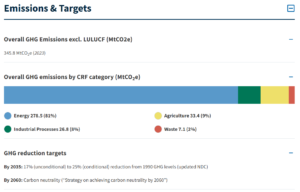
Kazakhstan Emissions Trading System emissions and targets
Source:

Kazakhstan also aims to reach carbon neutrality by 2060. The country expects changes in its power sector to help lower emissions. Under its main climate pathway, Kazakhstan projects net emissions of about 328 million tonnes of CO2e in 2030 and about 320 million tonnes in 2035.

Carbon projects can help fund emissions cuts and carbon removal. Still, carbon credits alone cannot deliver Kazakhstan’s climate goals. The country must also reduce emissions from energy and heavy industry, where fossil fuels remain important.

Exporters Face a Growing Carbon Challenge

Kazakhstan’s carbon market plans also matter for its exporters. The European Union’s Carbon Border Adjustment Mechanism (CBAM) entered its full phase in 2026. Kazakhstan has highlighted the possible impact on its industrial exporters and the need for better emissions data and carbon pricing.

This is important for carbon-intensive industries such as metals. A stronger domestic carbon market could help Kazakh companies measure emissions more accurately and prepare for rising carbon costs.

It could also make the country’s carbon projects more attractive to international investors if Kazakhstan can provide reliable monitoring, verification and accounting.

Land Is Only the Starting Point

Kazakhstan’s decision to identify 5.2 million hectares for potential carbon projects provides the country with a large base for new emissions reduction and carbon removal projects. But land alone will not create a successful carbon market.

Developers need clear rules, good monitoring and independent verification. International buyers also need confidence that credits represent real emissions reductions or carbon removals.

Kazakhstan already has a domestic ETS. It is now building new rules that could connect its carbon market with international climate finance.

If the new system works as planned, the 5.2 million hectares could become an important source of future carbon projects. The broader market reforms could also give those projects a path to buyers in Kazakhstan and abroad.

The next test will be how quickly Kazakhstan turns the available land and new rules into verified, investable, and internationally transferable carbon units.

The post Kazakhstan Opens 5.2M Hectares for Carbon Projects, Eyes Article 6 Credit Trading appeared first on Carbon Credits.
BHP Profit Soars 30% While Emissions Rise, Targets Net Zero With Up to 5M Carbon Credits

BHP Profit Soars 30% While Emissions Rise, Targets Net Zero With Up to 5M Carbon Credits

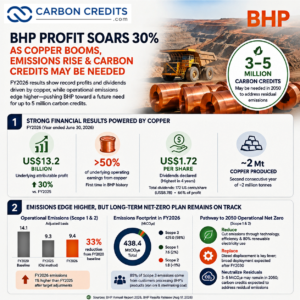
Mining giant BHP delivered stronger-than-expected financial results for FY2026 as surging copper prices drove growth and lifted shareholder returns. However, the company also reported that its operational emissions edged higher.

Copper played a bigger role in the result. BHP reported that copper made up over half of its underlying operating earnings for the first time. The company also produced around 2 million tonnes of copper for the second straight year.

At the same time, BHP’s FY2026 Annual Report shows that its operational greenhouse gas emissions rose slightly year-on-year on an adjusted basis. The company reported 9.4 million tonnes of CO2e (MtCO2e) in Scope 1 and Scope 2 emissions from its operated assets.

BHP has cut adjusted operational emissions by 33% from its FY2020 baseline. However, it still finds some emissions hard to eliminate. The miner says it might need 3 million to 5 million tonnes of carbon credits to help tackle residual emissions and meet its 2050 operational net-zero target.

The contrast highlights BHP’s two-track challenge: growing its business around copper and other future-facing commodities while cutting emissions across a large and complex mining portfolio.

Copper Powers BHP Profit and Dividend Growth

BHP’s strong FY2026 financial results give the miner more room to invest in growth and its long-term decarbonization plans.

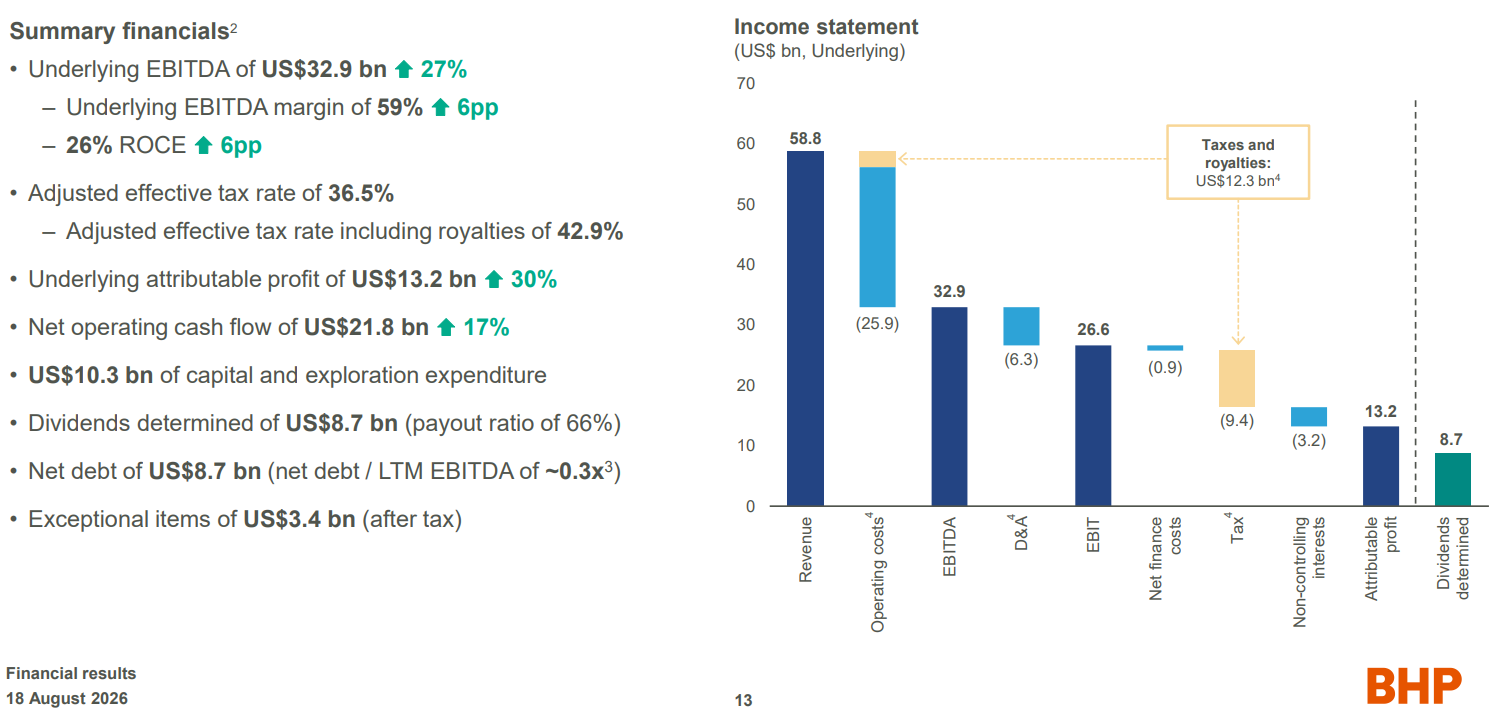
The company reported US$13.2 billion in underlying attributable profit, a 30% increase from FY2025 and above the US$12.66 billion analyst consensus cited by Reuters. BHP also reported US$9.8 billion in attributable profit for the year.

BHP financial results FY2026
Source: BHP Financial Report

Copper drove much of the improvement. Copper, including gold and uranium byproducts, generated US$18.19 billion in operating earnings, compared with US$14.53 billion from iron ore, making copper BHP’s largest earnings contributor.

BHP declared US$1.72 per share in dividends, its highest payout in four years. The company said total shareholder dividends reached 172 US cents per share, or US$8.7 billion, equal to 66% of underlying attributable profit.

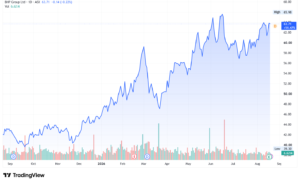
The stronger result comes as BHP increases its focus on copper, which it expects to play a growing role in the global energy transition. BHP shares rose 2.65% to A$63.85 on August 18. Investors responded positively to the stronger-than-expected FY2026 results and higher dividends.

BHP stock price

However, the Australian miner also reported rising GHG emissions in its 2026 Annual Report.

BHP’s Operational Emissions Tick Higher

BHP’s adjusted operational emissions fell from 14.1 MtCO2e in FY2020 to 9.4 MtCO2e in FY2026, a 33% reduction from its baseline. However, progress was not linear.

BHP reported higher emissions at BHP Mitsubishi Alliance (BMA) because of increased material movement and more methane-intensive mining areas. Emissions at New South Wales Energy Coal (NSWEC) also increased because of higher production and a revised methane emissions model.

Stable performance at Western Australia Iron Ore and Escondida helped balance some of those increases. The temporary suspension of Western Australia Nickel also contributed.

BHP also changed how it calculates Scope 2 emissions at its Australian operations by using a national residual mix factor (RMF) where available. Applying the new method changed the reported FY2025 comparison from a 36% reduction against the FY2020 baseline to 34%.

BHP total ghg emissions FY2026
Source: BHP Annual Report

That makes the adjusted year-on-year comparison important. BHP says FY2026 emissions were 1% higher than FY2025 after applying the adjustments used for its climate targets.

Scope 3 Emissions Dwarf BHP’s Operational Footprint

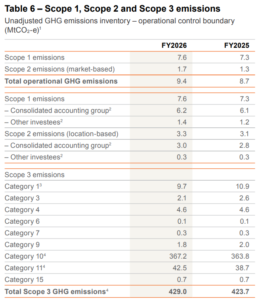
BHP’s wider emissions footprint is much larger when it includes its value chain. The company reported 429.0 MtCO2e of Scope 3 emissions in FY2026, up 1% from 423.7 MtCO2e in FY2025. Most of those emissions come from customers processing BHP’s products.

The downstream processing of iron ore and steelmaking coal accounted for 85% of reported Scope 3 emissions. Energy coal combustion contributed another 10%, while direct suppliers accounted for 2% and upstream and downstream shipping for 1%.

BHP has a separate long-term goal to reach net-zero Scope 3 emissions by 2050. The company says reaching that goal is uncertain. It relies on customers using lower-emissions steelmaking technologies.

Its 2050 operational net-zero goal is different. That goal covers only Scope 1 and Scope 2 emissions from BHP’s operated assets.

BHP ghg emissions scope 1 and 2 net zero
Source: BHP

BHP May Need 3–5 Million Carbon Credits

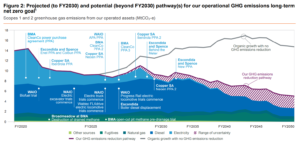
The biggest new carbon market figure in the report comes from BHP’s long-term operational emissions pathway. BHP says it intends to reduce emissions through structural measures wherever technology is mature, commercially available, and viable. It expects carbon credits to address emissions that remain after those measures.

The company now estimates that 3 MtCO2e to 5 MtCO2e of emissions could remain in CY2050. BHP says it would need carbon credits to offset those emissions and achieve its net-zero operational goal.

  • That range translates into roughly 3 million to 5 million carbon credits, as each credit represents one tonne of CO2e.

BHP stresses that this is an estimate, not a firm future purchase commitment. The company says its estimate could change as low- and zero-emissions technologies improve.

This distinction matters. BHP does not plan to use offsets as a substitute for cutting its operational emissions. Instead, it expects credits to cover the residual emissions that it cannot eliminate.

Technology Delays Could Increase Reliance on Offsets

BHP says diesel displacement remains its largest future lever for cutting operational emissions. The company has made progress on renewable electricity. It reported 80% renewable electricity usage across its operated assets globally. BHP also says its BMA mines in Queensland moved to 100% renewable power from July 2026.

The harder challenge is replacing diesel in heavy mining equipment.

BHP began trials of battery-electric haul trucks and locomotives during FY2026. At Jimblebar in Western Australia, it started testing two Caterpillar battery-electric haul trucks in March 2026. It also began trials involving two Wabtec FLXdrive battery-electric locomotives at Port Hedland.

However, BHP does not expect broad deployment of battery-electric mining systems across its operations until after FY2030. The company says some technologies needed for diesel displacement remain under development. It also faces challenges around charging infrastructure, power systems, mine planning, maintenance, and workforce skills.

BHP expects its continued operational decarbonization work to require at least US$4 billion of incremental nominal spending in the 2030s.

BHP emissions rise and carbon credits needed 2050

Methane Remains Another Challenge

Diesel is not BHP’s only difficult emissions source. Methane accounted for 12% of BHP’s Scope 1 and Scope 2 emissions in FY2026. The company says it can capture and abate drainage methane at its underground BMA steelmaking coal mine when it is safe and practical to do so.

Open-cut mines present a harder problem. BHP says no proven technology can currently abate fugitive methane from open-cut mines at scale. The company started a proof-of-concept trial for novel methane gas drainage at an operating open-cut mine during FY2026. It will continue that work in FY2027.

These technology gaps help explain why BHP expects some residual emissions to remain in 2050.

Carbon Credits Could Become BHP’s Net-Zero Backstop

BHP’s latest financials and emissions data show both progress and a growing challenge. The company has already cut adjusted operational emissions by 33% from FY2020. It has also expanded renewable electricity use and started testing technologies that could eventually replace diesel.

Yet, emissions increased slightly in FY2026, while some of the technologies needed for deeper cuts remain immature. That leaves carbon credits as part of BHP’s long-term pathway.

The company now thinks that 3 million to 5 million tonnes of residual emissions might still exist in 2050. This could lead to a future need for a similar amount of carbon credits.

For carbon markets, the figure is significant. It shows how even major miners pursuing large operational reductions may still depend on high-quality carbon removals or other eligible credits to address hard-to-abate emissions.

The next decade will determine how large that gap ultimately becomes. If electrification, renewable power and methane technologies advance faster than expected, BHP could reduce its reliance on offsets. If technology deployment falls short, the company’s need for carbon credits could grow.

The post BHP Profit Soars 30% While Emissions Rise, Targets Net Zero With Up to 5M Carbon Credits appeared first on Carbon Credits.
Vietnam Approves Singapore Carbon Pact, Opening New Article 6 Market

Vietnam Approves Singapore Carbon Pact, Opening New Article 6 Market

Vietnam and Singapore have agreed on a carbon credit deal. This brings them closer to starting cross-border carbon trading under Article 6 of the Paris Agreement.

The Vietnamese Government issued Resolution 235/NQ-CP, approving the Implementation Agreement on carbon credit cooperation with Singapore. It also assigned the Ministry of Foreign Affairs to complete the required procedures and notify the agreement’s entry into force.

The move gives Vietnamese companies and project developers a clearer legal path to generate carbon credits for transfer to Singapore.

The two countries originally signed the agreement on September 16, 2025. Singapore’s government states that the pact sets up a legal framework. This framework helps generate and transfer carbon credits from projects that follow Article 6.

Vietnam Moves Singapore Carbon Pact Toward Implementation

The August 2026 approval is an important step because the agreement now moves closer to actual implementation. The pact allows eligible mitigation projects in Vietnam to generate outcomes that can become internationally transferred mitigation outcomes (ITMOs). Vietnam can then authorize those outcomes for transfer to Singapore.

Article 6.2 provides the rules for countries to cooperate on these transfers. It also requires strong accounting to ensure that countries do not count the same emissions reduction twice.

Singapore’s carbon market platform states that its Implementation Agreements set up a two-way framework. This framework covers project approval, reporting, and necessary adjustments. These agreements also allow private companies to develop projects that can generate ITMOs.

For Vietnam, the framework could help connect domestic climate projects with international buyers and financing.

Projects Must Meet Carbon Credit Rules

The agreement does not allow every carbon credit from Vietnam to enter Singapore’s market. Project developers must follow the rules of both countries and meet the requirements of the bilateral agreement. Singapore has also set environmental integrity rules for international carbon credits.

These rules cover issues such as double counting and leakage. Singapore requires eligible credits to meet Article 6 requirements and represent verified emissions reductions or removals.

Carbon Credit generation article 6
Source: UNFCCC

The Singapore-Vietnam framework also sets out a formal process for project approval, ITMO issuance, and transfer. Singapore’s current Vietnam framework says the Joint Committee will oversee the agreement. The committee includes representatives from Singapore’s National Environment Agency and Vietnam’s Ministry of Agriculture and Environment.

However, some operational details remain under development. Singapore will share more details soon on the documents and steps required for Article 6 authorization. The August approval makes it legal, but developers still need to finish the detailed approval process to transfer credits.

Corresponding Adjustments Protect Market Integrity

Corresponding adjustments form a key part of the agreement. When Vietnam approves an ITMO transfer to Singapore, it must adjust accordingly when the parties make that transfer. The agreement requires Vietnam to follow the Article 6.2 guidance adopted under the Paris Agreement.

This accounting step stops Vietnam from using the same emissions reduction for its climate target after sending it to Singapore. Singapore can then recognize the transferred mitigation outcome for an approved purpose.

The agreement also requires both countries to meet reporting obligations under the Paris Agreement. This includes reporting under Article 6.2 and Article 13.

These rules matter because the growth of international carbon markets depends on credible accounting. Without these safeguards, the same emissions cut might back multiple climate claims.

Singapore’s Carbon Tax Creates Demand for New Credits

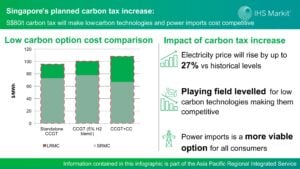
Singapore has a strong policy reason to develop a supply of high-quality international carbon credits. The country introduced its carbon tax in 2019. The rate reached S$45 per tonne in 2026 and 2027, and Singapore aims to raise it to S$50 to S$80 per tonne by 2030.

singapore carbon tax increase
Source: S&P Global

Since January 2024, facilities that owe carbon tax can use eligible international carbon credits. They can offset up to 5% of their taxable emissions. This creates potential demand for eligible credits from Vietnam.

However, supply remains limited. Singapore’s National Environment Agency says carbon credit projects typically take up to four years to generate credits. It also said stronger market focus on credit integrity and changing international rules have slowed the supply of eligible credits.

Vietnam could be a key future supplier if projects get approved. This would allow them to earn credits that meet Singapore’s needs.

The Deal Adds Climate Benefits Beyond Carbon Trading

The wider Singapore Article 6 framework also includes measures to support climate action in host countries. The country requires carbon credit developers to contribute 5% of the value of authorized Article 6 carbon credits under its Implementation Agreements. The money supports adaptation efforts in host countries and/or the UNFCCC Adaptation Fund.

Singapore also requires 2% of Article 6-authorized carbon credits to be canceled at issuance. These credits cannot enter the market, helping contribute to an overall reduction in global emissions.

The Singapore-Vietnam agreement itself gives its Joint Committee a role in determining additional contributions to overall mitigation and adaptation at the time of issuance. These measures aim to extend the climate benefits of carbon trading. They go beyond just transferring emissions reductions between countries.

Vietnam Could Unlock New Climate Finance

Vietnam’s approval could create new opportunities for investment in emissions reduction projects. The two countries have previously highlighted potential cooperation in areas such as clean energy, sustainable agriculture, technology and the circular economy. Vietnam has also sought Singapore’s experience in operating carbon credit markets and exchanges.

The agreement can help Vietnamese project developers reach international buyers. It may also attract financing for projects that cut or eliminate greenhouse gas emissions.

However, the agreement does not guarantee a certain volume of carbon credits or a specific price. Developers still need to secure project approvals, meet methodology requirements, and complete verification. They must also find buyers for the resulting credits.

The timing depends on how quickly Vietnam and Singapore finish the procedures. It also relies on how fast eligible projects move through the system.

Singapore Builds a Growing Article 6 Carbon Network

The Vietnam pact forms part of Singapore’s wider strategy to build a network of bilateral carbon market agreements. As of June 2026, Singapore had signed 11 Implementation Agreements with countries including Vietnam, Mongolia and the Philippines. The full list also includes Papua New Guinea, Ghana, Bhutan, Chile, Peru, Rwanda, Paraguay and Thailand.

Singapore has signed 20 memorandums of understanding with over 20 countries, said Trade and Industry Minister of State Alvin Tan. The government is working with businesses to develop projects that can generate Article 6 credits.

Singapore’s carbon tax and international credit framework give these partnerships a potential source of demand. At the same time, the government says it needs more projects to build the supply of eligible credits.

Vietnam’s approval therefore comes at an important time for both countries. For Vietnam, the agreement could help channel more international finance into emissions reduction projects. For Singapore, it could expand its future supply of high-integrity international carbon credits.

The next step will be implementation. As Vietnam completes the remaining procedures and both governments operationalize the project approval process, the pact could turn into a new channel for Article 6 carbon trading and climate finance in Southeast Asia.

The post Vietnam Approves Singapore Carbon Pact, Opening New Article 6 Market appeared first on Carbon Credits.

NexGen Energy Begins Construction of Rook I as Uranium Demand Rises

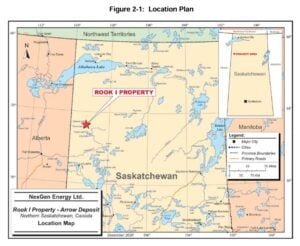
NexGen Energy has started building its Rook I uranium project in Saskatchewan, Canada. This marks a significant step toward creating one of the largest new uranium mines in the world.

It was reported that the C$2.2 billion ($1.6 billion) project focuses on the high-grade Arrow deposit. Once completed, Rook I is expected to produce around 30 million pounds of uranium each year. This would place it among the top uranium producers globally and make NexGen a key supplier for the growing nuclear energy market.

Uranium demand is rising sharply. Nuclear power is gaining traction as countries seek reliable, low-carbon electricity. The rapid growth of artificial intelligence is also increasing energy needs, NexGen revealed in a post on X.

Rook I Moves to Construction Phase

Major earthworks and surface infrastructure are in progress. The company has commissioned a 3,000-foot airstrip and completed expanded site accommodations, which are now in use.

NexGen plans to finish the full 5,840-foot airstrip by the end of 2026. Shaft development is set to begin in 2027.

Building the underground mine and processing facilities will take about four years. The project will use conventional underground mining, followed by processing the ore into uranium concentrate, known as yellowcake.

Importantly, the project has cleared major regulatory hurdles. The Canadian Nuclear Safety Commission approved the environmental assessment in March and granted NexGen a construction license for Rook I.

This approval allows the company to move forward after years of exploration and regulatory work.

rock1

A High-Grade Uranium Deposit

The Arrow deposit gives Rook I a major edge: exceptionally high uranium grades.

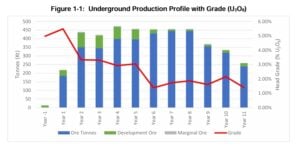
  • The 2021 feasibility study outlined probable reserves of about 239.6 million pounds of uranium at an average grade of 2.37% U3O8.
  • NexGen’s total measured and indicated resource stands at about 256.7 million pounds, including the reserves, plus another 80.7 million pounds in inferred resources.

These grades are well above the global average for uranium deposits.

As a result, the project needs to move less rock to produce a large amount of uranium. NexGen estimates only about three trucks per day will be needed to feed the mill, while roughly 1.5 trucks per day will remove processed material.

This relatively low movement could reduce the project’s infrastructure needs and environmental impact compared to lower-grade mining operations.

The geology supports conventional underground mining. Unlike some deposits that need complex methods like in-situ recovery, Arrow is located in hard rock at depth. The company says this setting allows for a more predictable mining operation.

nextGen uranium
Source: NextGen

A Large Production Profile

The scale of Rook I is critical for the uranium market.

The 2021 feasibility study outlined an 11-year mine life and projected total production of about 233.6 million pounds of yellowcake. It estimated an after-tax net present value of C$3.5 billion at an 8% discount rate, a 52.4% internal rate of return, and a payback period of less than one year.

The planned annual production of about 30 million pounds would exceed the licensed capacity of Cameco’s McArthur River-Key Lake operations, which stands at 25 million pounds.

Cameco expects to produce between 14 million and 16.5 million pounds from those operations in 2026.

Thus, Rook I could significantly boost global uranium supply once it begins production.

Nuclear Power Is Driving Long-Term Uranium Demand

The timing of this project is crucial.

Around 80 nuclear reactors are under construction worldwide, adding about 88 gigawatts of new capacity. This could increase global nuclear capacity by roughly 20% by the early 2030s.

At the same time, 38 countries aim to triple global nuclear capacity by 2050.

If achieved, global nuclear capacity could rise from around 380 GW to about 1,200 GW. This expansion would require a substantial increase in uranium supply.

Artificial intelligence could add to the demand.

Data centers need a lot of electricity, and the global AI buildout is speeding up. If the U.S. meets its AI-related electricity needs entirely with nuclear power, uranium demand could reach as much as 60 million pounds annually by 2030, according to NexGen’s estimates.

This highlights the scale of the challenge facing the uranium industry.

The Supply Problem Could Be Even Bigger

Uranium supply cannot quickly respond to sudden demand increases.

Developing a new mine can take 15 to 20 years from discovery to production. Today’s investment decisions will affect uranium supply well into the 2030s and 2040s.

NexGen forecasts a potential uranium supply deficit of about 335 million pounds per year by 2040. Meeting projected demand of roughly 530 million pounds would require mine production to triple from current levels.

These numbers show why new projects like Rook I are increasingly important.

The industry has mined about 8.6 billion pounds of U3O8 since uranium mining began. Over the next 25 years, the world could need about 7.3 billion pounds.

In short, the nuclear industry could consume nearly as much uranium in the next quarter-century as it has mined in the last 80 years.

Rook I Could Support a Low-Carbon Energy System

The project’s potential goes beyond just uranium production.

Nuclear power generates electricity with very low operational carbon emissions. Therefore, more uranium supply could help expand nuclear generation as countries aim to cut emissions while ensuring reliable electricity.

  • NexGen estimates Rook I could produce enough uranium to power around 46 million homes with carbon-free electricity.
  • The company also estimates that this nuclear generation could displace over 300 million tonnes of CO2 annually, equivalent to taking nearly 70 million cars off the road each year.

These figures depend on how the uranium is used and the assumptions behind the calculations. Still, they show why high-grade uranium projects are gaining attention as nuclear power returns to global energy discussions.

For NexGen, the next challenge is execution.

With construction now underway, Rook I is shifting from long-term development to a potential new source of uranium supply. If NexGen delivers on time, the mine could start production just as nuclear power, AI-driven electricity demand, and energy security concerns put more pressure on the global uranium market.

The post NexGen Energy Begins Construction of Rook I as Uranium Demand Rises appeared first on Carbon Credits.
OpenAI’s $20 Billion Georgia Data Center Puts ChatGPT’s Energy Footprint Under Scrutiny

OpenAI’s $20 Billion Georgia Data Center Puts ChatGPT’s Energy Footprint Under Scrutiny

OpenAI’s rapid expansion of ChatGPT is creating a growing energy challenge for the company and the communities hosting its data centers. That challenge is now playing out in Georgia, where OpenAI plans to build a $20 billion data center campus in Effingham County.

The project, called Project Camellia, is planned for 3.2 gigawatts (GW) of power. OpenAI says Georgia Power would deliver the electricity in phases from 2028 through 2032.

The project has drawn objections from environmental and consumer groups. They want more details about the power contract and stronger protections for Georgia electricity customers. The debate also raises a wider question for ChatGPT: how much energy and other resources will be needed as AI use keeps growing?

OpenAI Faces Questions Over Georgia Power Deal

OpenAI says it will pay the full cost of the electricity and infrastructure needed for Project Camellia. Georgia Power has also said the project will include financial protections for its customers. The ChatGPT developer stated:

“Building this infrastructure in the United States strengthens domestic industry, creates good jobs, and helps ensure American communities participate in the economic opportunity created by AI. Project Camellia can help build that foundation while creating lasting opportunity in Effingham County and Southeast Georgia, and would be entirely privately funded.”

However, environmental groups want more transparency.

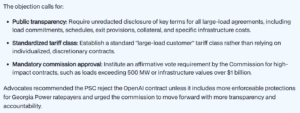
The Southern Alliance for Clean Energy, Sierra Club and Natural Resources Defense Council have objected to the proposed agreement. They say in the letter that important details remain unclear and are calling for stronger safeguards before the contract moves forward.

Their concerns include the size of the electricity load, infrastructure costs, and the possible effect on other power customers. Their letter reads:

“The magnitude of the load from the announced OpenAI project heightens the consequences of any shortcomings in the fully redacted contract’s cost-recovery provisions. A contract that does not adequately ensure recovery of all costs incurred to serve the load could leave Georgia Power customers responsible for those costs.”

OpenAI Georgia power objection
Source: Southern Alliance for Clean Energy

The issue matters because 3.2 GW is an extremely large power demand. The International Energy Agency (IEA) notes that traditional data centers often use 10 to 25 megawatts, while large AI data centers can require more than 100 MW. Project Camellia would therefore operate on a much larger scale than a typical data center.

OpenAI says the project will also be designed to reduce its impact on the local power system. It plans to lower its electricity use during periods of high demand so that residential customers are less affected.

How Much Energy Does ChatGPT Really Use?

The Georgia project also highlights a problem with measuring ChatGPT’s environmental footprint. OpenAI does not publish one total figure for the electricity used by ChatGPT worldwide.

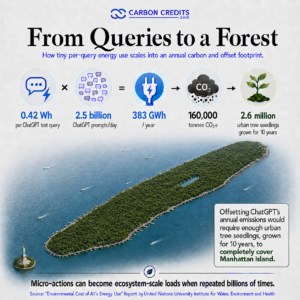
The energy needed for each query also varies. It depends on the model, the task, the length of the response, and the hardware used. OpenAI cites an Epoch AI estimate that a typical GPT-4o query uses about 0.3 watt-hours of electricity.

That number may sound small, but ChatGPT operates at huge scale. The United Nations University estimates that ChatGPT handles about 2.5 billion prompts each day. Its analysis estimates that global AI systems could have a much larger resource footprint as usage expands.

This creates an important distinction. Lower energy use per query does not necessarily mean lower total energy use. If the number of AI users and tasks grows faster than efficiency improves, overall electricity demand can still increase.

ChatGPT carbon footprint

That is one reason the environmental debate is shifting from individual prompts to the much larger data center system that supports them.

AI Is Driving Data Center Power Demand Higher

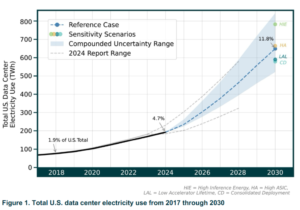
Data centers are becoming a major source of electricity demand. The IEA estimates they consumed about 415 TWh in 2024, with demand expected to more than double to 945 TWh by 2030, nearly 3% of global electricity use.

AI is a key driver. Electricity use from accelerated servers, which mainly support AI workloads, is expected to grow about 30% annually through 2030 in the IEA’s base case.

The U.S. faces an especially sharp increase. Data centers could account for nearly half of U.S. electricity demand growth through 2030, with consumption rising about 240 TWh from 2024 levels.

US data centers electricity use 2030

Project Camellia is part of this broader trend. As OpenAI and other AI companies expand computing capacity, utilities will need more power generation and grid infrastructure.

Water Is Another Environmental Concern

AI data centers also require water for cooling, although usage varies by facility and cooling system.

OpenAI says Project Camellia will use a closed-loop cooling system that recirculates water rather than continuously withdrawing and discharging large volumes. The company says this design will keep ongoing water use low.

The issue remains important as AI data centers expand. A 2026 United Nations University study estimates that global data centers could have a water footprint of about 9.3 trillion liters by 2030, alongside a land footprint exceeding 14,500 square kilometers.

These figures cover the global data center system, not OpenAI or ChatGPT alone. However, they show that AI’s environmental impact extends beyond electricity use.

OpenAI Is Expanding Its AI Infrastructure

Project Camellia is also only one part of OpenAI’s wider infrastructure expansion. The company says it needs substantially more computing power as AI systems become more capable and handle longer and more complex tasks.

OpenAI is developing other large data-center projects in the United States and abroad.

  • In Michigan, its Stargate project is planned around a 1-GW data center campus. OpenAI says the site will use closed-loop cooling.
  • OpenAI is also developing infrastructure in Norway. The company initially announced a project with 230 MW of capacity, with plans that could allow for added capacity later. The company says the Norway project will use renewable power and closed-loop direct-to-chip cooling.

These projects show that OpenAI is trying to address some of the environmental effects of its growth through cleaner electricity and more efficient cooling. However, the scale of the expansion remains significant.

Transparency Will Shape AI’s Climate Debate

The Georgia dispute points to a larger issue for OpenAI and ChatGPT. AI companies are improving model efficiency, but they are also expanding their computing infrastructure at a rapid pace. The project shows how the ChatGPT boom is becoming an energy and environmental issue as much as a technology story.

OpenAI has already made commitments for Project Camellia that include paying its own energy costs, keeping water use low, and providing public reporting through an annual independent audit. The company will now need to show that these commitments work in practice.

For ChatGPT, the key issue is not simply how much electricity one prompt uses. It is the combined effect of billions of prompts, increasingly powerful models, and the data centers needed to run them.

Lower energy use per AI task will help, but the long-term impact will depend on how quickly OpenAI can improve efficiency, expand clean power, reduce water use, and provide clear data on the resources behind its growing AI systems.

The post OpenAI’s $20 Billion Georgia Data Center Puts ChatGPT’s Energy Footprint Under Scrutiny appeared first on Carbon Credits.
CATL Says All 20 Battery Plants Are Carbon Neutral as Supply Chain Takes Center Stage

CATL Says All 20 Battery Plants Are Carbon Neutral as Supply Chain Takes Center Stage

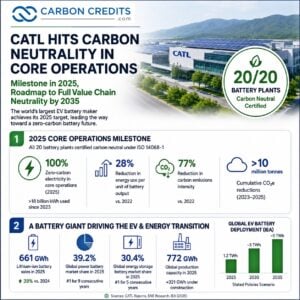
CATL, the world’s largest electric vehicle battery maker, says it has achieved carbon neutrality across its core operations, with all 20 battery plants certified as carbon neutral. The Chinese battery giant announced the milestone on August 17, 2026, after meeting a target it set for 2025. CATL also unveiled a new plan to make its entire battery value chain carbon neutral by 2035.

The timing is important. Global battery demand continues to grow quickly. The International Energy Agency (IEA) says global EV battery deployment reached 1.2 TWh in 2025, up almost 30% from 2024. It expects EV battery deployment to reach almost 3 TWh by 2030 under its Stated Policies Scenario.

That growth puts more pressure on battery makers to cut emissions not only from factories, but also from the wider supply chain. Robin Zeng, Chairman and CEO of CATL, remarked:

“As the world ramps up efforts toward net-zero, zero-carbon batteries will not be a choice but a necessity in the near future. We are ready to share our technologies and experience with partners across the industry, helping to shape global carbon standards and advance industry-wide decarbonization.”

CATL Reaches Its 2025 Carbon Neutrality Goal

CATL announced its core-operations carbon neutrality target in 2023. The company planned to reach carbon neutrality in its core operations by 2025 and across its battery value chain by 2035.

The battery giant says it met the first goal as planned. All 20 battery plants have now received carbon-neutral certification. CATL says 100% of the electricity used in its core operations came from zero-carbon electricity in 2025.

Since 2023, the company says it has consumed more than 18 billion kWh of zero-carbon electricity.

CATL also reports that energy use per unit of battery output fell 28% from 2022 levels, while carbon emissions intensity fell about 77% over the same period.

  • From 2023 to 2025, CATL says it achieved more than 10 million tonnes of cumulative CO2e emissions reductions.

The company uses the ISO 14068-1 framework for carbon-neutral certification. This matters because “carbon neutral” does not mean a factory produces no greenhouse gas emissions at all. It means the company applies measures to reduce emissions and address the remaining emissions within the relevant carbon-neutrality framework.

CATL’s own data also shows why reducing factory emissions matters. The company has built a large manufacturing base to meet rising battery demand.

A Battery Giant With a Growing Footprint

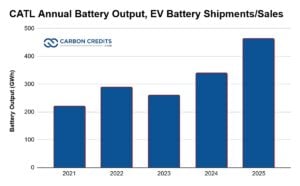
CATL’s scale makes the milestone significant for the wider battery industry. The company sold 661 GWh of lithium-ion batteries in 2025, a 39% increase from the previous year. 

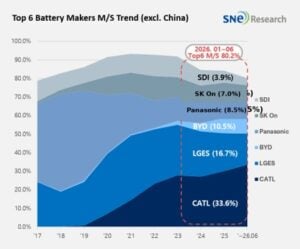
CATL top battery makers global SNE research

SNE Research data cited by CATL put its global power battery market share at 39.2%, keeping it in first place for the ninth consecutive year. CATL’s global production capacity reached 772 GWh in 2025, with another 321 GWh under construction at the end of the year.

The company also remains a major player in energy storage. Its energy storage battery shipments held a 30.4% global market share in 2025, according to SNE Research, marking its fifth consecutive year in first place.

The wider market is moving in the same direction. The IEA estimates that global lithium-ion battery manufacturing capacity exceeded 4 TWh at the end of 2025, about 30% higher than a year earlier. China accounted for more than 80% of global capacity.

CATL Annual Battery Output, EV Battery Shipments, Sales
Source: CATL Reports

As production expands, reducing the emissions intensity of each battery becomes increasingly important.

The Supply Chain Is the Bigger Climate Challenge

CATL’s factory milestone does not solve the full emissions problem. The company says more than 80% of carbon emissions across its product lifecycle come from its supply chain. It also says total value chain emissions exceed those from its core operations by more than five times.

Those emissions come from activities such as raw-material production, processing, manufacturing, and logistics. This makes the next stage of CATL’s climate strategy much harder. The company can directly control its own factories. It has less direct control over mines, chemical producers, material suppliers, and transport companies.

The Chinese firm has already collected baseline carbon data from more than 100 core Tier 1 suppliers. It wants to expand carbon data coverage across key upstream parts of the supply chain.

Starting in 2027, CATL plans to require new suppliers to provide product carbon footprint data. It will also consider renewable electricity use and energy efficiency in annual supplier reviews. Suppliers with stronger emissions performance could receive better order allocation and longer-term agreements.

CATL 300750 stock price

The announcement has acted as a long-term stabilizer rather than a short-term price booster, with the stock seeing a minor 0.91% dip shortly after. While this green milestone secures CATL’s access to strict markets like Europe, investors remain cautious. This is because 80% of the company’s total emissions come from its suppliers, meaning CATL now faces the harder, more expensive challenge of cleaning up its upstream supply chain by 2035.

CATL Targets the Full Value Chain by 2035

CATL’s new roadmap focuses on four main areas: materials and process innovation, manufacturing, green logistics, and battery recycling. The company plans to increase the use of lower-carbon materials and improve production processes. It also aims to achieve 100% green electricity use across its value chain by 2035.

CATL plans to expand zero-carbon logistics across its supply chain and continue building its global battery recycling network through Brunp Recycling.

The company has already taken steps on recycling. CATL says it recycled 210,000 tonnes of spent batteries in 2025, up 63.2% from 2024. It regenerated 24,000 tonnes of lithium salts, an increase of 40.4%.

CATL carbon neutral

CATL will also begin a supply chain decarbonization program with an initial group of 30 core suppliers. These actions could have a wider effect because battery supply chains remain highly concentrated. 

Why the Milestone Matters for EVs

Battery production sits at the center of the electric vehicle transition. The IEA expects global EV battery deployment to more than double from 1.2 TWh in 2025 to almost 3 TWh by 2030 under its Stated Policies Scenario. It further projects deployment to reach almost 5 TWh by 2035 under that scenario. That means battery manufacturers will need to produce far more cells while limiting their environmental impact.

The World Economic Forum analysis shows the global battery demand will grow to over 2.6 TWh in 2030.

global EV battery demand 2030

CATL’s factory-level achievement shows that large-scale battery production can move toward lower operational emissions. But the company’s own data points to the bigger challenge: most of its product lifecycle emissions occur outside its factories.

The 2035 target will therefore depend heavily on suppliers. If CATL can push lower-carbon electricity, cleaner materials, more efficient production, lower-emission logistics and recycling deeper into its supply chain, the impact could extend well beyond its 20 plants.

From Factory Decarbonization to Supply Chain Action

CATL’s latest announcement marks a shift from controlling emissions inside its factories to tackling emissions across the battery industry. The company has already reached its 2025 core-operations carbon neutrality target and certified all 20 battery plants as carbon neutral. It now has nine years to address the much larger emissions footprint across its value chain.

The challenge is substantial. CATL says more than 80% of lifecycle emissions come from its supply chain, while global battery demand continues to climb.

The next test will be whether CATL can turn its supplier requirements and 2035 roadmap into measurable emissions cuts across mining, materials, manufacturing, logistics and recycling. For an industry expected to supply several terawatt-hours of batteries each year, that could become as important as expanding battery capacity itself.

The post CATL Says All 20 Battery Plants Are Carbon Neutral as Supply Chain Takes Center Stage appeared first on Carbon Credits.