Google Signs 15-Year Solar PPA With RWE for 155 MW Oklahoma Project

Google is expanding its renewable energy portfolio in Oklahoma through a new 15-year power purchase agreement (PPA) with German energy company RWE. Under the agreement, Google will purchase all of the electricity generated by RWE’s 155-megawatt (MWac) Crooked Creek Solar project in McCurtain County, Oklahoma.

RWE Expands Solar Presence in Oklahoma

Ingmar Ritzenhofen, Chief Commercial Officer, RWE Americas:

“This agreement with Google marks an important milestone for RWE Americas and reflects the growing demand for affordable, reliable, domestically produced energy. Crooked Creek Solar demonstrates how strategic partnerships can accelerate new energy development while creating jobs, generating local tax revenue and strengthening communities. We’re proud to work with Google to help power its operations, while supporting Oklahoma’s continued economic growth with affordable, American-made energy.”

Crooked Creek Solar will be RWE’s first solar project in Oklahoma. The company already operates the 148 MW Boiling Springs wind project in Woodward County.

The company plans to begin construction on the project later this year. Crooked Creek Solar is expected to start commercial operations in 2028.

Once online, the solar project will supply electricity to support Google’s operations in the Southwest Power Pool (SPP) market. At the same time, it will create jobs, generate tax revenue, and provide long-term economic benefits for communities in southeastern Oklahoma.

RWE also has six additional power projects totaling about 1.6 gigawatts (GW) in development across the state.

Crooked Creek Solar: Boost Jobs, Tax Revenue and Local Investment

The company expects Crooked Creek Solar to create up to 250 jobs during peak construction. Construction activity is estimated to generate around $24.3 million in local economic activity.

The project is also expected to provide about $1.4 million in state and local tax revenue during construction.

Once the solar facility begins operating, its economic impact will continue. RWE estimates that Crooked Creek Solar could generate approximately $25 million in revenue over its operating life for local programs, emergency medical services, the Broken Bow School District, and regional technology education centers.

These benefits are becoming increasingly important as communities seek to attract new investment while expanding local power infrastructure. It has also contributed more than $100,000 through donations, sponsorships, and community partnerships in Oklahoma.

Google Continues to Secure Clean Power

For Google, the new PPA is part of a broader strategy to secure more electricity from clean energy sources.

The company has been increasing its renewable energy purchases as its electricity needs rise. Data centers supporting cloud computing and AI require large, reliable power supplies.

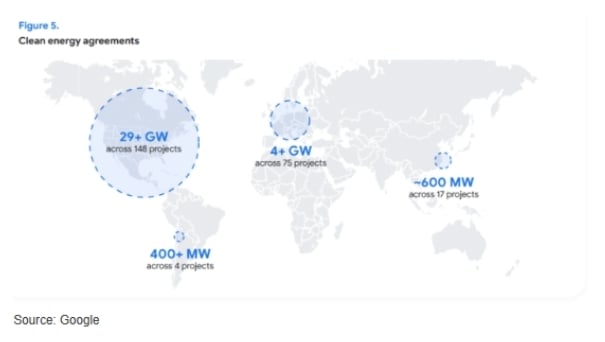
In 2025, Google signed agreements for more than 12 GW of new clean energy capacity. The company also launched more than 25 energy projects that added nearly 2 GW of new carbon-free electricity to the grids serving its operations.

At the same time, Google reported progress in reducing emissions from its own operations.

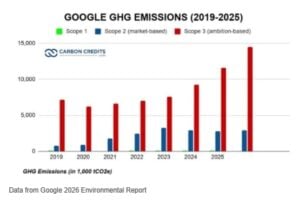
  • Its combined Scope 1 and market-based Scope 2 emissions declined by about 2% in 2025 to roughly 2.9 million metric tons of carbon dioxide equivalent (CO2e). That marked the second consecutive year of lower operational emissions.

Google is also working toward matching 100% of its annual electricity consumption with renewable energy purchases.

google emissions

The company’s approach is increasingly focused not only on buying renewable energy but also on bringing new clean power projects onto electricity grids.

Oklahoma Becomes a Major Google Investment Hub

The Crooked Creek agreement comes as Google increases its investment in Oklahoma.

The company has announced plans to invest $9 billion in the state to expand its cloud and AI infrastructure. The investment includes the development and expansion of data center infrastructure needed to support growing digital services.

Google has also secured another major solar PPA in Oklahoma this year. In May, the company signed a 15-year agreement with Enlight to purchase electricity from a 200 MW solar project.

Together, these agreements show how Google is using long-term power contracts to support the electricity needs of its growing operations.

google clean energy

For renewable energy developers, deals with major technology companies can also provide long-term revenue certainty. PPAs typically allow developers to secure a buyer for their electricity over many years, helping support financing and construction of large-scale projects.

Data Centers Are Driving Electricity Demand

The timing of these agreements is significant because electricity demand from data centers is rising rapidly.

AI applications require powerful computing systems, and those systems consume large amounts of electricity. As companies expand AI infrastructure, they are looking for additional power supplies that can operate reliably while also helping them meet emissions targets.

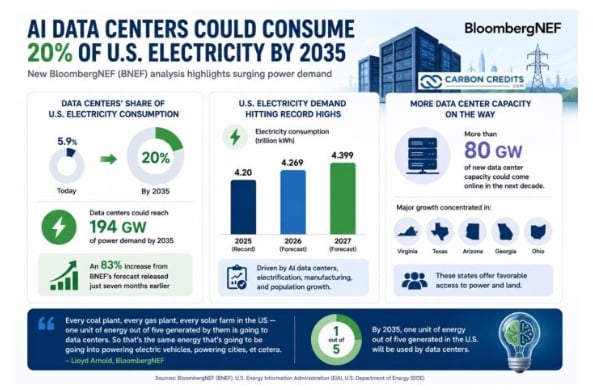
A new BloombergNEF (BNEF) analysis shows just how fast that demand is growing. It projects that data centers could consume about 20% of all U.S. electricity by 2035, up from 5.9% today.

data center electricity demand

Over the coming years, the country will therefore need substantial new generation capacity to meet this growing demand.

This is pushing companies such as Google, Microsoft, and Meta to secure electricity through long-term agreements with renewable energy developers. These contracts can help companies manage power needs while adding more clean generation to the grid.

However, renewable energy is only one part of the solution. Data centers require electricity around the clock, while solar and wind generation changes with weather and time of day.

As a result, companies and utilities are increasingly looking at a combination of solar, wind, battery storage, nuclear power, and other flexible generation resources.

Solar Takes Center Stage in U.S. Power Growth

Solar power is expected to play a major role in meeting the country’s growing electricity needs.

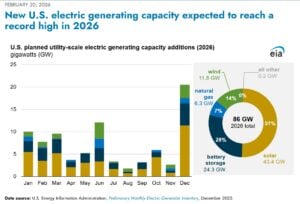
The U.S. solar industry installed about 7.8 GWdc of solar capacity during the first quarter of 2026. Solar also accounted for around 60% of new U.S. electricity-generating capacity additions during the quarter, according to Energy Information Administration (EIA) data.

EIA US solar

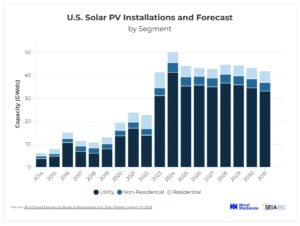
  • According to SEIA, the country’s total solar capacity is now around 210 GW, while solar generates roughly 8% of U.S. electricity.

More importantly, developers are adding tens of gigawatts of new solar capacity each year. This makes solar one of the fastest ways to bring additional electricity generation onto the grid.

For technology companies, solar PPAs can therefore provide access to large amounts of new electricity while supporting the expansion of renewable generation.

us solar pv additions

RWE Plans Major U.S. Energy Investment

RWE is also making the United States a major part of its global growth strategy. The company currently has approximately 13 GW of installed generation capacity across 27 U.S. states. Its portfolio includes solar, onshore wind, and battery storage projects.

  • By 2031, RWE plans to invest a net €17 billion in the U.S. This represents nearly half of its planned global investment of €35 billion.

The company expects these investments to add around 9 GW of new generation capacity, taking its total U.S. installed capacity to approximately 22 GW.

Alongside renewable energy, RWE plans to develop flexible generation capacity, including gas-fired peaking plants. These facilities can provide additional power when electricity demand is high and help support grid reliability.

The company’s U.S. strategy comes after RWE agreed to a $1.22 billion settlement with the U.S. Department of the Interior involving the relinquishment of several offshore wind leases.

Despite this change in its offshore strategy, RWE continues to invest in U.S. energy infrastructure, particularly projects that can respond to rising electricity demand.

Google’s Clean Energy Push Reflects a Bigger Shift

The Crooked Creek Solar PPA shows how renewable energy is becoming increasingly important to the technology sector.

Google needs more electricity to support its cloud and AI expansion. At the same time, the company is under pressure to control emissions from its growing operations. And long-term renewable energy agreements offer one way to address both challenges.

As U.S. electricity demand continues to rise, projects like Crooked Creek Solar could become increasingly important.

The broader trend is clear: major technology companies are becoming some of the largest buyers of new clean power, while energy developers are responding with bigger solar, wind, storage, and other generation projects.

Google’s latest agreement with RWE is another example of that shift, linking the rapid growth of AI and data centers with the expansion of America’s renewable energy infrastructure.

The post Google Signs 15-Year Solar PPA With RWE for 155 MW Oklahoma Project appeared first on Carbon Credits.


BYD’s (BYDDY Stock) Record EV Sales Power Its Race Toward Net Zero and Global Market Dominance

BYD's (BYDDY Stock) Record EV Sales Power Its Race Toward Net Zero and Global Market Dominance

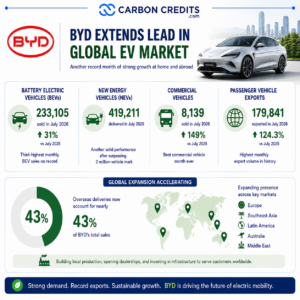
Chinese electric vehicle giant BYD continues to widen its lead in the global EV market. The company sold 233,105 battery electric vehicles (BEVs) in July 2026, up 31% from the same month last year. It was BYD’s third-highest monthly BEV sales on record and another sign that demand remains strong both in China and overseas.

When plug-in hybrids are included, BYD delivered about 419,211 new energy vehicles (NEVs) during the month. That marked another solid performance after the company surpassed the 2 million-vehicle mark earlier this year.

July also showed strength beyond passenger cars. BYD sold 8,139 commercial vehicles, including buses and trucks, up 149% year-over-year. It was the company’s best commercial vehicle month ever and highlights its growing role in electrifying public transport and freight.

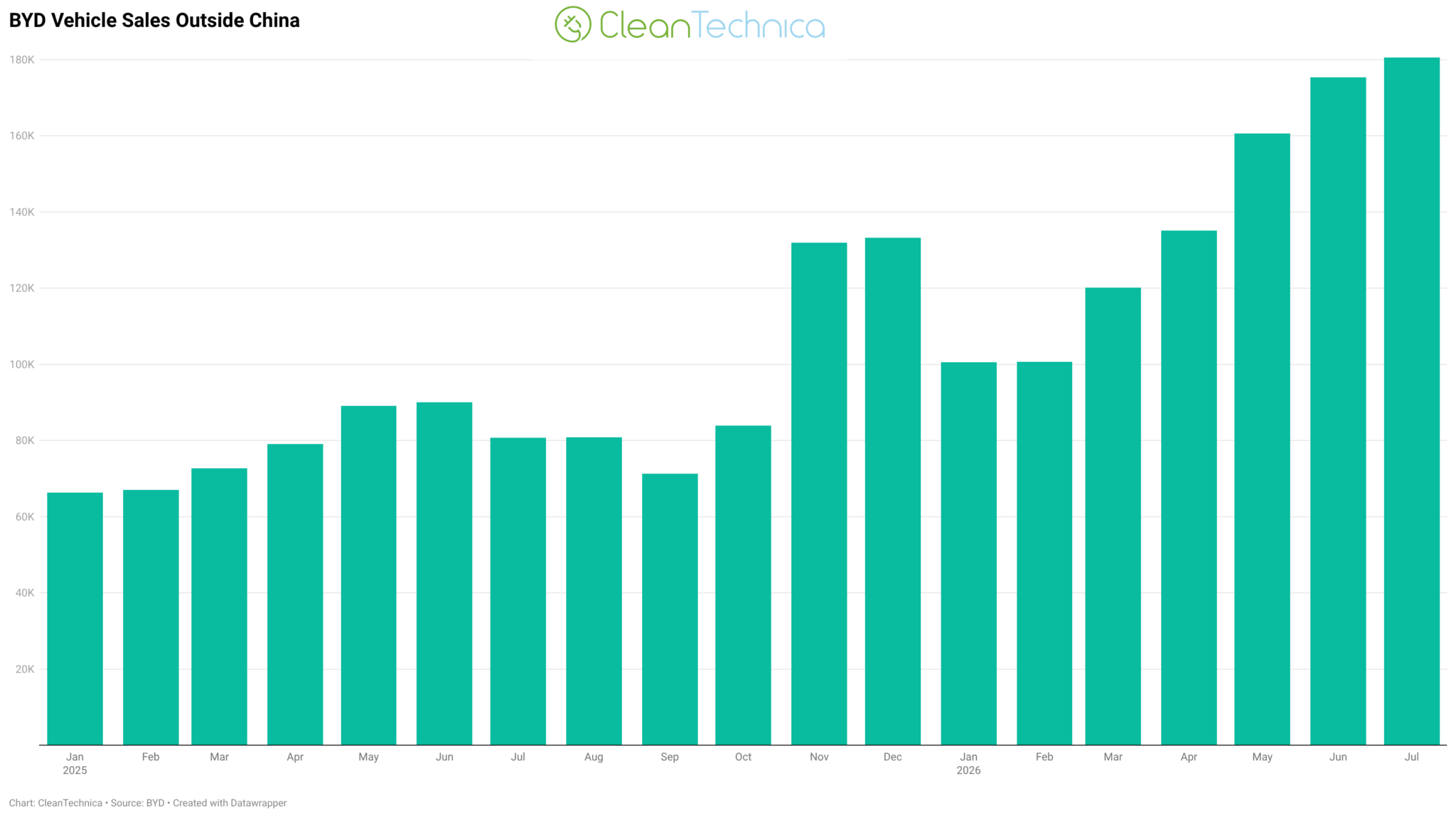
At the same time, BYD achieved another major milestone outside China. The company exported 179,841 passenger vehicles in July, up 124.3% from a year earlier and the highest monthly export volume in its history. 

Overseas deliveries now account for nearly 43% of vehicles BYD sells. These results show that international markets are becoming one of the company’s biggest growth drivers.

Record Exports Put BYD in the Global Fast Lane

For years, BYD depended mainly on China’s domestic market. That is changing quickly.

The company is expanding across Europe, Southeast Asia, Latin America, Australia, and the Middle East. It continues to launch new dealerships, open regional headquarters, and build local production facilities to serve overseas customers.

Europe remains one of its biggest targets. BYD now sells vehicles in more than 20 European countries. It is also building passenger car plants in Hungary and Türkiye to shorten delivery times and reduce import costs. Those factories are expected to strengthen BYD’s position as competition grows in Europe’s EV market.

BYD-vehicle-sales-outside-China-July-2026
Source: CleanTechnica

The Chinese EV maker is following a similar strategy in other regions. In Brazil, Thailand, Indonesia, and Mexico, BYD is expanding manufacturing and assembly operations while increasing investments in charging infrastructure and sales networks.

This global push is paying off. Record exports helped offset slower growth in China’s broader auto market and reduced BYD’s dependence on any single country.

BYD shares rose about 0.8% on August 4, 2026, after the company reported record July exports and another month of strong EV sales. Investors welcomed the continued growth in overseas deliveries, which helped offset weaker demand in China’s domestic market. Analysts said the export momentum reinforces confidence in BYD’s long-term global expansion strategy.

BYD BYDDY stock price

Commercial EVs Become a New Growth Engine

Passenger cars remain BYD’s biggest business, but commercial vehicles are growing even faster. The company’s 149% jump in commercial vehicle sales reflects rising demand for electric buses, trucks, and delivery vehicles.

Cities around the world are replacing diesel buses with electric fleets to improve air quality and reduce emissions. Logistics companies are also adding electric trucks as battery technology improves and operating costs fall.

BYD has become one of the world’s largest electric bus manufacturers. Its buses now operate in more than 400 cities across over 70 countries, according to the company. These vehicles have helped transit agencies lower fuel costs while cutting greenhouse gas emissions from public transportation.

Commercial vehicles could become an increasingly important source of future growth as governments tighten emissions rules and businesses electrify their fleets.

Scaling EV Production While Cutting Carbon

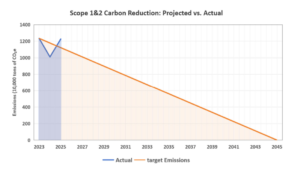
BYD’s rapid growth also supports its broader sustainability strategy. The company has pledged to achieve carbon neutrality across its operations by 2045. It is working toward that goal by expanding renewable energy, improving factory efficiency, and reducing emissions throughout its supply chain.

BYD emissions reduction plan
Source: BYD

Battery technology remains one of BYD’s biggest strengths.

Its Blade Battery, introduced in 2020, uses lithium iron phosphate (LFP) chemistry. These batteries avoid nickel and cobalt, improve safety, and typically have a longer operating life. They also help lower production costs, giving BYD a pricing advantage in many markets.

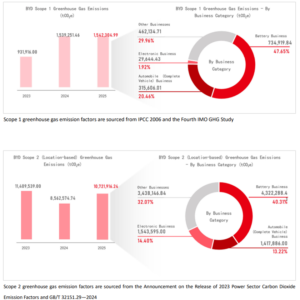
The company continues to expand renewable electricity at its manufacturing sites while improving recycling and energy management. According to its latest sustainability report, BYD has also increased the use of rooftop solar systems and energy-saving technologies across its factories to reduce operational emissions.

These investments support both higher production and lower carbon intensity as the company expands worldwide.

BYD ghg emissions 2025
Source: BYD

SEE MORE: BYD Opens America’s Largest Battery Project in Chile and Expands in Europe Despite Stock (BYDDY) Slump

The Global EV Market Keeps Breaking Records

BYD’s strong July results come as the global EV market continues to grow.

According to the International Energy Agency (IEA), global electric car sales exceeded 20 million units in 2025, making up more than 25% of all new car sales worldwide. The agency expects sales to continue rising through the rest of this decade as battery prices fall and more affordable models enter the market.

China remains the world’s largest EV market. The country accounted for more than half of global EV sales in 2024. It also leads the world in battery production, charging infrastructure, and electric bus deployment. These advantages have helped companies like BYD scale production faster than many global rivals.

The market is also becoming more competitive.

Chinese automakers are expanding into Europe, Southeast Asia, Latin America, and the Middle East. At the same time, established brands such as Tesla, Volkswagen, Hyundai, and Ford are introducing new EV models to defend their market share.

Scale Is Giving BYD an Edge

BDY EV sales July 2026

One of BYD’s biggest strengths is that it controls much of its own supply chain. The company designs and builds its own batteries, electric motors, and many of the key parts used in its vehicles. This reduces costs and helps protect production from supply chain disruptions.

It also gives BYD more flexibility to launch new models quickly and keep prices competitive. That advantage has become even more important as battery prices continue to fall and competition increases across the global EV market.

A Bigger Role in the Global Energy Transition

BYD’s latest sales report shows another strong month. The company is becoming one of the biggest forces in the global shift to electric transportation.

Strong domestic demand continues to support its business, but record exports and rapid growth in commercial vehicles show that BYD is now competing on a much larger stage.

At the same time, its investments in cleaner manufacturing, renewable energy, and battery technology support its long-term goal of reaching carbon neutrality by 2045.

As countries work to reduce transport emissions, companies that can produce affordable electric vehicles at large scale will likely play a bigger role in the transition. BYD’s latest results suggest it is becoming one of those companies. Its combination of growing exports, expanding commercial vehicle sales, and continued investment in clean technology is helping shape the next chapter of the global EV market.

The post BYD’s (BYDDY Stock) Record EV Sales Power Its Race Toward Net Zero and Global Market Dominance appeared first on Carbon Credits.
Inside China’s New 5-Year Climate Plan, and Why the World Is Watching

Inside China's New 5-Year Climate Plan, and Why the World Is Watching

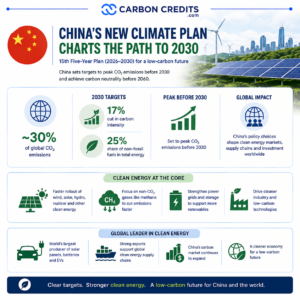
China has released one of its most important climate policy documents in years. The new climate action plan sets the country’s direction for cutting emissions during the 15th Five-Year Plan period (2026–2030). It is designed to help China achieve its long-standing goals of peaking carbon dioxide (CO₂) emissions before 2030 and reaching carbon neutrality before 2060.

The plan goes beyond climate policy. It covers energy, industry, transport, buildings, technology, and carbon markets. Together, these sectors account for most of China’s greenhouse gas emissions. The government says the plan will help build a cleaner economy while supporting energy security and economic growth.

The world is paying close attention.

China is the largest emitter of carbon dioxide, producing about 30% of global CO₂ emissions. It is also the world’s biggest producer of solar panels, batteries, and electric vehicles. That means changes in China’s climate policy can influence clean energy investment, supply chains, and carbon markets around the world.

China Charts Its Course Toward 2030 and Net Zero

The plan introduces two headline targets for 2030.

  • China will reduce its carbon intensity—the amount of CO₂ emitted for every unit of economic output—by 17% from 2025 levels. It also aims to increase the share of non-fossil fuels in total energy consumption to 25% by 2030.

These targets aim to help China peak its carbon emissions before 2030. They also set the stage for more significant cuts in the future. The plan will also support China’s next nationally determined contribution (NDC) under the Paris Agreement, which will cover climate action beyond 2030.

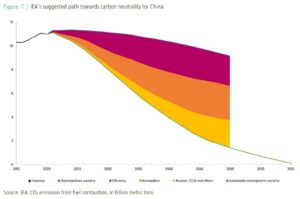
IEA’s suggested path towards carbon neutrality for China
Source: IEA

Unlike some earlier plans, however, this roadmap does not set an absolute cap on national CO₂ emissions. Instead, it continues to rely mainly on carbon intensity targets. Carbon Brief notes that, given economic growth, this approach might allow China’s total emissions to increase over the next five years. This would happen even as emissions become more efficient per unit of GDP.

Clean Energy Remains at the Center

Renewable energy remains the backbone of China’s climate strategy.

The plan calls for faster development of wind, solar, hydropower, nuclear power, and other non-fossil energy sources. It also helps create a clean, low-carbon, safe, and efficient energy system. Plus, it improves electricity transmission and storage to manage more renewable power.

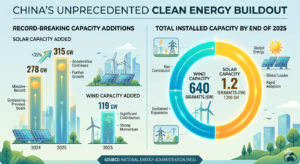
China already leads the world in clean energy deployment. According to the International Energy Agency (IEA), the country has installed more renewable electricity capacity in recent years than any other country. It is also the world’s largest manufacturer of solar panels, batteries, and electric vehicles, giving it a central role in the global energy transition.

Those investments are beginning to affect emissions.

Carbon Brief’s latest analysis found that China’s CO₂ emissions have been flat or falling for 21 consecutive months. The country’s emissions declined by 1% in the final quarter of 2025, leading to an estimated 0.3% decline for the full year. Rapid growth in clean electricity has helped offset rising demand from other sectors.

China carbon emissions
Source: CarbonBrief

SEE MORE: China’s 15th Five-Year Plan Commits $2.94 Trillion to Reach 50% Clean Electricity by 2030

China Expands Its Focus Beyond Carbon Dioxide

The new plan also gives more attention to non-CO₂ greenhouse gases, such as methane, nitrous oxide, and fluorinated gases. These gases make up a much smaller share of China’s emissions than carbon dioxide, but many trap far more heat in the atmosphere.

According to Carbon Brief’s analysis, non-CO₂ gases accounted for about 19% of China’s total greenhouse gas emissions in 2021. Methane was the largest source. It came mainly from coal mining, agriculture, oil and gas production, waste, and wastewater. 

The plan aims to better control emissions. It includes:

  • Improving methane monitoring,
  • Reducing leaks from the energy sector,
  • Promoting cleaner farming practices, and
  • Strengthening management of industrial gases.

Carbon dioxide is the main focus, but tackling non-CO₂ gases could provide quicker climate benefits. Many of these gases warm the planet much more than CO₂ in the short term.

China Strengthens the World’s Largest Carbon Market

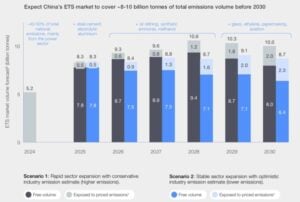
The new climate plan also strengthens China’s carbon market. It calls for further improvements to the national emissions trading system (ETS), which is already the world’s largest carbon market by covered emissions. The ETS currently covers the power sector and is expected to expand gradually to other heavy industries.

china compliance carbon market ets
Source: WEF Asia’s Carbon Markets Strategic Imperatives for Corporations_2025.

China plans to improve carbon accounting, emissions monitoring, verification, and trading rules. The goal is to make carbon pricing a stronger tool for reducing emissions while supporting cleaner industrial growth. The plan also encourages better links between carbon markets, green finance, and climate investment.

These changes could also support international carbon trading under Article 6 of the Paris Agreement. As more countries build carbon markets, stronger accounting rules will become increasingly important to avoid double counting and improve market confidence.

Clean Technology and Heavy Industry Enter a New Phase

Heavy industry remains one of China’s biggest climate challenges. Steel, cement, chemicals, and other energy-intensive industries still produce a large share of the country’s emissions. The new plan calls for cleaner production, higher energy efficiency, and faster adoption of low-carbon technologies across these sectors.

Technology will play a major role. The government will support innovation in:

  • Advanced manufacturing,
  • Clean energy equipment,
  • Energy storage,
  • Hydrogen,
  • Carbon capture, utilization, and storage (CCUS), and
  • Other low-carbon technologies.

These industries are expected to help reduce emissions while supporting economic growth and global competitiveness.

China already has a strong foundation. According to the IEA, the country produces most of the world’s solar panels and lithium-ion batteries and leads global electric vehicle manufacturing. Continued investment in these sectors could help lower clean energy costs worldwide while supporting China’s own climate goals.

china renewable solar wind energy additions

How China’s Climate Decisions Will Shape Global Markets

China’s climate decisions reach far beyond its borders. The country is a major supplier of clean energy technologies used around the world. It also has the world’s largest national carbon market by covered emissions and plays an increasingly important role in global climate negotiations.

For investors, businesses, and governments, the new five-year plan offers a clearer picture of where China intends to invest over the rest of this decade. It signals continued support for clean energy and low-carbon industries while keeping the country’s long-term climate goals firmly in place.

China 5 year climate plan

It also provides a roadmap for how the world’s largest emitter plans to balance economic growth with climate action during a critical decade for global decarbonization. China intends to keep expanding its clean economy. Because of the country’s size and influence, the success—or failure—of this five-year plan will shape not only China’s climate future, but also the pace of the global transition to a low-carbon economy.

The post Inside China’s New 5-Year Climate Plan, and Why the World Is Watching appeared first on Carbon Credits.

Shell Sells, TotalEnergies Buys: The Energy Giants’ Biggest Renewables Deal

Shell Sells, TotalEnergies Buys: The Energy Giants' Biggest Renewables Deal

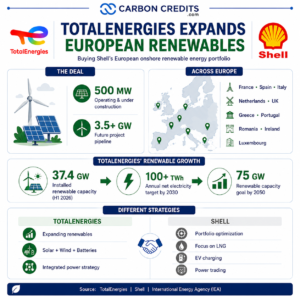
Two of Europe’s biggest energy companies are taking different paths in the clean energy transition. TotalEnergies will buy Shell’s entire onshore renewable power portfolio in Europe. This deal adds hundreds of megawatts of operating capacity and a big pipeline of future projects. The financial terms were not disclosed.

The agreement includes about 500 megawatts (MW) of solar and wind projects that are already operating or under construction. It also includes a pipeline of more than 3.5 gigawatts (GW) of future renewable projects across several European countries.

The assets are located mainly in France, Spain, Greece, Italy, Ireland, Luxembourg, Portugal, the Netherlands, Romania, and the United Kingdom.

Once completed, the acquisition will strengthen TotalEnergies‘ position as one of Europe’s largest renewable power producers. The company stated that the portfolio supports its strategy, which aims to create an integrated electricity business. It combines renewable generation, battery storage, and power trading.

Stéphane Michel, President, Gas, Renewables & Power at TotalEnergies, said:

“In line with our strategy, these two transactions enable us to optimize our capital allocation in renewables while continuing to deploy our Integrated Power strategy. The acquisition of Shell’s onshore renewables assets in Europe strengthens our power generation positions in selected key deregulated markets across Europe and supports the implementation of our integrated strategy across the electricity value chain, complementing the flexible generation capacity of the gas-fired power plants of TTEP, our joint venture with EPH, particularly in Italy, the Netherlands and the United Kingdom.”

Shell and TotalEnergies Are Taking Different Paths

The deal also highlights how Europe’s largest oil and gas companies are reshaping their clean energy strategies.

TotalEnergies continues to expand. The company has made renewable electricity one of its fastest-growing businesses. It is investing heavily in solar, wind, batteries, and flexible power generation while steadily reducing the share of oil in its energy mix.

Shell is taking a different approach. Rather than expanding its renewable generation portfolio, the company is focusing on businesses where it expects higher financial returns. These include liquefied natural gas (LNG), biofuels, electric vehicle charging, and power trading.

The oil major says the sale is part of its plan to simplify its renewable power business and improve capital discipline. The move follows several portfolio changes over the past two years.

In 2024, Shell sold its 1.2 GW onshore renewable business in India. Earlier this year, it also agreed to sell parts of its renewable portfolio in South Africa. Both companies remain committed to reaching net-zero emissions by 2050, but they are choosing different routes to get there.

TotalEnergies Keeps Growing Its Clean Energy Portfolio

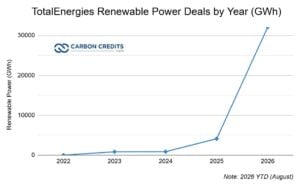
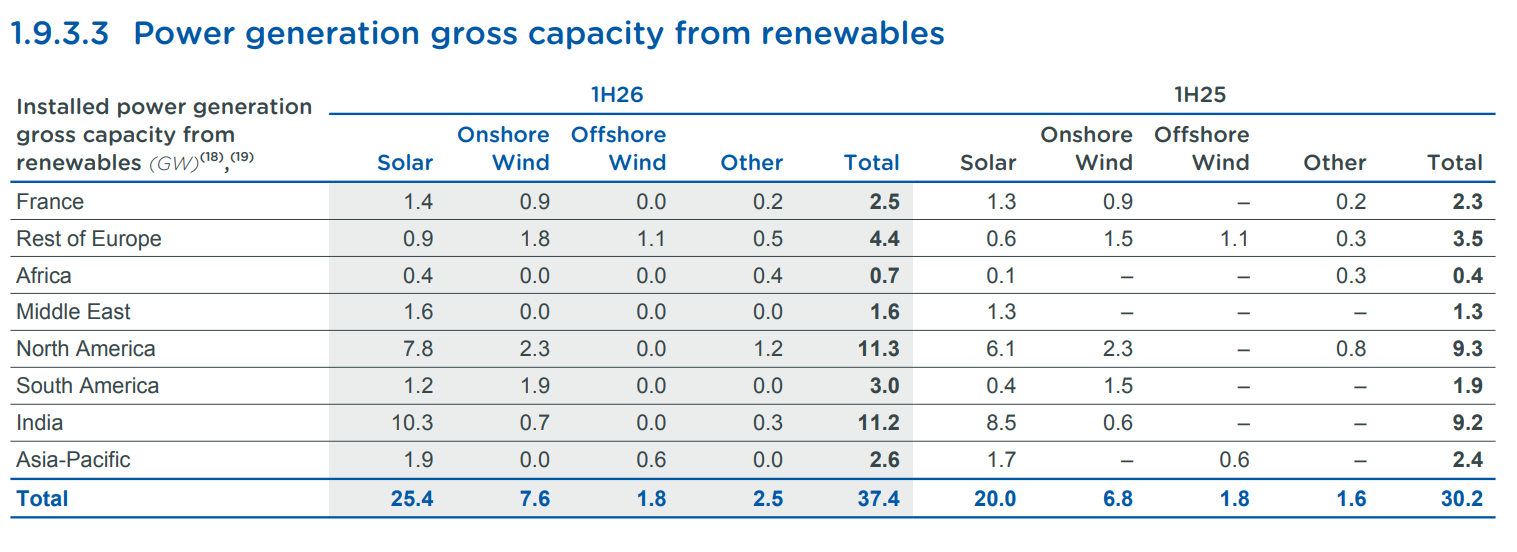
The acquisition builds on TotalEnergies’ rapid expansion in renewable electricity. The energy giant reported over 37.4 GW of installed renewable electricity capacity worldwide by the end of the first half of 2026. The massive deals within this period bring 681% growth in its renewable power agreements. 

Then, it will expand to over 100 terawatt-hours (TWh) of annual net electricity production by 2030. And it aims to reach 75 GW by 2050.

TotalEnergies Renewable Power Deals by Year (GWh)

The company also operates one of Europe’s largest renewable development pipelines. Before the Shell deal, TotalEnergies had nearly 10 GW of renewable capacity installed or being built in Europe. They also had another 27 GW in development.

Renewable electricity is becoming a bigger part of its business. During the first half of 2026, TotalEnergies generated 15% more electricity than a year earlier, driven by new solar and wind projects. Power production reached over 26 TWh, helping offset weaker oil and gas prices.

TotalEnergies electricity generation from renewables h12026
Source: TotalEnergies

The company says that combining renewable energy with battery storage and electricity trading helps provide more reliable power. This approach also boosts returns.

Europe’s Renewable Market Continues to Grow

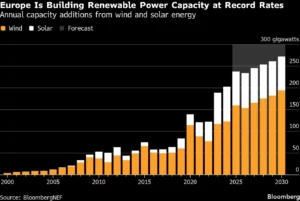
The timing of the acquisition reflects broader market trends. Europe is rapidly expanding renewable electricity to improve energy security and meet climate goals.

The International Energy Agency (IEA) expects renewable energy to supply almost all global electricity demand growth through 2028. Solar remains the fastest-growing source, while wind continues to expand across Europe.

The European Commission’s REPowerEU plan aims to speed up renewable deployment and reduce dependence on imported fossil fuels. The EU has set a binding target. It aims for at least 42.5% of its final energy to come from renewable sources by 2030. The goal is to eventually reach 45%.

Europe renewable power capacity forecast 2030

For companies such as TotalEnergies, these policies create long-term demand for renewable electricity. For Shell, priorities have changed. Now, it focuses on businesses that can yield better returns. It also aims to support its overall energy transition strategy.

The different approaches show that Europe’s energy transition is no longer about whether companies invest in low-carbon energy. It is increasingly about how they choose to compete in a rapidly changing power market.

Why Renewable Power Is the New Energy Battleground

The deal comes as Europe’s renewable energy market keeps growing.

According to the IEA, renewable energy will provide almost all of the world’s growth in electricity demand through 2028. Solar is leading the expansion, while wind power continues to grow across Europe.

The European Union is also raising its ambitions. The updated Renewable Energy Directive sets a goal for the EU.

As more renewable power enters the grid, companies need more than just wind and solar farms. They also need battery storage, electricity trading, and flexible power systems that can balance supply and demand. That is why large energy companies are increasingly building integrated electricity businesses instead of owning only renewable assets.

Scale Is Becoming a Competitive Advantage

TotalEnergies believes bigger renewable portfolios will create long-term value. The company is combining renewable power generation with battery storage, gas-fired flexibility, and electricity trading. This allows it to sell electricity when demand and prices are highest while improving returns from its renewable assets.

Shell is following a different strategy.

The company is not investing in more renewable energy. Instead, it focuses on areas with better profits, like LNG, power trading, electric vehicle charging, and low-carbon fuels. The company says these businesses can deliver better returns while still supporting its net-zero ambition.

TotalEnergies Shell renewable power deal

Both companies want to grow in the energy transition. They simply disagree on where future value will come from.

A New Chapter in Europe’s Energy Transition

The sale of Shell’s European renewable portfolio is more than a business transaction, as it highlights how the energy transition is entering a new phase. Companies are no longer asking whether to invest in clean energy. They are deciding which low-carbon businesses will generate the strongest returns over the next decade.

For TotalEnergies, buying Shell’s renewable assets strengthens its position as one of Europe’s largest clean electricity producers. The acquisition also supports its strategy of becoming a major integrated power company while advancing its goal of net-zero emissions by 2050.

For Shell, the sale reflects a more selective investment strategy focused on higher-return energy businesses.

Together, the two companies show that there is no single path to net zero. Some companies are expanding renewable generation as quickly as possible. Others are concentrating on areas where they believe they have the greatest competitive advantage.

As Europe accelerates its shift to clean electricity, both strategies will help shape the next stage of the global energy transition.

The post Shell Sells, TotalEnergies Buys: The Energy Giants’ Biggest Renewables Deal appeared first on Carbon Credits.
Brazil’s Mombak Delivers Amazon Carbon Credits Early, Giving Google a Climate Win

Brazil's Mombak Delivers Amazon Carbon Credits Early, Giving Google a Climate Win

Brazilian carbon removal company Mombak has reached an important milestone. The company has delivered its first carbon removal credits more than two years earlier than planned. The early delivery shows that large forest restoration projects can remove carbon at commercial scale and meet their commitments.

The first issuance includes more than 21,000 verified carbon removal credits. These credits were originally expected in 2028. Buyers include Google, McKinsey & Company, McLaren Racing, Bain & Company, Climeworks, Commons, and Union Square Ventures.

Mombak expects to issue more than 55,000 additional carbon credits before the end of 2026, increasing the total volume delivered this year.

The early delivery matters because many carbon projects have struggled to meet their timelines. Mombak is showing that high-quality carbon removal projects can deliver earlier than expected.

Restoring the Amazon, One Tree at a Time

Mombak does not protect existing forests. Instead, it restores land that has already been cleared.

The company buys or partners with owners of degraded cattle pasture in Brazil’s Amazon region. It then plants native trees to rebuild the rainforest. As the trees grow, they remove carbon dioxide from the air. This creates carbon removal credits, not avoided-emissions credits.

So far, Mombak has planted nearly 15 million native trees across 12 restoration projects in the state of Pará. At dense planting spacing, over 30 square miles, the trees would completely cover Manhattan, New York, and overflow into parts of Brooklyn.

The removal company uses more than 80 native Amazon tree species to rebuild forests that closely match the original ecosystem. Their restoration projects also provide other benefits. They improve biodiversity, restore soil, protect rivers, and create jobs for local communities.

The projects are certified under Verra standards. They also include 100-year permanence commitments, meaning the carbon is expected to stay stored for the long term. While Mombak uses Verra frameworks for baseline monitoring, this historic early credit issuance was officially issued via the scientific registry Isometric.

Mombak Chief Commercial Officer Dan Harburg noted:

“The carbon market has unfortunately had a lot of challenges with underdeliveries and late deliveries from suppliers across the board. Being two years early in some of our first deliveries is really valuable for the relationships that we build with existing buyers and with other buyers.”

Why Google and Microsoft Are Backing Mombak

The latest delivery builds on several major agreements.

Google first agreed to buy 50,000 tons of carbon removal from Mombak. It later expanded the deal to 200,000 metric tons in late 2025, making it one of Google’s biggest nature-based carbon removal purchases.

Microsoft signed an even larger agreement. It plans to buy 1.5 million metric tons of carbon removal through 2032. The deal supports Microsoft’s goal of becoming carbon negative by 2030 and removing all of its historical emissions by 2050.

Mombak is also the first restoration partner selected by the Symbiosis Coalition. The coalition includes Google, Microsoft, Meta, and Salesforce. Together, the group plans to buy up to 20 million metric tons of high-quality nature-based carbon removal by 2030.

These agreements show that major technology companies are putting more money into long-term carbon removal instead of relying only on traditional carbon offsets.

A Fast-Growing Carbon Removal Company

Mombak is still a young company. It was founded in 2021 but has grown quickly.

The startup has raised more than $200 million from investors. These include Bain Capital, AXA IM Alts, Lowercarbon Capital, Kaszek Ventures, and Union Square Ventures. Earlier this year, it raised another US$30 million to expand forest restoration projects across Brazil.

The company has also signed about $150 million in carbon removal agreements with corporate buyers. Mombak says demand continues to grow as more companies look for trusted carbon removal projects to help meet their net-zero goals.

Mombak’s business model is different from many forest carbon developers. Instead of protecting existing forests, it restores degraded cattle pasture into native rainforest. The company either buys land or partners with landowners, then plants diverse native tree species and manages the forests over the long term. This approach creates measurable carbon removals while helping restore biodiversity and improve local ecosystems.

Early Delivery Builds Trust in Carbon Removal

The early delivery sends an important message. The voluntary carbon market (VCM) has faced criticism in recent years. Some projects delivered fewer credits than promised. Others missed their timelines. That has made many buyers more careful.

Mombak is moving in the opposite direction. It delivered verified carbon removals years ahead of schedule. That gives buyers more confidence that nature-based carbon removal projects can deliver real results.

As demand for carbon removal grows, companies that consistently deliver high-quality credits on time—or even early—could help set a new standard for the global carbon market.

Carbon Removal Demand Is Accelerating Worldwide

Mombak’s early delivery reflects a bigger trend.

More companies are buying carbon removal credits to help meet their net-zero goals. Many have already cut emissions from their own operations. Now they need durable carbon removal to deal with emissions that are harder to eliminate.

The market is growing quickly.

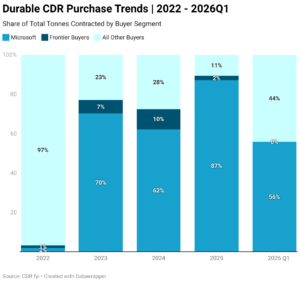
According to CDR.fyi, companies signed contracts for a record 8 million metric tons of durable carbon removal in 2025. Technology companies remained the biggest buyers. Microsoft, Google, Amazon, Meta, and Stripe continue to lead the market by supporting both nature-based and engineered carbon removal projects.

durable-cdr-purchase-trends-2022-2026q1

Scientists say demand will need to grow much further.

The Intergovernmental Panel on Climate Change (IPCC) estimates the world will need to remove billions of tons of CO₂ every year this century to help limit global warming to 1.5°C. The International Energy Agency (IEA) also says carbon removal will be needed alongside deep emissions cuts to reach global net-zero emissions.

Brazil Has Become a Global Carbon Removal Leader

Brazil is well placed to help meet that demand. The country holds about 60% of the Amazon rainforest, the world’s largest tropical forest. It also has millions of hectares of degraded pasture that can be restored without clearing new land.

amazon deforestation trend
Source: Mongabay

The World Resources Institute (WRI) estimates Brazil has more than 50 million hectares of degraded pasture with strong restoration potential. Turning even part of this land back into native forest could remove large amounts of carbon while improving biodiversity and water quality.

That opportunity is attracting more investment. Companies like Mombak are showing that restoring forests can produce verified carbon removal while creating jobs, improving local ecosystems, and supporting rural communities.

A Milestone That Could Strengthen the Entire Carbon Market

Delivering carbon credits early does more than help one company. It helps strengthen confidence in the entire carbon removal market.

Corporate buyers want projects that can deliver real carbon removals on time. Early delivery reduces execution risk and shows that high-quality nature-based projects can perform as promised.

That could become even more important as demand grows.

High-quality carbon removal credits remain in short supply, while many large companies are increasing their purchases each year. Projects that consistently deliver verified removals may attract more buyers and stronger pricing over time.

For Mombak, the early issuance marks an important milestone. For buyers like Google, McKinsey, and other corporate partners, it provides verified carbon removals sooner than expected, helping strengthen their long-term climate strategies.

More broadly, the achievement shows that restoring the Amazon rainforest can produce high-quality carbon removal credits at commercial scale. As more projects deliver on time—or even early—nature-based carbon removal could become a larger and more trusted part of the global effort to reach net zero.

The post Brazil’s Mombak Delivers Amazon Carbon Credits Early, Giving Google a Climate Win appeared first on Carbon Credits.

Microsoft Bets on Wastewater to Power the Next Wave of Carbon Removal

Microsoft Bets on Wastewater to Power the Next Wave of Carbon Removal

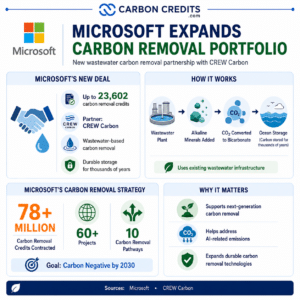
Microsoft is adding another technology to its growing carbon removal portfolio. The company has agreed to purchase up to 23,602 carbon dioxide removal (CDR) credits from U.S.-based startup CREW Carbon. The credits will come from projects that remove carbon while treating wastewater, opening a new pathway for durable carbon removal.

The agreement is small compared with some of Microsoft’s million-ton carbon removal purchases, but it highlights something bigger. The tech giant is continuing to diversify the technologies it supports.

Instead of relying only on direct air capture, biochar, or bioenergy with carbon capture and storage (BECCS), it is backing newer solutions that could scale faster and lower costs. The deal also shows that wastewater treatment may become an unexpected source of permanent carbon removal.

Phillip Goodman, Carbon Removal Portfolio Director at Microsoft, stated:

“Microsoft’s offtake agreement with CREW supports the advancement of a novel, wastewater-based approach that is highly durable and measurable. CREW has shown that carbon removal in the wastewater sector is implementable and scalable with high Monitoring, Reporting and Verification (MRV) certainty.”

Turning Wastewater Into a Carbon Sink: How It Can Lock Away Carbon for Millennia

Wastewater plants are built to treat wastewater, not to remove carbon. CREW Carbon wants to change that.

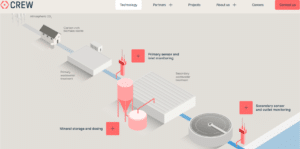
The company has developed a process that adds alkaline minerals to wastewater. These minerals react with dissolved carbon dioxide and convert it into stable bicarbonate ions that eventually flow into the ocean. There, the carbon can remain stored for thousands of years as part of the natural carbon cycle.

Unlike many engineered carbon removal systems, the process uses existing wastewater infrastructure. Utilities do not need to build entirely new plants. Instead, they can add CREW’s technology to facilities already treating municipal wastewater.

CREW Carbon waste treatment process
Source: CREW Carbon

The company says the process offers another benefit. It can improve wastewater treatment performance while helping utilities lower operating costs. This year, CREW Carbon raised $25 million in Series A funding. The money will help expand its projects to more wastewater treatment plants in North America.

This makes wastewater one of several emerging carbon removal pathways now moving from pilot projects toward commercial deployment.

The agreement builds on CREW’s existing long-term carbon removal deals with major corporate buyers, including JPMorgan, Google, Autodesk, and Stripe through Frontier. Together, these commitments bring CREW’s total contracted carbon removal portfolio to more than $40 million.

Microsoft Keeps Building the World’s Largest Carbon Removal Portfolio

The latest agreement fits Microsoft’s long-term climate strategy. The company has pledged to become carbon-negative by 2030 and remove all the carbon it has emitted since its founding in 1975 by 2050. Those goals require far more than cutting emissions.

The tech giant also needs permanent carbon removal.

Microsoft’s latest carbon removal update shows it has signed contracts for over 78 million metric tons of carbon removal. This includes more than 60 projects and 10 different carbon removal pathways.

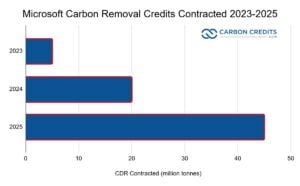
In fiscal 2025, it signed contracts for projects to remove over 45 million metric tons of carbon dioxide. These projects cover 29 initiatives across five continents and various carbon removal methods. These methods include direct air capture, biochar, reforestation, enhanced rock weathering, and BECCs.

The company states that these commitments are just a small part of the 7–9 billion metric tons of CO₂ the world needs to remove each year, which is essential to keep global warming near 1.5°C.

microsoft carbon removal contracts 2023-2025

The tech giant has become the world’s largest corporate buyer of durable carbon removal. In 2026 alone, it signed agreements covering:

  • 1 million biochar credits,
  • 626,000 BECCS credits,
  • nearly 37,000 enhanced rock weathering credits, and
  • several direct air capture and mineralization projects.

Carbon Removal Helps Microsoft Address Rising AI Emissions

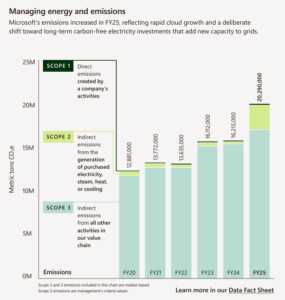
Microsoft’s growing investment in carbon removal reflects a much bigger climate challenge. The company’s greenhouse gas emissions reached 20.3 million metric tons of CO₂ equivalent (MtCO₂e) in fiscal year 2025, up 25% from 16.2 MtCO₂e in 2024. The rise came mainly from the fast growth of AI and cloud infrastructure. New data centers need a lot of steel, cement, semiconductors, and electricity.

Microsoft ghg emissions 2025
Source: Microsoft

Scope 3 emissions remain Microsoft’s biggest source of emissions, accounting for 85.8% of its total carbon footprint in 2025. The largest contributor was capital goods, which made up 44.6% of total emissions. Purchased goods and services added 25.3%, reflecting the carbon-intensive materials and equipment needed to build AI infrastructure.

Despite the increase, Microsoft remains committed to becoming carbon negative by 2030. The company is expanding one of the world’s largest corporate carbon removal portfolios to address emissions that cannot yet be eliminated.

Microsoft states that investing in new technologies, like wastewater carbon removal, will boost future supplies of high-quality carbon credits. This move will also speed up innovation in the industry.

Corporate Demand Is Fueling the Carbon Removal Boom

Microsoft’s latest deal reflects a much bigger trend. Companies are buying more durable carbon removal as they work toward net-zero goals.

According to CDR.fyi, buyers contracted more than 8 million metric tons of durable carbon removal in 2025, setting another annual record. Technology companies remain the biggest buyers because they face growing emissions from AI, cloud computing, and expanding digital infrastructure.

The market still has a long way to go. The Intergovernmental Panel on Climate Change (IPCC) states that the world must remove billions of tons of CO₂ each year this century. This is needed to balance emissions that are hard to cut. The International Energy Agency (IEA) also says carbon removal will play an important role in reaching global net-zero emissions by 2050.

Investment is rising as well. McKinsey & Company estimates the carbon removal market could grow into a $1.2 trillion industry by 2050 if countries stay on track to meet climate goals.

Could Wastewater Become Carbon Removal’s Next Big Market?

Most carbon removal projects today focus on forests, biochar, direct air capture, or enhanced rock weathering. Wastewater offers another opportunity.

According to the International Energy Agency, the global wastewater sector produces about 2% of energy-related methane emissions. Methane is a strong greenhouse gas. It warms the Earth about 80 times more than carbon dioxide over 20 years, says the United Nations Environment Programme (UNEP).

Microsoft carbon removal with CREW Carbon

Using wastewater plants to remove carbon while improving water treatment could create two climate benefits at the same time. Because thousands of wastewater treatment plants already operate worldwide, the technology may also scale faster than solutions that require entirely new facilities.

A New Frontier for Net Zero Climate Finance

Microsoft’s latest purchase is modest compared with its larger carbon removal agreements. But it highlights an important shift in the market.

The company is no longer investing only in proven technologies. It is also helping early-stage carbon removal companies move from pilot projects to commercial deployment. That strategy could speed up innovation while expanding future supplies of durable carbon removal.

For Microsoft, wastewater carbon removal adds another tool to help reach its goal of becoming carbon negative by 2030 and removing its historical emissions by 2050.

For the broader carbon market, the agreement shows that the next generation of carbon removal may come from unexpected places. Alongside forests, biochar, and direct air capture, wastewater could become another important part of the world’s effort to remove carbon permanently and achieve net zero.

The post Microsoft Bets on Wastewater to Power the Next Wave of Carbon Removal appeared first on Carbon Credits.
Canada’s Giant Nickel Mine Could Remove 1.5 Million Tons of CO₂ Every Year

Canada has approved one of its biggest critical minerals projects. The federal government has given the green light to the Crawford Nickel Sulphide Project in Ontario. The mine is being developed by Canada Nickel Company and could become one of the world’s largest producers of nickel while also storing large amounts of carbon dioxide (CO₂).

The approval follows a federal impact assessment. It includes 371 legally binding conditions. These cover environmental protection, Indigenous participation, water quality, wildlife, and long-term monitoring.

The project is also expected to deliver major economic benefits. According to Canada Nickel, Crawford could create about 5,000 jobs during construction and around 1,300 permanent jobs once the mine begins operating.

The company estimates the project could contribute more than C$70 billion to Canada’s economy over its operating life. Construction could begin after the remaining provincial permits are secured.

Mining Nickel While Pulling Carbon From the Air

Crawford is different from most mining projects. Instead of only producing minerals, the mine is designed to remove carbon dioxide from the atmosphere.

Canada Nickel states that the project could achieve permanent storage of up to 1.5 million metric tons of CO₂ each year during operations through a process called mineral carbonation.

The mine contains large amounts of ultramafic rock, which naturally reacts with carbon dioxide. When exposed to air, these rocks slowly lock CO₂ into stable carbonate minerals. This keeps the carbon stored for thousands of years without needing underground injection or long-term monitoring.

The company plans to speed up this natural process using its proprietary In-Process Tailings (IPT) Carbonation technology. Instead of treating mine waste as a problem, Crawford will use it to capture carbon while producing nickel.

Canada Nickel Crawford project
Source: Canada Nickel

Canada Nickel claims this could make Crawford one of the first net-zero nickel mines. It might even become one of the few mining projects that can go carbon negative over time.

Canada Nickel CEO Mark Selby said:

“Today’s decision recognizes the strategic importance of responsibly developing Canada’s critical mineral resources in partnership with all levels of government and Indigenous Nations while maintaining rigorous environmental standards.”

Why Nickel Is Powering the Clean Energy Boom

The timing is significant. Nickel is one of the world’s most important critical minerals. It’s commonly found in stainless steel. However, demand is growing due to electric vehicles, battery storage, and clean energy technologies.

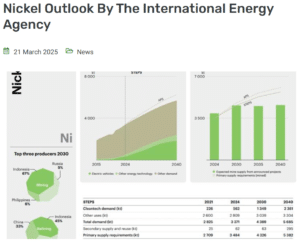
According to the International Energy Agency, demand for nickel could more than double by 2040 under countries’ current climate commitments. Under the agency’s Net Zero Emissions by 2050 plan, demand may rise more as battery production grows.

nickel outlook by the IEA demand 2040
Source: IEA

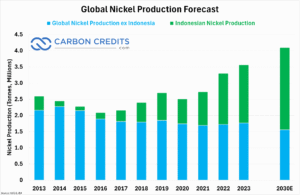
The United States Geological Survey estimates global nickel mine production reached about 3.7 million metric tons in 2025. Indonesia remained the world’s largest producer, supplying more than half of global output.

Canada ranked among the leading producers and continues to expand its role in supplying critical minerals to North America and Europe. Crawford could strengthen that position.

The project hosts one of the world’s largest nickel sulphide resources. Canada Nickel estimates measured and indicated resources of more than 3.7 billion tonnes, making it the second-largest nickel reserve globally. Unlike laterite deposits, sulphide ores are easier to process. They are also great for making battery-grade nickel.

If successful, Crawford would help supply the growing demand for low-carbon nickel while showing that mining and carbon storage can work together.

global-nickel-production-forecast

Critical Minerals Are Becoming a Climate Priority

Crawford comes at an important time for the global mining industry. Countries are racing to secure supplies of critical minerals needed for the clean energy transition. Nickel is one of the most important because it is used in electric vehicle batteries, renewable energy systems, and stainless steel.

The IEA warns that demand for critical minerals will continue to rise as countries expand clean energy. At the same time, many governments want these minerals to come from cleaner and more reliable sources.

Canada is well positioned to benefit. The Canadian government has identified nickel as a strategic mineral under its Critical Minerals Strategy. Crawford supports that goal by increasing domestic production while lowering emissions from mining.

Canada critical mineral reserves vs production

The project also fits Canada’s broader climate target of cutting greenhouse gas emissions by 40% to 45% below 2005 levels by 2030 and reaching net-zero emissions by 2050.

Can the Mining Industry Become Carbon Negative?

Mining has long been linked to high emissions. Producing the metals needed for clean energy often requires large amounts of fuel and electricity.

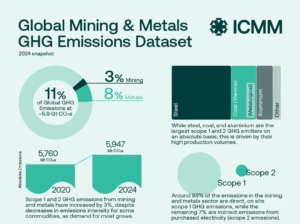
New data from the International Council on Mining and Metals (ICMM) show that mining and metals together produced about 11% of global Scope 1 and 2 greenhouse gas emissions in 2024. Mining accounted for 3%, while metal processing contributed another 8%.

global mining ghg emissions 2024 ICMM

That has raised concerns about whether the energy transition simply shifts emissions from one industry to another.

Projects like Crawford could help change that. By combining nickel production with permanent carbon storage, the project aims to lower the carbon footprint of mining instead of adding to it. Canada Nickel also plans to produce the following through its planned NetZero Metals processing facility:

  • NetZero Nickel™,
  • NetZero Cobalt™, and
  • NetZero Iron™.

The company says this could supply manufacturers looking for lower-carbon materials for batteries, vehicles, and steel. If successful, Crawford could become a model for future mines built on ultramafic rock deposits around the world.

A New Direction for Low-Carbon Mining

Crawford is more than another nickel mine. It shows how mining companies are beginning to combine critical mineral production with climate solutions. Instead of treating carbon as a by-product, the project plans to capture and permanently store it while producing the metals needed for the clean energy economy.

However, many challenges remain. The company still needs provincial approvals and must prove the carbon capture technology works at full commercial scale. It also needs to deliver the project on time and within budget.

Still, the opportunity is significant. As governments and manufacturers look for cleaner supplies of critical minerals, projects that produce metals while removing carbon could gain a competitive advantage.

For Canada Nickel, Crawford is a chance to build one of the world’s largest nickel mines. For the mining industry, it could show that the next generation of critical mineral projects can help support both the energy transition and global climate goals.

The post Canada’s Giant Nickel Mine Could Remove 1.5 Million Tons of CO₂ Every Year appeared first on Carbon Credits.
PayPal Expands Its Net Zero Strategy With 3Degrees’ Carbon Removal Portfolio

PayPal Expands Its Net Zero Strategy With 3Degrees' Carbon Removal Portfolio

PayPal, the digital payments company, expands its climate strategy by supporting next-generation carbon removal projects. These include biochar and bioenergy with carbon capture and storage (BECCS). The investments aim to cut emissions that are hard to eliminate and support the growth of the new carbon removal market.

The move reflects a broader shift taking place across corporate climate strategies. Many companies have already reduced emissions through renewable electricity, energy efficiency, and cleaner supply chains.

As those options become harder to expand, attention is turning toward permanent carbon removal to address the remaining emissions needed to reach net zero.

Cullen Mitchell, Sustainability Manager at PayPal, noted:

“As we work toward our 2040 net-zero target, investing in high-durability carbon removals was a vital step for PayPal… [3Degrees enables our company] to confidently invest in high-integrity, diversified carbon removals that fit both our budget and our climate ambitions.”

3Degrees Builds a Diversified Carbon Removal Portfolio

PayPal is investing with 3Degrees, a climate solutions company. Their solutions help businesses cut emissions and create carbon removal portfolios.

3Degrees built a diverse portfolio for PayPal. Instead of buying credits from just one project, it spreads investment across various carbon removal technologies and locations.

The portfolio features Heartyculture Biochar in India. This process turns agricultural waste into biochar, helping lock carbon in soils. It also includes Gevo’s North Dakota BECCS facility. This facility captures carbon dioxide from ethanol production and stores it underground for good.

3Degrees says this varied approach reduces technical and commercial risks. It also helps grow the next generation of lasting carbon removal technologies.

For PayPal, carbon removal is not a replacement for emissions reductions. It is becoming the final piece of a much larger climate strategy.

Years of Emissions Cuts Set the Stage for the Next Move

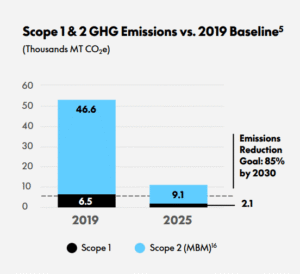
PayPal has made significant progress in reducing emissions from its own operations. According to its 2025 Global Impact Report, the company has reduced its Scope 1 and Scope 2 greenhouse gas emissions by over 80% compared with its 2019 baseline.

PayPal GHG emissions 2025
Source: PayPal

These reductions came from:

  • purchasing renewable electricity,
  • improving office energy efficiency, and
  • reducing emissions from its facilities and operations.

The company has also maintained 100% renewable electricity across its global data centers while continuing to improve the efficiency of its technology infrastructure.

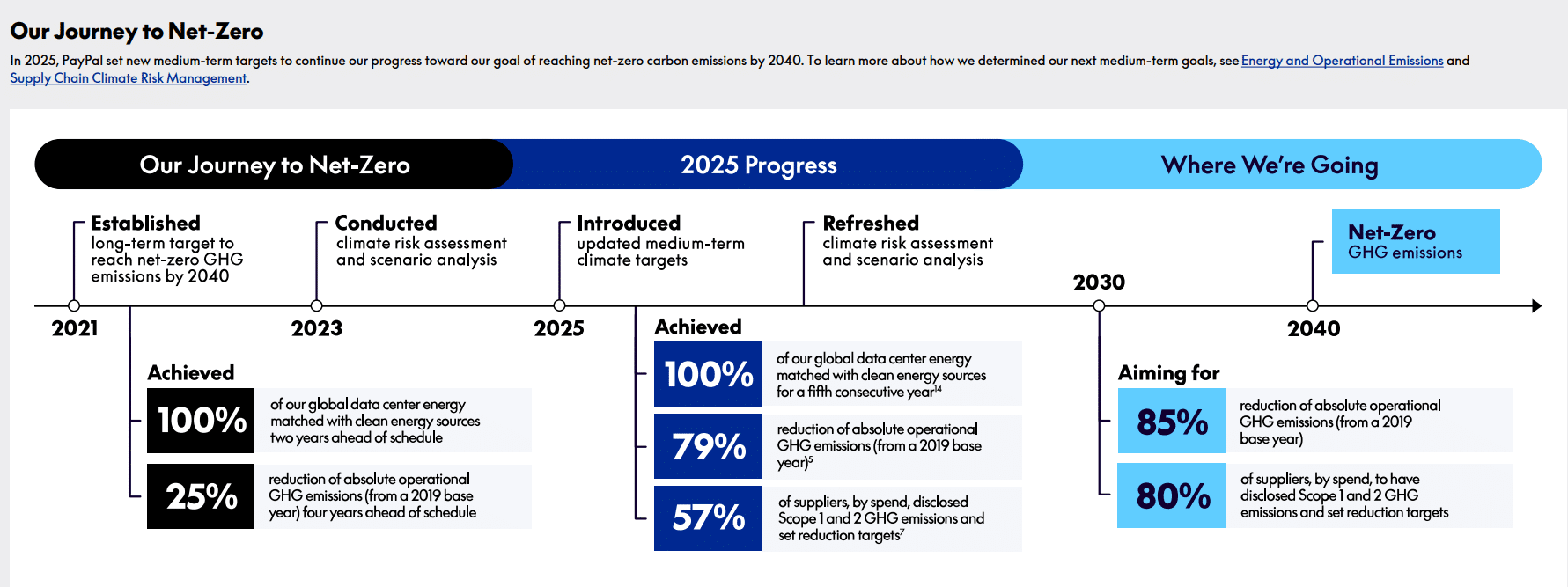
PayPal’s long-term goal is to reach net-zero greenhouse gas emissions across its value chain by 2040. The target has been validated by the Science Based Targets initiative (SBTi) and aligns with limiting global warming to 1.5°C.

The company’s updated transition plan also sets several interim goals by 2030. These include maintaining near-zero operational emissions while reducing supply chain emissions through stronger supplier engagement and cleaner procurement practices.

PayPal Net Zero roadmap and progress 2025
Source: PayPal

Scope 3 Remains PayPal’s Biggest Challenge

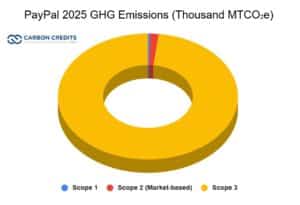
Like most technology companies, PayPal has already made strong progress in cutting emissions from its own operations. Its total GHG emissions fell from 515.1 thousand MTCO₂e in 2023 to 478.1 thousand MTCO₂e in 2024. But it rose to 578.6 thousand MTCO₂e again in 2025.

Scope 1 and Scope 2 emissions remained relatively low and stable, while the increase in 2025 was driven almost entirely by Scope 3 emissions, as shown in the chart below.

According to its Climate Transition Plan, Scope 3 emissions account for about 98% of PayPal’s total carbon footprint. These emissions come mainly from purchased goods and services, capital equipment, business travel, and employee commuting.

The use of cloud computing and technology services throughout its value chain also contributes.

PayPal 2025 GHG emissions by scope

That means PayPal cannot reach net zero by improving only its own buildings or electricity use. It also needs suppliers to lower their emissions.

To help achieve that goal, the company is working closely with key vendors. PayPal expects strategic suppliers to measure their emissions, set science-based climate targets, and increase their use of renewable electricity. The company is also including climate performance in supplier engagement and procurement decisions.

This reflects a growing trend across the technology industry. As operational emissions continue to fall, supply chain emissions are becoming the biggest obstacle to achieving corporate climate goals.

Why PayPal Is Investing in Carbon Removal

Even with deep emissions cuts, some emissions will remain difficult to eliminate by 2040. These are known as residual emissions. PayPal will focus on high-durability carbon removal instead of just traditional carbon offsets to tackle its remaining emissions.

The company is partnering with 3Degrees, a climate solutions provider, to buy carbon removal. This will support projects that permanently take carbon out of the atmosphere.

Current investments focus on two technologies. The first is biochar, which converts agricultural waste into a stable form of carbon that can remain stored in soils for hundreds of years while improving soil health.

The second is bioenergy with carbon capture and storage (BECCS). This technology captures carbon dioxide from biomass energy production. It then stores it deep underground, stopping it from going back into the atmosphere.

PayPal states that these investments aim to boost technologies needed to achieve global net-zero goals in the coming decades.

PayPal carbon removal biochar story
Source: PayPal

Durable carbon removal is different from traditional carbon credits. While many credits just aim to avoid future emissions, durable carbon removal actually takes carbon out of the atmosphere. It stores this carbon for a long time.

That makes it one of the fastest-growing areas of the voluntary carbon market.

Carbon Removal Is Becoming a Bigger Climate Investment

PayPal is not alone in backing carbon removal. More companies now see carbon removal as an important tool for reaching net zero. According to CDR.fyi, buyers contracted more than 8 million metric tons of durable carbon removal in 2025, setting another annual record.

Technology companies remain the biggest buyers, including Microsoft, Google, Stripe, Shopify, and Frontier.

The Intergovernmental Panel on Climate Change (IPCC) says carbon removal will be necessary because some industries, such as aviation, shipping, and heavy manufacturing, will continue to produce emissions even after making deep cuts.

The market is also expected to grow rapidly. McKinsey & Company estimates carbon removal could become a $1.2 trillion market by 2050 as demand rises for permanent carbon removal solutions.

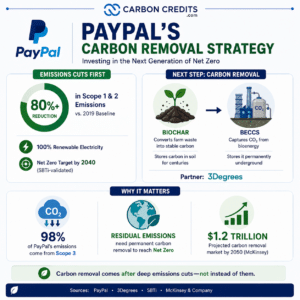
Carbon Removal Comes After Emissions Cuts

PayPal net zero carbon removal strategy

PayPal’s climate plan follows a clear order. The company reduces emissions first. It uses renewable electricity, improves energy efficiency, and works with suppliers to lower emissions across its value chain. Only then does it invest in durable carbon removal to address the emissions that remain.

This approach aligns with the Science Based Targets initiative (SBTi). It states that companies should focus on cutting direct emissions first; then they can use carbon removal for any residual emissions.

A New Phase of Corporate Climate Action

PayPal has already reduced its Scope 1 and 2 emissions by 80% from its 2019 baseline. Its next challenge is tackling the much larger Scope 3 emissions across its supply chain.

The company’s latest investments show how corporate climate strategies are changing. Businesses are no longer relying only on renewable electricity and energy efficiency. Many are beginning to invest in the carbon removal technologies they expect to need in the future.

For the carbon market, this is an important shift. Companies are moving beyond buying traditional offsets and helping finance the next generation of permanent carbon removal. If more businesses follow PayPal’s approach, demand for high-quality carbon removal credits could continue to grow as the global race to net zero accelerates.

The post PayPal Expands Its Net Zero Strategy With 3Degrees’ Carbon Removal Portfolio appeared first on Carbon Credits.
Amazon (AMZN) Stock Jumps on Record $200B Q2 Revenue, Fueled by AI Growth and Water-Positive Goals

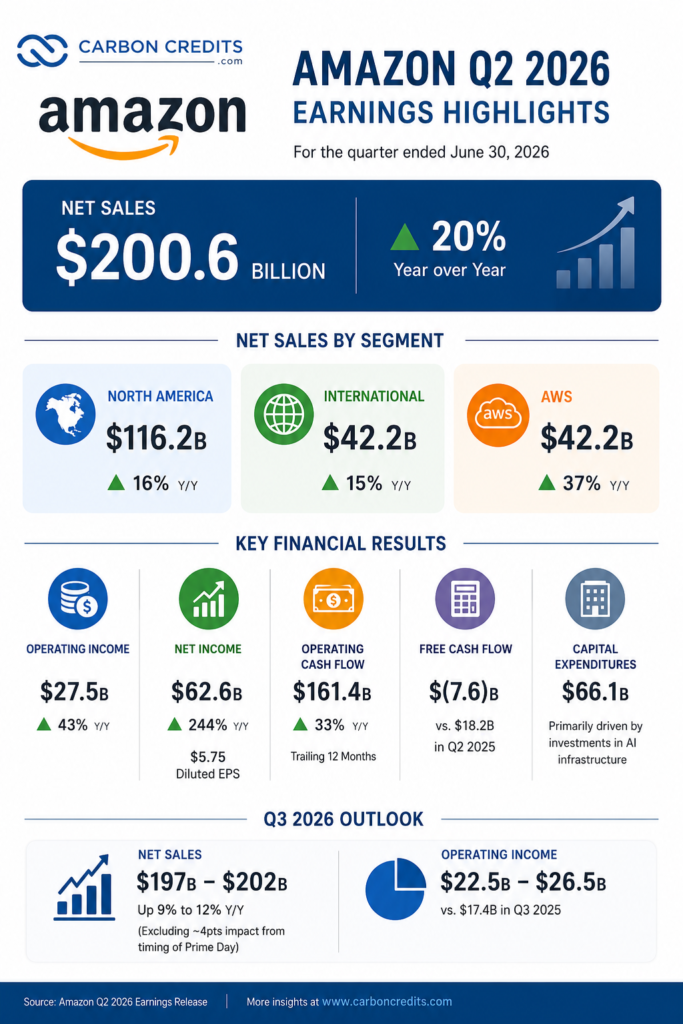
Amazon (NASDAQ: AMZN) had a strong quarter, fueled by growth in cloud computing, artificial intelligence (AI), advertising, and online retail. The company reported higher revenue and profits for Q2 2026 as demand for AI infrastructure surged.

However, Amazon’s big investments in AI pushed free cash flow into negative territory. The company also noted progress on its long-term sustainability goals, including renewable energy, water conservation, and lower-carbon construction materials for its expanding global data center network.

Amazon’s Revenue Tops $200 Billion in Q2

For the quarter ending June 30, 2026, Amazon reported net sales of $200.6 billion, a 20% increase from $167.7 billion last year. Currency fluctuations had little effect, indicating that the business grew by about 20%.

This growth came from all three major segments.

  • North America remained Amazon’s largest market, generating $116.2 billion in sales, up 16% year over year.
  • International sales rose 15% to $42.2 billion, showing steady growth despite a mixed global economy.
  • Amazon Web Services (AWS) led the way with a 37% revenue jump to $42.2 billion, driven by strong demand for cloud computing and AI services.

AWS Continues to Power Amazon’s Growth

AWS was Amazon’s biggest profit driver this quarter.

Operating income from AWS grew to $16.6 billion, up from $10.2 billion a year ago. This division accounted for over half of Amazon’s total operating profit.

  • CEO Andy Jassy noted that AWS saw its fastest growth in over four years. He stated that AWS’s AI business now exceeds a $25 billion annual revenue run rate, alongside Amazon’s custom chip business. Both are growing at triple-digit rates.

The company is expanding its AI offerings with custom silicon, cloud infrastructure, and partnerships, including an investment in AI startup Anthropic.

Operating Profit Climbs Despite Heavy Investment

Amazon’s operating income rose sharply to $27.5 billion, compared to $19.2 billion in Q2 2025. Across its businesses:

  • North America operating income increased to $9.1 billion, from $7.5 billion.
  • International operating income improved to $1.7 billion, from $1.5 billion.
  • AWS operating income jumped to $16.6 billion, from $10.2 billion.

Net income reached $62.6 billion, or $5.75 per diluted share, compared to $18.2 billion, or $1.68 per share, last year.

Much of this increase came from a $53.4 billion pre-tax gain, primarily tied to Amazon’s investment in Anthropic. Excluding this one-time gain, operating performance still showed solid improvement.

amazon revenue
Source: Amazon Press Release

AI Spending Weighs on Free Cash Flow But AMZN Stock Gains 

Despite higher profits, free cash flow turned negative as Amazon ramped up AI infrastructure investments. It showed a $7.6 billion outflow, down from a positive $18.2 billion the previous year.

This decline was largely due to an extra $66.1 billion spent on property and equipment. Most of that went to expanding AI infrastructure, like data centers and custom AI chips.

  • However, operating cash flow over the past year rose 33% to $161.4 billion.

Also, Amazon’s stock (NASDAQ: AMZN) reacted positively to the earnings report.

Shares rose about 9% in after-hours trading, following better-than-expected AWS growth and rising AI revenue. Investors responded well to AWS’s fastest growth in 18 quarters and Amazon’s growing AI business. Some analysts, however, noted that rising AI spending and negative free cash flow are areas to watch.

amazon stock
Source: Yahoo Finance

Q3 2026 Forecast

  • For Q3 2026, Amazon projects net sales between $197 billion and $202 billion, indicating growth of 9% to 12% compared to last year.

The company mentioned that timing differences for Prime Day affect year-over-year comparisons. Excluding these effects, third-quarter revenue growth would be nearly four percentage points higher.

The retail giant also forecasts operating income between $22.5 billion and $26.5 billion, up from $17.4 billion in Q3 2025. This guidance suggests continued demand for cloud computing, AI services, advertising, and e-commerce despite economic uncertainty.

Amazon Advances Water and Renewable Energy Goals

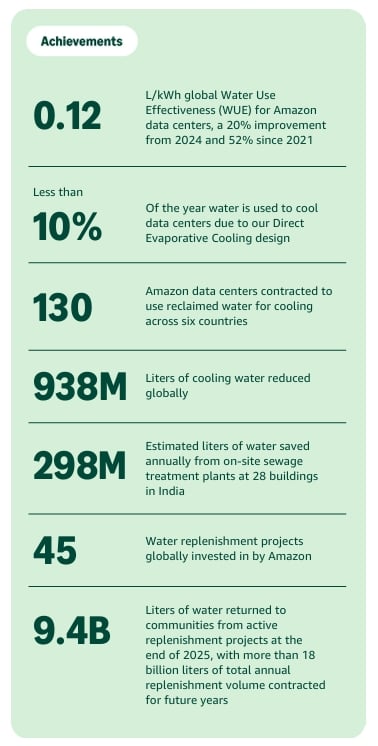
Alongside its financial results, Amazon reported ongoing progress on its environmental commitments. The company stated its global data centers are now more than seven times more water-efficient than the industry average.

It has reached 75% of its goal to become water positive across its global data center operations by 2030. This means returning more water to local communities than the company uses in its operations.

It also announced it achieved water-positive status in India ahead of its 2027 target, marking an important regional milestone.

water positive amazon
Source: Amazon

On clean energy, it matched 100% of the electricity used across its global operations with renewable energy in 2025, reaching this goal five years early. The company has maintained that achievement for three consecutive years, reducing emissions even as electricity demand grows.

Lower-Carbon Materials Help Reduce Construction Emissions

As Amazon expands its global data center footprint, it also aims to lower emissions from construction materials. Some examples include:

  • Built 33 data centers using lower-carbon steel, adding to 67 facilities completed since 2023. It also utilized lower-carbon steel in 22 logistics and operations buildings.
  • Constructed 39 data centers with lower-carbon concrete in 2025, bringing the total to 74 projects since 2023. Another 14 operations buildings also used this material.
  • Increasingly using mass timber in new buildings, with six projects in design or construction in 2025, including a delivery station in Indiana.
  • MUST READ: Rio Tinto and Amazon Web Services (AWS) Join Forces to Supply Low-Carbon Copper for U.S. Data Centers 

Amazon’s Carbon Emissions Continue to Decline

Amazon’s latest sustainability data show it continues to lower its carbon footprint while expanding its business.

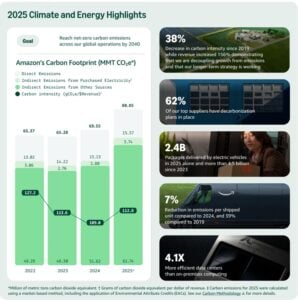
In 2024, Amazon reported 68.25 million metric tons of CO₂e across its operations, down from 70.74 million metric tons in 2023 and nearly 17% below its 2021 peak.

The emissions were distributed across three greenhouse gas categories:

  • Scope 1: 4.78 million metric tons CO₂e, mainly from fuel used in transport and operations.
  • Scope 2 (market-based): 0.77 million metric tons CO₂e, reflecting electricity purchases after renewable energy matching.
  • Scope 3: 62.70 million metric tons CO₂e, making up about 92% of Amazon’s total footprint. These emissions come primarily from purchased goods and services, construction materials, and transportation.

The stark difference between Scope 1 and Scope 3 highlights the challenge for Amazon and other tech firms. While renewable electricity cuts operational emissions, most emissions occur in complex global supply chains.

Amazon carbon emissions
Source: Amazon

As Amazon invests billions in AI data centers, reducing embodied carbon in materials like steel and concrete will be crucial for meeting long-term climate goals.

The company aims for net-zero carbon emissions by 2040 under The Climate Pledge, balancing rapid AI growth with investments in renewable energy, water conservation, and lower-carbon infrastructure.

The post Amazon (AMZN) Stock Jumps on Record $200B Q2 Revenue, Fueled by AI Growth and Water-Positive Goals appeared first on Carbon Credits.