
Singapore Targets 12 Million Carbon Credits in Major Article 6 Tender
Singapore has opened the second stage of a tender to buy at least 12 million Internationally Transferred Mitigation Outcomes (ITMOs) under Article 6 of the Paris Agreement. The tender opened on September 7, 2026, by the Ministry of Trade and Industry (MTI). Only bidders that passed the first stage can now submit detailed project proposals. A briefing for pre-qualified bidders is scheduled for September 23.
The tender marks a major step in Singapore’s plan to secure more international carbon credits. It also shows that the country is moving from signing Article 6 agreements to buying actual future credit supply.
However, the 12 million tonnes are a procurement target, not credits already issued. Projects must still be approved, monitored, and independently verified.
Singapore Is Scaling Up Carbon Credit Purchases
The new tender is much larger than Singapore’s first major government carbon purchase. In September 2025, the country agreed to buy 2.175 million tonnes of nature-based carbon credits from four projects in Ghana, Peru and Paraguay. The deals were worth about S$76 million, with deliveries planned from 2026 to 2030.
The new tender seeks more than five times that volume.
It also covers a wider range of projects. Singapore says the procurement can include nature-based and technology-based projects. That could include renewable energy, methane reduction, industrial projects and carbon removal, depending on the final eligibility rules.
The tender could therefore become an important source of demand for developers seeking long-term buyers for future Article 6 credits.
Article 6 Creates a Different Type of Carbon Market
Article 6.2 allows countries to transfer emissions reductions between countries. These units are known as ITMOs: Internationally Transferred Mitigation Outcomes.
A key safeguard is the corresponding adjustment. It stops both countries from counting the same emissions reduction toward their climate targets.
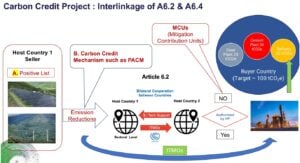
For example, if a project in a host country creates an authorised mitigation outcome and transfers it to Singapore, the host country must adjust its emissions accounting. It cannot also count the same reduction toward its own climate target.
This is an important difference between Article 6 transactions and many voluntary carbon market deals. Singapore’s bilateral Implementation Agreements create the framework for project approval, reporting, authorization, and corresponding adjustments.
Why Singapore Needs More International Carbon Credits
Singapore has limited land and fewer options for large-scale domestic carbon removals. International credits therefore form an important part of its climate strategy.
The country aims to reduce emissions to 45–50 million tonnes of CO2 equivalent by 2035 and reach net zero by 2050.

Singapore has estimated that it could need around 2.51 million tonnes of ITMOs each year during its 2021–2030 NDC period. The government plans to secure eligible credits through both direct procurement and its carbon-tax system.
That makes the new 12-million-ton tender important. The volume is large enough to build a bigger supply pipeline, rather than relying mainly on smaller individual deals.
Carbon Tax Creates Another Source of Demand
Singapore’s carbon tax adds another reason to expand the supply of eligible credits. The tax applies to industrial facilities that emit at least 25,000 tonnes of CO2e a year. It covers about 70% of Singapore’s national emissions, according to the government.
The carbon tax rose from S$25 per tonne in 2025 to S$45 per tonne in 2026 and 2027. Singapore plans to raise it to S$50–S$80 per tonne by 2030.
Since 2024, covered companies can use eligible international carbon credits for up to 5% of their taxable emissions. This creates a direct link between Singapore’s domestic carbon price and its international carbon market.
As the tax rises, demand for eligible credits could also increase, provided those credits meet Singapore’s rules.
Quality Matters as Much as Carbon Volume
Singapore is not simply looking for large volumes of cheap credits. Its eligibility rules require projects to meet key principles such as additionality, accurate measurement, permanence, transparency, and no double counting.
The country has also introduced additional safeguards for some project types. For example, certain renewable energy projects face extra requirements because Singapore wants to avoid using credits for projects that may already be financially viable without carbon revenue.
Singapore also requires cancelling 2% of authorized credits at issuance to support an overall reduction in global emissions. Another 5% of proceeds must support adaptation in host countries or the UNFCCC Adaptation Fund. These measures reduce the number of credits available for use, but they are intended to improve environmental integrity.
The Biggest Challenge: Turning Deals Into Real Credits
The large tender also reflects a simple problem: eligible Article 6 credits take time to develop. Singapore says carbon projects can take up to four years to generate credits. That makes early procurement important for companies and governments that need supply later.
Signing an Article 6 agreement also does not automatically create credits. Projects must be identified, approved, and monitored. Host countries must authorise the relevant mitigation outcomes, while developers must meet Singapore’s eligibility and verification requirements.
This creates a gap between policy agreements and actual carbon supply. The new tender is designed to help close that gap by bringing more projects into the pipeline now.
Singapore Is Building a Regional Carbon Network
The tender is part of a wider effort by Singapore to build a network of Article 6 partners across Asia and other regions.
Singapore has signed Implementation Agreements with countries including Ghana, Bhutan, Chile, Mongolia, Papua New Guinea,
Peru, Rwanda, Paraguay, Thailand, Vietnam and the Philippines. Laos also signed an Implementation Agreement with Singapore in September 2026.
This network gives Singapore a wider pool of potential projects. It also gives developing countries access to a buyer that is seeking credits that meet government standards.
That could encourage more investment in projects involving forests, clean energy, methane reduction, waste and other emissions reduction activities.
Carbon Finance Could Benefit Host Countries
The impact of the tender could extend beyond Singapore. Carbon projects often require large upfront investments. Revenue from future credits can help improve the economics of projects that might otherwise struggle to secure financing.
Singapore has also committed US$15 million to the Global Green Growth Institute’s Carbon Transaction Facility and established a Singapore Article 6 Carbon Facility to support project development and capacity building.
The combination of project financing, technical support and future credit demand could help countries develop stronger carbon market infrastructure. The benefits may also include renewable energy, better land management, rural income and other development gains, depending on the projects selected.
The 12M-Ton Tender Puts Article 6 to the Test
The second-stage tender is an important test for the Article 6 market. Singapore has spent years building bilateral agreements and setting strict rules for carbon-credit quality. It is now moving toward a much larger procurement programme.
For developers, the tender could create a major new source of demand. For host countries, it could bring more climate finance. For Singapore, it could help secure the international credits needed for its climate and carbon-tax policies.
The wider message is clear: Article 6 is moving from international climate rules toward real carbon market transactions at scale. As more governments begin to buy credits directly, the quality of those credits will matter as much as their volume.
For the leading carbon buyer in Asia, the new tender is a major step toward building a reliable international carbon supply. For the wider market, it could help turn Article 6 from a policy framework into a functioning source of climate finance.
READ MORE: Singapore and Indonesia Seal Landmark Carbon Credit Deal to Boost Southeast Asia’s Green Economy
The post Singapore Targets 12 Million Carbon Credits in Major Article 6 Tender appeared first on Carbon Credits.

