China’s $295 Billion AI Bet: Can Renewable and Nuclear Power Fuel the Next Data Center Boom?

China’s $295 Billion AI Bet: Can Renewable and Nuclear Power Fuel the Next Data Center Boom?

China is preparing one of the biggest artificial intelligence (AI) infrastructure programs ever announced. According to reports, Beijing is developing a plan to invest about 2 trillion yuan ($295 billion) over the next five years to build a nationwide network of AI-focused data centers.

The initiative aims to strengthen China’s position in the global AI race and challenge U.S. leadership in advanced computing. Yet, the plan is about more than data centers.

China aims to link its computing infrastructure with its power system, transport networks, and industrial strategy. Bloomberg reports that including power-grid integration could raise total investment to over 5 trillion yuan ($740 billion).

For climate and energy markets, an important question arises: Can China support a huge AI expansion and still move toward cleaner energy?

Beijing’s Blueprint for a Nationwide AI Superhighway

Unlike the United States, where AI investment is led mainly by private companies, China is taking a state-driven approach.

Bloomberg reports that major government agencies, like the National Development and Reform Commission (NDRC), are creating a plan for connected computing hubs nationwide. State-owned telecommunications giants China Mobile and China Telecom are expected to operate much of the infrastructure.

The project forms part of China’s broader “Six Networks” infrastructure program, which covers critical systems such as electricity, water, transportation, and digital connectivity.

The goal is to connect scattered computing facilities into a unified national network by 2028. This would build a digital backbone. It would support AI training, cloud computing, robotics, advanced manufacturing, and smart-city applications.

Investors expect to fund the project largely through sovereign debt, including ultra-long-term government bonds, strategic industry funds, bank loans, and private capital.

The investment reflects China’s growing confidence in the sector. According to NDRC estimates, the country’s AI industry could exceed 10 trillion yuan ($1.4 trillion) by 2030.

The AI Race Is Becoming an Energy Race

Building data centers is only part of the challenge. Powering them may be even harder.

AI systems require enormous amounts of electricity. Training large language models, running cloud services, and supporting AI applications consume far more power than traditional computing workloads.

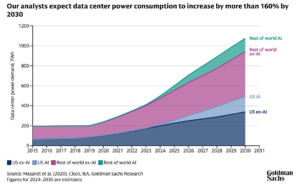
Goldman Sachs Research estimates that global data-center electricity demand could rise by over 160% by 2030 compared with 2023 levels. Other studies suggest AI could become one of the fastest-growing sources of electricity demand this decade.
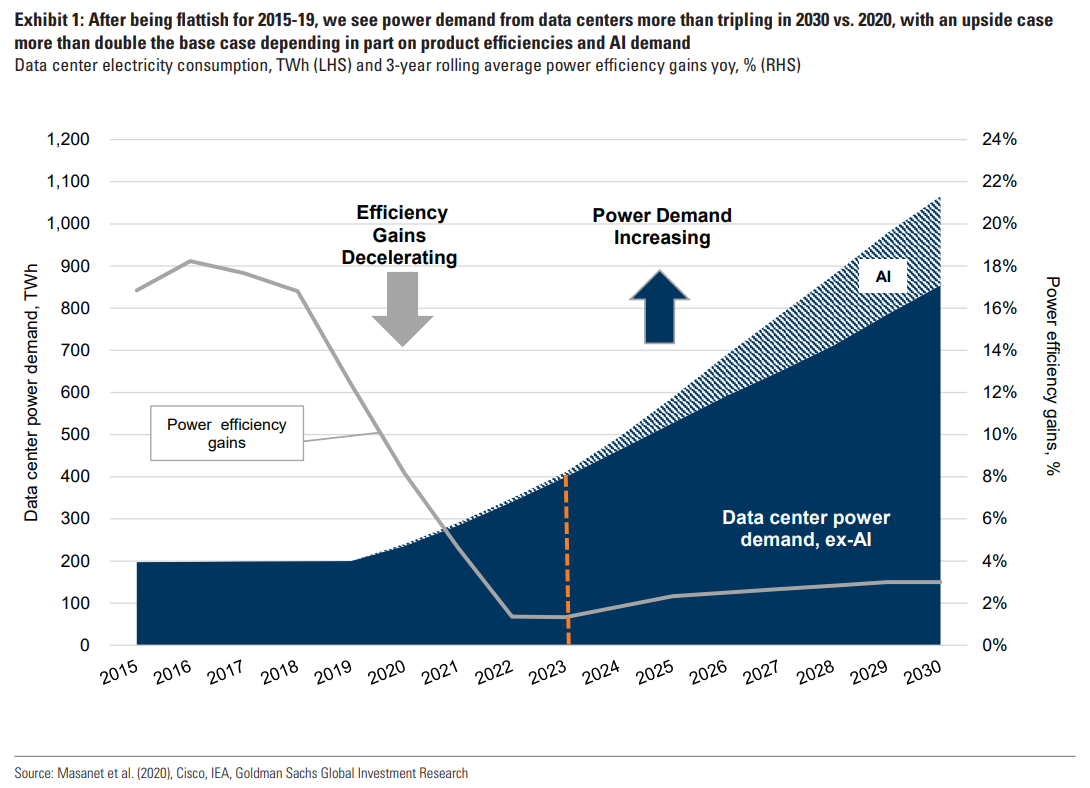
data center power demand AI 2030 Goldman

Many regions are already struggling to keep up.

Utilities in parts of the U.S. and Europe have reported delays. They can’t connect new data centers because local grids don’t have enough capacity. In some cases, projects face waiting periods of several years before receiving grid access.

China faces similar challenges. However, it enters the AI boom with one major advantage: a massive buildout of power infrastructure that has been underway for years.

That helps explain why China’s AI strategy includes plans to integrate computing facilities with the national power grid. Policymakers appear to recognize that future AI leadership may depend as much on electricity supply as on computing power.

China Already Leads the World in Renewable Energy
china renewable solar wind energy additions

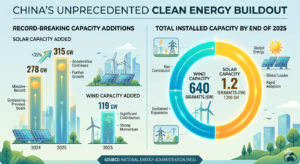
China’s clean energy buildout is unprecedented. According to the National Energy Administration,

  • The country added a record 278 gigawatts (GW) of solar capacity in 2024. That growth accelerated further in 2025, when China added another 315 GW of solar power and 119 GW of wind power.
  • By the end of 2025, China had installed approximately 1.2 terawatts (TW) of solar capacity and about 640 GW of wind capacity.

Together, those figures make China the world’s largest renewable energy market by a wide margin. The scale is difficult to overstate.

China now installs more renewable energy capacity each year than many countries have in their entire power systems. In several major clean energy categories, the country accounts for more solar PV deployment than the rest of the world combined.
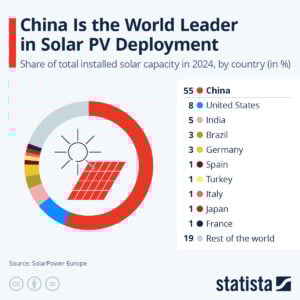
china leading solar pv deployment statista

This expansion matters for AI.

Renewable electricity is increasingly becoming the lowest-cost source of power for new industrial projects and data centers. Several Chinese firms are already exploring renewable-powered computing facilities to reduce operating costs and emissions.

However, renewable energy alone cannot solve every challenge. AI data centers require electricity around the clock, regardless of weather conditions. This is where nuclear power becomes important.

China’s Nuclear Expansion Adds a Powerful Edge

China is also building nuclear power faster than almost any other country. The country has over 30 nuclear reactors being built, according to the International Atomic Energy Agency. This is the biggest nuclear construction project in the world.

  • The country runs over 50 reactors and aims to boost nuclear capacity to about 200 GW by 2040. That’s nearly four times what it is now.
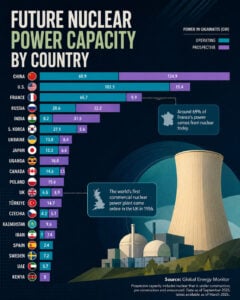
China nuclear power capacity and construction
Source: ZME Science

Nuclear energy provides a key benefit for AI infrastructure: reliable electricity 24 hours a day with virtually no direct carbon emissions.

Around the world, technology companies are increasingly turning to nuclear power to support AI growth. Amazon, Microsoft, and Google have all announced plans to invest in advanced nuclear energy and small modular reactor technologies (SMRs).

China is pursuing a different model. It is growing nuclear power through national planning and state support, not corporate deals.

Overall, renewable energy and nuclear power can help China meet its growing electricity needs. This mix can also limit emissions from its expanding digital economy.

Huawei and Domestic Technology Are Central to the Plan

The proposal is also designed to strengthen China’s technology independence. Bloomberg reports that at least 80% of the project’s technology will come from local suppliers. Huawei Technologies will lead this effort, providing key AI processors.

The policy follows earlier directives requiring state-funded data center projects to use locally produced AI chips. The strategy is now more crucial. U.S. export controls limit China’s access to advanced processors from NVIDIA and AMD.

Huawei has boosted production of its Ascend 910C AI chip. Many analysts see it as a top domestic alternative in China. This means the project is not simply a data center expansion plan.

It is also an industrial strategy designed to strengthen domestic computing, telecommunications, semiconductor production, and energy infrastructure simultaneously.

What It Means for Climate and Economic Growth

China remains the world’s largest greenhouse gas emitter, and coal still plays a major role in its power system.

At the same time, China is investing more in renewable energy and nuclear power than any other country. The country has pledged to reach peak carbon emissions before 2030 and achieve carbon neutrality before 2060.

The AI buildout could become an important test of those goals.

If China powers hundreds of billions in new computing with mostly renewable and nuclear energy, it will prove that digital growth and low-carbon electricity can thrive together.

The proposed $295 billion investment highlights a broader reality. The global AI race is no longer just about software, chips, or algorithms. It is increasingly about energy.

China enters that race with the world’s largest renewable energy buildout and one of the fastest-growing nuclear programs. Those energy investments may prove just as important as the data centers themselves in determining who leads the next phase of AI development.

The post China’s $295 Billion AI Bet: Can Renewable and Nuclear Power Fuel the Next Data Center Boom? appeared first on Carbon Credits.

Canada’s $4.7 Trillion Infrastructure Challenge: Can Faster Permits Unlock a Critical Minerals Boom?

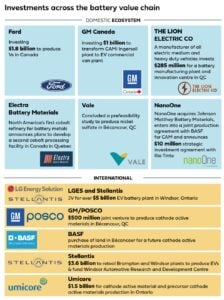
Canada stands at a crossroads. The country possesses vast reserves of critical minerals, abundant energy resources, and a strong reputation as a reliable supplier to global markets. Yet a new report prepared by Oxford Economics for PwC warns that the country could lose its competitive edge. Thus, faster infrastructure development and quicker project approvals are needed to attract investment, clean energy projects, and critical mineral supply chains.

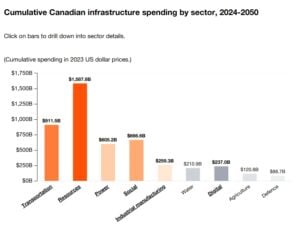
According to the forecasts, Canada will require roughly $4.7 trillion in infrastructure investment by 2050. The spending will support everything from roads, bridges, ports, and water systems to hospitals, defense facilities, power infrastructure, data centers, and mining projects.

The report argues that infrastructure is no longer simply about maintaining public assets. It has become a key driver of economic growth, energy security, trade competitiveness, and national sovereignty.

Infrastructure Spending Set to Rise, But Gaps Remain

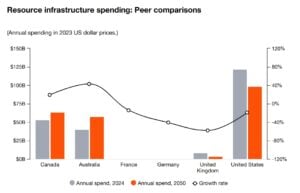
Canada currently ranks among the world’s largest infrastructure investors, spending about $145 billion annually. By 2050, that figure is expected to climb to approximately $210 billion per year, representing a 45% increase.

While that growth appears significant, PwC notes that Canada still trails many leading economies when infrastructure spending is measured as a share of GDP.

canada infrastructure spending
Source: PwC Report

Canada invests about 6.6% of its GDP in infrastructure today, compared with an average of 7.4% among top-performing countries. Closing that gap would require roughly $34 billion in additional annual investment by mid-century.

PwC emphasizes that future outcomes remain uncertain. Canada could surpass current forecasts if governments and industry act decisively. However, delays in decision-making and project development could leave the country behind as global competition intensifies.

The stakes are particularly high as nations race to secure critical mineral supplies, strengthen energy systems, and build the infrastructure needed for artificial intelligence, advanced manufacturing, and defense.

Critical Minerals Drive Canada’s Biggest Opportunity

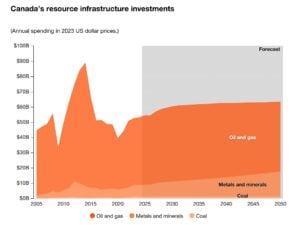
Resource infrastructure will remain the largest category of Canada’s infrastructure spending over the next 25 years.

Annual investment in facilities supporting mining, energy production, mineral processing, and transportation is projected to increase from approximately $53 billion today to $63 billion by 2050. Cumulatively, that represents nearly $1.6 trillion in spending.

canada mining investment
Source: PwC report

Several factors are fueling this growth.

  • Global demand for critical minerals continues to rise as countries expand electric vehicle production, battery manufacturing, renewable energy systems, and defense technologies.
  • At the same time, geopolitical tensions are encouraging Western economies to diversify supply chains away from heavily concentrated suppliers.

Canada can significantly benefit from these trends.

The country currently produces more than 60 minerals and metals and remains a leading global supplier of nickel, potash, aluminum, and uranium. Canada has also identified 31 minerals as strategically important under its Critical Minerals List.

To qualify as a critical mineral, a resource must support Canada’s economic security, contribute to the low-carbon transition, or serve as a reliable supply source for allies and trading partners.

Government incentives are also helping attract investment. Tax credits and other support programs encourage companies to develop clean-technology manufacturing facilities and critical-mineral processing operations across the country.

CANADA INVESTMENTS
Source: Govt of Canada

Ring of Fire Highlights Infrastructure Challenge

Despite Canada’s vast resource potential, many opportunities remain difficult to develop because supporting infrastructure is missing.

PwC points to Ontario’s Ring of Fire as one of the clearest examples. The mineral-rich region contains significant deposits of nickel, chromite, copper, and other critical minerals. However, large-scale development requires much more than mines alone.

Roads, electricity transmission lines, digital connectivity, and community infrastructure must all be built simultaneously before production can begin at scale.

The report argues that future competitiveness increasingly depends on integrated infrastructure systems rather than isolated projects. Mining operations, processing facilities, transportation networks, and energy systems must advance together to unlock economic value.

Without coordinated development, Canada risks missing opportunities as investors seek jurisdictions capable of moving projects forward more quickly.

North America’s Critical Minerals Market Continues to Expand

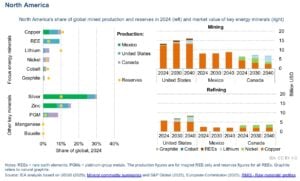
North America is expected to play an increasingly important role in global critical mineral supply chains over the coming decades.

IEA forecasts suggest the market value of North America’s energy mineral production could reach approximately $30 billion for mining activities and $14 billion for refining operations by 2040.

Growth will come from multiple sources, such as:

  • Copper production is expected to expand significantly in the United States and Mexico, while Canada is positioned to benefit from rising lithium and nickel output.
  • On the refining side, Canadian facilities are expected to strengthen their role in processing copper and nickel for domestic and international markets.

These developments help Western countries secure critical mineral supplies and reduce their reliance on a few major suppliers.

canada crirical minerals
Source: IEA

Defense Spending Emerges as a Major Growth Driver

The fastest-growing infrastructure category in Canada is defense.

PwC projects defense-related infrastructure investment will surge by nearly 389% between 2024 and 2050. The forecast aligns with Canada’s commitment to increase spending on defense and security by an additional 1.5% of GDP.

Many defense investments provide benefits beyond military applications. Airports, ports, communications networks, transportation corridors, and energy infrastructure can serve both national security and civilian economic needs.

As a result, defense spending could become a key catalyst for broader infrastructure modernization nationwide.

Canada Risks Falling Behind in Strategic Sectors

Although resource projects dominate Canada’s investment outlook, PwC warns that excessive concentration could create long-term vulnerabilities.

By 2050, resource infrastructure is expected to account for roughly 30% of Canada’s total infrastructure spending. Meanwhile, many competing countries are investing aggressively in sectors reshaping the global economy.

Nuclear power illustrates the challenge.

  • Global nuclear infrastructure investment is projected to increase by approximately 45% through 2050.
  • In Canada, however, growth is expected to reach only 11%, despite several major nuclear development projects already underway.

Canada also trails global growth projections in transportation infrastructure.

  • Worldwide investment in ports is expected to rise 73%, compared with 64% in Canada.
  • Airport infrastructure is projected to grow 93% globally versus 78% domestically.

The United States is forecast to outperform Canada in several strategic categories, including nuclear energy, airports, and other high-growth infrastructure segments.

PwC also highlights concerns about Canada’s ability to attract data center investments, where countries such as the United States, the United Kingdom, and Australia are moving rapidly to expand digital infrastructure.

canada investments
Source: PwC Report

Regulatory Delays Remain the Biggest Obstacle

While Canada offers strong mineral resources, political stability, and attractive investment incentives, the report identifies one persistent challenge: lengthy approval processes.

Complex permitting requirements, overlapping regulatory reviews, and extended timelines continue to increase costs and uncertainty for developers.

The federal government has acknowledged the issue, particularly for critical mineral projects that support climate goals and economic growth. Officials have emphasized the need to balance environmental protection, Indigenous engagement, and sustainable development with faster decision-making.

Canada has already introduced several funding programs to accelerate project development, including:

  • A $2 billion Critical Minerals Sovereign Fund
  • Substantial investments through the First and Last Mile Fund.
  • Additional financing support is available through institutions such as the Canada Infrastructure Bank and the Canada Growth Fund.

However, PwC argues that financial support alone will not be enough.

To fully capitalize on its resource wealth and strategic advantages, Canada must modernize approval processes and accelerate infrastructure delivery. Otherwise, competing jurisdictions may capture the investment, jobs, and supply chain opportunities that Canada is well-positioned to secure.

The Race Is On

Canada possesses many of the ingredients needed to become a global leader in critical minerals, clean energy, and strategic infrastructure. Massive mineral reserves, supportive government programs, and growing global demand create a compelling opportunity.

Yet the window may not remain open forever.

The PwC report delivers a clear message: infrastructure investment and permitting reform will determine whether Canada strengthens its competitive position or falls behind countries moving faster to secure the industries of the future.

The post Canada’s $4.7 Trillion Infrastructure Challenge: Can Faster Permits Unlock a Critical Minerals Boom? appeared first on Carbon Credits.
Amazon (AMZN) Stock Slips as It Opens Carbon Credits to UK Firms and Secures $17.5B Loan for AI

Amazon Opens Carbon Credits to UK Firms, Secures $17.5B Loan for AI, and Stock (AMZN) Slips

The voluntary carbon market (VCM) has struggled for years with one major problem: trust. Concerns about credit quality, transparency, and climate impact have made many companies cautious about buying carbon credits. Now, Amazon is trying to address this challenge.

The company has expanded its carbon credit service to qualified businesses in the United Kingdom. The move marks the first international expansion of the program since it launched in the United States in 2025.

Eligible companies can use Amazon’s Sustainability Exchange platform that offers a selection of vetted carbon credits. These credits are meant to support their efforts in reducing emissions.

The expansion comes as demand for trusted carbon credits continues to grow. More companies now want credits backed by strong science and measurable climate benefits.

Why Amazon Is Expanding Its Carbon Credit Service

For Amazon, the initiative supports its Climate Pledge commitment to reach net-zero carbon emissions by 2040. For the broader market, it could help channel more private capital toward forest protection, carbon removal, methane reduction, and other climate solutions.

Kara Hurst, Amazon’s chief sustainability officer, said:

“The voluntary carbon market has struggled with transparency and quality, making it hard for companies to invest with confidence. But the science is clear: we need to protect forests, restore ecosystems, and remove carbon at scale. We’re using our size and technical expertise to make high-quality credits available to ambitious UK companies already doing the hard work of cutting their own emissions and wanting to go further.”

Amazon says the service is only for companies that are already reducing emissions. Many businesses have cut emissions by purchasing renewable electricity, improving efficiency, electrifying fleets, and redesigning supply chains.

Yet, some emissions remain difficult to eliminate. These are often called residual emissions. That is where carbon credits can help. Amazon’s carbon credit portfolio includes several climate solutions:

  • Forest protection and avoided deforestation.
  • Ecosystem restoration and reforestation.
  • Direct air capture carbon removal.
  • Methane reduction and refrigerant destruction.
  • Lower-carbon fuel insets linked to supply chains.

To qualify for the program, companies must:

  • Have a net-zero target no later than 2050.
  • Cover Scope 1, Scope 2, and Scope 3 emissions.
  • Measure and publicly report greenhouse gas emissions regularly.

Amazon says these requirements help ensure carbon credits support emissions reductions rather than replace them. This approach shows increasing advice from climate groups and standard-setting organizations. They stress that companies must focus on reducing emissions and should only use carbon credits for any emissions that remain.

Beyond Offsets: The Rise of Carbon Insets

One notable feature of Amazon’s platform is its inclusion of carbon insets. Traditional carbon offsets support projects outside a company’s operations. Insets focus on reducing emissions within a company’s own value chain.

Examples include lower-carbon fuels (SAF) used in transportation or projects that reduce emissions from agricultural suppliers. Many experts view insetting as a key climate tool. It directly targets emissions tied to products and services.

Amazon carbon credit inset
Source: Amazon

Amazon’s Sustainability Exchange offers both neutralization credits and inset credits. The company says this gives businesses more options to address emissions both inside and outside their operations.

This reflects a broader shift in climate strategy. Companies increasingly want to reduce emissions across their entire value chain, not simply offset them elsewhere.

Inside Amazon’s Push Toward Net Zero

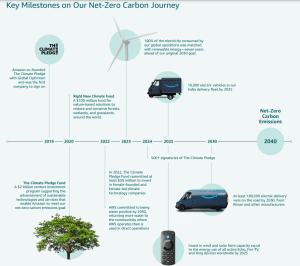
The expansion also highlights Amazon’s broader climate strategy. The company co-founded The Climate Pledge in 2019 and committed to reaching net-zero carbon emissions by 2040, ten years ahead of the Paris Agreement timeline. More than 550 organizations have since joined the initiative.

Amazon net zero 2040 journey
Source: Amazon

Amazon says it has made progress toward those goals. According to its latest sustainability report:

  • Carbon intensity has fallen by more than 40% since 2019.
  • Amazon remained the world’s largest corporate purchaser of renewable energy for the fifth straight year in 2024.
  • The company has supported more than 600 solar and wind projects worldwide.
  • Amazon deployed more than 31,000 electric delivery vans globally by the end of 2024.

Even so, Amazon reported about 68 million metric tons of CO₂e emissions in 2024. The figure shows how difficult it can be to reduce emissions while expanding a global business. In 2024, Amazon also launched the Sustainability Exchange platform to share climate tools, guidance, and best practices with suppliers and other companies.

Carbon Markets Could Become a Major Climate Finance Tool

Many analysts believe voluntary carbon markets are still in the early stages of development.

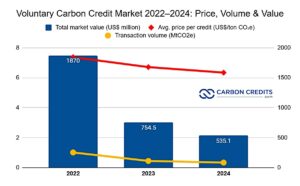
According to Ecosystem Marketplace, the market generated an estimated $535 million in transaction value in 2024. Activity is shifting towards higher-quality projects and carbon removal solutions. This is happening even though it’s below the peak of the carbon credit boom in 2021.

Voluntary carbon credit market; price, volume, value 2022-2024

Long-term forecasts remain significant.

The Taskforce on Scaling Voluntary Carbon Markets estimated that the market could hit $50 billion by 2030 if conditions are right. McKinsey & Company predicts that the demand for carbon credits might grow over 15 times by 2030. By 2050, it could rise up to 100 times compared to today’s levels.

projected global carbon credit market 2050
This chart shows the projected global carbon credit market size from 2025 to 2050. The green range shows lower and upper bounds, reaching $50–250 billion by 2050 (2024 prices). Growth depends on demand: high demand with loose supply drives the market to the upper bound, while low demand with loose supply results in the lower bound.

BloombergNEF estimates that global investment in carbon dioxide removal could reach hundreds of billions of dollars each year by mid-century. This funding is crucial for achieving net-zero pathways.

These forecasts help explain why large companies are investing in carbon projects today to secure future credit supply.

Balancing Climate Investments With a Massive AI Spending Push

Amazon’s carbon credit expansion comes at a time when the company is increasing spending across other parts of its business.

This week, Amazon secured a $17.5 billion delayed-draw loan facility led by major banks including Citibank, JPMorgan Chase, HSBC, Bank of America, and Wells Fargo. The financing allows Amazon to access capital gradually rather than borrow the full amount at once.

The tech giant said the funds are intended for general corporate purposes. However, investors widely see the move as supporting the company’s accelerating AI infrastructure buildout.

The financing adds to one of the biggest investment cycles in the company’s history.

Amazon previously outlined plans to spend about $200 billion in capital expenditures in 2026. Much of that is expected to support data centers, AI chips, cloud infrastructure, robotics, and other growth areas.

In the first quarter of 2026 alone, capital expenditures reached $44.2 billion, up from $25 billion a year earlier. Over the same period, trailing twelve-month free cash flow fell to about $1.2 billion from $25.9 billion as investment accelerated.

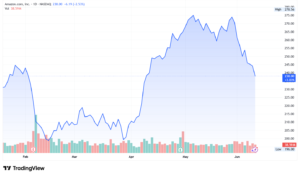
Investors reacted cautiously. Amazon stock slips slightly following the announcement of the deal.

Amazon AMZN stock price

A Defining Moment for the Future of Carbon Credits

Amazon’s UK expansion reflects a broader change in climate finance. Carbon credits are becoming a strategic tool for companies working toward net-zero goals.

The market’s future will depend on quality, transparency, and measurable climate benefits. Buyers increasingly want proof that credits deliver real emissions reductions or removals. Amazon is betting that stricter standards and stronger project screening can help build that confidence.

As net-zero deadlines draw closer, demand for trusted carbon credits is expected to grow. If that happens, access to credible carbon markets could become as important to many companies as access to renewable energy is today.

The post Amazon (AMZN) Stock Slips as It Opens Carbon Credits to UK Firms and Secures $17.5B Loan for AI appeared first on Carbon Credits.
Meta and Reliance Join Forces to Build One of the World’s Largest AI Data Center Campuses in India

Meta is strengthening its presence in India with a major investment in digital infrastructure and renewable energy. The company has signed an agreement with Reliance Industries to lease capacity at a new AI-focused data center in Jamnagar, Gujarat. At the same time, Meta has secured nearly 1 gigawatt (GW) of renewable energy through partnerships with Indian clean energy developers.

The move highlights India’s growing importance in Meta’s global strategy. With one of the world’s largest internet user bases, a rapidly expanding digital economy, and increasing demand for artificial intelligence (AI) services, India has become a key market for future growth.

Meta and Reliance Expand Their Long-Term Partnership

Meta and Reliance have worked together for several years. Their relationship began to deepen in 2020 when Meta invested $5.7 billion in Jio Platforms. That investment helped expand digital connectivity and supported millions of small businesses across India.

Since then, both companies have collaborated on technologies ranging from digital commerce to AI development. The new data center agreement marks another major step in that partnership.

Under the deal, Meta will lease capacity at Reliance’s upcoming data center campus in Jamnagar. The facility will run on renewable energy and use desalinated seawater for cooling, helping reduce pressure on local freshwater resources. Meta will pay the full cost of the energy and water needed to operate its portion of the facility.

  • Reliance is developing what could become one of the world’s largest data center campuses. The first phase alone will provide 168 megawatts (MW) of capacity, with room for future expansion.

This scale is especially important as AI workloads require large amounts of computing power and electricity.

Jamnagar’s Strategic Advantages 

Jamnagar offers strategic advantages for such a project. The location provides access to energy resources, land availability, and infrastructure needed to support large-scale AI operations. Combined with Meta’s global connectivity investments, including the Project Waterworth subsea cable system, the company aims to improve network performance and digital services for users across the region.

india data center

AI Is Driving a New Wave of Infrastructure Demand

The rapid growth of artificial intelligence is changing how technology companies build infrastructure.

Training and running advanced AI models requires massive computing capacity. As a result, global technology firms are investing billions of dollars in data centers, specialized chips, networking systems, and power supplies.

Meta’s Jamnagar investment reflects this broader trend. The company sees AI as a core part of its future products and services, from social media experiences to business tools and digital assistants.

By securing long-term infrastructure in India, Meta gains access to a growing market while positioning itself closer to users and developers. The project also supports India’s ambitions to become a global technology and AI hub.

Reliance Chairman Mukesh Ambani described the partnership as a significant milestone for India’s digital infrastructure sector. According to Ambani, the project demonstrates India’s ability to support world-class AI infrastructure and participate in the next phase of global technological innovation.

Renewable Energy Plays a Central Role

Alongside the data center investment, Meta announced major renewable energy agreements across India.

  • The company signed new contracts totaling nearly 1 GW of clean energy capacity.

The largest agreement is with CleanMax, which will develop 837 MW of new solar and wind projects in Rajasthan and Karnataka. Including previous deals, Meta’s partnership with CleanMax now exceeds 900 MW.

Meta also signed an agreement with Fourth Partner Energy for 88 MW of additional solar and wind capacity across Tamil Nadu, Karnataka, Maharashtra, and Uttar Pradesh.

Together with Reliance’s renewable energy support for the Jamnagar facility, these projects will help power Meta’s growing operations in India with cleaner electricity.

The company says these investments are also expected to reduce emissions across its value chain while supporting the expansion of India’s renewable energy sector.

Meta’s Broader Sustainability Strategy

The India investments align with Meta’s global sustainability goals.

Since 2020, the company has matched 100% of its annual electricity consumption with renewable energy purchases. Over the past decade, Meta has contracted more than 15 GW of new clean energy projects worldwide, making it one of the largest corporate buyers of renewable energy.

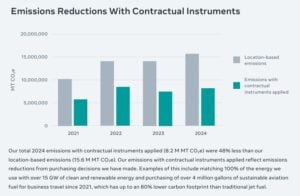
These efforts have produced measurable results. In 2024, renewable energy use helped Meta cut operational emissions by around 6 million metric tons of carbon dioxide equivalent (CO2e).

Massive Reduction in Value Chain Emissions 

The company also uses Energy Attribute Certificates (EACs) to address certain Scope 3 emissions linked to activities such as remote work, product usage, and energy-related supply chain operations. These actions reduced value-chain emissions by another 1.4 million metric tons of CO2e during 2024.

  • Overall, Meta reports that renewable energy procurement has helped lower total emissions by nearly 24 million metric tons of CO2e since 2021.

The company’s focus on additionality remains central to its strategy. Rather than simply purchasing existing renewable energy, Meta aims to support the development of new solar and wind projects that add fresh, clean power to electricity grids.

meta emissions
Source: Meta

India’s Data Center Market Is Expanding Rapidly

Meta’s latest investment comes as India’s data center industry enters a period of rapid growth.

Industry estimates show that installed data center capacity reached about 4.48 GW in 2025. The market is expected to grow to 5.45 GW in 2026 and climb to more than 15 GW by 2031. That represents annual growth of nearly 23% over the forecast period.

india data center market
Source: Modor Intelligence

Several factors are driving this expansion.

First, India’s Digital Personal Data Protection Act has increased the need for local data storage and processing. Companies are investing in domestic infrastructure to meet compliance requirements and improve service performance.

Second, global technology firms continue to commit large amounts of capital to India’s digital economy. Investments from major cloud providers and technology companies are accelerating demand for large-scale computing facilities.

Third, new subsea cable connections are improving international connectivity. Additional capacity landing in cities such as Mumbai and Chennai is strengthening India’s role as a regional digital hub.

At the same time, the rollout of 5G services is creating demand for more distributed computing infrastructure. Businesses increasingly need data processing closer to end users, encouraging the development of edge data centers in emerging urban markets.

The Shift Toward Hyperscale Facilities

India’s data center sector is also evolving from traditional colocation facilities toward larger hyperscale campuses.

Cloud providers are reserving massive blocks of capacity and securing long-term renewable energy agreements to control costs and support AI workloads. Many operators now view access to affordable clean power as a competitive advantage.

The growing use of AI further strengthens this trend. Large language models, advanced analytics platforms, and AI-driven applications require dedicated GPU clusters and specialized infrastructure.

Government initiatives such as the IndiaAI Mission are also increasing demand for high-performance computing resources across both public and private sectors.

As a result, developers are building larger facilities designed specifically for AI-era requirements.

Meta’s Jamnagar project fits squarely within this shift. By combining AI-ready infrastructure, renewable energy, and strategic connectivity investments, the company is positioning itself for the next stage of digital growth in India.

With strong local partnerships and rising demand for AI services, Meta’s latest investment signals confidence not only in India’s technology sector but also in its role as a future center for global digital infrastructure.

The post Meta and Reliance Join Forces to Build One of the World’s Largest AI Data Center Campuses in India appeared first on Carbon Credits.

EU Unveils €25 Billion Mediterranean Clean Energy Plan to Unlock Solar and Hydrogen Growth

EU Unveils €25 Billion Mediterranean Clean Energy Plan to Unlock Solar and Hydrogen Growth

The European Union is looking south for its next major clean energy opportunity. The European Commission (EC) has launched the Trans-Mediterranean Renewable Energy and Clean Tech Cooperation Initiative, known as T-MED. The program plans to gather up to €25 billion in investment by 2035. This funding will boost renewable energy, clean tech manufacturing, hydrogen projects, and electricity infrastructure in the Mediterranean region.

The initiative comes at a critical time for Europe. The bloc is working to cut emissions, strengthen energy security, and reduce dependence on imported fossil fuels.

Many countries along the southern Mediterranean have some of the best solar and wind resources in the world. However, these resources are still mostly underdeveloped. Brussels aims to link European capital with Mediterranean renewable energy. This new clean energy corridor will benefit both regions.

The Mediterranean: Europe’s Untapped Clean Energy Goldmine

The Mediterranean has some of the most attractive renewable energy resources in the world.

According to European Commission-backed assessments, the region’s technical solar and wind potential exceeds 2,300 gigawatts (GW). That is more than twice the European Union’s current installed electricity generation capacity. Yet, much of this potential remains untapped.

In several Southern Mediterranean countries, renewable energy still accounts for only 1% to 3% of the energy mix. Meanwhile, the region enjoys some of the world’s highest solar irradiation levels and strong wind resources along coastlines and desert areas.

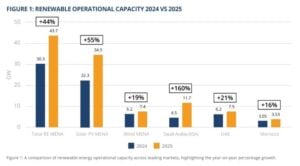
MENA renewable energy capacity
Source: MENA Energy Outlook 2026

The economics is also compelling.

Solar and wind power in parts of North Africa and the Southern Mediterranean can be produced at costs that are 30% to 40% lower than in many parts of Europe, per the EC data. Lower land costs, stronger solar resources, and favorable weather conditions all contribute to the advantage.

For Europe, this presents a major opportunity. Expanding partnerships in renewable energy can diversify energy supplies. It also supports the regional economic growth of the region.

What the €25 Billion Initiative Will Deliver

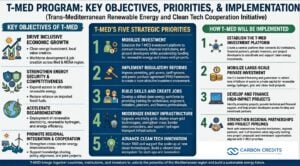
The EU’s T-MED initiative is designed to turn renewable potential into real projects. The European Commission has pledged over €5 billion in guarantees via the European Fund for Sustainable Development Plus (EFSD+).

Officials hope these guarantees will draw in public and private funds. They aim to help gather up to €25 billion in total investment by 2035.

The initiative focuses on several key areas, including:

  • Renewable energy generation,
  • Clean technology manufacturing,
  • Green hydrogen development,
  • Modern electricity grids and interconnections, and
  • Workforce training and skills development.

By 2035, T-MED aims to support at least 15 GW of new renewable energy capacity across Europe. It also seeks to create more than 100,000 jobs in clean energy sectors and advance energy-sector reforms in partner countries.

The first investment platform will likely start operating later this year. Early clean technology partnerships might kick off as soon as 2027.

Europe TMED program
Source of information: European Commission

Why Energy Security Is Rewriting the Climate Agenda

While climate goals remain important, energy security has become an equally powerful driver. Europe’s energy landscape changed dramatically after the 2021-2023 energy crisis. High fuel prices and supply disruptions exposed the risks of relying heavily on imported fossil fuels.

Since then, the EU has accelerated efforts to diversify energy sources and strengthen domestic clean energy production. T-MED supports that strategy.

European officials say the initiative is not simply about importing renewable electricity. It is also about building stronger energy connections, more resilient supply chains, and new industrial opportunities across the Mediterranean.

The program also aligns with the EU’s broader Clean Industrial Deal. This year, the European Commission suggested using €100 billion in funding to boost clean technology manufacturing and help decarbonize industry in Europe.

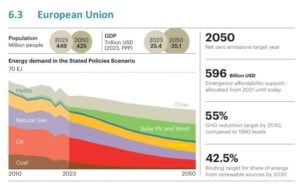
European Union energy demand under net zero
Source: IEA

Together, these initiatives show how the bloc is increasingly linking climate policy, industrial competitiveness, and energy security.

Can Mediterranean Renewables Power Europe’s Net-Zero Future?

The timing of T-MED is significant. The European Union has legally committed to reducing net greenhouse gas emissions by at least 55% by 2030 compared with 1990 levels. It also aims to reach climate neutrality by 2050.

Meeting those goals will require a massive expansion of clean electricity.

The International Energy Agency says global electricity demand will rise sharply in the next decade. This growth comes as transport, industry, and buildings get more electrified. Renewable energy will need to provide most of that growth.

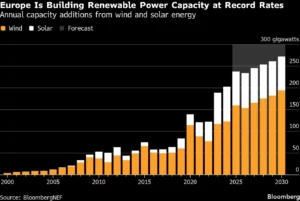
The growth of renewable power in Europe has been growing at record levels, as shown below.

Europe renewable power capacity forecast 2030

The Mediterranean could play a major role.

Beyond solar and wind power, the region is also emerging as a potential hub for green hydrogen production. Morocco, Egypt, and Tunisia have announced big hydrogen projects. These projects aim to supply local industries and European markets.

At the same time, stronger electricity connections could help renewable power flow better between Europe and its southern neighbors. This would boost grid flexibility and support more renewable energy on both sides of the Mediterranean.

The Investment Barriers Standing in the Way

Despite the opportunity, significant barriers remain. Many investors have been cautious about renewable energy projects in parts of North Africa and the Middle East. Regulatory uncertainty, permitting delays, financing challenges, and infrastructure gaps have often slowed investment.

According to EU estimates, Africa holds roughly 40% of the world’s solar potential but attracted less than 2% of global renewable energy investment in 2024.

T-MED aims to address these challenges through technical assistance, regulatory cooperation, and investment guarantees.

The initiative includes a Regulatory Accelerator designed to help partner countries improve permitting processes, strengthen energy regulations, and attract private capital. EU financial support will also be linked to measurable reform progress.

Whether these measures can unlock large-scale investment remains one of the key questions facing the program.

The Birth of Europe’s New Renewable Energy Corridor

The Mediterranean’s renewable resources have long been recognized. What has been missing is the investment needed to develop them at scale. The EU’s new €25 billion initiative is an attempt to change that.

If successful, T-MED could add 15 GW of new renewable capacity, strengthen regional energy security, and accelerate decarbonization across Europe and the Southern Mediterranean.

The initiative also reflects a broader shift in climate policy. Clean energy is no longer viewed only as an environmental goal. It is increasingly seen as an economic, industrial, and geopolitical priority.

For Europe, unlocking the Mediterranean’s vast solar and wind resources could become one of the most important energy opportunities of the next decade.

The sun and wind are already there. The challenge now is turning that potential into projects, investment, and clean power on a scale that can help meet the region’s climate and energy goals.

The post EU Unveils €25 Billion Mediterranean Clean Energy Plan to Unlock Solar and Hydrogen Growth appeared first on Carbon Credits.

Inside the DOMINANCE Act: America’s Push to Secure Critical Minerals Beyond China

The U.S. House of Representatives has passed the DOMINANCE Act, a bipartisan bill designed to strengthen America’s access to critical minerals and reduce its dependence on China. Lawmakers say the legislation will help secure supply chains for key industries, including electric vehicles (EVs), clean energy, semiconductors, and defense manufacturing.

The bill, formally known as the Developing Overseas Mineral Investments and New Allied Networks for Critical Energies (DOMINANCE) Act, was introduced by Representatives Young Kim and Ami Bera. It passed the House by voice vote and now moves to the Senate for consideration.

The legislation comes as governments worldwide race to secure supplies of critical minerals that power the energy transition and advanced technologies. At the same time, concerns continue to grow over China’s overwhelming control of global mineral processing and refining.

The Supply Chain Challenge Facing the U.S.

Critical minerals have become the backbone of the modern economy. They are essential for manufacturing batteries, electric vehicles, solar panels, wind turbines, semiconductors, and military equipment.

As demand for these technologies grows, access to reliable mineral supplies has become a strategic priority.

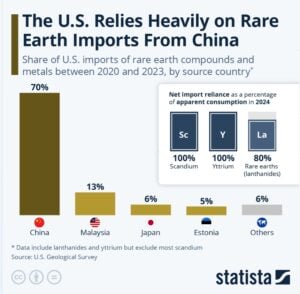
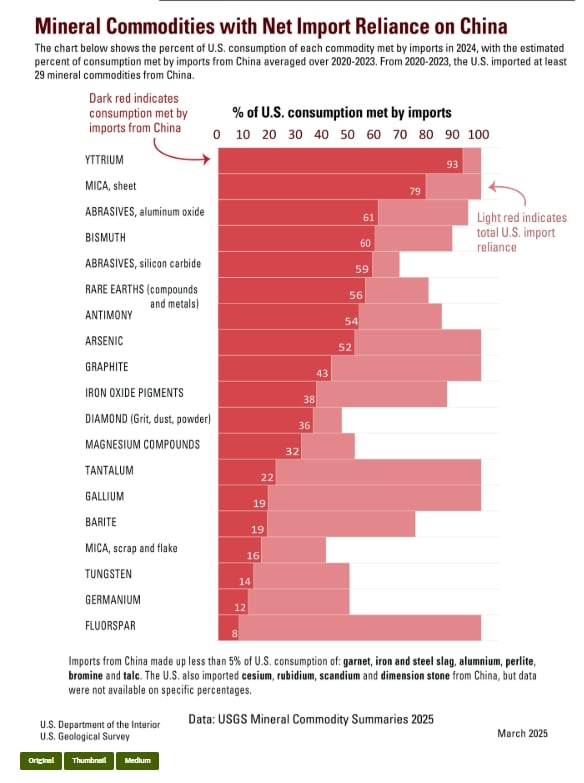
The United States currently depends heavily on imports for many of these materials. It remains 100% import-reliant for 11 critical minerals, including graphite, gallium, scandium, and yttrium.

This dependence has raised concerns among policymakers who fear that supply disruptions could affect both economic growth and national security.

US rare earth critical minerals

Targeting the Minerals Behind EVs, Batteries, and National Security

The bill does not identify a specific list of priority minerals. Instead, it focuses broadly on critical minerals and energy minerals that support national security and advanced manufacturing.

However, the legislation clearly targets materials where China maintains a dominant position in production or processing.

These include:

  • Rare earth elements used in magnets, electronics, and defense systems
  • Lithium for EV and energy storage batteries
  • Cobalt for battery production and military applications
  • Nickel used in batteries and industrial manufacturing
  • Graphite, a key battery material
  • Gallium and other specialty minerals used in semiconductors and advanced technologies

The bill generally aligns with the U.S. Department of the Interior’s critical minerals list, which identifies resources that face high supply disruption risks while serving essential economic and security functions.

us import critical mineral and rare earth china

China Still Controls the Market

A major driver behind the DOMINANCE Act is China’s strong position in global mineral supply chains.

Congressional documents supporting the legislation state that China controls more than 70% of global rare earth mining and nearly 90% of rare earth processing capacity. Rare earth elements are crucial for manufacturing EV motors, advanced electronics, renewable energy equipment, and defense technologies.

Lawmakers argue that this concentration creates significant risks for the United States and its allies.

Those concerns have intensified in recent years as China expanded export controls on several critical materials. U.S. officials say Beijing has repeatedly demonstrated its willingness to use its market position as leverage during geopolitical disputes.

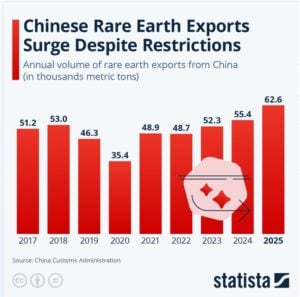
Meanwhile, China’s rare earth exports continue to rise. According to customs data cited by Reuters, the country exported 62,600 metric tons of rare earth products in 2025, up from 55,400 metric tons in 2024.

china rare earth

The figure marked the highest annual export volume in at least a decade and highlighted China’s continuing influence over global supply chains.

The Core Problem the U.S. Wants to Solve

The DOMINANCE Act is built around one central idea: the United States cannot secure its future industries if it depends on a geopolitical rival for essential materials. Lawmakers say the current system leaves U.S. companies vulnerable to:

  1. Supply disruptions: A single export restriction or trade dispute could slow production across multiple industries.
  2. Higher costs: Limited supply and geopolitical tensions can drive up prices for manufacturers.
  3. National security risks: Defense systems, advanced weapons, and military technologies require reliable access to rare earths and other critical minerals.
  4. Slower clean energy growth: EVs, batteries, wind turbines, and grid storage all depend on minerals such as lithium, cobalt, nickel, and graphite.

What the DOMINANCE Act Will Do

The bill does not seek to block Chinese exports. Instead, it aims to reduce U.S. dependence on China by building stronger supply chains with allies.

A key part of the legislation is creating a coordinated national strategy for energy and critical minerals. Supporters say current efforts are spread across multiple agencies, slowing responses to supply chain risks.

Representative Young Kim said the approach would create a single strategy and command center for America’s critical mineral efforts.

The move comes as demand for minerals continues to rise. Electric vehicles, battery storage systems, solar panels, and wind turbines all rely on these materials. As a result, supporters believe the legislation can help secure supplies, support clean energy growth, and strengthen U.S. manufacturing competitiveness.

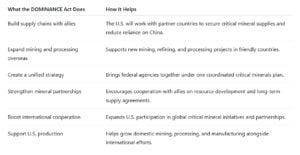
Here’s a summary of the DOMINANCE Act and how it helps to secure supply chains

dominance act

Looking Ahead

The House vote marks another step in Washington’s effort to strengthen mineral security and reduce strategic vulnerabilities.

If the Senate approves the legislation, the United States will gain new tools to build partnerships, support overseas mineral development, and strengthen supply chains for the materials that power modern economies.

While the bill will not eliminate China’s influence overnight, it signals a long-term strategy to create alternative sources of supply and reduce reliance on a single dominant player.

As competition for critical minerals intensifies, the DOMINANCE Act underscores a growing consensus in Washington: securing access to these resources is now as important as securing energy supplies. The outcome could shape global mineral markets, clean energy supply chains, and industrial competitiveness for years to come.

The post Inside the DOMINANCE Act: America’s Push to Secure Critical Minerals Beyond China appeared first on Carbon Credits.
SBTi’s Launches New Net-Zero Standard V2.0, Raising the Bar for Corporate Climate Action

SBTi’s New Net-Zero Standard Raises the Bar for Corporate Climate Action

The Science-Based Targets initiative (SBTi) has released the finalized Corporate Net-Zero Standard Version 2.0, creating new rules that will guide how companies set, manage, and report their net-zero plans.

The update arrives as more companies than ever are adopting climate targets. However, investors, regulators, and customers increasingly want proof that companies are reducing emissions, not just making promises. The revised standard reflects that shift. It moves the focus from target setting to implementation and accountability.

For businesses, the new framework provides a clearer roadmap to net zero. For carbon markets, it offers more guidance on the role of carbon removals and high-quality carbon credits.

David Kennedy, Chief Executive Officer at the SBTi, remarked:

“Businesses now have a great opportunity to manage their transition risk and strengthen resilience in a fast-changing world. The Standard provides a framework to achieve this in practice across a wide range of contexts, through aligning climate science with actions that they can and should take to transform their businesses. Those that use it will gain a competitive advantage while contributing to international climate objectives.”

How the New Rules Could Reshape Corporate Climate Strategy

The SBTi has become one of the most influential climate organizations in the corporate world. The initiative was started by CDP, the United Nations Global Compact, the World Resources Institute (WRI), and WWF.

The initiative helps companies set emissions targets that match climate science and the Paris Agreement goals. Its influence continues to grow.

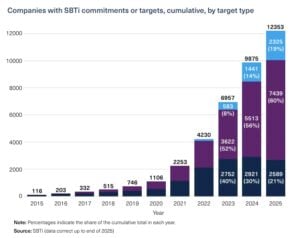
According to SBTi, more than 11,000 companies worldwide have either set science-based targets or committed to doing so. The organization reported a 40% increase in corporate climate target adoption in 2025. This growth was particularly strong in Asia and emerging markets.

companies with SBTi net zero target
Source: SBTi

Together, these companies make up a large part of the global economy. They also produce billions of tonnes of greenhouse gas emissions every year. That means changes to the SBTi framework can influence climate strategies across entire industries.

From Climate Targets to Climate Delivery

The biggest message from Version 2.0 is simple: setting a target is no longer enough. As Francesco Starace, SBTi Chair, stated, “Commitment is not the hardest part. Delivery is.”

That means the new standard seeks to move companies from climate ambition to real-world implementation.

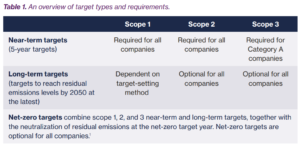
The original Corporate Net-Zero Standard, released in 2021, focused mainly on helping companies establish science-based net-zero goals. The updated version places greater attention on how companies achieve those goals and how they report progress.

SBTi net zero standard v2 requirements
Source: SBTi

The new framework introduces stronger expectations in five key areas:

  1. Net-zero governance – embedding climate goals into business decisions.
  2. Target setting – maintaining science-based emissions targets.
  3. Target implementation – showing actions taken to reduce emissions.
  4. Reporting and assessment – tracking and disclosing progress regularly.
  5. Progressive responsibility – addressing remaining emissions over time.

These changes aim to make corporate climate plans more transparent and measurable. For investors and stakeholders, that could improve confidence in net-zero claims.

According to Mark Kenber, Executive Director of the Voluntary Carbon Markets Integrity Initiative (VCMI), the new standard provides clearer guidance on how high-integrity carbon credits can complement direct emissions reductions in corporate net-zero plans. He further commented:

“It draws meaningfully on the work of VCMI to define best-practice corporate use of carbon credits, as well as recognizing ICVCM’s Core Carbon Principles as the benchmark for credit quality, sending a helpful signal of increasing alignment with business. We’re pleased SBTi has opened the door to recognizing companies that purchase carbon credits and stand ready to continuing to work with them to give businesses the confidence to act now.”

RELATED: SBTi Hits 10,000 Companies with Validated Targets in 2026: Asia Fuels the Net-Zero Momentum

Scope 3 Emissions Remain the Biggest Challenge

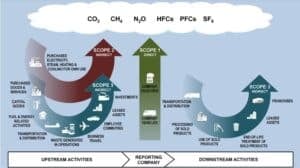
One of the most important parts of the new standard is its treatment of Scope 3 emissions. These emissions come from a company’s value chain, including suppliers, transportation, purchased goods, and product use.

scope 3 emissions GHG protocol 15 categories
Source: GHG Protocol

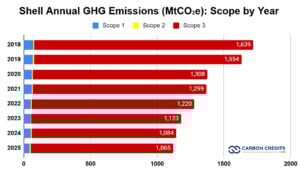
For many businesses, Scope 3 emissions account for more than 70% of their total carbon footprint, even over 95% for others. This is especially true for oil majors like Shell. Yet, they are often the hardest emissions to measure and reduce because companies do not directly control them.

Shell Annual Greenhouse Gas Emissions, Scope by Year, 2025

The updated standard gives companies more flexibility in how they address Scope 3 emissions while still requiring meaningful action. SBTi says businesses should work with suppliers, customers, and partners to cut emissions. They need to focus on the entire value chain, not just their own operations.

This reflects a growing understanding that reaching net zero will require action across entire economic systems, not just within individual companies.

Carbon Removals Gain a Bigger Role

One of the most closely watched changes involves carbon removals. The debate over carbon credits has intensified in recent years. Critics argue that some companies have relied too heavily on offsets instead of reducing their own emissions.

The new net-zero standard attempts to draw a clearer line.

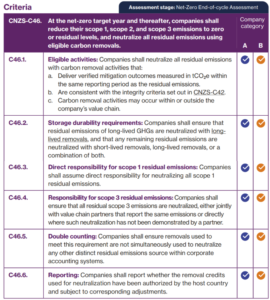
Companies must still prioritize direct emissions reductions. However, SBTi acknowledges that some residual emissions will likely remain, especially in sectors such as aviation, shipping, steel, cement, and heavy industry.

To address those emissions, the framework allows a greater role for carbon removals and certain high-integrity environmental instruments. This change aligns with findings from the Intergovernmental Panel on Climate Change (IPCC). Most climate pathways that limit global warming require large-scale carbon removal by mid-century.

SBTi new net zero standard and carbon removals
Source: SBTi

Demand is already rising. According to CDR.fyi, buyers have contracted more than 8 million tonnes of carbon removal credits globally. Technology companies have led much of that demand through investments in direct air capture, bioenergy with carbon capture, and other removal technologies.

The SBTi update might boost demand for top-notch carbon removals. It will also raise attention to project quality and verification standards.

A Major Signal for the Future of Carbon Credits

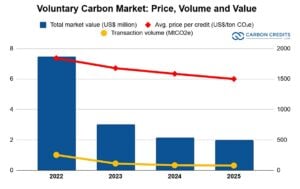
The revised standard may have significant implications for voluntary carbon markets (VCMs). Over the past few years, concerns about credit quality have slowed market growth. Buyers increasingly want assurance that carbon credits deliver real, measurable, and lasting climate benefits.

voluntary carbon market vcm price volume and value 2025

Version 2.0 reinforces that trend. The framework places greater emphasis on transparency, accountability, and measurable outcomes. As a result, demand could shift further toward higher-quality projects with stronger monitoring and verification systems.

This could benefit sectors such as:

  • Carbon dioxide removal (CDR),
  • Methane reduction,
  • Durable carbon storage, and
  • High-integrity nature-based projects.

The result may be a smaller but stronger carbon market focused on quality rather than volume. For project developers, that means demonstrating additionality, permanence, and long-term climate impact will become even more important.

A New Era for Corporate Net Zero

The release of the Corporate Net-Zero Standard Version 2.0 marks an important step in the evolution of corporate climate action. For years, companies focused on announcing climate commitments. Now the focus is shifting toward proving results.

The new framework maintains strong emissions-reduction goals. It also provides companies with clearer guidance on how to implement, govern, and report.

SBTi plans to begin validating targets under Version 2.0 in 2027. Companies can continue using the current Version 1.3.1 framework until January 2028. After that, new submissions will need to align with the updated standard.

As net-zero deadlines move closer, companies will increasingly be judged by the emissions they reduce, not the targets they announce.

The new SBTi standard reflects that reality. It raises expectations for transparency, accountability, and execution—three areas that are becoming just as important as ambition in the race to net zero.

The post SBTi’s Launches New Net-Zero Standard V2.0, Raising the Bar for Corporate Climate Action appeared first on Carbon Credits.
ChatGPT Hits 1 Billion Users as OpenAI Eyes IPO: What This Means for Energy, Emissions, and Climate Goals

ChatGPT Hits 1 Billion Users as OpenAI Eyes IPO: What This Means for Energy, Emissions, and Climate Goals

Artificial intelligence (AI) is growing at a pace few technologies have ever matched. In May 2026, ChatGPT became the fastest app in history to reach 1 billion monthly active users, as reported by Reuters. The milestone came just three years after the chatbot launched in late 2022.

Soon after, OpenAI confirmed it had confidentially filed paperwork for a potential initial public offering (IPO). This sets the stage for one of the most closely watched public listings in the technology sector.

Together, these developments highlight the extraordinary growth of generative AI. They also reveal a less discussed challenge: powering the infrastructure behind that growth.

For climate and carbon markets, the story goes beyond users and valuations. AI is driving a surge in electricity demand, data center construction, and computing capacity. That growth raises new questions about emissions, clean energy supply, and how the world can meet rising digital demand while staying on track with climate goals.

ChatGPT’s Rise: The Fastest Consumer Tech Adoption in History

ChatGPT’s growth has few parallels in the technology industry. Sensor Tower estimates the platform surpassed 1 billion monthly active users in May 2026, making it the fastest application ever to reach that milestone.

  • By comparison, TikTok took about five years to reach 1 billion monthly users, while Instagram needed nearly eight years.

The growth has accelerated rapidly over the past two years. OpenAI reported in early 2026 that ChatGPT reached over 900 million weekly active users and more than 50 million paying subscribers.

The platform’s reach now extends across consumers, businesses, education, software development, healthcare, and financial services. Generative AI tools are increasingly becoming part of daily workflows rather than standalone applications.

This explosive adoption has helped establish OpenAI as the leading company in the generative AI market. Yet, user growth is only part of the story. The infrastructure required to support those users is expanding just as quickly.

OpenAI’s IPO Filing: A Trillion-Dollar AI Race Takes Shape

OpenAI’s confidential IPO filing reflects the enormous investor interest surrounding artificial intelligence. The company has not disclosed the timing or size of a potential offering. However, the filing gives OpenAI the flexibility to move forward when market conditions are favorable.

The company wrote:

“We have not decided on timing yet; it may be a while because there are things we want to do that are likely easier as a private company. But it’s a complicated set of tradeoffs, and this gives us the option to go public sooner if that ends up being best.”

The numbers behind the company help explain why investors are paying attention.

OpenAI was valued at about $852 billion after its March 2026 funding round. This made it one of the most valuable private companies globally. Some analysts believe a future public listing could eventually push the company’s valuation closer to $1 trillion.

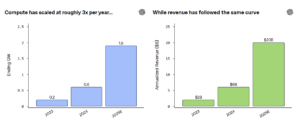
Revenue is also growing rapidly. Industry estimates put OpenAI’s annual revenue at over $20 billion in early 2026. This is a big jump from about $6 billion in 2024. These figures reflect a broader AI investment boom.

OpenAI revenue and compute growth
Source: OpenAI

Goldman Sachs says that Meta, Microsoft, Amazon, and Alphabet will spend about $5.3 trillion on capital from 2025 to 2030. That forecast is up from an earlier estimate of $4.5 trillion.

Much of that spending will support AI infrastructure, including data centers, advanced chips, networking equipment, and power systems. As a result, the future of AI is becoming closely tied to the future of energy.

The Power Problem Behind AI: From Queries to a Forest

Every AI query requires computing power. Training advanced models requires even more. So as AI adoption grows, electricity demand is becoming one of the industry’s biggest challenges.

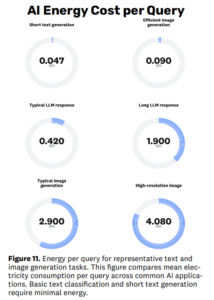
AI energy cost per query
Source: UNU Report

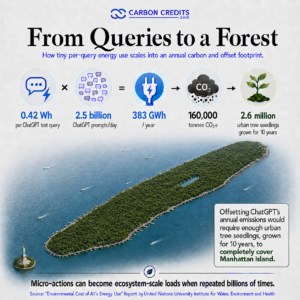
Putting that into perspective, a single text query using ChatGPT that uses 0.42 Wh of energy will translate into a carbon footprint that needs around 2.6 million tree seedlings grown for ten years to offset. That number of trees can already cover the entire Manhattan Island.

ChatGPT carbon footprint

Goldman Sachs Research estimates global data center electricity demand could increase by as much as 165% by 2030 compared with 2023 levels. AI applications could account for a large share of that increase.

data center power demand AI 2030 Goldman

The International Energy Agency (IEA) warns that electricity use from data centers, AI, and cryptocurrencies might double from 2022 to 2026. In some advanced economies, data centers could account for more than 20% of electricity demand growth by the end of the decade.

This trend is already affecting energy planning. Utilities are upgrading grids. Governments are reviewing power infrastructure needs. Technology companies are seeking long-term electricity supplies for future data centers.

Access to reliable power is becoming a strategic issue for AI development. In some areas, energy availability will play a bigger role in deciding where future AI infrastructure can be set up.

Why Big Tech Is Scrambling for Clean Energy

The rapid growth of AI is also raising concerns about emissions. If the world meets future electricity demand mostly with fossil fuels, the carbon footprint could increase a lot. This is pushing technology companies to secure cleaner sources of power.

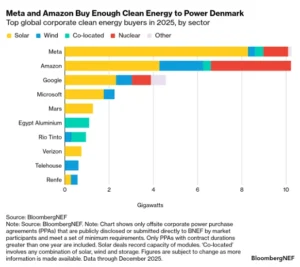
Many of the world’s largest technology firms are already among the biggest corporate buyers of renewable energy. Long-term agreements for wind and solar power have become common across the industry.

corporate clean energy purchases BNEF 2025

Interest in nuclear energy is also increasing.

Many tech companies are looking into advanced nuclear reactors and small modular reactors (SMRs). They see these as reliable, carbon-free options for future data centers. Nuclear power can operate around the clock, making it attractive for AI workloads that require continuous power.

This shift could have important implications for carbon markets.

Rising electricity demand from AI could boost investments in several areas. These include renewable energy, battery storage, advanced nuclear tech, grid upgrades, and carbon removal solutions. These sectors are all expected to play a role in supporting a lower-carbon digital economy.

The challenge, however, will be scaling clean energy fast enough to keep pace with AI growth.

Can OpenAI Match Its AI Leadership With Climate Leadership?

OpenAI is now a leading AI company, but its climate commitments are not as strong as those of some tech peers. The company has not announced a formal net-zero target or a detailed emissions reduction roadmap.

However, OpenAI’s infrastructure relies heavily on cloud providers and partners that have made major climate commitments.

Microsoft, one of OpenAI’s largest partners and investors, has pledged to become carbon negative by 2030 and remove all of its historical emissions by 2050. The company is investing a lot in renewable energy, carbon removal projects, and advanced nuclear tech. These efforts aim to boost future AI growth.

Across the technology sector, sustainability is becoming an increasingly important issue. Investors, regulators, and customers are paying closer attention to the environmental impact of data centers and AI operations.

That scrutiny is likely to increase if OpenAI eventually becomes a publicly traded company. This is because public markets focus more on environmental, social, and governance (ESG) disclosures. This includes emissions reporting and risks related to climate change.

The Collision Course Between AI Expansion and Net Zero

OpenAI’s growth, its potential IPO, and the broader AI investment boom are driving demand for new infrastructure on a massive scale. Data centers, computing hardware, transmission networks, and electricity generation will all need to expand to support future growth.

That creates both risks and opportunities.

More power demand could increase emissions if clean energy deployment falls behind. It could also speed up investment in renewable energy, advanced nuclear power, energy storage, grid updates, and carbon removal technologies.

The stakes are significant.

The same AI revolution that is reshaping industries could also influence the future direction of energy markets and global emissions. How governments, utilities, and tech companies respond will shape the next decade of digital growth. This can either support or complicate the shift to a lower-carbon economy.

The post ChatGPT Hits 1 Billion Users as OpenAI Eyes IPO: What This Means for Energy, Emissions, and Climate Goals appeared first on Carbon Credits.

A 9-Million-Ton Tournament: Why the 2026 World Cup Could Be Football’s Biggest Climate Challenge Yet

A 9-Million-Ton Tournament: Why the 2026 World Cup Could Be Football's Biggest Climate Challenge Yet

The 2026 FIFA World Cup is expected to be the biggest tournament in football history. It may also become the most polluting.

A new study from Loughborough University, the University of Bristol, and the University of Manchester estimates that the tournament could produce over 9 million tonnes of carbon dioxide equivalent (CO₂e). This would be the highest-emitting FIFA World Cup ever. Its footprint is nearly double the average from 2010 to 2022.

The warning comes as FIFA prepares for its first 48-team World Cup, hosted across 16 cities in the United States, Canada, and Mexico. The tournament will feature 104 matches, up from 64 in the previous format.

The findings raise broader questions about the environmental impact of major sporting events. They also highlight a growing contradiction: football is contributing to climate change while becoming increasingly vulnerable to its effects.
Bigger Tournament, Bigger Carbon Footprint

The main driver behind the projected emissions increase is expansion. For the first time, the World Cup will feature 48 teams instead of 32. The number of matches will increase by more than 60%, from 64 to 104.
At the same time, the tournament will span three countries and thousands of miles of travel between host cities.

Researchers estimate that air travel emissions for the 2026 World Cup will rise by 160% to 325% compared to past tournaments. Similar increases are expected for the 2030 and 2034 World Cups under the expanded format.

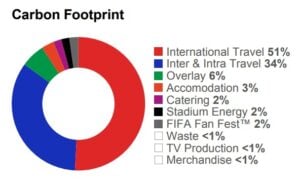
FIFA world cup 2026 carbon footprint
Source: FIFA World Cup 2026 Bid Book

Transportation has long been the largest source of emissions for major sporting events. International flights are hard to decarbonize. In contrast, stadium operations can increasingly use renewable electricity.

The study argues that tournament expansion is now becoming one of the biggest climate challenges facing global football. The scale of the event illustrates the issue. FIFA expects the 2026 World Cup to attract millions of fans and become the most-watched tournament in history.

The 2022 World Cup in Qatar reached about 5 billion viewers globally, while the final alone attracted around 1.5 billion viewers, according to FIFA. The larger 2026 event is expected to exceed those numbers.

Record Revenues Come With a Rising Carbon Bill

The environmental debate comes as football’s commercial success reaches new heights.

According to FIFA’s financial reports, the 2022 World Cup generated approximately $7.6 billion in total revenue. Broadcasting and media rights accounted for about 83% of FIFA’s total revenue, amounting to $6.3 billion, during the 2019-2022 cycle.

The organization expects revenues to keep growing from 2023 to 2026. Larger tournaments will bring more chances for sponsorship, broadcasting, and ticket sales.

Critics argue that this growth model has environmental consequences. The new study points to expanding competitions, rising travel demand, and increasing commercial activity as key factors behind football’s growing carbon footprint.

A report titled FIFA’s Climate Blind Spot by the New Weather Institute outlines that the 2026 World Cup will generate at least 9 million tonnes of carbon dioxide. This is roughly equivalent to the entire annual carbon emissions of countries like Luxembourg, Cyprus, or Latvia.

2026 fifa world cup carbon footprint

University researchers also raise concerns about the role of fossil fuel sponsorships in sport. In particular, the report highlights FIFA’s sponsorship agreement with Saudi Aramco, one of the world’s largest oil companies. The authors further proposed that UEFA should restrict
fossil fuel ownership, saying:

“We therefore recommend that actors with an active interest in football not becoming more sustainable should be hindered from owning clubs. This issue should be of particular interest to UEFA, given their interest in sustainability.”

The authors argue that football’s global influence gives it a unique responsibility to align with climate goals. They question whether continued tournament expansion is consistent with efforts to reduce emissions.

Climate Change Is Also Threatening the Game

While football contributes to emissions, it is also becoming more exposed to climate risks. A climate risk assessment for the 2026 World Cup showed that many host cities may face dangerous heat in the coming years.

Researchers predict that by 2050, 14 of the 16 stadiums in the tournament may reach temperatures that require cooling breaks for players and officials. More concerning, 11 venues could face heat conditions considered unsafe for human activity during parts of the year.

The risks are not limited to future decades.

A recent study by World Weather Attribution found that about one-quarter of matches planned for the 2026 World Cup might face heat levels above safety limits set by FIFPRO, the global players’ union.

Five matches could take place under conditions considered unsafe for play. Miami emerged as one of the most vulnerable locations. Researchers described dangerous heat levels there as “near certain” during parts of the tournament.

These findings highlight a growing challenge for global sports. Rising temperatures are already affecting player performance, fan safety, and event operations around the world.

From Flooding to Heatwaves: The Growing Price of Climate Disruption

Heat is only one part of the problem. The climate risk assessment also examined flooding, storms, and water stress across the tournament’s host cities. The results suggest that climate-related costs could increase significantly over the coming decades.

Annual flood-related damages at World Cup venues are projected to rise from approximately $10.9 million in 2025 to $15.6 million by 2050. Meanwhile, annual wind-related damages could increase from about $7 million to $7.7 million over the same period.

fifa world cup 2026 flood losses

Several host venues face particular exposure to flooding risks. Researchers say that six stadiums might flood. The water could rise from one to over two meters during big storms.

Water availability may also become a challenge.

The study found that almost one-third of World Cup venues might have water needs that outstrip local supply by mid-century. This raises concerns about maintaining playing surfaces and supporting large numbers of visitors during major events. These risks show that climate change is now a direct issue for global sports organizations.

Can Football Become More Sustainable?

Football’s climate footprint is attracting growing scrutiny. Many clubs, leagues, and governing bodies have introduced sustainability initiatives in recent years. Efforts include renewable energy installations, waste reduction programs, sustainable stadium design, and low-carbon transportation plans.

FIFA has also announced climate strategies and sustainability commitments. However, researchers argue that operational improvements alone may not offset emissions generated by larger tournaments and increased international travel.

The report suggests several actions, including.

  • First, it advises ending fossil fuel sponsorships.
  • Next, it recommends skipping future tournaments in major oil-producing states.
  • Finally, it urges a rethink of expanding global competitions.

Others suggest that future host selection could place greater emphasis on geography, transportation networks, and climate resilience.

Technology can help cut emissions. This includes using sustainable aviation fuels, cleaner transportation systems, and better energy efficiency. Yet, most experts agree that aviation remains one of the hardest sectors to decarbonize.

That means travel-related emissions will likely remain a major challenge for future World Cups.

A Defining Test for Football’s Climate Ambitions

The 2026 World Cup represents a milestone for football. It will feature more teams, more matches, more host cities, and likely more viewers than any tournament before it. But the same factors driving that growth are also increasing its environmental footprint.

At the same time, climate change is creating new risks for players, fans, and infrastructure. The result is a growing tension that football can no longer ignore.

Whether FIFA and other sports organizations can reduce emissions while adapting to a warmer world may become one of the defining questions for the future of international sport.

The 2026 World Cup will not answer that question alone. But it may become the tournament that forces the conversation onto center stage.

The post A 9-Million-Ton Tournament: Why the 2026 World Cup Could Be Football’s Biggest Climate Challenge Yet appeared first on Carbon Credits.