Bitcoin Meets Carbon Credits: How 7RCC New ETF is Bridging Crypto and Climate Investing

Bitcoin Meets Carbon Credits: How 7RCC New ETF is Bridging Crypto and Climate Investing

The 7RCC Global launched the 7RCC Spot Bitcoin and Carbon Credit Futures ETF (BTCK) on NYSE Arca. The fund links Bitcoin to regulated carbon credit futures. This makes it one of the first exchange-traded products that connects digital assets with carbon markets.

The launch happens when both markets are evolving quickly. Bitcoin is becoming more integrated into traditional finance through ETFs. Meanwhile, carbon markets are expanding as governments and companies pursue net-zero targets.

The result is a product that reflects two major investment themes: digital assets and decarbonization.

A New ETF Combining Bitcoin and Carbon Credits: The 80/20 Split

The BTCK ETF allocates approximately 80% of assets to Bitcoin and 20% to regulated carbon credit futures. The fund strategy avoids voluntary offsets entirely. Instead, it targets established, government-regulated compliance frameworks:

  • European Union Emissions Trading System (EU ETS): The world’s largest cap-and-trade system.
  • California Cap-and-Trade (CCA): North America’s premier carbon compliance market.
  • Regional Greenhouse Gas Initiative (RGGI): The Northeast U.S. power-sector cap complex.

These are among the most established carbon pricing systems in the world.

According to 7RCC, this hybrid structure captures two distinct macroeconomic forces. Bitcoin reacts to liquidity, adoption, and monetary policy. Carbon markets react to tightening emissions caps, industrial compliance, and regulatory enforcement.

The BTCK fund does not offer a literal carbon offset portfolio. Instead, it blends two of the most powerful structural themes of the decade: digitalization and decarbonization.

This structure could attract investors wanting cryptocurrency exposure. It also offers access to environmental markets in one listed product.

7RCC BTCK fund facts
Source: 7RCC Global

The launch also highlights how ESG considerations continue to influence financial innovation, even as sustainable investing strategies evolve.

From Speculative Asset to Wall Street Mainstay

The timing of the launch is notable because Bitcoin has become increasingly accepted by institutional investors.

The approval of U.S. spot Bitcoin ETFs in 2024 transformed access to the asset class. In their first year, spot Bitcoin ETFs pulled in over $36 billion. This makes them some of the most successful ETF launches ever.

Today, the largest Bitcoin ETFs manage tens of billions of dollars in assets. BlackRock’s iShares Bitcoin Trust (IBIT) alone has accumulated more than $46 billion in assets under management, demonstrating the scale of institutional demand.

This growth has helped move Bitcoin further into mainstream financial markets. Yet, Bitcoin’s environmental footprint remains a primary concern for institutional allocators.

However, the underlying energy mix is changing rapidly. A pivotal study by the Cambridge Centre for Alternative Finance (CCAF) highlights this dramatic shift:

  • Sustainable energy use: Reached 52.4% across the global network.
  • Renewable energy share: Accounts for 42.6% of total electricity.
  • Coal power collapse: Dropped significantly to just 8.9% of mining energy.
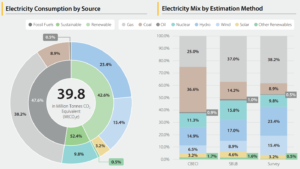
bitcoin electricity by source
Source: Cambridge Centre for Alternative Finance (CCAF)

The use of renewable energy in Bitcoin mining has grown recently. Major miners like Marathon Digital Holdings and Riot Platforms are anchoring operations near solar installations. They increasingly use grid-balancing programs to capture stranded and wasted energy.

Still, worries about electricity use and emissions from proof-of-work mining continue. This backdrop shows why an ETF combining Bitcoin with carbon market exposure might interest investors. They are looking for a bigger sustainability story.

The Quiet Rise of Carbon as an Investable Asset

While Bitcoin has captured headlines, carbon markets have quietly become one of the most important tools in global climate policy.

According to the World Bank, carbon pricing instruments now cover roughly 28% of global greenhouse gas emissions. Many governments are using carbon taxes and emissions trading systems more and more to promote decarbonization.
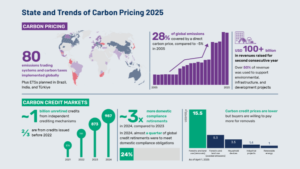
carbon pricing 2025 world bank

The EU ETS remains the world’s largest carbon market. It covers power generation, heavy industry, aviation, and maritime sectors across Europe. Similar compliance programs continue to expand in North America and Asia.

At the corporate level, demand for carbon-related products is also growing. Thousands of companies have established net-zero commitments, creating long-term interest in carbon credits, removals, and emissions reduction strategies.

Market forecasts suggest significant expansion ahead. McKinsey & Company estimates that global carbon credit demand could rise significantly by 2030. Companies are now seeking more ways to meet their climate goals.
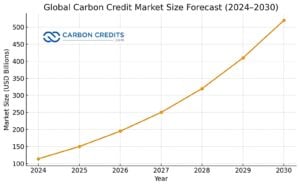
global carbon credit market size 2030

Carbon markets are smaller than traditional commodity markets. However, they are seen as a key asset linked to the energy transition.

Where Blockchain Meets the Energy Transition

The BTCK launch reflects a broader trend in financial markets: the convergence of digital assets and climate-related investments. Historically, these sectors developed separately.

Cryptocurrency investors focused on technological adoption and decentralized finance. Climate investors focused on emissions reductions, renewable energy, and sustainability-linked assets.

Today, those lines are beginning to blur. Institutional investors increasingly want diversified exposure to emerging themes. They also want investment products that fit within evolving ESG and sustainability frameworks.

By combining Bitcoin and carbon futures, BTCK attempts to bridge those worlds.

The fund operates at a highly competitive 44 basis points. It utilizes Gemini Trust Company as its primary digital asset custodian.

The concept is not necessarily about offsetting Bitcoin’s environmental footprint directly. Instead, it gives investors exposure to two markets that may benefit from long-term structural trends.

Both are expected to play larger roles in the global economy over the next decade and are both growing, but for different reasons. Bitcoin is benefiting from greater institutional adoption. Meanwhile, carbon markets are expanding as governments and companies pursue net-zero goals.

A Small Launch With Bigger Implications

The BTCK ETF is unlikely to reshape either the Bitcoin market or the carbon market on its own. However, it represents an interesting development in the evolution of both sectors.

For cryptocurrency investors, it introduces exposure to one of the world’s fastest-growing environmental markets. For climate-focused investors, it provides a new way to access digital assets within a regulated framework.

More broadly, the fund reflects how financial markets are adapting to two powerful global trends: digitalization and decarbonization.

Bitcoin and carbon credits may seem like an unlikely pairing. Yet, both markets are increasingly becoming part of larger conversations about the future of finance, energy systems, and net-zero transitions.

The success of BTCK will ultimately depend on investor demand. But its launch suggests that the gap between digital assets and climate finance may be narrowing, creating new opportunities where technology and sustainability intersect.

The post Bitcoin Meets Carbon Credits: How 7RCC New ETF is Bridging Crypto and Climate Investing appeared first on Carbon Credits.
Solar Cells, Battery Storage, and $3.1T in Investment Signal Energy Transition Momentum

Global clean energy trade rebounded in 2025, despite rising tariffs and geopolitical tensions. BloombergNEF’s Energy Transition Supply Chains 2026 report found that shipments of clean-energy products, battery metals, and grid equipment reached $479 billion in 2025, a 1% rise from 2024.

This modest growth signals recovery after a 7% drop in volumes from 2023 to 2024. The rebound shows the growing need for clean technologies as countries seek better energy security.

Energy Security Fuels Clean-Tech Demand

In recent years, global supply chains have drawn attention from governments and businesses. Trade disputes and geopolitical conflicts have exposed weaknesses in fossil-fuel supply chains.

The ongoing conflict in the Middle East has added uncertainty. Tensions with Iran have driven up oil and gas prices, impacting energy-importing nations in Asia and Africa.

Countries are boosting investments in solar power, battery storage, and electric vehicles as fuel costs rise. BloombergNEF’s data shows that nations dependent on imported fuels often increase clean-tech imports when fossil-fuel prices spike.

clean tech

Emerging economies are also adopting renewable technologies to reduce exposure to unstable fuel markets. Higher oil and gas prices strengthen the case for solar energy, batteries, and EVs. Demand for clean-energy equipment rises, even amid economic uncertainty.

BloombergNEF thinks that instability in fossil-fuel markets could raise global demand for renewable technologies. This is especially true in areas looking for energy independence.

“Many markets are doubling down on clean technology deployment to improve energy security,” said Antoine Vagneur-Jones, head of trade and supply chains at BloombergNEF.

Battery Storage Emerges as the Next Big Growth Story

Solar power has transformed electricity markets worldwide, but battery storage is now a crucial growth driver. In areas with high solar use, midday solar generation often lowers electricity prices. This challenges traditional power producers, as their revenues drop with increased solar output.

Instead of complex reforms, many countries are using battery storage to shift excess daytime solar generation to evening hours when demand peaks.

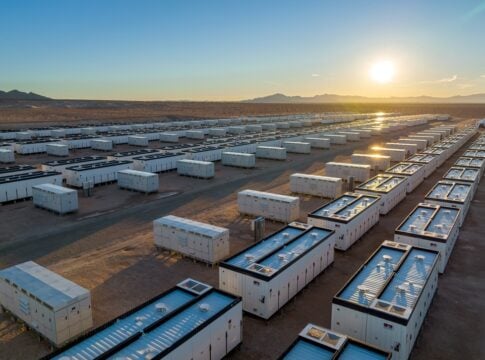
Battery systems are being deployed in utilities, businesses, and homes for better flexibility and grid stability.

The battery industry today resembles the solar industry from years ago. Manufacturing is competitive, products are standardizing, and prices continue to drop. This will lead to rapid battery deployment.

  • BNEF’s New Energy Outlook data shows global storage capacity to rise from 223 gigawatts in 2025 to 3.8 terawatts by 2050, a seventeen-fold increase.

However, adoption rates will vary. China may rely more on pumped hydro and other solutions, while U.S. trade policies could limit access to low-cost batteries.

global battery storage

Manufacturing Glut Continues to Pressure Markets

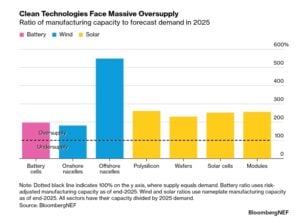
Despite rising demand, overcapacity remains a major challenge for clean-energy supply chains.

Global manufacturing capacity exceeds current demand by over 200% in many clean-tech sectors. Chinese investment drives much of this surplus, while new factories in India, Southeast Asia, Turkey, Egypt, and Ethiopia are adding to global production.

Meanwhile, the U.S. and Europe are unlikely to become major clean-tech exporters soon. While both regions have increased manufacturing capacity, growth has focused on assembly rather than complete supply chains.

Many announced projects face delays or cancellations due to changing policies, slower demand, and rising competition.

Equipment Prices Keep Falling, But More Slowly

Clean-energy equipment prices fell again in 2025, but the pace slowed compared to previous years. Similarly, solar module prices decreased, but higher silver prices limited further drops.

  • Battery pack prices fell significantly from $118 per kilowatt-hour in 2024 to $108 in 2025. However, rising battery-metal costs slowed this decline.

Wind equipment prices increased slightly, as some turbine manufacturers sought to recover losses from fierce competition. The slowdown in price drops means future growth will rely more on tech advances, policy support, and financing, not just lower equipment costs.

The Solar Revolution Is Reshaping Global Electricity

A key finding is solar energy’s growing dominance. Annual solar installations jumped from 75 gigawatts in 2016 to 655 gigawatts in 2025. That’s a nearly ninefold increase in less than ten years.

Another important finding is that the global solar trade is shifting toward solar cells rather than finished solar panels as more countries expand module assembly outside China.

  • Solar cells accounted for 44% of the global solar cell and module trade in 2025, up from 25% in 2024.
  • Meanwhile, total solar shipments declined ahead of 2026, when BloombergNEF expects solar installations to slow.

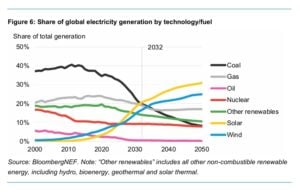
Today, solar stands alongside wind and nuclear as a major source of zero-carbon electricity. The report shows solar deployment to stay high through the decade. Under its Economic Transition Scenario, solar will become the largest source of zero-carbon power before 2030.

By 2032, solar is projected to surpass all other energy sources, becoming the world’s largest electricity source. While China leads in solar manufacturing, countries like India, Egypt, Ethiopia, and several Southeast Asian nations are rapidly expanding production capacity.

solar energy

Trillions More Needed to Meet Climate Goals

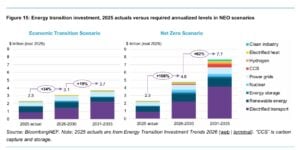
The global energy transition attracted a record $2.3 trillion in investment in 2025. This includes spending on renewable energy, batteries, electric vehicles, heat pumps, hydrogen, carbon capture, and related technologies.

  • Current investments align with BloombergNEF’s Economic Transition Scenario. Annual spending is expected to average around $3.1 trillion from 2026 to 2030.

However, much larger investments are needed to meet global climate targets.

Under BNEF’s Net Zero Scenario:

  • Annual low-carbon investment needs to average $4.8 trillion from 2026 to 2030. This is more than double the levels in 2025.
  • From 2031 to 2035, annual investment will need to increase further to about $7.7 trillion.

Electrified transport represents the largest investment opportunity and the biggest funding gap. Emerging technologies, like carbon capture and storage, are set to grow quickly.

Here’s the chart to understand the investment:

global clean energy investment

Clean Energy Becomes a Strategic Necessity

The clean-energy sector began 2026 with strong momentum. Trade volumes are recovering. Battery storage is expanding quickly. Solar power will soon be the world’s largest electricity source.

Manufacturers are dealing with oversupply. Geopolitical tensions are shifting supply chains. Plus, trillions in investment are needed to reach climate goals.

A clear trend is emerging: clean energy is now about more than just the environment. Countries are focused on energy security, economic stability, and shielding themselves from fossil-fuel price spikes. Because of this, solar, batteries, and other clean technologies are essential for the global economy.

The post Solar Cells, Battery Storage, and $3.1T in Investment Signal Energy Transition Momentum appeared first on Carbon Credits.
Top 4 Private Battery Tech Companies to Watch in 2026: Powering the EV and Net-Zero Transition

Top 4 Private Battery Tech Companies to Watch in 2026: Powering the EV and Net-Zero Transition

Battery technology is now one of the most important pillars of the global clean energy transition. It sits at the center of electric vehicles, renewable energy storage, and grid decarbonization.

Global investment in battery materials has jumped in recent years. This sector has drawn tens of billions in venture and infrastructure funding. Meanwhile, the demand for EVs and clean power keeps rising. These private companies are now competing to solve three major challenges: energy density, cost, and circular supply chains.

The four companies below are among the most influential private players shaping the next phase of battery innovation. But before we dive into each of them, let us examine the current market trends and growth forecast first to have a full picture of the sector.

Battery Market Growth Accelerates as Net-Zero Targets Expand

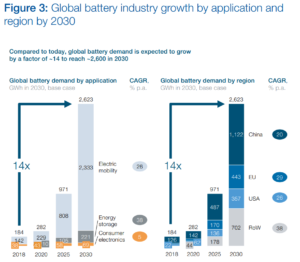
The global battery industry is entering a period of rapid growth as countries, automakers, and utilities invest in electrification. According to the International Energy Agency (IEA), global electric vehicle sales exceeded 20 million units in 2025, up from about 17 million in 2024.

EVs accounted for 25% of all new car sales worldwide. Global battery demand exceeded 1 terawatt-hour (TWh) for the first time. This surge was mainly due to transport and energy storage needs.

Growth is expected to continue through the decade. The IEA projects battery demand could increase more than fourfold by 2030 under current policy settings. Meanwhile, global energy storage deployment is also accelerating as countries add more solar and wind power to their grids.

global EV battery demand 2030

Source: World Economic Forum


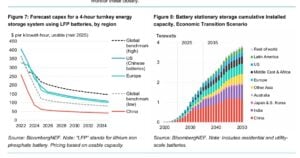
BloombergNEF predicts that stationary battery storage will grow quickly until 2035. This growth will make batteries essential for energy security and decarbonization.

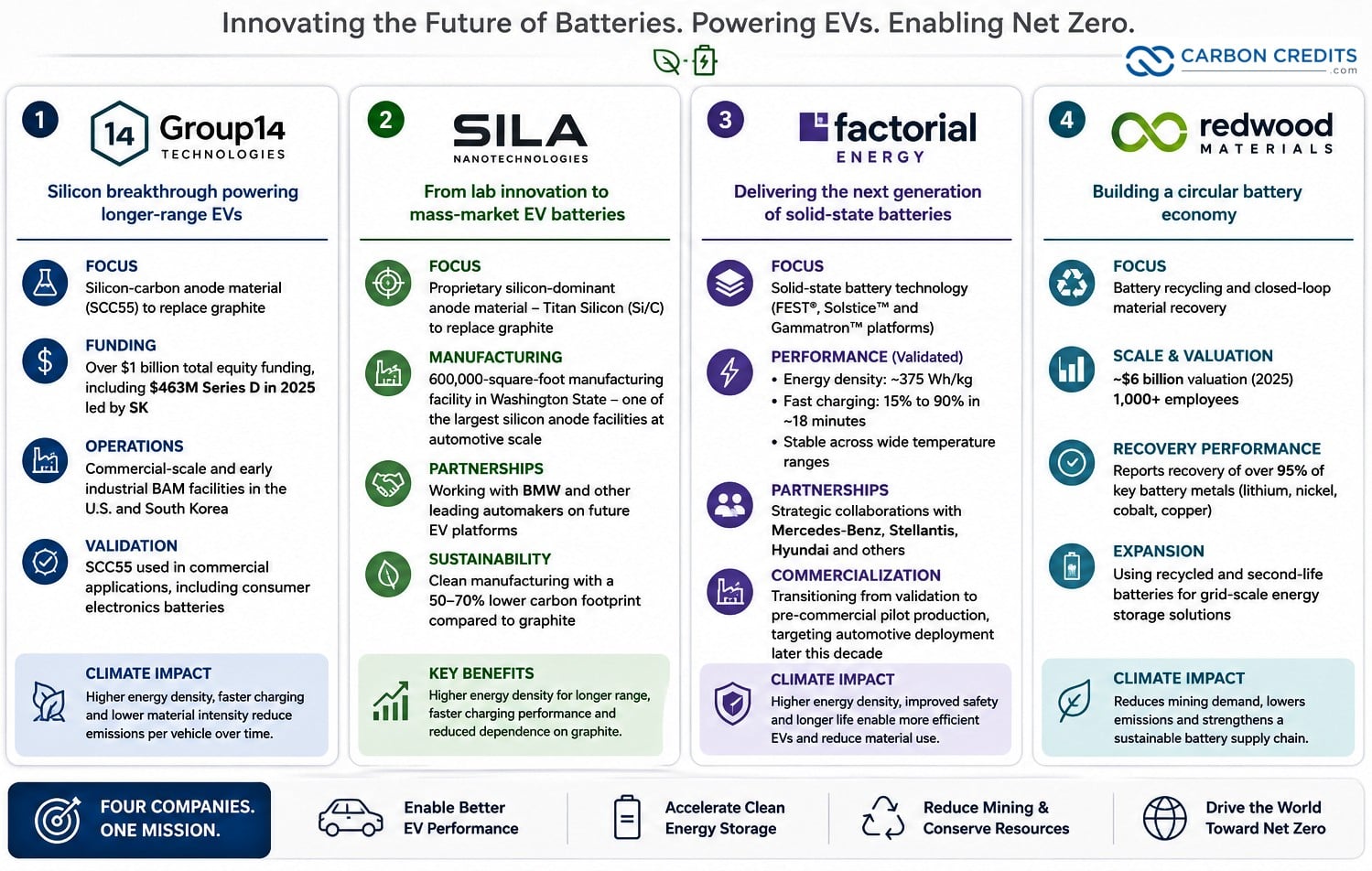
As a result, investors are increasingly focusing on private companies developing next-generation battery materials, chemistries, and recycling solutions. Here are the top private tech companies that are making a great impact in the sector.

Group14 Technologies: The Silicon Breakthrough Powering Longer-Range EVs

Group14 Technologies is one of the most advanced silicon-carbon battery material companies in the world. It develops SCC55, a silicon-based anode material designed to replace graphite in lithium-ion batteries.

This matters because graphite is one of the limiting factors in current EV battery performance. Silicon can store significantly more lithium, enabling higher energy density and faster charging.

The company has raised over $1 billion in total equity funding. This includes a $463 million Series D round in 2025. SK led this round, marking one of the largest battery material investments in the sector. It also includes backing from major strategic investors such as Porsche and Microsoft’s climate-focused investment arm.

Group14 runs commercial-scale and early industrial production Battery Active Material (BAM) facilities in the U.S. and South Korea. These facilities have the production capacity for EV-scale deployment. Its SCC55 material is already used in commercial applications, including consumer electronics batteries, showing early real-world validation.

From a climate perspective, silicon anode technology is important because it can:

  • Increase EV driving range without larger battery packs.
  • Reduce material intensity per kilowatt-hour.
  • Improve battery lifecycle efficiency.

These improvements lower emissions per vehicle over time. They do this by boosting EV adoption rates and cutting battery manufacturing inputs for each unit of performance.

Group14 is now scaling toward multi-GWh production capacity, positioning itself as a key materials supplier in the global EV supply chain.

Sila Nanotechnologies: From Lab Innovation to Mass-Market EV Batteries

Sila Nanotechnologies is a top U.S. company developing silicon-based battery materials. Their goal is to enhance EV battery performance.

Founded in 2011, Sila has built a proprietary silicon-dominant anode material, known as Titan Silicon (Si/C), designed to replace graphite in lithium-ion batteries. This means higher energy density. So, EVs can go farther on one charge without adding battery size or weight.

Sila titan silicon patent
Source: Sila Presentation by Gleb Yushin, CTO and Co-Founder

A key milestone is the new 600,000-square-foot manufacturing facility in Washington State. This is one of the largest facilities for silicon anode production at an automotive scale. This facility represents a key step in moving silicon battery technology from lab-scale innovation to industrial production.

Sila Nanotechnologies
Source: Sila Presentation by Gleb Yushin, CTO and Co-Founder

Sila has also partnered with leading automakers, including BMW, to support the integration of its materials into future EV platforms. The company’s technology targets three core improvements in EV batteries:

  • Higher energy density for longer driving range
  • Faster charging performance
  • Reduced dependence on graphite supply chains

The company also claims that its clean manufacturing has a 50-70% lower carbon footprint than graphite. These changes are significant for decarbonization. Transportation makes up about a quarter of global CO₂ emissions. Also, battery performance is a key barrier to quicker EV adoption.

By improving range, boosting charging time, and lowering emissions, silicon anode technology directly supports broader net-zero transport goals.

Factorial Energy: Delivering the Next Generation of Solid-State Batteries 

Factorial Energy is one of the most advanced private companies working on solid-state battery technology. It is revolutionizing batteries through its next-generation high-performance battery platforms, including Factorial Electrolyte System Technology (FEST®), SolsticeTM, and GammatronTM.

Unlike conventional lithium-ion batteries, solid-state batteries replace liquid electrolytes with solid materials. This improves safety, increases energy density, and reduces overheating risk.

Factorial has achieved key validation milestones with major automakers. Stellantis has confirmed that Factorial’s solid-state cells reach:

  • Around 375 Wh/kg energy density,
  • Charging from 15% to 90% in about 18 minutes, and
  • Stable performance under automotive testing conditions.

These results place Factorial among the leading solid-state developers globally, alongside a small group of competitors working toward commercialization.

The company has also secured strategic automotive partnerships, including with Stellantis, Hyundai, and Mercedes-Benz. These partnerships are critical because they provide a pathway from prototype cells to real-world vehicle deployment.

Solid-state batteries could significantly impact emissions reduction by:

  • Extending EV range and reducing range anxiety,
  • Improving safety and battery lifespan, and
  • Reducing reliance on critical raw materials per unit of energy.

If scaled successfully, this technology could accelerate EV adoption across passenger vehicles and commercial fleets.

Factorial is now transitioning from validation to pre-commercial pilot production, targeting automotive deployment later in the decade.

Redwood Materials: Building a Circular Battery Supply Chain

Redwood Materials is focused on one of the most overlooked parts of the battery ecosystem: recycling and materials recovery.

The company, started by ex-Tesla CTO JB Straubel, aims to create a closed-loop system that will recover essential battery metals like lithium, nickel, cobalt, and copper. They focus on recycling from old batteries and manufacturing waste.

The company has grown rapidly and was valued at around $6 billion as of 2025. It employs more than 1,000 people and operates large-scale recycling and materials processing facilities in the United States.

Redwood reports recovery rates of over 95% for key battery metals in its processing systems. This makes it one of the most efficient recycling platforms in the industry.

redwood materials battery tech company
Image from Redwood Materials website

The company has recently ventured into grid-scale energy storage. They use second-life EV batteries to create stationary storage systems for utilities and data centers.

This expansion is important for net-zero goals because it:

  • Reduces dependence on newly mined critical minerals.
  • Lowers lifecycle emissions from battery production.
  • Supports renewable energy integration through storage systems.

Battery recycling is expected to become a major industry as millions of EV batteries reach end-of-life over the next decade. Redwood is positioning itself as a key player in this emerging circular economy.

Four Different Paths, One Climate Goal: Why These Companies Matter for Net Zero

These four companies each cover a different part of the battery value chain, and together they support the shift toward net-zero emissions.

Top 4 private battery tech companies

Group14 Technologies and Sila Nanotechnologies focus on better battery materials. Their silicon-based anodes help EVs store more energy and charge faster. This improves driving range and reduces the amount of raw material needed per battery. Over time, this helps lower emissions per kilometer.

Factorial Energy works on solid-state batteries, which use a solid material instead of a liquid one. They can be safer, last longer, and store more energy. If widely used, they could make EVs and energy storage systems more efficient and less material-intensive.

Redwood Materials focuses on recycling. It recovers key metals from used batteries instead of relying only on new mining. This reduces environmental damage and helps secure supply chains.

Together, these companies improve both sides of the climate challenge. They help scale clean technologies while also cutting emissions across the full battery lifecycle.

Final Takeaway

Battery innovation is moving from research to industrial scale. The top four private battery tech companies driving this change are boosting performance. They are also changing how the global energy system handles emissions.

As EV adoption accelerates and renewable energy expands, battery technology will remain one of the most important enablers of the net-zero transition.

Private innovators like Group14, Sila Nanotechnologies, Factorial Energy, and Redwood Materials are now central to that shift—each addressing a different but essential part of the future energy system.

The post Top 4 Private Battery Tech Companies to Watch in 2026: Powering the EV and Net-Zero Transition appeared first on Carbon Credits.
Elon Musk’s xAI Just Spent $1 Billion on Tesla Batteries as the AI Power Race Reshapes Global Energy

AI’s Environmental Cost: Data Centers Now Rival Entire Nations in Energy, Water, and Land Use

Elon Musk’s xAI purchased another $269 million worth of Tesla Megapack products in April 2026 alone. This marks a massive jump in energy storage spending by Musk’s artificial intelligence (AI) company.

The purchase shows just how fast AI data centers need power. That single month exceeds what xAI spent on Tesla Megapacks in all of 2024. The April order pushes total Megapack spending by xAI to roughly $1 billion since 2024.

This deal reflects broader market trends. Data centers, where AI models are trained and run, are becoming among the largest new electricity consumers in the world. As power demand grows, energy storage is becoming increasingly important for supporting reliable power supplies and helping companies in their decarbonization efforts.

The Billion-Dollar Battery Bet Behind AI Expansion

The xAI unit purchased $269 million worth of Tesla megapacks in April, according to SpaceX’s amended S-1 IPO filing. This follows Tesla previously disclosing that it sold $430 million worth of Megapack battery systems to xAI last year.

The numbers tell a clear story about AI’s energy needs. AI energy and water consumption are among the most-cited journalism topics around AI in 2026. Data shows why this matters for the energy sector.

xAI operates the Colossus supercomputer in Memphis and needs steady power. xAI has already deployed 168 Megapack units at its Memphis facility and plans to scale to roughly 1 GWh of buffering capacity. At the scale xAI is building — targeting 2 GW of compute capacity — the battery storage needs are enormous.

The AI firm shows no signs of slowing down. Its power needs keep growing as it builds more data centers for AI training and operations. The growing use of battery storage also highlights a larger shift in how energy-intensive industries manage electricity demand.

Large-scale batteries can store excess renewable power when solar and wind generation is abundant and discharge it when demand rises. This helps reduce dependence on fossil-fuel peaker plants while supporting cleaner electricity systems.

As AI infrastructure expands, energy storage is increasingly viewed as a key tool for limiting the sector’s carbon footprint.

Tesla’s Fastest-Growing Business Isn’t Cars

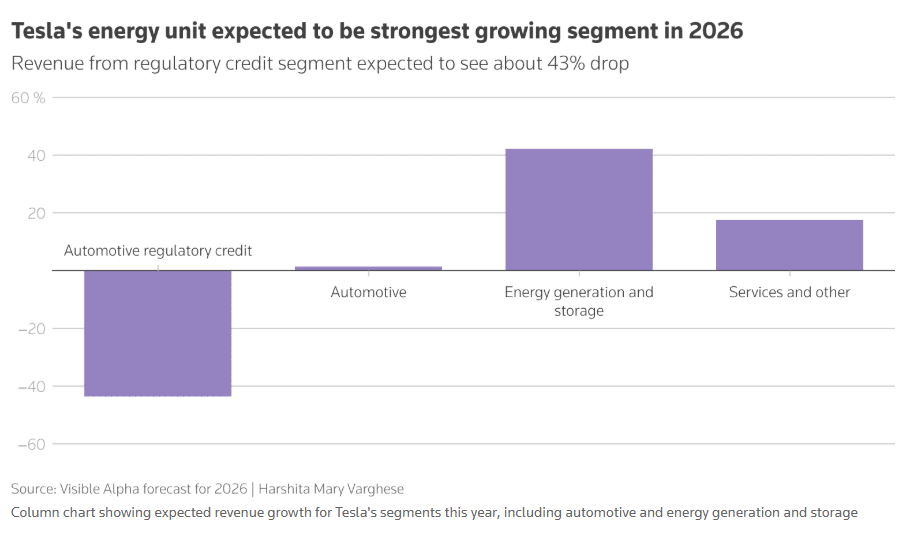
Tesla earned close to $12.8 billion in annual revenue from the segment, marking 26.6% year-over-year growth due to “higher deployments in all regions”. The energy business now makes up a bigger share of Tesla’s total sales.

Tesla energy storage business growth 2026
Image from Reuters

Tesla’s proportion of energy generation and storage to total revenue in 2025 increased to 13%, compared to the 10% share in 2024. This shift shows how important energy storage has become for the company.

The xAI purchases matter for Tesla’s bottom line. For Tesla’s energy division, which generated $12.8 billion in revenue in 2025, the xAI purchases represent a meaningful chunk of business. The $573 million Tesla recognized from SpaceX and xAI alone accounted for roughly 4.5% of total energy revenue.

Storage demand keeps climbing across all markets. Tesla deployed a record 46.7 gigawatt-hours of energy storage products in 2025, a 48% increase from last year. The company sees strong growth ahead despite some challenges.

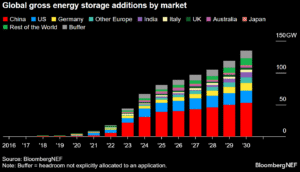
The growth reflects strong demand for grid-scale battery systems worldwide. The International Energy Agency (IEA) says global battery storage capacity hit new highs in 2025. It will keep growing quickly this decade, as shown in the Bloomberg chart below.

global energy storage market 2030 BNEF

Energy storage is one of the fastest-growing clean energy technologies. It helps solve the problem of renewable power generation being inconsistent.

For utilities and large power users, batteries are becoming essential infrastructure. They enhance grid reliability and cut down on renewable energy waste. They also aid the shift from carbon-heavy electricity sources.

AI’s Electricity Appetite Is Reaching Grid Scale

The AI boom drives huge energy needs. Electricity consumption from data centers is estimated to amount to around 415 terawatt-hours (TWh), or about 1.5% of global electricity consumption in 2024. It has grown at 12% per year over the last five years.

The growth will speed up. Global electricity use for data centers is expected to double, hitting about 945 TWh by 2030, based on recent United Nations research. AI will take up most of this power use. 

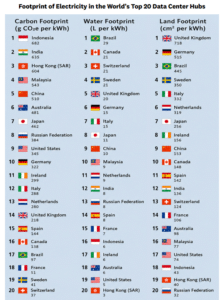
environmental footprint of top data centers
Source: UNU Report

This will account for nearly 3% of total global electricity consumption that year. From 2024 to 2030, data centre electricity consumption will grow by around 15% per year.

Some regions already see major impacts. In 2023, data centers in the state of Virginia (USA) consumed as much as 26% of all electricity in the state. Similarly high shares were recorded, among others, in Ireland – 21% of national electricity consumption in 2022 was attributable to data centers.

Power grids face new stress as AI data centers expand and place greater demands on electricity systems. This challenge is increasingly intersecting with climate goals.

Major technology companies, including Google, Microsoft, Amazon, and Meta, have all announced net-zero or carbon-free energy commitments. However, rapid growth in AI workloads and planned capacity are making those targets harder to achieve.

big tech AI data center planned growth 2030

As data center electricity demand grows, battery storage is key. It helps match clean energy supply with constant computing needs.

The trend is crucial. Data centers will need massive amounts of energy to operate. Without more renewable energy and storage systems, much of that demand may rely on fossil fuels.

Why Batteries Have Become Essential AI Infrastructure

Racks have gone from each having eight GPUs to 72 starting two years ago, requiring around 150kW of power. And power demand keeps growing. Rubin, Nvidia’s new GPU and rack system coming out later this year, will eventually need around 300kW to run.

These power needs drive storage demand. As a result, energy storage is now viewed as a key technology for decarbonization, not just backup power.

Batteries help renewable energy projects provide power even after sunset and when the wind isn’t strong. This increases the value of clean power assets and helps lower overall emissions from electricity systems.

The xAI-Tesla deals show how big customers drive the market. Large orders help Tesla scale production and lower costs for other buyers. This creates a cycle of growth in the storage sector.

Competition is heating up, too. Tesla anticipates margin compression in 2026 as “low-cost competition, policy uncertainty and tariff impacts” intensify. The company plans new products to stay ahead.

Analysts expect global battery storage deployment to grow significantly through 2030 as countries pursue net-zero targets and electrification strategies.

AI’s Next Bottleneck

xAI’s $269 million April purchase shows how quickly AI infrastructure is expanding. The deal pushes its total spending on Tesla Megapacks to about $1 billion and highlights the growing role of energy storage in supporting large-scale computing.

For Tesla, the order strengthens its position in the fast-growing battery storage market. As AI companies build larger data centers and electricity demand rises, battery systems are expected to become an increasingly important part of the global energy transition.

The post Elon Musk’s xAI Just Spent $1 Billion on Tesla Batteries as the AI Power Race Reshapes Global Energy appeared first on Carbon Credits.

New CDR Report Sounds Alarm on 5.2-Billion-Tonne Carbon Removal Gap by 2050

The world is not removing enough carbon dioxide from the atmosphere to meet the goals of the Paris Agreement. According to the latest State of Carbon Dioxide Removal (CDR) Report 2026, current plans leave a massive gap between what countries have pledged and what scientists say is needed to limit global warming to 1.5°C.

The report, prepared by more than 50 international researchers, finds that global carbon removal efforts must expand rapidly over the next two decades. While progress is being made, current commitments remain far below the level required to avoid the worst impacts of climate change.

Why 2050 Carbon Removal Targets Are Off Track

Carbon dioxide removal refers to activities that remove CO2 from the atmosphere and store it for long periods. These methods range from restoring forests to advanced technologies that capture carbon directly from the air.

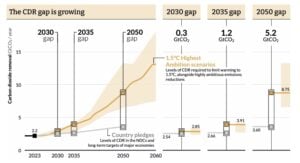
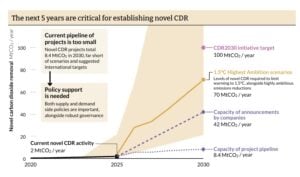
The report estimates that countries’ current climate pledges would deliver about 3.6 billion tonnes of CO2 removal annually by 2050. However, climate models consistent with the Paris Agreement require around 8.75 billion tonnes per year by mid-century.

  • And this leaves a shortfall of 5.2 billion tonnes annually.

CDR Carbon removal
Source: CDR 2026 Report

Researchers note that this gap has widened since the previous assessment because global greenhouse gas emissions continue to rise. The longer emissions remain high, the more carbon will need to be removed later.

The challenge becomes increasingly difficult over time. The gap is relatively small in 2030 but grows quickly through the following decades, reaching its largest level by 2050.

Forests Still Do Almost All the Work

  • Today, global carbon removal totals approximately 2.2 billion tonnes of CO2 per year, accounting for about 5% of total global emissions.

Almost all of this removal comes from conventional land-based approaches. Forest restoration, tree planting, improved forest management, and ecosystem recovery account for 99.9% of total carbon removal worldwide.

  • Major contributors include China, the United States, Brazil, Russia, and the European Union.

While forests remain essential climate tools, researchers caution that relying too heavily on them creates risks. Forests can burn, suffer from drought, or be cleared for agriculture and infrastructure projects. These threats can release stored carbon back into the atmosphere.

Brazil illustrates this challenge. Although Amazon deforestation has recently declined, concerns remain about future land-use changes linked to agriculture, transportation projects, and economic development. Scientists warn that continued pressure on forests could limit their ability to serve as reliable long-term carbon sinks.

carbon removal

Emergence of Novel Carbon Removal Technologies 

Novel carbon removal technologies receive significant attention, but their contribution remains extremely small.

  • Methods such as biochar, enhanced rock weathering, and direct air capture with carbon storage currently remove only about 2 million tonnes of CO2 per year globally. That amount represents a tiny fraction of what climate models suggest will be needed in the coming decades.

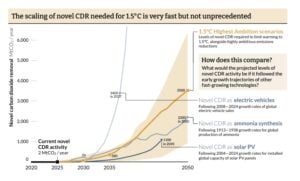
The good news is that these technologies are growing quickly. The report estimates annual growth rates of around 40%, comparable to the early years of the solar power industry.

However, researchers say even this rapid growth is not enough. To meet climate goals, many carbon removal technologies would need to expand at rates comparable to, or even faster than, those of the world’s fastest-growing clean energy technologies.

carbon removal technologies
Source: CDR report 2026

Heavy Reliance on Big Buyers Raises Risks

Another major concern is the concentration of investment and demand.

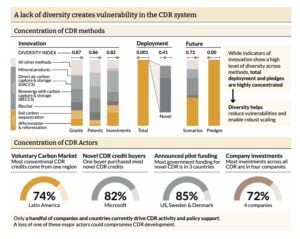
The report finds that a small number of companies and governments currently drive much of the carbon removal market.

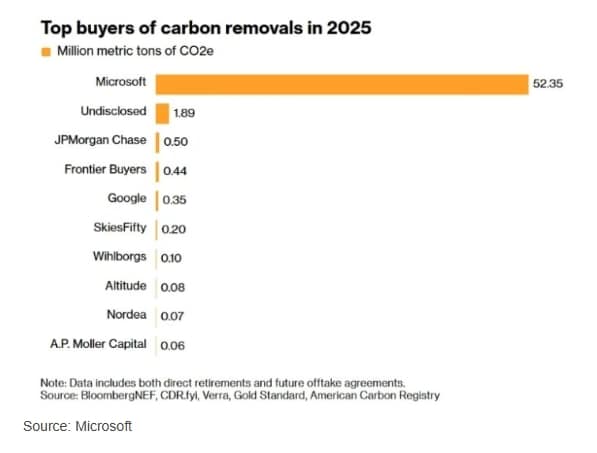
  • For example, Microsoft accounted for roughly 82% of purchases of novel carbon removal credits. Meanwhile, around 85% of government funding for large-scale demonstration projects is concentrated in the United States, Sweden, and Denmark.

Geographic concentration is also evident in voluntary carbon markets. More than two-thirds of conventional carbon removal projects supplying these markets are located in Latin America.

This concentration creates vulnerability. If a major buyer reduces purchases or a government changes climate policies, the entire sector can feel the impact.

Researchers point to recent shifts in U.S. climate policy and changes in corporate procurement strategies as examples of how fragile current support systems can be.

carbon removal microsoft

Governments Shift Focus Toward Carbon Removal Markets

While technological development continues, experts say future demand remains uncertain.

Many governments have focused on supporting carbon removal supply through research funding, pilot projects, and innovation programs. However, fewer policies create guaranteed long-term demand for removals.

This matters because companies are unlikely to invest heavily in expensive technologies without confidence that customers will buy their services in the future.

However, the voluntary carbon market has helped stimulate growth.

  • During the past year, contracts covering approximately 40 million tonnes of future removals were signed. Yet this volume remains small compared with future needs.

Several regions, including the European Union, the United Kingdom, and Switzerland, are exploring ways to integrate carbon removal into climate regulations. Such policies could provide stronger and more predictable demand signals.

Without them, large-scale deployment may remain difficult.

vcm

Emissions Cuts Must Remain the Priority

The report delivers a clear message: carbon removal cannot replace emissions reductions.

Researchers emphasize that at least 80% of the effort required to reach net-zero emissions must come from reducing emissions at their source. Carbon removal should address the remaining emissions that are difficult or impossible to eliminate.

Some policymakers and businesses have promoted carbon removal as a future solution that could offset delayed climate action. The report strongly warns against this approach.

A ten-year delay in emissions reductions would dramatically increase future carbon removal needs. Scientists estimate that such a delay could require the world to remove an additional 150 billion tonnes of CO2 from the atmosphere compared with the most ambitious emissions-cutting pathway.

That level of removal would place enormous pressure on land, water resources, ecosystems, and industrial infrastructure.

The Next Five Years Are Critical

Researchers describe the period from 2026 to 2030 as a decisive window for carbon removal.

During these years, governments must establish policies that encourage investment, build public trust, and create reliable markets for carbon removal services. The sector also needs to prove that its methods are effective, durable, and environmentally responsible.

At the same time, countries must accelerate emissions reductions. Faster cuts today would reduce future dependence on large-scale carbon removal and ease pressure on natural resources.

carbon removal
Source: CDR Report 2026

The report concludes that carbon removal has an important role in achieving climate goals, but it cannot succeed alone. Strong policies, stable demand, continued innovation, and rapid emissions reductions must work together. Without that combination, the world risks falling far short of the carbon removal levels needed to keep the Paris Agreement’s 1.5°C target within reach.

The post New CDR Report Sounds Alarm on 5.2-Billion-Tonne Carbon Removal Gap by 2050 appeared first on Carbon Credits.

UK Sets 87% Emissions Cut by 2040 as Net Zero Debate Intensifies

UK Sets 87% Emissions Cut by 2040 as Net Zero Debate Intensifies

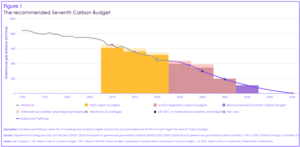
The United Kingdom has set a new legally binding target to cut greenhouse gas emissions by 87% below 1990 levels by 2040. This supports its pathway toward net-zero emissions by 2050. The target follows advice from the independent Climate Change Committee (CCC). It creates the country’s Seventh Carbon Budget for 2038 to 2042.

Energy Secretary Ed Miliband stated:

“As Britain faces the second fossil fuel shock of the decade, the only way to protect family and business finances is to drive for clean homegrown power that we control.”

Climate Minister Katie White also commented, saying:

“The record-breaking May heatwave is another reminder that climate change is no longer a distant prospect. Increased heatwaves, flooding, and nature loss are becoming the new norm for our country.”

The UK Has Already Cut Emissions in Half

The announcement comes at a critical moment. The UK has already reduced emissions by about 54% from 1990 levels, making it one of the fastest decarbonizing major economies in the world. However, the next stage of emissions reductions will be much harder than the last.

UK seventh carbon budget
Source: UK Climate Change Commission

Future reductions will not come just from switching from coal to natural gas or renewables. Instead, there’s a need for bigger changes in transport, buildings, agriculture, aviation, and industry. At the same time, the target has exposed growing political tensions over how quickly the country should pursue its net-zero ambitions.

Britain’s climate progress over the past three decades has been significant.

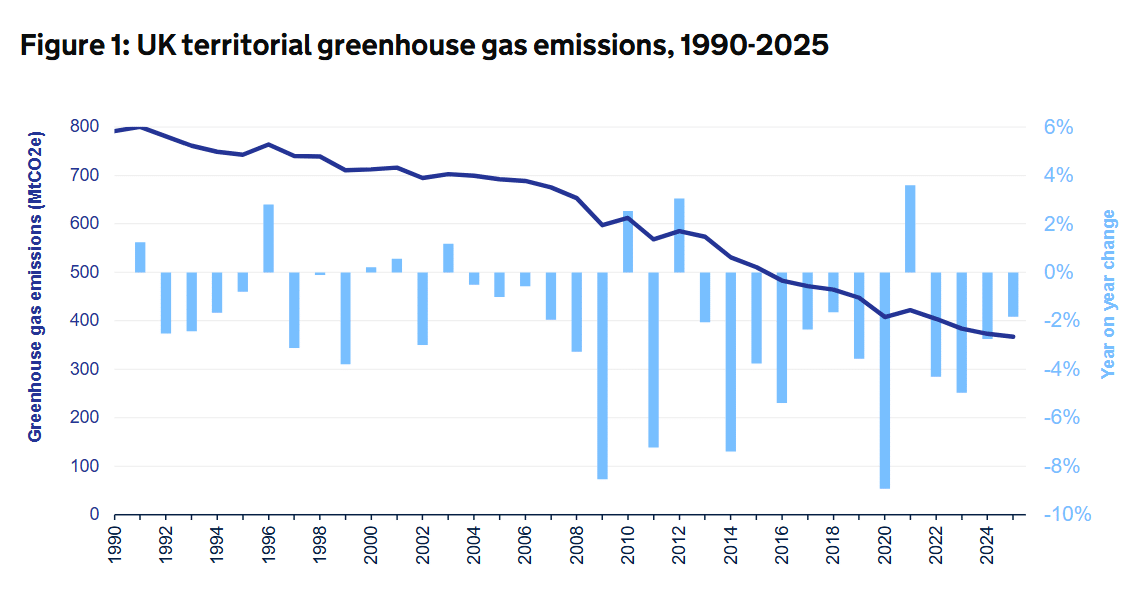
UK greenhouse gas emissions dropped to about 367 million metric tons of CO₂ equivalent in 2025, which is over half a decrease from 1990 levels, based on official government data. Emissions also declined by 2% in 2024.

UK ghg emissions 2025
Source: GOV.UK

Much of this progress came from changes in the power sector.

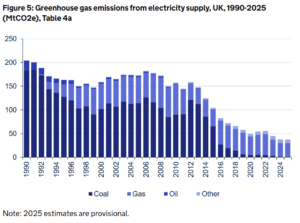
Coal use has almost disappeared from Britain’s electricity system. Government data shows that coal emissions have dropped by 99% since 1990. Meanwhile, renewable energy has grown quickly all over the country. The closure of the UK’s last coal-fired power station marked a major milestone in the country’s energy transition.

UK electricity generation by source 2025
Source: GOV.UK

These changes have helped Britain reduce emissions while continuing to grow its economy. However, the sectors that remain are more difficult to decarbonize.

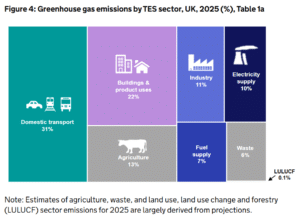
Transport is now the UK’s largest source of emissions, accounting for 31% of total emissions in 2025. Buildings contribute 22%, agriculture 13%, industry 11%, and electricity supply 10%.

UK ghg emissions by sector
Source: GOV.UK

As a result, future progress will depend less on power generation and more on changing how people travel, heat homes, and produce goods.

What an 87% Emissions Cut Will Require

The Climate Change Committee says the new target can be achieved, but only through large-scale deployment of clean technologies. Its pathway relies heavily on electric vehicles, heat pumps, renewable electricity, battery storage, and improvements in energy efficiency.

The plan also assumes continued reductions in industrial emissions and greater use of low-carbon fuels.

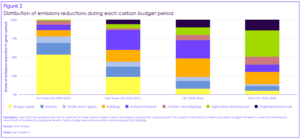
By 2040, the CCC expects surface transport emissions to drop by 86% from 2023 levels. Also, emissions from residential buildings should fall by 66%. This represents a major shift for households and businesses.

share of emissions reductions by sector in UK
Source: UK Climate Change Commission

Consumers would need to adopt more electric vehicles and low-carbon heating systems. Companies would need to continue investing in cleaner technologies and energy-efficient operations. The electricity system would also need to expand significantly to support growing demand from electrification.

The government claims these investments will boost energy security. They aim to cut our reliance on imported fossil fuels and shield us from global energy price swings.

Why Net Zero Is Becoming a Political Battleground

While the emissions target has support from climate experts, it has also intensified political debate.

The announcement came shortly after leaked communications revealed divisions within the governing Labour Party over climate policy. Former Prime Minister Tony Blair said the government should rethink net-zero spending. He believes the country needs affordable energy for economic growth and to boost artificial intelligence development.

The leaked messages also showed senior Labour figures privately agreeing with some of Blair’s concerns. Meanwhile, Energy Secretary Ed Miliband has continued to defend the government’s climate strategy and its long-term economic benefits.

Outside Labour, opposition parties have taken even stronger positions. Both the Conservatives and Reform UK have criticized current net-zero policies. They want to increase domestic oil and gas production.

This growing divide reflects a broader challenge facing many countries. Climate targets often enjoy support in principle, but disagreements emerge over costs, timelines, and implementation.

As net-zero policies move from the power sector into homes, transportation, and industry, political debates are likely to intensify.

How Clean Energy Is Becoming an Economic Strategy 

Supporters of the new target argue that climate policy is no longer only about emissions reductions. It is increasingly tied to industrial competitiveness, investment, and energy security.

The UK government says the country has attracted approximately £90 billion in clean energy investment since July 2024. Officials note that the net-zero economy supports over one million jobs. These jobs span various sectors, including renewable energy, electric vehicles, energy efficiency, and clean technology.

This trend mirrors developments across Europe and other advanced economies.

The European Union has reduced emissions by 40% from 1990 levels, driven largely by:

  • renewable energy growth,
  • efficiency improvements, and
  • cleaner industrial processes.

At the same time, investment in clean energy technologies continues to accelerate worldwide. For governments, the challenge is increasingly about balancing climate goals with economic growth and affordability.

The UK’s new target reflects an effort to pursue both.

The Hardest Part of Decarbonization Still Lies Ahead

The UK’s 87% emissions reduction target represents one of the most ambitious climate commitments among major economies. Yet, the country has already completed many of the easiest emissions reductions.

The next phase will require changes across sectors that are harder and often more expensive to decarbonize. Transport, buildings, agriculture, aviation, and heavy industry will all play larger roles in determining whether the target is achieved.

The good news is that Britain enters this phase with a strong track record. Emissions have already fallen by more than half since 1990, largely through cleaner electricity and reduced coal use.

The challenge now is maintaining that pace.

The 2040 target makes Britain’s direction clear. Whether the country can deliver on that ambition will depend on how quickly clean technologies can scale and how much political support remains behind the transition in the years ahead.

The post UK Sets 87% Emissions Cut by 2040 as Net Zero Debate Intensifies appeared first on Carbon Credits.

AI Charging Breakthrough Could Make EV Batteries Last 23% Longer, Study Says

Researchers at Chalmers University of Technology have developed a new artificial intelligence (AI)-based charging method that could help electric vehicle (EV) batteries last much longer without increasing charging time. The breakthrough may solve one of the biggest problems in the EV industry: how to charge batteries quickly without damaging them over time.

According to the researchers, the new charging system improved battery lifespan by 22.9% compared with traditional charging methods.

This improvement could have a major impact on the future of electric transportation. Longer battery life means lower replacement costs, less mining for raw materials, reduced waste, and better value for EV owners.

Why Battery Life Matters in Electric Vehicles

Battery health remains one of the biggest concerns for EV buyers. While electric cars are cleaner and cheaper to operate than gasoline vehicles, battery replacement can still be expensive. Fast charging also creates stress inside batteries, which slowly reduces their ability to hold energy.

Many EV owners use fast chargers regularly because they save time. However, charging too quickly can damage battery cells over the years. This is especially important for drivers who travel long distances or depend on public charging stations.

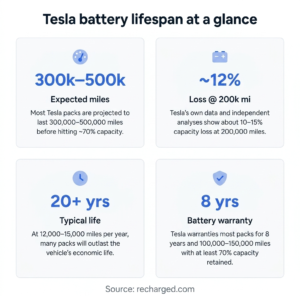
Today’s EV batteries already perform well. According to data collected by Recharged, most Tesla batteries still keep around 85% to 90% of their original capacity after driving nearly 200,000 miles. Some Tesla vehicles may even reach 300,000 to 400,000 miles before battery capacity drops to 70%.

tesla charging EV

The new AI-powered charging method could extend battery life even further.

How the AI Charging System Works

The researchers used a form of machine learning called reinforcement learning. In this system, AI learns by testing different actions and improving based on results over time.

Instead of using the same charging pattern every time, the AI system studies the battery’s condition before charging begins. It looks at factors such as:

  • Current battery charge level
  • Battery age
  • Overall battery health
  • Charging history

Based on this information, the AI adjusts the charging current in real time.

Traditional charging systems usually apply fixed current and voltage settings, no matter how old or healthy the battery is. The new AI method changes the charging process dynamically to reduce damage inside the battery.

The AI system also learns which charging patterns produce the best long-term battery performance. Over time, it becomes smarter and more efficient.

The 23% Battery Life Improvement

The study showed impressive results.

Using the AI-based charging strategy, researchers achieved a 22.9% increase in battery lifetime measured in equivalent full charging cycles. At the same time, charging speed remained almost the same.

The average charging time using the AI system was 24.12 minutes. Traditional charging methods averaged 24.15 minutes. That difference is almost impossible for drivers to notice.

And this means EV owners may get a much longer-lasting battery without sacrificing convenience.

The possible real-world benefits are significant. Some estimates suggest Tesla batteries can last between 300,000 and 500,000 miles. According to analysis from InsideEVs, a 23% improvement could add:

  • Nearly 70,000 extra miles on the lower end
  • More than 100,000 additional miles on the higher end

For automakers, this could reduce warranty costs and improve vehicle resale value. It could also help companies use fewer raw materials because batteries would not need replacement as quickly.

The Problem of Lithium Plating

One of the biggest causes of battery damage during fast charging is a process called lithium plating. The study, titled “Lifelong Reinforcement Learning for Health-Aware Fast Charging of Lithium-Ion Batteries”, was published in the journal IEEE Transactions on Transportation Electrification. The research was led by Changfu Zou and Meng Yuan.

Lithium-ion batteries store energy by moving lithium ions between electrodes. During fast charging, especially at high current levels, some lithium can build up as metallic deposits on the battery surface instead of being stored correctly.

This buildup significantly damages battery performance and shortens battery life.

Older batteries are even more vulnerable to lithium plating. However, most current charging systems still treat old and new batteries the same way.

The AI method changes that approach. It adjusts charging behavior based on battery condition, helping lower the risk of harmful chemical reactions. This is in contrast to the current charging systems, which often ignore battery aging during fast charging.

Changfu Zou, Professor at the Department of Electrical Engineering, Chalmers, explained,

“This work shows that the true bottleneck of fast charging is not simply current limits, but the evolving electrochemical state inside the battery. By integrating AI with physics-based understanding, we move closer to health-aware charging strategies that maximize both performance and lifetime.”

Real-World Testing Still Needed

Although the results are promising, the experiments were performed in laboratory conditions. The next step is real-world testing on physical battery packs and vehicles.

Commercial validation will be important before automakers fully adopt the technology.

Why This Matters for the EV Industry

The timing of this breakthrough is important because the global EV charging market is growing rapidly.

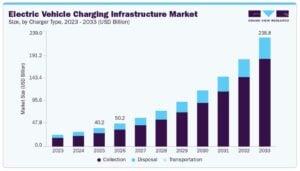
According to Grand View Research, the global EV charging infrastructure market was worth about $40.22 billion in 2025. It could grow to $50.2 billion in 2026 and eventually reach nearly $239 billion by 2033.

The market is expected to grow at a compound annual growth rate (CAGR) of 25%.

Fast chargers already dominate the market, accounting for more than 73% of charging infrastructure in 2025. This shows how important fast charging has become for EV adoption.

If AI charging systems can protect batteries while maintaining fast charging speeds, they may become a standard feature in future EVs.

ev charging

Easy Software Updates Could Enable Adoption

One major advantage of the new charging method is that it may not require expensive hardware changes.

Researchers say the technology could be added through software updates in existing battery management systems. That means many automakers might adopt the system without redesigning the entire vehicle.

This could make the technology both affordable and scalable.

Still, researchers say the AI model must be adjusted for different battery chemistries and vehicle designs. Different EVs use different battery materials and architectures, so calibration will be necessary before large-scale deployment.

The researchers also noted that transfer learning could help speed up this process. In transfer learning, AI uses knowledge gained from one system and applies it to another similar system.

Environmental Benefits Could Be Huge

Longer-lasting batteries could also support global sustainability goals.

Battery production requires large amounts of lithium, nickel, cobalt, and other critical minerals. Mining and processing these materials create environmental impacts and carbon emissions.

If batteries last longer, automakers will need fewer replacement batteries. This could reduce mining demand and lower manufacturing emissions. Drivers would also benefit financially because they could keep their EVs longer without worrying about expensive battery replacements.

In conclusion, the AI-powered charging breakthrough from Chalmers University of Technology could become a major step forward for electric vehicles. If future real-world tests confirm the lab results, the technology could improve EV reliability, lower ownership costs, reduce battery waste, and support cleaner transportation systems.

As the EV charging market continues to expand globally, AI-driven charging may soon become an important tool for building longer-lasting and more sustainable electric vehicles.

The post AI Charging Breakthrough Could Make EV Batteries Last 23% Longer, Study Says appeared first on Carbon Credits.
Climeworks and TD Bank Deal Signals a New Financial Era for Engineered Carbon Removal Credits

Climeworks and TD Bank Deal Signals a New Financial Era for Engineered Carbon Removal Credits

    • Climeworks has signed a carbon credit agreement with a major Canadian financial services company, TD Bank Group. The deal gives TD Bank access to carbon removal credits generated through Climeworks’ direct air capture (DAC) technology.

Climeworks is one of the most well-known companies in engineered carbon removal. It builds machines that capture carbon dioxide (CO₂) directly from the air. The captured CO₂ is then stored permanently underground.

TD Bank is using carbon credits from this deal to support its climate strategy and address its residual emissions. Susan Thompson, Managing Director, Sustainable Finance and Advisory at TD Securities, remarked:

“As carbon market standards and methodologies continue to evolve, Climeworks Solutions’ portfolio approach helps mitigate risk while providing organizations with flexible options in their carbon management strategies.”

Carbon Removal Market Is Growing, But Still Very Small

The agreement reflects a growing trend in corporate climate action. More companies now turn to high-quality carbon removal credits instead of older forms of offsetting, such as forestry-based credits that may carry a higher risk of reversal.

This shift is important because global climate targets become stricter. Many companies now aim for net-zero emissions by 2050 or earlier. However, reducing emissions completely is still difficult for sectors like finance, aviation, and heavy industry. Carbon removal is becoming a key tool to close this gap.

While the carbon removal industry is still in an early stage, it is expanding quickly.

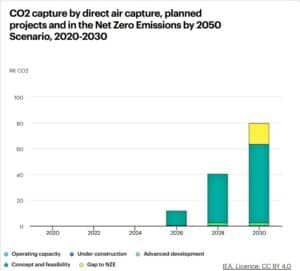
According to the International Energy Agency (IEA), reaching global net-zero emissions by 2050 will require around 7–10 billion tons of CO₂ removal per year by mid-century. Today, global carbon removal capacity is only a small fraction of that level.

Direct air capture is even smaller. The IEA estimates that DAC facilities currently remove less than 0.01 million tons of CO₂ per year globally, compared with gigaton-scale future needs.

direct air capture carbon planned net zero emissions IEA
Source: IEA

Climeworks operates some of the world’s first commercial DAC plants. Its facilities in Iceland and other locations capture CO₂ and store it underground through mineralization in basalt rock formations.

One of its flagship plants, Orca in Iceland, has a capacity of about 4,000 tons of CO₂ per year. Its newer plant, Mammoth, is designed to capture up to 36,000 tons of CO₂ per year when fully operational.

These numbers are small compared with global emissions. Global CO₂ emissions from fossil fuels remain above 37 billion tons per year, according to the Global Carbon Project.

This gap shows the scale of the challenge ahead. It also explains why early carbon removal contracts like the Climeworks–TD Bank deal are important for market development. They provide revenue certainty. They also help finance new facilities.

Climeworks Expands Its Role in the Carbon Removal Economy

Climeworks is one of the leading companies in the direct air capture sector.

The company operates plants in Iceland and is developing larger facilities in collaboration with industrial partners and governments. Its model combines carbon capture technology with permanent geological storage.

Climeworks has also signed agreements with major corporations across technology, finance, and consumer sectors. These deals are designed to provide long-term demand for carbon removal services.

This demand is important because DAC facilities are capital-intensive. They require a large upfront investment before they can operate at scale.

By securing long-term contracts, Climeworks can reduce financial risk and support expansion plans. The company has stated that scaling carbon removal is necessary to meet global climate goals. However, it also acknowledges that emissions reductions remain the first priority.

Carbon removal is positioned as a complementary tool, not a replacement for decarbonization.

TD Bank Expands Its Net-Zero Strategy Through Carbon Removal

TD Bank is part of the global financial sector’s shift toward net-zero commitments. Many large banks have pledged to reach net-zero emissions in their operations and financed activities by 2050. These targets are aligned with frameworks such as the Glasgow Financial Alliance for Net Zero (GFANZ).

For banks, emissions are not only direct. A large share comes from “financed emissions.” These are emissions linked to lending and investment portfolios. This makes decarbonization more complex than in other industries.

Carbon credits are often used as a transitional tool. They do not replace emissions cuts, but they can support near-term climate goals while long-term changes take place.

  • TD Bank has set a goal to reach net-zero emissions by 2050 across both its operations and financing activities.

The bank is also expanding its climate finance efforts. In 2024, TD reported C$76.4 billion in sustainable and decarbonization financing, up from C$69.5 billion a year earlier. This supports its larger goal of providing C$500 billion in sustainable and decarbonization finance by 2030.

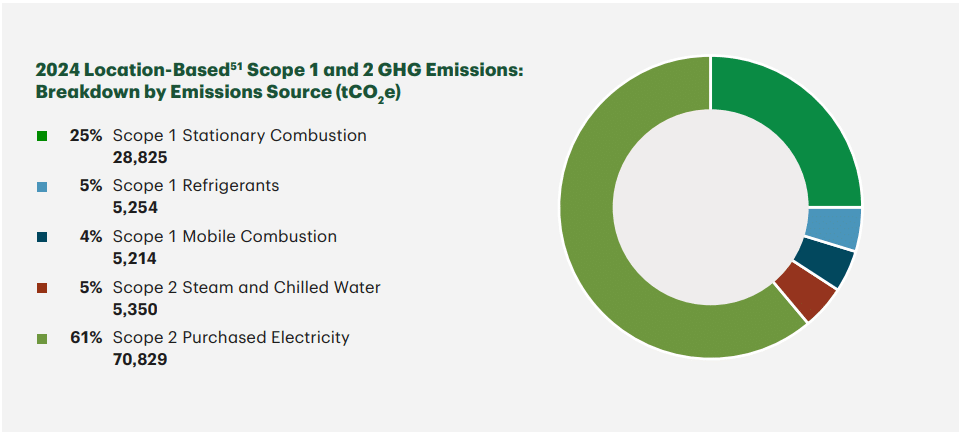
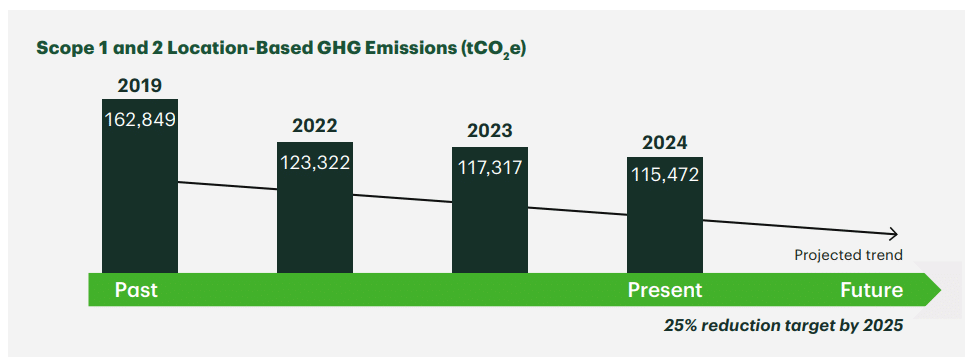
TD bank ghg emissiosn 2024 scope 1 and 2
Source: TD Bank

In 2024, the bank reported 115,472 metric tons of CO₂e from its Scope 1 and Scope 2 operations, a 29% reduction from 2019 levels. However, financed emissions were much larger, including:

  • about 10.0 million metric tons of CO₂e from residential mortgages,
  • 2.7 million metric tons from power generation financing, and
  • 2.1 million metric tons from agriculture-related lending.

This is why TD’s climate strategy focuses not only on reducing its own emissions but also on supporting lower-carbon activities across its lending and investment portfolio. These efforts are part of TD’s broader strategy to support the transition to a lower-carbon economy while reducing emissions across its business.

TD bank emissions 2024
Source: TD Bank

The bank also continues to increase its role in sustainable finance markets through green bonds, sustainability-linked financing, renewable energy funding, and other low-carbon investment activities.

The Climeworks deal fits into this broader approach. It allows the bank to support a new carbon removal industry while addressing emissions that are difficult to eliminate immediately.

At the same time, regulators and investors are paying closer attention to the quality of carbon credits. Financial institutions are under pressure to use credits that are durable, measurable, and verifiable.

Direct air capture is often seen as a higher-integrity solution compared with traditional offset projects because CO₂ is physically removed and stored for long periods.

Carbon Removal Moves From Concept to Early Market Reality

Carbon removal becomes more important because emissions cuts alone are not enough to meet global climate goals. The IPCC says most pathways that limit warming to 1.5°C require carbon dioxide removal, alongside deep emissions reductions. This includes both nature-based methods like forests and engineered solutions such as direct air capture and BECCS.

Nature-based offsets have risks such as fire, land-use change, and measurement uncertainty. Because of this, companies are moving toward engineered options that provide more permanent storage.

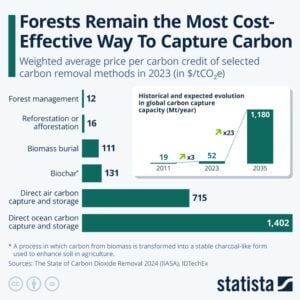
DAC systems, like those developed by Climeworks, capture CO₂ directly from the air and store it underground, where it remains permanently. But the technology remains costly. Prices usually range from several hundred dollars to over $600 per ton of CO₂, depending on the system and energy source used.

Even so, demand is growing as companies and banks move from short-term carbon offsetting toward longer-term carbon removal contracts. While current capacity is still very small compared with global emissions, early deals like this one between TD Bank and Climeworks help build the market structure needed to scale carbon removal in the future.

The post Climeworks and TD Bank Deal Signals a New Financial Era for Engineered Carbon Removal Credits appeared first on Carbon Credits.

Verra’s VM0046 Methodology Opens New Path for Food Loss and Waste Carbon Credits

Food waste is becoming one of the world’s biggest environmental and social challenges. Millions of tons of edible food are thrown away every year, while millions of people still struggle with hunger. At the same time, wasted food releases harmful greenhouse gases that worsen climate change.

Now, Verra has registered the first project under its food loss and waste methodology, called VM0046, in the United States. The project, known as the Brightly – Reducing Food Loss and Waste Project (Verra Project 4711), aims to rescue edible surplus food before it reaches landfills. Instead of being discarded, the food is redirected to nonprofit food rescue organizations that distribute it to people in need.

The initiative highlights how carbon markets can support both climate action and food security at the same time.

Why Food Waste Matters

According to the United Nations Environment Programme (UNEP), Food loss and waste account for nearly 8% to 10% of global greenhouse gas emissions. This is a major climate issue because food that ends up in landfills produces methane, a greenhouse gas far more powerful than carbon dioxide over the short term.

Significantly, around 1.05 billion tons of food were wasted globally in 2022. At the same time, nearly 783 million people faced hunger, while about one-third of the global population experienced food insecurity.

The United States is also one of the world’s largest generators of food waste. Experts estimate that nearly one-third of food meant for human consumption in the country is lost or wasted.

food loss and waste

When food is wasted, the damage goes beyond the food itself. All the resources used to produce and deliver that food are wasted, too. This includes:

  • Water used in farming
  • Energy for processing and refrigeration
  • Fuel for transportation
  • Agricultural land
  • Labor and packaging materials

As a result, food waste creates an enormous environmental and economic burden. Globally, the financial cost of food loss and waste is estimated at nearly $1 trillion every year.

How the Brightly Project Works

The Brightly project focuses on keeping edible food within the human food system instead of sending it to landfills.

Under the seven-year crediting period from 2020 to 2027, the project is expected to help rescue around 167 million pounds of food. It is also projected to generate nearly 115,118 tonnes of carbon dioxide equivalent (CO2e) emission reductions.

The project works closely with nonprofit food rescue organizations. These groups collect surplus food from businesses, retailers, and suppliers before the food becomes waste. The rescued food is then redistributed to communities facing food insecurity.

This process prevents methane emissions that would normally occur if the food decomposed in landfills.

The project uses Verra’s VM0046 Methodology for Reducing Food Loss and Waste to calculate avoided greenhouse gas emissions. The methodology allows projects to generate verified carbon credits based on measurable climate benefits.
These carbon credits can provide funding for food rescue operations, helping organizations expand their reach and improve food distribution systems.

Mandy Rambharos, CEO, Verra, said:

“Having a broad range of methodologies is key to mitigating the impacts of climate change and driving sustainable development, given the scale of the challenge, and this new methodology fills an important gap. The successful registration of the first project signals the operationalization of this methodology. It is in line with Verra’s mission to advance climate action in a way that benefits people and the planet.”
Understanding the Project Boundary

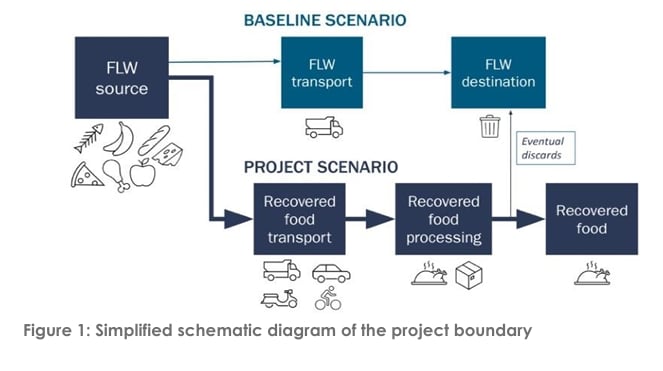
Verra’s methodology clearly defines how emissions are measured within the project boundary.

The project boundary includes areas where:

  1. Food waste is generated
  2. The baseline disposal sites are located
  3. The recovered food is distributed or consumed

The baseline scenario assumes that surplus food would normally be discarded and sent to food loss and waste destinations such as landfills.

Baseline Emissions

The largest baseline emissions come from the disposal and treatment of food waste at landfill sites. Methane emissions from decomposing food are a major part of these calculations.

In some cases, emissions from transporting food waste to disposal facilities may also be included if proper evidence and data are available.

verra food loss and waste
Source: Verra

Project Emissions

The project must also account for emissions linked to food recovery activities. These include:

  • Transportation of rescued food
  • Packaging and processing
  • Storage and refrigeration
  • Distribution activities

Any additional emissions created by project operations are included in the calculations.

The methodology also considers possible leakage emissions. For example, if recovered food is later discarded or if waste treatment systems are affected by reduced food disposal volumes, those impacts must also be measured.

However, emissions that remain the same in both the project and baseline scenarios are excluded. These may include cooking, digestion, or household refrigeration activities.

Food Rescue and Climate Action

Food rescue organizations are now being recognized as important contributors to climate solutions.

Traditionally, these groups were mainly viewed as charities working to reduce hunger. But projects like Brightly show they also play a major role in reducing greenhouse gas emissions.

By diverting edible food away from landfills, these organizations help slow methane emissions while supporting vulnerable communities.

The growing link between food waste and climate change is receiving more global attention. Extreme weather events, droughts, floods, and supply chain disruptions are already affecting agriculture and food systems worldwide.

Reducing food loss and waste can therefore improve both climate resilience and food security.

Global Push to Cut Food Waste

International organizations are increasingly calling for stronger policies to reduce food waste.

The United Nations’ International Day of Awareness of Food Loss and Waste recently highlighted how cutting food waste can help countries meet climate goals and Sustainable Development Goals (SDGs).

The Food and Agriculture Organization estimates that about 13% of the world’s food is lost during supply chain operations before reaching consumers. Meanwhile, another 19% is wasted at the retail, food service, and household levels.

These figures show that food waste happens throughout the entire supply chain.

Experts say governments need stronger policies, better monitoring systems, improved infrastructure, and more investment in technology to tackle the issue effectively.

Here’s an informational video on this subject:

Carbon Markets Support Food Security

The Brightly project also demonstrates how carbon markets can support social impact alongside emissions reduction.

Revenue generated through carbon credits can help food rescue organizations improve logistics, transportation, storage, and food distribution networks.

This creates a financial incentive to recover edible food rather than discard it.

Verra’s methodology offers a structured way to measure these climate benefits with transparency and accountability. Supporters believe such projects could encourage more investment in food recovery programs globally.

As countries prepare new national climate plans, also called nationally determined contributions (NDCs), food waste reduction is expected to become a more important part of climate policy.

Reducing food loss and waste delivers multiple benefits at once. It lowers emissions, saves resources, supports vulnerable communities, and strengthens food systems. Projects like Brightly show that climate action and social impact can work together through innovative carbon market solutions.

The post Verra’s VM0046 Methodology Opens New Path for Food Loss and Waste Carbon Credits appeared first on Carbon Credits.