EPA Rolls Back Carbon Rules for Coal and Gas Plants in Major U.S. Climate Shift

EPA Rolls Back Carbon Rules for Coal and Gas Plants in Major U.S. Climate Shift

The U.S. Environmental Protection Agency (EPA) has moved to dismantle federal limits on carbon emissions from coal- and natural gas-fired power plants, marking a major shift in U.S. climate policy.

On September 14, 2026, the EPA finalized a repeal of most of the greenhouse gas requirements in the Biden administration’s 2024 power plant rule. At the same time, it proposed removing the remaining federal greenhouse gas standards for fossil-fuel power plants.

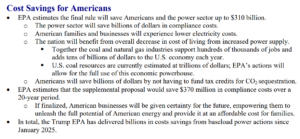
EPA Administrator Lee Zeldin said the changes will reduce costs and make it easier to expand U.S. power generation. The agency estimates that the finalized repeal could save the power sector and consumers up to $310 billion. Additionally, the proposed repeal might save another $370 million in compliance costs over 20 years.

The move comes as the U.S. faces rising electricity demand from data centers, manufacturing, and other industries. But it also removes a major federal tool for cutting power-sector emissions.

What the EPA Is Repealing

The Biden EPA finalized its Carbon Pollution Standards in April 2024. The rules covered existing coal-fired plants and new natural gas-fired power plants. The agency wrote:

“U.S. EPA is repealing the most burdensome greenhouse gas emissions standards from the EPA’s 2024 Carbon Pollution Standards (CPS), while simultaneously working to cement long-term energy prosperity by proposing to repeal the remaining Obama-Biden Greenhouse Gas (GHG) emission standards for the power sector.”

For existing coal plants, the rules relied heavily on carbon capture and storage (CCS) for units planning to operate for longer periods. New long-term natural gas plants also faced emissions limits based on technologies including CCS and lower-carbon fuels.

The Trump EPA now says those requirements were too costly and depended on technologies that are not available at the required scale. The agency specifically determined that 90% carbon capture was not adequately demonstrated or cost-effective for coal plants.

It also rejected natural gas co-firing as an appropriate emissions-control approach for existing coal units. Most of these requirements have now been removed.

The EPA is asking for public feedback on a plan to remove all remaining greenhouse gas standards for fossil-fuel power plants. This is under Section 111 of the Clean Air Act. That part is still a proposal, rather than a final repeal.

EPA Says Repeal Will Lower Energy Costs

The Trump administration argues that the rules could have forced utilities to spend heavily on emissions controls or retire plants earlier than planned. The EPA says repealing them will reduce compliance costs and make it easier to build and operate coal and natural gas generation.

Its September 2026 fact sheet estimates up to $310 billion in savings from the finalized repeal. It says the changes will also reduce barriers to new power projects and support greater use of domestic coal and natural gas. This argument comes as electricity demand is rising.
EPA Says Repeal Will Lower Energy Costs
Source: EPA

The U.S. Energy Information Administration expects electricity generation to reach new records in 2026 and 2027. It forecasts natural gas to provide about 40% of U.S. electricity generation in 2026, while coal’s share falls to about 16%.

Data centers are one source of the increase. Manufacturing growth and higher cooling demand are also adding pressure to the grid.
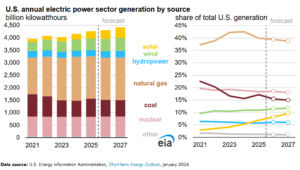
US annual electricity generation by source EIA
Source: EIA

U.S. Power Emissions Jump as Electricity Demand Grows

The timing of the repeal is important because U.S. power sector emissions increased in 2025. EIA estimates that carbon dioxide emissions from the electric power sector rose 4%, or 58 million metric tons, in 2025.

  • Electricity generation increased by 3%, while coal-fired generation jumped 13%.
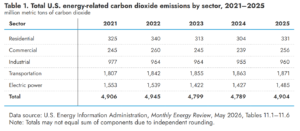
Total U.S. energy-related carbon dioxide emissions by sector
Source: U.S. Energy Information Administration

Coal-related power emissions rose by 78 million metric tons during the year. That increase reversed part of the longer decline in U.S. power-sector emissions.

Natural gas remains the largest source of U.S. electricity generation, but coal still produces much more CO2 per unit of electricity. EIA expects coal’s share of generation to decline over the next two years as scheduled retirements continue, even as overall power demand grows.

This means the EPA rollback does not guarantee a major increase in coal generation. Market forces, plant economics and the growth of lower-cost renewable power will continue to influence the generation mix.

Biden EPA Projected Large Emissions Cuts

The disagreement over the rules is partly about their expected climate benefits.

The 2024 EPA analysis projected that the standards would reduce power sector carbon pollution by 1.38 billion metric tons between 2028 and 2047. It also estimated up to $370 billion in climate and public health net benefits over two decades.

The agency’s analysis predicts that by 2035, the rules could reduce annual power sector CO2 emissions by 123 million metric tons. This is compared to a scenario without the standards. Those projected benefits will now largely disappear if the federal standards are fully removed.

The Trump EPA disputes the earlier estimates and argues that the rules relied on unrealistic technology assumptions and would have imposed unnecessary costs. The difference reflects two very different views of how the U.S. should decarbonize its electricity system.

CCS Loses a Major Policy Driver

The repeal also has implications for the U.S. carbon capture market. The 2024 rules helped create a potential market for CCS at coal and gas plants because some facilities would have needed major emissions reductions to comply.

Removing those requirements weakens one of the strongest federal policy drivers for power sector CCS. Yet, that does not mean CCS development will stop.

Federal tax incentives for carbon capture remain available, and companies in sectors such as cement, steel, chemicals and natural gas processing continue to explore the technology. However, power plants now have less regulatory pressure to install expensive capture systems.

For the carbon market, this is an important distinction. Capturing and permanently storing CO2 from a fossil fuel power plant is not automatically the same as generating a tradable voluntary carbon credit. Its value may instead come through regulatory compliance, tax incentives or corporate climate claims, depending on the project.

States and Corporate Buyers Can Still Push Cleaner Power

The federal rollback does not end climate regulation across the United States. States can maintain their own emissions rules, renewable energy standards and climate policies.

California and other states already have systems that require significant reductions in power-sector emissions. Utilities also face pressure from investors, customers and large electricity buyers.

Technology companies building data centers are increasingly looking for cleaner electricity to meet their own emissions targets. That creates another market force supporting renewable energy, storage and low-carbon generation even as federal climate rules are weakened.

The U.S. power market will likely stay split. Some states and companies are pushing for lower-carbon electricity. Meanwhile, federal policy supports more fossil fuel development.

What the EPA Rollback Means for Carbon Markets

The EPA’s decision could have effects well beyond power plants. The U.S. electric power sector produced about 1.485 billion metric tons of energy-related CO2 in 2025, making it a major source of emissions.

Removing federal carbon limits could make deeper emissions cuts harder and change investment decisions across coal, gas, renewables, storage and carbon capture. It also highlights the importance of policy risk for carbon markets, where project economics can depend on regulations, tax credits and carbon prices.

The move marks a major shift from the Biden administration’s approach, which used emissions standards to push utilities toward cleaner technologies. The Trump administration argues those rules would raise costs and threaten power reliability.

Meanwhile, electricity demand is rising due to data centers, manufacturing and electrification. Solar, wind, storage and natural gas will compete to meet that growth, while EIA still expects coal’s share of U.S. generation to decline.

The key question is whether market forces, state policies and corporate clean energy demand will continue to reduce emissions—or whether the federal rollback will slow that progress.

The post EPA Rolls Back Carbon Rules for Coal and Gas Plants in Major U.S. Climate Shift appeared first on Carbon Credits.

Pentagon Backs Nevada’s Springer Project to Boost US Tungsten Supply

The U.S. is backing an effort to rebuild its tungsten supply chain as China maintains a dominant position in the global market.

The U.S. Department of War, aka the Pentagon, has committed up to $450 million to The Elmet Group (NASDAQ: ELMT), a U.S.-owned tungsten and advanced materials company. About $150 million of that government-backed investment has been designated for a transaction involving Blue Moon Metals’ (TSXV: MOON; NASDAQ: BMM) Springer Tungsten Complex in Nevada.

Blue Moon, Elmet, and Australia-listed EQ Resources (ASX: EQR) have agreed to a US$150 million investment in the Springer project, with another US$25 million set aside by Elmet and EQ Resources for additional requirements, if needed, to restart the project’s ammonium paratungstate (APT) plant.

The deal comes as Washington tries to reduce exposure to China-dominated critical-mineral supply chains. Tungsten is particularly important because the U.S. has not mined the metal commercially since 2015, while domestic consumption remains heavily dependent on imports.

Department of War Backs Domestic Tungsten Capacity

Pentagon announced the $450 million investment in Elmet on September 14. The funding will take the form of redeemable preferred equity and is being provided through the department’s Industrial Base Analysis and Sustainment program.

The government says the investment will expand domestic tungsten capacity and strengthen the industrial base supporting U.S. defense programs. Elmet currently supplies materials and components for more than 100 Department of War programs, including the F-35, Patriot PAC-3, Trident D5, Next Generation Interceptor, PrSM and Virginia- and Columbia-class submarines.

A Bigger Role for Elmet

The government also says the investment will help establish North America’s only independent APT facility, addressing a major processing gap in the U.S. tungsten supply chain. China currently accounts for an estimated 85% of global tungsten supply, according to the Department of War.

Separately, Elmet said one of its subsidiaries secured a contract worth about $2 billion from the Defense Logistics Agency to help rebuild the National Defense Stockpile. The agreement includes a guaranteed funded commitment of $150 million and covers tungsten ores, concentrates and sodium tungstate.

The two announcements give Elmet a central role in Washington’s effort to rebuild domestic tungsten capacity, from raw material supply to processing and manufacturing.

U.S. Still Depends on Tungsten Imports

The supply-chain challenge is significant.

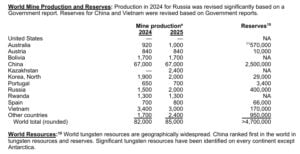
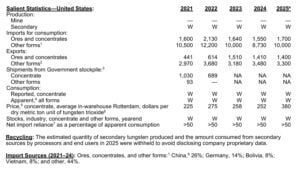
The latest U.S. Geological Survey data show that the U.S. has had no commercial tungsten mine production since 2015. Estimated 2025 imports reached:

  • 1,700 tonnes of tungsten contained in ores and concentrates
  • 10,000 tonnes in other tungsten forms
  • More than 50% net import reliance for apparent consumption
US Tungsten
Source: USGS

USGS also estimates that China represented 26% of U.S. tungsten import sources between 2021 and 2024, followed by Germany at 14%, Bolivia at 8% and Vietnam at 8%.

TUNGSTEN
Source: USGS

The figures show why Washington is focusing on more than simply reopening a mine. The U.S. needs additional capacity across mining, processing and manufacturing if it wants to reduce exposure to overseas supply disruptions.

The supply risk has become more urgent since China introduced export controls on selected tungsten products in February 2025. USGS reported that prices climbed sharply during 2025. The average Rotterdam price for 65% tungsten concentrate increased from $252 per metric ton in 2024 to an estimated $380 in 2025.

USGS also ranks tungsten among the minerals with a high potential economic impact from supply disruption. Its 2025 assessment estimated a probability-weighted reduction of about $544 million in U.S. GDP under the modeled disruption scenario.

Springer Could Restart U.S. Tungsten Mining

Against that backdrop, the Springer project offers a potential domestic source.

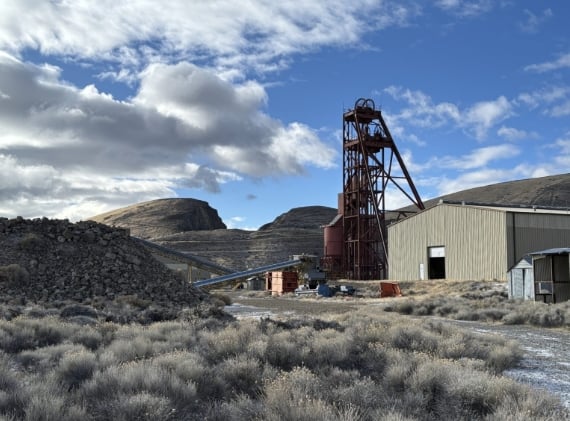
                                                The Springer Mine

springer
Source: Blue Moon

Located near Imlay, Nevada, Springer historically ranked among the largest tungsten mines in the United States. The project includes open-pit and underground mining operations, a 1,200-ton-per-day mill and an APT plant designed for potential production of up to 4,000 tonnes per year.

  • Blue Moon expects the Springer mine and mill to return to production in the fourth quarter of 2027. The APT plant is expected to restart in the second half of 2028.

The project already has access to water, electricity, natural gas, and tailings capacity. It is also located a few miles from Interstate 80 and the Union Pacific rail line. Blue Moon acquired additional water rights and land in September to provide access to the rail line, with the potential for a future loading facility.

Resource Estimate Needs Further Verification

Blue Moon reports a historical mineral resource of 10.7 million tonnes grading 0.45% WO₃. However, the company clearly states that this is a historical estimate from prior operators and has not been verified as a current NI 43-101 resource. Further drilling is planned to update the estimate.

That distinction is important for investors because the historical resource should not be treated as a current compliant resource.

Elmet Will Control the APT Plant

The transaction is designed to connect Springer mining with downstream tungsten processing.

Elmet will provide about $150 million across the Springer-related transactions. This includes a $50 million tungsten prepayment facility for Blue Moon and a $75 million capital contribution to the joint venture that will own and operate the APT plant. Elmet will also subscribe for $25 million of new Blue Moon equity.

The APT joint venture is expected to have the following ownership:

  • Elmet: 70%
  • Blue Moon: 20%
  • EQ Resources: 10%

Phase-one APT capacity is targeted at 4,000 tonnes per year, with infrastructure planned to support blue tungsten oxide capacity and an additional leaching line. Elmet will operate the facility.

The structure gives Springer a pathway from mined tungsten concentrate to a processed product that can feed downstream U.S. manufacturing.

EQ Resources Adds Australian and Spanish Supply

EQ Resources brings an allied supply component to the project.

The Australian company operates the Mt Carbine tungsten project in Queensland and Barruecopardo in Spain. Under the agreement, EQ will take a 10% interest in the APT joint venture and enter into an offtake agreement covering 4,000 tonnes of tungsten trioxide contained in its concentrate over eight years after the APT plant begins operating.

During the first five years, EQ could use up to 25% of the APT plant’s input capacity, capped at 1,000 tonnes of production capacity per year. Springer would receive up to 75% of the input volume during that period, with additional material potentially sourced through other agreements supported by Elmet and the Department of War.

EQ is also testing its ore-sorting technology at the Springer mill. Initial results were positive, although additional testing is still required before installation is confirmed.

Building a U.S.-Aligned Tungsten Chain

The Springer deal represents one part of a broader effort to rebuild U.S. tungsten supply.

The Department of War’s $450 million commitment to Elmet, the separate potential $2 billion DLA stockpile contract, and the Springer investment all address different parts of the same vulnerability: the U.S. has significant tungsten demand but no active commercial tungsten mine.

For Blue Moon, the transaction provides funding and strategic partners to advance Springer. For Elmet, it expands control over tungsten processing and downstream manufacturing. For EQ Resources, it creates another route into the U.S. market for tungsten from allied jurisdictions.

The broader market backdrop is also becoming more supportive for new Western supply. Global tungsten mine production reached an estimated 85,000 tonnes in 2025, according to USGS, while China remained the world’s leading producer, importer and consumer of tungsten concentrates.

Springer will not eliminate U.S. import dependence on its own. But if Blue Moon meets its development targets, the project could become an important domestic source of tungsten concentrate and APT.

The bigger investment story is the attempt to rebuild the entire supply chain, from Nevada mining to North American processing and U.S. defense manufacturing, at a time when China continues to dominate the global tungsten market.

The post Pentagon Backs Nevada’s Springer Project to Boost US Tungsten Supply appeared first on Carbon Credits.
Canada Investment Summit 2026: Can $1 Trillion Drive a Critical Minerals Mining Boom?

Canada is putting mining and critical minerals at the centre of a new push to attract global investment. Prime Minister Mark Carney hosted Canada’s first Investment Summit in Toronto on September 14–15, bringing together global investors and Canadian companies as Ottawa seeks to catalyze C$1 trillion in investment over the next five years.

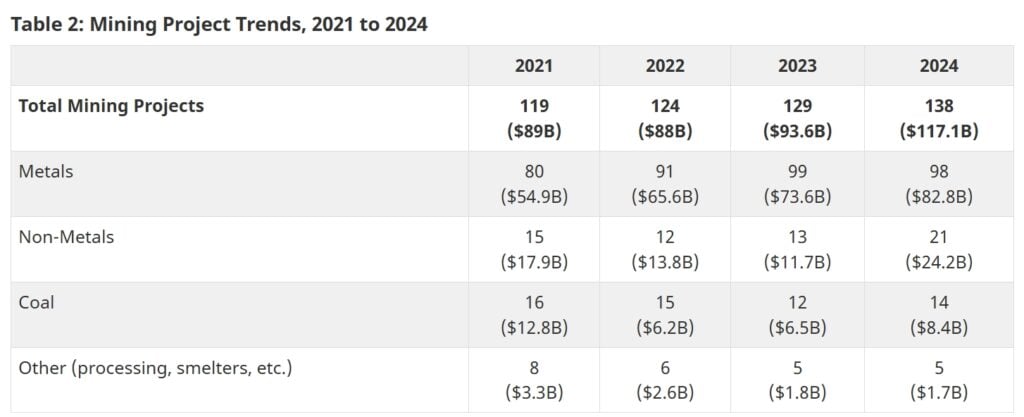
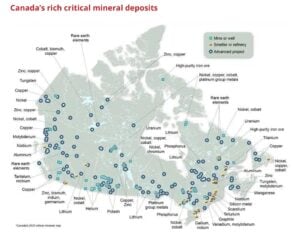
The government’s investment prospectus features 167 projects across eight sectors, with mining and metals accounting for 63 projects, the largest category in the portfolio. The projects span commodities including copper, lithium, graphite, gold and other minerals considered important to energy, technology and national security supply chains.

The focus on mining comes as governments and manufacturers look to diversify critical-mineral supply chains away from concentrated sources of production and processing.

For Canada, the opportunity is not simply to increase mine output. It is to attract the capital needed to build mines, processing facilities and infrastructure while keeping the environmental footprint of new production under control.

Mining Leads Canada’s Investment Pitch

The scale of the mining presence at the summit is significant.

As said before, of the 167 projects in the federal prospectus, 63 are in mining and metals. That makes the sector the largest component of Canada’s investment pitch to global institutional investors.

Canada already has a large and established mining economy.

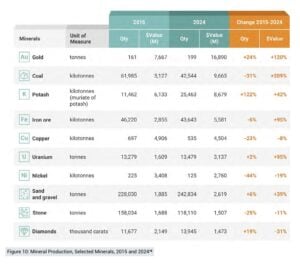
Natural Resources Canada says the country produced more than 60 minerals and metals worth C$64.3 billion in 2024. Metals accounted for more than half of that value, with gold alone contributing about 26%.

Canada is also a leading global producer of several critical minerals and ranked among the world’s major producers of uranium and palladium. The broader minerals sector directly employed approximately 438,000 people in 2024.

However, developing new deposits requires substantial upfront capital. Long permitting timelines, infrastructure requirements and the need for processing capacity can also make projects difficult to finance.

Ottawa is increasingly using government-backed capital to help bridge that gap.

Canada Mining
Source: Canada Govt

C$140 Million backs Ontario’s Generation Mining Marathon Project

Canada Growth Fund announced a commitment of approximately C$140 million to Generation Mining (TSXV: GENM) to support the development of the Marathon Project in northwestern Ontario. The investment is intended to help advance the project toward construction and mobilize additional private capital.

The Marathon Project is a large copper-palladium development that also contains platinum, gold and silver.

Generation Mining announced separately that it has now assembled approximately US$1.3 billion in project financing for construction. The package includes the Canada Growth Fund investment, approximately US$50 million from the Canada Infrastructure Bank, senior and subordinated debt and metal-streaming arrangements.

The project is expected to enter early construction work in the fourth quarter of 2026, subject to the company’s financing arrangements and construction conditions.

Marathon is important beyond its individual production potential because it could strengthen Canada’s domestic critical-minerals chain.

The company has an agreement with Glencore to purchase the project’s polymetallic concentrate, providing a potential route into existing Canadian processing infrastructure.

Frontier Lithium’s PAK Lithium Project Adds Another Layer

Lithium is another major theme in Canada’s investment push. Frontier Lithium’s PAK Lithium Project in northwestern Ontario has been included in the Canada Investment Summit prospectus and Ontario’s Deal Book. The company described PAK as the only lithium project included in Ontario’s investment portfolio.

Other projects are also seeking to connect Canadian mineral resources with international battery supply chains.

  • E3 Lithium, for example, recently signed a non-binding memorandum of understanding with India’s Epsilon Advanced Materials to potentially supply up to 5,000 tonnes of lithium carbonate per year from its Clearwater project in Alberta over five years.

The agreement highlights another part of Canada’s strategy: using its mineral resources to build relationships with buyers outside the U.S.

Canada’s Mining Output is Already Substantial

Canada’s critical-minerals investment strategy is being built on an existing mining base.

The value of Canadian mineral production reached C$64.3 billion in 2024, although that was down from C$70.4 billion in 2023. Natural Resources Canada says metals production increased by 1%, while non-metals and coal declined, largely because of lower coal and potash prices.

canada mining critical mineral
Source: The Mining Association of Canada | The Mining Story 2026

The country therefore has an established workforce, mining expertise, capital markets and infrastructure that can support a new generation of projects.

The challenge is scaling that system quickly enough.

CANADA mining critical minerals

The Emissions Challenge is Harder to Ignore

Canada’s mining expansion also comes with a climate challenge.

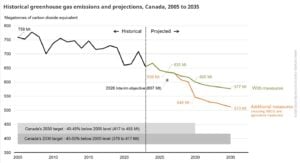
The country’s latest National Inventory Report, released in 2026 and covering emissions through 2024, puts Canada’s total greenhouse gas emissions at approximately 685 million tonnes of CO2e in 2024. It was about 10% below the 2005 level of 763 Mt CO2e.

Mining’s emissions require more careful interpretation.

Its stationary combustion emissions were about 5.5 Mt CO2e in 2024. This figure covers emissions from stationary fuel combustion and should not be treated as the industry’s entire carbon footprint.

Mining and quarrying also appear within broader energy-sector categories that include other activities.

For example, Canada’s facility-level reporting system groups mining, quarrying, and oil and gas extraction together. Those facilities reported approximately 126 Mt CO2e in 2024. However, that number should not be described as mining’s standalone emissions because the category includes the much larger oil and gas industry.

This distinction matters as Canada promotes new mining investment.

CANADA EMISSION
Source: Govt of Canada

The country wants to increase production of the minerals needed for electrification and energy technologies while also reducing the emissions intensity of the economy.

Low-carbon power could become a mining advantage

Canada has one potential advantage in that race: electricity.

Several major mining provinces have access to large amounts of hydroelectric or nuclear power. That could help mines reduce their reliance on fossil fuels, particularly for electricity-intensive processing.

For investors and industrial buyers, the carbon footprint of mineral production could become increasingly important. Copper, lithium, nickel, graphite and other minerals may be essential to the energy transition, but producing them still requires energy, transportation and processing.

This creates an opportunity for Canada to compete not only on resource availability but also on the potential carbon intensity of supply.

A Race for Capital, Not Just Minerals

Overall, the Canada Investment Summit highlights a clear opportunity for the country’s critical-minerals sector. Canada has the resources and mining expertise. Now, it needs capital, infrastructure, and faster project development.

With 63 mining and metals projects in the summit prospectus, Ottawa is betting that its C$1 trillion investment ambition can turn mineral wealth into new domestic supply chains and lower-carbon growth.

The question now is whether Canada can bring these projects into production fast enough, while keeping their environmental footprint competitive.

The post Canada Investment Summit 2026: Can $1 Trillion Drive a Critical Minerals Mining Boom? appeared first on Carbon Credits.
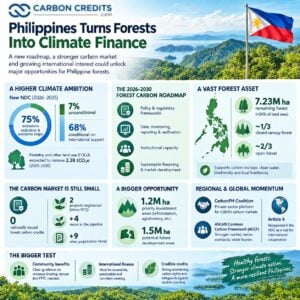
Philippines Builds Forest Carbon Roadmap as New Climate Target Raises Demand for Finance

Philippines Builds Forest Carbon Roadmap as New Climate Target Raises Demand for Finance

The Philippines is moving to turn its forests into a larger source of climate finance as it takes on a tougher emissions target. The country has a 2026–2030 roadmap for the voluntary forest carbon market. It is creating the registry, monitoring systems, and policies to draw in private investment for forests.

The move comes just days after the Philippines submitted its updated 2026 Nationally Determined Contribution (NDC) to the UN climate process.

The new NDC keeps the country’s 75% emissions reduction and avoidance target, but changes the structure. The target now covers 2025–2035 and includes forestry and other land use (FOLU).

Of the 75% target, 7% is unconditional, while 68% depends on international support. That makes forest carbon more than a conservation opportunity. It could become one tool for helping the Philippines secure investment needed to deliver its broader climate targets.

Philippines Puts Forests at the Center of Its Climate Strategy

The Philippines’ new NDC gives forests a much larger role in its emissions pathway. The 2026 NDC covers energy, transport, industrial processes, agriculture, waste, and forestry and other land use.

Updated government modelling shows the FOLU sector has been a net carbon sink since 2020. The NDC estimates that FOLU policies could reduce cumulative emissions by about 2.3 billion tonnes of CO₂e between 2025 and 2035 compared with the business-as-usual pathway.

With all identified policies and measures, the country is projected to become a net sink over the 2025–2035 period. That makes protecting and expanding the forest carbon sink important to the country’s overall climate strategy.

The NDC commits the Philippines to fully use this sink. This will happen through forest protection, reforestation, and sustainable land management.

DENR Forest Management Bureau Assistant Director Ray Thomas Kabigting remarked:

“FMB is ready to converse with the business sector in a more scaled-up way wherein we’re talking about financing, we can already understand balance sheets, and we can produce policies that are actually aligned with business concepts and business science rather than just pure forestry science.”

A Five-Year Roadmap for Forest Carbon

The Department of Environment and Natural Resources (DENR) formally adopted its Roadmap to Readiness in the Voluntary Forest Carbon Market 2026–2030 through Administrative Order No. 2026-02.

The roadmap identifies four priorities:

  1. Policy and regulatory frameworks,
  2. Data, monitoring, reporting, and verification,
  3. Institutional capacity, and
  4. Sustainable financing and market development.

The goal is to make the Philippines more attractive for high-quality forest carbon projects while creating safeguards around carbon ownership, benefit sharing, and environmental integrity.

The roadmap also calls for a DENR Forest Carbon Credit Database that will track forest carbon projects and credits. It is designed to connect with a broader national carbon registry being developed under the country’s Article 6 framework. This infrastructure matters because buyers increasingly want evidence that credits are real, additional, and not counted twice.

7.23 Million Hectares Give the Philippines a Major Carbon Asset

The economic opportunity is significant. The DENR roadmap estimates that the Philippines has about 7.23 million hectares of remaining forest, equal to roughly 24% of the country’s land area.

The document estimates that around one-third is closed-canopy forest and two-thirds is open forest. These forests provide more than carbon storage. They also protect watersheds, reduce soil erosion, support biodiversity, and provide livelihoods for local communities.

However, forest finance remains a major challenge. The roadmap says global investment in forests is about $2.2 billion per year. Still, the world needs over $450 billion annually to reach forest and climate goals.

Carbon finance can help bridge that gap. It creates revenue linked to clear forest protection and restoration efforts. The Philippines is thus trying to move from short-term conservation funding toward longer-term investment models.

The Forest Carbon Market Is Still Small, but the Pipeline Is Growing

Despite the potential, the Philippine forest carbon market remains small. The DENR roadmap says there were no nationally issued carbon credits at the time of its stocktake. Existing credits had been issued through international standards.

The government identified two projects registered under Verra’s Verified Carbon Standard, with four additional projects in the pipeline. At least nine other forest carbon projects were also identified outside the Verra system.

Some projects are in Mindanao. Other opportunities are being looked into in areas with community forest agreements, ancestral domains, and other forest tenure arrangements.

The roadmap highlights 1.2 million hectares of classified forest land as key investment areas. These areas are prioritized for reforestation, agroforestry, and other forest-based development.

Another 1.5 million hectares are being assessed for possible release for future development. That could significantly expand the potential project pipeline. But land tenure, carbon rights, and benefit sharing remain important hurdles.

Philippines Builds Forest Carbon Roadmap

CarbonPH Pushes the ASEAN Opportunity

This is where the recent CarbonPH Coalition initiative becomes important. At a CarbonPH Coalition Education Series session, DENR officials shared their plans. They aim to strengthen forest carbon project registration. They will also establish carbon baselines and expand monitoring.

The DENR Forest Management Bureau is creating a registry to track projects and credits. They are also using satellite monitoring to enhance verification.

The Philippines is also seeking a stronger position in the ASEAN Common Carbon Framework (ACCF). The country is an observer right now, while the regional initiative is focused on building a stronger carbon market. It aims to improve supply integrity, boost demand, and ensure interoperability.

The United Nations Environment Programme (UNEP) says annual investment in nature-based solutions must nearly triple by 2030, reaching more than $542 billion a year. This funding will be critical to meet global climate, biodiversity, and land restoration goals.

At the same time, demand for high-quality nature-based carbon projects is growing. Forest protection (REDD), reforestation (ARR), and mangrove restoration remain major sources of nature-based carbon credits. Buyers are increasingly looking for projects backed by strong science, reliable monitoring, and clear benefits for local communities.

nature based credits Allied Offsets
Source: Allied Offsets

That could give Philippine forest projects access to a wider pool of regional buyers if standards and systems become more connected.

Regional competition is already growing. Malaysia has a government-supported carbon exchange. Indonesia and Thailand are also building their carbon market systems. For the Philippines, credible forest projects could become a way to compete on quality rather than simply price.

Carbon Finance Must Also Deliver for Communities

Scaling forest carbon will require more than satellites and registries. The DENR roadmap identifies benefit sharing as a major gap.

Developers must submit benefit-sharing plans. However, the roadmap notes that more guidance is needed on revenue distribution. That issue matters a lot. Many potential projects affect communities, forest tenure holders, and Indigenous Peoples.

The roadmap calls for stronger safeguards and recognition of Free, Prior and Informed Consent (FPIC) where projects affect ancestral lands and domains. The credibility of Philippine forest credits depends on two things:

  • How much carbon they remove or avoid, and if local communities gain real benefits.  

The forest carbon roadmap fits directly into the Philippines’ broader climate finance challenge. The new NDC says implementation depends on access to accessible, predictable, and adequate international support. 

That means finance, technology, and capacity building are not secondary issues. They are central to delivering the country’s climate commitment. Carbon markets could become one part of that financing mix.

The new NDC also recognizes Article 6 mechanisms as tools for international cooperation and resource mobilization. Any international transfers, however, will require strong governance, monitoring, and safeguards against double counting.

Forest Carbon Could Link Climate Goals and Investment

The Philippines now has two pieces of a potentially important climate finance strategy. The 2026 NDC places the country’s forest sink directly inside its emissions pathway.

The CarbonPH Coalition is adding a private-sector platform to connect those developments with emerging ASEAN carbon markets. But the opportunity is still at an early stage.

The country needs clearer carbon rights, reliable monitoring, workable tenure rules and transparent benefit sharing before forest carbon can scale. It also needs international finance to help develop projects that may not be commercially viable on carbon revenue alone.

If those pieces come together, Philippine forests could play a larger role in both emissions reduction and climate finance.

The bigger test is whether the country can turn its millions of hectares of remaining forest and its expanding carbon market infrastructure into credible, investable climate assets while ensuring that communities and ecosystems share in the value.

The post Philippines Builds Forest Carbon Roadmap as New Climate Target Raises Demand for Finance appeared first on Carbon Credits.
Google’s Big Energy Bet on Finland: 22-Year Fortum Deal Brings Nuclear, Renewables and Storage Together

Google is taking a long-term stake in Finland’s low-carbon energy future. The technology giant has signed a 22-year power purchase agreement (PPA) with Finnish utility Fortum covering up to 50% of the generation capacity of the Loviisa nuclear power plant.

The press release says that the agreement will help Fortum finance investments needed to extend Loviisa’s operating life through 2050. It will also support a planned power upgrade at the plant.

Finland’s Electricity Demand is Rising, But Emissions are Falling

Finland consumed 85 TWh of electricity in 2025, up 2% from 2024. Industry accounted for 42% of demand, while households, services, buildings and agriculture made up most of the rest. Industrial electricity use rose 2.6% during the year.

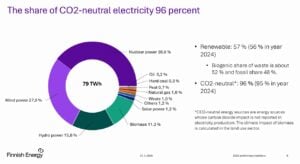
At the same time, 96% of Finland’s electricity came from CO₂-neutral sources in 2025, up from 95% in 2024. Here’s the chart showing the share:

low carbon electricity

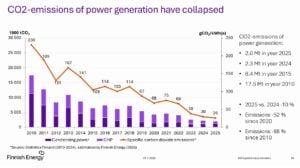
  • This cleaner power mix has helped cut emissions sharply. CO₂ emissions from electricity generation fell to 2 million tonnes in 2025, down 10% from 2024 and 88% from 2010.
  • Emissions from electricity and district heating also fell to 3.9 million tonnes in 2025, down 31% from the previous year and 88% from the 2003 peak.

carbon emission

The Loviisa Deal Puts Nuclear at the Center

The most important part of the partnership is the long-term PPA.

  • The agreement starts in 2028 with a smaller contracted capacity. From 2030 through 2049, Google will contract up to 50% of Loviisa’s generation capacity.

It gives Fortum something particularly valuable for a large nuclear investment: long-term revenue visibility.

Fortum is already pursuing an approximately €1 billion investment program to extend Loviisa’s operating life to 2050. About €700 million of the required capital expenditure is still pending investment decisions.

The Google agreement provides additional certainty to move ahead with those investments. This matters significantly because Loviisa is not a marginal asset for Finland.

                                        Loviisa nuclear plant

Loviisa nuclear plant
Source: Fortum

Keeping 10% of Finland’s power online

The plant currently provides about 10% of Finland’s electricity and employs approximately 580 people. Without the lifetime extension investment program, Loviisa would not be able to continue operating beyond 2030.

Extending the plant to 2050 therefore allows Finland to retain a large source of reliable, fossil-free electricity instead of losing that capacity at the end of the current operating period.

Additionally, the agreement could also increase the plant’s output. Fortum already has plans for a 38-megawatt capacity increase, expected to be operational in 2028. The new partnership with Google could support an additional 10 MW increase.

For Finland’s electricity system, keeping existing nuclear generation online while adding capacity can help strengthen supply without waiting years for entirely new large-scale generation projects.

Google’s Finland Bet Goes Beyond Nuclear Power

But the partnership goes beyond nuclear power.

The companies have also agreed to explore new nuclear generation, renewable energy and flexibility solutions. The companies are effectively building a broader framework for expanding reliable, low-carbon electricity across Finland.

  • Google plans to invest €13 billion in Finland during 2027 and 2028. The investment will include data centers, supporting infrastructure and partnerships in Hamina, Muhos, Vaala and Kajaani.

Fortum has an 8 GW renewable pipeline in the Nordic countries currently in the permitting phase. The company aims to have 1.2 GW of ready-to-build renewable projects and 2.5 GW of new flexibility services and generation assets ready to deploy by the end of 2028.

Google’s partnership could help create demand for some of that future capacity and create a much broader clean-energy strategy.

The companies also want to explore how nuclear, renewable energy and flexibility technologies can work together as electricity demand changes. However, for Fortum, the immediate focus is clear: keep a major source of Finland’s fossil-free electricity online for another two decades.

Batteries join the equation

The first example is already taking shape in Kajaani. The deal will help optimize a new 94 MW battery storage system that Google has contracted for near its new data center.

Battery storage can help balance variable renewable generation and provide additional flexibility to the electricity system. It makes the partnership broader than a traditional nuclear PPA.

Google’s Clean-Energy Portfolio is Expanding

The Fortum agreement also fits into Google’s rapidly expanding clean-energy portfolio.

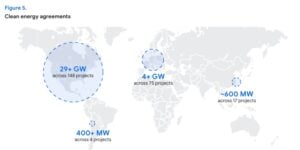
  • In 2025, Google struck more than 12 GW of net-new clean energy deals. It was the company’s largest annual clean-energy procurement and exceeded the combined amount it contracted during the previous two years.

Since 2010, it has signed more than 240 clean-energy agreements representing nearly 35 GW of capacity. It also reported a 37% increase in electricity demand in 2025.

  • Despite that increase, Google said it reduced operational emissions by 2% and matched 100% of its electricity consumption with renewable energy purchases for the ninth consecutive year.
  • Its energy, hardware and computing-efficiency initiatives also avoided more than 58 million metric tons of CO2 equivalent in 2025.
clean energy google
Source: Google

The Nuclear Strategy Extends Beyond Finland

The Loviisa agreement is not Google’s only nuclear commitment. The company has signed landmark nuclear agreements earlier, and they are:

  • Kairos Power: Google’s 2024 agreement supports up to 500 MW of advanced nuclear capacity by 2035. Its Hermes 2 project in Tennessee is expected to supply up to 50 MW to the TVA grid from 2030.
  • Elementl Power: In 2025, Google agreed to provide early-stage funding for three potential U.S. nuclear sites, each targeting at least 600 MW, with an option to purchase future power.
  • Commonwealth Fusion Systems: Google has invested in the fusion company as part of its strategy to support next-generation clean energy. The partnership aims to advance fusion power toward commercial deployment.
  • TAE Technologies: Google has also invested in TAE Technologies, supporting its efforts to develop fusion energy. TAE is pursuing a compact fusion approach designed to produce reliable, carbon-free power.

Geothermal, storage and fusion broaden the bet

In Taiwan, Google signed geothermal agreements expected to add 10 MW of always-on geothermal power to the grid and made an equity investment in Baseload Capital.

Google is also supporting long-duration energy storage through its partnership with Energy Dome. Its CO2 Battery technology is designed to store renewable electricity and discharge it over eight to 24 hours.

Together, however, they show Google’s willingness to support a wide range of technologies that could contribute to a more resilient low-carbon electricity system.

google clean energy
Source: Google

A Nordic Model for Clean Energy

The Loviisa deal shows how big companies can support the wider energy transition, not just buy clean electricity. Google’s long-term demand gives Fortum greater certainty to keep Loviisa running through 2050 and develop new renewable, storage and nuclear capacity.

Google’s €13 billion investment in Finland adds to this strategy by expanding its footprint and supporting the country’s low-carbon energy system. The partnership could become a model for using corporate demand and investment to strengthen clean energy infrastructure across Finland and the Nordic region.

The post Google’s Big Energy Bet on Finland: 22-Year Fortum Deal Brings Nuclear, Renewables and Storage Together appeared first on Carbon Credits.
Free EU Carbon Allowances Boosted Airline Profits More Than Green Investment, Report Finds

Free EU Carbon Allowances Boosted Airline Profits More Than Green Investment, Report Finds

European airlines received billions of euros in free carbon allowances under the EU Emissions Trading System (EU ETS), but most of the benefit appears to have supported airline profits rather than new green investment. That is the key finding of a new CE Delft report examining free aviation allowances between 2013 and 2025.

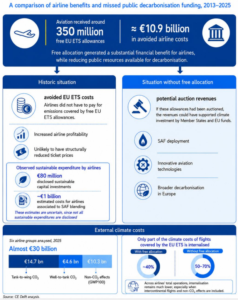
The study estimates airlines received €10.9 billion worth of free EU allowances during the period. By comparison, six major airline groups spent about €1.1 billion on sustainable activities, mainly sustainable aviation fuel (SAF). The findings come as the EU completes its phase-out of free aviation allowances in 2026.

Airlines Received €10.9 Billion in Free Allowances

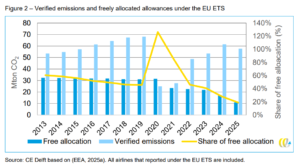
The EU originally provided free allowances to airlines to limit competitiveness concerns and reduce the risk of carbon leakage. Between 2013 and 2025, airlines received about 350 million free allowances, covering roughly half of the 700 million tonnes of verified aviation emissions reported under the EU ETS during the period.

The value of those allowances increased sharply as carbon prices rose.

CE Delft estimates the average EU allowance price increased from about €4.56 per tonne in 2013 to €73.43 in 2025, measured in 2025 prices. The annual average reached about €87.90 per tonne in 2022.

That made free allowances increasingly valuable to airlines, particularly during the years when carbon prices were high. The largest benefits came in 2022 and 2023, when airlines continued receiving free allowances while EU carbon prices remained elevated.

The author noted:

“We find no strong reason to expect that these expenditures would have been substantially lower without free allocation. EU ETS auction revenues, on the other hand, are largely used for climate and energy transition purposes. Full auctioning of aviation allowances would therefore most likely have made significantly more funding available for the decarbonisation of the European economy.”

Free Allocation Became a Major Profit Booster

CE Delft compared airline profitability with a scenario in which airlines had to purchase all their EU allowances. The six airline groups studied were Ryanair, Lufthansa, Air France-KLM, easyJet, Wizz Air and IAG.

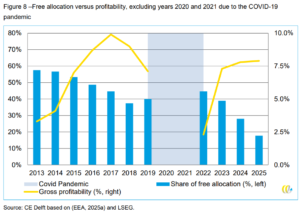
For five major European airline groups that were profitable over the period, the report estimates that free allocation accounted for about 17% of profitability. For Air France-KLM, which recorded cumulative losses, free allowances reduced those losses by about 10%.

Verified emissions and freely allocated allowances under the EU ETS
Source: CE Delft

The report also finds little evidence that ending free allocation has seriously damaged airline profitability. European airline margins during 2023–2025 were broadly comparable with pre-pandemic levels, even as free allocation declined sharply.

That does not mean airlines would face no costs from buying all their allowances. But it weakens the argument that free allocation was essential to protect the sector’s financial performance.

Free allocation versus profitability
Source: CE Delft

Green Spending Fell Far Behind the Carbon Windfall

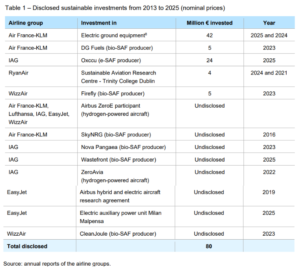
The biggest concern raised by the report is the gap between the value of free allowances and spending on sustainable activities. The six airline groups spent approximately €80 million on sustainable capital investments during the period studied.

They also spent an estimated €1 billion on SAF purchases. Combined, that is roughly €1.1 billion, compared with the €10.9 billion estimated value of free carbon allowances.

CE Delft also examined 2025 EU Taxonomy reporting from eight airlines. The airlines reported a combined €18.1 billion in capital expenditure. About €9.57 billion, or 52.8%, was classified as taxonomy-aligned.

However, almost all of that spending — €9.55 billion — was classified as transitional activity, mainly conventional aircraft purchases and maintenance.

Only €24 million, or 0.13% of total reported capital expenditure, was classified as genuinely sustainable investment. This consisted of electric ground-handling equipment reported by Air France-KLM.

sustainable investments from 2013 to 2025

The distinction matters because newer aircraft can use less fuel than older models but still rely mainly on fossil-based jet fuel.

Could Auction Revenue Have Delivered More?

The report argues that governments could have used auction revenue to support technologies that can cut aviation emissions. CE Delft models several hypothetical uses for the €10.9 billion in free allowances.

If the money had instead been used to purchase HEFA-based SAF, the report estimates it could have supported about 18 million tonnes of CO₂ reductions. Using synthetic SAF could have produced about 4.7 million tonnes of reductions.

The report also estimates that putting the money into the EU Innovation Fund could theoretically have generated up to 815 million tonnes of reductions across sectors. These are not actual historical savings. They are illustrative scenarios based on different technology and investment assumptions.

Still, they highlight the potential opportunity cost of giving carbon allowances to airlines rather than auctioning them.

The wider EU ETS has already become a major source of climate funding. EU ETS auctions generated more than €258 billion between 2013 and 2025, with revenues exceeding €43 billion in 2025, according to the European Commission.

Aviation’s Carbon Costs Remain Partly Unpriced

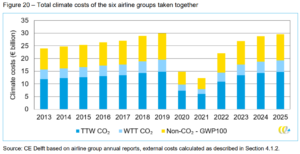
The report also examines aviation’s wider climate impact. For the six airline groups, CE Delft estimates their external climate costs reached almost €30 billion in 2025.

That included about €14.7 billion from direct aircraft CO₂ emissions, €4.6 billion from fuel-production emissions and €10.3 billion from non-CO₂ climate effects. These figures show why aviation’s climate impact extends beyond the CO₂ covered by the EU ETS.

Total climate costs of the six airline groups
Notes: TTW (tank-to-wing), WTT (well-to-tank), Source: CE Delft

CE Delft estimates that carbon pricing has internalized around 40% of the external cost of direct CO₂ emissions within the EU ETS scope in recent years. But the picture changes when international aviation and non-CO₂ effects are included.

For 2025, the report estimates only 16% of CO₂-related external costs were internalized when intercontinental aviation was included. Non-CO₂ effects, including climate impacts linked to aircraft emissions at altitude, remain much less covered by carbon pricing.

Europe Finally Ends Free Airline Allowances

The EU has now entered a new phase for aviation carbon pricing. Under the 2023 EU ETS reforms, free aviation allowances were reduced by 25% in 2024 and 50% in 2025. From 2026, regular free allocation has ended, and aviation allowances are auctioned.

The change means airlines now face a clearer market-based carbon cost for their EU ETS emissions. At the same time, the EU is directing carbon market resources toward aviation decarbonization.

  • Between 2024 and 2030, up to 20 million EU ETS allowances will be used to help narrow the cost gap between eligible SAF and conventional jet fuel.

EASA expects aviation emissions covered by the EU ETS to reach about 59.5 million tonnes in 2026. It estimates airlines could need to purchase about 34.5 million allowances this year. That makes the price of carbon increasingly important to airline costs.

# Philippines Builds Forest Carbon Roadmap as New Climate Target Raises Demand for FinanceThe Philippines is moving to turn its forests into a larger source of climate finance as it takes on a tougher emissions target. The country has adopted a **2026–2030 roadmap for the voluntary forest carbon market** and is building the registry, monitoring systems and policies needed to attract private investment into forests. The move comes just days after the Philippines submitted its updated **2026 Nationally Determined Contribution (NDC)** to the UN climate process. The new NDC keeps the country's **75% emissions reduction and avoidance target**, but changes the structure. The target now covers **2025–2035** and includes forestry and other land use (FOLU). Of the 75% target, **7% is unconditional**, while **68% depends on international support**. That makes forest carbon more than a conservation opportunity. It could become one tool for helping the Philippines secure investment needed to deliver its broader climate targets. ## Philippines Puts Forests at the Center of Its Climate Strategy The Philippines' new NDC gives forests a much larger role in its emissions pathway. The 2026 NDC covers energy, transport, industrial processes, agriculture, waste, and forestry and other land use. Updated government modelling shows the FOLU sector has been a **net carbon sink since 2020**. The NDC estimates that FOLU policies could reduce cumulative emissions by about **2.3 billion tonnes of CO₂e between 2025 and 2035** compared with the business-as-usual pathway. With all identified policies and measures, the country is projected to become a **net sink over the 2025–2035 period**. That makes protecting and expanding the forest carbon sink important to the country's overall climate strategy. The NDC also commits the Philippines to maximizing the potential of that sink through forest protection, reforestation and sustainable land management. ## A Five-Year Roadmap for Forest Carbon The Department of Environment and Natural Resources (DENR) formally adopted its **Roadmap to Readiness in the Voluntary Forest Carbon Market 2026–2030** through Administrative Order No. 2026-02. The roadmap identifies four priorities: 1. **Policy and regulatory frameworks** 2. **Data, monitoring, reporting and verification** 3. **Institutional capacity** 4. **Sustainable financing and market development** The goal is to make the Philippines more attractive for high-quality forest carbon projects while creating safeguards around carbon ownership, benefit sharing and environmental integrity. The roadmap also calls for a **DENR Forest Carbon Credit Database** that will track forest carbon projects and credits. It is designed to connect with a broader national carbon registry being developed under the country's Article 6 framework. This infrastructure matters because buyers increasingly want evidence that credits are real, additional and not counted twice. ## Philippines Has 7.23 Million Hectares of Forest The economic opportunity is significant. The DENR roadmap estimates that the Philippines has about **7.23 million hectares of remaining forest**, equal to roughly **24% of the country's land area**. The document estimates that around one-third is closed-canopy forest and two-thirds is open forest. These forests provide more than carbon storage. They also protect watersheds, reduce soil erosion, support biodiversity and provide livelihoods for local communities. But forest finance remains a major challenge. The roadmap estimates that global investment in forests is only about **$2.2 billion per year**, compared with more than **$450 billion annually** needed to meet international forest and climate goals. Carbon finance could help close part of that gap by creating a revenue stream tied to measurable forest protection and restoration. The Philippines is therefore trying to move from short-term conservation funding toward longer-term investment models. ## The Market Is Still at an Early Stage Despite the potential, the Philippine forest carbon market remains small. The DENR roadmap says there were **no nationally issued carbon credits** at the time of its stocktake. Existing credits had been issued through international standards. The government identified **two projects registered under Verra's Verified Carbon Standard**, with four additional projects in the pipeline. At least **nine other forest carbon projects** were also identified outside the Verra system. Several projects are located in Mindanao, while other opportunities are being explored in areas covered by community forest agreements, ancestral domains and other forest tenure arrangements. The roadmap also identifies **1.2 million hectares of classified forest land** as priority investment areas for reforestation, agroforestry and other forest-based development. Another **1.5 million hectares** are being assessed for possible release for future development. That could significantly expand the potential project pipeline. But land tenure, carbon rights and benefit sharing remain important hurdles. ## CarbonPH Pushes the ASEAN Opportunity This is where the recent **CarbonPH Coalition** initiative becomes important. At a CarbonPH Coalition Education Series session, DENR officials outlined plans to strengthen forest carbon project registration, establish carbon baselines and expand monitoring. The DENR Forest Management Bureau is also developing a registry to track projects and projected credits while using satellite-based monitoring to improve verification. The Philippines is also seeking a stronger position in the **ASEAN Common Carbon Framework (ACCF)**. The country currently participates as an observer, while the regional initiative works on stronger carbon-market infrastructure, supply integrity, demand and interoperability. That could give Philippine forest projects access to a wider pool of regional buyers if standards and systems become more connected. Regional competition is already growing. Malaysia has a government-backed carbon exchange, while Indonesia and Thailand are also developing carbon-market infrastructure. For the Philippines, credible forest projects could become a way to compete on quality rather than simply price. ## Carbon Finance Must Also Deliver for Communities Scaling forest carbon will require more than satellites and registries. The DENR roadmap identifies **benefit sharing** as a major gap. Developers will be required to submit benefit-sharing plans, but the roadmap says further guidance is still needed to determine how revenues should be distributed. That issue is especially important because many potential projects overlap with communities, forest tenure holders and Indigenous Peoples. The roadmap calls for stronger safeguards and recognition of **Free, Prior and Informed Consent (FPIC)** where projects affect ancestral lands and domains. The credibility of Philippine forest credits will therefore depend not only on how much carbon they remove or avoid, but also on whether local communities receive meaningful benefits. ## International Finance Is the Bigger Climate Test The forest carbon roadmap fits directly into the Philippines' broader climate-finance challenge. The new NDC says implementation depends on access to **accessible, predictable and adequate international support**. The government is seeking finance through public and private sources, including innovative financing instruments. It also says climate support should be **highly concessional, non-debt creating and accessible through simplified mechanisms**. The structure of the new NDC makes this particularly important. Only **7% of the 75% target is unconditional**. The remaining **68 percentage points are conditional on international support**. That means finance, technology and capacity building are not secondary issues. They are central to delivering the country's climate commitment. Carbon markets could become one part of that financing mix. The new NDC also recognizes **Article 6** mechanisms as tools for international cooperation and resource mobilisation. Any international transfers, however, will require strong governance, monitoring and safeguards against double counting. ## Forest Carbon Could Link Climate Goals and Investment The Philippines now has two pieces of a potentially important climate-finance strategy. The **2026 NDC** places the country's forest sink directly inside its emissions pathway. The **2026–2030 forest carbon roadmap** is building the policies, data systems, registry and financing mechanisms needed to attract investment into that forest base. The CarbonPH Coalition is adding a private-sector platform to connect those developments with emerging ASEAN carbon markets. But the opportunity is still at an early stage. The country needs clearer carbon rights, reliable monitoring, workable tenure rules and transparent benefit sharing before forest carbon can scale. It also needs international finance to help develop projects that may not be commercially viable on carbon revenue alone. If those pieces come together, Philippine forests could play a larger role in both **emissions reduction and climate finance**. The bigger test is whether the country can turn its **7.23 million hectares of remaining forest** and its expanding carbon-market infrastructure into credible, investable climate assets while ensuring that communities and ecosystems share in the value.
Source: CE Delft

The Next Test for Aviation Carbon Policy

The CE Delft report does not show that free allowances had no value to airlines. Instead, it raises a broader question about whether the policy delivered enough climate benefits for its cost.

The report was commissioned by Opportunity Green, so its policy recommendations should be considered in that context. Its analysis, however, uses EU ETS data, airline financial reports, EU Taxonomy disclosures and other published datasets.

With free allocation now ending, the focus shifts to what happens next. A stronger carbon price can increase the cost of flying while creating revenue for climate investment.

The challenge for Europe is to ensure that those revenues help scale technologies such as SAF, synthetic fuels, and eventually hydrogen and electric aviation.

For the EU’s carbon market, the goal is no longer simply putting a price on aviation emissions. It is turning that price into measurable progress toward cleaner flight.

The post Free EU Carbon Allowances Boosted Airline Profits More Than Green Investment, Report Finds appeared first on Carbon Credits.

Biochar Demand Hits 2.99 Million Tonnes: Can Corporate Buyers Trigger a Supply Crunch?

Biochar is quickly becoming one of the most important technologies in the carbon removal market. But as corporate demand grows, buyers are running into a new problem: there may not be enough high-quality biochar to go around.

A new report from carbon removal marketplace Supercritical shows that 81% of high-quality biochar supply for 2026 had already been committed by July. In 2025, the same threshold was not reached until October.

The shift highlights how quickly the biochar market is moving from an emerging carbon removal technology toward a more established market where buyers are competing for proven supply.

At the same time, the market is becoming more selective. Hundreds of projects are developing biochar capacity, but Supercritical found that only a small share meets its quality standards.

Biochar Demand Is Growing Rapidly

The numbers show just how quickly demand is changing.

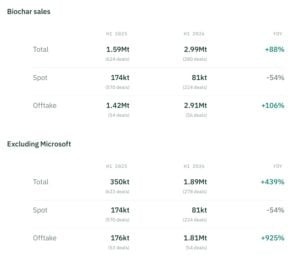
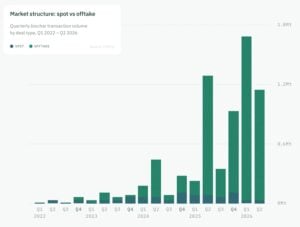
  • Biochar sales nearly doubled in the first half of 2026, rising from 1.59 million tonnes in H1 2025 to 2.99 million tonnes across 280 deals. However, the headline growth hides an important shift in how buyers are purchasing credits.
  • Spot-market sales actually fell 54%, from 174,000 tonnes to 81,000 tonnes.
biochar demand
Source: Supercritical

Instead, corporate buyers are increasingly signing longer-term offtake agreements. Offtake volumes jumped from 1.42 million tonnes in H1 2025 to 2.91 million tonnes in H1 2026.

  • Notably, excluding Microsoft, offtake purchases increased more than tenfold, from 176,000 tonnes to 1.81 million tonnes.

In other words, buyers are not simply buying more biochar. They are locking it up earlier.

That matters because biochar has traditionally had a two-speed market. Large buyers secure future supply through offtakes in the first half of the year, while smaller buyers typically turn to the spot market later in the year.

biochar offtake

But in 2026, that pattern has become much more pronounced.

Why High-Quality Biochar Is Harder to Find

The biochar market can look well supplied at first glance.

There are hundreds of projects across different stages of development, ranging from large industrial pyrolysis facilities to smaller distributed systems and artisanal production.

However, total capacity does not necessarily equal usable carbon removal supply.

Supercritical evaluated more than 400 biochar projects through its climate science process and found only 13 that passed its full assessment. Its 2026 report evaluates 119 projects using a 118-point vetting framework covering feedstock, production conditions, carbon stability, permanence, additionality, monitoring and verification.

This distinction matters for companies purchasing carbon removals.

For example, a project may be registered or rated but still have problems with additionality, methane emissions, delivery reliability or site-level safety.

One project Supercritical reviewed failed because it produced biochar at multiple open-pit sites without methane monitoring. Another failed an additionality assessment because the facility existed before the changes being credited. A smaller operation was also rejected because it lacked a meaningful delivery history.

So, while biochar production is expanding, high-integrity supply is a much smaller market.

The Market Is Moving Toward Long-Term Contracts

The growing preference for offtakes could reshape the biochar market.

Non-Microsoft buyers purchased more biochar in the first half of 2026 than they purchased during all of 2025. Most of that increase came from multi-year offtake agreements.

Part of the reason is that companies are beginning to plan carbon removal as a long-term component of their net-zero strategies rather than as an annual purchase.

Supercritical points to the Science Based Targets initiative’s Corporate Net-Zero Standard v2, which makes permanent carbon removal mandatory from 2035, eventually requiring removals for residual emissions. The EU’s Carbon Removal Certification Framework also certified biochar as a permanent removal pathway in February 2026.

As these frameworks develop, companies have more reason to secure future supply before they actually need it.

That creates a difficult position for buyers that rely on the spot market.

  • By July, 81% of high-quality 2026 supply had already been committed through offtakes and exclusive agreements. Supercritical estimates that active corporate RFPs could potentially claim another 70% of what remains.

Why Biochar Prices Could Rise Later in the Year

Timing is becoming increasingly important.

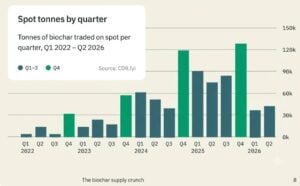
Historically, the fourth quarter has been the busiest period for biochar spot purchases. In Q4 2025, 994 spot transactions moved about 125,000 tonnes, with an average deal size of roughly 125 tonnes.

Thus, the three factors driving the late-year rush are:

  • Emissions needs become clearer: Companies often finalize their emissions data later in the year, pushing some buyers to the spot market to cover their remaining needs.
  • Project shortfalls tighten supply: Supercritical found that 73% of biochar projects lowered their capacity forecasts in 2025. Buyers may turn to spot credits when contracted volumes fall short.
  • New supply takes time: Biochar credits must go through production, verification, and registry approval before issuance, often bringing fresh supply to market when demand is already rising.
biochar demand and supply
Source: Supercritical

The result is a market where fresh supply and peak demand can collide toward the end of the year.

And prices already show the effect.

Supercritical reported that a biochar credit from the same project sold for $155 per tonne in July 2025 but reached $185 per tonne by November.

The report says high-quality biochar prices have remained broadly stable since 2024, but seasonal demand can push spot prices higher during the second half of the year.

That suggests the issue is not simply whether biochar is becoming more expensive. It is whether buyers are willing to wait until the market is most competitive.

India Is Becoming an Important Biochar Market

The supply story also highlights India’s growing role in biochar carbon removal.

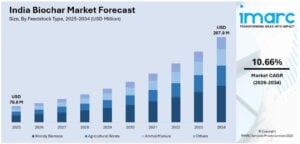
  • The country’s biochar market grew from $79.8 million in 2025 to $92.4 million in 2026. According to IMARC Group, the market is expected to reach $207.9 million by 2034, growing at a 10.66% CAGR from 2026 to 2034.
india biochar

Supercritical’s 2026 portfolio includes several Indian projects, including Varaha’s distributed biochar operation and Ground Up’s project using sugarcane residues.

Varaha’s model uses cotton stalks that might otherwise be burned, as well as the invasive Prosopis juliflora shrub. Its biochar is verified through Isometric, with batches tracked from production to soil.

Ground Up is already issuing credits through Isometric. According to Supercritical, field trials have shown potential yield increases of up to 38% for local sugarcane and 59% for wheat.

This points to one of biochar’s biggest advantages: the technology can connect carbon removal with agricultural waste management and soil applications.

India’s large agricultural residue base could therefore become an important source of future biochar supply, provided projects can meet the required standards for emissions monitoring, permanence, additionality, and verification.

The Bigger Problem Is Scaling High-Quality Supply

Biochar has already delivered more than twice the volume of all other permanent carbon removal pathways combined, according to Supercritical. It is also currently the only permanent removal method with a liquid spot market.

But its next challenge is not simply building more projects.

It is building projects that can reliably deliver high-quality removals at scale.

Supercritical says 73% of biochar projects revised their capacity downward in 2025. That highlights another risk for buyers: announced capacity can look very different from actual deliveries.

For corporate buyers, this makes due diligence increasingly important. Registry certification and third-party ratings can provide a starting point, but they may not answer every question about a project’s operations or ability to deliver.

As the market matures, buyers are likely to place greater value on projects with proven production records, robust monitoring and reliable feedstock.

The supply crunch is taking shape…

The biochar market is shifting from rapid growth to a race for reliable, high-quality supply. Demand is rising, while companies are signing larger offtakes and committing projects earlier. As a result, buyers who wait for the spot market could face higher prices and fewer choices.

Meanwhile, developers with reliable production and strong carbon accounting can capture more corporate demand.

The post Biochar Demand Hits 2.99 Million Tonnes: Can Corporate Buyers Trigger a Supply Crunch? appeared first on Carbon Credits.
Brazil Eyes China as Carbon Credit Buyer Ahead of Potential COP31 Accord

Brazil Eyes China as Carbon Credit Buyer Ahead of Potential COP31 Accord

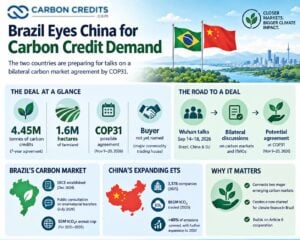
Brazil is looking to China as a potential buyer of its carbon credits as it works to build a stronger international carbon market. Brazilian officials are preparing for talks with China that could lead to a bilateral carbon market agreement by COP31 in November. The discussions will focus on whether China could purchase Brazilian Internationally Transferred Mitigation Outcomes (ITMOs) under Article 6 of the Paris Agreement.

The talks come as Brazil builds its own regulated carbon market and China expands the world’s largest emissions trading system. A deal would connect two major emerging carbon markets and could create a new channel for climate finance in Brazil.

Brazil Targets China for Carbon Credit Demand

Brazil will send a carbon market delegation to Wuhan from September 14 to 18. Officials from Brazil, China, and the European Union will meet there as part of a larger carbon market coalition.

Brazil’s Ministry of Finance confirmed that the Wuhan meetings will include bilateral discussions between Brazil and China on carbon markets. The talks follow earlier discussions at the China-Brazil High-Level Coordination and Cooperation Committee, or COSBAN, held in Beijing in June.

Brazilian carbon market officials are also exploring whether China could become a buyer of Brazilian ITMOs.

If it works, this deal would be important. China lacks an official bilateral ITMO trading agreement with any other country, according to Brazilian officials mentioned by Reuters.

Brazil wants to move quickly enough to potentially announce an agreement at COP31 in Antalya, Türkiye, which runs from November 9 to 20. However, talks have not yet resulted in a finalized deal. The two countries still need to agree on the rules, eligible projects, and other conditions for any future transfers.

Brazil Is Building Its Own Carbon Market

The push toward international carbon trading comes as Brazil develops its domestic carbon market. The nation established the Brazilian Emissions Trading System (SBCE) through Law No. 15,042 in December 2024. The system aims to build a regulated market for emissions and carbon assets. It also supports the country’s climate goals.

The government is now working through the detailed rules needed to make the system operational.

In July, Brazil opened a public consultation on rules for international carbon credit transfers. The proposal allows Brazil to join Article 6 cooperation but limits overseas mitigation transfers.

The proposed framework includes a global ceiling of 50 million tonnes of CO₂ equivalent (MtCO₂e) for international transfers. The limit could later be adjusted based on Brazil’s emissions and the economic performance of the mechanism. The proposed rules apply to mitigation outcomes generated during 2031–2035.

brazil ghg emissions trading system
Source:

Brazil is setting up the legal framework for international carbon trading. However, large-scale exports of ITMOs won’t happen right away.

Why ITMOs Matter

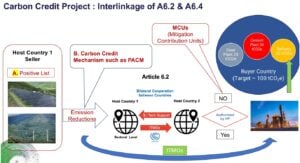
ITMOs are different from ordinary voluntary carbon credits. Under Article 6.2 of the Paris Agreement, countries can cooperate directly and transfer mitigation outcomes toward their climate targets. These transfers need accounting rules. This stops both countries from counting the same emissions reductions.

Carbon Credit generation article 6
Source: UNFCCC

This is where the corresponding adjustment becomes important.

When Brazil authorizes a mitigation outcome for export, it must make the required adjustment to its emissions accounting. This prevents Brazil from using the same reduction toward its own nationally determined contribution (NDC) after another country has used it toward its target.

For Brazil, the system could turn high-quality emissions reductions and removals into a source of international climate finance. The country must choose wisely which reductions to send abroad. It needs to meet its own climate goals too.

Ana Paula Cavalcante, Brazil’s deputy secretary, said:

“Both the coalition and the closer relationship with China can help scale up carbon markets and unlock investment flows for Brazil ​as it seeks to reindustrialize around new technologies.”

China’s Carbon Market Is Expanding

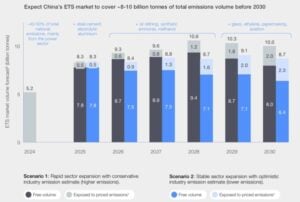
China represents an important potential buyer because its domestic carbon market is becoming larger and more sophisticated. Its national emissions trading system covered 3,378 companies in 2025, including power, steel, cement, and aluminum producers.

Those companies took part in a market that traded 865 million tonnes of carbon allowances. This was worth 57.663 billion yuan for the year. China is also continuing to expand the system.

In 2025, steel, cement, and primary aluminum were added to the national ETS. The expansion means the national market now includes over 60% of China’s total carbon emissions, says China’s Ministry of Ecology and Environment.

China aims to make its national carbon market more comprehensive by 2030. This includes broader coverage, better allowance controls, and a voluntary market that aligns more closely with international standards.

china compliance carbon market ets

That makes China a potentially important future participant in international carbon market cooperation.

Brazil and China Are Already Building Market Links

The potential bilateral agreement is also part of a broader effort to make different carbon markets more compatible. Brazil launched the Open Coalition for Regulated Carbon Markets at COP30. China and the European Union are among its participants.

The coalition focuses on areas such as monitoring, reporting, and verification (MRV), carbon accounting, offset rules, and market interoperability. Brazil says the longer-term goal is to make regulated carbon markets more compatible and potentially allow deeper connections between them.

The coalition now has an important next step in Wuhan.

Brazil, China, and the EU are expected to advance a work plan for improving compatibility between their carbon markets. The group has expanded beyond its original members and now represents a significant share of global emissions.

This wider cooperation could simplify future carbon credit trading. It would create consistent rules for measuring and tracking emissions reductions.

High-Integrity Credits Will Be the Price of Entry

For Brazil, access to China’s market would only be valuable if the credits could meet strict quality requirements.

Brazilian carbon market officials have emphasized the need for high-integrity credits before any international transactions take place. The government’s plan requires that internationally transferred credits follow approved methods. They must also get authorization from Brazil’s national authority.

That requirement is especially important because Brazil has a large pipeline of nature-based climate projects, including forest conservation and restoration.

The government will need to ensure that exported mitigation outcomes are real, measurable, and properly accounted for. Otherwise, international transfers could create risks for Brazil’s own climate targets. The same issue applies to China. Any future bilateral market must provide confidence that credits bought by Chinese entities or the Chinese government represent genuine emissions reductions.

BRAZIL CHINA Carbon credit cop31

COP31 Could Become the Next Carbon Market Milestone

The next two months could be important for Brazil’s international carbon market strategy. The September 14–18 Wuhan meetings could advance Brazil-China talks, while COP31 in November could provide a potential deadline for announcing a bilateral framework.

Still, expectations should remain measured. Brazil is implementing its domestic carbon market, while its international transfer rules are still being developed. China is also refining its own ETS.

A Brazil-China agreement would not immediately create a large carbon credit market. Instead, it could establish the rules and institutional foundation for future ITMO transactions.

That would still be significant. Brazil has major potential for emissions reductions and removals, while China has a large and expanding carbon market. Linking the two could open a new channel for climate finance and strengthen Article 6 trading among two major emerging economies.

The bigger question is whether they can build a system that makes cross-border carbon trading credible, transparent, and scalable. If an agreement is reached by COP31, it could become an important test of how major developing economies use Article 6 to finance decarbonization.

The post Brazil Eyes China as Carbon Credit Buyer Ahead of Potential COP31 Accord appeared first on Carbon Credits.
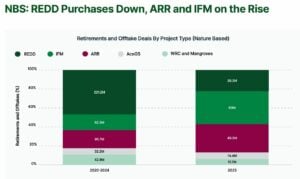
China’s Battery EV Market Grows as Tesla (TSLA Stock) Posts Third Straight Monthly Sales Decline

China’s Battery EV Market Grows as Tesla (TSLA Stock) Posts Third Straight Monthly Sales Decline

China’s electric vehicle market is showing a growing split between battery electric vehicles (BEVs) and other powertrains. The country’s overall passenger vehicle market fell sharply in August. Yet, BEV sales increased year over year, while plug-in hybrids, extended-range EVs and gasoline-powered vehicles all declined.

The shift is also exposing a tougher problem for Tesla. The company’s China retail sales fell for a third consecutive month, even as the broader BEV market expanded.

The latest figures show how quickly China’s auto market is changing. They also highlight the growing role of electrification in cutting oil demand and transportation emissions.

China’s Auto Market Slumps, But BEVs Keep Growing

China’s passenger vehicle retail market dropped 23.6% year-over-year in August, according to China Passenger Car Association (CPCA) data. New energy vehicle (NEV) sales also declined, falling 10.1% to about 1.005 million units. NEVs include BEVs, plug-in hybrids and extended-range electric vehicles.

However, the headline NEV decline masks a major difference between powertrains. BEV retail sales reached 698,000 units in August, up 0.8% from August 2025 and 7.9% from July.

China passenger NEV retail sales august
Source: CnEVPost

Meanwhile, plug-in hybrid sales fell 29.6%, and extended-range EV sales declined 22.2%. Fossil-fuel vehicles, including internal-combustion and conventional hybrid models, plunged about 40%. That made August another important month for China’s transition toward fully electric vehicles.

BEVs did not deliver explosive growth. However, they were the only major powertrain category to post year-over-year growth as the broader auto market contracted.

The result was a record 65.2% NEV penetration rate in China’s passenger vehicle retail market, up from 55.2% a year earlier. In other words, nearly two out of every three new passenger vehicles sold in China in August were NEVs.

Tesla Is Moving in the Opposite Direction

Tesla’s performance stands out because its core product is concentrated in the BEV segment. Tesla sold 50,047 vehicles in China in August, according to CPCA data. That was down 12.4% from 57,152 vehicles a year earlier.

It was also Tesla’s weakest August result in China since 2022. The decline followed a 32.9% year-over-year drop in July and a 14% decline in June, creating three consecutive months of falling China retail sales.

Tesla monthly retail sales in China august
Source: CnEVPost

The month-on-month comparison was better. Tesla’s August sales jumped 83.7% from July, when the company sold only 27,249 vehicles in China.

Still, the rebound was not enough to reverse the underlying annual decline. Through the first eight months of 2026, Tesla’s China retail sales reached 316,251 vehicles, down about 12.4% from the same period last year.

Tesla’s position in China’s NEV market also shows the intensity of competition. The company ranked sixth in August with a 5.0% share of NEV retail sales. BYD led with 233,943 vehicles and a 23.3% share, followed by Geely at 110,560 and Leapmotor at 84,874.

Tesla, therefore, sold less than half as many NEVs as BYD in the Chinese retail market during the month.

China's Aug 2026 NEV retail ranking
Source: CnEVPost

China’s EV Competition Is Getting More Intense

Tesla’s challenge is not simply a weak Chinese auto market. Local manufacturers are continuing to expand their presence across different price points and vehicle categories.

  • Other major players included Changan, SAIC-GM-Wuling, Chery, Huawei-backed HIMA, Li Auto, Nio, Xpeng and Xiaomi.

The rise of these companies matters because China’s EV market is increasingly driven by competition over price, battery technology, charging speed, software and vehicle features.

The International Energy Agency (IEA) estimates that China’s EV production costs are around 35% lower than in advanced economies, reflecting the country’s integrated battery, materials and manufacturing supply chains. China also accounted for nearly 75% of global electric car production in 2025.

Tesla once had a much larger position in this market. Reuters reported that Tesla’s share of China’s BEV sector fell to 6.6% in the second quarter of 2026, compared with more than 15% in 2020.

That decline shows the structural change underway. Tesla helped establish the premium mass-market EV category in China, but domestic manufacturers now have increasingly competitive alternatives.

Tesla Stock Reaction

Tesla shares showed little reaction to the August China sales figures. TSLA stock rose about 0.3% on September 9, even as Tesla’s China sales fell 12.4% from a year earlier.

Tesla TSLA stock price

Investors are looking beyond the latest sales numbers. Tesla’s stock has also been affected by concerns over its slowing vehicle sales, rising competition in China and uncertainty around its robotaxi and Cybertruck plans.

The bigger concern is the growing gap between Tesla and China’s broader BEV market. China’s BEV sales increased in August, while Tesla’s sales fell for a third straight month. This suggests Tesla is facing stronger competition, rather than simply a weaker EV market.

China Is Turning to Exports as Domestic Demand Weakens

China’s weakening domestic market is also pushing automakers toward international markets. Passenger vehicle exports reached 894,000 units in August, up 77.5% year over year, even as domestic sales fell 23.7%.

NEV exports were particularly strong, rising 154.7% from a year earlier. NEVs represented 58.4% of China’s passenger vehicle exports during the month. The trend extends beyond August.

IEA data show that Chinese electric car exports increased by more than 120% in the first half of 2026, fully offsetting the decline in domestic electric car sales. Electric vehicles accounted for more than 45% of China’s car exports, compared with around 35% in 2025.

Tesla is also increasingly using Shanghai as an export hub. The EV giant exported 36,119 vehicles from its Shanghai factory in August, up 38.7% year over year. However, that was down 45.6% from July’s record 66,330 exports.

The contrast is important. Tesla’s China retail market is shrinking, while its Shanghai factory is increasingly serving international markets. Chinese automakers face a similar dynamic, but their export growth has been substantially faster.

Electric Cars Are Starting to Cut China’s Oil Demand

The shift toward BEVs also has consequences beyond the auto industry. China is the world’s largest oil importer and has the world’s largest EV fleet. The IEA estimates that EVs already displaced around 1 million barrels of oil per day in China in 2025.

That figure could reach 2.7 million barrels per day by 2030 under current policies. Recent data suggest the effect is becoming visible in national energy statistics.

China’s carbon dioxide emissions fell 1% year over year in the second quarter of 2026, according to analysis by the Centre for Research on Energy and Clean Air (CREA). Oil consumption fell about 9%, while transport oil use dropped 16%.

CREA estimated that EVs displaced around 36 million tonnes of oil during the first half of 2026, contributing to an estimated 35 million tonnes of carbon emissions reductions after accounting for emissions from EV charging.

Net avoided greenhouse gas emissions from EV deployment, 2025-2035
Source: IEA

Sinopec’s research arm now expects China’s oil demand to decline by 600,000 barrels per day, or 8.9%, in 2026. Gasoline demand is forecast to fall 8.7%, while diesel demand could decline 11.4%.

EV adoption is not the only factor behind those changes. Higher oil prices, weaker economic activity, and changes in industrial demand also matter. Still, transportation electrification is becoming an increasingly important structural factor.

China’s EV Boom Is Becoming a Global Export Story

China’s auto market is under pressure, but BEVs are still gaining ground as gasoline vehicles lose share. At the same time, Chinese automakers are taking their EVs into overseas markets, increasing competition in Europe, Southeast Asia and other regions.

The IEA says China produced nearly 75% of the world’s electric cars in 2025, while Chinese brands accounted for more than half of EV sales in Southeast Asia.

Tesla faces a different challenge. Its August sales fell even as China’s BEV market grew, showing that stronger competition is hurting its position in the world’s largest EV market.

The long-term outlook for China’s EV market remains strong. The IEA expects EVs to make up more than 60% of China’s car sales in 2026 and more than 90% by 2035.

The shift also has climate implications. More BEVs can reduce oil demand and transport emissions while increasing demand for cleaner electricity and batteries.

READ MORE: China’s New 2030 Climate Playbook and What It Means for the EV Market

The post China’s Battery EV Market Grows as Tesla (TSLA Stock) Posts Third Straight Monthly Sales Decline appeared first on Carbon Credits.