Canada Pledges Up to C$560 Million to Tropical Forest Fund

Canada Pledges Up to C$560 Million to Tropical Forest Fund

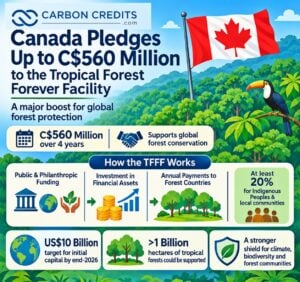
Canada has pledged up to C$560 million over four years to the Tropical Forest Forever Facility (TFFF), a global fund designed to reward countries for protecting tropical forests. Prime Minister Mark Carney announced the commitment on November 15, 2026, during the ASEAN Summit in Manila, following a meeting with Brazilian President Luiz Inácio Lula da Silva.

The pledge adds to growing international support for the facility, which aims to use public and private investment to provide long-term funding for forest protection. The decision comes as tropical forest loss remains a major source of greenhouse gas emissions and a threat to biodiversity.

Prime Minister Mark Carney posted on X:

“Canadians understand our responsibility to protect nature – both in our own backyard and around the world. Today, with President @LulaOfficial, I announced that Canada is putting half a billion dollars behind Brazil’s landmark rainforest conservation initiative to protect some of the most important ecosystems on earth.”

Canada Commits Up to C$560 Million to Forest Protection

Canada’s contribution will take the form of a loan provided over four years. It will come from the country’s existing international climate finance budget, managed by Global Affairs Canada. This means it is not a new grant or a separate additional budget allocation.

The commitment supports Canada’s wider goal of providing more than C$13 billion in climate-related finance to developing countries by 2031. The funding is intended to support climate action and help vulnerable countries protect nature and respond to climate change.

Canada’s pledge represents a maximum loan commitment, not money already paid to the facility. However, it adds to the TFFF’s growing pool of government support and could help attract more private investment.

How the Tropical Forest Forever Facility Works

Brazil launched the TFFF at COP30 in Belém in November 2025, with Norway as a co-leader. The facility aims to reward countries for keeping their tropical forests standing.

  • Once fully operational, it plans to support more than 1 billion hectares of tropical forests across more than 70 countries.

The TFFF uses an investment-based model. Governments and other sponsors provide capital to attract private investors. The facility then invests the money in a diversified portfolio of financial assets.
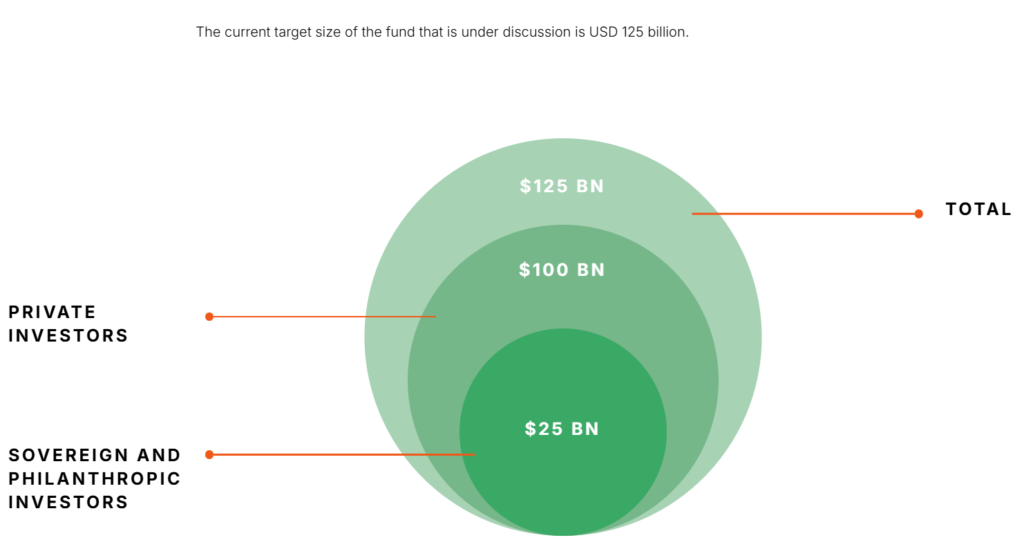
TFFF fund investment structure
Source: TFFF

Investment returns will fund annual payments to eligible tropical forest countries. These payments will depend on verified forest cover and conservation results. Countries that maintain their forests can receive payments, while deforestation and forest degradation can lead to deductions.

National forest monitoring systems and satellite data will help track forest conditions and verify results.

At least 20% of payments must go to Indigenous Peoples and local communities. This requirement recognizes their role in protecting forests and aims to ensure that conservation funding reaches the people who depend on these ecosystems.

TFFF Seeks US$10 Billion in Initial Capital to Attract Private Investment

The TFFF aims to raise US$10 billion in initial sponsor capital by the end of 2026. Its wider financing model seeks to use public and philanthropic funding to attract much larger private investment.

Under the latest target outlined by the Canadian government, US35 billion in sponsor contributions could help mobilize up to US$140 billion in private investment. Returns from these investments would then support payments to countries that meet the facility’s forest protection requirements.

Several countries have already announced commitments. These include US$3 billion from Norway, US$1 billion each from Brazil and Indonesia, €1 billion from Germany, €500 million from France, and £400 million from the United Kingdom.

The Netherlands also pledged up to US$500 million over 10 years in October 2026. These are announced commitments, not necessarily funds already received or invested.

Private foundations are also supporting the initiative. A coalition of philanthropic groups announced plans to commit about US$88 million, while the Minderoo Foundation increased its commitment to US15 million.

Before Canada’s announcement, the TFFF still faced a reported US$2.1 billion gap toward its initial US$ 10 billion target. Canada’s pledge could help close part of that gap, but the facility still needs to secure the remaining capital.

The World Bank will serve as trustee of the TFFF’s Financial Intermediary Fund and host its interim secretariat. Luxembourg will host the investment arm, known as the Tropical Forest Investment Fund.
CANADA TFFF

Tropical Forest Loss Remains a Major Climate Risk

The TFFF comes as tropical forests continue to face pressure from agriculture, logging, fires, and other land-use changes.

According to the World Resources Institute (WRI), the world lost 4.3 million hectares of tropical primary rainforest in 2025. This was 36% less than in 2024 but still 46% higher than the level recorded a decade earlier. The loss was equal to about 11 football fields every minute.

In 2024, tropical primary forest loss reached 6.7 million hectares and caused an estimated 3.1 billion tonnes of greenhouse gas emissions, WRI reported. Tropical forests are important carbon sinks. They absorb and store carbon dioxide while helping regulate rainfall, protect soils, and support biodiversity.

The TFFF’s supporters estimate that tropical forests absorb around 7 billion tonnes of carbon dioxide each year. They also provide food, water, and fuel for about 1.2 billion people.

Continued forest loss, therefore, threatens both climate goals and the livelihoods of communities that depend on these ecosystems.

How TFFF Differs From Carbon Credit Markets

The TFFF is designed to complement existing carbon markets, not replace them. It does not issue carbon credits or biodiversity credits, operate as an offset program, or directly finance individual forest projects.

Instead, it provides payments to countries based on their forest protection results. This differs from programs that generate carbon credits from measured emissions reductions or carbon removals.

For example, REDD+ programs can generate credits from activities that reduce emissions caused by deforestation and forest degradation. These credits may then be sold to governments or companies.

The TFFF takes a broader approach. Its payments are linked to forest protection at the national level rather than the sale of individual credits.

This distinction is important. The facility is not designed to create another source of carbon offsets. Its goal is to make standing forests financially valuable to the countries that protect them.

The model could also help address a major challenge in forest conservation. Many countries face strong economic pressure to convert forests into farmland, plantations, or other commercial uses.

Indigenous Communities and Forest Countries at the Center

The TFFF’s requirement to direct at least 20% of payments to Indigenous Peoples and local communities is a key part of its design.

Indigenous communities have long called for greater access to climate finance and stronger recognition of their land rights. Yet, funding often fails to reach them because of complex rules, limited access to financial systems, and weak benefit-sharing arrangements.

The TFFF’s payment requirement could help address this gap. However, its impact will depend on how countries distribute the money and involve communities in decisions. The facility will also need clear rules to measure forest protection, verify results, and prevent deforestation from simply moving to other areas.

TFFF Faces Funding and Implementation Challenges Ahead of Launch

Canada’s pledge adds momentum to the TFFF as it works toward its initial fundraising target. Its investment model offers a different way to fund forest conservation by using financial returns to support long-term payments.

However, major challenges remain. The facility must secure enough sponsor capital, attract private investors, and build a reliable system to monitor forests across many countries.

It must also ensure that payments reach the communities responsible for protecting these ecosystems. Transparent reporting and strong safeguards will be important to maintain trust among governments, investors, and local groups.

The TFFF cannot replace the need to cut fossil fuel emissions or address the main causes of deforestation. But it could give tropical countries a more reliable financial reason to keep their forests standing.

Canada’s commitment is another step toward that goal. The real test will be whether the facility can turn its funding pledges into lasting forest protection.

The post Canada Pledges Up to C$560 Million to Tropical Forest Fund appeared first on Carbon Credits.

China and Türkiye Sign $15 Billion Renewable Energy Deal at COP31, Target 7 GW of Solar and Wind

China and Türkiye Sign $15 Billion Renewable Energy Deal at COP31, Target 7 GW of Solar and Wind

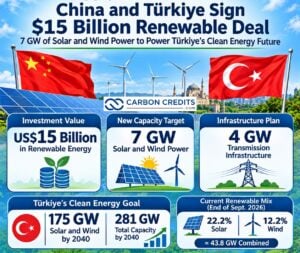
China and Türkiye have signed a preliminary agreement that could bring about US$15 billion in renewable energy investment to Türkiye. Announced during COP31 in Antalya, the deal aims to develop 7 gigawatts (GW) of solar and wind power, new energy storage systems, and 4 GW of electricity transmission infrastructure.

The agreement supports Türkiye’s plan to expand clean energy, improve energy security, and reduce its dependence on imported fossil fuels. It also includes technology transfer and plans to produce wind turbine equipment locally.

However, the US$15 billion is an estimated investment under a preliminary memorandum of understanding (MoU). The governments have not yet disclosed project locations, financing terms, participating companies, or construction schedules.

China–Türkiye Deal Targets 7 GW of New Renewable Capacity

Türkiye’s Ministry of Energy and Natural Resources and China’s National Energy Administration signed the MoU during COP31. Energy Minister Alparslan Bayraktar announced the agreement, which outlines several areas of cooperation.

The proposed investment covers 7,000 megawatts (MW) of combined solar and wind power capacity. It also includes new energy storage systems and 4,000 MW of electricity transmission infrastructure.

The deal goes beyond building new renewable power plants. It also aims to transfer technology and support local production of wind turbine equipment in Türkiye. This could help develop the country’s domestic supply chain and create opportunities for local manufacturers.

China is a major global supplier of solar panels, batteries, and wind power equipment. Its involvement could support Türkiye’s plans to expand renewable energy while building more local manufacturing capacity.

Still, key details remain unknown. The announcement does not identify the companies involved, the amount of storage capacity planned, or when construction could begin. The US$15 billion should be seen as a proposed investment. It is not for money already spent or projects that are under construction.

Türkiye Sets 175 GW Solar and Wind Goal for 2040

The agreement comes as Türkiye prepares for a major expansion of its power system. Under its National Energy 2040 vision, the country aims to increase total installed electricity capacity from about 128 GW to 281 GW by 2040.

Solar and wind are expected to account for 175 GW of that total. The plan also includes 10 GW of nuclear power capacity.

Türkiye’s current renewable energy base gives it a starting point for this expansion. By the end of September 2026, the country had 127,355 MW of installed electricity capacity. Solar accounted for 22.2%, while wind made up 12.2%. Together, they represented about 43.8 GW.

The proposed 7 GW of new solar and wind capacity would equal around 16% of this existing combined capacity. This will be a key step toward the 175 GW target. However, the agreement does not specify how much capacity will be built or when it will start operating.

The government’s wider plan reflects rising electricity demand. Türkiye’s electricity consumption reached 364.8 terawatt-hours (TWh) in 2025. The National Energy Plan expects consumption to reach 455.3 TWh by 2030 and 510.5 TWh by 2035.

China–Türkiye Renewable Energy Deal

Meeting this demand will require more power generation, stronger grids, and systems that can manage a growing share of variable renewable energy.

Fossil Fuels Still Dominate Türkiye’s Power Generation

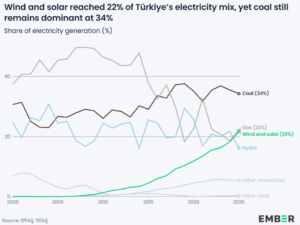
Despite its growing renewable energy capacity, Türkiye still relies heavily on fossil fuels for electricity. Government figures show that the country generated 366.9 TWh of electricity in 2025, an increase of 3.5% from 2024. Coal supplied 33.3% of generation, while natural gas accounted for 22.3%.

Hydropower contributed 15.7%, followed by solar at 11.9% and wind at 10.8%. Geothermal and other sources supplied the remaining share.

  • Solar and wind together generated 22.7% of the country’s electricity. Coal and natural gas still provided more than half.

This mix shows why adding renewable capacity matters. More solar and wind power could reduce the role of fossil fuels in electricity generation, especially as demand grows.

Turkiye electricity mix 2025
Source: Ember

Energy security is another major reason for the shift. Türkiye imports much of its oil and natural gas, leaving its economy exposed to global fuel prices and supply disruptions. Expanding domestic renewable energy could reduce some of this exposure and diversify its electricity supply.

The International Energy Agency (IEA) has highlighted Türkiye’s dependence on imported fuels and the need to modernize its energy system. Renewable power, energy efficiency, and stronger electricity networks will all play a role in the country’s transition.

Storage and Grid Investment Will Support Türkiye’s Renewable Expansion

The China–Türkiye agreement also covers energy storage and transmission infrastructure. These investments are important because adding solar and wind farms alone will not ensure a reliable electricity supply.

Solar and wind output changes with weather conditions and the time of day. Solar plants, for example, produce less electricity at night. Wind generation can also rise or fall depending on weather patterns.

Battery storage can help balance these changes by storing excess electricity and releasing it when production falls or demand increases. This can make it easier to use more renewable power without relying as heavily on fossil fuel plants.

Transmission networks are just as important. They carry electricity from power plants to homes, businesses, and industries. Stronger grids can help move renewable electricity between regions and reduce bottlenecks that limit new projects.

Türkiye’s National Energy 2040 vision recognizes the need for more storage, flexible power systems, and stronger grid connections. The China agreement could support these goals, although it has not yet disclosed the storage capacity or specific transmission projects involved.

China Deal Could Boost Türkiye’s Local Wind Equipment Industry

The proposed technology transfer is another important part of the agreement. Türkiye wants to produce more wind turbine equipment locally as it expands renewable energy. Working with Chinese companies could give local manufacturers access to equipment, technical knowledge, and production methods.

This could support domestic businesses and create opportunities across the renewable energy supply chain. These may include turbine components, electrical equipment, engineering, construction, and maintenance.

Local manufacturing could also reduce dependence on imported equipment over time. However, the actual benefits will depend on the final investment agreements, technology-sharing terms, and the role given to Turkish suppliers.

The governments have not yet disclosed specific factories, production targets, or local-content requirements. These details will help show whether the agreement leads to a lasting expansion of Türkiye’s clean energy industry.

COP31 Finance Push Supports Türkiye’s 2053 Net-Zero Target

The China–Türkiye agreement is part of a wider effort to finance the country’s energy transition. At COP31, the European Bank for Reconstruction and Development (EBRD) announced it will invest US$6 billion over five years. This funding will support Türkiye’s Renewable Energy Acceleration and Clean Transition Platform (REACT).

The wider platform aims to mobilize US$300 billion by 2040 for renewable power, grids, storage, manufacturing, and electrification. Separately, the Asian Infrastructure Investment Bank (AIIB) signed a US$1.6 billion climate financing package to support policy reforms and Türkiye’s climate commitments. This funding is not direct financing for the China-backed projects.

These investments support Türkiye’s goal of reaching net-zero emissions by 2053. Its 2025 climate pledge aims for a 2035 emissions target of 643 million tonnes of CO2 equivalent (MtCO2e). This is much lower than the projected business-as-usual emissions of 1,109 MtCO2e.

Expanding solar and wind power could help reduce emissions from electricity generation, while electrification could cut fossil fuel use in other sectors. However, Türkiye must also address its continued reliance on coal and natural gas and strengthen its power grid.

The proposed 7 GW of solar and wind capacity, along with storage and transmission upgrades, could support these goals. But the agreement’s impact will depend on implementation. The governments must still confirm project financing, participating companies, and construction plans before the investment can translate into new clean energy capacity and measurable emissions cuts.

The post China and Türkiye Sign $15 Billion Renewable Energy Deal at COP31, Target 7 GW of Solar and Wind appeared first on Carbon Credits.
Rock Tech Strengthens Canadian Lithium Portfolio with New Discovery

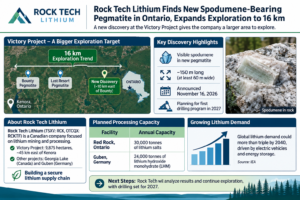
Rock Tech Lithium Inc. (TSXV: RCK) (OTCQX: RCKTF) has discovered a new lithium-bearing rock formation at its Victory Lithium Project in northwestern Ontario, Canada. The discovery extends the project’s known lithium exploration trend from approximately 6 kilometers to 16 kilometers, giving the company a larger area to explore.

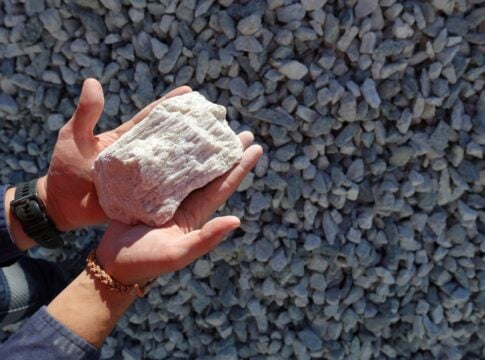
The new discovery contains visible spodumene, a mineral used to produce lithium for electric vehicle (EV) batteries and energy storage systems. Rock Tech identified the pegmatite about 10 kilometers east of its previously known Bounty Pegmatite.

The company announced the discovery on November 16, 2026. It plans to study the new area further and use the results to prepare for its first drilling program at Victory in 2027.

Rock Tech Finds New Spodumene-Bearing Pegmatite at Victory

Rock Tech identified the new pegmatite during its 2026 exploration program. The exposed rock formation measures approximately 150 meters along strike and at least 60 meters across.

The company also used handheld Laser-Induced Breakdown Spectroscopy (LIBS) equipment to check selected crystals for lithium. The initial tests detected lithium, supporting the team’s geological observations.

However, these readings are preliminary. Laboratory tests will provide more reliable information about the lithium content and quality of the mineralization.

Rock Tech has sent samples to Activation Laboratories (Actlabs) in Thunder Bay, Ontario. The laboratory will test the samples for lithium oxide (Li₂O) content and other elements commonly found in lithium-cesium-tantalum (LCT) pegmatites.

These results will help the company understand the mineral composition of the discovery and decide where to focus its next exploration activities.

The Victory Project now has three known spodumene-bearing pegmatite areas:

  • Bounty: A previously identified pegmatite and an important exploration target.
  • Last Resort: Another known lithium-bearing pegmatite occurrence.
  • New discovery: A recently identified pegmatite located approximately 10 kilometers east of Bounty.

The expanded 16-kilometer trend connects the wider exploration area, but it does not mean that lithium mineralization extends continuously across the entire distance. Rock Tech still needs drilling and further testing to establish the size, grade and continuity of the mineralization.

rock tech

Victory Project Adds to Rock Tech’s Canadian Lithium Portfolio

Rock Tech Lithium is a Canadian company focused on developing lithium resources and processing facilities. Its strategy covers both lithium mining and conversion, which involves turning raw lithium materials into chemicals used in battery production.

The Victory Project covers approximately 9,875 hectares and lies around 45 kilometers east of Kenora, Ontario. Rock Tech secured an option to acquire 100% of the property in June 2026.

The location also offers access to important infrastructure that could support future development.

Key advantages include:

  • Access to the Trans-Canada Highway.
  • Nearby railway connections for transporting materials.
  • Access to electricity transmission lines.
  • A natural gas pipeline in the surrounding region.

Rock Tech is exploring Victory as a possible additional source of lithium feedstock for its planned Red Rock Converter in Ontario.

The company also owns the Georgia Lake lithium project in Canada. In Europe, it is developing the Guben lithium converter in Germany.

Rock Tech has outlined the following annual production targets for its processing facilities:

rock tech lithium

These facilities form part of the company’s plan to supply lithium products to battery manufacturers and the growing EV market in North America and Europe.

However, Victory remains at an early exploration stage. The company must complete further studies and establish the project’s resource potential before it can determine whether the property can support commercial mining.

Rising Lithium Demand Supports New Exploration

The discovery comes as lithium demand continues to grow. EV manufacturing remains the biggest driver, while battery energy storage systems are creating another important source of demand.

As countries expand renewable energy capacity, utilities need larger battery systems to store electricity and manage changes in power supply. This trend could increase demand for lithium-based batteries over the coming years.

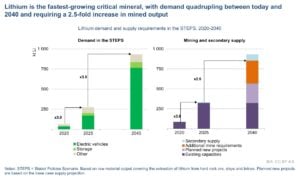
According to the International Energy Agency (IEA), global lithium demand could increase more than threefold between 2025 and 2040 under its Stated Policies Scenario.

lithium global

Meanwhile, lithium production has also increased as miners expand existing operations and bring new projects online.

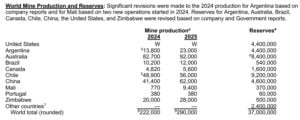
  • The U.S. Geological Survey (USGS) estimates that global lithium mine production, excluding U.S. output, reached approximately 290,000 metric tons in 2025. This was a 31% increase from the previous year.
lithium supply
Source: USGS

Despite this growth, the industry needs more investment in mining and processing capacity to meet future demand. New projects will also help diversify supply, which remains concentrated in a limited number of countries.

Canada is looking to develop its critical minerals sector to support domestic battery manufacturing and reduce reliance on imported raw materials. Ontario could play an important role because of its mining industry, industrial infrastructure and proximity to North American automakers.

For Rock Tech, developing Canadian lithium resources could strengthen its plans to connect mining operations with processing facilities.

Rock Tech Targets First Victory Drilling Program in 2027

Rock Tech will continue geological mapping and sampling across the Victory Project. Laboratory results should provide more information about the newly discovered pegmatite and help the company select drilling locations.

The planned 2027 drilling program will be an important milestone. It could help determine whether the new discovery contains lithium mineralization at depth and whether it can support future development.

For now, the discovery expands Rock Tech’s exploration opportunities in Ontario. Further testing and drilling will determine whether that potential can translate into a commercially viable lithium resource.

The post Rock Tech Strengthens Canadian Lithium Portfolio with New Discovery appeared first on Carbon Credits.

Occidental Secures 2 Million Tons of CO₂ Annually to Support Permian Oil Recovery

Occidental Petroleum (NYSE: OXY) has signed long-term carbon dioxide (CO₂) offtake agreements with two project developers to secure captured emissions for its enhanced oil recovery (EOR) operations in the Permian Basin. The agreements will support the development of carbon capture infrastructure in the Delaware Basin, a major oil and natural gas-producing region in West Texas and southeastern New Mexico.

The two projects are expected to capture and transport approximately 2 million metric tons of CO₂ annually from existing and new natural gas processing facilities. Their combined capacity could eventually increase to 4 million metric tons per year.

The project developers will finance and build the required capture facilities and transportation infrastructure. Occidental expects the first CO₂ deliveries in 2029, subject to final investment decisions.

The agreements mark another step in Occidental’s efforts to secure reliable CO₂ supplies for its oil recovery operations while expanding its carbon management business.

Occidental Expands CO₂ Supply with New Pipeline Infrastructure

Under the agreements, the two project developers will establish nearly 100 miles of new CO₂ pipelines across the Delaware Basin.

These pipelines will connect with Occidental’s existing CO₂ transportation network, which supplies its enhanced oil recovery operations across the wider Permian Basin. The additional infrastructure will also allow other natural gas processing facilities and industrial CO₂ sources to connect to the network.

This could create opportunities to bring more captured carbon into the region and support future oil recovery projects.

Occidental expects the agreements to diversify its CO₂ supply and improve access to more cost-effective sources. The company also highlighted federal 45Q tax incentives as an important factor supporting these investments.

The agreements follow Occidental’s broader strategy of securing third-party CO₂ supplies rather than relying entirely on naturally occurring underground sources.

Why the Permian Basin Matters for Occidental

The Permian Basin plays a central role in the US energy industry. It is the country’s largest oil-producing region and an important source of natural gas.

  • According to the US Energy Information Administration (EIA), the basin produced approximately 6.6 million barrels of crude oil per day in 2025. This represented around 48% of total US crude oil production.
Crude oil
Source: EIA

Natural gas production has also expanded rapidly. The EIA reported that marketed natural gas output in the Permian reached 27.6 billion cubic feet per day in 2025, up approximately 60% from 2021.

This concentration of oil and gas infrastructure makes the region an important market for carbon capture, transportation, and utilization.

CO₂ plays a key role in enhanced oil recovery. Operators inject it into underground reservoirs to increase pressure and help move trapped oil towards production wells. The process can improve recovery from mature fields that have already produced a significant portion of their original reserves.

For Occidental, access to a dependable CO₂ supply can help extend the productive life of existing oil fields and improve recovery from conventional and unconventional resources.

However, using captured CO₂ for EOR does not automatically make the resulting oil production carbon-neutral. The overall climate benefit depends on how much CO₂ remains stored underground, the emissions associated with capture and transportation, and the lifecycle emissions from the additional oil produced.

Carbon Capture Market Gains Investment Momentum

Occidental’s agreements come as the global carbon capture and storage (CCS) industry attracts more investment and new project development.

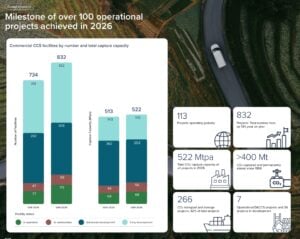
According to the Global CCS Institute’s 2026 data, the industry had 113 commercial CCS projects operating worldwide as of July 31, 2026. Their combined operational capture capacity reached 68 million metric tons of CO₂ annually.

  • Another 56 million metric tons per year of capture capacity was under construction. Once these projects become operational, global capacity could exceed 100 million metric tons annually.
  • More than 400 million metric tons of CO₂ have been captured and permanently stored globally since 1996. This figure represents cumulative storage, not annual capture capacity.
ccs
Source: Global CCS Institute

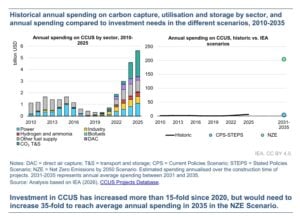
Investment is also increasing. The International Energy Agency (IEA), in its 2026 report Financing CCUS at Scale, reported that investment in carbon capture, utilization and storage (CCUS) exceeded $5 billion in 2025. This represents more than a 15-fold increase since 2020.

ccus investment
Source: IEA

The IEA also noted that more than 30 carbon capture and storage projects reached final investment decisions over the previous two years. The pipeline of projects under construction points to a near doubling of operational capture capacity by 2030.

These developments reflect growing interest in carbon management across industrial sectors, including natural gas processing, cement, steel, power generation, and hydrogen production.

Occidental Builds Its Carbon Management Business

The new agreements strengthen Occidental’s position in the carbon management market. The company is expanding beyond traditional oil and gas production through investments in carbon capture, transportation, utilization, and storage.

Its strategy includes securing third-party CO₂ supplies and developing infrastructure that can connect additional industrial emission sources to its existing network.

The Delaware Basin projects could therefore provide more than a dedicated supply for Occidental’s EOR operations. Their pipeline infrastructure could also support future carbon capture projects across the region.

However, the agreements remain subject to final investment decisions, construction, and regulatory approvals. Initial deliveries are not expected until 2029.

As global investment in carbon capture continues to grow, Occidental’s latest agreements highlight how existing energy infrastructure can support the development of a larger CO₂ transportation and utilization market. The long-term commercial opportunity will depend on project economics, reliable CO₂ supplies, and the ability to demonstrate measurable and lasting emissions reductions.

The post Occidental Secures 2 Million Tons of CO₂ Annually to Support Permian Oil Recovery appeared first on Carbon Credits.
Google Cloud Taps DSV for 10 Million Liters of SAF to Reduce Freight Emissions

Google is expanding its efforts to reduce transportation-related emissions through a new sustainable aviation fuel (SAF) partnership with Denmark-based logistics company DSV. Under the agreement, DSV will help secure nearly 10 million liters of SAF for Google Cloud’s air freight operations.

The companies will begin with a pilot covering a key air freight route. The initiative could also pave the way for broader cooperation on low-carbon logistics as Google works to reduce emissions across its global supply chain.

The fuel comes from waste and residue feedstocks. According to the companies, it can reduce lifecycle greenhouse gas emissions by approximately 85% compared with conventional jet fuel. The agreement also uses a book-and-claim system, allowing Google Cloud to claim the emissions reductions even when the physical fuel is used elsewhere.

How Will the DSV-Google Cloud SAF Agreement Work?

DSV and Google Cloud will use a book-and-claim approach to track the environmental benefits of the fuel. Under this system, SAF does not need to reach the aircraft carrying Google’s shipments. Instead, the companies allocate the associated emissions reductions to Google Cloud through a separate accounting process.

The agreement also includes third-party certification under the International Sustainability and Carbon Certification (ISCC) scheme. The fuel’s environmental attributes will be recorded, transferred, and retired through the independent Sustainable Aviation Fuel Certificate Registry.

DSV will maintain additional internal tracking to ensure that each emissions reduction goes to a specific shipper. This process also helps prevent double-counting and creates an auditable record for Google’s emissions reporting.

Frank Sobotka, CEO of DSV’s Air & Sea Division, said the partnership would help turn customer sustainability goals into measurable reductions in freight emissions.

Meanwhile, Google Cloud’s logistics leadership described the pilot as a transparent way to address emissions across its global transportation network.

Global SAF Production Grows, but Supply Remains Limited

The agreement comes as the aviation industry struggles to increase SAF production. Although output is rising, the fuel still represents a very small share of global aviation consumption.

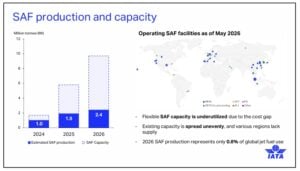
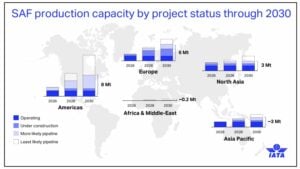
According to the International Air Transport Association (IATA), global SAF production reached approximately 1.9 million tonnes in 2025, nearly double the 1 million tonnes produced in 2024. However, this represented only 0.6% of global jet fuel consumption.

IATA expects production to reach around 2.4 million tonnes in 2026, equivalent to just 0.8% of total aviation fuel demand. The association also estimates that airlines will face an additional US$4.3 billion in SAF-related fuel costs in 2026.

SAF
Source: IATA

The gap between production capacity and actual output presents another challenge. IATA estimates that global SAF production capacity could exceed 9 million tonnes in 2026. Yet, expected production remains much lower at 2.4 million tonnes. High costs, limited feedstock availability, and uneven policy support continue to hold back the market.

What Is Driving SAF Production and Demand?

Producers can make SAF through several technologies using renewable and waste-based materials. The most established commercial route is Hydroprocessed Esters and Fatty Acids (HEFA). It converts used cooking oil, animal fats, and other waste oils into aviation fuel.

Other production pathways include:

  • Alcohol-to-Jet (AtJ): Converts alcohols, including ethanol, into aviation fuel.
  • Fischer-Tropsch (FT): Uses synthesis gas from biomass or other suitable feedstocks to produce liquid fuels.
  • Power-to-Liquid (PtL): Combines green hydrogen with captured carbon dioxide to create synthetic aviation fuel, also known as e-SAF.

However, each pathway faces different challenges. HEFA currently dominates commercial production, but the supply of waste oils and fats is limited. As a result, the industry needs to develop alternative technologies to increase output.

IATA’s global feedstock assessment estimates that the world could produce around 400 million tonnes of SAF annually by 2050. However, the aviation industry may need approximately 500 million tonnes annually to meet its net-zero emissions target. This leaves a potential 100-million-tonne supply gap.

Regional markets are also making progress. In 2025, the European Union supplied approximately 1.1 million tonnes of SAF, representing 2.8% of aviation fuel supplied at its airports. This exceeded the initial 2% requirement under the EU’s ReFuelEU Aviation rules. The fuel also delivered an estimated 3.77 million tonnes of lifecycle CO₂e savings.

SAF
Source: IATA

Google Faces Rising Scope 3 Emissions 

Google’s SAF investment comes as the company faces growing pressure to control emissions from its expanding AI and data center operations.

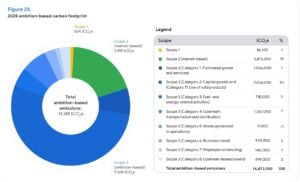
Its 2026 Environmental Report shows that Scope 1 and Scope 2 emissions (market-based) declined 2% year over year in 2025. However, Scope 3 emissions increased 25% to approximately 11.6 million metric tonnes of CO₂e. Higher emissions from hardware manufacturing, logistics, and data center construction contributed to this increase.

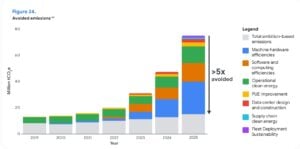
Despite the rise, Google estimates that its decarbonization initiatives avoided more than 58 million metric tonnes of CO₂e in 2025. These efforts included clean energy procurement, hardware efficiency, and improvements in data center operations. Clean energy purchases alone accounted for approximately 12 million tonnes of avoided emissions.

Google emissions

  • Meanwhile, the company continues to expand its SAF partnerships to address emissions from business travel and freight.

In 2024, Google joined United Airlines Ventures’ Sustainable Flight Fund. The fund attracted more than US$200 million in commitments from United Airlines and corporate partners to support SAF development and aviation technologies.

Google also signed an agreement with American Airlines covering 35 million gallons of SAF over three years. The deal is expected to deliver nearly 300,000 tonnes of CO₂e emissions reductions.

In addition, its partnership with Amex GBT and Shell Aviation through the Avelia platform supports SAF adoption through book-and-claim certificates.

Can SAF Partnerships Accelerate Aviation Decarbonization?

Corporate purchasing agreements are becoming an important part of the aviation industry’s transition to lower-carbon fuels. By committing to buy SAF, large companies can help producers secure financing, expand facilities, and develop new production technologies.

However, the market still faces major obstacles. SAF accounts for less than 1% of global jet fuel consumption, while production costs remain higher than those of conventional aviation fuel.

Therefore, scaling the market will require more investment, reliable feedstock supplies, improved production technologies, and stronger policy support.

Google’s agreement with DSV adds to the growing list of corporate initiatives supporting SAF demand. Whether these partnerships can make a meaningful difference will depend on how quickly the industry converts purchasing commitments into additional fuel production.

The post Google Cloud Taps DSV for 10 Million Liters of SAF to Reduce Freight Emissions appeared first on Carbon Credits.
Singapore Expands Carbon Market Push With First Rwanda Project and Bangladesh Deal at COP31

Singapore Expands Carbon Market Push With First Rwanda Project and Bangladesh Deal at COP31

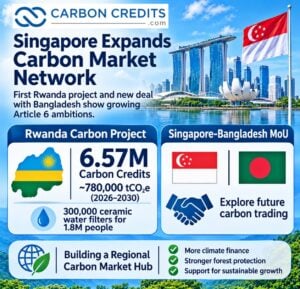
Singapore is expanding its international carbon market network after authorizing its first carbon credit project in Rwanda and signing a new carbon trading agreement with Bangladesh. Both developments, announced at COP31 in Antalya, Türkiye, show how Singapore is turning its Article 6 partnerships into practical projects and new sources of climate finance.

The Rwanda project is expected to reduce about 780,000 tonnes of carbon dioxide equivalent (CO₂e) between 2026 and 2030. It will distribute 300,000 ceramic water filters to households and early childhood centres, giving more people access to safe drinking water.

Singapore also signed a memorandum of understanding (MoU) with Bangladesh to explore future carbon trading. The two countries will work toward a formal agreement that could allow Bangladesh to transfer eligible carbon credits to Singapore.

These steps form part of a wider plan to build a regional carbon market hub. Singapore is also working with the World Bank and private groups to improve project funding, carbon registries, and access to buyers.

Singapore Approves First Rwanda Carbon Project Under Article 6

On November 14, Singapore’s National Environment Agency (NEA) announced its first project authorization under its carbon market agreement with Rwanda. Singapore-based Climate Bridge International developed the Safe Water Supply Project. It will distribute 300,000 ceramic water filters across Rwanda, focusing on the Western Province.

The filters will provide clean drinking water without the need to boil it using firewood or charcoal. This can lower fuel use, reduce emissions, and improve indoor air quality.

  • The project is expected to benefit around 1.8 million people and reduce about 780,000 tonnes of CO₂e from 2026 to 2030. The first 10,000 filters began distribution in June 2026, with the rest planned for 2027.

This is the first project authorized under Singapore’s six operationalised Article 6 agreements. More than 20 other projects are also being assessed under its agreement with Rwanda.

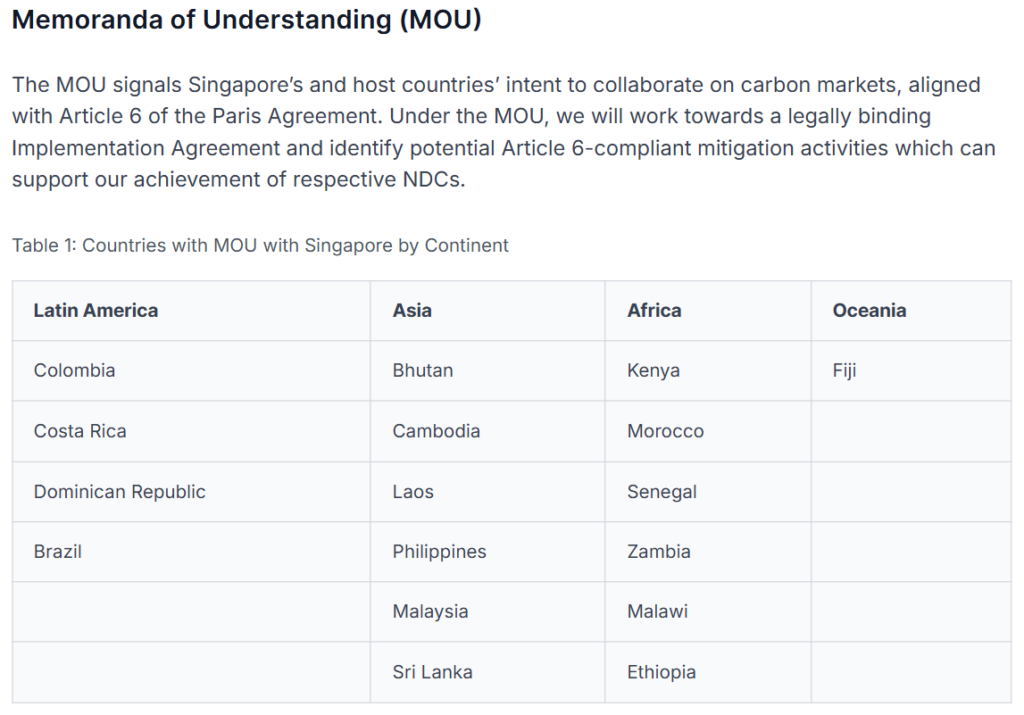
Countries with MOU with Singapore by Continent
Source: Singapore’s Carbon Markets Cooperation

However, authorization does not mean that all 780,000 credits have already been issued or transferred. The project must still undergo independent checks and credit issuance. The two countries must also approve the transfer of eligible credits.

Under Article 6 of the Paris Agreement, countries must make a corresponding adjustment when they transfer credits internationally. This prevents both countries from counting the same emissions reduction toward their climate targets.

The Singaporean official document reads:

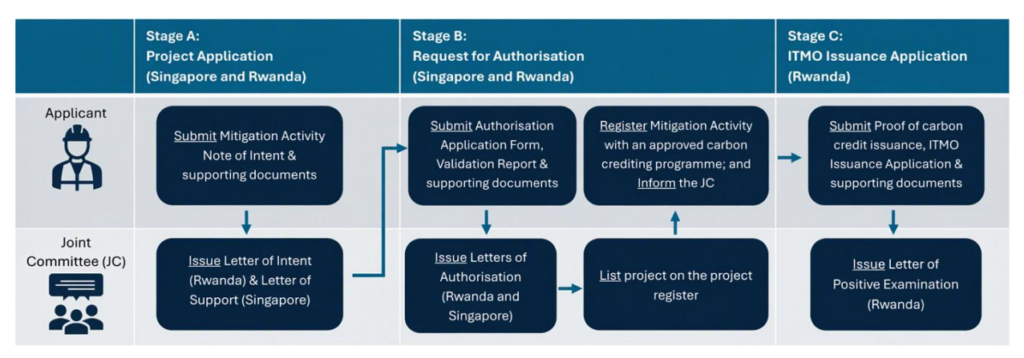
“The Singapore-Rwanda IA comprises three stages, corresponding to different stages of a carbon credit project’s development and implementation. At each stage, Singapore and Rwanda assess applications against their respective requirements. For Singapore, projects must meet Singapore’s eligibility criteria for International Carbon Credits (ICCs).”

Singapore Rwanda carbon credit agreement
Source: NEA

Singapore and Bangladesh Explore Carbon Trading

Singapore and Bangladesh also signed an MoU on November 14 to develop carbon market cooperation under Article 6. The agreement sets the stage for talks on a legally binding implementation agreement. This would establish how both countries approve projects and transfer eligible carbon credits from Bangladesh to Singapore.

The two governments also plan to share knowledge and support the growth of high-quality carbon markets. Bangladesh could gain new funding for projects that cut emissions and support sustainable development. Singapore could gain another source of international credits for companies covered by its carbon tax.

Permanent Secretary Melvyn Ong remarked:

“Carbon markets are a new area of partnership for Singapore and Bangladesh, and this MOU is an exciting next step in our relationship. Together, we will work towards an Implementation Agreement and enable the development of high-integrity carbon credit projects that support both countries’ climate goals.”

The MoU is an early step, however. It does not yet allow Bangladesh to transfer credits for use under Singapore’s carbon tax system. That will require a formal agreement and approved projects.

The deal adds to Singapore’s growing network of carbon market partners across Asia, Africa, and South America.

Singapore Expands Its Article 6 Network

Singapore has signed carbon market agreements with 12 countries: Papua New Guinea, Ghana, Bhutan, Peru, Chile, Rwanda, Paraguay, Thailand, Mongolia, Vietnam, the Philippines, and Laos.

Six agreements have been operationalized, with project application processes open for Ghana, Bhutan, Peru, Rwanda, Thailand, and Mongolia. These partnerships follow Article 6.2 of the Paris Agreement, which allows countries to trade emissions reductions toward their climate goals.

Singapore’s rules also include safeguards. Five percent of proceeds from authorised credits must support climate adaptation in host countries or the UN Adaptation Fund. In addition, 2% of authorised credits must be cancelled at issuance to help reduce global emissions.

These rules aim to ensure that carbon trading supports wider climate action, rather than simply moving credits between countries.

MORE STORIES on Singapore:

World Bank Partnership Supports Carbon Market Growth

Singapore is also working with the World Bank to help developing countries build the systems needed to take part in carbon markets. The two partners signed a 2027–2029 activity plan under the Singapore Carbon Markets for Development Programme at COP31.

  • The plan will focus on three areas: carbon market systems, project funding, and technical support.

It will help countries develop carbon registries and digital systems to track and verify emissions reductions. It will also explore ways to combine smaller projects into larger groups to attract investment.

This is important because many developing countries lack the funding, skills, and systems needed to bring carbon projects to market. Better infrastructure can help them attract buyers and manage credit transactions.

The programme also plans to develop a Carbon Registry Toolkit to guide countries in setting up and running their own registries.

Singapore Expands Carbon Market Network

New Initiatives Aim to Grow Credit Supply and Demand

Singapore also announced new efforts to support carbon project development and increase demand for credits. Its Economic Development Board awarded grants to myclimate and Conservation International to support early-stage projects in Southeast Asia. Potential areas include forest protection, mangrove restoration, and other nature-based projects.

Climate Action Reserve also plans to open an office in Singapore. It will work on carbon standards and project methods for the Asia-Pacific region, including coastal ecosystems, peatlands, and industrial emissions.

On the demand side, Climate Impact X launched a platform to make it easier for companies covered by Singapore’s carbon tax to buy eligible credits.

Another effort is the Action for a Resilient Climate (ARC) Coalition. It aims to bring together corporate buyers and support at least 10 million tonnes of carbon credit purchases by 2030. Its first request for proposals will target 1 million tonnes of nature-based credits in the first half of 2027.

While these are future targets, not completed purchases, they show how Singapore is trying to build both sides of the market: more projects and more buyers.

Carbon Tax Creates Demand for Eligible International Credits

Singapore’s carbon tax is another key driver of its carbon market plans. Companies covered by the tax can use eligible International Carbon Credits (ICCs) to offset up to 5% of their taxable emissions each year.

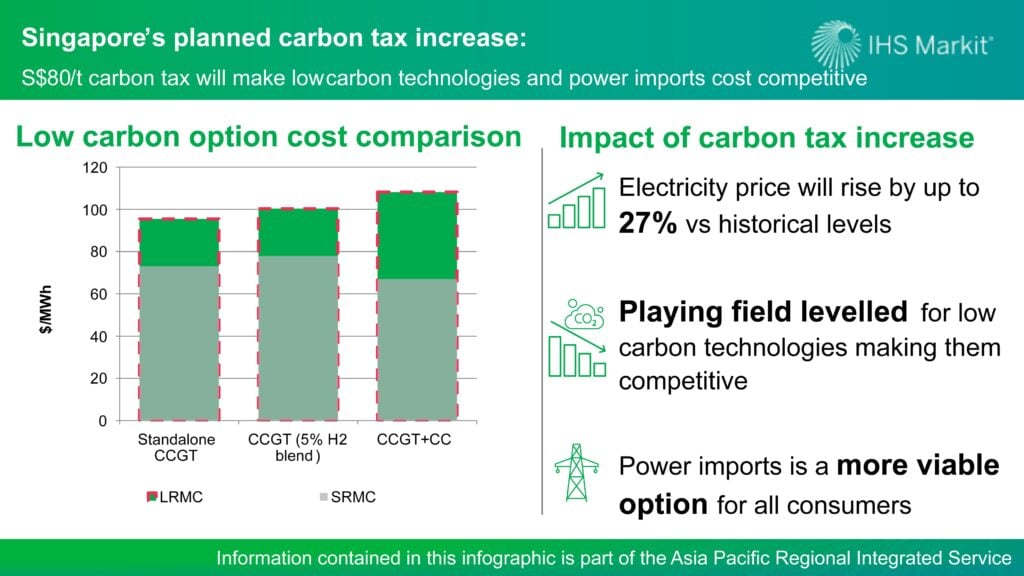
The government raised the carbon tax to S45 per tonne of CO₂e for 2026, up from S25 in 2025. It plans to increase the rate to between S50 and S80 per tonne by 2030.

singapore carbon tax increase
Source: IHS Markit

The higher tax rate gives companies a stronger reason to cut emissions and consider eligible carbon credits. It also creates demand for projects in partner countries.

However, the supply of approved credits has been limited. Singapore previously allowed companies to carry forward unused credit allowances from emissions year 2025 to 2026 because eligible international credits were not widely available.

The first Rwanda project authorisation is an important step toward building that supply. More projects must still pass the required checks before their credits can be used.

Singapore Seeks to Turn Carbon Deals Into a Regional Market Hub

Singapore’s latest moves show that it seeks to play a larger role in international carbon trading. The Rwanda project is a first example of its bilateral agreements moving into project authorization. The Bangladesh MoU expands its potential partner network, while the World Bank programme and private-sector initiatives aim to improve funding, project development, and access to buyers.

For developing countries, these partnerships could provide new funding for clean water, forest protection, renewable energy, and other climate projects. However, the market’s success will depend on more than agreements and targets. Projects must deliver real emissions reductions, credits must pass independent checks, and buyers must be willing to purchase them.

Singapore’s next challenge is to turn its growing network of partnerships into a steady supply of eligible credits and measurable climate benefits. If it succeeds, the country could strengthen its position as a regional hub for high-quality carbon markets while helping developing countries attract more climate finance.

The post Singapore Expands Carbon Market Push With First Rwanda Project and Bangladesh Deal at COP31 appeared first on Carbon Credits.

Oklo Signs HALEU Fuel Deal with Centrus Energy for 1.2 GW Ohio Nuclear Project

Oklo Inc. (NYSE: OKLO) has signed multi-year agreements with Centrus Energy Corp. (NYSE: LEU) to secure nuclear fuel for its planned advanced reactor deployment in Ohio. The deal will provide high-assay low-enriched uranium (HALEU) to support up to five Aurora powerhouses as Oklo advances its proposed 1.2-gigawatt (GW) power campus.

The agreements also support the development of America’s domestic nuclear fuel supply chain. Oklo will make advance payments to Centrus for future fuel deliveries, helping the company expand its uranium enrichment capacity. Deliveries are expected to begin in 2029 from Centrus’ American Centrifuge Plant in Piketon, Ohio.

The announcement formalizes a letter of intent signed by both companies in June 2026. It also advances their efforts to secure fuel for Oklo’s planned commercial reactor deployments.

Oklo and Centrus Move Ahead With Ohio Nuclear Project

Under the agreements, Centrus will supply enough HALEU to support up to five Aurora powerhouses over multiple years. The fuel will serve the first phase of Oklo’s planned Ohio campus, future Aurora deployments, and additional refueling needs for the Aurora-INL project in Idaho.

The proposed Ohio campus will have a total capacity of 1.2 GW and is linked to Oklo’s partnership with Meta. The tech company has agreed to make advance payments for future electricity production, supporting Oklo’s project development and fuel procurement plans.

This partnership connects growing electricity demand with investment in nuclear infrastructure. Meta gains a potential long-term source of reliable electricity, while Oklo secures financial support for its planned power generation capacity.

The project could also benefit Ohio’s economy. The companies expect the wider development to support thousands of direct and indirect jobs at full buildout. It could create opportunities for local businesses, expand the skilled workforce, and increase tax revenues for state and local governments.

OKLO stock

Why HALEU Matters for Advanced Nuclear Energy

Access to HALEU remains a major challenge for companies developing next-generation nuclear reactors.

HALEU contains uranium enriched to more than 5% but less than 20% of the uranium-235 isotope. Conventional commercial nuclear reactors generally use uranium enriched to between 3% and 5%.

The higher enrichment allows certain advanced reactor designs to operate with smaller cores and potentially longer refueling cycles. It can also improve fuel efficiency and reduce fuel requirements. As a result, HALEU has become an important fuel for several advanced nuclear technologies under development in the United States.

However, domestic production remains limited. The country needs more enrichment capacity to support advanced reactor projects and reduce its reliance on foreign nuclear fuel suppliers. Without reliable access to HALEU, developers could face delays in reactor testing, construction, and commercial deployment.

centrus HALEU
Source: Centrus Energy

The Oklo-Centrus agreement helps address this challenge by connecting future fuel demand with investment in domestic production.

US Nuclear Energy Demand Creates New Opportunities

The agreement comes as nuclear power maintains an important position in the US electricity mix. At the same time, electricity demand is rising because of data centers, artificial intelligence (AI), and industrial expansion.

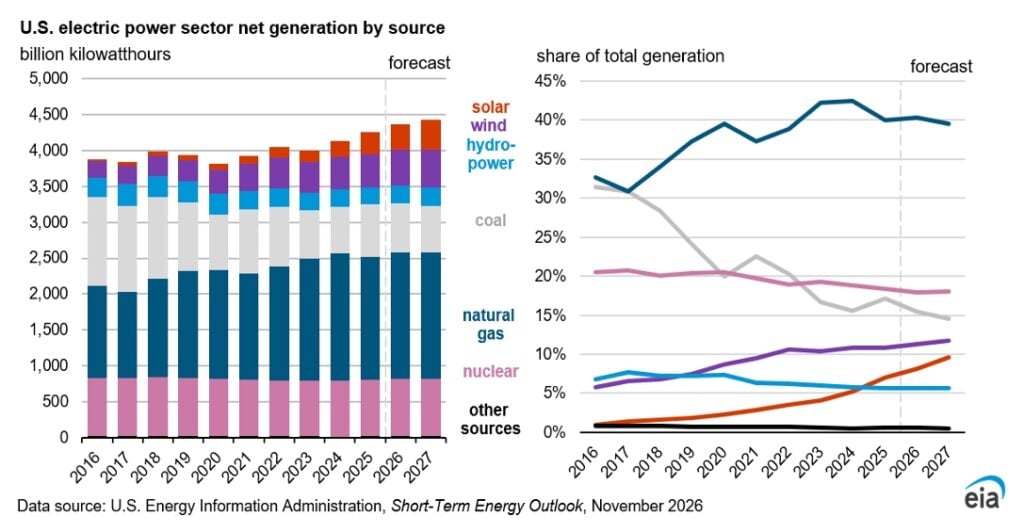
According to the US Energy Information Administration (EIA), nuclear power generated approximately 18% of US utility-scale electricity in 2025. It remains one of the country’s largest sources of low-carbon electricity.

The EIA’s November 2026 Short-Term Energy Outlook projects that nuclear power will continue to supply around 18% of US electricity generation in 2026 and 2027. Total US electricity generation is expected to reach approximately 4,368 billion kilowatt-hours in 2026, up 2.2% from 2025.

eia nuclear energy US

The United States currently has 94 operating commercial nuclear reactors across 54 power plants in 28 states, according to EIA data from March 2026. Together, these reactors have approximately 98.4 GW of net summer generating capacity.

The existing nuclear fleet also recorded an average capacity factor of 91% in 2025. This means reactors operated close to their maximum generating capacity for most of the year, highlighting their ability to provide consistent electricity.

As electricity consumption grows, advanced nuclear technologies could add more reliable power to the grid. They could also serve large industrial facilities and data centers that require electricity around the clock. However, expanding reactor capacity will require both new generating technologies and a dependable fuel supply.

Centrus Energy Expands America’s Nuclear Fuel Supply Chain

Centrus Energy plays an important role in the US nuclear fuel market. The company provides uranium enrichment services and nuclear fuel to commercial power producers and government customers.

Its American Centrifuge technology can enrich uranium for conventional reactors and advanced nuclear systems that require HALEU. Centrus operates its enrichment facility in Piketon, Ohio, and manufactures centrifuge equipment at its facility in Oak Ridge, Tennessee.

The company began producing HALEU at its Piketon facility in late 2023 under a contract with the US Department of Energy (DOE). It is now working to expand production and strengthen domestic enrichment capabilities.

In October 2026, Centrus completed and began shipping its first new centrifuge from its Oak Ridge manufacturing facility to support the expansion of uranium enrichment capacity in Ohio. This development marks progress toward scaling up its production infrastructure.

Centrus has also secured $5.4 billion in customer contracts and commitments to purchase low-enriched uranium (LEU) and HALEU from its planned new capacity, according to the company’s announcement. These commitments reflect growing interest in securing domestic nuclear fuel supplies.

What the Agreement Means for Oklo’s Expansion

The agreement strengthens Oklo’s plans to expand beyond its initial Aurora deployment in Idaho. Securing fuel well ahead of expected deliveries could help the company address one of the major challenges facing advanced reactor developers.

Meta’s involvement also highlights how technology companies are exploring nuclear energy to meet their growing electricity needs.

However, the fuel agreement alone does not guarantee that Oklo’s planned powerhouses will enter commercial operation on schedule. The company must still advance project development, construction, licensing, and other regulatory requirements.

For now, the deal gives Oklo a clearer path to securing fuel for its Ohio campus while supporting Centrus’ domestic enrichment expansion. It also highlights the importance of building both advanced reactors and the fuel infrastructure needed to operate them.

The post Oklo Signs HALEU Fuel Deal with Centrus Energy for 1.2 GW Ohio Nuclear Project appeared first on Carbon Credits.
Varaha’s Community Biochar Project Gets BeZero A.pre Rating Ahead of 2027 Credit Issuance

India’s biochar carbon removal market is gaining traction as developers turn agricultural waste into carbon removal credits. Varaha, an Indian climate-tech company, has reached another milestone with its community-led biochar project, Agnisparsh, receiving an A.pre ex ante rating from BeZero Carbon.

The rating, assessed as of October 2026, indicates low project execution risk. It also adds independent support to Varaha’s efforts to scale community-based carbon removal in India.

Located in western India, Agnisparsh will convert agricultural residues collected from smallholder farmers into biochar. Instead of burning crop waste after harvest, the project will use it to produce a carbon-rich material that can be returned to farms.

Varaha plans to begin issuing carbon credits from the project in January 2027. It expects to deliver more than 100,000 tonnes of carbon removals during 2027 alone.

Madhur Jain, Co-founder and CEO, Varaha, said:

“Distributed biochar will only scale if buyers can trust every tonne, and that trust has to be earned through independent scrutiny. While to date, all of our industrial-rated biochar projects have been A-rated, this rating shows that community-led biochar does not need to compromise in quality. The combination of community engagement, quality and affordability will enable us to scale this project quickly and sustainably.”

How Varaha’s Agnisparsh Project Works

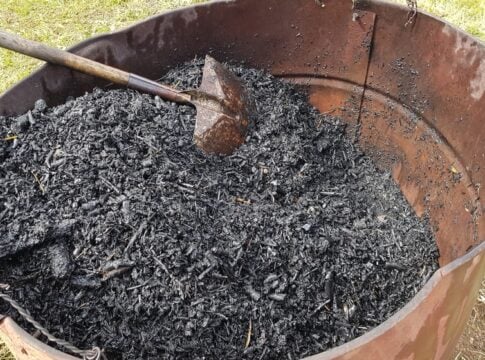
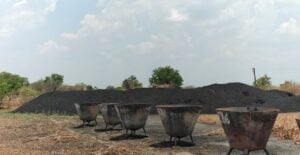
At full capacity, Agnisparsh will operate around 450 Kon-Tiki kilns across multiple mobile sites in western India.

These kilns will turn agricultural waste into biochar through a process called pyrolysis. It involves heating biomass with limited oxygen, which prevents it from burning completely.

The process converts part of the biomass carbon into a stable form that can remain stored in soil for long periods. Farmers can also use biochar to improve soil quality, water retention, and nutrient availability.

The project follows a community-led model. Local smallholder farmers will supply agricultural residues, and Varaha will return most of the resulting biochar to them free of charge.

This creates two benefits. Farmers get an alternative to open-field crop burning and access to a useful soil amendment. At the same time, the project removes carbon from the atmosphere and creates opportunities for local communities to participate in the carbon market.

Agnisparsh follows Rainbow’s Distributed Open-Kiln Biochar Methodology (Version 1.0). The methodology requires digital measurement, reporting, and verification (dMRV) to track production and carbon removal.

In March 2026, the Integrity Council for the Voluntary Carbon Market (ICVCM) confirmed Rainbow’s eligibility under its Core Carbon Principles (CCPs). However, the specific methodology is still under assessment. If approved, eligible credits from Agnisparsh could carry the CCP label.

biochar
Source: Varaha

Ludovic Chatoux, Co-founder and CEO of Rainbow, said:

“When it comes to carbon removal, distributed biochar is one of the most interesting pathways. It gives smallholder farmers a new source of income and healthier soils, and it can scale fast without heavy upfront investment. Developers like Varaha showed us that strong MRV is possible in the field, so we built a methodology with the rigour to match, including mandatory digital MRV. This rating is a strong signal for the whole pathway.”

What Does BeZero’s A.pre Rating Mean?

BeZero Carbon’s A.pre rating is an independent assessment of a project’s expected carbon removal performance before it issues credits.

The rating considers three important factors: additionality, carbon accounting, and permanence. In simple terms, it assesses whether the project delivers carbon removal that would not otherwise happen, measures it accurately, and stores the carbon for a meaningful period.

For buyers, this assessment provides an early indication of project quality and delivery risks. However, an ex ante rating does not guarantee future credit issuance or actual carbon removal.

The A.pre rating also highlights the potential of distributed biochar projects. They can involve many small production sites and local farmers rather than relying only on large industrial facilities.

India’s Biochar Market and Carbon Credit Issuance

India has significant potential to expand biochar production because of its large agricultural sector and access to crop residues. Rice husks, cotton stalks, sugarcane waste, and other agricultural materials can serve as feedstock.

Converting this waste into biochar offers an alternative to open-field burning while creating a new source of carbon removal credits.

The market is already seeing early commercial activity. A report by the Council on Energy, Environment and Water (CEEW) estimates that Indian projects have issued around 214,000 durable carbon removal credits. Biochar accounts for approximately 114,000 tonnes of this total, based largely on voluntary carbon market registry data.

These figures show that biochar is already an important part of India’s emerging durable carbon removal industry.

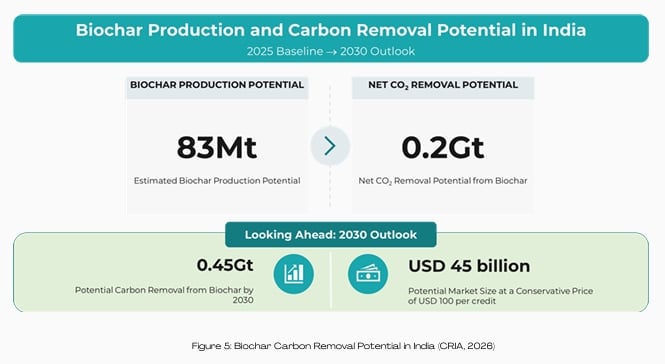
The country also has room to expand beyond its domestic market. The Carbon Removal India Alliance (CRIA) and BioFlux estimate that India could deliver around 0.2 gigatonnes of net carbon removal annually today, potentially rising to 0.45 gigatonnes by 2030. The report estimates a potential market opportunity of up to $45 billion annually under its assumptions. This covers the broader carbon removal industry, not biochar alone.

biochar india
Source: CRIA

Corporate demand is another growth driver. In January 2025, Google agreed to purchase 100,000 tonnes of biochar-based carbon removals from Varaha. Microsoft also signed a 100,000-tonne biochar carbon removal agreement with the company in January 2026. These deals show how international buyers are supporting India’s growing carbon removal sector.

Can Community-Led Biochar Scale?

Varaha’s Agnisparsh project highlights how India could combine agricultural waste management with carbon removal and rural development.

However, producing biochar does not automatically qualify a project for carbon credits. Developers must prove additionality, maintain accurate records, and demonstrate that the carbon remains stored.

However, scaling this model will require reliable biomass supplies, consistent biochar quality, and strong monitoring across multiple production sites. Digital MRV and independent verification will remain important for maintaining buyer confidence.

The project plans to begin its first credit issuance in January 2027 and deliver more than 100,000 tonnes during the year. If it meets this target, Agnisparsh could become one of the world’s largest biochar projects.

More importantly, it could show that community-led projects can participate in the growing durable carbon removal market without compromising on quality. Its progress will also offer a useful test of India’s ability to scale biochar production and attract international carbon finance.

The post Varaha’s Community Biochar Project Gets BeZero A.pre Rating Ahead of 2027 Credit Issuance appeared first on Carbon Credits.
Indonesia and Japan Expand Forest Carbon Credit Cooperation at COP31

Indonesia and Japan are looking to expand their cooperation in forest-based carbon projects through the Joint Crediting Mechanism (JCM), creating new opportunities for carbon finance, forest restoration, and biodiversity protection. The partnership could also help connect Indonesia’s large forest-carbon potential with Japan’s growing demand for carbon credits under its climate policies.

As per reports, the two countries discussed expanding the collaboration during a bilateral meeting at the 31st UN Climate Change Conference (COP31) in Antalya, Türkiye, on November 9, 2026. Indonesian Deputy Forestry Minister Rohmat Marzuki met with Japanese Deputy Environment Minister Hiroshi Ono to explore ways to develop high-integrity forestry carbon projects.

The discussions focused on more than generating carbon credits. Both countries want projects to support ecosystem restoration, protect biodiversity, and improve livelihoods in local communities.
The initiative also aligns with Indonesia’s broader strategy to attract international investment into nature-based climate solutions while supporting Japan’s carbon market ambitions.

Indonesia Targets 12 Million Hectares for Forest Carbon Removal

Indonesia is preparing an extensive pipeline of forest-based carbon projects under a four-part strategy outlined by its Forestry Ministry.

The plan covers both carbon removal and emissions avoidance, alongside greater participation from local and Indigenous communities.

Its main targets include:

  • 12 million hectares: Restore degraded and severely degraded land through carbon removal projects.
  • 50 million hectares: Protect forests from deforestation and degradation through carbon avoidance projects.
  • 8.3 million hectares: Develop carbon projects through the country’s social forestry program.
  • 1.4 million hectares: Expand carbon project development across customary forests.

These targets offer a substantial potential pipeline for nature-based carbon credits. Restoration projects can generate removals as vegetation and forest ecosystems absorb atmospheric carbon dioxide. Meanwhile, forest protection projects can generate avoided-emission credits by preventing deforestation and forest degradation.
Indonesia also wants peatlands and mangroves to become important parts of its JCM portfolio. Both ecosystems offer significant climate benefits because they store large amounts of carbon in vegetation and soils. Their protection can also support coastal resilience, water management, and biodiversity.

However, the government wants to translate these ambitions into projects with credible methodologies, effective environmental and social safeguards, and meaningful community participation. These requirements will be important for attracting international buyers and maintaining confidence in the resulting credits.

indonesia japan

Japan’s JCM Could Open a New Market for Indonesian Carbon Credits

The JCM could provide an important financing and crediting channel for Indonesia’s forestry ambitions.

Japan established the bilateral mechanism with Indonesia in 2013. It encourages Japanese companies to invest in emissions-reduction and carbon-removal projects in partner countries. The mechanism measures the resulting climate benefits and allows Japan and its partner country to account for their respective contributions.

As of November 2024, the two countries had implemented 51 JCM projects, supporting the deployment of low-carbon technologies, infrastructure, and emissions-reduction activities in Indonesia.

A major development came in October 2024, when Japan and Indonesia signed a mutual recognition arrangement covering the JCM and Indonesia’s national greenhouse gas emissions-reduction certification system. The agreement aims to improve coordination between the two systems and strengthen the framework for international carbon market cooperation.

Japan is also expanding the mechanism internationally. According to its Ministry of Foreign Affairs, the country had established JCM partnerships with 32 countries by April 2026.

  • The latest discussions at COP31 add a stronger forestry focus to this relationship. Indonesia expects the JCM to help connect Japan’s ambition to secure carbon credits equivalent to 100 million tonnes of CO2 by 2030 with its own ecosystem restoration plans.
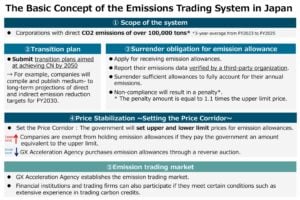
  • Japan’s Green Transformation (GX) Emissions Trading System also creates an additional opportunity. The system entered its mandatory phase in fiscal 2026, increasing the potential role of carbon credits in Japan’s wider decarbonization strategy.
japan emission trading scheme
Source: Ministry of Foreign Affairs, Japan

For Indonesia, this could translate into greater access to international climate finance. For Japanese companies, it could provide opportunities to support measurable emissions reductions and removals through projects in a country with extensive forest and peatland resources.

Forest Carbon Credits Gain Traction in the Global Market

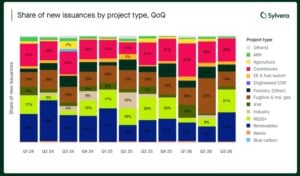
The renewed cooperation comes as forest-based carbon credits continue to attract buyers, although demand increasingly favours projects with stronger environmental integrity and measurable benefits.

This marked a recovery in issuance activity for projects focused on reducing emissions from deforestation and forest degradation.

credit issuances

Indonesia has already demonstrated its potential to supply credits at scale.

The Katingan Peatland Restoration and Conservation Project in Indonesia issued 10.78 million AA-rated credits in Q3 2026, making it the largest contributor to AA-rated issuance during the quarter. The project focuses on protecting peatland ecosystems and preventing emissions associated with their degradation.

Another important development came in July 2026, when Verra announced that it was preparing to issue at least 20 million tonnes of CO2-equivalent credits across three Indonesian forestry projects:

  • Katingan Peatland Restoration and Conservation Project
  • Sumatra Merang Peatland Project
  • The Mayas Project

These projects had secured the necessary approvals under Indonesia’s updated carbon market regulations. The development marked an important step toward aligning international carbon crediting standards with Indonesia’s domestic oversight framework.

The national government also plans to connect its domestic registry with Verra’s registry through an application programming interface (API). This should improve transparency and help track carbon credits for national climate reporting.

Quality and Biodiversity Will Shape Future Forest Carbon Investments

The market’s pricing trends also highlight why Indonesia and Japan are emphasizing high-integrity projects.

  • Sylvera’s Q3 2026 data also showed that BBB+ rated REDD+ credits averaged $7.75 per tonne, up 58% from $4.90 in Q3 2025. This suggests that buyers are increasingly willing to pay more for credits with stronger quality assessments.

However, generating large volumes of credits will not automatically guarantee investment. Projects must demonstrate additionality, establish credible baselines, monitor emissions reductions, and address the risk of carbon leakage and reversal.

Indonesia also faces the challenge of ensuring that forest carbon investments benefit the communities responsible for protecting these ecosystems.

Its social forestry and customary forest initiatives could help bring local communities and Indigenous groups into project development. Meaningful participation, transparent benefit-sharing, and safeguards for land rights will therefore play an important role in determining the success of the partnership.

The emphasis on biodiversity also gives the collaboration a broader environmental focus. Forest protection can deliver benefits beyond carbon storage, including habitat conservation, improved ecosystem resilience, and protection of water resources.

Can the Indonesia-Japan Partnership Scale Forest Carbon Finance?

The expanded JCM cooperation could create a stronger connection between Japan’s demand for international carbon credits and Indonesia’s extensive forest restoration and conservation opportunities.

For Indonesia, Japanese investment could help finance projects across degraded landscapes, peatlands, mangroves, and community-managed forests. For Japan, the partnership could diversify its access to nature-based carbon credits while supporting its international climate commitments.

However, the scale of the opportunity will depend on how quickly both countries translate their discussions into approved projects, credible credit issuance, and long-term financing arrangements.

Ultimately, the partnership could strengthen Indonesia’s position in the international forest carbon market while giving Japan another channel to support its decarbonization goals.

The post Indonesia and Japan Expand Forest Carbon Credit Cooperation at COP31 appeared first on Carbon Credits.