Lithium Prices Fall 23% as Supply Risks Keep Market Volatile

Lithium Prices Fall 23% as Supply Risks Keep Market Volatile

Lithium prices have fallen sharply in recent months, raising concerns about the battery metal’s outlook. However, some analysts say the market remains tight, with supply disruptions and growing demand still posing risks. The sharp swings have also made prices harder to predict.

At a conference in Shanghai on November 11, Roy Zhang, assistant to the president of China’s Ganfeng Lithium, said lithium price movements have become more extreme and market cycles shorter. He added that no one has a clear view of where lithium prices will go over the next six to 12 months.

His comments came as China’s lithium carbonate prices traded well below their May peak. At the same time, Benchmark Mineral Intelligence expects the global market to remain in deficit through 2027, despite recent price weakness.

The gap between falling prices and tight supply forecasts shows how quickly sentiment can change in the lithium market. It also highlights the challenges facing producers, battery makers, and investors as the energy storage and electric vehicle industries expand.

Lithium Prices Drop 23% From This Year’s Highs

China’s spot lithium carbonate prices have fallen about 23% this year to around 91,500 yuan (US$13,700) per tonne, according to figures cited by Bloomberg. The decline follows a strong rally earlier in the year. Prices climbed above 200,000 yuan per tonne in May before falling for several weeks as concerns about future demand grew.

The latest drop is part of a wider cycle of sharp price changes. Benchmark Mineral Intelligence data presented at Benchmark Week 2026 in Shanghai showed lithium prices reaching US$71,000 per tonne in January 2023. They then fell to US$8,100 in June 2025 before recovering to US$22,250 in early 2026. Prices had eased to US$16,200 by July.
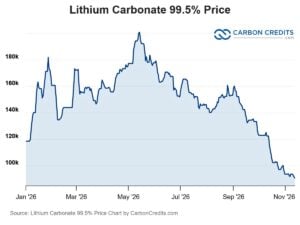
Lithium Carbonate Prices - CarbonCredits

These figures reflect different price points and market assessments, so they should not be treated as one continuous spot-price series. However, they show the scale of the market’s recent swings.

Zhang said lithium had already gone through a full price cycle since the start of 2026, an unusual development for the industry. He also warned that price movements have become harder to forecast as supply, demand, and trading activity grow.

The comments point to a market where short-term expectations can change quickly, even when longer-term demand remains strong.

Mine Restarts and Futures Trading Add Pressure to Lithium Prices

Several factors have weighed on lithium prices. According to Benchmark’s Head of Prices Daisy Jennings-Gray, these include speculative selling on China’s Guangzhou Futures Exchange (GFEX), concerns about high battery-cell inventories, and expectations of more supply entering the market.

Futures trading can influence prices by shaping expectations about future supply and demand. However, price movements in the futures market do not always reflect changes in physical supply or actual consumption.

The outlook for new supply has also affected market sentiment. Some Australian mines, including Mineral Resources’ Bald Hill and Core Lithium’s Finniss operation, have restarted and are shipping inventory. Stronger ore flows from Zimbabwe have added to expectations of higher supply.

Market participants are also watching developments at CATL’s Jianxiawo lithium mine in China. The possibility of a restart has added to expectations that more domestic supply could reach the market.

These developments have made buyers more cautious. If producers bring more material to market while battery makers reduce stockpiles, prices could face further pressure.

However, expected supply does not always become actual supply. Mine restarts, new projects, and expansions depend on operating conditions, costs, permits, and market prices. If prices fall too far, some higher-cost operations may delay production or become uneconomic.

Benchmark Sees Lithium Deficits Through 2027

Despite the recent price decline, Benchmark expects the lithium market to remain in deficit over the next two years. Jennings-Gray presented a forecast for a supply shortfall of 171,000 tonnes in 2026 and 44,000 tonnes in 2027. The market is then expected to move into surplus in 2028.

  • Benchmark expects that surplus to reach 452,000 tonnes in 2031 before the market returns to balance in 2035.

These projections suggest that current price weakness may not reflect the full supply outlook. They also depend on enough new production coming online to meet future demand. If prices remain too low to support investment, some planned supply may not materialize on schedule.

Still, other market forecasts point to a less tight outlook. A S&P Global Energy report said many Chinese market participants expected slower demand growth and rising supply to push the market toward a surplus in 2027.

S&P Global Energy cited a forecast that global lithium raw material supply could rise 26.8% year-over-year to about 2.5 million tonnes of lithium carbonate equivalent in 2027. It also reported expectations that China’s energy storage battery demand growth could slow to around 10% to 20% next year, after a much stronger expansion in 2026.
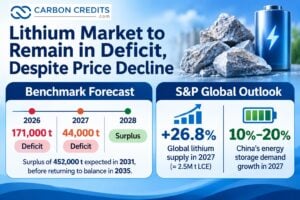
Lithium Market Deficit Outlook

The different outlooks show why lithium prices remain difficult to predict. Supply estimates, demand assumptions, and the timing of new projects can produce very different market balances.

EVs and Energy Storage Keep Demand Growing

Electric vehicles remain the main source of lithium demand. Lithium is a key material in rechargeable batteries used in electric cars, buses, and other vehicles.

However, battery energy storage systems (BESS) are becoming another major source of demand. These systems store electricity for later use and help balance power supply from renewable sources such as solar and wind.

Ganfeng’s Zhang said lithium demand is growing about 40% this year, while supply is also catching up quickly. He described the market balance as fragile, warning that a major disruption at even one mine could quickly change the supply outlook.

The International Energy Agency (IEA) also sees strong long-term demand. Its Global Critical Minerals Outlook 2026 projects that lithium demand will more than triple by 2040 under its Stated Policies Scenario. The agency identifies electric vehicles, battery storage, renewable energy, and electricity networks as major drivers of critical mineral demand.

Benchmark expects EVs to remain the largest source of lithium demand through 2035, even as energy storage grows. China will remain central to this trend. Its demand for EV materials is expected to exceed that of the rest of the world through 2035, according to Benchmark’s analysis.

This makes developments in China especially important for global lithium prices. Changes in Chinese battery production, inventories, and EV sales can influence expectations across the supply chain.
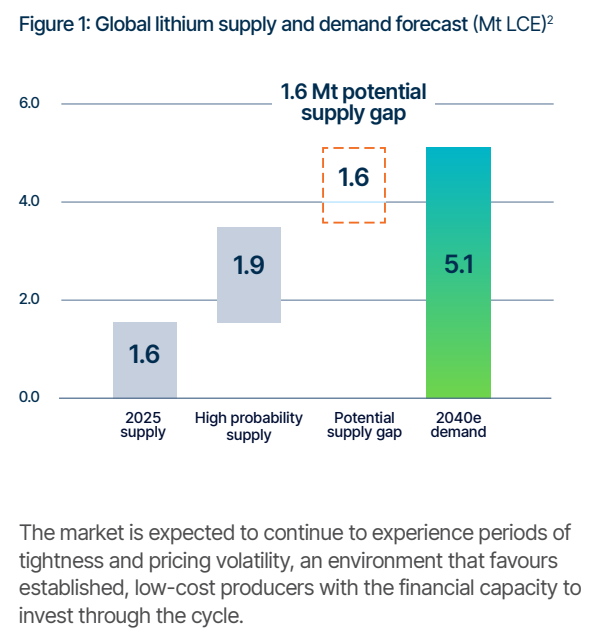
PLS global lithium demand and supply market outlook
Source: PLS Group

Supply Disruptions Could Quickly Change the Market

The lithium market remains exposed to supply risks. Zimbabwe’s export restrictions, changes in mine output, and the possible restart of CATL’s Jianxiawo operation are among the developments that could affect prices in the coming months.

A disruption at a major mine could tighten supply, especially if inventories are already low. On the other hand, a faster recovery in production or a wave of new supply could increase pressure on prices.

The market’s growing dependence on China also adds to the uncertainty. The country plays a major role in lithium processing and battery production, so changes in its industrial activity can affect both supply and demand expectations.

For producers, the current market creates a difficult investment environment. Higher prices can support new mines and expansions, but sharp declines make it harder to plan projects and secure financing. Lower prices may also force higher-cost producers to reduce output.

Battery makers and EV companies face a different challenge. Lower lithium prices can reduce input costs, but sudden price increases can raise battery production expenses. The IEA has noted that lithium and other battery material prices can affect battery costs, even as manufacturers work to improve efficiency and lower overall production costs.

Lithium Market Outlook Remains Uncertain

Lithium’s latest price decline does not necessarily signal a lasting drop in demand. Instead, it reflects a mix of futures-market activity, inventory concerns, expectations of new supply, and uncertainty about future battery production.

Benchmark’s deficit forecast suggests that the market could remain tight through 2027. However, other analysts expect supply growth and slower demand expansion to create a surplus sooner.

For now, the market faces competing forces. EV adoption and energy storage continue to support long-term demand, while mine restarts and new projects could increase supply. Any major disruption could quickly change that balance.

As Ganfeng’s Zhang noted, predicting lithium prices over the next six to 12 months has become increasingly difficult. The market’s next move will depend on how quickly supply grows, how strongly battery demand holds up, and whether new production arrives as expected.

The outlook remains uncertain, but one point is clear: lithium price swings will continue to matter for miners, battery manufacturers, and the wider clean energy supply chain.

The post Lithium Prices Fall 23% as Supply Risks Keep Market Volatile appeared first on Carbon Credits.

Ghana Issues 6.57 Million Forest Carbon Credits, Eyes $43 Million in Climate Finance

Ghana Issues 6.57 Million Forest Carbon Credits, Eyes $43 Million in Climate Finance

Ghana has received 6.57 million carbon credits for reducing emissions from deforestation and forest degradation, marking a major step for Africa’s forest carbon market. The credits were issued under the Architecture for REDD+ Transactions (ART) and its TREES standard, making Ghana the first African country to receive carbon credits through the program.

Announced on November 12, 2026, the issuance recognizes forest protection efforts across approximately 2.5 million hectares. This also marks the first issuance under ART’s TREES Crediting Level approach. It’s the first time TREES credits have received the Integrity Council for the Voluntary Carbon Market’s (ICVCM) Core Carbon Principles (CCP) Approved label.

The development could also bring significant funding to Ghana. Reports from COP31 in Türkiye expect initial forest carbon payments to be around $43 million, and major buyers include the LEAF Coalition.

The issuance gives Ghana a new opportunity to attract climate finance while protecting forests, supporting cocoa production, and improving rural livelihoods. It also highlights the growing role of jurisdictional REDD+ programs in global carbon markets.

Ghana Becomes First African Country to Receive ART TREES Credits

ART confirmed it issued 6.57 million TREES credits to the Government of Ghana. This followed an independent check of the country’s forest emissions reductions.

The credits recognize results from Ghana’s efforts to reduce deforestation and forest degradation. The program brings together government agencies, cocoa producers, private companies, and local communities to protect forests while supporting sustainable agriculture.

Ghana is now the third country to receive TREES credits. Guyana got credits from ART’s High Forest, Low Deforestation (HFLD) approach. Meanwhile, Costa Rica earned credits through ART’s forest restoration approach.

ART said 37 jurisdictions across Africa, Asia, and the Americas now participate in its program. Together, these areas cover more than 1 billion acres, or roughly one-quarter of the world’s tropical forests.

The Ghana issuance is especially important for Africa, where many countries are looking to use forest protection to attract international climate finance.

What the 6.57 Million Credits Represent

The credits cover verified emissions reductions achieved between 2017 and 2021. Ghana’s program aims to cut emissions from deforestation and forest degradation. It targets forest areas impacted by agricultural growth and other land-use pressures.

The initiative is closely linked to Ghana’s cocoa industry. Cocoa farming has contributed to forest loss as agricultural production expands into forest landscapes. Illegal mining and logging have also placed pressure on forest resources.

The Food and Agriculture Organization (FAO) has supported Ghana in improving its forest monitoring and reporting systems. These improvements helped the country meet ART’s requirements for measuring and verifying emissions reductions.

In a 2024 report, FAO said Ghana had submitted 11.9 million tonnes of CO₂e in TREES credits for the 2017–2021 period. About 90% of the reported reductions came from lower emissions due to deforestation and forest degradation. The other 10% resulted from increased removals through forest restoration.

ART has now issued 6.57 million credits. The public issuance announcement doesn’t clarify the full reconciliation. It leaves gaps between the earlier 11.9-million-tonne submission and the final issued volume. The two figures should therefore not be treated as equivalent.

The distinction matters because submitted emissions reductions are not the same as credits that have passed verification and been issued. Only the latter can be recorded as issued units in the carbon market.

Ghana’s Carbon Credits Milestone

CCP Approval Gives Ghana’s Forest Credits a Quality Milestone

One of the most important features of Ghana’s issuance is its CCP-Approved label. The ICVCM developed its Core Carbon Principles to set quality benchmarks for voluntary carbon credits. The principles cover areas such as:

  • effective governance,
  • transparent tracking,
  • independent verification,
  • additionality, and
  • the protection of people and the environment.

ART’s TREES Crediting Level approach received CCP approval in 2024. Ghana’s issuance is the first batch of TREES credits to receive the label under this approach. This can help buyers identify credits that meet the ICVCM’s quality requirements. It may also support demand from companies seeking credits with stronger integrity standards.

However, the CCP label does not guarantee that every buyer will purchase the credits or that the units have already been sold, transferred, or retired. These are separate steps in the carbon market.

The label should not be confused with approval from the Paris Agreement’s Article 6 or eligibility under aviation’s CORSIA offsetting system. Each framework has its own requirements.

Ghana Looks to Unlock $43 Million in Forest Finance

The issuance could help Ghana secure more funding for forest protection. A report from Bird Story Agency, shared by AllAfrica, said the country expects around US$43 million in early forest carbon payments. The payments are linked to the newly issued credits and Ghana’s wider forest program.

This figure represents expected payments, not confirmed revenue already received. Public information on the final purchase volumes, transaction prices, and payment schedule remains limited.

Ghana has worked with the LEAF Coalition to develop a large-scale forest emissions reduction program. The coalition brings together governments and companies seeking to finance tropical forest protection through verified emissions reductions.

The country has also developed benefit-sharing arrangements for its Cocoa Forest REDD+ Program. According to FAO, 69% of emissions reduction payments under that program are directed to farmer groups and local communities.

This approach is important because forest protection can affect people who depend on land for farming and income. Sharing carbon revenue with local communities can help support participation and create incentives to protect forests over time.

Jurisdictional REDD+ Brings Forest Protection to Scale

Ghana’s achievement also highlights the growing importance of jurisdictional REDD+ programs. REDD+ means reducing emissions from deforestation and forest degradation. It also includes conservation, sustainable forest management, and boosting forest carbon stocks.

Unlike individual forest projects, jurisdictional programs measure emissions reductions across a larger government-defined area, such as a country or state. This approach can help address deforestation across entire landscapes rather than focusing on isolated project sites.

ART’s TREES standard provides rules for measuring, reporting, and verifying these results. It also includes rules for environmental and social safeguards. These protections align with the UNFCCC’s Cancun Safeguards.

The approach can help governments attract larger-scale finance and coordinate forest policies across different regions. It can also reduce the risk that forest protection in one project area simply shifts deforestation to another location within the same jurisdiction.

However, jurisdictional credits still face important challenges. Buyers need confidence that reported emissions reductions are real, that forests remain protected, and that local communities receive fair benefits. Strong monitoring and transparent revenue-sharing systems will therefore remain essential as Ghana expands its program.

African Countries Push for More Forest Climate Finance

Ghana’s issuance comes as African governments push for more investment in forest conservation and carbon markets at COP31. Gabon recently signed an agreement with Germany’s state-owned energy company SEFE covering about 6 million tonnes of forest carbon credits. The credits were issued under ART’s TREES standard, with first deliveries expected in early 2027.

Other countries are also seeking new sources of forest finance. At a forest summit in Antalya, leaders from the Democratic Republic of Congo, the Republic of Congo, Nigeria, and Ethiopia shared their plans. They aim to protect forests, restore damaged land, and draw in private investment.

The need for more funding remains significant. The Forest and Climate Leaders’ Partnership shows that forests get under 1% of global climate finance. This is surprising since forests help cut emissions and support biodiversity.

The Tropical Forest Forever Facility is another effort to provide long-term payments to countries that keep tropical forests standing. It could offer an additional source of funding alongside carbon credit markets.

Ghana’s Next Challenge Is Turning Credits Into Lasting Results

Ghana’s 6.57 million TREES credits mark an important step for jurisdictional carbon markets in Africa. The issuance confirms the results of forest protection and helps the country attract climate finance.

The CCP-Approved label may boost buyer confidence. Additionally, expected payments of around US$43 million could aid in protecting forests and supporting community programs.

But issuance is only one stage of the process. Ghana must still turn market interest into completed transactions, ensure transparent use of the revenue, and maintain forest protection over time.

The country’s experience could offer a useful example for other African nations seeking to finance forest conservation through carbon markets. Its long-term success will depend on the number of credits issued, and also on whether the funding delivers lasting benefits for forests and the people who depend on them.

The post Ghana Issues 6.57 Million Forest Carbon Credits, Eyes $43 Million in Climate Finance appeared first on Carbon Credits.
COP31 Day 1: Article 6 Carbon Markets Take Center Stage as Countries Push for Climate Finance

COP31 Day 1: Article 6 Carbon Markets Take Center Stage as Countries Push for Climate Finance

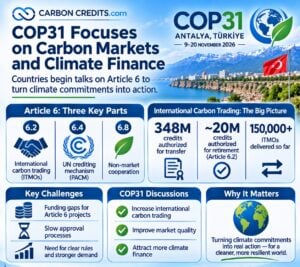
The 31st United Nations Climate Change Conference (COP31) opened in Antalya, Türkiye, on November 9, with carbon markets and climate finance among its key topics. Countries began formal talks on Article 6 of the Paris Agreement, while other sessions covered nature markets, methane, and industrial decarbonization.

The first day did not produce a major new carbon trading agreement or changes to Article 6 rules. Instead, discussions focused on how countries can put existing rules into practice, increase international carbon trading, and attract more funding for climate projects.

This reflects COP31’s wider goal of turning climate commitments into action. For carbon market participants, the main questions are how to increase credit transfers, improve market quality, and make climate finance more accessible to developing countries.

Article 6 Talks Lead COP31’s Carbon Market Agenda

Article 6 of the Paris Agreement allows countries to work together to meet their climate targets. It covers international carbon trading, a UN-backed crediting system, and cooperation that does not involve trading credits.

On November 9, countries began informal consultations on all three parts:

  • Article 6.2: Allows countries to trade internationally transferred mitigation outcomes (ITMOs) through bilateral or other agreements.
  • Article 6.4: Establishes the Paris Agreement Crediting Mechanism (PACM), a UN-supervised system for issuing carbon credits.
  • Article 6.8: Covers non-market approaches to climate cooperation that do not rely on carbon trading.

The first day also included the Article 6.2 Ambition Dialogue, a three-hour session on how countries can increase cooperation under the Paris Agreement. A key issue is how countries account for credits they transfer.

Article 6.2 requires corresponding adjustments to prevent two countries from counting the same emissions reduction toward their climate targets. These rules are important to buyers and sellers. They help ensure that a credit transferred to another country is not also counted by the country where the project took place.

However, COP31 is not expected to rewrite the Article 6 rulebook. Market analysis published by OPIS on November 9 said a formal review of the rules is not scheduled to begin until 2028. For now, the focus is on applying the existing rules and solving practical problems that slow down trading.

International Carbon Trading Still Faces Gaps

More countries are signing Article 6 agreements, but the number of credits actually transferred remains much smaller than the number authorized.

OPIS reported that 31 countries had authorized more than 348 million credits for international transfer. Yet, only about 20 million had been authorized for retirement by specific buyers under Article 6.2. Just over 150,000 ITMOs had been delivered. These figures show the gap between approval and actual market activity.

Authorizing credits does not guarantee that buyers will receive them. Countries must set up domestic rules, approve transfers, and apply the required accounting adjustments. Host countries also need to decide how many credits they can sell without making it harder to meet their own Nationally Determined Contributions (NDCs).

This is especially important for developing countries that need to attract foreign investment through carbon projects. They need clear approval processes, reliable registries, and the ability to track and report emissions reductions. COP31’s Article 6 talks will therefore focus on making international carbon trading easier to put into practice.

Funding and Slow Approvals Hold Back Article 6 Projects

Finance is another major issue. Article 6.2 and Article 6.4 both need funding for registries, technical systems, project reviews, and support for countries that lack the resources to take part.

The Article 6.2 Ambition Dialogue provided a forum to discuss how international cooperation can deliver stronger climate action. Building the skills and systems needed to authorize and track credits will be important, especially for developing countries.

  • The UN’s Article 6.4 mechanism also faces delays in moving projects toward credit issuance.

OPIS reported that 415 projects were approved to move from the old Clean Development Mechanism (CDM) to the new Paris Agreement system. They met the June 30 deadline. However, none had received host-country credit authorizations at the time of its November 9 report.

The Article 6.4 Supervisory Body had also approved five methods for new projects. These methods explain how developers must measure and verify emissions reductions before credits can be issued.

The slow progress shows why clear procedures and enough funding are needed. Without them, the UN crediting system may struggle to attract projects and buyers at the scale expected.

COP31 Carbon Markets Infographic

Nature Markets and Carbon Finance Draw Attention

COP31’s first-day program also included sessions on how carbon finance can support nature protection and local communities. One event, Beyond Carbon Credits: What Makes Nature Markets Credible, Investable and Fair?, looked at the standards and safeguards needed to build trust in nature-based markets.

These projects remain a smaller share of international Article 6 authorizations. IETA data from OPIS showed that nature-based solutions, like REDD+ and afforestation, made up 8.1% of authorized credits.

Cookstove projects made up just over half of the authorizations. Methane reduction projects in energy and waste made up 21.6%. Water purification projects were 12.9%.

These figures show that international carbon trading has so far leaned on certain project types. More support for forest protection and other nature-based activities could broaden the market. However, buyers will still need strong evidence that projects deliver real climate benefits, protect stored carbon, and support local communities.

Another first-day event, The Hydro Blind Spot: Methane, Carbon Markets, and the Case for Free-Flowing Rivers, examined links between methane emissions, hydropower, and river protection.

A separate session focused on building high-integrity carbon markets in Africa. It highlighted work by the West African Alliance and its partners. These events illustrated how carbon finance can help with climate action. They also protect ecosystems and support community interests.

Carbon Markets Could Help Fund Industrial Emissions Cuts

COP31’s carbon market agenda also covers industries that are difficult to decarbonize. Sectors such as cement, steel, and chemicals need costly technology and major changes to reduce emissions. Carbon finance could help fund some of these projects and support the shift to cleaner production.

The United Nations Industrial Development Organization (UNIDO) is scheduled to hold a session on November 11 called Carbon Markets for Industrial Transformation. It will examine how high-integrity carbon markets can help finance industrial emissions cuts.

Private companies and financial institutions also have an important role. They can invest in projects that reduce or remove emissions, while carbon credit purchases can provide another source of funding. However, market growth will depend on reliable measurement, clear project information, and strict rules for approving and using credits.

What to Watch as COP31 Continues

COP31’s first day set the agenda for further carbon market discussions, but key outcomes are still ahead.

  • Participants will watch for progress on Article 6.2, funding for the UN crediting mechanism, and support for countries entering international carbon markets.
  • More bilateral agreements and announcements linked to the Carbon Offsetting and Reduction Scheme for International Aviation (CORSIA) may also emerge during the summit.
  • The market will also look for steps to increase demand for high-integrity credits, especially those supporting forest protection, methane reduction, and industrial decarbonization.

The wider climate finance debate is crucial, too. On the opening day, countries discussed progress toward the previous goal of providing $100 billion in annual climate finance. Delegations disagreed over whether the target had been met in 2022, 2023, and 2024. Developing countries also called for better access to funding.

As COP31 continues through November 20, the focus will be on turning existing carbon market rules into a more active, transparent, and accessible source of climate finance.

The post COP31 Day 1: Article 6 Carbon Markets Take Center Stage as Countries Push for Climate Finance appeared first on Carbon Credits.
China Steps Up Global Carbon Market Push With New COP31 Initiative and IETA Deal

China Steps Up Global Carbon Market Push With New COP31 Initiative and IETA Deal

China is taking steps to expand its role in global carbon markets through two new developments announced at COP31 in Türkiye. The country has joined Türkiye and Ethiopia in launching an initiative to strengthen international cooperation on high-quality carbon credits. It has signed a memorandum of understanding (MoU) with the International Emissions Trading Association (IETA), which aims to boost the growth and global reach of its domestic voluntary carbon market (VCM).

Both announcements were made on November 11, 2026, in Antalya. Together, they signal China’s growing interest in international carbon market cooperation and the rules under Article 6 of the Paris Agreement.

The new initiative aims to improve cooperation between countries and promote high-quality carbon credit markets. The IETA agreement will boost dialogue, technical cooperation, and knowledge sharing. This will connect China’s market operators with international participants.

The developments come as China works to strengthen its domestic carbon market and build closer links with global trading systems.

China, Türkiye, and Ethiopia Launch Global Carbon Market Initiative

China, Türkiye, and Ethiopia jointly launched the Initiative for Enhancing International Cooperation on High-Quality Carbon Crediting Markets at the COP31 China Pavilion. The initiative aims to encourage cooperation on developing and using high-quality carbon credits. It also provides a platform for countries to exchange knowledge and experience as they expand their carbon market systems.

China’s Vice Minister of Ecology and Environment, Li Gao, highlighted the country’s support for multilateral cooperation during the launch. He also described carbon credits as a global public good, saying:

“We welcome governments, international organizations and relevant institutions to join us in delivering a new global public good for climate action.”

The partnership brings together China, the host of COP31, and Ethiopia, which is set to host COP32 in 2027. Türkiye’s participation also connects the initiative with the current climate conference presidency.

The three countries are seeking to promote greater cooperation in carbon credit development and market practices. This includes improving the quality of credits and encouraging wider participation in international carbon markets.

However, the initiative should not be confused with a new international carbon trading agreement. Its launch doesn’t automatically allow cross-border credit transfers. It also doesn’t create a system that connects the carbon markets of the participating countries. Instead, it creates a basis for further cooperation and dialogue.

IETA and Beijing Green Exchange Target Greater CCER Cooperation

On the same day, IETA and the China Beijing Green Exchange (CBGEX) signed a MoU. This agreement will help develop and internationalize China’s Certified Emission Reduction (CCER) scheme.

Under the agreement, the two organizations will promote dialogue among policymakers, regulators, and domestic and international market participants. They will also work together on technical cooperation, knowledge sharing, and high-integrity carbon market practices.

The partnership could help international market participants better understand China’s domestic crediting system and its rules. It may also support greater cooperation between Chinese institutions and global carbon market organizations.

CBGEX plays a central role in this effort. China’s Ministry of Ecology and Environment (MEE) allows it to run the national voluntary greenhouse gas emission reduction trading system.

China’s Global Carbon Market Push

The exchange manages the trading platform for CCERs, which are credits generated by approved domestic emissions reduction projects. These credits can boost income for projects that follow China’s rules on measurement, verification, and registration.

The MoU is a strategic cooperation agreement. It does not automatically make CCERs eligible for international trading or use under Article 6. Any cross-border transfer would still need to meet the relevant national and international rules.

China’s Domestic Carbon Markets Gain Trading Activity

The two COP31 announcements build on China’s efforts to strengthen its domestic carbon market. China operates two main systems. Its national emissions trading system (ETS) covers major industrial emitters and requires them to manage their emissions allowances.

The separate national voluntary carbon market allows eligible projects to generate CCERs from verified emissions reductions or removals.

China restarted its national voluntary crediting market in January 2024. It had paused new project registrations in 2017 to review its rules and methods.

The first batch of new CCERs was registered in March 2025. According to the MEE, these credits came from nine offshore wind and solar thermal projects. They totalled 9.48 million tonnes of carbon dioxide equivalent (CO2e).

  • Trading has since increased. In 2025, the voluntary market had 8.84 million tonnes of CCER transactions. This totaled 626 million yuan, roughly $89 million. The average transaction price was 70.76 yuan per tonne.

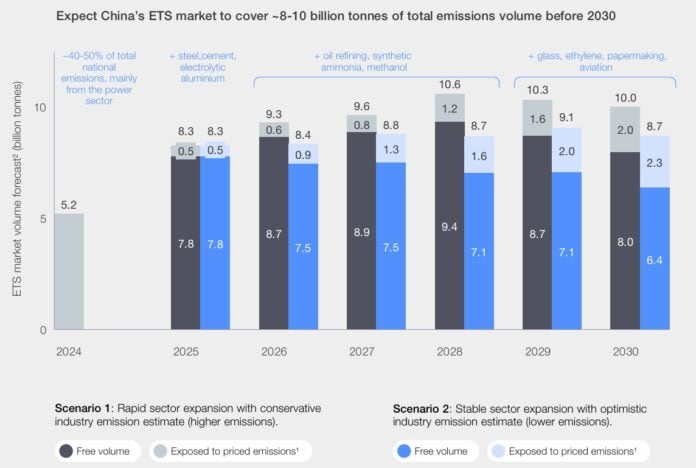
China’s compliance market has also grown. In 2025, its national ETS covered 3,378 key emitters across the power, steel, cement, and aluminum sectors. Trading volume reached 235 million tonnes of emissions allowances, worth 14.63 billion yuan.

china compliance carbon market ets
Source: WEF Asia’s Carbon Markets Strategic Imperatives for Corporations, 2025.

These figures show the scale of China’s domestic carbon market. They also provide a foundation for its efforts to increase international cooperation.

Article 6 Could Create New Opportunities for China

China’s growing international engagement comes as countries work to implement Article 6 of the Paris Agreement. Article 6 allows countries to cooperate in meeting their climate targets.

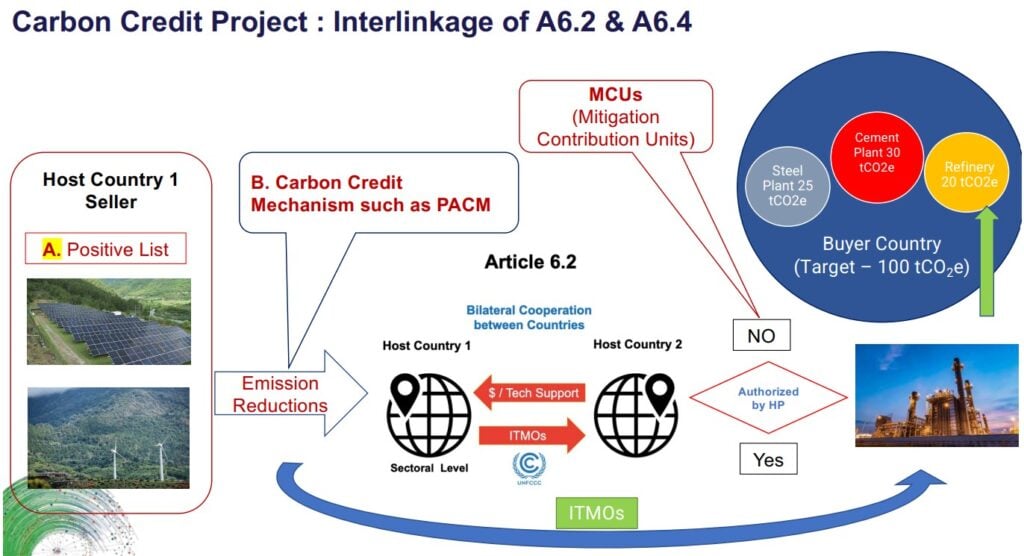
Under Article 6.2, countries can transfer internationally transferred mitigation outcomes (ITMOs) through bilateral or other cooperative arrangements. Article 6.4 establishes a UN-supervised crediting mechanism for eligible emissions reduction and removal projects.

Carbon Credit generation article 6
Source: UNFCCC

These mechanisms require clear rules for authorizing credits and tracking their use. Adjustments are also needed under Article 6.2. This prevents the same emissions reduction from counting toward two countries’ climate targets.

China’s new initiative and its partnership with IETA could support discussions on these issues. They may also help Chinese market institutions engage more closely with international buyers, developers, and policymakers.

However, the announcements do not confirm that China has begun transferring CCERs internationally under Article 6. Its domestic voluntary credits remain subject to China’s own rules. International use would require the relevant authorizations and accounting arrangements.   

This distinction is important for carbon credit buyers. Domestic certification does not automatically mean that a credit can be used toward another country’s climate target or under international compliance programs.

China Targets Wider ETS Coverage by 2027 

China’s international outreach also supports its wider plans to strengthen its carbon pricing system. In August 2025, the Chinese government issued guidelines to expand the national carbon market and improve its voluntary crediting system.

The policy aims to bring all major industrial sectors into the national ETS by 2027. It also calls for broader coverage of key sectors under the voluntary market.

By 2030, China plans to build a more advanced carbon market. This will include stricter rules, more participants, and better alignment with global standards.

The guidelines also call for deeper international exchanges and cooperation. This includes work toward greater recognition of carbon market methods, standards, technologies, and data across countries.

The COP31 initiative and IETA partnership fit within this broader direction. They give China additional channels to share its market experience and build relationships with international institutions.

What the Developments Mean for Global Carbon Markets

China’s announcements could have wider implications for the VCM and international climate cooperation. As one of the world’s largest emitters, China has significant potential to influence the future development of carbon trading. Its domestic market also offers a large base of industrial participants, project developers, and potential credit buyers.

Closer cooperation with IETA could help improve communication between Chinese market institutions and international businesses. It may also support the exchange of technical knowledge and stronger approaches to credit quality.

The new initiative with Türkiye and Ethiopia adds another platform for international dialogue. Its progress could help countries share experience, strengthen market systems, and explore opportunities for cooperation.

Still, the impact will depend on what follows the announcements. The partners still need to show how the initiative will lead to projects, investments, or international credit deals. The IETA MoU also needs to lead to practical cooperation before its market benefits can be measured.

For now, the two developments show that China wants a more active role in international carbon market discussions. As Article 6 moves from rulemaking toward implementation, China’s ability to connect its domestic crediting system with global market practices will be an important development to watch.

The post China Steps Up Global Carbon Market Push With New COP31 Initiative and IETA Deal appeared first on Carbon Credits.
Can the Adani-Codelco Copper Deal Help Meet India’s Rising Demand?

India’s Adani Group is looking overseas to strengthen its copper supply chain. The group has partnered with Chilean state-owned copper producer Codelco to explore three copper projects in Chile, potentially opening new opportunities for joint development and long-term resource access.

The two companies signed a Memorandum of Understanding (MoU) on November 21, 2025. The agreement brings together Codelco’s mining expertise and Adani’s industrial and infrastructure capabilities.

The partnership comes as India’s copper demand increases alongside investments in electricity networks, renewable energy, electric vehicles (EVs) and manufacturing. However, limited domestic mine production forces the country to depend on imported copper concentrates.

For Adani, the agreement could strengthen raw material supplies for its expanding copper business.

Adani and Codelco to Explore 3 Copper Projects

Under the non-binding MoU, Codelco and Kutch Copper Ltd (KCL), an Adani Enterprises subsidiary, will assess three copper projects in Chile.

The projects lie near established mining districts, including Sierra Gorda and Diego de Almagro, across the Antofagasta and Atacama regions.

The agreement establishes a framework for technical and legal information sharing, due diligence, and commercial discussions. Both companies will evaluate the projects before deciding whether to pursue joint development.

Codelco Chairman Máximo Pacheco said the partnership reflects the company’s commitment to public-private cooperation. Such arrangements can share investment risks, create value and support future copper production.

Adani’s CEO of Natural Resources, Vinay Prakash, highlighted the opportunity to combine the group’s infrastructure capabilities with Codelco’s mining experience. He said the partnership could help secure India’s long-term copper requirements.

The companies also highlighted the growing need for copper as electrification and renewable energy expand worldwide. Codelco’s announcement cited an outlook for global copper demand to increase by 50% by 2040.

However, the agreement does not guarantee new production or confirm future supply volumes. Project assessments and commercial negotiations will determine the next steps.

Partnership Builds on Earlier Copper Supply Deal

The latest agreement expands an existing relationship between the companies. Earlier in 2025, Codelco and Adani agreed to supply copper concentrates to Adani’s smelting facility in Mundra, Gujarat.

The new MoU takes their cooperation further by exploring opportunities at the mining stage.

Adani operates its copper business through Kutch Copper, which has developed a greenfield smelting and refining complex at Mundra. The facility has an annual capacity of 500,000 tonnes, with plans to expand it to 1 million tonnes.

The plant produces refined copper and other products, including precious metals and industrial by-products. Its coastal location also supports the import of raw materials and distribution of finished products.

In April 2025, Codelco Chairman Máximo Pacheco met Adani Group Chairman Gautam Adani in Ahmedabad to discuss potential cooperation.

India’s Copper Demand Reaches 2.1 Million Tonnes

India’s growing copper requirements provide a strong reason for the partnership.

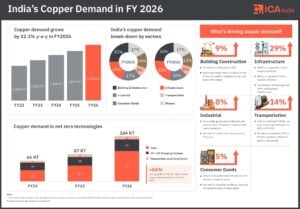
  • According to the International Copper Association India (ICA India), domestic copper demand rose 12% year-over-year to 2.1 million tonnes in FY2026, up from 1.878 million tonnes in FY2025.
india copper demand
Source: https://copperindia.org/

Infrastructure led sectoral growth, with copper consumption rising 29% and accounting for around 22% of total demand. Automotive consumption increased 14%, while building and construction demand grew 9%.

These sectors use copper in power cables, transformers, electrical equipment, EV motors and renewable energy installations. Expanding electricity networks and data centers could also support future consumption.

The Ministry of Mines expects India’s copper demand to reach approximately 3.3 million tonnes by 2030. This growth will require additional mining, refining, recycling and international supply partnerships.

Domestic Copper Production Expands, but Imports Remain Essential

India is adding smelting and refining capacity, but domestic mining has not kept pace with demand.

According to the Ministry of Mines’ Annual Report 2025-26, the country’s installed refined copper production capacity reached approximately 1.285 million tonnes per year.

Hindalco and Kutch Copper each have an annual capacity of 500,000 tonnes. Vedanta operates 216,000 tonnes of capacity, while Hindustan Copper Ltd. (HCL) has 68,500 tonnes.

During FY2024-25, organized-sector copper cathode production reached approximately 573,000 tonnes. Hindalco contributed 402,000 tonnes, Vedanta produced 149,000 tonnes, and Kutch Copper supplied 22,000 tonnes.

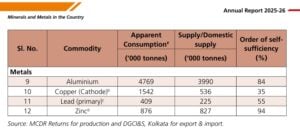
However, India’s limited domestic mine output creates a shortage of copper concentrates for these facilities. As a result, expanding smelting capacity also increases the need for imported raw materials.

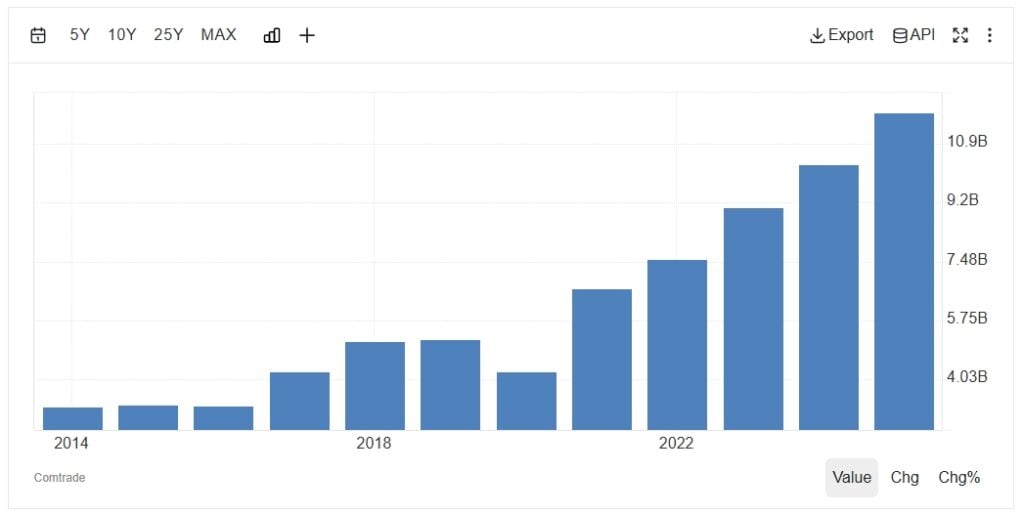
The country’s recent trade figures highlight this dependence. India imported 821,408 tonnes of copper concentrates between April and August 2026, up 56.8% from 523,870 tonnes during the same period in 2025.

india copper import
Source: Trading Economics

Chile supplied approximately 366,069 tonnes, making it India’s largest supplier during the period. Peru, Brazil and Australia also contributed to imports.

  • In contrast, refined copper cathode imports declined 22% year-over-year to approximately 85,048 tonnes between April and July 2026.

The difference highlights an important shift: India is increasing its domestic copper-refining capacity, but it still relies on overseas suppliers for the concentrates needed to produce refined metal.

India’s Copper Strategy Targets 2030

The government wants to strengthen domestic production and reduce import dependence. Its Copper Vision Document, released in July 2025, outlines plans to add 5 million tonnes per year of smelting and refining capacity by 2030.

The strategy also emphasizes mineral exploration, overseas resource partnerships and copper recycling.

Chile could play an important role in this effort. As one of the world’s leading copper-producing countries, it offers Indian companies access to established mining expertise and potential resource development opportunities.

For Adani, the Codelco partnership could support its expanding copper operations at Mundra. For India, it offers another opportunity to diversify copper supplies as domestic demand continues to rise.

The three projects remain under evaluation, but the partnership highlights the growing importance of overseas mining investments in India’s copper supply strategy.

The post Can the Adani-Codelco Copper Deal Help Meet India’s Rising Demand? appeared first on Carbon Credits.
Deutsche Bank, Rabobank Back $936 Million Germany Battery Storage Deal

Deutsche Bank, Rabobank Back $936 Million Germany Battery Storage Deal

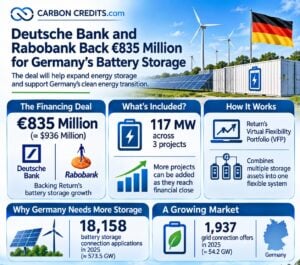
Deutsche Bank and Rabobank are backing an €835 million (about $936 million) financing package to help energy storage company Return expand its battery storage business in Germany. The deal will support new projects as the country works to integrate more wind and solar power into its electricity system.

The portfolio facility initially covers three battery energy storage projects with a combined capacity of 117 megawatts (MW). More eligible projects can be added as they reach financial close.

The financing combines support for physical battery assets with Return’s Virtual Flexibility Portfolio (VFP). This model connects multiple storage facilities into one virtual system. Energy companies can access flexible electricity capacity through a single platform.

The transaction involves several financial and technical advisers. Rabobank acted as financial adviser, while White & Case advised the lenders. Other firms involved included Hogan Lovells Cadwalader, Baker McKenzie, Baringa, DNV, EY, EY-Parthenon, and Marsh.

The deal comes as Germany’s battery storage market grows. It also shows how private finance helps build the infrastructure for a power system with more renewable energy.

A Financing Framework for Germany’s Battery Expansion

The €835 million facility gives Return a way to finance several battery projects under one structure instead of arranging separate financing for every site. This approach could help speed up project development. Eligible facilities can access funding as they progress toward financial close, without having to restart the financing process each time.

The initial portfolio includes three projects in Germany with a combined power capacity of 117 MW. Return stated that, with four-hour batteries running two full cycles each day, the facilities could provide enough electricity yearly to power around 100,000 German households.

The company plans to add more projects to the financing framework through 2027.

Return also has wider growth plans for the German market. It aims to install at least 1 gigawatt (GW) of battery storage capacity each year from 2027. The company estimates that this would require annual investment of €750 million to €1.2 billion, depending on market conditions.

The financing is therefore part of a much larger expansion plan. The company has not said that the full €835 million will be used only for the three projects in the initial portfolio.

Daniel Witvoet, CFO at Return, remarked:

“As demand for energy flexibility grows, we need to scale not just our battery storage capacity, but also the way we finance it. By bringing together physical infrastructure financing and our virtual flexibility model, we can expand more efficiently and respond to our customers’ evolving needs. This is an important step towards our ambition to become a leading independent provider of energy flexibility in Germany.”

Why Germany Needs More Battery Storage

Germany is adding more wind and solar power to its electricity mix. However, these sources do not produce power at a steady rate. Solar generation changes with daylight and weather, while wind output can rise or fall depending on conditions.

Battery storage can help manage these changes. It can store electricity when supply is high and prices are low, then release it when demand rises or renewable generation falls. This can help balance the grid and make better use of clean electricity.

Germany’s Federal Network Agency explains that battery systems can respond to electricity market prices, support grid stability, and improve the use of renewable power. The need for this flexibility is becoming clearer as storage projects move through the development pipeline.

According to data published by Germany’s Federal Network Agency in August 2026, network operators received 18,158 battery storage connection applications in 2025. These requests represented about 573.5 GW of planned power capacity and 1,583 gigawatt-hours (GWh) of energy capacity.

Germany’s Battery Storage Financing Boom

However, these figures do not represent projects that are certain to be built. Developers sometimes submit applications for the same project at several possible locations. The regulator noted that only one location may ultimately be selected.

A more advanced measure is the number of grid connection offers. In 2025, network operators issued 1,937 offers covering 54.2 GW of power capacity and 142.4 GWh of energy capacity. These offers provide a clearer picture of project progress because they are binding proposals for connection agreements.

Even so, projects still need to secure financing, complete construction, and meet other requirements before they can operate.

Germany’s Storage Pipeline Reflects a Growing Market

Germany’s battery storage market has expanded as renewable energy has gained a larger role in power generation. Fraunhofer ISE reported that, in 2025, wind and solar power generated more electricity than any other source in Germany’s public electricity mix. The shift increases the need for storage and other flexible resources that can help match supply with demand.

The International Energy Agency has also identified utility-scale battery storage as an important part of Germany’s energy transition. Large batteries can provide services such as frequency response and reserves, helping the grid remain stable as the electricity mix changes.

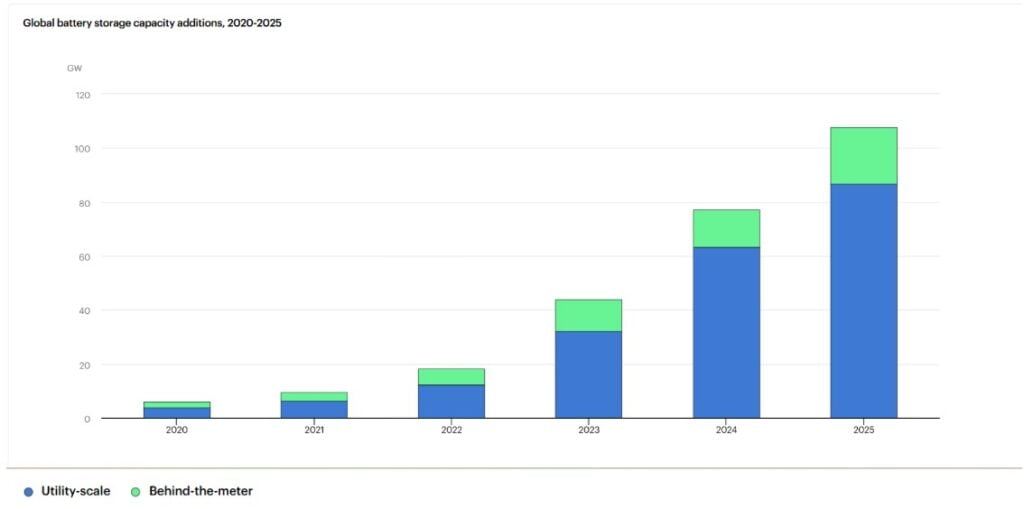
Globally, battery storage is growing quickly as well. The IEA’s Global Energy Review 2026 reported that 108 GW of new battery storage capacity was deployed worldwide in 2025, 40% more than in 2024. Global installed capacity was 11 times higher than in 2021.

global battery storage 2025 IEA
Source: IEA

These trends are creating opportunities for developers, utilities, and financial institutions. However, the scale of Germany’s connection requests also shows that grid access and project delivery remain important challenges.

Return Builds Its German Energy Flexibility Business

Return is an Amsterdam-based energy storage company that develops, owns, and operates large-scale battery systems. Its Virtual Flexibility Portfolio combines capacity from different storage assets. Customers can access flexible power through one platform.

The company has already secured commercial agreements with energy firms in Germany. ENGIE expanded its contracted battery flexibility partnership with Return to 400 MW, while Centrica Energy signed a separate 100 MW agreement.

  • Return also works with companies including Vattenfall, Essent, and Eneco in other European markets.

The new financing supports the physical infrastructure behind these services. It also gives Return a structure that can accommodate additional projects as its German business grows.

Battery Storage Could Help Germany Integrate More Renewables

Battery storage does not generate renewable electricity. Instead, it helps make power from sources such as wind and solar more useful by storing surplus electricity and releasing it when needed. This can reduce the need to rely on fossil-fuel power plants during periods of low renewable output. It can also help limit wasted renewable generation when electricity supply exceeds demand.

However, the climate benefits of battery storage depend on how the systems are charged and used. Batteries charged mainly with fossil-fuel electricity may deliver smaller emissions benefits than those charged with surplus renewable power. Their full environmental impact also depends on battery materials, manufacturing, operating life, and recycling.

So, the €835 million financing is better seen as support for energy infrastructure, not as a direct measure of emissions cuts. Return has not disclosed a specific emissions-saving estimate for the three projects covered by the initial facility.

The deal nevertheless shows how banks can help fund technologies that support a more flexible electricity system. As Germany expands its renewable energy supply, investment in storage will be important to balancing the grid and making better use of clean power.

Return’s planned annual installations of at least 1 GW from 2027 would mark a major step in its German expansion. Whether it reaches that pace will depend on market conditions, project development, and access to grid connections. For now, the new financing gives the company a broader funding structure to support its next stage of growth.

The post Deutsche Bank, Rabobank Back $936 Million Germany Battery Storage Deal appeared first on Carbon Credits.

Verra Approves First CCS Carbon Credits From Texas Project for Barnett Zero

Verra Approves First CCS Carbon Credits From Texas Project for Barnett Zero

Verra has approved the first carbon credits under its carbon capture and storage (CCS) methodology, marking a new step for technology-based projects in the voluntary carbon market (VCM). The credits come from a natural gas processing project in Texas that captures carbon dioxide (CO₂) and stores it permanently underground.

The project, called Barnett Zero, was developed by BKV Corporation in Bridgeport, northern Texas. It captures CO₂ separated from raw natural gas at a processing plant, compresses the gas, and sends it to a nearby injection well for permanent storage.

Verra announced the approval on November 6, 2026. The credits came from the Verified Carbon Standard (VCS) methodology VM0049. This method outlines how to measure emissions reductions and carbon removals from CCS projects.

The milestone gives developers a recognized way to certify carbon storage activities under Verra’s program. It also brings more attention to the role of carbon capture in the voluntary carbon market, where buyers are looking for ways to support measurable climate action.

Mandy Rambharos, CEO, Verra, remarked:

“Carbon capture and storage is one of the most technically demanding approaches in the market. Capturing and permanently storing the CO₂ that would otherwise be vented from natural gas is real, measurable climate action. Barnett Zero is the first of many projects we expect to be using VM0049. We’re proud to give project developers a credible pathway for permanent carbon storage that delivers verified and meaningful climate impact.”

Barnett Zero Earns the First Project Under Verra’s CCS Methodology

BKV developed Barnett Zero to capture CO₂ that would otherwise be released during natural gas processing. Raw natural gas can contain CO₂, which must be separated before the gas can be sold or transported for use. At the Bridgeport facility, the separated CO₂ is captured, compressed, and injected into a nearby underground well.

The project began commercial CO₂ injection in November 2023. It uses an existing natural gas processing operation and a nearby storage well, rather than capturing carbon directly from the atmosphere.

Independent validation and verification body GHD Limited verified the project. Verra said the project applies VM0049 together with a specific module, VMD0062, which covers CO₂ capture from natural gas processing.

BKV said the certification allows it to monetize the credits and move forward with its Carbon Sequestered Gas (CSG) business. The company will use the certification to back deliveries of its third-party-verified natural gas product. This is part of earlier agreements with Kiewit and Gunvor.

Carbon Sequestered Gas BKV
Source: BKV

However, Verra’s announcement did not disclose the number of credits approved or their total volume. It also did not provide a project-level estimate of annual emissions reductions.

How Verra’s VM0049 Methodology Works

Verra introduced VM0049 in June 2024. The methodology provides a framework for measuring the climate impact of CCS projects that capture CO₂ and store it permanently.

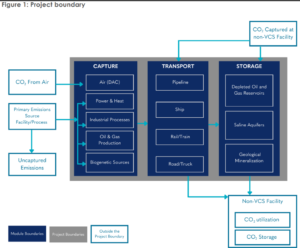
It covers different stages of the process, including carbon capture, transport, and geological storage. Developers can combine specific modules based on the technology and design of their projects. This structure allows the methodology to cover several types of CCS activities, including:

  • direct air capture (DAC),
  • bioenergy with carbon capture and storage (BECCS),
  • CO₂ transport, and
  • geological storage.

The methodology also sets rules for accounting for emissions linked to the energy used by CCS systems. This matters because capturing, compressing, transporting, and storing CO₂ can require significant energy. Projects must account for these emissions when calculating their climate benefits.

Verra CCS Methodology
Source: Verra

For Barnett Zero, the relevant module is VMD0062, which covers CO₂ capture during natural gas processing. It addresses CO₂ that is separated from raw gas and would otherwise be released into the atmosphere. This is different from direct air capture, which removes CO₂ already present in the atmosphere. It is also different from capturing emissions from a power plant after fossil fuels are burned.

Barnett Zero is therefore best described as an emissions-reduction project. It prevents CO₂ from a natural gas processing stream from entering the atmosphere and stores it underground.

Why ICVCM Approval of the Specific Module Matters

The first credits come as Verra’s CCS framework gains wider recognition in the carbon market. In September 2026, the Integrity Council for the Voluntary Carbon Market (ICVCM) approved VM0049 and several related modules under its Core Carbon Principles (CCPs). These principles set quality requirements for carbon credits, including rules on additionality, permanence, measurement, and transparency.

  • The approved modules include those covering direct air capture, CO₂ transport, CO₂ storage, and bioenergy with carbon capture and storage.

However, there is an important distinction for the Barnett Zero project. Verra said that module VMD0062, which the project uses for natural gas processing, was still under review by the ICVCM as of November 6. This means the wider VM0049 methodology has received CCP approval, but the specific module used by Barnett Zero had not yet received that separate approval. 

The distinction matters to buyers who use CCP approval as one way to assess credit quality. It also shows why carbon credit buyers need to check the exact methodology and modules used by a project, rather than relying only on the name of the broader standard.

BKV Expands Its Carbon Capture Business

The Verra certification is part of BKV’s wider plan to expand its carbon capture and storage operations. The company began its first commercial sequestration project with Barnett Zero in 2023. It has since added other operating facilities and projects to its carbon management business.

In its third-quarter 2026 results, BKV said its operational CCS portfolio had grown to four projects. Together, these facilities represented an annual carbon sequestration run rate of about 350,000 metric tonnes.

The company reported that its total CO₂ injection volume reached 55,200 metric tonnes in the third quarter of 2026. This figure covers its operational portfolio, not Barnett Zero alone.

BKV is also targeting an annual injection run rate of 1.5 million metric tonnes by 2028. This is a company target, not current operating capacity or confirmed annual storage.

The company sees carbon credits as a way to create additional value from its storage operations. Its Carbon Sequestered Gas product is designed to link natural gas sales with verified carbon storage.

Still, the climate value of such products depends on the full emissions profile of natural gas production, processing, transport, and use. Storing CO₂ separated during processing does not remove the emissions produced when customers later burn the gas.

Global CCS Capacity Grows, But Verification Remains Critical

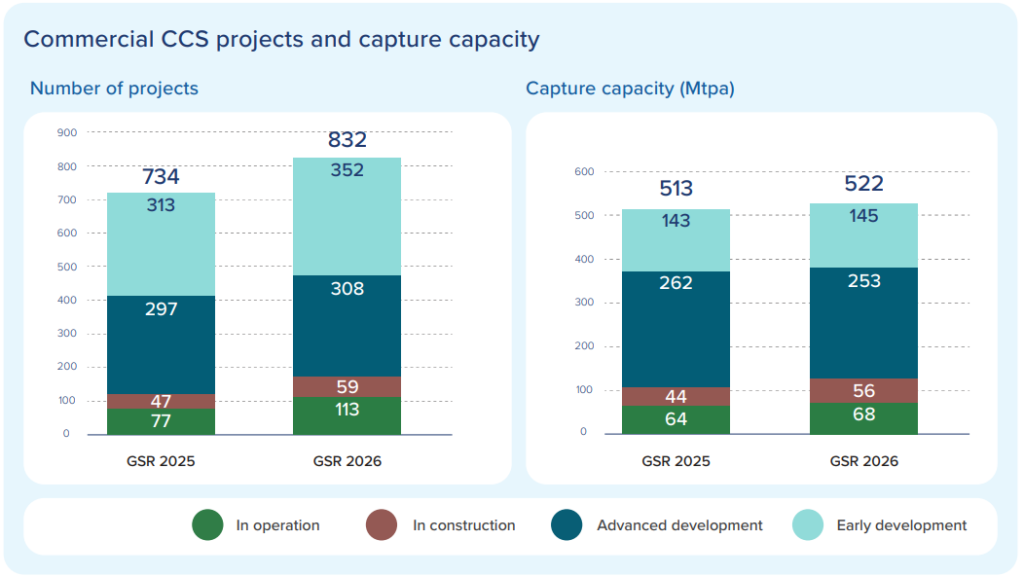
The Barnett Zero milestone comes as carbon capture and storage expands worldwide. The Global CCS Institute’s Global Status of CCS 2026 report counted 113 commercial CCS projects in operation as of July 31, 2026. These facilities had a combined CO₂ capture capacity of 68 million tonnes per year. Another 56 million tonnes per year of capture capacity was under construction.

Commercial CCS projects and capture capacity
Source: Global CCS Institute

The report also found that more than 400 million tonnes of CO₂ had been captured and permanently stored worldwide since 1996. These figures show that CCS is moving beyond pilot projects.

However, capture capacity is not the same as actual annual storage. The amount of CO₂ stored depends on how often facilities operate and whether their capture, transport, and injection systems perform as planned.

Carbon credits from CCS projects also need careful review. Buyers should think about a few key points:

  • Did the captured emissions happen anyway, even without the project?
  • Is the storage safe for the long term?
  • Are all emissions from the process included in the calculations?

For geological storage, monitoring is important to confirm that CO₂ remains underground. Projects must also account for possible leakage and other risks over time.

Verra’s VM0049 framework provides a way to measure these activities under a common standard. The first credits from Barnett Zero show how the framework can be applied to natural gas processing.

The next challenge is to demonstrate that projects can deliver reliable storage at a larger scale, with transparent accounting and strong safeguards. As more CCS projects seek carbon market certification, the quality of their measurements and the permanence of their storage will remain central to buyer confidence.

The post Verra Approves First CCS Carbon Credits From Texas Project for Barnett Zero appeared first on Carbon Credits.
Canada Needs C$2.2 Billion to Scale Carbon Removal by 2030, Report Finds

Canada Needs C$2.2 Billion to Scale Carbon Removal by 2030, Report Finds

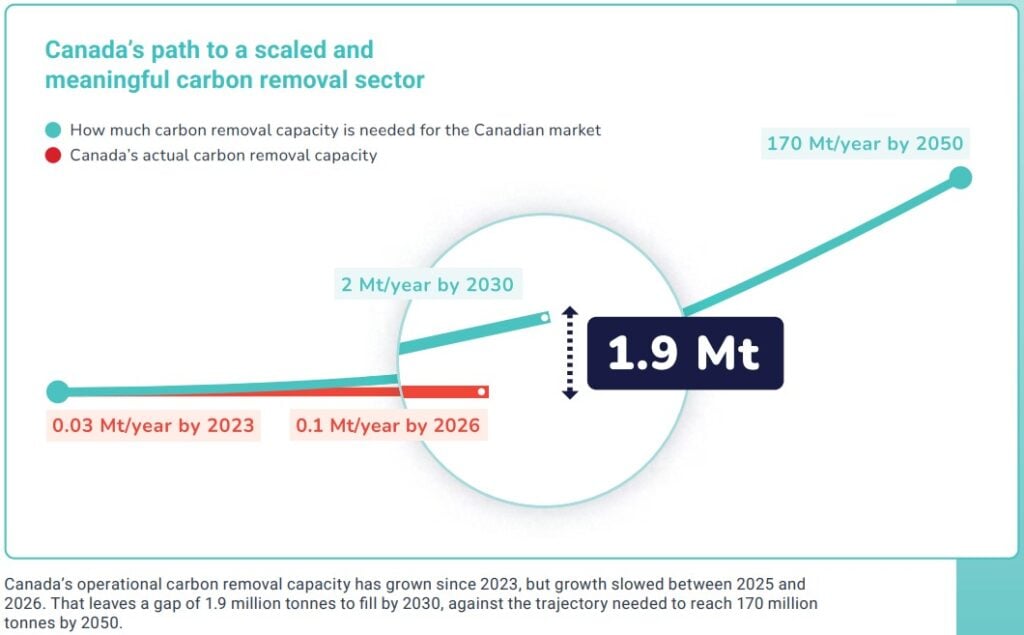
Canada needs about C$2.2 billion in new investment to grow its carbon dioxide removal (CDR) industry by 2030, according to a new report by Carbon Removal Canada. The report, Tracking the Tonnes 2026, says Canada needs to reach 2 million tonnes of annual carbon removal capacity by 2030. However, its 16 operating projects can currently remove only 98,250 tonnes of CO₂ each year.

Canada has a growing project pipeline and strong natural resources. However, limited funding, weak buyer demand, and policy gaps are slowing the industry’s growth.

The report warns that Canada could fall behind other countries unless it creates stronger demand and helps projects secure the money they need to grow.

Canada’s Operating Carbon Removal Capacity Remains Small

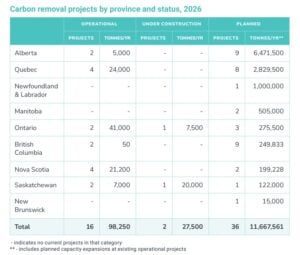
As of November 1, 2026, Canada had 16 operating carbon removal projects across six provinces. Together, they had the capacity to remove 98,250 tonnes of CO₂ per year. That is nearly three times the capacity reported in 2023.

However, growth has slowed. Operating capacity increased by only 150 tonnes between 2025 and 2026. Canada now needs to add about 1.9 million tonnes of annual capacity to reach its 2030 target.

The project pipeline offers room for growth. The report identifies 38 projects, including two under construction. Together, they represent nearly 12 million tonnes of planned annual capacity and about C$9 billion in estimated investment. But planned capacity is not the same as operating capacity. Many projects still need funding, buyers, permits, or other support before they can move ahead.

The two projects under construction, in Ontario and Saskatchewan, are expected to add 27,500 tonnes of annual capacity by the end of 2027. If completed on time, they could raise Canada’s current operating capacity by nearly 30%.

Canada carbon removal by 2030
Source: Carbon Removal Canada

Why Canada Needs C$2.2B in New Investment

Carbon Removal Canada estimates that reaching the 2030 target will require about C$2.2 billion in new public and private investment.

The report says this is less than 0.5% of the C$500 billion that Canadian financial institutions have committed to the wider economy. Yet getting money to carbon removal projects remains a challenge.

Many companies can attract early funding from venture investors. But they often struggle to raise the larger sums needed to test their technology at a commercial scale.

This creates a funding gap between early development and full commercial operations. Projects at this stage may be too costly for startup funding but still too risky for traditional lenders.

The report found that 13 of the 15 equity deals recorded in Canada’s carbon removal sector since 2024 took place at or before Series A funding. The number of deals also fell from six in 2025 to three in 2026.

Carbon Removal Canada says the industry needs more support for demonstration projects. It also recommends a mix of government purchases, grants, equity, debt, and long-term purchase agreements.

These tools could help companies prove their technology works, attract private investors, and move projects toward commercial operations.

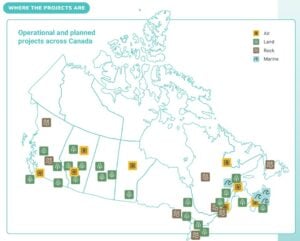
operational and planned carbon removal project canada
Source: Carbon Removal Canada

Corporate Demand for Carbon Removal Remains Weak

More projects will not guarantee industry growth. Canada also needs more companies willing to buy carbon removal credits.

A 2025 report by the Pembina Institute, Growing Curiosity: 2025 Scan of Carbon Dioxide Removal Buyers in Canada, surveyed 247 organizations operating in the country. It found that only 4% were engaged buyers with active plans to purchase durable carbon removal credits. Another 8% were interested but had no current purchase plans. The remaining 88% were not engaged.

High prices remain a major barrier for companies considering their first purchases. Still, there are signs of growing interest. Among engaged buyers, 67% planned to purchase carbon removal credits before the end of 2026.

Corporate purchases can give developers a source of revenue and help them attract investment. Some buyers also agree to purchase future removals before a project is built. These deals can give developers more certainty when raising funds.

The Canadian government has also started supporting demand. In March 2026, it launched a C$10 million standing offer to buy carbon removal credits from Canadian projects.

Carbon Removal Canada recommends turning this into a larger, multi-year program. Regular government purchases could give developers a more reliable source of demand.

Carbon removal projects 2026
Source: Carbon Removal Canada

Canada Has Strong Resources But Needs Clearer Policies

Canada has several advantages that could support a larger carbon removal industry. These include low-carbon electricity, geological storage sites, biomass, coastlines, and an established mining sector.

A January 2026 report by the Canada Energy Regulator identified 78 carbon removal companies and 48 active and planned projects in the country. It also reviewed the costs of different removal methods.

These include direct air capture, which pulls CO₂ from the air, and bioenergy with carbon capture and storage. Other methods include biochar, enhanced rock weathering, and carbon mineralization.

The estimated costs vary widely. Direct air capture could cost US$100 to US$300 per tonne once scaled. Enhanced rock weathering could cost US$50 to US$200 per tonne, while biochar could cost US$10 to US$345 per tonne.

These are estimates for scaled operations, not prices for every project today. Actual costs depend on the technology, location, energy needs, and storage method.

Policy gaps also create problems. Canada’s provinces and territories have different rules for carbon storage, incentives, and carbon markets. This can make it harder for companies to plan projects and attract investors.

In September 2026, the federal government said it was exploring a framework for international carbon market cooperation under Article 6 of the Paris Agreement. This could help Canadian projects sell eligible credits to buyers in other countries.

Carbon Removal Canada recommends including carbon removal in this framework and in existing compliance programs, such as the Clean Fuel Regulations. It also calls for wider investment tax credits and more funding for demonstration projects.

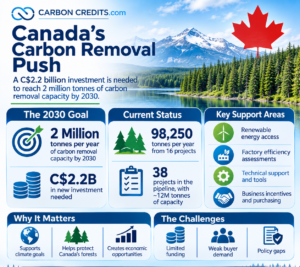
Canada’s Carbon Removal Push Infographic

Canada Faces Growing Competition Abroad

The report compared Canada’s policies with those in the European Union, Germany, the United Kingdom, Japan, and the United States.

Canada has made progress through its government purchase program, investment incentives, and provincial rules for carbon storage. However, the report says the EU, Germany, and the UK are moving faster to create long-term demand.

The EU has introduced a carbon removal certification framework and proposed including large-scale removals in its emissions trading system. Germany supports carbon removal research and industrial projects. The UK is also working toward including carbon removal in its emissions trading scheme.

These policies can give developers more confidence that buyers will be available when projects begin operating.

The global market is growing, too. The third edition of The State of Carbon Dioxide Removal, published in June 2026, estimated that newer carbon removal methods remove about 2 million tonnes of CO₂ each year. Deployment is growing by around 40% annually, but much faster growth will be needed to meet climate targets.

For Canada, the opportunity goes beyond its own climate goals. Carbon removal could support industries such as mining, forestry, steel, agriculture, and energy. It could also help Canadian producers serve markets that place greater value on lower-carbon products.

Funding and Policy Will Determine Whether Canada Meets Its 2030 Goal

Carbon Removal Canada says the next few years will be critical. Its recommendations focus on five areas: expanding access to international carbon markets, including removals in compliance programs, funding demonstration projects, widening tax incentives, and increasing government purchases.

The report estimates that about 20 Canadian companies could begin building demonstration projects in 2027 if the right support is available. Canada has many of the resources needed to build a strong carbon removal industry. But its project pipeline alone will not deliver the 2030 target.

The estimated C$2.2 billion is the additional investment needed to reach the target. It is not money already committed or guaranteed. Canada’s progress will depend on whether it can attract that funding, build a stronger base of buyers, and give developers clear rules to move projects from plans to operations.

The post Canada Needs C$2.2 Billion to Scale Carbon Removal by 2030, Report Finds appeared first on Carbon Credits.
Google Commits $17 Billion to Wyoming Data Center With Carbon Capture Power Plan

Google Commits $17 Billion to Wyoming Data Center With Carbon Capture Power Plan

Google is investing $17 billion in its first data center in Wyoming, as the company expands its artificial intelligence (AI) infrastructure in the United States. The project will use a mix of natural gas generation and fuel cells, with carbon capture and storage (CCS) planned for part of its power supply.

The project will be built in Laramie County near Cheyenne. Google is working with energy companies Tallgrass Energy, Black Hills Energy, and American Electric Power (AEP), along with data center developer Related Digital.

A key part of the plan is a 702-megawatt (MW) fuel cell development that will run on natural gas and include CCS technology. Bloom Energy will provide the fuel cells. Captured carbon dioxide will go to an underground storage site run by Tallgrass.

The project highlights a growing challenge for technology companies. AI boosts the need for data centers and electricity. However, it’s tough to meet this demand and cut emissions at the same time.

Google’s $17B Wyoming Data Center Takes Shape

Google announced that the Wyoming project is a long-term investment. It aims to boost its data infrastructure and create economic opportunities in the state.

The company expects the development to generate hundreds of millions of dollars in local property taxes for Laramie County and School District 1. It also plans to support education, workforce training, and local business development. The project is being developed with four main partners:

  • Tallgrass Energy: Supporting natural gas generation and carbon storage infrastructure.
  • Black Hills Energy: Providing power generation and managing energy resources through a private microgrid.
  • American Electric Power: Contracted to develop the 702 MW fuel cell project.
  • Related Digital: Supporting the data center development.

Google has not disclosed the facility’s total power demand or final data center capacity. Earlier plans for the site described a large campus with several data halls and supporting buildings, while construction is expected to continue through 2031.

The development was previously associated with Crusoe under the name Project Jade. The tech giant later took over the project, which is now known as Project Tembo.

Natural Gas Fuel Cells Will Power Part of the Facility

The most notable energy feature is the planned 702 MW fuel cell development with carbon capture. Fuel cells generate electricity through an electrochemical reaction rather than burning fuel in the same way as conventional power plants. However, the system planned for Wyoming will still use natural gas, which produces carbon emissions.

Bloom Energy will supply the fuel cells, while AEP will own and operate the power facility. Google has contracted with AEP to use its electricity under a power purchase agreement.

AEP announced in October that it plans to invest about $4 billion in the fuel cell project. The company expects to begin construction in 2026 and bring the facility into full operation by the end of 2028.

The fuel cells will be connected to Tallgrass’s Eastern Wyoming Sequestration Hub. The CCS system captures most carbon emissions from fuel cell development and stores CO₂ safely underground for the long term.

Google stated in its announcement:

“The CCS technology will enable the capture and permanent geologic storage of a large majority of its carbon emissions at Tallgrass’s nearby Eastern Wyoming Sequestration Hub. This project builds on our first CCS project in the U.S. announced last fall, and brings our total contracted CCS capacity to nearly 1 gigawatt.”

However, Google has not provided a specific capture rate or a project-level emissions estimate. The final climate benefit depends on three factors: how much CO₂ the system captures, its reliability, and the emissions from natural gas supply and power generation.

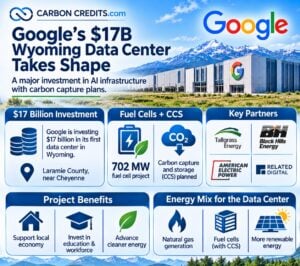
Google’s Wyoming Data Center Infographic

More Natural Gas Generation Will Support Energy Demand

The fuel cell development is only one part of the data center’s energy supply. Google will also source electricity from natural gas generators operated by Tallgrass Energy and Black Hills Energy. It is studying whether Tallgrass’s combined-cycle gas turbines can be fitted with carbon capture technology.

Black Hills has already signed agreements to serve the planned data center. The company plans to offer up to 590 MW of grid-connected energy. It will also manage around 2.1 GW of third-party contracted resources via a private microgrid.

To support the project, Black Hills plans to invest $1.8 billion between 2027 and 2029 to build 564 MW of new natural gas generation. The company expects the data center to begin taking energy service in late 2027, with demand rising toward its peak by 2030.

These plans show the scale of the energy infrastructure needed to support the new campus. They also make clear that natural gas will remain an important part of its electricity supply, even as Google adds carbon capture to one major power source.

Google said it will pay for 100% of the electricity it uses and cover infrastructure costs directly caused by its growth. The arrangements aim to keep the project’s energy costs from falling on local utility customers.

AI Boom Drives Demand for More Data Center Electricity

The Wyoming investment comes as AI drives a sharp rise in electricity demand from data centers. The International Energy Agency (IEA) reported that global data center electricity use rose 17% in 2025. Power demand from AI-focused data centers grew even faster.

The agency’s 2026 analysis estimates that total data center electricity consumption could nearly double, from 485 terawatt-hours (TWh) in 2025 to about 950 TWh by 2030. Electricity use from AI-focused data centers could triple over the same period. The following chart shows where the power for data centers will be coming from by 2035.

data center power sources, renewables, iea
Source: IEA

This growth is pushing technology companies to secure new sources of power. Renewable energy is key to their long-term plans, but natural gas is also becoming important. It can supply electricity when wind and solar power are low.

The IEA expects renewables to meet nearly half of the additional electricity demand from data centers through 2030. However, natural gas and coal together could supply more than 40% of that growth.

Google’s Wyoming project reflects this wider trend. The company is combining natural gas generation, fuel cells, and carbon capture to secure a large and steady power supply for its data infrastructure.

Carbon Capture Could Help, But Emissions Remain a Concern

CCS can reduce emissions from fossil fuel-based power generation by capturing CO₂ before it reaches the atmosphere and storing it underground.

The IEA says established power-sector capture systems have generally targeted rates of around 85% to 90%. Still, even at these levels, some emissions remain. A net-zero energy system would need to address these residual emissions through higher capture rates or other measures.

CCS also adds costs and uses some of the electricity generated by a power plant. The Congressional Budget Office says that adding CCS to a new power plant can significantly increase construction costs. It can also lower the amount of electricity available for sale.

For Google’s Wyoming project, the actual results will depend on the final design and performance of the capture and storage system. The company has not yet disclosed the expected volume of CO₂ captured each year or the emissions intensity of the electricity supplied to the data center.

Google’s wider climate record also provides important context. Its 2026 Environmental Report, covering 2025, said the company contracted more than 12 GW of new clean energy during the year. It also said its operations and supply chain cut over 58 million tonnes of CO₂ equivalent. This was done through energy procurement, hardware and software efficiency, and other actions.

Google clean energy portfolio
Source: Google

These figures reflect company-wide activities and should not be treated as emissions reductions from the Wyoming project.

Air Cooling Aims to Reduce the Data Center’s Water Footprint

Energy is not the only environmental issue facing large data centers. Their cooling systems can also put pressure on local water supplies.

The tech giant said the Wyoming facility will use air cooling to reduce its impact on local water resources. Unlike systems that rely heavily on evaporative cooling, air-cooled systems use air to remove heat from equipment.

The company also plans to work with local institutions on education, job training, and community investment. Google said it has met with more than 200 residents in Laramie County and is forming a Community Council with its project partners to discuss local concerns.

The development is expected to create jobs and increase local tax revenue. But its scale also raises questions about electricity supply, natural gas use, carbon storage, and the long-term environmental effects of AI infrastructure.

Google’s $17 billion investment shows how quickly the technology sector is building new energy-intensive facilities. Its Wyoming project will test whether carbon capture can help reduce the emissions linked to that growth. The answer will depend on how much carbon the system actually captures and stores once the facility begins operating.

The post Google Commits $17 Billion to Wyoming Data Center With Carbon Capture Power Plan appeared first on Carbon Credits.