
Korean Airlines Race for Carbon Credits as CORSIA Deadline Draws Closer
South Korean airlines are stepping up purchases of carbon credits as they face a growing compliance obligation under the International Civil Aviation Organization’s (ICAO) Carbon Offsetting and Reduction Scheme for International Aviation, or CORSIA.
The first compliance period covers 2024 through 2026, but airlines must secure and cancel the required eligible emissions units by the end of January 2028. With less than 16 months remaining, Korean carriers are moving to secure credits in a market where supply is already tightening.
Eastar Jet became the first South Korean airline to acquire CORSIA-eligible credits, purchasing 100,000 tonnes late last year. Trinity Airways, formerly T’way Air, followed in September 2026 with a purchase of 20,000 tonnes and plans to acquire more by the end of the year.
The moves highlight a broader challenge facing airlines worldwide: demand for CORSIA-eligible units is growing faster than authorized supply.
CORSIA’s First Compliance Test Is Getting Closer
CORSIA is the aviation industry’s global market-based system for addressing international flight emissions. Under the scheme, participating airlines must offset emissions above the applicable baseline by purchasing and cancelling eligible emissions units. The first phase covers 2024–2026, followed by the second phase from 2027–2035.
For 2024–2035, the CORSIA baseline is set at 85% of 2019 international aviation emissions. Any emissions above the applicable baseline create sector-wide offsetting requirements that are allocated among participating operators.
The compliance process is already underway.
Airlines must report their 2025 emissions during 2026. By November 30, 2026, states will use ICAO’s Sector’s Growth Factor to calculate each operator’s 2025 offsetting requirement. That makes 2026 a critical year for airlines to understand their eventual obligations and secure eligible units.
Korean Airlines Face Millions of Tonnes of Credit Requirement
South Korea has eight airlines subject to its international aviation carbon law: Korean Air, Asiana Airlines, Jeju Air, Air Busan, Jin Air, T’way Air, Air Incheon and Air Seoul. Their potential exposure is significant.
For 2024, Korean carriers collectively had an estimated CORSIA offsetting requirement of about 2.75 million tonnes. Korean Air led with about 1.55 million tonnes. Asiana Airlines followed with around 706,430 tonnes, and Jeju Air had about 133,202 tonnes.
By July 2026, only Eastar Jet had secured credits. Its purchase of 100,000 tonnes was about 3.6% of the 2024 national airline requirement. Korean Air, Asiana and the other major carriers had yet to secure credits for that obligation, according to Korean reporting.
The final 2025 and 2026 requirements will depend on ICAO’s calculations and reported emissions. Therefore, the 2.75-million-tonne figure should not be treated as the final three-year requirement. Still, it shows the potential scale of the market.
Why CORSIA Credits Are Different From Standard Offsets
Airlines cannot simply buy any carbon credit and use it for CORSIA. ICAO maintains specific eligibility rules for emissions units. For the 2024–2026 first phase, eight programs are currently approved to supply eligible units, including:
- American Carbon Registry,
- Architecture for REDD+ Transactions,
- Climate Action Reserve,
- Global Carbon Council,
- Gold Standard,
- Isometric,
- Thailand’s Premium VER Program, and
- Verra’s Verified Carbon Standard.
Credits also face safeguards against double counting. Host countries may need to issue authorization confirming that emissions reductions used for CORSIA are not also counted toward their Paris Agreement climate targets. This is linked to the use of corresponding adjustments under Article 6.
This restricted eligibility makes the market smaller than the broader voluntary carbon market. It also helps explain why airlines cannot wait until the last minute to source credits.
CORSIA Supply Is Falling Behind Demand
The shortage is not limited to South Korea. The International Air Transport Association (IATA) estimates airlines will need to purchase and cancel more than 200 million CORSIA-eligible emissions units by January 2028 to meet requirements for the 2024–2026 first compliance period.
Yet, as of August 2026, only about 72 million emissions units were covered by 42 CORSIA-compatible Letters of Authorization issued by host countries. That leaves an estimated gap of roughly 150 million units that must be filled over the following 15 months.
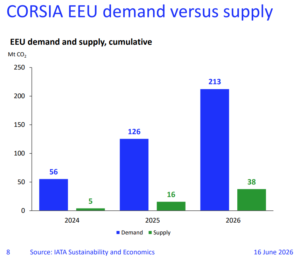
IATA said eligible supply is growing but remains well below the level needed. The available units are spread across Africa, Latin America and Asia-Pacific, with each region contributing a broadly similar volume.
The supply gap could put upward pressure on carbon prices as airlines move closer to the retirement deadline.
Korean Airlines Are Also Using SAF to Cut Obligations
Carbon credit purchases are only one part of the response. Airlines can also reduce their CORSIA obligations by lowering emissions through measures such as sustainable aviation fuel (SAF).
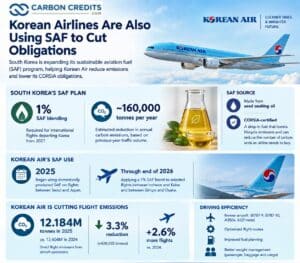
South Korea has been expanding its SAF market. The government plans to require 1% SAF blending for international flights departing Korea from 2027. The transport ministry estimated that this could reduce annual carbon emissions by about 160,000 tonnes, based on the country’s previous-year traffic volume.
Korean Air has already expanded its SAF use. In 2025, it began using domestically produced SAF on flights between Seoul and Japan. Its latest program applies a 1% SAF blend to selected flights between Incheon and Kobe and between Gimpo and Osaka through the end of 2026.
The SAF is made from used cooking oil and is CORSIA-certified. This drop-in fuel can therefore serve two purposes. It lowers the lifecycle emissions of flights and can reduce the number of carbon units an airline ultimately needs to purchase.
Korean Air Is Cutting Flight Emissions
Korean Air has also reported progress in reducing its direct flight emissions. The airline recorded 12.18 million tonnes of carbon emissions from aircraft operations in 2025, down from 12.60 million tonnes in 2024.
That represents a reduction of about 420,055 tonnes, or 3.3%, even though the number of flights increased approximately 2.6%.
The airline attributed the reduction to newer aircraft, optimized flight routes, improved fuel planning and more precise management of passenger, baggage and cargo weight.
Its newer aircraft fleet includes Boeing 787-9 and 787-10 aircraft, Airbus A350s and A321neos. Aircraft introduced since 2017 accounted for 41.6% of Korean Air’s total flights in 2025. These efficiency measures can help reduce both fuel consumption and future CORSIA exposure.
The Carbon Market Is Becoming an Aviation Cost
The Korean airline market shows how CORSIA is turning carbon emissions into a direct operating consideration.
The challenge is particularly significant because CORSIA credits must meet specific eligibility requirements. Airlines therefore compete for a relatively limited pool of units while international aviation demand continues to recover.
IATA estimates that over 200 million units will be needed by January 2028. In contrast, only about 72 million units have host-country authorizations as of August 2026. This shows a significant gap.
For Korean carriers, the next step is securing enough eligible units while continuing to reduce fuel use and adopt SAF. The market is already moving in that direction. Eastar Jet has secured 100,000 tonnes, while Trinity Airways has purchased 20,000 tonnes and plans further purchases.
For larger carriers such as Korean Air and Asiana, the potential requirement is substantially greater. As the January 2028 deadline approaches, CORSIA is therefore creating a new procurement market for airlines — one where access to eligible carbon units, SAF and lower-emission aircraft could directly affect compliance costs.
The Korean experience also reflects a broader global trend: as international aviation grows, carbon compliance is moving from a long-term sustainability issue toward an increasingly immediate financial and operational consideration.
The post Korean Airlines Race for Carbon Credits as CORSIA Deadline Draws Closer appeared first on Carbon Credits.