Terraton’s First Biochar Credits Boost Carbon Removal Expansion Across Africa

Agricultural waste-to-biochar developer Terraton has received its first carbon removal credits from Isometric for its EcoFix Kenya facility, marking a milestone in its plans to expand biochar production across emerging markets. The company has also secured purchase agreements covering up to 97,240 tonnes of carbon removal and $1.5 million in debt financing from HSBC Ventures to develop additional facilities.

The first issuance provides independent verification of carbon removed and stored through the Kenyan project. Terraton aims to replicate its standardized facility model across agricultural supply chains, turning crop residues into biochar while creating a new revenue stream for agribusiness operators.

Its latest agreements include purchases, reserved volumes and marketing rights involving Climeworks Solutions, Climate Impact Partners, Carbonfuture, CUR8 and nonprofit climate fund Terraset. These arrangements provide potential routes to market as the company develops more production capacity.

Terraton Turns Nut Waste Into Carbon Removal Credits

Terraton made its final investment decision on EcoFix Kenya in August 2025 and began producing biochar in May 2026. Isometric issued the facility’s first credits in October, completing the process in roughly 14 months from the investment decision.

Based in Nanyuki, Kenya, EcoFix processes croton nut husks collected through existing agricultural operations. The biochar facility uses this waste stream without requiring major changes to the company’s core business.

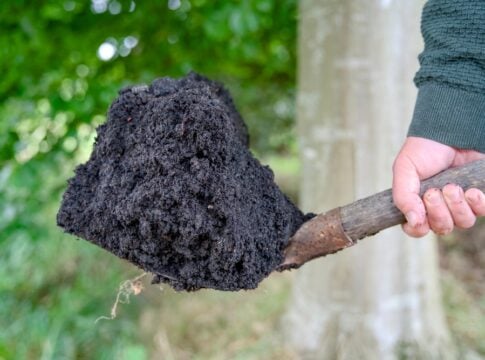
The project converts the husks into biochar through thermochemical carbonization, a process that heats biomass under controlled conditions. The resulting material stores carbon in a stable form and can improve agricultural soils when used in compost.

  • Biochar can also help raise soil pH, making it relevant to farming regions affected by soil acidification. Its agricultural applications create a potential dual benefit: durable carbon removal and improved soil conditions.

Terraton designed and financed the facility, installed its equipment and sensors, and supplied its smart facility management software. The software sends production data to Offstream’s digital monitoring, reporting and verification (dMRV) platform, which performs accounting and quality checks before submitting production records to Isometric.

David Armstrong, Partnerships Manager at Isometric, said:

“This is a major milestone for the Terraton and EcoFix Kenya teams: their first certificates backed by independent verification. It’s a testament to the work that goes into developing a high-quality carbon removal project, and marks the start of regular issuances. We’re looking forward to working with Terraton on their second project, Tupande.”

Biochar Carbon Removal Market Attracts More Buyers

Terraton’s first issuance comes as companies increase purchases of durable carbon removal credits. Biochar has established itself as a major pathway because producers can convert available biomass into carbon-storing material using commercially deployable technology.

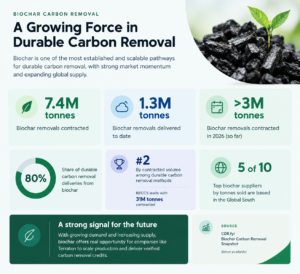
According to CDR.fyi. The market has recorded 7.4 million tonnes of contracted removals and 1.3 million tonnes delivered to date.

Key market figures include:

  • 7.4 million tonnes: Total biochar removals contracted.
  • 1.3 million tonnes: Biochar removals delivered to date.
  • More than 3 million tonnes: Biochar removals contracted in 2026 as of the report’s publication.
  • 80%: Approximate share of durable carbon removal deliveries attributed to biochar.
  • Five of the top 10 suppliers: Based in the Global South, highlighting the role of emerging markets in expanding production.

Biochar ranks second in contracted volume behind bioenergy with carbon capture and storage (BECCS), which has 31 million tonnes contracted. This growth creates opportunities for Terraton to expand its facilities and supply verified carbon removal credits.

BIOCHAR CARBON REMOVAL

More recent market activity points to continued demand for carbon removal.

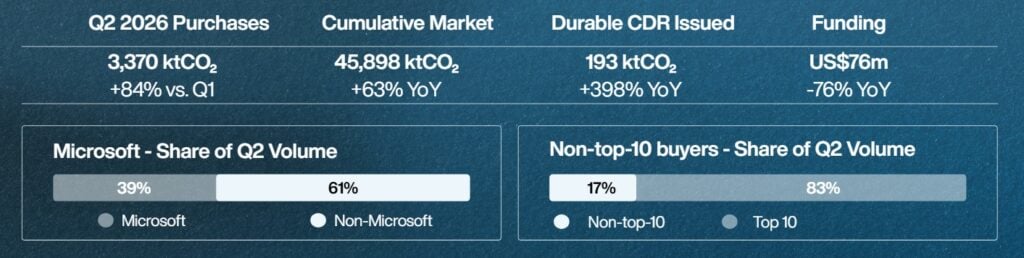
  • ClimeFi reported that corporate buyers committed to 2.1 million tonnes of carbon removal across all pathways in the second quarter of 2026, up 136% year over year.
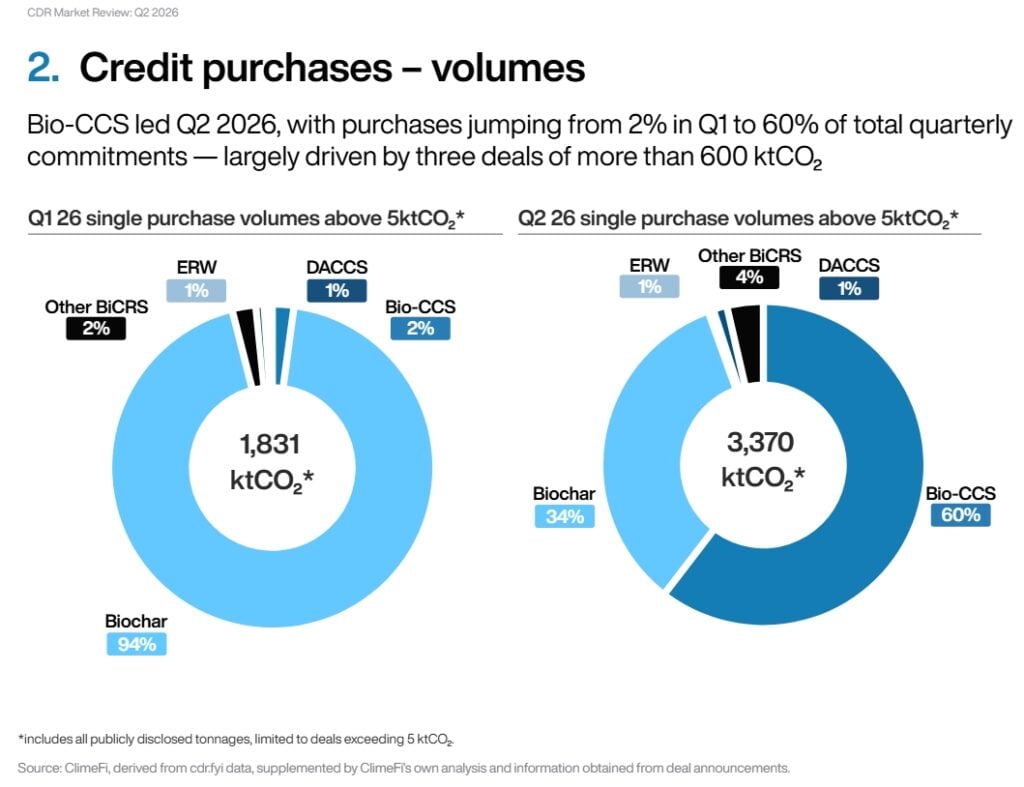
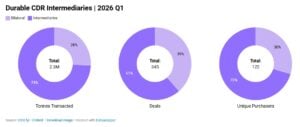
  • Biochar remains a major pathway for durable carbon removal, although other technologies are gaining ground. ClimeFi’s Q1 2026 review found that biochar accounted for approximately 94% of new carbon removal purchase volumes that quarter, supported by three large deals totaling 1.505 million tonnes.

However, biochar no longer led all pathways by purchase volume in Q2 2026 as the market diversified. This highlighted increasing competition among removal technologies.

Fourteen deals were recorded, including seven from companies making their first major carbon removal commitments. Biochar did not lead purchase volumes in that quarter.

biochar carbon credit
Source: ClimeFi

For developers such as Terraton, the opportunity depends on converting demand into verified deliveries. Buyers increasingly use forward offtake agreements to secure future supply, while developers need financing to build facilities before issuing credits.

Offtake Agreements Support Terraton’s Expansion

Terraton’s commercial agreements cover several stages of its planned production:

  • Climeworks Solutions committed to purchasing 2,000 tonnes from EcoFix and reserved a further 14,000 tonnes from future Terraton facilities.
  • Climate Impact Partners agreed to purchase credits from EcoFix, the upcoming Tupande project and facilities still in development.
  • Terraset signed a seven-year offtake agreement covering up to 14,000 tonnes from future facilities, with annual purchase volumes confirmed in advance.
  • Carbonfuture will bring up to 32,500 tonnes of carbon removal to market through 2031 using its trust infrastructure.
  • CUR8 secured a purchase of 240 tonnes, extending Terraton’s customer base to a leading global consumer brand.

These figures describe different types of arrangements and should not be treated as equivalent to credits already issued or delivered. The overall potential volume also includes future production that depends on facility development and performance.

Chris Walters, Sourcing Manager at Climate Impact Partners, said:

“We see growing demand from corporate buyers for tech-based carbon removals, but scaling supply remains a major challenge. Terraton’s approach combines project development, financing, operations and carbon markets to deliver new biochar projects efficiently and at scale, which presents a valuable addition to our portfolio of carbon removal projects.”

HSBC Financing Targets More Biochar Facilities

HSBC Ventures’ $1.5 million debt financing will support facility development over the next two years. Terraton is also developing a $25 million pooled financing vehicle intended to fund approximately 20 additional biochar facilities.

The company plans to standardize equipment, facility design, operating procedures, and reporting across projects. This approach could make it easier to assess and finance multiple facilities as a portfolio rather than evaluating each site independently.

Terraton expects its next facilities to reach credit issuance faster than EcoFix, as the company can reuse the technical systems and operating experience developed at its first site. Its next project, built with Tupande, One Acre Fund’s Kenyan brand, is already being commissioned in Sagana, Kenya.

  • It has also signed 28 additional memorandums of understanding and identified more than 30 other sites in its development pipeline across Africa, South America, South Asia and Southeast Asia.

Kevin Gibbs, CEO of Terraton, noted:

“The facility at EcoFix went from investment decision to issued credits in fourteen months, all while we were still building our software, structuring our credits, and learning the ins and outs of our equipment. Our next sites start with all of that experience in place, positioning us to deliver facilities and credits faster.”

Terraton’s growth will depend on how quickly it can replicate its model. Standardized facilities could lower costs and attract financing, but future credit issuance will depend on reliable operations and independent verification. The company was also one of 10 winners of the World Economic Forum’s UpLink Scaling Carbon Dioxide Removal Challenge for its approach to scaling biochar projects.

The post Terraton’s First Biochar Credits Boost Carbon Removal Expansion Across Africa appeared first on Carbon Credits.
Lithium Demand to Hit 4.8 Million Tonnes by 2050, BNEF Forecasts

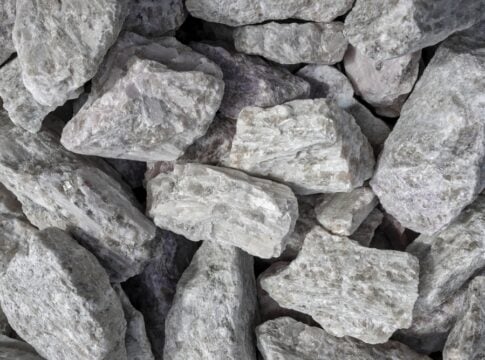
lithium carbonate

Global demand for transition metals is expected to grow as electric vehicles (EVs), renewable energy, battery storage and electricity networks expand. However, supply risks vary across commodities, with some markets facing potential shortages while others could experience oversupply.

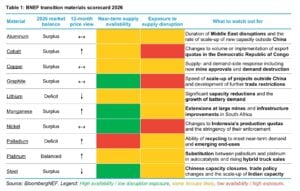
BloombergNEF’s (BNEF) Transition Metals Outlook 2026 highlights these differences. Copper faces the biggest long-term supply challenge, while lithium demand could triple by 2050. However, new mining capacity could ease lithium shortages in the near term and put pressure on prices as supply expands.

The outlook presents both opportunities and risks for mining companies and investors. Demand for battery materials is growing, but rising consumption does not automatically guarantee higher prices or stronger returns for producers.

Transition Metals Demand Will Rise Through 2050

BNEF’s report examines 10 materials: aluminum, cobalt, copper, graphite, lithium, manganese, nickel, palladium, platinum and steel. Under the report’s Economic Transition Scenario, demand for eight of these materials is expected to rise by 2050.

Copper presents the biggest long-term challenge. Demand could rise 61% between 2026 and 2050, reaching nearly 46 million metric tons annually. Without additional supply, the market could face a deficit of 20 million metric tons by 2050, equivalent to 44% of projected demand. BNEF estimates that bridging this gap could require $332 billion in new mine investment.

Graphite is another major growth market, with demand expected to more than double by 2050 as battery production expands. Meanwhile, changes in battery chemistry, particularly the growing adoption of lithium iron phosphate (LFP) batteries, have reduced BNEF’s demand projections for cobalt and nickel compared with previous estimates.

lithium

Recycling Will Help Close Supply Gaps

China dominates the refining of several transition metals, leaving manufacturers in other regions exposed to trade restrictions and supply disruptions. Governments and companies will need to diversify sourcing and expand recycling to strengthen supply security.

BNEF expects recycling to become essential for six of the 10 materials by 2035 and eight by 2050. Battery recycling is projected to expand faster than primary production between 2026 and 2050.

Recycling could help companies:

  • Recover valuable metals from used batteries.
  • Reduce reliance on newly mined materials.
  • Diversify supply chains and limit exposure to trade disruptions.
  • Support demand growth as more EV batteries reach the end of their useful lives.

Lithium Demand Could Reach 4.8 Million Tonnes

Lithium is a key material in rechargeable batteries used in electric cars, consumer electronics and grid-scale energy storage. Demand is expected to increase as transport electrification accelerates and power systems require more storage to balance variable renewable electricity generation.

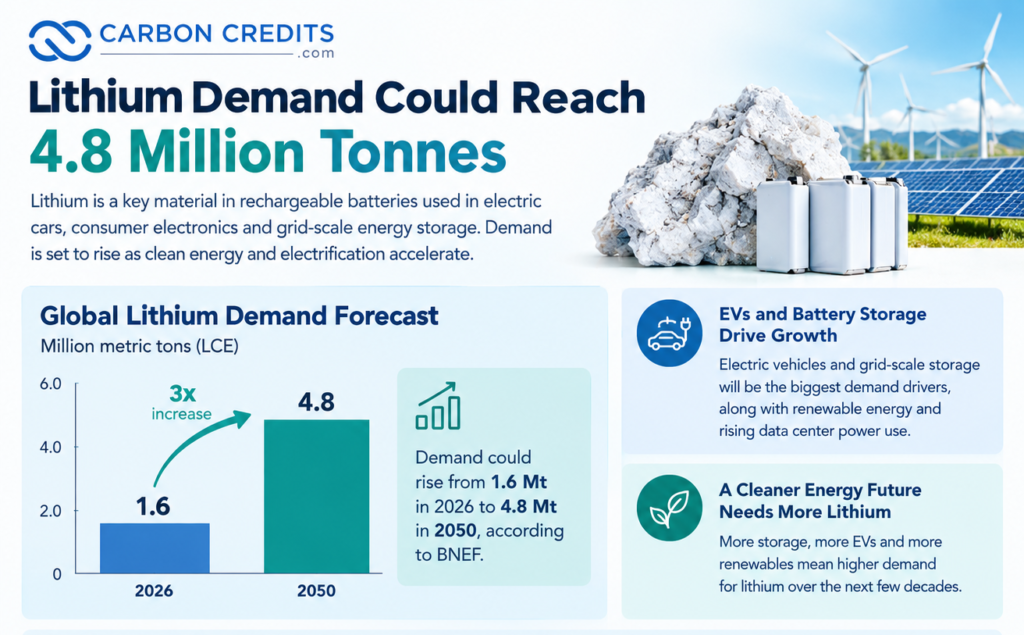
According to BNEF, global lithium demand is projected to rise from 1.6 million metric tons of lithium carbonate equivalent (LCE) in 2026 to 4.8 million metric tons in 2050. This represents a threefold increase over the period.

Lithium demand supply
Source: BNEF

EVs and Battery Storage Drive Growth

Electric vehicles remain a major source of lithium consumption, but stationary battery storage is becoming increasingly important. Utilities are installing batteries to balance electricity supply and demand, support grid reliability, and store excess solar and wind power. Rising electricity consumption from data centers could also strengthen the need for storage.

The main demand drivers include:

  • Electric vehicles: Automakers continue to expand their EV offerings and battery manufacturing capacity.
  • Grid-scale storage: Utilities use lithium-ion batteries to improve grid flexibility and integrate renewable power.
  • Renewable energy: Solar and wind projects need storage to help manage changes in electricity generation.
  • Battery technology: Advances in battery design could improve performance and change lithium requirements.

However, the pace of demand growth will depend on EV sales, energy storage investment, government policies and battery technology. Improvements in battery efficiency and the adoption of alternative chemistries could change how much lithium manufacturers need for each unit of storage capacity.

Lithium Production Expands as New Projects Advance

Despite strong long-term demand, lithium supply has expanded rapidly following earlier price increases. Producers developed new mines and processing capacity, contributing to oversupply and a sharp price correction in 2023–2025.

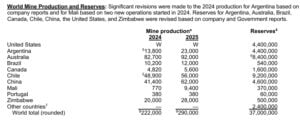
The U.S. Geological Survey (USGS), in its Mineral Commodity Summaries 2026, estimated that global lithium mine production outside the United States rose 31% in 2025 to approximately 290,000 metric tons of lithium content, up from 222,000 tons in 2024. Global consumption reached an estimated 263,000 tons, a 20% increase from 220,000 tons in 2024.

These figures use lithium content rather than LCE, so they are not directly comparable with BNEF’s demand forecast. They nevertheless illustrate the rapid expansion in mining output and consumption.

lithium supply data
Source: USGS

Which Countries Supply Lithium?

Australia, Chile, China and Argentina remain important lithium producers. New projects and capacity expansions in countries such as Brazil, Canada and Zimbabwe could add further supply. However, permitting, financing, infrastructure, and processing constraints can delay new production.

Producers face several challenges as they expand capacity:

  • Securing financing for new mines and processing facilities.
  • Managing production costs when lithium prices fall.
  • Obtaining permits and developing infrastructure.
  • Meeting environmental requirements and local community expectations.
  • Bringing projects online before market conditions change.

A Near-Term Deficit Could Give Way to Surplus

BNEF expects the lithium market to face a near-term deficit in 2026. New supply capacity coming online in 2027 could help resolve the shortfall. Over the longer term, additional production could push the market toward surplus conditions.

For investors, the distinction between a temporary deficit and a structural shortage matters. Delayed projects or production cuts could tighten the market, while rapid capacity growth could limit producers’ pricing power.

Lithium Prices Remain Under Pressure

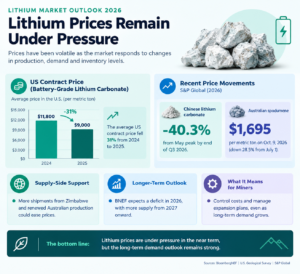
Lithium prices have been volatile as the market responds to changes in production, demand, and inventory levels.

USGS estimated that the average US contract price for battery-grade lithium carbonate fell to $9,000 per metric ton in 2025, down 31% from $11,800 in 2024. Stronger EV sales in China and Europe, along with growing demand for battery storage, later helped support a market recovery.

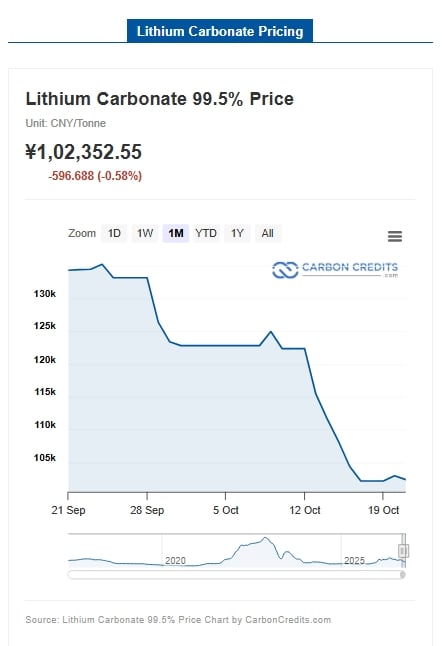
Latest data for Lithium Carbonate pricing: LITHIUM CARBONATE PRICES

Recent Price Movements Signal Volatility

S&P Global reported recently that, in 2026, Chinese lithium carbonate prices had fallen 40.3% from their May peak by the end of the third quarter. It also assessed Australian spodumene at $1,695 per metric ton on October 9, down 28.5% from July 1.

The reseach firm expects additional shipments from Zimbabwe and the resumption of Australian production to improve feedstock availability, potentially putting further pressure on prices. Shipment delays and strong spot demand could still trigger renewed volatility.

BNEF’s outlook also points to longer-term pricing pressure as supply capacity expands. Although the market could experience a deficit in 2026, additional production may ease supply conditions from 2027 onward.

For mining companies, this means that controlling costs and managing expansion plans will remain critical, even as long-term demand grows.

Lithium Prices Outlook summarized: 

lithium prices

What Could Change the Lithium Outlook?

Several factors will influence the balance between lithium demand and supply.

  • Faster battery storage growth: More grid-scale projects could increase demand beyond current expectations.
  • Mine delays or closures: Supply disruptions could tighten the market and support prices.
  • Faster capacity expansion: New mines could create surplus supply and limit price recovery.
  • Battery innovation: Alternative chemistries and more efficient designs could change lithium consumption.
  • Recycling growth: Recovering lithium from used batteries could reduce reliance on primary production over time.

What the Outlook Means for Investors

Lithium offers long-term demand growth but also significant price risk. Producers with competitive costs, reliable processing capacity and strong balance sheets may be better positioned to withstand market downturns.

The broader transition metals outlook reinforces an important point: growing demand does not automatically lead to sustained shortages or higher prices. Copper faces a potentially widening structural supply gap, while lithium could move from a near-term deficit toward a more balanced or oversupplied market.

Investors should therefore monitor production costs, project timelines, recycling capacity and battery storage deployment alongside demand forecasts. These factors will help determine which companies can turn the energy transition’s growing need for metals into sustainable returns.

The post Lithium Demand to Hit 4.8 Million Tonnes by 2050, BNEF Forecasts appeared first on Carbon Credits.
China Moves to Expand CCER Market With 11 New Carbon Credit Methods

China Moves to Expand CCER Market With 11 New Carbon Credit Methods

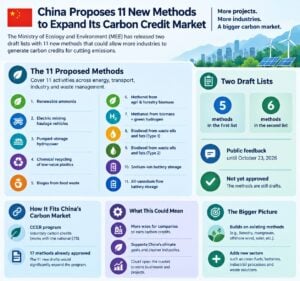
China is proposing a major expansion of its domestic carbon credit market, with 11 new methods that could allow more industries to generate credits for cutting greenhouse gas emissions. The proposals cover clean fuels, battery storage, electric mining vehicles, plastic recycling, and food waste treatment. They could widen the range of projects eligible to earn credits under China’s national voluntary emissions reduction program.

China’s Ministry of Ecology and Environment (MEE) published two groups of draft methods: One contains five proposals, while the other contains six. The ministry is seeking public feedback until October 23. The methods have not yet been approved.

The move comes as China continues to develop its carbon market. If adopted, the new methods could open more ways for companies to earn carbon credits while supporting the country’s wider efforts to cut emissions.

11 New Methods Target Clean Fuels, Batteries and Waste

The proposed methods cover 11 activities across energy, transport, industry and waste management. Five drafts focus on renewable ammonia, electric mining haulage vehicles, pumped-storage hydropower, chemical recycling of low-value plastics, and biogas production from food waste.

The other six include:

  • Methanol from agricultural and forestry biomass.
  • Methanol from biomass mixed with green hydrogen.
  • Two types of biodiesel from waste oils and fats.
  • Energy storage with sodium-ion batteries.
  • Energy storage with all-vanadium flow batteries.

These activities target different sources of emissions. Some could replace fossil fuels with lower-carbon alternatives. Others could improve energy storage, reduce fuel use in mining, or turn waste into useful products.

The proposed methods would set rules for how eligible projects are designed, assessed, and monitored. They would also establish how projects calculate their emissions reductions and how those results are checked.

That standardization matters because carbon credits need a consistent way to measure the emissions avoided or reduced by a project. Without clear rules, it becomes harder to compare projects and judge whether their claimed climate benefits are real.

New CCER Methods Could Broaden China’s Carbon Credit Market

China’s voluntary carbon credit program is known as China Certified Emission Reduction, or CCER. It works with the country’s national emissions trading system (ETS). This system requires companies to manage and give up emissions allowances based on government rules.

The CCER program resumed trading in January 2024. It provides a route for eligible projects to generate credits under China’s domestic system. These credits can be used under applicable market rules, including to meet part of the compliance needs of covered companies.

Before this latest proposal, China approved 17 methods under the current CCER framework. This information comes from a June 2026 overview by Columbia University’s Center on Global Energy Policy. The 11 new drafts would represent a substantial expansion if they are all approved.

The proposals also reflect a wider effort to bring more types of emissions-reduction projects into the system. Previous methods included:

  • Forest planting,
  • Mangrove restoration,
  • Offshore wind power,
  • Solar thermal power,
  • Energy-saving highway tunnel lighting, and
  • Using low-concentration coal mine gas.

The new proposals extend this approach into areas such as alternative fuels, industrial processes and energy storage. That could give more businesses a path to participate in carbon credit generation, although eligibility will depend on the final rules.

China’s Expanding Carbon Credit Market

RELATED: China’s Farmland Could Remove 350 Million Tonnes of CO₂ a Year, Study Finds

China’s Wider Carbon Market Is Also Growing

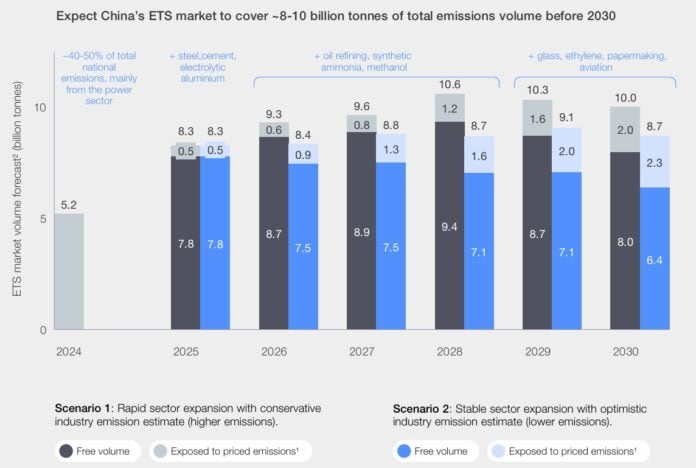
China operates two connected but distinct systems: a national emissions trading system (ETS) for covered emitters and the China Certified Emission Reduction (CCER) program, which allows eligible projects to generate carbon credits.

The national ETS is China’s main compliance carbon market. Its trading activity has continued to grow. Cumulative allowance trading exceeded 930 million tonnes by the end of July 2026, according to figures reported by Xinhua and cited by Carbon Herald.

On October 21, Vice-Minister of Ecology and Environment Li Gao announced that cumulative trading had passed 1 billion tonnes. The system covers about 8.3 billion tonnes of CO₂ emissions, representing more than 65% of China’s total carbon dioxide emissions.

China also plans to extend the ETS to major emitting industries, including petrochemicals and chemicals, by 2027. The government said its policies helped reduce emissions in the thermal power sector by about 530 million tonnes of CO₂ during 2021–2025.

china compliance carbon market ets
Source: WEF Asia’s Carbon Markets Strategic Imperatives for Corporations, 2025.

These developments provide important context for the 11 proposed CCER methods. While the ETS regulates emissions through allowance trading, the CCER program creates a route for eligible projects to earn credits. The proposed methods could expand the types of projects that qualify, but their impact will depend on final approval and the verified emissions reductions they deliver.

Carbon Credit Quality Will Depend on Strong Measurement Rules

More methods could create more routes for companies to seek carbon credits. But expanding the list of eligible activities does not guarantee that every project will deliver the emissions reductions it claims.

The final methods will need clear rules for setting emissions baselines, measuring results, and checking project performance. A baseline estimates what emissions would have occurred without the project. The difference between that baseline and the project’s actual emissions helps determine how many credits it may qualify to generate.

The rules also need to account for emissions created during production and operation. For example, a fuel made from waste or biomass is not automatically emissions-free. Its overall climate benefit depends on factors such as how the feedstock is sourced, how much energy production uses, and what emissions the new fuel replaces.

Energy storage projects also need sound accounting. Their climate benefits can depend on when and how the stored electricity is generated and used. If a battery charges with high-emissions electricity, its benefit may be smaller than if it stores power that would otherwise go unused from a lower-carbon source.

These issues make measurement, reporting, and verification essential. Strict rules can help ensure that credits reflect real emissions reductions rather than overstated estimates.

Public Consultation Is the Next Step

China’s consultation period for all 11 draft methods closes on October 23, 2026. The MEE will consider feedback before the proposals can move forward. The ministry has not yet confirmed that all 11 will be approved.

For project developers, approval could create new opportunities to seek crediting under the CCER program. For companies that buy credits to meet applicable obligations, the new methods could eventually broaden the range of available projects.

However, the number of proposed methods is only one measure of progress. The next milestones will be final approval, clear eligibility rules, project registration, and verified emissions reductions.

China’s proposal signals a wider scope for its domestic carbon credit system. Whether that expansion leads to a meaningful increase in high-quality credits will depend on how the methods are finalized and applied in practice.

The post China Moves to Expand CCER Market With 11 New Carbon Credit Methods appeared first on Carbon Credits.
Philippines Moves to Build National Carbon Market Under New Executive Order

Philippines Moves to Build National Carbon Market Under New Executive Order

The Philippines is taking a major step toward building a national carbon market. President Ferdinand Marcos Jr. has ordered the government to develop a policy framework to guide carbon credit projects, attract investment, and support the country’s climate goals.

Under Executive Order No. 127, signed on October 13, 2026, the Department of Environment and Natural Resources (DENR) will lead the development of the Philippine Carbon Market Policy Framework. The order also creates an inter-agency committee to guide the process and names the DENR as the country’s main authority for carbon markets.

The framework will set rules for carbon projects, credit trading, monitoring, and benefit-sharing. It will cover both voluntary carbon markets and international trading under Article 6 of the Paris Agreement. The DENR must submit the proposed framework to the committee for review and approval within 30 days after the order takes effect.

The move could help bring more funding to forest protection, clean energy, farming, and other projects that cut or remove greenhouse gas emissions. However, the detailed rules still need to be developed, and the impact will depend on how the system is put into practice.

Marcos Orders National Carbon Market Rules

Executive Order No. 127 aims to give the Philippines a clearer and more coordinated approach to carbon markets. The government wants the framework to support climate goals while opening the door to investment, funding, and technology. The EO read:

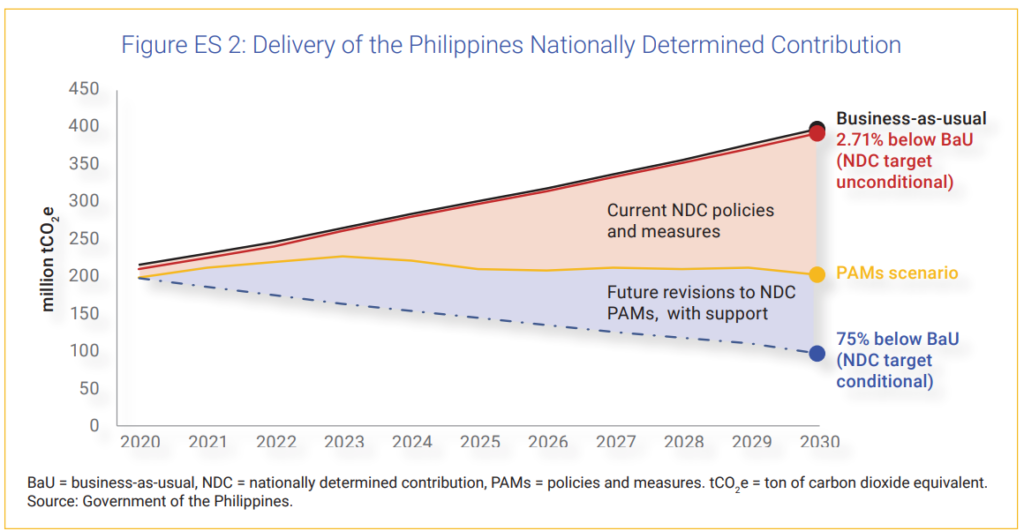
“There is a need to formulate a national carbon market framework aligned with international standards, through a whole-of-government approach, to support the achievement of the country’s NDCs (nationally determined contributions).”

Carbon markets allow companies and other buyers to purchase credits from projects that reduce or remove greenhouse gas emissions. One carbon credit usually stands for one metric ton of carbon dioxide equivalent. These credits are based on specific rules and standards.

Philippines Nationally Determined Contribution
Source: Climate Change Commission

Selling carbon credits can help fund projects that may struggle to secure enough money through other sources. The new framework will establish rules for:

  • Which projects qualify,
  • How credits are issued and transferred,
  • Accepted carbon standards, and
  • How projects report results.

It will also cover environmental and social safeguards and how project benefits should be shared. These rules could support projects in forestry, renewable energy, agriculture, and other sectors.

The order does not create a new carbon tax. Instead, it sets the direction for regulating carbon market activities and developing a more coordinated system for carbon projects.

DENR Takes the Lead as Agencies Join Carbon Market Committee

The order names the DENR as the national authority for carbon markets. It will oversee eligible projects and help ensure they follow national rules and environmental policies.

An Inter-Agency Committee on Carbon Markets (IACCM) will coordinate government policy and review the proposed framework. The Climate Change Commission will chair the committee, while the Department of Finance will serve as vice chair. Other members include:

  • DENR, Department of Energy, Department of Agriculture, Department of Transportation, Department of Trade and Industry, and the Securities and Exchange Commission.

These agencies cover areas that can affect carbon projects, from climate policy and land use to energy, transport, business, and finance. Their cooperation will be important because projects may need several permits and must meet different technical and reporting requirements.

The committee will review how the framework is applied. It will also approve fair fees for carbon market applications and certifications.

Philippines Plans National Registry to Track Carbon Credits

The government will establish a Philippine National Carbon Registry, which the DENR will manage. The digital system is intended to record carbon credits and related transactions. It should help regulators track credits and reduce the risk of the same emissions reduction being counted more than once.

This matters when credits are sold to different buyers or transferred between countries. If the same emissions reduction is claimed more than once, the climate benefit becomes less reliable.

The framework will also set rules for measuring and checking emissions reductions, approving international transfers, and reporting transactions. These requirements could help buyers assess credits and give project developers a clearer process for selling them in eligible markets.

However, the registry’s value will depend on how well the government checks project data, tracks credits, and enforces the rules.

Opening the Door to International Carbon Trading

The framework will cover both voluntary carbon markets and international trading under Article 6 of the Paris Agreement. In voluntary markets, companies and other organizations buy credits to support their climate goals. Eligible projects may include forest conservation, reforestation, renewable energy, farming, and waste management.

Article 6 allows countries to work together to meet their climate targets. Under Article 6.2, countries can transfer approved emissions reductions or removals, known as internationally transferred mitigation outcomes (ITMOs).

These transfers require government approval and proper accounting. Countries must follow the rules. This stops the same emissions reduction from counting for more than one climate target.

The new framework will set rules for approving international transfers. It will also manage carbon credits. This could help Philippine projects reach international buyers. However, approval under the national framework will not automatically mean that every credit qualifies for every market or buyer.

New National Framework Builds on Existing Sector Rules

The Philippines is not starting from zero. Several government initiatives have already laid the groundwork for carbon market development.

In 2025, the Department of Energy issued a framework for generating, managing, and monitoring carbon credits in the energy sector. It covers issues such as measuring emissions reductions, checking results, credit ownership, and preventing double counting.

The DENR set rules for forest carbon projects. In 2021, they issued an order to measure, verify, and certify forest carbon activities. Executive Order No. 127 creates a national framework. This aims to unite efforts and set broader rules for voluntary and international carbon markets.

The next challenge will be to align existing sector rules with the new framework. Project developers, communities, investors, and buyers will need clear guidance on how the different requirements work together.

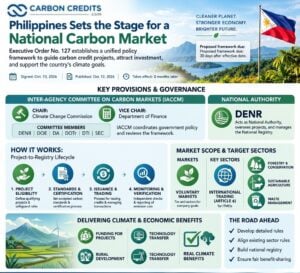
Philippines national carbon market framework

Clearer Rules Could Open New Opportunities for Investors and Communities

Clearer rules could make the Philippines more attractive to companies looking to develop carbon projects. Possible areas include forest restoration, forest protection, renewable energy, better farming practices, and waste management. These projects must show that they reduce or remove emissions and meet the relevant standards before they can generate eligible credits.

For investors, clear approval and reporting rules could make it easier to assess project risks. A national registry could also improve transparency by providing a central record of credits and transactions.

Communities and farmers may benefit through project funding, jobs, or a share of revenue. But these benefits are not guaranteed. The final rules and each project’s agreements will help determine how money is shared.

Strong checks will also be important. Projects must prove their claimed emissions cuts or removals, follow environmental and social safeguards, and avoid double counting.

Carbon credits are not guaranteed income. Projects may need upfront funding, technical studies, monitoring, independent checks, and government approval. Revenue will depend on the credits generated, their quality, buyer demand, and the terms of each project.

Will the Philippines’ Carbon Market Gain Momentum? 

Executive Order No. 127 gives the Philippines a clearer national plan for developing its carbon markets. It assigns the DENR a leading role, creates an inter-agency committee, and provides for a national registry.

The framework could help attract funding for projects that cut emissions or remove carbon from the atmosphere. It may also create new opportunities for developers, investors, and local communities.

But the order is only the first step. The government still needs to develop the detailed rules and put systems for project approval, verification, reporting, and credit tracking into practice.

The key test will be whether the new framework provides clear rules, attracts investment, and ensures that carbon credits deliver real climate benefits while sharing project gains fairly with local communities.

The post Philippines Moves to Build National Carbon Market Under New Executive Order appeared first on Carbon Credits.
Google and McKinsey Back Brazil Silvopasture Project in 320,000-Tonne Carbon Removal Deal

Google and McKinsey Back Brazil Silvopasture Project in 320,000-Tonne Carbon Removal Deal

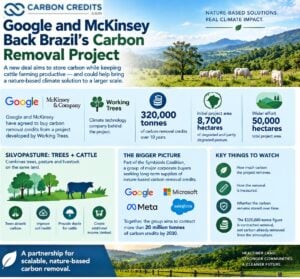
Google and McKinsey are backing a new carbon removal project in Brazil that aims to store carbon while keeping cattle farming productive. The deal could help bring a nature-based climate solution to a larger scale and create a new source of income for ranchers.

The two companies agreed to buy 320,000 metric tonnes of carbon removal credits over 10 years from a project developed by climate technology company Working Trees. The purchase is part of the Symbiosis Coalition, a group of major corporate buyers seeking long-term supplies of nature-based carbon removal credits.

The project will initially restore 8,700 hectares of degraded and partly degraded cattle pasture in Brazil’s southeastern Amazon and Cerrado regions. It forms part of a wider 50,000-hectare effort.

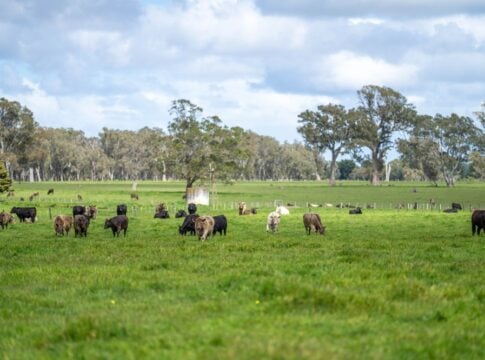
The approach is called silvopasture, which combines trees, pasture, and livestock on the same land. Trees absorb carbon as they grow, while cattle can continue grazing.

The agreement highlights a growing role for corporate carbon finance: helping projects secure money before they generate credits. Yet, the climate benefits will depend on how much carbon the project removes, how that removal is measured, and whether the carbon remains stored over time.

Julia Strong, Executive Director of Symbiosis Coalition, remarked:

“Silvopasture is one of the most underused tools we have for nature-based carbon removal, and what excites us about the Working Trees project is how much room there is to scale it. Working Trees’ project is sequestering carbon while also improving the land that communities rely on. That’s the kind of outcome we strive for at Symbiosis, real climate impact that supports the livelihoods of the communities this project touches while thinking holistically about landscape-level impacts that last.”

Silvopasture: How Trees and Cattle Can Share the Same Pasture

Traditional cattle pasture often has few trees. Silvopasture adds rows of trees to grazing land, allowing ranchers to keep cattle while increasing tree cover.

Working Trees says it combines native trees with commercial timber species and other trees suited to the land. The trees can absorb carbon, provide shade, improve soil conditions, and create additional income through timber sales. The company also says shade can reduce heat stress in cattle and help pastures cope with hot and dry conditions.

This matters in Brazil, where cattle farming is a major part of agriculture and land conversion is an important source of environmental pressure. Restoring degraded pasture could improve land productivity and reduce the need to clear additional areas for farming.

However, silvopasture is not the same as restoring a natural forest. The project must balance tree growth, grazing, and farm income. Its climate value will depend on the amount of carbon stored in trees and soil, minus relevant project emissions and any carbon losses.

Why the 320,000-Tonne Purchase Matters

The Google and McKinsey agreement gives Working Trees long-term buyers for a large share of its planned carbon removal. The companies have not publicly disclosed the purchase price or a detailed delivery schedule.

Long-term purchase agreements, often called offtake agreements, can help carbon project developers raise money and plan future work. Buyers agree to buy credits that meet specified requirements, often before all the credits have been generated.

This can help address some of the main barriers facing nature-based projects:

  • the high upfront cost of planting trees,
  • working with landowners, and
  • monitoring results over many years.

Working Trees says it covers most implementation costs for participating farmers and provides technical support. That can lower the financial burden on ranchers who want to change how they manage their land.

The company reports that it has planted about 450,000 trees across 2,167 hectares with 18 partner farmers. It also reports interest from landowners covering 200,000 hectares. These are company-reported figures, not independently verified measures of carbon removal.

The new deal could help the company expand beyond its existing projects. Still, the 320,000 tonnes represent contracted carbon removal, not carbon already removed from the atmosphere.

Corporate Buyers Are Building a Larger Carbon Removal Market

The agreement is part of a wider push by companies to secure future carbon removal. Google, Microsoft, Meta, and Salesforce are among the companies involved in the Symbiosis Coalition. The group aims to contract more than 20 million tonnes of carbon credits by 2030, with a focus on nature-based carbon removal.

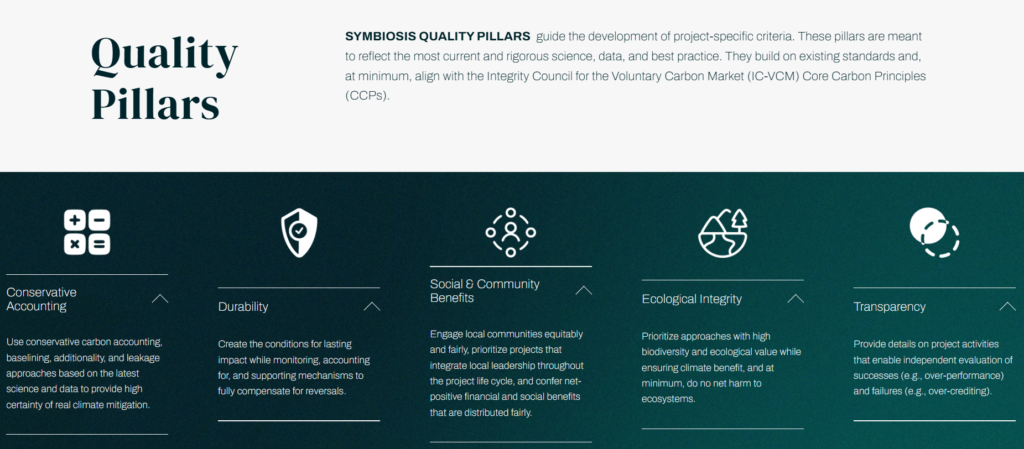
Symbiosis Coalition quality criteria
Source: Symbiosis Coalition

This demand can help developers secure funding for projects that take years to grow and deliver measurable results. Market data also show why nature-based removal matters.

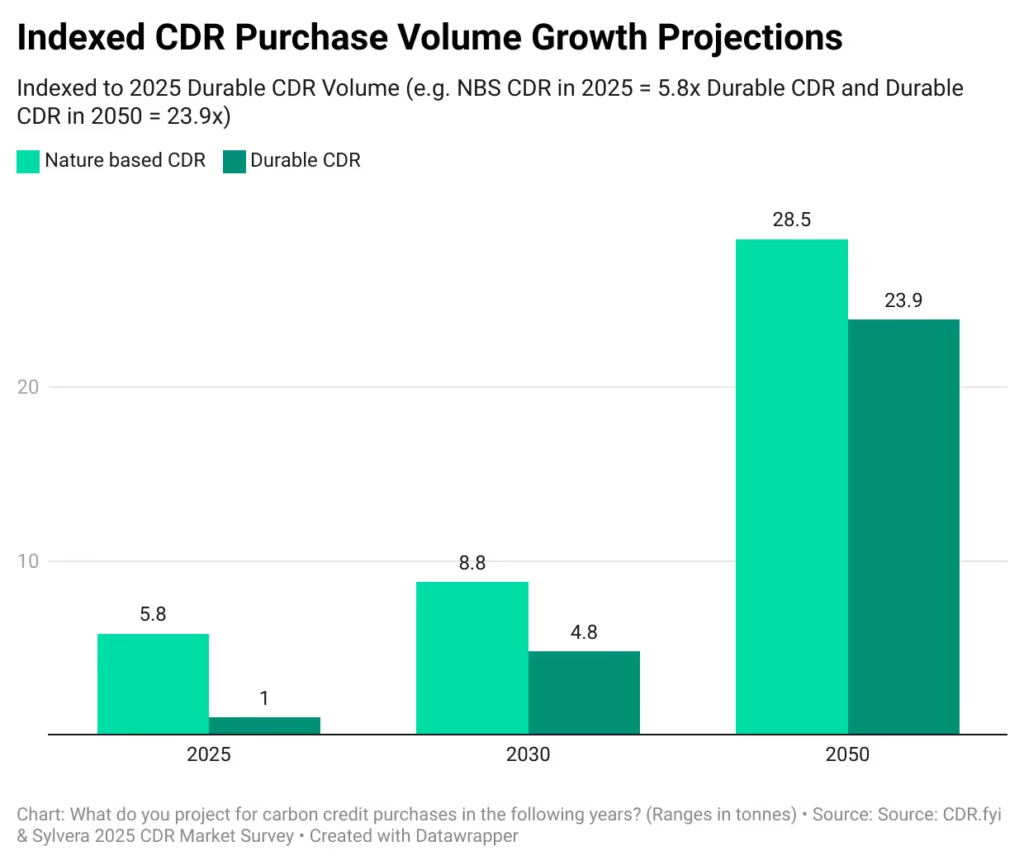
A 2025 survey by CDR.fyi and Sylvera found that nature-based carbon removal was much larger than durable carbon removal in terms of credits retired in 2024:

  • About 11 million nature-based credits compared with roughly 200,000 durable removal credits.

Nature-based projects can often be deployed across large areas, but they face risks such as fires, drought, pests, and changes in land use. Durable removal methods, such as direct air capture with storage, can offer longer-lasting storage but often have higher costs and greater energy needs.

carbon removal credits nature-based versus durable
Source: Sylvera

The two approaches serve different roles. This Brazilian deal shows how corporate buyers are helping build a supply of nature-based removal credits while seeking projects that can expand over time.

Brazil’s Carbon Market Adds Another Layer to the Investment Opportunity

Brazil has major potential for land-based climate projects because of its large agricultural sector, forests, and areas of degraded pasture.

McKinsey has estimated that Brazil could become a major global supplier of carbon removal credits. Its analysis points to restoration of degraded pasture, reduced deforestation, and improved land management as important opportunities. These are estimates of potential, not guaranteed future credit supply.

The country is also building a regulated carbon market. In December 2024, Brazil passed Law No. 15,042, which created the Brazilian Greenhouse Gas Emissions Trading System, known as the SBCE. The government is now working on the rules, governance, monitoring systems, and registry needed to implement it.

The Working Trees deal is a voluntary carbon removal agreement, not a transaction under the new regulated system. Even so, the wider policy effort could shape how carbon projects are measured and how buyers assess credits in Brazil.

For developers, a clearer market framework could support investment. For buyers, the challenge will remain to distinguish credible carbon removal from credits that overstate their climate benefits.

Carbon Quality Will Determine the Project’s Long-Term Value

The deal’s scale is important, but the project’s credibility will depend on how it measures and verifies carbon removal.

Tree growth can be measured over time, but carbon projects must also account for what would have happened without the project. They need to show that the activity creates additional climate benefits rather than simply paying for changes that were already planned.

Projects must also manage the risk of reversal. Trees can burn, die, or be cut down, releasing stored carbon. Soil carbon can also change with land management. Long-term monitoring and clear rules for handling carbon losses are therefore essential.

Working Trees says future timber revenue is part of its model. Whether that income is enough to support long-term maintenance remains to be demonstrated at scale.

Google and McKinsey Back Carbon Removal Brazil

Can Corporate Carbon Finance Help Silvopasture Scale?

Google and McKinsey’s 320,000-tonne purchase gives Working Trees long-term demand for carbon removal credits and supports the initial restoration of 8,700 hectares of Brazilian pasture.

The project offers a model that links carbon finance with continued cattle production, tree growth, and potential timber income. If it performs as planned, it could help show how degraded land can support both farming and carbon removal.

But the deal is not proof that all the expected carbon has been removed. The project must still deliver its planned work, measure results, and manage risks over time.

For the carbon market, the key test is whether long-term corporate purchases can turn promising land-based projects into verified, lasting carbon removal while creating lasting value for farmers.

The post Google and McKinsey Back Brazil Silvopasture Project in 320,000-Tonne Carbon Removal Deal appeared first on Carbon Credits.
GEVO Stock Slips Despite Signing 3-Year Carbon Credit Supply Agreement With CEEZER

Gevo, Inc. (NASDAQ: GEVO) has signed a three-year carbon removal credit supply agreement with CEEZER, adding another corporate buyer to its growing carbon business. The deal will supply durable carbon dioxide removal (CDR) credits from Gevo’s North Dakota ethanol facility through 2029.

Announced on October 14, the agreement marks Gevo’s first multi-year carbon removal contract with CEEZER. The company expects the growing business to generate more than $30 million in annual carbon revenue from its existing operations.

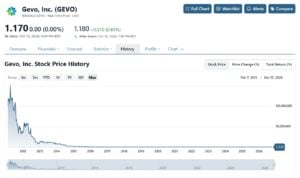
However, GEVO stock fell 9.3% on October 14, closing at $1.17, compared with $1.29 a day earlier. Shares remained at $1.17 at the close on October 15. The decline coincided with the announcement, although the available data does not establish that the deal caused the drop.

gevo stock
Source: Stock Analysis

Nonetheless, the agreement strengthens Gevo’s carbon credit sales pipeline as companies seek long-term supplies of durable removals. However, investors will need more information about contract pricing, delivery volumes, and revenue recognition to assess its direct financial impact.

Gevo Signs Three-Year Carbon Removal Deal With CEEZER

  • Under the agreement, Gevo will supply a five-figure volume of carbon removal credits to CEEZER through 2029. CEEZER will procure and manage the portfolio for an unnamed Fortune 500 enterprise software company.

The companies have not disclosed the exact number of tonnes covered by the contract or its financial value.

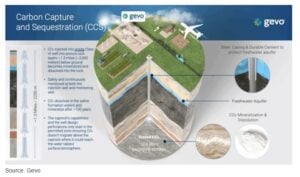
Gevo will generate the credits at its North Dakota facility, where the company captures biogenic carbon dioxide released during ethanol fermentation and stores it in deep geological formations.

According to Gevo, the facility stores CO₂ more than a mile underground, with expected permanence exceeding 1,000 years. The project also operates without a dedicated CO₂ pipeline.

The process uses bioenergy with carbon capture and storage (BECCS), which combines biomass-based production with carbon capture and permanent storage. When projects account for emissions across the production process, this approach can remove more carbon dioxide from the atmosphere than it releases.

gevo north dakota

Gevo says its North Dakota project is among the first commercial-scale U.S. BECCS facilities delivering verified carbon removal credits to the voluntary carbon market.

The company has also supplied credits to organizations including Nasdaq and Whirlpool. Its carbon removal certificates have appeared in the Puro.earth registry through purchases involving other buyers and intermediaries.

The CEEZER agreement gives Gevo another route to corporate customers and extends its contracted sales pipeline through 2029.

CEEZER Senior Vice President of Sourcing & Delivery Stephan Fuechtenhans, said:

“Companies building carbon removal portfolios increasingly need certainty of supply, price and quality over several years, not just individual purchases. Seeing Gevo’s operation, including on-site storage and supply chain, during our team’s recent site visit confirmed the kind of traceability our clients look for. Long-term offtakes with suppliers that combine an operating project with a proven delivery record are becoming central to how companies meet their long-term climate goals.”

Durable Carbon Removal Demand Grows, but Deliveries Lag

Gevo’s latest agreement comes as the durable carbon removal market expands. However, the gap between contracted purchases and delivered credits remains a major industry challenge.

Suppliers delivered 145,000 tonnes during the quarter, up 67% year over year. Buyers retired just over 100,000 tonnes. Biochar carbon removal accounted for 93% of newly contracted volume, while biomass-based carbon removal methods dominated deliveries.

GEVO CDR

The figures show that market demand is growing, but suppliers still need to turn contracts into verified deliveries. Long-term agreements can help developers plan production and give buyers greater confidence about future credit availability.

According to ClimeFi’s Q2 2026 CDR Market Review, buyer commitments increased by 83% from the first quarter. Purchases from buyers other than Microsoft also reached a record high, with non-Microsoft commitments rising 136% year over year. These trends suggest that demand is broadening beyond the market’s largest corporate buyer.

carbon credits BECCS
Source: ClimeFi 2026 Q2 CDR market review

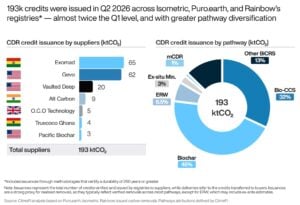
The quarter also marked a shift in purchasing patterns. Bioenergy with carbon capture and storage (Bio-CCS) overtook biochar to become the largest contributor to quarterly purchase volumes for the first time in more than a year. Credit issuances nearly doubled from the first quarter, according to ClimeFi.

For Gevo, existing ethanol production and carbon storage infrastructure provide a potential advantage because the company can generate removal credits alongside its core operations. However, future sales will depend on available credit volumes, buyer demand and the project’s ability to maintain verification standards.

Gevo Targets More Than $30 Million in Annual Carbon Revenue

The company is building its carbon business alongside its renewable fuels operations. In a June 2026 update, the company said first-half carbon removal sales had already surpassed its total 2025 sales, with deliveries on schedule.

Gevo also reported that its North Dakota facility had issued more than 500,000 carbon dioxide removal certificates since carbon capture and storage activities began in June 2022. The company sells these certificates under the Puro.earth standard.

Gevo CDR
Source: ClimeFi 2026 Q2 CDR market review

It expects its carbon business to generate more than $30 million in annual revenue from existing operations. The CEEZER agreement supports that objective, although the undisclosed contract value makes it difficult to estimate how much revenue the deal will contribute.

Section 45Z Tax Credit Revenue

Gevo is also monetizing government incentives tied to low-carbon fuel production. On October 1, it announced that it had sold substantially all the Section 45Z tax credits it expected to generate in 2026, representing $70 million. The company had received more than $30 million in cash from those sales through September 30 and expected the remaining proceeds over the following six months.

It also forecast more than $77 million in Section 45Z credits for 2027. Planned improvements at its North Dakota facility could increase production capacity and carbon capture volumes by 10% to 15%, supporting additional credit generation.

Section 45Z credits are separate from carbon removal credits. The government incentive supports qualifying low-emission transportation fuel production, while CDR credits are sold to buyers seeking verified carbon removals.

What the CEEZER Deal Means for GEVO Stock

The agreement adds another potential source of recurring revenue for Gevo and supports its strategy of generating additional value from existing infrastructure.

For investors, the key question is whether carbon credit sales can become a material and predictable contributor to the company’s financial performance. The $30 million annual revenue target provides a benchmark, but Gevo has not disclosed the CEEZER contract’s pricing or enough detail to quantify its contribution.

GEVO shares’ decline on October 14 also highlights why investors should distinguish a commercial milestone from its immediate stock-market impact. One session’s price movement does not establish how the market values the contract or whether the announcement influenced trading.

Going forward, investors will be watching carbon credit deliveries, realized prices, additional long-term agreements and progress toward the company’s revenue target. Gevo’s ability to turn growing demand for durable carbon removals into consistent cash-generating sales will be central to the investment case.

The post GEVO Stock Slips Despite Signing 3-Year Carbon Credit Supply Agreement With CEEZER appeared first on Carbon Credits.

Silver’s Industrial Demand Is Changing: AI, EVs and Power Infrastructure Are Rewriting the Market

Disseminated on behalf of Sierra Madre Gold & Silver Ltd.

Silver is no longer being driven by one industrial story. Solar remains one of the metal’s biggest applications, but a broader technology shift is reshaping demand.  

Artificial intelligence, data centers, electric vehicles, electronics, and power-grid investment are creating new uses for silver across the global economy.

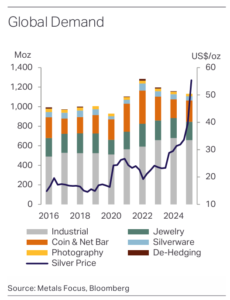
Industrial demand hit 657.4 million ounces in 2025. This made up over half of total global silver demand, as noted in the Silver Institute’s World Silver Survey 2026. 

Although industrial demand declined 3% last year because of weaker photovoltaic consumption, the underlying mix is changing. Structural growth in AI infrastructure, automotive applications, and electricity networks helped offset part of the decline in solar.

That shift matters for silver producers because the next demand cycle may be less dependent on any single end market.

silver industrial demand

Silver Is Becoming a Technology Metal

Silver’s value in industrial applications comes largely from one property: electrical conductivity.

The metal is used in electrical contacts, circuit boards, switches, and power electronics. It’s vital for parts that need reliable conductivity. That makes silver increasingly relevant as the global economy becomes more electrified and more digitally connected.

The Silver Institute estimates a 2% drop in electrical and electronics demand for 2025. However, gains from grid infrastructure, automotive applications, and AI-driven electronics still support the sector. 

Those gains were not enough to offset falling photovoltaic demand, where manufacturers have accelerated efforts to reduce silver loadings through thrifting and substitution.

The result is an important distinction: silver demand can remain structurally tied to technology even when total industrial demand temporarily declines. That makes the composition of demand increasingly important.

AI Is Creating a New Silver Demand Channel

The growth of artificial intelligence is adding another layer to silver demand.

AI models need a lot of computing resources. This includes servers, processors, networking gear, power systems, and data centers. Silver is used throughout electrical and electronic equipment because of its conductivity and reliability.

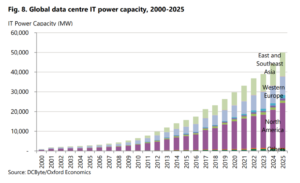
The Silver Institute’s 2025 tech report shows that global IT power capacity rose from 0.93 gigawatts in 2000 to almost 50 GW in 2025. That’s about a 53-fold increase. The organization expects data centers and AI-related technologies to remain important drivers of industrial silver consumption through 2030.

global data center IT power capacity

The connection is broader than AI chips themselves.

More computing requires more data center capacity. More data centers require more electricity. More electricity requires additional transmission, distribution, and power-management infrastructure. That creates multiple potential pathways for silver demand.

As AI adoption grows, the metal faces new demands. It is now needed for semiconductor production and the infrastructure for power-hungry computing systems.

EVs Add Another Layer of Electrical Demand

Transportation is undergoing a similar transformation.

Electric vehicles have more electrical parts than traditional internal-combustion vehicles. This opens up more uses for silver. It’s now found in electrical contacts, power electronics, battery management systems, and charging infrastructure.

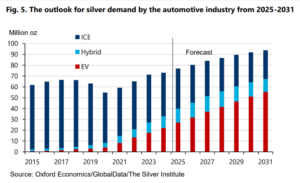
A Silver Institute report from Oxford Economics shows that battery-electric vehicles use 67% to 79% more silver than internal combustion vehicles. Each EV has about 25 to 50 grams of silver. It forecasts automotive silver demand to grow at a 3.4% compound annual growth rate between 2025 and 2031.

SILVER DEMAND OUTLOOK AUTOMOTIVE

The change is not limited to the vehicle itself. A larger EV fleet requires a larger charging network. That means additional electrical equipment, connections, and power infrastructure.

Oxford Economics predicts that by 2027, EVs will lead automotive silver demand. They expect EVs to make up 59% of this demand by 2031.

These figures show why electrification may be a long-term source of silver use. This is true even as manufacturers try to use less material.

Power Grids Could Become an Overlooked Silver Driver

The growth of AI and EVs ultimately leads back to electricity.

Data centers need power. EV charging requires power. Manufacturing, industrial automation, and broader electrification all require additional generation and transmission capacity.

Silver is used in electrical systems due to its excellent conductivity. This includes contacts, switches, and other electrical parts.

The Silver Institute specifically identified power-grid investment as one of the structural factors supporting electrical and electronics demand in 2025. This creates an important second-order effect for silver.

The world does not simply need more devices. It needs the electrical infrastructure capable of supporting those devices.

That means silver demand can be linked to several investment cycles at once: 

  • data center construction, vehicle electrification, renewable energy deployment, grid modernization, and broader industrial automation.

Solar Is Still Huge, But the Silver Story Is Changing

Solar remains critical to the silver market, but it is also where the industry is confronting one of its biggest challenges.

Photovoltaic demand helped drive years of industrial silver growth. However, manufacturers have increasingly reduced the amount of silver used per solar cell through thrifting and substitution.

The effect was significant in 2025.

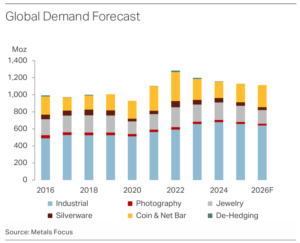
Industrial silver demand fell 3% to 657.4 Moz, while the electrical and electronics segment declined 2%. The Silver Institute noted that the drop in PV demand was the main cause of the weakness. This happened even with ongoing gains from AI, automotive, and grid applications.

The Institute predicts that industrial demand will drop another 3% in 2026. This decline is mainly due to ongoing weakness in photovoltaic silver use. At the same time, it expects AI infrastructure, automotive applications and power-grid investment to remain areas of structural growth.

silver Global Demand Forecast

This does not make solar less important. Instead, it shows why the silver market is becoming more diversified.

The next phase of industrial demand may rely less on just adding more solar panels. Instead, it will focus on expanding digital infrastructure, transportation electrification, and electricity networks together.

A Changing Demand Mix Raises the Stakes for Supply

This evolution creates an unusual challenge for the silver market.

Demand is becoming increasingly connected to industries that governments and companies are investing in for long-term economic reasons. AI infrastructure, EV adoption, grid modernization, and digitalization are not single-year trends.

However, silver supply cannot necessarily respond at the same speed.

The Silver Institute reported that global mine production reached 846.6 million ounces in 2025, up 3%, while the market still recorded a deficit. Its 2026 outlook calls for mine production to remain broadly flat and projects another 46.3 million-ounce structural deficit.

That makes existing production capacity increasingly relevant. New mines can take years to permit, finance, build, and ramp up. Expansions and restarts at existing mining operations can happen more quickly. This is especially true when there is already processing infrastructure and mining facilities in place.

That is where Sierra Madre Gold & Silver enters the picture.

Sierra Madre Is Expanding Into a Changing Silver Market

Sierra Madre is building its production base while the industrial demand story is becoming more diversified.

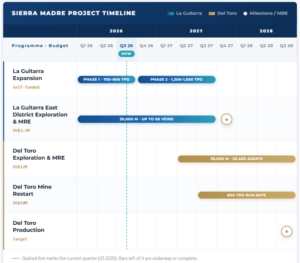
At La Guitarra in Mexico, the company is boosting its current operation from 500 tonnes per day to 750–800 tpd. They also plan to expand to 1,200–1,500 tpd by Q3 2027. The company recently reported processing rates reaching as high as 720 tpd, showing the operation is already moving beyond its original 500-tpd level.

Sierra Madre Project Timeline

The expansion is designed around existing infrastructure rather than starting a new mine from scratch. Sierra Madre has increased its milling, crushing, material handling, and tailings capacity. It is also making progress in developing the Guitarra complex.

The company also now has Del Toro, a past-producing silver-lead-zinc complex in Zacatecas.

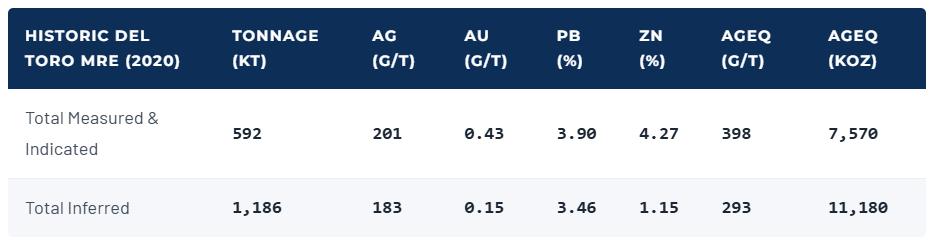
Del Toro includes three underground mines and a 3,000-tpd processing facility, along with more than 62.5 kilometers of underground development. Sierra Madre is evaluating a restart beginning at approximately 800 tpd, with potential to scale toward 1,600 tpd. 

Historic Del Toro MRE (2020)

The significance is not that one company can solve the global supply problem.

Sierra Madre shows how producers can meet a market linked to long-term tech and electrification trends. They can: expand current operations, restart old infrastructure, and build more production capacity.

The Silver Market Is Becoming More Electrified

Silver’s industrial story is entering a broader phase. Solar remains a major source of consumption, but AI, data centers, EVs, electronics, and power infrastructure are creating additional demand channels. 

Some applications will use less silver and become more efficient. But others will need more electrical equipment as economies go digital and electrified.

The result is a market where demand growth cannot be reduced to a single theme.

For producers, that creates a parallel challenge: supplying a metal that sits inside multiple growth industries while mine supply remains difficult to expand quickly.

Sierra Madre’s La Guitarra expansion and Del Toro restart strategy provide a direct example of how established mining assets can be positioned to participate in that changing market.

The bigger question for silver is whether new supply can keep pace as the metal moves from being primarily a precious metal into an increasingly important industrial and technology input.

DISCLAIMER

New Era Publishing Inc. and/or CarbonCredits.com (“We” or “Us”) are not securities dealers or brokers, investment advisers, or financial advisers, and you should not rely on the information herein as investment advice. Sierra Madre Gold and Silver Ltd. (“Company”) made a one-time payment of $25,000 to provide marketing services for a term of one month. None of the owners, members, directors, or employees of New Era Publishing Inc. and/or CarbonCredits.com currently hold, or have any beneficial ownership in, any shares, stocks, or options of the companies mentioned.

This article is informational only and is solely for use by prospective investors in determining whether to seek additional information. It does not constitute an offer to sell or a solicitation of an offer to buy any securities. Examples that we provide of share price increases pertaining to a particular issuer from one referenced date to another represent arbitrarily chosen time periods and are no indication whatsoever of future stock prices for that issuer and are of no predictive value.

Our stock profiles are intended to highlight certain companies for your further investigation; they are not stock recommendations or an offer or sale of the referenced securities. The securities issued by the companies we profile should be considered high-risk; if you do invest despite these warnings, you may lose your entire investment. Please do your own research before investing, including reviewing the companies’ SEDAR+ and SEC filings, press releases, and risk disclosures.

It is our policy that information contained in this profile was provided by the company, extracted from SEDAR+ and SEC filings, company websites, and other publicly available sources. We believe the sources and information are accurate and reliable but we cannot guarantee them.

CAUTIONARY STATEMENT AND FORWARD-LOOKING INFORMATION

Certain statements contained in this news release may constitute “forward-looking information” within the meaning of applicable securities laws. Forward-looking information generally can be identified by words such as “anticipate,” “expect,” “estimate,” “forecast,” “plan,” and similar expressions suggesting future outcomes or events. Forward-looking information is based on current expectations of management; however, it is subject to known and unknown risks, uncertainties, and other factors that may cause actual results to differ materially from those anticipated.

These factors include, without limitation, statements relating to the Company’s exploration and development plans, the potential of its mineral projects, financing activities, regulatory approvals, market conditions, and future objectives. Forward-looking information involves numerous risks and uncertainties and actual results might differ materially from results suggested in any forward-looking information. These risks and uncertainties include, among other things, market volatility, the state of financial markets for the Company’s securities, fluctuations in commodity prices, operational challenges, and changes in business plans.

Forward-looking information is based on several key expectations and assumptions, including, without limitation, that the Company will continue with its stated business objectives and will be able to raise additional capital as required. Although management of the Company has attempted to identify important factors that could cause actual results to differ materially, there may be other factors that cause results not to be as anticipated, estimated, or intended.

There can be no assurance that such forward-looking information will prove to be accurate, as actual results and future events could differ materially. Accordingly, readers should not place undue reliance on forward-looking information. Additional information about risks and uncertainties is contained in the Company’s management’s discussion and analysis and annual information form for the year ended December 31, 2025, copies of which are available on SEDAR+ at www.sedarplus.ca.

The forward-looking information contained herein is expressly qualified in its entirety by this cautionary statement. Forward-looking information reflects management’s current beliefs and is based on information currently available to the Company. The forward-looking information is made as of the date of this news release, and the Company assumes no obligation to update or revise such information to reflect new events or circumstances except as may be required by applicable law.

For more information on the Company, investors should review the Company’s continuous disclosure filings available on SEDAR+ at www.sedarplus.ca.

Disclosure: Owners, members, directors, and employees of carboncredits.com have/may have stock or option positions in any of the companies mentioned: None.

Carboncredits.com receives compensation for this publication and has a business relationship with any company whose stock(s) is/are mentioned in this article.

Additional disclosure: This communication serves the sole purpose of adding value to the research process and is for information only. Please do your own due diligence. Every investment in securities mentioned in publications of carboncredits.com involves risks that could lead to a total loss of the invested capital.

Please read our Full RISKS and DISCLOSURE here.

The post Silver’s Industrial Demand Is Changing: AI, EVs and Power Infrastructure Are Rewriting the Market appeared first on Carbon Credits.
JPMorganChase Extends Climate Targets to 2035 and Expands Green Finance Rules

JPMorganChase Extends Climate Targets to 2035 and Expands Green Finance Rules

JPMorgan Chase is changing how it measures climate progress and green financing as global energy demand rises. The U.S. banking giant has updated its emissions targets, expanded the types of projects that count toward its green finance goal, and launched a new center focused on energy and the environment.

The changes reflect the bank’s view that cutting emissions must go hand in hand with reliable and affordable energy. Its updated approach includes financing for nuclear power, electricity grids and other low-carbon energy activities.

The bank also extended key climate targets from 2030 to 2035. It says the targets will help track progress across its lending portfolio, but they will not restrict its financing decisions.

The changes were announced on October 14, alongside the release of JPMorganChase’s 2025 Sustainability Report. They mark a broader approach to climate finance as artificial intelligence, manufacturing and electrification increase demand for power.

Heather Zichal, Head of the Center for Energy and the Environment and Global Head of Sustainability, said:

“Meeting energy demand while balancing affordability, security, reliability, and sustainability, what we call the ‘Four Forces,’ is one of the defining economic opportunities of our era.”

Oil, Power and Auto Sectors Get New 2035 Emissions-Intensity Targets

JPMorganChase first set portfolio-level emissions targets in 2021. These targets measure the carbon intensity linked to its financing in selected industries.

Carbon intensity measures emissions against a unit of business activity or output. Tracking it helps the bank assess how emissions linked to its lending change over time.

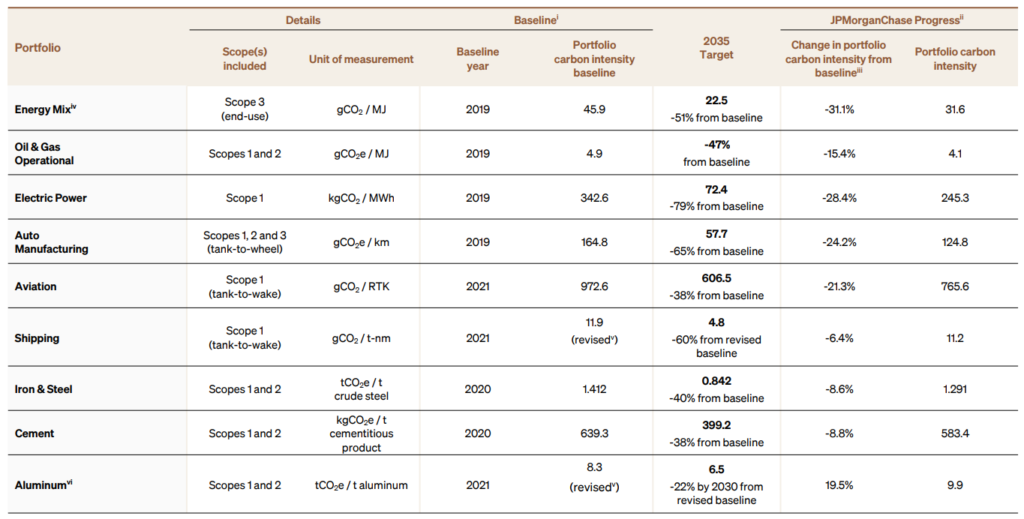
The bank has now updated its targets to align with the International Energy Agency’s 2025 Net Zero Emissions by 2050 scenario. The updated targets use 2035 as their target year rather than 2030. Three major changes stand out:

  • Oil and gas: The target is now a 47% reduction in carbon intensity by 2035, compared with the previous 45% reduction target by 2030.
  • Electric power: The target rises to a 79% reduction by 2035, from the previous 69% target by 2030.
  • Auto manufacturing: The target increases to a 65% reduction by 2035, compared with the previous 48% target by 2030.

These percentages refer to carbon intensity, not total emissions. They also do not mean the bank has already achieved these reductions. They are targets for measuring changes across its financing portfolio.

JPMorgan new climate targets 2035
Source: JPMorganChase

The bank also stresses that the IEA scenario is one possible path to reaching net zero, not a prediction of what will happen. JPMorganChase says its targets may change as technology, markets and available information develop.

Green Financing Now Includes Nuclear Power and Electricity Grids

JPMorganChase has also widened the types of activities that count toward the green objective of its $2.5 trillion Sustainable Development Target. The bank launched this 10-year goal in 2021. It aims to finance or help arrange more than $2.5 trillion for sustainable development by the end of 2030, including a $1 trillion green finance objective.

Under the new rules, eligible activities include:

  • Nuclear energy,
  • Electricity networks,
  • Grid upgrades,
  • Electric vehicle charging infrastructure, and
  • Zero- and low-carbon power generation at companies using various energy sources.

The change reflects the bank’s view that a cleaner energy system needs more than renewable power plants. Electricity grids need to link new energy sources to users. They must also provide reliable power to meet rising demand.

However, the expanded definition has an important effect on the reported figures. JPMorganChase applied the new eligibility rules to earlier years, too, allowing it to measure past financing under the updated system.

As a result, a higher green finance total does not necessarily mean the bank provided the same amount in new funding during that period. Some of the increase reflects activities that now qualify under the broader rules.

Bank Reports $520 Billion in Green Finance

JPMorganChase reported that it had financed or helped arrange $1.2 trillion toward its $2.5 trillion Sustainable Development Target by the end of 2025. Of that total, $520 billion counted toward its green finance objective.

  • The bank reported $217 billion in sustainable development financing during 2025, including $96 billion under the green objective.

The expanded eligibility rules contributed $145 billion to the reported green finance total. This is an important point when looking at the bank’s progress. The new figure includes financing that meets the new rules, not just new funding.

The green objective supports activities such as low-carbon energy, clean technology and projects that improve climate resilience. The bank says it has financed or helped arrange more than $500 billion in low-carbon energy since 2021. Its tax-focused investment team has also helped finance one in every four gigawatts of U.S. renewable energy and storage capacity, according to the bank.

These figures show the scale of JPMorganChase’s financing activity. However, money counted toward a green finance target is not the same as a measured reduction in greenhouse gas emissions. The actual climate impact depends on the projects financed and the results they deliver.

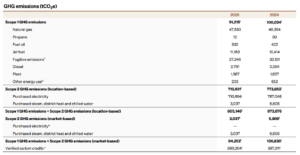
JPMorgan GHG emissions 2025
Sources: JPMorganChase

New Center Will Focus on Energy and Climate Challenges

Alongside the target changes, JPMorganChase launched its Center for Energy and the Environment (CE&E). The new center brings together the bank’s Center for Carbon Transition and its Corporate Sustainability functions. It aims to combine energy and climate expertise with policy knowledge and financial services.

The bank says this approach will help it identify barriers that money alone cannot solve. These include slow permit approvals, delays in connecting projects to electricity grids, worker shortages, supply chain problems, and uncertainty about future rules.

The center plans to work across businesses, policymakers and investors to help address these challenges. The bank has also placed greater emphasis on what it calls four forces: affordability, security, reliability and sustainability. It argues that energy investment must consider all four to support lasting progress.

This wider focus comes as power demand rises from data centers, artificial intelligence, manufacturing and electrification. JPMorganChase says it facilitates nearly $100 billion a year to help add new energy supply from different sources.

Emissions Targets Will Not Limit Lending

A major part of the updated strategy is the bank’s view that financed-emissions figures cannot tell the whole story. Financed emissions are greenhouse gas emissions linked to the activities of companies that a bank lends to or supports. These figures can track changes in a portfolio. However, the bank notes that gaps in data and different measurement methods can limit their usefulness for decisions on individual loans.

Absolute financed and facilitated emissions
Sources: JPMorganChase

JPMorganChase will continue using its climate targets to monitor trends and guide discussions with clients. However, it says the targets are not designed to restrict financing. This means the bank may continue to finance companies across different energy sectors while tracking how its portfolio’s carbon intensity changes.

The approach also reflects the bank’s focus on energy security and affordability. Nuclear power and grid upgrades might qualify for green finance rules. The bank sees them as key to a reliable, lower-carbon energy system.

The wider definition does not mean every activity at a company that uses fossil fuels automatically qualifies as green. Eligible activities must still meet the bank’s own criteria.

Will Broader Green Finance Deliver Measurable Climate Gains?

JPMorgan Chase’s new strategy focuses more on the capital it directs to energy projects. It also tracks emissions intensity closely.

The changes also make its green finance figures broader. This can help capture more low-carbon infrastructure types. However, readers need to tell the difference between new financing and amounts that qualify due to rule changes.

The bank’s approach also leaves open questions about how quickly its clients will cut emissions and how much the financing will contribute to real-world climate progress. Its updated targets provide a way to track portfolio trends through 2035, while the new center aims to address practical barriers to energy investment.

For investors and climate-market observers, the key measures to watch will be future financing totals, progress against the revised emissions-intensity targets, and evidence of actual emissions reductions. These will help show whether the broader strategy leads to changes beyond the way the bank reports its activities.

The post JPMorganChase Extends Climate Targets to 2035 and Expands Green Finance Rules appeared first on Carbon Credits.
Verra Issues First Rice Carbon Credits in India Under New Methodology

Verra has approved the first carbon credits under its methodology for improved rice production, opening a new opportunity to finance farming practices that reduce methane emissions. The credits come from an Indian rice cultivation project developed by Core CarbonX Solutions, which has avoided more than 210,000 tonnes of carbon dioxide equivalent (tCO2e) through improved water and crop management.

The project, called Core Carbon Sustainable Rice Productions 01, is registered under Verra Project 3243. It operates in the Suryapet district of Telangana, a major rice-producing state in southern India.

The milestone comes as carbon markets place greater emphasis on measurable emission reductions and high-quality credits. Rice cultivation offers an opportunity to address methane emissions while helping farmers access additional income from sustainable agricultural practices.
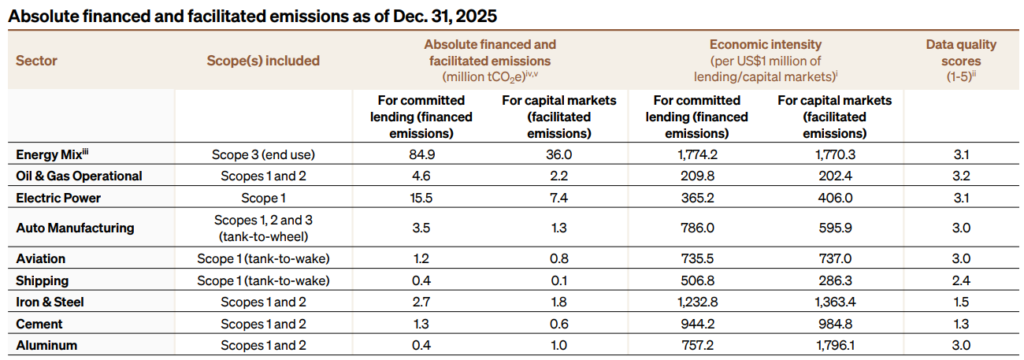
How Rice Farming Can Generate Carbon Credits

Flooded rice fields create conditions that encourage microorganisms to produce methane as they break down organic matter without oxygen. Methane is a potent greenhouse gas that contributes significantly to near-term global warming.

  • The Food and Agriculture Organization (FAO) estimates that flooded rice systems account for around 8% of human-caused methane emissions. Reducing these emissions is therefore an important part of efforts to limit global warming. FAO

How Core CarbonX Helps Farmers Cut Rice Methane Emissions

The Core CarbonX project tackles this problem through alternate wetting and drying (AWD), a water management technique that allows rice fields to dry periodically before farmers irrigate them again.

Under conventional rice cultivation, farmers often maintain standing water throughout much of the growing season. AWD introduces controlled periods of drainage, allowing oxygen to enter the soil and reducing the conditions that support methane-producing microbes.

Core CarbonX Solutions supports participating farmers with water-monitoring tubes, training and technical assistance. The company also shares revenue from carbon credit sales with farmers, providing an additional financial incentive to adopt improved cultivation practices.

The project demonstrates how agricultural emission reductions can create value beyond the farm. Farmers can contribute to climate mitigation while potentially improving water management and earning additional income.

However, the effects on crop yields and other greenhouse gases can vary with local conditions and how farmers implement AWD. Appropriate irrigation schedules and reliable monitoring remain important for achieving environmental benefits without compromising rice production.

What Verra’s VM0051 Methodology Means

The press release highlights that the project uses Verra’s VM0051 Improved Management in Rice Production Systems methodology. Introduced in 2025, the framework establishes requirements for measuring emission reductions from improved water and crop management in flooded rice systems.

The methodology provides a standardized approach to quantifying the difference between emissions under conventional farming practices and emissions after farmers adopt improved techniques. This helps carbon credit buyers assess the reductions associated with a project.

Beyond water management, VM0051 can support practices such as cultivating improved rice varieties and using methanotrophic bacteria, which consume methane. These options can broaden the range of interventions available to project developers.

Verra revised the methodology in July 2026, releasing version 1.1 to align it with updated program requirements and clarify monitoring and quantification procedures. Projects using the earlier version must follow the applicable transition deadlines.

VERRA RICE
Source: Verra

VKU Certification Private Limited served as the validation and verification body for the Core CarbonX project.

The methodology also has potential relevance for aviation-related carbon markets. In April 2026, Verra announced that the International Civil Aviation Organization’s technical advisory body had included eligible VM0051 credits from projects in qualifying REDD+ countries in the first and second phases of the Carbon Offsetting and Reduction Scheme for International Aviation (CORSIA). Eligibility depends on the project meeting applicable requirements, including host-country authorization.

This could expand the pool of potential buyers for qualifying rice methane credits, although approval of the methodology does not automatically make every project or credit eligible for CORSIA.

Rice Methane Credits and the Carbon Market Opportunity

Agricultural projects remain a relatively small part of the voluntary carbon market despite their potential to reduce emissions across food production systems.

A 2025 assessment by the FAO Investment Centre found that agrifood systems accounted for more than 10% of projects in the voluntary carbon market but generated only around 1% of issued credits. The gap highlights the challenge of scaling projects in a sector where emissions measurement, farmer participation, and implementation can be complex.

Meanwhile, demand for carbon credits is increasingly focused on quality and credible climate benefits. Climate Focus reported that carbon credit issuances fell to their lowest levels in years during the first half of 2026, while retirements remained resilient. The firm reported approximately 98 million credits retired during the period, compared with issuance of just under 100 million credits.
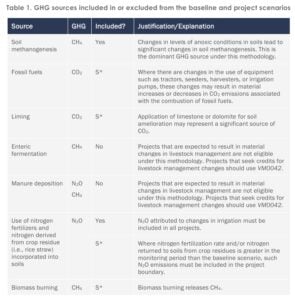
         Carbon credit demand remained robust, led by retirements of nature-based credits

rice carbon credits

For rice methane projects, this market environment creates an opportunity to attract buyers seeking measurable emission reductions. However, demand will depend on credit quality, pricing, project performance, and the eligibility requirements of different purchasing programs.

Verra lists 13 other projects using VM0051 that are under development or undergoing validation. These projects span countries including India, Brazil, Vietnam, the Philippines, Indonesia, Thailand, Malaysia, Myanmar and Madagascar.

The growing project pipeline suggests that rice methane reduction could become a more established segment of agricultural carbon finance. Yet, projects must demonstrate that their claimed reductions are real, measurable, and supported by reliable monitoring.

For Core CarbonX, the first approved credits provide a starting point for bringing improved rice cultivation practices into carbon markets. The broader opportunity will depend on scaling farmer participation, maintaining robust verification, and ensuring that carbon revenue delivers meaningful benefits to farming communities.
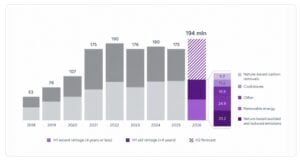
The post Verra Issues First Rice Carbon Credits in India Under New Methodology appeared first on Carbon Credits.