Chinese EV Makers Sell Carbon Credits to Porsche and Other Europe’s Auto Giants

Chinese EV Makers Sell Carbon Credits to Porsche and Other Europe’s Auto Giants

Chinese electric-vehicle makers are finding a new way to monetize their lead in electrification: selling regulatory carbon credits to global automakers that need them to meet emissions rules. XPENG is the latest example.

The Chinese EV maker has signed carbon credit agreements with Porsche and other international automakers covering the European Union, the UK, and Australia, according to recent reports. The total transaction value is expected to exceed 1 billion yuan ($149 million), while XPENG expects to receive more than 500 million yuan ($74.5 million) from carbon-credit trading in 2026. An XPENG vice president confirmed the figures publicly.

The development points to a wider shift in the global auto industry. Chinese manufacturers are no longer only exporting electric cars. Their growing EV sales are also creating regulatory assets that other automakers can use to manage fleet emissions.

Europe’s Carbon Rules Put a Price on EV Advantage

The European Union’s CO₂ rules are the main driver behind this market. Under the current framework, new passenger cars registered in the EU face a fleet-wide target of 93.6 grams of CO₂ per kilometer for 2025–2029. The target falls to 49.5 g/km from 2030 to 2034, before reaching 0 g/km from 2035 under the existing regulation.
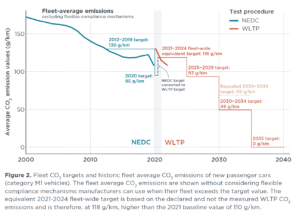
EU-CO2-standards
Source: ICCT

Automakers can form emissions pools. This allows manufacturers with lower fleet emissions to combine their results with manufacturers that have higher emissions. The system creates a financial value for automakers that sell large numbers of zero-emission vehicles.

The EU also applies an excess-emissions premium of €95 for each gram of CO₂ per kilometer above the applicable target for each new vehicle, subject to the rules governing the relevant compliance period. For manufacturers selling large numbers of higher-emission vehicles, surplus credits from EV-heavy manufacturers can therefore have significant financial value.

The system is already operating at scale. In 2025, several major automakers formed pools involving Tesla, while Mercedes established a pool involving Volvo Cars, Polestar and Smart. 

XPENG is now entering this market as a supplier of compliance capacity.

XPENG and Porsche Open a New China-Europe Link

The most notable agreement involves Porsche.

According to an official European Commission filing cited in recent reporting, Porsche withdrew from the Volkswagen Group’s internal emissions pool and established an independent, open pool for 2026 and 2027, with XPENG as a key partner. Financial terms have not been disclosed.

The structure is important because Porsche has a large portfolio of performance and premium vehicles, while XPENG’s fleet is centered on battery-electric vehicles.

  • In a regulatory emissions pool, the calculation is straightforward: more zero-emission vehicles can lower the average emissions of the combined fleet.

XPENG therefore gains another source of revenue from its EV sales without needing to sell the credits as conventional voluntary carbon offsets. That distinction matters.

These are regulatory CO₂ compliance credits, created by vehicle-emissions rules. They are not the same as voluntary carbon credits generated by projects such as forests, methane capture, or direct air capture.

China’s EV Boom Is Creating the Credit Supply

XPENG’s ability to generate credits comes from the rapid expansion of its electric vehicle business. The International Energy Agency estimates that global electric car sales exceeded 20 million units in 2025, up 20% from 2024. One in four new cars sold worldwide was electric.

China remained the largest EV market, with more than 13 million electric cars sold in 2025. Nearly 55% of all new cars sold in China were electric. Chinese manufacturers also accounted for 60% of global electric car sales in 2025.
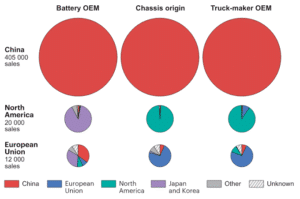
china ev market share
Source: IEA

The production advantage is just as large. China produced about 16 million electric cars in 2025, nearly 75% of global EV output. Chinese electric car exports more than doubled to over 2.5 million units.

Europe is becoming an increasingly important destination.

Sales of Chinese-made electric cars in Europe increased by almost 50% in 2025 to about 940,000 units, according to the IEA. Chinese brands accounted for more than 70% of Chinese-made EV imports into the EU, up from 50% in 2023. This expanding overseas EV fleet is also expanding the potential pool of regulatory credits.

XPENG’s Global EV Expansion Adds Another Revenue Stream

XPENG’s overseas business is expanding rapidly. The company delivered 45,008 vehicles outside China in 2025, up 96% year over year, while total deliveries reached 429,445, up 126%. It was selling vehicles in 60 countries and regions by year-end.

In Q2 2026, overseas sales topped 20,000 vehicles for the first time, up 81% year over year. Overseas revenue accounted for more than 25% of first-half revenue, with an average selling price above €40,000.

XPENG has also expanded its partnership with Volkswagen, which acquired a 4.99% stake for about $700 million in 2023. Their first jointly developed model entered mass production in March 2026.

The growing overseas EV business can therefore support both vehicle sales and XPENG’s ability to generate compliance value in regulated markets.

Leapmotor Shows XPENG Is Not Alone

XPENG is not the first Chinese automaker to monetize surplus emissions performance. Leapmotor transferred EU carbon credits to Stellantis for European and UK sales, generating 1.11 billion yuan ($165 million) in 2025. Its 2026 credit trading cap was later raised to 2.8 billion yuan ($417 million).

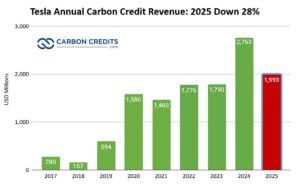
Tesla has used the same model for years, reporting about $2 billion in regulatory credit revenue in 2025, down from $2.76 billion in 2024.
Tesla carbon credit revenue 2025

For EV makers, regulatory credits can provide additional revenue. For automakers with higher fleet emissions, they can offer another compliance tool. However, their value remains dependent on emissions rules, pooling arrangements, and future regulatory changes.

XPENG’s Carbon Strategy Extends Beyond Credit Sales

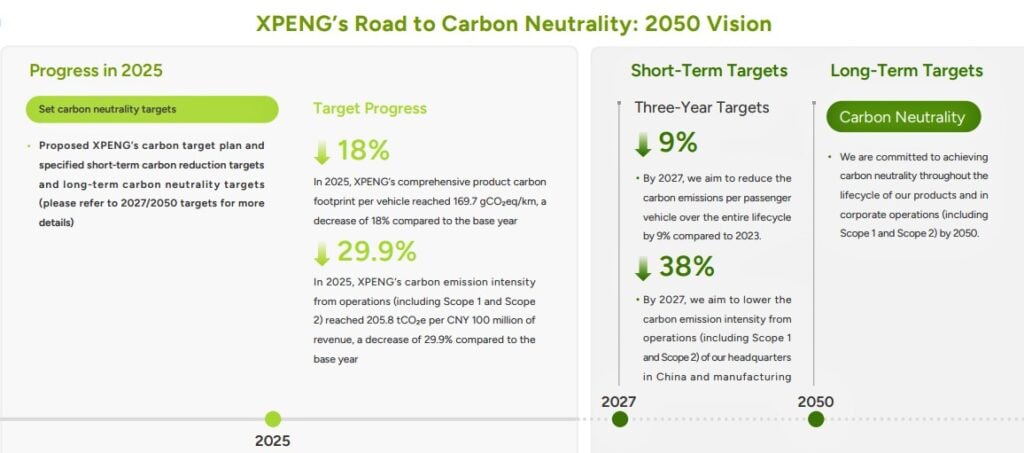
XPENG’s carbon strategy extends beyond regulatory credits. Its 2025 ESG report targets a 9% reduction in lifecycle carbon emissions per passenger vehicle by 2027 from 2023 levels, alongside a 38% reduction in operational carbon emissions intensity.

The company aims for carbon neutrality across its product lifecycle and corporate operations by 2050.
XPENG’s Road to Carbon Neutrality 2050 Vision
Source: XPENG

In 2025, XPENG reported a product carbon footprint of 169.7 grams of CO₂e per kilometer, down 18% from 2023. Operational carbon emissions intensity fell 29.9% to 205.8 tonnes of CO₂e per CNY 100 million.

It also recorded 73,000 MWh of clean energy consumption and 106,000 MWh of photovoltaic generation. XPENG estimates its 2025 vehicles will avoid more than 6 million tonnes of lifecycle greenhouse-gas emissions compared with conventional vehicles.

More EVs Mean a Bigger Compliance Credit Pool

The expanding EV market provides the underlying supply of these compliance assets. The IEA expects global electric-car sales to reach about 23 million vehicles in 2026, or roughly 28% of total car sales. EVs could account for about one-third of European sales and nearly 60% of China’s market.

  • By 2035, the global EV fleet could exceed 450 million vehicles under the IEA’s Current Policies Scenario.

Europe’s fleet is also becoming cleaner. Average CO₂ emissions from new passenger cars fell 28% between 2019 and 2024, while zero-emission vehicles accounted for 14.5% of new registrations in 2024.

As EV adoption rises and emissions rules tighten, the market for regulatory carbon credit transfers could expand.

Chinese EV Makers Are Turning Electrification Into a New Asset Class

XPENG’s agreements with Porsche and other international automakers show how China’s EV advantage is creating a new source of commercial value. Chinese EV exports exceeded 2.5 million vehicles, and Europe imported about 940,000 Chinese-made EVs.

Against this backdrop, XPENG expects more than 500 million yuan ($74.5 million) in carbon credit revenue in 2026. For European automakers, these credits provide another compliance tool as emissions standards tighten. For Chinese EV makers, they create an additional revenue stream from their growing zero-emission vehicle fleets.

Chinese automakers are therefore increasingly selling not only electric vehicles into Europe, but also the emissions-compliance value created by those vehicles.

The post Chinese EV Makers Sell Carbon Credits to Porsche and Other Europe’s Auto Giants appeared first on Carbon Credits.

Salesforce and Milkywire Back 3,661 Tons of Carbon Removal Across 8 Projects

Salesforce is supporting new early-stage carbon dioxide removal (CDR) projects. The company aims to contract $100 million in durable carbon removal by 2030.

Through Milkywire, Salesforce has pre-purchased 3,661 tonnes of durable carbon removal from eight suppliers. This portfolio includes direct air capture (DAC), ocean alkalinity enhancement, and biomass storage. Projects are located in Europe, Canada, India, and the U.S.

The press release says these purchases follow a larger round announced in January, where Milkywire bought over 12,500 tonnes from 19 suppliers. That earlier portfolio featured biochar, BioCCS, enhanced rock weathering, mineralization, biomass storage, and next-generation DAC.

Therefore, the company is not only focusing on commercially available carbon removal. Instead, it uses Salesforce funding to support technologies that need testing and investment.

Salesforce Aims for Early-Stage Carbon Removal

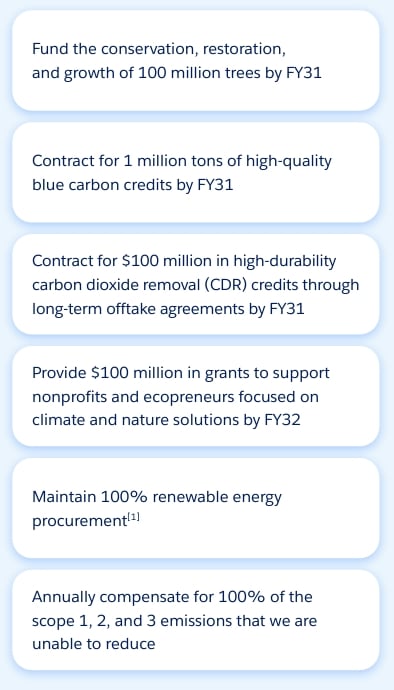
Salesforce plans to contract $100 million in high-durability CDR credits by fiscal 2031, aligning with 2030. The company started investing in early-stage CDR suppliers through partners like Milkywire and Frontier in FY25.

The strategy addresses a major challenge in the carbon removal market. Many new technologies require years of development before they can deliver large volumes of verified removals. Startups often struggle to get funding during this early stage.

Early purchases can provide revenue and help developers prove their technology.

Salesforce carbon credits
Source: Salesforce

“Catalytic” Purchasing

Milkywire calls this approach “catalytic” purchasing. Instead of buying the most tonnes available, it targets projects where early funding can advance technology.

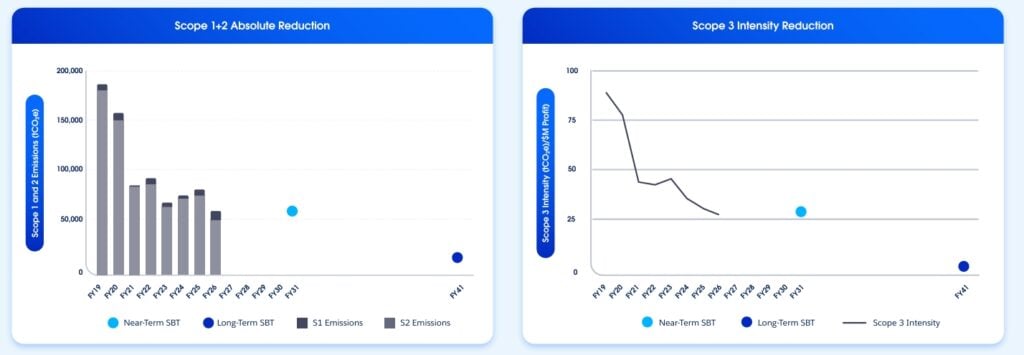
For Salesforce, these purchases fit into a broader climate strategy. The company plans to use durable carbon removal credits to offset its remaining emissions after reducing them across its value chain. It aims for durable carbon removals to equal 100% of its remaining Scope 1, 2, and 3 emissions by 2040.

salesforce emissions
Source: Salesforce

Four Projects Boost Direct Air Capture

Four of the eight purchases support direct air capture projects at various stages.

  • Sirona Technologies is developing a commercial DAC project that integrates a heat pump. The goal is to test if this can improve energy efficiency in DAC.
  • Yama operates France’s first DAC pilot and is creating a facility to remove 365 tonnes of CO₂ each year.
  • In the Netherlands, Brineworks combines electrochemical DAC with green hydrogen production. This method captures CO₂ while creating another low-carbon product.
  • Deep Sky in Canada is developing a DAC project that combines carbon capture with mineralization at Thetford Mines in Quebec. Mineralization stores CO₂ in solid forms for long-term storage.

These projects tackle the challenge of reducing energy use and costs in removing CO₂ directly from the atmosphere.

Ocean Carbon Removal Expands

The new portfolio also features two ocean alkalinity enhancement (OAE) projects.

OAE aims to boost the ocean’s capacity to absorb and store CO₂ by adding alkaline materials. This method is still emerging, with developers working to show its effectiveness and scalability.

PRONOE runs the EU’s first land-based OAE system linked to an industrial desalination plant.

In India, Alkamy Carbon is using wastewater treatment facilities in the Mumbai area to enhance alkalinity. This project should provide valuable data on wastewater-based alkalinity in tropical conditions.

The India project is crucial because carbon removal developers need more real-world data from diverse climates. This data helps researchers understand how these methods perform in different environments.

Biomass Storage Provides Another Pathway

The last two purchases focus on storing biomass in durable forms.

Carba converts waste biomass into stable biocarbon before burying it in landfills. This process prevents carbon in organic waste from quickly re-entering the atmosphere.

Cowboy Clean Fuels injects agricultural residues into unmineable coal seams in Wyoming. Microorganisms underground convert the biomass into CO₂, which binds permanently to the coal.

These projects illustrate how durable carbon removal can involve various technologies and storage methods.

The eight purchases are:

  • Alkamy Carbon: 667 tonnes
  • Brineworks: 500 tonnes
  • Carba: 816 tonnes
  • Cowboy Clean Fuels: 500 tonnes
  • Deep Sky: 394 tonnes
  • PRONOE: 131 tonnes
  • Sirona Technologies: 390 tonnes
  • Yama: 263 tonnes

This totals 3,661 tonnes.

                                                    Credit Issuance 

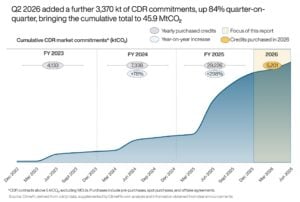
CDR purchases
Source: ClimeFi CDR Market Report

Why Early Buyers Matter for the CDR Market

These latest purchases come as the carbon removal industry faces challenges.

While the sector has seen significant investment, many companies developing new technologies encounter high costs, long timelines, and limited demand.

Milkywire says the market needs buyers who will back technologies early on. Without early demand, promising projects might find it hard to secure funding. They may also struggle to transition from pilot stages to commercial operations.

This approach can also yield technical insights. A first-of-a-kind project may remove small amounts of CO₂, but its operation can provide data to improve performance and reduce costs.

Notably, Milkywire has enabled more than $12 million in carbon removal purchases. This includes over 45 projects in 20+ countries.

The latest portfolio spreads funding across multiple technologies instead of focusing on one method.

                                                      CDR Market Growth

cdr Purchases cdr market
Source: ClimeFi CDR Market Report

For Salesforce, these purchases further its long-term carbon removal strategy. The company announced its $100 million durable CDR commitment in 2022 as part of the First Movers Coalition.

As the CDR market grows, these early purchases could help identify which technologies move from pilot to commercial deployment. For developers, funding means early buyers. For the industry, these projects offer real-world data on effective pathways for durable carbon removal at scale.

The post Salesforce and Milkywire Back 3,661 Tons of Carbon Removal Across 8 Projects appeared first on Carbon Credits.
Silver Falls 45% From Its 2026 Peak as Sierra Madre Scales Up Production

Silver Falls 45% From Its 2026 Peak as Sierra Madre Scales Up Production

Disseminated on behalf of Sierra Madre Gold & Silver Ltd.

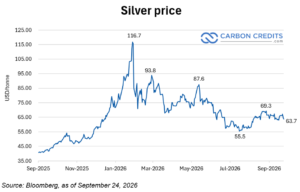
Silver has had a volatile 2026. It has pulled back sharply from its 2026 peak. The metal reached a 52-week high of about $115 per ounce in January before falling sharply during the year. 

By mid-September, silver futures had dropped to about $63 per ounce, roughly 45% below that peak. Prices later recovered to around $66.70 by September 18.

That move highlights an important shift for silver producers. The market is no longer simply a story of rising prices. Producers now have to operate through a much wider price range while managing costs, production growth, and capital spending.

The decline has changed the operating backdrop for silver producers, but the underlying supply picture remains tight.

According to the World Silver Survey 2026, global silver mine production increased 3% in 2025 to 846.6 million ounces. Recycling added another 197.6 million ounces. Yet, total demand reached 1.13 billion ounces, leaving the market with a 40.3 million-ounce deficit, the fifth consecutive annual shortfall.

Metals Focus expects another deficit in 2026, estimated at 46.3 million ounces. That backdrop matters for Sierra Madre Gold & Silver as it moves from restarting one mine to building a larger production base.

The changing silver price environment, therefore, tests the company’s strategy: how does an operating producer manage growth when the commodity price can move sharply in either direction?

Silver’s 2026 Rally Gives Way to a Sharp Reset

Silver entered 2026 at elevated levels after a strong run in late 2025 and early 2026, but it significantly dropped this month. The decline was not driven by one factor alone.

silver price

Higher U.S. Treasury yields, a stronger dollar, and changing expectations for Federal Reserve policy have affected precious metals. Silver can also experience larger price swings than gold because it combines investment demand with industrial uses.

Recently, silver had recovered to over $66 per ounce. That rebound, however, does not erase the earlier decline. Instead, it shows why mining companies must plan around changing commodity prices rather than rely on a single price environment.

For Sierra Madre, that distinction matters because the company is already generating revenue from an operating mine.

La Guitarra Is Already Generating Silver Revenue

La Guitarra is no longer simply a development project. Sierra Madre restarted commercial production at the Mexican mine on January 1, 2025. The operation includes an underground mine and a processing plant that previously operated at 500 tonnes per day.

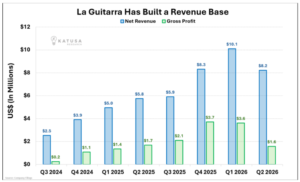
Moreover, the company reported 66,691 ounces of silver sold in Q2 2026, compared with 65,683 ounces in the same quarter of 2025.

The mine generated US$25 million of revenue and US$8.9 million of gross profit in 2025, its first full year back in production.

In the first half of 2026, La Guitarra generated another US$18.3 million of revenue and US$3.5 million of adjusted EBITDA. Sierra Madre also repaid its US$5 million First Majestic loan in July and ended June with US$22.2 million in cash and US$25 million in working capital.

The company received US$75.65 per silver-equivalent ounce sold in Q2 2026, compared with US$33.22 a year earlier.

Those figures show the effect that higher realized metal prices had on revenue. But they also highlight why future results cannot simply be extrapolated from the second quarter.

The spot and futures market has since moved below the $75.65 realized silver price reported for Q2. If lower prices persist, the company could face lower revenue per ounce even as production increases. That makes the production ramp-up increasingly important.

La Guitarra Is Already Generating Silver Revenue

That higher realized price helped offset higher costs during a development-heavy quarter.

Sierra Madre reported all-in sustaining costs of US$54.73 per ounce produced, up from US$32.54 a year earlier. The company attributed the increase to development ore, lower recoveries, power outages, a stronger Mexican peso, and higher royalties.

The cost increase shows why the silver price pullback matters. Higher metal prices can support revenue and margins, but production growth can also bring temporary cost pressure.

SEE MORE: Sierra Madre: Breathing New Life into Mexico’s Silver and Gold Heartland

Sierra Madre Pushes La Guitarra Toward Higher Throughput

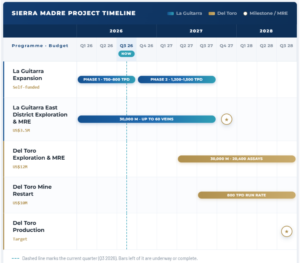
Sierra Madre is working to increase processing capacity at La Guitarra. The first phase is expected to bring capacity to about 750–800 tonnes per day, with the company expecting the expansion to come online before the end of Q3 2026. 

  • A second phase is planned to increase capacity to 1,200–1,500 tonnes per day by Q3 2027.
Sierra Madre Project Timeline
Source: Sierra Madre Gold and Silver Ltd. corporate presentation,

The company reported that throughput had reached as high as 672 tonnes per day in August, as it continued to ramp up the operation. This timing matters.

Higher throughput can increase the number of ounces produced and sold, although the actual financial benefit will depend on factors including grades, recoveries, operating costs, capital requirements and the silver and gold prices received.

Sierra Madre reported Q2 2026 cash costs of $49.28 per silver-equivalent ounce produced, compared with $26.89 in Q2 2025. Its all-in sustaining cash cost was $54.73 per silver-equivalent ounce, versus $32.54 a year earlier.

The company said it expects higher production from the expansion, along with a reduction in costs as the operation scales up. That makes the next stage of the ramp-up particularly important in a lower-price environment.

Del Toro Adds Another Mexican Silver Asset

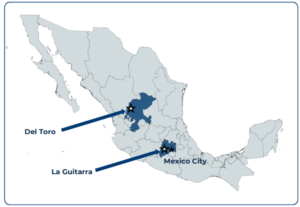
Sierra Madre added a second permitted silver mine to its portfolio in June 2026 with the acquisition of the Del Toro Silver Mine in Zacatecas, Mexico.

Del Toro

The company closed the deal with First Majestic Silver on June 22, 2026. First Majestic previously operated Del Toro from 2013 to 2019 and invested about US$175 million to build the operation.

The site includes three underground mines — San Juan, Perseverancia and Dolores — with more than 60 kilometres of underground development. It also has a 3,000-tonne-per-day flotation circuit and about 3,650 tpd of installed mill capacity.

Del Toro has a production history. It averaged 2.54 million silver-equivalent ounces per year from 2015 to 2018 under First Majestic.

Sierra Madre plans to restart the mine at a smaller scale. The company expects to spend about US$10 million initially, targeting 800 tpd, with a potential increase to 1,600 tpd. The restart is targeted for mid-2027, with production expected to begin in mid-2028.

Exploration will also be important. Sierra Madre has identified 23 deposits at Del Toro and plans about 30,000 metres of diamond drilling at a cost of roughly US$12 million.

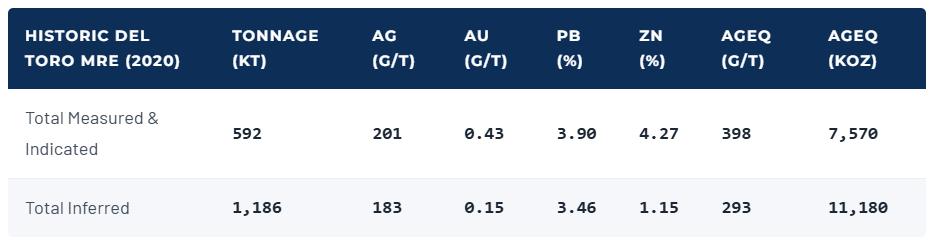
A 2020 historical estimate reported 7.57 million silver-equivalent ounces of measured and indicated material and 11.18 million ounces of inferred material. These figures are historical and are not current mineral resources. 

Historic Del Toro MRE (2020)

Sierra Madre plans new drilling and resource modelling to establish an updated resource.

The acquisition gives the company another developed Mexican silver asset with existing infrastructure, past production and exploration upside, while the company continues expanding La Guitarra.

Mexico Matters to the Silver Supply Story

Del Toro also places Sierra Madre in one of the world’s most important silver-producing countries.

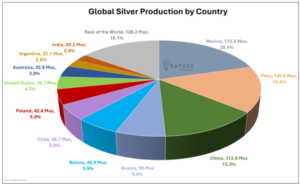
Mexico produced 172.9 million ounces of silver in 2025, down 5% from 181.1 million ounces in 2024. Still, it remained the world’s largest silver-producing country and accounted for about 20% of global mine supply.

global silver production

That makes Mexico an important part of the global supply story, while Zacatecas itself has a long history of silver production.

The Katusa Research report notes that roughly half of global silver production comes from Latin America, with Mexico accounting for about one-fifth of global output.

Sierra Madre’s strategy therefore combines existing Mexican infrastructure with a market where new supply remains difficult to bring online quickly.

Lower Silver Prices Put More Focus on Mine Execution

The silver pullback changes the economics of new production, even if the longer-term supply deficit remains. For Sierra Madre, the key issue is no longer simply whether silver prices are rising. The company now has to execute two different stages of growth.

La Guitarra needs to increase throughput while bringing costs under control. Del Toro needs to move through drilling, resource definition, mine planning, and restart work before it can contribute production.

The company is therefore entering a more demanding phase. The next stage of Sierra Madre’s story will depend on how efficiently it converts existing infrastructure, resources, and permits into production.

For now, La Guitarra provides an operating base while Del Toro offers a second potential source of growth. The silver price has pulled back, but Sierra Madre’s production strategy is moving forward. 


DISCLAIMER
New Era Publishing Inc. and/or CarbonCredits.com (“We” or “Us”) are not securities dealers or brokers, investment advisers, or financial advisers, and you should not rely on the information herein as investment advice. Sierra Madre Gold and Silver Ltd. (“Company”) made a one-time payment of $25,000 to provide marketing services for a term of one month. None of the owners, members, directors, or employees of New Era Publishing Inc. and/or CarbonCredits.com currently hold, or have any beneficial ownership in, any shares, stocks, or options of the companies mentioned.

This article is informational only and is solely for use by prospective investors in determining whether to seek additional information. It does not constitute an offer to sell or a solicitation of an offer to buy any securities. Examples that we provide of share price increases pertaining to a particular issuer from one referenced date to another represent arbitrarily chosen time periods and are no indication whatsoever of future stock prices for that issuer and are of no predictive value.

Our stock profiles are intended to highlight certain companies for your further investigation; they are not stock recommendations or an offer or sale of the referenced securities. The securities issued by the companies we profile should be considered high-risk; if you do invest despite these warnings, you may lose your entire investment. Please do your own research before investing, including reviewing the companies’ SEDAR+ and SEC filings, press releases, and risk disclosures.

It is our policy that information contained in this profile was provided by the company, extracted from SEDAR+ and SEC filings, company websites, and other publicly available sources. We believe the sources and information are accurate and reliable but we cannot guarantee them.

CAUTIONARY STATEMENT AND FORWARD-LOOKING INFORMATION

Certain statements contained in this news release may constitute “forward-looking information” within the meaning of applicable securities laws. Forward-looking information generally can be identified by words such as “anticipate,” “expect,” “estimate,” “forecast,” “plan,” and similar expressions suggesting future outcomes or events. Forward-looking information is based on current expectations of management; however, it is subject to known and unknown risks, uncertainties, and other factors that may cause actual results to differ materially from those anticipated.

These factors include, without limitation, statements relating to the Company’s exploration and development plans, the potential of its mineral projects, financing activities, regulatory approvals, market conditions, and future objectives. Forward-looking information involves numerous risks and uncertainties and actual results might differ materially from results suggested in any forward-looking information. These risks and uncertainties include, among other things, market volatility, the state of financial markets for the Company’s securities, fluctuations in commodity prices, operational challenges, and changes in business plans.

Forward-looking information is based on several key expectations and assumptions, including, without limitation, that the Company will continue with its stated business objectives and will be able to raise additional capital as required. Although management of the Company has attempted to identify important factors that could cause actual results to differ materially, there may be other factors that cause results not to be as anticipated, estimated, or intended.

There can be no assurance that such forward-looking information will prove to be accurate, as actual results and future events could differ materially. Accordingly, readers should not place undue reliance on forward-looking information. Additional information about risks and uncertainties is contained in the Company’s management’s discussion and analysis and annual information form for the year ended December 31, 2025, copies of which are available on SEDAR+ at www.sedarplus.ca.

The forward-looking information contained herein is expressly qualified in its entirety by this cautionary statement. Forward-looking information reflects management’s current beliefs and is based on information currently available to the Company. The forward-looking information is made as of the date of this news release, and the Company assumes no obligation to update or revise such information to reflect new events or circumstances except as may be required by applicable law.

For more information on the Company, investors should review the Company’s continuous disclosure filings available on SEDAR+ at www.sedarplus.ca.

Disclosure: Owners, members, directors, and employees of carboncredits.com have/may have stock or option positions in any of the companies mentioned: None.

Carboncredits.com receives compensation for this publication and has a business relationship with any company whose stock(s) is/are mentioned in this article.

Additional disclosure: This communication serves the sole purpose of adding value to the research process and is for information only. Please do your own due diligence. Every investment in securities mentioned in publications of carboncredits.com involves risks that could lead to a total loss of the invested capital.

Please read our Full RISKS and DISCLOSURE here.

The post Silver Falls 45% From Its 2026 Peak as Sierra Madre Scales Up Production appeared first on Carbon Credits.

NVIDIA’s AI Spending Surge to $279B as Infrastructure Commitments Hit Record Levels, NVDA Stock Gains

NVIDIA’s AI Spending Surge to $279B as Infrastructure Commitments Hit Record Levels, NVDA Stock Gains

NVIDIA (NASDAQ: NVDA) is moving deeper into the center of the global AI infrastructure boom as spending commitments across the industry reach unprecedented levels. The chipmaker is benefiting from rising demand for AI computing, while also helping finance and build the infrastructure needed to support future growth.

The trend is reflected in NVIDIA’s latest results. For the second quarter of fiscal 2027, revenue reached $96.2 billion, up 106% year over year. Data Center revenue rose 117% to $89 billion.

NVIDIA expects another record quarter, forecasting $108 billion in fiscal Q3 revenue. Behind those numbers is a much larger infrastructure cycle involving chips, data centers, networking, electricity, and financing.

The $2.7T AI Spending Wave Is Just Getting Started

The scale of AI investment has expanded sharply. Gartner forecasts worldwide AI spending at $2.7 trillion in 2026, up 49.5% from 2025. AI infrastructure is expected to account for about $1.48 trillion of that spending. Gartner forecasts total AI spending could reach approximately $3.64 trillion in 2027.

Data center investment is also creating a major new demand for electricity.

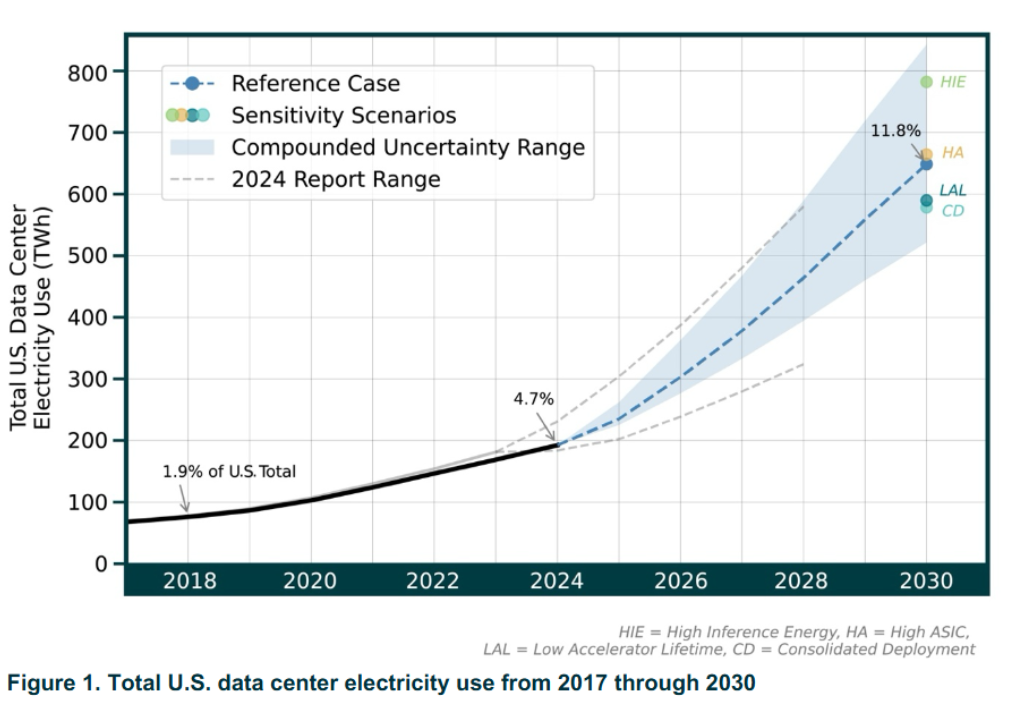
The International Energy Agency (IEA) estimates global data center electricity consumption will roughly double from 485 TWh in 2025 to 950 TWh in 2030. Electricity use from AI-focused data centers is expected to triple over the same period.

The IEA also expects data centers to account for about 3% of global electricity demand by 2030. In the U.S., they could account for almost half of electricity-demand growth through the end of the decade. This creates demand not only for GPUs but also for networking equipment, cooling systems, power infrastructure, and data center capacity.US data centers electricity use 2030

NVIDIA’s Results Show the Scale of Demand

NVIDIA’s latest financial results provide a direct measure of the AI infrastructure boom. For the quarter ended July 26, 2026, revenue reached $96.2 billion, compared with $46.7 billion a year earlier. Operating income climbed 124% to $63.7 billion, while net income increased 126% to $59.7 billion. GAAP gross margin was 75%.

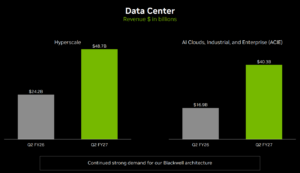
The Data Center segment remains the main growth engine. Revenue increased 18% from the previous quarter and 117% from a year earlier to $89 billion. NVIDIA’s Edge Computing revenue reached $7.2 billion, up 27% year over year.

Nvidia data center revenue Q2 2027
Source: Nvidia

For fiscal Q3, NVIDIA expects revenue of $108 billion, plus or minus 2%. Its forecast assumes no Data Center compute revenue from China. Gross margin is expected at 74%, plus or minus 50 basis points.

The company has also sharply increased its supply and capacity commitments. NVIDIA’s fiscal Q2 filing shows these commitments rose from $119 billion to $279 billion as of July 26, 2026. The company said the increase was intended to meet future demand.

These commitments are not the same as revenue. They represent future obligations and capacity arrangements. NVIDIA also warns that customers could delay purchases because of shortages of land, electricity, data center shells, or capital.

NVIDIA Moves Into AI Infrastructure Financing

The world’s most valuable company is also expanding beyond chip sales. In August, NVIDIA announced partnerships with Apollo, BlackRock, Blackstone, Brookfield, Goldman Sachs and KKR to establish independent financing platforms for AI infrastructure.

The platforms aim to mobilize more than $500 billion of third-party capital over time. The objective is to help fund large AI data centers and computing systems. This reflects a broader shift in the industry.

The IEA says data center investments have become too large to be funded entirely from company balance sheets, making capital markets increasingly important.

However, the $500 billion figure is a target for capital mobilization, not money already committed. NVIDIA’s announcement says the arrangements remain subject to definitive agreements. NVIDIA’s Q2 filing also shows $99 billion of equity investments and $25 billion of equity investment commitments as of July 26, 2026.

OpenAI’s 10-GW Plan Adds Fuel to the AI Buildout

One of the clearest examples of AI infrastructure demand is NVIDIA’s partnership with OpenAI. In September 2025, the companies announced plans for at least 10 gigawatts of NVIDIA systems for OpenAI’s next-generation AI infrastructure.

NVIDIA said it intended to invest up to $100 billion in OpenAI progressively as each gigawatt is deployed. The first gigawatt was targeted for deployment in the second half of 2026 using NVIDIA’s Vera Rubin platform.

NVIDIA’s broader infrastructure model now covers computing, networking, software and financing. The company’s fiscal Q2 results also highlighted its DSX platform, which is designed to help infrastructure builders design, build and operate large-scale AI factories. This suggests that NVIDIA’s role in the AI economy is expanding beyond supplying individual processors.

The Next AI Bottleneck: Finding Enough Power

The next challenge is increasingly physical. AI data centers require enormous amounts of electricity, and connecting new facilities to power grids can take years. The IEA says bottlenecks involving grid connections, transformers, gas turbines, advanced chips and other infrastructure are already slowing some projects.

NVIDIA’s own regulatory filing makes a similar point. It says access to land, power, data center shells and capital is crucial to customer deployment.

This creates a potential constraint on how quickly AI computing capacity can grow. Having demand for GPUs does not automatically mean the infrastructure exists to operate them. It also creates a larger connection between the technology and energy markets.

The IEA expects renewables and natural gas to supply much of the additional electricity needed by data centers, with nuclear also becoming more important later this decade.

NVIDIA’s AI Growth Comes With a Bigger Emissions Bill

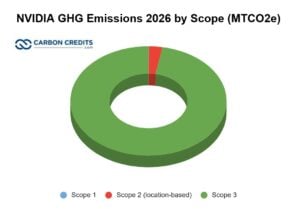
NVIDIA GHG emissions 2026

The infrastructure boom also raises environmental questions for NVIDIA and its supply chain. It has science-based emissions targets based on a FY2023 baseline, aiming to cut absolute Scope 1 and Scope 2 emissions by 50% by FY2030. It also targets a 75% reduction in Scope 3 emissions intensity from the use of sold GPUs per PFLOP by FY2030.

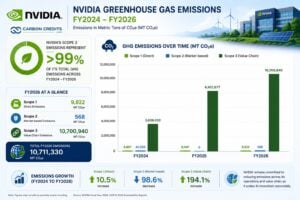
The company has made progress on operational electricity emissions. Its FY26 sustainability report shows 9,822 metric tons of Scope 1 emissions and 568 tons of market-based Scope 2 emissions. However, its wider supply chain footprint has increased sharply.

NVIDIA reported 10.7 million metric tons of Scope 3 emissions in FY26, compared with 6.9 million tons in FY25. Purchased goods and services accounted for 9.3 million tons. That increase highlights the environmental challenge created by rapid hardware expansion.

Nvidia GHG emissions 2026 by scope
Data source: Nvidia
  • The chipmaker is therefore pursuing two parallel goals: increasing computing efficiency while reducing emissions across its operations and value chain.

NVIDIA Stock Moves Higher as AI Spending Accelerates

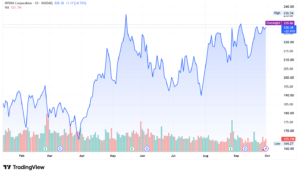
NVIDIA stock closed at $228.38 on September 30, 2026, gaining 0.5% for the session. The stock rose 1.7% on September 28 after NVIDIA announced a record $150 billion increase to its share-repurchase authorization. This lifts the total remaining authorization to about $235 billion.

Recent trading has therefore taken place alongside continued investor focus on AI infrastructure spending, NVIDIA’s earnings growth and its expanding capital-return program.

NVIDIA NVDA Stock

NVIDIA’s AI Infrastructure Cycle Keeps Expanding

NVIDIA enters the next phase of the AI buildout with several major infrastructure commitments already in place. OpenAI’s planned 10-GW deployment adds another large source of future demand.

At the same time, the industry faces physical and financial constraints. Electricity demand from data centers is projected to nearly double by 2030, while grid connections, power equipment, land, construction capacity and financing could limit the speed of new deployments.

For NVIDIA, the opportunity is therefore no longer limited to selling GPUs. The company is increasingly involved in the broader AI infrastructure stack, including computing, networking, software, capacity and financing.

The scale of those commitments shows how much capital is now moving behind AI. It also makes energy availability, infrastructure delivery, emissions, and the economic returns from AI spending increasingly important factors in the next phase of the market.

The post NVIDIA’s AI Spending Surge to $279B as Infrastructure Commitments Hit Record Levels, NVDA Stock Gains appeared first on Carbon Credits.