Singapore and Laos Build Article 6 Carbon Credit Pipeline With 58 Approved Methodologies

Singapore and Laos Build Article 6 Carbon Credit Pipeline With 58 Approved Methodologies
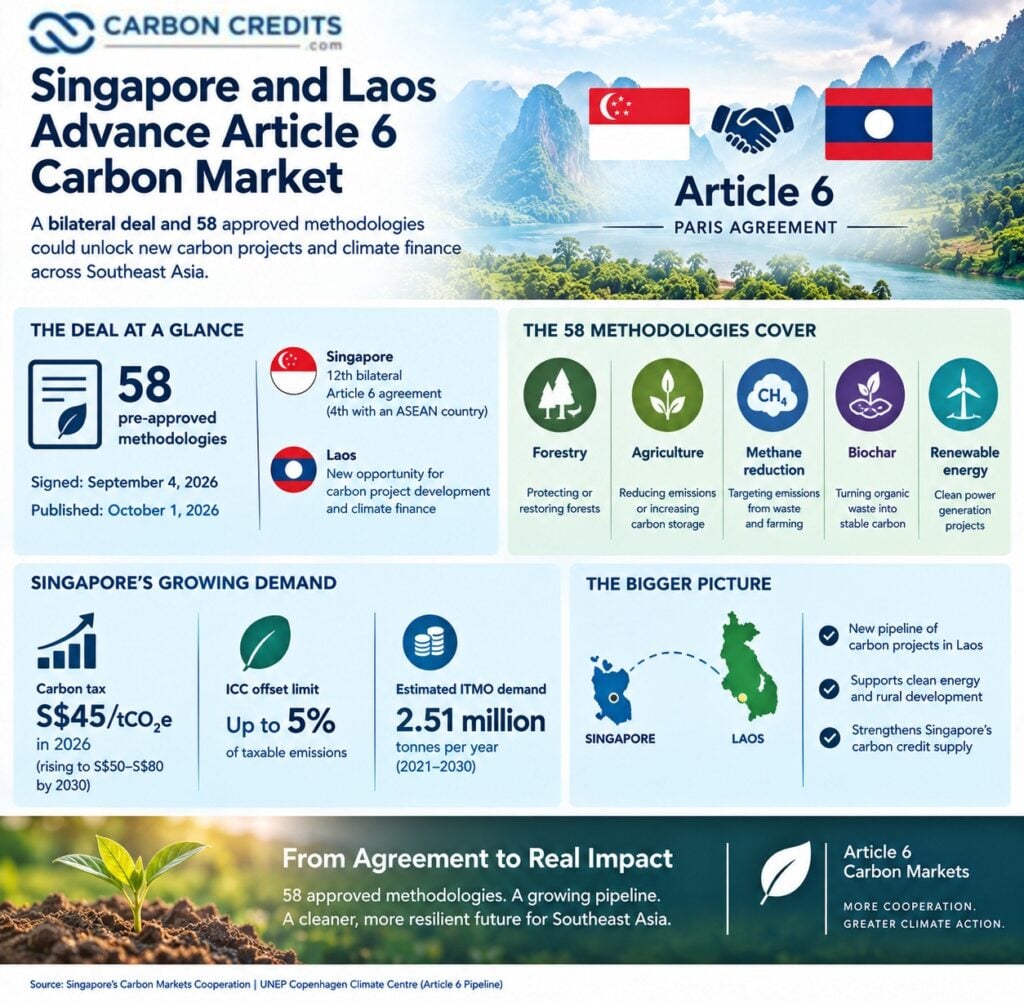
Singapore and Laos are taking another step toward building a cross-border carbon market. The two countries have agreed on 58 pre-approved carbon credit methodologies under their bilateral deal linked to Article 6 of the Paris Agreement.

The methodologies cover forestry, agriculture, methane reduction, biochar and renewable energy. They give project developers a clearer path to seek approval for carbon credits that could later be transferred internationally as Internationally Transferred Mitigation Outcomes (ITMOs).

Singapore and Laos signed their Implementation Agreement in September 2026. Singapore published the list of eligible methodologies on October 1.

The move could create a new pipeline of carbon projects in Laos while giving Singaporean companies another source of international carbon credits. It also adds Laos to Singapore’s growing network of Article 6 partners.

58 Methodologies Give Laos a New Carbon Project Pipeline

The new list covers a wide range of climate projects. Forestry projects can focus on protecting or restoring forests. Agricultural projects can reduce emissions or increase carbon storage. Methane projects can target emissions from waste and farming.

The list also includes biochar and renewable energy methodologies. However, the 58 methodologies do not mean that 58 projects have already been approved.

Projects must still go through Singapore and Laos’ authorization process before they can generate transferable ITMOs. Singapore says its methodology lists are designed to give developers more certainty because the methods have already been reviewed and published.

The next step will be the launch of the project application process. For developers, this could make Laos more attractive as a location for carbon projects targeting the international market.

Singapore and Laos Move From Agreement to Project Development

Singapore and Laos signed their Implementation Agreement on September 4, 2026. It was Singapore’s 12th bilateral Implementation Agreement for carbon market cooperation and its fourth with an ASEAN country.

The agreement allows eligible projects in Laos to generate carbon credits that can be transferred to Singapore, subject to approval by both countries. A key part of the system is the use of corresponding adjustments.

These adjustments help prevent the same emissions reduction from being counted twice — once by Laos and again by Singapore or another buyer. This is one of the main differences between Article 6 credits and many credits traded in the voluntary carbon market.

The agreement also sets financial and environmental safeguards. Laos will receive a 5% share of proceeds from authorized carbon credits to support climate adaptation. Another 2% of credits must be cancelled when the credits are first issued. These credits cannot be sold or used toward another climate target.

Singapore Has Growing Demand for Carbon Credits

The Laos agreement comes as Singapore’s carbon market expands. Singapore’s carbon tax rose to S$45 per tonne of CO₂e in 2026, up from S$25 in 2024 and 2025. The government plans to raise the tax to between S50 and S80/tCO₂e by 2030.
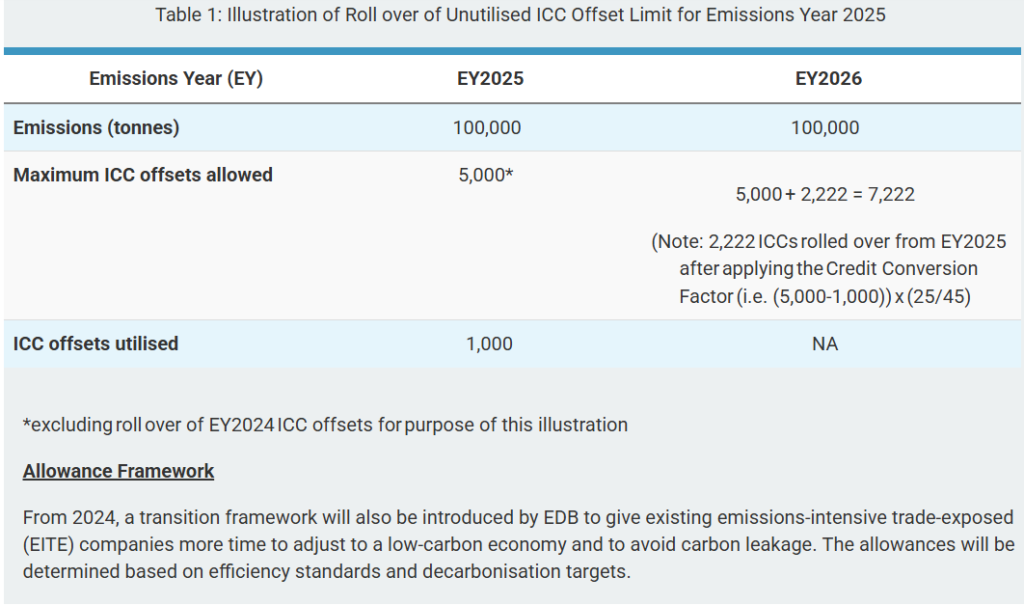
ICC Offset Limit for Emissions Year 2025
Source: Singapore’s Carbon Markets Cooperation

Companies covered by the carbon tax can use eligible international carbon credits (ICC) to offset up to 5% of their taxable emissions. That creates demand for high-quality international credits.

Singapore estimates that it could need about 2.51 million tonnes of ITMOs each year during its 2021–2030 climate-target period. But supply remains a challenge.

The government has said carbon projects can take several years to develop and generate credits. Singapore has therefore been working with several countries to build future supply. Laos now becomes part of that pipeline.
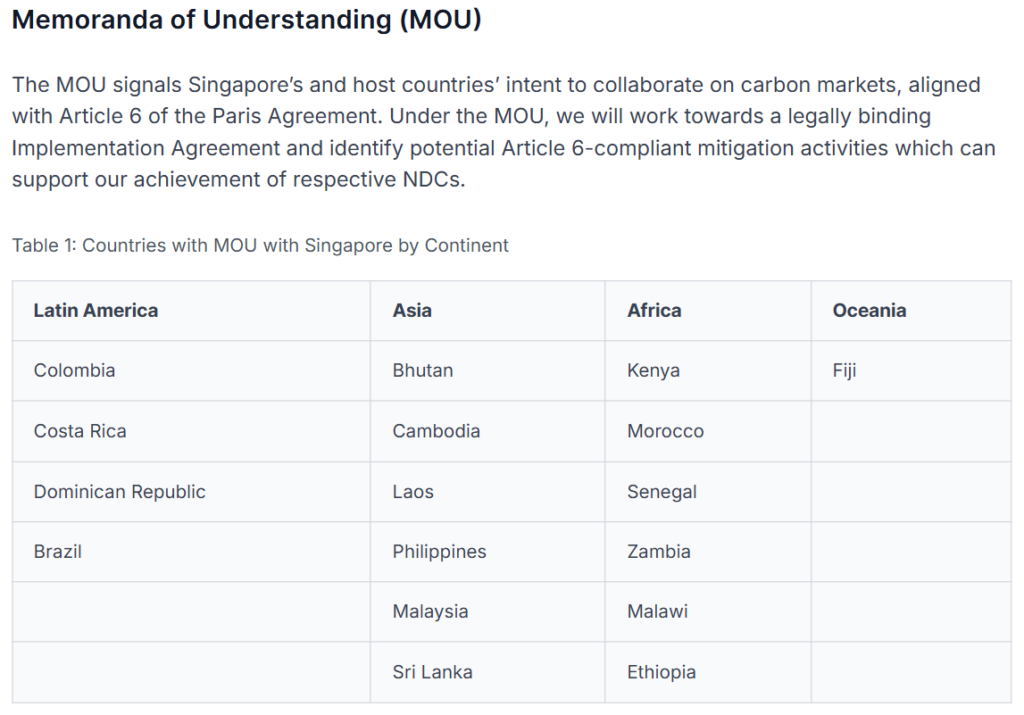
Countries with MOU with Singapore by Continent
Source: Singapore’s Carbon Markets Cooperation

Singapore Is Already Paying for High-Quality Carbon Credits

Singapore has already committed significant money to international carbon projects. The government has contracted about 2.175 million tonnes of high-quality nature-based carbon credits from projects in Ghana, Peru and Paraguay.

The contracts are worth about S$76 million in total. That equals an average value of around S$35 per tonne, although carbon prices vary between projects.

Singapore has also continued to seek new Article 6 credits from partner countries. A 2025 government tender for nature-based credits attracted offers ranging from about $19 to $41 per tonne, according to S&P Global. The tender received offers from 17 suppliers.

These prices are not a standard market price for Article 6 credits. They show, however, that buyers are willing to pay more for credits that meet stronger quality and government-approval requirements. That could benefit projects in Laos if they can meet Singapore’s eligibility rules.

Laos Could Attract New Climate Finance

For Laos, the agreement creates a potential new source of international climate finance. The country has large areas of forest and significant agricultural activity. These sectors could support projects that reduce emissions, store carbon, or improve land management.

The 58 approved methodologies give developers several possible project types to explore. But carbon revenue is not guaranteed.

Projects must prove that their emissions reductions are real and meet the rules of both countries. They must also pass the required monitoring, reporting, and verification processes.

  • The 5% share of proceeds gives Laos a direct financial benefit from successful projects. The 2% cancellation requirement also adds a climate-integrity safeguard.

For example, if a project generates 100 tonnes of eligible mitigation, two tonnes would be cancelled under the agreement. Only the remaining amount could potentially be transferred, subject to all other requirements. 
Singapore Laos carbon credits

Article 6 Market Is Growing, But Actual Trading Is Still Small

The global Article 6 market is expanding, but actual ITMO transfers remain at an early stage. As of September 4, 2026, the UNEP Copenhagen Climate Centre’s Article 6 Pipeline recorded 78 bilateral agreements in the East Asia and Pacific region, involving 16 countries.

  • Singapore had the largest network, with 28 agreements, followed by South Korea with 14 and Japan with 32 globally.

However, only about 54,000 ITMOs had been transferred or received in the East Asia and Pacific region by that date. Globally, the number was much larger, but still concentrated in a small number of transactions.

This shows the gap between signing Article 6 agreements and actually generating tradable credits. Countries are building the rules, approving methodologies, and developing project pipelines before large-scale trading begins.

The market is also becoming more focused on high-quality credits. The World Bank says carbon credit issuances rose 8% in 2025, while credits eligible for international compliance markets continued to receive price premiums.

For Singapore and Laos, the 58 approved methodologies could help close part of that gap by giving developers a clearer route from project development to government authorization and eventual ITMO transfers.

Article 6 Market Could Expand Across Southeast Asia

The latest Singapore agreement shows how Article 6 is moving from international climate policy into actual carbon market development.

The Paris Agreement created the framework for countries to cooperate on emissions reductions. Bilateral agreements now provide the rules needed to turn that framework into transactions.

For Singapore, the goal is to secure a supply of high-quality international credits as its carbon tax rises.

For Laos, the opportunity is to attract investment into forestry, agriculture, methane reduction, renewable energy and other climate projects.

The two countries will still need to prove that projects can move from approved methodologies to real credits.

That is the next test. With 58 methodologies already eligible, Singapore’s carbon tax at S$45/tCO₂e, potential ITMO demand of 2.51 million tonnes a year, and billions of dollars of global interest in higher-quality carbon credits, the foundation is now in place.

The post Singapore and Laos Build Article 6 Carbon Credit Pipeline With 58 Approved Methodologies appeared first on Carbon Credits.

Sumitomo Projects 34,000-Ton Nickel Surplus in 2027 Amid Indonesia Output Recovery

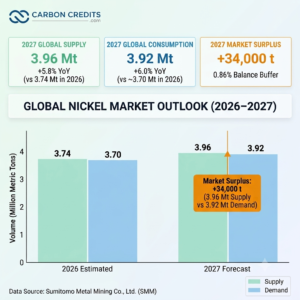
Japan’s Sumitomo Metal Mining expects the global nickel market to remain in surplus in 2027, even as demand from electric vehicles, stainless steel, and AI data centers continues to grow.

Reuters originally reported that the company forecasts a 34,000-metric-ton global nickel surplus in 2027, narrowing from an estimated 38,000 tons this year. The outlook highlights Indonesia’s continued influence on the global nickel market, with the country accounting for more than 60% of global production.

The forecast comes as nickel prices remain well below earlier-year peaks. At the same time, Indonesia is adjusting mining quotas and considering tighter controls on new processing capacity as it tries to prevent another prolonged period of oversupply.

Nickel Supply Set to Recover in 2027

Sumitomo expects:

  • Global nickel supply to increase 5.8% to 3.96 million tons in 2027, compared with 3.74 million tons estimated for 2026.
  • Demand is also expected to grow strongly. Global nickel consumption will rise 6% to 3.92 million tons next year.

The difference leaves the market with a relatively small surplus of 34,000 tons.

Indonesia will remain the biggest factor behind the supply outlook. Sumitomo expects Indonesian nickel pig iron (NPI) production to rebound 11.9% to 1.88 million tons in 2027.

NPI is a lower-grade form of nickel mainly used to produce stainless steel. Sumitomo expects production to decline 2.3% in 2026 after rising 12.4% in 2025, following Indonesia’s decision to reduce mining quotas.

Lower sulfur and sulfuric acid prices could also reduce production costs and support higher output of nickel intermediates such as mixed hydroxide precipitate.

Indonesia Holds the Key to Nickel Prices

Indonesia has spent much of 2026 trying to balance its enormous nickel processing industry with a tighter supply of domestic ore.

The government initially set the 2026 nickel ore production quota at around 260 million to 270 million metric tons, well below the 379 million tons approved in 2025. The lower quota briefly pushed LME nickel prices toward $20,000 per ton in May.

But the rally did not last.

Reuters reported in September that nickel had fallen back to around $16,500 per ton as the market became less convinced that Indonesia could maintain tight supply. Higher quota allocations later in the year and rising imports from the Philippines added to that pressure.

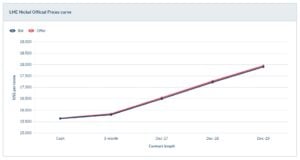
  • The latest LME data show three-month nickel closing at about $16,481 per ton on October 7, with exchange stocks at roughly 278,628 tons.
nickel
Source: LME

On October 7, three-month nickel was also reported at $15,840 per ton in Indonesian market data, underscoring the volatility across the market.

Indonesian Nickel Ore Prices Ease

The pressure is also visible in Indonesia’s domestic nickel ore market.

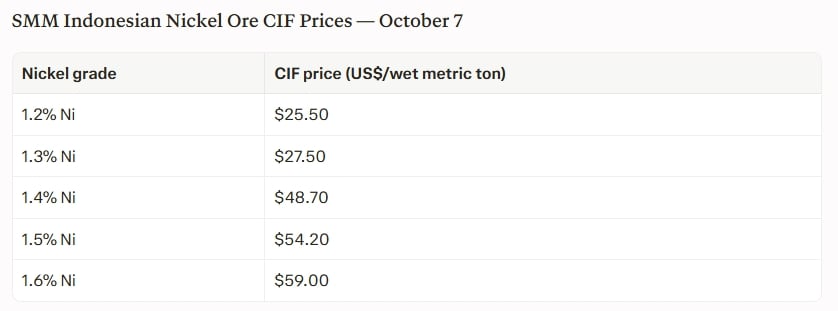
Shanghai Metals Market reported that Indonesia’s first-half October nickel benchmark price, or HMA, fell to $16,322.67 per ton, down 2.25% from $16,698 in the second half of September. Nickel ore prices also weakened as additional mining quotas entered the market.

SMM indonesia nickel
Data Source: SMM

These prices matter because Indonesia’s large processing industry requires huge volumes of ore. Indonesian industry group FINI estimates the country’s 2026 processing capacity at about 2.7 million tons across RKEF and HPAL facilities, requiring roughly 340 million to 350 million wet metric tons of ore.

That creates a supply dilemma. Indonesia has restricted mining to support prices, but its large smelter base needs enough ore to keep operating.

Indonesia May Restrict New Nickel Processing Plants

Jakarta is now looking beyond mining quotas.

Indonesia is considering a moratorium on new processing facilities that produce partly processed nickel products, according to a Reuters report on October 7.

Coordinating Minister for Downstreaming and Energy Transition Bahlil Lahadalia said the government was considering limiting new plants producing semi-finished nickel because oversupply has pushed down prices.

Indonesia wants to encourage investment in higher-value finished products instead of adding more capacity for nickel pig iron, ferronickel and other semi-processed materials.

The policy could become increasingly important if Indonesia continues adding processing capacity faster than global demand grows.

Nickel Demand Gets a Boost From EVs and AI

The supply outlook remains bearish, but demand is not standing still.

Sumitomo expects global nickel demand to rise 6% next year, helped by stable stainless steel consumption and increasing demand for specialty steel used in AI data centers.

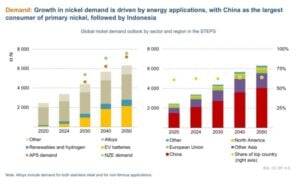
  • Battery demand should also improve. Sumitomo expects global nickel demand from batteries to rise to 620,000 tons in 2027, up from 560,000 tons in 2026.
  • Significantly, earlier Benchmark also forecasted that over 50% of nickel demand growth by 2030 will come from batteries. By the end of the decade, battery nickel demand could hit 1.5 million tonnes annually.

Chinese EV sales remain an important driver of this growth. However, the battery market is changing. Lithium iron phosphate (LFP) batteries do not use nickel, limiting how quickly EV growth translates into higher nickel demand.

nickel demand
Source: IEA

Sumitomo also expects continued declines in Chinese cathode production to reduce the surplus of high-purity Class 1 nickel. At the same time, a recovery in Indonesian NPI production could ease the shortage of Class 2 nickel, creating different supply conditions across nickel products.

Nickel Market Faces a Delicate 2027 Balance

The latest outlook points to a nickel market that is moving closer to balance but has not reached it yet.

Indonesia’s production decisions will remain the biggest variable. Lower quotas can tighten ore availability and support prices, while higher allocations can quickly bring additional supply back into the market.

At the same time, battery demand is growing, but LFP technology limits nickel intensity in EVs. Stainless steel remains the largest demand driver, while AI data center construction is creating a newer source of specialty-steel demand.

For investors and mining companies, the key question is whether Indonesia can restrain supply faster than global demand expands.

However, as of now, Sumitomo’s forecast suggests the answer is no. The 34,000-ton surplus expected in 2027 is much smaller than previous oversupply estimates, but it still leaves the nickel market vulnerable to renewed downward price pressure if Indonesian production rebounds faster than expected.

The post Sumitomo Projects 34,000-Ton Nickel Surplus in 2027 Amid Indonesia Output Recovery appeared first on Carbon Credits.

Google, Constellation Strike 890 MW Nuclear Deal to Support PJM Grid

Google and Constellation Energy have signed a 20-year power purchase agreement (PPA) to add 890 megawatts (MW) of new nuclear capacity to the PJM electricity grid.

The agreement will support more than $4.3 billion of investment by Constellation to upgrade 11 existing nuclear units across Illinois, Pennsylvania, and New Jersey. The upgrades are expected to increase the plants’ output without building new reactors from scratch.

The first upgraded capacity is expected to reach the grid in 2028, with the full 890 MW targeted by the end of 2032. Constellation says the additional power is roughly equivalent to adding a large new nuclear reactor to the PJM system.

Amanda Peterson Corio, global head of energy and power at Google, said:

“We’re committed to meeting our growth responsibly by actively investing in clean, reliable power that brings new capacity to our nation’s grids. Our agreement with Constellation to fund nuclear reactor uprates will strengthen the PJM grid, which serves 67 million people, all while protecting energy affordability and supporting local union jobs.”

Google Is the Anchor Customer

Google’s role in the deal is important to understand. The tech giant is not building or operating the nuclear plants. Instead, it has committed to buying the additional electricity under the 20-year PPA.

That long-term commitment gives Constellation greater revenue certainty to invest in upgrades at its existing reactors. In other words, Google is acting as the anchor customer that helps make the nuclear uprates commercially viable.

Constellation will fund and carry out the physical upgrades, including improvements to turbines, steam generators, and digital control systems. These changes can increase the amount of electricity produced by an existing reactor without requiring a completely new plant.

The agreement is expected to:

  • Add 890 MW of new, firm nuclear capacity to PJM.
  • Support more than $4.3 billion of investment by Constellation.
  • Sustain about 4,400 existing jobs.
  • Create roughly 7,200 construction jobs during the upgrade program.
  • Bring the first additional capacity online in 2028.

Google and Constellation also signed a separate 15-year agreement covering another 2,700 MW from Constellation’s PJM generation fleet.

Importantly, this second 2,700 MW should not be described as new nuclear capacity. It covers additional electricity from Constellation’s existing PJM generation assets and provides longer-term revenue certainty for those facilities. Combined, the two agreements cover 3,590 MW of electricity supply.

The Importance of Existing Nuclear Plants

The 890 MW expansion is based on nuclear uprates rather than new reactor construction.

A nuclear uprate involves upgrading an existing reactor so it can produce more electricity. This can be faster than developing a new nuclear plant because the facility already has its site, grid connection, and operating infrastructure.

The approach is becoming more important as the U.S. looks for additional firm electricity to meet growing demand.

The U.S. had 94 operating commercial nuclear reactors at 54 nuclear power plants as of March 2026, with a combined net summer generating capacity of 98,441 MW, according to the Energy Information Administration (EIA). The average nuclear capacity factor was 91% in 2025, showing how intensively the existing fleet is used.

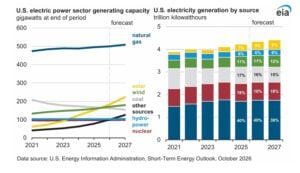
EIA also expects U.S. electricity demand to reach new records in 2026 and 2027. Its latest outlook puts total U.S. electricity consumption at 4,288 billion kilowatt-hours in 2026 and 4,356 billion kWh in 2027. Nuclear power is expected to account for about 18% of generation in both years.

US electricity nuclear

That makes additional output from existing nuclear plants an important option for meeting demand without waiting for entirely new reactors.

PJM Faces Rapid Load Growth

The Google-Constellation deal is particularly significant for PJM.

The PJM Interconnection operates the largest U.S. power market, covering 13 states and serving about 67 million people. The region is facing rapidly rising electricity demand from large data centers and other industrial customers.

PJM has proposed a “Bring Your Own Power” approach for large new electricity users. The idea is that companies adding major loads should also help bring additional generation onto the system.

The Google-Constellation agreement provides a practical example of that model.

Instead of simply connecting new data centers to the existing grid and increasing demand, Google is supporting additional generation capacity through a long-term purchase commitment.

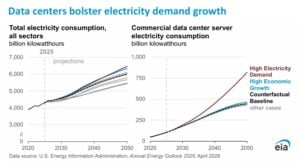
This could help address one of the biggest challenges facing the U.S. power sector: adding electricity supply quickly enough to keep up with new demand. i.e., primarily from data centers.

EIA electricity consumption

Google Links Nuclear Power to Its Clean Energy Goals

The nuclear agreement also fits Google’s broader clean-energy strategy.

Google aims to operate its data centers and campuses on carbon-free energy 24 hours a day, every day, by 2030. The company has already matched 100% of its annual electricity consumption with renewable energy purchases since 2017, but its 24/7 goal is more demanding because electricity must be carbon-free at the time and location it is consumed.

The rapid expansion of AI has made that target more difficult.

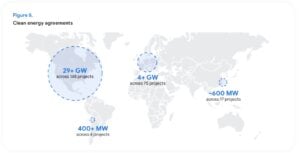
Google’s 2026 Environmental Report said the company signed agreements for more than 12 GW of net-new clean energy in 2025. Between 2010 and 2025, it signed more than 240 agreements covering nearly 35 GW of new clean-energy capacity. At the same time, Google said its AI infrastructure is growing faster than the grid is decarbonizing.

google clean energy
Source: Google

Nuclear power gives Google access to carbon-free electricity that can operate around the clock, complementing variable renewable sources such as wind and solar.

The company said its nuclear agreements, including this latest deal, have now enabled more than 1.5 GW of new nuclear capacity for the U.S. power system through uprates and reactor restarts.

Ratepayer Protection Adds Another Layer

The agreement also aligns with the White House’s Ratepayer Protection Pledge, launched in March 2026.

Google was among seven major technology companies that initially signed the pledge. Under it, participating companies committed to build, bring, or buy the power needed for their data centers and pay for new power-delivery infrastructure required to serve them.

The pledge also calls on companies to pay for power and infrastructure brought online for their facilities even when they do not use all of that electricity.

The broader goal is to prevent the cost of rapidly growing data-center electricity demand from being shifted to residential and other existing electricity customers.

As of October 2026, the White House says the pledge has expanded to more than 300 organizations, covering about 80% of the electricity delivered to U.S. homes and businesses.

The Google-Constellation agreement fits this model because the company is helping support new power supply rather than relying only on existing grid capacity.

AI, Nuclear Power and the Grid

The deal points to a changing relationship between technology companies and the power sector.

For Constellation, it provides a long-term customer and supports billions of dollars in nuclear upgrades. For Google, it secures additional firm, carbon-free electricity while supporting its 24/7 clean-energy ambitions.

More broadly, the deal shows how large electricity users could play a bigger role in financing new power supply as the U.S. grid enters a period of rapid load growth.

Rather than waiting only for new power plants to be built, companies can help unlock additional capacity from existing infrastructure.

And lastly, for PJM, that could mean more reliable electricity. For Google, it means more power for AI and data centers. And for the U.S. nuclear industry, it creates another commercial pathway to expand generation from an existing fleet that already provides nearly one-fifth of the country’s electricity.

The post Google, Constellation Strike 890 MW Nuclear Deal to Support PJM Grid appeared first on Carbon Credits.
Gevo Sells 10,000 Carbon Removal Credits as (GEVO) Stock Gains 5%

Gevo Sells 10,000 Carbon Removal Credits as (GEVO) Stock Gains 5%

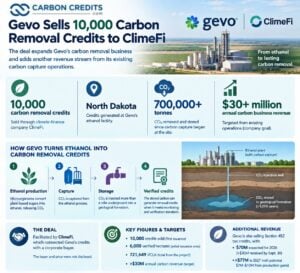
Gevo is expanding its carbon removal business after completing a sale of 10,000 carbon removal credits through climate-finance company ClimeFi. The deal gives the U.S. renewable fuels producer another way to earn revenue from its existing carbon capture operations.

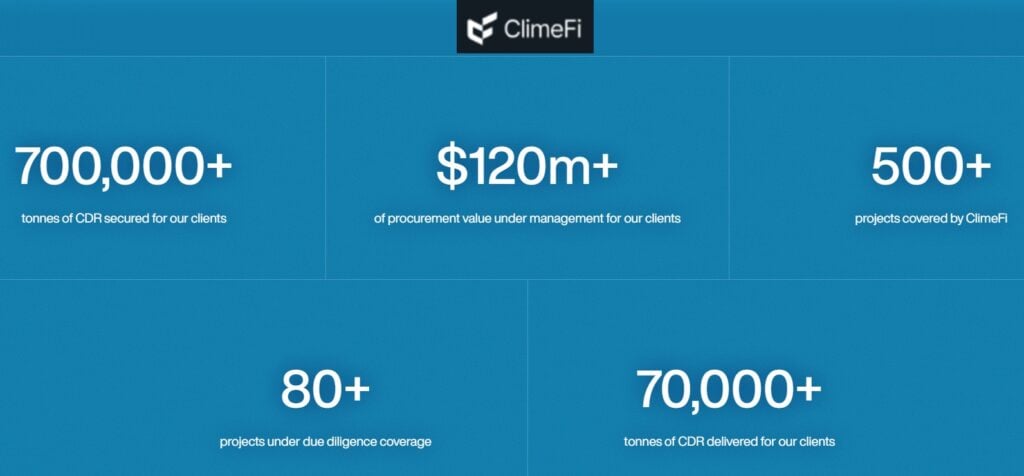
Announced on October 8, 2026, the transaction involved credits generated at Gevo’s North Dakota ethanol facility. Gevo says the site has produced more than 700,000 tonnes of carbon dioxide removal since carbon capture and storage began.

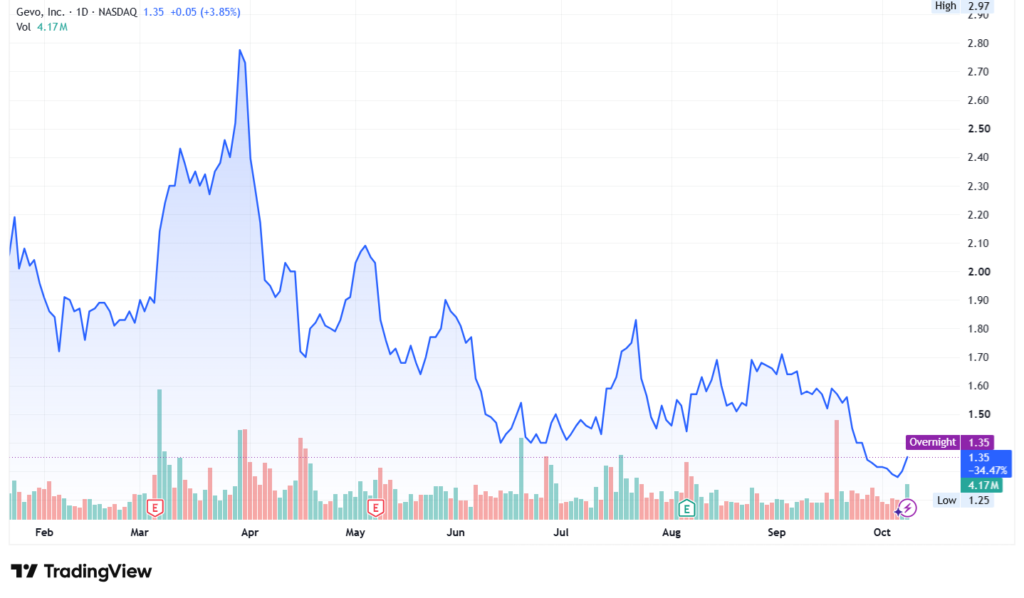
The announcement came as Gevo shares gained 5.13% in European trading. The report cited a move from €1.17 to €1.23 on the Lang & Schwarz platform. This was not necessarily the closing price of Gevo shares on Nasdaq, and the timing alone does not prove the deal caused the increase.

Gevo is targeting more than $30 million in annual carbon business revenue from existing operations. That remains a company target, not revenue already achieved. The latest sale provides another example of how Gevo plans to turn carbon capture into a source of income alongside renewable fuels.

How Gevo Turns Ethanol Production Into Carbon Removal Credits

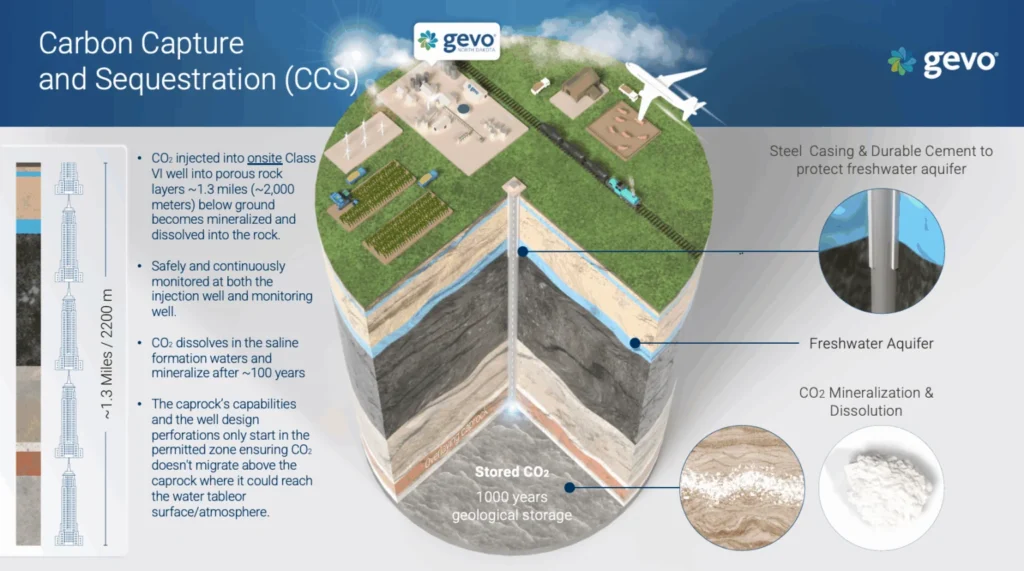
Gevo’s project captures carbon dioxide released during ethanol production and stores it underground. Ethanol plants use microorganisms to convert plant-based sugars into alcohol. This process releases carbon dioxide. Gevo captures that gas and injects it into a geological formation more than a mile beneath its North Dakota facility.

The process is known as bioenergy with carbon capture and storage (BECCS). It combines fuel production from biological material with carbon capture and long-term storage.

Gevo says the stored carbon can remain underground for more than 1,000 years. The company uses its existing ethanol plant, capture equipment, and storage well to support the process.

The captured carbon can generate carbon removal credits when the project meets the required monitoring and verification standards. Each credit represents one tonne of carbon dioxide removed from the atmosphere and stored.

However, capturing biogenic carbon does not automatically guarantee a net climate benefit. Project assessments must account for emissions from growing and transporting feedstock, operating the facility, and storing the carbon. The overall process must demonstrate that it delivers genuine net removals.

Gevo says its North Dakota operation is among the first commercial-scale BECCS projects in the United States to deliver verified carbon removal credits to the voluntary market. 

Gevo CCS
Source: Gevo

Gevo Chief Executive Officer Paul Bloom:

“With proven sequestration infrastructure, commercial operations and access to both compliance and voluntary carbon markets, we believe our existing operations can support a growing carbon business and create a meaningful contributor to earnings, cash generation and shareholder value.”

ClimeFi Helps Connect Gevo With Buyers

ClimeFi facilitated the transaction and helped connect Gevo’s credits with a corporate buyer. The companies did not publicly identify the buyer or disclose the sale price.

Intermediaries such as ClimeFi help carbon removal suppliers reach companies seeking verified climate solutions. They can also help buyers assess projects, compare removal technologies, and manage credit purchases.

Carbon removal differs from credits that represent avoided emissions. A removal credit represents carbon taken out of the atmosphere and stored. Avoidance credits generally represent emissions that a project prevents from being released.

Durable carbon removal can be more expensive because projects must capture carbon and demonstrate that it remains stored over time.

Gevo has previously reported carbon credit sales involving buyers such as Nasdaq and Whirlpool. The ClimeFi transaction adds another completed sale to its commercial record.

climefi
Source: ClimeFi

However, without a disclosed price, the transaction does not establish how much revenue Gevo earned per credit. It also does not provide a reliable price benchmark for the wider carbon removal market.

Gevo Targets $30 Million in Annual Carbon Revenue

Gevo wants to build a carbon business alongside its renewable fuels operations. Its target of more than $30 million in annual carbon business revenue would create another income stream from existing facilities.

The company is also earning money through U.S. clean fuel tax incentives. These incentives are separate from carbon removal credit sales.

On October 1, Gevo announced that it had sold substantially all the Section 45Z tax credits it expected to generate from its ethanol and renewable natural gas facilities in 2026. The expected total was $70 million.

Gevo had received more than $30 million in cash from those sales by September 30. It expected to receive the remaining proceeds over the following six months.

The company also forecast more than $77 million in Section 45Z credits for 2027. Planned production improvements at its North Dakota facility could add an estimated $7 million to $10 million to that amount.

These tax credits are not carbon removal credits. Section 45Z is a government incentive for qualifying low-emission transportation fuels, while carbon removal credits are sold to buyers seeking verified emissions removals. 

Gevo carbon removal credits

Both can support Gevo’s finances, but they depend on different rules and markets. The company’s ability to grow its carbon business will depend on future credit sales, buyer demand, verification requirements, and operating costs.

Durable Carbon Removal Demand Surges, But Delivery Lags

Gevo’s deal comes as buyers show growing interest in durable carbon removal. However, the market still faces a gap between credits purchased for future delivery and removals already delivered.

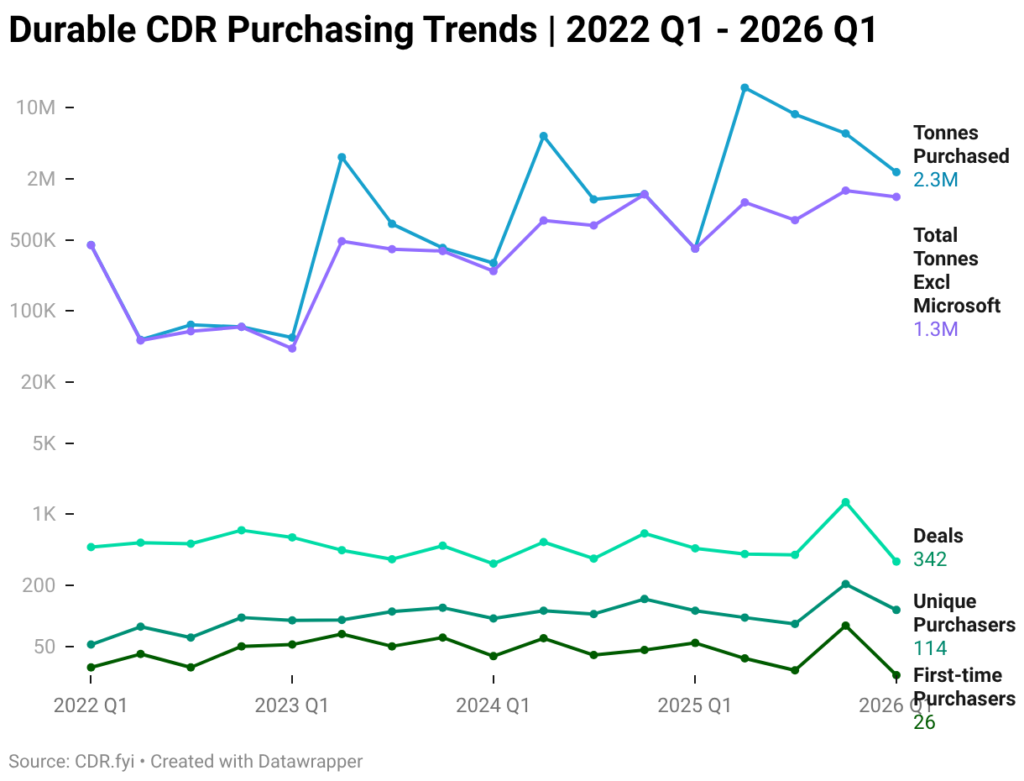
CDR.fyi reported that buyers contracted for 2.3 million tonnes of durable carbon removal in the first quarter of 2026. That was about 560% higher than in the first quarter of 2025.

The market also recorded approximately 145,000 tonnes delivered in the first quarter of 2026, a 67% increase from a year earlier. These figures cover the wider durable carbon removal market, not just BECCS projects.

The difference between contracted and delivered volumes remains substantial. Contracts can cover removals that will occur years later, while delivered credits represent a more advanced stage of project execution.

durable CDR

That makes Gevo’s completed transaction important. It shows that the company has moved beyond developing carbon capture infrastructure to selling credits from its operations.

Still, one transaction does not prove that the market can sustain rapid growth. Future demand will depend on corporate climate commitments, credit quality, prices, and confidence that projects deliver measurable, durable removals.

What the Stock Gain Means

Gevo shares gained 5.13% in European trading on October 8, rising from €1.17 to €1.23 on the Lang & Schwarz platform, according to AD HOC News.

Investors may see the sale as a positive sign for Gevo’s carbon business. However, a single day’s share-price movement does not establish that the transaction caused the increase.

The company’s wider progress also matters. Gevo is working to improve production at its North Dakota facility and increase the value it earns from renewable fuels, tax incentives and carbon products.

Gevo stock price

The 10,000-credit transaction provides evidence that Gevo can sell removals from its existing operations. The next challenge is to repeat those sales at prices and volumes that make carbon removal a reliable source of revenue.

One Credit Sale, a Bigger Carbon Business Ambition

Gevo’s sale through ClimeFi shows how an ethanol plant can generate revenue from both fuel production and carbon removal.

The company says its North Dakota facility has generated more than 700,000 tonnes of carbon dioxide removal. It is now seeking to grow its carbon business to more than $30 million in annual revenue.

The latest sale advances that goal, but the undisclosed price means the transaction’s financial contribution remains unclear.

For the carbon market, the deal highlights the importance of actual delivery. Buyers need projects that can capture carbon, store it securely, and support credits with credible monitoring and verification.

If Gevo can expand its credit sales while maintaining reliable storage and emissions accounting, carbon removal could become a more important part of its business. For now, the 10,000-credit deal is a concrete step toward that target—not proof that the company has already achieved it.

The post Gevo Sells 10,000 Carbon Removal Credits as (GEVO) Stock Gains 5% appeared first on Carbon Credits.
Verra Approves First Carbon Credits Under Food Loss and Waste Methodology

Verra Approves First Carbon Credits Under Food Loss and Waste Methodology

Verra has approved the first carbon credits generated under its methodology for reducing food loss and waste, opening a new pathway for food rescue projects to access carbon market finance.

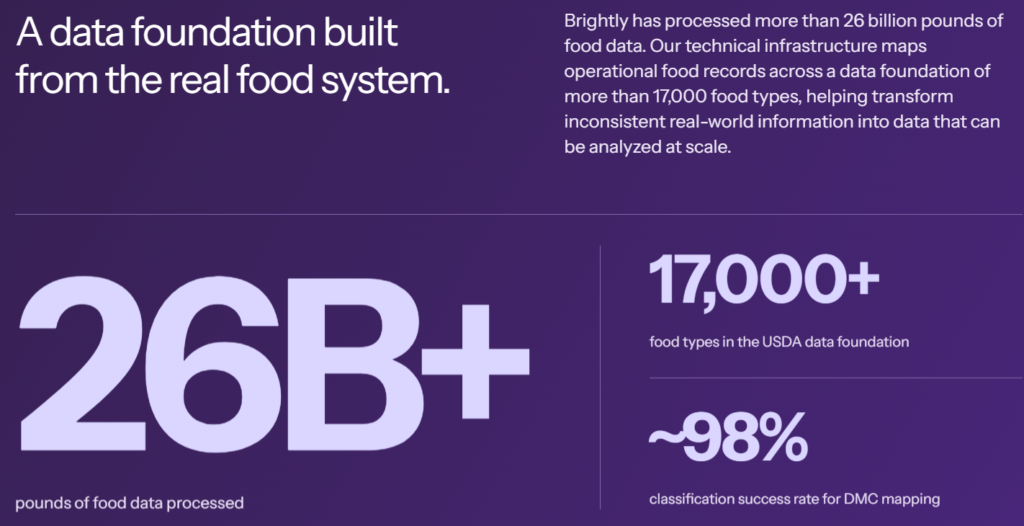
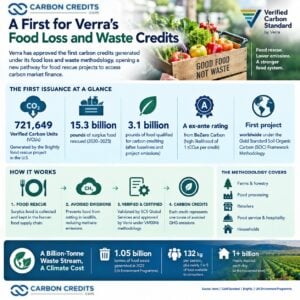
The credits come from the Brightly – Reducing Food Loss and Waste project in the United States. The project generated 721,649 Verified Carbon Units (VCUs) by redirecting surplus food to people instead of allowing it to enter waste streams.

The milestone gives food rescue organizations a new way to monetize avoided methane emissions while addressing food insecurity. It also broadens the types of activities that can earn verified carbon credits. This goes beyond traditional areas like forestry, renewable energy, and methane capture.

Verra approved the credits under its VM0046 Methodology for Reducing Food Loss and Waste, v1.0. Mandy Rambharos, CEO, Verra, remarked: 

“Food waste is one of the most overlooked sources of methane, and preventing it is one of the most solvable issues. This first issuance under VM0046 proves that keeping food out of landfills can be measured with integrity, and that carbon markets can move finance to the organizations making it happen. It also shows why Verra keeps broadening its methodology portfolio: there are many ways to cut emissions, and each one needs a credible pathway to carbon finance.”

721,649 Credits Put Food Rescue on the Carbon Map

Brightly’s project covers food rescue activities carried out between March 2020 and December 2023. During that period, participating organizations rescued 15.3 billion pounds of surplus food. After applying historical baselines and accounting for project-related emissions, 3.1 billion pounds of the rescued food qualified for carbon crediting.

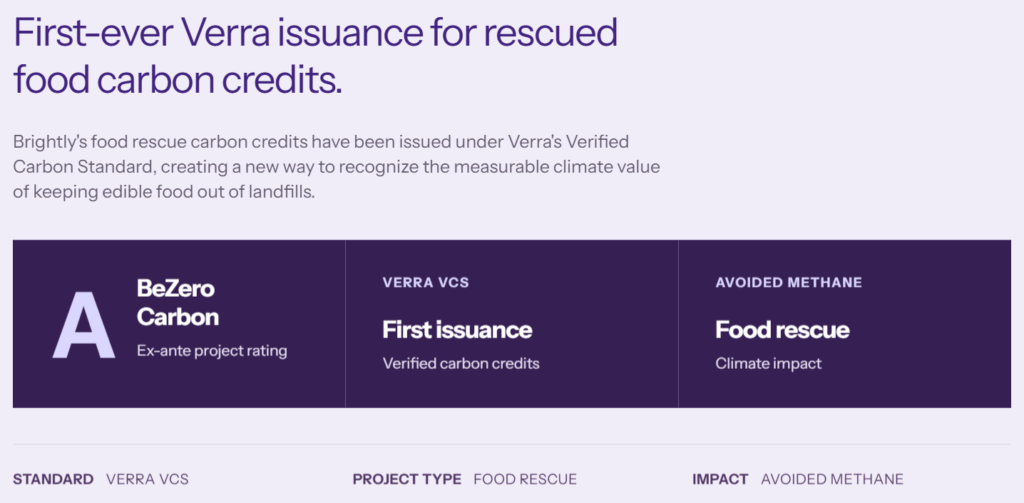
That activity produced 721,649 VCUs, with each credit representing one tonne of avoided greenhouse gas emissions. The credits received an A ex-ante rating from BeZero Carbon, indicating a high likelihood that each credit represents one tonne of avoided emissions.

SCS Global Services, a Verra-approved body, independently validated and verified the project. Then, Verra reviewed and approved the issuance.

The first issuance follows Verra’s registration of Brightly’s project in May 2026. At that stage, Verra expected the project to save about 167 million pounds of food over seven years, from 2020 to 2027. It would also cut emissions by about 115,118 tonnes of CO2e.

The latest issuance reflects verified historical activity rather than the entire future potential of the project.  

Brightly – Reducing Food Loss and Waste
Source: Brightly

How Verra’s Food-Waste Methodology Works

Verra’s VM0046 methodology has been active since July 12, 2023. It falls under the Verified Carbon Standard’s waste-handling and disposal sector.

The methodology allows projects to quantify emissions avoided when food that would otherwise become waste remains in the human food supply chain. Projects can operate at several points along the food chain, including:

  • Farms,
  • Food processing facilities,
  • Retailers,
  • Food-service and hospitality businesses, and
  • Households.

The methodology measures the emissions that would happen if the food went to a waste site, like a landfill. That makes it different from carbon removal projects. The credits represent avoided emissions, primarily by preventing food from decomposing in waste streams and generating methane.

The methodology also addresses additionality. Brightly establishes a conservative historical baseline for participating organizations, with only food rescued above that baseline eligible for crediting. This ensures that credits show real climate impact. They don’t just reward current food-rescue efforts.

A Billion-Tonne Waste Stream With a Climate Cost

The potential market for this type of project is large because food loss and waste occur across the global food system.

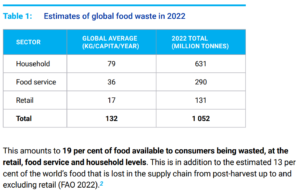
The UN Environment Programme estimates that 1.05 billion tonnes of food waste were generated in 2022 at the retail, food service and household levels. That amounted to 132 kilograms per person and nearly one-fifth of food available to consumers. Households alone wasted more than 1 billion meals per day.

global food waste in 2022
Source: UN Environment Programme

Food loss also occurs before food reaches consumers.

The Food and Agriculture Organization estimates that 13.2% of food is lost worldwide from harvest to retail. Additionally, 19% is wasted at retail, food service, and households, according to 2024 UNEP statistics. Together, food loss and waste account for an estimated 8% to 10% of global greenhouse gas emissions, according to FAO.

This gives carbon markets a large potential emissions reduction opportunity. However, not every tonne of wasted food automatically translates into a carbon credit.

Projects must establish baselines, quantify eligible activity, and account for emissions associated with the intervention. VM0046 provides the framework for doing that.

Carbon Revenue Could Help Scale Food Rescue

The Brightly project connects climate finance with food rescue. The company works with food rescue organizations that collect edible surplus food and redistribute it instead of allowing it to enter waste streams. The organizations can then receive revenue from carbon credit sales.

Feeding America said the majority of net proceeds from credit sales will return to participating food rescue organizations. The funding can cover costs like trucks, drivers, refrigeration, staff, and other infrastructure needed to recover and distribute food.

The scale of the network has also expanded significantly.

Brightly partners with 198 Feeding America food banks and 28 independent food rescue groups. This helps us reach communities in every U.S. state and about 97% of U.S. counties. Together, these organizations rescue more than 5 billion pounds of surplus food each year, according to Feeding America.

Brightly food rescue
Source: Brightly

This can lead to a feedback loop. More carbon revenue helps organizations recover more food. This, in turn, can create further measurable emissions reductions.

Carbon Markets Broaden Beyond Forests and Renewables

The first food-loss-and-waste issuance comes as the broader carbon credit market continues to develop.

The World Bank reported that global carbon credit issuances increased 8% between 2024 and 2025, although issuance remained about 20% below its 2022 peak. Independent crediting mechanisms still accounted for about 70% of total issuance.

At the same time, carbon credit retirements fell by more than 10% in 2025. Voluntary uses made up over 80% of retired credits. Meanwhile, companies and other buyers signed around $12 billion in offtake agreements for future carbon credits. This amount is three times what was recorded in 2024.

Prices also varied sharply by project type. The World Bank said carbon credit prices declined slightly across 2025, but higher-quality and compliance-eligible credits continued to command premiums. CORSIA-eligible credits, for example, traded at around $15 to $22 per tonne, compared with roughly $1 to $14 for most other credit types.

For food-loss-and-waste projects, the key question will be whether buyers place a premium on the combination of methane avoidance, food security, and measurable local impact. 

Verra food waste carbon credits

Food Rescue Enters the Carbon Credit Economy

Verra’s first VM0046 issuance does more than create another category of carbon credits. It demonstrates that food rescue can be measured through a standardized carbon methodology and converted into a tradable environmental asset.

The Brightly project also shows how carbon finance can potentially reach organizations that traditionally depend heavily on grants and donations.

With 721,649 credits now approved from the first issuance, the project provides an initial test of demand for this new credit type. Future projects could expand the market to other parts of the food supply chain, including retailers, food processors, farms, and food-service businesses.

The climate opportunity is significant. Over 1 billion tonnes of food waste are created each year at the consumer level. This waste contributes to nearly 10% of global greenhouse gas emissions.

VM0046 does not solve that problem by itself. But it gives project developers a standardized way to measure a portion of the emissions avoided when food stays in the human food system. For carbon markets, that creates a new pathway to finance climate action while also reducing food waste and supporting food security.

The post Verra Approves First Carbon Credits Under Food Loss and Waste Methodology appeared first on Carbon Credits.
Europe’s Soil Carbon Market Gets a First: Gold Standard Credits Issued in France and Belgium

Europe’s Soil Carbon Market Gets a First: Gold Standard Credits Issued in France and Belgium

Europe’s soil carbon market has reached a new milestone. The European Soil Revitalization Programme, covering farms in France and Belgium, has issued the first carbon credits worldwide under the Gold Standard Soil Organic Carbon (SOC) Framework Methodology.

South Pole, agricultural technology company Gaïago, and Gold Standard announced the first issuance on October 6, 2026. The initial issuance covers 6,000 verified hectares. The wider program includes 727 farms and could expand to more than 39,282 hectares.

At full enrollment, the project is forecast to remove 264,174 tonnes of CO₂ equivalent (tCO₂e) during its first crediting period.

The milestone comes as Europe builds a stronger policy framework for soil health and carbon farming. The European Commission says 60% to 70% of EU soils are unhealthy, while new EU rules are creating a formal system for certifying carbon farming activities.

That could create a growing role for high-quality soil carbon projects in Europe’s climate market.

A First for Gold Standard Soil Credits

The European Soil Revitalization Programme is the first project worldwide to issue credits under Gold Standard’s Soil Organic Carbon Framework Methodology. Gold Standard launched the framework to measure changes in soil carbon and greenhouse gas emissions when farmers adopt improved agricultural practices.

The framework can cover both emissions reductions and carbon sequestration in soils. It also allows different approaches to measure soil carbon, including direct field measurements, scientific models, and approved default factors.

Sarah Leugers, Chief Growth Officer at Gold Standard, said:

“As the first project worldwide to issue credits under our Soil Organic Carbon Framework Methodology, the European Soil Revitalization Programme shows how rigorous standards can unlock vital finance for sustainable land management. We congratulate Gaïago and South Pole on this important milestone.”

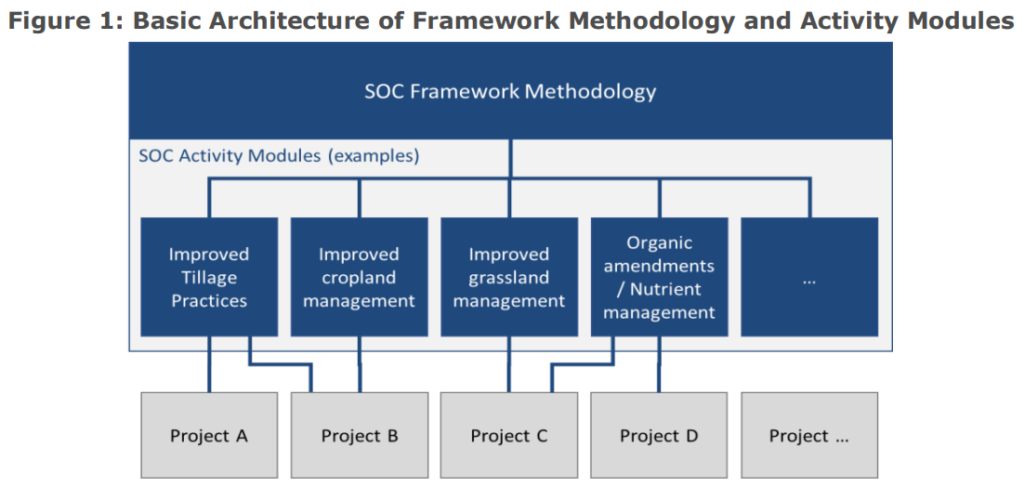
Basic Architecture of Framework Methodology
Source: Gold Standard

For the French and Belgian project, the specific activity module covers biostimulants for soil revitalization. The project combines this approach with other regenerative farming practices, including reduced or zero tillage and year-round cover crops.

The program began in 2022 and has a planned 20-year operational horizon. South Pole has worked with Gaïago since launch as the carbon asset development partner. They help develop the project and complete the certification and verification process.

The project uses the UN Food and Agriculture Organization’s GSOC monitoring, reporting, and verification protocol (MRV). It also aligns with the FAO’s RECSOIL initiative.

6,000 Hectares Mark the First Step

The first issuance is based on the program’s initial 6,000 verified hectares. The full program is much larger.

  • Across its 727 participating farms, the project could eventually cover more than 39,282 hectares and remove an estimated 264,174 tCO₂e during its first crediting period.

That works out to roughly 2.5 tCO₂e per hectare per year based on the project’s full enrollment forecast.

The first group of participating farms has already produced measurable results. The project developers’ latest calculations from August 2026 show that the first cohort removed about 3.1 tCO₂e per hectare each year over the last three years.

The developers have not publicly disclosed the exact number of carbon credits contained in the inaugural issuance in the announcement.

That distinction matters. The 6,000-hectare figure is the verified area covered by the first issuance, not a statement that 6,000 credits were issued. As more farms join the program, the project could become a meaningful source of European soil-based carbon removals.

Why Soil Carbon Matters to European Farmers

The project arrives against a major soil-health problem. The European Commission says 60% to 70% of EU soils are in an unhealthy state. Soil degradation costs the EU more than €50 billion each year, according to the Commission.

Loss of soil organic carbon is one of the main forms of degradation. Healthy soil does more than store carbon. It helps retain water, supports crops, protects biodiversity and improves the resilience of farmland. That gives soil carbon projects a different value proposition from credits focused only on carbon removal.

Regenerative practices can potentially improve farm conditions while also creating carbon market revenue.

For farmers, however, changing agricultural practices can involve upfront costs and uncertainty around yields. Carbon finance can help offset some of those costs by creating another source of income.

That is a key part of the European Soil Revitalization Programme. The project aims to enhance soil structure, fertility, and water retention. It also boosts farm resilience and increases soil carbon stocks.

Gold Standard Tightens the Rules for Soil Carbon

Measuring soil carbon is not as simple as measuring emissions from a factory. Carbon levels can vary across fields and change with weather, farming practices and soil conditions. Carbon stored in soil can also be released later if management practices change.

  • Gold Standard has therefore placed strong requirements around additionality, permanence, uncertainty and measurement.

Its SOC framework lets projects use various measurement and modeling methods. However, it requires that uncertainty be addressed in the calculations.

In September 2025, Gold Standard also released specific guidelines for using soil organic carbon models. The guidelines set out a seven-step process covering model selection, data collection, calibration, validation, prediction, and verification.

The goal is to make soil carbon estimates more consistent while still allowing models to reflect local soil and climate conditions. That could become increasingly important as more agricultural projects seek carbon market certification.

Europe Builds a New Framework for Carbon Farming

The Gold Standard issuance is happening alongside a separate European policy push. In July 2026, the European Commission adopted new certification methodologies under the Carbon Removals and Carbon Farming Regulation (CRCF).

The rules cover three types of carbon farming:

  • Agriculture and agroforestry on mineral soils,
  • Rewetting and restoration of peatlands and other organic soils, and
  • Afforestation.

The EU states that these activities offer benefits beyond just carbon removal. They also enhance climate resilience, protect biodiversity, and improve food and biomass security. This creates an emerging European framework for certifying carbon farming.

The Gold Standard program is separate from the EU’s CRCF certification system. However, both developments point toward a larger focus on measuring and rewarding carbon stored in agricultural land.

For project developers, that could mean more opportunities to finance regenerative farming. For buyers, it could create a wider pool of European carbon removal projects.

Soil Carbon Credits Command Premium Prices

Soil carbon is emerging as a premium segment of the voluntary carbon market. In January 2026, Microsoft agreed to buy 2.85 million soil carbon removal credits from Indigo Carbon over 12 years. Reuters reported that Indigo’s historical credits sold for 60–80 per tonne, implying a potential deal value of 171 million–228 million.

Microsoft’s disclosed purchases from Indigo now total 2.95 million tonnes, including earlier purchases of 40,000 tonnes in 2024 and 60,000 tonnes in 2025.

Europe is also seeing significant transactions. In June 2026, South Pole facilitated the sale of 29,000 Verra-certified soil carbon credits from eAgronom for €1.46 million, equal to about €50 per tonne.

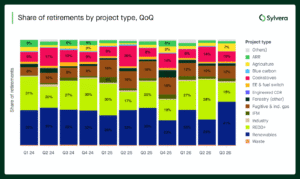
These transaction prices are much higher than in the broader VCM. In Q3 2026, the average retired credit price was $6.92/t. This shows how much more buyers will pay for high-quality agricultural removals. The volume of retired credits also increased for the quarter, per Sylvera’s report.

credit retirements by project type q3 2026
Source: Sylvera

A New Test for Europe’s Soil Carbon Market

The first Gold Standard soil issuance does not mean soil carbon has become a mature market. It does, however, remove one important barrier:

  • A large European agricultural project has now demonstrated that soil carbon can be certified and issued under Gold Standard’s dedicated framework.

The next challenge is scale. The program must expand beyond its initial 6,000 hectares while maintaining reliable measurement and verification. More projects will also need to show that soil carbon gains are real, additional and durable.

Europe’s policy environment is moving in the same direction. The EU aims to achieve healthy soils by 2050, while its carbon-farming rules are creating new certification pathways for agricultural carbon projects.

If more farmers can combine regenerative practices with credible carbon revenue, soil could become an increasingly important part of Europe’s carbon-removal market.

The first Gold Standard issuance is therefore more than a project milestone. It is an early test of whether carbon finance can help turn healthier European farmland into a measurable climate asset.

The post Europe’s Soil Carbon Market Gets a First: Gold Standard Credits Issued in France and Belgium appeared first on Carbon Credits.
Pentagon Bets on Space Solar Power as Solar Market Hits Record Growth

Pentagon Bets on Space Solar Power as Solar Market Hits Record Growth

The U.S. Department of War is putting new money behind a technology that could change how solar power reaches the ground: beaming electricity from space. Virginia-based startup Overview Energy received a contract through the Department of War’s Operational Energy Capability Improvement Fund (OECIF). The company will design, build, and test a ground-based homing beacon for its planned space solar system.

The contract value was not disclosed.

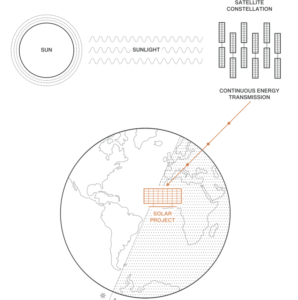
The beacon is a key part of Overview’s plan. It would allow satellites to identify and authenticate receiving sites on Earth before sending power to them. The company says its satellites will collect sunlight in orbit and convert it into a safe, invisible beam of near-infrared light. It plans to test the system in space in 2028, with its first geosynchronous-orbit satellites targeted for deployment from 2030. 

The Pentagon Wants Solar Power Without Fuel Convoys

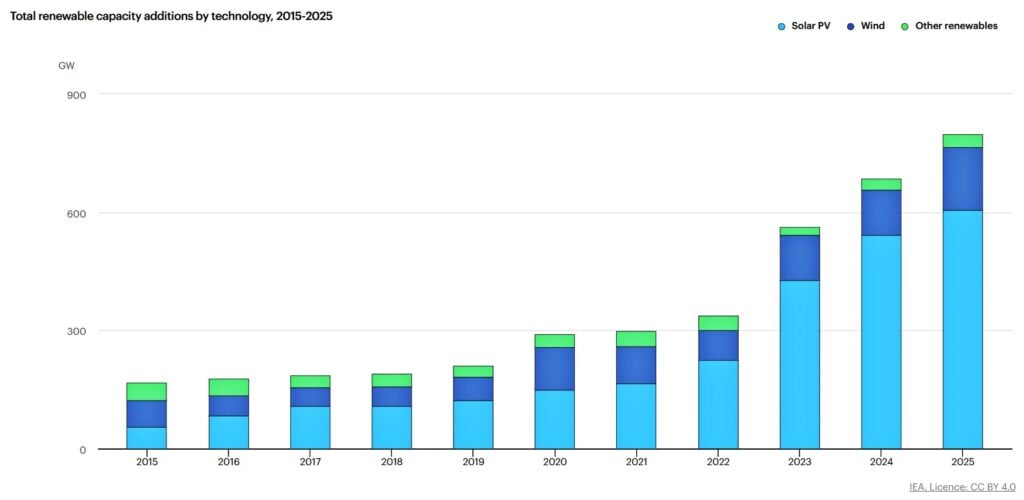
The project comes as solar power is already expanding at record speed on Earth. The International Energy Agency (IEA) says solar PV additions topped 600 GW in 2025, while total renewable capacity additions reached 800 GW.

Now, U.S. energy and defense agencies are exploring whether some of that growth can move beyond the planet. 

Remote military bases can depend on fuel deliveries to keep generators running. Those supply lines can be expensive, difficult to protect, and vulnerable in conflict zones. Space-based solar power could offer another option.

Overview says its system could send power to remote or contested locations without regular fuel shipments. Satellites could also shift power between receiving sites as demand changes. That makes the technology especially interesting for military operations where reliable energy is difficult to provide.

The OECIF program is designed to support advanced technologies before they reach commercial use. The program works with military users to test new energy systems under real operational requirements.

Overview Energy is not starting from scratch. In May, the Air Force awarded the company a separate contract to study how space-based solar power could support military operations in constrained and contested logistics environments.

The latest contract focuses on a smaller but critical piece of the system: making sure the power beam reaches the right place.

A Beacon Will Tell Satellites Where to Send Power

The homing beacon would be installed at a receiving site on the ground. A satellite would use the beacon to locate the site and establish a secure connection before sending power. The system requires an active and authenticated beacon before transmission begins, according to Overview.

Overview Energy space-based solar
Source: Overview Energy

That security feature is important because a power beam cannot simply be pointed toward a general area. The satellite needs to know exactly where the receiver is and confirm that it is an authorized destination.

Overview plans to use near-infrared light to transmit the energy. The company says this approach would allow its satellites to deliver power to existing and future utility-scale solar infrastructure.

The system is designed around satellites in geosynchronous orbit (GEO). At that altitude, a satellite can remain aligned with the same area of Earth as the planet rotates.

Overview says this could allow its satellites to collect sunlight continuously rather than only when solar panels on the ground are exposed to sunlight. The company has already demonstrated power beaming from a moving airborne platform, testing the tracking and pointing technology that will be needed for its orbital system.

Overview Targets a 2028 Space Demonstration

The next major milestone is the company’s planned 2028 space demonstration. Overview plans to integrate the Pentagon-funded beacon into its first satellite. The company then expects to use the ground hardware as part of a larger GEO constellation targeted for deployment beginning in 2030.

These are company targets, not confirmed commercial launch dates. The 2028 test will matter because the full space-to-ground system has not yet been proven in orbit.

Several questions remain, however. The system must show that it can maintain a precise connection over the long distance between orbit and Earth. It must also demonstrate acceptable conversion and transmission efficiency while meeting safety requirements.

Launch costs are another major issue. Space-based solar systems require large structures and power-generation equipment to be placed in orbit. The economics will depend heavily on how cheaply those systems can be manufactured, launched, and maintained.

Overview has also attracted commercial interest. In April 2026, the company reached an agreement with Meta that gives the company early access to up to 1 GW of planned capacity. Overview expects commercial power delivery around 2030, although that timeline remains a company goal.

The US Is Funding Multiple Space Solar Approaches

Overview is part of a wider U.S. push into space-based energy. Another company, Katalyst Space, received an OECIF award in September to develop and launch robotic spacecraft that could assemble a large power-beaming system in orbit and transmit electricity back to Earth.

Its approach is different. Katalyst plans to use microwaves, while Overview is developing near-infrared transmission.

The Air Force Research Laboratory has also spent years studying space solar power. Its Space Solar Power Incremental Demonstrations and Research Project, or SSPIDR, is examining how satellites could collect sunlight, convert it to radio-frequency energy, and transmit it to ground-based receiving antennas.

The Arachne flight experiment is a major part of that work. It is designed to test solar power generation, beamforming, and wireless power transmission.

DARPA is separately developing technologies for airborne optical power transmission that could create more flexible wireless energy networks.

Together, these programs show that space-based power is moving beyond a purely theoretical idea. Yet, the technology remains at the demonstration stage.

Space Solar Is Arriving as Earth Solar Hits Records

The interest comes at a time when solar power is already dominating new renewable energy growth. The IEA says global renewable capacity additions reached 800 GW in 2025, up 16% from the previous year. It was the 23rd consecutive year of record renewable expansion.

Total renewable capacity additions by technology, 2015-2025
Source: IEA

Solar PV made up more than three-quarters of those additions. More than 600 GW of solar capacity was added globally, taking total installed solar PV capacity to about 2,800 GW.

China remains the biggest driver. It added nearly 500 GW of renewable capacity in 2025, including about 370 GW of solar and 117 GW of wind.                                                                                

The IEA expects renewable power capacity to grow by another 4,600 GW between 2025 and 2030, with solar PV accounting for nearly 80% of that increase. But conventional solar still faces limits.

Solar panels on Earth do not generate power at night, and their output can drop because of clouds, weather, and seasonal changes. Grid bottlenecks are also becoming a bigger problem as more renewable projects seek connections.

The IEA has identified more than 2,500 GW of renewable, storage, and large-load projects waiting in grid queues worldwide. Space solar is being developed partly as a way to overcome some of those limits.

Pentagon Bets on Space Solar Power

From Climate Technology to Energy Security

Space solar power is not yet a proven low-cost alternative to conventional solar. For now, its strongest case may be energy security.

The Pentagon is interested in whether space-based power can provide electricity to locations where fuel deliveries are difficult or dangerous. At the same time, commercial companies see potential for supplying electricity to grids without building an entirely new ground-based power network.

That dual-use potential is helping attract government funding.

The climate benefits could become important if space solar eventually replaces fossil-fuel generation or reduces the need for diesel generators at remote facilities. But that outcome remains unproven.

For now, the key milestone is much simpler: can a satellite safely and efficiently send usable power to Earth? Overview’s 2028 demonstration should provide the first major answer.

If it works, space solar could move from a long-running science project toward a real energy technology. If it fails, the industry will gain valuable data on what still needs to change. Either way, the Pentagon’s latest investment shows that the race to expand solar power is no longer limited to the ground.

The post Pentagon Bets on Space Solar Power as Solar Market Hits Record Growth appeared first on Carbon Credits.
Rio Tinto Pushes Steel Decarbonization with Carbon Capture Trial in China

Rio Tinto and Chinese steelmaker Shougang Group have commissioned an industrial-scale carbon capture trial facility designed to capture carbon dioxide directly from blast furnace gas at Shougang’s Jingtang steelmaking base in China.

The facility can process up to 3,000 cubic metres of blast furnace gas per hour and is designed to capture as much as 10,000 tonnes of CO₂ annually.

The project targets one of the hardest parts of steelmaking to decarbonize: existing blast furnace operations. Rather than replacing the blast furnace with a different production route, the technology captures CO₂ from gas generated during ironmaking and could potentially allow existing assets to continue operating with lower emissions.

The facility is part of a broader technology partnership between Rio Tinto and Shougang that began with a 2022 memorandum of understanding. The companies are working on low-carbon sintering, blast furnace and basic oxygen furnace optimization, and carbon capture and utilization technologies.

Steelmaking Remains a Major Source of Global Emissions

The project comes as the steel industry faces growing pressure to reduce its carbon footprint.

  • Steelmaking accounts for about 7% to 9% of global CO₂-equivalent emissions, according to a 2025 review published in Nature Reviews Clean Technology.

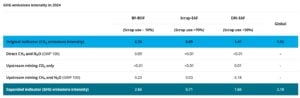
Around 70% of global steel production still uses the blast furnace-basic oxygen furnace (BF-BOF) route, which has an emissions intensity of about 2.32 tonnes of CO₂e per tonne of steel.

steel emissions
Source: World Steel

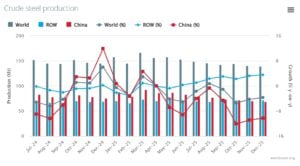
Global crude steel production reached about 1.85 billion tonnes in 2025. China remained by far the world’s largest producer, producing 960.8 million tonnes, or more than half of global output.

china steel making steel production
Source: World Steel Association

China’s steel industry is particularly important to global decarbonization efforts. Research published in 2026 estimates that China’s iron and steel sector accounts for roughly 15% of the country’s CO₂ emissions and more than 30% of its industrial emissions.

China’s total energy-related CO₂ emissions declined by around 0.5% in 2025, according to the International Energy Agency (IEA), with lower steel and cement production contributing to the decline. However, the scale of China’s steel industry means even incremental changes in emissions intensity can have a significant impact globally.

Shougang’s Steel Footprint

Shougang Group produced 30.23 million tonnes of crude steel in 2025, ranking it 12th among the world’s largest steelmakers, according to World Steel Association data. The company’s production declined from 31.57 million tonnes in 2024.

The company does not appear to publicly disclose a single consolidated current CO₂ footprint for the entire group that can be directly attributed to its 2025 steel production. However, the company has expanded its carbon accounting and product-level carbon footprint systems.

Shougang says Beijing Shougang and Shougang Jingtang have completed organization-level carbon emissions accounting and carbon footprint assessments for customer products. Both operations have also received carbon certification from SGS.

At Jingtang, the company has already been pursuing several measures to lower emissions from conventional steelmaking. Its blast furnace process has increased the share of pellet ore to more than 55%, which Shougang says has reduced CO₂ emissions by more than 167 kilograms per tonne of iron compared with the previous process.

Jingtang has also demonstrated steelmaking using more than 50% scrap in automotive steel production. Higher scrap use can reduce the need for carbon-intensive primary ironmaking.

Rio Tinto and Shougang Scale Up Carbon Capture

The new carbon capture facility follows a smaller-scale blast furnace carbon capture unit commissioned in 2024.

The companies are now testing the technology at a larger industrial scale and plan to operate the facility over the longer term for research and technology development.

Using waste heat from existing steelmaking operations could help reduce the energy requirements and costs associated with carbon capture. If costs can be lowered sufficiently, the approach could eventually be applied to other existing blast furnace facilities.

Rio Tinto Iron Ore Sales and Marketing Vice President Ramona Sim said:

“This milestone is an important step in our 30-year relationship with Shougang and our work together to find practical ways to reduce emissions from steelmaking.

“Steelmakers are exploring a range of technologies to lower emissions from existing blast furnace operations, and carbon capture and utilisation could play a key role as these technologies continue to develop.

“We’re committed to working with our customers to find better ways to use Pilbara ores in a lower-carbon future.”

A Partnership that Dates Back to 1996

The partnership between the two companies dates back to 1996, when Shougang received its first shipment of Rio Tinto iron ore from Australia’s Pilbara region. Three decades later, the relationship is increasingly focused on how that iron ore can be used in a lower-carbon steel industry.

Shougang Group Vice President Zhu Guosen said:

“Through this collaboration with Rio Tinto on carbon capture technology, Shougang has successfully developed and commissioned a 10,000-tonne-scale industrial trial facility.

“This achievement represents an important milestone for blast furnace decarbonisation and provides valuable demonstration value for reducing emissions in the conventional steelmaking route.

“The project has effectively addressed key challenges associated with carbon reduction in the blast furnace process and serves as an important example of our commitment to China’s dual-carbon goals and the advancement of low-carbon, green development.

“Looking ahead, we will continue to optimise the technology, advance the utilisation of captured carbon resources, and contribute to the green and low-carbon transformation of the steel industry.”

Captured CO₂ Could Be Reused in Steelmaking

The project is focused not only on capturing CO₂ but also on finding ways to use the captured carbon.

Rio Tinto and Shougang are exploring the conversion of captured CO₂ into syngas that could be recycled into the steelmaking process. Such an approach could reduce the amount of new carbon-based inputs required by steelmakers while creating a circular carbon pathway inside the plant.

That could become increasingly important as steelmakers look for ways to decarbonize existing BF-BOF assets without waiting for complete replacement with hydrogen-based direct reduced iron or electric arc furnace technologies.

The Broader Carbon Capture Market

Carbon capture is also becoming a larger commercial market.

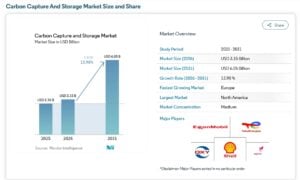
  • According to Mordor Intelligence, the CCS market size is expected to grow from USD 2.76 billion in 2025 to USD 3.15 billion in 2026 and is forecast to reach USD 6.05 billion by 2031 at 13.98% CAGR over 2026-2031.

carbon capture

Other market estimates vary significantly depending on whether they include transportation, utilization, and storage infrastructure.

The growth reflects rising demand for industrial carbon management, particularly in sectors such as steel, cement, chemicals and refining where process emissions can be difficult to eliminate through electrification alone.

Carbon Capture Targets Existing Steel Assets

The Rio Tinto-Shougang project highlights a broader debate over how quickly the global steel industry can move away from conventional blast furnace technology.

Hydrogen-based direct reduced iron and electric arc furnaces offer a potential pathway to much lower-emission steel, but replacing the world’s existing blast furnace fleet would require significant investment, new infrastructure and large amounts of low-carbon electricity or hydrogen.

Carbon capture offers another route by targeting emissions from facilities that are already operating.

The challenge will be cost. Capturing 10,000 tonnes of CO₂ annually at Jingtang is small compared with the emissions generated by a large integrated steel mill. But the trial could provide data on capture efficiency, energy use, operating costs, and the potential value of using captured CO₂.

For Rio Tinto, the project also extends its role beyond supplying iron ore into technologies that could lower emissions further down the steel value chain.

The post Rio Tinto Pushes Steel Decarbonization with Carbon Capture Trial in China appeared first on Carbon Credits.
Xpansiv Secures Major Growth Investment From Verdane to Expand Global Environmental Markets

Xpansiv Secures Major Growth Investment From Verdane to Expand Global Environmental Markets

Xpansiv has gained a significant investment from Verdane, a European firm. This funding will help the environmental markets infrastructure company expand by making acquisitions, developing new products, and growing internationally. The companies announced the strategic partnership on September 22, 2026. They did not disclose the size of the capital raise.

Xpansiv plans to use the new investment to strengthen its position across carbon credits, renewable energy certificates (RECs), clean fuels, and other environmental commodities. The company also wants to expand into new asset classes and geographic markets.

The deal comes as environmental markets become more complex. Companies are facing wider climate reporting rules, rising carbon prices, and stronger demand for clean energy certificates. For Xpansiv, that creates an opportunity to build the digital infrastructure behind these markets.

Xpansiv Is Building the Rails for Environmental Markets

Xpansiv operates a mix of registries, marketplaces, trading services, data products, and portfolio-management systems. Its platform connects companies, utilities, and traders to carbon credits, RECs, clean fuels, and other environmental products. Verdane says Xpansiv processes about 1 billion transactions each year.

Its registry network now supports more than 320 gigawatts (GW) of renewable generation capacity across more than 60 countries. That represents about 4% of global electricity generation and 7% of renewable energy generation.

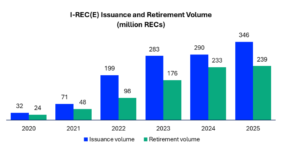
Xpansiv also says about 28% of RECs issued globally in 2025 were managed through its registry network. The scale is important because environmental markets depend on more than buyers and sellers.

They also need systems to register assets, issue certificates, verify ownership, track transfers, and record retirement. Xpansiv is trying to bring many of those functions onto one platform.

Xpansiv REC issuances and retirements volume
Source: Xpansiv 

Acquisitions Drive Xpansiv’s Expansion Strategy

Verdane’s investment will support Xpansiv’s merger and acquisition strategy, which has already become a major part of its growth model. Over the last four years, Xpansiv acquired:

  • APX, a provider of energy and environmental registry infrastructure;
  • Evolution Markets, a market execution and brokerage business; and
  • Evident, which operates the I-REC(E) renewable energy registry.

The strategy is continuing. In September 2026, Xpansiv agreed to acquire Formbay. This Australian platform makes and validates renewable energy certificates for rooftop solar and battery projects.

Formbay supports about 25% of Australia’s Small-scale Technology Certificate market. It creates nearly 100,000 certificates daily and helped with over A$1 billion in transactions in 2025. It also supports about 30,000 retailers and installers and is involved in one in three Australian home solar installations.

The Formbay deal is expected to be Xpansiv’s 13th acquisition since 2017. It remains subject to regulatory approval.

The new Verdane capital could give Xpansiv more room to continue making similar investments.

Carbon Is Just One Piece of the Environmental Markets Puzzle

Xpansiv’s growth strategy extends beyond carbon credits. The CBL exchange trades carbon credits, RECs, and other environmental commodities. Xpansiv Connect links various registries and marketplaces for easy portfolio management.
That broader approach could become increasingly important as companies manage several types of environmental assets at once. For example, a company may need carbon credits for climate targets, renewable energy certificates for electricity claims, and clean fuel credits for transport emissions.

Xpansiv is building infrastructure that can manage these products together. The company also provides market data and execution services through Evolution Markets, giving it a role beyond simply recording transactions.

That could help Xpansiv benefit from the wider growth of environmental markets rather than relying on one asset class.

Carbon Markets Are Attracting More Capital

The timing of the investment is notable because capital flowing into carbon projects and future carbon supply has risen sharply. MSCI estimates that capital in the global carbon credit market hit $22 billion in 2025. This is a 72% increase from 2024 and over five times the amount from 2021.

Offtake agreements, where buyers commit to future carbon credit supply, reached $12.3 billion in 2025, nearly three times the previous year’s level.

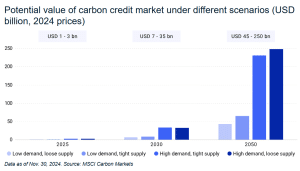
Yet, the market remains small compared with long-term climate needs. MSCI estimates the primary global carbon credit market could grow from about $1.4 billion in 2025 to $5–20 billion by 2030 and $60–270 billion by 2050.

carbon credit market value 2050 MSCI

That potential growth creates demand for better market infrastructure. As transaction volumes grow, buyers require reliable data. Regulators and companies also need clear records of credit origins and usage.

RECs Add Another Fast-Growing Market

The opportunity extends into renewable energy markets. Xpansiv’s registry network supports over 320 GW of renewable energy. In July 2026, its I-REC registry hit a big milestone by recording its one billionth I-REC redemption.

The I-REC market has expanded tenfold since 2020. Now, over 80,000 organizations in more than 140 countries use I-RECs for buying renewable energy and supporting sustainability programs.

Xpansiv’s North American REC business is also expanding. The company said more than 3 million RECs were traded on its CBL exchange in 2024, up 18% year over year. In January 2025 alone, REC transaction value exceeded $27 million, a monthly record for the exchange.

Corporate clean energy targets, renewable portfolio standards, and rising demand for data centers are driving these markets. Electrification is also a key factor.

AI Could Help Scale Environmental Markets

Technology is another major part of the investment story. Xpansiv says its AI-enabled systems are being used to improve verification, auditability, and workflow management.

Formbay adds another example. Its platform uses AI to validate solar and battery installations and automate certificate creation. These tools can become more valuable as environmental markets grow.

Manual checks become harder when millions of certificates and transactions are involved. Automated data checks can reduce administrative work and help identify errors faster.

That does not remove the need for independent verification or market rules. Instead, digital systems can make those processes easier to manage at scale. For carbon markets, this could be especially useful as companies face growing demands for evidence behind climate claims.

Verdane Brings Climate and Technology Experience

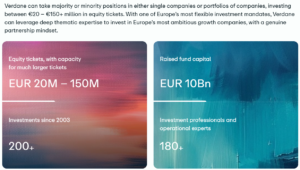
Verdane is a European growth investment firm focused on technology-enabled and sustainable companies. The firm says it has raised €10 billion in capital and made more than 200 investments since 2003. Its team includes more than 180 investment and operating professionals across Europe.

Verdane portfolio
Source: Verdane

Its investment in Xpansiv fits a broader strategy around companies involved in digitalization and decarbonization.

Verdane said Xpansiv’s market infrastructure could become more important as environmental reporting and compliance requirements widen. The investment also gives Verdane exposure to several markets at the same time, including carbon, renewable energy, and clean fuels.

For Xpansiv, this partnership means more capital and a growth investor. This investor knows how to scale tech platforms in Europe.

A Bigger Bet on Environmental Market Infrastructure

The new investment is important not because of its undisclosed size, but because of what Xpansiv plans to do with it. The company wants to keep buying businesses, enter new markets, and expand its technology platform. That strategy comes as environmental markets become more connected.

Carbon markets are expanding. Renewable energy certificates are becoming more widely used. Clean fuel and methane markets are developing. At the same time, governments are increasing reporting and compliance requirements.

All of these markets need trusted systems for registration, verification, trading, settlement, and data. Xpansiv is betting that one integrated platform can serve more of those needs. The latest Verdane investment provides more capital to continue that expansion.

As the market grows from a relatively small voluntary sector into a broader system linked to corporate reporting, renewable power, and climate regulation, the companies providing the digital rails could become as important as the developers creating the underlying carbon and clean energy assets.

The post Xpansiv Secures Major Growth Investment From Verdane to Expand Global Environmental Markets appeared first on Carbon Credits.