Amazon’s $2.8 Billion Clean Energy Push in Australia: Why Battery Storage Matters

Amazon (AMZN stock) is expanding its clean-energy strategy in Australia with a move that could become increasingly important as renewable power takes a larger role in the country’s electricity system. It has signed its first standalone battery storage agreement globally for the 50-megawatt Bairnsdale battery energy storage system (BESS) in Victoria. It is also the first standalone battery agreement signed by a non-energy company in Australia.

The project marks a shift in how Amazon approaches renewable energy. Rather than focusing only on adding wind and solar generation, the company is investing in infrastructure that can help manage when electricity is produced and when it is needed.

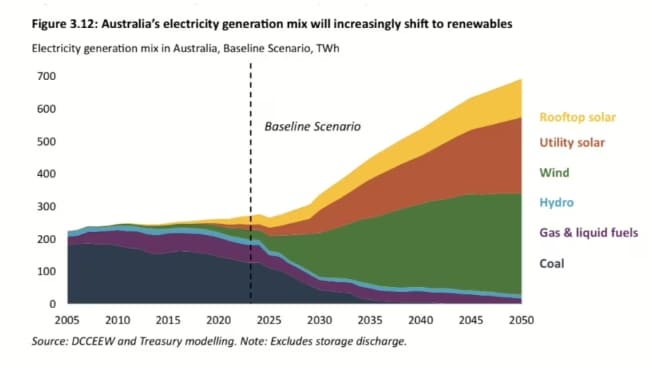
That distinction matters because Australia’s renewable energy system is producing more electricity at certain times than the grid can immediately use.

Australia clean energy
Chart from The Energy.com

Why Amazon Is Investing in Battery Storage

The Bairnsdale battery is not directly connected to a solar or wind farm. Instead, it connects to the national electricity grid. This allows the battery to operate independently of a specific renewable project. When electricity supply is high and demand is relatively low, the system can store power. Later, when demand increases, it can send electricity back into the grid.

The timing is particularly important for solar power. Solar farms can produce large amounts of electricity around midday, when sunlight is strongest. However, electricity demand often rises later in the day as households return home, businesses remain active and solar generation begins to decline.

Battery storage helps bridge this gap.

Instead of curtailing surplus renewable electricity, the grid can store some of it and use it during periods of higher demand. In turn, this can reduce pressure on the electricity system, improve grid flexibility and make renewable generation more valuable.

  • Australia produced an estimated 7.2 terawatt-hours of surplus wind and solar electricity in 2025. Much of this electricity was generated at times when the grid did not need all of the available supply.

Consequently, batteries are becoming a critical part of Australia’s energy transition.

Amazon’s Growing Energy Portfolio in Australia

Bairnsdale is only one part of Amazon’s expanding energy investments in Australia. The company has invested in seven battery projects in Victoria and 10 battery projects across Australia. Once completed, the projects are expected to provide a combined 368 MW of battery capacity.

At the same time, the retail giant continues to develop a broader portfolio of renewable energy projects.

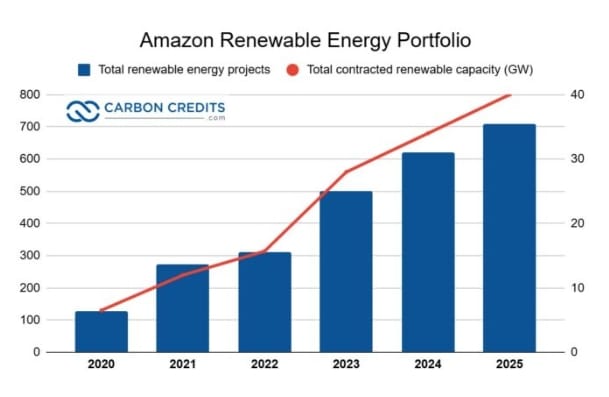
  • Since 2020, the company estimates that it has invested about A$2.8 billion in carbon-free energy projects across Australia. Its portfolio includes solar, wind and battery storage.
  • It expects its 20 Australian carbon-free energy projects to eventually provide almost 1 GW of new renewable capacity. The company estimates the electricity generated will be equivalent to the annual consumption of more than half a million Australian households.

The scale of this investment highlights an important change in corporate renewable energy procurement. Large companies are no longer simply looking for enough renewable electricity to match their consumption. Increasingly, they are looking at how their investments can support the wider electricity system.

Carbon Footprint Adds to this Context

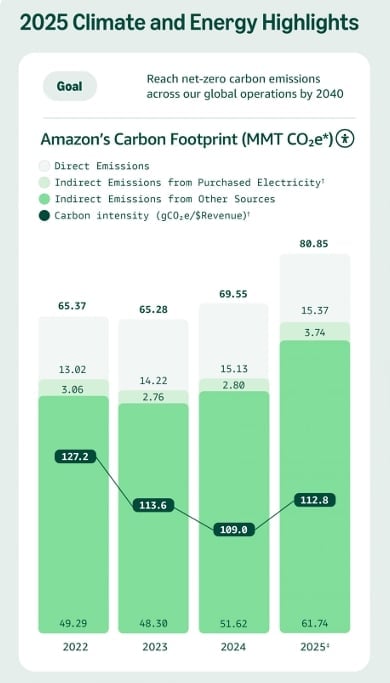
Amazon’s renewable energy investments also need to be viewed against the scale of its overall carbon footprint.

The company’s emissions come from a broad global operation that includes data centers, transportation, warehouses, buildings, purchased electricity, and its supply chain. As its logistics network and cloud computing business continue to expand, reducing emissions across these activities remains a significant challenge.

Amazon has committed to reaching net-zero carbon emissions across its operations by 2040 through The Climate Pledge. The company says its approach starts with reducing emissions across its operations and supply chain. It also plans to address remaining emissions through measures such as carbon removal, nature-based solutions and other forms of carbon neutralization.

emissions Amazon
Source: Amazon

Closing the Emission Gap 

Renewable energy is therefore only one part of the strategy. Battery storage is becoming relevant because it can help Amazon address electricity-related emissions while also supporting a more flexible grid.

Amazon reached its goal of matching 100% of the electricity consumed by its global operations with renewable energy in 2025, five years earlier than its original 2030 target. However, matching electricity consumption with renewable energy does not eliminate all of the company’s emissions.

“According to BloombergNEF, Amazon was the largest corporate purchaser of carbon-free energy in Australia in 2025.”

Its wider carbon footprint means Amazon still needs to reduce emissions from transportation, buildings, manufacturing, suppliers and other parts of its value chain.

Data Center Demand Makes Grid Investment More Important

The battery investment comes as electricity demand is expected to rise. Amazon Web Services operates data centers in Australia, while demand for cloud computing and artificial intelligence continues to grow globally. Data centers require large and reliable supplies of electricity, making access to clean and dependable power increasingly important.

This creates a complicated challenge.

Adding more solar and wind capacity can reduce the carbon intensity of electricity, but these resources do not produce power continuously. At the same time, data centers require electricity around the clock. Battery storage can help manage short-term fluctuations by shifting electricity from periods of abundant supply to periods of stronger demand.

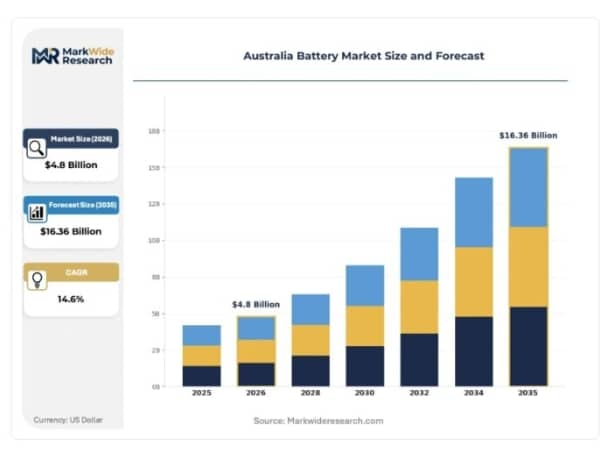
  • Thus, industry forecasts predict the Australian battery market will grow from $4.8 billion in 2026 to $16.36 billion by 2035, with a CAGR of 14.6%.

Australia battery market

For Amazon, this creates a potential double benefit. The company can increase its access to carbon-free electricity while supporting infrastructure that makes the broader grid more capable of absorbing renewable generation.

A Bigger Global Energy Strategy

Amazon’s global clean-energy portfolio has grown rapidly. As of January 2026, the company had supported more than 712 carbon-free energy projects across 30 countries. Together, the projects represented about 42 GW of carbon-free energy capacity.

The portfolio includes wind, solar, hydroelectric, geothermal, nuclear power and battery storage.

Amazon says these investments are designed not only to support its own operations but also to bring new energy capacity to the grids where its employees, customers and communities operate.

For investors, the broader trend is worth watching.

The next stage of the energy transition will require more than building wind and solar farms. It will also require batteries, transmission infrastructure, grid connections and other technologies capable of balancing supply and demand.

And the Bairnsdale agreement clearly illustrates this shift.

Extending to Europe

The approach to clean energy also extends well beyond Australia. In Germany, the company has signed an agreement to purchase 600 MW of carbon-free electricity from the Gennaker offshore wind farm in the Baltic Sea. The long-term power purchase agreement gives developer Skyborn Renewables greater certainty over future revenues.

For large renewable projects, such commitments can help developers secure financing and move from planning to construction.

Gennaker is expected to generate enough electricity to power the equivalent of more than one million German households annually once operational.

Amazon has also signed four new power purchase agreements in Sweden. The deals bring its carbon-free energy capacity in the country to nearly 1 GW and increase its portfolio to nine utility-scale wind projects.

These agreements show how corporate buyers can influence renewable energy development beyond their own electricity consumption.

The company is moving from simply purchasing renewable electricity toward investing in the infrastructure needed to make carbon-free power more reliable and useful. As electricity demand from data centers, artificial intelligence and broader electrification grows, that flexibility could become increasingly valuable.

Ultimately, Amazon’s battery investment is not just a clean-energy procurement decision. It reflects a wider shift in the corporate energy market, where companies are increasingly looking beyond renewable generation and toward the infrastructure required to build a more reliable, flexible and lower-carbon electricity system.

The post Amazon’s $2.8 Billion Clean Energy Push in Australia: Why Battery Storage Matters appeared first on Carbon Credits.

Google, Fervo (FRVO Stock) Sign Record Geothermal Deal to Power AI

Google, Fervo (FRVO Stock) Sign Record Geothermal Deal to Power AI

Google is turning to next-generation geothermal power as it expands its artificial intelligence infrastructure. The tech giant and geothermal developer Fervo Energy have signed a 396-megawatt (MW) power purchase agreement (PPA) for Fervo’s Cape Station project in Utah. The deal has a 15-year term and marks the largest enhanced geothermal power purchase agreement to date, according to Fervo.

Power delivery will start in the third quarter of 2028 through four 99 MW blocks. Google also has an option for about 600 MW of additional capacity, which could bring total contracted capacity to roughly 950 MW by June 2030.

The deal comes as AI data centers drive electricity demand higher. It also shows why companies are looking for clean power that can operate around the clock, rather than relying only on variable sources such as solar and wind. Lucia Tian, at Google, remarked:

“The next chapter of advanced power generation technology is being written in Utah. This project will drive meaningful economic benefit to the local community and help catalyze long-term energy cost reductions by making enhanced geothermal more affordable and accessible.”

Google Locks In 396 MW of Next-Gen Geothermal

The agreement covers 396 MW from Fervo’s Cape Station enhanced geothermal system in Beaver County, Utah. Fervo will provide power through four 99-MW blocks, with deliveries starting in Q3 2028. The agreement will run for 15 years.

CEO and Co-Founder of Fervo, Tim Latimer, noted:

“As demand for reliable electricity grows, customers like Google need energy resources that can be deployed at scale, operate around the clock, and deliver where power is needed. This new PPA is part of our repeatable commercial model that enables us to meet customer needs and directly deliver clean, firm power to large electricity users.”

Google has not finalized the location of the Utah data center that could use the power. The company says the geothermal supply would support a potential Utah data center presence, subject to engineering, regulatory, and commercial approvals.

The deal therefore secures power before Google has announced a final data center site.

The tech giant can also choose to buy about 600 MW of additional Cape Station capacity. If it exercises the option and the companies reach final terms, total contracted capacity could reach about 950 MW, with the added capacity guaranteed to operate by June 2030.

The financial terms were not disclosed.

AI Is Creating Demand for Firm Clean Power

The deal comes as data centers become a much larger source of electricity demand. The International Energy Agency expects global data center electricity use to rise from about 415 TWh in 2024 to around 945 TWh by 2030. AI is the main driver of the increase.

Google is already moving quickly to secure more clean energy. The company says it signed contracts for more than 12 GW of new clean energy in 2025, its largest annual total. It also aims to run its data centers and offices on 24/7 carbon-free energy by 2030.

Google carbon-free energy goal 2030
Source: Google

That goal is harder than simply matching yearly electricity use with renewable energy purchases. A data center needs power at night and during periods when solar or wind output is low.

Geothermal can help fill that gap because it can generate electricity continuously.

Fervo’s Enhanced Geothermal Could Unlock New Resources

Traditional geothermal power depends on natural underground conditions. That limits where developers can build projects. Fervo uses enhanced geothermal systems (EGS) to reach heat in hot rock that lacks the natural conditions needed for conventional geothermal plants.

The company uses drilling techniques adapted from the oil and gas industry to create engineered geothermal reservoirs. The approach could allow geothermal development in more places.

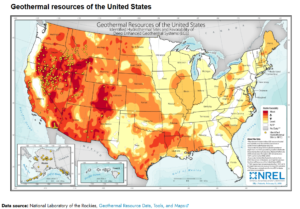
The U.S. Energy Information Administration says geothermal plants generated about 16 billion kWh of electricity in 2025, equal to roughly 0.4% of U.S. utility-scale generation. That small share shows how much room geothermal has to grow. If EGS can lower costs and work in more locations, it could become a larger source of firm clean power.

geothermal resources in USA.jpg
Source: US EIA

For AI companies, that could be especially valuable because data centers need reliable electricity around the clock.

Cape Station Is Built to Scale

The Google deal helps move Cape Station from an early project into a much larger commercial development. Fervo’s first phase is about 100 MW.

The company expects its first GeoBlock to begin producing test power in Q4 2026, with full production expected by the end of the year. Its second phase represents about 400 MW and is expected to come online in 2028.

Fervo expects Phase II to reach an installed cost of about $5,500 per kilowatt. Its long-term goal is to reduce that cost to $3,000 per kilowatt.

Lower costs will be critical if enhanced geothermal is to compete with other large-scale clean energy technologies. Fervo says it is using a repeatable GeoBlock design to make future projects easier and cheaper to build.

The company also reported a commercial development pipeline of more than 50 GW at the end of June 2026. It went public last May 2026 on Nasdaq under the FRVO stock ticker. 

Google and Fervo Take Their Partnership to the Next Level

The new agreement builds on a partnership that started in 2021. Google and Fervo developed an enhanced geothermal project in Nevada known as Project Red. Fervo began producing power from the pilot in 2023, supplying electricity to the local grid, including the system serving Google’s Nevada data centers.

In June 2024, Google, Fervo and NV Energy signed a separate 115 MW agreement in Nevada. That deal supported NV Energy’s Clean Transition Tariff, which lets Google help fund new geothermal power while limiting the cost impact on other utility customers.

The Utah agreement now moves the relationship to a much larger commercial scale. It also shows how large technology companies can help emerging clean-energy technologies reach the market by committing to long-term power purchases.

Geothermal Could Fill the Gaps Left by Solar and Wind

The value of geothermal goes beyond supplying one data center. Unlike solar and wind, geothermal plants can operate regardless of weather and time of day. That makes them useful as a steady power source alongside variable renewables.

Google’s clean energy strategy includes solar, wind, hydro, nuclear and geothermal. The company says a mix of clean energy technologies can help supply power when variable renewable sources are not producing enough electricity.

Fervo’s systems could therefore complement growing solar and wind capacity rather than replace it. This could become increasingly important as electricity demand rises from AI, electric vehicles and industrial electrification.

More firm clean power can also reduce the need for fossil-fuel generation during periods of high demand. For carbon markets, the benefit is indirect. The geothermal deal is not a carbon credit purchase. Still, replacing fossil-based electricity with new clean generation can lower the emissions intensity of the power system.

Fervo (FRVO) Stock Jumps on Google Deal

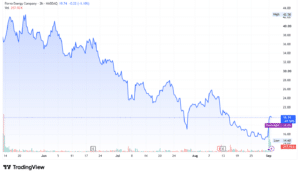
Investors reacted strongly to the announcement. Fervo shares jumped 28.41% to $19.75 on September 1, according to market data, with trading volume reaching about 35.1 million shares. The company went public on Nasdaq in May 2026. 

The rise came after Fervo announced the 396 MW Google agreement.

The market reaction shows how important long-term customer contracts are for an emerging power company. A major buyer such as Google can provide more visibility into future demand and help support financing for large projects.

However, FRVO stock remains highly volatile. Fervo’s projects still face construction, financing, permitting, and operating risks.

Fervo FRVO stock

AI Could Give Enhanced Geothermal Its Breakthrough Moment

The Google-Fervo agreement is a power purchase deal, not a carbon offset transaction. Google is paying for electricity from a new geothermal project. The company is not using the deal as a substitute for direct emissions cuts.

That distinction matters as companies face growing pressure to show that climate claims reflect real changes in energy use, especially AI.

The tech giant says it is working toward 24/7 carbon-free energy by 2030 and continues to invest in new clean generation. Fervo’s deal could help support that goal by adding firm power that can operate when solar and wind output is low.

The geothermal developer also has a major opportunity ahead. Its pipeline exceeds 50 GW, while its long-term cost target is $3,000 per kW.

The next challenge is execution. The company must build projects at scale, control costs, and show that enhanced geothermal can provide reliable power at competitive prices. The Google agreement gives it a major customer and a clearer path to growth.

The bigger story is that AI is creating demand not only for more electricity, but for new forms of reliable, low-carbon power. If Fervo can scale enhanced geothermal as planned, the technology could become an important part of the clean-energy system supporting the next generation of AI infrastructure.

The post Google, Fervo (FRVO Stock) Sign Record Geothermal Deal to Power AI appeared first on Carbon Credits.

Japan Opens New Carbon Credit Channel for India as JCM Enters Article 6 Market Era

Japan Opens New Carbon Credit Channel for India as JCM Enters Article 6 Market Era

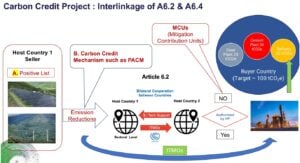
Japan and India are moving closer to a working carbon credit market after adopting rules for their Joint Crediting Mechanism (JCM) under Article 6.2 of the Paris Agreement.

The two countries adopted the Rules of Implementation (RoI) on June 8, 2026. The rules create the basic system for approving projects, checking emissions cuts, and issuing and transferring credits. Japan’s Environment Ministry said both sides are still working on some detailed procedures. 

The JCM could bring Japanese finance and low-carbon technology to Indian projects. In return, both countries can share the carbon credits created by those projects.

The move comes as India expands its clean energy sector and Japan builds a wider network of international carbon market partnerships.

Japan and India Turn Carbon Deal Into Action

Japan and India first signed their JCM cooperation agreement on August 7, 2025. The deal created a framework for Japanese and Indian entities to work together on projects that reduce greenhouse gas emissions. 

The 2026 implementation rules now give that framework a clearer structure. India’s Environment Ministry says the rules cover project approval, third-party validation and verification, sustainable development safeguards and national registries for issuing and transferring credits.

A Joint Committee made up of both governments will oversee the mechanism. This is an important step because Article 6.2 requires clear accounting when countries transfer emissions reductions across borders.

Carbon Credit generation article 6
Source: UNFCCC

For Indian developers, the JCM now offers a more defined route to international carbon finance.

India’s Green Projects Get a New Credit Route

The JCM can support projects across several parts of India’s energy and industrial sectors. India and Japan have highlighted areas such as compressed biogas, renewable hydrogen and ammonia, high-emission industries, and carbon capture and storage (CCS). 

Other clean energy and efficiency projects could also qualify if they meet the JCM’s rules. The JCM is not simply a market for existing Indian voluntary carbon credits.

Companies must develop eligible projects under the JCM system. Projects then go through approval, monitoring, validation, and verification before the two countries can issue and share credits. This process is designed to improve the quality and credibility of the resulting credits.

Article 6 Builds a Guardrail Against Double Counting

The JCM operates under Article 6.2, which lets countries transfer mitigation outcomes across borders. A key rule is that both countries cannot count the same emissions reduction toward their climate goals. The India-Japan rules cover these aspects:

  • Credit allocation,
  • Credit issuance, and
  • Corresponding adjustments.

They also require third-party checks of project results. A corresponding adjustment changes a country’s emissions accounting when it transfers a mitigation outcome. This helps prevent double counting.

For buyers and investors, these safeguards can provide more confidence that a credit represents a real and measurable emissions reduction. For India, the system can connect local climate projects with international carbon market demand.

Japan Brings the Capital and Clean-Tech Push

The JCM aims to do more than create carbon credits. Japan’s Foreign Ministry says the mechanism supports the spread of decarbonization technologies and infrastructure through investment by Japanese entities.

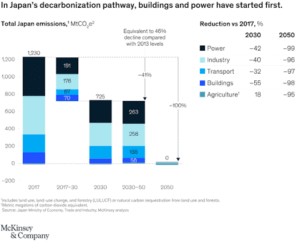
The resulting emissions reductions can then be measured and shared between Japan and its partner country. It will also be significant for the country’s decarbonization or net-zero pathway. 

Japan carbon neutrality 2050 McKinsey
Source: McKinsey & Company

This could help Indian projects gain access to Japanese technology, equipment and finance. Japanese companies, in turn, can support emissions cuts outside Japan while receiving a share of the resulting JCM credits.

The model therefore links investment, technology transfer, and carbon markets.

India’s Climate Goals Create Strong Demand

The JCM also fits India’s wider climate plans. The country‘s updated climate target calls for a 47% reduction below 2005 levels by 2035. It also aims to have about 60% of installed electricity capacity from non-fossil sources by 2035.

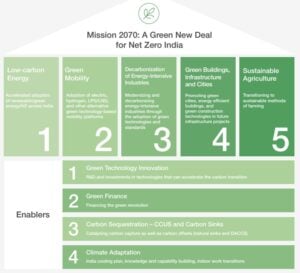
India separately targets net-zero emissions by 2070. It has already moved past its power-sector target.

Mission 2070 for India net zero goal
Source: SRIRAM’s IAS

The government said non-fossil sources accounted for 54.18% of installed electricity capacity as of June 30, 2026.  India also cut its emissions intensity by 37.38% in 2022 from the 2005 level.

The JCM could help fund further progress in clean energy and hard-to-abate industries.

Japan’s Carbon Network Keeps Expanding

India is part of a much larger Japanese carbon market strategy. As of April 2026, Japan had 32 JCM partner countries. The program had also selected more than 290 projects through its financing program.

India became Japan’s 31st JCM partner in 2025. Oman later became the 32nd partner in April 2026. 

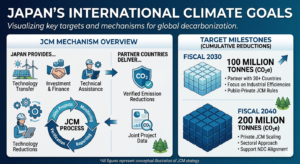
Japan has set an even larger long-term target. It aims to secure about 100 million tonnes of international greenhouse gas reductions or removals by fiscal 2030 and around 200 million tonnes by fiscal 2040 through public-private JCM cooperation. 

Japan climate goals carbon reductions

India could become an important source of projects within that network. The next major step will come in New Delhi.

  • Japan and India plan to hold the India Forum: Advancing International Carbon Markets for Climate Ambition, Sustainable Development and Shared Prosperity on September 28, 2026.

The event will focus on India’s international carbon markets and Article 6 implementation.

One session will focus on the India-Japan JCM under Article 6.2. The two governments plan to explain the new rules and encourage Indian and Japanese companies to develop projects. The timing is important because the basic JCM rules are now in place.

India’s Homegrown Carbon Market Adds Another Route

The JCM is also arriving as India develops its own domestic carbon market. The country has been building its Carbon Credit Trading Scheme (CCTS) to encourage companies to cut emissions and create a national carbon market.

The JCM and CCTS are separate systems. But they could give Indian companies different routes to finance emissions reduction projects.

Developers will need to understand which projects qualify for each market and how international transfers affect emissions accounting. This will become more important as India expands its links with global carbon markets.

The new system creates an opportunity, but it does not guarantee valuable credits. Projects must prove that they deliver real emissions reductions or removals. They must also meet the JCM’s rules for monitoring, reporting, validation, and verification.

The 2026 RoI includes third-party validation and verification and sustainable development safeguards. Strong project data will therefore be important from the start.

For buyers, the value of the JCM will depend on whether it can produce credits that meet Article 6 rules and maintain environmental integrity.

A New Carbon Bridge Between Japan and India

The India-Japan JCM has now moved beyond a basic cooperation agreement and into implementation. The adoption of the Rules of Implementation gives both countries the core procedures needed to operate their Article 6.2 carbon credit system.

For India, the mechanism could bring more Japanese investment and technology into renewable energy, clean fuels, industrial decarbonization and CCS. For Japan, it creates another source of international mitigation outcomes while supporting its wider JCM network.

The market is still at an early stage. Both countries are working on further details, and actual credit supply will depend on how quickly companies develop and verify projects.

The September 28 India JCM Forum could help turn the new rules into a stronger project pipeline. If India and Japan can build a steady flow of high-quality projects, the JCM could become an important Article 6 channel for bringing Japanese climate finance into India’s energy transition.

The post Japan Opens New Carbon Credit Channel for India as JCM Enters Article 6 Market Era appeared first on Carbon Credits.

Shein Goes Public at $26.5B, a 73% Drop in Valuation as Fashion Giant Faces a Net-Zero Test

Shein Goes Public at $26.5B, a 73% Drop in Valuation as Fashion Giant Faces a Net-Zero Test

Chinese fast fashion company Shein has finally debuted on the Hong Kong stock market, giving investors insight into one of the largest online fashion retailers. However, the fashion giant is facing slower growth, stricter trade rules, and a significant emissions footprint.

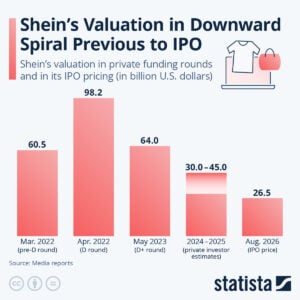
Shein began trading on September 1, 2026, under stock code 0625 on the Hong Kong Stock Exchange. The company priced its IPO at HK$48.56 per share, raising about HK$13.6 billion (US$1.7 billion) and valuing the business at roughly US$26.5 billion.

That valuation is far below Shein’s US$98.2 billion private valuation in 2022, a drop of about 73%.

The weaker valuation reflects slower growth and growing pressure on Shein’s business model. At the same time, the company faces another challenge: cutting emissions across a global supply chain that produces most of its carbon footprint.

Shein’s $98 Billion Valuation Comes Crashing Down

Shein’s public debut marks a major reset in how investors value the company.

Private investors valued Shein at US$98.2 billion in April 2022. That fell to about US$64 billion in 2023 and later to roughly US$45 billion to US$55 billion in 2024 and 2025 private transactions.

The Hong Kong IPO values the company at about US$26.5 billion. Shein offered about 280 million Class B shares at HK$48.56 each.

The lower valuation comes as Shein faces weaker growth, rising costs, and changes to low-value import rules in key markets. These factors have put pressure on the fast-fashion model that helped drive its rapid expansion.

Shein IPO valuation

Growth Slows as Profits Take a Hit

Shein generated US$41.85 billion in revenue in 2025, up about 8% from 2024. That was much slower than the 20.7% growth recorded in 2024.

Profit also weakened. Net income fell 38.7% to US$2.06 billion in 2025, from US$3.37 billion in 2024.

The slowdown continued in early 2026. First-quarter revenue rose just 1.1% to US$9.05 billion, while Shein reported a US$99 million net loss. A US$328 million fair-value loss linked to convertible preferred shares was a major factor in that loss.

The U.S. market became a particular challenge. Shein’s U.S. revenue fell 14.3% to US$2.04 billion in the first quarter of 2026. The U.S. accounted for 22.5% of quarterly revenue, down from 29.4% of annual revenue in 2023.

However, slower growth does not automatically mean a smaller environmental footprint. Shein still operates at a very large scale, also increasing its carbon footprint. 

Shein Sets a 2050 Net-Zero Goal

Shein has set climate targets approved by the Science Based Targets initiative (SBTi). The company aims to reach net-zero greenhouse gas emissions across its value chain by 2050, using 2023 as its base year.

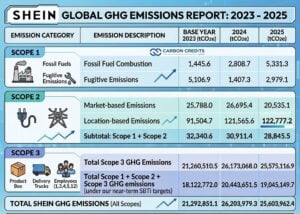
Shein GHG carbon emissions 2025

By 2030, Shein plans to:

  • Cut absolute Scope 1 and 2 emissions by 42%
  • Cut absolute Scope 3 emissions by 25%
  • Source 100% of electricity used in directly managed operations from renewable sources

By 2050, Shein aims to cut absolute Scope 1 and 2 emissions by 90% and Scope 3 emissions by 90%, before addressing remaining emissions in line with the SBTi framework.

The targets cover emissions from Shein’s operations as well as its supply chain, including purchased goods, transport, waste and sold products.

The Supply Chain Drives Shein’s Carbon Footprint

Shein’s biggest climate challenge sits outside its own facilities. The company says purchased goods and services and upstream transportation and distribution accounted for about 96% of emissions covered by its near-term Scope 3 targets in 2025. That includes emissions from producing fabrics and garments and moving products through the supply chain.

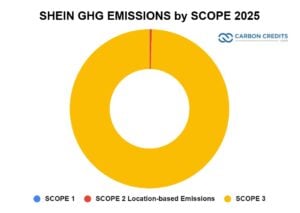
Across all years, from 2023 to 2025, Scope 3 emissions comprise nearly 99.9% of Shein’s entire corporate carbon footprint. This means the vast majority of their climate impact occurs outside their direct operations.

Shein ghg emissions 2025 by scope
Data from Shein

The fashion retailer reported progress in 2025:

  • Its measures in purchased goods and services were estimated to avoid 316,842.8 tonnes of CO2e, up 59.2% from 2024.
  • Transport-related measures produced estimated avoided emissions of 604,868.0 tonnes of CO2e in 2025, down from 668,800 tonnes in 2024.

These are estimated emissions avoided through specific projects, not a reduction in Shein’s total Scope 3 emissions.

Renewable Electricity Reaches 85%

Shein is also cutting emissions from its own facilities. The company used 275,723.2 MWh of electricity across its globally managed operations in 2025, up 13.3% from 2024.

The share of electricity purchased from renewable sources rose to 85.1%, from 76% in 2024. Shein also expanded its solar capacity to 93.9 MW across 16 facilities by the end of 2025, a 66.8% increase from 2024.

The company consumed 36,909.5 MWh of solar electricity in 2025 and estimated that it avoided 19,576.4 tonnes of CO2e.

Shein also introduced 78 energy-efficiency measures across 22 facilities in China. It estimates those measures saved 33,581 MWh of electricity and cut emissions by 19,934.1 tonnes of CO2e in 2025.

Shein Targets Materials, Packaging and Freight

The company is also targeting emissions tied to its products and logistics. In 2025, 9.2% of polyester directly sourced for Shein-branded products was recycled, up from 6.7% in 2024. Shein estimates this reduced emissions by 48,664.2 tonnes of CO2e.

For packaging, 19.7% of plastic packaging purchased for Shein-branded products contained at least 50% recycled polyethylene, up from 17.0% in 2024. Shein estimates this work avoided 5,647 tonnes of virgin plastic.

The company also shifted some deliveries from air freight to sea freight and trucking and used 125 electric or lower-fuel-consumption vehicles in warehousing and distribution in 2025.

Shein also tested 187.3 tonnes of sustainable aviation fuel across 14 Atlas Air charter flights, which it estimates avoided 579.1 tonnes of CO2e.

Carbon Removals Wait Until the Endgame

Shein’s net-zero strategy does not rely on carbon credits as its main way to meet near-term targets. The company says it plans to reduce emissions deeply across its operations and value chain first. It expects to address remaining emissions through carbon removals as it approaches its 2050 goal.

That approach fits the SBTi net-zero framework, which places deep emissions reductions ahead of neutralizing residual emissions.

For carbon markets, Shein could eventually become a buyer of high-quality carbon removal credits. But its future demand will depend on how much residual emissions remain after it meets its reduction targets.

Public Investors Will Watch Climate Progress

Shein’s IPO brings greater public attention to its environmental performance. The company says its 2025 Scope 1, 2 and 3 inventory received independent verification from Bureau Veritas under ISO 14064-1:2018 and the GHG Protocol.

The fashion giant also says it is working with suppliers on energy efficiency and renewable power and developing a wider decarbonization roadmap. Its scale makes that work significant. Shein served about 273 million active customers across roughly 160 markets in 2025.

The company therefore faces a difficult balance. It must maintain growth while reducing emissions across a supply chain that it does not fully control.

Shein’s IPO Is Also a Climate Test

Shein’s Hong Kong debut has put a public market value on a company whose valuation has fallen sharply from its US$98.2 billion peak in 2022 to about US$26.5 billion.

At the same time, Shein has committed to cut Scope 1 and 2 emissions by 42% and Scope 3 emissions by 25% by 2030, followed by 90% reductions across both categories by 2050.

The biggest challenge will be its supply chain, where most of its emissions occur.

As Shein enters public markets, investors will have more data to assess whether its sustainability efforts keep pace with the scale of its business. The key test will be whether Shein can deliver continued growth while making real, measurable cuts across the supply chain behind its global fast-fashion business.

The post Shein Goes Public at $26.5B, a 73% Drop in Valuation as Fashion Giant Faces a Net-Zero Test appeared first on Carbon Credits.

CF Industries, JERA and Mitsui Break Ground on $3.7 Billion Low-Carbon Ammonia Plant in Louisiana

CF Industries, JERA and Mitsui are moving ahead with one of the world’s largest low-carbon ammonia projects, as demand grows for cleaner fertilizer and lower-emission energy products. The three companies have broken ground on the Blue Point One ammonia plant in Modeste, Louisiana. The project represents a $3.7 billion investment and is expected to produce 1.4 million metric tons of ammonia annually when it begins operations in 2029.

The scale is significant. Blue Point One is expected to become the world’s largest ammonia plant once operational, while creating more than 100 permanent manufacturing jobs and an estimated 3,900 construction jobs over four years.

U.S. Secretary of Agriculture Brooke Rollins joined federal, state and local officials at the groundbreaking, highlighting the project’s importance to both domestic agriculture and America’s industrial base. For investors, however, the bigger story is the project’s position at the intersection of fertilizer security, carbon capture and the emerging global market for low-carbon ammonia.

us ammonia

A Major Bet on U.S. Ammonia Production

CF Industries owns 40% of Blue Point One, while Japan’s JERA owns 35% and Mitsui holds the remaining 25%.

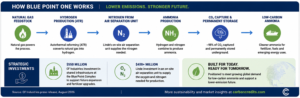
The companies are targeting 2029 for the start of production. The plant will use autothermal reforming, or ATR, to produce hydrogen, which is then combined with nitrogen to make ammonia.

  • The key difference is what happens to the carbon dioxide generated during production.

Blue Point One Targets 98% CO₂ Capture

Blue Point One is designed to capture and permanently store about 98% of the CO₂ produced by the facility. A joint venture between Occidental subsidiary 1PointFive and Enbridge will handle the transportation and permanent sequestration of the captured carbon.

That could give the project one of the lowest carbon footprints among large-scale ammonia facilities.

The project is also designed to serve two markets. Traditional customers will use the ammonia for fertilizer, while emerging applications could include low-carbon fuels and energy-related uses.

That flexibility matters because ammonia is moving beyond its traditional role in agriculture.

Around 70% of global ammonia production is currently used for fertilizer, but the molecule is increasingly being considered as an energy carrier and fuel for sectors that are difficult to electrify.

CF Industries and Linde Create Expansion Potential

CF Industries is making another $550 million investment at the Blue Point Complex over the next four years. The spending will support shared infrastructure that can accommodate future ammonia production and fertilizer upgrades.

This creates an important option for expansion. Rather than building every piece of infrastructure from scratch for future projects, the companies can use the shared facilities already being developed around Blue Point One.

Linde is also investing more than $400 million in an on-site air separation unit. The facility will supply the oxygen and nitrogen needed for ammonia production.

Together, these investments create a broader industrial platform rather than a standalone ammonia plant. This could become increasingly valuable if demand for low-carbon ammonia accelerates through the end of the decade.

CF Industries President and Chief Executive Officer Chris Bohn said,

“We are proud to break ground on the Blue Point One joint venture, a transformative project that brings together American energy resources, world-class engineering and partnerships, and trusted global allies. Most importantly, this facility will serve people, growing access to the reliable, domestic nitrogen supply American farmers need to feed the world, expanding our nation’s export capacity through shipping American-made energy to global markets and creating jobs in Louisiana.”

Global Low-Carbon Ammonia Demand Is Growing, but Supply Is Still Limited

The timing of Blue Point One reflects a broader shift in the ammonia industry.

Global ammonia production is highly emissions-intensive. The International Energy Agency estimates that direct emissions from ammonia production are around 450 million metric tons of CO₂ annually. More than 70% of production currently relies on natural-gas-based steam reforming, with much of the remainder produced using coal.

At the same time, demand for ammonia is not disappearing. Population growth and rising food demand are expected to support continued fertilizer consumption, while new markets could emerge in shipping, power generation and other energy applications.

The supply side, however, remains at an early stage.

  • The IEA says announced and existing near-zero-emission ammonia projects have been expanding, but low-emission production remains a small share of the global market.
  • A 2025 assessment found that low-emissions ammonia projects for fertilizer accounted for about 19 million tonnes of production capacity, including operational projects that had reached final investment decision or completed feasibility studies.

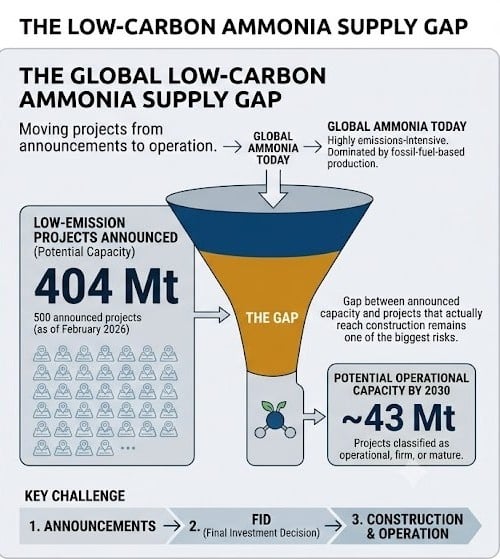
The project pipeline is much larger than current operating capacity. The Ammonia Energy Association identified 500 announced low-emission and transitional ammonia projects as of February 2026, representing 404 million tonnes of potential capacity. However, only about 43 million tonnes of that capacity could be operational by 2030 based on projects classified as operational, firm, or mature.

This gap between announced capacity and projects that actually reach construction remains one of the biggest risks for the sector.

ammonia supply gap
Source: IEA

JERA Connects Blue Point One to Global Markets

JERA’s involvement also gives Blue Point One an international dimension. It is Japan’s largest power generation company and a major player in the global energy market. Founded in 2015, it supplies about one-third of Japan’s electricity and ranks among the world’s largest buyers of liquefied natural gas (LNG).

The company operates across the energy supply chain, from gas exploration and LNG projects to fuel procurement, transportation and power generation. JERA is also expanding its focus on lower-carbon energy as part of its transition strategy. It aims to reach net-zero CO₂ emissions across its domestic and international operations by 2050.

JERA Global Energy Solutions Chief Executive Officer, JERA Senior Managing Executive Officer, Chief Operating Officer of Low Carbon Fuels Business Irtiza Sayyed:

“Today’s groundbreaking marks an important milestone for Blue Point One and brings us one step closer to establishing a reliable low-carbon ammonia value chain. At JERA, we believe that energy transition must be supported by practical projects and strong partnerships across the value chain. Blue Point One reflects this belief, bringing together partners with a shared commitment to build the foundation needed to scale lower-carbon ammonia for the future.”

Japan is one of the countries exploring ammonia as part of its strategy to reduce emissions from power generation and diversify energy supplies. Ammonia can be transported using established shipping infrastructure, making it easier to move between production hubs and overseas markets than hydrogen in some applications.

The IEA expects long-term bilateral contracts to play an important role in emerging hydrogen and ammonia trade, particularly because buyers need confidence that low-carbon fuel supplies will actually be delivered.

That creates an opportunity for U.S. producers with access to natural gas, carbon-storage infrastructure and export terminals.

Blue Point One brings those elements together.

Cost Remains the Critical Question

Low-carbon ammonia still has to compete with conventional production on price.

The IEA estimates that natural gas-based ammonia with carbon capture could reach production costs of roughly $230 to $440 per tonne by 2030 in regions with low-cost gas and suitable CO₂ storage. Electrolysis-based production could cost roughly $400 to $620 per tonne in regions with excellent renewable resources.

That makes carbon capture an important route for scaling lower-carbon ammonia, particularly in regions such as the U.S. Gulf Coast where natural gas, industrial infrastructure and potential CO₂ storage resources are available.

The economics could improve further as carbon prices, clean-fuel standards and corporate demand create premiums for lower-emission ammonia.

Blue Point Could Become a Platform for Future Growth

The biggest investment takeaway may not be the 1.4 million tonnes of annual production alone.

The additional infrastructure spending gives CF Industries and its partners room to expand the site as demand develops. That optionality could become valuable if fertilizer customers increasingly seek lower-carbon products or if shipping and power markets begin adopting ammonia at a larger scale.

All in all, the project therefore sits at the center of several major investment themes: U.S. manufacturing, fertilizer security, carbon capture, energy exports and the development of low-carbon fuels. The real test will come after groundbreaking. Blue Point One must move from construction to reliable production while proving that large-scale ammonia can be made with significantly lower emissions at a competitive cost.

If it succeeds, Louisiana could become an important hub in the next generation of global ammonia supply.

The post CF Industries, JERA and Mitsui Break Ground on $3.7 Billion Low-Carbon Ammonia Plant in Louisiana appeared first on Carbon Credits.

Citi Hits $647B Sustainable Finance Milestone, Sets New 2030 Climate Goals

Citi Hits $647B Sustainable Finance Milestone, Sets New 2030 Climate Goals

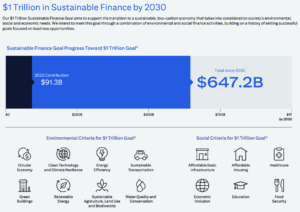
Citigroup has committed an estimated $647.2 billion to sustainable finance since 2020, putting the bank more than halfway toward its $1 trillion goal by 2030.

Citi reported the milestone in its latest 2025 Sustainability Report, released in July 2026. The bank also set new targets to cut its own operational emissions and energy use through 2030 after exceeding several of its previous climate goals.

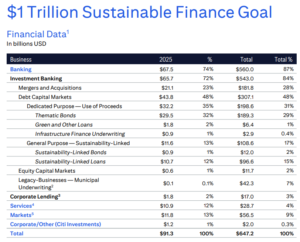
Citi committed $91.3 billion to sustainable finance in 2025 alone. Of that amount, 62% went to international markets outside North America, while 38% went to North America.

The latest numbers show how banks are becoming a major source of capital for the energy transition. They also highlight a key difference between financing climate projects and cutting the bank’s own emissions.

Citi Crosses the $647 Billion Mark

Citi launched its $1 trillion Sustainable Finance Goal in 2021. The target covers both environmental and social finance, so the full amount does not represent spending on climate projects alone.

  • By the end of 2025, Citi had financed and facilitated an estimated $647.2 billion toward the goal. That equals about 65% of the $1 trillion target.
Citibank sustainable finance 2030
Source: Citigroup

The bank added $91.3 billion in 2025. Banking contributed $67.5 billion, while Investment Banking accounted for $65.7 billion in eligible activity. Renewable energy and sustainable transportation were among the largest environmental categories.

The company estimates that financing since 2020 has helped avoid around 8.8 million metric tons of greenhouse gas emissions. It has also supported over 4.4 million jobs and reached nearly 67 million people.

Citi says it uses a conservative approach to estimate these impacts and only includes transactions where it has suitable methods and data. Those impact figures are estimated outcomes linked to financing, not direct reductions in Citi’s own corporate emissions.

Citi’s Climate Capital Goes Global

Citi’s sustainable finance activity is also becoming more international. Of the $91.3 billion committed in 2025, about $56.6 billion, or 62%, supported projects outside North America. North American projects received $34.7 billion, or 38%.

Citi $1T sustainable finance goal
Source: Citigroup

Looking at the full program since 2020, international markets received $363.8 billion, or 56% of total commitments. North America accounted for $283.3 billion, or 44%.

This mix is important because many emerging markets need private capital to grow. They want to expand clean energy, improve infrastructure, and boost climate resilience.

For Citi, it also creates a bigger opportunity to finance projects in markets where energy demand and investment needs are growing quickly.

Citi Exceeded Its 2025 Emissions Goal

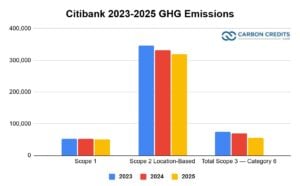
Citi also reported strong progress in its own operations. The bank had set a 2025 goal to cut location-based Scope 1 and Scope 2 emissions by 45% from its 2010 baseline. It achieved a 58% reduction instead.

The major financier noted in its report:

“At the end of 2025, we closed out our fourth generation of goals, which have helped drive performance improvements related to GHG emissions, energy, water, waste, and sustainable building design.”

Citi’s total location-based Scope 1 and 2 emissions stood at 370,030 metric tons of CO2e in 2025, about 3.8% lower than in 2024. Scope 1 emissions accounted for 50,790 tonnes, while location-based Scope 2 emissions totaled 319,240 tonnes.

Citibank GHG emissions 2025

The bank also achieved its energy goal. It cut total energy consumption by 43% from the 2010 baseline, beating its earlier target of 40%. Citi also maintained 100% renewable electricity sourcing in 2025.

These results show progress in the areas Citi can control directly, such as its buildings, electricity use and other operating activities.

New 2030 Goals Raise the Bar

After exceeding its previous targets, Citi has set a new set of operational goals for 2030. The bank plans to cut location-based emissions by another 15% from its 2025 baseline. It also aims to reduce energy consumption by 10% from the same baseline.

Citi says the new goals use revised boundaries and baselines, so the comparison does not simply extend the older 2010 targets.

The bank will focus on areas such as energy efficiency, facility upgrades, and onsite renewable generation. Citi installed onsite renewable systems at 17 locations during its previous goals. It also added batteries at some sites to store extra renewable power.

The new targets support Citi’s broader commitment to reach net-zero emissions from its own operations by 2030.

Carbon Credits Do Not Count Toward the Goal

The major bank also reports carbon credit purchases, but it keeps them separate from its operational emissions target.

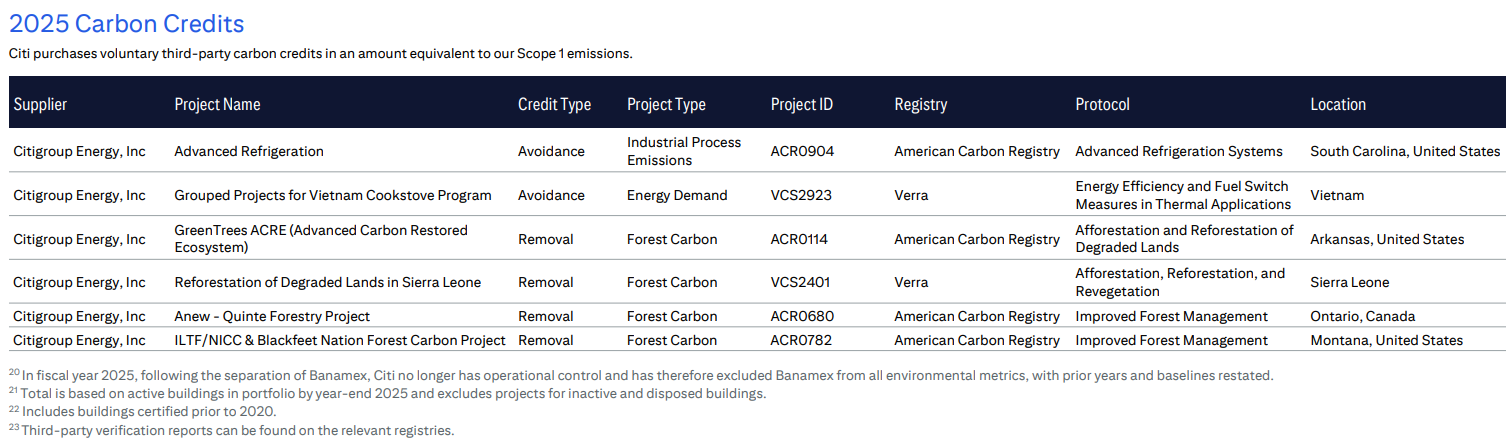
The bank reported 50,790 metric tons of carbon credits for 2025. This includes projects like nature-based solutions, energy efficiency, and methane destruction. Those credits did not count toward Citi’s operational emissions goals.

Citibank carbon credits
Source: Citigroup

That distinction is important. Citi has said its operations target focuses on reducing its own Scope 1 and Scope 2 emissions rather than relying on offsets. Its net-zero commitment covers its global operations by 2030, while its financing-related emissions target extends to 2050.

This approach separates direct emissions cuts from voluntary carbon market activity. This is important for carbon markets. Companies must show that carbon credits lead to real emissions cuts, not just replace them.

The Bigger Challenge Is Citi’s Financed Emissions

For a major bank, its biggest climate impact does not come from its offices. It comes from the businesses and projects it finances.

Citi committed to reach net-zero greenhouse gas emissions associated with its financing by 2050. Since 2021, it has established 2030 interim emissions reduction targets for 10 sectors in its portfolio, including some of the most carbon-intensive parts of the economy.

These areas include sectors such as energy, power, steel, and other carbon-intensive industries. This creates a harder challenge than cutting electricity use in offices.

Citi can control its own facilities directly. It has much less direct control over the emissions produced by companies and projects that receive its financing.

The bank therefore uses client engagement, emissions data, and transition plans as part of its net-zero strategy.

Sustainable Finance Is Not the Same as Green Finance

Citi’s $647 billion figure needs some context. The bank’s $1 trillion goal includes both environmental and social finance. Eligible areas range from renewable energy and clean technology to affordable housing, health care, education and food security.

That means the full $647.2 billion cannot be described as climate finance. It is also important to distinguish financing activity from actual investment.

Citi says the goal can include transactions it has financed or facilitated, and a transaction may qualify under more than one environmental or social category but counts only once toward the overall goal.

Citi’s Two-Front Climate Fight

Citi’s latest report shows progress on two different fronts. The bank has reached $647.2 billion toward its $1 trillion sustainable finance goal, leaving about $352.8 billion to reach the target by 2030.

It also reduced location-based operational emissions by 58% from 2010 levels and energy use by 43%. At the same time, it maintained 100% renewable electricity sourcing.

Now Citi wants another 15% cut in location-based emissions and a 10% reduction in energy use by 2030 from its 2025 baseline.

The harder test will remain financed emissions. Citi’s role as a global lender means its climate impact depends heavily on where it directs capital and how quickly its clients cut emissions.

As the bank moves toward its $1 trillion sustainable finance goal and its 2050 net-zero financing commitment, the key measure will be how much money Citi labels as sustainable and whether that capital helps deliver measurable emissions cuts across the wider economy.

The post Citi Hits $647B Sustainable Finance Milestone, Sets New 2030 Climate Goals appeared first on Carbon Credits.

China’s Data Center Power Demand Could Quadruple by 2030 as AI Boom Accelerates

China’s Data Center Power Demand Could Quadruple by 2030 as AI Boom Accelerates

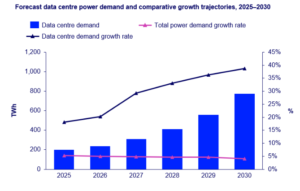
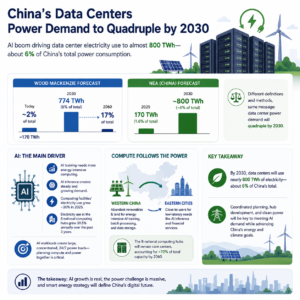
China’s data centers could quadruple their electricity use to 774 terawatt-hours (TWh) by 2030, as artificial intelligence (AI) drives a rapid increase in computing demand.

The forecast comes from Wood Mackenzie’s “Rewiring China’s Grid for the AI Era” report. It says data centers could account for 6% of China’s total electricity use by 2030, up from about 2% today. Their share could rise to 17% by 2060.

China’s government sees a similar trend. The National Energy Administration (NEA) says computing facilities used about 170 billion kilowatt-hours, or 170 TWh, in 2025, equal to 1.6% of national electricity use. The NEA expects computing power demand to reach about 800 TWh by 2030, or around 6% of national electricity use.

The small difference between the 774 TWh Wood Mackenzie estimate and the NEA’s 800 TWh forecast reflects different definitions and methods for measuring data center and computing electricity use. Yet, both point to the same sharp rise in demand.

AI Turns Computing Into a Power-Hungry Business

AI is the main force behind the expected increase. Wood Mackenzie says AI training needs more energy-intensive computing systems. At the same time, AI inference is creating a steady stream of electricity demand as businesses and consumers use AI services more often.

The NEA reported that China’s computing facilities increased their electricity use by about 30% in 2025. Electricity use at the eight national computing hubs has jumped by 39.5% each year over the last three years. This growth is much quicker than the overall electricity demand in the country.

This fast growth is changing power planning. Data centers need reliable electricity around the clock. AI workloads can also create large and concentrated power loads. That means China needs to plan computing capacity and electricity supply together.

Data Centers Are Coming for 6% of China’s Power

China data center AI power demand 2030
Source: Wood Mackenzie

Wood Mackenzie expects data centers to account for 6% of China’s total power consumption by 2030. By 2060, that share could reach 17%. The figures show how quickly computing could become a major part of China’s energy system.

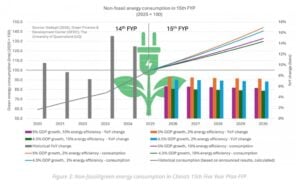
China’s government is already preparing for this shift. The country’s 15th Five-Year Plan calls for coordinated development of computing infrastructure and green electricity.

china 15th year plan
Source: greenfdc.com

The government also wants stronger links between computing demand and the power system. Recent policies encourage direct renewable power supply for computing facilities and better use of flexible computing loads. This could help China meet AI demand without relying solely on new fossil-fuel generation.

The New Rule: Compute Follows the Power

Data centers have traditionally followed customers. They often cluster around large cities and technology centers where businesses, workers, and network connections are available.

AI could change that model.

Wood Mackenzie expects more “compute follows power” development, especially for workloads that do not need instant results. Western China has large renewable energy resources and available land. That makes the region attractive for energy-intensive AI training, batch processing, and data storage.

Eastern cities will still matter for applications that need fast connections. These include AI inference and financial services. This could create a split between eastern computing centers and western regions with greater power availability.

Wood Mackenzie expects China’s eight national computing hubs to remain the main centers of data center capacity through 2060. The hubs could account for more than 70% of total capacity.

Can Clean Power Keep AI’s Carbon Footprint in Check?

More electricity demand does not automatically mean equal growth in emissions. The key factor is the source of the power.

Wood Mackenzie expects data center carbon emissions in China to peak by 2035 as renewable power expands and green power requirements become stricter.

China already has a huge renewable energy base. By June 2026, the country had over 4 billion kilowatts in total power generation capacity. This included more than 2.4 billion kilowatts from renewable sources, as reported by the NEA.

The world’s largest emitter is also expanding its green-power market. In July 2026, the NEA issued 306 million green electricity certificates, or green certificates, covering renewable energy projects. The country traded 54.68 million certificates during the month.

These systems can help data center operators use and track renewable electricity.

China Wants Computing and Power to Work Together

China is also testing ways to make data centers more flexible for power users. Wood Mackenzie says the following could allow some data centers to shift electricity use to periods when renewable power is plentiful, or prices are lower:

  • Battery storage,
  • Smarter power systems, and
  • Intelligent workload scheduling

The NEA is pushing a similar idea. Government guidance calls for data centers in western regions to connect their development with large renewable energy projects. In eastern regions, the government wants closer links between distributed computing, distributed power, microgrids and virtual power plants.

China has also introduced rules for multi-user direct green power connections. The policy prioritizes computing facilities and other new industries. It requires participating projects to use storage and flexible loads to improve the local use of renewable power.

These steps could help data centers become more active participants in the power market instead of simply adding demand.

Grid Investment Will Be Critical

The scale of growth will require more than data centers and renewable projects. China will also need stronger transmission networks, energy storage, and grid control.

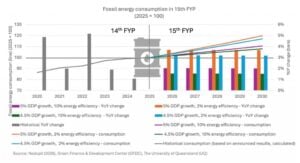
The NEA expects computing electricity use to add more than 100 billion kWh each year on average during the 2026–2030 period. By 2030, it expects computing facilities to consume about 800 billion kWh.

China fossil fuel energy use 2030
Source: greenfdc.com

This growth comes as China’s wider electricity demand continues to rise from electric vehicles, industrial activity, and other new loads. That makes the location of new data centers increasingly important.

Building an AI facility where power is scarce can require expensive new grid investments. Building it near renewable generation may lower some of those costs, but operators still need reliable connections and high-quality power.

Carbon Markets Could Benefit from the Shift

China’s AI power boom could also create opportunities for the carbon market. Growing electricity demand can increase emissions when fossil fuels provide the extra power. Renewable energy, storage, and efficiency can reduce that carbon impact.

This could support demand for projects involving renewable power, energy storage, grid efficiency, and other emissions-reduction measures.

China data center power demand 2030

However, higher renewable power use does not automatically create carbon credits. Projects must meet the rules of the relevant carbon market and prove that they deliver eligible emissions reductions.

China already operates a national emissions trading system covering major power-sector emitters. As power demand from computing grows, stronger carbon pricing and emissions tracking could become more important.

AI Could Reshape China’s Energy System

Wood Mackenzie’s 774 TWh forecast shows the scale of China’s AI power challenge. China’s own forecast is close, with the NEA expecting computing electricity demand to reach 800 TWh by 2030.

With these estimates, the message is clear: AI is becoming a major part of China’s energy system. The country is responding by linking data center planning with renewable power, storage, and grid development.

For carbon markets and the clean energy industry, this creates both a challenge and an opportunity. The faster AI demand grows, the more important clean electricity and flexible power systems will become in keeping that growth from driving a matching rise in emissions.

The post China’s Data Center Power Demand Could Quadruple by 2030 as AI Boom Accelerates appeared first on Carbon Credits.
Why Copper Could Be One of the Biggest Commodity Bets of the AI Era

Copper has become one of the hottest commodities of 2026, and the rally may have more staying power than a typical commodity cycle.

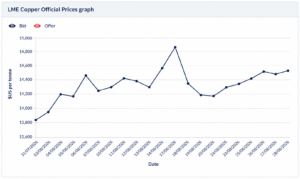
A recent Bloomberg report revealed that the metal has climbed about 15% since the beginning of the year and recently traded above $14,300 a metric ton on the London Metal Exchange, close to its record high of $14,527.50 reached earlier this year. The rally has been supported by strong demand, limited mine growth and growing concerns about where future supplies will come from.

LME copper

However, the price surge is not simply an AI trade.

Copper is fundamental to the global economy because it moves electricity through power grids, buildings, factories, electric vehicles and renewable energy systems. Artificial intelligence is adding another fast-growing source of demand, but its bigger significance is that it highlights just how much new electricity infrastructure the world will need.

That could keep copper in the spotlight well beyond the current price cycle.

Copper Demand Is Heading Higher: 

In a separate analysis, S&P Global expects global copper demand to rise from about 28 million metric tons in 2025 to 42 million tons by 2040, representing a 50% increase. The growth will come from several directions.

Traditional economic activity remains the largest source of copper consumption, particularly as developing economies urbanize, incomes rise and electricity use increases. At the same time, electric vehicles, renewable power, grid expansion and industrial investment are adding new demand.

Data centers are becoming another important contributor.

The distinction matters because AI is unlikely to account for most of the world’s future copper consumption. Instead, it is adding demand to an already expanding market. The resulting pressure grows when combined with the long lead times required to develop new mines.

  • S&P Global estimates that the copper market could face a supply shortfall of about 10 million metric tons a year by 2040, equivalent to nearly 24% of projected demand. This gap underpins the longer-term copper investment story.

AI Is Creating a New Copper Demand Cycle

The rapid construction of AI data centers is making copper’s role even more important. AI systems require enormous computing capacity, and that capacity requires electricity. Data centers consequently need extensive electrical infrastructure, including power distribution equipment, cooling systems, cabling, and connections to the wider grid.

S&P Global estimates that data centers consumed around 1.1 million metric tons of copper in 2025. By 2040, that figure could reach 2.5 million tons a year, more than doubling over the period. Depending on how quickly data centers expand and how much copper their designs require, the research firm places the 2040 range between 1.7 million and 2.7 million tons.

The numbers become more striking when measured against individual facilities.

S&P Global estimates that data centers can require roughly 30 to 40 metric tons of copper per megawatt of capacity, with some AI-focused facilities using even more. That means a 100 MW AI data center could require several thousand tons of copper before accounting for the broader infrastructure needed to supply its electricity.

This is why the AI story extends well beyond the server room.

A new data center can require new substations, transformers, transmission lines and generation capacity. If renewable energy is used to supply that electricity, additional copper is needed across the generation and grid infrastructure.

In effect, AI can create copper demand twice: inside the data center and across the power system supporting it.

The Supply Side Is the Bigger Problem

Demand growth would be manageable if miners could respond quickly. Copper, however, is not a commodity that can simply be produced more quickly when prices rise. New mines can take many years to permit, finance and build. Existing operations also face declining ore grades, aging infrastructure and geopolitical risks.

Analysts expect mined copper production to increase in the near term before declining later in the next decade. Without substantial new projects and expansions, the industry will struggle to keep pace with consumption. Even recycling, to become increasingly important, is unlikely to close the entire gap.

That creates an unusual setup for a commodity market.

Copper prices are already high enough to encourage investment in new supply, yet the response from mining companies cannot happen overnight. If demand continues to rise faster than available production, prices may need to remain elevated for long enough to justify the enormous capital required to develop new mines.

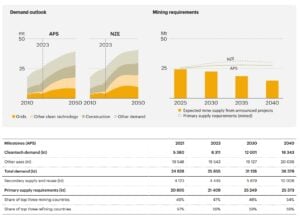
Copper Demand and Mining Requirements: IEA Analysis 

Why Copper Prices Are Already So High

The current rally also reflects more immediate market forces.

Copper has been pulled higher by concerns over future U.S. tariffs, which have encouraged traders to move metal into the United States ahead of potential restrictions. That has tightened availability elsewhere even though the global market was previously expected to remain in surplus this year. Reuters reported that LME copper reached $14,343 a ton in August as inventories outside the U.S. became tighter.

This distinction is important for investors.

Today’s price does not necessarily mean the world is already experiencing a structural 10-million-ton shortage. Some of the recent rally reflects inventory movements, trade policy and expectations about future supply.

Nevertheless, those short-term factors are occurring against a much more bullish long-term backdrop.

If mine production struggles to keep pace with electrification, grid investment and data center construction, the market could remain structurally tight even after today’s tariff-related distortions disappear.

How Investors Can Play the Copper Story

The investment case goes beyond simply buying copper. Bloomberg recently examined several ways investors can gain exposure to the theme, including copper futures, mining companies and businesses that supply the infrastructure required by electrification and data center expansion.

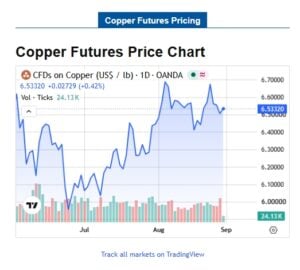
The most direct route is a copper-linked fund such as the United States Copper Index Fund, or CPER, which invests in copper futures. However, futures-based products can experience differences between their returns and the spot price because contracts have to be rolled as they expire.

copper futures

Copper miners offer another approach, but with greater company-specific risk. Higher copper prices can improve miners’ margins, yet investors also face operational problems, geopolitical exposure, permitting risks and rising development costs.

There is also a broader infrastructure opportunity.

Companies supplying electrical equipment, grid technology, cooling systems and data center infrastructure can benefit from the same investment cycle without relying entirely on copper prices. That makes the infrastructure angle potentially more diversified than simply betting on a higher metal price.

Copper’s Bigger Story Is Electrification

AI may be the newest reason to watch copper, but it is not the only one. The world is building more electric vehicles, renewable energy projects, factories, homes and data centers while upgrading power networks that were designed for a very different electricity system. All of those trends compete for the same finite supply of a highly conductive metal.

That is why the copper market could remain tight even if the AI boom eventually slows. S&P Global’s forecast captures the scale of the challenge: demand could rise 50% by 2040 while supply struggles to keep pace, leaving a potential 10-million-ton annual shortfall.

For investors, the opportunity is therefore less about predicting whether AI will create the next copper supercycle and more about recognizing the infrastructure investment required to support an increasingly electrified economy.

AI is accelerating that investment. And copper is what helps make it possible.

The post Why Copper Could Be One of the Biggest Commodity Bets of the AI Era appeared first on Carbon Credits.
ClimeCo and Marsoft Launch First-of-Its-Kind Gold Standard Shipping Carbon Credit Project

Shipping carbon credits

The shipping industry is working on decarbonization, but progress is slow. New fuels and zero-emission vessels are still being developed. Meanwhile, improving existing ships’ efficiency can lead to immediate emissions cuts.

This is where shipping carbon credits come in.

ClimeCo and Marsoft Global Carbon Solutions (MS-GCS) have launched the first carbon credits from the Marsoft GreenScreen project under the Gold Standard. This project allows shipowners to turn verified emissions reductions from energy-efficiency upgrades into carbon credits for the voluntary carbon market.

This model gives shipowners a new revenue stream while helping finance technologies that cut fuel use and CO2 emissions.

Why Shipping Needs Faster Decarbonization

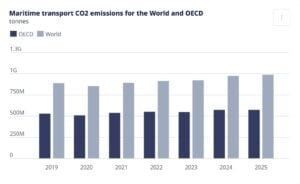
Shipping accounts for most global trade by volume, making it hard to replace with other transport modes. However, this also creates major emissions challenges. The International Maritime Organization (IMO) estimates that shipping produced about 1.06 billion tonnes of CO2 in 2018, roughly 2.9% of global human-caused CO2 emissions. International shipping alone was responsible for around 740 million tonnes.

Despite efficiency improvements, emissions remain high.

The IMO’s 2023 greenhouse gas strategy aims for international shipping to achieve net-zero emissions by 2050. It also sets interim goals: cutting annual emissions by at least 20% by 2030 and at least 70% by 2040, compared to 2008 levels. These targets push shipowners to invest in efficiency now, even as cleaner fuels and technologies are developed.

maritime shipping emission
Source: OECD

Marsoft GreenScreen Brings Carbon Finance to Ship Efficiency

GreenScreen targets this immediate opportunity. The program helps shipowners measure fuel and emissions savings from vessel retrofits. These upgrades can enhance hydrodynamics, propulsion efficiency, and overall vessel performance.

  • According to MS-GCS, over 350 ships have joined the program, including bulk carriers and chemical tankers. Together, they are expected to save more than 2.3 million tonnes of CO2 emissions during their next docking.
  • The program has also analyzed over 200 ship-years of operational data, giving Marsoft valuable performance insights.

After identifying emissions reductions, the GreenScreen model converts these into Gold Standard carbon credits. ClimeCo and MS-GCS manage credit issuance, while ClimeCo handles commercialization in the voluntary carbon market.
This links ship efficiency to carbon markets. Instead of viewing a retrofit as a cost, shipowners can potentially earn revenue from emissions reductions.

marsoft greenscreen
Source: Marsoft

Arlie Sterling, President of Marsoft, said:

This is the first issuance of shipping carbon credits using the latest methodology we developed in collaboration with the MIT Sea Grant Design Laboratory, marking a significant milestone for the industry. This issuance, together with others already underway, will deliver funding to accelerate the pace of retrofitting and decarbonization.”

How Shipping Carbon Credits Work

The concept is simple. First, GreenScreen evaluates vessel data to estimate fuel and emissions savings from a retrofit. It uses existing data from shipowners, so no new data collection is needed. Next, emissions reductions are measured and verified using the appropriate carbon-credit methodology.

Gold Standard has a specific method for quantifying emissions reductions from energy-efficiency retrofits in shipping. This aligns with Gold Standard requirements for generating carbon credits.

Once verified, credits can be issued.

shipping carbon credits
Source: Marsoft
  • Each credit represents one tonne of reduced or removed greenhouse gas emissions, following the relevant methodology and verification steps.

ClimeCo then connects those credits to buyers in the voluntary carbon market. This is crucial because carbon markets can incentivize emission-cutting projects that might struggle to find funding.

ClimeCo Adds Carbon Market Expertise

Erika Schiller, Chief Development Officer at ClimeCo, also noted,

“We’re proud to partner with Marsoft to bring our carbon market expertise to the registration and issuance of these high-quality, third-party verified credits. Together, we’re supporting shipowners in obtaining funding for more advanced retrofits and helping them navigate the voluntary carbon market with confidence.”

ClimeCo brings over a decade of experience in carbon project development and environmental markets to this partnership.

Founded in 2009, the company started with industrial emissions-reduction projects and expanded into carbon project development, environmental commodities, and sustainability consulting. ClimeCo reports that its projects have reduced, avoided, or removed over 50 million tonnes of CO2e since 2009.

This experience is vital for GreenScreen, as shipping retrofits require credible emissions accounting, verification, and access to buyers.

ClimeCo goes beyond selling credits. Its carbon project business focuses on establishing baselines, measuring emissions reductions, and applying methodologies to create credible environmental assets. This expertise could further help GreenScreen grow as more shipowners seek ways to finance efficiency upgrades.

Can Carbon Credits Accelerate Shipping Retrofits?

The shipping industry faces a capital problem as much as a technology one.

Shipowners can invest in efficiency upgrades today, but financial benefits depend on fuel savings and operating conditions. Carbon revenue can provide an additional income stream.

However, carbon credits won’t replace direct emissions reductions. GreenScreen connects the two. Ships first reduce emissions, and then the verified reductions create carbon market value.

This connection is crucial as carbon markets face scrutiny over additionality, measurement, and credibility. High-quality shipping credits need strong monitoring and verification to ensure claimed reductions are real and linked to the retrofit.

GreenScreen’s use of a Gold Standard methodology provides a trusted framework for measuring these reductions.

A New Market for Maritime Decarbonization

Shipping carbon credits are still emerging, but GreenScreen shows how the voluntary carbon market can support decarbonization in a hard-to-abate sector. The industry needs cleaner fuels, new vessel designs, and maybe zero-emission propulsion to hit long-term climate goals. These solutions will require time and investment.

Energy-efficiency retrofits can deliver reductions much sooner.

By turning verified reductions into marketable carbon credits, GreenScreen connects today’s shipping fleet with tomorrow’s low-carbon vessels. Shipowners can cut fuel use and fund retrofits, while carbon buyers gain access to credits linked to measurable shipping emissions cuts.

As the IMO pushes for deeper emissions cuts, it’s essential to find ways to raise funds for rapid efficiency improvements. This will be key in the shipping decarbonization toolkit.

The post ClimeCo and Marsoft Launch First-of-Its-Kind Gold Standard Shipping Carbon Credit Project appeared first on Carbon Credits.