AMD Stock Soars: Can ESG and Net-Zero Momentum Sustain the Rally?

AMD Stock Hits All-Time Highs: Can ESG and Net-Zero Momentum Sustain the Rally?

Advanced Micro Devices (NASDAQ: AMD) has been in the spotlight lately. This is due to its record stock price and strong environmental, social, and governance (ESG) efforts, as well as its sustainability programs. The company’s strong financial growth is driven by the soaring demand for its AI and data center chips.

AMD’s focus on sustainability gives it a competitive edge, which may help the company thrive for years to come. Let’s dive into the chipmaker’s record-breaking achievements.

AMD Hits Record Highs on AI Momentum

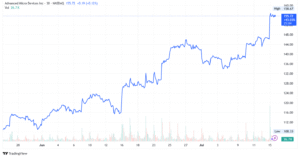
AMD’s stock recently climbed significantly as shown in the chart. The excitement around its MI300 series GPUs and EPYC processors drives this surge. These products are made for artificial intelligence (AI) and high-performance computing (HPC). These products are allowing AMD to compete aggressively with rival tech giant Nvidia.

AMD stock
Source: TradingView

Analysts are hopeful about AMD’s future, with HSBC upgrading its stock. They see the MI350 chip as a strong competitor to Nvidia. As such, AMD’s forward price-to-earnings (P/E) ratio is about 21x. This is attractive, especially when you compare it to Nvidia’s P/E of around 38x.

The broader AI market is also booming. According to International Data Corporation (IDC), AI server spending is expected to grow by over 25% annually through 2027. This growth is likely to increase demand for AMD’s AI-specific chips.

Notably, AMD now powers 157 of the world’s top Green500 supercomputers, platforms that combine raw computing power with energy efficiency. This highlights AMD’s dual focus on performance and sustainability.

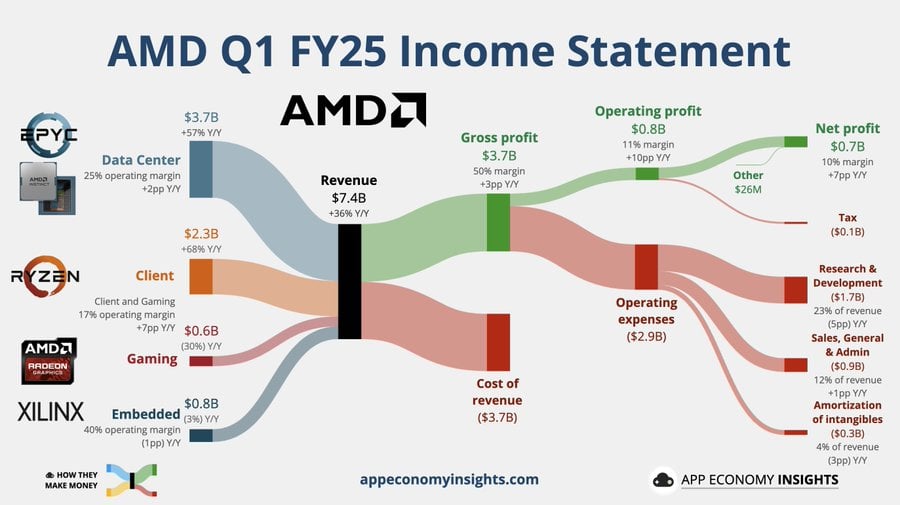
AMD’s recent financial reports reflect this momentum. In the first quarter of 2025, AMD posted double-digit revenue growth and improved gross margins. Strong sales in data centers and AI platforms boosted earnings. This sparked greater confidence among both analysts and investors.

AMD first qtr financial

AMD’s Blueprint for Responsible, Greener Growth

Beyond its technology leadership, AMD puts great emphasis on sustainability and responsible governance. The company was named Newsweek’s #1 Greenest Company in 2024. It also earned top scores for environmental transparency from various ESG rating agencies.

AMD’s governance and ESG framework includes:

  • Conducting thorough materiality assessments in partnership with BSR (Business for Social Responsibility).
  • Aligning reporting and disclosures with industry-leading frameworks like the Task Force on Climate-related Financial Disclosures (TCFD), Sustainability Accounting Standards Board (SASB), and CDP (formerly Carbon Disclosure Project).
  • Committing to achieving full net-zero emissions throughout its entire value chain by 2050, with interim targets already set.

This strong ESG framework builds investor trust. It also aligns AMD with new global policies. These include Europe’s Corporate Sustainability Reporting Directive (CSRD) and the International Sustainability Standards Board (ISSB) guidelines. Both are shaping future sustainability reporting needs.

From Silicon to Sustainability: AMD’s Net Zero Game Plan

AMD’s environmental goals focus heavily on reducing its greenhouse gas (GHG) emissions. It has pledged to cut absolute Scope 1 and 2 emissions (direct emissions and those from purchased electricity) by 50% by 2030, compared to 2020 levels.

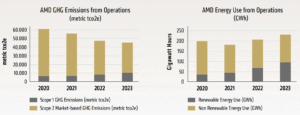
By 2023, AMD achieved a 24.5% reduction, lowering emissions to 46,605 metric tons of CO₂ equivalent from a baseline of 61,754 in 2020. Third-party assurance standards (ISAE 3000) have verified this data, adding credibility to its progress.

AMD ghg emissions 24
Source: AMD Report

AMD completed the acquisition of Xilinx in 2022. This increased its emissions baseline because of larger operations. However, AMD has kept making progress despite this challenge. This shows the company’s ability to manage decarbonization efforts even while growing.

AMD boosted its renewable energy use. It jumped from 18% in 2020 to around 40% by 2023. This means over 83 gigawatt-hours (GWh) of clean power each year. It more than doubles renewable electricity use in just three years. This cuts down the environmental impact of its operations. It also supports the sustainability goals of its data center customers.

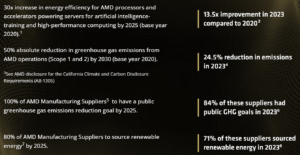
Importantly, AMD’s climate ambitions extend beyond its own operations to its supply chain. The company asks all its manufacturing suppliers to set public GHG reduction targets by 2025. So far, approximately 84% of these suppliers have already published emissions targets, and 71% source at least some renewable energy.

AMD sustainability goals
Source: AMD

AMD aims for full alignment by 2025, with 80% of suppliers sourcing renewable energy by that time. Also, 83% of supplier manufacturing sites have been audited by the Responsible Business Alliance (RBA). This checks for responsible labor and environmental standards.

This approach boosts AMD’s role across the value chain. It starts from chip making and goes to finished electronics. This helps the whole industry make progress on climate change.

ESG Risk Management and Regulatory Alignment

AMD also incorporates climate risk into its long-term strategic planning. It is part of the Semiconductor Climate Consortium. This group creates climate transition strategies by looking at physical and market risk scenarios.

By doing this, AMD prepares for future regulatory demands, including the U.S. Securities and Exchange Commission (SEC) Climate Rule and the EU’s CSRD.

Energy Efficiency: The 30× by 2025 Goal

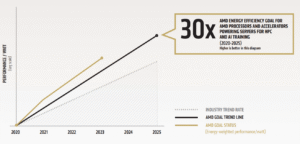
In addition to emissions reductions, AMD pursues ambitious energy efficiency targets. The company set a goal to improve the energy efficiency of its AI and HPC chips by 30 times by 2025 compared to 2020 levels. As of late 2023, AMD recorded a 13.5× efficiency gain using its MI300A APU chip.

AMD Energy Efficiency The 30× by 2025 Goal
Source: AMD report

If used worldwide, this efficiency could save data centers billions of kilowatt-hours in 2025. This would cut carbon emissions and lower operational costs. AMD’s modular chiplet-based design, along with AI chips, cuts power use. This also lowers the environmental impact during manufacturing.

AMD-powered supercomputers, like the Frontier system at Oak Ridge National Laboratory, are among the most energy-efficient high-performance computers worldwide. These gains give AMD a real advantage in securing contracts with big companies and government agencies that want sustainable, high-performance computing.

ESG as a Competitive Advantage, Yet Risks & Challenges Remain

AMD’s sustainability credentials provide several key competitive benefits, in:

  • Cost Savings and Emissions Mitigation: Energy-efficient products help customers reduce electricity costs and meet their own ESG goals.
  • Winning Contracts: Governments and enterprises are increasingly selecting AMD’s technology, appreciating both its performance and sustainability profile.
  • Attracting Investors: More ESG-conscious investors want companies that reduce emissions and report clearly. AMD’s ESG achievements improve its appeal to these capital sources.

Despite its momentum, AMD must navigate several ongoing challenges:

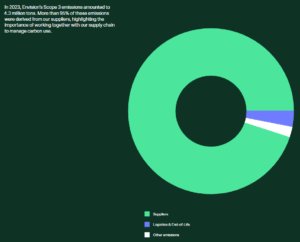
  • Scope 3 Emissions: AMD tracks direct emissions effectively. However, fully capturing and reducing Scope 3 emissions—those from the whole value chain, like product use and end-of-life—is still just starting. Addressing this is critical as Scope 3 typically represents the largest portion of a tech company’s carbon footprint.
  • Intense Competition: Rivals such as Nvidia, Intel, and a host of AI chip startups compete fiercely for market share.
  • Supply Chain Complexity: As AMD expands globally, it will be harder to ensure suppliers meet emissions targets and ESG standards.

When Technology Meets Sustainability: The AMD ESG Equation

AMD’s recent stock rally is not merely a product of hype around AI demand. It reflects a robust technology leadership combined with serious, measurable ESG progress. AMD shows that economic growth can go hand in hand with environmental responsibility. It achieves this through strong energy efficiency goals, confirmed emissions cuts, and climate-friendly actions in its supply chain.

Thus, AMD stands out for investors interested in tech innovation and climate action. Its strong AI chip performance, increasing use of renewable energy, and strict sustainability governance make it an appealing option.

The post AMD Stock Soars: Can ESG and Net-Zero Momentum Sustain the Rally? appeared first on Carbon Credits.

India Achieves 50% Non-Fossil Fuel Power Milestone: Solar Shines Bright

india

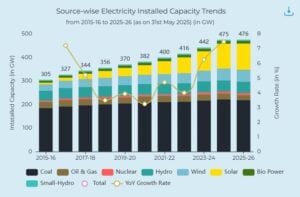
India’s energy transition reached a critical milestone in June 2025. The Government of India, Press Information Bureau, noted that the country’s total installed power generation capacity hit 476 GW, with non-fossil fuel sources contributing nearly 49 percent. This marks a substantial shift from a coal-dominated past, driven by rapid solar growth, expanding wind and hydro capacity, and early strides in hydrogen and nuclear energy.

India’s Rising Electricity Demand Fuels the Shift

Electricity demand in India has surged in recent years, fueled by growing commercial and residential spaces, increased ownership of air conditioners and appliances, and rising industrial consumption. Over the past five years, India recorded the third-largest growth in power generation capacity globally, after China and the United States.

Although generation has increased across all sources, investment in renewables—especially solar PV—has taken the lead. According to the IEA, 83 percent of India’s power sector investment in 2024 went to clean energy.

India also became the world’s largest recipient of development finance for clean power, receiving around USD 2.4 billion for project-level interventions. As a result, the share of non-fossil power generation capacity climbed to 44 percent in 2024, closing in on India’s target of 50 percent by 2030.

INDIA ELECTRICITY
Source: CEA and NPP (https://iced.niti.gov.in/energy/electricity/generation)

Solar Power Becomes the Cornerstone of Clean Energy

Solar energy continues to dominate India’s renewable push. Installed solar capacity soared to 110.9 GW in June 2025, up from just 2.82 GW in March 2014—a nearly 39-fold increase. In FY 2024–25 alone, 23.83 GW of solar was added, showcasing robust government support and investor confidence.

This growth aligns with a major expansion in domestic solar manufacturing. Module production capacity jumped from 2.3 GW to 88 GW, and cell production rose from 1.2 GW to 25 GW. These developments have strengthened India’s self-reliance in the solar supply chain.

Flagship programs such as PM Surya Ghar: Muft Bijli Yojana, rooftop solar subsidies, and the PM-KUSUM scheme have accelerated adoption, especially in rural and residential areas, empowering households and farmers to embrace solar energy.

india solar power
Source: CEA and NPP (https://iced.niti.gov.in/energy/electricity/generation)

Coal Still Dominates India’s Power Mix, but Its Grip is Slipping

Despite clean energy gains, coal remains India’s largest single source, with an installed capacity of 219 GW. When combined with gas (20 GW) and diesel (0.589 GW), thermal power contributes 240 GW, slightly over 50 percent of the country’s total.

Coal continues to play a key role in meeting base load demand, particularly for industrial use. However, its dominance is gradually eroding as solar, wind, and other renewable options scale up. Additionally, policy pressure to decarbonize and falling costs of renewables are accelerating this shift.

Wind, Hydro, and Biomass Add Balance to the Grid

India’s renewable mix is becoming increasingly diverse. Wind power reached 51.3 GW, with 4.15 GW added in the last fiscal year. Hydropower, including both large and small projects, stood at 48 GW, up from 35.8 GW in 2014. These sources provide critical grid flexibility and peak load management.

Biomass and biogas power have also strengthened, contributing 11.6 GW. Over five million small biogas plants and hundreds of medium-scale systems are now operational. In a major leap, India’s production of compressed biogas has reached 1,211 tonnes per day across 150 plants—up from just 8 tonnes per day in 2014.

Green Hydrogen finds its Place in the Energy Mix

India’s green hydrogen ambitions are taking shape under the National Green Hydrogen Mission. While still in its early stages, pilot projects using electrolysis powered by solar and wind have begun.

These initiatives support the government’s target of producing 5 million metric tonnes of green hydrogen annually by 2030, backed by 125 GW of renewable capacity.

Though current hydrogen capacity remains in the pilot phase, it is expected to play a transformative role in decarbonizing heavy industries, refining, and long-duration storage in the coming decade.

Nuclear power: Needs a Ramp-Up

Nuclear energy continues to provide a steady source of low-emission electricity, with 8.8 GW of capacity as of June 2025. While its share remains modest, nuclear offers reliable baseload power and supports the country’s broader clean energy ambitions.

The Government of India’s Department of Atomic Energy has announced that the RAPS-7 reactor (700 MW) was successfully connected to the grid on March 17, 2025, increasing the total number of operational nuclear reactors in the country to 25, with a combined capacity of 8,880 MW.

An additional 13,600 MW of nuclear power capacity is currently under implementation. Once these projects are progressively completed, India’s total nuclear capacity is expected to reach 22,480 MW by 2031–32.

The private sector is already playing a significant role in the nuclear ecosystem, particularly in the manufacturing, supply, and execution of nuclear power projects. Moreover, private investment in nuclear power generation has now been enabled within the current legal framework to support the establishment of Bharat Small Reactors (BSRs).

India’s Investment Landscape and Infrastructure Bottlenecks

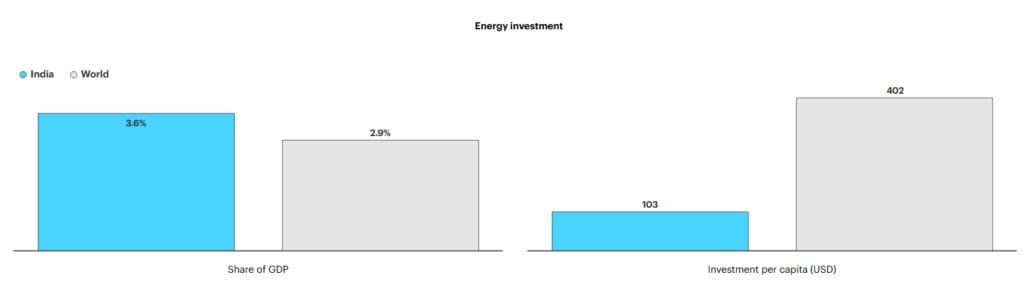
India has introduced several steps to attract more investment in clean energy. These include significant support for solar panel manufacturing, battery production, and building better electricity grids. The IEA further highlighted that in 2023, foreign direct investment (FDI) in the power sector reached USD 5 billion. It’s almost double the amount seen before COVID-19. Under the current policy, India allows 100 percent FDI in power generation and transmission, except in nuclear energy.

However, foreign portfolio investment (money from global investors in stocks and bonds) has dropped over the last two years. One major challenge is the high cost of financing. In India, borrowing costs for renewable energy projects are 80 percent higher than in developed countries, which makes clean energy projects more expensive and less profitable.

INDIA ENERGY INVESTMENT
Source: IEA

Another serious issue is off-taker risk—this means that electricity distribution companies (discoms) often fail to pay power generators on time. As of March 2025, discoms owed more than USD 9 billion in unpaid bills. Their total losses had reached USD 75 billion by 2023.

In addition, poor transmission infrastructure is holding back progress. India has about 60 GW of renewable power capacity that is ready but cannot be used fully because the electricity cannot be moved where it is needed. This shows the urgent need to improve the power grid and connect new projects to the system faster.

The Future is Clean Energy

India’s energy system is changing quickly. Today, clean energy sources like solar, wind, hydro, biomass, nuclear, and hydrogen make up almost half of the country’s power capacity, nearly equal to fossil fuels. This shows that India is on track toward a cleaner, low-carbon future.

  • The country’s goal is to have 500 GW of non-fossil power capacity by 2030.

The progress seen by June 2025 proves that this goal is within reach. But to keep the momentum going, India must solve key problems like discom debt, grid delays, and high project costs. With the right actions, India can fully unlock the potential of clean, affordable, and reliable energy.

The post India Achieves 50% Non-Fossil Fuel Power Milestone: Solar Shines Bright appeared first on Carbon Credits.

NVIDIA (NVDA Stock) Hits $4 Trillion, Igniting ESG Investment Momentum Across the Semiconductor Sector

nvidia

Nvidia’s (NASDAQ: NVDA) historic climb to a $4 trillion valuation has sent shockwaves through both the tech world and ESG investment strategies. With a staggering 7.3% weight in the S&P 500, Nvidia now holds an outsized influence in global indices, meaning its ESG performance directly affects the sustainability ratings of thousands of funds and ETFs.

ESG investors are closely looking at Nvidia’s emissions data, renewable energy targets, and supply chain practices. Its stock price movements and sustainability disclosures now have material portfolio-level implications that are reshaping how risk and opportunity are assessed in ESG-aligned investments.

Will NVIDIA’s Skyrocketing Market Cap Be a Game-Changer for ESG?

The global Artificial Intelligence (AI) infrastructure market is experiencing explosive growth, with spending projected to exceed $200 billion by 2028, according to the latest IDC Worldwide Semiannual AI Infrastructure Tracker.

In the first half of 2024, organizations ramped up their investments in compute and storage hardware for AI applications, pushing spending to $47.4 billion. It’s a whopping 97% increase compared to the same period last year.

AI market cap
Source: International Data Corporation
Moving on, NVIDIA dominates the AI chip market with its H100 and A100 GPUs, which are essential for training large language models. Microsoft (NASDAQ: MSFT) had already revealed its plans to integrate the NVIDIA Blackwell platform with Azure AI services infrastructure.

Other major partnerships add fuel to the fire:

  • Oracle is integrating Nvidia’s AI chips into its cloud infrastructure.
  • The upcoming Blackwell chip, slated for 2025, is expected to deliver 10x energy efficiency improvements.

Q2 Revenue Outlook Stays Strong

For Q2 of fiscal 2026, NVIDIA predicts revenue of $45 billion, despite the ongoing U.S. export restrictions to China. The company is moving forward with strategic plans, including expanding U.S. manufacturing and forming new deals in the Middle East.

As the AI chip market’s momentum grows, Nvidia’s leadership looks unshakable. This dominance, however, brings with it new ESG responsibilities.

Let’s analyze it below:

NVIDIA: Setting a New Benchmark for Tech Sustainability

Nvidia is setting standards in sustainability. As one of the world’s most valuable companies, Nvidia’s ESG strategy now serves as a model for the broader semiconductor industry. With data centers under increasing scrutiny for their emissions and energy use, its focus on renewable electricity and efficient chip design is being closely watched.

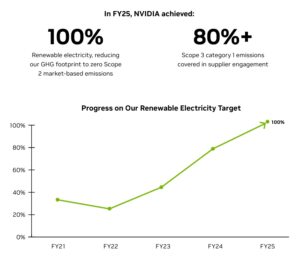
The company achieved 100% renewable electricity usage in FY25 for all offices and data centers under its operational control. This milestone was reached through a combination of on-site solar, utility renewable electricity tariffs, energy attribute certificates, and long-term power purchase agreements.

Real Progress on Scope 1, 2, and 3 Emissions

Nvidia’s climate goals go beyond its operations. Its latest sustainability report showed that the company is making strong progress on all three scopes of emissions:

  • Scope 1 & 2: Nvidia has committed to reducing absolute emissions by 50% by FY30 from a FY23 base year.
  • Scope 3: Already engaged with suppliers accounting for over 80% of its Scope 3 Category 1 GHG emissions, Nvidia now aims to reduce emissions intensity by 75% per PFLOP (a unit of computational power) by FY30.

Notably, Nvidia’s Scope 3 emissions rose from 3.6 million CO₂e in FY24 to 6.9 million CO₂e in FY25, due to increased chip demand. However, its focus on emissions per unit of computation helps offset the overall growth in absolute emissions.

These goals have been validated by the Science-Based Targets initiative (SBTi), aligning Nvidia with a 1.5°C climate pathway.

NVIDIA
Source: NVIDIA

Growing Pressure from ESG Investors and Stakeholders

Nvidia’s central role in major indices and AI infrastructure is bringing it under growing scrutiny from ESG investors and regulators. Shareholders are now demanding:

  • Greater transparency on Scope 3 emissions
  • Responsible water and energy use
  • Ethical sourcing and labor practices in the supply chain

As a fabless company that outsources its manufacturing, Nvidia wields increasing influence over its suppliers. The company is now requiring foundries and vendors to adopt cleaner energy and reduce waste, raising the bar for environmental responsibility across the semiconductor industry.

Sustainability Is Driving Product Innovation

The company would continue encouraging innovation in green technology. As demand surges for energy-efficient chips, the company is helping shift the focus from raw performance to performance plus sustainability.

This shift includes:

  • Designing GPUs using more recycled materials
  • Exploring product circularity and repairability
  • Promoting “as-a-service” models that lower carbon impact across the product lifecycle

Additionally, NVIDIA chips are powering applications that directly support climate action, from energy modeling and emissions tracking to smart grid optimization.

Pushing the Semiconductor Sector Toward Climate Solutions

The semiconductor sector has long faced criticism for its environmental footprint. Now, companies like Nvidia are reframing the narrative by showing how advanced chips can enable sustainability across industries.

By powering high-efficiency data centers and low-energy AI workloads, the chip giant is making the tech sector more climate-aligned.

Also, data centers using Nvidia’s architecture are being designed to:

  • Minimize energy waste
  • Reduce cooling demands
  • Operate with higher computational efficiency

This positions Nvidia and the broader semiconductor sector as both contributors as well as solvers of the climate crisis.

NVDA Stock (NVDA): Riding High on AI Chips Demand

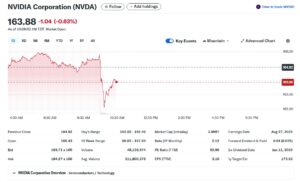
Nvidia stock (NVDA) has been one of the standout performers of 2025, trading near record highs at $164.92 per share. Its market cap surged past $4 trillion, delivering nearly 40% year-to-date gains—a reflection of:

  • Unmatched demand for AI chips
  • Blockbuster earnings results
  • Strategic partnerships with Big Tech

Races Ahead the Big Techs and Industry Titans

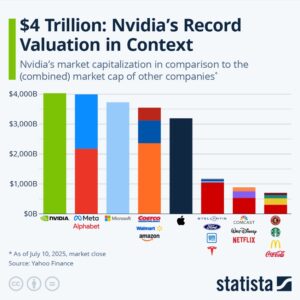
Statista also reported that because of its AI boom, its stock has jumped over 1,000% in just 2.5 years.

To grasp the scale quickly, NVIDIA is worth more than Apple and Microsoft. It tops Alphabet and Meta combined.

NVIDIA
Source: Statista

Despite regulatory risks and competition from AMD (NASDAQ: AMD) and Intel (NASDAQ: INTC), Nvidia’s dominance in AI chips and commitment to sustainable growth continue to win over investors.

nvidia NVDA STOCK
Source: Yahoo Finance

Its meteoric rise and sustainability leadership are redefining what it means to be an ESG-aligned tech giant. For ESG investors, NVDA is more than just a growth stock. It’s rather a climate-impact stock, with deep implications for fund strategies and sustainability benchmarks.

As Nvidia scales new heights in AI and semiconductors, its environmental and social choices will shape its future and the entire tech industry.

The post NVIDIA (NVDA Stock) Hits $4 Trillion, Igniting ESG Investment Momentum Across the Semiconductor Sector appeared first on Carbon Credits.

China’s Envision Energy Launches World’s Largest Green Hydrogen and Ammonia Plant

China's Envision Energy Launches World’s Largest Green Hydrogen and Ammonia Plant

China’s Envision Energy has launched the world’s largest green hydrogen and ammonia plant in Chifeng, Inner Mongolia. The plant sits in the Net-Zero Industrial Park. It runs completely on off-grid renewable sources like wind, solar, and battery storage. Artificial intelligence manages its operations.

The facility will start with a capacity of 320,000 tonnes of green ammonia each year. It plans to begin exports in the fourth quarter of 2025. This milestone is key for large-scale decarbonization. It puts China in a leading role in the global hydrogen economy.

Off-Grid & On Point: The World’s Smartest Hydrogen Plant

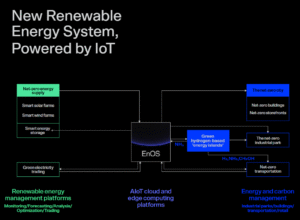
Envision’s Chifeng plant stands out as it operates fully off-grid, unlike many hydrogen facilities that still rely on fossil fuel-powered grids. This means it uses only renewable sources for electrolysis and ammonia synthesis. Thus, there are no carbon emissions from energy input. AI is key in managing these operations. It helps keep energy supply and demand balanced in real time.

Envision Energy net zero system
Source: Envision Energy

A particularly innovative feature is the use of surplus renewable energy to produce and store liquid nitrogen. This helps stabilize the system when the wind or sun is low, providing a steady, reliable energy supply.

With this system, AI, clean power, and storage tech help solve a big problem in green hydrogen production: the unpredictability of renewable energy.

From Mongolia to the World: Scaling Up Clean Ammonia

Envision’s ammonia output is already the largest in the world at 320,000 tonnes per year. But they plan to grow this capacity to 1.5 million tonnes each year by 2028. This nearly fivefold expansion signals the company’s long-term commitment to clean fuels and global exports.

In line with these goals, Envision has secured a major offtake agreement with Marubeni Corporation of Japan. The deal will supply green ammonia to sectors like fertilizers, chemicals, and shipping. These markets are looking for low-carbon options.

Ammonia is key as a hydrogen carrier. It makes storage and transport easier than pure hydrogen gas. This makes it especially attractive for industries such as global shipping and heavy manufacturing, which require scalable clean fuels.

By enabling ammonia production using green hydrogen from renewable energy, Envision’s plant supports both climate targets and energy security. China is pushing hard on clean energy. This project highlights the country’s growing role in global decarbonization.

The country ramped up its clean power output to a record-breaking 951 TWh in the first quarter of 2025, up 19% from Q1 2024. Renewables account for nearly 39% of its total electricity mix. Wind (307 TWh) and solar (254 TWh) led the surge, with solar generation growing by 48%, marking the first time these sources combined surpassed hydropower in China’s power mix.

The Global Hydrogen Market: Strong Growth Ahead

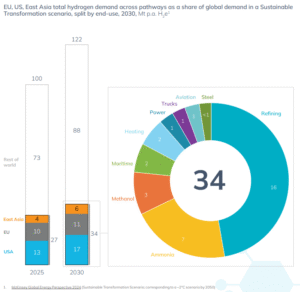
The launch of Envision’s hydrogen facility aligns with accelerating global trends in green hydrogen. Market analysts project explosive growth over the next decade:

Such projections are driven by falling costs and stronger policy support. Electrolyzer technologies are becoming more efficient and affordable, and renewable energy is now the cheapest source of new electricity in many regions. As such, green hydrogen is becoming more competitive with fossil-based hydrogen. This is especially true in tough-to-decarbonize sectors.

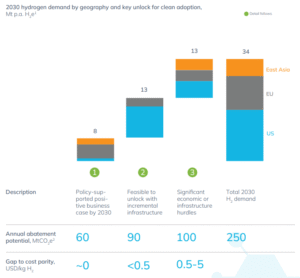
EU, US, East Asia total hydrogen demand across pathways
Source: Hydrogen Council

Large-scale projects in Saudi Arabia and Australia echo this momentum:

  • NEOM Green Hydrogen Project (Saudi Arabia): Expected to produce 600 tonnes of hydrogen per day and 1.2 million tonnes of ammonia annually.
  • Australian Renewable Energy Hub: Aims to harness 26 GW of solar and wind for hydrogen and ammonia production.

Meanwhile, both the European Union and the United States are rolling out major policies, including hydrogen subsidies and certification standards, to speed up adoption.

2030 hydrogen demand by geography
Source: Hydrogen Council

A Blueprint for Industrial Decarbonization

Envision’s achievement is more than a regional success story. It provides a clear plan for countries and industries. They can quickly boost clean hydrogen production by using renewable energy, AI, and smart design.

Also, this project highlights how green ammonia can act as both a climate mitigation tool and a clean energy carrier. It will play an increasingly important role in decarbonizing global trade, shipping, and chemical production. 

More notably, this initiative shows Envision Energy’s commitment to its pioneering net-zero efforts.

Envision Energy’s Net-Zero Progress and Emissions Strategy

Envision Energy aims for net-zero emissions by 2050. They also have goals for 2030. The company’s 2024 Net Zero Action Report states that the company became carbon neutral in 2022. It also plans to cut Scope 1 and 2 emissions by 50% by 2030, using 2020 as the baseline.

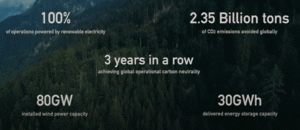
Envision Energy carbon neutrality

Envision is tackling Scope 3 emissions, which are the largest part of its carbon footprint. They are focusing on engaging suppliers and improving product design throughout their lifecycle. The company uses digital tools to cut emissions. Its AIoT operating system, EnOS™, helps optimize wind farms, batteries, and hydrogen systems.

Envision energy GHG emissions 2023
Source: Envision Energy

In 2023, Envision cut over 2 million metric tons of CO₂e through its clean energy technologies. These efforts follow SBTi guidance and the UN Race to Zero campaign. They also strengthen Envision’s role in climate-friendly innovation and decarbonization.

Envision is also key in speeding up global decarbonization. Its Net Zero Industrial Park in Ordos, Inner Mongolia, hosts the world’s largest green hydrogen and ammonia project. This industrial park integrates wind and solar energy, AI, and hydrogen technologies into a closed-loop, zero-emissions system.

It is a model for green manufacturing that aims to cut millions of tons of emissions each year. Also, it supports low-carbon supply chains in industries like steel, cement, and chemicals.

Looking Forward: China’s Role in a Hydrogen Future

Envision Energy’s hydrogen development also reflects China’s broader ambition to lead in the global energy transition. China, already a leader in solar panels, electric vehicles, and battery storage, is now investing heavily in green hydrogen. This move aims to strengthen its position in clean energy.

For global stakeholders, the Chifeng plant can be a wake-up call. As hydrogen markets take shape, those who lead in innovation and infrastructure may define the new clean economy.

Envision’s Chifeng facility marks a turning point in the global hydrogen race. With its blend of renewable power, smart systems, and scalable design, it sets a new benchmark for what’s possible in clean fuel production.

The post China’s Envision Energy Launches World’s Largest Green Hydrogen and Ammonia Plant appeared first on Carbon Credits.

Formation Metals (FOMO Stock) Powers Up: Gold, Nickel, and More For a Clean Energy Future

gold

Disseminated on behalf of Formation Metals Inc.

Formation Metals Inc. (CSE:FOMO, OTCPK:FOMTF, FSE:VF1) is a Canadian exploration company focused on supplying minerals essential to modern technology and clean energy. While much attention has been given to its gold assets, the company is also advancing exploration for copper, zinc, nickel, and titanium. This multi-metal approach supports North America’s growing need for critical minerals and positions the company for long-term growth as demand continues to rise.

Mining More Than Gold: Why FOMO’s Metals Mix Matters

Critical minerals are vital to industries such as electric vehicles (EVs), renewable energy, electronics, and national defense. Gold is used in electronics and valued as a store of wealth. Copper and zinc are essential for wiring, batteries, and large infrastructure projects. 

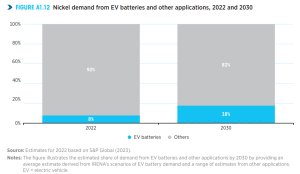
Nickel is a key ingredient in EV batteries, and demand for it could nearly double by 2030. From 2017 to 2022, the percentage of nickel used in batteries rose from 6% to 16%. Titanium, known for its strength and lightweight, plays an important role in aerospace and advanced manufacturing.

nickel demand from EV batteries 2022 and 2030

Governments in Canada and the United States have identified these minerals as strategic resources. With growing pressure to build secure, local supply chains for clean energy, both countries are actively supporting domestic exploration and development of critical minerals. 

Canada, for instance, is the fourth-largest global producer of nickel and fifth in titanium. In 2024, the global nickel market was valued at around $37 billion and is expected to grow to $73 billion by 2032.

Notably, Canada faces a growing challenge to capture its share of a booming $65 billion critical minerals market. A new report warns that Canada risks losing up to $100 billion in investment by 2030 without faster permitting and better coordination. 

Canada critical mineral reserves vs production
Source: CCI Report

This matters to Formation Metals (FOMO), as its Quebec and Ontario projects—gold, nickel, copper, zinc, and titanium—align directly with national priorities. With Canada targeting 60% of global potash and 14% of nickel supply, FOMO’s focus on domestic, multi-metal exploration positions it to benefit from policy improvements and rising clean-tech demand.

Exploring a Diversified Portfolio Across Canada

Formation Metals’ flagship asset is the N2 Gold Project, located in Québec’s Abitibi Greenstone Belt—one of the world’s most productive gold regions. The project spans 87 claims covering approximately 4,400 hectares and is accessible by road year-round. It holds a historical gold resource of about 870,000 ounces, with large parts of the property still underexplored. 

FOMO Abitibi Greenstone Belt
Source: FOMO

Recent reviews of historic drill core samples have revealed copper and zinc mineralization, suggesting the project’s value could extend beyond gold. This is important as demand for base metals like copper continues to rise, driven by growth in the EV sector and renewable infrastructure.

In addition to the N2 project, Formation Metals owns the Nicobat Project in Ontario, which is focused on nickel, copper, and cobalt—metals that are essential for batteries and clean energy systems. The company is also advancing an early-stage titanium project in Québec, aimed at serving aerospace, defense, and high-tech industries. 

By exploring a range of metals, Formation Metals spreads risk and creates multiple pathways to market success. This strategy enables the company to benefit even when the price of one commodity fluctuates.

Strong Jurisdictions and Responsible Development

All of Formation Metals’ assets are in Canada. The country is known for its political stability, clear mining rules, and skilled workers. Québec and Ontario are top mining regions. They provide reliable infrastructure and clear permitting processes. These strengths help reduce project risk and improve the efficiency of development.

FOMO also prioritizes responsible exploration. The company works with local governments, municipalities, and Indigenous communities. This helps ensure their projects respect local interests and meet environmental standards. This commitment supports long-term success and reflects the expectations of today’s investors and regulators.

Backed for Big Exploration in 2025

As of mid-2025, Formation Metals maintains a strong financial position, with about C$2.8 million in working capital. It recently completed a private placement to fund continued exploration. 

The company is fully financed for a 20,000-metre drill program at the N2 Gold Project. The first phase, covering 5,000 metres, is already underway. This drill program focuses on expanding known gold zones and testing new areas for copper and zinc mineralization. Systematic exploration like this is essential for uncovering a project’s full resource potential.

Riding the Wave of Clean Tech Demand

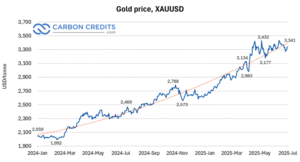
The company’s multi-metal strategy fits well with current global market trends. In 2025, gold prices reached record highs above $3,400 per ounce, driven by economic uncertainty and strong central bank demand. 

Gold Price - July 2025 upd

At the same time, copper demand is expected to grow by 30% by the mid-2020s. This rise is mainly driven by electric vehicle production and power grid upgrades. Nickel demand is also increasing as EV adoption grows and stainless steel production expands. The global market for nickel-based batteries alone could grow from USD 2.34 billion in 2025 to USD 2.82 billion by 2030.

Key Market Highlights:

  • Gold: Prices above $3,400/oz in 2025, driven by investor demand.
  • Copper: 30% demand growth forecast due to EVs and grid expansion.
  • Nickel: Market value to nearly double from USD 37B (2024) to USD 73B (2032).
  • Battery-grade nickel: Projected growth from USD 2.34B (2025) to USD 2.82B (2030).
  • Titanium and zinc: Strong demand in aerospace and infrastructure.

By targeting both precious and base metals, Formation Metals can benefit from several market forces at once. This diversified approach allows the company to create shareholder value even if one metal’s price declines. It also aligns with national efforts to secure domestic supplies of essential minerals.

Stability and Opportunity in Critical Minerals

Looking ahead, Formation Metals is positioned for growth as it continues to develop its projects. With a fully funded exploration program, strong financial footing, and projects located in top mining jurisdictions, the company is advancing assets that are critical to the future of clean energy and high-tech industries.

As global demand for critical minerals continues to grow, companies with diversified portfolios and responsible development strategies are likely to play a major role. Formation Metals’ focus on gold, copper, zinc, nickel, and titanium gives it broad exposure to several high-demand sectors.

Its multi-metal strategy and commitment to sustainable development offer both stability and upside potential for investors. Formation Metals is more than a gold explorer—it is helping to secure the resources needed for a cleaner, more sustainable future.

DISCLAIMER

New Era Publishing Inc. and/or CarbonCredits.com (“We” or “Us”) are not securities dealers or brokers, investment advisers or financial advisers, and you should not rely on the information herein as investment advice. Formation Metals Inc. made a one-time payment of $30,000 to provide marketing services for a term of 1 month. None of the owners, members, directors, or employees of New Era Publishing Inc. and/or CarbonCredits.com currently hold, or have any beneficial ownership in, any shares, stocks, or options in the companies mentioned. This article is informational only and is solely for use by prospective investors in determining whether to seek additional information. This does not constitute an offer to sell or a solicitation of an offer to buy any securities. Examples that we provide of share price increases pertaining to a particular Issuer from one referenced date to another represent an arbitrarily chosen time period and are no indication whatsoever of future stock prices for that Issuer and are of no predictive value. Our stock profiles are intended to highlight certain companies for your further investigation; they are not stock recommendations or constitute an offer or sale of the referenced securities. The securities issued by the companies we profile should be considered high risk; if you do invest despite these warnings, you may lose your entire investment. Please do your own research before investing, including reading the companies’ SEDAR+ and SEC filings, press releases, and risk disclosures. It is our policy that information contained in this profile was provided by the company, extracted from SEDAR+ and SEC filings, company websites, and other publicly available sources. We believe the sources and information are accurate and reliable but we cannot guarantee it.

 CAUTIONARY STATEMENT AND FORWARD-LOOKING INFORMATION

Certain statements contained in this news release may constitute “forward-looking information” within the meaning of applicable securities laws. Forward-looking information generally can be identified by words such as “anticipate”, “expect”, “estimate”, “forecast”, “planned”, and similar expressions suggesting future outcomes or events. These statements reflect current views regarding company performance, business goals, market conditions, and intellectual property development. The statements are based on current business and market expectations. However, they involve various risks and uncertainties, including potential delays, financial difficulties, operational challenges, and problems protecting intellectual property. Additional risks include possible regulatory approval delays, market disruptions, personnel issues, and competitive pressures.

Although management of the Company has attempted to identify important factors that could cause actual results to differ materially from those contained in forward-looking information, there may be other factors that cause results not to be as anticipated, estimated or intended. There can be no assurance that such forward-looking information will prove to be accurate, as actual results and future events could differ materially from those anticipated in such forward-looking information. Accordingly, readers should not place undue reliance on forward-looking information. Readers are cautioned that reliance on such information may not be appropriate for other purposes. Additional information about risks and uncertainties is contained in the Company’s management’s discussion and analysis for the year ended December 31, 2024, and the Company’s annual information form for the year ended December 31, 2024, copies of which are available on SEDAR+ at www.sedarplus.ca.

The forward-looking information contained herein is expressly qualified in its entirety by this cautionary statement. Forward-looking information reflects management’s current beliefs and is based on information currently available to the Company. The forward-looking information is made as of the date of this news release and the Company assumes no obligation to update or revise such information to reflect new events or circumstances, except as may be required by applicable law.

For more information on the Company, investors should review the Company’s continuous disclosure filings that are available on SEDAR+ at www.sedarplus.ca.

Please read our Full RISKS and DISCLOSURE here.

Carboncredits.com receives compensation for this publication and has a business relationship with any company whose stock(s) is/are mentioned in this article.

Additional disclosure: This communication serves the sole purpose of adding value to the research process and is for information only. Please do your own due diligence. Every investment in securities mentioned in publications of carboncredits.com involves risks that could lead to a total loss of the invested capital.

Please read our Full RISKS and DISCLOSURE here.

The post Formation Metals (FOMO Stock) Powers Up: Gold, Nickel, and More For a Clean Energy Future appeared first on Carbon Credits.

MP Materials (MP Stock): The Rare Earth Magnet Powering America’s Clean Energy and Climate Goals

mp materials

MP Materials (MP Stock) is a key player in two major global shifts: the race for critical minerals and the transition to clean energy. The company operates Mountain Pass in California, which is notably the only rare earth mine and processing facility in the U.S.

MP’s neodymium-praseodymium (NdPr) magnets are powering modern life and are essential for clean technology. It produces over 10% of the world’s rare earth supply and is positioning the U.S. as a key player in this sector.

Why Are MP Materials’ Rare Earth Magnets America’s Clean Energy Backbone?

MP Materials’ NdPr magnets, specifically neodymium-iron-boron (NdFeB) permanent magnets, are the world’s most powerful and efficient permanent magnets. Broadly speaking, they are essential for high-performance electric motors and generators in sectors such as electric vehicles, wind turbines, robotics, aerospace, defense, and advanced electronics. Without a steady supply, the entire U.S. EV and renewable energy roadmap could be in jeopardy.

In 2024, MP launched its state-of-the-art Independence Parkway facility in Fort Worth, Texas. The site plans to produce about 1,000 metric tons of finished NdFeB magnets each year, starting to increase production slowly in late 2025. The facility will supply magnets to General Motors and other companies, using raw materials from Mountain Pass, MP Materials’ mine and processing plant in California.

It’s a major milestone, making MP the only U.S. company with a fully integrated supply chain from mine to magnet.

From Mine to Magnet: MP Materials Powers a Low-Emission Future

MP Materials is redefining rare earth production with sustainability at its core. Its Mountain Pass site—America’s only integrated rare earth facility combines mining, beneficiation, and processing in one location. This streamlined setup significantly cuts transport emissions and boosts operational efficiency.

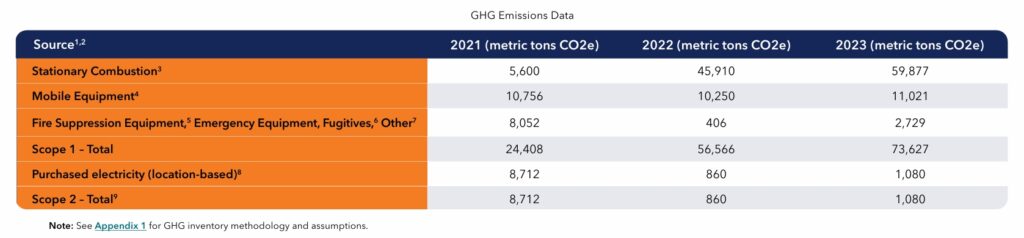
The company’s sustainability report revealed that it follows California’s AB 32 Global Warming Solutions Act, which mandates the purchase of emissions allowances. These funds support the state’s climate programs. While overall greenhouse gas emissions increased in 2023 due to expansion, MP remains committed to reducing its carbon intensity by adopting cleaner energy and improving processes.

Its sustainable strategy is backed by real progress:

  • Water Conservation: Achieved a 95% water recycling rate during beneficiation.
  • Waste Reduction: Utilizes closed-loop systems to minimize hazardous waste.
  • Independent Recognition: Earned a Bronze Medal from EcoVadis and completed an IRMA Verified self-assessment.
  • Life Cycle Research: Ongoing studies aim to lower cradle-to-gate environmental impacts.
  • Clean Compliance: Reported zero environmental violations in 2023.

A 2023 German government study even ranked MP’s environmental performance above global peers, especially in water efficiency and climate-related metrics, placing it at the forefront of sustainable rare earth mining.

mp materials
Source: MP Materials

Greener Magnet Manufacturing

MP’s approach extends beyond extraction. It has developed cutting-edge, low-impact techniques to produce high-performance magnets:

  • Molten Salt Electrolysis: Converts rare earth oxides into pure metals efficiently.
  • Strip Casting: Blends rare earths with other metals to form magnet-ready alloys.
  • Pressing & Sintering: Shapes alloy powders into powerful magnetic blocks.
  • Precision Finishing: Enhances magnetic properties while reducing material waste.
  • Recycling Innovation: Invests in systems to recover rare earth materials and close the loop.

By focusing on cleaner production and recycling, MP Materials is setting new standards for responsible magnet manufacturing. Its integrated and innovation-driven model supports both national security and the clean energy transition, proving that rare earth production can be both powerful and planet-friendly.

Green Finance in Action

In 2021, MP Materials issued $672.3 million in green bonds, fully allocated to climate-aligned projects under its Green Financing Framework. The funds supported efforts in:

  • Sustainable water management
  • Renewable energy adoption
  • Energy-efficient production equipment
  • Eco-efficient product innovation

The framework aligns with the International Capital Market Association’s Green Bond Principles and reflects MP’s long-term ESG vision. By investing in cleaner systems now, MP is building a greener supply chain that delivers environmental and economic value.

Carbon Credit Potential

MP’s operations have real carbon credit relevance. By ending rare earth concentrate shipments to China and moving processing onshore, it is cutting off transoceanic shipping emissions. This not only lowers carbon footprints for its customers but also qualifies MP’s supply chain for lifecycle carbon savings.

Their integrated approach at Mountain Pass helps conserve water (95% recycled), minimize hazardous waste, and reduce emissions across the value chain. The company’s recycling-first mindset further adds to the emissions-cutting potential of every magnet it sells.

MP Materials Stock (NYSE: MP): A Rare Investment Opportunity

MP Materials is right now the cornerstone of America’s clean energy future.  As demand grows for EVs, wind power, and defense tech, it is supplying the rare earth magnets that power low-carbon innovation.

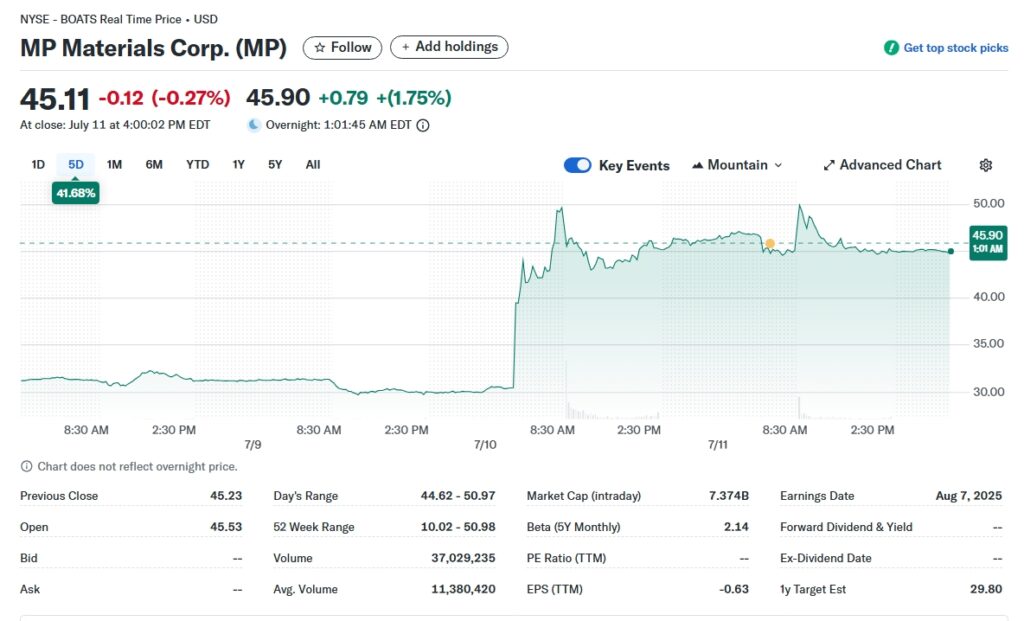
The MP Materials Corp. stock [NYSE: MP] jumped nearly 51% to close at $45.23 on 10th July and continued to climb early Friday, reaching an intraday high of $50.98 before settling slightly down 0.3% to $45.09 at the close.

mp materials stock
Source: Yahoo Finance

This surge on Thursday and Friday brought MP Materials’ stock to its highest level in about three years, dating back to early 2022. The precise reasons were:

  • Strategic Deal with U.S. Department of Defense (DoD): A $400 million equity stake and $150 million loan from the DoD will help expand Mountain Pass. The Pentagon will also become MP’s largest shareholder and a guaranteed buyer of magnets for 10 years at a set price of $110/kg.
  • “10X Facility” by 2028: This new site will produce 10,000 metric tons of magnets per year, making MP the backbone of U.S. clean-tech and defense manufacturing.
  • U.S.-China Decoupling: MP cut off concentrate exports to China. Instead, it’s focusing on supply agreements with the U.S., Japan, and South Korea, fortifying energy security.

Revenue Growth in Q1 2025 

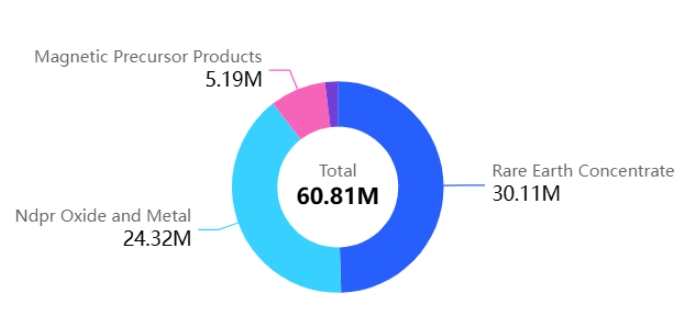
Total revenue rose 25% year over year to $60.8 million in Q1 2025, driven by higher production of separated products like NdPr oxide and metal. For the first time, revenue from magnetic precursor sales was recognized in early 2025. Meanwhile, rare earth concentrate sales dropped as more material was refined into higher-value products.

Highlights include a record 563 metric tons of NdPr produced, a 36% increase, and strong REO production at 12,213 metric tons, up 10% from last year. NdPr sales more than doubled to 464 metric tons. The Magnetics division made its first metal deliveries, generating $5.2 million in revenue with positive adjusted EBITDA.

MP Materials Business Review
Image sourced from AI Invest, data: Q1 2025

MP’s current financials reflect the cost of rapid scaling, with a current operating margin of -53.88%. At the end of 2024, it was -45.79%. It’s mostly due to declining revenue from China. Nonetheless, experts believe that this is a long-term play.

With strong support from the Pentagon and growing U.S. efforts to secure critical minerals, MP is positioned to lead in rare earth production for years to come. For carbon credit and ESG-focused investors, it offers something rare: real emissions impact, a green supply chain, and alignment with national priorities. It’s a rare opportunity in every sense.

The post MP Materials (MP Stock): The Rare Earth Magnet Powering America’s Clean Energy and Climate Goals appeared first on Carbon Credits.

Carbon Capture and Storage to Grow 4x by 2030: It Is a Turning Point for Climate Action?

Carbon Capture and Storage to Grow 4x by 2030: It Is a Turning Point for Climate Action?

Carbon capture and storage, or CCS, is rapidly becoming one of the most important tools in the fight against climate change. With global emissions still rising and many industries struggling to cut carbon, CCS offers a way to remove and store CO₂ before it reaches the atmosphere. 

Recent reports show that global CCS capacity is expected to grow quickly this decade, marking a critical moment for the technology and its role in meeting climate goals. Let’s unravel why this technology is important in achieving net-zero pledges, which regions lead in development, and what challenges are slowing its adoption. 

What Is CCS and Why Does It Matter?

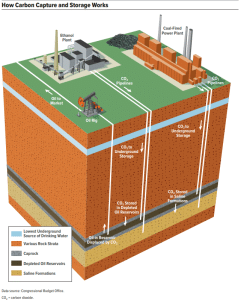
To understand carbon capture and storage, think of it as a climate safety net. It works by capturing carbon dioxide from two main sources. One is industrial sites, like factories and power plants. The other is directly from the air using advanced machines.

The captured CO₂ is compressed and stored underground in rock formations. This keeps it out of the atmosphere for hundreds or even thousands of years.

how carbon capture and storage works
Source: Image from Congressional Budget Office.Gov

This process is essential for two reasons:

  1. It helps lower emissions from hard-to-decarbonize sectors such as cement, steel, and chemicals.

  2. Using direct air capture (DAC) or biomass energy (BECCS) can remove carbon from the atmosphere. This is essential for reaching net-zero by mid-century.

Although CCS alone can’t solve the climate crisis, most scientists and climate experts agree that it must be part of the solution.

CCS Capacity Set to Quadruple by 2030 

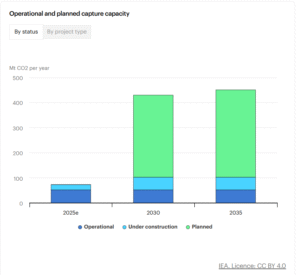
In the past, CCS was mostly used in small pilot projects. But now, it’s entering a new phase. According to the latest data, global CCS capacity is projected to quadruple by 2030. This rapid growth is backed by an estimated $80 billion in investments expected to be deployed over just five years.

Today, there are around 50 million tonnes of CO₂ captured each year through CCS, according to the International Energy Agency. By 2030, that number is expected to rise to 430 million tonnes, with storage capacity potentially reaching 670 million tonnes. This shift is no longer theoretical—it’s happening now.

CCS operational and planned capacity IEA
Source: IEA

Several new projects have broken ground recently, including the world’s first cement plant with carbon capture and the largest DAC facility. These developments show that CCS is expanding both in size and across different sectors.

Who’s Leading the Charge? Global CCS Hotspots and Rising Stars

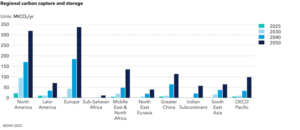
Right now, North America and Europe lead the world in CCS development. Together, they make up about 80% of all upcoming capture and storage capacity. However, other regions are beginning to catch up.

DNV_CCS_forecast_2050_Regional_carbon_capture_and_storage
Source: DNV

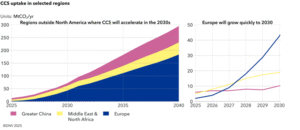
Countries like China, Brazil, and some in the Middle East are starting to invest heavily in CCS projects. For example, China alone is building projects that could capture over 15 million tonnes of CO₂ per year.

DNV_CCS_forecast_2050_CCS_uptake_in_selected_regions
Source: DNV

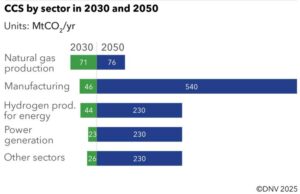
The types of industries using CCS are also growing. Originally tied closely to oil and gas, the technology is now being adopted by the shipping industry, natural gas power plants, and even waste-to-energy projects.

DNV_CCS_forecast_to_2050_CCS_by_sector_2030_and_2050
Source: DNV

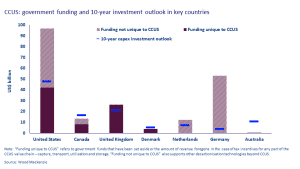
Wood Mackenzie’s projection echoes this trend. The major research and consulting firm estimates that the U.S. carbon capture, utilization, and storage (CCUS) sector could present a $196 billion investment opportunity over the next decade. This is particularly true within the oil, gas, chemical, and power industries.

Wood Mackenzie
Source: Wood Mackenzie

This broader adoption shows that CCS is no longer a niche tool, but it’s becoming mainstream in global climate strategies.

Why Policy and Finance Are Fueling the CCS Surge

This growth wouldn’t be possible without strong policy support and financial incentives. In the United States, the 45Q tax credit provides up to $85 per tonne of CO₂ captured, and even more for DAC, which could reach as high as $180/t. These financial tools make CCS more affordable and appealing to companies. 

Other countries are following suit. The United Kingdom has pledged £22 billion toward CCS, and Canada is offering up to C$83 billion in clean-tech funding, including for carbon removal technologies. These programs give companies the confidence to invest in long-term infrastructure.

As more countries build policy frameworks and carbon markets expand, experts expect investment in CCS to continue rising over the next decade.

What’s Holding Carbon Capture Back

Despite the optimism, several challenges could hold CCS back. One of the biggest issues is the time it takes to move a project from planning to operation. Right now, it can take up to 6 years to complete a CCS facility. To meet the 2030 goals, that timeline needs to be cut in half.

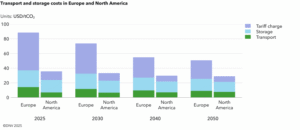
Costs also remain a concern. While prices are coming down, technologies like direct air capture are still expensive—sometimes over $300 per tonne of CO₂ removed. Continued innovation and large-scale deployment are needed to make these solutions more affordable.

DNV_CCS_forecast_2050_transport_and_storage_costs_in_EUR_and_NAM

Another challenge is that CCS projects are unevenly distributed across the globe. Most are in wealthy nations, while developing countries are left behind. For CCS to support global climate goals, more investment and technology sharing must be directed to lower-income regions.

Finally, some critics worry that CCS could be used to delay the transition to renewable energy. If the technology is used to extend the life of fossil fuel plants, it might slow down broader efforts to move away from polluting energy sources.

How Much Can CCS Really Help?

Even with all planned projects, CCS will likely capture only about 6% of the emissions needed to reach net-zero by 2050. That means we need a lot more projects—possibly 100 times more by mid-century.

  • According to global climate scenarios, carbon capture must remove over 1 billion tonnes of CO₂ each year by 2030, and over 6 billion tonnes by 2050.

That’s a steep climb from today’s numbers. Still, if deployed alongside renewable energy, electrification, and energy efficiency, CCS can be a vital piece of the climate puzzle.

Its biggest strength lies in areas where other solutions don’t work well. For example, cement and steel production produce chemical emissions that can’t be avoided without carbon capture. Similarly, CCS makes hydrogen production cleaner and helps remove historical emissions through direct air capture.

If CCS scales as planned, it can:

  • Cut CO₂ emissions from industrial sites like cement and steel
  • Support zero-carbon hydrogen production
  • Enable net-negative emissions when combined with BECCS and DAC

A Powerful Ally in the Net Zero Race

Carbon capture and storage has reached a critical turning point. With capacity set to grow four times larger by 2030 and major projects already underway, CCS is becoming a reality. But if the world hopes to limit warming to 1.5 degrees Celsius, much more is needed.

CCS alone can’t fix the climate crisis, but it can help close the gap, especially in sectors where other solutions fall short. With smart policies, fast deployment, and global cooperation, carbon capture can become a powerful ally in the race to a cleaner, more sustainable future.

The post Carbon Capture and Storage to Grow 4x by 2030: It Is a Turning Point for Climate Action? appeared first on Carbon Credits.

Masdar and Iberdrola Strike €5.2B Deal for UK’s Largest Offshore Wind Project

Featured image sourced from Iberdrola press release 

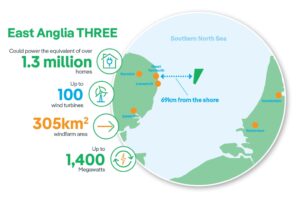
Masdar, the UAE-based clean energy powerhouse, and Spanish energy giant Iberdrola have taken a major leap in global offshore wind development. The duo announced a €5.2 billion co-investment in the 1.4 GW East Anglia THREE project in the UK.

The press release highlighted that it’s the largest offshore wind transaction of the decade. Each company will hold a 50% stake and share governance of the project, reinforcing their long-term alliance to scale renewable energy solutions across Europe and beyond.

HE Dr. Sultan Al Jaber, UAE Minister of Industry and Advanced Technology and Chairman of Masdar, said:

“Masdar and Iberdrola are continuing to forge one of the largest and most powerful strategic clean energy partnerships to accelerate capacity growth in Europe and worldwide. Offshore wind will play a crucial role in the global energy transformation, and landmark developments like Baltic Eagle and East Anglia THREE are significant advances towards clean energy targets in major European nations. With demand surging due to exponential AI growth and the rise of emerging markets, projects such as these have never been more critical.”

1.4 GW East Anglia THREE Project Set to Power 1.3 Million Homes in UK

All conditions for the transaction have been met, and financial close is expected soon. On July 9, project financing was secured with 24 global banks, raising £3.5 billion (€4.1 billion) in one of the largest debt facilities in the sector. The financing, oversubscribed by 40%, will cover a significant portion of the total project cost and will not affect the financial statements of either partner.

Located off the Suffolk coast, East Anglia THREE is part of the broader East Anglia Hub. It received development consent in August 2017, with construction starting in July 2022.

The key milestones of the project are:

  • Deliver clean electricity to 1.3 million UK homes once operational in Q4 2026.
  • Generate more than 2,300 construction jobs and 100 long-term roles, helping to boost the UK’s green economy.

Additionally, the project is backed by a 15-year CPI-linked Contract for Difference (CfD) from the UK government under AR4 and AR6, providing long-term revenue certainty. A Power Purchase Agreement (PPA) with Amazon, signed in 2024, further supports the project’s financial stability and signals growing private sector demand for clean power.

East Anglia THREE offshore wind
Source: Scottish Power Renewables

Unlocking the Fully Energized Baltic Eagle Offshore Wind Farm

Adding to the momentum, the partners celebrated the full energization of the 476 MW Baltic Eagle offshore wind farm in Germany’s Baltic Sea. This is the first project to go live under the Masdar–Iberdrola strategic alliance.

  • Baltic Eagle will generate enough clean electricity for around 475,000 households, cutting 800,000 tons of CO₂ emissions annually.

It forms part of Iberdrola’s larger Baltic Hub, which also includes the Wikinger (350 MW) and Windanker (315 MW) wind farms. Together, these projects will make up the largest offshore wind complex in the Baltic Sea, totaling over 1.1 GW in capacity.

This is also a landmark for Masdar as it marks its first offshore wind project in Germany and the company’s largest-ever euro-denominated financing.

The Baltic Sea holds an estimated 93 GW of offshore wind potential, and countries such as Germany, Poland, Sweden, and Estonia are racing to tap into this vast renewable energy source.

Ignacio Galán, Iberdrola’s Executive Chairman, expressed himself saying

 “Today is an important landmark in our global partnership with Masdar. Partnerships such as this one are vital in accelerating energy security and competitiveness and working towards delivering ambitious climate targets. With Masdar, we have a partner who shares our vision and commitment.”

“Joining forces with Masdar in the East Anglia THREE offshore windfarm will allow Iberdrola to accelerate our strategic focus on the UK, where we are investing £24 billion to 2028 in transmission and distribution networks and in renewable energy, contributing to the delivery of the UK Government’s ambitious electrification plans. The completion of Baltic Eagle represents a new milestone in our partnership, reinforcing Iberdrola’s commitment to electrification and strengthening our presence in the Baltic Sea.”

€15 Billion Alliance to Expand Offshore Wind and Green Hydrogen

These back-to-back milestones reflect the strength of Masdar and Iberdrola’s partnership, launched in December 2023. With a €15 billion joint investment target, the collaboration aims to boost offshore wind and green hydrogen across major markets like the UK, Germany, and the US.

The East Anglia and Baltic Eagle projects not only highlight their leadership in renewable development but also help accelerate Europe’s offshore wind deployment goals. The alliance supports global efforts to triple renewable capacity by 2030, aligning with net-zero ambitions and climate targets.

Work is already underway to identify new joint ventures, with more projects expected to be announced in the coming years. Both companies see their partnership as a long-term strategy to strengthen clean energy infrastructure globally.

offshore wind

Masdar’s European Footprint Grows with 30 GW Target

As Masdar pushes toward its 100 GW global clean energy goal by 2030, Europe remains a strategic priority. In 2024, the company expanded its presence by acquiring Saeta Yield in Spain and TERNA ENERGY in Greece. These deals, alongside its offshore wind ventures, position Masdar to contribute up to 30 GW of clean energy capacity in the region.

Beyond its work with Iberdrola, Masdar has invested heavily in solar and wind projects across key European markets. This not only reinforces its role as a reliable, long-term partner but also boosts regional efforts to meet climate goals and energy security needs.

Furthermore, Mohamed Jameel Al Ramahi, Chief Executive Officer of Masdar, also commented on this historic deal. He said,

“This landmark partnership underscores our commitment to driving Europe’s energy transformation and advancing global climate goals. Our strategic co-investments with Iberdrola in East Anglia THREE and Baltic Eagle demonstrate how ambitious cross-border partnerships can deliver transformative impact at scale. Together, we are setting a new benchmark for offshore wind collaboration, and we are looking forward to deepening this partnership as Europe accelerates its renewable energy targets.”

“Through this partnership, Masdar is reaffirming its long-standing commitment to the European energy transformation. From our roots in the UK since 2008 to our growing presence in Germany, we are proud to be part of some of the region’s most iconic renewable energy developments. Our co-investments in East Anglia THREE and Baltic Eagle exemplify how cross-border collaboration can accelerate impact at scale.”

masdar
Source: MASDAR

Iberdrola Leads Renewable Investments and PPA Market

In 2024, Iberdrola invested €17 billion to support the global energy transition, including over €5.4 billion in renewables.

  • This added 2,600 MW of green energy capacity, pushing the company’s total renewable portfolio past 44,000 MW.

The company remains a PPA market leader in Europe, having signed 1,250 MW worth of long-term energy deals with industrial partners in 2024 alone. These agreements support decarbonization in hard-to-abate sectors and ensure demand for new renewable generation.

Iberdrola’s green investments also drive economic growth, energy independence, and job creation, making the company a vital force in building Europe’s clean energy future.

Iberdrola green energy
Source: Iberdrola

Masdar and Iberdrola’s recent achievements represent a powerful blueprint for scaling clean energy through strategic global partnerships. With bold investments, a shared vision, and boots on the ground in key markets, these energy giants are shaping the next phase of the global energy transition.

The post Masdar and Iberdrola Strike €5.2B Deal for UK’s Largest Offshore Wind Project appeared first on Carbon Credits.
Delta Air Lines’ (DAL) Strong Earnings Spark Airline Stocks Rally, And A Flight Plan to Net Zero

Delta Air Lines' (DAL) Strong Earnings Spark Airline Stocks Rally, And A Flight Plan to Net Zero

U.S. airline stocks surged sharply, driven by Delta Air Lines’ (NYSE: DAL) exceptionally strong second-quarter earnings. Major carriers like United Airlines (UAL), American Airlines (AAL), Alaska Air Group (ALK), and Southwest Airlines (LUV) saw big gains. This happened after Delta shared its positive financial report and full-year guidance update.

But what about the airline’s environmental and sustainability impact? The company’s net-zero journey shows equally impressive progress.

Delta’s Q2 Performance Sparks Market Optimism

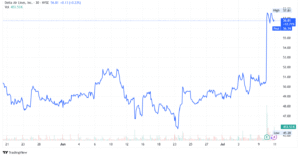
Delta’s stock alone jumped by about 12.5%, making it the top mover of the day. The company reported adjusted earnings per share (EPS) of $2.10, beating analyst forecasts of $2.05–$2.08. Revenue climbed to $15.5 billion, exceeding the expected range of $15.42–$16.41 billion.

Delta Airlines stock
Source: TradingView

Delta also restored its full-year 2025 guidance, showing management’s confidence. This was important because most major airlines, like Delta, stopped giving forecasts earlier this year. They were worried about global economic instability, especially due to President Trump’s new tariff policies.

Now, Delta expects full-year earnings per share between $5.25 and $6.25, with free cash flow projected to range from $3 billion to $4 billion. These results gave investors a clear signal that the travel sector may be turning a corner.

Sympathy Rally Lifts the Entire Airline Sector

Delta’s upbeat results caused a “sympathy rally.” This is when good news from one company boosts others in the same industry. Here’s how key players performed:

  • United Airlines (UAL) surged between 9.4%and 14%, reaching over $89 per share.
  • American Airlines (AAL) rose by 7.8% to 13%, closing in on its 200-day moving average.
  • Alaska Airlines (ALK) gained nearly 10%, adding more than $5 per share.
  • Southwest Airlines (LUV) posted a more modest gain of 2.8% to 3.4%. 

This rise shows that investors are more confident now. This comes after a tough start to 2025, which was marked by trade tensions and fluctuating fuel prices.

Analysts liked Delta’s earnings report. They expect United and American Airlines will also do well in their next earnings announcements. Deutsche Bank, among others, forecast continued strong results across the sector.
For investors, these trends suggest that the airline sector may be entering a more stable and profitable phase, following the turbulence of early 2025. But how about the sector’s environmental footprint? Let’s take a closer look at Delta’s sustainability and climate goals. 

Delta Airlines: In Route Toward Net Zero

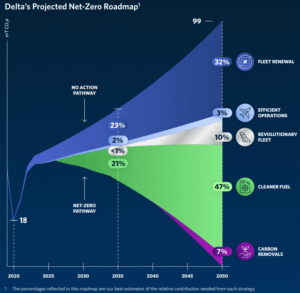
As climate concerns grow and investor pressure mounts, Delta Air Lines has taken firm steps toward its long-term sustainability goals. The company aims to become the first carbon-neutral airline globally and has pledged to reach net-zero emissions by 2050.
Delta Airlines net zero roadmap
Source: Delta Airlines

This goal covers three areas: Direct operations (Scope 1), indirect emissions from energy use (Scope 2), and some Scope 3 emissions like upstream fuel production and corporate travel.

Since nearly 90% of its greenhouse gas emissions come from jet fuel, reaching net-zero by 2050 requires Delta to effectively decarbonize its flight operations. The company’s sustainability strategy is designed to support this goal by focusing on:

  • What We Fly — transitioning its fleet to more fuel-efficient aircraft
  • How We Fly — adopting new technologies, procedures, and other strategies to improve fuel efficiency
  • The Fuel We Use — collaborating to scale supply and reduce the cost of SAF

Sustainable Aviation Fuel (SAF): A Key Ingredient

One of Delta’s biggest bets in reducing emissions is sustainable aviation fuel. SAF comes from renewable sources like used cooking oil or plant waste. It can cut lifecycle carbon emissions by up to 80% when compared to traditional jet fuel.

Delta has signed several major SAF purchase agreements, including:

  • A long-term agreement with Neste to purchase 10 million gallons of SAF per year.
  • A partnership with Gevo, with the potential for 75 million gallons annually starting in 2026.

The company’s goal is to replace at least 10% of its conventional jet fuel with SAF by 2030, a target aligned with broader aviation industry goals. Below is the company’s SAF purchases:

Delta SAF purchases
Source: Delta Airlines

Cleaner Planes and Smarter Flying

Delta is also focused on fleet renewal—replacing older planes with newer, more efficient models. The latest Airbus A321neos and A220s offer 20–25% better fuel efficiency per seat, helping lower emissions on each flight.

In addition, Delta uses AI and data analytics to optimize flight routes and reduce fuel burn. The company added lighter seats and cabin materials to cut aircraft weight. It also improved aerodynamics to save energy while flying.

Ground Operations and Renewable Energy

Beyond the skies, Delta is greening its ground operations. So far, the airline has:

  • Converted over 25% of its ground service equipment to electric or hybrid.
  • Purchased renewable electricity for 100% of its operations at Atlanta’s Hartsfield-Jackson International Airport—Delta’s largest hub.
  • Set a goal to electrify 50% of its ground operations by 2025.

Carbon Offsets: A Transitional Tool

While Delta previously announced carbon neutrality starting in 2020, it primarily relied on carbon offset credits to compensate for emissions. These carbon credits supported projects like forest protection and methane capture. In 2022, Delta shifted away from offsets. They decided to focus on reducing actual emissions instead of using compensatory measures.

This move reflects the industry-wide demand for real climate impact and transparency in offset claims. Delta now uses offsets sparingly and only in cases where decarbonization options are limited.

Tracking Progress

According to Delta’s latest difference report, the company has emitted over 60 million tonnes of CO2e. It has achieved the following progress in cutting its emissions: 

  • The company cut its Scope 1 emissions intensity by 13% compared to 2019 levels.
  • Delta invested $1 billion over 10 years in a long-term climate strategy starting in 2020.
  • It avoided 1.7 million metric tons of CO₂ through efficiency improvements and SAF use between 2021 and 2023.
Delta Airlines GHG emissions 2024
Source: Delta Airlines

Public Accountability and Disclosure

Delta regularly publishes climate data through its annual ESG and TCFD reports. The company joined the Science-Based Targets initiative (SBTi). It shares risks about climate change, policies, and fuel prices. In 2023, Delta ranked among the top U.S. airlines for climate transparency.

Earnings Up, Green Goals Still in Sight

Delta’s net-zero plan is one of the most comprehensive in the airline industry. It combines technology, SAF, operational efficiency, and transparency to make measurable progress. The company faces challenges, like scaling SAF production and electrifying long trips. Still, its recent actions show a strong commitment to growth and environmental responsibility.

Delta’s strong Q2 2025 results have not only boosted its stock but also lifted the entire airline industry. Behind the numbers is a broader story of operational resilience, pricing discipline, and strategic planning during uncertain times.

At the same time, Delta is showing that profitability and sustainability can go hand in hand. Its investments in SAF, fuel efficiency, and low-carbon operations signal a long-term vision aligned with climate goals.

The post Delta Air Lines’ (DAL) Strong Earnings Spark Airline Stocks Rally, And A Flight Plan to Net Zero appeared first on Carbon Credits.