Zambia, Brazil and Ecuador Accelerate Carbon Markets as Article 6 Gains Ground

Zambia, Brazil and Ecuador Accelerate Carbon Markets as Article 6 Gains Ground
Carbon markets are entering a new stage. Governments are moving beyond climate plans and building systems to issue, track, and trade carbon credits. Three developments this week show how fast this shift is happening.

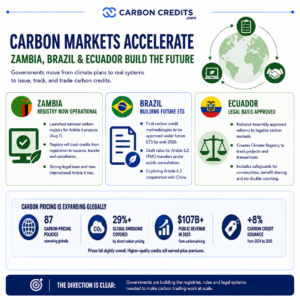
Zambia has launched an operational national carbon registry for Article 6 projects. Brazil plans to approve its first carbon credit methodologies under its future emissions trading system by the end of 2026. It is also considering deeper Article 6 cooperation with China. Ecuador’s National Assembly has approved reforms that would give carbon markets a legal basis.

The three moves are different, but they show the same trend. Governments are taking a bigger role in tracking, approving and trading carbon credits.

Carbon Pricing Is Moving From Policy to Infrastructure

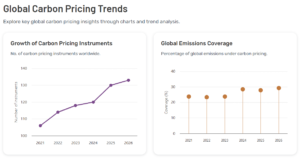
These developments come as carbon pricing expands around the world. The World Bank’s State and Trends of Carbon Pricing 2026 found that 87 carbon pricing policies were operating globally. Direct carbon pricing now covers more than 29% of global greenhouse gas emissions. It also generated more than $107 billion in public revenue in 2025.

The report also found that carbon credit issuance rose 8% between 2024 and 2025. Carbon prices, however, fell slightly overall. Higher-quality credits still earned price premiums. This is making the carbon market more demanding for countries that want to increase credit supply.
carbon pricing trend world bank 2026
Source: World Bank

Governments need more than carbon projects. They also need clear rules for approval, measurement, reporting and verification. They need registries, accounting systems and safeguards.

Zambia, Brazil and Ecuador are now building these systems.

Zambia Switches On Its Article 6 Carbon Registry

Zambia launched an operational national carbon registry on August 7 for projects under Article 6 of the Paris Agreement. The system is also expected to support voluntary carbon market projects.

The registry is part of Zambia’s wider carbon market system. The Zambia Environmental Management Agency (ZEMA) will administer it.

Zambia’s 2026 regulations require ZEMA to maintain the National Carbon Registry as part of the country’s measurement, reporting, and verification system. The registry will hold information on carbon credit projects and activities across the country.

This is an important step. A national registry helps governments track carbon units from project registration to issuance, transfer, and cancellation.

Zambia has also built a legal base for its carbon market. Its Green Economy and Climate Change Act No. 18 of 2024 regulates carbon markets and brings the Paris Agreement into national law.

Dr. Douty Chibamba, Permanent Secretary of the Zambian Ministry of Green Economy and Environment, remarked during the launch:

“Zambia’s Carbon Registry is fully online, demonstrating our integrity and strong commitment to accountability and transparency. We will ensure that all activities conform to the provisions of Zambia’s Green Economy and Climate Change Act and the Paris Agreement, and that actions related to our carbon credits are visible and can be reviewed by members of the public.”

The country’s carbon market framework covers both Article 6 activities and voluntary projects. It also includes rules for corresponding adjustments, fees, and the move of existing voluntary projects into Article 6 structures.
zambia carbon registry
Source: ZEMA

Zambia is also building international Article 6 ties. Its government signed an Article 6 cooperation agreement with Switzerland at COP30. Norway and Zambia also finalized cooperation covering credits from renewable power projects.

The new registry gives the Southern African country a stronger base to expand these activities.

Brazil Builds a Future Emissions Market

Brazil is taking a different approach. The country is building the Brazilian System for Emissions Trading, or SBCE, after passing Law 15.042/2024. The system will create a national cap-and-trade market. It will include rules for large emitters, emissions monitoring and reporting, and a central registry.

Brazil now plans to approve its first carbon credit methodologies under the future ETS by the end of 2026, according to a Brazilian official. 

These methodologies are important. They set the rules for measuring emission reductions and removals. They also determine how those results can become eligible carbon units.

Brazil is also working on rules for international transfers under Article 6.2. In July, the government opened a public consultation on a draft resolution covering the approval and transfer of Internationally Transferred Mitigation Outcomes, or ITMOs. The proposal would connect ITMO approvals to the SBCE and require mitigation outcomes to be recorded in the system.

  • The draft framework targets a reduction of 100 million tonnes of CO2e between 2031 and 2035. Up to 50 million tonnes could be approved for international transfer as ITMOs.

Brazil is also interested in an Article 6.2 memorandum of understanding with China. A deal could create another channel for ITMO transfers between two of the world’s largest economies.

Ecuador Revives Its Push for a Legal Carbon Market

Ecuador is taking another step after an earlier setback. The National Assembly recently approved reforms that would create a legal basis for carbon markets. The legislation now awaits the signature of President Daniel Noboa. News agencies reported that Noboa vetoed similar legislation in 2024.

The latest reform has gone through an extended legislative process.

Ecuador’s National Assembly said the proposed changes would separate regulated carbon markets, voluntary carbon markets and non-market approaches. The draft also proposes a National Climate Change Registry to track climate projects and carbon market transactions.

The reforms seek to improve transparency and tracking. They would also give Ecuador a clearer legal basis for taking part in international climate finance markets. This could be important for a country with large forests and other natural ecosystems.
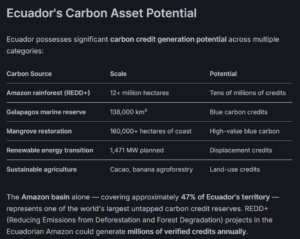
Ecuador carbon asset potential
Source: Ecuador Brief

The legislation also includes safeguards. Parliamentary discussions have focused on protecting Indigenous and local communities, ensuring fair benefit sharing and preventing the same emission reduction from being counted twice.

The reforms seek to open the market while giving the government greater oversight.

Article 6 Moves Toward Real-World Trading

These three developments also show how Article 6 is changing.

Article 6.2 allows countries to cooperate through internationally transferred mitigation outcomes. When a country approves an emission reduction for international transfer, it must apply a corresponding adjustment. This prevents the same emission reduction from counting toward the climate targets of two countries.

That rule makes national tracking systems essential. Governments need to know which credits exist, where they came from, and whether they have been approved for international use. They also need to track whether units have already been transferred or cancelled.

The UNFCCC’s Article 6 framework now includes detailed rules for reporting and reviewing these cooperative approaches. This is why registries, carbon credit methodologies and approval systems are becoming so important.
Quality Will Matter More as Markets Grow

The rapid growth of national carbon systems raises an important question: will buyers trust the credits?

The World Bank says the carbon credit market is becoming more focused on credit quality. Issuance increased 8% from 2024 to 2025, but prices fell slightly overall. Credits linked to international aviation and highly rated forest conservation and reforestation projects continued to earn price premiums.

This means countries cannot rely only on producing large numbers of credits. They need strong measurement systems and clear safeguards. They also need registries that provide reliable tracking.

Three Countries Show Where Carbon Markets Are Heading

Zambia, Brazil and Ecuador are at different stages. Each country is addressing a different part of the same challenge. Yet, their recent actions show how carbon markets are changing.

Zambia is putting market infrastructure into operation. Brazil is building a large future compliance market and preparing for international Article 6 transfers. Ecuador is working to create the legal certainty needed for carbon market activity after years of political and legal challenges.

If these systems work as planned, these three nations could become important participants in the next stage of international carbon markets. The message they are sending is straightforward: carbon markets are moving beyond policy plans. Governments are now building the registries, rules and legal systems needed to make carbon trading work at scale.

The post Zambia, Brazil and Ecuador Accelerate Carbon Markets as Article 6 Gains Ground appeared first on Carbon Credits.
Temasek-Backed GenZero Reports 4.4 MtCO₂e Climate Impact as Carbon Credit Demand Shifts

The Temasek-owned GenZero is putting commercial viability at the center of its climate investment strategy as demand grows for high-quality carbon credits, carbon removals and scalable climate technologies.

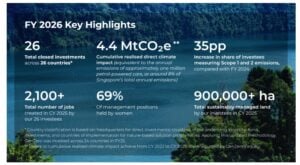
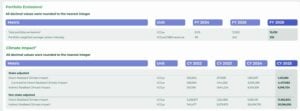
  • The company reported 1.4 million metric tons of carbon dioxide equivalent (MtCO₂e) in direct realized climate impact in 2025.
  • That lifted its cumulative direct impact to 4.4 MtCO₂e between 2022 and 2025, based on GenZero’s stake-adjusted measurement.

Direct realized impact increased 47% from the previous year. When direct and indirect impacts are combined, GenZero said its portfolio generated 8.3 MtCO₂e of realized climate impact in 2025.

The results come at an important point for the carbon market. Buyers still want credits, but they are becoming more selective. At the same time, project developers need long-term commitments to finance projects that may take years to generate credits.

That is pushing the market toward a new model: climate projects must show both measurable environmental benefits and a credible path to commercial scale.

Carbon Footprint and Climate Impact Data

bezero climate impact
Source: GenZero

GenZero Expands Its Global Climate Portfolio

GenZero outlined its progress in its second Sustainability Report, Steadfast in Shifting Times. The company now has 26 closed investments across 26 countries, covering climate technology, nature-based solutions and carbon-market infrastructure.

Overall, nature remains an important part of the strategy.

Expanding Sustainable Land Management

More than 900,000 hectares are now under sustainable management through GenZero-backed investments. That is up from about 750,000 hectares at the end of 2024 and equals almost 13 times the land area of Singapore.

These projects can deliver more than carbon benefits. Forest conservation, restoration and sustainable land management can also support biodiversity, improve ecosystems and create economic opportunities.

be zero Temasek
Source: GenZero

Stronger Impact Measurement

GenZero has also strengthened how it measures portfolio performance. The share of portfolio companies measuring Scope 1 and Scope 2 emissions increased by 35 percentage points to 58% for the financial year ended March 31, 2025. More than 2,100 jobs were also created across investee companies under its expanded impact framework.

Climate Investment Is Becoming More Commercial

The bigger shift, however, is in how investors approach climate solutions.

Early-stage climate companies once attracted funding largely because of their emissions-reduction potential. Today, investors increasingly want to know whether those solutions can compete on cost, scale production, and generate reliable revenue.

GenZero calls this approach “principled pragmatism.”

The strategy reflects a tougher climate investment environment. Higher financing costs, supply-chain challenges, and policy uncertainty have made it harder for emerging technologies to move from pilot projects to commercial operations.

At the same time, demand for climate solutions continues to grow.

Rising electricity consumption, including demand linked to artificial intelligence and data centers, is increasing pressure on businesses to manage both energy costs and emissions. As a result, technologies that can cut emissions without adding high costs could gain an advantage.

Carbon Market Capital Is Moving Into Future Supply

This commercial focus also fits a major change taking place in carbon markets.

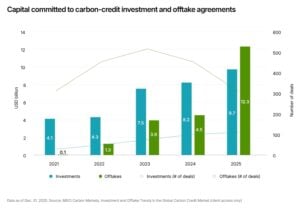
MSCI found that total tracked investment and offtake activity in the global carbon-credit market reached $22 billion in 2025, a 72% increase from 2024. However, the market recorded fewer deals, showing that larger transactions are driving growth.

More importantly, buyers are increasingly securing future supply.

  • $12.3 billion went into carbon-credit offtake agreements in 2025.
  • Offtakes exceeded direct investment for the first time.
  • Forward agreements and pre-purchases represented 66% of offtake value.
  • Corporate carbon-market activity reached $11.4 billion.

The trend matters for project developers. A long-term offtake can provide predictable future revenue, making it easier to raise capital and build projects.

It also shows that large buyers are becoming more proactive. Instead of waiting for credits to reach the market, companies are increasingly helping secure future supply from projects they consider strategically important.

GenZero’s Low-Carbon Cement Targets a Major Source of Emissions

GenZero’s investment in Terra CO2 shows how this strategy is taking shape.

The company represents GenZero’s first investment in the built environment sector. Terra CO2 develops lower-carbon cementitious materials using locally available feedstocks.

The opportunity is significant because cement remains one of the hardest industrial sectors to decarbonize. Traditional cement production emits pollutants from both fuel combustion and the chemical processes used to make clinker.

Therefore, replacing some conventional cement with lower-carbon alternatives could reduce emissions without forcing builders to change how they construct buildings completely.

The challenge is cost.

If low-carbon materials cannot compete with conventional products, adoption will remain limited. GenZero’s investment reflects the growing focus on solutions that can address emissions while also making commercial sense.

Nature Restoration Attracts More Capital

GenZero is also expanding its nature-based investments. Its first investment in Brazil came through The Reforestation Fund, which targets the conservation, restoration and reforestation of 270,000 hectares of degraded land across Latin America.

Nature projects have become an increasingly important part of the carbon market. However, buyers now demand stronger evidence that projects deliver real and lasting climate benefits.

That is changing where capital goes.

  • MSCI found that nature restoration attracted $10.1 billion of investment and offtake activity in 2025, more than double its 2024 level.
  • Carbon engineering attracted another $10.3 billion. Together, the two categories accounted for 93% of tracked carbon-market deal activity.

The numbers suggest that buyers are concentrating capital around carbon removal and nature projects rather than spreading funding evenly across the market.

Carbon Credits and Sustainable Agriculture

GenZero’s involvement in sustainable agriculture highlights another important trend. The Good Rice Alliance significantly secured a long-term agreement with Amazon for more than 680,000 tCO₂e of carbon credits from methane-reduction projects in India.

Rice cultivation can generate methane when farmers flood fields. Improved water management can reduce those emissions while maintaining rice production.

Long-term agreements can give developers greater revenue visibility before credits reach the market. They can also help projects secure financing and scale operations.

Demans for Future supply

This demand for future supply is particularly important for carbon removal.

carbon credit demand and supply offtakes
Source: Carbon Direct

That creates a clear financing gap.

The market may have a growing pipeline of future carbon removal projects, but developers still need buyers willing to commit before those projects are fully operational.

Blended Finance Opens Another Route

In this domain, the company participated in a $91 million blended finance package for the Imperative Spekboom Ecosystem Restoration Project. The structure combines a World Bank Outcome Bond with a streaming facility involving GenZero and other investors.

Blended finance can reduce some of the risks that discourage traditional investors from entering climate and nature projects.

That could become increasingly important as developers seek larger amounts of capital to build climate infrastructure.

Building a Stronger Carbon Market

However, GenZero’s work extends beyond individual investments. It launched the Action for a Resilient Climate Coalition to help mobilize funding for high-quality climate projects. It also expanded its Green Fuel Forward initiative to 45 participating organizations to support demand for sustainable aviation fuel certificates across Asia-Pacific.

GenZero also joined the All Aboard Coalition and became part of the steering committee for the ASEAN Common Carbon Framework.

These initiatives reflect a broader goal: building the infrastructure needed for climate finance to grow.

The carbon market still faces challenges around credit quality, transparency, and inconsistent rules. Carbon Direct found that carbon removal represented only 6% of voluntary carbon credits in its 2026 analysis, while fewer than 10% of the projects it reviewed met its high-quality thresholds with minimal reservations.

That scarcity could make high-quality projects more valuable as corporate demand increases.

The Next Stage of Climate Finance

GenZero’s 4.4 MtCO₂e of cumulative direct climate impact shows how its portfolio has grown since 2022. More importantly, its strategy reflects where climate finance may be heading next.

The market is no longer focused only on generating more carbon credits. Buyers want better credits. Investors want stronger projects. Developers need reliable offtake agreements. Climate technologies must also prove that they can operate as sustainable businesses.

GenZero’s investments in low-carbon cement, reforestation, sustainable agriculture and climate finance show how these priorities can come together.

The carbon market’s next growth phase may therefore look different from its earlier years. Instead of relying mainly on spot purchases, companies are increasingly using long-term offtakes and pre-purchases to secure future supply.

That shift could benefit projects with strong measurement, credible climate claims and clear commercial models.

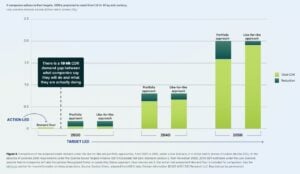
  A market for two gigatonnes of CDR by 2050?

carbon market future
Source: Carbon Direct

As carbon markets mature, the winners may not simply be projects that promise the largest emissions reductions. They will be projects that can prove their impact, attract long-term buyers and scale economically.

For investors like GenZero, that combination could become the defining test of the next generation of climate solutions.

The post Temasek-Backed GenZero Reports 4.4 MtCO₂e Climate Impact as Carbon Credit Demand Shifts appeared first on Carbon Credits.
Nvidia (NVDA Stock) to Invest $3 Billion on Lancium as AI Race Turns Into a Power Race

Nvidia (NVDA Stock) to Invest $3 Billion on Lancium as AI Race Turns Into a Power Race

Nvidia is preparing to invest up to $3 billion in Lancium, a Texas-based power infrastructure developer tied to the Stargate AI data center project. The investment would give the big tech a direct stake in the infrastructure needed to power the next wave of artificial intelligence (AI) computing. It also shows how the AI boom is shifting from a race for chips to a race for electricity, land, and grid connections.

According to Reuters, Nvidia would invest $2 billion initially for about a 20% stake in Lancium. The company could add $1 billion if Lancium meets specific conditions. This includes securing more grid connections. The deal would value Lancium and its land and power assets at about $10 billion.

The move comes as data center developers face growing pressure to secure reliable power for increasingly energy-intensive AI systems.

Nvidia Moves Deeper Into AI Power Infrastructure

Nvidia has built its business around the processors that power AI systems. Its latest Lancium investment takes that strategy further by moving into the infrastructure needed to run those processors.

Lancium develops large data center campuses and power infrastructure. Its flagship site is the Lancium Clean Campus in Abilene, Texas, which serves as the first operational site of the Stargate initiative. Reuters says the campus covers about 1,000 acres.

Lancium says the Abilene campus has a 1.2-gigawatt grid interconnection that has been approved by ERCOT. The company is also developing other gigawatt-scale AI campuses, including a 1.0 GW campus in Childress, Texas, announced in July.

The scale matters because modern AI data centers can require enormous amounts of electricity. Securing a site with power capacity already available can reduce one of the biggest barriers to expanding AI infrastructure. The investment, therefore, gives Nvidia exposure to a part of the AI supply chain that sits behind the GPUs themselves.

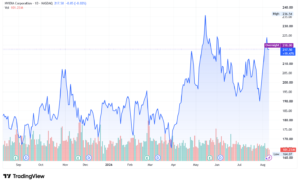
How NVDA Stock Reacts?

Nvidia shares fell about 3% in the trading session following reports of the potential Lancium investment. The decline came as investors weighed the scale of Nvidia’s growing commitments to AI infrastructure, even as the company continues to benefit from strong demand for its AI chips.

Nvidia NVDA stock price

The market reaction highlights a key concern around the AI buildout: Nvidia is increasingly investing not only in the hardware that powers AI, but also in the infrastructure needed to support its customers’ massive computing expansion.

AI Is Creating a New Electricity Demand Surge

The timing reflects a major change in global electricity demand.

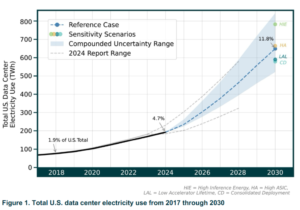
The International Energy Agency estimates that data center electricity use will more than double. By 2030, it will reach about 945 terawatt-hours (TWh), up from around 415 TWh in 2024. That would represent almost 3% of global electricity consumption by the end of the decade.

AI is the main driver of this growth. The agency also expects electricity use from accelerated servers, which are mainly used for AI workloads, to grow by about 30% per year through 2030. The United States is set for strong growth. Data centers will make up almost half of the rise in U.S. electricity demand by 2030.

US data centers electricity use 2030
Source: Smith, S., et al. (2026, June 18). United States Data Center Energy Usage Report: 2025 Update, LBNL

This creates a new challenge for technology companies.

Building more GPUs does not help if data centers cannot obtain enough electricity to operate them. As a result, power availability, grid connections, and the speed of new infrastructure construction are becoming strategic issues for the AI industry.

Why Texas Is Becoming AI’s Power Capital

Texas is emerging as one of the most important locations for this infrastructure build-out.

Lancium’s Abilene campus already has a 1.2 GW interconnection, while the company’s broader portfolio includes multiple gigawatt-scale sites. The Abilene campus is also connected to the Stargate project backed by OpenAI, Oracle and SoftBank.

Crusoe, a clean energy and AI infrastructure innovator, is expanding the site. The second construction phase adds six more buildings. This brings the total to eight buildings, covering about 4 million square feet and providing 1.2 GW of power capacity.

Lancium’s strategy is built around combining large-scale data centers with power infrastructure and grid management.

Its website says the company is developing campuses that can integrate renewable energy and use power-management systems to support grid reliability. That approach could become increasingly important as large AI loads are added to electricity systems.

The broader U.S. power market is already responding. The U.S. Energy Information Administration forecasts electricity use will hit a record 4,268 billion kilowatt-hours in 2026. It will rise to 4,391 billion kWh in 2027. AI and data centers are key drivers of this growth in industrial and commercial demand.

Nvidia Has the Financial Firepower to Chase AI’s Next Bottleneck

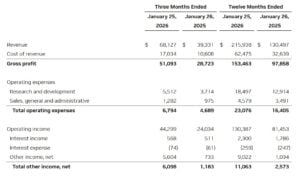
Nvidia has strong financial capacity to make investments of this size. The company reported $81.6 billion in revenue in the first quarter of fiscal 2027, up 85% from a year earlier. Data Center revenue reached $75.2 billion, up 92% year over year.

That growth explains why securing power has become strategically important.

Nvidia’s fiscal 2026 revenue reached $215.9 billion, up 65% from the previous year. Data Center revenue in the fourth quarter alone reached $62.3 billion, up 75% year over year.

NVIDIA financial results 2025
Source: NVIDIA

The company is thus selling increasingly powerful AI systems into a market that requires increasingly large amounts of electricity.

Investing in Lancium could help Nvidia strengthen its position across that growing infrastructure chain. It also fits with Nvidia’s broader push to make AI data centers more efficient and responsive to power constraints.

Nvidia’s Climate Goals Face a Bigger Test

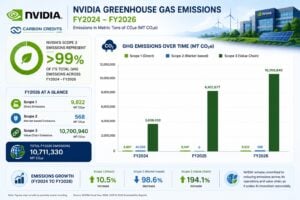
The investment also creates an important environmental question. Nvidia says it matched 100% of its global electricity use with clean electricity in FY2026 for sites under its operational control. Its clean electricity sourcing includes on-site solar, power purchase agreements, renewable utility tariffs and energy attribute certificates.

The company has also adopted science-based emissions targets validated by the Science Based Targets initiative.

Nvidia aims to reduce absolute Scope 1 and Scope 2 market-based emissions by 50% by FY2030, using FY2023 as the base year. It also aims to reduce the emissions intensity of Scope 3 emissions from the use of its sold GPUs by 75% per PFLOP by FY2030.

NVIDIA GHG emissions 2026

However, the company’s broader emissions challenge is becoming larger as its AI business expands. It reported 10.7 million metric tons of Scope 3 emissions in FY2026, according to its sustainability disclosures. That was almost three times its FY2024 Scope 3 figure of 3.64 million tons.

This makes the power infrastructure behind AI increasingly important to Nvidia’s environmental story.

Matching its own electricity use with clean electricity addresses operational emissions, but much of Nvidia’s footprint sits in its wider value chain. The company’s FY2026 report says it is improving its Scope 3 methodology by using more supplier-specific data to identify emissions-reduction opportunities.

Clean Power Will Be Critical to AI Growth

The Lancium investment comes at a time when the energy mix supporting AI data centers is also changing.

The IEA expects renewables to meet about half of the growth in global data center electricity demand through 2035. Natural gas will also play a major role, while nuclear power is expected to become more important later in the decade. That creates both an opportunity and a challenge.

AI companies need electricity that is available around the clock. Renewable power can provide a large share of that supply, but data centers may also need storage, grid connections and dispatchable generation to maintain reliability.

Lancium’s model is built around this broader power challenge. Its Abilene campus combines a large grid connection with power-management systems and plans for integrated renewable energy.

For Nvidia, that could help address one of the biggest constraints facing future AI deployment. Its investment gives it a deeper connection to that infrastructure.

Ultimately, the Nvidia-Lancium deal suggests the tech giant wants to secure a position on both sides of the equation: building the machines that power AI and helping secure the electricity infrastructure needed to run them.

The post Nvidia (NVDA Stock) to Invest $3 Billion on Lancium as AI Race Turns Into a Power Race appeared first on Carbon Credits.

Sila Nanotechnologies Lands $1.4B U.S. DoD Backing to Challenge China’s Battery Supply Chain

Sila Nanotechnologies Lands $1.4B U.S. DoD Backing to Challenge China's Battery Supply Chain

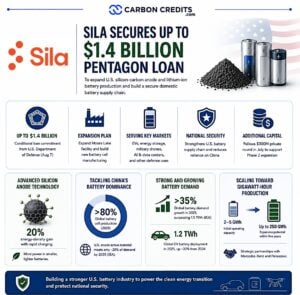
Sila Nanotechnologies has received a conditional loan commitment of up to $1.4 billion from the U.S. Department of Defense to expand production of silicon-carbon battery anodes and lithium-ion battery cells. The funding could accelerate one of the largest efforts to build a U.S.-based alternative to China’s dominant battery supply chain.

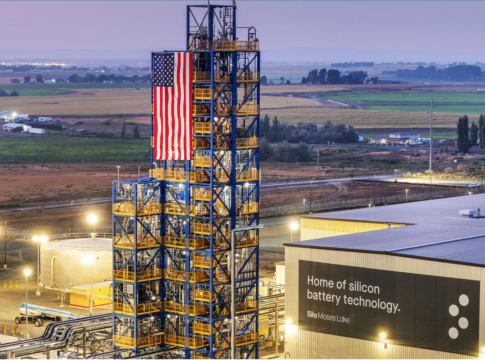
Sila plans to expand its Moses Lake, Washington, facility and develop a new battery-cell manufacturing operation. The project will serve various markets. This includes electric vehicles (EVs), energy storage, military drones, and other defense applications.

The deal comes as battery demand grows and governments focus more on supply security. It also shows how advanced battery materials are becoming important for both the clean energy transition and national security.

$1.4 Billion Loan Supports U.S. Battery Production

The Pentagon announced the conditional loan commitment on August 7. The financing will support the expansion of Sila’s silicon-carbon anode facility in Moses Lake and a new lithium-ion battery cell facility.

The battery-cell operation could serve specialty markets, including industrial, agricultural and military drones. The project will also support battery applications in energy storage, AI and data centers.

The $1.4 billion is a conditional commitment, not money that Sila has already received in full. The company must meet additional requirements before the financing can close.

The announcement follows a $300 million private funding round announced by Sila in July. The company said the funding would support its Phase 2 expansion and the ramp-up of its Moses Lake operations.

Together, the private financing and federal commitment give Sila significant capital to move from early commercial production toward larger-scale manufacturing.

Silicon Anodes Could Pack More Power Into Smaller Batteries

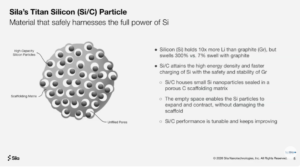
Sila’s main technology is its Titan Silicon silicon-carbon anode. Silicon can store more lithium than graphite, which gives it the potential to increase battery energy density.

Sila titan silicon patent
Source: Sila Presentation by Gleb Yushin, CTO and Co-Founder

Sila says Titan Silicon can deliver a 20% energy-density gain while also supporting rapid charging. The company markets the technology for EVs, defense systems, data centers and robotics.

Higher energy density can allow an EV to travel farther without increasing battery size. It can also allow manufacturers to use smaller and lighter batteries for the same amount of energy. That is especially useful for drones and other defense systems, where weight and operating time can affect performance.

Silicon, however, has a technical problem. It expands when it absorbs lithium and contracts when lithium is removed. This can damage the material and shorten battery life. Sila’s silicon-carbon design aims to control this swelling while retaining silicon’s energy storage advantage.

Sila Targets a Weak Spot in China’s Battery Dominance

The strategic importance of Sila’s expansion goes beyond battery performance.

The International Energy Agency says China accounted for more than 80% of global battery cell production in 2025. It also held an even larger share of production for several battery materials. The concentration extends to anode materials, a key component of lithium-ion batteries.

The IEA says U.S. domestic production of anode active material could meet only about one-quarter of U.S. demand by 2035 under its Stated Policies Scenario. The remaining supply would continue to rely on imports from China, Southeast Asia, and South Korea. This dependence has turned battery materials into a strategic issue for governments.

For the U.S., expanding domestic anode production could reduce exposure to trade restrictions, geopolitical tensions, and supply disruptions.

Sila’s technology also offers a different approach. Instead of simply expanding conventional graphite production, it aims to replace part of the graphite anode market with silicon-carbon materials.

Global Battery Demand Continues to Rise

The investment comes as battery demand expands across several markets. The IEA reported that global battery demand grew by more than 35% in 2025, surpassing 1.5 terawatt-hours (TWh). Battery storage was a major driver of that growth, while lithium demand increased by about 25% per year on average over the previous two years.

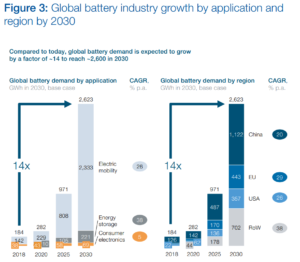
Industry reports, like the one from the WEF below, project battery demand could increase more than fourfold by 2030 under current policy settings.

global EV battery demand 2030
Source: World Economic Forum

EVs remain the largest source of battery demand. Global EV battery deployment reached 1.2 TWh in 2025, up almost 30% from 2024. The IEA expects it to reach almost 3 TWh by 2030 and around 4 TWh by 2035 under its Current Policies Scenario.

Energy storage adds another major source of demand. This wider market creates opportunities for technologies that can store more energy in smaller and lighter battery systems.

For Sila, that means its potential market extends beyond passenger vehicles. Its technology is also being positioned for drones, robotics, data centers, and other applications where weight, space, and reliable backup power matter.

Sila Is Scaling Toward Gigawatt-Hour Production

Sila’s Moses Lake facility began operations in 2025. The plant covers about 160 acres and more than 600,000 square feet.

The facility initially supports 2–5 GWh of capacity and has been designed to expand to as much as 250 GWh within five years, according to Sila.

The difference between those figures is important. The 2–5 GWh figure refers to the initial operating phase, while 250 GWh is the plant’s longer-term expansion potential.

Sila has built commercial ties with companies like Mercedes-Benz and Panasonic. These partnerships help Sila expand Titan Silicon into larger battery applications. The company now needs to prove that it can scale production while maintaining quality, cost, and reliability.

That will be critical because battery manufacturing is highly competitive. A technology can offer better performance in testing but still faces challenges when production reaches commercial scale.

The Project Has a Lower-Carbon Power Advantage

The Moses Lake facility also has an environmental angle. Sila selected the Washington location partly because of access to hydropower, which supplies the plant’s electricity. Using low-carbon electricity can reduce the emissions linked to battery material production compared with facilities powered mainly by fossil fuels.

The U.S. Department of Energy finished an environmental assessment of the Moses Lake project in 2024. They issued a Finding of No Significant Impact for the project.

However, the project should not be viewed as emissions-free. Battery materials still require industrial processing, raw materials, and energy.

Sila’s public materials reviewed do not identify a corporate net-zero target. Its environmental positioning instead focuses on lower-carbon electricity at Moses Lake and the performance benefits of its battery technology.

Sila Nanotechnologies battery DoD loan

Washington’s Battery Push Is Becoming a National Security Strategy

Sila’s $1.4 billion commitment reflects a wider change in how governments view batteries. Batteries are no longer used only in consumer electronics and EVs. They are increasingly important for energy storage, drones, robotics, AI infrastructure, and military systems.

The U.S. government is therefore supporting domestic battery production as part of a broader effort to strengthen critical supply chains.

For Sila, the opportunity is significant. The company is working to commercialize a silicon-carbon technology. This tech could boost battery performance and reduce reliance on traditional graphite supply chains.

The challenge is now execution.

Sila has an operating plant and a technology that has moved beyond the laboratory. Its Moses Lake facility can initially support 2–5 GWh, while the long-term design allows for expansion to as much as 250 GWh.

If that expansion succeeds, Sila could become an important U.S. supplier of advanced battery materials for EVs, energy storage, and defense.

The Pentagon’s commitment is therefore more than a financing deal. It is part of a broader effort to build a domestic battery industry, strengthen national security, and reduce reliance on a supply chain that remains heavily concentrated in China.

The post Sila Nanotechnologies Lands $1.4B U.S. DoD Backing to Challenge China’s Battery Supply Chain appeared first on Carbon Credits.
$400M U.S. Bet on Scandium: Sunrise Energy Metals (SREMF) Eyes American Listing

Sunrise Energy Metals (ASX: SRL, OTCQX: SREMF) is preparing to pursue a listing on a U.S. securities exchange after securing a potential US$400 million financing commitment from the U.S. government for its Syerston Scandium Project in New South Wales, Australia.

The funding could become a major turning point for the company and the development of a Western scandium supply chain. The U.S. Department of War’s Office of Strategic Capital (OSC) has conditionally committed up to US$400 million through a proposed 25-year debt facility to support the project.

The company said the financing could significantly reduce the funding and development risks associated with Syerston. The company is now also preparing for a U.S. listing, although the process will require shareholder, court and regulatory approvals.

Sunrise’s Chairman, Mr Robert Friedland, commented:

“This is a landmark moment for Sunrise and Australia’s mining industry, and the
financing aligns with the goals of the U.S.-Australia Partnership on critical minerals.
The world has entered an era in which access to critical minerals will shape industrial
strength, technology leadership and national security. Scandium is one of the clearest
examples, supporting the technologies, industries and defence capabilities that will
shape the coming decades. We thank President Donald J. Trump and the Department of War’s Office of Strategic Capital for its support as we aim to establish Syerston as a cornerstone of Western scandium supply.”

Why Scandium Is Becoming a Strategic Metal

Scandium is a relatively obscure metal, but its importance is growing as governments look to secure materials needed for defense, aerospace and advanced technology.

A Lightweight Metal With High-Tech Uses

The metal is classified as a rare-earth element and has unique properties that make it valuable in specialized applications. When added to aluminum, for example, scandium can improve strength and fatigue resistance while helping reduce weight.

That combination makes scandium-aluminum alloys attractive for aerospace and defense applications. Lighter and stronger materials can improve the performance of aircraft and other high-performance systems.

  • Scandium also has applications in advanced manufacturing, solid oxide fuel cells, and high-intensity lighting.
  • More recently, attention has expanded to technologies linked to artificial intelligence infrastructure and wireless communications.

A Market Constrained by Supply

The global scandium market remains extremely small. Only a limited amount of scandium oxide is traded each year, while commercial production is concentrated in a handful of supply chains. Unlike many major metals, scandium does not have a large network of dedicated mines.

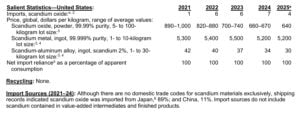
“The U.S. Geological Survey estimated that global consumption of scandium oxide in
2025 was 60 tons, and that the primary global uses were aerospace alloys, other alloys, and solid oxide fuel cells.”

Instead, most scandium is recovered as a byproduct when companies process other minerals such as nickel, titanium, uranium, and rare earths.

That creates a structural problem. Scandium production does not necessarily increase when scandium demand rises because miners are generally producing another commodity as their primary business.

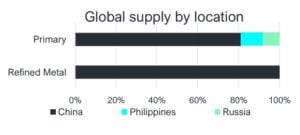
China Dominates a Thin Market

China’s position in global mineral processing has also made it an important source of scandium.

china scandium
Source: Sunrise Energy Metals

U.S. Seeks Greater Scandium Supply Security

This concentration has become increasingly important as the U.S. and other Western economies attempt to reduce dependence on Chinese critical-mineral supply chains.

The issue is not simply the volume of scandium available. The market is so small that disruptions to production, processing, or exports can have an outsized impact on downstream users.

For U.S. manufacturers, developing alternative sources could therefore provide greater supply security.

  • This is particularly relevant for defense and aerospace companies. Scandium can help produce lightweight aluminum alloys used in demanding applications, while its broader technological uses could make the metal increasingly important as advanced manufacturing expands.

The U.S. government has consequently increased its focus on domestic and allied scandium supply. That policy support is now extending beyond research and development toward actual project financing.

US SCANDIUM
Source: USGS

Sunrise’s Syerston Project Offers a New Supply Source

Sunrise’s Syerston project is designed to address this supply gap.

Located in New South Wales, Syerston is being developed as a dedicated primary scandium operation rather than relying on scandium as a secondary byproduct of another mine.

That distinction is important because it could give the project greater control over production volumes and allow supply to respond more directly to demand for scandium.

Updated Feasibility Study

Sunrise completed an updated feasibility study in March 2026.

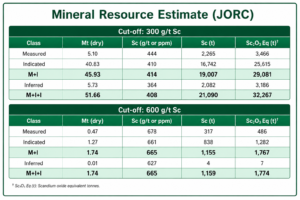
  • The study outlined a 32-year mine life and annual production of approximately 60 tonnes of high-purity scandium oxide.
  • It also estimated development capital of about A$120 million and relatively low operating costs compared with other potential sources.
SCANDIUM
Source: Sunrise Energy Metals

The project has already progressed through important permitting milestones. Sunrise says its mining lease, development consent and environmental approvals are in place, reducing some of the regulatory uncertainty associated with a new mining project.

Syerston also benefits from a large resource base. The mineralization occurs relatively close to the surface, which could support a straightforward mining operation and help control costs.

The project is therefore positioned not only as a source of scandium, but also as a potential long-term strategic asset for countries seeking supply outside China.

U.S. Listing Could Change Sunrise’s Investor Base

The proposed U.S. listing adds another dimension to the announcement.

Sunrise currently trades on the Australian Securities Exchange and on the OTCQX market in the United States. A full U.S. exchange listing could give the company greater exposure to institutional investors and the world’s largest pool of mining and technology capital.

It could also improve the company’s visibility among U.S. investors focused on critical minerals, defense and strategic supply chains.

However, the listing remains a proposal rather than a completed transaction. Sunrise will need to obtain the required shareholder, court and regulatory approvals before moving forward.

The timing is nevertheless significant. The U.S. government’s financing commitment effectively links Sunrise to Washington’s broader strategy of building resilient critical-mineral supply chains.

SREMF Stock Surges on U.S. Funding Boost

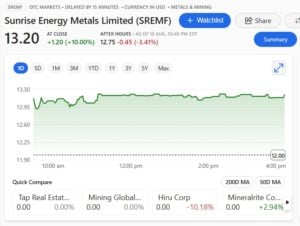
Following the funding announcement, Sunrise Energy Metals’ stock has jumped, putting more focus on its Syerston scandium project. The shares closed at A$18.55 on August 10, close to the company’s 52-week high of A$20.50.

sunrise energy metals
Source: MSN

The rise shows that investors are increasingly optimistic about Syerston’s potential to become a major scandium supplier outside China.

Competition Is Emerging

Sunrise is not the only company targeting a new source of scandium.

USGS also highlighted that NioCorp Developments (NASDAQ: NB) is advancing the Elk Creek Critical Minerals Project in Nebraska. The project is expected to produce scandium oxide alongside niobium and titanium.

NioCorp’s feasibility study estimates potential scandium oxide production of roughly 103 tonnes annually. Construction of the project’s main underground access portal began in February 2026, marking a significant step toward development.

This emerging competition highlights the scale of the opportunity.

For years, the scandium market has remained too small and supply constrained to support widespread adoption. If new projects can increase production and lower costs, the market could expand into applications that are currently uneconomic.

That could create a feedback loop.

More supply could reduce prices. Lower prices could encourage manufacturers to use more scandium. Higher demand could then support additional investment in production and processing capacity.

Sunrise has described this as a potentially much larger market than current consumption suggests.

Critical Minerals Become a Strategic Priority

The Syerston financing comes as the U.S. strengthens its focus on critical minerals and reducing reliance on China.

For Sunrise, the US$400 million conditional commitment could give Syerston a strategic role in the Western scandium supply chain. The project still faces construction, financing, commissioning and customer-qualification hurdles, and the commitment is not yet finalized project financing.

Still, the announcement strengthens Syerston’s outlook as a potential large-scale primary scandium supplier. It also highlights Washington’s growing willingness to support overseas projects that can strengthen allied mineral supply chains and reduce dependence on China.

The post $400M U.S. Bet on Scandium: Sunrise Energy Metals (SREMF) Eyes American Listing appeared first on Carbon Credits.
Lithium Prices Stay Strong as Albemarle (ALB) Earnings Surge on Market Recovery, and RBC Sees Demand Resilience

Lithium Prices Stay Strong as Albemarle (ALB) Earnings Surge on Market Recovery, and RBC Sees Demand Resilience

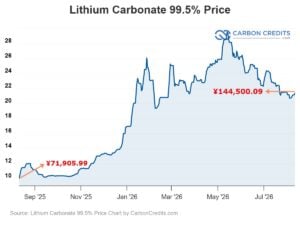
Lithium prices remain above CNY 144,000 per metric ton in China, despite pulling back from their 2026 highs. The latest data shows a market that remains volatile but is still much stronger than a year ago.

That recovery is also reflected in Albemarle’s second-quarter results. The producer reported a sharp increase in revenue and earnings as higher lithium prices lifted margins.

Meanwhile, RBC Capital Markets remains positive on long-term lithium demand. The bank recently lowered its Albemarle price target to $157 from $166 but kept its outperform rating. RBC said electric vehicles (EVs) and energy storage continue to support demand.

Together, the latest price data, Albemarle’s results and the RBC outlook point to a lithium market entering another important phase.

Lithium Price Remains Well Above 2025 Levels

The latest available benchmark data shows lithium at CNY 144,500 ($21,410) per metric ton on August 11 at the time of writing, up 1.23% from the previous session. Lithium was down about 6.2% over the previous month, but remained almost 94% above its level a year earlier. Trading Economics expects the price to reach about CNY 145,238 per ton by the end of the quarter.

lithium carbonate prices

SMM’s (Shanghai Metals Market) latest assessment put battery-grade lithium carbonate at about $18,910 per ton on August 10, with a range of roughly $18,580 to $19,240.

Prices have also pulled back significantly from their 2026 peak. Benchmark Minerals reported that Chinese lithium carbonate prices reached CNY 182,500 per ton in May, supported by tighter feedstock availability and lower downstream inventories.

The subsequent decline shows that supply remains a major source of price pressure.

Higher Lithium Prices Power Albemarle’s Q2 Surge

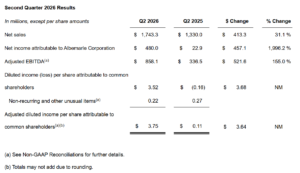
Albemarle’s second-quarter results show how strongly higher lithium prices can affect producer earnings. The company reported $1.74 billion in Q2 2026 net sales, up 31.1% from $1.33 billion a year earlier. Net income attributable to Albemarle reached $480 million, compared with $22.9 million in Q2 2025.

Adjusted EBITDA climbed 155% to $858.1 million, while adjusted diluted earnings reached $3.75 per share, compared with $0.11 a year earlier. Recent market coverage also confirmed that both earnings and revenue exceeded analyst expectations.

Albemarle Q2 2026 financial results
Source: Albemarle Financial Report

Lithium was the main driver.

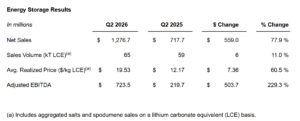
Albemarle’s Energy Storage segment generated $1.28 billion in revenue, up nearly 78% year over year. Sales volumes increased 11% to 65,000 metric tons of lithium carbonate equivalent (LCE).

The average realized lithium price rose to $19.53 per kilogram of LCE, from $12.17 a year earlier. That was a 60.5% increase.

Energy Storage adjusted EBITDA jumped 229% to $723.5 million. The results show the strong operating leverage in lithium production. Even moderate changes in selling prices can have a much larger impact on earnings.

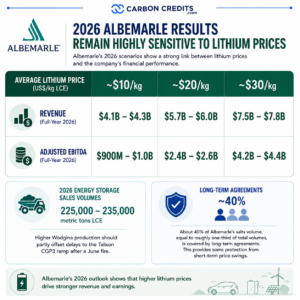
2026 Albemarle Results Remain Highly Sensitive to Lithium Prices

Albemarle’s 2026 scenarios highlight how much its financial performance depends on lithium prices.

  • At an average price of about $10/kg LCE, the company estimates full-year revenue of $4.1 billion to $4.3 billion and adjusted EBITDA of $900 million to $1 billion.
  • At $20/kg, revenue could reach $5.7 billion to $6 billion, while adjusted EBITDA could rise to $2.4 billion to $2.6 billion.
  • At $30/kg, Albemarle’s model points to $7.5 billion to $7.8 billion in revenue and $4.2 billion to $4.4 billion in adjusted EBITDA.

The company expects 2026 Energy Storage sales volumes of 225,000 to 235,000 metric tons LCE. Higher Wodgina production should partly offset delays to the Talison CGP3 ramp after a June fire.

About 40% of Albemarle’s salts volume, equal to roughly one-third of total volumes, is covered by long-term agreements. This provides some protection from short-term price swings.

Albemarle q2 2026 earnings and lithium price

RBC Stays Bullish on Lithium’s Long-Term Demand

RBC’s latest outlook suggests that weaker prices do not necessarily signal weaker underlying demand. The bank lowered its Albemarle price target to $157 from $166 while keeping an outperform rating. The revision was linked mainly to lower lithium price assumptions rather than a major deterioration in demand.

According to industry analysis, lithium prices cooled during the second quarter as supply concerns returned. However, RBC continues to see support from EVs and energy storage.

That distinction matters for producers. Prices can change quickly, while changes in underlying demand often take longer to appear in sales volumes.

Albemarle’s low-cost operations could also provide an advantage if prices remain under pressure. Its Specialties business offers another source of earnings stability during periods of lithium volatility.

Energy Storage Gives Lithium Demand Another Lift

Energy storage is becoming an increasingly important driver of lithium demand.

Albemarle has forecast global lithium demand of 1.8 million to 2.2 million metric tons in 2026, representing growth of roughly 15% to 40%. EV adoption and stationary energy storage are both expected to contribute.

Albemarle’s Q2 results support that trend. Energy Storage revenue increased nearly 78%, while volumes rose 11%.

Albemarle energy storage results
Source: Albemarle

This means lithium demand is no longer tied only to passenger EVs. Grid batteries and other stationary storage systems are creating another major source of consumption.

Still, supply remains the key risk. Higher prices can encourage new mines to restart and existing producers to increase output. That can quickly create another surplus.

Albemarle Pushes Lower-Carbon Lithium Growth

Albemarle’s growth strategy also includes environmental targets. The company aspires to achieve net-zero carbon emissions by 2050. It also aims to reduce the combined carbon intensity of its Catalysts and Bromine businesses by 35% by 2030 and grow its lithium business in a carbon-intensity-neutral manner through 2030.

In 2025, 26% of Albemarle’s electricity came from renewable sources, up from 24% in 2024. Its operations in Chile, Kings Mountain and Qinzhou sourced between 95% and 100% of purchased electricity from renewable sources.

The company reported 1.11 million metric tons of Scope 1 and market-based Scope 2 emissions in 2025, compared with 994,000 tons in 2024. Scope 3 emissions reached 2.71 million tons, bringing total Scope 1, 2 and 3 emissions to about 3.82 million tons.

Albemarle GHG emissions 2025
Source: Albemarle 2025 Sustainability Report

Albemarle is also testing direct lithium extraction. Its La Negra pilot in Chile achieved more than 94% lithium recovery over 3,000 hours of operation.

Water management is another focus. Albemarle’s Chile and Jordan operations target a 25% reduction in freshwater intensity by 2030, while Chile had already achieved nearly a 47% reduction from its 2019 baseline.

Lithium’s Next Test: Can Demand Outrun New Supply?

Lithium’s recovery has delivered a major boost to producers such as Albemarle, but prices remain volatile. At CNY 144,500 per ton, lithium is still far above its level a year ago. However, the recent monthly decline and retreat from the May peak show that supply remains a major concern.

Albemarle’s Q2 results demonstrate how higher prices can rapidly improve producer earnings. RBC’s outlook, meanwhile, suggests that underlying EV and energy storage demand remains strong enough to support the longer-term market.

The next phase will depend on the balance between demand and supply. Demand must grow fast enough to absorb new production, while producers need to control costs and capital spending.

For Albemarle, the second quarter shows that it is entering this phase from a stronger financial position. Whether that strength continues will depend largely on whether lithium demand can stay ahead of supply growth.

The post Lithium Prices Stay Strong as Albemarle (ALB) Earnings Surge on Market Recovery, and RBC Sees Demand Resilience appeared first on Carbon Credits.
Indonesia Builds the Rulebook for Global Carbon Credit Trading Under Article 6

Indonesia is moving closer to becoming one of the world’s leading suppliers of high-quality carbon credits. The government plans to create an Article 6 methodology panel and a national nesting framework. These two systems will help Indonesia prepare for international carbon trading under Article 6 of the Paris Agreement.

Article 6 allows countries to trade verified emissions reductions while making sure the same carbon reduction is not counted twice.

The new methodology panel will review how carbon projects measure emissions cuts. It will include scientists, researchers, and technical experts. The panel will check whether project methods follow both Indonesian rules and international standards.

At the same time, the government plans to complete the national nesting framework within 12 to 18 months. These changes come as more countries prepare to trade carbon credits across borders. Strong rules are now essential for attracting climate investment and building trust among buyers.

Indonesia Has One of the World’s Largest Carbon Assets

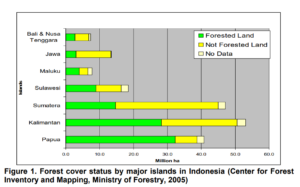
Indonesia starts with one major advantage—its forests. According to the Ministry of Forestry, the country has about 95.5 million hectares of forest. This gives Indonesia the third-largest tropical rainforest in the world, after Brazil and the Democratic Republic of the Congo.

forest cover in indonesia islands
Source: FAO

Indonesia is also home to the largest mangrove forests on Earth. They cover about 3.44 million hectares, or around 20% of the world’s total mangrove area. Mangroves are powerful carbon sinks. They can store several times more carbon per hectare than many tropical forests. They also protect coastlines and support wildlife.

The country also has one of the world’s largest tropical peatland areas. Together, its forests, mangroves, and peatlands store billions of tonnes of carbon. Protecting these ecosystems is important for both Indonesia’s climate goals and global efforts to slow climate change.

Indonesia’s Forestry and Other Land Use (FOLU) Net Sink 2030 program aims for a net carbon sink of 140 million tonnes of CO₂ equivalent (MtCO₂e) by 2030. The plan includes reducing deforestation, restoring forests, protecting peatlands, restoring mangroves, and improving land management.

Why the New Framework Matters

Large forests alone are not enough to build a successful carbon market. Buyers also need to know that every carbon credit is real and counted only once. That is why the new nesting framework is important.

It will connect carbon projects with Indonesia’s national greenhouse gas inventory. If a forest project earns carbon credits, it will also record emissions reductions in the country’s climate accounts. This prevents double counting, which is one of the main rules under Article 6.

The framework will also help Indonesia approve carbon credits for international trading through Corresponding Adjustments. These adjustments are one of the key requirements for high-integrity Article 6 carbon markets.

Building on an Existing Carbon Market

Indonesia has already taken important steps to build its carbon market. The country launched IDXCarbon, its national carbon exchange, in September 2023. Companies also register carbon projects and report emissions through the government’s National Registry System (SRN-PPI).

The new methodology panel and nesting framework build on these systems.

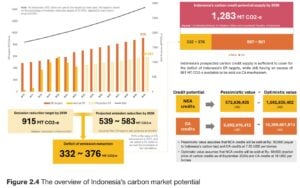
Together, they can strengthen Indonesia’s carbon market, boost investor confidence, and help the country become a top supplier of Article 6 carbon credits in the future. According to analysts, the country has the following carbon market potential.

Indonesia’s carbon market potential
Source: PwC

Indonesia’s Carbon Market Is Growing Quickly

Indonesia is not starting from zero. Over the past few years, the country has built many of the key pieces needed for a national carbon market.

The IDXCarbon allows companies to buy and sell carbon credits and emissions allowances under government supervision. By July 2025, the exchange recorded over 1.6 million tonnes of CO₂ equivalent (tCO₂e) traded. The total transaction value reached about IDR 77 billion, which is roughly US$4.7 million. More than 100 organizations had joined the market as registered users.

The government is now taking the next step.

By introducing an Article 6 methodology panel and a national nesting framework, Indonesia is preparing its domestic market for international carbon trading. These new systems will help make sure carbon credits meet global standards. This way, they can be traded with other countries under the Paris Agreement.

A Bigger Opportunity for Forest Carbon Credits

Indonesia’s forests could become one of its biggest climate assets. Its FOLU Net Sink 2030 program aims to make the forestry and land-use sector a net carbon sink.

According to Ecosystem Marketplace, the global Forestry and Land Use sector successfully resisted the broader carbon market’s 25% volume drop in 2024. It maintained stable overall transaction volumes and captured 87% of all supplier demand inquiries. The World Bank also found that highly rated forest conservation and reforestation credits continued to command price premiums in 2025.

Indonesia is already attracting international interest. In July 2026, Verra said it expects to issue at least 20 million tonnes of CO₂ equivalent from three Indonesian forestry projects under the country’s updated carbon market rules. These projects show the potential for Indonesia to supply large volumes of higher-quality forest credits to the growing international market.

Global Demand for Article 6 Credits Is Rising

The timing of this move may be good. Countries are beginning to move from discussing Article 6 to putting it into practice. Governments are negotiating carbon trading agreements, while companies are looking for credits with stronger environmental integrity.

The International Emissions Trading Association (IETA) estimates that Article 6 could reduce the cost of meeting global climate targets by as much as $250 billion every year by 2030. The mechanism could also channel billions of dollars into developing countries that can supply high-quality emissions reductions.

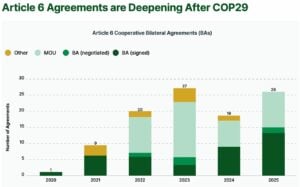
article 6 agreements AlliedOffsets
Source: AlliedOffsets

Nature-based projects are expected to play an important role. Indonesia’s forests, mangroves, and peatlands give it one of the largest potential supplies of these credits. A clear methodology and a trusted nesting framework could make those credits more attractive to governments and corporate buyers.

A New Chapter for Indonesia’s Carbon Economy

Indonesia’s latest announcement is about new regulations, as well as about building trust. High-quality carbon markets depend on clear rules, transparent accounting, and confidence that every credit represents a real emissions reduction. The new methodology panel and nesting framework are designed to provide exactly that.

Much work remains before the system is fully operational, but the direction is clear.

If Indonesia successfully completes these reforms, it could become one of the world’s leading suppliers of Article 6 carbon credits. That would support forest conservation, attract more climate investment, and create new economic opportunities while helping countries and companies meet their net-zero goals.

For the global carbon market, Indonesia is no longer just protecting one of the world’s largest tropical forests. It is building the institutions needed to turn those forests into one of the world’s most important sources of high-integrity carbon credits.

The post Indonesia Builds the Rulebook for Global Carbon Credit Trading Under Article 6 appeared first on Carbon Credits.
Ørsted Expands Texas Clean Energy With 250 MW Battery Storage Project Powered by Tesla Megapacks

Battery storage is becoming one of the most important technologies supporting the clean energy transition. As more wind and solar power come online, large-scale batteries help keep electricity flowing even when the sun is not shining or the wind is not blowing.

According to the press release, Danish renewable energy company Ørsted has taken another step in that direction by bringing its Old 300 battery energy storage system (BESS) into commercial operation in Needville, Texas.

The new 250-megawatt (MW) / 500-megawatt-hour (MWh) facility strengthens the reliability of the Texas power grid while expanding Ørsted’s growing U.S. renewable energy portfolio.

The project also highlights the increasing role of Tesla’s Megapack battery systems, which are becoming a preferred storage solution for utility-scale renewable energy projects.

Ørsted Adds Large Battery Project in Texas

Old 300 Storage is located alongside the company’s 430 MW Old 300 Solar project in Fort Bend County, Texas. Although the battery system is co-located with the solar farm, it operates independently and stores electricity when supply exceeds demand. It can then send power back to the grid during periods of high electricity use.

This flexibility helps improve grid stability and reduces pressure during periods of extreme demand.

Old 300 Solar: Powering Communities

Old 300 Solar has supplied electricity to nearly 80,000 homes and businesses since it began operating in 2024. At the time, it ranked among the largest solar projects commissioned in the United States.

Together, the solar and battery projects are expected to generate around $110 million in local property tax revenue over their lifetime. Those funds will support schools, emergency services, roads, and other community infrastructure in Fort Bend County.

The project also expands Ørsted’s U.S. onshore renewable energy business, which now includes more than 6 gigawatts (GW) of operating wind, solar, and battery storage projects across eight states.

Tesla Megapacks Power the Storage System

Ørsted selected Tesla’s Megapack battery technology for the project. The Megapacks were manufactured at Tesla’s Megafactory in Lathrop, California, the largest battery storage manufacturing facility in the United States.

Designed specifically for utility-scale applications, Megapacks allow renewable electricity generated during periods of high production to be stored and released when demand increases. This helps utilities reduce dependence on fossil fuel power plants while improving grid reliability.

Tesla’s energy storage business has become one of the company’s fastest-growing divisions.

During its latest quarter, Tesla deployed a record 13.5 gigawatt-hours (GWh) of battery storage systems, driven largely by strong demand for Megapacks. The rapid growth reflects rising global investment in battery storage as utilities look for reliable ways to integrate renewable energy into electricity grids.

Safety Remains a Priority

Ørsted also worked closely with Tesla and the Needville Fire Department before the project entered service.

The companies provided local emergency responders with training on battery technology, fire response procedures, and operational safety protocols. As battery storage expands across the country, collaboration with first responders is becoming an increasingly important part of project development.

These preparations aim to ensure safe operations throughout the facility’s lifetime while giving local emergency personnel the knowledge needed to respond effectively if required.

Why Battery Storage Matters in Texas

Texas has become the largest battery storage market in North America because of the unique design of its electricity market.

As per sources, unlike many U.S. regions, the Texas grid, managed by the Electric Reliability Council of Texas (ERCOT), operates as an energy-only market. Power producers earn revenue mainly by selling electricity into wholesale markets instead of receiving separate payments simply for keeping generation capacity available.

As a result, electricity prices can change rapidly. Prices rise sharply when electricity becomes scarce and fall just as quickly when supply exceeds demand. During periods of abundant wind or solar generation, wholesale prices can even become negative.

Battery storage systems thrive under these market conditions. They charge when electricity prices are low and discharge stored energy when prices increase, helping stabilize the grid while creating new revenue opportunities for operators.

Recent years have also shown how valuable battery storage can be during periods of high electricity demand. Batteries help reduce the need for energy conservation alerts by supplying additional power during peak hours.

Texas Battery Capacity Continues to Surge

Battery deployment across Texas has accelerated at an extraordinary pace.

According to Modo Energy’s ERCOT’s latest Annual Buildout Report, approximately 6 GW of new battery capacity entered commercial operation during 2025, making it the largest year for battery installations in the state’s history.

  • The additions increased Texas’ operational battery fleet to approximately 13.9 GW of power capacity and 22.9 GWh of energy storage entering 2026—almost double the previous year’s total.

Industry analysts expect this rapid growth to continue. The report projects that Texas could have between 40 GW and 55 GW of operational battery storage by 2029, depending on future project completion rates.

Unlike many other electricity markets, this expansion is being driven largely by market economics rather than government incentives or long-term capacity payments. The volatility of the ERCOT market continues to make battery storage an attractive investment.

Ørsted Continues to Grow Its Global Renewable Portfolio

Beyond Texas, Ørsted continues to expand its renewable energy business worldwide.

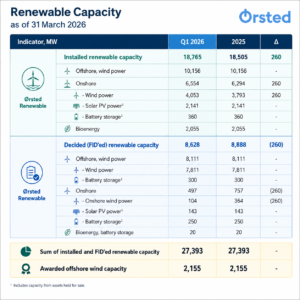
  • According to the company’s Q1 2026 financial report, its installed renewable energy capacity reached 18.8 GW as of March 31, 2026, up from 18.5 GW at the end of 2025.

The increase came primarily from an additional 260 MW of onshore wind capacity. Meanwhile, offshore wind, solar, battery storage, and bioenergy capacity remained largely unchanged during the quarter.

The company generated 11.3 terawatt-hours (TWh) of electricity during the first quarter, with 98% coming from renewable energy sources.

Offshore wind generation increased 27% year over year to 6.9 TWh, supported by stronger wind conditions and higher production from the Borkum Riffgrund 3 and Greater Changhua 4 offshore wind farms.

Orsted renewable
Source: Orsted

Battery Storage: A Core Part of the Energy Transition

The launch of Old 300 Storage reflects a broader shift in renewable energy development. Solar and wind projects are increasingly being paired with large battery systems that can store clean electricity and deliver it when demand is highest.

As electricity consumption rises because of data centers, artificial intelligence, electrification, and population growth, reliable battery storage is becoming essential for modern power systems.

For Ørsted, the Texas project strengthens its position as one of America’s largest renewable power producers. For Tesla, it showcases the growing demand for utility-scale battery technology. And for Texas, it represents another milestone in building a cleaner, more flexible, and more reliable electricity grid.

The post Ørsted Expands Texas Clean Energy With 250 MW Battery Storage Project Powered by Tesla Megapacks appeared first on Carbon Credits.
Trump Unveils $2 Billion Mining Push for US Critical Mineral Independence

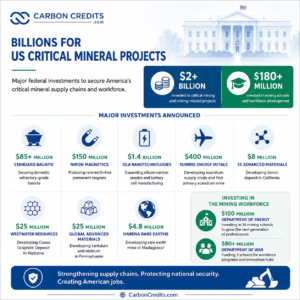
The Trump administration is boosting the U.S. mining industry to lessen dependence on foreign critical minerals. On August 7, the President met with mining leaders at the White House. The administration announced over $2 billion in new investments for mining and related projects. More than $180 million will also support mining schools and workforce programs.

This move comes as the U.S. needs to secure minerals for batteries, electronics, defense, renewable energy, and advanced manufacturing.

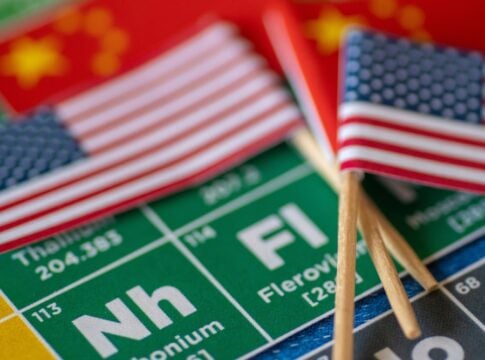
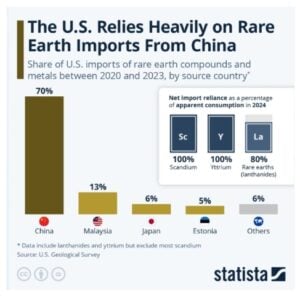
The country relies heavily on imports for many critical minerals. The U.S. is entirely dependent on imports for 11 critical minerals, including graphite, gallium, scandium, and yttrium.

us China import dependent critical mineral

This reliance poses economic and national security risks. Disruptions in global supplies could raise costs for American manufacturers and slow production.

Billions for US Critical Mineral Projects

The press release revealed that the new investments target various parts of the critical mineral supply chain, from mining to battery materials and manufacturing.

Defense Drives Bauxite and Magnet Investments

The Department of War plans to invest over $85 million in Standard Bauxite. This funding will secure domestic supplies of refractory-grade bauxite, essential for high-temperature-resistant products in industry and defense.

The department will also invest $150 million in Niron Magnetics, a Minnesota company that creates rare-earth-free permanent magnets. This aims to build a U.S. alternative to foreign magnets.

Magnets are crucial for electric motors, defense equipment, electronics, and advanced technologies. Reducing reliance on foreign supplies could strengthen multiple U.S. industries.

$1.4 Billion Boost for Battery Manufacturing

Another major investment goes to Sila Nanotechnologies. The Department of War is investing $1.4 billion to boost production of silicon-carbon battery anodes and establish a lithium-ion battery cell manufacturing facility.

These materials support various uses, from satellites to defense equipment.

Scandium Project Targets Aerospace Demand

The department will invest $400 million in Sunrise Energy Metals to develop a domestic scandium supply chain. This could lead to the world’s first primary scandium mine.

Scandium is vital in high-performance aluminum alloys, important for fighter aircraft and spacecraft.

US Backs Boron and Graphite Supply

The Export-Import Bank is also backing several critical mineral projects.

It plans to invest $8 million in 5E Advanced Materials for a boron deposit in California. Boron is used in permanent magnets, semiconductors, and glass.

Tantalum, Niobium and Rare Earths Gain Support

Another $25 million will support Westwater Resources in developing its Coosa Graphite Deposit in Alabama. Graphite is crucial for batteries and will be increasingly important as U.S. battery production expands.

The bank will invest $25 million in Global Advanced Materials in Pennsylvania, focusing on tantalum and niobium for electronics, magnets, and steel.

Rare Earth Mine in Madagascar

Additionally, the U.S. Development Finance Corporation will match a $4.8 million investment in Harena Rare Earths. This project aims to develop a rare earth mine in Madagascar to benefit American manufacturers.

Here’s a summary of the investment plan:

us critical mineral
Data Source: White House Press Release

Mining Workforce Funding

Building mines alone won’t resolve the supply chain issue. The U.S. needs skilled workers to operate them. That’s why the administration is allocating over $180 million for mining education and workforce development.

  • The Department of Energy will invest $100 million across 14 U.S. mining schools to enhance training and increase skilled graduates.
  • The Department of War will provide over $80 million to three schools for workforce programs and technology hubs.

These programs will train future geologists, metallurgists, and mining engineers.

This workforce initiative addresses a long-standing problem. While demand for critical minerals has risen, domestic mining and processing capacity has declined.

Consequently, the U.S. has become more reliant on foreign supply chains.

US-China Competition Heightens Stakes

The push to grow domestic mining comes as the U.S. and China compete over critical minerals.

Bloomberg reported that the White House event emphasized efforts to speed up U.S. mining ahead of a planned September visit by Chinese President Xi Jinping. Trump stated that domestic mining activity is quickly expanding under his administration. He highlighted the reopening of mines and new industrial facilities.

The U.S. is particularly focused on rare earth elements. China remains dominant in the global rare earth supply chain, especially in processing and magnet production.

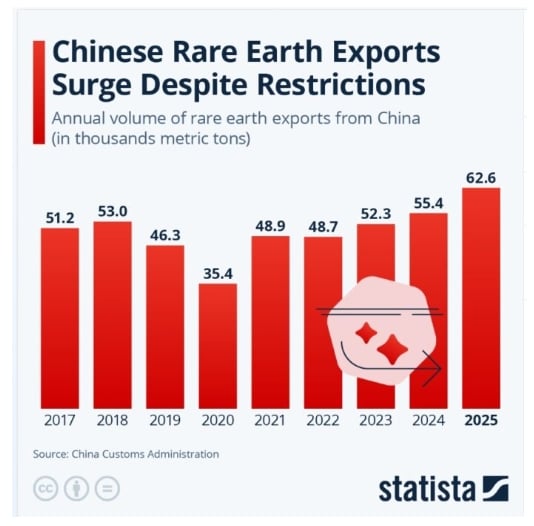
  • According to customs data from Reuters, China exported about 62,600 metric tons of rare earth products in 2025, up from about 55,400 metric tons in 2024.

china rare earth

While a recent trade truce eased some export restrictions on critical minerals, tensions remain between the two largest economies. However, for the U.S., the challenge lies not just in finding more mineral deposits but also in developing the infrastructure for mining, processing, refining, manufacturing, and recycling those materials domestically.

A Mine-to-Magnet Supply Chain

The latest investments reflect a strategy to build a secure domestic supply chain.

Critical minerals are essential across the modern economy. They power electric vehicles, batteries, smartphones, computers, factory equipment, aircraft, and military systems.

Thus, securing supply is increasingly vital.

Since January 2025, the Trump administration has signed or approved 160 minerals-related deals worth nearly $40 billion. These projects aim to boost domestic production, attract investment, and create jobs.

The administration has also employed trade policies, including Section 232 measures, to protect industries crucial for U.S. national and economic security. These measures cover products like steel, aluminum, copper, automobiles, timber, semiconductors, critical minerals, and pharmaceuticals.

The latest mining investments build on this strategy.

However, building a competitive domestic mineral industry will take time. New mines require years of permitting, construction, and investment, while processing and refining capacity must expand alongside production.

Still, the August 7 announcement marks a major step toward strengthening U.S. critical mineral supply chains. As demand for batteries, electronics, and defense technologies grows, secure domestic supplies will become increasingly important.

The U.S. aims to build a complete supply chain, from mining and processing to manufacturing. This could reduce exposure to geopolitical risks while supporting American mining, manufacturing, and clean energy industries.

The post Trump Unveils $2 Billion Mining Push for US Critical Mineral Independence appeared first on Carbon Credits.