Microsoft (MSFT Stock) Emissions Up 23%, Invests in Waste-to-Energy Project to Capture 3 Million Tons of CO₂

Microsoft

In 2020, Microsoft (NASDAQ: MSFT) made a bold promise to become carbon negative by 2030. This means it aims to remove more carbon from the atmosphere than it emits. The company is not only focusing on cleaner operations but also transforming its entire supply chain and investing in long-term carbon removal solutions.

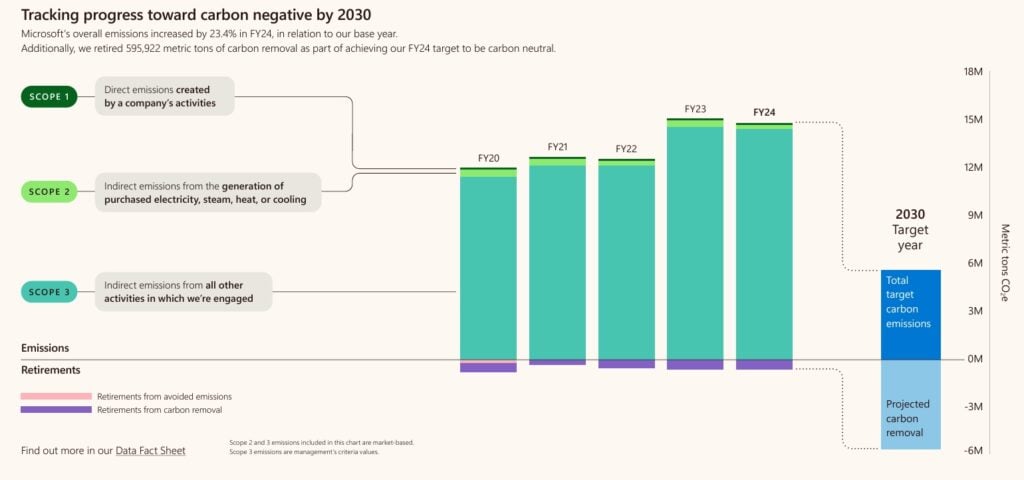
It recently published its 2025 sustainability report, which revealed that its overall emissions increased by 23.4% from its base year. This increase largely stems from growth in its cloud and AI infrastructure. Yet, the company continues to intensify its efforts toward its climate goals.

How Microsoft Tracked and Tackled Its Carbon Footprint

  • Microsoft’s total emissions in FY 2024 were approximately 15 million metric tons CO₂e.

Even though its Scope 1 and 2 emissions were reduced by 30% from 2020 levels, the real challenge lies in Scope 3 emissions. It comprised 97.29% of Microsoft’s total footprint in the same year.

These emissions come from the supply chain and product use. Key sources include construction materials like steel and concrete, business travel, product use, and logistics.

Microsoft’s Total Emissions
Microsoft
Source: Microsoft

The company uses life cycle assessments (LCAs) to track emissions and environmental costs. This process spans design, production, usage, and end-of-life. And more importantly, transparency enables Microsoft to identify the top emission sources and target effective solutions.

The significant drop in direct emissions was due to the following three main actions:

  • Investing in clean energy
  • Upgrading energy efficiency,
  • Using green tariffs.

Transforming the Supply Chain to Cut Scope 3 Emissions

Microsoft’s Supplier Code of Conduct says that its suppliers must use 100% carbon-free electricity by 2030. This rule pushes suppliers to aim higher, like following RE100 standards. This means it will focus on areas with strong supply chains, along with tackling local policy and financing issues.

This will further boost access to clean energy worldwide, especially in regions with weak infrastructure.

                                          Microsoft’s Scope 3 Emissions 

Microsoft
Source: Microsoft

Adds 19 GW of Renewables in 2024

In 2024, Microsoft added 19 gigawatts (GW) of renewable energy capacity. This expansion happened across 16 countries and is the largest yet. It includes new solar and wind farms, long-term power purchase agreements (PPAs), and energy storage projects.

Notable projects include:

  • A 250-megawatt solar deal in Wisconsin. This project has a $15 million fund for community environmental initiatives.
  • Partnered on a 415-megawatt solar facility in Germany. At the time, it was Europe’s largest and was built on a former coal mine.
  • In Ireland, the Drumlins Park wind project was the first to start commercial operations under a framework with Energia Group.
  • Launched the 36-megawatt Kotun Solar Project in Poland to boost clean energy in Europe.

Additionally, Microsoft started 45 carbon-free electricity projects across 15 countries. New projects include locations in Canada, Chile, France, Japan, and Poland.

  • By the end of this year, the tech giant aims to power all its operations with 100% renewable electricity.

Solar Circularity and Smart Energy Partnerships

Some areas where it’s using circular economy principles in renewable energy projects are:

  • Four solar PPAs signed with Engie require all solar modules to be reused or recycled, setting a new industry benchmark for circularity.
  • A separate agreement with Qcells will deliver up to 12 GW of U.S.-manufactured solar modules over eight years, strengthening domestic supply chains.
  • Formed a clean energy buyers group with Google and Nucor to scale carbon-free technologies and push for supportive policies, with projects expected in 2025.

Powering Down Emissions: How Microsoft’s Data Centers and Green Logistics Drive Its Net Zero Goals

Microsoft’s massive network of data centers is vital for decarbonization. The company improved its power efficiency strategy with a method called power harvesting. This technique redirects unused energy from underutilized workloads. As a result, it has doubled the company’s power savings rate in the past year.

Another significant win came from low-power server states, which cut energy use by up to 35% for inactive servers. By the end of 2024, this initiative had expanded from a few thousand servers to nearly 2 million. Meanwhile, Microsoft has reduced hardware needs on its Azure platform by 1.5% since 2020 by strategically oversubscribing CPU cores for internal workloads.

Tapping into Nuclear Power to Cut Data Center Emissions

It signed its first large-scale nuclear PPA with Constellation for the Crane Clean Energy Center in Pennsylvania. This project will restart an 835-megawatt nuclear facility that has been offline since 2019. Once running, it will deliver steady, carbon-free electricity to Microsoft’s data centers.

On the logistics side, it opened its fourth LEED Platinum-certified SuperHub in North America. Built with DB Schenker, this warehouse uses rooftop solar, advanced HVAC systems, and eco-friendly stormwater management.

In transportation, Microsoft switched to renewable diesel in California and Europe. This move cut freight emissions by 50%. It also helped avoid the costs and waste of retiring old vehicles.

The company expanded its use of sustainable aviation fuel (SAF) for shipping cloud hardware by air. This effort reduced emissions by over 17,000 metric tons, which is like avoiding 40,000 barrels of oil.

Scaling Carbon Removal: 22 Million Tons and Counting

In the last fiscal year, Microsoft contracted almost 22 million metric tons of carbon removal. This amount exceeds all previous years combined. By 2030, about 2.8 million metric tons will be delivered for the company’s milestone. The rest will help Microsoft remain carbon negative in the coming years. It will also support their goal of removing all historical operational emissions by 2050.

Tracking progress toward carbon negative by 2030
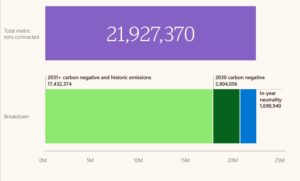
Microsoft carbon removal
Source: Microsoft

This growing portfolio includes various projects. In Sweden, a 10-year deal with Stockholm Exergi will cut over 3 million metric tons of emissions. It uses bioenergy with carbon capture and storage (BECCS). This process captures carbon dioxide from sustainably sourced biomass and stores it underground.

In Brazil, it is working with re.green to plant over 10 million native tree seedlings. This project will cover 16,000 hectares in the Atlantic and Amazon forests. The agreement lasts 15 years and will remove about 3 million metric tons of carbon through natural regeneration.

Additionally, its role in advanced carbon removal technologies involves a partnership with Climeworks to support direct air capture (DAC) in Iceland since 2022. These efforts have changed from short-term purchases to long-term contracts. This shift shows Microsoft’s commitment to a strong carbon removal market.

  • LATEST:
  1. Microsoft (MSFT) Signs $2.6 Million Soil Carbon Credit Deal with Agoro Carbon to Meet its Net-Zero Goals
  2. Microsoft Inks a 4.8M Tons of Forest Carbon Credit Deal with Anew Climate
  3. Microsoft Buys 60,000 Soil Carbon Credits from Indigo’s Largest Carbon Crop 
To further expand its carbon removal portfolio, the company announced a new agreement, explained below: 

Microsoft Backs Denmark’s Project Gaia: Turning Waste into Carbon Removal and Clean Heat

One of Microsoft’s boldest climate efforts is Project Gaia, a new carbon capture project in Denmark. The company signed a long-term agreement in FY24 to purchase 2.95 million tons of high-quality carbon removals starting in 2029.

The project is a joint venture between Copenhagen Infrastructure Partners (CIP) and Danish waste-to-energy company Vestforbrænding. Located in Glostrup near Copenhagen, the Gaia facility will become one of Europe’s first large-scale carbon capture systems added to a waste-to-energy (WtE) plant.

One of the First of Its Kind Technologies

Gaia will use amine-based technology to capture over 95% of CO₂ from the plant’s flue gas. This gas includes the remaining emissions after all waste reduction steps are followed, in line with the EU’s waste hierarchy. Once captured, the CO₂ will be transported and stored permanently.

Microsoft’s offtake deal is among the first long-term, multi-year agreements for carbon removals from a WtE facility. The plant will handle up to 500,000 tons of biogenic and fossil CO₂ annually, proving that carbon capture at waste facilities is both possible and commercially viable.

Beyond reducing emissions, Gaia will also expand district heating to more than 10,000 homes. This shows how carbon capture can support both environmental and community goals.

Certified and Traceable Carbon Removals

The biogenic portion (carbon from organic materials) will be measured and certified using radiocarbon methods. These certified Carbon Removal Units (CRUs) will help Microsoft reach its net-zero goals.

Gaia has already secured most permits and was prequalified for Denmark’s carbon capture and storage (CCS) tender. It plans to bid for state aid in December 2025 to help scale the project further.

Brian Marrs, Senior Director of Energy & Carbon Removal at Microsoft

“Gaia’s approach of retrofitting waste-to-energy facilities—in combination with the enforcement of the EU Waste Framework Directive—helps unlock more carbon-free energy while ensuring waste prevention and recycling remain top priorities. We’re pleased to see experienced developers like Copenhagen Infrastructure Partners, through its Energy Transition Fund, entering the carbon removal market and look forward to ongoing collaboration.”

MSFT Stock Tops $500 as Microsoft Targets $4 Trillion Valuation with AI Push

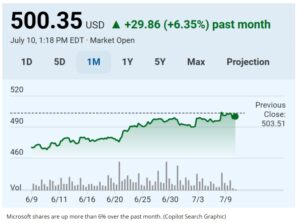
Microsoft stock (MSFT) closed above $500 for the first time Wednesday, marking a major milestone as confidence grows in its AI strategy. The company’s market cap now sits at $3.7 trillion, and analysts at Wedbush say it could soon join the $4 trillion club, with an eye on $5 trillion in the next 18 months.

MSFT STOCK microsoft
Image sourced from GeekWire

New $4B AI Program to Train 20M People

Alongside the stock surge, Microsoft launched Microsoft Elevate, a $4 billion program aimed at helping schools and nonprofits adopt AI. Over five years, the company plans to train 20 million people in AI skills—part of its push to make AI accessible while fueling long-term growth.

The post Microsoft (MSFT Stock) Emissions Up 23%, Invests in Waste-to-Energy Project to Capture 3 Million Tons of CO₂ appeared first on Carbon Credits.

Study Shows How AI Can Cut Over 5 Billion Tons of Carbon Emissions in 3 Key Sectors

Study Shows How AI Can Cut Over 5 Billion Tons of Carbon Emissions in 3 Key Sectors

Artificial intelligence (AI) is rapidly changing how industries operate, and it could also help fight climate change. A major study published in npj Climate Action finds that AI could cut global carbon emissions by up to 5.4 billion tonnes per year by 2035. That’s more than the total annual emissions of the United States.

The study is led by researchers from the London School of Economics and Systemiq. The report entitled “Green and intelligent: the role of AI in the climate transition” shows that applying AI to three key sectors—food, electricity, and mobility—can unlock enormous environmental benefits.

AI’s strength lies in its ability to process large datasets, identify patterns, and optimize systems in real time. When used strategically, this can translate into greater efficiency, lower energy use, and less waste. These improvements are essential to reduce greenhouse gas emissions and slow climate change.

A Sector-by-Sector Breakdown: Where AI Delivers the Most Cuts

The study highlights three areas where AI can drive the biggest reductions in carbon dioxide equivalent (CO₂e) emissions:

  • Food: 0.9–1.6 billion tonnes CO₂e per year (up to 3.0 GtCO₂e in a highly ambitious scenario)
  • Energy (Electricity): Up to 1.8 billion tonnes CO₂e per year
  • Mobility (Transport): 0.5–0.6 billion tonnes CO₂e per year
Total emissions and emissions savings from AI
Source: Stern, N. et al. (2025) https://doi.org/10.1038/s44168-025-00252-3.

These figures are significant. Together, they represent 8% to 10% of total global greenhouse gas emissions. That’s a substantial contribution to international efforts like the Paris Agreement, which aims to limit global warming to well below 2°C.

In the food and agriculture sector, AI can improve productivity while reducing environmental harm. Smart sensors and machine learning tools help farmers use just the right amount of water, fertilizer, and pesticides.

AI also enables precision farming, reducing waste and cutting emissions from overuse of chemicals. It can predict crop yields and improve food distribution. This helps cut spoilage and lowers emissions from storage and transport.

AI helps the clean energy transition in electricity generation. It manages supply and demand more efficiently. Moreover, AI algorithms can predict electricity use. They also enhance energy storage and optimize the integration of solar and wind power.

Additionally, AI helps stabilize power grids and boosts low-carbon energy use. This cuts down the need for dirty backup systems that run on coal or gas.

For mobility and transport, AI improves logistics, reduces fuel use, and supports the development of cleaner vehicles. Fleet managers use AI to plan efficient routes, avoid traffic, and reduce idle times. AI is key to making self-driving cars. These vehicles could boost road safety and cut emissions even more.

The chart below shows the projected global emissions by 2035, with AI adoption differing from business-as-usual and ambitious reduction scenarios for the three sectors identified.

Projected annual global emissions in AI
Note: the ambitious emissions reduction scenario is calculated using the IEA’s net zero emissions scenario for Power and Light Road Vehicles and UNEP’s 2050 Paris-aligned target3 for Meat and Dairy. Source: Stern, N. et al. (2025) https://doi.org/10.1038/s44168-025-00252-3.

AI Carbon Reductions in Other Sectors

AI is also critical in industries like cement and steel, where emissions are hard to abate. Machine learning helps monitor production processes and reduce energy waste. AI also enables real-time emissions tracking and reporting, helping companies stay accountable to their climate goals.

A recent McKinsey report shows that AI technologies can help businesses lower CO₂ emissions by up to 10%. They can also reduce energy costs by 10–20%. Additionally, buildings could save 20% on energy, while transportation systems might save 15%.

Complementing this, the International Energy Agency (IEA) estimates that adopting existing AI applications across end-use sectors like energy, industry, transport, and buildings could reduce emissions by about 1.4 gigatons of CO₂ annually.

AI emission reductions IEA
Source: IEA

Together, these findings underscore AI’s significant role in accelerating decarbonization across multiple sectors. And the good news? These AI applications already exist and are being tested or deployed by companies around the world. What’s needed now is rapid scaling.

The Role of Policy and Industry Action

The study authors say AI’s benefits will only happen with strong guidance from policymakers and investors. Without supportive rules and incentives, AI might raise emissions. It could increase demand for power-hungry data centers. Also, it may automate processes that lead to more production and consumption.

To avoid these risks, the researchers call for:

  • Public and private investment in climate-focused AI tools
  • Open access to high-quality environmental datasets
  • Standards and guardrails to guide responsible use

They also warn against “AI rebound effects,” where efficiency gains are offset by increased consumption. For example, making vehicles more fuel-efficient might encourage people to drive more. That’s why careful planning and strong governance are essential.

Another key recommendation: include developing countries in the AI transition. These regions often face the greatest climate risks but have limited access to technology. Thus, international partnerships and funding will be needed to ensure AI’s climate benefits are shared globally.

AI as a Climate Enabler, Not Just a Tool

AI can also strengthen other climate solutions. For example:

  • Carbon removal. AI helps track carbon storage in forests and soils, improving the quality of carbon credits and offset programs.
  • Resilience planning. AI models assist cities in getting ready for floods, heat waves, and other climate effects. They do this by simulating different scenarios and testing response plans.
  • Energy optimization. AI manages heating, cooling, and lighting in buildings. It cuts energy waste while keeping comfort high.

These applications make climate solutions smarter, cheaper, and faster. AI doesn’t just reduce emissions—it helps manage the clean energy transition more effectively.

Governments are starting to notice. The European Union and Canada have launched initiatives to support green AI. Companies like Google, Microsoft, and Amazon are also building AI tools for climate forecasting, carbon tracking, and energy management.

Tech vs. Time: Can AI Help Us Beat the Climate Clock?

The new study offers compelling evidence that AI could play a leading role in slashing global carbon emissions. The estimated 3.2 to 5.4 billion tonnes of CO₂e reductions by 2035 are not just theoretical; they’re within reach if the right steps are taken.

These findings come at a time when many countries are off track in meeting their 2030 and 2050 climate goals. AI may help close that gap by offering fast, reliable, and affordable emissions cuts in important sectors.

Private companies, too, are under pressure to deliver on net-zero commitments. For them, AI can provide tools to track emissions, meet regulatory standards, and optimize energy use. Investors are also watching closely, with many ESG (environmental, social, governance) funds now looking for AI-powered climate solutions.

The bottom line? AI can become one of the world’s most powerful climate allies. But its impact depends on how it’s used, who controls it, and whether its benefits are shared widely. By focusing on climate-smart applications in food, electricity, and transport, AI can help build a cleaner, more resilient future.

The post Study Shows How AI Can Cut Over 5 Billion Tons of Carbon Emissions in 3 Key Sectors appeared first on Carbon Credits.
Ares Strategic Mining Is Securing America’s Fluorspar – The Secret Critical Mineral Fueling Clean-Tech

fluorspar

Fluorspar, also known as fluorite, is a key industrial mineral made of calcium fluoride (CaF₂). It’s critical for making hydrofluoric acid, aluminum, steel, fluoropolymers, and refrigerants. With growing demand for cleaner technologies, low-carbon materials, and sustainable alternatives, fluorspar is no longer just a niche commodity; it’s now a strategic mineral with global importance.

The Clean-Tech Catalyst: Why Fluorspar Is Suddenly Essential?

  • Critical Mineral Status = Faster Permits: Fluorspar’s designation streamlines permitting and supports funding access.
  • Onshoring Supply Chains: As geopolitical tensions rise, U.S. industries are shifting toward domestic mineral sourcing.
  • Energy Security: Sectors like EV batteries, semiconductors, and steel are demanding more secure and sustainable inputs.

Market Size & Growth Forecast: Rising Demand in a Low-Supply Market

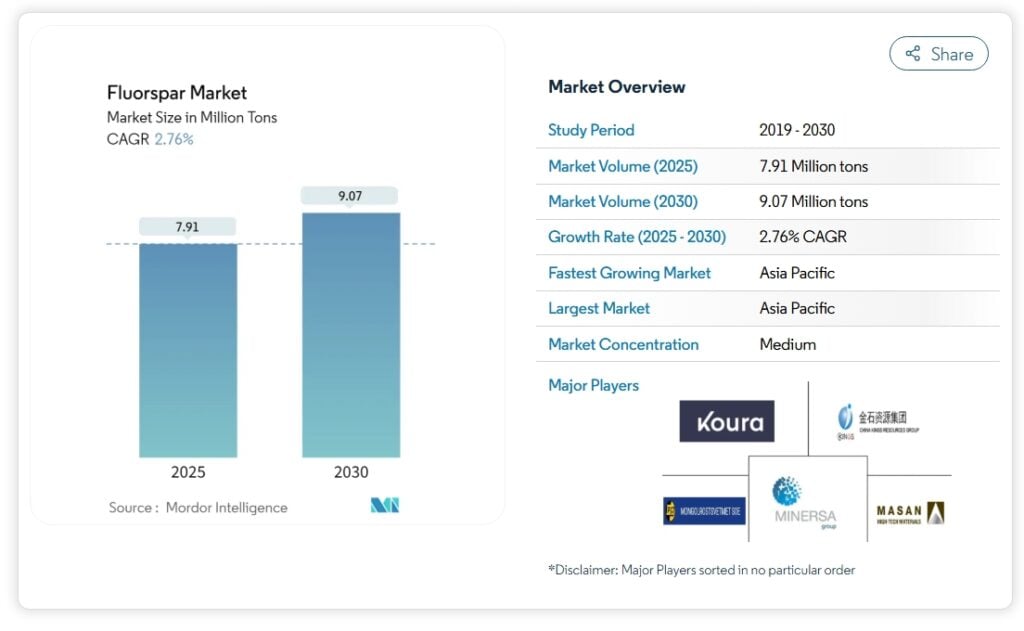
According to Mordor Intelligence, the global fluorspar market is expected to grow from 7.91 million tons in 2025 to 9.07 million tons by 2030, at a CAGR of 2.76%.

Global Fluorspar Market Size 

fluorspar
Source: Modor Intelligence

Top Growth Drivers:

  • Rising demand for fluoropolymers in medical devices and electronics
  • High usage in hydrofluoric acid production for lithium-ion batteries
  • Growing need for metallurgical-grade fluorspar in the steel and aluminum sectors
  • Increased adoption of eco-friendly refrigerants
  • Surge in EV manufacturing and solar energy installations

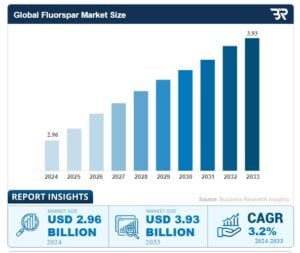
Meanwhile, Business Research Insights estimates the market value will rise from USD 2.96 billion in 2024 to USD 3.93 billion by 2033, driven by its diverse applications and supply constraints.

fluorspar
Source: Business Research Insights

The U.S. currently imports 100% of its fluorspar needs, despite it being labeled a Critical Mineral by the U.S. government in 2018. One company grabbing this domestic momentum is Ares Strategic Mining.

Let’s take a closer look at how it’s addressing the U.S. need for fluorspar.

Ares Strategic Mining Powers North America’s Fluorspar Future

Ares Strategic Mining Inc. (the “Company”) (CSE: ARS) (OTC: ARSMF) (FRA: N8I1) has a competitive edge as it’s the only permitted fluorspar mining operation in the U.S.. It is uniquely positioned to become a leading domestic supplier, filling a critical gap in the North American supply chain.

In North America, Canada is leading the growth curve, with an estimated CAGR of 8% from 2024 to 2029. The St. Lawrence region is seeing rapid investment in fluorspar mining and processing, thanks to government support and sustainable mining incentives.

The Mexican market is also expanding, offering cross-border growth opportunities and regional trade advantages.

From Explorer to Producer: Ramping Up the Lost Sheep Project

With its fully permitted Lost Sheep Project in Utah, Ares is strategically located to serve the U.S., Canada, and Mexico – three of the most promising fluorspar markets in the Western Hemisphere.

The company owns 5,982 acres with 353 mining claims in the Spor Mountain region. With full permits in place, including approval from the Bureau of Land Management, the project has moved from exploration to development.

Since restarting operations, Ares has resumed underground mine work and construction of its processing facilities. The company recently secured $11 million in funding to accelerate the buildout. Its team is now focused on completing the metallurgical and flotation plants, which will enable near-term production and revenue generation.

What makes this transformation remarkable is that Ares will be the first and only producer of fluorspar in the U.S., a major milestone for domestic mineral supply and industrial security.

Take a peek into the Lost Sheep Project

Sustainability & Innovation

As said before, fluorspar supports greener technologies, such as low-global-warming refrigerants and high-performance polymers, in batteries and electronics. These materials are critical in the energy transition, especially for electric vehicles and solar panels.

Ares is aligning itself with these trends by focusing on responsible mining and processing. The company’s approach includes minimizing waste, using clean energy where possible, and ensuring environmental compliance. These actions not only protect the environment but also enhance Ares’ appeal to industries looking for sustainable raw materials.

Technological Edge: Better Processing, Less Waste

The company is investing in advanced plant technologies to meet the highest level of performance and environmental standards. These upgrades aim to improve fluorspar recovery rates while reducing energy use and waste. The company has brought in experts to optimize plant operations based on the specific characteristics of its ore.

This technical focus will ensure that Ares can produce high-purity fluorspar suitable for specialized uses in electronics, EV batteries, and precision industries. By improving the quality and consistency of its product, it is strengthening its competitiveness in a high-demand, low-supply market.

At the Right Time, in the Right Place

Ares is advancing its project at a critical time when global industries are urgently seeking reliable, domestic supplies of strategic minerals.

 Ares Clears and Readies Site for Ore Stockpiling

Ares strategic Mining
Source: Ares

James Walker, President and CEO of Ares Strategic Mining, commented

“We are delighted with the rapid progress being made on site. The teams are advancing ahead of expectations, and we are particularly excited at the prospect of beginning fluorspar stockpiling in the near term. Bringing in plant optimization experts further reinforces our commitment to deliver a highly efficient and productive operation that will establish Ares as the only domestic supplier of this critical mineral.”

With fluorspar’s U.S. supply chain currently dependent on imports, Ares can potentially fill a national gap and become a key supplier for industries vital to American infrastructure and energy independence.

The post Ares Strategic Mining Is Securing America’s Fluorspar – The Secret Critical Mineral Fueling Clean-Tech appeared first on Carbon Credits.
US Government Approves “One Big, Beautiful Bill”: How SolarBank is Beating the Clock

US Government Approves “One Big, Beautiful Bill”: How SolarBank is Beating the Clock

Disseminated on behalf of SolarBank Corporation

The U.S. government has approved a sweeping new budget bill, dubbed the “One Big, Beautiful Bill”, signalling a significant shift in federal support for clean energy. Senate Republicans, aligned with former President Trump’s energy plan, support the bill. It removes the excise tax on renewable energy. However, it hurts solar and wind development by cutting the timeline for key tax credits drastically.

Elon Musk: The “Utterly Insane and Destructive” Bill 

Industry experts have quickly raised alarms over the bill’s long-term implications. For years, solar and wind developers have relied on stable federal tax incentives to finance and scale their projects.

The new law requires clean energy developers to either begin construction by July 4, 2026 (in which case there will be four years to complete the project) or if construction begins after July 4, 2026, the projects must be operational running by December 31, 2027 to get the Investment Tax Credit (ITC) and Production Tax Credit (PTC).  The clean energy sector, particularly in the U.S., now finds itself racing against the clock.

Critics say the bill would hurt efforts for net-zero emissions. It could raise electricity prices and slow down infrastructure growth. This comes when the country is seeing high demand from AI, electrification, and data centers.

Tesla CEO Elon Musk called the legislation “utterly insane and destructive.” Clean energy groups warn it could threaten hundreds of thousands of jobs. They say it may also stall the industry’s progress when it was just gaining momentum.

The bill passed quickly through the Senate, despite its controversy. This showed a clear partisan split over America’s energy future. And it has also been passed in the House and was signed into law.

Fossil fuel subsidies stay mostly the same, while the bill creates a tougher future for clean energy developers. Companies must adapt quickly to changing rules.

The bill’s key solar-related changes:

  • Ends the 30% residential solar tax credit by December 2025—nearly 10 years earlier than expected.
  • Requires solar and wind projects to either begin construction by July 4, 2026 (and be online within four years) or begin construction after July 4, 2026 and be online by December 31, 2027 to qualify for commercial tax credits.

SolarBank’s Bright Strategy in a Dark Policy Era

The U.S. solar industry may face challenges with those policy changes, but SolarBank Corporation (NASDAQ: SUUN) shows strong resilience and a clear strategy. 

SolarBank has enough advanced-stage projects that we can get into construction before the deadline to take advantage of the tax credits. In particular, there is still enough time to execute on the projects supported by the $100 million financing with CIM. In addition,  it focuses on community and commercial-scale solar. These segments gain more from state-level incentives and local energy policies than from federal programs.

The latest Q2 2025 report from Wood Mackenzie and SEIA shows the U.S. solar industry is shrinking. There was a 7% drop in installations compared to Q1 2024. The community solar segment—SolarBank’s focus—saw a 22% decline in quarterly installations, but this came after a record-setting end to 2024. 

community solar installations & forecasts wood mac
Source: Wood Mackenzie

Analysts believe the segment will stabilize in key markets like New York, where plenty of Solarbank projects are located, and Illinois. These states have nearly 5 GWdc in pipeline projects combined.

The report warns that changes in federal policy, tariffs on Southeast Asian parts, and the early end of tax credits are causing uncertainty. However, state-level programs and corporate demand remain strong growth drivers.

SolarBank focuses on community and large-scale projects. This is supported by steady regional programs and varied supply sources. These factors give it an advantage in today’s unstable climate. 

The U.S. solar market may drop by about 7% each year until 2027. However, WoodMac forecasts around 43 GWdc in new capacity added each year until 2030. This shows a long-term chance for strategic players such as SolarBank.

community solar installations & forecasts wood mac
Source: Wood Mackenzie

The Company has prioritized development pathways in key U.S. states where site control, interconnection progress, and permitting are sufficiently advanced to qualify for full ITC treatment under the new rules. The $100 million in project-level capital announced through a strategic partnership with CIM Group provides much of the capital to allow SolarBank to move swiftly toward construction on a 97 MW portfolio in these high-value markets.

The company’s CEO, Dr. Richard Lu, has also emphasized that SolarBank is diversified outside the United States. He stated:

“SolarBank benefits from Canada’s support to clean energy… and is leading the charge to build Canada as an energy superpower.” 

He pointed to Prime Minister Mark Carney’s “Build, baby, build” initiative—Canada’s new fast-track push for infrastructure, housing, and energy development—as a major accelerant for clean energy developers with shovel-ready assets.

SolarBank focuses on community solar in more than 20 U.S. states. It also expands its portfolio with projects in Canada. This strategy helps reduce risks from sudden policy changes.

Thanks to this foresight, the company announced a big 2.4 MWdc solar project in Nova Scotia last month. It’s expected to power over 220 homes. The news sent shares of SUUN up by nearly 28%, as investors recognized the strength of its cross-border growth strategy.

Built to Weather the Shift: SolarBank’s Vertical Edge

SolarBank stands out from residential solar installers. While they struggle with the early ITC sunset, SolarBank uses a build-to-own model. This vertical integration helps SolarBank thrive. This lets the company control development, construction, and maintenance better. It also helps generate long-term revenue by owning assets.

The model also acts as a buffer against rising costs or policy changes. It lessens dependence on short-term sales and federal subsidies.

SolarBank’s operations are further bolstered by a strong financial foundation. In its last quarterly report, the company reported over $25 million in cash and $45 million in current assets. This was backed by funding from institutions such as RBC and Highbridge. 

The company’s supply chain strategy focuses on U.S.-made solar parts or parts that have limited impacts from tariffs. This choice helps it navigate new tariffs on foreign-made equipment.

While much of the U.S. solar market is re-evaluating its projects in light of the new law, SolarBank continues to push forward. It’s building a project pipeline that goes beyond the U.S. It includes areas like Ontario and Nova Scotia, where clean energy policies are stable and supportive.

SolarBank project pipeline
Source: SolarBank

As the broader industry adjusts to a compressed tax credit timeline and shifting political winds, SolarBank has emerged as a case study in proactive planning and policy-proof execution.

A Defining Moment for U.S. Solar — And a Strategic Opportunity

The  “One Big, Beautiful Bill” may mark a turning point for the U.S. clean energy sector. With long-term tax credits now set to expire much earlier, solar developers must act fast or risk losing vital financing tools. The change should speed up project timelines. However, it might also cause cancellations, bottlenecks, and funding gaps. This is especially true for residential and large utility-scale projects.

In this uncertain environment, companies like SolarBank show that smart strategies and quick actions can still drive growth. The company provides a strong model for investors, policymakers, and communities.

In the U.S. clean energy transition, the winners will be those who act fast, diversify smartly, and create solar solutions that can handle Washington’s politics. And right now, SolarBank is showing what that looks like in action.

There are several risks associated with the development of the projects detailed in this report. The development of any project is subject to the continued availability of third-party financing arrangements for the project owners and the risks associated with the construction of a solar power project. There is no certainty the projects disclosed in this report will be completed on schedule or that they will operate in accordance with their design capacity. In addition, governments may revise, reduce or eliminate incentives and policy support schemes for solar power, which could result in future projects no longer being economic.

Please refer to “Forward-Looking Statements” in the press release entitled “SolarBank Issues Update on Strategic Positioning Amid Shifting U.S. and Canadian Policy Landscape” for additional discussion of the assumptions and risk factors associated with the statements in this report.


Disclosure: Owners, members, directors, and employees of carboncredits.com have/may have stock or option positions in any of the companies mentioned: None.

Carboncredits.com receives compensation for this publication and has a business relationship with any company whose stock(s) is/are mentioned in this article.

Additional disclosure: This communication serves the sole purpose of adding value to the research process and is for information only. Please do your own due diligence. Every investment in securities mentioned in publications of carboncredits.com involves risks that could lead to a total loss of the invested capital.

Please read our Full RISKS and DISCLOSURE here.

The post US Government Approves “One Big, Beautiful Bill”: How SolarBank is Beating the Clock appeared first on Carbon Credits.

D-Wave Quantum (QBTS Stock) Powers Climate Action Through Quantum Computing

D-Wave Quantum (QBTS Stock) Powers Climate Action Through Quantum Computing

Businesses and governments are turning to cutting-edge technologies to help meet climate goals as the global push for decarbonization intensifies. One company at the forefront of this transformation is D-Wave Quantum Inc. (NYSE: QBTS), a pioneer in commercial quantum computing based in Canada, with offices in California.

D-Wave uses a unique method to tackle tough optimization problems. So far, it has helped reduce emissions, integrate clean energy, and promote sustainable operations. Let’s discover how this company and its technology help decarbonize industries and businesses. 

What Makes Quantum Computing Different?

Quantum computers are different from traditional ones. They use qubits instead of bits. While bits can only be 0 or 1, qubits can be in many states at once.

This key difference allows quantum systems to consider many possible solutions at the same time, making them great for solving optimization problems. These include route planning, supply chain logistics, energy grid balancing, and materials simulation. All these factors help reduce carbon emissions.

D-Wave focuses on quantum annealing. This type of quantum computing is great at finding the best solutions from many options. It is this capability that makes D-Wave’s technology so promising for climate-focused applications.

How It Works: Quantum Annealing

Quantum annealing is D-Wave’s signature method of computing. It is great at finding the best solutions for problems with many variables. For example, it can balance loads in a power grid or find the most fuel-efficient delivery routes.

D-Wave uses quantum annealing to model situations in real-time. This enables them to adjust strategies based on live data. It’s a key feature for changing systems like city traffic and renewable energy grids.

Real-World Impact: From Grid Efficiency to Cleaner Cities

D-Wave’s quantum systems are already in use across various industries to reduce emissions, cut energy use, and enhance operational efficiency. These real-world applications illustrate the technology’s value beyond the lab:

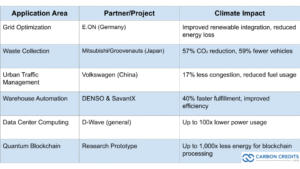
  • Grid Optimization and Renewable Integration

D-Wave is working with E.ON, a major utility in Europe. They aim to manage energy grids that rely more on solar and wind power. Their quantum algorithms optimize power flow, forecast energy generation, and create microgrids. This ensures local stability and efficient energy use.

Result: Reduced energy waste, improved load balancing, and more reliable integration of renewables into the grid.

  • Emission Reduction in Logistics

In Tokyo, D-Wave partnered with Mitsubishi Estate and Groovenauts to optimize waste collection routes. Using quantum computing, they reduced driving distances from 2,300 km to 1,000 km per route.

Result: 57% reduction in CO₂ emissions, 59% fewer vehicles needed, and 38% decrease in work hours.

Similar collaborations with Volkswagen have demonstrated a 17% reduction in traffic congestion through improved fleet coordination.

  • Cleaner Computing

Traditional data centers are energy-intensive. For specific optimization tasks, D-Wave’s systems use up to 100 times less energy than classical supercomputers. This improved efficiency is crucial as digital infrastructure expands globally.

  • Scope 3 Emissions and Sustainable Operations

D-Wave’s technology helps companies tackle tough Scope 3 emissions. It does this by optimizing supply chains, delivery routes, and energy use in its ecosystems.

QBTS Key Case Studies Highlighting Climate Impact

QBTS Key Case Studies Highlighting Climate Impact

Quantum Advantage in Action

D-Wave’s latest system, Advantage2, features over 4,400 qubits and includes a new Zephyr-12 topology. It offers:

  • 40% higher energy scale
  • 75% lower noise levels
  • 2x coherence time
  • 20-way qubit connectivity

In high-precision workflows, Advantage2 has demonstrated performance that is 10,000x faster than earlier models. It uses only 12 kW of power. This makes it one of the most energy-efficient platforms for large-scale optimization tasks.

The system is accessible through Leap™, D-Wave’s cloud-based quantum platform. This allows users worldwide to use quantum capabilities without needing to own any hardware. This makes powerful quantum solutions accessible to businesses of all sizes, from logistics firms to utilities.

Fundraising and Strategic Partnerships

D‑Wave has recently strengthened both its balance sheet and global alliances:

In December 2024, it raised $175 million via at‑the‑market equity offerings. With over $160 million in cash by quarter end, the funding supports technical development and product expansion.

CEO Dr. Alan Baratz said it positions the company “to fully execute against our product and go‑to‑market strategy”.

In January 2025, D-Wave teamed up with Carahsoft. Carahsoft is a major U.S. government IT services provider. They will distribute quantum solutions to agencies like NASA and intelligence services through federal procurement channels.

In June 2025, it signed an MOU with Yonsei University and Incheon City in South Korea. This agreement aims to develop and install an Advantage2 system for both academic and commercial use.

Other partnerships include Staque (Middle East adoption), Zapata AI (hybrid quantum-generative AI), and Interpublic Group (quantum marketing optimization). These moves position D‑Wave for climate-focused impact and broader quantum adoption.

Expanding Market and Commercial Growth

D-Wave serves over 100 clients, including Mastercard, Deloitte, Siemens Healthineers, Ford, BBVA, and Lockheed Martin. In May 2025, its stock surged by 20% after launching Advantage2 on the Leap cloud platform.

QBTS stock chart
Source: D-Wave Quantum website

The company has raised over $400 million in funding and holds around $800 million in cash, positioning it well for continued growth. In Q1 2025, D-Wave saw its revenue rise by 509% compared to last year. This growth shows increasing commercial interest in its quantum solutions.

D-Wave is not only focused on its quantum annealing systems, but is also looking into hybrid methods that use gate-based models. This helps D-Wave stay competitive with companies like IBM and Google.

Sustainable Tech for ESG and Net-Zero Goals

D-Wave’s technology directly supports several U.N. Sustainable Development Goals:

  • Goal 7: Affordable and Clean Energy
  • Goal 11: Sustainable Cities and Communities
  • Goal 13: Climate Action

Moreover, its quantum solutions provide measurable ESG benefits, including the following:

  • 20% CO₂ reduction for logistics companies
  • 17% cut in urban congestion
  • 40% improved warehouse operations

Quantum Computing for a Cleaner Future

As the demand for low-carbon innovation grows, D-Wave is demonstrating that quantum computing can offer practical, immediate solutions. D-Wave’s systems support sustainable infrastructure and business operations. They help with grid optimization, emissions reduction, clean energy forecasting, and logistics planning.

By merging advanced computing with environmental responsibility, D-Wave is helping industries worldwide move closer to a net-zero future.

The post D-Wave Quantum (QBTS Stock) Powers Climate Action Through Quantum Computing appeared first on Carbon Credits.

Mars Invests $250M in Sustainable Innovations to Boost Net Zero Journey

Mars Invests $250M in Sustainable Innovations to Boost Net Zero Journey

Mars, the global company behind famous brands like M&M’s, Snickers, and Pedigree, has announced a major new initiative: a $250 million Sustainability Investment Fund. The fund supports innovations in agriculture, ingredients, and packaging. It focuses on areas that have the biggest impact on Mars’ environmental footprint and carbon emissions.

Mars is also working on its climate goals through the “Sustainable in a Generation” plan. The aim is to cut emissions in half by 2030 and reach net zero by 2050. Here’s how the fund fits into Mars’s sustainability journey—and why it matters for the food and consumer goods sector.

Why Mars Is Betting Big on Sustainability

Mars has tied up to 2,000 senior leaders’ compensation to emission reductions, showing strong internal accountability. But much of its carbon footprint—over 70%—comes from purchased goods and services like farming, animal feed, and materials.

Thus, the new fund will invest in the following areas to address those emission sources:

  • Advanced Agriculture,
  • Innovative Ingredients, and
  • Next‑Gen Packaging

These focus areas target Mars’s main emissions hotspots. They aim to speed up solutions that go beyond traditional carbon offsets.

Here is how the fund will drive systemic change in the company’s quest for sustainability. 

Modern Farming Practices

Mars will provide digital tools for farmers. These tools will help track fertilizer use, monitor soil health, and boost yields. They will also aid in reducing emissions. Remote sensing and satellites will help fight deforestation. They also improve traceability, which is important for sourcing ingredients.

Low‑Carbon Ingredients

The fund will finance innovation in plant-based proteins and raw materials. Shifting from animal-based inputs can significantly reduce emissions, water use, and supply‑chain risk.

Circular Packaging

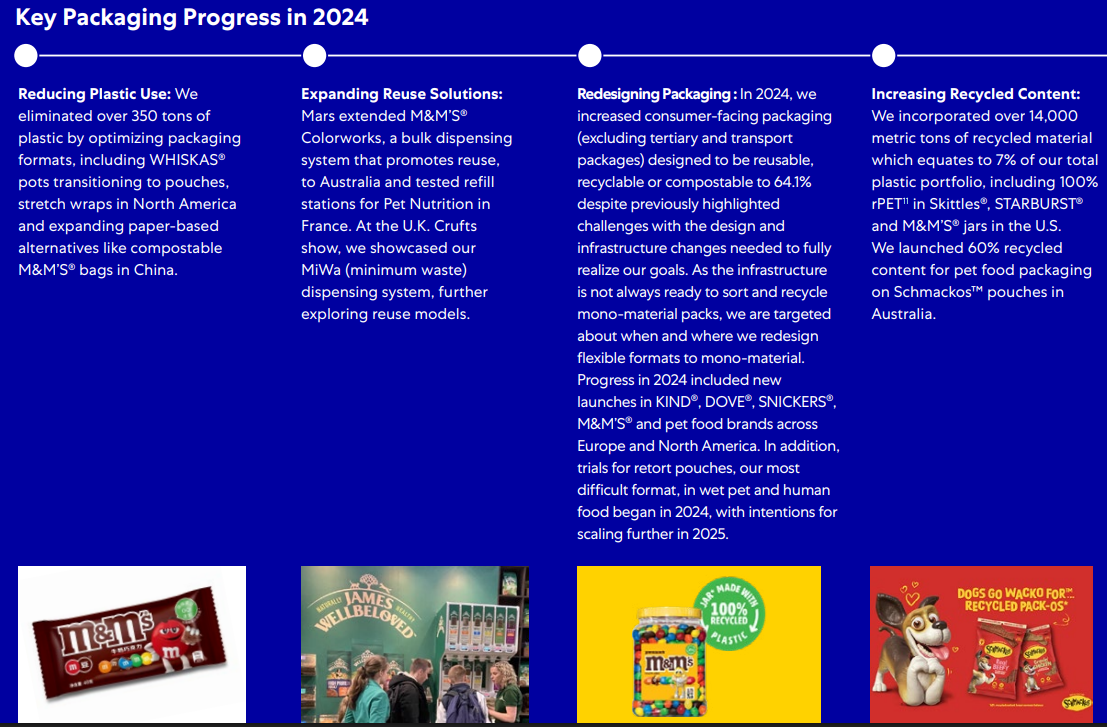
Packaging improvements include replacing flexible plastics with compostable or recyclable alternatives. Mars has already achieved meaningful shifts and now seeks to support emerging materials at scale.

All these help the company advance its path to net zero by 2050.

Mars net zero roadmap
Source: Mars Report

A Net-Zero Game Plan Backed by Real Numbers

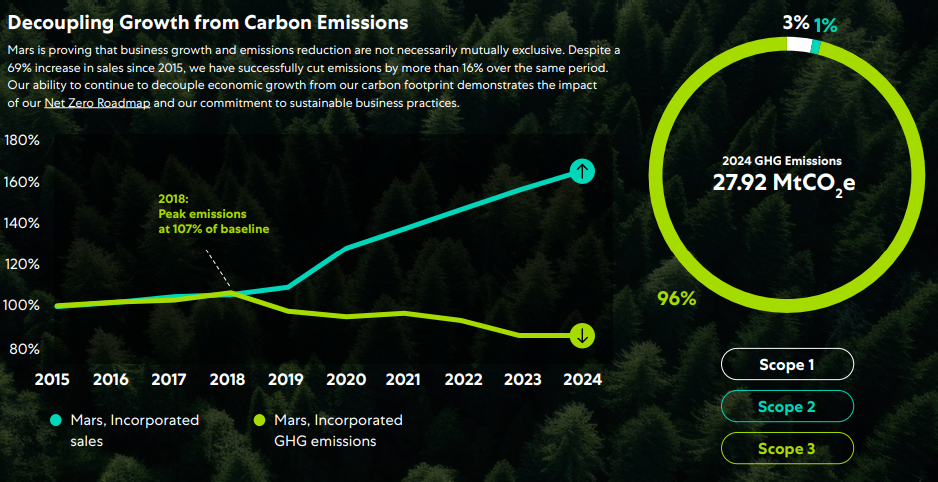
Mars has made strides in its emission reduction and net-zero goals. It cut greenhouse gas emissions by 16.4% since 2015. At the same time, revenue rose by 69%, hitting $55 billion in 2024. That includes a 1.9% drop in 2024 alone, as seen in the chart below.

By 2030, Mars aims to cut emissions by 50% throughout its entire value chain—Scopes 1, 2, and 3. The company will also integrate sustainability into executive performance.

Mars carbon emissions 2024
Source: Mars Report

The company also achieved several milestones in its net-zero journey, including:

  • Transitioned 58% of its operations to renewable electricity, aiming for 100% by 2040.
  • Made 64% of consumer packaging recyclable, reusable, or compostable.
  • Launched climate-smart agriculture projects in 29 countries, across 60+ partnerships, including protecting 8,000 ha of forest in palm oil supply chains.

CEO Poul Weihrauch said during the launch of the sustainability investment fund,

“I’m pleased to see our continued ability to decouple our business growth from our carbon footprint while simultaneously investing in innovation and getting behind start-ups that will be creating new solutions and advance breakthroughs to help companies address resilience challenges. These are important areas to make meaningful progress in helping us to reduce exposure to future environmental risks, and eventually, turn it into profit and competitive advantage.”

This change marks a major step in blending scale with sustainability. Moreover, the company is buying high-quality carbon removal credits to offset emissions it cannot eliminate directly. These credits support carbon-neutral products like the Mars Bar. They help projects that remove CO₂ from the air, like reforestation and soil carbon efforts. The credits are verified by trusted standards, including the Gold Standard and Verra.

Mars views carbon removals as a key tool in its Net Zero by 2050 strategy. This is especially true for tough sectors like agriculture. The company invests in projects like the €150 million Livelihoods Carbon Fund 3. This fund supports nature-based carbon removal and helps develop communities.

Beyond Carbon: Mars’s Broader ESG Mission

Mars goes beyond carbon. Its reef restoration initiative has received over $10 million since 2020, deploying innovative “Reef Stars” in 12 countries to boost coral recovery.

The company also works on water stewardship and farmer livelihoods, aiming to help 30% of suppliers earn a living income by 2027. Some rice projects in Thailand increased yields by up to 43% while cutting water use by over 40%.

More notably, Mars ties 20% of executive pay to emissions progress. This makes sustainability a key part of its corporate culture.

Market Momentum Meets Mission-Driven Investment

Mars’s Sustainability Fund comes at a time when global demand for sustainable solutions is rapidly growing. The sustainable packaging market, a key focus area for Mars, is experiencing significant expansion. The market is expected to rise from $292.7 billion in 2024 to USD 423.6 billion by 2029, growing at a compound annual rate of 7.7%

Additionally, over 54% of U.S. consumers now choose eco-friendly packaging. Also, 90% prefer brands that use it. Mars’s move towards sustainable materials matches what consumers want and where the market is heading.

Mars packaging progress
Source: Mars

The fund also taps into expanding carbon credit markets, particularly in agriculture, forestry, and land use (AFOLU). The market could rise from $5.8 billion in 2024 to $7.5 billion in 2025. This shows a nearly 29% annual growth rate. By 2029, it could hit $20.8 billion. 

carbon credit for agriculture AFOLU
Source: The Business Research Company

Carbon farming—which aligns with Mars’s agricultural footprint—could generate as much as $13.7 billion in credits annually by 2050. These trends suggest that innovative ag-focused investments may yield strong returns while advancing climate impact.

On the broader carbon removal front, the market is set to rise from about $733 million in 2024 to nearly $2.85 billion by 2034. This shows a projected growth rate of 14.5% each year. As Mars supports sustainable farming and packaging technologies, these markets offer both environmental value and long-term economic opportunity.

Why This Matters to Industry and Investors

Mars is a major player in food and pet care, including snack favorites and pet nutrition. Its investments set sector-wide signals on value-chain decarbonization, sustainable sourcing, and packaging evolution.

The fund’s 250 million-dollar commitment matches the scale already seen in clean agriculture and materials innovation. It provides early funding for innovative solutions. This way, it links financial success to environmental performance.

Investors should note Mars’s strong execution: a 16% emissions cut amid significant growth shows ambitious goals are feasible. 

Mars’s Sustainability Investment Fund marks a strategic leap beyond internal emissions cuts. It tackles systemic issues—agriculture, packaging, ingredients—using innovative solutions

As consumer goods and agriculture industries face climate pressures, Mars offers a model of responsible leadership. It funds future technologies and places sustainability at its core. This shows that profitable growth and caring for the planet can go hand-in-hand.

The post Mars Invests $250M in Sustainable Innovations to Boost Net Zero Journey appeared first on Carbon Credits.

Archer Aviation Stock (ACHR) Soars: Leading the U.S. eVTOL Market with Zero-Emission Air Taxis in NYC, LA, and Beyond

archer aviation

The electric aviation market is heating up, and Archer Aviation Inc. (NYSE: ACHR) is leading the charge. Its stock surged over 35% in 2025, making it a key player in the electric vertical takeoff and landing (eVTOL) sector. Archer is at the intersection of clean mobility, ESG investing, and carbon markets.

Beyond flying taxis, Archer’s Midnight aircraft could cut Scope 3 emissions, enable tech-based carbon offsets, and provide low-emission transport solutions for companies, governments, and investors.

eVTOL Market Takes Off—and So Does ACHR Stock

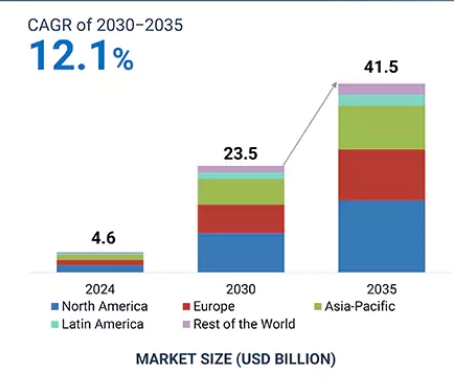
MarketsandMarkets says the urban air mobility (UAM) market will reach $23.4 billion by 2030. Archer stands out due to its rapid progress in certification, partnerships, and production.

archer URBAN AIR MOBILITY
Source: Markets and Markets

Last month, Archer raised $850 million, boosting its liquidity to nearly $2 billion. This gives Archer the strongest financial position in the eVTOL industry.

In Q1 2025, Archer exceeded analyst expectations, posting an EPS of -$0.17 versus the forecasted -$0.28. With cash reserves of $1.03 billion and a $6 billion order book, the company now has a market cap of $6.57 billion and a Strong Buy consensus rating from analysts.

Archer partners with United Airlines, Palantir, Stellantis, and other global operators. This shows strong market support and readiness. Archer aims to create valuable carbon offsets by focusing on global carbon reduction goals.

Cutting-Edge Aircraft Design with Zero Emissions

Archer’s Midnight eVTOL is a four-seat aircraft powered by six battery packs. This design enhances safety and ensures zero operational emissions. The company commits to renewable energy at all its vertiports, reinforcing its clean transport solution.

The company is a clean tech player creating carbon-efficient infrastructure. As cities invest in sustainable transit, Archer’s low-noise, zero-emissions air taxis can replace carbon-heavy helicopters and congested ground routes.

For instance, planned 5–15 minute air taxi routes between NYC and nearby airports could replace 1–2 hour car rides, boosting productivity and sustainability, especially for corporations addressing Scope 3 travel emissions under Science-Based Targets (SBTi).

archer aviation
Source: Archer

A Carbon Credit Powerhouse in the Making

Carbon markets are shifting from nature-based solutions to technology-driven offsets that offer permanence, transparency, and additionality. Archer’s eVTOL emissions reductions meet these criteria:

  • Zero direct emissions during flight

  • Displacement of fossil-fuel travel on short regional routes

  • Integration with renewable energy in operations

  • Quantifiable, measurable environmental impact

These features enable Archer to generate premium offsets, which could command higher prices as the market matures.

The voluntary carbon market is expected to grow from $1.4 billion in 2024 to $35 billion by 2030 and potentially reach $200 billion by 2050. Archer is set to play a central role in the next wave of credit generation.

Certification Milestones and Global Scaling

Archer has secured its Part 135 Air Carrier Certificate, paving the way for commercial operations once FAA Type Certification is granted (expected by late 2025). This milestone will allow revenue-generating flights across major U.S. cities.

Manufacturing is ramping up. Archer’s Georgia facility aims for 2 aircraft per month by the end of 2025, with plans to scale further. With Stellantis’ supply chain capabilities, Archer is building a repeatable production model to meet growing demand.

Regulatory alignment is vital. Archer has been chosen as the official air taxi provider for the 2028 Los Angeles Olympics, increasing U.S. government confidence in the technology.

Why ESG Investors Are Paying Attention to Archer?

Carbon-conscious investors are looking for reliable, scalable ways to cut emissions, and Archer delivers. Its Midnight eVTOL aircraft produces zero direct emissions during flight, making it a strong option for both sustainability and returns.

  • Research shows that when fully loaded, eVTOLs emit 52% less than gas cars and 6% less than electric cars. If powered by renewable energy, their carbon footprint drops even further.

Additionally, most eVTOLs use lithium-ion batteries for short trips, but newer tech like lithium-sulfur, solid-state batteries, and hydrogen fuel cells could boost range and energy efficiency. As these technologies improve, eVTOLs will fly farther, use less energy, and play a key role in reducing transport emissions.

Turning Flight Emissions into Carbon Credit Gains

Archer Aviation is tackling short-haul flights, which make up 17% of airline emissions. Its zero-emission eVTOL aircraft can replace fossil fuel travel and cut carbon pollution. These reductions can turn into verifiable carbon credits. As carbon markets move toward tech-based offsets, Archer is in a strong position, similar to Joby Aviation’s deal with JetBlue.

For ESG investors, Archer offers real value. It has financial momentum, emissions-cutting technology, and clear ties to net-zero goals. Furthermore, it also gives carbon credit buyers, fund managers, and sustainability leaders a simple way to cut travel emissions and support a cleaner future.

ARCHER AVIATION ACHR STOCK
Source: Yahoo Finance

Strategic Partnerships Driving Commercialization

Archer’s success relies on alliances with companies that understand the future of mobility

  • United Airlines plans to buy 200 Midnight aircraft and aims to launch services in NYC by 2026.

  • Stellantis, a key manufacturing partner, will support Archer’s facility in Georgia, targeting 650 aircraft per year by 2030.

  • Palantir is developing AI-powered aviation software to optimize routing, flight safety, and energy use.

  • The UAE’s Launch Edition Program marks international growth, with Abu Dhabi Aviation set to operate Archer aircraft, expecting delivery in Q4 2025.

  • Signed a $30 million agreement to deploy its Midnight aircraft with Ethiopian Airlines under its Launch Edition program.

Regulatory support from President Trump’s 2025 executive order launching the eVTOL Integration Pilot Program gives Archer a clearer path to market entry than many competitors.

Key Risks That Could Slow Archer Aviation’s Takeoff

Experts are also weighing in on the flip side of the coin. This means while Archer is gaining altitude, it faces challenges that could impact long-term growth. Regulatory approvals are crucial; delays in securing FAA Type Certification could postpone commercial launches and hurt investor confidence. Current battery technology limits aircraft range to 20–50 miles, restricting operational flexibility in early deployments.

The urban air mobility ecosystem lacks enough infrastructure. Vertiports, charging networks, and advanced air traffic systems must develop quickly to support Archer’s growth. Without this groundwork, widespread deployment could face hurdles.

Competition is increasing. Rivals like Joby Aviation and Lilium are advancing. Any breakthrough from a competitor could undermine Archer’s market share or delay its path to profitability.

Despite these risks, Archer’s strong financial position, strategic partnerships, and regulatory progress give it an edge in this emerging market.

Investing in the Future of Clean Flight

Archer Aviation is more than just an electric aircraft maker. It’s a climate tech company ready to lead sustainable urban mobility. With its zero-emission Midnight aircraft, strong partnerships, and progress in regulations, Archer aims to change short-range aviation and create new ESG value.

As carbon markets grow and the need for quality offsets rises, Archer’s tech-driven model stands out. It offers one of the most credible and scalable ways to reduce carbon in modern transportation.

Overall, for investors interested in ESG performance, emission reductions, and future mobility, ACHR stock deserves attention.

The post Archer Aviation Stock (ACHR) Soars: Leading the U.S. eVTOL Market with Zero-Emission Air Taxis in NYC, LA, and Beyond appeared first on Carbon Credits.
Trump Ends Era of ‘Unreliable Green Energy’—Wind and Solar Subsidies Scrapped

trump

President Donald Trump signed an executive order on July 7, aiming to roll back support for wind and solar energy. The move is part of the new One Big Beautiful Bill Act, which cuts renewable energy tax credits and prioritizes traditional energy sources.

Trump’s EO Ends Support for “Unreliable” Green Energy

Trump’s administration labeled these renewable sources as unreliable, expensive, and overly dependent on foreign supply chains. According to Trump, clean energy policies threaten U.S. national security, disrupt the electric grid, and harm the natural environment.

This executive order marks a major reversal from the direction set by the 2022 Inflation Reduction Act, passed by Democrats, which offered strong incentives for clean energy projects.

Now, Trump’s energy policy shifts back to conventional energy sources like coal, natural gas, and nuclear—those he calls “reliable and dispatchable.” His administration argues that green energy has received unfair advantages and is weakening the nation’s energy system.

Tax Breaks for Renewables Face the Axe

As part of the executive order, the Treasury Department is now required to end tax credits for wind and solar production. It must also apply stricter rules concerning foreign-controlled companies involved in renewable energy supply chains.

In addition, the Interior Department must revise current policies that have so far favored renewables, such as streamlined permitting and lease arrangements. Both agencies have 45 days to submit detailed reports of their actions to the White House.

Moreover, the order freezes new permits and approvals for wind energy projects, especially offshore developments. Until a full government review is completed, federal agencies are barred from issuing new loans or contracts for wind projects. This decision creates immediate uncertainty in a sector that has been growing rapidly due to both state and federal commitments.

Wind Power at Risk: What’s at Stake

As per EIA, currently, wind energy plays a vital role in the U.S. electricity mix, contributing about 10% of the nation’s power, making it the largest single source of renewable energy. In states like Iowa and South Dakota, wind supplies more than half of all electricity.

According to the U.S. Department of Energy, over 131,000 Americans are employed in wind energy-related jobs. These workers now face an uncertain future as federal support for their industry is scaled back.

Under the new law, developers will only be able to claim tax benefits for wind and solar projects if construction begins before the end of 2026. Furthermore, these projects must be completed and placed in service by the end of 2027.

Previously, developers could rely on tax incentives through 2032 under the 30% tax credit program. The shorter timeline could discourage companies from launching new renewable projects due to the higher financial risks and increased upfront costs.

Offshore Wind Goals in Limbo for States

This dramatic shift in policy could most severely impact states with ambitious climate targets. For instance, New York aims to install nine gigawatts of offshore wind capacity by 2035, enough to power roughly six million homes. The state has already invested heavily in infrastructure and workforce development to support this target.

Similarly, New Jersey plans to develop 11 gigawatts of offshore wind by 2040 and transition to a 100% clean energy power sector by 2050.

Offshore wind was a central pillar in both states’ strategies. Now, with federal support in question, these states may be forced to revise their energy roadmaps or find alternative funding solutions. Several state officials have already expressed concerns that their clean energy timelines may slip, which could push critical emissions targets further into the future.

wind energy U.S.

Solar Slowdown: Cheap Power Faces New Roadblocks

The clean energy sector, especially solar, has made remarkable progress in lowering costs. Today, solar energy is one of the cheapest sources of new electricity in the United States. However, despite falling prices, large-scale projects still rely heavily on financial incentives to offset their high upfront expenses.

According to Wood Mackenzie, the U.S. solar industry installed 10.8 gigawatts (GWdc) of new capacity in Q1 2025. This was a 7% drop compared to Q1 2024 and a 43% decrease from Q4 2024.

U.S. Solar
Source: Wood Mackenzie

If these federal benefits are removed, it could significantly slow the pace of new solar developments. It may also discourage private investors at a time when international competition in green energy is heating up.

What’s Next for U.S. Energy Policy Under Trump?

Supporters of the move believe that Trump’s new policy will help restore American energy independence and reduce unnecessary government spending. His energy policy puts the spotlight back on fossil fuels and nuclear power. On his first day back, he declared a “National Energy Emergency” aimed at eliminating what he calls bureaucratic barriers to energy production.

Fossil Fuels Back in the Spotlight

So, as part of this plan, he established the National Energy Dominance Council, which will focus on increasing fossil fuel production, attracting private investment, and accelerating domestic energy production.

According to Trump, returning to traditional energy sources will strengthen the economy, create well-paying jobs, reduce trade deficits, and improve the U.S. position on the global stage.

A Major Clean Energy Setback 

Countries across Europe and Asia are increasing their investments in renewables, treating green energy as both an environmental and economic priority.

  • According to the IEA’s World Energy Investment 2025 report, global energy investment is projected to reach $3.3 trillion in 2025.

Out of this, approximately $2.2 trillion will go toward clean energy sources like renewables, nuclear, power grids, storage, low-emission fuels, energy efficiency, and electrification. That’s twice the amount, around $1.1 trillion, allocated to fossil fuels like oil, gas, and coal.

Source: IEA

  • So if the U.S. steps back from clean energy leadership, it could fall behind in both technology development and global market share.

Thus, critics warn that this approach overlooks the long-term risks of continued reliance on fossil fuels, especially in a world already experiencing the impact of climate change.

Many cities, companies, and even Republican-led states have embraced renewables, not just for environmental reasons but also for economic growth. Pulling back federal support now, they say, risks stalling progress and undermining years of clean energy investment.

The Bottom Line: U.S. Climate Goals at Crossroads

In the near term, this executive order is expected to cause major uncertainty across the wind and solar industries. Projects currently in the pipeline could be delayed or canceled entirely.

Developers who had planned on receiving federal tax credits now face stricter deadlines and higher costs. Meanwhile, states will need to reevaluate their clean energy goals and consider alternative funding methods to stay on track.

Over the next several months, federal agencies will begin to implement the executive order. Their decisions and the public and state-level responses will shape the future of U.S. energy policy. Whether this move marks a new era of energy dominance or a costly detour from climate leadership remains to be seen.

The post Trump Ends Era of ‘Unreliable Green Energy’—Wind and Solar Subsidies Scrapped appeared first on Carbon Credits.

Google, Meta, and Others Invest $41M in Carbon Removal Credits

Google, Meta, and Others Invest $41M in Carbon Removal Credits

Frontier, a group that includes big tech names like Google and Meta, just made a huge deal with Arbor. Arbor is a next-gen startup focused on bioenergy with carbon capture (BECCS). This pact signals a turning point in how carbon removal projects can support both climate goals and clean power needs.

Here’s what makes it significant, and why investors and industry watchers are paying attention.

Frontier’s $41M Vote of Confidence in Arbor’s Carbon Tech

Frontier, an advanced market commitment supported by companies like Google, Meta, Shopify, Stripe, and McKinsey, has made a key carbon removal deal with Arbor, a BECCS startup. Under the deal, Frontier will purchase 116,000 tons of durable CO₂ removal credits from Arbor’s future facility between 2028 and 2030

The deal is worth $41 million. It is Arbor’s biggest offtake contract yet. Also, it’s one of the most important carbon credit deals using BECCS technology to date.

Arbor’s first commercial-scale plant will generate carbon removal credits. It will be near Lake Charles, Louisiana. This site was selected because it has access to sustainable biomass and skilled labor. It also has CO₂ transportation and storage systems in place.

Construction of the plant is expected to begin in the next two years, with full operations planned for 2028. The deal features long-term commitments from various buyers in the Frontier coalition. This includes tech giants and climate-friendly brands like H&M, along with enterprise software leader Autodesk. The group has the following projects.

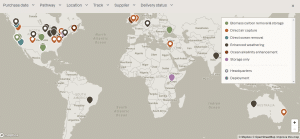
Frontier project map
Image from Frontier

Offtake agreements give Arbor the financial support it needs. This helps them go from pilot operations to full-scale deployment. It also bridges the “valley of death” that often slows clean tech startups during scaling.

This commitment shows that buyers are more confident in new carbon removal technologies. It also highlights a shift in the industry. Now, companies want to invest in permanent carbon removal alongside nature-based offsets. It also sets a standard for future Frontier purchases. 

Hannah Bebbington, head of deployment at Frontier, remarked:

“As we are thinking about carbon removal demand and where our electricity generation is going to come from, and how we are going to ensure that we are powering this [AI] boom as cleanly and efficiently as possible, Arbor really fits the bill.”

Turning Plant Waste into Climate Wins: Arbor’s Biomass Breakthrough

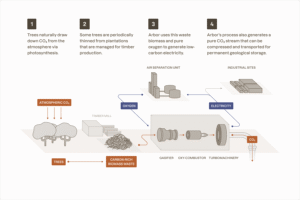
At the heart of this deal is Arbor’s innovative approach to bioenergy with carbon capture and storage. Unlike traditional BECCS plants that rely on large, centralized facilities, Arbor uses a compact, modular system. This technology turns low-grade organic waste, like forest residues and agricultural byproducts, into gas. It burns this gas with oxy-combustion, which uses pure oxygen.

Arbor carbon capture or removal process
Image from Frontier: Arbor’s BECCS method

Such a carbon capture method helps achieve nearly complete combustion. The result is a high-purity stream of supercritical CO₂, more than 99% of which is captured and stored underground.

Arbor’s method stands out because it has dual functionality. First, it captures CO₂ and then, it uses that CO₂ to power an 18 MW turbine. This turbine produces a lot of clean electricity and also verifies carbon removals.

For each ton of CO₂ removed, the system can generate up to 1,000 kilowatt-hours (kWh) of electricity. That’s enough to power an average U.S. household for about a month.

Remarkably, Arbor’s plants are carbon-negative and energy-positive. They can provide 24/7 baseload power for energy-heavy sectors like data centers and AI infrastructure.

Moreover, Arbor’s modular units use technology inspired by rocket engines. This makes them scalable and cost-effective. They can be deployed in many different locations.

Each unit is self-contained and portable. With these, Arbor can avoid many permitting and infrastructure issues that come with centralized BECCS facilities. The system also doesn’t release particulate matter, NOx, or other pollutants. This tackles a big issue with biomass burning.

This architecture creates a new path in clean energy. It combines carbon removal, power generation, and industrial decarbonization all in one platform. Arbor’s model provides a strong solution for sectors aiming for net-zero goals and growing energy needs.

Broader Carbon Removal and Power Trends

BECCS is emerging as a top carbon removal method due to its scalability and dual benefits—carbon removal plus power generation. The International Energy Agency estimates that carbon capture from biogenic sources could hit 60 million tons per year by 2030. However, currently operational and planned BECCS capacity are not on track toward net zero. The world needs about 185 million tons to meet net-zero goals.

Operational and planned BECCS capture capacity vs. the Net Zero Scenario, 2022-2030

In 2024, the carbon removal market grew 59% to $3.34 billion, with BECCS accounting for most of the volume. Early adopter deals—like those between Microsoft and Stockholm Exergi—have already proven this model works.

Frontier’s purchase adds to a recent deal. In March, they teamed up with Eion for 78,707 tons of CO₂ removal using enhanced rock weathering. Arbor’s BECCS deal, larger and combined with clean electricity, shows how carbon credits can deliver powerful co-benefits.

Why This Deal Matters: How Frontier Is Scaling Carbon Removal

This Frontier-Arbor carbon credit deal is significant for the following reasons:

Dual Impact: Carbon Removal + Clean Power

The agreement showcases a new generation of climate solutions that pair carbon removal with dependable clean energy. Arbor’s system captures over 99% of CO₂ and generates electricity around the clock. This helps meet the rising energy demand from AI and data centers. This dependable energy source helps keep the grid stable and cuts emissions. 

Scaling Up Carbon Markets

In 2024, BECCS accounted for nearly 90% of all carbon removal credits sold. Arbor’s high-quality approach sets a strong benchmark for permanence, verifiability, and climate benefit. By backing projects like this, Frontier is helping the voluntary carbon market shift away from less reliable offsets toward more impactful, long-term removal solutions.

Financing Commercial Deployment

Frontier’s $41 million advance purchase agreement gives Arbor the financial stability to build its first commercial-scale plant. These offtake deals function like power purchase agreements, helping startups bridge funding gaps and scale faster.

Meeting Tech Sector Needs

Big tech firms need clean, consistent energy to power AI-driven infrastructure. Arbor delivers both emissions removal and baseload electricity—meeting growing expectations for climate-aligned digital operations.

If Arbor delivers as promised, it may reduce the captured CO₂ price to below $100/ton, a critical threshold for scalable removal. Frontier’s $41 million deal with Arbor’s BECCS-based carbon credits sets a milestone in building a high-integrity market for dual-purpose projects, offering carbon removal and clean power.

The startup’s innovative oxy-combustion turbine and modular approach offer scalable potential. If successful, this model may transform carbon markets and the energy systems needed to support growing digital infrastructure.

The post Google, Meta, and Others Invest $41M in Carbon Removal Credits appeared first on Carbon Credits.